
Cat life guide
A cat, a caged bird and a fish tank in one Indian home
Every page ranking for this question is written for a house where the bird is legal, the windows are sealed and only the cat lives there. None of those three things is true in an Indian flat.
Quick answer
A cat and bird in same house works only as permanent physical separation, never as an introduction. Ask the legal question first: ten native parakeets sit in Schedule II of the Wild Life (Protection) Act, so most birds sold in Indian markets cannot lawfully be kept at all. For a lawful exotic bird, the cage goes in a room the cat never enters, and any cat contact, however small, is a same-day veterinary emergency.
This guide is general information for Indian pet owners and is not a diagnosis. Always consult a registered veterinarian near you before acting on anything you read here, and treat any sudden change in your pet's condition as urgent.
Can a cat and a bird live in the same house? The short answer
A cat and a bird live in the same house safely only under permanent physical separation, and never under supervision alone. Three things decide it, and the first one is not about the cat.
The first is legal. Ten of India's native parrots are listed in Schedule II of the Wild Life (Protection) Act, 1972, which makes catching one an offence and keeping one a second offence The Wild Life (Protection) Act, 1972. If the bird in your house is a green parakeet that came from a street seller or a weekly market, nothing else on this page applies to it, because the lawful answer is not a better bird cage.
The second is behavioural. The only controlled, replicated household trial of ways to reduce hunting in pet cats cut prey brought home by 36 percent with a meat-rich food and by 25 percent with daily play, and its authors describe what they achieved as reducing a cat's tendency to hunt rather than impeding its hunting. A reduced tendency is not a safe bird.
The third is clinical. A bird a cat has touched is an emergency patient on the same day, with or without a visible wound, because the bacteria in a cat's mouth kill small birds faster than the injury does.
There is no introduction protocol here, because there is no safe one. A staged introduction works between a cat and a dog, where a failed session costs a scratched nose and both animals can retreat. Between a cat and a 60 gram bird the cost of one failed session is a dead bird. For the version where staging is genuinely supported by survey data, read introducing a cat to a dog.
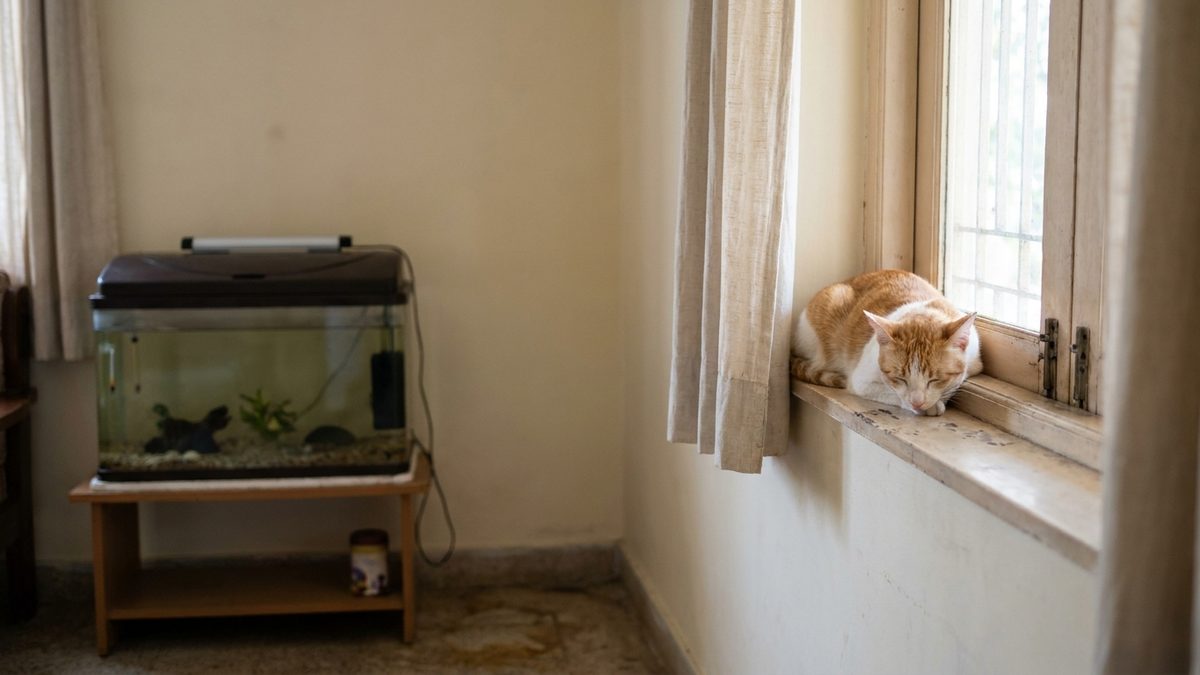
The fish tank is a separate and much smaller problem. It gets its own section, and the honest summary is that a tank and a cat coexist in most Indian homes without incident once the aquarium lid is fixed down.
Which birds you may lawfully keep in India, and which you may not
You may lawfully keep a bird that is not an Indian wild species, and you may not keep one that is. The Wild Life (Protection) Act, 1972 settles it in three steps, and the parakeet most Indian households recognise sits on the wrong side of all three.
Step one is the definition. Section 2(16) of the Act defines hunting to include capturing, snaring and trapping a wild or captive animal, and every attempt to do so. The Animal Welfare Board of India's own enforcement handbook states the section 9 offence in the same words, as "Capturing, killing, poisoning, snaring, trapping of any wild animal, and every attempt to do so";.
Step two is section 9 itself, which reads: "No person shall hunt any wild animal specified in Schedules I and II except as provided under section 11 and section 12";.
Step three is the schedule. In the Gazette of India text of the Wild Life (Protection) Amendment Act, 2022, Schedule II carries a block headed PARROTS that runs from entry 686 to entry 695.
| Entry | Common name | Scientific name |
|---|---|---|
| 686 | Alexandrine Parakeet | Psittacula eupatria |
| 687 | Blossom-headed Parakeet | Psittacula roseata |
| 688 | Grey-headed Parakeet | Psittacula finschii |
| 689 | Long-tailed Parakeet | Psittacula longicauda |
| 690 | Malabar Parakeet | Psittacula columboides |
| 691 | Nicobar Parakeet | Psittacula caniceps |
| 692 | Plum-headed Parakeet | Psittacula cyanocephala |
| 693 | Rose-ringed Parakeet | Psittacula krameri |
| 694 | Slaty-headed Parakeet | Psittacula himalayana |
| 695 | Vernal Hanging Parrot | Loriculus vernalis |
Entry 693 is the bird almost every Indian reader means by "parrot". The munias sold in the same markets are listed too, under their own heading from entry 618.
Keeping the bird is a separate offence from catching it, and this is the part the ranking pages miss. Section 39(1)(a) makes every wild animal other than vermin that is "kept or bred in captivity" the property of the State Government, and section 39(3) says no person shall, without the previous permission in writing of the Chief Wild Life Warden or the authorised officer, acquire or keep it in his possession, custody or control. The Animal Welfare Board handbook lists "Acquiring, possessing, transferring, destroying or damaging any wild animal" under section 39 as an offence in its own right.
Section 51 sets the price. A general offence under the Act carries imprisonment of up to three years, a fine of up to one lakh rupees (₹1,00,000), or both.
The Schedule number on most Indian pages is out of date
Pages that place parakeets in Schedule IV are quoting the Act as it stood before 1 April 2023. The Ministry of Environment, Forest and Climate Change notified S.O. 1394(E) on 22 March 2023, appointing "the 1st day of April, 2023 as the date on which the said Act shall come into force", and that amending Act replaced the old schedules.
The disagreement is live and worth publishing rather than smoothing over. Nature inFocus, an Indian wildlife publication writing in November 2023, states flatly: "Today, parakeets are protected under Schedule IV of the Wildlife (Protection) Act, 1972";. The Gazette text of the amending Act puts the rose-ringed parakeet at entry 693 of Schedule II. Both describe real text; only one of them describes the Act now in force. Nothing about the offence changes either way, because section 9 reaches Schedules I and II alike.
What this means if you already have one
Route it through the forest department, not through a quiet decision at home. Section 39(3) makes the written permission of the Chief Wild Life Warden the only lawful basis for possession, and the same provision bars transferring the bird to any person by gift, sale or otherwise. Selling it on, giving it to a relative and opening the window are all outside that route.
The officer in question is a state officer, which is the part people get wrong when they search for a national helpline. Section 39 vests the bird in the State Government, so the decision belongs to the Chief Wild Life Warden of Maharashtra, of Tamil Nadu, of Karnataka or of whichever state you live in, acting through the local forest division. That is the office to approach, and approaching it is also the only route that ends with the bird somewhere better.
The scale of the trade behind that cage is not small. Nature inFocus records more than 1,700 birds rescued from a single New Delhi market, over 500 of them chicks, and cites a 2019 CITES analysis finding that 90 per cent of all live birds traded are parrots.
Paying for a trapped bird funds the next trapping. This page does not tell you where to buy a bird, and it never will. If you want to help a bird you have seen for sale, the complaint goes to the state forest department, which is the authority the Act gives the power to act.
The birds you can lawfully keep are the ones that are not Indian wild species. Every one of the ten parrots in that Schedule II block is native: nine Psittacula parakeets and the vernal hanging parrot. A budgerigar is Australian and a cockatiel is Australian, and neither appears there. An exotic bird of that kind is the realistic subject of the rest of this page.
The bird cage is a legal object too, and most household cages fail the test
A bird cage has to let the bird move, and Indian law says so twice. Section 11(1)(e) of the Prevention of Cruelty to Animals Act, 1960 makes it an offence to confine an animal in a space that does not provide reasonable opportunity for movement, and the Animal Welfare Board of India's enforcement handbook records that offence as non-cognizable.
Non-cognizable tells you how it is policed in practice: a police officer cannot act on it without a magistrate's direction, so nobody is coming to measure your cage. The standard still exists, and it is the standard your own judgement should use.
The only Indian instrument that describes what a bird's enclosure has to achieve is the Prevention of Cruelty to Animals (Pet Shop) Rules, 2018, published in the Gazette of India. Its Second Schedule opens the bird section with this.
- "Birds shall be housed in large and spacious aviaries."
- "The aviaries shall be large enough to allow each bird full body extension, and wide enough to accommodate the fully stretched wings of all, and allow easy hopping, jumping, climbing and flight within the aviary."
- "Well-placed perches shall be provided within each aviary where the birds can stand upright without having head contact with any ceiling, and tail contact with the floor or grate."
- "Perches shall be strategically placed so as to prevent droppings from contaminating food and water vessels."
Those rules bind pet shops rather than homes, and that limit is worth stating plainly rather than pretending otherwise. They remain the clearest statement India has of what an enclosure is for, and the ordinary rectangular cage sold for a budgerigar fails the flight clause before anything else is considered. A cage that restricts a bird to shuffling along one perch is the cage the 1960 Act describes.
The cage question matters here for a second reason. A cage big enough for flight is a cage the bird can move away in, which is the only thing that separates a frightened bird from a trapped one when a cat is in the room.
Can a cat be trained not to hunt the bird? What the one controlled trial found
A cat's hunting can be reduced and has never been shown to be switched off. The strongest evidence is a controlled, replicated household trial of five interventions, published in Current Biology in 2021, which measured prey brought home rather than opinions about cats.
The results were not uniform, and the pattern is more useful than any single number.
- A high meat protein, grain free food: 36 percent fewer animals captured and brought home.
- Five to ten minutes of daily object play: 25 percent fewer.
- Puzzle feeders: 33 percent more, an increase rather than a reduction.
- Collar covers designed to make a cat visible to birds: 42 percent fewer birds, with no discernible effect on mammals.
- Cat bells: no discernible effect.
The authors' own summary is the sentence to carry away: "Reductions in predation can be made by non-invasive, positive contributions to cat nutrition and behavior that reduce their tendency to hunt rather than impede their hunting";. Tendency is the word. Nothing in that trial removed the predatory sequence, and nothing claimed to. Predatory instinct is not a dial you can turn to zero, and no published work has turned it to zero in a pet cat.
Read the puzzle feeder line twice, because it is the advice people give for exactly this situation. Making the cat work for food made it kill more, not less. That does not make puzzle feeders a bad thing in general, and our page on indoor cat boredom covers where they do earn their place. It does mean you cannot treat enrichment as a safety measure for the bird.
Why "my cat ignores the cage" is not evidence
Your cat ignoring the cage today tells you about today. The arithmetic of the arrangement is one-sided: you need the cat to fail on every one of roughly five thousand days of a shared life, and the cat needs to succeed once. A single swipe through bars is enough, and so is a single cage door left on its latch while somebody carries the shopping in. You cannot supervise five thousand days, and the hours you cannot supervise are the hours the flat is quiet.
What happens when a cat does reach a bird is the one thing with a solid denominator. A review of 82 wildlife rehabilitation centres across North America over three and a half years found domestic pets responsible for 14 percent of all admissions, the second most common identifiable cause of injury, with more birds admitted after cat attack than reptiles, amphibians or mammals, and 78 percent of those birds did not survive.
The 78 percent comes from free-roaming cats and wild birds in North America, not from pet cats and caged birds in India, and the admitted birds are a selected group: a bird found dead never reaches a centre. What transfers is the direction. When a cat reaches a bird, the bird usually dies, and it usually dies after reaching treatment rather than before.
A cat that has stalked the cage for a year has not been failing. It has been waiting.
The bird's side: what living in sight of a cat does, and what nobody has measured
Living within sight of a predator is treated in Indian law as a welfare problem in its own right, and it has never been measured in a living room. The clearest Indian statement of the principle is a pet shop rule.
Rule 7(2)(j) of the Prevention of Cruelty to Animals (Pet Shop) Rules, 2018 requires that "pet animals that are inimical to each other are not displayed or housed in abutting enclosures, and dogs and cats are not kept adjacent to each other, and birds, rabbits, guinea pigs, hamsters, and rodents are not kept adjacent to dogs and cats, since the same can cause acute stress";.
Read what that rule does and does not ask for. It does not ask for a stronger cage, a tighter lid or closer supervision. It separates the enclosures, and it states the reason in four words: acute stress. The rule drafters treated proximity itself as the harm.
The same Rules repeat the principle in the Second Schedule, where cats and kittens "shall be kept in a room which is not shared by other, inimical animal species" and the identical sentence is written for rabbits. Nowhere in that instrument is the answer better supervision.
No published study measures what a resident cat does to a caged pet bird's physiology. Searching in October 2026 turned up work on stress in captive parrots and on predator stress in wild birds, and nothing at all on the household arrangement this page is about. The pet shop rule is the best available statement of the principle in India. It is not a measurement of your bird, and this page does not pretend it is.
The practical consequence follows from the rule's own logic. If proximity is the harm, distance is the remedy, and no amount of covering the cage, reassuring the bird or leaving the radio on substitutes for a closed door. A cover removes the sight of the cat and leaves the sound and the smell of it, which is why a covered cage in a shared room is a comfort to the owner rather than to the bird.
The cat has a stress side to this too, and it is a smaller one. A resident cat with a permanently unreachable prey animal in the flat is living with a frustration it cannot resolve. Our page on making a house cat friendly covers environmental stress in cats and why it shows up as a medical problem rather than a behavioural one.
A cat bite on a bird is a veterinary emergency within hours, and most owners do not know it
Take a bird to a vet the same day after any cat contact, even when you can find no wound at all. The reason is bacterial rather than mechanical, and it is the single most useful thing on this page.
A Munich avian clinic reported fatal Pasteurella multocida infection in bird patients after cat bites from early 1986 onward, and set out the two conclusions that still govern practice: "Even birds with trivial wounds caused by cats must be classified as emergency patients", and "The risk of an infection after a cat bite is about 56%";.
Fifty-six percent is the figure to hold on to, and so is the word trivial. A cat's canine teeth are fine and sharp, so they seal a puncture behind them, and a bird's feathers hide the entry point. The owner sees a shaken bird with no blood and decides to watch it overnight. The bacteria do not need the night off.
The veterinary standard says the same thing from the other direction. A WSAVA World Congress paper on avian emergency and critical care states that "Any confirmed or suspected cat bite injury should be flushed and the bird placed on broad spectrum antibiotics immediately";. Note the word suspected. The threshold for treatment is the cat, not the wound.
What to do in the first hour after any cat contact
- Separate the animals completely, cat out of the room and door shut, before you look at the bird.
- Put the bird in a small, dark, warm, ventilated container rather than back in its cage, so it stops flying and stops bleeding.
- Telephone a clinic that treats birds and say the words "a cat got to my bird", because that phrase is what moves the appointment to today.
- Leave the wound alone. Flushing a bird's wound and choosing an antibiotic are veterinary acts, and the paper that produced the 56 percent figure names a tetracycline-class drug as the treatment of choice, which is a decision for the vet and not for you.
- Give nothing by mouth on the way, and never a human antibiotic from the cupboard.
Find the clinic before you need it, not during. Many vets who see dogs and cats do not take birds, so the question to ask is specific: do you treat birds, and who is on call on a Sunday? A Sunday evening in a small town is the wrong moment to discover that the nearest vet who will see a bird may be in Pune or Chennai. Our guide to pet first aid at home covers how to build that list and what belongs in the box.
A bird that was in a cat's mouth and has no blood on it is still an emergency patient under the clinical standard quoted above. Treat a scratch from a paw pushed through the bars the same way. The published series is about bites, so that is a precaution rather than a measured risk, and it costs one consultation to take.
The arrangement that works in an Indian flat, and the five that fail
The arrangement that works is one room the cat never enters, with a door that latches, plus a bird cage that does not depend on the cat losing interest. Everything else is a variation on hoping.
Cage placement inside that room matters less than the door, and it still matters. Put the cage against a solid wall rather than free standing, at a height where a person can see into it without lifting it, and away from the window a cat can sit outside. A bird that can put its back to a wall has one less direction to watch.
| The arrangement | What fails | What to do instead |
|---|---|---|
| Cage in the living room, cat shooed away | Supervision ends the moment you leave the room, and the cage is in the room everyone leaves last | Move the cage to a room with a door, and keep that door shut rather than ajar |
| Cage on a tall stand, out of reach | Cats climb and stands tip. Height buys a few seconds, not safety | Wall-mount or floor-stand against a wall, and treat height as irrelevant to the decision |
| Covered cage at night | A cover removes the sight of the cat and leaves the sound and the smell, and it hides what is happening from you | Use a cover for darkness and sleep, never as a barrier |
| Cat kept out during the day, bird out for exercise in the evening | Free flight removes the cage, which was the only barrier the arrangement had, and a bird in the air is the trigger a sleeping cat was waiting for | Fly the bird only behind a shut door, with the cat seen and confirmed on the other side of it |
| Cage on the balcony for sun and air | Street cats climb, kite string cuts, and an Indian balcony in May is an oven | Keep the cage indoors. If you want sun, open the room's window behind a secure grille and a mesh, not the balcony |
The grille is not a barrier, and the open window is the Indian variable
Every page ranking for this question assumes a sealed house. Indian flats are not sealed. Windows stay open for cross ventilation through most of the year, the kitchen door is propped for the smoke, and a humid evening is exactly when nobody wants a closed room. A window grille stops a person and does not stop a cat, and the gap under a grille door is wider than a cat's skull in most buildings.
The monsoon makes it worse in both directions, which is the season to plan for rather than the one to improvise through. Rain means windows that are opened and shut several times a day by whoever is nearest, so the door discipline this page depends on gets tested by weather rather than by anybody's decision. A damp flat also means more time indoors for the cat, more hours near the cage, and more reason to have put the cage behind a door in the first place.
That cuts both ways. A resident cat can leave, and a free-ranging cat can arrive. A ground-floor or first-floor flat with a caged bird and an open window has a cat problem that has nothing to do with the cat you own. Our pages on indoor cat safety and community cats in India cover the hardware and the neighbourhood side of that.
A balcony cage adds a seasonal hazard that is specific to this country. From December into mid-January, glass-coated kite string hangs across balconies and terraces in many Indian cities, and a caged bird on a balcony sits in the path of it. Our page on manja injuries to animals carries the rescue counts behind that.
The person who moves the cage without being told
Write the rule on the door, because the rule only works if everybody in the house knows it. The arrangement most often broken by somebody who meant well: a grandparent who thinks the bird looks lonely, a child who wants to show a friend, house help who moves the cage to sweep under it, or a guest who opens the bedroom door to find the bathroom.
- Say the rule out loud to every adult in the house, in one sentence: this door stays shut and the cage does not move.
- Stick a written note at eye level on the outside of that door, in the language the person reads.
- Give one person the job of checking the cage door latch every evening.
- Brief anyone who stays overnight or feeds the animals while you travel, in writing, with the vet's number on the same page.
Our guide on house help, drivers and your pet covers the written-instruction habit in more detail, and it is the same habit here.
If the cat and the bird are ever in the same room, a human is in that room too, awake, and between them. There is no version of this where the answer is a sturdier cage.
The fish tank is a smaller problem with three real parts
A fish tank and a cat share a flat far more easily than a cage and a cat, and three parts of it still need attention: the aquarium lid, the cords and the water. Nothing here is in the same risk class as the bird.
Start with the lid, because a cat will sit on it. A loose glass sheet resting on the rim is not a lid, it is a trapdoor, and the failure mode is a cat in the water and a sheet of broken glass. Use a fitted hood or a lid clipped to the frame, and check that it holds a cat weighing four or five kilos without flexing. A cat that cannot get a paw past the lid loses interest much faster than one that can.
Cords come next. A submersible heater and an external filter both run mains cable along the back of the tank, usually behind furniture where a cat sits unobserved. The chewed-cord hazard is covered in full on our page about festive lights and chewed cords; apply the same measures to the tank, which is the one appliance in the house whose cable runs all year.
Is aquarium water harmful to cats?
Nobody has studied it, and that is the honest answer rather than a reassuring one. A search of the veterinary literature in October 2026 found no study, case series or poison-control analysis on cats drinking aquarium water. What fills page one of Google for the question is aquarium hobby blogs, which is a gap this page can name but not close.
What is knowable is the variable you control. Plain, unmedicated tank water is tank water. A dosed tank is a different object, because the treatments an aquarium takes come from identifiable classes: copper-based parasite treatments, dye-based treatments, broad antiparasitics and dechlorinators. The safe rule needs no missing study. If you have dosed the tank, keep the lid shut and the cat out of the room until the next water change is done.
The United States Centers for Disease Control states plainly that "Tank water and items in tanks can be contaminated with germs", and lists mycobacteriosis, also called fish tank granuloma, along with salmonella and several others among the diseases fish spread. That advice is written for the people cleaning the tank, which is the next section.
When the power goes and the filter stops
Restore surface movement and stop feeding, in that order. A filter and an air pump are what put oxygen into the water, warm water holds less dissolved oxygen than cool water, and an Indian summer power cut combines both problems. Keeping fish through a long cut is aquarium husbandry rather than veterinary care, and this site does not cover it; a battery-operated air pump is the standard answer and belongs in the same drawer as the torch.
The part this page can speak to is the cat. A dark flat during a cut is when the tank becomes interesting: the pump noise that used to mask the room has stopped, the water is still, and nobody is watching. Shut the door of the room the tank is in before you deal with anything else. Our page on power cuts and heatwaves covers the rest of a long cut for the animals that need it most.
Cats watch, and a cat that paws at the surface is doing what it would do at a puddle. Reaching a fish through water, in a tank with planting to hide in, is a far harder problem than reaching a bird through bars. Manage the lid, the cord and a dosed tank, and stop worrying about the fish.
Do the bird or the fish pose any health risk to the cat?
The documented risks run to people rather than to the cat, and the cat's own exposure is simply not quantified. Two disease names are worth knowing, and both of them are about you.
Psittacosis is the first. The Centers for Disease Control states that the bacteria "infect many types of birds", that the illness "is most commonly associated with pet birds, like parrots and cockatiels", and that "The most common way someone gets infected is by breathing in dust containing dried bird secretions or droppings";. Read what that page does not say: it names no mammal other than people. The bird-to-cat route is not described there, and this page will not invent one.
Aquarium germs are the second, and the CDC's advice for living with a tank is specific and practical.
- Wash hands with soap and running water after handling fish, feeding them, handling equipment or cleaning the tank.
- Wear gloves when cleaning or caring for the aquarium, and treat gloves as essential if you have a cut on your hands.
- Empty tank water and rinse aquarium items in a bathtub, a laundry sink or outside, never in the kitchen sink, and disinfect afterwards.
- Keep children under five away from cleaning or handling aquarium items.
- Clean any scratch or cut immediately, and tell a doctor about the fish contact if it becomes red, painful, warm or swollen.
The bird cage deserves the same handling discipline for the same reason. Dust from dried droppings is the documented route for psittacosis, so a cage cleaned dry and indoors puts that dust into the air of the room you sleep in. Damp down the tray before you scrape it, clean the cage where there is air movement, and wash your hands afterwards.
On the cat's own side, the realistic risk from a bird is not infectious at all. It is the bird: a large parrot's beak injures a cat, and a cat that eats a bird can take a bone or a foreign body into its gut. Both are far less likely than the outcome this whole page exists to prevent.
What this page can prove, and what it cannot
This page can prove the legal position and the clinical urgency, and it cannot prove the thing an owner most wants proved. Setting the two apart is how you judge any page you read on this subject, including this one.
Four things here are documented and checkable. The ten native parrots in Schedule II are printed in the Gazette of India at entries 686 to 695. The commencement date of those schedules is a notification with a number, S.O. 1394(E). The housing principle is a rule with a clause number and a stated reason. The clinical standard for a cat-bitten bird is published in two independent places, a 1990 clinic series and a 2013 WSAVA congress paper Laurel Degernes, DVM, MPH, DABVP (Avian).
Three things here are weaker than they look, and each is weak in a specific direction.
- The predation figures come from a 2021 field trial in ordinary households, measuring prey that owned, outdoor-roaming cats carried home. They establish that hunting can be reduced and not removed. The abstract states no number of cats, no number of households and no trial length, so this page gives none, and nothing in it describes an Indian flat.
- The 78 percent mortality figure comes from North American wildlife rehabilitation centres and a selected population of admitted wild birds, not from pet birds.
- The 56 percent infection risk comes from one Munich clinic's case series published in 1990, in German, with no denominator stated in the abstract.
One thing is missing entirely. No study measures the stress physiology of a caged pet bird that lives with a resident cat, in India or anywhere else, and no Indian dataset records cat injuries to pet birds. The Pet Shop Rules state the principle and do not measure it. If a veterinary college or a rescue in Mumbai, Delhi or Bengaluru published even a year of intake records for cat-injured pet birds, this page would be rewritten around that number, and it would be the first such number anywhere.
Until then, the decision rests on an asymmetry rather than on a statistic. The cost of being wrong about a fish tank is a wet cat. The cost of being wrong about a bird is a dead bird, and it is paid once.
Common questions
Can a cat and a bird live in the same house?
A cat and a bird live in the same house only under permanent physical separation: the bird cage in a room with a door that stays shut, and no shared airspace while you are out. Supervision alone fails because it ends the moment you leave the room, and the one controlled trial of hunting reduction in pet cats reduced the tendency to hunt without removing it.
Can you keep cats and birds together?
You keep cats and birds in the same home, never together in the same room unsupervised. India's own standard for this arrangement is the Pet Shop Rules, 2018, which require that birds are not kept adjacent to dogs and cats because the proximity can cause acute stress. That rule separates the enclosures rather than strengthening them, and a household can copy it with a closed door.
Are cats and birds compatible?
Cats and birds are not compatible, and the evidence points one way on this. Hunting in pet cats can be reduced by a meat-rich diet and daily play, by 36 and 25 percent respectively, but the trial authors describe their result as reducing a cat's tendency to hunt rather than impeding its hunting. A reduced tendency protects nothing over a bird's whole life.
Are cats friendly with birds?
A cat that seems friendly with a bird is a cat whose predatory sequence has not yet been triggered, which is different from a cat that has lost it. Calm interest, sitting near the cage and sleeping beside it all persist right up to the moment a bird flaps. Treat the apparent friendliness as information about today and not about the next ten years.
How to protect a bird from a cat?
To protect a bird from a cat, put the cage in a room the cat never enters, keep that door latched, fly the bird only behind that shut door, and keep the cage off balconies and away from windows a street cat can reach. Write the rule on the door for everyone in the house, and treat any cat contact, with or without a wound, as a same-day veterinary emergency.
Is it allowed to pet a parrot in India?
Keeping an Indian parrot is not allowed. Section 9 of the Wild Life (Protection) Act, 1972 prohibits hunting any wild animal listed in Schedules I and II, hunting is defined to include capturing and trapping, and section 39 makes a wild animal kept in captivity government property that nobody may possess without the Chief Wild Life Warden's written permission. The penalty reaches three years imprisonment.
Which parrot is legal in India to pet?
No parrot native to India is legal to keep. The Gazette text of the amended Act lists ten native parrots in Schedule II, entries 686 to 695, including the rose-ringed parakeet at 693 and the Alexandrine at 686. Non-native cage birds such as the budgerigar and the cockatiel are Australian and do not appear in that block, which is why they are the birds kept lawfully in Indian homes.
Is it safe to have a fish tank with cats?
A fish tank is safe with cats once the aquarium lid is fixed rather than resting loose on the rim, the heater and filter cords are protected, and a dosed tank is put out of reach until the next water change. The tank sits in a far lower risk class than a caged bird, because a fish behind glass is not reachable in the way a bird behind bars is.
Is aquarium water harmful to cats?
Nobody has measured it. A search of the veterinary literature found no study or poison-control analysis on cats drinking aquarium water, so any page giving you a confident threshold is guessing. The variable that matters is what you added: copper-based treatments, dyes, antiparasitics and dechlorinators all make tank water something other than water, so keep the cat out after dosing.
Will cats bother a fish tank?
Cats watch a tank and some paw at the surface, which is exploratory behaviour rather than successful hunting, because a fish with planting to retreat into is hard to reach through water. Nobody has counted how often a cat catches an aquarium fish. The hazards worth managing are the lid a cat sits on, the mains cords behind the tank, and treated water after you have dosed it.