
Dog and cat travel guide
Can a dog travel on a bus in India: what every major operator actually publishes, and when a bus is the wrong choice
Nine operators, three positions, no national rule. Karnataka publishes a pet rule and then shuts pets out of every air-conditioned service. Andhra Pradesh lists them among prohibited items. Most publish nothing at all, and nothing is not permission.
Quick answer
Can dogs travel in bus India-wide? No single rule says. Karnataka's KSRTC publishes a pet rule and bars pets from every air-conditioned and sleeper service. Andhra Pradesh's APSRTC lists pet animals among prohibited items. Most state corporations and private operators publish nothing at all, so a conductor decides at the door. State motor vehicle rules let him put you off mid-journey with no refund, which is why a bus is the weakest of the travel options for most animals.
This guide is general information for Indian pet owners and is not a diagnosis. Always consult a registered veterinarian near you before acting on anything you read here, and treat any sudden change in your pet's condition as urgent.
What the rule actually is for a dog on an Indian bus
The rule for a dog on an Indian bus is whatever the individual operator publishes, and twelve of the thirteen operators we read publish nothing or publish a prohibition. There is no national bus rule for animals, no equivalent of the Railway Board's dog box order, and no central form to fill in.
We read each operator's own passenger, luggage or terms page on 22 October 2026 and recorded what it says. The table below is that record. Where an operator publishes nothing, that absence is what we have written, because the alternative is inventing a rule that a conductor has never heard of.
| Operator | What its own page says about animals | Where we read it |
|---|---|---|
| KSRTC, Karnataka | Pets allowed in City, Suburban, Ordinary and Mofussil services only, never in premium or air-conditioned services; carried in baskets, chained, with facemasks, at the passenger's risk; charged as luggage | Luggage transportation and charges page |
| APSRTC, Andhra Pradesh | "Pet animals and other animals" is item 21 on the prohibited items list | Prohibited items page, and the e-ticket terms APSRTC Online, E-Ticket Terms… |
| UPSRTC, Uttar Pradesh | One line only, in the Dont's list: "Allow dogs on seats". No ban on the animal itself | Dos and Dont's page, last updated 1 July 2021 |
| TNSTC, Tamil Nadu | Nothing. The Rules and Regulations page covers reservation, children and refunds and never mentions an animal or luggage | Rules and Regulations page |
| MSRTC, Maharashtra | Nothing a passenger can read on the terms pages | Terms and Conditions page |
| TGSRTC, Telangana | Nothing beyond "Baggage and Luggage will be booked at owner's risk" | Terms and Conditions page |
| GSRTC, Gujarat | Nothing, on either the booking terms or the FAQ | Online and Mobile Booking terms |
| RSRTC, Rajasthan | Nothing on the booking portal | RSRTC online booking site |
| DTC, Delhi | Nothing on the corporation site | Delhi Transport Corporation site |
| BMTC, Bengaluru | Nothing. BMTC is a separate corporation, so the KSRTC pet rule does not reach a BMTC bus | BMTC site, English |
| KSRTC-SWIFT, Kerala | Nothing. The only instance of the letters "pet" on the terms page is the place name Kalpetta | Terms And Conditions page |
| KTCL, Goa | Nothing across 22 pages of the Citizen Charter | Citizen Charter, last updated 5 February 2025 |
| IntrCity SmartBus | "Animals, birds, insects, meat, fish, or items with foul odour" are strictly prohibited | Guidelines and Policy page |
Three positions, not one
Operators fall into three groups and the practical advice differs for each. One publishes a pet rule and you can hold it to that rule. Two publish a prohibition and arguing is pointless. Ten publish nothing, and that is the hardest case, because there is no document on either side.
- Published and permissive. KSRTC in Karnataka. Read the rule, meet its conditions, and carry a printout.
- Published and prohibited. APSRTC in Andhra Pradesh and IntrCity SmartBus among the private intercity operators. The animal is on a list beside kerosene and dead bodies.
- Unpublished. TNSTC, MSRTC, TGSRTC, GSRTC, RSRTC, DTC, BMTC, Kerala's KSRTC-SWIFT, KTCL in Goa and zingbus. Nothing says yes, nothing says no, and the decision moves to the crew.
An operator that publishes no pet rule has not allowed anything. It has simply left the question to the conductor, who answers it at the door with your ticket already paid for. Treat an unpublished position as a coin toss you are paying to enter, not as a yes.
One limitation of this sweep, stated plainly. We read the corporations serving the south, west, north and Goa, plus the three largest private intercity brands. We did not read the eastern and north-eastern corporations, so if you are travelling out of Kolkata or Guwahati, apply the method rather than the table: open the operator's own luggage or terms page, search it for the words pet and animal, and telephone the depot if it says nothing.
Two things repeated on the pages that currently rank for this question are wrong against the operators' own documents. The first says government buses including KSRTC generally do not permit dogs, which is the opposite of what KSRTC publishes. The second says KSRTC buses are fully pet friendly across India on all services, which is wrong twice over: KSRTC is a Karnataka corporation, and its own rule excludes every air-conditioned and sleeper service it runs.
Karnataka's KSRTC: the one published pet rule, and the exclusion nobody reports
Karnataka's KSRTC publishes its pet rule inside the luggage page rather than the passenger page, allows an animal on four classes of service, excludes it from every premium and air-conditioned service, and charges it outside the free allowance. That exclusion is the part no ranking page carries, and it removes exactly the services an owner with a long journey would choose.
The rule sits at point 4 of the luggage classification, between portable articles and cocoon, which tells you how the state road transport corporation thinks about your dog. The wording is short enough to quote in full, and worth quoting because a conductor can be shown it.
- "Pet animals/ birds are allowed in City, Suburban, Ordinary and Mofussil services only.";
- "Pet animals/ birds are not allowed in premium services like Karnataka Vaibhava, Rajahamsa, Non AC sleeper and all Air-conditioned services.";
- "Rabbit, pup, cat, bird, birds in cage etc. are charged at the child fare prescribed.";
- "Pet animals are allowed at the risk of accompanying passengers.";
- "Pets shall be carried in baskets, tied with chains and facemasks.";
- "Passengers should ensure safe keep of pets and not to cause disturbance to other passengers / bus crew / KSRTC property.";
Read the second line again. The services a pet may use are the ordinary stopping services, which on a long route means a non-AC bus with sliding windows, no reserved luggage space and a halt pattern set by the driver. The overnight Rajahamsa and the air-conditioned sleeper, which is what most people booking Bengaluru to Mangaluru or Bengaluru to Hyderabad actually buy, are closed to animals. The one corporation in India that says yes has said yes only to the hottest, slowest and most crowded half of its own fleet.
Every summary of this rule we read, including Google's own AI overview on 22 October 2026, reports that KSRTC allows pets and omits that it bans them from every air-conditioned and sleeper service. If you plan a long Karnataka journey around "KSRTC allows pets", you will arrive at the counter for the wrong bus.
The dog fare is the one number KSRTC does not print
KSRTC names the child fare for "Rabbit, pup, cat, bird, birds in cage etc." and prints no rate for an adult dog. The only place a dog appears on the page is a worked example: "An Adult passenger intends to carry bed-roll of 5 kgs and is accompanied by a dog. The bed-roll to be allowed free. However, the Dog is to be charged."; Charged at what, the page does not say.
News coverage from 2018 and 2022 reports a dog charged at an adult passenger's fare and a later circular reducing it. We have not found that circular on the corporation's own site, so we are publishing the disagreement rather than resolving it: the live page gives a child fare for a pup, a cat and a rabbit and no figure for a grown dog. Ask at the counter before you board and get the rupee amount written on the luggage ticket.
The separate luggage rate table is published in full and runs from Rs 6.00 for 1 to 5 chargeable stages up to Rs 145.00 for 156 to 160 stages. Whatever the dog is charged, the note at the end of the pet section is unambiguous: "Pet animals shall be charged as indicated above and shall under no circumstances be treated as part of free allowance";.
One more line matters and is easy to miss. The prohibited luggage list on the same page includes "Animals excl. pets";. A pet dog is carved out of a general ban on animals; a goat, a chicken or a rescued street dog you are not the owner of is not.
The corporations that prohibit a pet, and the ones that publish nothing
Andhra Pradesh prohibits a pet outright, Uttar Pradesh publishes one oddly narrow line, and eight more corporations publish nothing at all. Each of those three positions needs a different plan.
APSRTC publishes a page headed prohibited items in the bus. Item 21 of the list is "Pet animals and other animals", sitting between "Bones/Horne" and "Batteries (not crated)";. The same list is reproduced inside the e-ticket terms on the booking portal, so a passenger who reads the terms before paying has in fact been told. There is no exception for a small dog, no carrier clause and no fare. On an APSRTC bus the answer is no, in writing, and the honest advice is to stop there rather than hope for a sympathetic conductor.
UPSRTC's only published rule about dogs is that they may not sit on a seat
UPSRTC's Dos and Dont's page, last updated 1 July 2021, carries eight Dont's. They are smoking, playing radios, damaging the vehicle, spitting, obstructing gangways, littering, distracting the driver, and "Allow dogs on seats";. That is the entire published position of a corporation running more than thirteen thousand buses.
Read literally, it is not a prohibition on the dog. It is a prohibition on the dog occupying a seat, which implies an animal on the floor or on a lap is contemplated. We are not going to tell you that amounts to permission, because it plainly was not drafted as one, and a conductor who has never read the page will not accept that reading. What it does do is make the frequent claim that UPSRTC bans dogs demonstrably untrue against the corporation's own words.
Eight corporations that say nothing, and how we checked
- TNSTC, Tamil Nadu. The Rules and Regulations page covers advance reservation, child fares, height limits and refunds. It contains no instance of pet, animal, dog, cat or even luggage.
- MSRTC, Maharashtra. The Terms and Conditions page and the timetable terms page carry nothing about an animal. On a Mumbai to Pune run, the governing text is therefore rule 102 of the state rules rather than anything the corporation has published.
- TGSRTC, Telangana. The terms page says only that "Baggage and Luggage will be booked at owner's risk".
- GSRTC, Gujarat. Neither the Online and Mobile Booking terms nor the FAQ mentions an animal.
- RSRTC, Rajasthan. The booking portal publishes nothing about animals.
- DTC, Delhi. The corporation site publishes nothing about animals.
- BMTC, Bengaluru. Nothing on the English site or the fare pages. BMTC is a separate corporation from KSRTC, so the KSRTC pet rule does not govern a BMTC bus, however often the two are reported as one.
- KSRTC-SWIFT, Kerala. Nothing in the Terms And Conditions. Kerala also runs a corporation abbreviated KSRTC, which is why half the coverage of the Karnataka rule is filed under Kerala.
- KTCL, Goa. The Citizen Charter runs to 22 pages of fares, depots, concessions and refund rules and never mentions an animal.
The honest summary across those nine is that nobody has written the rule down. That is a finding about Indian bus governance rather than about your dog, and it explains why every forum thread on this subject ends in contradictory anecdotes.
Private intercity operators, and the platform you buy the ticket from
Private intercity operators split the same way the corporations do, and the aggregator you pay has disclaimed the whole question in advance. Check the operator's own page, not the booking app.
IntrCity SmartBus publishes a Guidelines and Policy page with a strictly prohibited list. It reads "Animals, birds, insects, meat, fish, or items with foul odour", immediately after a luggage schedule that charges Rs 300 for an item up to a foot cubed and ₹500 for a carton up to two feet cubed. A dog in a carrier is prohibited on that fleet whatever its size.
zingbus publishes Terms and Conditions effective 21 March 2025 with no clause about animals at all. It is in the unpublished group with the state corporations.
The booking platform has disclaimed the question
redBus, which is where a large share of Indian intercity bus tickets are bought, says in its Terms of Service that it "only provides a technology platform that connects intending travelers with bus operators" and "doesn't operate any bus";. Its limitation of liability then lists what it is not responsible for, including "The conduct of bus operator's employees, representatives or agents" and "Cancellation of the trip due to any reasons";.
The terms carry no clause about animals anywhere. What they do carry is an instruction: "Users are advised to call the bus operator to find out the exact boarding point, or any information which they may need for the purpose of boarding or travel in that trip";. That sentence is the whole answer to whether a booking protects you. It does not. The platform has told you in its own terms to telephone the operator yourself, and if the crew refuses the animal, the platform's position is that this is the operator's conduct and not its problem.
Nothing in the booking flow of any Indian bus aggregator asks whether you are travelling with an animal, so nothing in the booking flow has approved one. You can hold a confirmed seat on a service whose operator prohibits pets and find out at the boarding point.
The practical consequence is a phone call. Get the depot or operator helpline number, ask whether an animal is carried on that specific service and that specific bus type, ask for the answer by message rather than on a call, and keep it. A screenshot is weak evidence and it is far better than nothing.
What the law says, which is the state rules rather than the Motor Vehicles Act
The law on an animal in a bus lives in the state motor vehicle rules, not in the Motor Vehicles Act and not in the Central Motor Vehicles Rules. We read the central rules looking for it and it is not there.
The Central Motor Vehicles Rules, 1989 mention an animal three times and none of them is about a passenger carrying one. The references are to a vehicle category called an animal ambulance, defined as "a motor vehicle intended to be used for the emergency transportation of sick, injured, wounded or otherwise incapacitated animals", and to an entry in a dangerous goods schedule. There is no central rule about your dog on a bus.
The rule that exists is in the state stage carriage rules, and it is modelled closely enough that two large states have almost identical text.
| State | Rule | What it says |
|---|---|---|
| Karnataka | Rule 94, Conduct of persons using stage carriage | Catches a passenger who "carries any animal, bird flesh, or fish ... which annoys or inconveniences or is offensive to any other passenger or is likely to do, or be so"; |
| Maharashtra | Rule 102, Conduct of persons using stage carriage operating in Maharashtra State | Near-identical wording, catching a passenger who "carries any animal, bird, flesh or fish ... which annoys or is offensive to any other passenger or is likely to do, or be, so"; |
| Tamil Nadu | Rule 79, Conductor's duties towards passengers | No animal clause at all. Instead the conductor "shall not, save for good and sufficient reasons, refuse to carry any person tendering the legal fare"; |
The legal test is annoyance to another passenger, not the animal
Notice what the Karnataka and Maharashtra rules do not say. They do not ban animals. They make it an offence to carry one that annoys, inconveniences or offends another passenger, or is likely to. That test is applied on the spot, by the crew, on the strength of one complaint, and there is no appeal on the bus.
The consequence is set out in the same rule and is worth reading before you buy a ticket. "The driver or the conductor may require such person to alight from the vehicle forthwith and may stop the vehicle or keep it stationary until such person has alighted. Such person shall not be entitled to a refund of any fare which he may have paid", and a passenger who does not comply "may be removed by the conductor or the driver, or any Police Officer on being requested by the driver or conductor or any passenger in the behalf, and shall be guilty of an offence";.
If a conductor in Karnataka or Maharashtra puts you off a stage carriage under these rules, the statutory position is that you get no money back. A removal under rule 94 or rule 102 is not a cancellation, so no operator refund policy applies either. This is why the phone call before booking matters more than the argument at the door The Maharashtra Motor Vehicles Rules.
Tamil Nadu is the useful contrast. Its rules carry no animal clause, and the duty they do impose runs the other way: a conductor "shall not, save for good and sufficient reasons, refuse to carry any person tendering the legal fare", and "shall not, save for good and sufficient reasons require any person who has paid the legal fare to alight from the vehicle before the conclusion of the journey";. Whether a leashed small dog in a closed basket is a good and sufficient reason has not, as far as we can find, been tested. We are not going to tell you it is settled.
The complaint book nobody asks for
Both states require a complaint book. Karnataka rule 96 and Maharashtra rule 104 require a bound, paged, stamped complaint book countersigned by the Regional Transport Authority to be kept at bus stands "and also in every stage carriage", available at all times to any passenger who wants to record a complaint.
What follows is the part that gives it teeth. The manager or permit holder "shall promptly look into every complaint recorded in the complaint book, remove the cause of the complaint or of its recurrence and submit within a month of the recording of the complaint an explanation to the Regional Transport Authority which granted the permit", and must send a copy of that report to the complainant. Karnataka also puts a duty on the driver, who "shall, on demand by any passenger, produce the complaint book";.
So if you are refused in a state with these rules, the route is not an argument. It is a written entry in the complaint book with your name, address and the date, which starts a clock the operator has to answer to the Regional Transport Authority within a month. Almost nobody uses it, which is precisely why no operator has ever been made to publish a policy.
What actually happens at the door, which is not what is published
At the door, conductor discretion decides, and it decides on size, container and crowd rather than on any document. Keep this separate in your head from the rules above, because the rules describe the position you can appeal to and this describes the position you will meet.
Four patterns come up repeatedly in Indian owner accounts, and they are consistent with what the published rules and the physical bus make likely. We are describing them as practice, not as rules, and none of them is something to plan a journey around.
- A small animal in a closed basket on a lap is often waved through, especially on an ordinary stopping service, because the crew never sees it and no other passenger objects.
- A large dog is usually refused at the step, whatever the operator publishes, because there is nowhere for it that does not block the gangway.
- The refusal frequently lands after the ticket is paid for, at the boarding point rather than at the counter, which is the worst possible moment and the one with no refund behind it.
- A conductor who first says yes can change his mind, because the rules make one complaint from another passenger sufficient, and a bus that fills up at the next town is a different bus from the one you boarded.
The adjacent problem of a driver refusing an animal in an app-hailed cab is covered in full on our guide to pets in Uber, Ola and Rapido in India, including who pays for a cancellation and how to message a driver before pickup. A bus conductor is a different person with different powers, so do not carry that page's tactics across: a cab driver is accepting a private hire, while a conductor is applying stage carriage rules that give him an express statutory power to put you off.
The person who can give you a real answer is the depot or station manager, during office hours, in advance. The person at the door is deciding in thirty seconds with twenty people behind you. Those are not the same question and they do not get the same answer.
If you are refused, do three things and skip the argument. Ask for the reason, write it in the complaint book if the state has one, and move to your fallback immediately rather than trying the next bus on the same route, which will usually have the same crew culture and often the same depot.
The welfare case against a bus, stated carefully
A bus is harder on an animal than a car for reasons that are specific and checkable, and the evidence does not support the stronger claim that vehicle travel is inherently bad for dogs. Both halves of that are worth having straight.
Start with the half that cuts against the alarm. In a survey of 907 dog owners, 76.2 percent said their dog always responded positively to car transport, and only 6.7 percent said it always reacted negatively; 23.8 percent of the sample were reported as problematic in some way. Dogs habituated to vehicles as puppies were far less likely to develop a problem, 6.3 percent against 24.1 percent, and dogs driven only to the veterinary clinic were much more likely to react badly, 46.4 percent against 22.7 percent. Most dogs travel in vehicles without distress, and the ones that struggle are disproportionately those whose only journeys end at a vet.
Now the half that cuts the other way. In a controlled study of 18 transport-naive beagles, one and two-hour road journeys raised cortisol roughly twofold in plasma and eightfold in saliva, raised the neutrophil to lymphocyte ratio, raised heart rate and lowered heart rate variability. Licking the mouth was the most frequent behaviour during transport and was not seen in the stationary vehicle, which points at the motion rather than the vehicle. The authors' conclusion is the line to keep: transport-naive dogs "do not adapt to repeated transports within a few weeks although habituation over a longer time-period cannot be excluded";. Three weekly journeys did not make it easier. Motion sickness itself is a separate subject and our guide to car sickness in dogs in India covers the signs and what helps.
What a bus removes that a car does not
The dog is not the variable. The vehicle is. Journey duration matters on any mode, and on a bus it is the only variable you still control once you have chosen the service. Five things a car gives you are absent on a scheduled bus, and every one of them matters more in an Indian summer or a humid coastal monsoon.
- You do not control the stop. The EU Platform on Animal Welfare guidance for transporting dogs by road calls for "regular breaks (every 4 hours) to check their container and bedding, monitor them as applicable and allow them the opportunity to urinate and/or defecate";. On a bus, the halt is the driver's decision, it is usually one meal stop on a nine-hour run, and it is at a dhaba forecourt full of traffic.
- You cannot adjust the air. The same guidance sets an ambient temperature band of 15 to 25 C for a dog or cat in transit, "not greater than 25 C or less than 10 C and ideally kept at a steady 20 C", with humidity between 30 and 70 percent. A non-AC bus in Chennai or Nagpur in May holds none of that, and a humid coastal run holds neither limb of it.
- You cannot leave. "Animals must never be left in a vehicle unattended", and a stationary vehicle in warm weather is specifically named as a high heat-stroke risk. On a bus you are both unable to take the dog out at a halt in heavy traffic and unable to leave it on board while you do anything else.
- The air conditioning stops with the engine. A bus runs its cooling off the engine, so a long halt with the engine off is a stationary metal box with the sun on it. Our guide to heat safety for dogs in India covers what that does to an animal and what the early signs look like.
- You cannot space the animal out. A stage carriage fills to its seating capacity and beyond, and the gangway is where your dog will be.
Where the evidence does not support the strong claim
Two things we are not going to say, because the sources do not carry them. We have no measurement of cabin temperature inside an Indian bus at a halt, so we are not going to put a number on it; the published temperature band above is a transport standard, not a measurement of any bus. And we are not going to claim that a few hours on a bus causes lasting harm to a healthy adult dog, because the cortisol literature shows an adaptive response that resolves after the journey rather than a lasting injury.
The honest claim is narrower and still decisive. A bus is the only common mode where the animal's water, air, toilet and exit are all controlled by somebody with no duty towards it. For a brachycephalic breed, a senior dog, a puppy, a cat or any animal with a heart or airway condition, that is enough on its own. The EU guidance singles out brachycephalic dogs and cats because "their ability to thermoregulate is significantly reduced and they are therefore far more susceptible to overheating";.
If your animal is unwell, pregnant, very young, very old, flat-faced or on medication, the fitness question is a veterinary decision and not a reading decision. Ask the vet who knows the animal whether it should travel at all, and ask before you book, not the night before. Do not give a sedative or any calming product for a journey without that conversation US Food and Drug Administration.
On water, the guidance in hot conditions is simply to offer it more often than usual. How much an animal actually needs in Indian heat is covered in our guide to summer hydration for pets in India.
If a bus is genuinely the only option
To travel by bus with an animal when nothing else exists, confirm the operator's position in writing first, book the earliest daylight-free departure you can, use a closed basket or hard carrier, and plan the water and the toilet yourself because nobody else will.
Work through these in order. Steps one and two are the ones that prevent the journey going wrong; the rest make it survivable.
- Confirm with the depot, in writing, for that service. Telephone the depot or operator helpline, name the species, the weight and the container, and ask for the answer by message. Ask specifically about the bus type, because KSRTC's own rule turns on it.
- Book a non-AC ordinary or mofussil service if the operator is KSRTC, because the air-conditioned and sleeper services are closed to pets and a sleeper ticket will be refused at the door.
- Travel overnight or at first light in the hot months. The hot-weather guidance is explicit that "the journey should take place at the coolest part of the day i.e. night-time, early morning". On a non-AC bus in Maharashtra or Tamil Nadu in April, this is the single biggest thing you control.
- Use a closed basket or a hard-sided carrier with real ventilation, latched and tested at home, not at the kerb. KSRTC's wording is "carried in baskets, tied with chains and facemasks", so carry a lead and a muzzle even if you never use them, because a crew that asks for one and does not get it will refuse you.
- Take the window seat in the middle of the bus, away from the engine at the back and away from the door. Keep the carrier on the floor between your feet or on your lap, never on the seat, which is the one thing UPSRTC actually prohibits.
- Withhold the meal, not the water. Feed a light meal several hours before and keep water available up to departure. The transport guidance advises against feeding adult animals in the hours immediately before loading and advises walking the dog before it is loaded.
- Carry a collapsible bowl, a litre of water, absorbent pads, two spare pads, wipes and a bin bag. At every halt, offer water and take the animal out on a short lead if the forecourt is safe enough to do it.
- Board last and sit down fast. The fewer minutes your animal spends visible in a queue, the fewer chances another passenger has to object, and one objection is all rule 94 needs.
The documents to take, and nothing more
Carry the rabies vaccination card, a veterinary fitness certificate dated close to the journey, a photograph of the animal and your own photo identity. No bus operator we read asks for any of them, which is exactly why they are worth having when a crew member wants reassurance. The law on what paperwork a pet genuinely needs, who must sign it and what no Indian state actually requires is set out in full in our guide to interstate pet travel rules in India. Three of its conclusions are worth stating here in a line each: no Indian state issues a standing pet entry permit; the one statutory requirement is a qualified vet's certificate of fitness written within 12 hours of departure, and it binds the carrier rather than you; and a state can stop a dog at a border only after notifying a controlled area for rabies.
A microchip is the quiet insurance on a journey where the animal is in a strange place among strangers. Our guide to microchipping a dog or cat in India covers what it does and does not do.
Cats on a bus
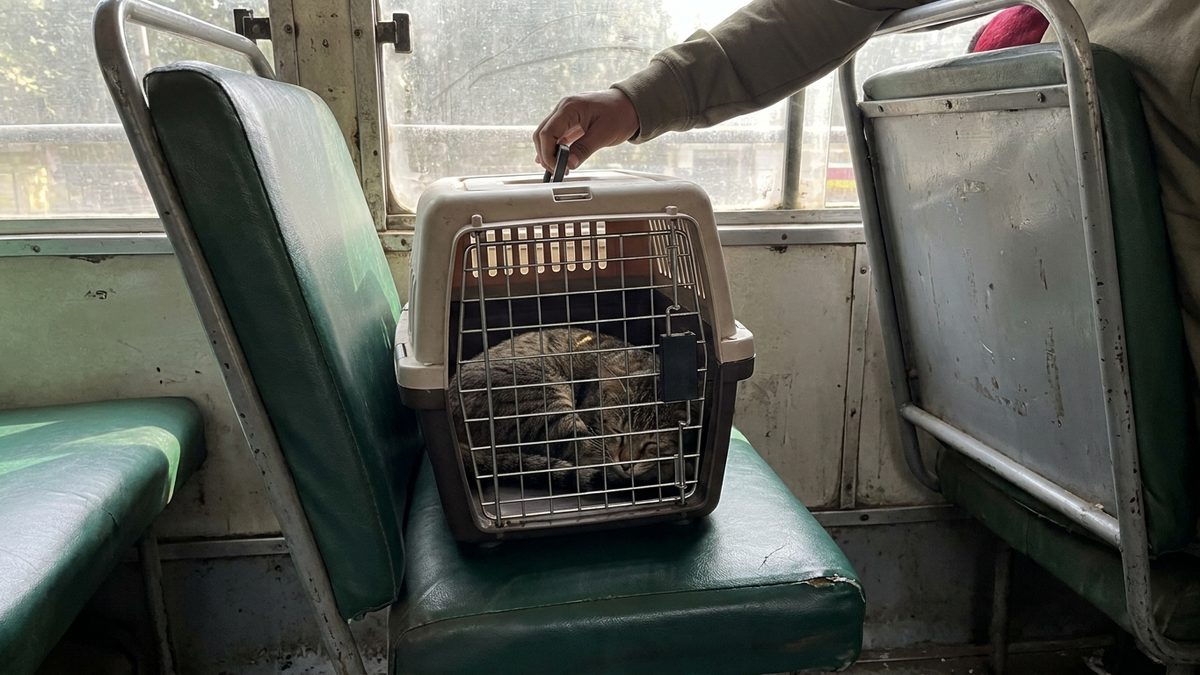
A cat on a bus is a narrower question with a clearer answer: the only operator that names a cat charges it a child fare and requires a closed basket, and every other published position prohibits it or says nothing.
KSRTC names "Rabbit, pup, cat, bird, birds in cage etc." at the child fare and requires carriage in baskets. APSRTC's prohibited items list makes no distinction by species, so a cat is prohibited there too. IntrCity SmartBus prohibits animals generally.
The practical difference is that a cat in a hard carrier is physically easy on a bus and behaviourally hard. A frightened cat goes silent and still rather than restless, which makes it look like it is coping when it is not, and a carrier that opens in a crowded gangway is an animal you will not catch. Keep the carrier latched for the entire journey including halts, cover three sides with a light cloth, and do not open it to reassure the cat.
Everything about how a cat behaves in a vehicle, how to build up to a journey and what a carrier needs is covered in our guide to travelling with a cat in a car in India. The physiology is the same on a bus; only the control you have is different, and you have less of it.
The honest recommendation
For most animals and most journeys, a scheduled public bus is the worst of the Indian travel options, and we are saying so plainly rather than writing a neutral guide to a thing we would not do.
The reason is not snobbery about buses. It is that the bus is the only mode where the operator has written nothing down, the crew can remove you mid-journey with no refund, and the four things that keep an animal safe are all outside your control. Every other mode fixes at least one of those.
- A car you drive is the best option on almost every count, because you own the stops, the windows and the air conditioning. Our guides to a road trip with your dog in India and to restraining a dog in a car cover the method and the restraint.
- A train has an actual written rule, a fare and a booking flow. First AC or First Class with the whole coupe under one PNR, or the brake van dog box on a confirmed ticket. The classes, the Scale-L fare and the documents are in our guide to taking a pet on an Indian train.
- A flight is fast and heavily regulated, with published airline policies, weight limits and a crate standard. See flying with a pet in India and the IATA pet crate guide for India.
- An app cab works for a city hop and fails as a plan for a journey that cannot fail, for the reasons set out in pets in Uber, Ola and Rapido.
- A hired vehicle is a different transaction from a ticket, and where no scheduled service will take your animal it is the remaining road option. What those services are, what the law requires of them and what to ask before you book one is covered in pet relocation services in India.
There is a narrow case where a bus is right, and it is worth naming so this does not read as a blanket ban. A short daylight run of an hour or two, in cool weather, on an ordinary non-AC service, with a small animal in a closed basket, on a route where you have confirmed the operator's position, is a reasonable thing to do. A nine-hour overnight intercity run in May with a 30 kg dog is not, and no amount of preparation changes the parts you do not control.
One corporation out of thirteen publishes a pet rule, and it does so because someone asked for it. The complaint book in every stage carriage in Karnataka and Maharashtra is a statutory route to the Regional Transport Authority that costs nothing and gets an answer in a month The Maharashtra Motor Vehicles Rules. A refusal recorded there is worth more than a refusal argued about.
If none of the alternatives is open to you and the bus is genuinely it, follow the method above, keep the journey short, and accept before you leave home that you may be standing at a boarding point at 10 pm with a paid ticket, a refused dog and no refund. Plan what you will do in that minute, because that is the minute this page exists for.
Common questions
Am I allowed to take my dog on a bus?
You are allowed to take a dog on a bus only where that operator permits it, and in India one major corporation publishes such a rule. Karnataka's KSRTC allows pet animals on its City, Suburban, Ordinary and Mofussil services, carried in baskets, tied with chains and facemasks, at the passenger's risk, and charged outside the free luggage allowance. It bars them from every premium and air-conditioned service. Most other operators publish nothing, which leaves the conductor deciding.
Can I travel with my dog in a bus in India?
You can travel with a dog on an Indian bus where the operator allows it, and you can be removed mid-journey where it does not. Karnataka's and Maharashtra's motor vehicle rules let a driver or conductor require a passenger carrying an animal that annoys or inconveniences another passenger to alight forthwith, with no entitlement to a refund of the fare paid. Confirm the operator's position with the depot before booking rather than at the door.
Is it allowed to carry pets in a bus?
It depends on the operator, and two of the thirteen we read prohibit it in writing. APSRTC lists "Pet animals and other animals" as item 21 on its prohibited items page, alongside kerosene, explosives and unauthorised forest produce, and repeats the list in its e-ticket terms. IntrCity SmartBus prohibits animals, birds and insects in its published policy. Where an operator publishes nothing, nothing has been allowed; the question has simply been left to the crew.
Can we carry pets in a BMTC bus?
BMTC publishes no pet rule that we could find, having read its English site and fare pages on 22 October 2026. BMTC is a separate corporation from KSRTC, so the KSRTC pet rule covering City, Suburban, Ordinary and Mofussil services does not govern a BMTC bus in Bengaluru, however often the two are reported together. Ask the depot. On an unpublished position the conductor decides, and a refusal carries no refund.
Which buses in Delhi are pet friendly?
No Delhi bus operator publishes a pet policy that we could find. The Delhi Transport Corporation site carries nothing about animals, and what ranks for this query is a business directory listing travel and cargo agents rather than scheduled bus services. redBus, where many tickets are bought, publishes no animal clause and advises users to telephone the bus operator for any information they need for boarding. For a Delhi journey, call the depot or use another mode.
Can I carry my cat in a bus?
A cat may travel on a KSRTC City, Suburban, Ordinary or Mofussil service, charged at the prescribed child fare and carried in a basket, under the same rule that covers rabbits, pups and caged birds. APSRTC prohibits all pet animals without distinguishing species, and IntrCity SmartBus prohibits animals generally. Keep a hard carrier latched for the whole journey including halts, because a frightened cat in a gangway is not recoverable.
Can I book a ticket for my dog?
No Indian bus operator sells a pet ticket online. KSRTC charges a pet as luggage, outside the free allowance, assessed and collected on the bus or at the counter rather than booked in advance, and its page prints a child fare for a pup, cat, rabbit or bird while giving no rate for an adult dog. Ask for the amount in writing on the luggage ticket. The booking platforms do not ask about animals at any stage.