
Breed profile
Schipperke: Price in India, Heat Limits and Health
A small black Belgian sheepdog with a compulsory undercoat, one genuinely breed-specific mutation, and an Indian price that contradicts itself on the page that prints it.
Quick answer
No verifiable Schipperke price in India exists. The one Indian page that ranks for the query prints two different figures for it, Rs 25,000 to Rs 80,000 on its spec card and Rs 20,000 to Rs 50,000 in its own prose, and India's dog import policy is restricted, so no lawful commercial supply route into India exists for this Belgian breed.
This page reports published veterinary research, registry screening datasets and Indian price data. It is not a diagnosis and it is not a treatment plan. Heat collapse, a hind leg that skips or locks, sudden clumsiness in a young dog and any change in coat or appetite all need a physical examination. Consult your nearby vet before acting on anything here, and before starting or stopping any medicine.
Schipperke at a glance
What a Schipperke actually is
The Schipperke is a small black Belgian sheepdog held by the FCI as standard 83, accepted on a definitive basis on 27 October 1954, and filed in Group 1 Sheepdogs and Cattledogs, Section 1 Sheepdogs, without a working trial.
Its name settles the argument about what kind of dog it is. In the Flemish dialect Schipperke means little shepherd, and the standard's own history names a probable common ancestor with the Belgian Shepherds, a small black sheepdog called the Leuvenaar. The breed traces to the 17th century, and around 1690 it was the favourite dog of working people and cobblers in the St. Gery quarter of Brussels, who held competitions to show off the worked brass collars they put on their dogs. It was shown for the first time in 1882 at Spa, became fashionable through Queen Marie-Henriette of Belgium, and reached Great Britain and the United States in 1887. The first standard was drawn up in 1888 by a breed club founded that year, which the FCI calls the oldest breed club in Belgium.
Four registries, four answers
Ask what group the Schipperke belongs to and you get four different answers from four bodies. The disagreement is not trivial, because group placement is how a buyer forms an expectation about what a dog will do all day.
| Body | Group | What that implies |
|---|---|---|
| FCI | Group 1, Sheepdogs and Cattledogs, Section 1 Sheepdogs | A working herding breed |
| The Kennel Club | Utility | A non-sporting working dog |
| American Kennel Club | Non-Sporting | A companion |
| Dogs Australia | Group 7, Non Sporting | A companion |
| United Kennel Club | Companion Dog Group | A companion |
Only the FCI, the body that holds the standard and whose authentic text is the French, treats it as a sheepdog. Dogs Australia Breed Listing United Kennel Club American Kennel Club McMillan's 2024 supplementary table records the same split from a third angle, filing the breed under Kennel Club group Utility and FCI group Sheepdogs and cattledogs in the same row.
The standard specifies no height
The FCI standard for the Schipperke gives weight only: between 3 and 9 kg, with an average of 4 to 7 kg sought after. It contains no height figure anywhere. Instead it fixes proportion, requiring height at withers to equal length of body, the chest to come down level with the elbows, and the muzzle to be definitely less than half the length of the head. The outline is therefore square by definition rather than by measurement, and the standard adds that the body should ideally fit into a square. OFA files the same dog under breed code SK.
Search results will hand you heights like 25 to 33 cm for this breed. Those come from national registries and aggregators, not from FCI standard 83, which specifies no height at all. If a seller quotes you a height standard, ask which document it is from.
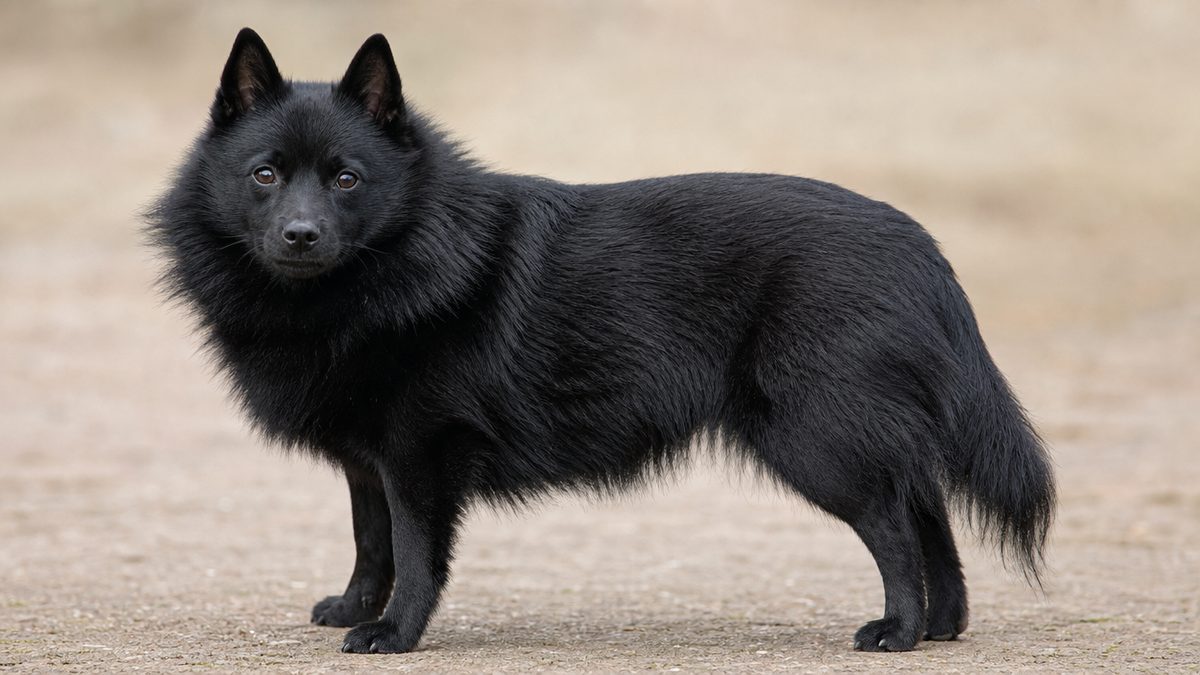
The coat is the other structural requirement. The topcoat is abundant, thick, straight and sufficiently harsh, forming a wide ruff around the neck, a mane over the top of the neck to the withers and shoulders, a frill under the neck and chest, and culottes on the backs of the thighs. Underneath it sits a soft thick undercoat, and the standard is emphatic about it: not enough undercoat is a fault, and total lack of undercoat is a disqualifying fault. Colour is totally black, with any other topcoat colour or even tiny white spots on the toes disqualifying.
One historical detail matters in India. The standard's history records that the tail was completely docked, a fashion it says seems to have existed since the 15th century. The current text has moved on: dogs born completely tailless or with a rudimentary tail are not to be penalised, and a natural tail reaching at least to the hock is described as the normal alternative. That change is convenient, because docking is prohibited in India.
Schipperke price in India, and why the one figure available fails
No verifiable Schipperke price in India exists. The page that ranks for the query prints two different price ranges for the breed, in two places, on the same page, and neither matches the other at either end.
Start with the source rather than the number. The Indian page that ranks for this breed's price is HappyPet Care, updated 23 May 2025 and read live on 9 September 2026. Its spec card, which appears twice on the page, gives Cost of buying Rs 25,000 to Rs 80,000. Its own prose, under the heading How Much Does Schipperkes Puppy Cost, says that in India the price of a Schipperke puppy normally falls in the range of Rs 20,000 to Rs 50,000.
| Where on the page | Floor | Ceiling |
|---|---|---|
| Spec card, printed twice | Rs 25,000 | Rs 80,000 |
| Body prose, price section | Rs 20,000 | Rs 50,000 |
| Gap | Rs 5,000 | Rs 30,000 |
A page cannot disagree with itself by Rs 30,000 at the top end and still be reporting an observation. It is emitting a figure, and the two emissions were not reconciled. Neither number should be treated as the Schipperke price in India.
The structural reason no Indian price exists
India's import policy for pet dogs is restricted, and permitted only with an authorisation from the DGFT. The DGFT's own import guidance lists the specific purposes for which a dog may be imported, and then states plainly that dogs for commercial purposes like breeding, as a gift or other purposes are not allowed to be imported, and that new born puppies of less than 7 months are not to be allowed either. The lawful routes that remain are a research organisation with a CPCSEA recommendation, the Defence and Police forces, a certified emotional support or therapy dog, or a dog that has lived with its owner abroad for at least two years and is coming in on transfer of residence.
Import is also confined to the airports and seaports of Delhi, Mumbai, Chennai, Hyderabad, Bengaluru and Kolkata and, since October 2024, Kochi airport, with the animal quarantined where required, and the DGFT advises starting the authorisation at least two months before travel. Directorate General of Foreign Trade Between the ban on commercial import and the seven month floor on puppies, no lawful breeding supply chain can form in India for a Belgian breed with no domestic population. That is why no genuine market price exists to report. The full route is set out in how to import a dog to India.
What the foreign figures are worth
The other price circulating for this breed is a US dollar band. The aggregator dogbreedslist.info, whose title tag is literally Schipperke - Price, Temperament, Life span, quotes an average of 1,200 to 2,000 US dollars. That is a foreign asking price, and converting it into rupees would produce a number no Indian seller has ever quoted. This page publishes no converted figure, because a conversion is arithmetic rather than an observation.
If you want this specific breed in India, the honest routes are a returning-resident import under the transfer of residence rules, or rescue. Neither has a sticker price. If what attracts you is a small, alert, black, vocal watchdog, the money question changes completely, because that description fits dogs already in Indian shelters.
The 2024 Indian breed circular does not reach this breed. CBIC Instruction 05/2024-Customs of 14 March 2024 reproduces a DAHD letter naming breeds prohibited for import, and the list contains four bare category words that are never defined: Mastiffs (boerbulls), Terriers, Wolf dogs and Canario. None of the four reaches a Schipperke, which is a sheepdog by FCI classification and a companion by every other registry's. The circular was in any case quashed by the Karnataka High Court on 10 April 2024 and set aside by the Delhi High Court that month, so no Indian law in force today bans owning, breeding or selling any of the breeds it named.
Real cost of ownership in India, line by line
The cost of ownership figure circulating for the Schipperke in India is a template constant shared with unrelated breeds, so this section rebuilds it from Indian prices that name a supplier.
The number you will meet is Rs 3,300 a month basic and Rs 5,400 premium. It is not an observation about Schipperkes. Its three component lines are food Rs 1,200 to Rs 1,800, veterinary Rs 900 to Rs 1,800 and grooming Rs 1,200 to Rs 1,800, and those three sum exactly to the totals: 1,200 plus 900 plus 1,200 is 3,300, and 1,800 plus 1,800 plus 1,800 is 5,400.
The test for a template is to pull an unrelated breed from the same site and compare the lines to the rupee. Done in the same session, the Lhasa Apso page prints the identical three lines and the identical totals. The Lhasa Apso is a floor-length coated Tibetan breed that the same site says needs daily brushing and a bath every three to four weeks. The Schipperke has a short harsh jacket that the same site says does not need trimming at all. They are given the same grooming line.
A cost row that gives a short-coated ratting dog and a floor-coated Tibetan breed the identical grooming budget is not costing either of them. Where the two pages genuinely differ is in the fields a human filled in: buying price, ideal weather band, ideal space and daily calories all diverge. The money does not.
Costs that name a supplier
These are Indian prices with a named source. They are what a 4 to 7 kg dog actually generates, and every one of them can be checked.
- Core vaccination, per shot. Anti-rabies Rs 699, puppy DP Rs 849, 9-in-1 DHPPiL Rs 899, canine corona Rs 899, kennel cough Rs 1,349 at one national clinic chain. These are promotional starting prices and the same chain quotes different course prices on different city pages, so record which city you were quoted.
- Deworming. Drontal Plus is Rs 754 for six tablets against an MRP of Rs 838, which is Rs 125.67 a tablet, dosed at one tablet per 10 kg. A Schipperke at the standard's sought-after 4 to 7 kg takes a single tablet, so one deworming costs about Rs 126.
- Municipal registration. Delhi charges Rs 500 for a new pet dog registration and Rs 500 to renew, with a late fee of Rs 100 a month. Greater Chennai Corporation charges Rs 50 for a pet licence, issued 9,115 of them in 2024, and runs six municipal pet clinics that provide treatment and anti-rabies vaccination free of cost.
- Grooming. This breed does not need a professional groom on a schedule. The coat is brushed, not clipped, so the realistic Indian grooming spend is a brush and a mild shampoo rather than a salon booking.
The single largest variable is not on any of those lists. It is the vet bill you cannot schedule, and for this breed the two most likely candidates are a hind leg that starts skipping and a young adult that becomes unsteady on its feet. Both are covered in the health section, and both are worth budgeting for as a contingency rather than a monthly line.
Greater Chennai Corporation's six pet clinics provide all treatment and anti-rabies vaccination free of cost. For a Chennai owner that removes the largest recurring veterinary line on the list above, and it is a better fact than any breed price.
Heat tolerance: Brussels against six Indian cities
The Schipperke has poor heat tolerance for a small dog, because the FCI standard makes its insulation compulsory, and its homeland is cooler in July than most of India is in January.
The comparison below uses NASA POWER climatology for 2001 to 2020, queried by explicit latitude and longitude so that no place name can be substituted for another. The cell elevation is echoed for every point and compared with the town's real elevation, because POWER returns a grid cell rather than a point and can be badly wrong in hill country. Brussels returned a cell elevation of 36.84 m against a real city elevation near 13 m, an error of about 24 m, so this cell genuinely describes the town.
| Place | Annual mean C | Annual RH % | Hottest month | Peak wet bulb C |
|---|---|---|---|---|
| Brussels, Belgium | 10.40 | 83.23 | Jul 18.57 | 15.55 (Jul) |
| Delhi | 25.60 | 45.56 | Jun 35.88 | 26.50 (Jul) |
| Mumbai | 26.77 | 67.39 | May 31.19 | 25.77 (Jun) |
| Chennai | 27.95 | 72.39 | May 31.51 | 26.11 (May) |
| Kolkata | 25.81 | 73.93 | May 31.53 | 27.09 (Jun) |
| Bengaluru | 23.74 | 67.94 | Apr 28.37 | 21.86 (May) |
| Pune | 23.86 | 66.80 | Apr 28.93 | 22.97 (Jun) |
Read the fourth column against the second. Brussels' hottest month averages 18.57 C. Chennai's coolest month, January, averages 24.09 C. Chennai never gets as cool as Brussels ever gets warm. The same holds for Mumbai, whose coolest month is 23.19 C, for Hyderabad at 20.76 C, for Bengaluru at 20.22 C and for Ahmedabad at 19.93 C. Only Delhi, whose January averages 13.61 C, and Kolkata at 17.31 C drop below a Belgian July.
Humidity is not the problem, and saying so is the honest correction
Indian breed pages routinely warn that European breeds will struggle with Indian humidity. For this breed that is simply wrong. Brussels runs 83.23 percent annual relative humidity, higher than every Indian city in the table, including Kolkata at 73.93 and Chennai at 72.39. A Schipperke's ancestors lived in damp air. What they never met is damp air at 30 C.
That is why the last column matters. Wet bulb temperature combines heat and humidity into the single figure that describes how hard evaporative cooling has to work, and a dog cools mainly by panting, which is evaporative. Brussels peaks at 15.55 C wet bulb in July. Kolkata peaks at 27.09 C, Delhi at 26.50 C and Chennai at 26.11 C. That is an eleven and a half degree gap in the variable that actually limits a panting animal.
The FCI standard makes not enough undercoat a fault and a total lack of undercoat a disqualifying fault, so the double coat is structural to the breed. Shaving it does not cool the dog. It removes the layer between skin and sun and can change how the coat regrows. Manage the heat instead of the hair.
What Indian law says about exactly this dog
India's Dog Breeding and Marketing Rules 2017 contain a clause written for this situation. Second Schedule Part IV paragraph 21(1) bars keeping in outdoor facilities, without the attending veterinary practitioner's written approval, dogs not accustomed to local temperatures, dog breeds that cannot tolerate the temperatures prevalent in the area or region in question, such as long-haired breeds in high temperature locations, and sick, infirm, aged or young animals. A black double-coated Belgian sheepdog in a Chennai courtyard is the case the clause describes.
- Walk on the clock, not the calendar. In Delhi that means before sunrise and after dark from April to July, when the mean June temperature is 35.88 C.
- Test the ground with the back of your hand. Black paw pads on dark tarmac take the same solar load the black coat does.
- Watch for panting that does not settle within five minutes of stopping. That is the point at which a walk becomes a heat event.
- Give shade and moving air rather than a bath. A wet dense undercoat in humid air holds heat against the skin and invites skin trouble.
- Treat the monsoon as a skin season, not a cool season. Kolkata's wet bulb peak of 27.09 C falls in June, inside the monsoon, not in the dry heat of May.
Temperament and who should not buy one
The Schipperke is an alert, curious, physically busy small guard dog that is gentle with its own family and openly suspicious of everyone else, and the breed standard says all of that in plain words.
The FCI text is unusually direct about behaviour. It describes an excellent small guard dog and an exceptional alarm, bubbling with vitality, aloof with strangers, active and busy, agile, tireless, perpetually interested in what is going on around it, inclined to snap if anyone approaches objects it has been given to guard, very gentle with children, and always curious to know what is behind a closed door or a moved object. Almost every difficult thing an owner reports about this breed is in that sentence.
Two behaviours in it deserve separating. Being aloof with strangers is social caution and responds to early exposure. Snapping over guarded objects is resource guarding, which is a specific, trainable problem and not a general temperament flaw. The standard treats general aggression differently again: aggressive or overly shy is a disqualifying fault, alongside apathetic or timid as an ordinary fault. A Schipperke that menaces visitors is not showing breed type; it is showing a fault the standard would eliminate from the ring.
Who this breed suits
- Households that want a doorbell with legs and can live with a high-pitched bark reporting every corridor noise.
- Owners who enjoy a dog with opinions and do not need instant compliance to feel respected.
- Homes with secure boundaries. This is a small, curious dog with a strong interest in what is on the other side of any barrier.
- People who are home, or who have arranged company. A busy, watchful dog left alone all day invents work.
Who should look elsewhere
- Anyone in a shared-wall apartment with a noise-sensitive neighbour. The barking is written into the breed's purpose.
- First-time owners wanting an easy dog. Independent, vocal and escape-minded is a demanding combination for a beginner.
- Households with pet rodents or rabbits. The standard says outright that it will hunt rats, moles and other vermin.
- Anyone who wants a dog that can live outdoors in an Indian summer. See the climate section, and paragraph 21(1).
The standard says very gentle with children and inclined to snap over guarded objects in the same breath. Both are true. The practical version is that a Schipperke is usually excellent with the children it lives with, and that food bowls, chews and favourite toys are where supervision is genuinely needed.
Training a Schipperke, and what it resists
To train a Schipperke, work in short sessions with food and give it problems to solve, because the breed learns quickly and then negotiates about whether to comply.
The intelligence in this breed is the busy, investigative kind rather than the biddable kind. The standard's own description of a dog always curious to know what is going on behind a closed door tells you what motivates it: access, novelty and information. Training that supplies those things works. Training that consists of repetition for its own sake gets boredom, and a bored Schipperke is inventive.
Three things worth training first
- A trade cue for guarded objects. Because the standard names snapping over guarded objects as a breed characteristic, teach a swap early and pay generously for it. Do not take things off this dog by hand as a routine.
- A recall that competes with prey. This is a breed the standard says will hunt rats, moles and other vermin. A recall trained in a quiet room does not transfer to a rat in a drain. Build it against real distraction, and use a long line until it holds.
- A quiet cue and a settle mat. You will not remove the bark, and trying to punish it out tends to make an alert dog more anxious rather than less. Teach an alternative behaviour that ends the alarm, and reward the dog for stopping rather than for staying silent.
Socialisation is the single highest-value investment for this breed in an Indian city. A dog the standard calls aloof with strangers, living in a building with lifts, delivery riders, watchmen and constant unfamiliar footfall, needs to have met all of it early and pleasantly. Socialise deliberately in the first four months, in short positive exposures rather than long overwhelming ones.
The Schipperke Club of America's own guidance says plainly that Schipperkes have a tendency to bolt outdoors, can be hard to housebreak, like to bark and are very independent and willful little dogs. Physical containment comes first. Balcony gaps, gate bottoms and lift doors are the three Indian failure points.
Housebreaking deserves realistic expectations. A small dog in a high-rise, with a long trip to ground level, is being asked to hold on for longer than a small bladder wants to. Toilet training this breed is usually a logistics problem rather than a training problem, and an indoor tray during the first months solves more of it than any amount of correction.
How much exercise a Schipperke needs
A Schipperke needs about 45 to 60 minutes of activity a day, split across at least two outings, with a real share of it going to mental work rather than distance.
The standard calls this dog active and busy, agile and tireless. Tireless is the operative word: it is not a dog that runs itself out on a long walk and then sleeps. What settles a Schipperke is having had something to think about. A 20 minute walk plus 15 minutes of scentwork, a food puzzle or a training game usually produces a calmer evening than a 45 minute walk alone.
In Indian conditions the constraint on exercise is not the dog's stamina, it is the thermometer. From March to June across most of the country the only genuinely safe outdoor windows are before sunrise and well after dark, and in Delhi, where June averages 35.88 C, that is not a preference but a limit. Plan for indoor exercise to carry the load for four months of the year.
- Scatter feeding indoors. Scatter the daily ration across a room or a snuffle mat instead of a bowl. It is the cheapest mental exercise there is.
- Stair work in a cool stairwell, in short sets, for a young adult dog with sound hips and knees.
- Find it games with a named toy, which suit a breed bred to hunt vermin in confined spaces.
- A daily training session of five to ten minutes, which does more for settling than the same time spent walking.
Legg-Calve-Perthes disease, the femoral head problem this breed is watched for, presents in young dogs. Forced repetitive exercise, long runs beside a bicycle and stair sprints all belong to a physically mature dog, not a growing one. If a young Schipperke starts limping on a hind leg, stop the exercise programme and see a vet rather than resting it and hoping.
Grooming a double coat in Indian humidity
Groom a Schipperke by brushing the double coat weekly, more often during a seasonal shed, and never by clipping or shaving it, because the undercoat is part of how the dog manages heat.
The coat is easier than it looks. The topcoat is harsh, straight and close-lying on the body, with short hair on the head, ears, the front of the forelegs and the hocks, and the longer furnishings concentrated in the ruff, mane, frill and culottes. There is nothing to trim into shape and nothing that mats the way a silky coat does. A slicker brush and a comb through the ruff and culottes once a week covers most of the year.
The exception is the seasonal shed, when a Schipperke drops undercoat in quantity. During that period brush every day or two and expect it to take a fortnight. Getting the dead undercoat out matters more in India than in Belgium, because a mat of shed undercoat trapped against the skin in humid air is both an insulator and a moisture trap.
Monsoon skin, ears and feet
- Dry the dog properly after rain or a bath. Air drying is standard advice in temperate countries and transfers badly to an Indian monsoon. Towel the coat down to the skin, especially through the ruff and culottes where the hair is deepest.
- Dry between the toes. Small feet with tight arched toes hold water, and the gap between the pads is where a monsoon skin infection usually starts.
- Plug or protect the ears before bathing. Water in a small erect ear is the commonest avoidable cause of ear trouble in a wet season.
- Check the black coat for parasites in daylight. Ticks are genuinely hard to see on a solid black dog, which matters in a country with the tick-borne disease burden described in the health section.
- Brush the teeth. This breed has a dentition problem worth taking seriously, and it is covered below.
Schipperkes develop a bilaterally symmetrical alopecia that is preceded by a lightening of the coat, with no systemic signs. It is not simply a bad shed. See the health section before accepting a hormone panel result, because the study that characterised it found the same hormone elevations in healthy dogs.
Health, screening data and life expectancy
The Schipperke is a long-lived breed with one genuinely breed-specific mutation, a striking dentition problem and a real diabetes signal, and the screening numbers behind all three are public.
Start with longevity, because it is good news and it is measured. McMillan 2024 studied companion dog longevity in the United Kingdom across 155 recognised purebred groups and gives the Schipperke a median survival of 14.2 years, 95 percent confidence interval 12.7 to 15.8, on 28 recorded deaths. Its hazard ratio against the crossbred comparator is 0.60 (0.42 to 0.87), p less than 0.01, meaning a significantly lower hazard of early death than crossbred dogs. That is an unusual direction for a purebred in that study and it is worth stating plainly. The sample is small, so quote the death count alongside the median rather than the median alone.
MPS IIIB: the mutation that is effectively this breed's alone
Mucopolysaccharidosis IIIB is a lysosomal storage disease caused by deficient alpha-N-acetylglucosaminidase. It was first characterised in this breed in 2003, in two three-year-old Schipperkes evaluated for tremors and stumbling, with cerebellar signs including dysmetria, hind limb ataxia and a wide-based stance with truncal swaying. Enzyme activity in cultured fibroblasts was between 4.3 and 9.2 percent of normal, and post-mortem findings included severe cerebellar atrophy and Purkinje cell loss. Pedigree analysis supported autosomal recessive inheritance.
The causative variant was published in 2020: an insertion in exon 6 of NAGLU consisting of a 40 to 70 base pair poly-A tract plus an 11 base pair duplication. Affected dogs were homozygous; healthy sequenced dogs were heterozygous or homozygous wild-type. Between 2003 and 2019, 3,219 Schipperkes were genotyped. 1.5 percent were homozygous and clinically affected, 23.6 percent were heterozygous carriers and clinically healthy, and 74.9 percent were homozygous wild-type. Those three figures sum to 100.0.
Now put the register beside the paper. OFA's Mucopolysaccharidosis IIIB table contains exactly one breed row, the Schipperke, at 115 evaluations, against an ALL BREEDS total of 119. In other words this breed is effectively the entire database. Its current figures are 93.0 percent normal, 7.0 percent carrier and 0.0 percent abnormal.
| Source | Dogs | Carriers | Affected |
|---|---|---|---|
| Raj 2020, genotyped 2003-2019 | 3,219 | 23.6% | 1.5% |
| OFA published records, read 2026 | 115 | 7.0% | 0.0% |
That is what a working screening programme looks like from the outside, and the paper says the same thing in its own words: the number of dogs homozygous and heterozygous for the insertion declined rapidly after the initial years of genotyping. For a buyer the practical consequence is simple. This is a recessive with a DNA test, so ask for both parents' MPS IIIB results, and understand that a carrier bred to a clear dog produces no affected puppies.
A 1993 case report describes an adult-onset lysosomal storage disease in a five-year-old Schipperke with progressive cerebellar and vestibular signs, with beta-galactosidase at 50 percent of normal and findings resembling human adult-onset galactosialidosis. That is biochemically a different disease from MPS IIIB and should not be merged with it. Two reports, two conditions.
What the OFA tables actually show
| Database | Evaluations | Result | All-breeds comparison |
|---|---|---|---|
| Hips | 813 | 90.0% normal, 9.2% dysplastic | 14.2% dysplastic across all breeds |
| Elbows | 183 | 6.6% dysplastic | 12.0% across all breeds |
| Patella | 768 | 2.7% abnormal | 3.5% across all breeds |
| Dentition | 71 | 45.1% abnormal | 7.1% across all breeds |
| Thyroid | 769 | 86.2% normal | 84.8% across all breeds |
| Cardiac, basic | 133 | 100.0% normal | 99.7% across all breeds |
| Progressive retinal atrophy | 67 | 100.0% normal | 86.6% across all breeds |
| Degenerative myelopathy | 59 | 100.0% normal | 65.5% across all breeds |
Every row above closes arithmetically against its own components. The hip row reads 11.1 percent excellent, 63.0 percent good and 16.0 percent fair, which sums to 90.1 against a printed 90.0, and 8.0 mild plus 1.1 moderate plus 0.1 severe, which sums exactly to the printed 9.2 dysplastic. Hip dysplasia is therefore genuinely uncommon in this breed by comparison with the all-breed figure, and patellar luxation, which every ranking page lists as the Schipperke's headline orthopaedic risk, sits below the all-breed rate at 2.7 percent of 768 evaluations.
The dentition figure nobody publishes
The striking row is dentition. 45.1 percent of the 71 Schipperkes evaluated were abnormal, which ranks the breed 4th worst of 76 breeds in that table, behind only the Manchester Terrier at 46.5 percent, the Alaskan Klee Kai at 46.0 and the Norwich Terrier at 45.7. The all-breed abnormal rate is 7.1 percent, so this breed's rate is over six times it. The denominator is small, at 71 dogs, and that should be said alongside the percentage.
The standard explains why the number is high and why it matters in India at the same time. FCI 83 tolerates the loss of one or two first premolars or one second premolar, treats the loss of one incisor or three first premolars as a severe fault, and disqualifies a dog missing four teeth or more excluding the four first premolars. India's Dog Breeding and Marketing Rules 2017, Second Schedule Part III paragraph 8(10), require that breeding dogs have been tested for genetic defects including two or more missing teeth, wry mouth and overshot or undershot jaw. A dentition the FCI standard tolerates is a defect the Indian Rules name.
Eyes, endocrine and coat
The OFA eye figures contradict themselves, as they do for many breeds, and both halves belong on the page. The summary line reports 96.3 percent normal across 873 evaluations. The detail rows, on a denominator of 872, record 640 normal, which is 73.4 percent, a gap of 22.9 points. The largest named findings in the detail rows are persistent pupillary membranes iris to iris at 10.9 percent, cataract of unknown significance at 4.6 percent and distichiasis at 3.3 percent. Neither figure should be quoted as the breed's eye rate on its own.
On the endocrine side, a Norwegian study of serum samples submitted between 2001 and 2018 found the Australian Terrier, Swedish Lapphund, Samoyed and Schipperke at highest risk for diabetes mellitus in that population. Notably the same study's highest-risk list for hypothyroidism does not include the Schipperke. That distinction is worth keeping: the endocrine signal in this breed is diabetes, not thyroid, and OFA's thyroid figure of 86.2 percent normal on 769 evaluations sits slightly better than the all-breed 84.8 percent.
The coat disorder is the finding most likely to be mishandled. Schipperkes develop a bilaterally symmetrical alopecia preceded by lightening of the hair coat, with no systemic signs, presumptively diagnosed as Alopecia X but never investigated until 2019. In that study of three healthy and eight affected dogs, complete blood count, chemistry, urinalysis, total and free thyroxine, TSH and post-ACTH cortisol were normal in all dogs, histopathology showed hair cycle arrest, and androstenedione was increased in every dog, healthy and affected alike. Estradiol was raised in all three healthy dogs and four of eight affected ones.
The sex hormone abnormalities in that study appeared in the healthy control dogs as often as in the affected ones. A raised androstenedione in a Schipperke therefore does not establish a diagnosis, and a panel showing one does not by itself justify treatment. Take the result to your nearby vet and discuss what it does and does not rule out.
One more association is worth knowing. A study replicating a canine idiopathic epilepsy risk locus analysed 157 cases and 179 controls across three additional breeds, the Schipperke, Finnish Spitz and Beagle, and identified a common 28 kilobase risk haplotype in the ADAM23 gene present at frequencies of 0.49 to 0.7 across the breeds studied. The authors describe ADAM23 as a low penetrance risk gene, and the causative variant remains unidentified. That is a risk factor, not a diagnosis, and it should not be sold as a test result.
The Indian risk that has nothing to do with the breed
Tick-borne disease is the health issue an Indian Schipperke is most likely to actually meet, and it is not genetic. In a West Bengal study of 584 dogs screened at veterinary clinics, Babesia gibsoni was detected in 76.54 percent and 72.9 percent of the 584 carried two or more pathogens. In Kerala, a study of 120 dogs found Babesia in 80 of them, with a peak before the monsoon between March and May. Both sampled clinic caseloads and clinically suspected animals rather than random populations, so these are not prevalence figures for the general dog population. They do tell you that year-round tick control is not optional here, and that a solid black coat makes visual tick checks harder than they are on a pale dog.
Feeding a 4 to 7 kg dog in India
Feed a Schipperke to a body condition score rather than to a cup measure, because the standard's weight range spans 3 to 9 kg and a dog at the top of it eats roughly twice what a dog at the bottom does.
The FCI standard sets weight between 3 and 9 kg and names 4 to 7 kg as the average sought after. It also disqualifies a weight clearly outside the designated limits. That is a threefold span between the lightest and heaviest permitted dog, which is why a single feeding figure for the breed is meaningless. The Indian ranking page quotes 400 kcal a day for puppies and 300 for adults, and three quarters to one and a half cups of dry food a day, and offers no bodyweight to attach either figure to.
Use body condition instead. You should be able to feel the ribs easily under a thin layer of covering without pressing, see a waist from above and a tuck from the side. Weigh the dog monthly on the same scale, note the number, and adjust the ration by about ten percent at a time rather than by eye.
Practical points for an Indian kitchen
- Split the day's food into two meals for an adult and three or four for a puppy under six months. A small stomach and a busy dog do better on smaller, more frequent meals.
- Use part of the ration as training currency rather than adding treats on top of it. In a breed with an obesity risk and a heat problem, extra weight costs twice.
- Do not free-feed in a humid climate. Food left down in monsoon humidity spoils faster than owners expect, and free-feeding also removes the appetite change that is often the first sign a dog is unwell.
- Feed after exercise, not before, and leave a gap around the hottest part of the day.
Given that a Norwegian study placed the Schipperke among the four breeds at highest risk for diabetes mellitus in that population, unexplained weight change, increased drinking and increased urination in a Schipperke deserve a blood test rather than a diet adjustment. Ask your nearby vet for a glucose check before you assume it is the food.
The first year, month by month
A Schipperke puppy's first year is dominated by three things: getting the socialisation done before four months, keeping the growing joints out of trouble, and setting up the guarding and barking rules before they harden.
- Months 0 to 2. The puppy is with its breeder or foster. Indian law fixes the floor: Rule 8(1)(a) of the 2017 Rules provides that pups less than eight weeks in age are not sold. Any offer of a younger puppy is a reason to walk away.
- Month 2. Home, and the vaccination course begins. Anti-rabies alone runs about Rs 699 at a national clinic chain, with the multivalent shots in the Rs 849 to Rs 899 band. Start the trade cue and hand-feeding from day one.
- Months 2 to 4. The socialisation window, and the highest-value period of the whole year for a breed the standard calls aloof with strangers. Lifts, watchmen, delivery riders, traffic, other dogs, children, umbrellas and the monsoon itself, all in short, positive doses.
- Month 3 to 4. Deworming continues on your vet's schedule. At Schipperke weights that is a single Drontal Plus tablet, about Rs 126 a dose. Register the dog: Rs 500 in Delhi, Rs 50 in Chennai. Greater Chennai Corporation veterinary…
- Months 4 to 6. Teething, and the point at which the dentition issue becomes visible. Count the adult teeth as they come in and tell your vet what is missing, because this breed's OFA abnormal rate is 45.1 percent. Start daily tooth brushing now, while the dog is young enough to accept it.
- Months 4 to 9. Watch the hind legs. Legg-Calve-Perthes disease presents in young small-breed dogs as a gradually worsening hind limb lameness. Any limp that persists more than a few days needs radiographs, not rest.
- Months 6 to 9. Adolescence, when the guarding and barking behaviours consolidate and recall gets worse before it gets better. Keep the long line. Do not let this be the period when you stop training.
- Months 9 to 12. The adult coat and the first seasonal shed. Increase brushing, and expect the volume of undercoat to surprise you.
- Month 12 onwards. Full physical maturity, and the point at which higher-impact exercise becomes reasonable. If the dog came from a breeder, this is also when to ask for and file the parents' MPS IIIB results if you did not get them at purchase.
Some Schipperkes are born completely tailless or with a rudimentary or short tail, and the FCI standard says explicitly that they should not be penalised for it. A tailless Schipperke puppy is not a docked one, and in India that distinction matters, because docking is prohibited.
Schipperke against the breeds Indian buyers cross-shop
Indian buyers rarely choose between a Schipperke and another Schipperke. They choose between the idea of a small black alert dog and whatever is actually available, so this table compares it against what they will really be offered.
| Schipperke | Pomeranian | Indian Spitz | Indian pariah dog | |
|---|---|---|---|---|
| Weight in the standard | 3 to 9 kg, 4 to 7 sought | Toy spitz, well under 3.5 kg typically | Small to medium | Medium |
| Coat | Harsh double coat, compulsory undercoat, always black | Profuse standing double coat, many colours | Double coat | Short single coat |
| Heat adaptation | None. Homeland annual mean 10.40 C | None. Northern European spitz | Long established in India | Native |
| Available in India | No lawful commercial import route | Widely, and widely mis-sold | Yes | Free, in every shelter |
| Barking | Written into the breed standard as an alarm | High | High | Variable |
| Documented breed-specific mutation | MPS IIIB, with a DNA test | Not comparable | Not comparable | Not applicable |
The comparison that matters most is the last row of availability. A Pomeranian is the dog an Indian buyer will actually be shown if they ask for a small fluffy black dog, and the Schipperke's visual similarity in a photograph is exactly why misdescription happens. If you are shown a small black spitz-shaped puppy described as a Schipperke, ask for the import paperwork, because a legitimately imported dog has a DGFT authorisation and an AQCS clearance behind it.
If what you want is the temperament
The Schipperke's appeal is a compact, sturdy, alert, curious watchdog with a big personality. That description also fits a great many Indian street-descended dogs, and it fits them without the heat problem. A pariah-descended dog carries no compulsory undercoat, has spent a hundred generations in this climate, and costs nothing to adopt. If the coat colour is the attraction, black is common in Indian shelters.
For almost every Indian household, the correct version of this page's advice is that the Schipperke is a genuinely interesting breed to read about and a poor practical choice to import. If you already have one, this page is written for you. If you are choosing, start at the adoption section.
Mistakes Indian owners make with this breed
Five mistakes account for most of the avoidable trouble with a Schipperke in India, and four of them come from applying temperate-climate advice unchanged.
- Shaving the coat for summer. It is the most common and the most damaging. The undercoat is compulsory in the standard, it insulates against heat as well as cold, and removing it exposes black skin to direct sun.
- Letting the dog air dry after a monsoon bath. Overseas grooming guides say towel off and let the dog air dry, which is sound in Belgium and poor advice in an Indian monsoon. Dry down to the skin through the ruff and culottes, and dry between the toes.
- Treating the barking as a training failure. The FCI standard describes the high-pitched bark as the breed's characteristic reaction. Punishing it usually raises anxiety in an alert dog. Train an alternative and manage the triggers instead.
- Skipping tick prevention because the dog is small and indoors. Indian clinic-based studies report very high haemoprotozoan burdens, and a black coat hides ticks.
- Buying on a quoted Indian price without asking how the dog got here. No lawful commercial import route exists, so a Schipperke offered for sale in India needs an explanation.
Two errors that come from the internet rather than the climate
The first is quoting the breed's monthly cost from an Indian breed page. That figure is a shared template, and the identical three component lines appear on a Lhasa Apso page on the same site. The second is treating a raised androstenedione result as a diagnosis for the breed's coat disorder, when the study that characterised it found the same elevation in its healthy controls.
The 2017 Rules, Second Schedule Part II paragraph 6(8), forbid tail docking, ear cropping, de-barking, de-clawing and any change of appearance by artificial means. Paragraph 6(9) prohibits breeding to create new breeds of dogs or unusual looks, and paragraph 6(3) prohibits in-breeding within four generations and incest breeding. Overseas breeding advice for a numerically small breed sometimes assumes close breeding is acceptable. In India it is not.
Adopt, verify and source responsibly
To get a Schipperke in India honestly, you either adopt a dog already here or you bring your own dog with you on transfer of residence, because no lawful commercial import route exists.
The DGFT's own guidance is the whole answer to sourcing. Import of pet dogs is restricted and needs a DGFT authorisation, dogs for commercial purposes like breeding or as a gift are not allowed to be imported, and new born puppies of less than 7 months are not to be allowed. Import without authorisation is available only to a person shifting residence permanently to India after two years of continuous stay abroad, for up to two pets, under the customs baggage rules.
If you are bringing your own dog to India
- Confirm the two-year rule applies to you. Continuous stay abroad must exceed two years for the baggage route; otherwise you need a DGFT authorisation.
- Start early. The DGFT advises initiating the application at least two months before travel, and the Exim Facilitation Committee meets once a month.
- Get the advance NOC from the AQCS at your port of entry, seven days before travel, relaxable to three days in specific circumstances.
- Plan for one of seven ports. Delhi, Mumbai, Chennai, Hyderabad, Bengaluru, Kolkata or, since October 2024, Kochi.
- Carry the pet book and vaccination certificate, which must be attached to the application, and the official veterinarian's health certificate.
If you are adopting in India
A purebred Schipperke in an Indian shelter is unlikely but not impossible, and breed-specific rescue networks occasionally rehome imported dogs whose owners have left the country. What is far more likely, and worth saying without condescension, is that the dog you actually want exists already. The Schipperke's appeal is a small, black, sturdy, alert, vocal, curious dog that watches the door. Indian shelters are full of dogs matching that description, adapted to the climate, at no purchase cost.
- Verify any claimed pedigree against a document, not a photograph. Ask which registry issued it and check that registry's own records.
- Ask for both parents' MPS IIIB genotypes if a dog is offered as a Schipperke from a breeding programme. A test exists and the responsible answer is a result, not a reassurance.
- Register the dog with your municipality. Rs 500 in Delhi, Rs 50 in Chennai, and it is what makes the dog legally yours.
- Use the free municipal veterinary services where they exist. Greater Chennai Corporation's six pet clinics provide treatment and anti-rabies vaccination at no cost.
We report published prices and registry documents as editorial content. We do not recommend breeders, link puppy listings or quote a live price as an offer. Where we cannot verify a figure, we say so and publish nothing, which is why this page carries no Schipperke price in India of its own.
Schipperke questions Indian buyers actually ask
Is a Schipperke a good family dog?
A Schipperke suits a family that wants an alert small dog and can live with noise. The FCI standard describes it as very gentle with children while also inclined to snap if anyone approaches objects it has been given to guard, so the honest answer is that it is good with its own family and reactive about its possessions. Supervise young children around food and toys.
How expensive is a Schipperke?
No Schipperke price in India survives checking. The top Indian ranking page prints Rs 25,000 to Rs 80,000 on its spec card and Rs 20,000 to Rs 50,000 in its own prose, on the same page on the same day, and neither figure matches the other at either end. Because India's dog import policy is restricted, there is no lawful commercial route by which a market price could form.
Are Schipperkes aggressive?
Aggression is a disqualifying fault in the breed standard, so an aggressive Schipperke is a fault rather than a breed trait. What the standard does describe is a dog that is aloof with strangers and inclined to snap if anyone approaches something it is guarding. That is resource guarding and territorial alarm, not general aggression, and both respond to early socialisation.
Do Schipperke bark a lot?
Yes. The FCI standard calls the Schipperke an exceptional alarm and says it shows its reaction by its high-pitched bark, its raised mane and hackles. Barking is written into the breed's job description as a guard dog, so in an Indian apartment with shared walls you are managing the volume and the triggers rather than removing the behaviour.
What is MPS IIIB and why does it matter for this breed?
Mucopolysaccharidosis IIIB is a lysosomal storage disease caused by an insertion in the NAGLU gene that is specific to the Schipperke. Affected dogs are normal for the first two to three years, then develop tremors, a wide-based stance and hind limb ataxia from cerebellar degeneration. It is recessive, so two carriers are needed to produce an affected pup, and a DNA test exists.
How long do Schipperkes live?
McMillan 2024 gives the Schipperke a median survival of 14.2 years with a 95 percent confidence interval of 12.7 to 15.8 years, on 28 recorded deaths. Its hazard ratio against the crossbred comparator is 0.60, meaning a significantly lower hazard of early death than crossbred dogs, which is unusual for a purebred in that study.
Can a Schipperke handle Indian heat?
Poorly, and the arithmetic is stark. Brussels averages 10.40 C across the year and its hottest month, July, averages 18.57 C. Chennai's coolest month averages 24.09 C, so Chennai never gets as cool as Brussels ever gets warm. Add a black coat over a mandatory undercoat and this is a dog managing heat load every day of an Indian year.
Should I shave a Schipperke in summer?
No. The double coat insulates against heat as well as cold, and the FCI standard treats the undercoat as structural, making too little undercoat a fault and a total lack of undercoat a disqualification. Shaving removes the barrier between the skin and direct sun and can permanently change how the coat regrows. Manage heat with timing, water and shade instead.
How tall is a Schipperke supposed to be?
The FCI standard gives no height at all. It specifies weight only, at 3 to 9 kg with an average of 4 to 7 kg sought after, and describes the dog as squarely built with height at withers equal to body length. Any centimetre figure you read for this breed comes from a national registry or an aggregator, not from the FCI standard.
What is the real monthly cost of a Schipperke in India?
The Rs 3,300 to Rs 5,400 figure circulating on Indian breed pages is a template constant, not an observation of this breed. Its three component lines are food Rs 1,200 to Rs 1,800, veterinary Rs 900 to Rs 1,800 and grooming Rs 1,200 to Rs 1,800, and the identical three lines appear on the Lhasa Apso page of the same site, a floor-coated breed with completely different grooming needs.
Is the Schipperke a sheepdog or a companion dog?
Four registries give four answers. The FCI files it in Group 1 Sheepdogs and Cattledogs, Section 1 Sheepdogs. The Kennel Club places it in Utility, the American Kennel Club in Non-Sporting, Dogs Australia in Group 7 Non Sporting and the United Kennel Club in the Companion Dog Group. Its Flemish name means little shepherd, which is the FCI's case.
Is tail docking of Schipperkes legal in India?
No. The Prevention of Cruelty to Animals (Dog Breeding and Marketing) Rules, 2017, Second Schedule Part II paragraph 6(8), states that there shall be no tail docking, ear cropping, de-barking, de-clawing or any other kind of mutilation, and that any change of appearance by artificial means is strictly forbidden. The current FCI standard does not require a docked tail either.
Compare with similar breeds
Schipperke sits in 2 Bonbeno groups. Each one compares it directly against the breeds it is genuinely an alternative to, on the same figures.