
Breed profile
Sabueso Espanol in India: Price, Ears, Climate and Health
A Spanish scent hound whose ears reach past its nose, whose standard the FCI still ties to a working trial, and which has never appeared in a single peer-reviewed veterinary paper.
Quick answer
No verifiable Sabueso Espanol price in India exists, and no Indian listing for the breed could be found at all. What can be established is precise: FCI standard 204 puts males at 52 to 57 cm, gives no weight, requires ears that reach well beyond the nose, and still ties the breed to a working trial. This page publishes those documents and the climate arithmetic instead of a price.
This page is reference information, not veterinary advice. The Sabueso Espanol appears in no peer-reviewed veterinary literature at all, so every health statement here is either a general canine fact or an inference from the breed's anatomy, and it is labelled as such. Take any ear odour, head shake or persistent scratching in a long-eared dog to your nearby vet rather than treating it from a page.
Sabueso Espanol traits, rated for India
What the Sabueso Espanol is, from its own two standards
The Sabueso Espanol is a medium-sized Spanish scent hound from the Cantabrian north, recognised by the Federation Cynologique Internationale as standard 204 on a definitive basis since 15 November 1957 and listed by name in the annex to Spain's Real Decreto 558/2001.
Two official documents describe this breed and they agree almost word for word. FCI standard 204 was published in its current form on 24 July 2000 against an official valid standard of 26 May 1982, and the FCI record names Spanish as the official authentic language. The racial prototype in the annex to Real Decreto 558/2001 begins at page 27 of the consolidated Spanish text. Heights, tolerances, proportions, colour rules and faults all match between them.
The measurements are specific and the standard is unusually direct about why. Males stand 52 to 57 cm at the withers and females 48 to 53 cm, with one centimetre above those limits tolerated in dogs of excellent proportions. The standard opens its size clause by stating that this breed shows pronounced sexual dimorphism, with females noticeably smaller and finer, and the Spanish text uses the same words.
Neither text prints a weight. The string kg appears zero times in the English standard, and the national prototype gives heights and proportions only. Any kilogram figure you meet for this breed comes from somewhere other than its standard.
The proportion that makes it a hound rather than a pointer
The body must be longer than the dog is tall, and the standard puts a number on it. Length of body is widely superior, from 7 to 10 cm, to the height at the withers, and the skull and muzzle are of equal length at 1 to 1. A dog whose body length equals or falls below its height at the withers is disqualified, which is a strong statement: the rectangle is not a preference, it is the breed.
The thorax is built to match. The prototype in the national annex requires a thoracic perimeter one third greater than the height at the withers, expressed as a 3 to 4 ratio, and the FCI describes the development of that perimeter and the length of the body as remarkableFederation Cynologique Internationale.
The ears, which decide everything else on this page
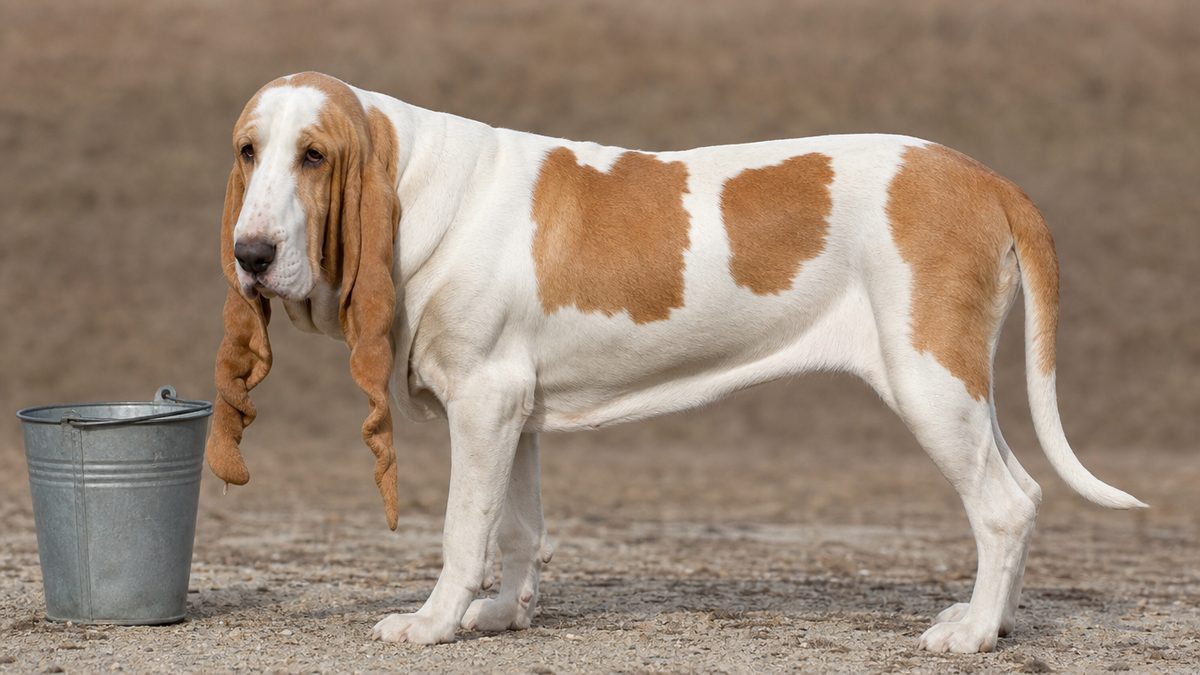
Read the ear clause slowly, because it is the whole care argument for an Indian owner. The leathers are large, long and hanging, of soft texture, rectangular in shape with a rounded tip. They are set below eye level, they hang freely twisted in corkscrew, and without being stretched they must reach well beyond the nose. The standard adds that the venous system is very visible and sits just under the skin.
The neck matches the ears. Skin thick and very loose, forming a marked and loose dewlap without exaggeration, over skin the standard describes as very elastic, thick, pink and loose all over the body, which sometimes wrinkles on the forehead when the head is lowered. That last detail is a description of how the dog works: head down, nose on the ground.
| Clause | What the standard says |
|---|---|
| Height, males | 52 to 57 cm, with 1 cm above tolerated in excellent proportions |
| Height, females | 48 to 53 cm, same tolerance; the standard states pronounced sexual dimorphism |
| Weight | Not stated. The word appears nowhere in either official text |
| Body length | 7 to 10 cm greater than the height at the withers; equal or less is disqualifying |
| Skull to muzzle | 1 to 1, equal length |
| Ears | Set below eye level, corkscrew-twisted, reaching well beyond the nose unstretched |
| Coat | Dense, short, fine and smooth or flat, down to the interdigital spaces |
| Colour | White and orange only; tricolour or tan markings are disqualifying |
| Gait | A long, sustained, economical trot, with a natural tendency to walk head-low while sniffing |
| Working trial | Required, per the FCI Breeds Nomenclature |
English Wikipedia's appearance section states that the dog's total height should be a maximum of 52 to 57 cm in males and 48 to 53 cm in females. The standard says those are the heights, and that one centimetre above the limits is tolerated in dogs of excellent proportions. Converting a range with an explicit upward tolerance into a maximum deletes a real allowance, and it is the same flattening this site has caught on several breeds. DogZone, by contrast, gives 20.5 to 22.5 inches and 19 to 21 inches, which converts to 52.07 to 57.15 cm and 48.26 to 53.34 cm and therefore agrees with the standard.
The history in the standard is short and checkable. It records the breed as already known in the late Middle Ages, brilliantly described in the venery book of King Alfonso XI in the fourteenth century, and again by Argote de Molina in 1582. That is a claim about literature rather than about genetics, and this page reports it as the standard's own account rather than as an established lineage.
Sabueso Espanol price in India, and why there is no figure
There is no verifiable Sabueso Espanol price in India, and this research found no Indian listing for the breed at any position in the results. Bonbeno publishes no rupee figure for this breed.
Look at what actually ranks. Every result for this breed is a general international breed directory: an encyclopedia entry, three or four template breed-profile sites, a pet-supplies page and the FCI's own record. There is no Indian seller, no Indian classifieds page and no Indian price band, which is different from the usual pattern on this site where a fabricated Indian figure exists and has to be dismantled.
That absence is worth stating plainly rather than dressed up. A rare European working hound with no lawful commercial import route into India, no Indian breed club and no Indian listings does not have an Indian price, and inventing one by converting a euro figure would be fabrication. This site has repeatedly caught pages and answer engines doing exactly that, printing a rupee band that divides straight back into the foreign figure it was made from at 74, 80 or 84.38.
One instrument limitation, recorded rather than hidden
The ranked set above was harvested through a search tool whose geography is the United States, not India. By the time this breed was researched, Bing India was serving a bot challenge reading One last step, Please solve the challenge below to continue, and DuckDuckGo was answering HTTP 202 with a stub for every query including the control. So the competitor list is a real ranked set and it is not an India-geo ranked set, and that distinction is recorded here because it changes what the list proves.
What it still proves is enough. No Indian commercial page ranks for this breed anywhere in the set, and the breed's own registry record ranks instead, which is the opposite of what a live Indian market looks like. Compare that with a breed that does have an Indian market, where the first page of results is dominated by Indian sellers.
Divide it. A rupee figure for a rare European breed that comes out as a round number of euros or dollars at 74, 80, 84.38 or anything near 91 was made by multiplication rather than observed in India. If the quotient is a price a seller would actually print, such as 800 or 1,500, the figure is a conversion. Bonbeno does not publish converted prices, and neither should you rely on one.
What a Sabueso Espanol costs to keep in India
A Sabueso Espanol is an inexpensive dog to run in India by the standards of foreign breeds, because it is medium sized, short coated and has no specialist grooming needs. Its one recurring expense that other breeds do not have is ear care, and that one is not optional.
Size is the first thing to establish honestly, because the recurring costs are all weight-banded and the standard gives no weight. What can be said is that a 52 to 57 cm rectangular scenthound sits in the same physical class as a Basset Hound or a large Beagle, which in Indian retail terms means the 15 to 30 kg parasiticide band rather than a small-dog or giant-dog band. Weigh the dog and buy to the reading rather than to an estimate.
Published Indian figures for that band are straightforward. Drontal Plus works out at Rs 125.67 a tablet, dosed one per 10 kg, so a 25 kg dog needs three tablets, about Rs 377 a dose. NexGard Spectra's 15 to 30 kg pack is Rs 3,308 for three tablets, about Rs 1,103 a month, and for a dog that pushes through undergrowth nose-down that monthly cover is the single most important preventive purchase you make.
| Line | Published Indian figure | Notes for this breed |
|---|---|---|
| Anti-rabies, single | Rs 699 at a Vetic clinic, Rs 100 at a Goa government hospital | Not weight-banded |
| 9-in-1 DHPPiL | From Rs 899 at a Vetic clinic, Rs 600 at a Goa government hospital | A 3.3 times spread on one identical vaccine, driven by delivery model |
| Kennel cough | Rs 1,349 | Worth doing before any boarding stay |
| Deworming | About Rs 377 a dose at 25 kg | Three Drontal Plus tablets at Rs 125.67 each |
| Monthly tick, flea and worm cover | About Rs 1,103 | The single most important line for a nose-down hunting breed in India |
| Grooming | Bathing from Rs 934 in Delhi | The coat needs almost nothing; you are paying for the bath, not a trim |
| Ear cleaner and drying solution | A recurring consumable rather than an occasional one | Budget for it monthly, not annually |
| Overnight boarding | Rs 899 for 24 hours in Bengaluru | Warn the facility about the voice before you book |
| Municipal registration | Rs 500 in Delhi, Rs 50 in Chennai | Chennai also runs six free municipal pet clinics |
Grooming barely registers as a cost. The coat is dense, short, fine and flat, and a rubber mitt once a week does most of the work. A bath from Rs 934 at Delhi rates, a handful of times a year, is the whole salon budget, and there is no clip, no strip and no trim to pay for.
Registration and municipal costs are flat regardless of breed. Delhi charges Rs 500 to register a pet dog and Rs 500 to renew, with a Rs 100 per month late fee, and has issued 18,958 certificates since 2021. Chennai charges Rs 50 for a pet licence, issued 9,115 in 2024, and runs six municipal pet clinics providing treatment and anti-rabies vaccination free of cost. Boarding in Bengaluru runs Rs 599 for four hours, Rs 799 for a ten-hour day and Rs 899 overnight.
The expensive scenario with this breed is not routine care, it is a chronic ear. An untreated otitis that becomes chronic means repeated consultations, cytology, culture, medicated drops and in the worst case surgery, and none of that is cheap anywhere in India. Spending ten minutes a week on ears is the cheapest veterinary decision available to a Sabueso owner.
Can a Sabueso Espanol handle the Indian climate
A Sabueso Espanol struggles on the Indian plains and manages on the plateau, and humidity is not what makes the difference. Its Asturian homeland is more humid than any Indian metro measured here. The gap is heat, and it runs to more than ten degrees of wet bulb.
Query the homeland by coordinates rather than by name, so no other town can be silently returned. NASA POWER at latitude 43.362, longitude minus 5.849, over Oviedo in Asturias, gives an annual mean of 13.97 C, an annual relative humidity of 77.39 percent, a hottest month of August at 19.95 C and a peak Stull wet bulb of 16.74 C. The cell elevation the model reports is 204.58 m against a real 232 m, an understatement of 27.4 m, which is small enough to use.
Gijon sits about 25 km from Oviedo and roughly 222 m lower, and POWER returns a byte-identical series for it from the same 204.58 m cell. For Gijon that cell is wrong by plus 194.6 m. Two towns returning the same numbers to the decimal have not confirmed each other; they have been queried as one cell. This page uses Oviedo, where the error is 27.4 m, and says so, rather than presenting the match as corroboration.
Now set that against India, with every cell elevation echoed so an elevation error cannot pass silently.
| Place | Cell elevation and error | Annual mean | Annual humidity | Hottest month | Peak wet bulb |
|---|---|---|---|---|---|
| Oviedo, Asturias | 204.58 m, minus 27.4 | 13.97 C | 77.39 % | August, 19.95 C | 16.74 C, August |
| Delhi | 206.37 m, minus 9.6 | 25.57 C | 45.51 % | June, 35.88 C | 26.50 C, July |
| Chennai | 48.95 m, plus 43.0 | 27.94 C | 72.39 % | May, 31.51 C | 26.11 C, May |
| Mumbai | 97.15 m, plus 83.2 | 26.77 C | 67.28 % | May, 31.19 C | 25.77 C, June |
| Kolkata | 7.35 m, minus 1.7 | 25.80 C | 73.84 % | May, 31.53 C | 27.09 C, June |
| Bengaluru | 841.72 m, minus 78.3 | 23.74 C | 67.84 % | April, 28.37 C | 21.86 C, May |
| Pune | 635.99 m, plus 76.0 | 23.86 C | 66.68 % | April, 28.93 C | 22.97 C, June |
Read the humidity column first, because it kills the usual argument. Asturias at 77.39 percent is more humid than Kolkata at 73.84, Chennai at 72.39 and every other city on that table. A page telling you that Indian damp will overwhelm a Cantabrian hound is describing a climate it has not measured. This dog comes from one of the wettest corners of Spain.
Then read the wet-bulb column, which is the number that decides whether panting can still shed heat. Oviedo peaks at 16.74 C and Kolkata at 27.09 C, a gap of 10.35 degrees. That is the largest homeland-to-India wet-bulb gap on any page in this Spanish cluster, and it is entirely a heat gap rather than a humidity one.
What follows for an Indian owner
Bengaluru and Pune are the only Indian metros where this breed is a reasonable proposition, at 21.86 C and 22.97 C peak wet bulb. Even there the dog is working about five degrees above anything its ancestors met, so the management is the same everywhere: exercise in the two coolest windows of the day, shade and water always available, and no scent work in the afternoon.
Exertion is where the harm actually happens. Hall 2020 recorded 1,259 heat-related illness events from 1,222 dogs, of which 879 had a recorded trigger, and 652 of those 879, or 74.2 percent, were exertional. A scent hound following a line does not self-regulate; it will work itself into trouble because the nose overrides everything. That is a specific and serious risk for this breed in India, and it is the reason a long lead beats an off-lead run in hot weather.
Bodyweight is the one heat risk factor with a measured odds ratio that transfers. Hall 2020 in Scientific Reports found bodyweight at or above the breed and sex mean carried 1.42 times the odds of heat-related illness, 1.12 to 1.80. A hound is an easy dog to let get heavy, and in India that carries a measurable cost.
Indian law addresses the outdoor question directly. Second Schedule Part IV paragraph 21(1) bars keeping dogs in outdoor facilities without the attending veterinary practitioner's written approval where the dog is not accustomed to local temperatures, where the breed cannot tolerate them, or where the animal is sick, infirm, aged or young.
Sabueso Espanol temperament and household fit
The Sabueso Espanol is an affectionate and calm dog at home that becomes something else entirely on a scent line, and its standard says so in one sentence. The household problem is not aggression, it is a voice bred to be heard across a valley.
The standard's behaviour clause is a single line and it is well chosen. He is an affectionate and calm dog which, when out hunting big game, shows extraordinary courage and bravery. The general appearance clause adds that the gaze is soft, sad and noble, and the Spanish national prototype says the same thing in its own words, describing a dog of sweet, sad and noble gaze that in combat with big game shows uncommon bravery and courage.
Extracted with pypdf, the consolidated Boletin Oficial del Estado text of that clause reads *Carinoso y mando*, and *mando* is not the word the sentence needs. The obvious reading is *manso*, gentle, which is how the FCI's own English renders the passage. This page does not quote the Spanish word, because the difference between what a PDF extracts and what a gazette prints is exactly the kind of gap that turns into a fabricated quotation elsewhere.
The voice is the part Indian buyers underestimate. The standard's utilization clause describes a hunter who, instructed by the dog's voice and its modulations, recognises the sequence of the hunt and its incidents, including a cold or fresh line of scent, double scent lines, firmness on the line and the kill. That is a dog bred to be audible and informative at distance. In a flat with shared walls, it is a complaint.
Who this breed suits
- Rural or semi-rural households with secure ground, because a hound on a scent will keep going
- Owners who want a gentle, undemanding house dog and can supply real outdoor work
- Families in Bengaluru, Pune or a hill station, where the wet-bulb load is within reach
- People who will actually check ears daily, which is the breed's only non-negotiable routine
- Anyone who understands that a hound's recall is a lifelong project, not a six-week course
It suits fewer Indian households than that reads. A vocal, nose-driven, secure-fencing-dependent working hound in a metro flat is a mismatch that shows up within months, and it usually shows up as noise complaints and a dog that has learned to bolt through a gate.
Everything in this section comes from two breed standards. There is no published behavioural survey of the Sabueso Espanol, and no peer-reviewed veterinary paper of any kind names it. Treat the description as description, and judge the individual dog.
Training a Sabueso Espanol, and the one thing it will not do
Train a Sabueso Espanol with food, patience and a long line, and accept that a reliable off-lead recall against a fresh scent is a goal rather than an expectation. Its own standard records a natural tendency to walk with the head low while sniffing, and that is the behaviour every command has to compete with.
Socialise the puppy hard between eight and sixteen weeks, because a calm adult hound is made in that window. In an Indian city the list has to include auto-rickshaws, delivery riders, lift doors, cattle in the road, temple bells, firecrackers and other dogs, and it has to happen in the cool hours. A gentle breed that has met nothing is still a fearful adult.
Then build the recall, and build it as a lifelong maintenance job rather than a course. Use a long line of ten to fifteen metres in any unfenced space for the first two years, pay the recall with something better than whatever the dog is smelling, and never call a hound you cannot enforce. Every ignored recall teaches the dog that the command is optional.
Work with the nose instead of against it
- Teach a find-it game indoors, where scattered food turns the nose into something you control
- Teach a scent trail in a garden or a quiet park, laying a short line with a treat at the end
- Teach a settle on a mat, which is what gives a working hound an off switch in a flat
- Teach lead manners before the dog reaches 20 kg, because a hound leaning into a harness is hard to argue with
- Teach a quiet cue early, because the voice is a breed feature and not a training failure
Do not train through corrections. A dog described in its own standard as affectionate, calm, soft-eyed and noble shuts down under pressure rather than arguing, and a shut-down hound simply stops offering behaviour. Food, repetition and short sessions do far more.
Timelines are moderate. Expect house training in four to eight weeks, a settle by three to four months, workable lead manners by six to eight months, and a recall that is good but never absolute somewhere past eighteen months. The FCI still files this breed as subject to a working trial, which is a formal way of saying it is defined by a job rather than by obedience.
A scent hound on a line does not stop when it gets hot. Hall 2020 found that 652 of the 879 heat-related illness events with a recorded trigger, 74.2 percent, were exertional. For this breed the practical rule is that scent work is a cool-hour activity only, and a long line is a heat-safety tool as much as a control one.
Daily exercise a Sabueso Espanol actually needs
A Sabueso Espanol needs 60 to 90 minutes of steady movement a day plus deliberate scent work, split across the two coolest parts of an Indian day. The standard describes the gait it is built for, and it is a long, sustained, economical trot rather than a sprint.
The gait clause reads like a training brief. The preferred gait is the trot, long, sustained and economical, without tendency to lateralisation or ambling, and the standard asks that particular attention be paid to the elbows and hocks in movement. The hindquarters clause explains why: they give the dog the strength, agility and impulsion to follow a trail on very bumpy terrain with significant unevenness.
So the right exercise is distance at a moderate pace on varied ground, not intervals and not fetch. A dog built to trot economically for hours is under-served by twenty minutes around a block and over-served by anything explosive.
A realistic Indian week
- Two walks a day of 30 to 45 minutes, before about 7 am and after about 8 pm from March to October
- Three or four scent sessions a week, ten to fifteen minutes each, which tire this breed more than an hour of walking
- One longer weekend outing on varied ground where a sustained trot is possible
- A long line rather than off-lead in any unfenced Indian space, for both control and heat safety
- Indoor nose games on days the weather cancels the walk, which in an Indian summer is many days
Under-exercise shows up audibly in this breed. A bored hound gives tongue, and a hound that has learned that giving tongue produces attention gives more of it. Boredom barking in an apartment building is the most common reason a scent hound is rehomed in an Indian city, and it is a workload problem rather than a behaviour problem.
Growth-stage limits are ordinary for a medium breed. Keep forced exercise low until about four months, restrict repetitive jumping and hard surfaces through the first year, and let the puppy set the pace. Skeletal maturity in a 52 to 57 cm dog arrives somewhere around twelve to fifteen months.
Grooming a Sabueso Espanol, which is really ear care
The Sabueso Espanol's coat takes five minutes a week and its ears take the rest. Dense, short, fine and flat hair needs a rubber mitt and nothing else, while ears that reach beyond the nose and hang in a corkscrew twist need checking every day through an Indian monsoon.
Start with the easy half. The coat is dense, short, fine and smooth or flat, covering the whole body down to the interdigital spaces. A rubber curry mitt once or twice a week removes the loose hair, and a bath is needed only when the dog is actually dirty. A wavy, hard or semi-long coat is a severe fault and a hard, long or woolly coat is disqualifying, so if the dog in front of you needs real coat work, something is wrong with its breeding rather than with your routine.
Now the half that matters. Read the ear clause again as a care instruction rather than a description: leathers large, long and hanging, of soft texture, set below eye level, hanging freely twisted in corkscrew, and reaching well beyond the nose without being stretched. That is a heavy flap sealing a warm canal, on a dog that pushes its head through wet undergrowth.
| Task | Dry season, November to February | Hot season, March to June | Monsoon, July to October |
|---|---|---|---|
| Coat | Rubber mitt once a week | Twice a week, more loose hair | Twice a week, and dry the dog properly after rain |
| Ears, outside | Check twice a week | Check every two days | Check and dry EVERY day, without exception |
| Ears, inside | Clean if dirty | Clean if dirty | Clean on a vet-recommended schedule, and dry after |
| Bathing | When actually dirty | When actually dirty | Only when necessary, ears plugged, dried completely |
| Skin folds and dewlap | Wipe weekly | Wipe twice a week | Wipe and dry daily, the loose neck skin traps moisture |
| Nails and feet | Monthly | Monthly | Monthly, and check between the toes after wet walks |
Why overseas ear advice does not transfer
European guidance for drop-eared hounds assumes a climate where a wet ear dries. Asturias is humid, at 77.39 percent annual mean, but it is also cool, with a hottest month of 19.95 C. An Indian monsoon combines that humidity with air ten degrees warmer, and a warm damp sealed canal is a different environment from a cool damp one.
So the Indian adaptation is specific. Plug the ears before any bath, dry the inside of the flap and the entrance to the canal after every wetting, lift and air the ears daily for a minute, and treat an odour, a head shake, a head tilt or repeated scratching as a reason to see a vet rather than to reach for a bottle. Do not pour cleaner into an ear that already hurts, and do not use a cotton bud inside the canal.
This breed appears in no veterinary literature at all, so there is no published otitis rate for it. What can be said without a study is that the standard mandates the ear anatomy most associated with otitis externa in dogs generally: long, heavy, pendulous, low-set and enclosing. A ranking page listing ear infections among the breed's health concerns is reasoning the same way, from anatomy rather than from data, and it should say so.
Sabueso Espanol health, and a zero that was earned
The Sabueso Espanol has no veterinary literature at all. Three name forms return zero PubMed records against a control returning 126 in the same session, no OFA row could be obtained, and the one large survival study that lists the breed excludes it. Everything anyone tells you about this breed's health is inference.
Prove the absence before building on it, because a zero from a broken search is worth nothing. Run on 9 September 2026 with the control query Labrador retriever hip dysplasia returning 126 records in the same session, PubMed gives 0 for "Spanish Hound"[tiab], 0 for "Sabueso Espanol"[tiab] and 0 for the accented native form, each with a clean unrewritten query translation and no collapse into an author search. Those are real zeros on three name forms, which is the test this site requires before the word no is used.
Searching the bare word Sabueso returns exactly one PubMed record, PMID 34025818, Ceron and colleagues, COVID-19 fake news diffusion across Latin America. El Sabueso is a Mexican fact-checking outlet, so the hit is a homonym rather than a veterinary paper. A less careful search would have counted it, and a much less careful one would have cited it.
No lifespan is published here either. McMillan 2024's supplementary Table S5 carries a Spanish Hound row whose Included in Survival Analysis flag reads N, with KC Group NA, body size Medium and cephalic index Dolichocephalic. An N flag means the breed was considered and not included, so it has no median survival and no hazard ratio in that dataset.
The Orthopedic Foundation for Animals could not be read at all. Its disease-statistics page returned HTTP 200 with 1,752 characters of visible text ending in Searching Database, Please wait, and a LABRADOR control returned zero rows on the same fetch, which makes it an instrument failure rather than an absence. No OFA figure appears on this page in either direction.
What the ranking pages claim, and what that claim is worth
DogZone lists hip dysplasia, ear infections and obesity as this breed's health concerns, and cites nothing for any of them. That is not dishonest so much as unlabelled. Two of the three are reasonable inferences from anatomy and lifestyle, and the third is a general canine risk. None of them is a measurement of this breed.
| Claim | Evidence for it in this breed | How this page treats it |
|---|---|---|
| Hip dysplasia | None. No screening scheme, no OFA row, no paper | Reported as a general large-and-medium-breed risk, not a breed finding. Indian law requires breeding dogs to have been tested for it regardless |
| Ear infections | None specific, but the standard mandates long, low-set, corkscrew-twisted pendulous ears | Reported as an anatomical inference, and treated as the breed's main Indian care task |
| Obesity | None specific | Reported as a hound-wide risk driven by appetite and under-exercise |
| Lifespan of 10 to 12 years | None. The breed is excluded from the only survival study that lists it | Not published on this page at all |
Indian law asks for hip testing whatever the breed's own literature says. Second Schedule Part III paragraph 8(10) requires that dogs used for breeding shall have been tested for genetic defects, including hip dysplasia, progressive retinal atrophy, night blindness, hypothyroidism, entropion, ectropion, overshot, undershot jaw, wry mouth, two or more missing teeth and cryptorchidism. The word including makes that list illustrative rather than closed.
Two of the standard's own faults are health-adjacent and worth knowing. Entropion and ectropion are listed as severe faults, and the eyelids are described as close to the eyeball with slight relaxing permitted at rest. A loose-skinned breed with a heavy head is exactly where eyelid conformation matters, and it is one of the few health-relevant things the standard does police.
The Indian risks, which are measured even though the breed is not
Tick-borne disease is the dominant health question for any dog living in India, and for a hound that works through undergrowth it is the dominant one full stop. A survey of 584 dogs in West Bengal found Babesia gibsoni in 76.54 percent and two or more pathogens in 72.9 percent of the 584 dogs screened. An Odisha series of 178 dogs found Ehrlichia canis in 56 of 178, or 31.46 percent, with 75 percent of infected dogs over 20 kg and 79 percent carrying a tick history. Both sampled clinic caseloads rather than random populations, so they describe dogs presented for testing.
Heat is the second, and the climate section above gives the arithmetic. The transferable finding is bodyweight: at or above the breed and sex mean it carries 1.42 times the odds of heat-related illness, 1.12 to 1.80. Keeping a hound lean is the cheapest heat intervention available.
Feeding a Sabueso Espanol in India
Feed a Sabueso Espanol by weighed portion to a lean body condition, split across two meals, and treat its appetite as a permanent management problem rather than a phase. Hounds are built to eat opportunistically, and an overweight hound in India carries a measured heat risk.
There is no published weight for this breed to plan against, which changes the method. Neither the FCI standard nor the national prototype prints oneReal Decreto 558/2001, de 25 de mayo, so portion against the manufacturer's chart for the dog's actual weighed weight rather than against a breed figure, and correct by hand every fortnight.
Score by feel, weekly. Ribs easily felt under a thin covering, a waist visible from above, a tuck from the side. A hound will convince you it is starving at any body condition, and it will be convincing.
Keeping this breed lean is not cosmetic in India. Hall 2020 found that a bodyweight at or above the breed and sex mean carried 1.42 times the odds of heat-related illness. For a heat-sensitive dog in a Chennai or Delhi summer, three extra kilograms is a real and avoidable risk.
Practical rules for a food-motivated hound
- Weigh the daily ration once in the morning and feed from that measured amount all day, treats included
- Use the dog's own kibble as training currency, which costs nothing and keeps the total honest
- Split into two meals for an adult and three or four for a puppy, with an hour of rest either side
- Secure the bin and the counter, because a scent hound finds food you have forgotten about
- Keep water available and expect intake to rise sharply through the Indian summer
Storage matters as much as the food. Buy pack sizes you will finish in a few weeks, decant into an airtight container, keep the sack off the floor and discard anything that smells musty. Aflatoxin from mould on maize and groundnut in humid Indian storage is a genuine hazard for any breed, and the monsoon is when a stored sack goes wrong silently.
One breed-specific note on treats. Because scent work is the best mental exercise available to this dog and food is the best scent-work currency, the treat budget can quietly become a large share of daily calories. Take it out of the meal rather than adding it on top.
Sabueso Espanol puppy timeline, month by month
A Sabueso Espanol's first year has two legally fixed points and one that is specific to the breed. No puppy may lawfully be sold in India below eight weeks, vaccination runs from seven or eight weeks to about eighteen, and daily ear handling has to become a habit before the ears reach full length.
Both legal points come from the gazette. Rule 8(1)(a) of the Prevention of Cruelty to Animals (Dog Breeding and Marketing) Rules 2017 requires that pups less than eight weeks in age are not sold, and Second Schedule Part III paragraph 8(9) states that all pups shall be vaccinated, which can start at seven to eight weeks and is usually completed at eighteen weeks.
| Age | What matters most | What to avoid |
|---|---|---|
| 8 to 10 weeks | Legal earliest sale. Vaccination begins. Handle ears, feet and mouth every single day | Buying below eight weeks, which is unlawful rather than merely unwise |
| 10 to 16 weeks | The socialisation window, in the cool hours. New person, surface or sound daily | Waiting for the vaccination course to finish, which wastes the window |
| 16 to 18 weeks | Vaccination completes. Long line goes on and stays on in unfenced ground | Off-lead freedom in an open space, which teaches a hound that leaving works |
| 4 to 6 months | Lead manners taught while you still outweigh the dog. First scent games | Correction-based training, which shuts this temperament down |
| 6 to 9 months | Adolescent independence and voice appear together. Reinforce settle and quiet | Assuming the calm puppy will stay calm through adolescence |
| 9 to 12 months | Ears at adult length and weight. Daily monsoon ear routine is now permanent | Letting ear checks lapse in the dry season, because the habit is what carries you |
| 12 to 15 months | Skeletal maturity. Sustained trotting work can extend | Long hard-surface running before this point |
Handle the ears from the first week, before there is any reason to. A dog that has had its ears lifted, looked into and wiped every day since eight weeks will let a vet examine them at five years. A dog that first meets ear handling when an ear already hurts will not, and sedation for an ear examination is a cost and a risk nobody needs.
Because neither official standard gives an adult weight for this breed, your own growth record is the only weight reference you will ever have. It is also what makes parasiticide banding, drug dosing and body-condition management accurate rather than guessed.
Sabueso Espanol against the scent hounds Indian buyers can actually get
Three scent hounds are realistic alternatives to a Sabueso Espanol in India, and two of them have measured lifespans while the Sabueso has none. On availability the comparison is not close: the Beagle is everywhere and the Sabueso is nowhere.
| Breed | Median lifespan, McMillan 2024 | Deaths behind it | Hazard ratio vs crossbreds | Available in India |
|---|---|---|---|---|
| Sabueso Espanol | None. Flagged N, not included | n/a | n/a | No lawful purchase route, and no Indian listing found |
| Beagle | 12.5 years | 1,552 | 0.95 (0.91 to 1), p 0.07, not significant | Yes, widely, with a real Indian market |
| Basset Hound | 12.5 years | 883 | 0.90 (0.84 to 0.96), p below 0.01 | Occasionally |
| Bloodhound | 9.3 years | 71 | 1.68 (1.33 to 2.12), p below 0.001 | Rarely |
| Foxhound | 13.0 years | 31 | 0.67 (0.47 to 0.95), p 0.02 | Effectively absent |
The Bloodhound row is the one to look at hardest, because it is the breed the Sabueso is most often compared to on the strength of long ears and a tracking job. At a median of 9.3 years on 71 deaths, with a hazard ratio of 1.68 against crossbreds, it is one of the shortest-lived breeds in that dataset. Nothing in that transfers to the Sabueso, which is a smaller, lighter dog with no measured figure at all, but it is a warning against assuming that a long-eared tracking hound is a long-lived one.
If it is the nose you want
The Beagle does the same job at a quarter of the trouble, is genuinely available in India, and has a 12.5 year median measured on 1,552 deaths. Its hazard ratio of 0.95 with a p value of 0.07 means it is statistically indistinguishable from crossbreds, which is a perfectly respectable place to be. It also barks, so the voice problem does not disappear.
If it is the hunting heritage you want
India has its own hunting hounds and they are adapted to this climate. The Mudhol Hound and the Chippiparai are sighthounds rather than scent hounds, so the working style differs, but both answer the underlying want without an import, a heat problem or an evidence vacuum. For most Indian households the Indian Pariah Dog is the honest answer to all of it.
Mistakes Indian owners make with long-eared scent hounds
Five mistakes account for most of what goes wrong with a Sabueso Espanol in India, and two of them are about ears. The other three are about mistaking a working hound for a quiet house dog.
- Checking ears weekly instead of daily through the monsoon, which is how a manageable ear becomes a chronic one
- Bathing without plugging the ears and then letting the dog air dry, which is advice written for a cool European summer
- Letting a hound off lead in unfenced Indian ground, where a fresh scent line beats any recall you have built
- Exercising in the afternoon, when a dog following a scent will not stop and 74.2 percent of triggered heat-illness events are exertional
- Buying on a lifespan or health figure found online, when the breed has no measured lifespan and no veterinary literature at all
The drying mistake is the expensive one. A corkscrew-twisted ear that reaches past the nose seals a canal that is already warm, and in a Kolkata or Mumbai July that canal does not dry on its own. Plug before the bath, dry the flap and the canal entrance afterwards, and lift the ears to air for a minute a day.
Two mistakes about what the dog is
Treating a working hound as a low-maintenance house dog is the first. The FCI still files this breed as subject to a working trial, and its utilization clause is a description of a job rather than of a pet. An owner who supplies no work gets a vocal, bored, escape-prone dog and concludes the breed is difficult.
Buying a docked or cropped dog is the second, and here the standard and Indian law agree for once. Cropped ears and a docked tail are both severe faults in FCI 204, and the national prototype lists *amputacion de orejas o cola* among its grave faultsReal Decreto 558/2001, de 25 de mayo. Indian law goes further and prohibits both outright under Second Schedule Part II paragraph 6(8). There is no version of this breed in which a cropped or docked dog is correct.
The coat. A dense, short, fine, flat coat on a breed with no clipping, stripping or trimming requirement is about as low-maintenance as a dog gets. Indian owners who budget for a groomer are budgeting for a bath, and the money is better spent on ear consumables and monthly parasite cover.
Adoption, sourcing and the Indian import position
You cannot lawfully import a Sabueso Espanol into India in order to buy one, and no Indian breeding population exists. Adoption is the honest route, and for a breed with no health baseline and a serious heat gap it is also the better one.
Read the import position from the instrument itself. The Directorate General of Foreign Trade's own FAQ states that the import policy for pet dogs and cats is restricted and permitted only with a DGFT authorisation under ITC(HS) code 01061900, and lists the permitted purposes exhaustively: research by R&D organisations with a CPCSEA recommendation, internal security by the Defence and Police Force, a therapy or emotional support dog with a medical certificate, and a dog that has been the applicant's own pet for at least two years where the applicant is transferring residence to India after two years of continuous stay abroad.
It then shuts the commercial door. Dogs for commercial purposes like breeding or as a gift or for other purposes are not allowed to be imported, and new born puppies are not allowed. Import without authorisation is permitted only to a person shifting residence permanently to India under the customs baggage rules, capped at two pets, and only through the airports and seaports of Delhi, Mumbai, Chennai, Hyderabad, Bengaluru and Kolkata and, since October 2024, Kochi airport Department of Animal Husbandry…. The full route is set out in how to import a dog to India.
Verify any breed number you are shown against the FCI's own group index rather than against a URL somebody built. Group 6 lists SABUESO ESPANOL at 204 among its scent hound entries, and on fci.be the trailing number in a link decides which breed's document you get while the name in the path is ignored entirely. A pedigree quoting a different number for this breed is quoting a different dog.
Where the breed's records live is worth knowing before you believe any pedigree. The Real Sociedad Canina de Espana keeps the Sabueso Espanol's official genealogical book, under the authority of the Principado de Asturias, and there is no dedicated national breed club acting as keeper on the Spanish list. India is a full FCI member represented by the Kennel Club of India, so an FCI pedigree can be honoured here, but the origin register is Asturian.
What a rarity claim about this breed can and cannot say
Any population figure for the Sabueso Espanol comes from one register in one autonomous community. That is a real limitation, and it is the reason this page says the breed is uncommon outside Spain rather than putting a number on it. A rarity claim built on a single register is a claim about that register, and this breed does not have a second one to check against.
What to do instead
- Adopt a medium Indian dog, which every metro shelter holds and which is already adapted to the local wet-bulb load
- Consider the Indian Pariah Dog, which needs no cooling budget and carries no import question
- Consider a Beagle if the nose is what you want, since it is available here and has a measured 12.5 year median
- Register whatever dog you get. Delhi charges Rs 500, Chennai Rs 50, and Chennai's six municipal clinics treat and vaccinate free
- Ask any seller of any breed for the vaccination record and the parents' health testing, both of which Indian law already requires of a breeder
If you are genuinely relocating from Spain with your own Sabueso, the transfer-of-residence route is the one that exists. It needs proof of two years of continuous stay abroad, an advance No Objection Certificate from the Animal Quarantine and Certification Service regional officer at the port of entry obtained seven days before travel and relaxable to three, and a health certificate from a veterinarian in the exporting country. Time the arrival for the cool months, and have an ear routine in place before the first monsoon.
Sabueso Espanol questions Indian buyers actually ask
What is the Sabueso Espanol price in India?
No verifiable Sabueso Espanol price in India exists, and this research found no Indian listing for the breed at all. Every page ranking for the breed is a general international breed directory rather than an Indian seller, and none of them quotes an Indian figure. Bonbeno publishes no price for this breed.
How big is a Sabueso Espanol?
Males stand 52 to 57 cm at the withers and females 48 to 53 cm, with one centimetre above those limits tolerated in dogs of excellent proportions. The standard emphasises pronounced sexual dimorphism, with females noticeably smaller and finer, and it prints no weight at all.
How long do Sabueso Espanol dogs live?
Nobody has measured it. The breed appears in McMillan 2024's supplementary Table S5 as Spanish Hound with the inclusion flag N, meaning it was not included in the survival analysis and has no median survival figure. Bonbeno publishes no lifespan for this breed, and any confident figure you find elsewhere cites nothing.
Why are the Sabueso Espanol's ears so long?
Because the standard requires it. FCI 204 says the leathers are large, long and hanging, of soft texture, rectangular with a rounded tip, set below eye level, hanging freely twisted in corkscrew, and that without being stretched they must reach well beyond the nose. Long low ears sweep scent upward toward a nose that works close to the ground.
Do Sabueso Espanol dogs get ear infections?
No breed-specific data exists, but the anatomy is the worst case. This is a dog with very long, heavy, corkscrew-twisted ears set below eye level over a warm, poorly ventilated canal, which hunts nose-down through undergrowth. In an Indian monsoon that combination is the textbook setup for otitis externa, so daily checking is not optional.
Is the Sabueso Espanol a good family dog?
Its standard describes an affectionate and calm dog that shows extraordinary courage and bravery when hunting big game, with a soft, sad and noble gaze. That is a gentle household temperament attached to a working drive and a hound voice, so it suits a rural or semi-rural home far better than an Indian flat.
Is the Sabueso Espanol recognised in India?
Indirectly, through the FCI. India is a full Federation Cynologique Internationale member represented by the Kennel Club of India, so the FCI's definitive recognition of standard 204 on 15 November 1957 is the operative answer. The Kennel Club of India publishes no breed list of its own, so an absence there proves nothing.
What colours can a Sabueso Espanol be?
White and orange only, with one colour or the other dominant, in irregular well-defined patches and without ticking. The orange may run from a light lemon to an intense russet-brown. A tricoloured dog, or one with tan markings on the muzzle and legs, is a disqualifying fault.
Can a Sabueso Espanol handle Indian heat?
Poorly on the plains and adequately on the plateau, and humidity is not the obstacle. Its Asturian homeland runs 77.39 percent annual humidity, higher than any Indian metro measured here. The gap is heat: Oviedo peaks at a 16.74 C wet bulb against Kolkata's 27.09 C and Bengaluru's 21.86 C.
Does the Sabueso Espanol need a working trial?
The FCI files it that way. Its breed record states the breed is subject to a working trial according to the FCI Breeds Nomenclature, and the standard itself devotes its utilization clause to how a hunter reads the dog's voice for cold or fresh scent lines, double lines, firmness on the line and the kill. This is a breed defined by a job.
Can you import a Sabueso Espanol into India?
Not to buy one. India's pet import policy is restricted and needs a Directorate General of Foreign Trade authorisation, and it permits import only for research with CPCSEA recommendation, Defence and Police use, a therapy or emotional support dog, or your own pet of at least two years on transfer of residence. Dogs for commercial purposes like breeding are not allowed to be imported.
Who keeps the Sabueso Espanol studbook?
The Real Sociedad Canina de Espana keeps it, under the authority of the Principado de Asturias. That matters for any rarity claim, because it means the breed's population figures come from one register in one autonomous community rather than from a dedicated national breed club.
¿Cuánto cuesta un sabueso español?
Google asks this in Spanish because the people asking about this dog are Spanish, and the Indian answer is that nothing can be quoted. No verifiable Sabueso Español price in India exists, no Indian listing for the breed was found at all, and every page ranking for it is an international breed directory rather than an Indian seller. The studbook is kept by the Real Sociedad Canina de España under the Principado de Asturias, and India's import policy bars bringing a dog in to breed or sell, so no lawful Indian supply chain can form.
¿Cómo es el temperamento del sabueso español?
Asked in Spanish, what is the Sabueso Español's temperament: the FCI standard answers in one sentence, an affectionate and calm dog which, when out hunting big game, shows extraordinary courage and bravery, with a gaze the general appearance clause calls soft, sad and noble. Spain's national prototype says the same in its own words, sweet, sad and noble gaze, uncommon bravery in combat with big game. The household problem is not aggression but a hound voice bred to be heard across a valley, so it suits a rural home far better than an Indian flat.
¿Qué es el sabueso español?
Asked in Spanish, what is the Sabueso Español: a medium-sized Spanish scent hound from the Cantabrian north, recognised by the Federation Cynologique Internationale as standard 204 on a definitive basis since 15 November 1957, listed by name in the annex to Spain's Real Decreto 558/2001, and subject to a working trial. Males stand 52 to 57 cm and females 48 to 53 cm, in white and orange only, with very long, hanging, corkscrew-twisted ears set below eye level that the standard requires.
¿Cuáles son las razas de perro sabueso?
Asked in Spanish, which breeds are scent hounds: the Sabueso Español is one, and the four this page sets beside it on measured evidence are the Beagle at a 12.5-year median on 1,552 deaths, the Basset Hound at 12.5 years on 883, the Bloodhound at 9.3 years on 71, and the Foxhound at 13.0 years on 31, while the Sabueso itself has no measured figure. In India only the Beagle is widely available. The Mudhol Hound and the Chippiparai are Indian hounds too, but they are sighthounds rather than scent hounds.
Compare with similar breeds
Sabueso Español sits in 1 Bonbeno group. Each one compares it directly against the breeds it is genuinely an alternative to, on the same figures.