
Dog breed profile
Córdoba Fighting Dog: The Extinct Breed Built for the Pit
Argentina bred a dog whose only job was to win fights, then criminalised the fights in 1954. This page is about what that did to the animal, what the record actually documents about how it disappeared, and why the widely repeated story is only half true.
Quick answer
The Cordoba fighting dog is an extinct Argentine dog type, bred in Córdoba province purely for organised dog fighting and gone since roughly the 1950s. No kennel club ever recognised it, no breed standard exists, and nobody in India or anywhere else can buy one. It survives only as the foundation of the Dogo Argentino, which Antonio Nores Martínez built out of it from the mid-1920s specifically to make a big-game hunting dog rather than a fighting one.
This guide is general information for Indian pet owners and is not a diagnosis. No veterinary literature exists for the Córdoba fighting dog itself, so nothing here is a health profile for any living animal. Where health data appears it belongs to the Dogo Argentino, the surviving descendant. Consult a registered veterinarian who has examined your dog before acting on anything you read here.
What the record supports, rated honestly
What the Córdoba fighting dog was, and why nobody can own one
The Córdoba fighting dog was an Argentine dog type bred in and around the city of Córdoba for one purpose, winning organised dog fights, and it has not existed for roughly seventy years. No kennel club ever recognised it, no breed standard was ever published for it, and no living population remains. This page is history and law. It is not a buying guide, and there is nothing to buy.
The Spanish name is viejo perro de pelea cordobés, the old Córdoba fighting dog, and the word old is doing real work in it. By the time anyone wrote the name down, the animal was already being described in the past tense. The FCI, which has no standard for the Córdoba but describes it inside the standard for its descendant, calls it the Old Fighting Dog of Cordoba and defines it as a breed of great power and strength, which was the product of crossbreeding among dog of the breeds Bulldogs and Bull Terriers.
A type, not a breed, and the distinction is not pedantry
It was never a standardised breed, and the people who curate the main English-language reference on it agree. In June 2022 a Wikipedia editor changed the article's short description from Extinct dog breed to Extinct dog type and moved the page to lower case with the explicit reason not a recognized breed; a later attempt to reintroduce purebred terminology was reverted with the note that it's not a documented purebred so we don't use that terminology.
That matters for an Indian reader in a practical way. A breed has a registry, a standard and a pedigree, so a claim about one can be checked against a document. A type has none of those, so every number attached to it, every height, weight and lifespan you will find online, rests on somebody's recollection rather than on a measurement anybody recorded.
What the period description actually says
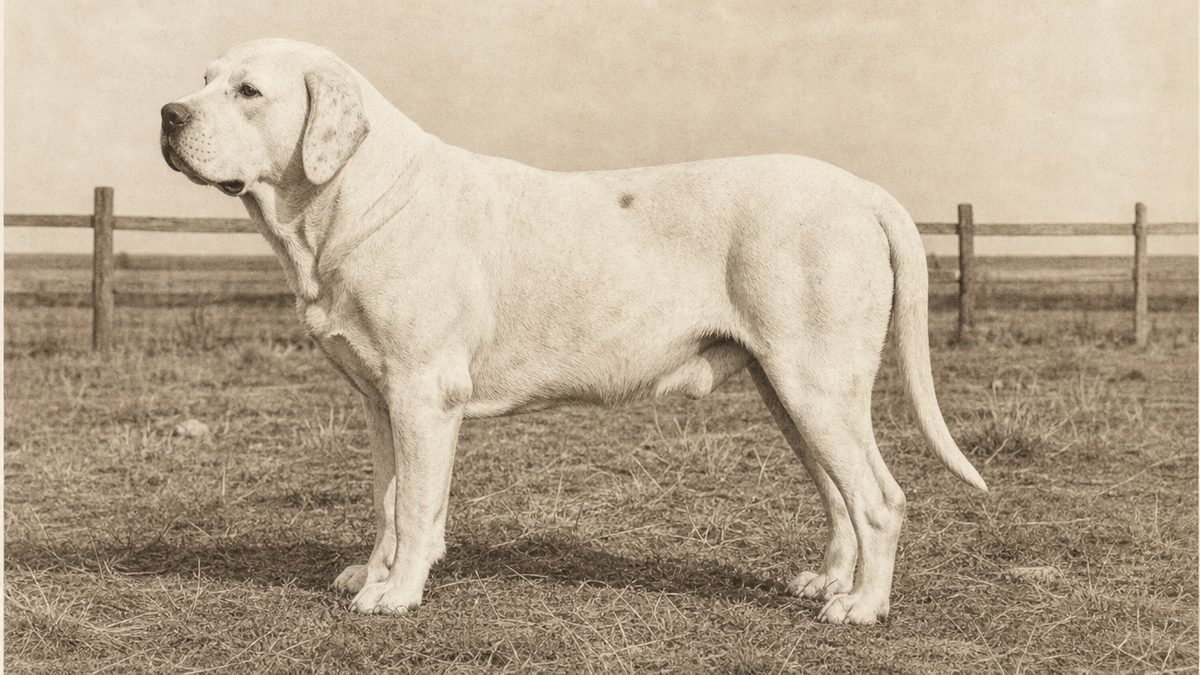
The fullest surviving physical account comes from a Modern Molosser history of the Dogo Argentino, which describes the Córdoba as dogs of good size, almost completely white, but at times with beige or black spots, and as courageous, fierce almost to the point of ferocity, resistant and tireless to pain, adding that their wounds did not seem to matter to them, and this allowed them to triumph in any kind of struggle. The Argentina Independent's 2009 reporting gives the same two qualities, a willingness to fight to the death and a high pain tolerance even when mortally injured.
Read those two descriptions carefully and notice what they are describing. Neither is a temperament in the ordinary sense. Both are descriptions of an animal selected to carry on past the point where a normal dog would stop, which is to say selected for its own injury.
| Figure | Source | What backs it |
|---|---|---|
| Height around 25 inches | Dog Breed Info Center | Nothing cited. No standard exists to check it against |
| Weight 55 to 90 lb (25 to 41 kg) | Dog Breed Info Center | Nothing cited |
| Weight 90 to 130 lb (41 to 59 kg) | Dog Breed Info Center, same page, same card | Nothing cited, and it contradicts the line above it |
| Life expectancy about 11 to 14 years | Dog Breed Info Center | Nothing cited, for a type with no recorded population |
| Height and weight: Unknown | Dogs and Cats Wiki infobox | Honest, and the only honest entry in the set |
One aggregator page printing two mutually exclusive weight ranges on the same specification card is the cheapest possible proof that nobody is measuring anything. Bonbeno publishes no height, weight or lifespan for this breed, because no source exists that could support one.
This is an account of a dog created for a practice that is a criminal offence in India today. Nothing here is a recommendation, a temperament guide or a sourcing route. Forcing dogs to fight is illegal in India under the Prevention of Cruelty to Animals Act, 1960, and the specific provisions are quoted in full further down this page.
Why the Córdoba fighting dog died out: three documented mechanisms and one story
Three mechanisms are documented in retrievable sources, and a fourth, the one everybody repeats, is not. The breed was absorbed into a deliberate crossbreeding programme from the mid-1920s, it lost its only lawful purpose when Argentina criminalised animal fighting in 1954, and it was already unusable for anything else because it turned on its own pack. The story that mating pairs fought instead of breeding is a separate claim, and it does not survive checking.
Mechanism one: it was bred into something else, starting in the 1920s
The largest single cause is the least dramatic. Antonio Nores Martínez began crossing the Córdoba with other breeds in the mid-1920s, and the AKC records that at that point the Córdoba was teetering on the brink of extinction. That is three decades before the ban. Whatever was left of the population was steadily absorbed into a programme whose explicit goal was to produce a different animal, and the FCI records that by 1947 the breed was already created and its genotype and phenotype were stabilized.
So the sequence runs the wrong way round from how it is usually told. The Dogo Argentino did not appear after the Córdoba died out. The Córdoba died out partly because the Dogo Argentino was being made out of it.
Mechanism two: Argentina made its only job a crime in 1954
Ley 14.346, sanctioned on 27 September 1954, lists among the acts of cruelty it punishes, at article 3 clause 8, realizar actos públicos o privados de riñas de animales, corridas de toros, novilladas y parodias en que se mate, hiera u hostilice a los animales, that is, carrying out public or private acts of animal fights, bullfights, heifer fights or parodies of them in which animals are killed, wounded or harassed. Article 1 sets the penalty at fifteen days to one year of imprisonment.
Wikipedia's summary of the consequence is short and, on this point, well founded: already quite rare and with no other purpose, the Córdoba dog became extinct. A dog bred for a single activity does not survive that activity being outlawed unless it can do something else.
Mechanism three: it could not do anything else
The Córdoba could not be kept as a working pack dog, and this is the mechanism with the best contemporary reporting behind it. The Argentina Independent, tracing why the Nores Martínez brothers started crossbreeding at all, states plainly that after several years, breeders realised this dog was unstable as it often turned on its own pack members. The AKC says the same thing in breeder's language, calling the Córdoba a talented hunter with one deal-breaking drawback, its understandably intense dog aggression.
Boar hunting in Argentina was pack work. A dog that attacks the dog beside it is worse than useless in a pack, so the one alternative career available to a large catch dog was closed to it. That is a real and sourced extinction pressure, and it is close enough to the folklore version to explain how the folklore grew.
| Explanation | Best available source | Verdict |
|---|---|---|
| Absorbed into the Dogo Argentino programme from the mid-1920s | AKC breed history; FCI Standard 292 | Documented |
| Lost its purpose when animal fighting was criminalised in 1954 | Ley 14.346 art. 3(8), read in the original | Documented |
| Unusable as a pack dog because it turned on packmates | The Argentina Independent, 2009; AKC breed history | Documented |
| Males were killed in the pits, thinning the population | None. Deleted from Wikipedia as dubious in 2021 | Plausible but unsourced |
| Mating pairs fought instead of breeding, so it could not reproduce | None. Deleted from Wikipedia as an absurd statement in 2016 | Folklore |
Wikipedia today carries a single sentence on this, the dog was so aggressive that fights would arise even during mating, cited to Desmond Morris, Dogs: The Ultimate Dictionary of over 1,000 Breeds, page 352. Note how much weaker that is than the version in circulation. Fights arising during mating is not the same claim as pairs refusing to mate, and it is nowhere near the claim that this is why the breed went extinct.
Tracing the fight-instead-of-mate story to the day it was deleted
The most repeated fact about this breed was deleted from Wikipedia on 17 October 2016, and the editor's entire explanation was two words, absurd statement. Everything below can be checked by anyone in about two minutes using Wikipedia's own View history tab, which is why Bonbeno traced it rather than repeating it.
The sentence, in the exact form it stood on Wikipedia until that day, was the breed had such strong aggression toward other dogs that the males and females would rather fight than mate. It carried no citation of its own. The reference that follows it in the article attaches to the previous sentence, about pain tolerance, and points at the Argentina Independent, which says nothing about mating at all.
The companion sentence lasted another four and a half years
A second sentence, in addition, many members of this breed died in the dog fighting pits, contributing to the breed's extinction, survived that edit. In June 2020 an editor tagged it and the neighbouring packmate sentence with a Citation needed template whose stated reason was simply source?. On 26 February 2021 the same editor removed both, with the summary Removed dubious text.
The same 2020 clean-up removed a temperament paragraph sourced to a site called sarahsdogs.com, with the reason that it came from a page with no author or references provided and did not meet Wikipedia's reliable-source standard. So two separate claims about this breed's character were struck from the same article inside eight months, both for the same reason.
The deleted text is still live on at least four sites
Deleting a sentence from Wikipedia does not delete it from the internet. The mirrors that copied the article while the sentence was in it never updated, and they now rank in their own right.
- Dogs and Cats Wiki, a Fandom stub whose infobox image was uploaded in October 2014, still prints both deleted sentences and carries no references at all. It also serves a noindex, nofollow robots directive, so it is being read by people and by language models rather than being ranked by Google.
- Dog Breed Info Center prints they were inbred so much for the quality of dog aggressiveness that it was difficult to breed thereafter because males and females would rather fight than mate, and its page is likewise served noindex.
- Europetnet carries the same text inside a page whose own heading reads Cirneco dell'Etna, which is a completely different breed. That is a template serving one breed's content under another breed's title.
- Social platforms carry it as a standalone fact. The India-localised search for this term returns Reddit, Instagram, YouTube, Quora, TikTok and Facebook in six of the top twelve positions, and the framing in those results is the extinction-by-aggression story.
The aggregator that prints the folklore also contradicts it
Dog Breed Info Center is worth reading to the end, because its own history section gives a completely different cause of death. After repeating the mating claim, the same page concludes that as the economy changed, Argentinians could not afford to spend money on the breeding of fighting dogs which resulted in the end of the Cordoba Fighting Dog. A page that offers two unrelated extinction mechanisms in the same article is not reporting a finding. It is assembling one.
The fight-instead-of-mate story is folklore. It is not disproved, because you cannot disprove a claim about an unrecorded population, but it has never been supported by a retrievable source, it was removed from its own most-cited home as absurd, and it survives only in mirrors that predate the deletion. The documented mechanisms in the section above are enough to explain the extinction on their own.
What it was actually made from: five source lists that do not agree
Five reference sources give five different founding-breed lists for the Córdoba, and they overlap on only two entries, the Bulldog and the Bull Terrier. Those two are the only components any primary source supports, and everything else in circulation is an addition somebody made later.
The strictest source is also the closest to the original breeders. FCI Standard No 292 for the Dogo Argentino, translated from the official Spanish, says the Old Fighting Dog of Cordoba was the product of crossbreeding among dog of the breeds Bulldogs and Bull Terriers and names nothing else.
| Source | Breeds named | Type of source |
|---|---|---|
| FCI Standard 292 | Bulldogs, Bull Terriers | The recognising body's own standard for the descendant |
| American Kennel Club | Unnamed. 'Generations of Old World mastiff-type dogs' | National kennel club breed history |
| Wikipedia, current | Spanish Mastiffs, Bull Terriers, early Bulldogs | Tertiary, sourced to a novelty book and a dog memoir |
| Wikipedia, 2020 version | Boxer, Bulldog, Bull Terrier, English Mastiff | Tertiary, sourced to Dan Rice, Big Dog Breeds, 2001 |
| Dog Breed Info Center | Fila Brasileiro, Presa Canario, English Mastiff, English Bulldog, Bullenbeisser, Boxer, American Pit Bull Terrier | Aggregator, nothing cited |
Where the Spanish Mastiff came from, and it was not Argentina
The Spanish Mastiff entered the English record on 7 April 2013, when an anonymous editor rewrote the Wikipedia sentence with this explanation: the breeds claimed in the ancestry were incorrect, per argentine dogo breeders knowledgable on the breed histories, the cordoba was a mix of SPANISH mastiff breeds and fighting offs from the USA & Britain. No source was added. That unsourced correction is now the first line of the highest-ranking page on the subject, and it is repeated across the Indian and Spanish-language web.
Two different Pyrenean breeds keep being swapped
A related error runs through the descendant's ancestry rather than the Córdoba's, and it is easy to settle. The FCI recognises Pyrenean Mastiff as standard 92 and Pyrenean Mountain Dog, the Great Pyrenees, as standard 137, from Spain and France respectively, and it lists Spanish Mastiff as standard 91. FCI Standard 292 and the AKC both name the Pyrenean Mastiff among the Dogo's outcrosses, while the Modern Molosser history and older Wikipedia revisions name the Great PyreneesWikipedia, Córdoba fighting dog. These are three separate breeds with three separate standards, and a page that treats them as interchangeable is not reading any of them.
The current lead sentence about the Córdoba's composition is footnoted to Desmond Morris's breed dictionary and to Nanette L. Charron, Why Men Are Like Dogs and Women Are Like Cats, published by Xlibris Corporation in 2011. A related claim is footnoted to Larry Levin's Oogy: The Dog Only a Family Could Love, a 2010 memoir about a rescued bait dog. A self-published novelty title and a pet memoir are not cynological sources, and neither could establish what an Argentine dog type was crossed from.
The Dogo Argentino descends from it, and the direction of travel matters
The Dogo Argentino was built out of the Córdoba fighting dog, not the other way round, and it was built specifically to stop being a fighting dog. Antonio Nores Martínez started crossing in the mid-1920s, wrote a first standard in 1928, and by 1947 the FCI records the new breed as created and stabilised. Every step of that programme was aimed at producing a big-game hunting dog that could work in a pack.
The FCI standard states the purpose in one word under UTILIZATION: Big-game hunting dog, and its historical summary says the creator's work was based upon the methodical crossbreeding of the Old Fighting Dog of Cordoba, selecting completely white dogs for breeding, not undershot, with heavy heads and long muzzle. The dogs it was crossed with are listed there as English Bull Dog, Great Dane, Pyrenean Mastiff, Bull Terrier, Boxer, Pointer, Dogue de Bordeaux and Irish Wolfhound.
The dates, with the disagreements left in
| Date | What happened | Source |
|---|---|---|
| 1907 | Antonio Nores Martínez born | FCI Standard 292, which gives his dates as 1907 to 1956 |
| mid-1920s | Crossbreeding begins. He was 18. The Córdoba was already near extinction | AKC breed history |
| 1928 | First Dogo Argentino breed standard written, with his own drawings | AKC breed history |
| 1947 | Breed created, genotype and phenotype stabilised; standard presented at the Hunters' Club, Buenos Aires | FCI Standard 292 |
| May 1947 | The standard published in the magazine Diana | Modern Molosser |
| 1954 | Argentina criminalises animal fighting | Ley 14.346 |
| 1956 | Antonio Nores Martínez dies. AKC says murdered while bird-hunting; Modern Molosser says an abduction that ended in tragedy | AKC and Modern Molosser disagree |
| 1964 | Recognised by the Federación Cinológica Argentina and the Sociedad Rural Argentina, which open their studbook | FCI Standard 292 |
| 1973 | Accepted by the FCI | FCI Standard 292 |
| 2020 | Full recognition by the American Kennel Club | AKC breed history |
Two of those rows disagree with each other and Bonbeno is publishing both rather than picking one. The AKC states that in 1956, out bird-hunting without his Dogo, he was murdered, along with a friend, presumably in a botched burglary, while the Modern Molosser account says only that due to an abduction that ended in tragedy, Dr. Antonio died. The FCI gives the year and nothing more.
The 1928 and 1947 dates are not a contradiction
Indian pages routinely print one date or the other as the founding year, and both are right about different things. 1928 is when the first written standard and drawings were produced, several years after breeding began. 1947 is when the FCI considers the type fixed and the standard formally presented. An Indian kennel currently advertising the breed manages to garble both into the sentence that it was first raised in 1928 by the Cordoba fighting dog, which is a good indicator of how carefully the history travels.
The FCI standard requires the Dogo Argentino to be silent, never barking on the trail, and states that it should never be aggressive toward humans, a feature that will be severely observed. Aggressive or overly shy is a disqualifying fault, and so is deafness. A breed whose written standard disqualifies aggression is the deliberate opposite of the animal it was made from.
Registry status: no kennel club anywhere has ever recognised it
No kennel club recognises the Córdoba fighting dog, and the check is quick because there is only one place it could plausibly sit. FCI Group 2 was read in full on 27 August 2026 and the only Argentine breed in it is the Dogo Argentino, standard 292.
Group 2 covers Pinscher and Schnauzer, Molossoid and Swiss Mountain and Cattledogs, and Section 2.1 is the Mastiff type where any Argentine catch dog would belong. That section lists twelve countries. Under ARGENTINA there is exactly one entry, DOGO ARGENTINO (292), with a validity date of 10 November 2011. No Córdoba, no perro de pelea, no old fighting dog of any nationality.
What that settles for an Indian reader specifically
India appears in the FCI's own members and contract partners register, in the Asia, Africa and Oceania section. Indian pedigrees are issued against FCI nomenclature, so a breed absent from FCI nomenclature has no pedigree route into India at all. There is no paperwork that could exist for a Córdoba fighting dog, because there is no body anywhere in the world that could issue the first document in the chain.
Bonbeno does not report the Kennel Club of India as having refused or declined this breed, because that would be a manufactured finding. The KCI does not publish a breed list, so a query there returns nothing for this breed and nothing for every control breed too. That is a broken instrument, not evidence. The FCI route above is the one that actually answers the question.
| Register | Result for the Córdoba fighting dog | Control in the same check |
|---|---|---|
| FCI Group 2, read in full | Absent | Dogo Argentino present as standard 292 |
| FCI members register | Not applicable | India listed as a member country |
| American Kennel Club | Absent from the breed roster | Dogo Argentino fully recognised in 2020 |
| Kennel Club of India | No answer obtainable | No breed list is published, so every control also returns nothing |
Peer-reviewed literature: zero, and the zero was earned
A PubMed search for the exact phrase Cordoba fighting dog returned a count of 0 on 27 August 2026. That zero is worth more than most, because the engine did not run the phrase you typed. It broadened it into cordoba[All Fields] AND (fight OR fighting OR fights) AND (dogs[MeSH Terms] OR dogs OR dog), which is a far looser search, and still found nothing.
The control run in the same session settles that the tool was working. Dogo Argentino returned 12 records under an exact-phrase translation, including a Veterinary Record deafness study and a reproductive survey conducted in Córdoba province itselfStrain GM, Congenital sensorineural…Caffaratti M, González G, Gorla N. So the absence is a genuine finding about the breed, not an artefact of a failed query.
A dog type with no standard, no studbook and no literature is the ideal thing to sell, because nothing can be checked against anything. Treat any Indian listing using this name as a listing for an unregistered crossbreed with a rare-breed price attached.
Córdoba fighting dog price in India: there is none, and here is how that was proved
No Córdoba fighting dog price exists in India, or anywhere else, because there is nothing for sale. That is the finding, not a gap in the research, and it was established with a control search rather than by looking at an empty results page and drawing a conclusion from it.
A Firecrawl search for cordoba fighting dog price in india puppy for sale, location set to India, run on 27 August 2026, returned twelve results and not one Indian listing for the breed. What it did return was Etsy merchandise at position one, a Dogo Argentino kennel page, a US pet-insurance blog, a Europetnet page whose own heading names a different breed entirely, plus YouTube, Facebook and QuoraEuropetnet, a print-search page titled….
The control, run in the same session
An empty result proves nothing unless you show the instrument works. The identical search for dogo argentino price in india puppy returned working Indian listings with rupee prices in the top ten, including a national listing site, a Jaipur city page, a Gorakhpur trade listing and Instagram sellers advertising in Chennai and Bangalore. The search works for Indian dog listings. It simply finds none for this breed.
What the descendant costs in India, since that is where every search lands
| Claim | Source | At 84.38 | At 80.00 | At 74.00 |
|---|---|---|---|---|
| Rs 50,000 | Mr n Mrs Pet, band floor | 592.56 | 625.00 | 675.68 |
| Rs 80,000 | Mr n Mrs Pet, tier | 948.09 | 1,000.00 | 1,081.08 |
| Rs 1,00,000 | Mr n Mrs Pet, tier | 1,185.11 | 1,250.00 | 1,351.35 |
| Rs 1,20,000 | Mr n Mrs Pet, band ceiling | 1,422.13 | 1,500.00 | 1,621.62 |
| Rs 85,000 | Testify Kennel | 1,007.35 | 1,062.50 | 1,148.65 |
| USD 1,500 to 2,500 | Dog Breeds List, United States | n/a | n/a | n/a |
Read that table the careful way. Not one figure divides cleanly at 84.38 or at 74, which are the two rates that actually catch a converted price list. Four of the five divide cleanly at 80, but that proves almost nothing, because 1,000 divided by 80 is 12.5, so any rupee figure ending in three zeros passes at 80 by construction. The Rs 85,000 row is the useful one: it ends in three zeros too, yet gives 1,062.50, which is not a price any seller would print.
The honest reading is that these are rupee-native round numbers chosen by Indian sellers, not an American price list run through a calculator. One coincidence is worth flagging rather than resolving: the band ceiling of Rs 1,20,000 lands on exactly USD 1,500 at 80, and USD 1,500 is precisely the floor of the US band printed by a co-ranking American page. That may be arithmetic and it may be an anchor. Bonbeno cannot tell which, and says so.
The commercial value of an extinct name is that nothing attached to it can be checked. There is no standard to measure the dog against, no studbook to look it up in and no registry to complain to. If an Indian seller offers you a Córdoba fighting dog at any price, the price is not the problem with the offer.
Cost of ownership: what can honestly be costed for a dog nobody keeps
No cost of ownership can be published for the Córdoba fighting dog, because no population exists to cost. What can be costed is the descendant, and the published Indian figure for it does not survive contact with the standard's own weight range.
The single Indian monthly figure in circulation comes from a listing site, which states that on average, monthly expenses for a Dogo Argentino range from INR 3,000 to INR 7,000, covering food, grooming, vet visits and routine care. Treat that as a marketing claim rather than a costing, for two reasons that take a minute each to check.
Reason one: the sentence is a template with the wrong breed left in it
The same answer ends Dogo Argentinos typically cost less to maintain than Standard ones. There is no Standard variety of this breed. That phrasing belongs to a Poodle or Schnauzer template, and it survived a find-and-replace. A cost estimate produced by substituting a breed name into a generic answer is not an estimate of anything.
Reason two: the arithmetic is checkable against the standard
The FCI standard puts adult weight at 40 to 45 kg for males and 40 to 43 kg for bitches. Rs 3,000 a month is about Rs 100 a day, and Rs 100 a day has to cover the food of a 40 kg dog plus grooming, vet visits and routine care. You do not need our figure to test that. Price a bag of large-breed kibble in your own city, divide by its stated daily ration for a 40 kg dog, and see where Rs 100 lands.
The costs Indian law actually fixes
Three costs are not optional for anyone buying a dog of this line in India, and they are set by the 2017 Rules rather than by the breeder.
- Micro-chipping, required at sale under Rule 8(1)(e), which states that each pup sold is micro-chipped and a complete record of treatment and vaccination is maintained.
- Sterilisation, required before any sale of a dog over six months old under Rule 8(1)(b), unless the sale is to another licensed breeder.
- Vaccination and inoculation records, since Rule 8(1)(d) requires that only dogs in good health that have been provided the medical inoculations are sold.
Add one more that the law does not require and that this line specifically needs. A BAER hearing test is the only way to establish whether a white-coated dog of this ancestry is deaf in one or both ears, and roughly a quarter of the breed is. Indian law is silent on it: across all fourteen pages of the 2017 Rules the words BAER and deaf appear nowhere, and hearing appears once, as an appeal hearing before the Secretary, Animal Husbandry. So nobody will make you do it, and a unilaterally deaf dog will pass every test the Rules do require.
A 40 kg dog in an Indian flat costs more in management than in money. Two walks a day at hours that avoid the heat, a lift or stairwell shared with neighbours, and a building association that may take a view. Price those before you price the food.
Indian law on dog fighting, quoted from the Act and dated to the amendment
Dog fighting is a criminal offence in India under the Prevention of Cruelty to Animals Act, 1960, and two separate clauses of section 11(1) cover it. Clause (m)(ii) catches the person who sets the dogs on each other, and clause (n) catches the person who runs the place. The clauses are quoted below in the Act's own words, taken from the gazette text rather than from a summary.
Section 11(1)(m) reads, in the operative text, solely with a view to providing entertainment, (i) confines or causes to be confined any animal (including tying of an animal as a bait in a tiger or other sanctuary) so as to make it an object of prey for any other animal; or (ii) incites any animal to fight or bait any other animal.
Section 11(1)(n) reads organises, keeps, uses or acts in the management of, any place for animal fighting or for the purpose of baiting any animal or permits or offers any place to be so used or receives money for the admission of any other person to any place kept or used for any such purposes. Both clauses were cross-checked against an independent full text of section 11 before being quoted here, because a legal quotation taken from a single copy is a quotation from one transcription.
Neither clause looked like that in 1960, and the change is the interesting part
Bonbeno extracted the original 1960 gazette text as well as the current one, and they differ in two ways that nobody publishes. In the Act as passed, clause (m) had no sub-clauses at all and covered only confining an animal as prey. There was no offence of inciting an animal to fight. And clause (n) opened with the words for the purposes of his business, so running a fighting venue was an offence only if you did it commercially.
Both were changed by section 10 of the Prevention of Cruelty to Animals (Amendment) Act, 1982 (Act 26 of 1982), with effect from 30 July 1982. That section substituted clause (m), which is how sub-clause (ii) and the express fighting offence came into Indian law, and it omitted the words for the purposes of his business from clause (n). The consolidated bare Act records both changes in its own footnotes to section 11.
So the correct statement for an Indian reader is that inciting a dog to fight has been a named offence in India since 30 July 1982, and that since the same date running a fight venue is an offence whether or not you are doing it as a business.
One clause is cognizable and the other is not
This distinction decides what the police can do without a warrant, and it is set by section 31, which reads notwithstanding anything contained in the Code of Criminal Procedure, 1898, an offence punishable under clause (l), clause (n) or clause (o) of sub-section (1) of section 11 or under section 12 shall be a cognizable offence within the meaning of that Code.
| Provision | What it covers | Cognizable |
|---|---|---|
| Section 3 | Duty of every person having the care or charge of any animal to take all reasonable measures to ensure its well-being and prevent unnecessary pain or suffering | Not an offence clause |
| Section 11(1)(m)(ii) | Inciting any animal to fight or bait any other animal, solely with a view to providing entertainment | No. Not listed in section 31 |
| Section 11(1)(n) | Organising, keeping, using or managing any place for animal fighting, offering a place, or taking money for admission | Yes, under section 31 |
| Section 13 | On conviction under section 11, the court may order the animal destroyed if keeping it alive would be cruel, on veterinary evidence | Not an offence clause |
| Penalty under section 11(1) | First offence, fine not less than ten rupees and up to fifty rupees. Second or subsequent within three years, fine not less than twenty-five rupees and up to one hundred rupees, or imprisonment up to three months, or both | As above |
A maximum fine of fifty rupees for a first offence has not been revised since 1982 and is not a deterrent against an activity that PETA India describes as a form of gambling with substantial money on it. The offence is real, the clause is clear and the venue offence is cognizable. The sentence attached to it is not proportionate to what happens in the ring.
What Indian enforcement actually looks like in 2026
Indian courts have confirmed that any citizen can trigger a dog-fighting prosecution, and the gap is enforcement rather than law. The Punjab and Haryana High Court said so directly in an order of 19 March 2026, and the counsel who argued the case put the problem in one sentence.
The High Court was hearing a public interest litigation about private dog fights involving what the petition called ferocious breeds. Chief Justice Sheel Nagu and Justice Sanjiv Berry held that if a cognisable offence occurs, even a stranger can lodge an FIR, provided the information so furnished to the police or the concerned competent authority alleges the commission of a cognisable offence.
Three practical points came out of the same order. Societies for Prevention of Cruelty to Animals already exist in every district, chaired by the respective deputy commissioners, with the duties given to them under the 1960 Act. Certain offences under section 11(1) are cognisable by virtue of section 31. And if the police decline to register an FIR, the complainant may take recourse under the Bharatiya Nagarik Suraksha Sanhita, 2023.
Advocate Varnika Singh, who represented the petitioner, summarised the position afterwards: this case clearly shows that the issue is not the absence of law, but the failure of enforcement. When documented evidence, complaints, and even media reports do not result in action, it points to a serious implementation gap.
What is being enforced against, in documented terms
A Fauna Police investigation supplied to PETA India recorded organised fights staged in open fields and dedicated rings across Haryana, Maharashtra, Punjab, Rajasthan and Uttar Pradesh, and the union territories of Delhi and Jammu, using pit bulls, Pakistani bully kuttas and mastiffs.
- Duration, with fights recorded lasting up to two hours.
- Injuries, described as severe bruising, deep puncture wounds and broken bones.
- Deaths, some in the ring and others hours or days later from blood loss, shock, dehydration, exhaustion or infection.
- Mutilation, with ear cropping performed specifically so an opponent cannot grab the ears, which is separately prohibited in India.
- Baiting, with dogs trained on community dogs and on Asian palm civets, foxes, leopards and wild boars, engaging the Wild Life (Protection) Act, 1972 as well.
Why an extinct Argentine breed page carries all this
Because the Córdoba fighting dog is the same argument at a century's distance. Argentina bred an animal for the pit, criminalised the pit in 1954, and the animal did not outlive its use. India criminalised the same conduct in stages, completing it in 1982, and the practice continues in seven named states and union territories with the dogs supplied by whichever breed is currently marketed on gamenessPETA India, New Investigation Reveals….
The relevant Indian breeds are on this site and each carries the same legal note. Read the Bully Kutta, the Gull Dong and the Gull Terrier if you want to see what the modern version of this market looks like in South Asia.
Report it to the police as a cognizable offence under section 11(1)(n), and to your district Society for Prevention of Cruelty to Animals, which the High Court has confirmed exists in every district under the deputy commissioner. You do not need to be a party, a witness with standing, or the owner of any animal involved.
What this history says about breeding for aggression, and how India answers it
The Córdoba fighting dog is the cleanest natural experiment there is in breeding an animal for aggression, because the programme ran for decades, produced exactly what it aimed at, and then the trait it selected for destroyed the population's only use. Two countries have drawn opposite regulatory conclusions from that history, and India's is the more defensible one.
Take the outcome first. A breeding programme aimed at one trait produced an animal that could not be worked in a pack, could not be housed with other dogs, and had no function outside an activity that was about to be criminalisedDenise Flaim, Dogo Argentino History. Within thirty years of Nores Martínez starting work, the type was gone.
Then take the counter-experiment, which ran in the same province with the same founding stock. Selecting deliberately against dog aggression, for pack work and for a silent, human-safe temperament, produced a breed whose written standard makes aggression a disqualifying fault and which reproduces normally, with an 84 percent whelping rate in a survey of 149 bitchesCaffaratti M, González G, Gorla N. Aggression proved to be a trait that could be selected in, and then selected back out, inside roughly two decades of work.
Two regulatory answers, and the difference is conduct versus category
| United Kingdom | India | |
|---|---|---|
| What is prohibited | Possession of named types of dog | Specified acts done to any animal |
| Instrument | Dangerous Dogs Act 1991, section 1, 'Dogs bred for fighting' | Prevention of Cruelty to Animals Act, 1960, section 11(1) |
| Named breeds | Pit bull terrier and Japanese tosa in the Act; Dogo Argentino and Fila Brasileiro designated 12 August 1991; XL Bully designated 2023 and 2024 | None. No breed-specific ban of this kind |
| What the owner must not do | Breed from, sell, gift, or have such a dog unmuzzled and off lead in public | Incite any animal to fight or bait another; organise, keep, use or manage any place for animal fighting |
| Penalty | Up to six months imprisonment or a level 5 fine, or both | First offence, fine of ten to fifty rupees; second within three years, up to one hundred rupees or three months, or both |
The UK approach bans a category and catches every owner of that category, including the ones who never did anything. The Indian approach bans the conduct, which is narrower, more defensible and much harder to enforce, and the enforcement gap is exactly what the Punjab and Haryana High Court was hearing about in March 2026.
There is a live Indian proposal to move toward the UK model
PETA India is seeking an urgent amendment to the Prevention of Cruelty to Animals (Dog Breeding and Marketing) Rules, 2017, to prohibit the keeping and breeding of pit bull type dogs, using mandatory declaration, sterilisation and government registration of existing animals plus a cut-off date after which no new dogs of those breeds could be bred, kept or sold. Whatever you think of it, that is the debate an Indian reader is actually inside, and it is a live one rather than a hypothetical.
What Indian law already says about breeding for a look or a trait
One clause is closer to this argument than most people realise. Second Schedule Part II paragraph 6(9) of the 2017 Rules states, in full, breeding to create new breeds of dogs or unusual looks shall be strictly prohibited. That single sentence forecloses the enthusiast project of recreating an extinct fighting type, and it does so without needing a breed name in it.
A breed built for aggression is not a strong breed. It is a fragile one, dependent on a single use, and it disappears when that use does. The Córdoba fighting dog is the proof, and the Dogo Argentino standing beside it, bred out of the same dogs and disqualified for aggression, is the control.
Indian climate: a white, short-coated 40 kg catch dog meets a 40 degree threshold
No heat-tolerance figure exists for the Córdoba fighting dog and none can be manufactured, because no population was ever kept, weighed or observed under recorded conditions. What can be said for India rests on the descendant's standard, on the Indian heat-wave criteria, and on Indian tick data, and all three point the same way.
Start with the threshold an Indian reader is actually living under. The India Meteorological Department declares a heat wave when the maximum temperature of a station reaches at least 40 degrees C for the plains and at least 30 degrees C for hilly regions, with a coastal criterion that requires an actual maximum of 37 degrees C or more alongside a departure from normal. Heat waves typically run March to June, occasionally into July, and the peak month over India is May.
One caution on that source, because Bonbeno reads what it cites. The WHO India page's rendering of the severe-heat-wave thresholds is garbled, printing figures such as 450 degrees C, so those specific numbers are not quoted here. The plains, hilly and coastal thresholds above are printed cleanly and are the ones used.
What the descendant's standard says about coat and climate
The FCI standard for the Dogo Argentino describes the coat as uniform, short, smooth, with an average length of 1.5 to 2 cm and adds that density and thickness vary according to climate. It also records that in wintertime the Dogo grows an undercoat. A breed whose standard anticipates a winter undercoat was developed somewhere with a winter. Across most of the Indian plains there is no season that triggers one, so the coat you get is the thin summer version year round.
That cuts both ways and the honest version is not a simple warning. A short, thin coat sheds heat better than a double coat, so this is not a Husky. What it does not do is protect skin, and that is where the Indian problem sits.
The specific Indian risk is unpigmented skin under a high sun
The standard requires the dog to be entirely white, with at most one dark patch on the head covering no more than 10 percent of it, and states plainly that comparing two dogs of equal quality, the whiter should be preferred. A short white coat over unpigmented skin is the coat type with the least sun protection there is. In a country whose heat-wave season is four months long and peaks in May, midday walking is not a preference question.
| Factor | The figure | What it means in practice |
|---|---|---|
| Plains heat-wave threshold | 40 degrees C maximum | Walk before sunrise and after dark for most of March to June |
| Hilly-region threshold | 30 degrees C maximum | A Shimla or Ooty summer is already stressful for a 40 kg dog |
| Coastal criterion | 37 degrees C actual maximum | Mumbai and Chennai add humidity on top, which blocks evaporative cooling |
| Peak heat-wave month | May | Plan the first year so a puppy is not growing through its first May outdoors |
| Adult weight of the descendant | 40 to 45 kg males, 40 to 43 kg bitches | Body mass is the single largest heat-load factor you cannot change |
| Coat length | 1.5 to 2 cm, white | Good heat shedding, poor sun protection, no seasonal undercoat here |
Tick pressure is the Indian factor nobody imports into a breed page
A survey of 525 dogs across four Indian cities found 261, or 49.7 percent, infected with at least one tick-borne pathogen by PCR. Hepatozoon canis led at 30 percent, followed by Ehrlichia canis at 20.6 percent, Mycoplasma haemocanis at 12.2 percent, Anaplasma platys at 6.5 percent, Babesia vogeli at 5.5 percent and Babesia gibsoni at 0.2 percent. Ticks were found on 278 dogs, or 53 percent, and 39 percent of infected dogs carried more than one pathogen.
The authors' own conclusion is the practical one for an Indian owner. Finding one such pathogen raises the potential for multiple infections which may warrant different clinical management strategies. A short white coat makes ticks easier to see, which is the one genuine advantage this coat type has in India. Use it.
Temperament: what the record describes, and what it refuses to describe
Every surviving description of the Córdoba fighting dog's temperament describes its behaviour toward other dogs, and almost none describes its behaviour toward people. That silence is the most honest thing in the record, and it is why this section publishes no household-fit rating for the breed.
Three independent accounts agree on the same narrow point. The Modern Molosser history calls the type courageous, fierce almost to the point of ferocity, resistant and tireless to pain. The Argentina Independent describes a willingness to fight to the death and a high pain tolerance even when mortally injured, and adds that breeders found the dog unstable as it often turned on its own pack members. The AKC calls the dog aggression understandably intense and a deal-breaking drawback.
The word understandably is doing real work
The AKC's phrasing is worth pausing on, because it declines to call the aggression a fault of the animal. A dog selected across generations for the single trait of continuing to fight after injury is behaving exactly as designed. Framing that as the breed's temperament, in the way a page describes a Labrador as friendly, mistakes a breeding outcome for a personality.
What the record does not support
- Aggression toward humans. No retrieved source describes it. The deleted Wikipedia and aggregator claims about turning on the owner trace back to the same unsourced text discussed above.
- A family or household rating. Nobody kept these dogs as household animals in a way anyone recorded, so any such rating is invented.
- Trainability. No training account exists for the type, only accounts of conditioning for the pit.
- Behaviour with children. Zero sources. A page that gives this breed a child-friendliness score is generating content, not reporting it.
Bonbeno therefore publishes trait ratings for availability, published data and heat tolerance and refuses the rest. A rating you cannot source is worse than a blank, because a blank tells the reader the truth.
The one temperament claim with a real citation, read carefully
Wikipedia's current article carries one sourced temperament sentence, the dog was so aggressive that fights would arise even during mating, footnoted to Desmond Morris's breed dictionary at page 352. Bonbeno could not open that page and does not restate the claim as fact. What can be said is what the sentence does and does not assert. It asserts that fights occurred during mating. It does not assert that pairs refused to mate, that litters failed, or that this is why the breed disappeared, which are the three things the internet has built on top of it.
The FCI requires the Dogo Argentino to be silent, never barking on the trail, with a keen nose and excellent flair, vent, agile, strong, robust and especially brave, and states it should never be aggressive toward humans, a feature that will be severely observed. It must give you love without conditions or reservations, and both aggressive and overly shy are disqualifying faults.
Training: nothing from this breed transfers, and one thing about it is a criminal offence
No training method survives from the Córdoba fighting dog, because what was done to these dogs was conditioning for the pit rather than training. The only reason this section exists is that the conditioning methods are still in use in India today, they are documented, and every one of them is unlawful here.
The Argentina Independent's 2009 investigation set out the standard preparation regime in detail, and the equipment list has not changed much. It described a catmill, a rotating pole with protruding beams to which a dog is chained while a cat, puppy or rabbit is harnessed to another beam as bait; a jump pole, a hanging rope the dog bites and dangles from to build jaw muscle; weights and heavy chains strapped to the neck and body; and drugs, including testosterone, weight-gain supplements and cocaine.
Each of those is a separate Indian offence
An Indian reader should be able to name the provision rather than take our word for it.
- Bait animals are covered by section 11(1)(m)(i), which makes it an offence, solely with a view to providing entertainment, to confine any animal so as to make it an object of prey for any other animal.
- Setting dogs on each other is section 11(1)(m)(ii), inciting any animal to fight or bait any other animal.
- Drugging is section 11(1)(c), which covers wilfully and unreasonably administering any injurious drug or injurious substance to any animal.
- Heavy chaining is section 11(1)(f), keeping an animal chained or tethered for an unreasonable time on an unreasonably short or unreasonably heavy chain.
- Baiting wildlife, which PETA India's investigation records with Asian palm civets, foxes, leopards and wild boars, engages the Wild Life (Protection) Act, 1972 in addition.
PETA India's account adds that training begins when the dogs are still puppies, and that they are incited to a level of violence at which they can only be separated or controlled using sticks. That is the endpoint of this method, and it is the reason a page about an extinct breed has a training section at all.
What genuinely transfers to the living descendant
The AKC's guidance on the Dogo Argentino is short and specific. The breed requires a strong owner, intense socialization, and a clear understanding of their steely-willed nature, and its own community is careful to say that the fire of their Cordoban ancestor hasn't been completely extinguished. Socialisation here means structured, early, repeated neutral exposure to other dogs, not a dog park.
That is not a training service and it is not a grey area. Offering to prepare an animal to fight is an offence under section 11(1)(m)(ii), and providing the venue is a separate and cognizable offence under section 11(1)(n). Report it. The High Court has confirmed that any person, including a stranger to the matter, can lodge an FIR for a cognisable offence.
Exercise: the pack problem, and why it is the whole story
The Córdoba fighting dog could not be exercised in company, and that single limitation is the clearest documented cause of its disappearance. Understanding why matters more than any minutes-per-day figure, because it is the trait the descendant was built to remove and the trait Indian buyers are still sold on.
The pack constraint is described in two independent places. The Argentina Independent records that breeders found the dog unstable as it often turned on its own pack members. The mirrored aggregator version puts it in operational terms: most of the time, the Cordoba Fighting Dog could not hunt in packs or else the dogs would end up fighting each other, and could sometimes work as a single pair of opposite sexes, though it was always a risk whether they would fight each other or not.
Treat the second of those as folklore-adjacent, since it comes from the same unsourced chain as the mating claim. The first is contemporary reporting and stands on its own. Both point at the same functional problem, and the AKC confirms it independently by naming dog aggression as the drawback that forced the crossbreeding programme.
Why an animal that cannot work in company has no future
Boar hunting in Argentina was pack work, and the FCI standard records exactly what the replacement had to do: it praises the Dogo's strength, tenacity, sense of smell and bravery which make it the best in the pack of dogs to hunt wild boars, peccaries, pumas and other predators. Note the phrase, the best in the pack. A dog that cannot be in a pack fails the one alternative job available to it, which is why the only remaining use for a Córdoba was the pit, and why criminalising the pit in 1954 ended it.
What this means for an Indian owner of the descendant
Exercise planning in India is set by the heat rather than by the breed, and a 40 to 45 kg dog has the least margin of any size class. From March to June, and especially through May, the plains cross the 40 degree heat-wave threshold and the useful hours are before sunrise and after dark.
- Split the day's work into two sessions rather than one long one, because heat load accumulates.
- Avoid the group walk and the dog park entirely until you know the individual dog, which for this line means at least the first year.
- Carry water on every outing, and end the session on the dog's breathing rather than on the clock.
- Check for ticks after every outing, given that ticks were found on 53 percent of dogs in a four-city Indian survey.
- Refuse any activity that involves another dog as a target, however it is described to you.
You will find pages quoting a daily exercise requirement for the Córdoba fighting dog in minutes. Nobody exercised these dogs for recreation and nobody recorded what they needed, so any such figure was invented. The honest answer is that the requirement is unknown and the question is moot, because there is no dog to exercise.
Grooming: a short white coat in Indian humidity, and one thing that is not grooming
Grooming a coat of this type in India is a five-minute weekly job and a daily tick check, because the coat is short, smooth and roughly 1.5 to 2 cm long. The real work is skin and ears rather than hair, and the one procedure most associated with fighting dogs is not a grooming choice at all in India. It is prohibited.
The FCI describes the descendant's hair as uniform, short, smooth, with an average length of 1.5 to 2 cm, with density and thickness varying by climate, and the skin as homogeneous, thick but elastic with semi-loose subcutaneous tissue that is laxest at the throat. That combination, a thin coat over thick loose skin, sheds heat reasonably and traps moisture in the folds.
- Brush weekly with a rubber mitt, which is enough for a coat this length.
- Check the neck and throat folds after every wet-season walk, because loose skin plus humidity is where Indian skin problems start.
- Inspect for ticks daily, given 53 percent of dogs in a four-city Indian survey carried them.
- Dry the ears properly after any bath or swim rather than leaving them to air dry, which is care advice written for temperate climates and does not transfer to an Indian monsoon.
- Shade the dog rather than sun-cream it, because unpigmented skin under a 1.5 cm white coat has almost no protection during a heat-wave season that runs March to JuneFédération Cynologique Internationale.
Ear cropping is not grooming, and in India it is an offence
This is the one place where the FCI standard and Indian law point in opposite directions, and an Indian reader needs to know which one governs. The standard for the Dogo Argentino says of the ears that functionally, they should be cropped and erect, in triangular shape, and describes the uncropped alternative as an option.
Indian law does not permit that. Second Schedule Part II paragraph 6(8) of the 2017 Rules states, verbatim, there shall be no tail docking, ear cropping de-barking, de-clawing, branding, dyeing, injecting substances to enhance visual appeal, performing a surgery or procedure to camouflage or hide any defect or infirmity or any other kind of mutilation of any body part of the pup and any change of appearance by artificial means is strictly forbidden.
The reason cropping is attached to this breed family at all is not cosmetic. PETA India's investigation records that dogs used in Indian fights endure painful physical mutilations such as ear-cropping, an illegal process that involves cutting part of a dog's ears to prevent another dog from grabbing them during a fight. A cropped ear on a bull-type dog in India is a signal, not a style.
Any Indian seller showing you a cropped dog of this line is showing you something that cannot lawfully have been produced here. Do not buy it, and do not accept the explanation that it was done abroad or by a vet for health reasons. The clause covers any procedure to camouflage or hide any defect and any change of appearance by artificial means.
Health: zero data for this breed, real data for its descendant, and a gap in Indian law
No health data exists for the Córdoba fighting dog, and this page publishes no lifespan, no disease prevalence and no screening advice for it. What does exist, and matters to any Indian reader who ends up with the descendant, is a body of veterinary literature on the Dogo Argentino, and its headline finding is one that Indian breeding law does not cover.
The absence is established rather than assumed. PubMed returned zero records for the exact phrase after broadening the query on its own, while the control phrase Dogo Argentino returned twelve in the same session. There is no lifespan study, no mortality series, no screening dataset and no clinical case report for the Córdoba fighting dog anywhere in the indexed literature.
Congenital deafness runs at about one in four in the descendant
A retrospective study of 811 Dogo Argentino dogs tested by brainstem auditory evoked response found hearing status of 74.23 percent bilaterally hearing, 20.35 percent unilaterally deaf and 5.43 percent bilaterally deaf, an overall prevalence of 25.77 percent. Deafness was not associated with sex, but dogs without a patch had a significantly higher prevalence rate than patched dogs. Blue-eyed dogs showed higher rates, though the author judged the association not reliably assessable because of small numbers.
A separate histopathology paper describes the mechanism. From a litter of ten Dogo pups, five were deaf, two bilaterally and three unilaterally. Examination of one bilaterally deaf 43-day-old female found bilateral cochlear degeneration with atrophy of the stria vascularis, collapse of the cochlear duct, degeneration of the organ of Corti, and abnormal tectorial membrane, with vestibular and spiral ganglia essentially normal. The authors classify it as cochleosaccular degeneration and note the lesions resembled those described in deaf Dalmatian pups.
The standard rewards the phenotype that carries the defect
Put the two documents side by side. The FCI standard lists deafness as a disqualifying fault, and in the same document instructs that the patch must not exceed 10 percent of the head and that comparing two dogs of equal quality, the whiter should be preferred. The prevalence study finds that unpatched dogs are significantly more often deaf than patched dogs. A standard that disqualifies deafness while preferring the less-patched phenotype is pulling in two directions at once, and that is worth saying out loud rather than reconciling.
Indian law mandates testing for eleven defects and deafness is not one of them
Second Schedule Part III paragraph 8(10) of the 2017 Rules reads, verbatim from the gazette text Bonbeno extracted, the dogs shall have been tested for genetic defects, including hip dysplasia, progressive retinal atrophy, night blindness, hypothyroidism, entropion, ectropion, overshot, undershot jaw (when incisors do not touch or mesh), wry mouth, two or more missing teeth, unilateral cryptorchid or full cryptorchid males.
Across all fourteen pages of that gazette, BAER appears zero times and deaf appears zero times. The word hearing appears once, and it refers to an appeal hearing before the Secretary, Animal Husbandry. The clause opens with including, so the list is illustrative rather than closed, and a careful breeder is not excused from testing for an unlisted defect. But no Indian breeder is required by name to BAER-test the one inherited condition that affects a quarter of this breed.
Two further breed-specific findings have been published since 2021, and both are worth naming because they mark the difference between a breed with a literature and a type without one. A familial narcolepsy in Dogo Argentino dogs was traced to a tandem duplication mutation in HCRTR2, and a disproportionate dwarfism in the same breed to a PRKG2 splice site variant. Neither is common. What they show is that the descendant has attracted enough veterinary genetics to have its own named mutations, which the Córdoba fighting dog never will.
| Finding | Sample | Source |
|---|---|---|
| Congenital sensorineural deafness, 25.77 percent overall | 811 dogs, BAER tested | Strain, Veterinary Record, 2021 |
| Unilateral deafness 20.35 percent, bilateral 5.43 percent | Same 811 dogs | Strain, Veterinary Record, 2021 |
| Cochleosaccular degeneration described histologically | One 43-day-old pup from a litter of ten, five of them deaf | Coppens et al., Journal of Comparative Pathology, 2003 |
| Familial narcolepsy from a tandem duplication in HCRTR2 | Breed-specific finding | Journal of Veterinary Internal Medicine, 2025 |
| Disproportionate dwarfism from a PRKG2 splice site variant | Breed-specific finding | Genes, 2021 |
| Whelping rate 84 percent, dystocia 6.69 percent of 299 pregnancies | 149 intact bitches, Córdoba province | Caffaratti et al., Journal of Veterinary Medicine, 2013 |
The direct descendant of the Córdoba, surveyed among breeders in Córdoba province itself, reaches puberty at an average of 8.93 months, has a whelping rate of 84 percent, and across 299 pregnancies recorded 89.30 percent normal parturitions, 6.69 percent dystocia, 2.68 percent caesareans and 1.34 percent abortions. The authors conclude it is a good reproductive breed with normal reproductive functions. That does not disprove anything about the ancestor, which was a different animal selected for a different trait. It does show that this line breeds perfectly well once the aggression is bred out of it.
Feeding: no ration exists for this breed, and what transfers to a 40 kg descendant
No feeding data exists for the Córdoba fighting dog, and this page publishes no ration, no calorie figure and no food-cost estimate for it. What can be said applies to the living descendant, and the useful advice is about how a large dog is fed rather than how much.
Body condition beats portion size for a dog of this build, because the published weight range is broad. The FCI standard puts the descendant at 40 to 45 kg for males and 40 to 43 kg for bitches, describes the chest as broad and deep with the sternum reaching the level of the elbows, and requires good musculature without fat. Feed to keep the last two ribs findable under light pressure and the waist visible from above, and adjust monthly rather than following a bag chart.
Three feeding practices that raise bloat risk, and one honest caveat
A prospective cohort study of 1,637 large and giant breed dogs aged six months and over found a cumulative GDV incidence of 6 percent over the study, with risk significantly raised by increasing age, having a first-degree relative with a history of GDV, a faster speed of eating, and a raised feeding bowl. Roughly 20 percent of cases in large breeds and 52 percent in giant breeds were attributed to the raised bowl.
The caveat matters and Bonbeno states it rather than burying it. That study enrolled eleven named breeds, Akita, Bloodhound, Collie, Great Dane, Irish Setter, Irish Wolfhound, Newfoundland, Rottweiler, Saint Bernard, Standard Poodle and Weimaraner, and the Dogo Argentino was not among them. So the 6 percent incidence is not this breed's incidence and is not quoted as such. What transfers are the handling factors, which are not breed-specific: feed at floor level, slow the dog down, and split the day's food into two or three meals.
Feeding in Indian heat and Indian availability
- Feed at the cool ends of the day, before the early walk and well after the evening one, because a full stomach and a hot afternoon are a poor combination.
- Separate feeding from exercise by at least an hour in each direction.
- Weigh the dog monthly rather than eyeballing it, since a 40 kg frame hides three kilos easily.
- Buy a large-breed formulation rather than an adult all-sizes one during growth, and keep the growth rate steady rather than fast.
- Avoid free feeding entirely with any dog of this line, because a food bowl is one of the two things most likely to trigger a confrontation in a multi-dog Indian household.
On availability, large-breed dry food is stocked in every Indian metro and most tier-two cities, and cost scales with the dog rather than with the breed. Bonbeno publishes no monthly rupee figure here, because the only Indian figure in circulation for this line is the Rs 3,000 to Rs 7,000 range examined in the cost section, and that came out of a template with the wrong breed left in it.
The first year, month by month, anchored on the dates Indian law actually fixes
Every date below comes from a legal instrument or a published study rather than from a generic puppy calendar, because a page about an extinct breed has no puppy calendar of its own. The timeline applies to the living descendant, and four of its milestones are set by the 2017 Rules rather than by any breeder.
| Age | What happens | What fixes it |
|---|---|---|
| 6 to 7 weeks | Earliest practical BAER hearing test. The histopathology paper examined a bilaterally deaf pup at 43 days | Coppens et al., 2003 |
| 7 to 8 weeks | Vaccination course may start. Second Schedule Part III para 8(9) says pups shall be vaccinated 'which can start at the age of seven-eight weeks' | 2017 Rules, para 8(9) |
| 8 weeks | Earliest lawful sale. Rule 8(1)(a) requires that 'pups less than eight weeks in age are not sold' | 2017 Rules, Rule 8(1)(a) |
| At sale | Micro-chipping and a complete record of treatment and vaccination, under Rule 8(1)(e) | 2017 Rules, Rule 8(1)(e) |
| About 18 weeks | Vaccination course usually complete, per the same para 8(9) | 2017 Rules, para 8(9) |
| 3 to 6 months | Structured neutral socialisation with other dogs, which is the window that decides everything for this line | AKC breed guidance |
| 6 months | Sale after this age requires prior sterilisation under Rule 8(1)(b), unless the buyer is another licensed breeder | 2017 Rules, Rule 8(1)(b) |
| 8.9 months | Average age at puberty for bitches of the descendant breed, from a survey of 149 intact bitches | Caffaratti et al., 2013 |
| 12 months | Adult frame largely set. Target the standard's 40 to 45 kg rather than exceeding it | FCI Standard 292 |
Two of those rows are worth expanding, because they are the ones Indian buyers skip.
The hearing test is not on anybody's checklist and it should be
A BAER test can be done well before the dog goes home, and it is the only way to know. Roughly a quarter of the descendant breed is deaf in one or both ears, and a unilaterally deaf dog behaves normally in a house, which is exactly why it goes undetected and gets bred from. Indian law will not prompt you, because the mandatory genetic-defect list in Second Schedule Part III para 8(10) does not mention deafness or BAER anywhere in the Rules.
The socialisation window is short and it does not reopen
The AKC's guidance for this line is intense socialization alongside a strong owner. For an Indian household that means planned, calm, repeated exposure to other dogs at a distance the puppy can handle, arranged rather than encountered. It does not mean a crowded dog park, and it does not mean letting a heavy adolescent work things out with community dogs on the street.
Second Schedule Part II paragraph 6(4) states that female dogs shall not be mated after the age of eight years, and paragraph 6(5) requires every breeder to furnish proof of the age of their breeding females certified by a veterinary practitioner. Ask for that certificate. A breeder who cannot produce it for the mother is not operating within the Rules.
Head to head: what an Indian search for this breed actually leads you to
Searching for a Córdoba fighting dog in India leads to four other things, and none of them is the breed. The table below sets out what is genuinely on offer, what each one costs here, and what the law says about it, so you can see the substitution happening rather than discover it after paying a deposit.
The single most common landing point is the Dogo Argentino, because every account of the Córdoba names it as the descendant. That substitution is at least honest in one sense, since the lineage is real and documented in the FCI standard. It is still a different animal, bred deliberately away from dog fighting and toward big-game hunting, and it is available in India at real prices.
| What you searched | What you get | Indian price | Legal position in India |
|---|---|---|---|
| Córdoba fighting dog | Nothing. No breeder, no listing, no litter anywhere in the world | No price exists | Not banned, because there is nothing to ban. Recreating it collides with the 2017 Rules |
| Dogo Argentino | The documented descendant, FCI standard 292, big-game hunting dog | Rs 50,000 to Rs 1,20,000 and up, with one kennel quoting Rs 85,000 | Lawful to own. Prohibited by name in the UK as a dog bred for fighting |
| Bully Kutta | A large South Asian mastiff type, widely marketed on fighting ability | Varies widely by seller | Lawful to own. Fighting it is a criminal offence |
| Pit bull type | Whatever the seller has, under a name with no registry meaning | Varies widely by seller | Lawful to own. Prohibited by name in the UK |
| An unnamed white mastiff cross | An unregistered crossbreed sold on the story | Whatever is asked | Lawful, but you are paying a rare-breed premium for a mixed dog |
The Dogo Argentino is the honest comparison, and it is not a like-for-like swap
Antonio Nores Martínez set out to remove exactly the trait the Córdoba was famous for. The FCI standard records the intended utilisation as big-game hunting dog, requires the dog to be silent, never barking on the trail, and states that it should never be aggressive toward humans, a feature that will be severely observed. Aggression is a disqualifying fault. A seller who pitches you a Dogo on its Córdoba fighting ancestry is selling you the one quality its creator spent two decades breeding out.
The AKC's own history is blunter about the reason. It describes the Córdoba as a master of the fighting pits with one deal-breaking drawback, its understandably intense dog aggression, and lists what each outcross was for: the Pointer for scenting, the harlequin Great Dane for height, the Bull Terrier for the white coat, the Pyrenean Mastiff for a steady calm temperament, the Boxer for tractability and agility, and Bulldogs for jaw power.
Where the comparison genuinely helps an Indian buyer
Three of the crossing breeds are on Bonbeno already and are easier to source, cheaper to keep and better documented than anything sold as a Córdoba. Read the Boxer, the Bull Terrier and the Great Dane before you chase a rare white catch dog, because between them they cover most of what people actually want from the look.
If what appeals is a hardy, heat-adapted, low-cost dog that suits Indian conditions, the honest recommendation is the Indian Pariah Dog. It evolved in the climate it has to live in, it is free to adopt, and no part of its history requires you to explain away a fighting pit.
Any Indian seller who advertises a Córdoba fighting dog is advertising an animal that has not existed for roughly seventy years. There is no pedigree that could be issued for it, because no kennel club anywhere recognises the name. Whatever is in the crate is something else, sold at a premium for a name.
What Indian readers get wrong about this breed, and what the sources actually show
Six mistakes recur in Indian searches for this breed, and five of them come from the same place, an unsourced sentence that lived on Wikipedia for years and now circulates as fact. Each one is set out below with what the record actually supports.
- Believing the breed died out because the dogs would not mate. No source establishes this. The sentence was deleted from Wikipedia on 17 October 2016 by an editor whose entire edit summary was 'absurd statement', and it had carried no citation while it was there.
- Treating an extinct type as a purchasable breed. Nobody sells one. A search for the term plus 'price in india' returns merchandise, a Dogo Argentino kennel and a US insurance blog, while the same search run for the Dogo Argentino in the same session returns working Indian listings with rupee prices.
- Assuming a fighting breed must be banned in India. India has no breed-specific ban of this kind. What Indian law criminalises is the conduct, under section 11(1)(m)(ii) and section 11(1)(n) of the Prevention of Cruelty to Animals Act, 1960.
- Repeating that the Córdoba was part Spanish Mastiff. That claim entered the English Wikipedia in April 2013 from an anonymous editor citing unnamed Argentine breeders. The FCI standard for the descendant breed says the Old Fighting Dog of Cordoba was the product of crossing Bulldogs and Bull Terriers, and names no mastiff at all.
- Confusing the Great Pyrenees with the Pyrenean Mastiff. These are two separate FCI breeds with separate numbers, 137 and 92, from two different countries, and the sources on this lineage swap them freely.
- Thinking a modern breeder could bring the type back. Second Schedule Part II paragraph 6(9) of the 2017 Rules states that breeding to create new breeds of dogs or unusual looks shall be strictly prohibited. A revival programme is creating a breed.
The seventh mistake is the expensive one
Paying a premium for a fighting bloodline is the mistake that costs money and can end in a criminal case. Any seller who markets gameness, pit lineage or fighting ability as a selling point is describing a criminal use of the animal. Under the Act it is an offence, solely with a view to providing entertainment, to incite any animal to fight or bait any other animal, and a separate offence to organise, keep, use or act in the management of any place for animal fighting. Walk away, and consider reporting the listing.
Every claim on this page about what Wikipedia used to say can be checked in about two minutes. Open the article, click View history, and compare any two revisions. The removals described here are revisions 744781859 of 17 October 2016 and 1009038028 of 26 February 2021, and the edit summaries are the editors' own words, not ours.
Adoption: the only route that ends with a real dog
Adopt, because there is no purchase route for this breed and there never will be. Every Indian rupee spent chasing a Córdoba fighting dog buys either a different animal or a story, while shelters in every Indian metro hold large, sound, adult dogs that need homes today and cost nothing to acquire.
This is the section where a normal breed page weighs buying against adopting. Here there is nothing to weigh. The breed has no living population, no registry, no breeder and no pedigree, so the choice is between adopting a real dog and being sold something under a false name.
What to adopt if the appeal is the physical type
Large white and light-coloured mastiff crosses turn up in Indian shelters regularly, usually surrendered at eighteen months when the owner discovers what a 40 kg adolescent costs to keep. Ask a shelter directly for a large adult dog rather than a puppy. An adult's temperament is already visible, which matters far more with a heavy dog than with a small one, and it removes the guesswork that makes a puppy of unknown breeding a genuine risk in a flat.
- Ask what the dog's history with other dogs actually is, and get the answer in specifics rather than adjectives.
- Meet the dog twice on separate days before committing, once quietly indoors and once outside.
- Walk it yourself, on your own lead, for at least twenty minutes.
- Check that it is vaccinated, dewormed and sterilised, and get the dates.
- Plan the first month before the dog arrives, including where it sleeps and who walks it at 6 am.
If you are buying a Dogo Argentino instead, verify these five things
The Dogo is the lawful, obtainable descendant, so most readers of this page end up looking at one. Buying one well means checking documents rather than admiring the dog.
- Confirm a BAER hearing test result for the puppy and for both parents, because congenital sensorineural deafness runs at roughly one in four in this breed.
- Confirm the pup is at least eight weeks old, since Rule 8(1)(a) of the 2017 Rules requires that pups less than eight weeks in age are not sold.
- Confirm the pup is micro-chipped, which the same Rule requires at sale.
- Reject any dog with cropped ears, because ear cropping is strictly forbidden here under Second Schedule Part II paragraph 6(8), whatever the FCI standard says about croppingFédération Cynologique Internationale.
- Walk away from any seller who mentions fighting ability, gameness or pit lineage, and from any seller who will not let you meet the mother.
The Córdoba fighting dog existed because people wanted a dog that would keep fighting after it should have stopped, and it stopped existing when that use was made a crime. Adopting an ordinary dog is the exact opposite transaction, and it is the only one on this page that ends with an animal in your house.
Córdoba fighting dog questions, answered from the sources
Is the Cordoba fighting dog extinct?
Yes. The Córdoba fighting dog is extinct and has been since roughly the 1950s. Wikipedia's own summary is that, already quite rare and with no other purpose, it became extinct after Argentina criminalised animal fighting in 1954. No living population, breeder or registry entry exists anywhere in the world.
Why did the Cordoba Fighting Dog go extinct?
Three documented reasons and one story. It was absorbed into the Dogo Argentino breeding programme from the mid-1920s, it lost its only purpose when Argentina made animal fighting a crime in 1954 under Ley 14.346, and it could not work in a pack because it turned on its own packmates. The popular claim that mating pairs fought instead of breeding has never had a source.
Is it true the males and females would rather fight than mate?
No source supports it. That exact sentence sat on Wikipedia without a citation until 17 October 2016, when an editor deleted it with the two-word summary 'absurd statement'. It survives on Dog Breed Info Center, a Fandom stub, Europetnet and social media because those copied the article before the deletion and never updated.
cordoba fighting dog bite force
No bite force figure exists for this breed and any number you find was invented. Bite force is measured on living animals with instrumentation, and nobody ever measured a Córdoba fighting dog. PubMed returns zero records for the breed even after broadening the query on its own, against a control that returned twelve.
What was the size and weight of a Cordoba fighting dog?
Nobody recorded it, so Bonbeno publishes no figure. The one aggregator that prints measurements gives two mutually exclusive weight ranges on the same specification card, 55 to 90 lb and 90 to 130 lb, and cites nothing for either. A Fandom wiki honestly lists height and weight as Unknown.
cordoba fighting dog vs dogo argentino
They are ancestor and descendant rather than rivals. Antonio Nores Martínez built the Dogo Argentino out of Córdoba fighting dogs from the mid-1920s, crossing in Bulldog, Great Dane, Pyrenean Mastiff, Bull Terrier, Boxer, Pointer, Dogue de Bordeaux and Irish Wolfhound to produce a big-game hunting dog. The FCI standard makes aggression a disqualifying fault.
cordoba fighting dog for sale
Nothing is for sale, because the breed does not exist. A search for this term in India returns Etsy merchandise, a Dogo Argentino kennel page and a US insurance blog, while the identical search for the Dogo Argentino in the same session returns real Indian listings with rupee prices. Any Indian seller using this name is selling something else.
What breeds made the Cordoba fighting dog?
Five sources give five different answers and they overlap on only two entries. FCI Standard 292 for the descendant says the Old Fighting Dog of Cordoba was the product of crossbreeding Bulldogs and Bull Terriers, naming nothing else. The widely repeated Spanish Mastiff claim entered Wikipedia in April 2013 from an anonymous editor citing unnamed Argentine breeders.
Is the Cordoba fighting dog banned in India?
No, because there is nothing to ban. India has no breed-specific prohibition of this kind. What Indian law criminalises is the conduct, under section 11(1)(m)(ii) of the Prevention of Cruelty to Animals Act, 1960, which covers inciting any animal to fight, and section 11(1)(n), which covers running a place for animal fighting.
Is dog fighting illegal in India?
Yes, and it has two separate clauses behind it. Section 11(1)(m)(ii) makes it an offence, solely with a view to providing entertainment, to incite any animal to fight or bait any other animal. Section 11(1)(n) makes organising, keeping, using or managing any place for animal fighting an offence, and section 31 makes that one cognizable.
Can I report a dog fight in India if I am not involved?
Yes. The Punjab and Haryana High Court held on 19 March 2026 that if a cognisable offence occurs, even a stranger can lodge an FIR. Societies for Prevention of Cruelty to Animals exist in every district under the deputy commissioner, and if police decline to register the FIR you may take recourse under the BNSS, 2023.
Could someone recreate the Cordoba fighting dog today?
Not lawfully in India. Second Schedule Part II paragraph 6(9) of the Prevention of Cruelty to Animals (Dog Breeding and Marketing) Rules, 2017 states that breeding to create new breeds of dogs or unusual looks shall be strictly prohibited. A programme that assembled white bull-and-mastiff crosses and called the result a revived Córdoba is creating a breed.
cordoba fighting dog vs pitbull
The comparison cannot be made, because one of the two animals has not existed for about seventy years and was never measured while it did. Bonbeno publishes no fight matchup content. In India, staging any such contest is a criminal offence under sections 11(1)(m)(ii) and 11(1)(n) of the PCA Act 1960.
What health problems does its descendant have?
Congenital sensorineural deafness is the headline one. A study of 811 Dogo Argentino dogs tested by brainstem auditory evoked response found 25.77 percent deaf in one or both ears, 20.35 percent unilaterally and 5.43 percent bilaterally, with unpatched dogs significantly more affected than patched ones. India's 2017 breeding Rules do not mention deafness or BAER testing anywhere.
Where can I read the Argentine law that ended dog fighting?
Ley 14.346, sanctioned 27 September 1954 and published in the Boletín Oficial on 5 November 1954, is online in full. Article 3 clause 8 lists as an act of cruelty the carrying out of public or private acts of animal fights, bullfights, heifer fights or parodies in which animals are killed, wounded or harassed.
How strong was a Cordoba Fighting Dog?
Nobody measured it, so no strength, bite force or weight figure exists and any number you find was invented. What the record holds is qualitative: the fullest surviving account describes dogs of good size, almost completely white, courageous, fierce almost to the point of ferocity, resistant and tireless to pain, whose wounds did not seem to matter to them, and a 2009 report adds a high pain tolerance even when mortally injured.
What is the strongest fighting dog breed?
Bonbeno publishes no ranking of fighting breeds and no fight matchup content, because staging any such contest is a criminal offence in India under sections 11(1)(m)(ii) and 11(1)(n) of the Prevention of Cruelty to Animals Act, 1960. The history on this page argues the opposite of the question: a breed built for aggression is not a strong breed but a fragile one, dependent on a single use, and the Cordoba fighting dog disappeared when that use was criminalised in 1954.
Why are dogo argentinos illegal?
They are illegal to possess in the United Kingdom, not in India. Section 1 of the Dangerous Dogs Act 1991, headed Dogs bred for fighting, prohibits possession of named types, and the Dogo Argentino and Fila Brasileiro were designated on 12 August 1991 by the Dangerous Dogs (Designated Types) Order 1991. India has no breed-specific ban of this kind and criminalises the conduct of fighting instead, and the FCI standard for the Dogo makes aggression a disqualifying fault.
Compare with similar breeds
Córdoba fighting dog sits in 3 Bonbeno groups. Each one compares it directly against the breeds it is genuinely an alternative to, on the same figures.