
Breed profile
Calupoh in India: Wolf Ancestry, Law, Price and Heat
The wolf question answered from the FCM standard and the breed's own guardians, the CITES four-generation rule applied to an eight-generation dog, the Wild Life (Protection) Act searched for the word hybrid and found not to contain one, and an origin climate at 2,600 metres with zero months at or above 28 degrees C.
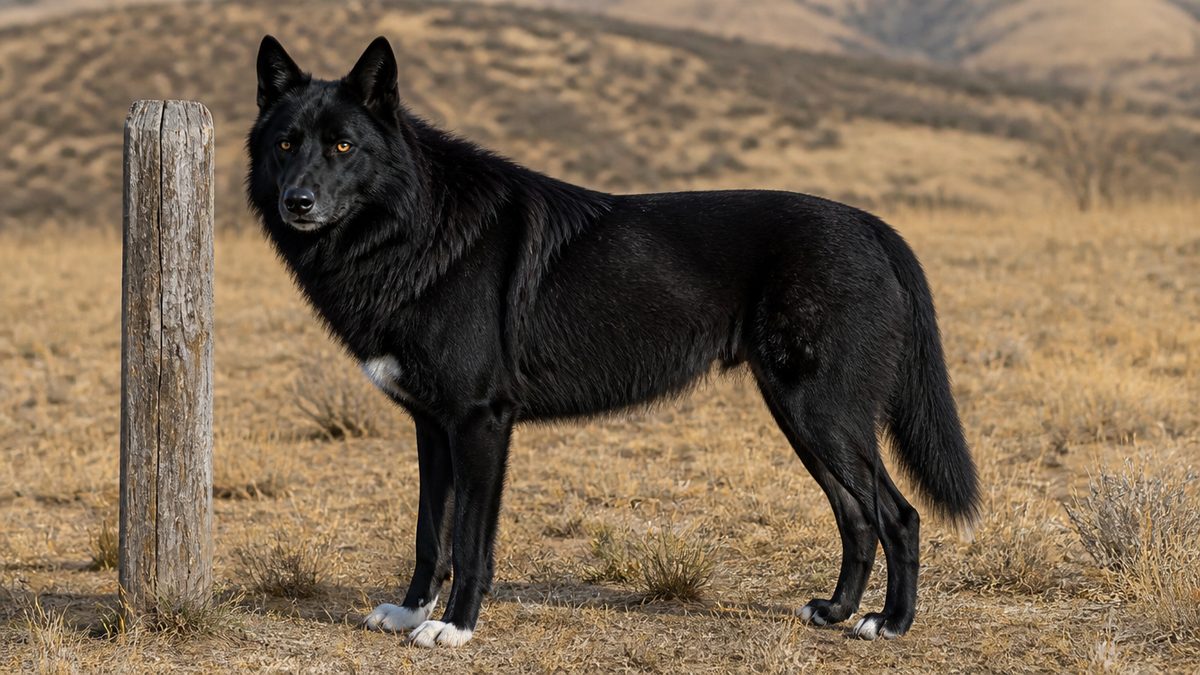
Quick answer
No calupoh price in india can be verified, because no Indian seller lists the breed and every rupee figure the query returns belongs to something else. The only sourced price is Mexican, 30,000 to 40,000 pesos from a kennel, roughly Rs 1.1 to 1.7 lakh before shipping. Modern Calupoh are not crossed with wolves, and the breed's own guardians put the last wolf eight generations back, which is outside the four-generation window CITES uses.
This guide is general information for Indian pet owners and is not a diagnosis. Consult a registered veterinarian near you before acting on anything you read here, and treat collapse, disorientation or laboured breathing after exercise in hot weather as an emergency rather than something to observe.
Calupoh at a glance
What a Calupoh actually is
A Calupoh is a large black double-coated Mexican dog breed created in a deliberate breeding programme from the 1990s, recognised nationally by the Federacion Canofila Mexicana, recorded by the American Kennel Club in its Foundation Stock Service, and not recognised by the FCI.
The official standard calls it the Perro Lobo de Mexico, the Mexican Wolfdog. It is published by the Federacion Canofila Mexicana in the magazine Perros Pura Sangre, dated July 2018, and it opens by describing the breed as "un hibridismo entre el perro y el lobo gris que se llevo a cabo en el Mexico prehispanico desde inicios de nuestra era hasta el siglo XVI", a hybridism between the dog and the grey wolf carried out in pre-Hispanic Mexico from the beginning of our era until the 16th century. Read that sentence carefully, because almost every page about this breed misreads it. The standard is describing something that happened a thousand years ago, not something a breeder did last decade.
The standard files the breed under Utilizacion: Grupo 1 Perros de Pastoreo y Boyeros, sheepdogs and cattle dogs, and then adds a second line that matters more than it looks: Clasificacion FCM: Grupo 11. The FCI's own nomenclature runs to ten groups, so a Group 11 is not an FCI group. The official English edition of the same standard prints the utilisation line and the size table but Bonbeno could not confirm whether it carries the Group 11 line, because that PDF is a magazine layout and text may have been lost in extraction. Bonbeno could not find any FCM page defining what Group 11 contains, and says so rather than guessing.
The name is an acronym, and it names its own ingredients
Calupoh is built out of the two species in it. The breed's guardian organisation in Mexico states that the name comes from Canis lupus, the wolf, Canis lupus familiaris, the dog, and a final h in homage to the surname Hank. That last letter is a clue to the programme's origin: the same source names the engineer Jorge Hank Rhon as the person who drove the project and the veterinarian Ricardo Forastieri as the person who developed it. Wikipedia independently attaches the breeding organisation Criadero Caliente and Jorge Hank Rhon to the breed's show participation.
So this is not a landrace that turned up in a village and got written down. It is a named, funded, twentieth-century project with an acronym for a name, and the honest way to describe it is as a deliberately created breed with a pre-Hispanic argument attached.
| Question | What the primary documents say |
|---|---|
| Origin | Mexico. Standard published by the Federacion Canofila Mexicana |
| Height | Males 62 to 75 cm, females 58 to 70 cm |
| Weight in the standard | None given. The standard says only that weight must not look disproportionate |
| Preferred colour | Black or smoky black. Silver in some adults. Sable accepted but not desired |
| Eyes | Clear yellow tones, almond shaped. Dark eyes permitted |
| Ears | Always erect, triangular, large and thick |
| FCI status | Not listed under C, not listed under P, not in the provisional register |
| AKC status | Foundation Stock Service, not a recognised breed |
| Indian availability | No Indian seller lists the breed, proven with a working control |
The dog the standard describes is unmistakably wolf-shaped and unmistakably a dog. It calls for a lupoid skull, ears that are always erect and carried at 85 to 95 degrees, a mane that grows in with maturity, and a tail carried below the dorsal line that may rise on alert but must never curl over the back. It also calls for a full scissor bite, disqualifies aggression and extreme shyness outright, and requires that only functionally and clinically healthy dogs be used for breeding. Those are dog-show provisions, not wildlife provisions.
Two questions on this breed have real consequences and no honest short answer. The first is how much wolf is in a modern Calupoh, which decides whether CITES applies. The second is what Indian law does with a wolf-dog hybrid, which decides whether you could lawfully keep one. Bonbeno went to the primary documents for both and reports where they run out.
The wolf question, answered from the documents
Modern Calupoh are not crossed with wolves, and the two bodies closest to the breed both say so in writing, but they disagree about which wolf started it and neither has published a genetic study on the living population.
The American Kennel Club's breed page is the plainest statement anyone has published. It says the breed originated "two thousand years ago", that Calupoh "are the result of crossing native Mexican dogs with the grey wolf", and then, in its own words, that "While no longer crossed with wolves in modern times, Calupoh retain the noble bearing and strong character of their ancient wolf ancestors";. Wikipedia says the same thing in different words: "modern lines are purebred dogs bred to a standard, not actively crossed with wolves";.
The Mexican guardian organisation is more specific and, on one point, flatly contradicts the ancient story. It states that the modern programme began in the 1990s with "un cruce controlado entre el lobo gris y el pastor aleman";, a controlled cross between the grey wolf and the German Shepherd, selected for temperament and functionality. Wikipedia records the same thing and draws the obvious conclusion out loud: "Despite being a breed with pre-Hispanic inspiration, the Calupoh was initially developed as mix of Mexican wolf with German Shepherd, the latter of which was non-existent in pre-Hispanic Mexico";.
Three accounts, and what each one actually claims
| Source | When the wolf cross happened | Which dog was used | Modern wolf crossing? |
|---|---|---|---|
| FCM official standard | Pre-Hispanic, start of our era to the 16th century | Ancient Mexican dogs | Not addressed at all |
| Guardianes del Calupoh | The 1990s, a controlled cross | German Shepherd | No. Eight generations of selection since |
| American Kennel Club | Two thousand years ago | Native Mexican dogs | No, explicitly |
| Wikipedia | The 1990s, initially | German Shepherd | No, explicitly |
The gap between row one and row two is the whole story. The FCM standard's historical summary never says a living wolf was used in the 1990s. It says a genetic project has been running "desde mediados de la decada de los 90" and presents the Calupoh as the completion of an ancient proposal. The organisation that actually breeds the dogs says a grey wolf and a German Shepherd were crossed. Both cannot be the founding event, and the standard's silence is what lets the ancient version travel unchallenged.
The genetics have not been done on the living breed
No peer-reviewed study has tested any of this. A PubMed search for the term Calupoh returns zero records, and the NCBI interface prints its own warning that the phrase was not found. The absence was earned with controls run in the same session: "Czechoslovakian wolfdog" returned 10 records, "Saarloos" returned 106, "wolf dog hybrid genetics" returned 122, and Xoloitzcuintle returned 1. A search for "perro lobo mexicano" collapsed to the separate words perro, lobo and mexicano and still returned zero.
One record does surface for the words Mexican and wolfdog together, and it is worth reading precisely because it is not about this breed. Federoff and Kueppers measured alpha-1-antitrypsin across North American Canis and found the allele frequencies of domestic dogs and grey wolves "very similar", 0.72 against 0.67 for PiM and 0.28 against 0.33 for PiS, with Mexican wolves significantly lower at PiS 0.10. That is the genetic closeness the FCM standard leans on when it explains why the ancient hybridisation was possible at all. It is not evidence about any Calupoh.
You will see wolf percentages quoted for this breed. Bonbeno found no document, from the FCM, the AKC, the guardian organisation or any journal, that states a wolf-content percentage for the Calupoh. This page therefore publishes none. A dog described as being a specific percentage wolf, without a genetic test naming the marker panel used, is being sold a story.
Eight generations, five generations, and why the number decides everything
The number of generations since the last wolf is the single fact that decides a wolf hybrid's legal status, because CITES defines recent lineage as the previous four generations and Indian law incorporates the CITES appendices wholesale.
CITES Resolution Conf. 10.17 (Rev. CoP14), titled Animal hybrids, is the provision that does the work. Its operative text decides "that hybrid animals that have in their recent lineage one or more specimens of species included in Appendix I or II shall be subject to the provisions of the Convention just as if they were full species, even if the hybrid concerned is not specifically included in the Appendices", and then adds the definition everything turns on: "as a guideline, the words 'recent lineage', as used in this Resolution, shall generally be interpreted to refer to the previous four generations of the lineage".
So the question is not philosophical. It is arithmetic. Count back four generations from the animal in front of you. If a wolf appears in that window, the animal is treated as a CITES specimen of the wolf's Appendix. If no wolf appears, it is a dog.
What the two available numbers are
The Calupoh's guardian organisation gives a specific figure. It reports that the project ran for more than two decades with clinical and genetic studies on offspring from seven different families and eight generations, undertaken to meet international parameters, and that recognition followed in August 2016 after 1,551 specimens with complete genealogies were presented. Eight generations is double the CITES window. On that account, a Calupoh registered today is not a CITES specimen, and it is a dog in law.
The other number comes from India, and it is much tighter. The Rs 50 crore "wolfdog" that ranks on page one of this very query was described by its claimed owner to The Hindu as "the fifth-generation descendant of a wolf-dog cross";, from a cross made in the United States about twenty years earlier between a rescued wolf and a Caucasian Shepherd. Five generations clears the four-generation guideline by exactly one generation. That is not a comfortable margin, and a claim of five made in a magazine interview is not a pedigree.
| Animal | Claimed generations since a wolf | Inside the CITES four-generation window? | Evidence behind the claim |
|---|---|---|---|
| Calupoh, per its guardian organisation | 8 | No | Stated on the organisation's own site, no studbook published |
| Cadabom Okami, per its claimed owner | 5 | No, by one generation | A magazine interview. The ED later found no dog and no documents |
| A first-cross wolf and dog | 1 | Yes | By definition |
| A second, third or fourth generation animal | 2 to 4 | Yes | By definition |
Indian law counts to four as well, for a different reason
There is a second four in Indian law, and it is worth noticing because it lands in the same place from a different direction. The Prevention of Cruelty to Animals (Dog Breeding and Marketing) Rules 2017 define prohibited in-breeding as "breeding between relatives of the 2nd to 4th grade in straight or side line within the first four generations", and separately prohibit incest breeding between parents and children or brother and sister. That is a welfare rule about relatedness, not a wildlife rule about species, but it means an Indian breeder is already expected to be able to name four generations of a dog's ancestry on paper. If a seller cannot produce four generations, they cannot satisfy either rule.
Ask any seller offering a wolfdog in India for a written pedigree naming four generations. Not a photograph, not a screenshot, not a verbal count. Four named generations on a document issued by a registry you can telephone. Everything else on this page follows from whether that document exists.
Kennel club recognition: national in Mexico, nowhere in the FCI
The Calupoh is recognised nationally by the Federacion Canofila Mexicana and recorded by the American Kennel Club in its Foundation Stock Service, and it appears nowhere in the FCI nomenclature or the FCI provisional register, both of which Bonbeno opened and checked with controls.
The FCM is an FCI member body, which makes this the interesting case. National recognition by an FCI member does not create an FCI breed. The FCI keeps its own nomenclature and its own provisional register, and a breed has to be admitted to one of them to have an FCI standard number and a group allocation.
Bonbeno read four FCI pages in full rather than searching for the breed name. The nomenclature under C lists 44 breeds, from CA DE BESTIAR to CURLY COATED RETRIEVER, and holds no Calupoh; the controls CHIHUAHUENO, CHOW CHOW and CANE CORSO ITALIANO are all present, so the page loaded. The nomenclature under P lists 27 breeds including PERDIGUEIRO PORTUGUES, PERDIGUERO DE BURGOS, PERRO DE AGUA ESPANOL and PERRO DOGO MALLORQUIN, and holds no PERRO LOBO of any kind.
The provisional register matters most, because a breed on its way into the FCI sits there first. Bonbeno checked the page's own heading before reading anything off it, and it reads "Breeds recognised on a provisonal basis", misspelling and all, which is how you know you have the real register and not the decoy page that serves a complete English Setter profile at a neighbouring URL. It lists 20 breeds with standard numbers from 351 to 378, including the Kazakh Tazy at 372, the Ratonero Bodeguero Andaluz at 371 and the Macedonian Shepherd Dog Karaman at 378. There is no Calupoh and no Mexican breed at all.
| Registry | Status | What was actually checked |
|---|---|---|
| Federacion Canofila Mexicana | Recognised, third Mexican breed | The FCM's own published standard, in Spanish and English |
| FCI nomenclature | Absent | Letter C, 44 breeds. Letter P, 27 breeds. Three controls each |
| FCI provisional register | Absent | All 20 breeds, numbers 351 to 378, heading verified |
| American Kennel Club | Foundation Stock Service | The AKC's own breed page carries the FSS badge where a group would go |
| American Rare Breed Association | Publishes a standard | Cited by Wikipedia. The ARBA PDF returned HTTP 503 on two attempts |
| Alliance Canine Worldwide | Recognised in 2025 | Reported by the guardian organisation, no ACW page retrieved |
| Kennel Club of India | No route | The KCI registers FCI breeds against FCI standards, and there is no FCI standard |
What Foundation Stock Service does and does not mean
The AKC's Calupoh page prints the breed name, the three-word temperament summary "loyal / attentive / even-tempered", and then a Foundation Stock Service link in the position where a fully recognised breed prints its group. Foundation Stock Service is a recording service. It gives a breed a studbook inside the AKC and a route towards eventual recognition; it does not make the breed eligible for regular AKC conformation championships. The guardian organisation dates the opening of that studbook to late 2024.
Bonbeno also retrieved the AKC's Foundation Stock Service programme page to read the roster off it, and could not: every one of the twelve occurrences of the word Calupoh on that page is inside the site-wide breed-name dropdown, and the FSS roster itself loads by script. So the status is taken from the AKC's own breed page, which names it on its own face, and the limitation is reported rather than papered over.
There is no Kennel Club of India route for this breed and there cannot be one until the FCI admits it. The KCI is India's FCI member and registers dogs of FCI-recognised breeds against FCI standards. A Mexican FCM pedigree is a real document in Mexico and carries no registration weight here, and neither does an AKC Foundation Stock Service record.
The 1999 date almost every page prints, and where it actually comes from
Almost every English page says the FCM recognised the Calupoh in September 1999, and that date traces back through Wikipedia to one 2019 news article that gives no month, misnames the recognising federation, and reads like a translation of the FCM standard.
Start with what the FCM standard itself says, in Spanish: "gracias a un intenso trabajo arqueozoologico, fue posible identificar al primer ejemplar en 1999", thanks to intense archaeozoological work it was possible to identify the first specimen in 1999. That sentence is about an archaeological specimen. It is not about a registry decision, and the standard says nothing anywhere about a recognition date.
Now follow the English claim back. Wikipedia states "In September 1999 it was recognized as a breed by the Federacion Canofila Mexicana", and the wikitext attaches exactly one reference to that sentence: a piece titled "Meet the Mexican wolf-dog" in The Yucatan Times, dated 4 October 2019. Bonbeno opened the archived capture of that article and read it.
Three things are wrong with it as a source for a recognition date. First, it gives no month at all: it says only "In 1999 was recognized as the third breed of Mexican dogs". Wikipedia's "September" appears nowhere in the article it cites. Second, the article names the recognising body as the "Mexican Canola Federation", which is a machine translation of Federacion Canofila Mexicana and tells you what kind of editing went into it. Third, and decisively, the same article says three paragraphs later, "As a result of archeological work, in 1999 the first specimen of Mexican wolf dog was identified";. It carries both sentences. It has taken the standard's archaeological date and also asserted a recognition in the same year.
| Claim | Source | Supporting detail offered |
|---|---|---|
| Recognised September 1999 | Wikipedia | One 2019 news article, which gives no month |
| Recognised 1999 | The Yucatan Times, 4 Oct 2019 | None. Same article dates the first archaeological specimen to 1999 |
| First specimen identified 1999 | FCM official standard | Attributed to intense archaeozoological work |
| Recognised August 2016 | Guardianes del Calupoh | 1,551 specimens presented with complete genealogies |
| Considered a breed today | Gaceta UNAM, quoting FMVZ UNAM | "ya esta estandarizado: los colores, el tamano, etcetera" |
Against the 1999 claim stands a much more specific one. The guardian organisation says the FCM recognised the Calupoh as the third Mexican breed in August 2016, after the presentation of 1,551 specimens with complete genealogies, and describes that step as one stage towards eventual FCI recognition. A figure like 1,551 is the kind of detail that comes from a file rather than from a summary. Bonbeno could not obtain an FCM minute or resolution confirming either date, and reports both rather than choosing.
The independent Mexican academic comment sits carefully between them. Gaceta UNAM quotes Elizardo Valadez Franco of the university's veterinary faculty saying that the Calupoh "al dia de hoy, si se le considera una raza porque ya esta estandarizado: los colores, el tamano, etcetera", it is considered a breed today because it is now standardised on colour, size and so on. That is a statement about the present, not a date.
Open the citation, not the claim. Wikipedia's footnote marker took ten seconds to click and the article behind it contradicted the sentence it was supporting. This is the cheapest fact-checking there is, and it works on every breed page on the internet including this one.
Size, coat colour and the weight nobody's standard prints
The FCM standard gives heights of 62 to 75 cm for males and 58 to 70 cm for females and deliberately gives no weight figure at all, which is why the weight ranges you see quoted come from elsewhere and disagree with each other.
The size section of the official English edition reads in full: "The height for males is 24-29 inches (62-75 cm), females 22-27 inches (58-70 cm). The weight should not cause a disproportion to the size or show a health problem, either obesity or low weight";. The Spanish edition says the same and adds nothing numeric about weight. That is a standard consciously declining to specify a weight.
Now compare the AKC. Its breed page prints height males 24-29 inches; females 22-27 inches, which is the FCM's own inch conversion reproduced digit for digit, and then prints weight 70 to 100 lbs, a figure that appears in neither edition of the standard. The Mexican guardian organisation gives 35 to 45 kg, which is 77 to 99 lb and sits neatly inside the AKC band. So two sources agree on roughly 32 to 45 kg and the standard itself is silent.
| Source | Male height | Female height | Weight |
|---|---|---|---|
| FCM standard, Spanish | 62 to 75 cm | 58 to 70 cm | None stated |
| FCM standard, English | 24 to 29 in (62 to 75 cm) | 22 to 27 in (58 to 70 cm) | None stated |
| American Kennel Club | 24 to 29 in | 22 to 27 in | 70 to 100 lb (32 to 45 kg) |
| Guardianes del Calupoh | 62 to 75 cm | 58 to 70 cm | 35 to 45 kg |
Notice that the FCM's own inch conversion is loose. 58 cm is 22.8 inches and the standard prints 22; 70 cm is 27.6 inches and it prints 27. Those rounded figures then travelled verbatim into the AKC page, which is a useful reminder that the AKC entry is derived from the Mexican standard rather than independently measured.
Coat colour, and the one genetic claim that checks out
The standard's coat section is specific. The manto is double-layered, of medium length, rough outside and soft inside. The preferred colour is black or smoky black, some adults turn silver like the wolf, and animals born white/sable or fully sable "can be accepted although these are not desirable colors". White spots are permitted on the chest and feet, plus brown socks, but never anywhere else on the body. The guardian organisation adds that sable animals are accepted on the register but not permitted at shows, and that their reproduction is not promoted.
The interesting part is where that black coat comes from. The guardian organisation states that the wolf's black colour arises from a mutation that originated in domestic dogs and entered wolves through natural hybridisation, crediting research at Stanford and the University of California. That checks out. Anderson and colleagues, publishing in Science in 2009 with a first author at Stanford, showed that melanism in the grey wolf is caused by the K locus, which encodes a beta-defensin, and that "the melanistic K locus mutation in North American wolves derives from past hybridization with domestic dogs, has risen to high frequency in forested habitats, and exhibits a molecular signature of positive selection";.
The guardian organisation adds that the melanistic variant gave carrier wolves greater resistance to distemper. Anderson and colleagues make no such finding: their paper is about pigmentation genetics and positive selection in forested habitat, and distemper appears nowhere in it. Bonbeno found no paper supporting the distemper claim for this variant and therefore does not repeat it.
Calupoh price in India, checked result by result
No calupoh price in india can be verified, because no Indian seller lists the breed at any price, and every rupee figure the query returns belongs to a different dog, a paracetamol brand or a phone.
Bonbeno ran the target query on both engines with Indian settings on 24 August 2026 and read every result. Google returned about 4,130 results and its top ten contained one page about this breed's price, a 3 minute 36 second YouTube video by Animal Platoon with 5,800 views. The rest were a Rs 50 crore wolfdog story on Facebook, an Instagram reel about the same dog, an Instagram topic page called "wolf dog price in india 2025", a Facebook post about the Haofa Tangkhul Hui, an image-search shell that returned HTTP 404 when opened, the AKC breed page, a French pet blog and an Indian retailer's catalogue.
Bing was worse, and the way it failed is the finding. Queried with cc=IN and setmkt=en-IN, it reported about 140,000 results and returned Calpol: Calpol syrup on Amazon.in, Calpol 500 mg tablets on Flipkart at Rs 14, Calpol Paracetamol 650 mg on Blinkit, Calpol 650mg on MrMed, then an iPhone price page, a Pixel price story and the 1mg pharmacy homepage. Bing printed "Missing: calupoh"; against six of the ten results and offered "calpol syrup price", "calpol amazon price" and "calpol amazon India" as related searches. A search engine that substitutes a fever medicine for a dog breed is telling you the query has no Indian commercial intent behind it.
The two Indian retailers that rank do not sell the breed
Two Indian commerce pages rank for this query, and Bonbeno retrieved both and searched their markup. Marshalls Petzone's "Genuine Breeds" catalogue contains zero occurrences of the word Calupoh; the sixteen animals it actually lists are a Pug, a Yorkshire Terrier, a Dachshund, a French Bulldog, a Pitbull, a Bullmastiff, a Belgian Malinois, a Chihuahua, a Pomeranian, a Shih Tzu, a Lhasa Apso, a Doberman Pinscher, a Dalmatian, a Cocker Spaniel and two Persian kittens. TradeIndia's Pet Dog category page also contains zero occurrences across its 31 product headings, which cover German Shepherds, Rottweilers, Siberian Huskies, cremation urns and grooming kits.
The absence, proved with a working control
An empty search result proves nothing unless you show the search works. Bonbeno ran "calupoh puppy for sale price India rupees breeder" restricted to India and got ten results, of which not one was a Calupoh listing: two dog price lists, two Cadaboms Okami news items, and six generic Indian kennel homepages the engine substituted because it had nothing better. The control was the identical query shape for a breed India genuinely sells. "Labrador retriever puppy price in india rupees breeder" returned ten breed-specific pages with live rupee bands, including Mr n Mrs Pet quoting INR 30,000 to 1,20,000 with a city-by-city table for Hyderabad, Bangalore, Delhi, Chennai, Lucknow, Mumbai, Jaipur and Pune.
Same tool, same session, same query shape. One breed produces a market, the other produces substitutes. That is a real absence rather than a broken search.
| Figure | What it is really attached to |
|---|---|
| Rs 14 | A strip of Calpol 500 mg paracetamol on Flipkart |
| Rs 2,000 to Rs 1,50,000 | The full Indian dog price range, indie to KCI show quality |
| Rs 30,000 to Rs 1,20,000 | A Labrador Retriever, the control breed |
| Rs 20 crore | Cadabom Hayder, a Caucasian Shepherd, per Google's own PAA answer |
| Rs 50 crore | Cadaboms Okami, which the Enforcement Directorate found did not exist |
| No figure at all | A Calupoh, from any Indian seller |
Ask for three things before anything else: the FCM green pedigree with the breeder's signature on the reverse, the microchip number, and the import authorisation issued by the DGFT in the importer's name. Bonbeno found no Indian listing for this breed at all, so an offer is either a different dog, an unregistered look-alike, or an import that has not happened.
The only real price is Mexican, and it survives the currency test
The only sourced purchase price for a Calupoh is Mexican: 30,000 to 40,000 pesos from a kennel in 2026, which the guardian organisation itself converts to 1,500 to 2,000 US dollars, working out at roughly Rs 1.1 lakh to Rs 1.7 lakh before shipping.
The guardian organisation publishes it plainly under a heading called Precio justo, fair price: "El valor de un Calupoh de criadero oscila entre $30,000 y $40,000 MXN (1,500 - 2,000 USD; precios 2026). Sin incluir el costo de envio", the value of a kennel Calupoh runs between 30,000 and 40,000 Mexican pesos, 1,500 to 2,000 US dollars at 2026 prices, shipping not included.
Run the arithmetic on their own conversion first, because it tells you how much care went into it. 30,000 pesos divided by 1,500 dollars is exactly 20.00. 40,000 divided by 2,000 is exactly 20.00. They have converted at a flat, round 20 pesos to the dollar rather than at a market rate, which means the dollar figures are indicative rather than transactional. That is worth knowing but it is not dishonest, and the peso figures are the primary ones.
| Figure | In USD | At Rs 84.38 per USD | At Rs 74 per USD |
|---|---|---|---|
| MXN 30,000 (kennel low) | 1,500 | Rs 1,26,570 | Rs 1,11,000 |
| MXN 40,000 (kennel high) | 2,000 | Rs 1,68,760 | Rs 1,48,000 |
| Aristopattes low | 1,500 | Rs 1,26,570 | Rs 1,11,000 |
| Aristopattes high | 3,500 | Rs 2,95,330 | Rs 2,59,000 |
| Aristopattes, imported | 4,000+ | Rs 3,37,520+ | Rs 2,96,000+ |
| Aristopattes, show or breeding | 5,000+ | Rs 4,21,900+ | Rs 3,70,000+ |
The second source is the French blog that ranks fourth in India for this query. It quotes 1,500 to 3,500 dollars from a reputable Mexican breeder, at least 4,000 dollars if you are importing outside Mexico, and over 5,000 for show or breeding quality, plus 80 to 150 dollars a month on food and 1,000 dollars or more for obedience training. Its low end matches the Mexican organisation exactly. Its high end is 75 percent above it and carries no source, and the page ends with a visible heading reading "SEO tags." listing its own target keywords, which is the tell that it was written for the query rather than from a market.
Why the rupee column is an estimate and not a price
Nothing in that table is an Indian price. It is a Mexican price converted twice, and Bonbeno publishes both rates because Indian pages routinely print dollar figures run through one exchange rate and call them local. This time the direction is honest and stated: the peso figure is real, the rupee figure is arithmetic, and the gap between them is a landed cost nobody has published. Add international air freight for a 35 to 45 kg dog in a crate, an IATA-compliant crate, veterinary health certification in Mexico, quarantine at an Indian port and customs duty, and the number stops resembling anything on that table.
For scale, Supertails puts the whole Indian dog market at Rs 2,000 for an indie or native breed to over Rs 1,50,000 for a KCI-registered show-quality dog, with monthly upkeep of Rs 3,000 to Rs 18,000 and a first-year budget of Rs 80,000 to Rs 2,00,000. The Mexican kennel price alone sits at the very top of that national range before a single rupee of transport.
The guardian organisation warns that a puppy offered without a microchip, a groin tattoo and a green FCM pedigree, at a price noticeably below the usual, indicates a scam or irresponsible breeding. It also warns against informal clauses requiring you to return the dog later so the breeder can use it. Those are useful tests in any country, including this one.
The Rs 50 crore wolfdog at position one, and what the Enforcement Directorate found
The result ranking first in India for this query is a Rs 50 crore wolfdog called Cadaboms Okami, and the Enforcement Directorate concluded the purchase was a hoax after finding no dog, no documents and no import licence.
This matters on a Calupoh page because it is what an Indian buyer meets first. In March 2025 a Bengaluru breeder, S. Satish, president of the Indian Dog Breeders Association, told reporters he had bought a rare wolfdog from the United States for about Rs 50 crore, roughly 5.7 million dollars. The story travelled worldwide and still occupies several of Google's top ten Indian results for the phrase calupoh price in india.
The claims themselves are worth reading, because they are unusually precise. Satish told The Hindu that the eight-month-old Okami is "the fifth-generation descendant of a wolf-dog cross", that about twenty years earlier in the United States "a rescued wolf and a Caucasian Shepherd were crossed", that the wolf died but the bloodline continued, and that Okami weighs 75 kg, stands 30 inches and eats about 3 kg of chicken daily. He also said "you wouldn't find it even in the records of American Kennel Club";.
That last sentence is checkable, and it is wrong in an instructive way. The AKC does hold a wolfdog breed in its records. It is the Calupoh, in Foundation Stock Service, with a breed page carrying height, weight and life expectancy.
What the investigation found
The Enforcement Directorate searched Satish's residence looking for a possible Foreign Exchange Management Act violation. NDTV reported that officers went through his bank accounts and "did not come across any huge transaction around the time the dog was allegedly purchased", and quoted a source saying the claim that the dog was of a foreign breed "may also not be true";.
The Times of India reported the outcome. During the probe "it was revealed that Satish neither possessed the dog nor had any documentation to support the alleged purchase. Officials discovered that the photographs used to substantiate the claim were of a dog owned by another individual. There were no records of foreign transactions, import licenses, or any evidence of an Rs 50-crore expenditure. The entire episode appears to have been a meticulously crafted publicity stunt";.
| Claimed | Found by the Enforcement Directorate |
|---|---|
| Bought for about Rs 50 crore in February 2025 | No matching bank transaction, no record of foreign remittance |
| Imported from the United States | No import licence on record |
| Owned by the claimant | The claimant did not possess the dog |
| Photographs of the animal | Photographs were of a dog owned by another person |
| A wolf and Caucasian Shepherd cross | A source told NDTV the foreign-breed claim may not be true |
Google's own People Also Ask box, on this same query, answers "Which dog costs 20 crore?" with a different dog from the same kennel, Cadabom Hayder, described as a Caucasian Shepherd valued at Rs 20 crore. The Hindu adds a longer list of claimed purchases from the same owner: a Korean Mastiff at Rs 1 crore, an Alaskan Malamute at Rs 8 crore, a Tibetan Mastiff at Rs 10 crore and a Caucasian Shepherd at Rs 20 crore, alongside appearance fees of Rs 2.5 lakh per hour.
The most widely reported wolfdog transaction in Indian history produced no dog, no invoice and no import licence when a federal agency looked for them. Treat every crore-rupee canine headline as marketing until a document exists. For an animal with any wolf in its recent lineage, the document that matters is an import authorisation, and there was none.
What Indian law actually says about a wolf hybrid
Indian wildlife law contains no provision about animal hybrids at all, which means a wolf-dog cross is not classified anywhere in the statute, while the grey wolf itself sits in Schedule I of the Wild Life (Protection) Act with some of the strongest protection the Act gives.
Start with the wolf, because that part is unambiguous. Schedule I of the Wild Life (Protection) Act 1972, substituted in full by the Wild Life (Protection) Amendment Act 2022 with effect from 1 April 2023, lists under CANIDS at entry 20 the Asiatic Wild Dog or Dhole, at entry 21 the Grey Wolf, Canis lupus, and at entry 22 the Jackal. Schedule I is the Act's highest tier.
Two definitions then do the work, and the 2022 amendment narrowed both. Section 2(36) now reads that a "wild animal" means any animal specified in Schedule I or Schedule II and found wild in nature, the words "Schedules I to IV" having been substituted by section 3 of the amending Act. Section 2(5) reads that a "captive animal" means any animal, specified in Schedule I or Schedule II which is captured or kept or bred in captivity. Note the asymmetry: the wild-animal definition carries the qualifier "found wild in nature" and the captive-animal definition does not.
Possession is then controlled twice over. Section 40(2) provides that no person shall "acquire, receive, keep in his control, custody or possession, sell, offer for sale or otherwise transfer or transport any animal specified in Schedule I ... except with the previous permission in writing of the Chief Wild Life Warden or the authorised officer". Section 40(2A), inserted by the 2022 amendment, goes further: no person without a certificate of ownership may acquire, receive or keep any captive animal specified in Schedule I except by way of inheritance. Section 43(1) then forbids the commercial sale of any such animal held under a certificate of ownership.
The word that is missing from the entire Act
Bonbeno searched the complete consolidated Act, 222 pages as on 5 June 2025, for the word hybrid. It appears twelve times. Two are the butterfly Heliophorus hybrida, the Hybrid Sapphire, in Schedule I. One is the Whiskered Tern, Chlidonias hybrida. The remaining nine are the CITES-derived interpretation notes in Schedule IV about artificially propagated plant hybrids. Not one provision in the Act addresses an animal hybrid.
The control on that search is the same document. The phrase "wild animal" returns 65 hits, "captive animal" returns 43, and "Canis lupus" returns 7, so the search was working. The absence is real.
| Provision | What it says | Does it name hybrids? |
|---|---|---|
| Schedule I, CANIDS entry 21 | Grey Wolf, Canis lupus | No |
| Section 2(36) | Wild animal: Schedule I or II, and found wild in nature | No |
| Section 2(5) | Captive animal: Schedule I or II, captured, kept or bred in captivity | No |
| Section 40(2) | No possession or transfer without the Chief Wild Life Warden's written permission | No |
| Section 40(2A) | No possession without a certificate of ownership, except by inheritance | No |
| Section 43(1) | No commercial sale of such an animal | No |
| Section 62A | Centre may regulate or prohibit import, trade, possession of invasive alien species | No |
Bonbeno could not find any Indian statute, rule, notification or published circular that decides at what point a dog-wolf cross stops being a dog and becomes Canis lupus in law. The Act's Schedule I entry says Canis lupus with no annotation excluding the domesticated form, while its own Schedule IV entries for the same species carry exactly that exclusion. Nobody should read this page as advice that keeping a wolf hybrid in India is lawful. If you are considering one, the person to ask is your State's Chief Wild Life Warden, in writing, before money changes hands.
CITES, the four-generation rule, and the Mexican wolf's Appendix II listing
The Mexican grey wolf sits in CITES Appendix II, the Indian wolf sits in Appendix I, the domestic dog is excluded from the Convention entirely, and a hybrid falls inside CITES only if a listed animal appears in its previous four generations.
The CITES Appendices in force from 5 March 2026 list Canis lupus twice under Family Canidae. Appendix I carries "Canis lupus (Only the populations of Bhutan, India, Nepal and Pakistan; all other populations are included in Appendix II)". Appendix II carries "Canis lupus (Except the populations of Bhutan, India, Nepal and Pakistan, which are included in Appendix I)". Both entries then add the same brace: "Excludes the domesticated form and the dingo which are referenced as Canis lupus familiaris and Canis lupus dingo, respectively, which are not subject to the provisions of the Convention".
Read those two lines together and the picture is precise. A wolf from Mexico is an Appendix II animal. A wolf from India is an Appendix I animal. A domestic dog is outside CITES altogether. India's own Schedule IV reproduces both entries word for word, including the brace excluding the domesticated form, which is how the Convention enters Indian law.
Where a hybrid lands
Resolution Conf. 10.17 (Rev. CoP14) supplies the rule. A hybrid with an Appendix I animal in its recent lineage is treated as Appendix I. A hybrid with an Appendix II animal in its recent lineage, and no Appendix I animal, is treated as Appendix II. And recent lineage means, as a guideline, the previous four generations.
| Animal | Listed ancestor | Generations back | CITES treatment |
|---|---|---|---|
| First-cross Mexican wolf and dog | Canis lupus, Mexican population, Appendix II | 1 | Appendix II specimen |
| Second to fourth generation from that cross | Same | 2 to 4 | Appendix II specimen |
| Calupoh at the claimed eighth generation | Same | 8 | Outside the guideline. Treated as a dog |
| Cadabom Okami at the claimed fifth generation | A rescued wolf, population unstated | 5 | Outside the guideline by one generation |
| Any cross involving an Indian wolf | Canis lupus, Indian population, Appendix I | 1 to 4 | Appendix I specimen, the strictest tier |
The consequences inside India are concrete. Chapter VB of the Wild Life (Protection) Act, inserted in 2022, defines a "scheduled specimen" as any specimen of a species listed in Appendices I, II or III of the Convention and incorporated as such in Schedule IV, and defines "species" to include "any species, sub-species, or geographically separate population thereof". That last phrase is what makes the Mexican population a distinct listing. Section 49H(1) then provides that no person shall engage in trade of scheduled specimens except as provided in that Chapter, and section 49N requires anyone breeding a specimen listed in Appendix I of Schedule IV to hold a licence from the Chief Wild Life Warden.
What this does not settle
It does not settle a Calupoh's position, and honesty requires saying why. The eight-generation figure comes from the breed's own guardian organisation and not from a studbook Bonbeno could inspect. Resolution Conf. 10.17 says "as a guideline", not "in every case", which leaves room for a Management Authority to take a different view. And the resolution operates on the animal in front of the officer, so a Calupoh with an undocumented recent cross would be an Appendix II specimen whatever the breed's average pedigree says.
Bonbeno found no published decision by India's CITES Management Authority on how a dog-wolf hybrid is classified, and no Indian notification applying Resolution Conf. 10.17 to any canid. The analysis above is what the texts say when read together. It is not a ruling, and no reader should treat it as permission.
Why no lawful Calupoh supply chain can form in India
Dogs are a Restricted import into India, breeding and trading applications are rejected outright, wild animals as defined by the Wild Life (Protection) Act are prohibited from import altogether, and there is no FCI standard for the Calupoh and therefore no Kennel Club of India route.
DGFT Trade Notice No. 22/2022-23 of 19 December 2022 sets out the whole position for pet animals, and Bonbeno read the five-page notice from its own extraction rather than a summary. Under ITC (HS) 01061900, mammals other than those separately classified are Restricted, subject to Policy Condition 6 of that chapter.
Policy Condition (6) is the one that bites hardest on this breed: "Import of Wild Animals (including their parts and products) as defined in the Wild Life (Protection) Act, 1972 (as amended from time to time) is prohibited and those species which are listed in CITES are subject to the provisions of CITES". Prohibited is a stronger word than Restricted. Restricted means you may apply; prohibited means there is nothing to apply for.
Policy Condition (7) then narrows dog imports to three purposes only: a pet dog with a valid pet book and relevant records in the name of the importer; dogs imported by R&D organisations with a recommendation from the CPCSEA; and dogs for internal security by the Defence and Police forces. Policy Condition (8) adds that "import of commercial dogs for breeding or any other commercial activities other than the purposes mentioned above is not permitted", and paragraph 6 of the notice states that any applications for trading or breeding purposes, or made on behalf of another person or entity, "shall be duly rejected";.
- Entry points are seven. Import of pet animals is allowed only through the airports and seaports of Delhi, Mumbai, Chennai, Hyderabad, Bengaluru and Kolkata and, since October 2024, Kochi airport, with quarantine at the government station where required Department of Animal Husbandry….
- Baggage import is narrow. Up to two pets may come as passenger baggage without DGFT authorisation only for a person transferring residence to India after two years of continuous stay abroad, and only cats and dogs qualify under the baggage rules.
- Everything else needs an authorisation. Fewer than two years abroad, more than two animals, or a temporary import all require a DGFT import authorisation, applied for on ANF-2M and examined by the Department of Animal Husbandry and Dairying.
- Timing is not casual. The notice advises starting the application at least two months before travel, and an Advance No Objection Certificate from the Animal Quarantine and Certification Service must be obtained seven days before the date of travel, relaxable to three.
The registry side closes the other end
Even if an animal arrived lawfully as somebody's transferred pet, no breeding population could form behind it. The Kennel Club of India is India's FCI member body and registers dogs of FCI-recognised breeds against FCI standards. The FCI publishes no Calupoh standard, as its nomenclature under C and under P and its provisional register all show Federation Cynologique Internationale. So there is no breed number, no group allocation and no basis for a KCI pedigree, and a Mexican FCM green pedigree does not convert into one.
Layer the 2017 Rules on top and the last door shuts. Second Schedule Part II paragraph 6(9) provides that "Breeding to create new breeds of dogs or unusual looks shall be strictly prohibited";. Whatever view a Chief Wild Life Warden took of an individual animal's ancestry, a programme in India aimed at producing wolf-looking dogs runs straight into that paragraph.
Restricted import, breeding applications duly rejected, wild animals prohibited outright, seven ports, no FCI standard, no KCI route, and an express prohibition on breeding for unusual looks. Those six facts together mean no lawful Calupoh supply chain can form in India, which is exactly what the empty search results already showed. The full route is set out in how to import a dog to India.
Rabies vaccination and hybrids: a documented grey area, reported and not resolved
A peer-reviewed case report documents rabies in a wolf-dog hybrid that had received a licensed canine rabies vaccine, and India's national rabies plan contains no provision about hybrids at all, so this page reports what each document says and stops there.
The peer-reviewed record is specific and it is old. In March 1993 an eleven-month-old neutered male wolf-dog hybrid in northern California developed progressive neurological signs over five days and was confirmed rabid by direct fluorescent antibody testing and by PCR. The animal was currently vaccinated with a USDA-approved canine rabies vaccine. A month earlier it had been seen carrying a dead skunk in its enclosure in a rabies-endemic area. Seven people required post-exposure prophylaxis.
The authors then state the position that has travelled ever since: "No rabies vaccine is currently licensed for use in wild animals or in wild-domestic animal hybrids in the United States."; They add that the case "underscores the public safety issues faced by veterinarians caring for wild-domestic animal hybrids". That is a 1994 statement about American licensing, and Bonbeno reports it as exactly that.
What the Indian documents say, which is nothing
India's National Action Plan for Dog Mediated Rabies Elimination from India by 2030 is the governing national document, published by the National Centre for Disease Control under the Ministry of Health and Family Welfare, 132 pages long. Bonbeno extracted the full text and searched it. The word "hybrid" appears zero times. The word "wolfdog" appears zero times. The word "wolf" appears exactly once, in a sentence listing the Indian wild species in which rabies has been reported: "Bear, Hyena, Jackal, Leopard, Mongoose, Sambar deer, Wolf, and fox".
The control on that search is the same document: "Rabies" returns 792 hits and "pet dog" returns 10, so the search was working. The plan's dog-side provisions address pet dogs and community-owned dogs generically, promoting registration and ensuring "that pet dogs or community owned dogs are properly vaccinated and treated against diseases";. It draws no line anywhere for an animal with wolf ancestry.
| Document | Jurisdiction | What it says |
|---|---|---|
| Jay et al. 1994, JAVMA | United States | No rabies vaccine licensed for wild-domestic hybrids; a vaccinated hybrid developed rabies |
| NAPRE 2021 | India | Silent. Zero mentions of hybrid or wolfdog in 132 pages |
| Dog Breeding and Marketing Rules 2017 | India | Pups vaccinated from seven to eight weeks, usually completed by eighteen weeks. No hybrid provision |
| Guardianes del Calupoh | Mexico | The Calupoh has the same vaccination and deworming needs as any dog |
| Indian CITES Management Authority | India | Bonbeno found no published position on canid hybrids |
The Mexican guardian organisation's position is that the Calupoh "tiene las mismas necesidades de vacunacion y desparasitacion que cualquier perro", the same vaccination and deworming needs as any dog. On an eighth-generation animal that is a reasonable position and it is consistent with the animal being a dog in law. It is not a statement about first-generation or second-generation crosses, and it is not an Indian regulatory statement.
Bonbeno could not find any Indian document, from the Central Drugs Standard Control Organisation, the Department of Animal Husbandry and Dairying or any State animal husbandry department, that addresses whether a rabies vaccine licensed for dogs may lawfully be administered to a wolf-dog hybrid, or how a municipality should treat such an animal for licensing. That question is open on the Indian record as far as Bonbeno could establish. Do not read the American 1994 statement as Indian law, and do not read the Mexican organisation's guidance as a regulatory clearance. Ask your veterinarian and your municipal authority, and get the answer in writing.
The real cost of ownership for this dog in India
A 35 to 45 kg double-coated working dog is at the expensive end of Indian dog ownership before any purchase price, and the diet its own breeders recommend, 1 to 1.5 kg of meat a day, is the single line that would dominate the budget.
Anchor on the national numbers first, because they are the only Indian figures with a published source behind them. Supertails, which ranks in India for this exact query, puts monthly upkeep at Rs 3,000 to Rs 18,000 depending on breed size and grooming needs, average monthly maintenance at Rs 3,000 to Rs 11,000, and a first-year budget including purchase, vaccinations, food, training and supplies at Rs 80,000 to Rs 2,00,000. A Calupoh belongs at the top of every one of those bands, because size is what drives them.
The feeding line, which is not like other breeds
The guardian organisation recommends a BARF diet based on meat, bones and cooked fruit and vegetables, states that the Calupoh's stomach is prepared to digest raw meat and bone, and puts an adult's requirement at 1 to 1.5 kg of meat a day depending on weight, activity and climate. It adds that kibble, if used, must be high in animal protein and grain-free, that it does not replace meat, and that BARF and kibble must never be mixed in the same meal because their digestion times differ.
One to one and a half kilos a day is 30 to 45 kg of meat a month. For scale, the claimed Rs 50 crore wolfdog in Bengaluru was reported to eat about 3 kg of chicken daily at eight months old. Bonbeno publishes no rupee figure for that meat, because Indian retail chicken and mutton prices move weekly and differ by city and Bonbeno found no single national published series it could verify. Price 35 kg a month at your own local rate and you will have a better number than any breed page can give you.
| Line | What is actually published | Source |
|---|---|---|
| Purchase, Mexico | MXN 30,000 to 40,000, roughly Rs 1.1 to 1.7 lakh | Guardian organisation, 2026 prices |
| Purchase, imported elsewhere | At least USD 4,000, roughly Rs 3 to 3.4 lakh | One unsourced blog figure |
| Import authorisation | Not obtainable for breeding or trading | DGFT Trade Notice 22/2022-23 |
| Monthly upkeep, large breed in India | Rs 3,000 to Rs 18,000 | Supertails national range |
| First year, all in | Rs 80,000 to Rs 2,00,000 | Supertails national range |
| Food, adult | 1 to 1.5 kg of meat a day, 30 to 45 kg a month | Guardian organisation |
| Professional obedience training | Quoted at USD 1,000 or more abroad | Aristopattes, no source given |
| Hip radiographs | Recommended around 8 months | Guardian organisation |
Three Indian-specific costs do not appear on any overseas breed page and belong in the budget. The first is cooling: an animal this size and this coat, in a city with four to seven months averaging 28 degrees C or above, will need air conditioning or at minimum a cooled room through the hot season, and that is an electricity line rather than a pet line. The second is space: the guardian organisation says a Calupoh can live in a flat only if it gets its exercise, and two hours a day of real work in an Indian city means either a large private plot or a daily commute to one. The third is veterinary unfamiliarity, because almost no Indian practice has seen this breed and unfamiliarity tends to cost money in referrals rather than in fees.
Do not budget from the purchase price. On this breed the purchase price is the only number anybody publishes and the one you are least likely to actually pay, because there is no lawful route to import breeding stock. Budget instead from the meat, the electricity and the two hours a day, which are the same whether the dog cost a lakh or nothing.
Heat tolerance, argued from the coat and from 2,600 metres of altitude
The Calupoh has the lowest heat tolerance of any breed Bonbeno has rated, because its origin sits at roughly 2,600 metres above sea level with an annual mean of 13.63 degrees C and not one month averaging 28 degrees C or above.
Three features of the dog set the ceiling. The standard requires a double coat of medium length, rough outside and soft inside, capable of protecting from the environment and from changes in climate. The guardian organisation adds that the coat runs about 1 cm longer in cold climates than in warm ones, that there is an abundant moult every season, and that the dog must never be clipped, only brushed. And the frame is 35 to 45 kg, which is a lot of mass for the surface area available to shed heat from.
The skull helps. A lupoid mesocephalic head with a well-marked stop and a proportional muzzle pants efficiently, and that is a genuine advantage over any short-faced breed. Hall and colleagues, working from the clinical records of 905,543 UK dogs under veterinary care in 2016, identified 395 confirmed heat-related illness events, an incidence of 0.04 percent and an event fatality rate of 14.18 percent, and found brachycephalic skull shape among the significant risk factors. The Calupoh is not brachycephalic and does not carry that penalty.
It carries two others from the same study. Hall and colleagues found higher bodyweight relative to the breed and sex mean a significant risk factor, and found dogs weighing over 50 kg at greater risk. A 45 kg male sits just under that threshold, and a heavy male sits at the top of his own breed's distribution, which is the first of those two risks.
The number that settles the argument
The follow-up study is more useful still. Hall and colleagues reported that the median ambient temperature on days of heat-related illness events was 16.9 degrees C. Now put that beside the origin climate. NASA POWER's twenty-year climatology for Teotihuacan, queried by explicit coordinates, gives the hottest month of the year, May, an average of 16.97 degrees C.
Those are the same number. The temperature at which UK dogs were presenting with heat-related illness is the temperature the Calupoh's archaeological origin reaches in its warmest month. That comparison has limits and they should be stated: the UK cohort is a different population of breeds, most of those events were triggered by exertion rather than ambient heat alone, and a median is not a threshold. But it is the clearest single indication on this page of how little heat this dog's origin ever asked it to handle.
- Subtract for the coat. A medium-length double coat with a soft insulating undercoat, which the standard requires and which cannot be clipped.
- Subtract for the mass. 35 to 45 kg, in a study that found higher relative bodyweight a risk factor.
- Subtract for the origin. Zero months at or above 28 degrees C at Teotihuacan, Mexico City or Tijuana, against four to seven in most Indian metros.
- Subtract for the drive. A Group 1 herding dog needing two hours a day, which pushes it into the exertional category behind most heat-illness events.
- Add back for the skull. Mesocephalic and efficient at panting, avoiding the brachycephalic penalty.
Walk at first light and after dark, every day of the year, not only in summer. Treat the middle of the day as indoor time and provide a genuinely cooled room through the hot season. Never shave the coat, because the undercoat is what keeps radiant heat off the skin and a shaved double coat regrows badly. Treat collapse, disorientation or laboured breathing after exertion as an emergency, not as something to watch.
Teotihuacan against nine Indian cities, on one dataset
The Calupoh's archaeological origin at Teotihuacan runs an annual mean of 13.63 degrees C at roughly 2,600 metres, against 27.95 degrees C in Chennai, a gap of more than fourteen degrees across the whole year.
Every figure below comes from one source queried one way: NASA POWER's Source Native Resolution Climatology API, MERRA-2, the twenty-year monthly and annual climatology covering January 2001 to December 2020, requested by explicit latitude and longitude rather than by place name, with the coordinates the API returned checked against the coordinates requested. Querying by coordinates removes the failure mode that has repeatedly served this project a complete, correctly formatted climate document for the wrong city.
Three Mexican anchors are given rather than one, because this breed has two origins and they are not in the same place. Teotihuacan at 19.6925 N, 98.8438 W is where the archaeological wolf-dog hybrids were excavated. Mexico City at 19.4326 N, 99.1332 W is the seat of the Federacion Canofila Mexicana. Tijuana at 32.5149 N, 117.0382 W is where the kennel associated with the modern programme operates. NASA POWER returns grid-cell elevations of 2,633 m, 2,627 m and 394 m for the three.
| Location | Annual mean T (C) | Hottest month mean (C) | Annual mean RH (percent) | Months at or above 28 C |
|---|---|---|---|---|
| Teotihuacan (archaeological origin) | 13.63 | 16.97 (May) | 66.55 | 0 |
| Mexico City | 13.83 | 17.17 (May) | 65.75 | 0 |
| Tijuana | 17.04 | 23.15 (Aug) | 62.60 | 0 |
| Chennai | 27.95 | 31.51 (May) | 72.39 | 7 |
| Ahmedabad | 27.57 | 35.06 (May) | 48.32 | 7 |
| Mumbai | 26.77 | 31.19 (May) | 67.39 | 4 |
| Hyderabad | 26.10 | 33.30 (May) | 60.30 | 4 |
| Kolkata | 25.81 | 31.53 (May) | 73.93 | 5 |
| Delhi | 25.60 | 35.88 (Jun) | 45.56 | 6 |
| Jaipur | 25.58 | 34.57 (Jun) | 40.94 | 6 |
| Pune | 23.86 | 28.93 (Apr) | 66.80 | 2 |
| Bengaluru | 23.74 | 28.37 (Apr) | 67.94 | 1 |
Read the table three ways
First, the origin is genuinely cool and there is no argument about it. Not one of the three Mexican anchors has a single month averaging 28 degrees C or above. Bengaluru, the mildest Indian city on the list, has one. Chennai and Ahmedabad have seven each. Teotihuacan's hottest month, May at 16.97 degrees C, is cooler than the coldest month of every Indian city here.
Second, altitude is doing most of the work, not latitude. Teotihuacan sits at 19.7 degrees north, further south than Delhi, Ahmedabad and Jaipur, and further south than Kolkata. It is cold because it is high. That matters because it means a reader in Bengaluru cannot reason from "Mexico is hot" to "this dog will be fine", and it means the Indian places that come closest to the origin thermally are Himalayan hill stations rather than any metro on this table.
Third, the peak matters less than the year. NASA POWER's highest recorded monthly mean maximum for Teotihuacan across the period is 30.98 degrees C, which is a warm afternoon rather than a heatwave. Delhi's is 48.79, Ahmedabad's 48.58, Kolkata's 46.81 and Jaipur's 46.92. A dog whose ancestors never met 40 degrees C at all is being asked to live through eighteen degrees more than its origin's recorded extreme.
There is no Indian metro where this breed is a comfortable fit. Bengaluru and Pune are the least bad, at one and two months at or above 28 degrees C, and both are still warmer year-round than the origin's hottest month. Chennai, Ahmedabad, Delhi and Jaipur are the hardest, on temperature, on humidity or on both. If you live in one of the four and are drawn to a wolf-shaped dog, the honest answer is that the climate argument does not work and no amount of grooming fixes it.
Temperament and household fit, and the job it must not be given
The Calupoh is described by every source as stable, loyal and easy to handle, and the Mexican archaeozoologist closest to the breed says plainly that it is a companion animal and must not be given guarding or protection work.
The standard is unusually warm for a wolf-shaped dog. It calls the Calupoh "a very agile and dynamic dog yet very stable and easy to handle that is accustomed to all kinds of activities", "a loyal and noble dog with the family", one that "easily coexists with other dogs and is always willing to please its owner but can appear as aloof before strangers";. Its utilisation line calls for "a versatile dog and great companion which due to its exaggerated tolerance and nobility, adapts to any activity". The AKC's three-word summary is "loyal / attentive / even-tempered";.
Crucially, the standard makes aggression or extreme timidity a disqualifying fault, alongside any dog showing clear signs of physical or behavioural abnormality. A breed standard that disqualifies both ends of the reactivity spectrum is telling you what the selection programme was actually for.
The warning from the researcher, not from the breeders
Raul Valadez Azua of UNAM's Instituto de Investigaciones Antropologicas, the archaeozoologist whose work on Teotihuacan's wolf-dog hybrids underpins the breed's whole historical case, has said the useful thing out loud. The Calupoh retains "rasgos reactivos heredados del lobo", reactive traits inherited from the wolf, but "esto no significa que sea un perro de guardia o de proteccion", this does not mean it is a guard or protection dog. It is "un animal de compania, que desarrolla vinculos estrechos con las personas que identifica como parte de su grupo familiar", a companion animal that forms close bonds with the people it identifies as its family group. He adds that the challenge now is to keep studying the breed "evitando atribuirle funciones de vigilancia que no corresponden a la naturaleza de esta raza", avoiding attributing to it guarding functions that do not correspond to its nature.
That is the opposite of how a wolf-looking dog is usually sold in India, and it is the single most useful sentence on this page for a buyer who wants the look for the wrong reason.
The wolf-derived habits nobody warns you about
- It howls more than it barks. The guardian organisation describes a silent dog that tends to howl rather than bark, and says it learns to bark from living with other dogs. In an Indian apartment block a howl carries further than a bark and reads as distress to neighbours.
- It digs. Enjoying digging holes in the garden is listed as normal behaviour.
- It caches food. Hiding food to eat later is described as a natural instinct of resguardo and prevision from its lupine heritage.
- It cycles once a year. Females come into season once a year like wolves rather than twice like most dogs. That halves the breeding opportunities and it also means an owner should not expect a standard six-month rhythm.
- Sable-coloured animals behave differently. The guardian organisation notes that sable Calupoh tend to behave more lobuno, more wolf-like. Sable is accepted on the register but barred from shows and not promoted for breeding.
Household fit follows from all that. The breed coexists well with other dogs and with children according to both the standard and the guardian organisation Guardianes del Calupoh, Inicio, but it is described as timid and distrustful with strangers and as hierarchical, needing clear and consistent routines to settle into a family. That combination is manageable in a house with land and a settled routine. It is a daily negotiation in a flat with deliveries, domestic help and a building security guard.
Anyone who wants a guard dog, on the researcher's own advice. Anyone in a flat who cannot commit two hours a day. Anyone in Chennai, Ahmedabad, Delhi or Jaipur, on the climate table. Anyone buying because it looks like a wolf, which is the reason the standard's disqualification of aggression exists to work against. And anyone who cannot obtain a written pedigree naming four generations.
Training a dog that howls more than it barks
Train the Calupoh with early group socialisation, positive reinforcement and a long line that does not come off, because the breed is intelligent and quick to learn but stubborn, hierarchical and frightened of new places as a puppy.
The starting point is unusual and it catches new owners out. The guardian organisation says a Calupoh puppy commonly shows fear of going out for a walk at all, and prescribes a three-step gradual introduction: carry the puppy while walking so it learns the area, sit with it somewhere public so it gets used to noises and smells, then motivate it with treats to walk a little at a time. A dog that looks like a wolf and is scared of the street is not what anyone expects, and pushing it produces exactly the extreme timidity the standard disqualifies.
If the household has no other dog, the guardian organisation recommends group training classes specifically, because the Calupoh learns confidence from other dogs and will feel safer going out with them. In Indian cities that is a real and findable option, and it should be booked before the puppy arrives rather than after the first failed walk.
What works and what the breed resists
- Socialise from the first week home. The breed shows itself fearful in new experiences, so people, dogs and environments have to be introduced deliberately and early.
- Train with positive reinforcement only. Both the guardian organisation and the AKC specify reward-based methods, and the AKC adds that consistency and positive, reward-based training yield excellent results.
- Start strength management early. Because of its physical strength the breed must be trained young to avoid accidents, which in practice means loose-lead work at eight to sixteen weeks rather than at eight months and 40 kg.
- Expect stubbornness. Intelligent and quick to learn, but its terquedad requires more patience than a biddable gundog.
- Build the bond before the obedience. On arriving in a new home the dog will be distrustful and needs time, play, walks and shared routine to integrate.
The recall is the whole programme
The AKC gives the instruction plainly and it is the one that matters in an Indian street: "Remember to not let the dog off leash, as even the best-trained dog can become distracted and not follow every command";. That is standard AKC boilerplate, but on this breed it is load-bearing. A 40 kg wolf-shaped dog loose on an Indian road is a public-safety event regardless of how friendly it is, and the reaction of the people around it will be the danger rather than the dog. Use a long line in unfenced space at every age.
The AKC also names the outlets that suit the breed's herding origin: agility, herding, tracking and dock diving. Agility and obedience are the two with real Indian club infrastructure, and either satisfies the mental-stimulation requirement the guardian organisation insists on alongside the physical one.
Because this dog howls rather than barks, an Indian housing society will hear it differently from a barking Labrador. Teach a settle on a mat from week one, and never leave the dog alone for long stretches in the first year, because a lonely howl at 2 am is how a resident welfare association meeting starts.
Exercise needs: two hours a day, and what the Indian clock does to them
The Calupoh needs a minimum of two hours of exercise a day, split into one session in the morning and one in the afternoon, plus separate mental stimulation, and in most Indian cities both sessions have to happen in the dark.
The figure is published by the breed's guardian organisation and it is not a soft recommendation. The Calupoh belongs to Grupo 1, Perros de Pastoreo y Boyeros, so it has a large working capacity; it is a high-energy dog that enjoys wide spaces to run, explore and stay active; and it needs "minimo 2 horas de ejercicio al dia, una por la manana y otra por la tarde, ademas de estimulacion mental";. The same source says the breed can live in a flat as well as a house, but only if it gets that exercise.
The AKC agrees in its own words: "As a very active and athletic breed, the Calupoh requires lots of exercise for his physical and mental well-being. A dog who is not exercised enough will become frustrated and likely to develop undesirable behaviors";.
The Indian clock problem
Two hours a day is achievable in Bengaluru and hard in Chennai, and the reason is the climate table rather than anyone's willingness. Chennai has seven months averaging 28 degrees C or above and Ahmedabad has seven; Delhi and Jaipur have six. In those cities the only usable windows are before sunrise and after dark, which means a working owner is doing an hour at 5:30 am and an hour at 8:30 pm, every day, for a dog that will live over a decade.
It also means the exertional risk is concentrated exactly where it hurts. Hall and colleagues found that most heat-related illness events were triggered by exertion, and that the risk of severe disease rose where the dog could not escape the heat source. A big double-coated dog worked hard at the wrong hour is the textbook case.
| City | Months at or above 28 C | Realistic exercise window | Mid-day policy |
|---|---|---|---|
| Bengaluru | 1 | 6 am and 6 pm most of the year | Shade and water, indoors Mar to May |
| Pune | 2 | 6 am and 6:30 pm | Indoors Apr and May |
| Mumbai | 4 | 5:45 am and 8 pm | Indoors, humidity is the limiter |
| Hyderabad | 4 | 5:45 am and 8 pm | Indoors Mar to Jun |
| Kolkata | 5 | 5:30 am and 8 pm | Indoors, humidity 73.93 percent annual |
| Delhi | 6 | 5:30 am and 9 pm | Indoors Apr to Sep |
| Jaipur | 6 | 5:30 am and 9 pm | Indoors Apr to Sep |
| Chennai | 7 | 5:30 am and 8:30 pm | Indoors most of the year |
| Ahmedabad | 7 | 5:30 am and 9 pm | Indoors most of the year |
Growth changes the rules for the first two years
This is a slow-maturing breed and over-exercising a growing one damages joints. The guardian organisation reports that during the first 6 to 8 months a Calupoh can gain 2 kg or more per week, that the first year is growth in length and height, that the ribcage broadens and muscle volume arrives after the first year, and that most animals finish developing at 2 years, with some continuing more slowly to 3 or 4. It also advises against neutering before 2 years because early sterilisation can affect physical development.
The AKC's puppy guidance fits that: short daily walks plus play sessions in a safely fenced area rather than distance work. Practical translation for an Indian owner: no jogging, no cycling alongside and no stairs work until the dog is two.
The two hours are physical. The mental stimulation is separate and it is the part an Indian summer cannot take away from you. Scent games indoors, food puzzles, obedience shaping and trick training all burn a herding dog's attention without raising its core temperature, and on a 40 degree afternoon they are the only training available.
Grooming a double coat through an Indian monsoon
Brush a Calupoh every third day, step it up to daily during the heavy seasonal moults, never clip or shave the double coat, and dry it thoroughly after every soaking because a wet undercoat in Indian humidity is where skin trouble starts.
The standard describes the coat precisely: double-layered, of medium length, rough in texture on the outside and soft on the inside, capable of protecting from the environment and from changes in climate. That soft inner layer is the undercoat, and it is both the reason the dog struggles in Indian heat and the reason you must not remove it.
The guardian organisation gives the schedule and the two dates that matter. Brush every third day to keep the coat healthy and free of knots. The first major coat change comes at 2 to 2.5 months and the second at 8 months. Every season brings an abundant moult, so the breed needs more maintenance than its short-coated look suggests. And the coat runs about 1 cm longer in cold climates than in warmer places, which is the breed adapting rather than the owner choosing.
The AKC describes the same coat from the other end: "a quick brushing every few days or so to help remove loose hairs, but they do shed more profusely once or twice a year", an occasional bath, and nails trimmed or ground every month if they are not worn down naturally. Neither source specifies clipping, and the guardian organisation states outright that the breed "no requiere cortes de pelo";, needs no haircuts.
What transfers badly to India, and one thing that transfers well
Overseas grooming guidance for double-coated breeds is written for climates where a damp dog dries. In Kolkata, at 73.93 percent annual relative humidity, and in Chennai at 72.39 percent, a thick undercoat that goes into a monsoon evening damp may still be damp in the morning. That is the mechanism behind hot spots and pyoderma in double-coated breeds in Indian cities, and the fix is mechanical rather than medical: towel to the skin, not to the topcoat, then a cool blow-dry through the undercoat until your fingers meet dry skin at the shoulder and the rump.
The thing that transfers well is the ears. The standard requires ears that are always erect, triangular, large and thick. An erect ear ventilates, and this breed therefore avoids the single most predictable Indian monsoon problem for pendulous-eared gundogs and hounds. Still check and dry the ear after every soaking and after every bath, but the anatomy is on your side here in a way it is not for a Cocker Spaniel.
- Never shave the coat. Removing the undercoat removes the insulation that keeps radiant heat off the skin, and on a double coat it regrows patchy. Heat is managed by timing and shade, not by clippers.
- Use an undercoat rake, not just a slicker. The dead soft layer is what mats and what holds water, and a slicker only reaches the topcoat.
- Bathe rarely and dry completely. An occasional bath is the AKC's own guidance, and in Indian humidity the drying matters more than the shampoo.
- Groom outdoors during the moult. A seasonal moult on a 40 kg double-coated dog fills an Indian flat.
- Check between the toes. Wide paws, which the guardian organisation notes as a breed feature, hold monsoon grit and stay wet.
Grooming is the cheapest part of owning this breed in India. No professional trim is required by either standard, no clipping is recommended by anyone, and the whole programme is a rake, a slicker, nail clippers and about fifteen minutes every third day. Budget for the brushing time, not for a groomer.
Health issues, and the register that holds nothing for this breed
The Calupoh has no published health survey, no breed screening scheme and zero rows in the Orthopedic Foundation for Animals database, against 10,691 breed rows across 271 breeds, so the only quantified risk on this page is the German Shepherd hip figure the breed inherits from.
Start with the register, because the absence is the finding. Bonbeno retrieved OFA's complete disease statistics as a 2,225,910-character dump and searched it case-insensitively. CALUPOH returns zero. So does MEXICAN. The dump itself is genuine and complete: it carries 10,691 breed rows across 271 distinct breed labels, and the controls all return data.
| Breed | Evaluations | Normal % | Dysplastic % | Mild / Moderate / Severe % |
|---|---|---|---|---|
| Calupoh | 0 | no data | no data | no data |
| German Shepherd Dog | 146,658 | 77.2 | 20.4 | 11.9 / 6.9 / 1.6 |
| Czechoslovakian Vlciak | 130 | 90.8 | 8.5 | 6.2 / 2.3 / 0.0 |
| Tamaskan | 102 | 88.2 | 11.8 | 4.9 / 5.9 / 1.0 |
| Xoloitzcuintli | 280 | 95.7 | 4.3 | 1.8 / 1.8 / 0.7 |
| Chihuahua | 175 | 93.7 | 5.7 | 4.6 / 1.1 / 0.0 |
| Caucasian Shepherd | 117 | 46.2 | 49.6 | 23.9 / 20.5 / 5.1 |
Every percentage in that table was checked by addition before it was printed. The German Shepherd's 20.4 percent dysplastic is 11.9 plus 6.9 plus 1.6, and its 77.2 percent normal is 4.9 excellent plus 51.6 good plus 20.8 fair. The arithmetic closes on every row.
Read the table one line at a time and the absence stops being neutral. OFA holds hip data on both other Mexican breeds. It holds data on the FCI-recognised wolfdog. It holds data on the Tamaskan, a breed with no wolf ancestry at all that merely looks like one. It holds 146,658 hip evaluations on the German Shepherd, which is the Calupoh's own dog parent. The Calupoh, with 1,551 animals presented on complete genealogies in 2016, has never been submitted.
There is a threshold effect worth naming honestly. The smallest hip rows in the dump start at 101 evaluations, with 220 breeds tabulated, which is consistent with a minimum submission count before a breed is tabulated at all. So a zero here means either that no Calupoh has been submitted or that fewer than about a hundred have. Either way there is no published prevalence figure for this breed anywhere.
The one inherited risk that is actually named
The guardian organisation names one condition and traces it: the Calupoh "puede llegar a tener displasia de cadera, heredada del pastor aleman", can develop hip dysplasia inherited from the German Shepherd, and it recommends radiographs at around 8 months of age. That inheritance claim is consistent with the OFA figure above, where the German Shepherd runs 20.4 percent dysplastic across a very large sample.
The eight-month timing needs a correction for Indian readers, because it is presented as screening and it is not. Eight months gives a preliminary evaluation, useful for early warning. Definitive hip grading in the schemes that publish these statistics is done at two years, which is also the age at which this breed finishes growing. Radiograph at eight months if you want early information, and again at two years if the dog is going to be bred.
What Indian law requires that no breed club does
Indian law supplies the screening list this breed lacks. The Prevention of Cruelty to Animals (Dog Breeding and Marketing) Rules 2017, Second Schedule Part III paragraph 8(10), requires that dogs "shall have been tested for genetic defects, including hip dysplasia, progressive retinal atrophy, night blindness, hypothyroidism, entropion, ectropion, overshot, undershot jaw, wry mouth, two or more missing teeth, unilateral cryptorchid or full cryptorchid males". Two items on that list are already serious faults in the breed's own standard: cryptorchidism and missing teeth.
The AKC's Calupoh page says under Health, in full, "Most Calupohs are healthy dogs";. That is a four-word statement on a breed with no health survey, no screening scheme and no register data. Treat it as a placeholder rather than as a finding, and do not let a seller quote it to you as one.
Life expectancy: 15 to 20 years against 11 to 12, and no study behind either
The two published life expectancies for the Calupoh are 15 to 20 years from its guardian organisation and 11 to 12 years from the American Kennel Club, they cannot both be right, and Bonbeno found no cohort study, insurance dataset or mortality survey behind either.
The guardian organisation states it in one line: "Su esperanza de vida es de 15 a 20 anos", its life expectancy is 15 to 20 years. The AKC's breed page prints 11-12 years in the same slot where it prints height and weight. There is no overlap between those two ranges at all. The bottom of one is three years above the top of the other.
Size is the reason to be sceptical of the higher figure rather than the lower. This is a dog of 35 to 45 kg. Body mass and longevity run in opposite directions in dogs, which is why giant breeds are short-lived and toy breeds are not. A 40 kg dog with a median lifespan of 15 to 20 years would be an extraordinary outlier and the kind of claim that would attract research attention. No research has attached to it: PubMed returns zero records for the breed, proven with controls in the same session.
| Figure | Source | Evidence offered | Plausible for a 35 to 45 kg dog? |
|---|---|---|---|
| 15 to 20 years | Guardianes del Calupoh | None stated | Would be an extreme outlier |
| 11 to 12 years | American Kennel Club | None stated | Ordinary for the size |
| No figure | FCM official standard | The standard gives no lifespan at all | Not applicable |
| No figure | Peer-reviewed literature | Zero PubMed records for the breed | Not applicable |
Notice which document is silent. The FCM standard, the one authority that actually defines the breed, gives no life expectancy anywhere in either its Spanish or its English edition Federacion Canofila Mexicana. The two figures in circulation both come from bodies describing the breed rather than from bodies that measured it.
Where a real figure would come from, and why it does not exist yet
Longevity figures that hold up come from one of three places. They come from a national kennel club health survey with a defined denominator, from an insurance dataset, or from a primary-care records study of the kind the VetCompass programme runs, which drew its heat-illness findings from the clinical records of 905,543 dogs. This breed has none of the three. Its registered population was 1,551 animals at the point of national recognition, and a population that size, scattered across private kennels, does not generate a survivable cohort study without somebody deliberately building one.
So Bonbeno publishes no life expectancy for the Calupoh. That is the honest outcome, it is the same outcome this site reached on other breeds where the numbers in circulation had nothing behind them, and it is more useful to a buyer than repeating whichever figure the seller prefers.
If a seller quotes you 15 to 20 years for this breed, ask which study. There is no study. What that question actually tests is whether the person is reading a website to you or telling you what they know, and it works on every claim on this page including the ones Bonbeno has verified.
Feeding a dog its own breeders put on 1 to 1.5 kg of meat a day
The Calupoh's guardian organisation recommends a raw BARF diet of meat, bone and cooked fruit and vegetables, putting an adult's requirement at 1 to 1.5 kg of meat a day, which is the single largest recurring cost of owning one in India.
The guidance is explicit and it is not hedged. The Calupoh is described as strong and athletic, so "su nutricion debe basarse en una dieta rica en proteinas". The ideal feeding is the BARF diet, based on meat, bones and cooked fruit and vegetables. The stomach is described as prepared to digest raw meat and bone, and "un adulto puede requerir entre 1 y 1.5 kg de carne al dia", an adult may require between 1 and 1.5 kg of meat a day depending on weight, activity level and climate, supplemented with cooked fruit and vegetables and with sources of calcium and collagen, which matter most during growth.
The same source is firm about the two mistakes. If kibble is used it must be high in animal protein and grain-free, and it does not replace meat. And "NO mezcles BARF y croquetas en la misma comida";, do not mix raw and kibble in the same meal, because their digestion times differ and the combination causes gastrointestinal problems.
The AKC's nutrition guidance is the opposite in temperature and worth reading beside it: a high-quality dog food appropriate to age, table scraps sparingly if at all, no cooked bones, no high-fat foods, and vitamin and mineral supplements unnecessary if the food is good. Both cannot be followed at once, and this page reports the disagreement rather than resolving it, because neither body has published a feeding trial.
What 1 to 1.5 kg a day means in an Indian kitchen
| Period | At 1 kg a day | At 1.5 kg a day |
|---|---|---|
| Per day | 1 kg of meat | 1.5 kg of meat |
| Per week | 7 kg | 10.5 kg |
| Per month | About 30 kg | About 45 kg |
| Per year | About 365 kg | About 548 kg |
Bonbeno publishes no rupee figure against those quantities, and the reason is method rather than caution. Indian retail chicken and mutton prices move week to week and differ substantially between cities, and Bonbeno found no single published national series it could verify and cite. Take the monthly kilos above to your own butcher and you will have a better number than any breed page can give you. For scale, the Bengaluru wolfdog that ranks on this query was reported to eat about 3 kg of chicken a day at eight months old.
Three Indian-specific cautions on raw feeding
- The cold chain is the whole safety argument. Raw feeding depends on meat that has stayed cold from slaughter to bowl. In a city with seven months averaging 28 degrees C or above, that means buying daily or freezing properly, not leaving a day's portion out.
- Growth is fast and mistakes compound. A puppy gaining 2 kg or more a week for six to eight months is laying down skeleton at speed, and an unbalanced calcium to phosphorus ratio during that window is how a large breed ends up with orthopaedic disease. Get the ratio checked by a veterinarian rather than following a recipe.
- Body condition beats any chart. Nobody has published a growth chart for this breed. Score the dog instead: you should feel ribs easily under a thin fat cover, see a waist from above and a tuck-up from the side. The standard itself refuses to give a weight and says only that weight must not show a health problem, "either obesity or low weight".
Raw diets carry real bacterial risk to the dog and to the household, and they are easy to get wrong on calcium, phosphorus and vitamin balance in a fast-growing large breed. If you want to follow the Mexican guidance, do it with an Indian veterinarian formulating it and reviewing body condition monthly through the first two years.
The first year, month by month, with Indian law attached
Plan a Calupoh's first year around three fixed points: no lawful transfer before eight weeks, a first major coat change at 2 to 2.5 months, and a second at 8 months, with joint-safe exercise until the dog finishes growing at two years.
| Age | What is happening | What you do about it |
|---|---|---|
| Birth to 3 weeks | Puppies look like bear cubs; eyes are grey | Nothing. Lawful transfer is impossible at this age |
| 4 to 6 weeks | Weaning; ears still down | Vaccination can begin from 7 to 8 weeks under the 2017 Rules |
| 8 weeks | The earliest lawful sale age in India, Rule 8(1)(a) | Take delivery no earlier. Check microchip and pedigree |
| 2 to 2.5 months | First major coat change; eye colour starts to shift from grey | Start brushing every third day. Start carrying the puppy outdoors |
| 1 to 1.5 months onward | Ears begin to stand | Do not tape or interfere. Erect ears come on their own |
| 3 to 4 months | Fear of going outside is common | Gradual exposure, group classes if there is no other dog at home |
| 4 to 6 months | Growth of 2 kg or more per week | Short walks and fenced play only. No jogging, no stairs work |
| 6 months | Sale above this age requires prior sterilisation under Rule 8(1)(b) | Relevant if you are being offered an older dog |
| 8 months | Second major coat change | Daily brushing through the moult. Preliminary hip radiographs |
| 12 months | Growth in height and length largely done | Begin building toward the two hours a day |
| 18 weeks | Vaccination course usually complete under the 2017 Rules | Confirm against the vaccination card |
| 2 years | Adult. Chest broadens, muscle fills in | Definitive hip radiographs. Neutering, if any, from here |
Two of those rows are law rather than advice. Rule 8(1) of the Prevention of Cruelty to Animals (Dog Breeding and Marketing) Rules 2017 provides that every breeder shall ensure that "(a) pups less than eight weeks in age are not sold" and that "(b) dogs over six months in age are not sold without first being sterilised, unless they are being sold to another licensed breeder";. The Second Schedule Part III paragraph 8(9) adds that all pups shall be vaccinated, which can start at seven to eight weeks and is usually completed by eighteen weeks.
The Mexican guidance lands in the same place from the other side, and that agreement is worth noticing. The guardian organisation instructs buyers to "verifica la edad del cachorro, la entrega solo debe realizarse a partir de las 8 semanas (2 meses), NUNCA ANTES", check the puppy's age, delivery only from 8 weeks, never before. The breed's own people and Indian law agree on the number.
The Facebook post that Google's own AI Overview cited as evidence on this query advertises a long-coat male puppy at 42 days old, and mentions Wolfdog Calupoh puppies in the same thread. Forty-two days is six weeks. That is two weeks below the minimum sale age in Rule 8(1)(a). Whatever breed is actually being sold there, the age alone tells you what kind of operation it is.
The growth figures come from the guardian organisation and they shape everything else in the first year: 2 kg or more per week for the first 6 to 8 months, growth in length and height through year one, ribcage and muscle after that, full development at 2 years and occasionally as late as 3 or 4. Every joint-loading decision, from stairs to car jumps to distance walking, should be made against that timetable rather than against how big the dog already looks.
Against the breeds an Indian buyer is actually choosing between
Nobody in India is comparing a Calupoh with another Calupoh, so the real comparison is against the wolf-shaped breeds that can actually be bought here, and on availability, law and heat the Calupoh loses every one of those comparisons.
Six breeds cover almost everyone who arrives at this page. Three of them look like wolves and are available in India. One is FCI-recognised and is the closest true analogue. One is the breed the Rs 50 crore story was actually about. And one is the dog the climate table quietly recommends.
| Breed | FCI status | Available in India? | OFA hip evaluations | Percent dysplastic | Months at or above 28 C at origin |
|---|---|---|---|---|---|
| Calupoh | Not listed | No listing found | 0 | no data | 0 (Teotihuacan) |
| German Shepherd | Recognised | Yes, widely | 146,658 | 20.4 | n/a |
| Siberian Husky | Recognised | Yes, widely | 22,665 | 2.3 | n/a |
| Czechoslovakian Vlciak | Recognised, standard 332 | Rare | 130 | 8.5 | n/a |
| Caucasian Shepherd | Recognised | Rare and expensive | 117 | 49.6 | n/a |
| Xoloitzcuintli | Recognised | Very rare | 280 | 4.3 | n/a |
| Indian Pariah Dog | Not applicable | Free, everywhere | no register | no data | Same as your city |
| All breeds, for scale | n/a | n/a | 1,711,996 | 14.2 | n/a |
Read the availability column first, because it decides the rest. Five of those six can be obtained in India through a lawful route. The Calupoh cannot: no Indian seller lists it, proven with a working control, no FCI standard exists so there is no Kennel Club of India registration route Federation Cynologique Internationale, and DGFT policy rejects import applications made for breeding or trading outright.
The Czechoslovakian Vlciak is the comparison that actually matters
If you want a wolfdog with paperwork, this is the breed that exists. The FCI's nomenclature under C lists CESKOSLOVENSKY VLCIAK as a recognised breed, which means an FCI standard number, a group allocation and a route into the Kennel Club of India. OFA holds 130 hip evaluations on it, showing 90.8 percent normal and 8.5 percent dysplastic, and 130 elbow evaluations showing 100 percent normal. PubMed returns 10 records for it against zero for the Calupoh.
That is the honest shape of the choice. Both breeds are wolf-derived, both are difficult, and one of them has a standard number, a screening record, a literature and a registration path while the other has an acronym and a story.
The Caucasian Shepherd, and what the Rs 50 crore dog was
The wolfdog at position one on this query is described as a wolf crossed with a Caucasian Shepherd, and Google's own People Also Ask answer names a Caucasian Shepherd, Cadabom Hayder, as the Rs 20 crore dog. Look at what OFA holds on that breed before being impressed by either figure: 117 hip evaluations, 46.2 percent normal and 49.6 percent dysplastic, the worst ratio of any breed in this table. Half the evaluated dogs of that breed have dysplastic hips, and it is being sold in India by the crore.
If what draws you to a Calupoh is a lean, self-reliant, primitive-looking dog that copes with your city, the Indian Pariah Dog is the answer the data gives. It evolved in the exact climate you live in, it costs nothing to acquire, and its origin column in the table above is your own city rather than a highland valley at 2,600 metres. Compare it also with the German Shepherd if you want the working temperament, and read the Siberian Husky page before assuming any double coat can be managed in an Indian summer.
Eight mistakes Indian buyers make with this breed
Every mistake below has been made on the record, in public, by somebody in India, and each one is avoidable by asking for a single document or checking a single number.
- Believing a wolf percentage. No document from the FCM, the AKC, the guardian organisation or any journal states a wolf-content percentage for the Calupoh. A seller who names one is inventing it, and a genetic test without a named marker panel is not a test.
- Not counting generations. The one number that decides the CITES position is the number of generations since a listed animal, and the guideline is four. Ask for four named generations on paper. The most publicised wolfdog in Indian history had none.
- Assuming FCM recognition means FCI recognition. The FCM is an FCI member, and that does not make its national breeds FCI breeds. The FCI nomenclature under C and P and the provisional register were all read in full and hold no Calupoh Federation Cynologique Internationale.
- Repeating the 1999 recognition date. It traces to one 2019 news article that gives no month and misnames the Federacion Canofila Mexicana as the "Mexican Canola Federation", while carrying the archaeological 1999 date in the same piece. The guardian organisation dates recognition to August 2016.
- Quoting the 15 to 20 year lifespan. No study supports it, PubMed holds zero records for the breed, and the AKC prints 11 to 12 years in the same slot.
- Treating it as a guard dog. The UNAM researcher whose archaeozoological work underpins the breed's history says explicitly that reactive traits inherited from the wolf do not make it a guard or protection dog, and warns against attributing guarding functions to it.
- Shaving the coat for the Indian summer. The standard requires a double coat that protects against changes in climate, the guardian organisation says the breed needs no haircuts at all, and removing an undercoat removes insulation rather than heat.
- Taking a puppy before eight weeks. Rule 8(1)(a) of the 2017 Rules prohibits the sale of pups under eight weeks, and the breed's own guardian organisation says delivery only from eight weeks, never before.
The mistake behind all eight
Every item above comes from reading a summary instead of a document. The AI Overview Google served on this query illustrates it perfectly. It states, correctly, that the Calupoh is recognised by the Federacion Canofila Mexicana and the American Kennel Club and is virtually non-existent among Indian commercial breeders. Then it hyperlinks the words "Federacion Canofila Mexicana" to thekennelclub.org.uk, the British Kennel Club, and cites as evidence a Facebook post advertising a six-week-old puppy.
That is not an argument against AI summaries in general. It is an argument for clicking the link. Two of the three claims in that overview are right and the sourcing under them is wrong, which is the exact failure mode that puts a wrong wolf percentage or a wrong lifespan into a buyer's head.
The FCM standard for what the breed is. The FCI provisional register for what it is not. DGFT Trade Notice 22/2022-23 for whether it can come here. And CITES Resolution Conf. 10.17 for what the wolf in it means. Bonbeno opened all four, and any Indian buyer can open all four in about twenty minutes.
What the pages currently ranking for this breed actually contain
Every English page ranking for this breed already knows readers are asking whether a Calupoh is legal to own, and not one of them answers the question against a statute or mentions India at all.
Bonbeno harvested the H1 to H4 headings of every retrievable page in the ranking set rather than reading their prose, because a heading shows what a page decided to cover. The pattern in them is worth reporting. DogTime carries an H3 reading "Is owning a Calupoh legal?";. DogPack's FAQ asks "Are Calupoh dogs legal to own outside of Mexico?" and "Is the Calupoh recognized by major kennel clubs?";. NAHF's FAQ asks "Are Calupoh good dogs?" and "What is a Mexican wolf dog?";. So the legality question is not one this page invented; it is the question the whole ranking set already knows readers are asking.
What none of those pages does is answer it against a statute, and none of them mentions India at all. Creatures goes further in the other direction, publishing headings for "Calupohs for Sale", "Calupoh Herdbook", "Calupoh Profiles" and "Calupoh Breeders"; on a page whose own FAQ has to ask "Is a Calupoh the same as a Mexican gray wolf?". A marketplace with a for-sale heading and an unresolved species question in the same document is exactly the gap an Indian buyer falls into.
| Question | Asked by a ranking page? | Answered against a document? |
|---|---|---|
| Is owning a Calupoh legal? | Yes, DogTime H3 | No statute cited |
| Are Calupoh legal outside Mexico? | Yes, DogPack FAQ | No statute cited |
| Is it recognised by major kennel clubs? | Yes, DogPack FAQ | No register read |
| Is a Calupoh the same as a Mexican gray wolf? | Yes, Creatures FAQ | On a page selling them |
| How much wolf is in one? | No | No |
| What does CITES do with a wolf hybrid? | No | No |
| What does Indian law do with one? | No | No |
| Can it handle Indian heat? | No | No |
A heading is a public statement about what a page thinks the reader wants. Four separate breed sites independently decided that legality was a top-level question on this breed. That is stronger evidence of reader intent than any keyword tool, and it is free.
Adoption, and how to verify what you are actually being offered
There is no Calupoh to adopt in India, so the practical question is how to identify what a seller is really offering you when they use the word wolfdog, and the answer is three documents and one phone call.
Say the obvious thing first. Bonbeno found no Indian shelter, rescue or listing carrying this breed, and no Indian seller offering one, proven with a control query that produced ten live rupee-priced Labrador pages in the same session. A breed with 1,551 registered animals worldwide at recognition, no lawful import route for breeding stock and no FCI standard does not produce Indian rescues, because it does not produce Indian dogs.
So what would you actually be shown? On the evidence of this query, one of four things. A different breed with a wolf-shaped head, most often a German Shepherd or a Husky cross. An unregistered indie or mixed dog sold on its looks. A generic kennel homepage that appeared in your search because the engine had nothing better to substitute. Or, in the most publicised case on record, a dog that did not exist at all.
The verification checklist, taken from the breed's own people
The Mexican guardian organisation publishes a buyer checklist and it is unusually good, so use it whatever country you are in.
- Registered breeder. A responsible breeder is registered with the kennel federation of their country, which in Mexico means the Federacion Canofila Mexicana, and has verifiable presence through a website, social accounts and references from other buyers.
- Meet the breeder and the parents. Ask why they breed Calupoh, how they choose the matings, whether you can see the facilities, and whether you can meet the puppy's parents and see their certificates. A responsible breeder will interrogate you back about your home and experience.
- Age at delivery. From eight weeks, never before. This matches Rule 8(1)(a) of the Indian 2017 Rules exactly.
- Microchip and tattoo. The chip sits high on the back and, in Mexico, a tattoo in the groin is still used. Both should be present at handover.
- The green FCM pedigree, signed. The pedigree must be signed by the breeder on the reverse in the owner section. Without that signature the transfer of ownership cannot be completed and the animal legally remains the previous owner's.
- Vaccination and deworming card. Ask for the schedule and the card itself before delivery, plus the current feeding recipe and timings to avoid digestive upset during transition.
The organisation also names the warning signs. A puppy without chip, tattoo and pedigree, offered at a price noticeably below the usual, indicates a scam or irresponsible breeding. And informal clauses conditioning the sale, such as a requirement that you return the dog later so the breeder can "use" it, are not acceptable.
Registered breeder, meet the parents, eight weeks minimum, microchip and tattoo, a signed pedigree and a vaccination card. Six items, and any seller anywhere who cannot produce all six is not a breeder you should be buying from.
The Indian layer: five questions to ask before money moves
Add five Indian checks on top of the Mexican checklist, because any Calupoh in India arrived from abroad and the documents that prove it did so lawfully are the documents a seller is least likely to have.
- Ask for the DGFT import authorisation, in the importer's name. Any Calupoh in India arrived from abroad. Import of dogs is permitted only for a pet with a valid pet book in the importer's name, for CPCSEA-recommended research, or for Defence and Police use, and applications for trading or breeding "shall be duly rejected".
- Ask which of the seven ports it entered through. Pet animals may enter only through Delhi, Mumbai, Chennai, Hyderabad, Bengaluru, Kolkata or, since October 2024, Kochi Department of Animal Husbandry….
- Ask for four named generations. That is the CITES recent-lineage window, and it is also what the 2017 Rules already expect an Indian breeder to be able to document Ministry of Environment.
- Ask your State's Chief Wild Life Warden before you buy, in writing. Bonbeno could not find any Indian provision classifying dog-wolf hybrids, and section 40(2) makes possession of a Schedule I animal without written permission an offence. Get the position on paper before money moves, not after.
- Adopt instead if what you want is the temperament. An Indian shelter can give you an independent, hardy, heat-adapted dog today for the cost of vaccination, and the Indian Pariah Dog is the closest thing to this breed's actual working profile that exists here.
This site does not broker sales, recommend breeders or link listings. On this breed the honest editorial answer is that an Indian reader cannot lawfully acquire a Calupoh for breeding, is unlikely to encounter a genuine one, and should treat any Indian offer as a claim to be documented rather than a dog to be bought. If you have read this far because you love the look of a wolf, go and meet an Indie at your nearest shelter. It will be better suited to your city than anything Mexico can send you.
Calupoh questions Indian readers actually ask
Is wolfdog legal in India?
Indian law does not answer that question directly, and anyone who tells you otherwise is guessing. The Wild Life (Protection) Act contains no animal-hybrid provision at all, proven by searching all 222 pages, while the Grey Wolf sits in Schedule I and section 40(2) forbids possessing a Schedule I animal without the Chief Wild Life Warden's written permission. Ask your State's Chief Wild Life Warden in writing before buying anything sold as a wolfdog.
Which dog costs 20 crore?
Google's own answer names Cadabom Hayder, a Caucasian Shepherd owned by a Bengaluru breeder. Treat that figure the way the Enforcement Directorate treated the same owner's Rs 50 crore wolfdog claim, which it found to be a hoax with no dog, no documentation, no import licence and photographs of an animal belonging to somebody else. No Calupoh has a crore-rupee price or any Indian price at all.
Which dog is RS 5000?
Around Rs 5,000 in India buys an adoption from a shelter with first vaccinations, or an Indian Pariah Dog, or the bottom of the published national range, which Supertails puts at Rs 2,000 for an indie or native breed rising to over Rs 1,50,000 for a KCI-registered show-quality dog. It does not buy a Calupoh, because no Indian seller lists the breed at any price.
Which dog is under 10,000 rupees?
Most Indian native and indie dogs sit under Rs 10,000, and so does the bottom of several common imported breeds. The Calupoh appears on none of those tables. Any figure quoted to you under Rs 10,000 for one is either a different dog, an unregistered look-alike, or an invention, because the only sourced price for the breed is Mexican and converts to roughly Rs 1.1 lakh at its lowest.
Is it legal to own a Calupoh in India?
Bonbeno could not verify that it is legal to own one, and says so rather than guessing. There is no Indian rule classifying dog-wolf hybrids, no published decision from India's CITES Management Authority on canid hybrids, and no lawful import route for breeding stock. If a Calupoh is treated as a dog it can be owned like any dog; if any authority treats it as Canis lupus, section 40(2A) allows possession only under a certificate of ownership and by inheritance.
How much wolf is in a Calupoh?
No document anywhere states a percentage, so this page publishes none. What is documented is a controlled cross between a grey wolf and a German Shepherd in the 1990s, followed by eight generations of selection according to the breed's guardian organisation, and explicit statements from the American Kennel Club and Wikipedia that modern lines are no longer crossed with wolves.
Does CITES apply to a Calupoh?
Only if a listed animal appears in its previous four generations. CITES Resolution Conf. 10.17 treats a hybrid as a full CITES species when its recent lineage contains an Appendix I or II specimen, and defines recent lineage as the previous four generations. The Mexican grey wolf is Appendix II, so a first to fourth generation cross would be an Appendix II specimen, while an eighth-generation animal falls outside the guideline.
Can I import a Calupoh into India?
Only as your own pet with a valid pet book in your name, and in practice only when transferring residence to India after two years of continuous stay abroad. Dogs are Restricted under ITC (HS) 01061900 and DGFT Trade Notice 22/2022-23 states that applications for trading or breeding purposes shall be duly rejected. Entry is limited to Delhi, Mumbai, Chennai, Hyderabad, Bengaluru, Kolkata and, since October 2024, Kochi.
Is the Calupoh recognised by the FCI?
No. Bonbeno read the FCI nomenclature under C, which lists 44 breeds, the nomenclature under P, which lists 27, and the complete provisional register of 20 breeds with standard numbers 351 to 378. None contains a Calupoh or any Perro Lobo. The Federacion Canofila Mexicana is an FCI member, and national recognition by a member body does not create an FCI breed.
Can a Calupoh handle Indian heat?
Poorly, and the origin climate is why. NASA POWER's twenty-year climatology, queried by coordinates, gives Teotihuacan an annual mean of 13.63 degrees C at roughly 2,600 metres with not one month averaging 28 degrees C or above, against Chennai's 27.95 degrees C and seven such months. This is a medium-length double coat on a 35 to 45 kg frame, and it needs dawn and dusk exercise all year plus a cooled room.
How long do Calupohs live?
Nobody has measured it. The breed's guardian organisation says 15 to 20 years and the American Kennel Club says 11 to 12, and those ranges do not overlap at any point. There is no cohort study, no insurance dataset and no breed mortality survey behind either figure, and PubMed holds zero records about the breed, so Bonbeno publishes no life expectancy rather than repeating one.
Can a Calupoh be vaccinated against rabies like a normal dog?
Its Mexican guardians say it has the same vaccination and deworming needs as any dog, which is reasonable for an eighth-generation animal. Bonbeno found no Indian document addressing rabies vaccination of wolf hybrids at all: the National Action Plan for Dog Mediated Rabies Elimination mentions hybrids zero times across 132 pages. A 1994 American case report documents rabies in a wolf-dog hybrid vaccinated with a licensed canine vaccine.
Is the Calupoh a good guard dog?
No, and the researcher closest to the breed says so directly. Raul Valadez Azua of UNAM states that the reactive traits the Calupoh inherited from the wolf do not make it a guard or protection dog, that it is a companion animal that bonds closely with its family group, and that guarding functions should not be attributed to a breed whose nature does not include them.
What health tests should a Calupoh have before breeding in India?
There is no breed scheme, so use the list Indian law already requires. The 2017 Rules, Second Schedule Part III paragraph 8(10), require testing for hip dysplasia, progressive retinal atrophy, night blindness, hypothyroidism, entropion, ectropion, overshot and undershot jaw, wry mouth, two or more missing teeth and cryptorchidism. Note also that Part II paragraph 6(9) prohibits breeding to create new breeds of dogs or unusual looks.
Compare with similar breeds
Calupoh sits in 1 Bonbeno group. Each one compares it directly against the breeds it is genuinely an alternative to, on the same figures.