
Extinct type
Welsh Hillman: The Extinction Date Rests on One Dog
Everything published about this dog traces to a handful of sources, and two of them turn out to be one. Here is the citation chain followed to the bottom, what the dictionary of Welsh really says about gellgi, and the two newspaper hits that are both about men.
Quick answer
The Welsh Hillman was an upland Welsh herding and droving type, never registered and never given a written standard. Its famous 'extinct around 1990' date rests on ONE spayed pet bitch called Jess, bought near Hay-on-Wye in 1974, reported from memory in 1994. Wikipedia has carried that date uncited through 60 revisions, and its two apparently separate sources are one publisher. Searching 15 million articles of Welsh newspapers returns two hits for the phrase, both meaning a man.
Nothing on this page is veterinary advice. This page summarises mid-twentieth-century natural history writing, kennel club records, a historical dictionary and peer-reviewed genetics. No health, screening or lifespan figure exists for this animal and none is given, and every health figure quoted here describes living breeds an Indian reader can actually acquire. For any decision about a real dog in front of you, consult your nearby vet, who can examine the animal and knows local disease pressure.
Welsh Hillman trait ratings, and what each rating rests on
What the Welsh Hillman was, and what the record actually contains
The Welsh Hillman was an upland herding and droving dog of Wales, said to have died out around 1990, and the whole of its documented existence amounts to one sentence from 1948, two conflicting descriptions written decades apart, and two black-and-white photographs of different dogs.
This page is unusual on Bonbeno, because its subject is not really the dog. It is the citation chain, and the chain is the most interesting thing about the Welsh Hillman by a wide margin.
Here is the headline finding, and everything below supports it. The famous extinction date rests on the death of a single spayed pet bitch called Jess, reported from memory in 1994 by one woman writing a reminiscence column in a small American quarterly. There is no survey, no census, no registry closure and no document. There is Jess.
What can be said with confidence
- It was never registered. No kennel club anywhere ever held it, and this was checked in four registers with controls that returned.
- It had no written standard, which Wikipedia's own editors noted in 2016.
- The earliest datable naming is 1947, in Clifford Hubbard's Working Dogs of the World, followed by two 1948 books.
- Hubbard's 1948 description is one sentence long and does not describe the animal at all.
- Nineteenth-century Welsh newspapers have never heard of it. The phrase appears twice in 15 million articles, and both times it means a man.
Every claim on this page has been laundered through a chain that ends in a mainstream magazine and an encyclopedia, both of which present it as settled fact. The chain is short, traceable and circular in one place. If you want a worked example of how a breed page gets built out of almost nothing, this is the cleanest one Bonbeno has found.
Bonbeno's two-condition test, applied to a name with no documents behind it
To count as a breed on this site an animal needs two documents: a written breed standard and a studbook. The Welsh Hillman has neither and never did, and the contrast with three other Welsh and British types makes the verdict unusually clear.
Run it the usual way, with each cell naming the document it rests on.
| Condition | Verdict | Evidence |
|---|---|---|
| A written breed standard | Never existed | No registry, club or author ever published points, a height range or a weight range. Wikipedia's own editors concluded the same in 2016: 'I've looked and I find no published breed standards of any kind for this' |
| A studbook | Never existed | Absent from the Royal Kennel Club's 227-breed A to Z, the AKC's 297-slug index, the FCI letter W index and provisional register, and the UKC's 387 breeds across nine groups, each read with Welsh control breeds that returned on the same document |
| An authority saying so explicitly | Yes, and it is worth having | David Hancock: 'Never listed by the KC were the Welsh Hillman (the longer-legged uplands sheepdog of Wales), the Old Welsh Grey (the bearded sheepdog of Wales) and the Welsh Black and Tan Sheepdog'. Note that this parenthetical is reused verbatim across at least four of his articles and carries no source in any of them |
| A vulnerable-breeds listing | Not applicable, and that is informative | The Royal Kennel Club's vulnerable list holds breeds under 300 registrations a year and its at-watch list those between 300 and 450. A breed the club never registered cannot fall below a registration threshold, which is why four Welsh breeds appear on those lists and this one cannot |
| Contemporary attestation | None found in the Welsh press | The phrase 'welsh hillman' returns exactly two results across roughly 15 million articles in Welsh Newspapers Online, and both are about people. The control 'welsh sheepdog' returns four, all canine |
| Formal verdict | Type, and an unusually thinly evidenced one | It fails both documentary conditions. What the sources describe is a regional upland working type, and the strongest single statement of that is on Wikipedia's own talk page, not in its article |
The contrast that settles it, and it is a living dog
The Welsh Sheepdog is also absent from all four kennel clubs, and it is not extinct, because somebody built it a studbook. The Welsh Sheepdog Society was formed in 1997, keeps two registers, and has now birth-registered a thousand puppies.
Read the Society's own account of where it started, because it describes exactly the position the Hillman was in: "Historically there had been no record of the genealogy of these dogs and so the only evidence available as to the purity of their breeding line is their true 'Welsh' manner of working". Dogs were inspected for history, type and correct working manner, a foundation stock was selected, and a register began from there.
Nobody ever did that for the Hillman. The word Hillman appears on none of the nineteen pages read across the Society's current and legacy sites, with a Welsh-language control word appearing on ten of ten. Bonbeno's Welsh Sheepdog: Breed Status, Price in India, Care page covers the living breed.
Tracing 'extinct around 1990' to its origin, which is one dog
The extinction date comes from Barbara Carpenter, writing in 1994 from her own recollection, about a spayed companion bitch bought from a farm near Hay-on-Wye in 1974. Wikipedia has carried the date since 2012 without a citation, through sixty revisions.
Start at the bottom and work up, because the bottom is a single paragraph.
"The last known Hillman was 'Jess', purchased from a hill farm in the Hay-on-Wye area in 1974. She was a companion dog, and had unfortunately been spayed before her owner realized her rarity. Jess died in 1990, so this ancient breed is now no more, as too is the Welsh Black-and-Tan Sheepdog." Barbara Carpenter, The Shepherd's Dogge, Fall 1994.
That is an extinction inference drawn from one animal's death, published in a hobbyist quarterly, by an author writing from memory. The website that republishes her says so directly: Carpenter "was able to describe a few scattered remnants of these types that she remembered seeing in the 1970s and '80s", and her biographer on the same site writes that "She held a great deal in her memory".
Carpenter was a real and respected figure, 1921 to 2013, who published on British working dogs under the name E. B. Carpenter. She also lived all her life in the Forest of Dean in Gloucestershire, across the Wye from Wales rather than in it, and the Hillman piece belonged to an occasional reminiscence column called Musings from Pastor's Hill.
The circularity, which is the part nobody has noticed
Wikipedia cites two apparently independent sources for this breed: Carpenter's 1994 article in The Shepherd's Dogge, and a Border Collie Museum web page. They are one publishing operation.
The Border Collie Museum is a personal website maintained by Carole Presberg. The Shepherd's Dogge was published and edited by Carole Presberg, and ceased publication with the Winter 2002 issue after fifteen years. So the journal that printed Carpenter and the website that republishes Carpenter are the same person, and what looks like corroboration is one source cited twice.
And the Wikipedia sentence has never had a citation at all
All sixty revisions of the article were retrieved as raw wikitext. The article was created on 13 February 2012 by a single editor, and its creation text already carried the sentence about extinction around 1990 with no reference attached. In the current revision it still carries none. The only footnote in that paragraph hangs off the breed's name, not off the date.
| Step | Source | What it adds |
|---|---|---|
| 1947 to 1948 | Clifford Hubbard, Working Dogs of the World and Dogs In Britain; Vesey-FitzGerald, The Book of the Dog | The earliest datable naming. Hubbard gives ONE sentence and no description of the animal |
| 1977 | Wildhagen, ASCA Yearbook | German Shepherd-like, about 25 inches, fast and fearless, prick ears, golden-red coat. Its host site prefixes it with a note that it is 'what was then known or surmised' |
| 1994 | Barbara Carpenter, The Shepherd's Dogge | Jess, 1974 to 1990, from memory. A DIFFERENT physical description from Wildhagen's |
| 2013 | Border Collie Museum, Carole Presberg | Republishes Carpenter. Same publisher as the 1994 journal, so not independent |
| 2012 | Wikipedia, created 13 February | Prints 'extinct around 1990' with NO citation, and has done so through 60 revisions |
| 2019 to now | Country Life, National Purebred Dog Day, Kiddle, Grokipedia | Repeat Wikipedia's text. Kiddle states outright that it is based on Wikipedia; one AI encyclopedia cites Kiddle, a Wikipedia mirror, as a source |
The laundering is documented rather than alleged. A national magazine published the Wikipedia account in November 2019 with no source cited, seven years after the article was written, and it now functions as independent-looking confirmation. A breed-appreciation site published it again in September 2022 with no sources at all, opening with a phrase lifted word for word from David Hancock.
One AI-generated encyclopedia goes further still. It attributes to a children's Wikipedia mirror two claims that mirror does not contain, "20 miles daily" and a combination of "heading and heeling", and cites a 1961 House of Commons debate on Welsh depopulation and unemployment as the source for Hubbard's 1948 statement. That is a miscitation you can check in one click, and it is presented as fact-checked.
The gellgi problem, and what the authoritative dictionary of Welsh actually says
The claim that the Welsh Hillman descended from the gellgi or Welsh wolfhound rests on one 1948 sentence, and the University of Wales Dictionary of the Welsh Language does not gloss gellgi as wolfhound at any point. It means tawny dog.
Hubbard's sentence is the origin, and it is worth reading in full because two separate claims are folded into it.
He writes that the Black-and-Tan Sheepdog and the Welsh Hillman "were probably descendants of the ancient Covert Hounds or Buck-hounds which were used about a thousand years ago in Wales and later known as Welsh Wolf-hounds; these Hounds were frequently mentioned in the Welsh Laws of the early tenth century as Gellgy (Gellgi in modern Welsh), and had the highest value of all breeds of dogs recognised by the court of King Hywel Dda".
What the dictionary says
Geiriadur Prifysgol Cymru is the historical dictionary of the Welsh language, and its entry for gellgi was published in 1968. It glosses the word as "mastiff, stag-hound; lap-dog" and derives it from gell plus ci. The entry for gell gives it as "bay, brown, auburn, orange, yellow, tawny-coloured".
So gellgi is a colour word plus the word for dog. It means tawny dog. It is a description, not a bloodline name, which puts it in the same class as several other names this site has had to disentangle.
- The dictionary never glosses gellgi as wolfhound, at any point in the entry. Hubbard's stag-hound reading is broadly compatible with his Buck-hounds; his "later known as Welsh Wolf-hounds" is not supported.
- The Welsh for wolfhound is bleiddgi, from blaidd meaning wolf, and it is an entirely different word with its own dictionary entry.
- The attestations are twelfth and thirteenth century, not tenth. The laws are traditionally ascribed to Hywel Dda, who died around 950, but they survive in later manuscripts, and the dictionary's earliest citations reflect that.
- The value claim has a basis and is overstated. A thirteenth-century citation records a king's gellgi valued at a pound, which is substantial; "the highest value of all breeds" is Hubbard's own addition.
A conflation on top of the mistranslation
Hubbard attributes the gellgi descent to both the Black-and-Tan Sheepdog and the Welsh Hillman. Then two later writers each narrowed it, in opposite directions.
Wildhagen in 1977 narrowed it to the Black-and-Tan alone, writing that that breed "descended from the 'Gellgy,' an ancient covert hound of 900 A.D.", while separately calling the Hillman "the Wolfhound". Wikipedia narrowed it the other way, to the Hillman alone, welding two of Wildhagen's adjacent sentences together while citing Hubbard. Both are partial readings of one sentence, and the two partial readings are incompatible.
The University of Wales dictionary's search interface has two modes, and mode 0 returns zero matches for EVERYTHING, including the control word milgi, which is a certain Welsh word for greyhound. Only mode 1 works, and the control returned six matches on it. A zero from mode 0 is a broken instrument, not a finding about a word.
What it looked like, and why the two descriptions cannot both be right
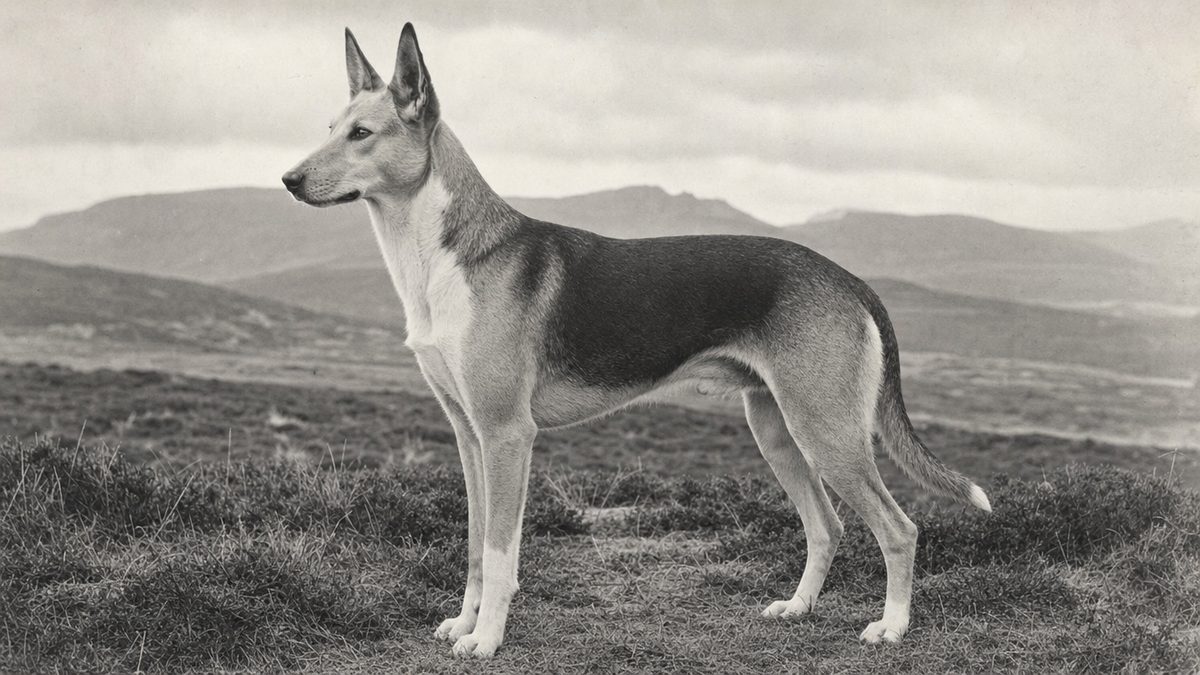
Two written descriptions of the Welsh Hillman exist, written seventeen years apart, and they describe visibly different dogs. Both surviving photographs are black and white, so neither can settle the colour question.
Set them side by side rather than blending them, because blending them is what every downstream page does.
| Wildhagen, 1977 | Carpenter, 1994 | |
|---|---|---|
| What it resembled | German Shepherd-like | Similar to smooth-coated hill dogs of the English Lake District |
| Size | A large dog, about 25 inches, slightly shorter than German Shepherds | A tall dog |
| Colour | Golden-red coat | Usually light sandy-coloured, with a black saddle |
| White markings | White on the chest, legs and tip of tail | White chest, white on legs and tail, and a blaze on the face |
| Ears | Pricked | Prick-eared, of smart upstanding stance |
| Other colours | Not mentioned | Blue merle dogs were also bred |
| Character | Fast and fearless | Not stated |
A German Shepherd and a smooth-coated Lakeland hill dog are not the same animal, and golden-red and light sandy with a black saddle are not the same colour. Wikipedia prints only the German Shepherd version, which is the one that survives into Country Life and every downstream page.
Three specific things the popular account gets wrong
- The height is a conversion presented as a measurement. Every source says "about 25 inches". Wikipedia's infobox states 64 cm, which is that rounded figure converted, and it reads as though somebody measured a dog.
- The infobox colour absorbed a different dog's name. It lists blue-grey among the colours. The body text says blue MERLE, and the Welsh Blue-Grey Sheepdog is a separate type in Wildhagen's own list. A neighbouring breed's name appears to have become a colour.
- Both photographs are monochrome, and they show two different dogs. One is Carpenter's own, taken in 1976; the other is undated and comes from David Hancock's archive with no provenance given. Neither can corroborate any colour claim, and every statement about sandy, red-gold or fawn rests on written description alone.
One quotation cannot be sourced at all and is worth flagging. The Border Collie Museum's current page says Carpenter believed she had seen the last Hillman, "a dog that David Hancock called 'a fine-looking red-coated dog'", with no citation given. That phrase could not be found anywhere in Hancock's own online archive, and one AI encyclopedia has already reassigned it from Hancock to Carpenter. Hancock published extensively in print, so it may be genuine and it cannot presently be checked.
The newspaper test, and the two results that are both about men
Searching roughly fifteen million articles of Welsh newspapers from 1804 to 1919 for the phrase Welsh hillman returns exactly two results, and neither is about a dog. The control returns four, all canine.
This is the strongest single test on the page, because it asks whether contemporaries used the name at all.
The National Library of Wales runs Welsh Newspapers Online, covering about 15 million articles. The phrase returns two hits.
- The North Wales Chronicle, 14 May 1892, page 7, in a leader titled The Celtic Revolt, on the Clergy Discipline Bill and Welsh disestablishment: "The Welsh hillman knows nothing of, and cares less for, the citizenship of the Empire. To him Chatham, Wellington, Canning are names of foreigners, and naught else."
- The South Wales Weekly Post, 24 November 1917, page 3, a sportsman's obituary: "his physique (of the typical Welsh hillman) was such as enabled him on more occasions than one to make his presence felt."
Both mean a man from the Welsh hills. In the nineteenth-century Welsh press, that is what the phrase denoted.
The control, which is what makes the absence mean something
The same corpus searched the same way for "welsh sheepdog" returns four results and every one is genuinely canine, including the Royal Welsh Sheep Dog Trials at Vivod Park, Llangollen, under royal patronage in the Evening Express of 21 August 1903, and the Tregaron Sheep Dog Trials in the Cambrian News of 19 October 1894.
So the corpus does discuss Welsh sheepdogs, at length and by name. It has simply never heard of a Welsh Hillman dog. That is a controlled absence across a century of Welsh journalism, and it is the single hardest fact on this page.
A query containing TWO quoted phrases is silently degraded to an OR search on Welsh Newspapers Online. A test query pairing two phrases returned 25,369 junk results. Single-phrase queries behave correctly, which is how the counts of 2 and 4 above can be trusted, and the highlighted OCR shows the words adjacent in each hit.
Welsh droving was real and well documented, and it never names this dog
The Welsh cattle droving trade is a serious subject of academic history, and the standard scholarly account mentions the drovers' dogs while naming no breed or type whatsoever.
Richard Colyer's study in the National Library of Wales Journal is the reference work, and it is specific about the trade.
- Droves ran from one to four hundred cattle, attended by four to eight drovers and their dogs.
- Rhys Morgan of Tregaron, styled King of Northampton, normally employed a dozen men to handle a drove of 300 beasts.
- The trade ended in the 1860s, when the railway reached Pembroke, Holyhead and Aberystwyth.
All three parts of that study were searched byte by byte for collie, sheepdog, sheep dog, Hillman, corgi and breed of dog. Zero hits in all three, while the generic word dog does appear, which is the in-document control proving the search worked.
So the definitive scholarly treatment of Welsh droving discusses the drovers' dogs and names no breed at all. That is not evidence against the Hillman's existence, and it is evidence about what the historical record supports: a real working economy that used dogs, described without breed vocabulary, because breed vocabulary is a later invention.
What contemporaries did record is function rather than type. Hubbard notes that eighteenth-century Welsh drovers took five or six sheepdogs as "herders on the narrow roads, guards against highwaymen, and providers of game on the route", and a 1977 study of shepherding customs describes a "road dog" whose job was solely patrolling the flanks of the flock. Neither names a breed either.
Where the Welsh Hillman sits among the other lost British types
Four other extinct British dogs are commonly listed beside the Welsh Hillman, and they occupy three genuinely different positions, which is what makes the comparison worth drawing.
The useful axis is not extinction. It is whether anything was ever written down.
| Dog | Written standard? | Studbook entry? | What it actually was |
|---|---|---|---|
| English Water Spaniel | YES. An itemised points list in Drury's British Dogs, third edition 1903, pages 329 to 330, present in the first edition too | YES. Kennel Club Stud Book Volume I, 1874, Class XVII, 21 dogs at numbers 2247 to 2267 with no gaps | A BREED that ended. The clean contrast case |
| Toy Trawler Spaniel | A full published description, Leighton 1907 | NO. Its own leading breeder called it 'the unregistered breed known as the Miniature Toy Trawler' in 1911 | A halfway house: show classes without a studbook |
| Welsh Hillman | NO | NO | A type. Nothing was ever written down |
| Old Welsh Grey Sheepdog: What the Sources Actually Say | NO | NO | A type, and its extinction claim rests on the SAME 1994 column by the same author on the same website |
| Cumberland Sheepdog: The Extinct Fell Collie | NO | NO. Its dogs entered trials, not a studbook | A type, probably absorbed into the Border Collie |
Read the English Water Spaniel row twice
That breed had both documents and still died out. The 1874 studbook entries are real records of real animals: the first reads "2247. Albert. Mr. J. Haimes's, 49, Thames-street, Leicester; breeder, Mr. J. Brown; born 1871; colour, liver". Owner, address, breeder, birth year, colour.
That is what a breed ending looks like, and it is a completely different thing from what happened to the Hillman. One had a paper trail and lost its population; the other never had a paper trail at all.
One correction while we are here, because this site aims to be right rather than tidy. The often-quoted figure that the Kennel Club Stud Book listed only fourteen English Water Spaniels is a misreading twice over. Drury's text says the Stud Book "has only increased its list... by fourteen in twelve years". That is an increase, not a total, and Volume I alone held twenty-one.
The sibling page problem, stated plainly
The Old Welsh Grey's extinction claim comes from the same 1994 article, by the same author, republished on the same website. So Bonbeno now has two pages whose central date traces to one woman's recollection, and both say so. That is not a defect in either page; it is the actual state of the evidence for both animals, and hiding it would make both pages worse.
Health, lifespan and genetics, none of which exist for this dog
There are no health issues, no life expectancy and no genetic data for the Welsh Hillman, and the searches establishing that returned some of the most spectacular false positives this project has recorded.
Every absence here was measured against a control that succeeded in the same session.
The literature, and a 1,209-count that means nothing
PubMed returns 35 records for the unquoted phrase Welsh Hillman, and not one of them is about a dog. All 35 were fetched and their XML parsed by field: 27 matched an Investigator surname inside consortium author lists, 4 an author surname, 1 a first author and 4 a grant agency, affiliation or cited reference. The exact-phrase query returns 0 with PubMed's own warning.
The homonym is enormous in both halves of the name. Hillman alone returns 1,209 records in title or abstract, and Hillman combined with dog returns ZERO. Welsh is itself a common surname, appearing on 8,923 author records. So one breed name generates a four-figure count and a zero, both meaningless, and the well-controlled negative is the combination.
The most seductive false positive is worth naming, because it would fool a careful reader: a 1999 paper on fluoride prescription dispensing in South Wales, whose first author is named Hillman and whose abstract mentions the Welsh Health Common Services Authority. A dentistry paper retrieved by a dog-breed query.
Searching the Welsh name for the Welsh Sheepdog, Ci Defaid Cymreig, returns 2,043,673 records in PubMed. That is not a literature. PubMed discarded both Welsh words as unrecognised and searched 'chemically induced' OR 'ci'. A number that large from an obscure query is evidence of a rewrite, never of coverage, and it must never be reported as a count.
Genetics: the major panels exclude every Welsh herding landrace
Two large studies were checked against their actual breed tables rather than their prose. A 161-breed genomic analysis contains only two Welsh entries, the Cardigan and Pembroke Welsh Corgis. A 2,000-canid consortium dataset contains four Welsh values, all Kennel Club show breeds, and twelve values containing Sheepdog, none of them Welsh.
That second one is the sharper finding, because the project explicitly sampled dogs representing local niche populations and breeds not nationally registered, eighteen samples of them, and not one is a Welsh herding type. The Welsh landraces are simply outside the genomic record.
Screening data: none, with the instrument proved
OFA's statistics dump was retrieved in full and its controls all returned their expected occurrence counts, LABRADOR 109, BULLDOG 170 and BEAGLE 61, before anything was concluded. In that proven-working document HILLMAN occurs zero times, while WELSH occurs 190 times and SHEEPDOG 281, so the dump holds Welsh breeds and sheepdogs in quantity and does not hold this one.
OFA's threshold makes that unsurprising: "For hips, each breed must have at least 100 evaluations in the database. For all other databases, there must be at least 50". An extinct unregistered type will never meet it.
Any page offering a life expectancy, a health-screening recommendation or an inherited-disease list for the Welsh Hillman has invented it. There is no population, no register, no screening data and no genetic sample. For any decision about a real dog in front of you, consult your nearby vet.
What an Indian owner of a living herding dog should act on instead
Since no breed-specific risk can be stated for an extinct breed, the useful health content here is the risk that applies to any working dog in India and never applied in Wales. Tick-borne disease is the difference between the two countries, and Indian surveys report high burdens among dogs presented at veterinary clinics. A West Bengal survey of 584 dogs screened found *Babesia gibsoni* in 76.54 percent and reported that 72.9 percent of the 584 dogs screened carried two or more pathogens.
Say the denominator out loud when you use a figure like that, because "of the 584 screened" and "of infected dogs" are different claims, and these were clinic caseloads rather than random samples. Compare that against a Welsh upland farm, where tick-borne disease pressure of this kind is simply not the daily problem, and you have the one genuinely transferable lesson: a rare or unfamiliar breed brought into India meets a parasite environment its ancestors never did. Verify any dog's parasite history in writing before you accept it, and treat a monthly parasiticide and a weekly tick check as non-negotiable rather than optional.
Temperament, and the two words that are all anyone has
The only temperament description of the Welsh Hillman in any source is the phrase fast and fearless, and it comes from a 1977 article whose own host site warns that it summarises what was then known or surmised.
That is the whole of it. "Fast and fearless" appears in Wildhagen's 1977 account and is repeated by every later page, usually in quotation marks, usually without saying who said it.
It is worth reading the disclaimer the hosting site attaches to that article: it "is a summary of what was then known or surmised" and "more detailed, and sometimes, contradicting, information has come to light in the meantime". A source that flags its own uncertainty this clearly is being honest, and the pages that quote it without the flag are not.
What can be inferred, and labelled as inference, is functional. An upland herding and droving dog worked at distance from its handler over rough ground, which selects for independence, stamina and decision-making rather than for close biddability. That is a statement about the job, and the job is better attested than the dog.
It is invented. There is no standard, no breed club, no temperament survey and no living population. A page giving this dog numbered ratings for friendliness, trainability or good-with-children has run a template over a name, which is the same mechanism this whole page documents.
Training, and what an upland working type would have needed
No training account of the Welsh Hillman exists, so what follows is general guidance for the upland herding types that do survive, labelled as that rather than presented as breed knowledge.
The Welsh Sheepdog Society's own description of its foundation stock is the nearest thing to a working description that survives, and it is about behaviour rather than looks: dogs were inspected for "history, type and correct 'Welsh' manner of working". A working manner, not a coat colour, is what defined these dogs to the people who used them.
- Expect independence. A dog working sheep across open hill has to make decisions out of earshot, and that is selected for rather than trained out.
- Build recall on a long line first, because an independent worker with no recall is a dog you lose.
- Keep sessions short and end them well, which suits a working type better than long drilling.
- Give the dog a job. Scent work, structured walks or formal herding training all do more for an upland type than obedience repetition.
- Train in the cool hours anywhere in the Indian plains, since a thermally uncomfortable dog does not learn well.
None of that is Hillman-specific, and saying so is the point. Guidance invented for an extinct dog is worse than useless, because it sounds authoritative.
Exercise, for the upland working types that survive
An upland herding type needs one to two hours of real activity daily plus mental work, and in India that has to fit inside the cool hours.
Colyer's droving figures give a sense of what the historical job actually involved: droves of one to four hundred cattle attended by four to eight men and their dogs, moving from mid-Wales to English markets. These were dogs on their feet for days.
- Morning, 45 to 75 minutes of brisk walking or trotting in the coolest part of the day.
- Evening, 30 to 45 minutes once the ground has cooled, with training folded in.
- Indoors, daily, scent games and puzzles, which suit a thinking breed and add no thermal load.
- Never at midday in the Indian plains, and check the ground with the back of your hand first.
Grooming, and a coat nobody can describe with confidence
The two descriptions of the Welsh Hillman's coat disagree, and both surviving photographs are black and white, so no grooming regime can honestly be specified for it.
One source calls the coat golden-red and another light sandy with a black saddle, and neither says whether it was single or double, short or moderate Border Collie Museum, Extinct Breeds page. Carpenter's comparison to smooth-coated hill dogs of the English Lake District is the closest thing to a coat description in either, and it points at a short flat coat.
For any surviving upland working type in India, the guidance is coat-led rather than breed-led.
- Short flat coat, weekly brushing, with sun protection considered for thin-coated dogs in Indian summers.
- Moderate double coat, two to three brushings a week with an undercoat rake and daily during a moult.
- All coats, complete drying to the skin after any bath in humid weather, and the ears plugged before bathing and dried after.
- All coats, a weekly tick check down to the skin, which matters more in India than brushing does.
Budget for professional drying if you cannot do it at home, from about Rs 934 for a bath in Delhi.
Welsh Hillman price in India, and why no figure can exist
No Welsh Hillman price exists anywhere, because the animal is extinct and was never registered, so no pedigree, no register and no seller can exist for it.
This is the simplest price section on the site. There is nothing to price.
Indian law closes the question from the other end too, for anyone tempted by an offer. Dogs are a Restricted import under ITC(HS) 01061900, and DGFT Trade Notice 22/2022-23 states that applications to import for trading or breeding purposes "shall be duly rejected".
The pedigree question closes just as firmly. India is a full FCI member represented by the Kennel Club of India in Chennai, which issues pedigrees against FCI nomenclature, and this breed holds no FCI number and never did, so no KCI pedigree for it can exist. State that limit honestly, though: the KCI publishes no breed list for any breed, so a direct query there returns nothing for this breed and nothing for a Labrador either, which is a broken instrument rather than a finding. The FCI absence, checked with four Welsh controls returning, is what carries the weight.
They are offering a different dog. No pedigree can exist under this name in any register anywhere, so any paperwork presented with it is either empty or for another animal. That is not a comment about the dog in front of you. It means there is no document to check, in a market where the document is usually the pitch. Ask instead to see the parents, the date of birth and a health record.
A related caution about revival claims. David Hancock, in the same article that says the breed was never listed by the Kennel Club, refers in passing to "a revived Hillman" among emergent breeds. No organisation, register, breeder or programme reviving this dog could be found. Treat that as aspirational, and treat any dog sold as a revived Hillman as a dog with a new name and no history.
Monthly cost of keeping a medium herding dog in India
A medium herding dog costs roughly Rs 5,000 to Rs 11,000 a month to keep properly in an Indian metro, and the figures below are published Indian rates for the living breeds a reader might choose instead.
| Item | Published rate | Source and caveat |
|---|---|---|
| Puppy core vaccination course | From Rs 6,499 | Vetic national page, a promotional floor from one chain; the same chain quotes Rs 7,199 on its Mumbai page the same day |
| Annual booster | From Rs 3,199 | Same chain, same caveat |
| Anti-rabies, single | Rs 699 | Against which Greater Chennai Corporation's six municipal clinics give anti-rabies vaccination free |
| Consultation | Rs 500 to Rs 1,000 | ONE data point, not two: a stray-dog charity and a general insurer publish byte-identical ranges |
| Tick and flea control, monthly | Rs 1,103 | NexGard Spectra 15-30 kg, which is the right band for most medium herding dogs |
| Grooming, per session | Bath from Rs 934 | Vetic Delhi |
| Municipal registration | Rs 500 in Delhi, Rs 50 in Chennai | Delhi registers pet dogs only; Chennai licenses pet animals generally and issued 9,115 licences in 2024 |
Working herding breeds are cheap to feed and expensive to under-exercise. The largest cost most Indian owners of this type actually meet is the consequence of an unmet exercise requirement in a hot city, and it does not appear on any rate card.
The Welsh uplands, and a homeland wetter than Chennai
Mid-Wales runs an annual mean near 8.8 C with an annual mean relative humidity above 90 percent, which is HIGHER than any Indian city measured here, so the climate problem for a Welsh dog in India is heat rather than damp.
The point chosen is Tregaron, the great mid-Wales drovers' town that Colyer names, which puts the climate figure in the same place as the historical evidence.
The cell check, done before any figure was used
Tregaron's grid cell sits at 245.39 m against a real elevation near 180 m, an error of about +65 m, so it is usable. Two other Welsh points were tested and one was rejected: Brecon is about +105 m out and marginal, while Dolgellau is about +240 m out and was not used, because that valley town sits under Cadair Idris and the cell picks up the mountain. The three points do not share a cell.
| Place | Cell elevation vs real | Annual mean | Warmest month | Coolest month | Annual mean RH |
|---|---|---|---|---|---|
| Tregaron, mid-Wales | 245.39 m vs ~180 m (+65) | 8.82 C | 14.81 C (Jul) | 3.53 C (Feb) | 90.2% |
| Brecon, mid-Wales | 255.48 m vs ~150 m (+105) | 8.74 C | 15.06 C (Jul) | 3.28 C (Feb) | 89.6% |
| Chennai | 48.95 m vs 6 m (+43) | 27.94 C | 31.51 C (May) | 24.09 C (Jan) | 72.4% |
| Delhi | 206.37 m vs 216 m (-10) | 25.57 C | 35.88 C (Jun) | 13.61 C (Jan) | 45.5% |
| Mumbai | 97.15 m vs 14 m (+83) | 26.77 C | 31.19 C (May) | 23.19 C (Jan) | 67.3% |
| Bengaluru | 841.72 m vs 920 m (-78) | 23.74 C | 28.37 C (Apr) | 20.22 C (Dec) | 67.8% |
| Pune | 635.99 m vs 560 m (+76) | 23.86 C | 28.93 C (Apr) | 19.62 C (Dec) | 66.7% |
| Kolkata | 7.35 m vs 9 m (-2) | 25.80 C | 31.53 C (May) | 17.31 C (Jan) | 73.8% |
| Hyderabad | 494.59 m vs 505 m (-10) | 26.09 C | 33.30 C (May) | 20.76 C (Dec) | 60.2% |
| Ahmedabad | 46.53 m vs 53 m (-7) | 27.56 C | 35.06 C (May) | 19.93 C (Jan) | 48.2% |
The humidity inversion, which most pages get backwards
Tregaron runs 90.2 percent annual mean relative humidity. Chennai runs 72.4 and Delhi 45.5. Wales is materially damper than any Indian city here, which is not a surprise to anybody who has been to Wales and is a surprise on a breed page.
So a Welsh dog in India does not meet unfamiliar humidity. It meets unfamiliar heat. Tregaron's warmest month averages 14.81 C. Chennai's COOLEST month averages 24.09 C, which is more than nine degrees above the hottest month a Welsh upland dog would ever have known. The right way to express the combined load is wet bulb: Tregaron peaks at 13.17 C in July against Chennai's 26.11 C in May.
Note the warmest-month column, which catches people out. Delhi peaks in June, not May, at 35.88 C, and Bengaluru and Pune both peak in April and are coolest in December.
One limit on heat risk, stated rather than filled in. The largest study of canine heat-related illness modelled breed types with at least five heat-related illness cases and/or at least 5,000 dogs in a UK population. An extinct unregistered type is not in that model, so no breed-specific odds ratio exists for it. What transfers to any dog is the finding that bodyweight at or above the breed and sex mean carried an odds ratio of 1.42, confidence interval 1.12 to 1.80.
Feeding a medium working dog by life stage
Feed a medium herding dog a complete diet split across two meals and adjust by body condition, and treat any breed-specific feeding claim for the Welsh Hillman as invented, because no such research exists.
- Puppy, to 4 months, three to four meals a day on a complete growth diet, kept lean rather than round.
- Puppy, 4 to 12 months, two to three meals a day with growth rate controlled deliberately.
- Adult, two meals a day, portioned to a condition where ribs are easy to feel without pressing.
- Senior, two meals a day with the ration reduced as activity falls.
Keeping a working dog lean is a heat intervention in India. Dogs at or above the mean bodyweight for their breed and sex carried 1.42 times the odds of heat-related illness, with a confidence interval of 1.12 to 1.80.
Month by month through the first year
No Welsh Hillman puppy exists, so this timeline is for the medium working puppy an Indian reader will actually raise, and its organising fact is that the first hot season arrives before the dog is grown.
- Months 0 to 2. The puppy stays with its dam. Indian law is explicit that pups under eight weeks are not to be sold, at Rule 8(1)(a) of the Dog Breeding and Marketing Rules 2017.
- Month 2 to 4. Core vaccination course, from about Rs 6,499 at one national chain. Habituation to traffic, crowds and handling.
- Month 4 to 6. Monthly parasite control begins, about Rs 1,103 for a 15 to 30 kg dog. Municipal registration, Rs 500 in Delhi or Rs 50 in Chennai. Recall on a long line.
- Month 6 to 9. The first real hot season. Move all exercise to the cool hours.
- Month 9 to 12. Adult size and coat. Establish the weekly skin and tick check as routine, and discuss neutering timing with your vet rather than the internet.
Mistakes in almost everything written about this breed
The six errors below appear across mainstream magazines, breed-appreciation sites and AI-generated encyclopedias, and every one is checkable in minutes.
- Treating 'extinct around 1990' as a researched date. It is one spayed pet bitch's death, reported from memory in 1994, and Wikipedia has carried it uncited through sixty revisions.
- Citing Carpenter and the Border Collie Museum as two sources. They are one publishing operation: Carole Presberg edited the journal and runs the website.
- Calling the gellgi a Welsh wolfhound. The University of Wales dictionary glosses gellgi as mastiff, stag-hound and lap-dog, and never as wolfhound. The Welsh for wolfhound is bleiddgi.
- Blending the two physical descriptions. German Shepherd-like and Lake District hill dog are different animals, and golden-red and light sandy with a black saddle are different colours.
- Printing 64 cm as a measurement. It is a rounded conversion of 'about 25 inches'.
- Listing blue-grey as a colour. The Welsh Blue-Grey Sheepdog is a separate type, and its name appears to have been absorbed into this one's colour field.
The FCI's letter index honours the parameter ?init=W. The parameter ?letter=W returns HTTP 200, an empty page title, and ALL FOUR Welsh control breeds at ZERO. Anyone checking this breed's FCI status with the wrong parameter would find a clean, plausible, completely false absence, and would find the same false absence for the Welsh Terrier and both corgis.
Adoption, and the living Welsh dogs you could actually have
The Welsh Hillman cannot be adopted, and four Welsh breeds are alive, registered and available, with one more surviving outside the kennel clubs because a society built it a studbook.
If what draws you is Welsh working dogs rather than this particular lost one, the choices are real.
- The Welsh Sheepdog: Breed Status, Price in India, Care is the closest living relative in function, and the clearest proof that a Welsh landrace can be preserved without a kennel club, through a society register that has now recorded a thousand puppies.
- The Corgi Price in India 2026 and the Spine Risk and the Cardigan Welsh Corgi Price in India and the Tail Rule are the two Welsh breeds that appear in every genomic panel and every register.
- Adopt rather than buy wherever you can. Indian shelters hold herding-type crossbreeds in numbers, surrendered for the same reason across every city: an exercise requirement the household could not meet.
- Consider an Indie, and read the Indie Dog: Indian Pariah Dog Breed and Care Guide 2026 guide, because a dog already adapted to your climate solves the hardest problem on this page for free.
Bonbeno does not broker sales, recommend breeders or link puppy listings. For this breed there is nothing anywhere to link to, and that is the honest end of the page.
Welsh Hillman: the questions people actually ask
Are Welsh Collies good pets?
Welsh herding dogs suit active, experienced households and are a poor fit for anyone short of time, and the question appears here because Google has almost no on-breed material for the Welsh Hillman and substitutes its living relatives. The one that actually survives is the Welsh Sheepdog, preserved since 1997 by a society that keeps two registers and has birth-registered a thousand puppies. It is a working type selected for independence and stamina, which is exactly what makes it demanding as a pet: it needs one to two hours of real activity daily and a job to do.
What is the famous Welsh dog story?
The best-known is the legend of Gelert, the hound said to have been killed by Llywelyn the Great after being wrongly blamed for harming his child, and it is a legend rather than documented history. The documented Welsh dog story is less dramatic and more useful: the droving trade, in which four to eight drovers and their dogs moved herds of one to four hundred cattle from Wales to English markets until the railways ended it in the 1860s. That trade is well studied, and notably the standard scholarly account mentions the dogs and names no breed at all.
What is the least wanted dog?
No register publishes a least-wanted list, and for the Welsh Hillman the more revealing question is how thinly a dog can be documented and still have a name. Its entire record is one 1948 sentence that does not describe it, two incompatible descriptions from 1977 and 1994, two black-and-white photographs of different dogs, and an extinction date resting on one spayed pet bitch. By contrast the Royal Kennel Club's vulnerable native breeds list, which holds breeds under 300 registrations a year, contains four Welsh breeds, all of them alive and counted.
How long do Welsh sheepdogs live?
No life expectancy figure exists for the Welsh Hillman and Bonbeno prints none, because there is no population, no register and no study. For the living Welsh Sheepdog the position is better but still thin: it too is absent from all four major kennel clubs, and it is absent from the large genomic panels, where a 161-breed study holds only the two Welsh corgis and a 2,000-canid dataset holds four Welsh values, all Kennel Club show breeds. Consult your nearby vet about any real dog rather than relying on a figure for a landrace nobody has followed.
When did the Welsh Hillman go extinct?
The date usually given is around 1990, and it comes from a single source with no document behind it. Barbara Carpenter wrote in 1994, from her own recollection, that the last known Hillman was a bitch called Jess, bought from a hill farm near Hay-on-Wye in 1974, spayed before her owner realised her rarity, and dead in 1990. That is an extinction inferred from one animal. Wikipedia has carried the date since February 2012 without a citation attached, through sixty revisions, and a national magazine repeated it in 2019 with no source.
Was the Welsh Hillman a real breed?
It was a real type and never a breed in the documentary sense. No written standard was ever published for it and no studbook ever held it, checked across the Royal Kennel Club's 227 breeds, the AKC's 297, the FCI's letter W and provisional register and the UKC's 387, each with Welsh control breeds that returned on the same document. Wikipedia's own editors reached the same conclusion on its talk page in 2016, noting that no published breed standards of any kind could be found and that there was no evidence the dogs were genetically consistent.
What did the Welsh Hillman look like?
The two surviving descriptions disagree, and this page prints both rather than blending them. Wildhagen in 1977 called it German Shepherd-like, about 25 inches, fast and fearless, with pricked ears and a golden-red coat with white on chest, legs and tail tip. Carpenter in 1994 called it a tall dog similar to smooth-coated hill dogs of the English Lake District, usually light sandy-coloured with a black saddle, a white chest, white on legs and tail, a blaze on the face, and prick ears, adding that blue merle dogs were also bred. Both surviving photographs are black and white, so neither can corroborate any colour claim.
Was the Welsh Hillman descended from a Welsh wolfhound?
That claim rests on one 1948 sentence and does not survive checking against the Welsh language. Hubbard wrote that the type probably descended from covert hounds later known as Welsh wolfhounds, mentioned in the Welsh laws as gellgi. The University of Wales Dictionary of the Welsh Language glosses gellgi as mastiff, stag-hound and lap-dog, never as wolfhound, and derives it from gell, meaning bay, brown, auburn or tawny, plus ci, dog. So gellgi means tawny dog. The Welsh word for wolfhound is bleiddgi, from blaidd, wolf, and it is a different word.
Can you buy a Welsh Hillman?
No. The animal is extinct and was never registered anywhere, so no pedigree can exist under the name and any paperwork offered with one is either empty or for a different dog. In India there is a second barrier: dogs are a Restricted import under ITC(HS) 01061900 and applications to import for trading or breeding purposes are to be duly rejected. Be cautious of any dog sold as a revived Hillman; no reviving organisation, register, breeder or programme could be found.
Is the Welsh Hillman the same as the Welsh Sheepdog?
No, and the difference between them is the most useful thing on this page. Both are Welsh working landraces and both are absent from every major kennel club register. The Welsh Sheepdog survives because the Welsh Sheepdog Society was formed in 1997, inspected foundation stock for history, type and correct Welsh manner of working, and started a register that has now birth-registered a thousand puppies. Nobody ever did that for the Hillman, and the word Hillman appears on none of the Society's pages.
Which other Welsh dog breeds are extinct?
Three are usually named alongside the Hillman: the Old Welsh Grey Sheepdog, the Welsh Black-and-Tan Sheepdog and the Welsh Blue-Grey Sheepdog. Note that the Old Welsh Grey's extinction claim comes from the SAME 1994 article by the same author republished on the same website, so two of these dates trace to one person's recollection. David Hancock grouped the three together in a sentence he reused verbatim across at least four articles without citing a source: never listed by the Kennel Club were the Welsh Hillman, the Old Welsh Grey and the Welsh Black and Tan Sheepdog.
Did Welsh drovers use a special breed of dog?
The historical record describes drovers' dogs by function and names no breed. Richard Colyer's standard study of nineteenth-century Welsh cattle droving records droves of one to four hundred cattle attended by four to eight drovers and their dogs, and all three parts of it were searched for collie, sheepdog, Hillman and corgi with zero hits, while the generic word dog does appear. Eighteenth-century accounts describe drovers taking five or six dogs as herders on the narrow roads, guards against highwaymen and providers of game on the route. Function, not breed, is what contemporaries recorded.
Compare with similar breeds
Welsh Hillman sits in 3 Bonbeno groups. Each one compares it directly against the breeds it is genuinely an alternative to, on the same figures.