
Breed profile
Old Welsh Grey Sheepdog: A Lost Welsh Landrace, Read From the Sources
A breed that is gone, written from the documents rather than from the other pages about it, with every disagreement left standing.
Quick answer
The Old Welsh Grey Sheepdog was a shaggy bearded herding landrace of Wales, distinct from the living Welsh Sheepdog and generally reported extinct. Barbara Carpenter photographed working Welsh Greys at Rhandirmwyn in 1987 or 1988 and wrote in 1994 that a few survived. No kennel club ever recognised it, no living population is registered anywhere, and no Indian price exists.
This page describes a breed with no living registered population, so it carries no health screening data and no veterinary care protocol for it. Any health guidance here concerns dogs generally in Indian conditions and is not veterinary advice. Sites publishing hip-evaluation schedules and portion sizes for this breed are describing an animal nobody can examine. For any real dog, consult a qualified veterinarian who has seen the animal.
Old Welsh Grey Sheepdog at a glance
What the Old Welsh Grey Sheepdog was
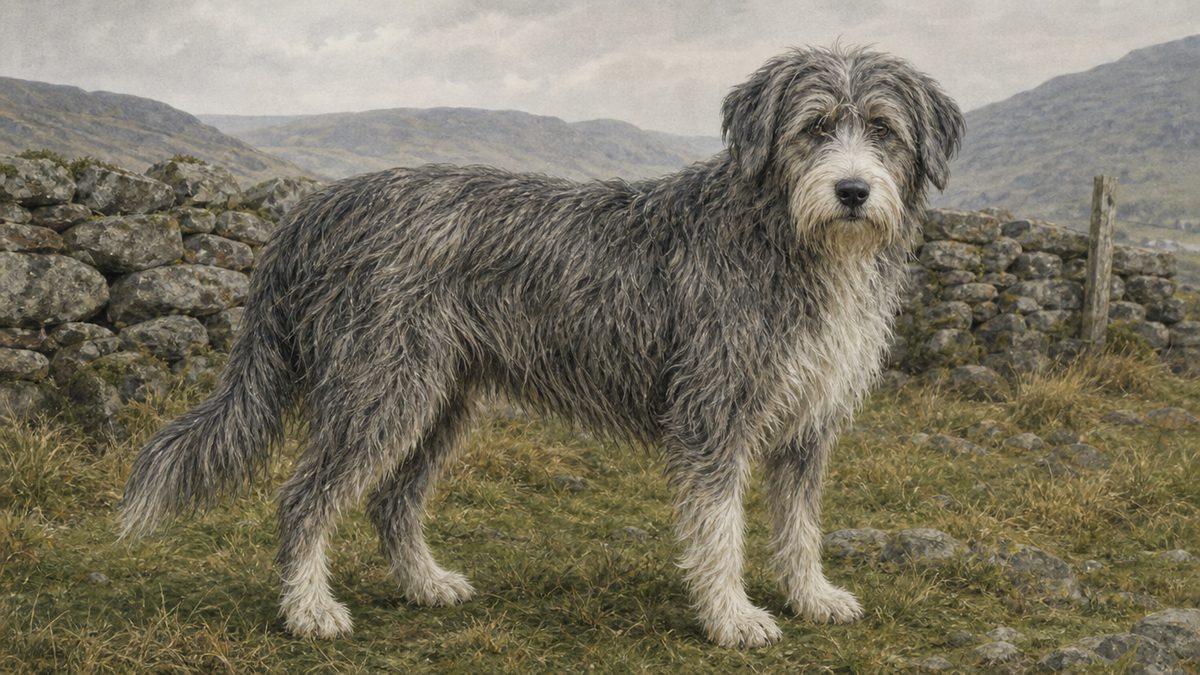
The Old Welsh Grey Sheepdog was a shaggy, bearded, long-haired herding landrace of Wales, worked on hill farms and by drovers, and it is now generally reported extinct. David Hancock, who has written on Welsh breeds for decades, calls it in four words the bearded sheepdog of Wales.
Start with the description, because it is the only part every source agrees on. Clifford Hubbard, a Welshman who wrote extensively on British dogs, described it as an unbeautiful dog much like a small old-fashioned Bearded Collie. Barbara Carpenter, who actually saw working examples, called them shaggy dogs, similar to the working Bearded Collie. The word unbeautiful is doing real work there. Nobody ever bred this dog to look like anything.
It was a landrace rather than a breed in the modern sense. There is no breed standard, there was never a register, and its working ability was the entire selection pressure. That distinction matters for everything below, because a landrace cannot be verified against a document the way a registered breed can.
The one thing that is not agreed: its coat colour
The breed is named for its grey coat colour, and the majority of sources describe it that way. But at least one account does not. A rendering of Desmond Morris's 2008 dictionary states that the colour, despite the breed's name, was usually fawn or light brown, and places the breed in Snowdonia in north-west Wales rather than in the south-west. Bonbeno could not open Morris directly, so this is flagged as an unresolved disagreement rather than corrected in either direction.
The top image result on Google India for this breed name is an Etsy poster, and one page-one result offers AI-generated stock photographs of the breed described as a short-coated gray and white dog. Every genuine account describes a shaggy coat. An AI image site inventing a smooth coat for a breed defined by its shagginess is a good summary of the whole information problem here.
What the dog did for a living
It herded, and it drove. The Welsh Sheepdog Society's account of the Welsh droving trade explains what that meant in practice: cattle, sheep, pigs and even geese were driven on foot for hundreds of miles to the English markets, and just a few men and their dogs could take 300 or more cattle at a time. A loose-eyed dog that circled a large mob, barked when needed and guarded the herd overnight was the tool that made that trade possible.
| Source | Date | What it says |
|---|---|---|
| David Hancock, on his own site | archive article | "the bearded sheepdog of Wales", never listed by the Kennel Club |
| Clifford Hubbard, quoted | 1949 | "An unbeautiful dog much like a small old-fashioned Bearded Collie" |
| Barbara Carpenter, The Shepherd's Dogge | Fall 1994 | "shaggy dogs, similar to the working Bearded Collie", bred pure in one district |
| Diversity, peer-reviewed | 2019 | Photograph captioned "Old Welsh Gray Dog ... (now extinct)" |
| Wikipedia | current | "a breed of sheepdog native to Wales. It is likely now extinct" |
Is it the same dog as the Welsh Sheepdog? No, and here is the proof
The Old Welsh Grey is a distinct landrace from the living Welsh Sheepdog, the Ci Defaid Cymreig, and four independent lines of evidence separate them. They are related by ancestry, which is what every conflation is built on.
This is the question that matters most on this page, because the Welsh Sheepdog Society runs a real register of living dogs and the Old Welsh Grey has none. Confusing the two turns an extinct landrace into a purchasable animal, which is exactly what several sites have done.
Four pieces of evidence that they are different dogs
- Hancock separates them in a single sentence. He writes that never listed by the Kennel Club were the Welsh Hillman, the Old Welsh Grey and the Welsh Black and Tan Sheepdog, giving each its own descriptor, and then discusses the Welsh Sheepdog Society's living breed in a separate paragraph.
- Welsh-language Wikipedia draws the line explicitly. Its article on the Hen Gi Defaid Llwyd Cymreig says the breed has probably disappeared, but that the Ci Defaid Cymreig breed continues. Two named breeds, one gone and one not.
- The Welsh Sheepdog Society's own colour list has no grey in it. It says its dogs can be of most colours including black, black-and-tan, red, blue merle or roan, with or without white markings. Grey is absent from a list that names five other colours.
- Google's own knowledge graph treats them as separate entities. The Old Welsh Grey has its own knowledge panel reading Breed, Origin: Wales, and the related-searches module places the Welsh Hillman and the Patagonian Sheepdog beside it rather than merging it into the Welsh Sheepdog.
But the sources genuinely disagree, and here is where
Bonbeno is not going to tidy this away. The single best source contradicts itself within one paragraph. Hancock lists the modern Welsh Sheepdog's colours as often blue merle around Plynlimon and Devil's Bridge, tri-coloured in Tywyn, red-tan down the Cardigan coast, and white or a lighter sable and white, with no grey anywhere in the list. Two sentences later, in the same paragraph, he writes that they were famed as drovers' dogs and that in North Wales a big grey variety was favoured.
So the most authoritative writer on Welsh breeds says both that the Old Welsh Grey was a separate, never-recognised breed and that a big grey variety of the living breed was favoured in the north. Those two statements can be reconciled, but only by guessing, and guessing is what this page is trying to stop.
Linda Rorem's article on the Welsh Sheepdog contains the sentence that the breed is believe to have become established in the 19th century when working collies from Scotland were blended with the old native Welsh breeds such as the Black and Tan Sheepdog, the sable or blue-merle Hillman, and the shaggy Old Welsh Grey, typo and all. A search snippet of that sentence drops the middle clause, leaving "The Welsh Sheepdog, also referred to as Welsh Collie, the sable or blue-merle Hillman, and the shaggy Old Welsh Grey". The truncation converts an ancestry claim into an aliasing claim. The full sentence disproves the reading the snippet creates.
The honest summary is that the Old Welsh Grey is one of several old native Welsh types that were crossed into what became the modern Welsh Sheepdog. Ancestor is not the same as alias. A grandparent is not a grandchild.
Everything written about this breed rests on one source
Follow the citations back and they converge. Wikipedia's apparently independent peer-reviewed reference and its hobbyist reference are the same source, and that citation loop is the most important thing to understand before believing anything about this dog.
The English Wikipedia article presents several references that look independent. Two of them carry almost all the weight, and they are the same page wearing different clothes.
| Apparent source | What it actually rests on |
|---|---|
| Wikipedia's hobbyist reference | The Border Collie Museum's page quoting Barbara Carpenter |
| Wikipedia's peer-reviewed reference, Diversity 2019 | Its own reference 27 is the Border Collie Museum, and its Old Welsh Grey photograph is Carpenter's, reproduced with the museum's permission |
| The Diversity paper's collie family tree | Credited to Linda Rorem, used with the permission of Carole Presberg, Border Collie Museum |
| The circa 1898 drover photograph everyone reposts | Hancock's article, where the date appears only in the image filename |
| The only genuinely separate strand | Clifford Hubbard's books, which this research could not open |
That is not a strict circle. It is a star, with one website at the centre and a peer-reviewed paper, an encyclopedia and a dozen content farms arranged around it, all looking like corroboration. Wikipedia. Old Welsh Grey Sheepdog. Read 3… And the star's centre no longer serves its own pages: the Border Collie Museum's live URLs for this material do not return the text, which is why this page cites an Internet Archive capture of 7 February 2013 instead.
The peer-reviewed paper cannot decide what to call the breed
The one genuinely academic source on the Old Welsh Grey names it three different ways in a single document. Its abstract and its Figure 11 caption say Old Welsh Grey. Its body text says Old Grey Welsh. Its Figure 4 caption says Old Welsh Gray Dog. Bonbeno counted the occurrences in the paper's own markup: ten, one and four.
The paper is still valuable, and its Figure 4 caption is the clearest single statement of the breed's fate: Photographs of the Old Working Dog Beardie type and the Old Welsh Gray Dog (now extinct). The photograph shown in C was taken by Barbara Carpenter, Rhandirmoyn, Wales, in around 1987. It also documents a real historical link, placing Old Welsh Grey and other UK herding dogs arriving in the Aysen and Magallanes regions of Chile between 1877 and 1910.
Hancock records that the Welsh Sheepdog Society, hunting for a bigger gene pool, made enquiries in Patagonia, where Welsh settlers developed the Barboucho from the dogs they took with them. The peer-reviewed paper, written from the Chilean end, names the Old Welsh Grey among the breeds likely to have contributed to the Patagonian Sheepdog. Two independent bodies of work reaching for the same connection from opposite hemispheres is the strongest evidence on this page that the dog was real and that something of it survived.
One more caution about a date everybody repeats. The photograph captioned circa 1898 that circulates widely takes its date from an image filename on Hancock's site and from nothing else. There is no stated provenance. Use the picture; do not build a chronology on it.
History, and how the breed disappeared
The Old Welsh Grey did not die out mysteriously. It was crossed out of existence after sheepdog trials made one Scottish breed fashionable, and the history of its extinction is documented by the people trying to save its surviving cousin.
The Welsh Sheepdog Society sets out the mechanism plainly. Sheepdog trials, first introduced in the late 1800's, made the Scottish Border Collie very popular. Much cross breeding took place and the native Welsh type was becoming much diluted though small pockets of relatively pure stock remained. That is the whole story in three sentences, and it applies to the Old Welsh Grey as much as to the Welsh Sheepdog it was written about.
Note what trials rewarded. A trial course rewards a dog that works close, under command, with a fixed stare. The Welsh types worked loose-eyed and independently at distance. When the competition format changed what a good dog looked like, the dogs that did not fit the format stopped being bred.
The last documented sighting, and the date it happened
Barbara Carpenter wrote in The Shepherd's Dogge in the autumn of 1994 that Britain's ancient regional herding types were gone, except for perhaps a few Welsh Grey Sheepdogs, which I saw several years ago, working cattle on a hill farm. These shaggy dogs, similar to the working Bearded Collie, have been bred pure in that district. One line is said to breed stumpy tailed dogs. So, perhaps this old breed might just about survive a while longer.
Her photograph is captioned with a place and a date: taken at Rhandirmoyn, Wales, in 1987 or 1988. Rhandirmwyn sits in the upper Towy valley in Carmarthenshire, which matches the location Wikipedia gives independently. That is the most solid single fact on this page: a named photographer, a named village, a two-year window, and working dogs on a farm.
| Source | Date | Verdict | Wording |
|---|---|---|---|
| Barbara Carpenter | 1994 | Surviving, barely | "might just about survive a while longer" |
| Border Collie Museum | 2007 | Extinct | "today, sadly extinct" |
| National Purebred Dog Day | 2017 | Extinct, with a caveat | "some experts hold out hope" |
| Diversity, peer-reviewed | 2019 | Extinct | "(now extinct)" |
| David Hancock | archive | Lost, genes persist | "throwbacks ... cropping up in sheepdog litters" |
| English Wikipedia | current | Likely extinct | "It is likely now extinct" |
| Welsh Wikipedia | current | Gone, successor survives | "wedi diflannu, ond mae brid y Ci Defaid Cymreig yn parhau" |
Hancock's version is the one worth sitting with, because it is neither extinct nor alive. He writes that sometimes I learn of throwbacks to these breeds, cropping up in sheepdog litters as the gene pool rakes up its range of contents. A landrace absorbed into a larger population does not vanish so much as stop being nameable.
Kennel club recognition: none, proven with controls
No registry anywhere recognises the Old Welsh Grey Sheepdog. Bonbeno checked the Royal Kennel Club and the FCI directly and confirmed each absence against control breeds visible on the same document, because an unproven absence is a broken query rather than a finding.
Kennel club recognition was never granted. Hancock states it directly: never listed by the KC were the Welsh Hillman, the Old Welsh Grey and the Welsh Black and Tan Sheepdog.
The FCI check, and what it shows about Wales
The FCI's Group 1 nomenclature lists sheepdogs by country of origin. Under 7. GREAT BRITAIN in Section 1 it holds exactly six breeds: Bearded Collie 271, Border Collie 297, Collie Rough 156, Collie Smooth 296, Old English Sheepdog 16 and Shetland Sheepdog 88. Three of those, the Old English Sheepdog, the Border Collie and the Bearded Collie, are the controls, and all three are present on the document Bonbeno read. The Old Welsh Grey is absent, and so is the living Welsh Sheepdog.
The wider point is worth stating. The only Welsh breeds anywhere in FCI Group 1 are the two Corgis, filed under Cattledogs. Wales's entire herding tradition is represented in the world's largest kennel federation by two short-legged cattle dogs.
The vulnerable-breeds list it fell off the bottom of
The Royal Kennel Club maintains a vulnerable native breed list for British and Irish breeds falling below 300 registrations a year, plus an at-watch band from 300 to 450. Four of the five Welsh breeds the club recognises are on one of those lists today.
| Breed | 2025 registrations | Status |
|---|---|---|
| Spaniel (Welsh Springer) | 213 | Vulnerable native breed |
| Welsh Terrier | 190 | Vulnerable native breed |
| Sealyham Terrier | 111 | Vulnerable native breed |
| Welsh Corgi (Cardigan) | 80 | Vulnerable native breed |
| Welsh Corgi (Pembroke) | 758 | Not listed |
| Old Welsh Grey Sheepdog | Never registered | Not eligible |
The Corgi row is the interesting one. Hancock, writing when the 2015 figures were current, put the Pembroke at 166 and expected it to keep sliding. The Royal Kennel Club's own 2025 Pastoral table now shows 758. A Welsh breed can recover, and one has. The difference between the Pembroke and the Old Welsh Grey is that somebody was keeping a register when the numbers fell.
The Welsh Sheepdog Society, formed to preserve the ancient Welsh breed in its working context, registers purebred stock dogs on working ability rather than looks, and states plainly that it wishes to restrict the sale of registered puppies to working stock farms only. Hancock adds that bob-tailed dogs found in south-east Wales cannot be registered with the society at all.
One footnote on dates, because two sources disagree and neither is obviously wrong. The Society says it was formed in 1997. Hancock says formed in 1998. Bonbeno publishes both.
And in India, for completeness
Indian readers usually ask next about the Kennel Club of India, which issues pedigrees from Chennai against FCI nomenclature as India's FCI member body. That route settles the question without needing a separate search: a breed absent from the FCI's own register cannot be issued an FCI-nomenclature pedigree in India either. So there is no KCI paperwork for this breed, and any document offered as one is describing a different dog.
Old Welsh Grey Sheepdog price in India
There is no price, because there is no dog. No living registered population of Old Welsh Grey Sheepdogs exists anywhere in the world, so nothing can lawfully or unlawfully be sold, and Bonbeno quotes no rupee figure for the breed.
Say it first rather than burying it, because a reader who arrived from a price query deserves the answer in one line. Availability in India is zero, and availability everywhere else is zero too.
Bonbeno tested the Indian search results rather than assuming them. Queries for Indian listings and prices under this breed name returned no listing, no breeder and no rupee figure for the breed, while a Labrador Retriever price in india control run through the same tools in the same session returned real Indian price pages with real rupee bands. So the absence is evidential rather than an artefact of a broken search.
The only rupee figure attached to this breed name
There is exactly one, and it is not a dog. An Etsy India listing under this breed's name carries a sale price of Rs 3,499, and the product is a digital download wall-art print. It is also the top image result Google India returns for the breed. Any aggregator scraping rupee figures against this breed name is scraping a poster.
The Old English Sheepdog. Google's own People also ask box on this query includes What is the average cost of an Old English Sheepdog?, and Indian searches for this breed substitute that one almost every time. Those are different breeds from different countries. If a price is quoted to you, ask which dog it is for, and read our Old English Sheepdog page before you agree to anything.
One directory gets this right, and several do not
A price field reading Unavailable is the correct answer for this breed, and at least one India-facing directory prints exactly that. Most do not. One breed directory publishes a full care profile, states that the breed exists today and isn't classified as extinct, and lists it under alternative names including Welsh Collie and Welsh Sheepdog. Another reproduces the living Welsh Sheepdog's entire encyclopedia article, pronunciation guide included, under the Old Welsh Grey's name.
Three such sites give three different lifespans for the same non-existent dog. That divergence is the signature of independent invention rather than of a shared real source, and it is the cheapest way to spot a generated breed page.
Cost of ownership: what a shaggy Welsh working dog would cost in India
No Old Welsh Grey can be bought, so this section prices the animal you would actually be keeping if you found a shaggy Welsh-type working dog in India. Budget Rs 8,000 to Rs 14,000 a month, with grooming as the line that separates it from a smooth-coated dog of the same size.
Every figure below is a named Indian provider's own published price. None of it is breed-specific, because breed-specific Indian costs for this breed would be fabricated.
| Line | Published Indian figure | Monthly equivalent |
|---|---|---|
| Professional grooming, haircut with dematting | From Rs 1,359 per 120-minute session, Delhi | Rs 1,359 to Rs 2,718 |
| Bath and blow dry between haircuts | From Rs 934 per 60-minute session, Delhi | Rs 934 to Rs 1,868 |
| Grooming add-ons: nails, ears, medicated bath | From Rs 99 each | Rs 200 to Rs 400 |
| Monthly parasite prevention | NexGard Spectra, Rs 3,308 for three tablets | About Rs 1,103 |
| Annual vaccination booster | From Rs 3,199 a year | About Rs 267 |
| Veterinary consultation | Rs 500 to Rs 1,000 a visit | Rs 500 to Rs 1,000 |
| Food, medium to large adult | Re-price locally before budgeting | Rs 3,000 to Rs 5,500 |
| Boarding, per 24 hours, Bengaluru | Rs 899 overnight | As used |
| Municipal registration, Delhi | Rs 500 a year | About Rs 42 |
The Delhi grooming prices were re-checked on 3 September 2026 and are unchanged, and they are promotional Starts at floors against struck-through prices of Rs 1,599, Rs 1,099 and Rs 2,199. The vaccination floor is the same chain's. The consultation range should be treated as one data point, not two, because two unrelated organisations publish it byte-identically. Boarding is one Bengaluru operator's own overnight rate. Parasite cover is a published retail pack price.
Municipal fees are the one Indian line that stays put. Delhi's MCD charges Rs 500 to register a pet dog, with a Rs 100 per month late fee, and has issued 18,958 certificates since 2021. The Greater Chennai Corporation charges Rs 50, issued 9,115 licences in 2024, and runs six pet clinics providing all treatment and anti-rabies vaccination free of cost.
Climate: what an upland Welsh coat means in India
A Welsh hill dog's heat tolerance is the lowest Bonbeno rates, and the numbers are not close. NASA POWER puts the warmest month in the breed's Carmarthenshire homeland at a mean of about 16 C, while ten of Chennai's twelve months average at or above 25 C.
Bonbeno queried NASA POWER by explicit latitude and longitude rather than by place name, and checked each grid cell's reported elevation against the real town, because in hilly terrain the model can describe a place a kilometre away vertically. The five Indian plains cities below all came back within 83 metres of their true elevation and are usable at face value.
| Place | Coolest month, mean | Months at or above 25 C |
|---|---|---|
| West Country Britain (Taunton point) | 4.88 C in February | 0 of 12 |
| Chennai | 24.09 C in January | 10 of 12 |
| Mumbai | 23.19 C in January | 9 of 12 |
| Delhi | 13.61 C in January | 7 of 12 |
| Pune | 19.62 C in December | 4 of 12 |
| Bengaluru | 20.22 C in December | 3 of 12 |
Wales is wetter and colder than the point used above, so treat the British row as a conservative floor rather than an exact homeland figure. The direction is not in doubt. A long-haired upland herding coat evolved where no month averages 25 C, and Chennai has ten such months.
Indian law names this exact category of dog
Second Schedule Part IV paragraph 21(1) of the Prevention of Cruelty to Animals (Dog Breeding and Marketing) Rules, 2017 bars keeping certain dogs in outdoor facilities without the attending veterinary practitioner's written approval, and it names its own worked example: dog breeds that cannot tolerate the temperatures prevalent in the area or region in question, such as long-haired breeds in high temperature locations. The clause is often miscited as Rule 21, a string that appears zero times in the gazette.
The monsoon problem
A shaggy working coat that takes hours to dry is badly suited to an Indian monsoon. Damp held against skin under dense hair is where matting and skin disease start, and a coat you cannot see through also hides ticks. Among 584 dogs presented at veterinary clinics in West Bengal, canine haemoprotozoa were found at high rates, though that study sampled clinic caseloads rather than random pets and its percentages are not population prevalence. The transferable point is simply that ticks are common and long coats hide them.
Temperament, as far as anyone recorded it
Nobody wrote a temperament profile for the Old Welsh Grey, because nobody wrote a breed standard for it. What survives describes a hardworking, independent hill and droving dog, and the closest living description is the Welsh Sheepdog Society's account of its own breed.
Be clear about the evidence quality here. Every temperament rating you will find for this breed on a directory site was generated, not observed. One publishes an intelligence score of five stars out of five and a kid-friendliness score of four for a dog last photographed in 1988. Those numbers describe nothing.
What can be said honestly comes from the working record. Carpenter watched Welsh Greys working cattle on a hill farm, and noted that they had been bred pure in that district, with one line said to produce stumpy-tailed dogs. Hancock places the breed among Wales's drovers' and hill dogs.
The living cousin, described by the people who keep it
The Welsh Sheepdog Society describes its dogs as middle sized and well proportioned, with an alert expression, an active disposition and highly intelligent, good guard dogs, barking at intruders, but normally gentle and good with children. It adds that they are capable of using their own initiative as well as being directed, and that a good Welsh dog weighing in at about 20kg can easily turn a 750kg cow.
That last line is the temperament, really. A 20 kg dog that will face down a three-quarter-tonne animal is not a dog that defers, and the herding instinct in these types is not a trainable-away quirk. It is the whole animal.
Working stock farms, and nobody else. The Welsh Sheepdog Society states that it wishes to restrict the sale of registered puppies to working stock farms only, and that their will to work is in-bred and they need an active lifestyle. If the living Welsh landrace is not offered as a pet by the people who preserve it, the extinct one should not be marketed as one either.
Training a loose-eyed Welsh working type
Train a Welsh working type for independence rather than obedience, because these dogs were bred to make decisions at distance. The Welsh Sheepdog Society describes dogs capable of using their own initiative as well as being directed, which is a different animal from a trial collie.
The loose-eyed working style is the key to the whole training question. A Border Collie is trained to take continuous direction. A Welsh type was trained to be sent out and left to it. Google's own AI summary of the difference puts it accurately for once: Welsh Sheepdogs work freely and make decisions without constant human control, while Border Collies use a strong-eyed stare.
What that means for an Indian household
- Give the job before the obedience. A dog bred to think will invent work if you do not supply it, and the invented work is usually herding your family.
- Teach a stop and a recall at distance. Close-range control is not what this type is built for, and a hundred-metre stop is worth more than a perfect heel.
- Expect barking, and shape it early. The society describes good guard dogs that bark at intruders and will bark strongly at stock when necessary. In an Indian apartment that is the neighbour complaint waiting to happen.
- Start at eight weeks, which is the Indian legal floor. Rule 8(1)(a) of the 2017 Rules requires that pups less than eight weeks in age are not sold.
One historical note that says a lot about the type. Welsh Law manuscripts dating back over 800 years describe the herd-dog that guards the stock and goes before them in the morning and comes home behind them at night, and record that such dogs were worth the same as the most important beast of the stock he guards. A dog valued at the price of a prize cow was not being asked to sit on command.
Exercise: a droving dog's requirement, and an Indian day
A Welsh droving type needs hours rather than minutes, and in India those hours have to fit before 7 am and after 8 pm for much of the year. This is the section where an honest page admits that the climate, not the dog, sets the limit.
The historical workload is the best available guide. Welsh drovers moved cattle, sheep, pigs and geese on foot for hundreds of miles, and just a few men and their dogs could take 300 or more cattle at a time. The society describes dogs with tremendous agility and stamina that will spring to flush sheep from rocks and undergrowth. Nothing about that suggests a twenty-minute walk.
| City | Months at or above 25 C mean | What that means |
|---|---|---|
| Bengaluru | 3 of 12 | The widest usable window in India |
| Pune | 4 of 12 | Workable with a hard summer break |
| Delhi | 7 of 12 | Excellent winter, then indoor work only |
| Mumbai | 9 of 12 | Two narrow windows a day, all year |
| Chennai | 10 of 12 | The hardest city on this list |
Delhi is the interesting case and it cuts both ways. Its January mean of 13.61 C is genuinely cooler than the British summer this type evolved in, so a Delhi winter suits the coat well. Its June mean of 35.88 C then goes somewhere nothing in the dog's history prepares it for.
What to do in the months you cannot walk
- Scent work indoors, which tires a working brain faster than distance does.
- Short frequent sessions rather than one long one, because heat load accumulates through the day.
- Training as exercise. A dog bred to solve problems is genuinely tired by problems.
- Nothing forced. A treadmill removes the dog's ability to stop, and exertion is the dominant trigger of heat illness in dogs generally.
Grooming a shaggy coat in Indian humidity
The grooming load for a shaggy Welsh working coat is high but not extreme, and it is guesswork rather than guidance, because no breed club ever published a grooming schedule for this breed. Budget a salon session every six to eight weeks at Rs 934 upwards in Delhi, plus weekly work at home.
Be honest about what is known. The coat colour and texture are described consistently across sources as grey, shaggy and goat-haired, and Hubbard's summary is an unbeautiful dog much like a small old-fashioned Bearded Collie. Nobody recorded how often it was brushed, because farm dogs of this kind were not groomed to a schedule at all.
So the practical guidance below is inferred from the coat type and from Indian conditions, and it is labelled as inference rather than dressed up as breed fact.
- Brush to the skin weekly, in sections, rather than skimming the top of the coat. A surface brush leaves the mat underneath.
- Check eight friction points every week: behind each ear, each armpit, each inner thigh, the base of the tail and the chest. You are looking for ticks, mats and damp skin.
- Dry the coat to the base after every wetting, not to the tip. An Indian monsoon does not dry a dense coat the way British air does.
- Do not shave a working double coat down to the skin in summer without veterinary advice, because the undercoat that traps warmth in also keeps radiant heat off the skin.
Salon prices in India are published and stable. A Delhi chain lists bathing with blow-dry from Rs 934 for a 60-minute session and a haircut including coat brushing and dematting from Rs 1,359 for 120 minutes, with add-ons from Rs 99. Its own FAQ puts a session at one hour to two and a half hours depending on breed, size and coat.
A coat built to shed Welsh hill rain at 10 C is doing something useful in Wales and something actively unhelpful in Chennai. That is not an argument against long coats. It is an argument for keeping a landrace where the landscape that made it still is, which is precisely the argument the Welsh Sheepdog Society makes for its own dogs.
Health and life span: no data exists, and who invents it anyway
No health data exists for the Old Welsh Grey Sheepdog. There is no screening scheme, no registry statistics table, no breed health survey and no published life span, because there is no population to measure. Several websites publish all four anyway.
This is the section a generated breed page fills with the most confidence, and it is the section where confidence is least warranted. The honest answer is short: nobody has ever screened an Old Welsh Grey Sheepdog for anything, because the last documented dogs were working on a Carmarthenshire hill farm in 1987 or 1988.
What the directories publish, and why it is worthless
One breed directory publishes for this breed a Hip Evaluation, annually after 2 years of age and a Thyroid Function Test, annually after 5 years of age, together with a portion size of two to three cups per day and treatment plans for hip dysplasia and progressive retinal atrophy. The same page states that the breed exists today and isn't classified as extinct, and directs readers to seek breeders who conduct health screenings. It is describing an annual veterinary appointment for a dog nobody can produce.
The life span figures are the clearest tell. Three directory sites give three different answers for the same non-existent dog: 12 to 15 years, 10 to 14 years, and 10 to 12 years, with one site contradicting its own prose in its own table. Real breed data converges as more of it accumulates. Invented breed data diverges, because each site invents separately.
At least one directory's Old Welsh Grey page is the living Welsh Sheepdog's Wikipedia article pasted verbatim, pronunciation guide and 12 to 15 year lifespan included, under the wrong breed name. That explains the health advice: it was written for a breed that exists, then relabelled. It also explains why such a page insists the Old Welsh Grey is not extinct.
What can honestly be said about health
Two things, both indirect. First, a landrace selected for working ability across an open population is generally under less inbreeding pressure than a closed studbook breed, which is the argument the Welsh Sheepdog Society makes for registering on work rather than looks. Second, Carpenter's note that one line was said to breed stumpy-tailed dogs points to a natural bobtail gene in the population, which is a documented trait in nearby Welsh types rather than a defect. Hancock records that bob-tailed dogs in south-east Wales cannot be registered with the Welsh Sheepdog Society.
Anything beyond those two statements would be invention, and this page does not make any.
Feeding a Welsh working type in India
Feed a medium-to-large working dog on measured meals of a size-appropriate complete food, and budget Rs 3,000 to Rs 5,500 a month in an Indian city. No breed-specific feeding guidance exists for the Old Welsh Grey and this page invents none.
Size is the only breed-adjacent input available, and even that is contested. The Welsh Sheepdog Society describes its living dogs at about 20 kg. One rendering of a reference dictionary gives the Old Welsh Grey as 43 to 46 cm and 16 to 18 kg, but Bonbeno could not open that source directly and does not treat those numbers as established.
A monthly food figure is arithmetic, not a quoted price. A 20 kg active working dog eats roughly 250 to 350 grams a day of a complete dry food, and the rupee number follows from your bag's price per kilogram this month. Check the pack's own feeding panel against your dog's weight rather than trusting any breed page's figure.
- Store food against humidity. Large bags in a coastal Indian monsoon spoil faster than the date on the bag suggests. Decant into an airtight container.
- Water in more than one place. A long-coated dog in Indian heat needs constant access, not a single bowl.
- Wipe the beard after meals. A bearded face carries water and food into the coat, and damp hair around the mouth becomes a skin problem in humid weather.
- Measure rather than free-feed, because appetite change is often the first sign that something is wrong.
The first year, if you found a Welsh-type working pup
No Old Welsh Grey puppy exists to raise. This timeline covers the Welsh-type working pup you might realistically bring home from a farm litter in Britain, or the shaggy Indian working-type pup you might adopt here, which is the closer analogue than any import.
| Age | What is happening | What you do |
|---|---|---|
| 8 weeks | The Indian legal earliest sale age under Rule 8(1)(a) | Collect the pup, start 60 seconds of daily brushing, begin handling feet and ears |
| 8 to 12 weeks | Vaccination course under way | Carried socialisation only. Introduce the dryer at low speed from across the room |
| 12 to 18 weeks | Course usually completes around eighteen weeks | Short walks in cool hours. Begin distance recall in a safe enclosed space |
| 4 to 6 months | Adult coat starts through; herding instinct wakes | Grooming time roughly doubles. Redirect herding onto a toy before it lands on children |
| 6 to 9 months | Independence asserts itself | Work the stop and the distance recall hard. This is when a loose-eyed type stops asking permission |
| 9 to 12 months | Frame fills out | Keep the dog lean, avoid forced running on hard surfaces, keep the weekly coat check going |
The single most useful habit to build in that first year is the weekly coat-to-skin check. A working dog in India collects ticks, and a shaggy coat hides them. Among 584 dogs presented at veterinary clinics in West Bengal, canine haemoprotozoa were common, though that sample was clinic caseload rather than a random population.
Delhi's MCD charges Rs 500 to register a pet dog and applies a Rs 100 per month late fee, so the cheapest time to do it is immediately. Chennai charges Rs 50.
Head to head against the breeds people confuse it with
Three breeds get mistaken for the Old Welsh Grey, and Google's own question box makes two of those mistakes on this very query. The table below is the comparison no ranking page publishes.
| Point | Old Welsh Grey | Welsh Sheepdog | Bearded Collie | Old English Sheepdog |
|---|---|---|---|---|
| Status | Extinct or near-extinct | Living, registered | Living, registered | Living, registered |
| Kennel Club recognition | Never | Never | Yes | Yes |
| In the FCI register | No | No | Yes, 271 | Yes, 16 |
| Register that exists | None | Welsh Sheepdog Society, on working ability | Kennel Club studbook | Kennel Club studbook |
| 2025 UK registrations | None possible | Not a KC breed | 158 | 218 |
| Vulnerable native breed | Not eligible | Not eligible | Yes | Yes |
| Working style | Loose-eyed drover and hill dog | Loose-eyed | Loose-eyed | Drover |
| Available in India | No | No | No verified listing | Published bands, no verified listing |
Registration figures are the Royal Kennel Club's own: 158 for the Bearded Collie and 218 for the Old English Sheepdog in 2025, both on the vulnerable native breeds list. The two Welsh landraces cannot appear on that list at all, because a breed has to be registered before it can be counted as declining.
Why the Bearded Collie keeps coming up
Because every description of the Old Welsh Grey reaches for it. Hubbard called it much like a small old-fashioned Bearded Collie, Carpenter called the dogs she saw similar to the working Bearded Collie, and National Purebred Dog Day reports that many cynologists believe the Welsh Grey is an ancestor of the breed. Nobody has tested that genetically, and nobody now can. Our Bearded Collie page covers the living breed properly.
The Border Collie comes up for the opposite reason. It is not an ancestor; it is the cause. Trials made it fashionable, cross breeding followed, and the native Welsh types were diluted. Our Border Collie page covers the breed that won.
Mistakes people make about this breed
Five mistakes account for nearly everything wrong on the internet about the Old Welsh Grey Sheepdog, and the first one is committed by Google's own question box.
- Treating it as the Welsh Sheepdog. They are related, not identical. Hancock lists the Old Welsh Grey among three breeds never listed by the Kennel Club and discusses the living Welsh Sheepdog separately.
- Treating it as the Old English Sheepdog. Different country, different breed, different size, and one of them is registered with the FCI as standard 16. Google's own People also ask box on this query asks the cost of the Old English Sheepdog.
- Believing a directory that says it is not extinct. One breed site prints a conservation status of Not Extinct with a stable population, on a page that elsewhere says the breed declined to a few remaining types by the 1940s.
- Repeating the circa 1898 date as established. It comes from an image filename with no stated provenance.
- Mistaking one source for a consensus. Wikipedia's hobbyist reference and its peer-reviewed reference both lead back to the Border Collie Museum and to Barbara Carpenter's photograph.
Two more that only an Indian reader will meet
Taking a rupee figure at face value. The only rupee price attached to this breed name in India is Rs 3,499 for a digital poster. Any aggregator quoting an Indian price for the dog is quoting wall art or a different breed.
Assuming a rare breed must be expensive rather than absent. Rarity and unavailability look identical from a search results page and are completely different things to a buyer. This breed is not rare. It is gone.
Adoption, and the honest thing to do with this page
You cannot adopt an Old Welsh Grey Sheepdog. What you can do is adopt a living landrace that was selected on the same principle, and in India that animal is on the street outside.
This page exists to answer a question, and the answer is no. There is no rescue, no waiting list, no breeder and no import route, because there is no dog. Every route below is what a reader who liked the idea of this breed should look at instead.
If what you liked was the landrace idea
The Indian Pariah Dog is a living landrace shaped by work and climate rather than by a show ring, which is exactly what the Old Welsh Grey was. It is free to adopt from any Indian shelter, it is adapted to the climate you actually live in, and the Greater Chennai Corporation's six pet clinics provide treatment and anti-rabies vaccination free of cost. The Himalayan Sheepdog is India's own herding landrace and faces the same conservation question Wales's breeds do.
Two municipal facts are worth knowing wherever you live, because they apply to the dog you do bring home rather than the one you cannot. In Tamil Nadu, the Greater Chennai Corporation issued 9,115 pet licences in 2024 at Rs 50 each. In Delhi, the MCD has issued 18,958 pet dog certificates since 2021 and rejected 71 of 1,006 applications in FY 2026-27. Neither figure is a rupee price for a breed. Both are things you can actually verify before you spend a rupee on any dog.
If what you liked was the shaggy Welsh working dog
Then the animal to support is the living Welsh Sheepdog, and the way to support it is not to buy one. The Welsh Sheepdog Society wishes to restrict the sale of registered puppies to working stock farms only, and it registers on working ability assessed in front of an inspection panel rather than on appearance. It runs five branches, including a Swedish and a North American branch, and holds an annual hill competition. That is what active landrace conservation looks like.
If someone offers to sell you one anyway
- Ask which registry the parents are in. There is no registry for this breed anywhere in the world, so any answer is the wrong answer.
- Open the photograph's filename. If it names another breed, you are being shown another breed.
- Ask for the breeder's State Board registration under the 2017 Rules, which every commercial breeder in India must hold.
- Walk away. Somebody selling a dog that has not existed since the 1980s is not confused about paperwork. They are selling you something else.
Hancock ends his article on Wales's lost breeds with an instruction rather than an elegy: Come on, Welshmen, save your breeds! The Old Welsh Grey is past saving. The four Welsh breeds now on the Royal Kennel Club's vulnerable native breeds list are not. That is the useful thing to take from a page about a dog you cannot have.
Old Welsh Grey Sheepdog: the questions people actually ask
Is a Welsh Sheepdog a Border Collie?
No. The Welsh Sheepdog is a separate landrace that works loose-eyed and independently, while the Border Collie is a standardised breed that works with a fixed stare. The Welsh Sheepdog Society records that sheepdog trials from the late 1800s made the Scottish Border Collie popular, much cross breeding took place, and the native Welsh type became much diluted.
Do Welsh Sheepdogs make good pets?
The society that keeps the register says no, in effect. It states plainly that it wishes to restrict the sale of registered puppies to working stock farms only, and describes a dog whose will to work is in-bred and which needs an active lifestyle. This is a farm dog with a register, not a companion breed.
How long do Welsh Sheepdogs live?
No breed club, kennel club or veterinary study publishes a lifespan for the Old Welsh Grey, because no population exists to measure. Figures of 10 to 12, 12 to 14 and 12 to 15 years circulate on directory sites for this breed, and they disagree with each other because each was generated rather than observed. Bonbeno publishes none of them.
What is the average cost of an Old English Sheepdog?
Google shows this question on the Old Welsh Grey query, which is the conflation this page exists to correct, and the two are different breeds. The Old English Sheepdog has published Indian bands from Rs 50,000 to Rs 1,25,000 and a Bonbeno page of its own. The Old Welsh Grey has no price because it has no living population.
Is the Old Welsh Grey Sheepdog the same as the Welsh Sheepdog?
No, and the best expert source separates them in one sentence. David Hancock lists the Welsh Hillman, the Old Welsh Grey and the Welsh Black and Tan Sheepdog as three breeds never listed by the Kennel Club, calling the Old Welsh Grey the bearded sheepdog of Wales, and then discusses the living Welsh Sheepdog Society breed separately. Welsh-language Wikipedia says the same thing.
Is the Old Welsh Grey Sheepdog extinct?
Almost certainly, but the sources disagree on the word. Barbara Carpenter wrote in 1994 that a few survived on a hill farm and might just about survive a while longer. A 2019 peer-reviewed paper labels its photograph now extinct. Hancock says the genes still surface as throwbacks in sheepdog litters. Bonbeno publishes all three rather than picking one.
Can I buy an Old Welsh Grey Sheepdog in India?
No. No living registered population exists anywhere in the world, so there is nothing to import and nothing to sell. Searches for Indian listings return the Old English Sheepdog instead, against a Labrador control that returned real Indian price pages in the same session. Any Indian seller offering this breed is offering a different dog.
What did the Old Welsh Grey Sheepdog look like?
Shaggy, bearded and untidy, and smaller than an Old English Sheepdog. Clifford Hubbard described it as an unbeautiful dog much like a small old-fashioned Bearded Collie. Barbara Carpenter, who saw working examples, called them shaggy dogs similar to the working Bearded Collie. Hancock simply calls it the bearded sheepdog of Wales.
Was the Old Welsh Grey Sheepdog recognised by the Kennel Club?
Never. Hancock states directly that it was never listed by the Kennel Club, and it appears nowhere in the Royal Kennel Club's registers or its vulnerable native breeds table. It is equally absent from the FCI: Group 1 Section 1 lists exactly six Great Britain sheepdog breeds and none of them is Welsh.
Why do so many websites publish health advice for an extinct breed?
Because they generate breed pages from templates and fill the gaps automatically. One directory publishes annual hip evaluations, thyroid tests and portion sizes for this breed and states outright that it is not extinct. Another reproduces the living Welsh Sheepdog's entire encyclopedia article under this breed's name. Neither is describing a real animal.
Is the Old Welsh Grey an ancestor of the Bearded Collie?
Some writers say so and none has proved it. National Purebred Dog Day reports that many cynologists believe the Welsh Grey is an ancestor of the Bearded Collie, and frames it as a question in its own headline. No genetic study has tested the claim, because there is no population left to sample.
What happened to the Welsh sheepdog breeds?
Sheepdog trials happened. The Welsh Sheepdog Society records that trials from the late 1800s made the Scottish Border Collie popular, that much cross breeding followed, and that the native Welsh type became much diluted with only small pockets of relatively pure stock remaining. Hancock warns that in the next twenty or thirty years the native dog breeds of Wales could disappear.
Compare with similar breeds
Old Welsh Grey Sheepdog sits in 3 Bonbeno groups. Each one compares it directly against the breeds it is genuinely an alternative to, on the same figures.