
Breed profile
Volkosob: a military hybrid programme, not a breed
A wolf and German Shepherd hybrid population bred at a Russian military institute from the late 1990s, named by Russian law as a potentially dangerous wolf hybrid, and holding no breed standard and no studbook anywhere on earth.
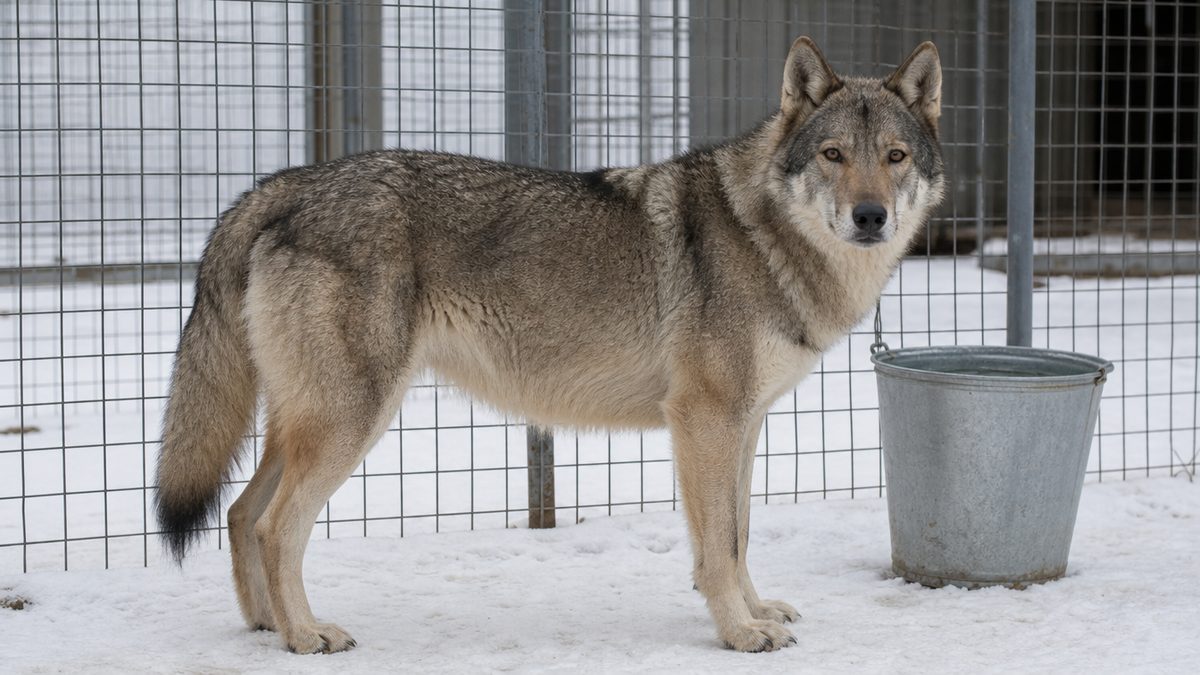
Quick answer
The volkosob is not a dog breed. It is a population of wolf and German Shepherd hybrids bred at a Russian military institute from the late 1990s, named in Russian law as a potentially dangerous wolf hybrid, holding no breed standard and no studbook anywhere. No Indian price exists and none should, because there is nothing to price.
This page reports legal instruments, news reports and search audits for general information. It is not veterinary advice. There is no published veterinary literature on this animal at all, so nothing here should be treated as a health profile, and the lifespan figures circulating for it are not supported by any study. If you are in contact with any wolf-hybrid animal, rabies risk and bite injury are the two things to discuss with your nearby veterinarian and with a doctor, promptly and without waiting for symptoms.
Volkosob at a glance, rated for India
What a Volkosob is, and what it is not
A Volkosob is a wolf and German Shepherd hybrid bred at a Russian military institute, and it is not a dog breed: no body anywhere publishes a breed standard for it and no studbook exists Rossiyskaya Gazeta.
The name is a compound of the Russian words for wolf and dog, and the animals it describes were produced at the Perm Institute of Internal Troops of the Russian Ministry of Internal Affairs from the late 1990s, under Professor Vyacheslav Kasimov. That is a military training establishment, not a kennel club, and the difference runs through everything on this page.
Bonbeno applies one test to any name used like a breed, and it is short: a breed has a written standard and a studbook, so that a puppy can be measured against a document and its ancestry traced. A national kennel club is a common way of supplying both, and it is not the only way. The Shiloh Shepherd and the Tamaskan Dog pass this test on private paperwork. The Volkosob fails both limbs.
| Condition | Volkosob | Saarloos Wolfdog | Czechoslovakian Wolfdog |
|---|---|---|---|
| A written breed standard | None found in any language | FCI standard 311 | FCI standard 332 |
| A studbook | None. An institutional kennel with percentages chalked on the enclosures | Dutch Kennel Club, with an approved outcross register | National registers under FCI patronage |
| Kennel club recognition | None anywhere | Definitive since 18 November 1981 | Definitive since 1999 |
| Measured wolf ancestry | Reported as 50 or 75 percent per animal by an institute | 18 to 33 percent, published, on two dogs | 11 to 12 percent, published, on three dogs |
| Named in national law | Yes, as a potentially dangerous wolf hybrid | No | No |
| Verdict | Not a breed | A breed | A breed |
Why 'not a breed' is a finding rather than a snub
Three of the six pages Bonbeno built alongside this one describe modern creations that pass the test on private paperwork, and this site says so plainly on each. The verdict here is different because the evidence is different. There is no document to measure a puppy against, no register to trace it in, and no organisation that claims to keep one. Where the Saarloos Wolfdog's own club publishes a nine-page outcross plan with litter counts, the Volkosob's record is two newspaper reports and a legal schedule Rossiyskaya Gazeta.
Neither major encyclopaedia treats it as a breed. On English Wikipedia the title 'Volkosob' redirects to the article Wolfdog, where it is a subsection carrying zero citations. On Russian Wikipedia it redirects to the article on dog-wolf hybrids, which describes volkosoby as a 'population of wolf-dog hybrids' rather than as a breed. Two encyclopaedias, two redirects, one conclusion.
Russian law names it: item 9 on the list of potentially dangerous dogs
The legal status of the Volkosob is settled by one document. Russian Government Decree No. 974 of 29 July 2019 lists it by name, as item 9, and glosses it in the instrument's own words as a wolf hybrid. Its legal status in India is a separate question, dealt with in the section that follows this one.
The decree is short. Made under the Federal Law on responsible treatment of animals and signed by the Prime Minister, it approves a schedule headed 'List of potentially dangerous dogs' with thirteen entries. Two of those entries are the reason this page exists, and they are separate entries rather than one.
| Item | Entry | What it names |
|---|---|---|
| 1 | Akbash | A Turkish livestock guardian breed |
| 2 | American Bandog | A crossbred type |
| 3 | Ambuldog | A bulldog type |
| 4 | Brazilian Bulldog | A bulldog type |
| 5 | Bully Kutta | A South Asian mastiff type |
| 6 | Alapaha Blue Blood Bulldog (otto) | An American bulldog type |
| 7 | Bandog | A crossbred type |
| 8 | Wolf-dog hybrids | A category, not a breed |
| 9 | Volkosob, a wolf hybrid | This animal, named and glossed |
| 10 | Gull Dong | A South Asian type |
| 11 | Pit Bull Mastiff | A crossbred type |
| 12 | North Caucasian dog | A regional type |
| 13 | Crossbreds of the dogs listed in items 1 to 12 | An extension clause |
Read items 8 and 9 together and the drafting is deliberate. Item 8 covers wolf-dog hybrids as a class. Item 9 then names the Volkosob specifically, and defines it in four words as a wolf hybrid. A government does not usually name a thing separately from the category it already falls inside unless it wants no argument about whether it is covered.
An independent copy of the same schedule on a Russian legal database matches on both entries, adds that from 1 January 2020 a potentially dangerous dog may not be walked without a muzzle and lead outside the owner's fenced territory, and describes the listed animals as possessing genetically determined qualities of aggression and strength. The official publication record confirms the number, the title and a publication date of 30 July 2019.
What this does and does not establish
- It establishes that the Russian state recognises the name. The animal is real and it is regulated.
- It establishes what the state thinks it is. Not a breed with a standard, but a hybrid of a wolf, listed among crossbred types.
- It does not create a breed. A legal schedule is not a studbook, and being named in one is not recognition in the cynological sense.
- It does not tell you anything about Indian law, which is dealt with separately below.
- It does not describe the animal. The decree gives no size, no coat, no temperament and no permitted wolf percentage.
Russia's kennel establishment issues pedigrees against international nomenclature that contains no Volkosob, while Russia's government names the Volkosob in a list of dogs that must be muzzled in public Independent cross-check of Decree No. 974…. The state regulates it; no registry recognises it. Those two facts are not in tension. They are what 'not a breed' looks like in practice.
History: one she-wolf named Naida, and a professor who called it an experiment
The Volkosob programme began with a single animal: a two-year-old she-wolf named Naida, bought by Professor Vyacheslav Kasimov from a man who intended to have her stuffed.
The most detailed contemporary account is a 2007 report in Rossiyskaya Gazeta, read here from an Internet Archive capture because the newspaper now returns a robot check to a direct fetch. It records that work at the Perm Institute of Internal Troops had begun about eight years earlier, when a hunter offered Kasimov the wolf, and quotes him on why he took her: her behaviour was abnormal for a wolf, she was loyal to people, and when about fifty people surrounded her on arrival she was unbothered.
A 2012 photo report adds the mechanics. Kasimov bought Naida with his own money. Unlike ordinary wolves, whose neophobia the reporter describes as pathological caution, she had almost none. It then took four years to find her a suitable mate, and the mate eventually chosen was a male German Shepherd. The first offspring convinced the professor the direction was worth pursuing.
What the kennel actually contained
In 2007 the institute's kennel held about 70 German Shepherds, nine volkosoby and two purebred wolves. One detail in that report tells you more about the programme's status than any claim about capability: on the enclosures, beside each animal's name, the institute wrote the percentage of wolf genes, some 50 and some 75, depending on how purebred the parents were.
A population in which individuals are labelled 50 percent and 75 percent wolf is not a breed. It is a breeding trial in progress, and the professor said so. Asked about wider service use, he answered: 'The experiment is at an initial stage.' Besides a calm attitude to people, he explained, they still needed to fix the behavioural trait of wanting to work for a human, and it was not yet strongly expressed. Only once that was achieved, he said, could one speak of forming a population of animals ready for service.
| Item | What is recorded | Source |
|---|---|---|
| Founding animal | A two-year-old she-wolf, Naida, with almost no neophobia | 2012 photo report |
| Time to find a mate | Four years, settling on a male German Shepherd | 2012 photo report |
| Start of the work | About eight years before November 2007 | 2007 newspaper report |
| Kennel in 2007 | About 70 German Shepherds, 9 volkosoby, 2 purebred wolves | 2007 newspaper report |
| Wolf percentage | Written on the enclosures, 50 and 75 percent | 2007 newspaper report |
| The professor's stated ideal | No more than 10 percent wolf genetic material | 2012 photo report |
| Generations reached | The fifth was being raised at the time of writing | 2012 photo report |
| Status in the director's own words | 'The experiment is at an initial stage' | 2007 newspaper report |
Russian Wikipedia states that the Perm project was closed and that 46 volkosoby in five generations were produced over 16 years, and cites the 2012 photo report for it. That report was read in full here. It contains no total, no mention of closure and no sixteen-year span, saying only that the fifth generation was then being raised. This page therefore publishes no total and no closure date, and neither should anyone else until a source that actually says it turns up.
The capability claims, traced back to where they came from
Every dramatic claim about this animal in English traces to two Russian news reports and one uncited encyclopaedia paragraph, and none of it has been through peer review Search audit run against PubMed on 9….
The literature audit is quick, because there is none. PubMed returns zero records for the Latin name forms with unrewritten query translations, and zero for a broadened 'Perm wolfdog' query in which the engine itself widened the search, which makes that zero a stronger negative rather than a weaker one. The in-session control returned 126. Europe PMC returns zero for both the Latin and the Cyrillic form.
The Cyrillic searches deserve a note of their own, because a careless researcher would report them as evidence. A PubMed query in Cyrillic returns zero with a blank query translation line, which means the query was emptied rather than searched, and the same happens for the Cyrillic word for dog itself. A zero from a search that never ran is not a finding, and this page does not treat it as one.
| Claim | Where it comes from | Status |
|---|---|---|
| Developed in the 1990s for Russian border guards | English Wikipedia, Volkosob subsection | Uncited. That subsection carries no references at all |
| A Caspian Steppe Wolf bred to East European Shepherd lines in 2000 | English Wikipedia | Uncited. The 2007 Russian report names only a German Shepherd male |
| An F3 generation was standardised | English Wikipedia | Uncited, and no standard has ever been published |
| Tracked a target in 15 to 20 seconds against 3 to 4 minutes for police dogs | A 2006 tabloid report | Not peer-reviewed; the Russian sources give 20 seconds against 4 to 6 minutes |
| Found hidden TNT in seconds in Chechnya | The 2007 newspaper report | A single reported incident, not a trial |
| Can follow a three-day-old trail | The 2012 photo report | A reported claim with no method or measurement |
| Can distinguish the blood of a cancer patient | The 2012 photo report | A reported claim with no study behind it |
| Lives 25 to 30 years | The 2012 photo report | Implausible. Longer than any verified dog or wolf lifespan |
The one claim that fails on its face
Take the lifespan claim seriously for a moment, because it is the cheapest check available. A figure of 25 to 30 years for these animals appears in the 2012 report. Wolves in captivity rarely pass their late teens and the oldest reliably documented domestic dogs sit under thirty as extreme outliers. A hybrid routinely reaching 25 to 30 would be the longest-lived canid population ever recorded, and it would have a literature. It has none. Where one number in a source is impossible, the rest of that source's numbers deserve the same scepticism.
The most useful sentence anyone has published about these animals came from the man who bred them, in a national newspaper, in 2007: the experiment is at an initial stage, and the willingness to work for a human is not yet strongly expressed. A researcher declining to claim success is worth more than every capability story written about him since.
Indian law and wolf content: what was read, and what could not be
Indian law on a wolf hybrid could not be settled from source in this session, so this page quotes no clause of the Wild Life (Protection) Act in either direction and sends you to your State Chief Wild Life Warden, who is the officer with the power to answer it.
Start with the honest part. The consolidated text of the Wild Life (Protection) Act, 1972 was sought on four routes on 9 September 2026 and every one failed. The India Code page returned 404, the alternate India Code host returned 502, one environment ministry path presented a certificate that did not match its own hostname, and a second ministry path returned 404. A researcher who has not read a statute does not get to summarise it, so this page does not.
Three Indian and international documents that were read in full
- The DGFT wildlife appendix, a 27-page official list of the Wild Life (Protection) Act entries published for the export policy schedule, extracted to 31,130 characters. It lists Indian Wolf, printed there as Canis lupas pallipes, Tibetan Wolf (Canis lupus chanco), Jackal and wild dog or dhole. Across the whole document the word 'hybrid' occurs exactly once, and it is a butterfly, Heliophorus hybrida. 'Domestic' occurs zero times and 'familiaris' zero times.
- The CITES appendices valid from 21 May 2023, the official 81-page English PDF, 110,408 characters. Canis lupus is Appendix I for the populations of Bhutan, India, Nepal and Pakistan and Appendix II elsewhere, with both entries annotated to exclude the domesticated form.
- The Dog Breeding and Marketing Rules, 2017, the Indian gazette notification G.S.R. 496(E), 14 pages with a real text layer throughout.
The rules notification carries the clause most directly aimed at a project like this one. Second Schedule Part II, paragraph 6(9) reads, in full, that 'Breeding to create new breeds of dogs or unusual looks shall be strictly prohibited'. Whatever the Wild Life (Protection) Act does or does not say about a hybrid, an Indian breeder who set out to repeat the Perm experiment would be running straight into that sentence. The same schedule prohibits breeding between relatives of the second to fourth grade within the first four generations, and Part IV requires a dog with a vicious or aggressive disposition to be housed separately and forbids sedation as a means of controlling its behaviour.
Forums repeat a 'four generations from the wild ancestor' test as though it were universal. It is United States law. 50 CFR 23.43 defines recent lineage as the last four generations of a specimen's ancestry and exempts a hybrid between a CITES species and a non-CITES species from CITES documentation where no purebred CITES species appears in those four generations. Read the rest of the section before quoting it: it is a documentation rule for import and export, not a rule about keeping an animal, and it is one country's rule. Do not import it into an Indian conversation.
| Question | Status here | Where an answer comes from |
|---|---|---|
| Is the Indian wolf a protected species | Established. Listed in the official appendix, and CITES Appendix I for India | DGFT appendix and CITES |
| Does the Wild Life (Protection) Act cover a wolf hybrid | Not established. The Act's consolidated text could not be retrieved on four routes | State Chief Wild Life Warden |
| Is there a four-generation rule in Indian law | Not established, and the rule usually quoted is American | State Chief Wild Life Warden |
| Can you breed a new wolf cross in India | Prohibited by the 2017 rules in terms | Gazette G.S.R. 496(E), paragraph 6(9) |
| Would import law let one in | No import route was found. Nothing is registered, nothing is documented | DGFT and your regional CITES management authority |
| Is it a dangerous animal in its own country | Yes. Russia lists it and requires a muzzle in public | Decree No. 974 |
The practical route is short, and it is the same one this site gives for every animal with a wild parent. Write to the Chief Wild Life Warden of your state before you spend a rupee. That officer administers the Act in your state, holds the permit powers under it, and gives an answer that binds. A breeder's assurance does not, an internet thread does not, and neither does this page. Ask in writing, and verify the reply against the section of the Act it names.
One more point of law that needs no research. An undocumented animal cannot be registered anywhere. There is no studbook to enter it in, no standard to measure it against and no kennel club that will issue a pedigree, so a municipal registration clerk asked to register a Volkosob has nothing to write in the breed field.
Price in India: there is no price, because there is no market
A Volkosob has no price in India. India's fullest dog price list, forty breeds deep, contains the word 'Volkosob' zero times and the word 'Wolf' zero times, while the in-document controls 'German Shepherd' and 'Labrador' occur 15 and 30 times.
That is the whole answer, and the controls are what make it worth reading. A zero in a document that also returns zero for common breeds would mean the document is broken. A zero beside 15 and 30 means the document works and the animal is not in the Indian market.
The search audit says the same thing from the other side, and it is more interesting than a blank result. Queried against Bing India in one session on 9 September 2026, 'volkosob price in india' returned about 5,310 results, ten of them pages belonging to an online gaming and hotel brand in Jaipur, which is homonym capture rather than a dog market. 'volkosob dog' returned about 74 results, ten of them pages about the abbreviation ng on Baidu Zhidao and Stack Overflow, covering nanograms and the Angular command line. In the same session the control 'labrador retriever price in india' returned about 16,200 results and ten genuine Indian Labrador pages.
| Query or lookup | Result | Reading |
|---|---|---|
| 'Volkosob' in India's 40-breed price list | 0 occurrences | Not sold in India |
| 'Wolf' in the same list | 0 occurrences | No wolf-content animal is listed at all |
| 'German Shepherd' in the same list | 15 occurrences, Rs 20,000 to Rs 75,000 | The control works |
| 'Labrador' in the same list | 30 occurrences | The control works |
| Bing India, 'volkosob price in india' | About 5,310 results, a Jaipur gaming brand | Homonym capture |
| Bing India, 'volkosob dog' | About 74 results, pages about nanograms | Substitution, not a market |
| Bing India, 'labrador retriever price in india' | About 16,200 results, genuine Indian pages | The instrument was healthy |
What a quoted puppy price would actually mean
If somebody quotes you a puppy price for a Volkosob in India, one of four things is true, and none of them is good. The animal is a German Shepherd or a Northern Inuit type sold under a rare name. It is a genuine wolf cross of unknown percentage, sold undocumented. It is a wolf, which is an Appendix I animal for India. Or there is no animal and the deposit is the product. There is no fifth possibility, because there is no legal import route, no studbook and no standard to verify a claim against.
Ask the seller for the registering body and the standard the puppy was bred to. Every recognised breed has both, and three of the modern wolf-look breeds Bonbeno covered alongside this page have both from private clubs rather than national kennel clubs. A seller who cannot name either is not selling you a breed. Walk away rather than negotiate.
Cost of ownership: cost the containment, not the kibble
The cost of ownership for a wolf-content animal in India is dominated by containment and liability rather than food, because the routine line items are ordinary German Shepherd costs while the fencing, the insurance question and the boarding refusal are not.
This section is written as a warning rather than a budget, because a budget implies the purchase is available and it is not. What follows are the Indian figures that would apply to a 35 to 45 kg working dog, each read from the seller's own page on 9 September 2026, plus the costs that only a wolf cross generates. The parasite line is typical of how these figures were taken: a three-tablet pack of a tick and flea product for a 15 to 30 kg dog listed at Rs 3,308 works out at Rs 1,102.67 a month, and a 40 kg animal sits in the next weight band up.
| Line item | Indian figure | Source read |
|---|---|---|
| Puppy vaccination course | From Rs 6,499, six visits | One national chain's promotional floor |
| Annual booster | From Rs 3,199 | Same chain |
| Anti-rabies alone | From Rs 699 | Same chain |
| Tick and flea, 15 to 30 kg | Rs 1,102.67 a month | Three tablets at Rs 3,308 |
| Vet consultation | Rs 500 to Rs 1,000 | Indian cost round-up |
| Grooming | Rs 300 to Rs 2,000 a visit | Indian cost round-up |
| Boarding, overnight | Rs 899 for up to 24 hours | One Bengaluru operator |
| Municipal registration, Delhi | Rs 500 new, Rs 500 renewal, Rs 100 a month late | MCD citizen portal |
| Professional training | Rs 5,000 to Rs 15,000 | India's 40-breed price list |
The four costs that only a wolf cross generates
- Containment. A wolf cross needs fencing built to hold a climber and a digger, which means height with an inward return and a dug or paved apron. Nothing in the list above prices that, and it is the single largest number in the project. Budget it as construction, not as a pet expense.
- Boarding refusal. Indian boarding is priced per night for ordinary dogs, and an operator who is told the animal has wolf content will usually decline. Assume you cannot travel, or price a live-in handler instead.
- Veterinary reluctance. Handling an animal that will not be restrained conventionally is a specialist job, and the Rs 500 to Rs 1,000 consultation assumes a dog that can be examined on a table.
- Liability. In its own country this animal is on the list that requires a muzzle and lead in public from 1 January 2020. An Indian owner has no such framework to point at, which is worse rather than better if something happens.
Feed cost is the least interesting number on the page. You feed a 40 kg working animal roughly what you feed a large German Shepherd, and if the food budget is the part of this project that worries you, the containment budget has not been calculated yet.
Two of the breeds researched alongside this page give you the wolf-like appearance with a published standard, a studbook and a normal veterinary life. The Saarloos Wolfdog has carried an FCI standard since 18 November 1981. If the look is the goal, buy the look with paperwork attached.
Heat tolerance: a Perm winter animal in an Indian summer
This animal rates 1 of 5 for heat tolerance in Indian conditions, and the number that earns it is blunt: Perm's January mean is minus 16.20 C, while Chennai's coolest month averages 24.09 C NASA POWER climatology 2001-2020 for twelve….
The homeland baseline was taken at Perm by explicit latitude and longitude, 58.0105 north and 56.2502 east, the city where the Perm Institute of Internal Troops bred these animals. NASA POWER returns a cell elevation of 174.22 m against a real elevation of about 171 m, an error of 3 m, so the grid cell genuinely describes the city rather than a hillside beside it. Its 2001 to 2020 climatology gives an annual mean of 1.13 C, an annual relative humidity of 90.32 percent, a July mean of 18.13 C and a January mean of minus 16.20 C.
| Place | Cell elevation | Annual mean | Hottest month | Coolest month |
|---|---|---|---|---|
| Perm, Russia | 174.22 m | 1.13 C | July, 18.13 C | January, minus 16.20 C |
| Delhi | 206.37 m | not applicable | June, 35.88 C | January, 13.61 C |
| Chennai | 48.95 m | not applicable | May, 31.51 C | January, 24.09 C |
| Mumbai | 97.15 m | not applicable | May, 31.19 C | January, 23.19 C |
| Bengaluru | 841.72 m | not applicable | April, 28.37 C | December, 20.22 C |
| Pune | 635.99 m | not applicable | April, 28.93 C | December, 19.62 C |
Read the annual mean first. Perm averages 1.13 C across the year. Not its winter, its year. Six of its twelve months sit at or below freezing and only three clear 15 C. Bengaluru, the mildest Indian city in that table, is warmer in its coolest month than Perm is in its hottest. An animal selected for that thermal world is heat-sensitive in a sense that no acclimatisation programme fixes, because the selection pressure ran the other way for its entire history.
The double coat is the mechanism, not the marketing
A double coat carries a dense insulating undercoat beneath a weather-shedding outer coat, and it is what lets a double-coated northern animal sit out a minus 16 C January. In India that same structure traps heat against the skin. The July wet-bulb figure at Perm, computed from the mean temperature and the mean humidity, is 15.93 C, which a coastal Indian city passes before breakfast for most of the year. Kolkata, absent from the table above because only its hottest month sits in the cache, peaks at 31.53 C in May. Frame the risk as wet-bulb load rather than as monsoon or as air temperature, because wet bulb is the number the coat actually fights. Run the arithmetic and the point lands: a monsoon afternoon at 30 C and 90 percent humidity gives a wet bulb of 28.62 C, while a dry 35 C afternoon at 30 percent humidity gives 22.14 C. The cooler-looking month is the dangerous one.
No hill-station figure appears here, and that is deliberate
The obvious move is to propose a hill station as an Indian analogue. NASA POWER's grid cells for Manali, Shimla, Ooty, Darjeeling and Gangtok are wrong by 700 to 1,935 m in both directions, so any figure taken from them would be an artefact rather than a climate. This page publishes no hill-station number. A reader who wants one should take a local station reading instead.
The largest study of canine heat-related illness followed 905,543 UK dogs and found 395 confirmed events with an event fatality rate of 14.18 percent, identifying higher bodyweight relative to the breed and sex mean, an age over two years and a bodyweight over 50 kg as risk factors. Neither 'Volkosob' nor 'wolfdog' appears anywhere in that paper, while the in-document control 'German Shepherd' appears once, so no figure specific to this animal exists and none is invented here. The bodyweight finding is what transfers. No northern animal is hardy in the Indian sense of the word.
Temperament: one calm she-wolf is not a temperament record
The documented temperament record for the Volkosob is two sentences long, and both of them come from the man who bred the animals: the founding she-wolf was unusually calm around people, and the willingness to work for a human was not yet strongly expressed in her descendants.
Everything else circulating in English is inference. There is no standard describing required temperament, no club assessment scheme, no breed survey and no published behavioural study. This section therefore separates three things that usually get mixed together: what the primary reports actually say, what generalises from wolf-content animals, and what nobody knows.
What the primary reports say
- Naida had almost no neophobia. The 2012 report describes the caution of an ordinary wolf as pathological and says she had none of it, which is why she was selected.
- She was unbothered by a crowd. On arrival about fifty people surrounded her and she was calm, which is the observation that convinced Kasimov to try.
- The founder's own goal was a calm attitude to people plus a fixed desire to work. He had the first and was still chasing the second in 2007.
- The animal photographed in 2012 was 25 percent wolf, and the professor named no more than 10 percent as his ideal proportion. A programme still moving its target downward is a programme whose temperament is not fixed.
What generalises, and how to hold it
Two behavioural traits transfer from wolf-content animals generally and neither is a defect. A high prey drive makes small animals, poultry and cats a management problem rather than a training problem, and a strong flight response makes a startled animal go through a fence rather than face what startled it. A shy reaction to strangers is normal in wolf-derived populations and is documented in the one wolf-derived breed that has a standard, which is why that breed's registry writes temperament into its paperwork at all. None of this has been measured in a Volkosob, and this page does not pretend otherwise.
| Claim | Confidence | Why |
|---|---|---|
| Founding wolf was calm with people | Documented | Two independent reports, one quoting the breeder |
| Work drive was not fixed as of 2007 | Documented | The breeder's own words in a national newspaper |
| Wolf percentage varied by animal, 25 to 75 | Documented | Chalked on the enclosures and stated in 2012 |
| High prey drive | Expected, not measured | Generalised from wolf-content animals |
| Reserve toward strangers | Expected, not measured | Documented in a wolf-derived registered breed |
| Suited to family life | Unknown | No study, no survey, no club assessment exists |
| Aggression toward people | Unknown | The Russian decree asserts it as a class, without data |
The socialisation window in dogs closes early, and a wolf-content animal gets no extension for its ancestry. An animal that has not met people, surfaces, traffic and handling before that window shuts does not catch up later with effort. Anyone who tells you a wolf cross can be socialised into an ordinary pet at eight months is describing a hope, not a method.
Training: the breeder said the desire to work was not yet there
To train a wolf-content animal, start from what the Perm programme itself reported: the trait it was still trying to fix after eight years was the desire to work for a human, and it was not strongly expressed.
That single admission reframes every capability story written about these animals. A dog is trainable because thousands of years of selection built a willingness to take direction from a person. Dilute that with wolf ancestry and you keep the nose, the stamina and the problem-solving while losing part of the biddability that makes training work. The Perm reports describe both halves of that trade honestly, and the second half is the one nobody quotes.
What the reported successes actually were
Two animals were sent to Chechnya to be studied in new climatic conditions and reportedly found hidden TNT in seconds. A later report adds claims of following a three-day-old trail and distinguishing the blood of a cancer patient. Read those as scent capability, which is the half of the trade that went well. None of them is a trial, none has a method, and none appears in peer-reviewed literature. A nose that good in an animal that will not reliably take direction is a research problem, not a working dog.
| Method | Works | Breaks |
|---|---|---|
| Food-motivated shaping | Well, while the animal is hungry and interested | The moment something outdoors is more interesting |
| Compulsion and correction | Never. It produces a defensive animal | Escalates a flight response into a bite |
| Long-line management | Well. Management substitutes for recall | Requires an adult at the other end, every time |
| Off-lead recall | Rarely, and never reliably | Prey drive overrides recall at the worst moment |
| Crate rest and confinement | Poorly without early conditioning | Panic rather than settling |
| Sedation to control behaviour | Prohibited in India for a dog of vicious or aggressive disposition | Indian rules require separate housing instead |
That last row is Indian law rather than opinion. The Dog Breeding and Marketing Rules, 2017 require a dog with a vicious or aggressive disposition to be housed separately and provide that sedation shall not be used to control the behaviour of such dogs. An owner planning to chemically manage a wolf cross in India should read that clause before buying anything.
Train the environment rather than the animal. A wolf-content animal is managed with fences, gates, double-door airlocks and long lines, and trained with food inside that management. Every plan that depends on the animal choosing to obey at the critical moment is a plan with a hole in it. If that sounds like too much, the conclusion is not a different training method, it is a different animal.
Exercise: the fence matters more than the walk
A wolf-content animal needs less exercise planning than containment planning, because the failure mode is not an under-exercised dog, it is an animal loose in an Indian neighbourhood that no authority has a category for.
Take the physical requirement first, because it is the easy part. This is a 35 to 45 kg working animal from a lineage of German Shepherds and wolves, and it wants two to three hours of activity a day, most of it sniffing and moving rather than repetitive fetch. In Indian conditions that has to happen before sunrise and after dark for eight months of the year, which is the same constraint every northern breed on this site carries.
Containment specification, written as a build
- Height with an inward return. A vertical fence is a ladder to a climbing animal. The return at the top is what stops it, not the height alone.
- A dug or paved apron. Wolf-content animals dig under rather than over when the top is closed. A buried skirt turned inward at the base removes that route.
- A double-gate airlock. Every escape story starts with a single gate and a delivery.
- No climbable furniture inside the run. Kennels, water drums and trees beside a fence are step ladders.
- Daily inspection. Fences fail slowly and then all at once.
Russia's own answer to a loose animal of this kind is a legal one. From 1 January 2020 a dog on the potentially dangerous list may not be walked without a muzzle and lead outside the owner's fenced territory. India has no comparable schedule, so there is no muzzle rule to comply with and no framework to shelter behind. The obligation falls entirely on the owner.
| City | Workable window | Months that are hardest |
|---|---|---|
| Delhi | Before 06:30 and after 21:00 | April to June, peaking at 35.88 C in June |
| Chennai | Before 06:00 and after 21:30 | All twelve, coolest month still 24.09 C |
| Mumbai | Before 06:00 and after 21:30 | March to May, with humidity year round |
| Bengaluru | Before 07:00 and after 20:00 | March to April, peaking at 28.37 C in April |
| Pune | Before 07:00 and after 20:30 | March to April, peaking at 28.93 C in April |
The 2007 report records that two volkosoby were sent to Chechnya specifically to be studied in new climatic conditions. That is the closest thing to a warm-climate trial this animal has, it involved two individuals, it produced no published physiological data, and Grozny is still a great deal cooler than Chennai. Nobody has tested this animal in Indian heat.
Grooming: a northern double coat that sheds twice and never thins out
To groom a wolf-content northern animal in India, work the undercoat out twice a year with a rake and an undercoat blade, brush weekly in between, and never clip the coat down in the belief that it will cool the animal.
The coat is the least mysterious part of this animal, because wolf and German Shepherd both carry the same architecture. A dense insulating undercoat sits under a coarse weather coat, and the whole structure exists to hold warmth at minus 16 C. It sheds heavily in two seasonal moults and lightly all year, and in an Indian climate the moult is often continuous rather than seasonal because the temperature cue that triggers it never arrives properly.
| Task | Frequency | Indian note |
|---|---|---|
| Slicker brush through the outer coat | Weekly | Twice weekly during a moult |
| Undercoat rake to the skin | Every 2 to 3 weeks | More often in a humid coastal city |
| Full de-shed with a blade | Twice a year | Often blurs into a year-round job in India |
| Bath | Every 6 to 8 weeks | Dry to the skin or you will grow a hot spot |
| Ear and skin check | Weekly | Humidity is the driver, not dirt |
| Professional grooming | Optional | Rs 300 to Rs 2,000 a visit in Indian salons |
Coat and colour, and why no standard describes them
Coat and colour in this animal are whatever the parents happened to carry, because there is no document that prescribes them. A recognised breed's colours are a list in a standard and a disqualification if you stray outside it. Here the range runs from German Shepherd sable through wolf grey, and an individual's appearance depends on its own wolf percentage rather than on any written requirement. That is another way of saying what the rest of this page says: with no standard, appearance is not a promise anyone can make.
A clipped double coat loses its ability to hold a layer of still air away from the skin and exposes skin that has never seen Indian sun. The cooling is imaginary and the sunburn and coat damage are not. Rake the undercoat out instead, and manage heat with shade, water and timing. Ask your nearby vet before any clip if the coat is matted to the point where removal is the only option.
Health: no scheme, no screening data, and one impossible lifespan claim
No health data exists for the Volkosob. There is no breed health scheme, no registry collecting results, no published study and no screening requirement, because all four of those things are functions of a registry and this animal has none Search audit run against Europe PMC on 9….
Say that plainly before anything else, because the absence is the finding. When Bonbeno writes a health section for a registered breed it quotes a scheme's own tables. Here there is no table to quote. The North American orthopaedic registry's statistics interface was unreachable throughout this research, on three separate routes, so no hip or elbow figure appears on this page for any breed, including the German Shepherd that stands on one side of this animal's pedigree. A number nobody read is not a number.
The lifespan claim, checked against arithmetic
A life expectancy of 25 to 30 years is claimed for these animals in the 2012 photo report. That figure fails on its face. Captive wolves rarely pass their late teens, large working dogs average nine to thirteen years, and the oldest reliably documented domestic dogs are extreme individual outliers rather than a population norm. A canid population routinely reaching 25 to 30 years would be the longest-lived ever recorded and would have generated a literature. It has generated none. This page publishes no life expectancy figure for the Volkosob, because the only one on offer is not credible and no other has been measured.
| Question | Answer available | Basis |
|---|---|---|
| What is the life expectancy | No | The only published figure, 25 to 30 years, is not credible |
| What is the hip dysplasia rate | No | No registry collects results and no statistics interface was reachable |
| What genetic tests are required | None exist | There is no body to require them |
| What is the inbreeding coefficient | No | No studbook, so no pedigree depth to calculate from |
| Is there a breed health survey | No | No club, no survey |
| What does the literature say | Nothing | Zero records in two databases, with controls that passed |
The gene pool problem, which is arithmetic rather than opinion
One she-wolf founded this population. A gene pool that starts with a single wild female and a small number of institutional German Shepherds is narrow by construction, and there is no register to manage it with. The team that sequenced the two registered wolfdog breeds, comparing 46 Czechoslovakian Wolfdogs and 20 Saarloos Wolfdogs against 12 German Shepherds and 20 wolves, closed by recommending that breeders maintain genetic diversity, minimise inbreeding, select unrelated individuals from diverse lineages and avoid additional uncontrolled crossings with wild wolves. Every one of those four recommendations requires a studbook to carry out. Without one they are not advice, they are a description of what cannot be done.
Hybrid vigour is the counter-argument usually offered, and it is misapplied here. Vigour comes from crossing two genetically distant populations that are each reasonably diverse. Crossing one wolf into a handful of related shepherds and then breeding the offspring among themselves for five generations is not outcrossing, it is founding a bottleneck. You cannot screen your way out of that either, because screening needs a scheme and there is none.
If a wolf-content animal is already in your home, treat it as a large working dog with an unknown genetic background and an unknown drug history. Keep vaccination and parasite control current, weigh it monthly, and get orthopaedic and cardiac checks at the intervals your vet sets rather than at breed-typical ones. Consult your nearby vet before any anaesthetic, any sedation and any change of diet, and tell them the wolf content up front so they can plan handling and dosing. Nothing on this page is a substitute for that conversation.
Feeding: an ordinary large-dog plan, with two wolf-specific cautions
To feed a 35 to 45 kg wolf-content animal in India, use a large-breed diet split across two meals, hold the animal lean, and treat raw feeding as a food-safety decision rather than an ancestral one.
The quantity question is unremarkable. An animal of this size eats what a large German Shepherd eats, adjusted to condition rather than to a chart, and the target is a visible waist and ribs you can feel under a thin layer. That target is not cosmetic in India. The largest study of canine heat-related illness found that bodyweight higher than the breed and sex mean was a risk factor, alongside age over two years and a bodyweight over 50 kg. Every extra kilogram on a double-coated animal in Chennai is a heat risk, not just a joint risk.
| Stage | Meals a day | What to watch |
|---|---|---|
| 8 to 16 weeks | 4 | Growth rate, not size. Fast growth damages joints |
| 4 to 8 months | 3 | Keep lean through the growth spurt |
| 8 to 18 months | 2 | Large-breed formulation until skeletal maturity |
| Adult | 2 | Body condition monthly, weight monthly |
| Hot season, any age | 2, timed cool | Feed after the evening walk, never before exertion |
| Senior | 2 | Protein maintained, calories reduced |
The two cautions that are specific to wolf content
- Raw feeding is a food-safety question in an Indian kitchen. The argument that a wolf-content animal needs raw meat because wolves eat raw meat is an appeal to ancestry, not evidence. Raw handled in a warm climate carries a bacterial load for the household as much as for the animal. If you feed raw, handle it like poultry in a restaurant kitchen, with separate boards, cold chain and hand discipline.
- Resource guarding is likelier and harder to fix. Guarding food is normal canine behaviour that intensifies in wolf-content animals and does not respond to the confrontation that works on nothing anyway. Feed in a closed space, leave the animal alone while it eats, and never make a habit of taking food away to prove a point.
Supplement claims deserve one sentence of scepticism. No supplement fixes a structural problem, no joint powder substitutes for keeping an animal lean, and no diet compensates for a coat that cannot lose heat. Ask your nearby vet before adding anything, particularly in an animal whose baseline bloodwork nobody has published.
Puppy timeline: what the first year would look like, and why it rarely does
Wolf-content puppies need earlier and heavier socialisation than dog puppies and get a shorter window in which to do it, which is the single hardest fact in raising one.
This timeline is written conditionally, because there is no legitimate Indian source for such a puppy and this site does not help anyone find one. It is here so that a reader who is already committed, or who has inherited an animal, knows what the schedule looks like.
| Age | What matters most | Constraint |
|---|---|---|
| 0 to 8 weeks | Stays with the litter | Indian rules prohibit sale under eight weeks |
| 3 to 12 weeks | The socialisation window. People, surfaces, sounds, handling | Vaccination timing limits outings; use carried exposure |
| 8 to 16 weeks | Vaccination course, six visits from Rs 6,499 | Book cool-hour appointments |
| 4 to 6 months | Containment training and long-line habits | Fence must already exist, not be planned |
| 6 to 9 months | Adolescent testing of every boundary | Escape attempts start here |
| 9 to 12 months | Size and weight approach adult, drive sharpens | Heat management becomes daily |
| 12 to 18 months | Skeletal maturity, temperament settles or does not | Rehoming options are effectively zero |
Size and weight, stated as an estimate and labelled as one
No standard prescribes size and weight for this animal, so no authoritative figure exists. What can be said is bounded by its parents: a European grey wolf and a German Shepherd both sit in the 30 to 45 kg range for males, so an adult in that band is what the pedigree predicts. Bonbeno publishes that as an inference from parent species, not as a specification, and it is exactly the kind of statement a breed standard would replace with a measured range if one existed.
The Dog Breeding and Marketing Rules, 2017 provide at Rule 8(1)(a) that pups less than eight weeks in age are not sold, and at Second Schedule Part II paragraph 6(3) prohibit breeding between relatives of the second to fourth grade within the first four generations. A five-generation programme founded on one female would struggle to satisfy the second clause, and an Indian imitator would also collide with paragraph 6(9), which prohibits breeding to create new breeds outright.
Comparison: five wolf-look animals, and which of them are actually breeds
Four of the five wolf-look animals compared here are breeds with a standard and a studbook, and the Volkosob is the one that is neither Federation Cynologique Internationale.
Anyone reading this page arrived wanting a wolf-like animal, and the useful service is to show what the alternatives actually offer on paper. Two of these carry international recognition, two carry private club paperwork that satisfies the same two conditions without a national kennel club, and one carries nothing.
| Animal | Written standard | Studbook | Measured wolf ancestry | Verdict |
|---|---|---|---|---|
| Saarloos Wolfdog | FCI 311, definitive 18 Nov 1981 | Yes, with an approved outcross register | 18 to 33 percent, published | Breed |
| Czechoslovakian Wolfdog | FCI 332 | Yes | 11 to 12 percent, published | Breed |
| Tamaskan Dog | Club standard, published | Yes, club-kept | None. No recent wolf in the pedigree | Breed, on private paperwork |
| Shiloh Shepherd | Club standard, published | Yes, club-kept | None | Breed, on private paperwork |
| Volkosob | None anywhere | None | 50 and 75 percent, chalked on an enclosure | Not a breed |
The Tamaskan and Shiloh rows are the interesting ones for this comparison, because they show that the verdict here is not about kennel club politics. Neither animal is FCI recognised. Both are still breeds under this site's test, because a club that publishes a standard and keeps a register supplies both conditions. Being unrecognised by a national body is not the failure. Having nothing to be recognised is.
Wolf ancestry, measured against asserted
The genetics paper that measured the two European wolfdog breeds worked from a dataset of 697 individuals and reported 11 to 12 percent wolf ancestry in the Czechoslovakian Wolfdog and 18 to 33 percent in the Saarloos. Those are laboratory figures with a method behind them. The Volkosob's 50 and 75 percent are institutional bookkeeping written beside an animal's name, and the one animal given a figure in 2012 was described as 25 percent wolf. A population whose wolf content is asserted rather than assayed, and whose asserted figures move between 25 and 75 percent across two reports five years apart, is unsettled in the most literal sense.
Buy an animal whose paperwork you can read. Two of the five above have an FCI standard you can download and check a puppy against, and two more have club standards that do the same job. All four give you a registered animal, a traceable pedigree and a vet who is not being asked to treat an unknown.
Common mistakes: seven ways people get this animal wrong
The most common mistake about the Volkosob is treating an uncited encyclopaedia paragraph as a breed profile, and the other six all follow from it.
- Repeating the English Wikipedia subsection as fact. It states a 1990s border-guard origin, a Caspian Steppe Wolf crossed to East European Shepherd lines in 2000 and a standardised F3 generation, and it carries zero citations for any of it. The 2007 Russian report names a German Shepherd male and no steppe wolf.
- Quoting the 46 animals in 16 years figure. Russian Wikipedia attributes it, plus the project's closure, to the 2012 photo report. That report was read in full and contains none of the three claims.
- Treating the Russian decree as recognition. Being named in a list of potentially dangerous dogs is regulation, not registration. A government schedule is not a studbook.
- Applying the American four-generation rule to India. 50 CFR 23.43 is United States law and it governs import and export documentation rather than keeping an animal.
- Believing the 25 to 30 year lifespan. No canid population lives that long, and the claim sits in a source with no supporting data.
- Assuming a Russian breeder can sell you one. Nothing is registered, no import route was found, and any Indian offer is one of the four scenarios set out in the price section.
- Confusing a wolf look with wolf content. Several breeds achieve the look with no recent wolf in the pedigree at all, which is why their registries can describe them precisely and this page cannot describe a Volkosob at all.
The research mistake worth naming separately
A researcher checking this animal in Cyrillic will get zeroes and may report them as evidence of nothing being published. Those zeroes are worthless. PubMed returns 0 for the Cyrillic form with a blank query translation line, and does the same for the Cyrillic word for dog, which means the query was voided rather than searched. Europe PMC returns 3 for the Cyrillic word for dog across its entire corpus, so its Russian-language coverage is negligible and a zero there carries little weight either. The Latin-form zeroes are the ones that count, and one of them came after the engine broadened the query itself.
Adoption: there is nothing to adopt, and that is the right outcome
You cannot adopt a Volkosob in India. No rescue holds one, no register lists one, no importer brings one in, and the honest advice is to take the interest that brought you here to an Indian shelter instead.
This is the shortest section on the page because the answer is short. There is no Volkosob rescue anywhere, in any country, and there is no Indian population to rescue from. The animal exists as an institutional kennel population in Perm, described in two news reports and one legal schedule Government of the Russian Federation.
What to do with the interest that brought you here
- If you wanted the wolf look, four registered alternatives are compared above, two with FCI standards and two with club standards and registers.
- If you wanted a serious working animal, a well-bred German Shepherd from a breeder who screens and shows you the results does everything a Volkosob is claimed to do, in a body your vet knows how to treat.
- If you wanted a dog that needs you, Indian shelters are full of animals that will cost you a consultation at Rs 500 to Rs 1,000 and a vaccination course rather than a fence budget.
- If somebody offers you one anyway, ask for the registering body and the standard, then walk away when neither exists.
One last framing, because it matters more than any of the practical advice. The Perm programme was run by a professor who bought a wolf with his own money to keep her from being stuffed, spent four years finding her a mate, and told a national newspaper that after eight years his experiment was at an initial stage Rossiyskaya Gazeta. That is a careful researcher describing careful research. What the internet did with it, over the next twenty years, was invent a border-guard super-dog with a thirty-year lifespan. The animal deserves better and so does the reader.
Write to your State Chief Wild Life Warden and get the position in writing, price the containment as construction rather than as a pet expense, confirm a vet who will take the case, and confirm boarding that will accept the animal when you travel. If any one of those four comes back negative, the project is finished. Most people find out in that order, and the animal is usually already home by the time they do.
Volkosob questions Indian readers actually ask
Is the Volkosob a real dog breed?
No. On Bonbeno's two-condition test a breed needs a written standard and a studbook, and neither exists for this animal in any language or under any body. What exists is a hybrid population from a military research programme, and a named entry in a Russian list of potentially dangerous dogs.
What is a Volkosob?
A cross between a wolf and a German Shepherd, bred at the Perm Institute of Internal Troops of the Russian Ministry of Internal Affairs from the late 1990s under Professor Vyacheslav Kasimov, starting from a single she-wolf named Naida who was unusually tolerant of people.
How much wolf is in a Volkosob?
It varied by individual and the institute wrote it on the enclosures. A 2007 newspaper report records the percentage of wolf genes displayed beside each animal's name, some 50 percent and some 75, depending on how purebred the parents were. The professor's own stated ideal was no more than 10 percent.
Is the Volkosob legal in Russia?
It is legal and it is regulated by name. Government Decree No. 974 of 29 July 2019 lists it as item 9 on the list of potentially dangerous dogs, glossed as a wolf hybrid, with wolf-dog hybrids generally at item 8. From 1 January 2020 such dogs may not be walked without a muzzle and lead outside the owner's fenced land.
Is the Volkosob legal in India?
Nobody can answer that from a document this session could reach, and the honest position is that it is unsettled. What can be said is that CITES excludes the domesticated form of Canis lupus from the Convention while listing the wolf itself, and that no Indian instrument reached here contains an animal hybrid rule at all. Ask your State Chief Wild Life Warden in writing.
What is the Volkosob price in India?
There is none, and there is nothing to price. The word occurs zero times on India's fullest published dog price list, no registry issues papers for the animal, and the only recorded population was an institutional kennel in Russia. Any Indian rupee figure attached to this name is an invention.
Can a Volkosob be registered with the Kennel Club of India?
No. India is a full FCI member represented by the Kennel Club of India, so Indian pedigrees are issued against FCI nomenclature, and the FCI's letter V index returns three breeds, none of which is this. There is no register anywhere that could issue papers for it.
How long do Volkosobs live?
No reliable life expectancy figure exists. A 2012 photo report attributes a lifespan of 25 to 30 years to these animals, which is longer than any verified dog or wolf has lived and should not be repeated. There is no published study of the population's longevity, health or mortality.
Is there any scientific research on the Volkosob?
None that a controlled search can find. PubMed returns zero records for the Latin name forms with unrewritten query translations, and zero for a broadened Perm wolfdog query, while the in-session control returned 126. Europe PMC returns zero for both the Latin and Cyrillic forms.
Did the Perm project produce 46 dogs over 16 years?
That figure circulates widely and its source does not support it. Russian Wikipedia states that the project was closed and that 46 animals in five generations were produced over 16 years, citing a 2012 photo report. That report contains no total, no mention of closure and no sixteen-year span; it says only that the fifth generation was being raised.
Are Volkosobs better working dogs than German Shepherds?
The claims are striking and none of them is peer-reviewed. Reports credit the animals with finding hidden explosives in seconds and following three-day-old trails. Against that, the programme's own director said in 2007 that the willingness to work for a human was not yet strongly expressed and the experiment was at an initial stage.
What should an Indian reader do with this information?
Treat any dog offered in India as a Volkosob as unverifiable, because no paperwork exists that could prove it. If you want a large, capable working dog, the German Shepherd side of this cross is registrable through the Kennel Club of India and priced between Rs 20,000 and Rs 75,000.
Are wolfdogs legal in India?
Unsettled, and this page will not pretend otherwise. The consolidated Wild Life (Protection) Act could not be retrieved on four routes, so no clause is quoted in either direction; what was read in full is that CITES lists the wolf on Appendix I for India while excluding the domesticated form, that the official wildlife appendix contains no animal hybrid rule, and that the 2017 Dog Breeding and Marketing Rules prohibit breeding to create new breeds outright. Write to your State Chief Wild Life Warden before spending a rupee.
Can you crossbreed a wolf and a dog?
Biologically, yes, and the Volkosob is the record of one state doing it: a cross between a wolf and a German Shepherd bred at the Perm Institute of Internal Troops of the Russian Ministry of Internal Affairs from the late 1990s under Professor Vyacheslav Kasimov, starting from a single unusually calm she-wolf named Naida, with wolf percentages of 25 to 75 chalked on the enclosures. In India, doing it deliberately runs straight into the 2017 rules, whose Second Schedule states that breeding to create new breeds of dogs or unusual looks shall be strictly prohibited.
Are wolfdogs safe as pets?
Nobody has measured it. The documented temperament record for the Volkosob is two sentences from its breeder, that the founding she-wolf was calm with people and that the desire to work for a human was not yet fixed in her descendants, and no study, survey or club assessment exists on suitability for family life. What generalises from wolf-content animals is a high prey drive, a strong flight response and reserve toward strangers, Russia lists the animal as potentially dangerous and requires a muzzle in public, and a socialisation window that has closed does not reopen.
Compare with similar breeds
Volkosob sits in 2 Bonbeno groups. Each one compares it directly against the breeds it is genuinely an alternative to, on the same figures.