
Breed profile
Tahitian Dog: The Society Islands Branch of One Pacific Population
Cook's men ate it, Forster carried two aboard toward England, and Charles Hamilton Smith gave it a scientific name that covered the Hawaiian dog in the same breath. It is the best-described of the Pacific dog populations and the only one that has never been sequenced.
Quick answer
The Tahitian dog is extinct and was never a separate breed. It was the Society Islands branch of one Pacific-wide population, called uri maohi in Tahitian, and Charles Hamilton Smith named it together with the Hawaiian dog under a single binomial in 1839. Frederick Debell Bennett recorded it as already absorbed into introduced European stock by the mid-1830s.
This page reports a historical record. The animal in the title is extinct, no clinical record exists for it, no screening scheme has ever covered it and no life expectancy was ever measured, so every health statement here is about living village-type dogs in India rather than about the Tahitian dog. Guidance written for registered breeds may not transfer. Nothing here is a diagnosis or a treatment plan. Consult your nearby vet before acting on anything on this page, and take any dog showing heat distress, collapse, pale gums, dark urine or an unexplained fever to a veterinary surgeon the same day.
Tahitian Dog at a glance
What the Tahitian Dog was, and what it was a branch of
The Tahitian Dog was the Society Islands branch of one Pacific-wide dog population, not a separate breed. Its Tahitian name, uri maohi, simply means native dog, and it is the best-described and least-measured of the four Polynesian dog populations.
Say the relationship first, because every other page on this term buries it. This animal was not a breed similar to other Polynesian dogs. It was the local population of the same animal, carried to the Society Islands by the ancestors of the Mahoi people during the settlement of Polynesia, and the pages on the Kuri and the Hawaiian Poi Dog describe the same animal from other islands.
The clearest proof of that sits in the scientific record. When Charles Hamilton Smith coined a name for these dogs he did not coin one for Tahiti. He coined one for two archipelagoes at once: the native race, known by the name of The Poe Dog (Canis Pacificus, Nob.), Uri-Mahoi of Tahiti and Ilio of the Sandwich Islands. Two islands, one name, one sentence.
What the animal looked like and was for
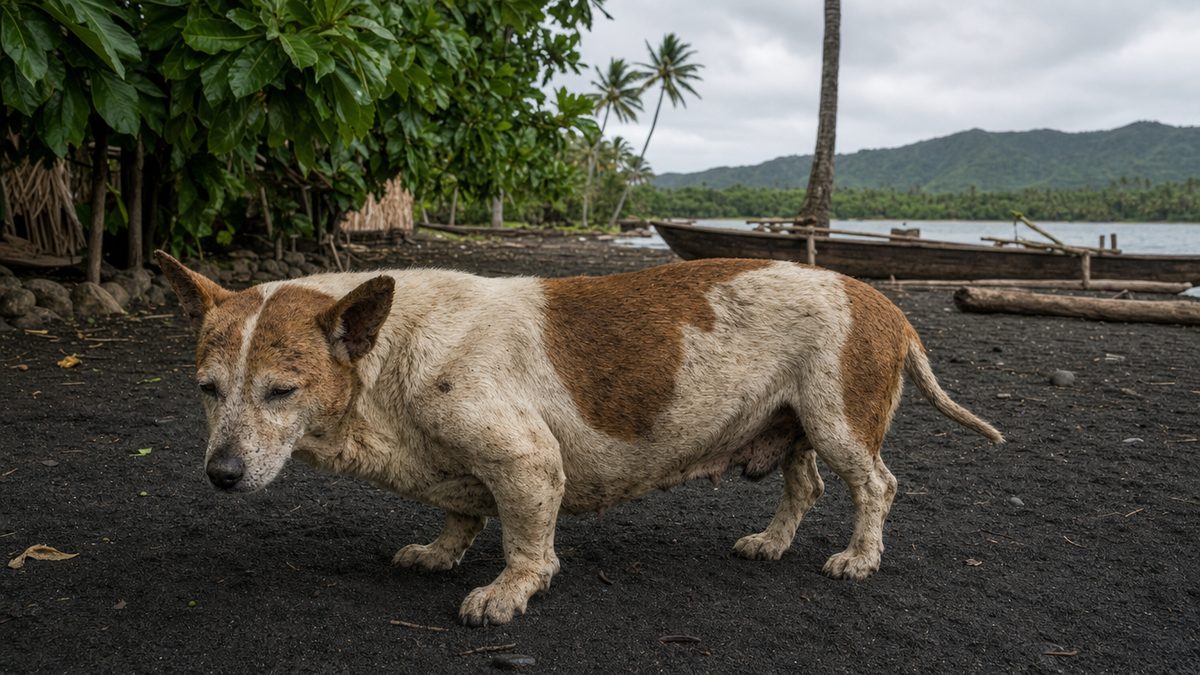
It was small, lean, long in the back, short and slightly crooked in the foreleg, broad in the skull, pointed in the muzzle, small-eyed and prick-eared, with a coat variously described as smooth or as rather long, lank and hard, most commonly white and brown. It rarely barked. It was fed a largely vegetarian diet of breadfruit, coconut, yams and taro, was kept tied around the belly in the house rather than free-ranging as the Indian village dog does, and was raised for dog meat and for the hair that fringed ceremonial ornaments.
The strange shape of the evidence
This branch has a record unlike any of its siblings, and the imbalance is the most interesting thing about it. Europeans described these dogs more thoroughly than any other Pacific population, because Cook's expeditions spent months in the Society Islands from 1769, drew them, ate them and carried two aboard toward England. And yet nobody measured one, nobody preserved a specimen, and no Society Islands dog has ever been sequenced.
So the best-observed of the four is the least measured. That is the tension this page works through, and it is why the honest verdict below rests on documents rather than on data.
Bonbeno carries five pages that touch this population: the Polynesian Dog parent page plus one for each island branch. They exist because readers search island names, not because we think there were five breeds. This page adds the Society Islands detail the parent page does not carry, and defers to the parent on the genetics.
Bonbeno's two-condition test, applied as a table
To count as a breed on this site an animal needs a written breed standard and a studbook, and the Tahitian Dog had neither at any point. The formal verdict is type, and more precisely a geographic population of a wider type that no register ever held.
The verdict set runs breed, breed in formation, type, brand, and register without standard. This is not a marginal case: the population was absorbed into introduced European stock before the institutions that would have held it were founded.
| Condition | Verdict | Evidence, and the named document |
|---|---|---|
| A written breed standard | Never existed | No registry, club or author has published points, a height range or a weight range for this animal. Luomala's 1960 survey states that the taxonomists' source material came at second and third hand from impressionistic descriptions by Cook's expeditions and other eighteenth-century explorers, none of whom gave a single measurement or preserved a specimen, and she records separately that no numerical data exist on the native dogs of the Society Islands |
| A studbook | Never existed | No pedigree authority anywhere has held the name. Absent from the FCI's letter T index (10 entries, TAHITIAN zero times, with Taiwan Dog 348, Thai Ridgeback Dog 338, Tibetan Spaniel 231 and Tosa 260 returning as controls) and from the FCI provisional register, with Macedonian Shepherd Dog Karaman 378 as a control |
| A distinct population, demonstrated | Not tested here, and unlikely | No Society Islands dog has ever been sequenced. The ancient-DNA work that places four archipelagoes in one haplogroup, A2b2, sampled Tokelau, Hawaii, New Zealand and the southern Cook Islands, and the strings Tahiti and Huahine occur zero times in it |
| A separate binomial that survived | No, and it was never separate | Six Latin names were given to these dogs. The best known, Canis pacificus, was coined for the Tahitian and Hawaiian animals TOGETHER and was later retired to a junior synonym of the domestic dog in Mammal Species of the World |
| Controlled reproduction | Yes, in a limited and culinary sense | Dogs were tied with strings around the belly and kept in the house, raised as a food source alongside pigs, and were less abundant than pigs possibly because they were killed young. That is management of a food animal, not selection toward a written type |
| A defined ideal | Yes, and it was edible | What was selected for is legible in the record: an animal that fattened on breadfruit and taro, stayed quiet, and produced hair worth trading. Cook's own account describes dogs bred to be eaten that taste no animal food |
| Formal verdict | Type | It fails both documentary conditions, and it fails them structurally rather than through neglect. It is best described as the Society Islands geographic population of the wider Polynesian dog type |
Why the verdict is not breed and not breed in formation
Breed in formation is for a live programme with a standard and a register in progress, and nothing of that kind exists or can exist here, because there is no population left to enrol. Breed would require documents that were never written.
It is worth saying that the test is a proxy and that this population met the purpose of neither condition. A standard defines a target and a studbook controls who breeds with whom. Here an ocean did the second job and nobody did the first, which is exactly why the population stayed recognisable for centuries and then dissolved within about a generation of European ships arriving with dogs aboard.
No pedigree can exist under this name, in India or anywhere, and no living dog descends from this population intact. Any paperwork accompanying an animal sold as a Tahitian Dog, an uri maohi, an Otaheite Dog or a South Sea Dog is either empty or belongs to a different animal. Treat the offer as fraud rather than as a negotiation.
One population or two? What this page and the Polynesian Dog page share
The Tahitian Dog and the Polynesian Dog are not two animals. The second is the collective name for the population of which the first is one island branch, and this page and its parent are two views of the same thing rather than two breeds.
A reader arriving from a search may reasonably wonder why this site carries both pages. The answer is that they answer different questions, and it is worth setting out the evidence for the relationship here rather than making anyone click through.
Four things establish the relationship
- One binomial covered two islands. Smith's Canis pacificus was coined in a single sentence for the uri maohi of Tahiti and the ilio of the Sandwich Islands, under a running head reading Dog of the South Sea Islands, with the New Zealand dogs described as a variant in the same section.
- A published source calls the kuri a descendant of this animal. Wikipedia's own Tahitian Dog article states that these dogs were closely related to the Hawaiian Poi Dog and the New Zealand kuri, and that the kuri is believed to be a descendant of the Tahitian breed.
- One haplogroup spans the sampled islands. Ancient mitogenomes from Tokelau, Hawaii, New Zealand and the southern Cook Islands form haplogroup A2b2, separate from dingoes and New Guinea Singing Dogs.
- Even the search engine cannot hold them apart. Of the four People-also-ask questions Google returns for tahitian dog, the only one about a Polynesian dog at all asks why the kuri went extinct.
And one honest limit
The wider origin question is settled without this branch's help. Oskarsson and colleagues mapped the founder haplotypes across 424 Southern East Asian and 219 Island Southeast Asian dogs and found all three present in South China, Mainland Southeast Asia and Indonesia but absent in Taiwan and the Philippines, which rules out the northeastern route the Austronesian language expansion would otherwise suggest. The genetic half of that argument does not include this branch. No Society Islands specimen has been sequenced, and the strings Tahiti and Huahine occur zero times in the Pacific ancient-mitogenome paper. So the Tahitian dogs are joined to the rest by the taxonomy, the language and the voyaging history, and not by a sequence of their own.
That is still a strong position. The Society Islands sit geographically between Hawaii and the southern Cooks, the dogs arrived on the same voyages, and the contemporaries who saw both could not tell them apart. But it is an inference and this page labels it one, because a page claiming the Tahitian dog had been genetically matched to the kuri would be inventing a result that does not exist.
| Question a reader has | Which page answers it |
|---|---|
| What were the dogs of the Pacific, as a whole? | The Polynesian Dog page, which carries the distribution, the taxonomy and the ancient DNA |
| What did Cook actually see and eat in Tahiti? | This page, which carries the European encounter record in full |
| Are the island animals one thing or several? | Both pages, and both say one |
| Which branch has the best physical evidence? | The Kuri page. It has the mounted specimen and the sequenced mitogenomes |
| What should an Indian reader actually do? | Either page. Both point at the same living landrace |
A single merged page would answer the taxonomy question well and the Cook question badly, because the Society Islands eyewitness material is substantial and specific and would be cut to fit. Readers searching tahitian dog want that material. The structure this site has settled on is a parent page carrying the population-level evidence and one page per island carrying the local record, with every page stating the relationship on its own face.
Uri maohi, Otaheite Dog, South Sea Dog, Poe Dog
The Tahitian name uri maohi translates as native dog, and the animal collected four more names in English and Latin as European visitors described it. Every one of the alternatives is a European coinage rather than a local one.
The local word is the informative one. Uri is the Tahitian generic for dog, and Smith glossed the compound himself, if imperfectly, as from Uri a dog, and Mahoi indigenous. Luomala notes that Smith did not fully understand the Tahitian language and rendered the name as the Uri-Mahoi of Tahiti.
That generic sense matters. Bennett recorded that Tahitians applied the names of their own animals to introduced ones, giving the larger the name buaa, or pig, and the smaller uri, the dog, or iore, the rat. So an ox became buaa-toro, the pig with a long neck; a horse became buaa-horo-fenua, the pig that runs quickly over the ground; a monkey became uri-taata, the man-dog; and a cat became iore-pii-fare, the rat that climbs the house.
A language that builds new animal names out of uri is a language in which uri means dog rather than a breed, which is the same point the parent page makes about kuri being the widespread Polynesian word rather than a New Zealand breed name.
| Name | Language and origin | Note |
|---|---|---|
| Uri Maohi | Tahitian | Translates as native dog. The only name the people who kept the animal used |
| Otaheite Dog | English, eighteenth century | From the old European rendering of Tahiti. Used as the title of Charles Catton's 1788 aquatint |
| South Sea Dog | English | The general European term for the Pacific animal |
| Society Islands Dog | English | Recorded by Titcomb and Pukui among the alternative names |
| Poe Dog | English, from Hawaiian | Smith's name for the animal across BOTH Tahiti and Hawaii, from the Hawaiian poi. Its use for a Tahitian dog is itself evidence the two were not held apart |
| Canis pacificus | Latin, Smith | Now a junior synonym of the domestic dog |
The name that gives the game away
Poe Dog is the tell. Poi is a Hawaiian food, made from taro, and the poi dog is the Hawaiian animal named after what it was fed. Smith applied that Hawaiian-derived name to the Tahitian animal as well, in the same sentence in which he gave it a Tahitian name. A naturalist who thought he was describing two breeds would not have done that.
The correct Tahitian form carries an okina and macrons that this page writes unmarked in body text for search reasons, and it says so rather than pretending the plain form is correct. It is worth noticing that a site currently ranking in the top ten for this term prints the marked form as mojibake in its own title, which is what happens when a page copies a name it cannot encode.
European encounters: Wallis in 1767, Cook from 1769
Samuel Wallis was the first European to record these dogs, in 1767, and did not recognise them as dogs at all. Cook's expeditions from 1769 then produced the fullest description of any Polynesian dog population, which is why this branch is the best-documented and the least measured.
The first encounter is the strangest and it says something real about how the animals were kept. In 1767 Wallis observed the breed for the first time in Tahiti. The dogs were bound with their fore-legs tied over their heads and attempted to run away in an erect position, and Wallis initially took them for some strange animal. When trading, his men accepted the offered hogs and cloth but untied the dogs and turned them loose, an act that confused the Tahitians.
Read that carefully and it is a small ethnographic collision. The Tahitians were offering livestock in the form livestock was offered in. The British saw pets being mistreated and freed them. Neither side understood what the other was doing.
Cook's first voyage, 1769
Cook and his crew spent three months in the Society Islands in 1769 and developed a taste for the animal. His account of the first time his men tried it is the most detailed description of a Polynesian dog being prepared that exists, and it doubles as a description of the animal: a hole about a foot deep, a fire kindled with stones layered among the wood, the dog singed and scraped with a shell until the hair came off as clean as if he had been scalded, the whole covered and left somewhat less than four hours.
The sentence that matters for a breed page comes at the end of it. The dogs which are here bred to be eaten, taste no animal food, but are kept wholly upon bread-fruit, cocoa-nuts, yams, and other vegetables of the like kind. That is the diet, stated by an eyewitness, and it is the single most explanatory fact about the animal's size and temperament.
What they thought of it, including the dissent
Cook recorded in his journal that for tame animals they had hogs, fowls and dogs, the latter of which we learned to eat from them, and few were there of us but what allowed that a South Sea dog was next to an English lamb.
Sydney Parkinson, the expedition artist, reported that Cook, Banks and Solander called roasted dog the sweetest meat they ever tasted, while Parkinson himself abhorred the disagreeable smell and could not be prevailed upon to eat it. That dissent is worth keeping. A record in which everybody agrees is usually a record with one source in it.
Forster at Huahine, September 1773
The fullest physical description comes from Cook's second voyage. Georg Forster, walking on Huahine with Anders Sparrman in September 1773, wrote that the dogs of all these islands were short, their sizes varying from that of a lap-dog to the largest spaniel; the head broad, the snout pointed, the eyes very small, the ears upright, and the hair rather long, lank, hard, and of different colours, but most commonly white and brown; they seldom if ever barked, but howled sometimes, and were shy of strangers to a degree of aversion.
Note the opening words again: the dogs of all these islands. Forster, standing in the Society Islands, was already describing one population rather than a local breed.
Dog meat is central to this animal's record and removing it would falsify the history, because the diet explains the size, the temperament and the management. It is reported here as history with the sources named, and it is not offered as a practice anyone should follow.
The two dogs Forster took toward England, and what became of them
Georg Forster brought two Tahitian dogs aboard on Cook's second voyage intending to take them home to England. Both were used in an arrow-poison experiment at Malakula, both survived it, one later died from eating poisonous fish, and the fate of the other was never recorded.
This is the closest the world ever came to a preserved Society Islands specimen, and it is worth telling in full because it explains why no such specimen exists.
During Cook's second voyage Forster brought two Tahitian dogs aboard the ship to take home to England. They were tested with arrow poison at Malakula by having their legs opened with a lancet and the substance inserted. Both dogs recovered. One later died from eating poisonous fish. The fate of the other dog, and of the remains of both, is unknown.
Luomala, who went looking, put it plainly: she never located any information as to what finally happened to the Tahitian dog that Forster mentions was brought back to England, and there is no further word on its fate or on what disposition of its hide and skeleton was eventually made when it died.
What was lost
Had either animal reached a British collection and been kept, almost every gap on this page would be smaller. A hide would have settled the coat question that Forster and Smith disagree on. A skeleton would have given the measurements that nobody took. And a modern laboratory could have sequenced it, which would close the one genuine hole in the argument that these island populations are one animal.
Instead the Society Islands branch is represented in world collections by nothing at all, and its physical record is a handful of excavated bones covered in the next section.
The arrow-poison episode is sometimes retold as though it killed the dogs. It did not; both recovered, and the fish killed one of them afterwards. This page states it that way because the two claims are separated in the source, and because an extinct animal accumulates dramatic retellings faster than most subjects.
What they looked like, and the measurements nobody took
Every description agrees on a small dog with a long back, short and often crooked forelegs, a broad head, a pointed muzzle, small eyes and prick ears. Not one observer recorded a height, a weight or any other measurement of a Society Islands dog.
The absence governs everything else, so state it first. Luomala, having surveyed the entire eighteenth and nineteenth-century literature, records that no numerical data exist on the native dogs of the Society Islands and the Tuamotus, and that none of the observers gave a single measurement or preserved a specimen for scientific study.
| Feature | What the sources say | Agreement |
|---|---|---|
| Size | Lap-dog to largest spaniel (Forster 1773); equal to a terrier (Bennett); small or middle size (Ellis 1853); smaller than a large spaniel (McCormack) | Consistent. Small to medium |
| Body | Long back (Smith); very long back (McCormack); somewhat elongated body (Fitzinger, via Luomala) | Unanimous |
| Legs | Limbs crooked (Smith); crooked or bandy fore-legs (Bennett); bowed forelegs (McCormack); forelegs not completely straight but somewhat crooked (Fitzinger) | Unanimous, and the most distinctive feature |
| Head | Broad head, pointed snout, very small eyes (Forster); head sharpened at the muzzle (Smith); foxy head (Bennett) | Consistent |
| Ears | Upright (Forster); erect (Smith); upright (McCormack) | Unanimous |
| Coat | Rather long, lank and hard (Forster); smooth (Smith); short to long (McCormack) | GENUINELY CONTRADICTORY between Forster and Smith. Published rather than resolved |
| Colour | Most commonly white and brown (Forster); tan or rusty ochre (Smith); brown (Bennett); solidly brownish or rusty-gold (Fitzinger) | Consistent on brown and rust; Forster alone emphasises white |
| Tail | Straight or slightly curled (Bennett) | One source only |
| Voice | Seldom barked, howled sometimes (Forster); silent (Smith); feeble but shrill bark (Bennett) | Consistent on rarely barking |
| Height and weight | No figure from any observer, ever | Total absence |
The one real contradiction, published rather than smoothed
Forster says the hair was rather long, lank and hard. Smith says it was smooth. Both were describing Society Islands dogs, roughly sixty years apart. This page prints both rather than picking one, because there is no third document to settle it and because the same population is known to have varied in coat across short distances: the Tuamotuan dogs of the same island group carried white hair 10 to 15 cm long.
The likeliest reconciliation is that coat length genuinely varied and each observer described what he saw. It is a reconciliation and not a finding, and the page labels it one.
The comparison the record actually reaches for
Nineteenth-century writers repeatedly compared this dog to a terrier, and Bennett reached further, calling it a mixture of a fox-dog, a turnspit and a terrier. The Turnspit Dog is itself an extinct British breed defined by a long body on short bowed legs, so Bennett was reaching for the nearest British outline he knew for a long-backed, short-legged dog.
The pictures, and how few there are
The pictorial record is thin and partly unreliable. Western artists often gave Pacific dogs European characteristics, and some plates may show ships' pets rather than native animals. Luomala sifted the corpus and identified a handful she trusted, by Parkinson, Webber, Buchan and Miller.
She then went looking for more. At the British Museum in May and June 1960 she found five additional eighteenth-century sketches in a collection of drawings by Buchan, Parkinson and Miller from Cook's first voyage that may have come from Joseph Banks's estate. Three of the five show Society Islands dogs, and she notes they portray them less clearly than the views she had already published. A dedicated search of the best collection on earth added three pictures.
Charles Catton the younger published an aquatint titled Otaheite Dog in 1788, having accompanied none of the voyages. On its appearance and description it may actually depict a kuri rather than a Tahitian dog. So the single most famous image labelled with this breed's name may show the New Zealand branch, which is a fitting problem for a page arguing that the two were not held apart.
The archaeological record: teeth, a skull and some bone fragments
Archaeology confirms dogs were present in the Society Islands from initial settlement to European contact, and the physical remains recovered amount to a few teeth, one skull with limbs and vertebrae, a jawbone and some bone fragments. None has been sequenced.
The general finding is solid. Archaeological records indicate that dogs were present in the Society Islands from the period of initial settlement up to the point of European contact. That is the continuity claim, and it matters because it rules out a late introduction.
The specific finds are few. Modern digs in Tahiti and the other Society Islands have uncovered few surviving remains.
| Year | Site | What was found |
|---|---|---|
| 1960 | Ana Paia shelter, Mo'orea | A few canine teeth |
| 1962 | A marae site, Mo'orea | A complete skull, limbs and vertebrae |
| 1962 | Another site on Mo'orea | A jawbone |
| 1973 | Vaiato'oia, near Fa'ahia, Huahine | Bone fragments of domesticated dogs and pigs in an early habitation site, excavated by Yosihiko H. Sinoto and Patrick C. McCoy |
The complete skull is the tantalising one
A complete skull with limbs and vertebrae from a marae site is exactly the material that would answer the questions this page cannot. A skull gives a measurement, which no observer ever took. And a skull yields DNA, which would place this branch inside or outside the A2b2 haplogroup that the other islands share.
As far as the published record goes, neither has been done. No morphometric study of Society Islands dog remains has been published that this page could reach, and no sequence from any of this material appears in the Pacific ancient-mitogenome literature. The material exists; the analysis does not.
What that means for the honest verdict
It means this branch's inclusion in the one-population argument rests on history, taxonomy and geography rather than on its own genetics, and this page says so in three separate places rather than letting the reader assume otherwise. It also means the gap is closeable. Unlike the Marquesan case, where the material is fragmentary, there is a complete skull in a collection somewhere.
A single sequenced Society Islands specimen would settle whether the Tahitian dogs sit inside haplogroup A2b2 with Hawaii, New Zealand, Tokelau and the southern Cooks. The material to do it was excavated in 1962. If that work is published, this page will be rewritten around it.
The Tuamotuan dogs, the hair trade, and why they are not a sixth breed
The Tuamotuan dogs carried white hair 10 to 15 cm long that Tahitian warriors crossed open ocean to trade for, and Wikipedia treats them as a variety of this breed rather than as a separate one. A published alternative explains the difference without any separate ancestry at all.
This is the sub-population that tests whether coat length makes a breed, and the answer here is instructive.
The hair had a market. Dog hair, especially the long tail hairs of the Tuamotuan dogs, decorated the fringes of the taumi, a crescent breast ornament often called a gorget, worn by priests and high chiefs. McCormack puts numbers on it: Tuamotu dogs were distinctive in having very long white hair, 10 to 15 cm, and Tahitian warriors arrived by canoe to trade bark-cloth for the esteemed hair to decorate their breast-plates.
That 10 to 15 cm is, as far as this page can establish, the only measurement of any kind in the entire Society Islands and Tuamotu dog record, and it is a measurement of hair rather than of an animal.
Titcomb's explanation, which needs no separate breed
The historian Margaret Titcomb argued that the Tuamotuan varieties may not have been a separate breed that developed in isolation at all. Her alternative is economic: the people of the Tuamotus could have eaten their short-haired dogs and kept their longer-haired ones for export to the Society Islands.
That is selection by trade rather than by isolation. It produces a visibly different population within a few generations, from exactly the same ancestry, purely because the short-coated animals were removed from the breeding pool by being eaten. No separate origin is required and none is evidenced.
How Wikipedia itself resolves it
The encyclopedia's own handling is the neatest summary available. Its Polynesian Dog article lists the Tuamotuan Dog as a sub-bullet underneath the Tahitian Dog, glossing it as possibly a longer-haired version of the same animal. Its Tuamotuan Dog page is 34 bytes and reads, in full, a redirect into this breed's History section. And its List of extinct dog breeds omits the Tuamotus entirely, containing the string zero times.
So one Wikipedia article treats it as a variety of this breed, a second resolves it into this breed, and a third does not mention it. Bonbeno follows the first two and carries no separate Tuamotuan page, for the same reason it treats this breed as a branch rather than a breed.
A coat difference between two populations is not automatically a breed difference, and where a trade or a food practice removes one coat type from the breeding pool, the difference can appear within a few generations from identical ancestry. Ask what was being selected for and by what mechanism before treating a visible difference as a lineage.
The extinction date, and a citation correction the top result needs
The Tahitian Dog was already gone or absorbed by the mid-1830s, on the evidence of a naturalist who was in the Pacific between 1833 and 1836. The quotation everyone uses for that is real, and the page ranking first for this term attributes it to the wrong book.
This site dates an extinction claim from a primary source rather than repeating a secondary assertion, and here the primary source is unusually good: one witness, in the right place, at the right time, describing two island populations at once.
What Bennett actually wrote, and where
Frederick Debell Bennett sailed the Pacific aboard the whaler Tuscan from 1833 to 1836. He gave Charles Hamilton Smith a note on the Pacific dogs, which Smith printed in full, introducing it with the words To Mr. Frederick Bennet we are indebted for a note on these dogs, which we here insert.
Verbatim: Amongst the Society Islands, the aboriginal dog, which was formerly eaten as a delicacy by the natives, is now extinct, or merged into mongrel breeds by propagation with many exotic varieties. He continues that at the Sandwich group, where the custom of eating them was still pertinaciously retained, the pure breed of the Poe dog had been better protected, and although becoming yearly more scarce, examples were yet to be met with in all the islands, principally as a delicacy for the chiefs.
One note, two islands, one moment. The Society Islands population was gone; the Hawaiian one was not.
The citation correction
English Wikipedia attaches that quotation to Bennett's own book, Narrative of a Whaling Voyage Round the Globe, volume I, page 86, introducing it with By 1834, British traveler Frederick Debell Bennett noted. That page reference is wrong.
Bennett's volume I was read in full for this page from the Internet Archive, 554,261 characters, with the identifier found through the archive's search API rather than guessed. Page 86 does discuss the Tahitian dog, and what it says is different: The aboriginal dog has also merged into a mongrel breed. The Tahitians formerly considered a dog, fed on vegetable food, a delicate dish; and although the impairment of the purity of the breed, and the prejudices of Europeans, have done much to abolish this taste, it is still not unfrequently indulged.
The phrases propagation with many, exotic varieties and is now extinct occur zero times in the entire volume. So the quotation is genuine, Bennett did write it, and it is not in that book. It is the separate note printed at pages 210 to 211 of Smith's volume 2. Wikipedia attaches both references to the sentence, so the Smith half is correct and the Bennett page reference is not.
Why the difference between the two texts matters
It is not only a filing error. The two passages say slightly different things. The note says the animal is now extinct, or merged into mongrel breeds. The book says it has merged into a mongrel breed and that the practice of eating it continues. Absorption and extinction are not the same claim, and a reader working from the stronger wording will date the end of this population earlier and more sharply than the softer wording supports.
| Date | Source | Exact claim | How firm |
|---|---|---|---|
| 1767 | Wallis, via Hawkesworth | First European record of the dogs, alive and abundant enough to be offered in trade | Firm. The opening of the observed record |
| 1769 | Cook, first voyage | Dogs plentiful, bred to be eaten, kept wholly on breadfruit, coconuts and yams | Firm. Three months of direct observation |
| Sept 1773 | Forster, Huahine | Great numbers of hogs, dogs and fowls seen on one walk | Firm. Still abundant |
| 1833 to 1836 | Bennett's note in Smith | Amongst the Society Islands the aboriginal dog is now extinct, or merged into mongrel breeds | The best-anchored end point. A named witness present in the period |
| Same period, softer | Bennett's own book, p.86 | The aboriginal dog has also merged into a mongrel breed; the taste for eating it is still not unfrequently indulged | Same witness, weaker claim. Published alongside rather than instead |
| 19th to early 20th century | Titcomb and Pukui, via Wikipedia | Most other breeds of Polynesian dogs also became extinct through interbreeding by the beginning of the 20th century | A general statement about the group, not a date for this branch |
This population did not fail. It was interbred out of existence by introduced European dogs over roughly two generations, and the declining consumption of dog meat removed the reason to keep the old animals separate. That distinction matters, because an animal that is absorbed leaves its genes thinly distributed in a mixed population rather than leaving nothing at all.
Kennel club recognition: none, checked with controls
No kennel club has ever recognised the Tahitian Dog, and the reason is chronological rather than judgemental. The population was absorbed by the mid-1830s, decades before the FCI existed and before studbooks and written standards were institutions.
The check was run rather than assumed, because an absence is only real when a control succeeded in the same session on the same instrument.
The FCI's letter T nomenclature index was read in full and enumerated: exactly 10 entries, being Taiwan Dog 348, Tatransky Duric 377, Terrier Brasileiro 341, Thai Bangkaew Dog 358, Thai Ridgeback Dog 338, Tibetan Spaniel 231, Tibetan Terrier 209, Tiroler Bracke 68, Tornjak 355 and Tosa 260. TAHITIAN, POLYNESIAN and OTAHEITE each occur zero times. Controls returning as expected: Taiwan Dog 348, Thai Ridgeback Dog 338, Tibetan Spaniel 231 and Tosa 260.
The FCI's provisional register was read separately, at the working path rather than the decoy that serves an English Setter page, and TAHITIAN occurs zero times, with Macedonian Shepherd Dog Karaman 378 as an in-document control.
An honest limit on a letter index
The FCI's letter indexes serve original-language names on some fetches, which is why a parallel read of letter P returned Perro de Agua Espanol and Polski Owczarek Nizinny rather than their English forms. A letter index alone therefore cannot prove an absence, and this one is corroboration rather than the decisive instrument. The decisive point is that there was nothing left to register by the time any of these bodies existed.
The India question, answered from the same documents
The Kennel Club of India is the FCI member body for India and issues pedigrees against FCI nomenclature, so a breed the FCI does not hold is one for which no Indian pedigree can exist. That is the correct route to the Indian answer, and it avoids a trap this site has documented: the KCI publishes no breed list at all, so a query against it returns zero for every breed including well-known ones, which is a broken instrument rather than a finding.
Screening registries, and why the absence is structural
The Orthopedic Foundation for Animals publishes its inclusion threshold, and it explains this absence better than speculation: for hips a breed needs at least 100 evaluations, and for its other databases at least 50, before it appears in the published statistics. A population with no register and no living members cannot accumulate one evaluation, so the absence carries no information about the dogs.
For a living rare breed, being unrecognised tells a buyer something real about paperwork, supply and price. For an animal absorbed in the 1830s, it tells you only that the calendar ran in a particular order. This page runs the check because readers ask it, and then says plainly that the answer contains no information about the animal.
What the result set for this breed actually contains
The ten results for tahitian dog include one good encyclopedia article, one genuinely useful biodiversity page, a stock-photo listing about a different breed, a site that cannot encode the breed's own name, and a knowledge panel illustrated from a craft marketplace. Sorting them is a service this page can perform.
This site judges the page rather than the domain, because a weak site can carry an accurate page and a strong one can carry a bad page. Where a Wikipedia article is quoted here it was read as raw wikitext and its revision history checked, so the byte size of the article quoted matches the article that was fetched and it did not move between reads.
| Source | What it offers | Verdict |
|---|---|---|
| English Wikipedia, Tahitian Dog | A good article with a real bibliography and the fullest European encounter record online | Genuinely useful, and the best starting point. Its one checkable defect is the Bennett page reference corrected on this page |
| Reddit r/todayilearned | A widely shared post that the breed was specifically bred for human consumption and fed a completely vegetarian diet | Substantially accurate, which is worth saying. The diet and the purpose are both in Cook's own account |
| Shutterstock | Ranks third under a Tahitian Dog heading with text describing the TAIWANESE dog, also called the Formosan Mountain Dog | Wrong animal, wrong ocean. A stock library's search page ranking on a name it has no images of |
| Cook Islands Natural Heritage Trust | A named biodiversity director's account carrying the Tuamotu hair measurement and the Atiu and Tonga episodes | The best non-academic source in the set |
| Wisdom Panel, Polynesian Street Dog | Asserts that descendants of these native dogs live on the streets of French Polynesian islands | Not supported. A 549-dog survey finds South Pacific village dogs almost completely European-derived |
| Nom Nom Dog Food | Describes the Polynesian Dog as not exactly a breed itself but a parent term | Correct in substance and worth recording, though its list of branches is loose |
| Dogell | A breed-information page whose own title renders the Tahitian name as mojibake | A page that cannot encode the animal's name is not a page that read a source about it |
| Google knowledge panel | Attributes its illustration for this extinct breed to ETSY | Merchandise art standing in for a record of the animal |
The tell that works on any extinct-breed page
Three fields cannot be filled honestly for this animal, because no observer recorded them: a height range, a weight range and a lifespan. A page that prints any of the three has generated it. That single check sorts the result set faster than reading the prose does, and it works on every extinct breed on this site.
A related pattern this site has documented on exactly this group of animals is a content farm publishing a different real breed under an obscure breed's name. One aggregator's Marquesan Dog profile is entirely the kuri, complete with Maori migration dates and the Te Papa specimens, and recommends an annual hip evaluation for breeding dogs of an extinct breed. Its own similar-breeds module then lists its separate kuri profile as a 90 percent match.
Asked for a Tahitian Dog price in India, Google's AI Mode answered that there is no price because the breed is completely extinct, and printed no rupee figure at all. This site has repeatedly documented answer engines inventing an Indian price immediately after saying none exists, so a case where the check comes back clean is worth publishing.
Tahitian dog price in india: there is none, and here is why
There is no Tahitian dog price in india because there is no Tahitian dog. The population was absorbed into introduced European stock by the mid-1830s, so no animal exists to price, and any rupee figure attached to this name was generated rather than observed.
This page quotes no breed price. That is the correct answer rather than a gap, and this section sets out what you will be shown instead and how to test it.
What the search actually returns
Asked directly for this price, Google's AI Mode answered that there is no price because the breed is completely extinct and offered no figure. What sat beneath that answer is the more interesting part: ten organic results about Tibetan Mastiffs, along with an invitation to name a different rare or imported breed available in India. The engine substituted a living expensive breed for an extinct one.
That substitution is the practical risk here. A reader who scrolls past the correct answer meets a page of five and six-figure rupee bands and can easily carry one away attached to the wrong animal.
| Mechanism | The tell | The check |
|---|---|---|
| Converted from a foreign asking price | The rupee figure divides to a round dollar or euro number at 84.38, 80, 74 or a euro rate near 91 | Divide it yourself. A quotient a shop would print means it was converted |
| Converted per end, then rounded | The two ends of a band imply two slightly different rates | Test each end separately |
| Currency symbol stripped | Digits identical to a US page's with the dollar sign removed, so no division works | Ask whether the number is plausible as rupees at all |
| A house price point on a carousel | The same figures recur across unrelated breeds, attached to whichever puppy is in stock | Read what the carousel contains. It usually holds none of the breed |
| Substitution by the engine | The answer is about the right breed and the results beneath it are about another | Check that the price you noted came from a page about the animal you searched |
| Merchandise | The only rupee figure attached to the name is a print, a poster or a mug | Confirm the listing is for a live animal |
And a note about result counts
This page will not treat a search result count as evidence of market size. The same fixed control query returned About 16,200 results on one pull and About 9,290 on another inside a single session on this site's testing, a 43 percent swing on an unchanged query, so an absolute count measures nothing about demand. What evidences an absent market is composition rather than volume, and for an animal absorbed in the 1830s the argument is simpler than that anyway.
An Indian shelter will place a short-coated village-type dog with you for an adoption fee of Rs 0 to Rs 3,000, usually covering vaccination, deworming and sterilisation. On the genomic evidence that animal has retained more of its indigenous ancestry than anything left in the South Pacific, and it is already adapted to the climate this page measures.
Monthly cost of keeping a dog of this kind in India
Budget roughly Rs 3,000 to Rs 8,000 a month for a 12 to 20 kg short-coated village-type dog in an Indian city. The monthly cost is dominated by food and parasite control, and the widest spread in the whole table is not between breeds but between ways of buying one identical vaccine.
There is no animal to cost, so the useful question is what a dog of this size and coat costs to keep in India. Every figure below was read from a named seller or a municipal page.
| Line | Realistic monthly range | Where the figure comes from |
|---|---|---|
| Food | Rs 1,500 to Rs 4,000 | Arithmetic from pack rates at roughly 200 to 300 g a day, not a quoted monthly price. Re-price the bag before trusting any monthly figure |
| Tick, flea and worm control | Rs 1,103 | NexGard Spectra 15-30 kg, three tablets Rs 3,308 against MRP Rs 3,375, covering ticks, fleas, roundworm and hookworm in one monthly tablet |
| Deworming, if bought separately | Rs 126 to Rs 252 a dose | Drontal Plus at Rs 125.67 a tablet, dosed one per 10 kg |
| Vaccination, annualised | Rs 60 to Rs 270 a month | Anti-rabies Rs 699 and a 9-in-1 at Rs 899 spread over a year, or free at a Greater Chennai Corporation clinic in Tamil Nadu |
| Consultation, when needed | Rs 500 to Rs 1,000 a visit | Published Indian range, treated as one data point because two organisations print it byte-identically |
| Grooming | Rs 0 to Rs 300 | A short coat needs no professional grooming |
| Boarding, if you travel | Rs 500 to Rs 900 a night | Bengaluru operator listings in Karnataka, most in the Rs 500 to 800 band |
| Municipal registration | Rs 50 to Rs 500 a year | Greater Chennai Corporation Rs 50; Delhi MCD Rs 500 new and Rs 500 to renew |
The spread is the finding
The same 9-in-1 vaccine runs Rs 600 at a Goa government veterinary hospital inclusive of vaccine and certificate, from Rs 899 at a private clinic chain, and from Rs 1,999 through a vet-at-home service that adds a further Rs 699 visit fee. Anti-rabies spans Rs 100 to Rs 1,199 across those three routes.
That is a 3.3 times spread on the vaccine and 12 times on rabies for an identical drug. A reader who changes only where they vaccinate moves their annual bill further than any choice of dog would.
Greater Chennai Corporation's six municipal clinics provide treatment and anti-rabies vaccination free of cost, and it issued 9,115 pet licences in 2024 at Rs 50 each. Delhi's MCD charges Rs 500 to register a pet dog and has issued 18,958 certificates since 2021.
Several large Indian breed sites publish monthly running costs that are shared constants rather than observations, and the mechanism is proven: a total is the sum of three preset lines, so unrelated breeds print identical totals and a pug and a wire-coated terrier get the same grooming line. If you meet a monthly cost table on a breed page, compare its component lines against another breed on the same site before believing it.
Heat tolerance: the Society Islands against India, measured
The Society Islands are one of the closest homeland matches to coastal India on this entire site. Huahine runs an annual mean of 26.96 C at 79.19 percent humidity inside a band 2.04 degrees wide, and its peak wet bulb sits 1.09 C below Chennai's.
Climate is where an extinct-animal page can do new work rather than repeat prose, because the homeland can still be measured. Every figure came from a single-point NASA POWER climatology query by explicit latitude and longitude, with the grid-cell elevation echoed back and compared against the real one.
Why these cells are unusually trustworthy
POWER returns a grid cell rather than a point, and on small islands and in hill country a cell can sit a kilometre from the ground vertically. These do not. Huahine's cell reports 4.41 m against a real elevation of about 5 m, an error of 0.6 m, which is among the most accurate cells this project has measured anywhere. Rangiroa in the Tuamotus reports 0.04 m against about 3 m. Papeete reports 62.97 m against about 2 m, an error of +61 m, which is the weakest of the three and still well inside the usable band.
No two Pacific points returned an identical series, so none of them is one cell queried twice, which is the check that catches a small island being flattened into a single grid square.
| Place | Annual mean | Coolest month | Hottest month | Annual range | Annual RH | Peak wet bulb |
|---|---|---|---|---|---|---|
| Huahine, Society Islands | 26.96 C | Aug 25.81 | Apr 27.85 | 2.04 C | 79.19% | Mar 25.02 C |
| Papeete, Tahiti | 26.30 C | Aug 25.02 | Mar 27.32 | 2.30 C | 78.93% | Mar 24.55 C |
| Rangiroa, Tuamotus | 27.12 C | Aug 26.13 | Mar 27.95 | 1.82 C | 79.04% | Mar 25.12 C |
| Kochi | 27.31 C | Aug 25.91 | Mar 29.42 | 3.51 C | 78.83% | May 25.79 C |
| Chennai | 27.95 C | Jan 24.09 | May 31.51 | 7.42 C | 72.39% | May 26.11 C |
| Mumbai | 26.77 C | Jan 23.19 | May 31.19 | 8.00 C | 67.39% | Jun 25.77 C |
| Kolkata | 25.81 C | Jan 17.31 | May 31.53 | 14.22 C | 73.93% | Jun 27.09 C |
| Bengaluru | 23.74 C | Dec 20.22 | Apr 28.37 | 8.15 C | 67.94% | May 21.86 C |
| Pune | 23.86 C | Dec 19.62 | Apr 28.93 | 9.31 C | 66.80% | Jun 22.97 C |
| Delhi | 25.60 C | Jan 13.61 | Jun 35.88 | 22.27 C | 45.56% | Jul 26.50 C |
Kochi is the match, and that is a real finding
Look down the Kochi row against the Huahine row. Annual means within 0.35 C. Humidity within 0.36 points. Annual ranges of 3.51 and 2.04 degrees, both far narrower than anywhere else in India. Coolest month August in both, because both sit in a wet season rather than a cold one. Peak wet bulb 25.79 against 25.02.
Of every extinct breed on this site, this is the one whose homeland India can most nearly reproduce, and Kochi is where it reproduces it. That is a genuinely useful thing to be able to tell a reader, and it is available only because the climate was measured rather than described.
Where India is harder, and by how much
The heat tolerance question turns on wet bulb rather than temperature, because a dog cools by evaporation and evaporation fails as air saturates. Huahine peaks at 25.02 C, Chennai at 26.11 and Kolkata at 27.09, so coastal India is between one and two degrees harder at the peak. That is a real difference and a small one.
The bigger change is seasonality rather than heat. A dog from a place with a two-degree annual range would meet, in Delhi, a January mean of 13.61 C and a June mean of 35.88 C, which is a 22-degree swing and entirely outside its experience. Compare that with the New Zealand branch, where the gap to India runs to eight or nine wet-bulb points, and the range within this one population becomes obvious.
Two figures routinely misread
- T2M_MAX is a period extreme, not an average daily high. Delhi's climatology T2M_MAX sits near its all-time record rather than at a routine May afternoon, and quoting it as a mean overstates ordinary heat by eight to ten degrees. No such figure appears above.
- A wet bulb above about 35 C is physically impossible. Every wet-bulb figure here is Stull computed from T2M and RH2M, never from T2M_MAX, and the highest in the table is 27.09 C.
- Hottest months are checked rather than assumed. Delhi peaks in June and not May, Bengaluru and Pune in April, and Kochi is coolest in August because of the monsoon.
Exertional heat illness, not a hot car, is the main danger. In a UK cohort of 905,543 dogs, 652 of the 879 heat events with a recorded trigger were exertional, which is 74.2 percent, against 113 environmental and 46 from vehicular confinement. Dogs at or above the mean bodyweight for their breed and sex carried odds of 1.42. Exercise at dawn and after dark, and consult your nearby vet about heat management for your own animal.
Temperament: shy, silent and indolent, and what that actually describes
Every European who described these dogs described the same temperament, and the agreement across sixty years is unusual enough to be worth taking seriously. What it most likely describes is a management system rather than an inherited disposition.
The sources first, because the consistency is the finding. Forster at Huahine in September 1773: they seldom if ever barked, but howled sometimes, and were shy of strangers to a degree of aversion. Smith in 1839: a silent lazy animal. Bennett in the 1830s: gentle and indolent, with a dull expression of countenance and a feeble but shrill bark.
Wikipedia's article summarises the same corpus as lazy, shy and not ferocious, but as having notoriously bad dispositions, and notes they seldom barked but sometimes howled. That phrase about bad dispositions sits oddly beside gentle and indolent, and it is the one point in the record where the sources genuinely pull apart.
Why this probably describes management
A dog tied around the belly and kept in the house, fed a fixed vegetarian diet, never worked, never hunted with, and raised for the table has little scope to be anything else. Several of the reported traits follow from the husbandry directly: low activity from confinement and a low-protein diet, wariness of strangers from limited socialisation, and quietness from a life with nothing to guard.
The comparison that settles it is inside the same population. The New Zealand branch lived largely on fish, grew appreciably larger, and was used in hunting birds. Same ancestry, different management, a visibly and behaviourally different animal. If diet and use can do that, they can account for the Society Islands temperament reports too.
What the record cannot tell you
It cannot tell you how one of these dogs would behave in a home today, because nobody ever kept one that way. The nineteenth-century judgements about sagacity were made by men who did not know what the animals were for and who were mostly assessing them as food.
Nothing in a description of a penned food animal predicts the temperament of a modern village-type dog you might adopt. Indian landrace dogs that share this animal's general history are typically alert, independent, reserved with strangers and perfectly capable of being noisy, which is close to the opposite of the record above. Judge the animal in front of you.
Training: no account survives, in either direction
No account of anyone training a Tahitian dog exists, in any language. The record covers diet, appearance, voice, price in trade goods and how to cook one, and says nothing at all about handling or teaching.
The absence should be stated before anything else, because breed pages routinely fill it. Cook's expeditions recorded a great deal about these animals across two voyages and several months. What they did not record is a single instance of a Tahitian dog being asked to do anything.
That silence is about the observers as much as the dogs. What interested European visitors about Pacific dogs was how they tasted, and that is what they wrote down.
What applies to a living dog of this general type
Since nobody can train this animal, the useful version of this section is the landrace pattern that applies to the living village-type dogs sharing its history.
- Pay for behaviour rather than correcting it. Dogs shaped by independent scavenging do not find compliance intrinsically rewarding, and correction-based handling produces avoidance rather than learning.
- Treat recall as a year-long project on a long line. It is the hardest thing you will teach a landrace dog and the one that keeps it alive on an Indian street.
- Socialise deliberately and in short sessions. Lifts, autorickshaws, tiled floors, umbrellas, crowds and cattle are urban Indian stressors a village dog has never met.
- Work in the cool hours. A training session is exertion, and a willing dog will keep going past the point of safety in afternoon heat.
A realistic first-year target for a village-type dog is a reliable name response and a solid settle by four months, a long-line recall holding against moderate distraction by eight months, and calm handling for grooming and veterinary examination by twelve.
It is tempting to read the absence of training accounts as evidence these dogs were untrainable, and Smith and Forster came close to saying so about the group. It is not evidence of that. The absence describes what the observers chose to write down.
Exercise needs: none were recorded, and the husbandry is the clue
No daily exercise requirement was ever recorded for these dogs, and the honest inference is that it was very low. They were tied around the belly and kept in the house, fed a set diet, and never worked.
The record is specific about confinement. Dogs were tied with strings around the belly and kept in the house, where they were raised as a food source alongside domesticated pigs. An animal kept that way has an exercise requirement close to zero by construction, and the indolence every observer noted is what that produces.
Wallis's 1767 encounter adds an odd detail that fits: the dogs he saw were bound with their fore-legs tied over their heads and attempted to run away in an erect position. Whatever else that describes, it does not describe a free-roaming animal.
The Indian version, for a living dog of this type
- 45 to 75 minutes a day for a lean 12 to 20 kg village-type dog, split into two sessions.
- Both sessions outside 10 am to 5 pm for most of the Indian year.
- Sniffing counts, and counts more than distance. Twenty minutes of scent work tires this kind of dog more than an hour on a lead.
- Check the tarmac with the back of your hand for seven seconds before walking on it. Indian roads hold heat long after sunset.
- Long-line freedom rather than off-lead freedom, until the recall is genuinely proven.
What happens without it is predictable and is a common reason landrace dogs are surrendered: fence-testing, gate-bolting, destructive chewing and rising interest in the neighbourhood's cats. Each reads as a temperament problem and is usually an exercise problem.
Exertional heat illness accounted for 652 of the 879 recorded-trigger heat events in a 905,543-dog cohort. Almost every Indian heat emergency in a fit dog is a walk that ran ten minutes too long. Carry water, turn back early, and treat panting that does not settle within a few minutes of rest as a same-day veterinary matter.
Grooming and coat care, and the contradiction in the sources
Coat care for a Tahitian dog would have been minimal, and the coat is the one feature on which the two best eyewitnesses flatly disagree. Forster calls the hair rather long, lank and hard; Smith calls it smooth.
Set them side by side. Forster, Huahine, September 1773: the hair rather long, lank, hard, and of different colours, but most commonly white and brown. Smith, 1839: the hair is smooth, but retains its primitive livery of tan or rusty ochre-colour. McCormack, summarising the whole tropical record: short to long white, brown or black hair.
This page prints the disagreement rather than resolving it, because no third document settles it and because the same island group is known to have carried both: the Tuamotuan dogs of this population had white hair 10 to 15 cm long, traded across open ocean for taumi ornaments. A population that ran from smooth to 15 cm within one archipelago group can accommodate both descriptions.
Coat care for a village-type dog in Indian humidity
For the living dog an Indian reader would actually groom, the routine is short and the monsoon is the part that matters.
- Brush weekly with a rubber curry or hound glove, twice weekly through a seasonal shed.
- Bathe when dirty, not on a schedule. Over-bathing a short coat in humid conditions strips it and irritates skin.
- Dry the ears actively after every soaking. The most skipped step, and the one that matters most in an Indian monsoon.
- Check between the toes and in the groin weekly through the wet months, where humid-climate skin problems begin.
- Check for ticks daily in season, along the neck, inside the ears and between the toes.
The imported-advice trap
Overseas breed clubs publish care guidance written for temperate climates and Indian pages copy it verbatim. The clearest case on this site is a parent club instructing owners to towel the dog and let him air dry, which is correct in Wisconsin and wrong in an Indian monsoon, where published Indian series place a large share of canine otitis cases in the wettest months and name bathing without plugging the ears among the commonest causes. Whatever the coat, dry the ears actively.
Clipping a dog to help it with heat removes its protection against direct sun and does not improve heat loss, because dogs do not cool through the skin the way people do. If a dog is struggling in Indian heat, change when it goes out and speak to your nearby vet.
Health issues and life expectancy: no clinical record exists
No inherited condition has ever been described in a Tahitian dog, no screening scheme covered it, and no life expectancy was measured. This section says so plainly rather than borrowing a related breed's numbers, and then gives the Indian health picture a living dog of this type actually faces.
Three absences, each checked rather than assumed. There is no breed-specific veterinary literature: PubMed returns 0 for the singular, 0 for the plural and 0 for the unquoted retry, with a sane broadened translation on the last of those, against a Labrador Retriever control of 1,109 in the same session. There is no screening data, because OFA's own threshold is 100 evaluations for hips and 50 for its other databases and this population has none. And there is no life expectancy figure, because nobody recorded one and no observer took any measurement at all.
A broadened query that the engine widened on its own and that still returned nothing is a stronger negative than a narrow phrase search, which is why the zero here is reported as a real absence rather than as a failed query.
The health issues a living village-type dog meets in India
Tick-borne disease dominates Indian canine practice and is what a short-coated outdoor dog in India is genuinely exposed to. Both studies below sampled dogs presented at veterinary clinics rather than random populations, and that caveat is not optional.
| Study | Place and period | Dogs screened | Headline finding |
|---|---|---|---|
| Shil 2026 | Salt Lake, Kolkata, Jul 2024 to Dec 2025 | 584 | Babesia gibsoni 76.54 percent; Anaplasma 55.75 percent; 72.9 percent of the 584 screened carried two or more pathogens |
| Venugopal 2026 | Southern India, Nov 2023 to Sep 2024 | 120 | Babesia species 66.7 percent, that is 80 of the 120 screened; E. canis 5.0 percent; cases peaked pre-monsoon, March to May |
In practice that means the conversation to have with your vet is about a tick panel rather than a hip score, that monthly tick control is the highest-value line in the budget at about Rs 1,103, and that March to May is when to be most vigilant in southern India.
A word about genetic diversity and health claims
The popular assumption that a landrace is automatically healthier than a registry breed does not follow for an island founder population. The New Zealand branch's founding population, the only one measured, was fourteen dogs carrying five closely related haplotypes and a single control-region type, which is precisely the situation in which recessive disorders concentrate.
Nobody can say whether that happened here, because no nuclear genome exists and no clinical record was kept. The Indian village dog, drawn from a continental-scale population showing minimal European admixture, is a far better example of the diversity argument than any Polynesian dog is.
Nothing in this section is a diagnosis or a treatment plan, and none of it is breed-specific, because no breed-specific veterinary evidence exists for this animal. Consult your nearby vet before starting any parasite protocol, and take any dog showing collapse, pale gums, dark urine, an unexplained fever or heat distress to a veterinary surgeon the same day.
Feeding: what Cook recorded them eating, and why it is not a diet plan
Cook recorded that the dogs bred to be eaten tasted no animal food and were kept wholly on breadfruit, coconuts, yams and other vegetables. That is a historical record of a managed food animal and it is not a model for feeding a dog today.
The diet is unusually well documented because it interested the people writing it down. Cook's own account is explicit and it is the primary statement: the dogs which are here bred to be eaten, taste no animal food, but are kept wholly upon bread-fruit, cocoa-nuts, yams, and other vegetables of the like kind. Smith's description agrees, calling the Poe Dog an animal feeding on vegetable diet such as taro and breadfruit and entirely reserved for the table.
Why the diet explains the animal
This is the most explanatory fact on the page. A low-protein plant diet produces a smaller, less muscular, less active dog, and the record contains its own control: the fish-fed New Zealand branch of the same population grew appreciably larger than the taro-fed tropical ones. Diet, not ancestry, accounts for the most visible difference between the island populations.
Wikipedia goes further and reports that the soft vegetarian diet caused the dogs to develop round skulls and a small stature. Treat that as the received account rather than a measured finding, since it rests on the same undermeasured literature as everything else here.
Do not feed a modern dog this way
A dog fed on taro and breadfruit today would be short of several things it needs. Feed a complete food formulated for dogs and treat the history as history.
| Stage | Meals a day | Practical guidance |
|---|---|---|
| 8 to 16 weeks | 4 | Small frequent meals. Weigh weekly. Deworm on your vet's schedule, at roughly Rs 126 to Rs 252 a dose for this size |
| 4 to 6 months | 3 | Growth is fast and appetite unreliable. Do not free-feed in a humid climate; food spoils |
| 6 to 12 months | 2 | Move to adult portions gradually. Watch weight through the monsoon when exercise drops |
| Adult | 2 | Roughly 200 to 300 g of complete dry food a day, adjusted to body condition |
| Senior | 2 | Reduce quantity before reducing quality. Reassess after any drop in activity |
Feed to condition rather than to a chart, which is the only method available here anyway, since no breed weight standard exists to feed toward. Run your hands flat along the ribs: each should be easy to feel under a thin covering without pressing.
Store kibble sealed and dry. Humidity turns an open bag rancid faster than most owners expect, and a spoiled bag causes more Indian digestive upsets than any choice between premium foods.
The first year: nothing recorded, and the Indian rules that apply anyway
No puppy timeline exists for this population. No litter size, birth weight, growth curve or weaning age was recorded, though one contemporary observation about young dogs does survive. What follows is the timeline Indian law and ordinary veterinary practice impose on any puppy in India.
One relevant fragment does exist and it is worth having. Dogs were less abundant than pigs in the islands, possibly because they were killed while they were young. That is a statement about the population's age structure rather than about development, and it is the only thing in the record that touches young animals at all.
European visitors also noticed that native women, especially those who had lost their own children, would sometimes breastfeed puppies and small pigs. It is reported here because it is in the record and because it says something about how closely these animals lived with people.
| Age | What happens | The rule or figure behind it |
|---|---|---|
| Under 8 weeks | The puppy must not be sold | Rule 8(1)(a) of the Dog Breeding and Marketing Rules 2017: pups less than eight weeks in age are not sold. Verified verbatim in the gazette |
| 8 to 12 weeks | Core vaccination begins; first deworming | Per-vaccine prices at one clinic chain: puppy DP Rs 849, 9-in-1 DHPPiL Rs 899 |
| 12 to 16 weeks | Course completed; anti-rabies | Anti-rabies Rs 699 privately, or free at a Greater Chennai Corporation clinic |
| 3 to 4 months | The socialisation window closes fast | Lifts, traffic, tiled floors, crowds and other dogs, in short positive sessions |
| 4 to 6 months | Municipal registration | Delhi MCD Rs 500; Chennai GCC Rs 50 |
| 6 months | Sterilisation conversation | The 2017 Rules require that dogs over six months are not sold without first being sterilised, unless sold to another licensed breeder |
| 6 to 12 months | Adult feeding; recall work on a long line | Growth completes. Do not push endurance work in the heat during this period |
Two clauses to raise with any seller
The 2017 Rules require that breeding dogs shall have been tested for genetic defects, including hip dysplasia, progressive retinal atrophy, night blindness, hypothyroidism, entropion, ectropion, overshot, undershot jaw, wry mouth, two or more missing teeth and cryptorchidism. The operative word is including, so the list is illustrative rather than closed.
A separate paragraph prohibits tail docking, ear cropping, de-barking, de-clawing, branding, dyeing and any change of appearance by artificial means.
If a page gives you a litter size, a birth weight, an adult height or a lifespan for a Tahitian Dog, it did not get it from a source, because no such figure was ever recorded. Those fields are exactly where template content shows itself on an extinct-animal page.
Indian law: nothing to import, and what the gazette actually contains
There is nothing to import and no pedigree to import it with, so Indian import law is not the operative constraint here. What is worth knowing is what the Rules governing dog breeding in India actually say, because they name no breed at all.
This section exists partly to answer a People-also-ask question that Google attaches to this breed, about whether a particular large breed is legal in India. This page cannot settle that from any document it opened, and says so rather than repeating press coverage.
What it can report is what the governing instrument contains. Across the whole 51,979-character extraction of the Dog Breeding and Marketing Rules 2017, the terms Tibetan, Mastiff, Rottweiler, Pitbull, banned, dangerous and fight each occur zero times, and there is no breed list anywhere in it. The only behavioural provision is a housing clause: dogs with a vicious or aggressive disposition shall be housed separately from other dogs, and sedation shall not be used to control behaviour of such dogs.
So the instrument that actually regulates dog breeding in India regulates practices, not breeds. Any question about a specific circular or a specific breed ban is a question for a lawyer and for the text of that circular, not for a breed page.
The clause a reconstruction programme would hit
Second Schedule Part II paragraph 6(9) reads, verbatim: Breeding to create new breeds of dogs or unusual looks shall be strictly prohibited. A back-breeding programme aiming at a lost phenotype is, on the face of the text, breeding to create a breed. That clause binds breeders in India, and what a text says is a separate question from how it is enforced.
The neighbouring clauses
- Paragraph 6(3) prohibits in breeding and incest breeding and defines both, in breeding being breeding between relatives of the 2nd to 4th grade in straight or side line within the first four generations. Only out breeding and line breeding are permitted.
- Paragraph 6(4) provides that female dogs shall not be mated after the age of eight years, with 6(5) requiring veterinary certification of a breeding female's age.
- Paragraph 6(8) forbids tail docking, ear cropping, de-barking, de-clawing, branding, dyeing and any change of appearance by artificial means.
- Part IV paragraph 21(1) bars outdoor housing, without the attending veterinary practitioner's written approval, for dogs not accustomed to local temperatures, for breeds that cannot tolerate them such as long-haired breeds in high temperature locations, and for sick, infirm, aged or young animals.
Citation form, because it is routinely got wrong
These are Second Schedule paragraphs, not Rules. The Rules run 1 to 13 and stop, so any citation reading Rule 14 or higher is wrong by construction, and the strings Rule 14 and Rule 21 occur zero times in the gazette. Rule 8(1)(a), the eight-week minimum, is a genuine Rule. BAER and patella also occur zero times, so Indian law mandates no hearing test and no patella grade.
India treats live dogs as a Restricted import and refuses applications for trading or breeding purposes, with entry limited to genuine personal pets under a valid pet book. This page quotes no clause-level detail from the trade notice, because that document returned HTTP 403 on two attempts on 10 September 2026 and this site does not quote a document it could not open on the day. Nothing here turns on it, since there is no animal to move.
The Tahitian Dog against its three neighbours, scored on evidence
Ranked by what a reader can actually check, this branch has the best eyewitness record of the four and no genetic evidence at all. That combination is unique among them and it is the most useful thing this page can hand you.
The four populations on the popular list are not equivalent in evidence, and the spread between them is large.
| Population | Eyewitness description | Ancient DNA | Physical specimens | Available in India |
|---|---|---|---|---|
| Tahitian Dog, Society Islands | BEST OF THE FOUR. Wallis 1767, Cook 1769, Forster 1773, Ellis 1853, Bennett 1830s; two carried toward England | NONE. Tahiti and Huahine occur zero times in the main Pacific paper | Teeth and a complete skull from Mo'orea, bone fragments from Huahine. None sequenced | No |
| Kuri, New Zealand | Yes, several detailed accounts | BEST OF THE FOUR. 14 complete mitogenomes from Wairau Bar, all carrying A192 | A mounted skin, carved figures, kahu kuri cloaks, teeth from many individuals | No |
| Hawaiian Poi Dog | Yes, including a substantial 1779 account and a dated 1835 sighting | Sequenced, and inside haplogroup A2b2 | Two skulls from Kaua'i, described in 1931 | No |
| Marquesan Dog | None. No European recorded seeing one alive | None | Bone fragments, four burials, one pre-molar, one drilled canine | No |
| Indian Pariah Dog | Living, so the question does not arise | Yes, and shows minimal European admixture | Millions | Yes, at any shelter for Rs 0 to Rs 3,000 |
The inversion at the top of the table
The first two rows are the interesting pair. This branch was described repeatedly, at length, by trained observers who spent months among the animals, and it has never been sequenced. The New Zealand branch was described by fewer Europeans over a shorter period and it has fourteen complete mitogenomes.
So a reader who wants to know what these dogs looked like should read the Society Islands material, and a reader who wants to know what they were should read the New Zealand genetics. Neither branch answers both questions, and that is why this site carries both pages.
The comparison that helps an Indian reader
Set the whole group against the Indian Pariah Dog. Both are landrace animals shaped by a place rather than a breed club. One group is extinct, undermeasured and reachable only through documents. The other is at your nearest shelter, already adapted to a climate this page measured as being close to its own homeland, needs no paperwork, costs an adoption fee, and on the genomic evidence has kept more of its indigenous ancestry than the Pacific populations did.
The Polynesian Dog page carries the population-level evidence and the taxonomy. The Kuri page carries five disagreeing extinction dates and a museum record checked against Wikipedia's claim about it. The Hawaiian Poi Dog page traces a 1970 zoo director's one-line opinion becoming an eighteenth-century observation. The Marquesan Dog page shows a top-ten result for that breed that is entirely about a different dog.
Eight things people get wrong about the Tahitian Dog
Most errors here come from treating an island population as a separate breed, and from a citation at the top of the result set that points at the wrong book. These are the eight this page found, each with the document that settles it.
- Calling it a breed similar to other Polynesian dogs. It was the Society Islands branch of one population. Smith's Canis pacificus was coined for the Tahitian and Hawaiian animals together in a single sentence.
- Attributing the extinction quotation to Bennett's own book. It is a note Bennett gave to Charles Hamilton Smith and printed in Smith's volume 2. The phrases propagation with many, exotic varieties and is now extinct occur zero times in Bennett's Narrative of a Whaling Voyage.
- Assuming it has been genetically studied. No Society Islands dog has ever been sequenced. Tahiti and Huahine occur zero times in the main Pacific ancient-mitogenome paper.
- Treating the Tuamotuan dogs as a separate breed. Wikipedia nests them under this one and redirects their article into this one's history section, and Titcomb offered an economic explanation that needs no separate ancestry at all.
- Quoting a height, weight or lifespan. Luomala states that no numerical data exist on the native dogs of the Society Islands. Every such figure in circulation was generated.
- Believing modern French Polynesian street dogs are its descendants. A 549-dog village-dog survey finds South Pacific populations almost completely derived from European stock.
- Trusting the illustration. Google's knowledge panel sources its image for this breed to Etsy, and the most famous historical image labelled Otaheite Dog, Catton's 1788 aquatint, may actually depict a kuri.
- Reading the arrow-poison story as fatal. Both dogs recovered from the Malakula experiment. One died later from eating poisonous fish, and the fate of the other was never recorded.
A ninth, about the search results themselves
One more is worth knowing because it will shape what a reader sees. Of the four People-also-ask questions Google returns for this breed, only one is about a Polynesian dog at all and it asks about the kuri. The engine does not hold the island populations apart either, which is a modern echo of exactly what the nineteenth-century naturalists did.
A directory that silently fixes its own errors is asking you to trust it. One that prints them gives you a way to check it. Every figure on this page names the document it came from and the date it was read, so a reader who disagrees can go and look.
Adoption: the animal is gone, so here is what to do instead
No Tahitian dog can be adopted, bought or bred anywhere in the world. To get the animal this page describes, go to an Indian shelter and ask for a young short-coated village-type dog, which shares almost every trait in the historical description and lives in a climate close to the original one.
The recommendation follows from the evidence rather than from sentiment. Everything attractive in the record, a small, hardy, heat-tolerant, human-shaped dog with no kennel-club paperwork behind it, is also true of the Indian landrace, and the Indian population has kept far more of its indigenous ancestry.
The climate argument is unusually strong on this page specifically. Kochi's annual mean, humidity, annual range and coolest month all sit close to Huahine's, so an Indian reader on the southwest coast is living in the nearest thing to this animal's homeland that India offers.
What to do, in order
- Contact a registered shelter or a municipal facility in your city. Adoption fees typically run Rs 0 to Rs 3,000 and usually include vaccination, deworming and sterilisation.
- Meet the dog twice, on different days. One meeting tells you about that afternoon; two tell you about the dog.
- Ask what is known about its history. A shelter that says it does not know is being straight with you.
- Have a vet examine it before you commit, and ask specifically for a tick-borne disease panel given Indian clinic prevalence.
- Register the dog with your municipality. Delhi charges Rs 500, Chennai Rs 50.
- Budget monthly parasite control from day one, at roughly Rs 1,103 for a combination product.
If it is the history you came for
Most of the good material is free. Luomala's 1960 paper is open access and is the best account of what the eighteenth-century record does and does not contain, and her 1962 follow-up describes the five additional sketches she found at the British Museum. Wikipedia's Tahitian Dog article carries Cook's full account and is worth reading with the Bennett citation caveat above in mind. The Cook Islands Natural Heritage Trust page is short and carries the only measurement in the record.
The physical remains sit in collections. A complete skull with limbs and vertebrae was excavated at a marae site on Mo'orea in 1962, and the Australian Museum's James Cook collection holds a taumi fringed with Tuamotuan dog hair.
And if somebody offers to sell you one
Treat it as fraud. There is no living population, no register, no pedigree and no lawful route, and the correct response is to walk away rather than to ask for documentation. The same applies to any dog offered as an uri maohi, an Otaheite Dog, a South Sea Dog or a Poe Dog.
The Tahitian dog is gone and cannot come back. The kind of dog it was is at your nearest Indian shelter, costs an adoption fee, is already adapted to your climate, and can be met before you decide. Consult your nearby vet about vaccination and parasite control for whichever animal you choose.
Tahitian Dog questions people actually ask
Why did the kurī dog go extinct?
The kuri is the New Zealand branch of this same population and it ended the same way the Tahitian one did, by absorption rather than by dying out. Introduced European dogs interbred with it until no distinct population remained. Google shows this question on a Tahitian Dog search, which is itself a sign that the search engine does not hold the island populations apart either, and neither did the naturalists who named them.
Is Tahiti dog friendly?
The historical record says shy rather than friendly. Georg Forster, who saw them at Huahine in September 1773, wrote that they seldom if ever barked, howled sometimes, and were shy of strangers to a degree of aversion. Charles Hamilton Smith called the animal silent and lazy and Frederick Debell Bennett called it gentle and indolent. That is a description of a penned food animal rather than of a family companion.
Is Tibetan mastiff legal in India?
This page cannot settle that from a document it opened, and says so rather than repeating press coverage. What it can report is what the instrument that actually governs dog breeding in India contains. The Dog Breeding and Marketing Rules 2017 name no breed at all: across the whole gazette, Tibetan, Mastiff, Rottweiler, Pitbull, banned, dangerous and fight each occur zero times, and there is no breed list in it. Ask a lawyer about any specific circular rather than a breed page.
What is the rarest Indian dog breed?
No sourceable answer exists, and the reason is worth knowing. Ranking a breed as rarest requires per-breed registration counts, and the Kennel Club of India publishes no breed list at all, so a query against it returns zero for every breed including common ones. That is a broken instrument rather than a finding. Any page naming a rarest Indian breed is guessing.
What was the Tahitian Dog?
The Tahitian Dog, in Tahitian the uri maohi or native dog, was the Society Islands branch of the Polynesian dog population that Austronesian voyagers carried across the Pacific. It was small, long-backed, short-legged and prick-eared, was fed a largely vegetarian diet, and was raised for meat and for the hair used on ceremonial ornaments.
Was the Tahitian Dog a separate breed from the kuri and the Hawaiian Poi Dog?
No. Charles Hamilton Smith coined a single scientific name, Canis pacificus, covering the Tahitian and Hawaiian animals together in one sentence, under a section headed Dog of the South Sea Islands in which the New Zealand dogs appear as a variant. The modern ancient-DNA work places the sampled island populations in one haplogroup. Bonbeno carries a page for each island because readers search those names, and every one of them says this.
When did the Tahitian Dog become extinct?
By the mid-1830s, on the best-dated evidence available. Frederick Debell Bennett, who was in the Pacific between 1833 and 1836, wrote that amongst the Society Islands the aboriginal dog is now extinct, or merged into mongrel breeds by propagation with many exotic varieties. In the same note he recorded the Hawaiian population still surviving, with a dated sighting in Honolulu in October 1835.
Has a Tahitian Dog ever been genetically sequenced?
No, and this is the single most important absence on the page. The main Pacific ancient-mitogenome study sampled Tokelau, Hawaii, New Zealand and the southern Cook Islands, and the strings Tahiti and Huahine occur zero times in it. So this branch is joined to the wider population by history, language and taxonomy, and not yet by a sequence.
What did Cook's crew think of eating Tahitian dog?
They liked it. Cook recorded in his journal that few of his men did not allow that a South Sea dog was next to an English lamb, and Sydney Parkinson reported that Cook, Banks and Solander called roasted dog the sweetest meat they ever tasted. Parkinson himself abhorred the smell and could not be prevailed upon to eat it, which is the honest dissent in the record.
What is the Tahitian dog price in india?
There is no price, because the animal has been extinct for roughly two centuries. Asked this exact question, Google's own AI Mode answered correctly that there is no price because the breed is completely extinct, and printed no rupee figure at all, which is worth recording because this site has documented answer engines inventing one. Any rupee band you are shown for this name was generated.
What is the life expectancy of a Tahitian Dog?
Nobody recorded one. No lifespan, litter size, birth weight, height or weight was ever written down for a Society Islands dog, and Luomala's survey of the whole eighteenth-century literature states that none of the observers gave a single measurement or preserved a specimen for study. Any figure in circulation was generated rather than sourced.
Is the Tahitian Dog recognised by any kennel club?
No, and the chronology explains it. The population was absorbed into introduced European stock before the FCI existed and before any kennel club kept a studbook. The FCI's letter T index holds ten entries and carries TAHITIAN zero times, with Taiwan Dog 348 and Thai Ridgeback Dog 338 returning as controls, and its provisional register carries it zero times.
Compare with similar breeds
Tahitian Dog sits in 3 Bonbeno groups. Each one compares it directly against the breeds it is genuinely an alternative to, on the same figures.