
Breed profile
Hawaiian Poi Dog: The India Guide
The ʻīlio, the native dog of Hawaiʻi, described once at length by a lieutenant on Cook's third voyage, measured as two skulls by an anatomist in 1931, and gone as a distinct animal by the early twentieth century after settler dogs bred into it.
Quick answer
The Hawaiian Poi Dog was the native dog of Hawaiʻi, the ʻīlio, a small short-legged long-backed dog with pricked ears that Polynesian voyagers brought east across the Pacific. It was fed poi, kept as a companion and an ʻaumakua, and also eaten. It disappeared as a distinct animal by the early twentieth century after settler dogs bred into the population, and no genome from a Hawaiian specimen has been published.
This page summarises historical accounts, published anatomy and zoology, and Indian veterinary and legal texts for general information. It is not a diagnosis and it is not treatment advice. Consult a registered veterinarian who has examined your own animal before acting on anything here. No clinical health data was ever recorded for the Hawaiian Poi Dog, so nothing here should be read as a clinical description of it.
Hawaiian Poi Dog traits, rated for India, and what each rating rests on
What the ʻīlio was, and why 'poi dog' is a nickname rather than a name
The Hawaiian Poi Dog was the native dog of Hawaiʻi, and its Hawaiian name is ʻīlio. Polynesian voyagers carried the ancestors of these dogs east across the Pacific, and the animal that resulted was kept as a companion, as an ʻaumakua by some families, and as food.
Start with the word, because the English name is a description of the diet and the Hawaiian name is the actual name. Pukui and Elbert's 1986 dictionary defines ʻīlio as a dog, brought to Hawaiʻi by early Polynesians, considered an ʻaumakua by some, and traces it to the Proto-Polynesian form kulii, noting that the Hawaiian word may have come from Tuamotu kurio with the u replaced by an i. The brown variant has its own name, ʻīlio mākuʻe, and the same dictionary defines mākuʻe as dark brown, or any dark colour.
Poi is the second half. Poi is a staple made from mashed and cooked kalo, the taro root, and the mash was used to fatten the dogs, because meat from land or sea was too valuable to be used as dog food. So the English name records what the dogs were fed rather than what they were.
The word is still alive, and it does not only mean an old dog
ʻĪlio does a great deal of work in Hawaiian beyond the animal. The dictionary gives it as a generic term for a foreign quadruped, as a poetic word for a cloud, as the tie beam or brace holding a rafter to a crossbeam in a house, and as a seaweed. Parker's 1922 dictionary explains the cloud sense directly, saying the Hawaiian poet personified the clouds as ʻīlio, dogs, having no nobler animals to hand. And Andrews in 1865 records ʻīlio hihiu for a wolf and ʻīlio hahai for a greyhound, which is the word being stretched to cover animals that arrived with ships.
What the record actually consists of
It is smaller than you would expect and it is worth listing, because the size of the evidence base is the main thing every ranking page hides.
- One substantial eyewitness description, written by James King in 1779 and published in 1784.
- Two skulls, from Kauaʻi, measured and described in a 1931 paper of three pages.
- A contested handful of drawings, none of them authentically attributed, which two scholars spent papers in 1960 and 1962 trying to sort out Luomala K. Additional Eighteenth-Century….
- A tangle of nineteenth-century Latin names, at least one of which has no findable original description.
- A zoo breeding-back project, begun in 1967 and abandoned Young C. The History of Hawaiʻi.
There is no genome. There is no lifespan. There is no breed standard, because the dogs were never deliberately bred to one.
Two reasons, and one of them is unusual for this site. It is a clean case study in how a caricature outlives its evidence, which is what an Indian buyer meets whenever a seller describes an imported breed. And, uniquely among the extinct breeds we have covered, its homeland climate is one an Indian city can actually match, so the heat section below is a real comparison rather than a demonstration of impossibility.
The 1779 eyewitness account, and the sentence everyone deletes
James King wrote the only substantial description of the dogs of Hawaiʻi, in 1779, and it was published in 1784 in the third volume of the Cook voyage. Read it whole and it contains a hedge that has been dropped from every modern retelling.
King commanded the Discovery after Cook was killed at Kealakekua Bay in February 1779, and Book V of the published volume is his journal. We downloaded the Internet Archive's scan of that volume, about 796,000 characters, and read the natural-history passage directly.
His words, in order. The quadrupeds in these, as in all the other islands that have been discovered in the South sea, are confined to three sorts, dogs, hogs, and rats. The dogs are of the same species with those of Otaheite, having short crooked legs, long backs, and pricked ears. I did not observe any variety in them, except in their skins; some having long and rough hair, and others being quite smooth.
Now the sentence that gets cut
They are about the size of a common turnspit; exceedingly sluggish in their nature; though perhaps this may be more owing to the manner in which they are treated, than to any natural disposition in them.
Every ranking page carries the first half of that sentence. We found none that carries the second. King is not describing a lazy breed; he is describing animals in a condition and telling his reader he does not know whether the condition is the animal or its keeping. That is careful eighteenth-century observation, and deleting the hedge converts it into a slur.
He goes on. They are, in general, fed, and left to herd, with the hogs; and I do not recollect one instance in which a dog was made a companion, in the manner we do in Europe. Indeed, the custom of eating them is an insuperable bar to their admission into society, and as there are neither beasts of prey in the island, nor objects of chace, it is probable that the social qualities of the dog, its fidelity, attachment, and sagacity, will remain unknown to the natives. And he notes that the dogs were far fewer, in proportion, than on Tahiti, while hogs were far more numerous and of a larger and weightier kind.
The turnspit comparison is a size, not a shape
King's phrase about the size of a common turnspit is the most-copied detail about this animal and the least understood. Katharine Luomala addressed it directly in 1960: turnspit was the name for any dog in Europe or the British Isles that was taught to run around inside a treadmill wheel to work a roasting spit, and in general a medium-sized, sturdy, teachable dog was used. She adds that terms like shepherd's cur and turnspit refer to the dog's function in a culture rather than to a form, and that it is usually difficult to know what variety a writer has in mind when he likens a Polynesian dog to a barbet, pomeranian, turnspit, poodle, dachshund, terrier or Asiatic pariah dog.
The 1784 volume is a free scan with a text layer. One warning from our own run: it is set in the eighteenth-century long s, so the page reads 'the fize of a common turnfpit' and a search for 'turnspit' returns zero across all 796,000 characters. Our first search reported an absence that was entirely our own query's fault. Search for a distinctive fragment such as 'pricked ears' instead, then read outward.
Canis pacificus: a Latin name whose original description nobody can find
The scientific name most often attached to this dog, Canis pacificus, has no traceable original description. Katharine Luomala searched the zoological indices in 1960 and could find neither the description nor the identity of the authority abbreviated as 'Nob.', and she noted that the name kept being cited anyway.
Her sentence is worth quoting because of how precise it is. A search of zoological indices has not revealed 'C. Pacificus, Nob.' among new species, or any productive clue either to the identity of the natural scientist whose name is abbreviated as 'Nob.' or to the location of his original description. The classification continues to be cited, however, probably secondarily.
Where it comes from, and what it was attached to
The name reaches the modern literature through Charles Hamilton Smith, writing in 1845, who used it for what he called the poi dog, the ʻīlio of the Hawaiians and the uri-mahai of the Tahitians. His description reads: in form this variety bears marks of decrepitude; the head is sharpened at the muzzle, the ears erect, the back long, the limbs crooked; the hair is smooth, but retains its primitive livery of tan or rusty ochre colour.
Smith also filed the same animal in three places at once. He put the poi dog under Canis feri, under Canis terrarius, and under Canis Pacificus, and in the first of those he groups it with the terrier, the Lapland cur, the pariah dog, the New Zealand dog, the Patagonian dog and the Tierra del Fuego dog. Bonbeno's page on the Fuegian Dog covers that last animal, which almost certainly was not a dog at all, so Smith's category was doing very little work.
The wider naming mess, in one table
| Name | Author and date | Status |
|---|---|---|
| Canis familiaris villaticus, meridionalis | Walther, 1817 | Applied to the Society, Sandwich and New Zealand dogs |
| Canis otahitensis | Reichenbach, 1836 | A Tahitian-referenced name applied across the group |
| Canis Pacificus, Nob. | Smith, 1845 | No original description locatable; authority unidentified |
| Canis familiaris otahitensis | Giebel, 1859 | Applied to New Zealand, Society and Sandwich Islands dogs, with no sources given |
| Canis lupus familiaris | Linnaeus, 1758 | The accepted modern name for the domestic dog, ACCEPTED in GBIF |
Only the last row is a name a taxonomist would use today. The others are a record of European naturalists classifying an animal most of them had never seen, from descriptions written by sailors, which is exactly what Luomala set out to document.
Luomala allows herself one joke in twenty-three pages and it is the fairest summary of the subject anybody has written. Tracing what each European breed name meant at the moment a writer used it, she says, leads into a fascinating maze, because the name of each breed has an associated literature so controversial that one concludes the correct term for a writer about dogs is not scientist but dogmatist.
Where the ʻīlio came from, and what the genetics actually says
The ʻīlio descends from the dogs Polynesian voyagers carried east across the Pacific, and the best genetic evidence points to a route through Mainland Southeast Asia into Indonesia before the Neolithic, rather than through Taiwan with the Austronesian expansion. No Hawaiian specimen has been sequenced.
The study behind that is Oskarsson and colleagues, who mapped the distribution of the mitochondrial founder haplotypes for dingoes and for ancient Polynesian dogs across 424 samples in Southern East Asia and 219 in Island Southeast Asia. All three haplotypes were found in South China, Mainland Southeast Asia and Indonesia, and were absent in Taiwan and the Philippines.
Their conclusion is a specific route: Australian dingoes and Polynesian dogs originate from dogs introduced to Indonesia via Mainland Southeast Asia before the Neolithic, and not from Taiwan together with the Austronesian expansion. The authors say this underscores the complex origins of Polynesian culture.
Why 'Indonesia' is not a good enough summary
Wikipedia compresses that into the statement that genetic studies on the New Zealand Kurī indicate the origin of this dog, and therefore probably the Hawaiian poi dog, to be Indonesia. Indonesia is in the finding, but the point of the paper is the direction of travel and what it excludes. Dropping the mainland route and the Taiwan exclusion removes the part that was news.
The Hawaiian gap
Nothing in that work is a Hawaiian sample. The haplotypes are characterised from ancient Polynesian dogs generally and from the New Zealand material, and the inference to Hawaiʻi is exactly that, an inference, which Wikipedia's own wording marks with the word probably Oskarsson MCR, Klutsch CFC, Boonyaprakob U.
Two skulls from Kauaʻi are the physical Hawaiian material anybody has published on, and they were described in 1931, before ancient DNA existed. Whether either survives in a condition that would yield a sequence is a question for the museum holding it, not for us.
What that looks like beside a case that was solved
The Coast Salish woolly dog is the comparison worth holding. One preserved pelt, collected in 1859, sequenced and reported in 2023, integrated with interviews with Elders, Knowledge Keepers and weavers, and described by the authors as the only known example of an Indigenous North American dog with dominant precolonial ancestry postdating the onset of settler colonialism. On the other side of the continent, Ni Leathlobhair and colleagues sequenced 71 mitochondrial and 7 nuclear genomes across about 9,000 years and found that after the arrival of Europeans, native American dogs almost completely disappeared, leaving a minimal genetic legacy in modern dog populations.
That the ʻīlio was a Polynesian dog, that the best mitochondrial evidence for Polynesian dogs generally points through Mainland Southeast Asia to Indonesia rather than through Taiwan, and that no Hawaiian specimen has been sequenced. We will not write that the Hawaiian dog's origin has been established genetically, because no Hawaiian sample has been tested.
**Size and weight**, **coat colours**, and where the modern picture comes from
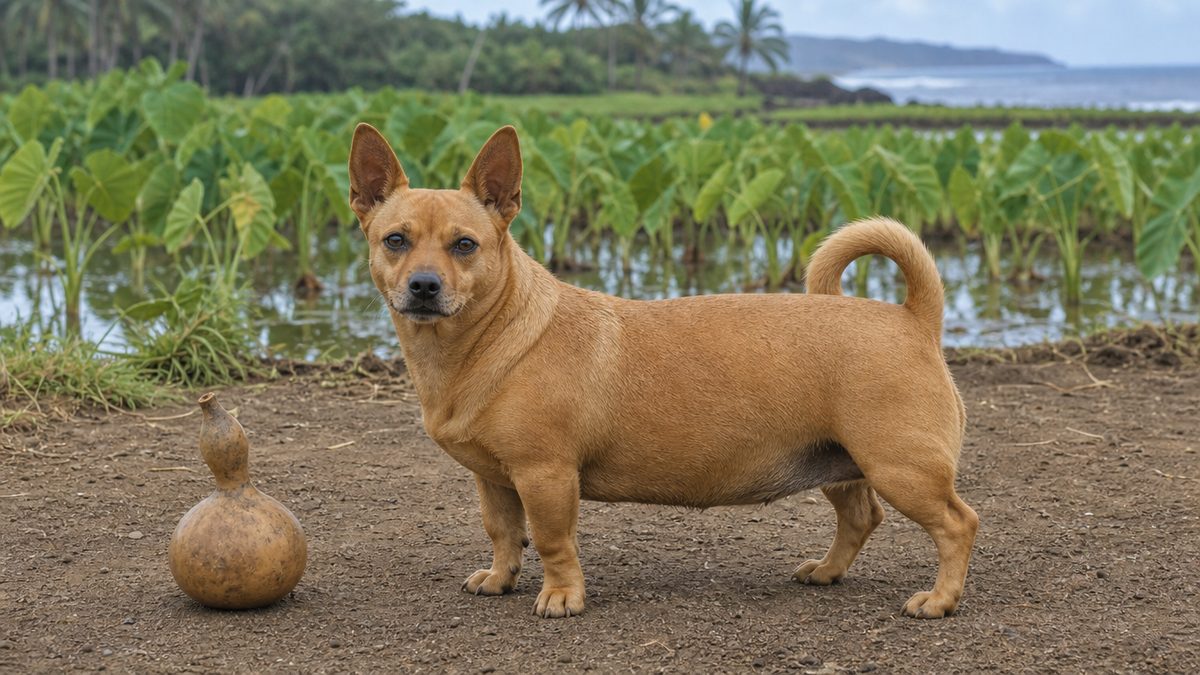
The ʻīlio was a small dog with short, slightly crooked legs, a long back and erect pointed ears, standing about 14 inches or 36 cm at the shoulder. No historical weight for it exists anywhere, and the sources disagree about the muzzle and about the coat.
King in 1779 gives the frame: short crooked legs, long backs, and prick ears, with variety only in the skins, some having long and rough hair and others being quite smooth, and all of them about the size of a common turnspit. Charles Hamilton Smith in 1845 adds a head sharpened at the muzzle, erect ears, a long back, crooked limbs, and smooth hair retaining a tan or rusty ochre colour.
The one height figure, and its odd companion detail
The 14-inch height comes from the Honolulu Zoo's 1970 description of what it was trying to breed back: an animal with a long body, short bowed legs, one more bowed than the other, pointed ears, almond-shaped eyes, and hair usually yellow, white or brown in colour, standing about 14 inches high and barkless. An aggregator prints about 14 inches or 36 cm without saying where it comes from.
Notice the asymmetric forelegs in that description, because it has a traceable and uncomfortable history. Wood-Jones described the appearance of the Hawaiian dog in 1931 without citing a source, and Luomala flagged one detail in particular: the statement that one foreleg was commonly more bent than the other has not previously been recorded Wood-Jones F. The Cranial Characters…. Thirty-six years later a zoo was selecting live dogs against a standard that included it.
Three sources, three different dogs
| Source and date | Muzzle | Coat | Compared to |
|---|---|---|---|
| King, 1779, from living animals | Not described | Variable: some long and rough, some quite smooth | A common turnspit, for size only |
| Smith, 1845, working from written accounts | Sharpened at the muzzle | Smooth, tan or rusty ochre | Marks of decrepitude, in his phrase |
| Wood-Jones, 1931, from two skulls | Short and rounded, with a short broad palate | Short-haired terrier type | A dachshund, but with large erect ears |
| Honolulu Zoo, 1970, breeding to a standard | Not described | Usually yellow, white or brown | About 14 inches high and barkless |
Smith's sharpened muzzle and Wood-Jones's short rounded one cannot both be right, and only one of the two authors had a skull in front of him. We publish the disagreement rather than picking the more convenient reading.
Weight, which does not exist
No historical weight for this animal has been recorded. Wikipedia describes European explorers meeting pot-bellied, short-legged dogs. An aggregator's entire Weight field reads that the dogs were overweight with distended bellies for the purpose of eating, which is a characterisation rather than a measurement. If you see a kilogram figure for this dog anywhere, it was generated.
Brown dogs were distinct enough to be named separately, as ʻīlio mākuʻe, and the dictionary gives mākuʻe as dark brown or any dark colour Wikipedia, Hawaiian Poi Dog. That is the closest thing to a colour classification the language records, and it is a good deal more solid than the yellow, white or brown of the 1970 zoo standard.
The flattened skull: two specimens, one 1931 paper, and a claim that outran them
The claim that a poi diet reshaped the ʻīlio's skull rests on a three-page paper published in 1931 describing exactly two skulls from Kauaʻi. The anatomy in that paper is real. The causal story attached to it is not in it.
Frederic Wood-Jones described the skeletal remains in the Journal of Mammalogy in 1931, and Luomala quotes him verbatim. The most conspicuous feature of the skull of the Hawaiian dog, he writes, is the rounded and smooth contour of all parts of the cranium. The temporal lines are hardly visible; they are separated by an interval of nearly 30 mm at the vertex, and the skull is therefore entirely devoid of a sagittal crest. The supraorbital processes are roundly convex and blunt. The muzzle is short and rounded, and the palate short and broad Luomala K. A History of the Binomial….
What the two specimens were
Luomala records both. One is a young animal found in Nuololo Valley, Kauaʻi, as a separate burial bundle inside the general wrappings of a child, and it is in the Bishop Museum. The other is an adult from a burial cave at Nuololo Flat, Kauaʻi, whose present location she says is unstated. Both were found wrapped in tapa. She also notes that study of Hawaiian canine skulls shows the persistence of the long upper carnassial tooth, a primitive trait, alongside noticeable deviations from Papuan and Australian forms.
Note what neither specimen is. What an archaeologist excavates from a settlement deposit gives you many individuals across time; a burial gives you one.
Where the diet story comes from, and how far it has travelled
Wikipedia is careful with it. It says the flattened appearance is a trait sometimes ascribed to the diet of the dogs, albeit in some unspecified way, and then offers the reasoning as its own editorial note: since poi does not require substantial chewing, the dogs may have reduced their temporalis muscles, and a reduced temporal fossa makes a skull look flat.
An aggregator drops every hedge. Its Description field states that the head was large and flat due to the lack of chewing from its vegetarian diet, and its Health Problems field states that the vegetarian diet made the dogs obese, gave them distended bellies and slow mentalities, and that the bones in their heads became flat and enlarged from lack of chewing. Slow mentalities is not a veterinary finding, and no study of any kind supports it.
What two skulls can and cannot support
- They can support a description. Wood-Jones measured what he had and wrote it down, and the cranial description is the most solid physical fact on this page.
- They cannot establish a population trait. Two individuals, one of them juvenile, from one valley on one island, with no comparison series of dogs fed differently, cannot show that a diet reshaped a population.
- They cannot establish a mechanism. Muscle-driven remodelling of the temporal fossa is a plausible hypothesis. Nobody has tested it on this animal.
- They say nothing about intelligence. The word does not occur in the anatomy, and no cognitive claim can follow from a cranial contour.
There is one more piece of physical evidence in the literature, and we failed to obtain it. Arthur Svihla published Dental Caries in the Hawaiian Dog in the Bishop Museum's Occasional Papers in March 1957, which is exactly the study a reader would want on the question of a starch diet. The Museum URL Wikipedia cites now returns 404, three direct fetches of the Internet Archive snapshot returned 503, and a stealth-proxy retrieval failed. The Archive's availability API confirms a working snapshot exists. We could not open it, so we quote nothing from it, and we say so rather than paraphrasing a title.
**Dog meat**, ʻaumakua and the household: handling the documented record
The ʻīlio was eaten, and it was also kept as a companion and regarded by some families as an ʻaumakua. Both are in the record, they are not in tension, and the way to write about them is plainly, with the sources named.
King records the food role in one clause, and it is his explanation for something else. Writing that he did not recollect one instance in which a dog was made a companion in the manner Europeans do, he adds: indeed, the custom of eating them is an insuperable bar to their admission into society. That is an outsider's inference about a society he had been in for weeks, and it is contradicted by the Hawaiian-language evidence.
What the language records
Pukui and Elbert define ʻīlio as a dog brought to Hawaiʻi by early Polynesians, considered an ʻaumakua by some, and the entry carries ʻaumakua as one of its tags. Wikipedia renders the same role as a lucky charm and describes the animal as a two-purpose breed used for sustenance and as a good-luck charm. Lucky charm is a poor translation of ʻaumakua, and the dictionary's own wording is the better guide.
The material culture is documented too. A lei niho ʻīlio, a lei made from the teeth of the dog and olonā fibre, is held at the Bailey House Museum on Maui.
How the dogs were fed, and why
Poi is a staple made from mashed and cooked kalo, and the mash was used to fatten the dogs for use as livestock, because meat obtained from land or sea was too valuable to be used simply as dog food. King's own observation fits: the dogs were fed and left to herd with the hogs, and there were far fewer of them, in proportion, than on Tahiti, while the hogs were more numerous and of a larger and weightier kind.
Read that economically rather than sensationally. On an archipelago with no large land mammals other than pigs, a starch-fed animal converting a surplus crop into protein is a rational part of a food system, and that is what the sources describe.
The claim with a physical correlate, and the limit of it
An aggregator tells a longer story with no source at all: that women cared for and nursed poi puppies, that a puppy was sometimes given to an infant at birth, that if the child died the dog was killed and buried with the child's body, and that if the child outlived the dog its teeth were made into a necklace. Part of that has a documented physical correlate. One of Wood-Jones's two skulls is a young animal found as a separate burial bundle inside the general wrappings of a child.
A burial is not a narrative, and one burial is not a custom. What we can say is that a young dog was buried with a child on Kauaʻi and that a version of the story circulates unsourced. Those two facts should be reported next to each other and not merged.
The aggregator page refers throughout to the tribes in which the dogs lived. Tribe is not the word for Hawaiian society, and the loose vocabulary is of a piece with the loose sourcing. Where a Hawaiian word exists, this page uses it: ʻīlio for the dog, ʻīlio mākuʻe for the brown one, kalo for the taro, ʻaumakua for the role the dictionary records.
The **extinction date**, which nobody recorded, and the bracket the sources allow
No extinction date for the ʻīlio exists, because nobody recorded a last animal. The bracket the sources allow is wide but real. King saw a uniform population in 1779, artists were drawing foreign dogs in Hawaiʻi by the nineteenth century, and the animal had gone as a distinct entity by the early twentieth century at the latest.
The 1779 anchor is unusually good. King wrote that he did not observe any variety in them, except in their skins, which is an eyewitness statement that the population was still homogeneous in form when Cook's ships were there.
The nineteenth-century anchor comes from the pictures. Luomala found that drawings from the nineteenth century usually show dogs that are obviously European or mixed European and native, and Wikipedia states the same thing more bluntly: by the nineteenth century, the dogs being depicted were of foreign breeds Wikipedia, Hawaiian Poi Dog.
The closing anchor is Wikipedia's own careful phrasing. Over time, free-ranging and feral dogs brought by European and American settlers interbred with the local poi dogs, and by the early twentieth century, at the latest, the breed had disappeared as a distinct entity.
Two mechanisms, and they are not the same
| Mechanism | What the source says | How solid it is |
|---|---|---|
| Interbreeding with settler dogs | Free-ranging and feral dogs brought by European and American settlers interbred with the local poi dogs | Supported by the pictorial record, which shifts to foreign dogs during the 19th century |
| Loss of the role | The breed declined as the islanders' beliefs were forgotten and eating dog meat became unfashionable | Stated by Wikipedia without a citation; treat as the article's own summary |
| A recorded last individual | None | No source names one, and no year should be given |
The wider pattern, where it has been measured
What happened here has been measured elsewhere for Indigenous dog populations meeting colonial ones. Ni Leathlobhair and colleagues found that after the arrival of Europeans, native American dogs almost completely disappeared, leaving a minimal genetic legacy in modern dog populations. The Coast Salish study states its own cause in plain words: colonial policies led directly to the woolly dogs' disappearance. Neither study is about Hawaiʻi, and we do not extend their conclusions to it. They establish that the pattern is real and measurable where anybody has looked.
We will write that the ʻīlio was gone as a distinct animal by the early twentieth century, because that is what the best source says and the pictorial record supports the direction. We will not give a year, name a last individual, or repeat the confident nineteenth-century dates that circulate without support. An honest bracket beats a date nobody can defend.
The Honolulu Zoo **breeding program**, and where 'lazy and stupid' actually comes from
In 1967 the director of the Honolulu Zoo began selecting local dogs to re-create the Polynesian dog, working from descriptions written before 1825 and from surviving skeletal remains. The single most-quoted line about the ʻīlio comes from that project, not from history, and it was said by the man doing the breeding.
Wikipedia sets out the project. Jack L. Throp studied eighteenth and nineteenth-century descriptions of the dog from before 1825, together with the surviving skeletal remains, to set a standard; local dogs in Hawaiʻi were then selected and bred for the desired traits; and by the third generation a female was born with the desired appearance of the ancient breed.
Throp's own statement of purpose, from 1969, is modest and clear. The Honolulu Zoo undertook a project in 1967 to re-create the Polynesian dog. The purpose behind such a project is to tell the story of the animal life of the Hawaiian Islands in a living Hawaiian exhibit. The dog is an important part of the Polynesians' contribution to this story.
The line that became the animal's reputation
HONOLULU Magazine, drawing on its own 1970 coverage, opens with him: he was a quiet, lazy, stupid animal, somewhat like a pig, said Jack Thorp, then director of the Honolulu Zoo, about the original Hawaiian poi dog of old Polynesia. The same piece quotes him on progress: we have a kennel of 19 now, but it will be a good five years more before we achieve similar characteristics found in skeletons or early drawings.
That sentence, written in 1970 by a man breeding modern dogs toward a reconstruction, is now the most-quoted description of an eighteenth-century animal. It is not an observation of an ʻīlio. Nobody alive in 1970 had seen one.
The chain the sentence came down, which is older than the zoo
| Source | What it says | Had the author seen one? |
|---|---|---|
| King, 1779 | Exceedingly sluggish, though perhaps more owing to the manner in which they are treated than to any natural disposition | Yes |
| Walther, 1817 | Short legs, long backs, pricked ears, an occasional howl but no bark; shy towards strangers and stupid | No. Working from Bechstein and Forster |
| Smith, 1845 | In form this variety bears marks of decrepitude; silent and lazy | No. Working from written descriptions |
| Throp, 1970 | A quiet, lazy, stupid animal, somewhat like a pig | No. Breeding a reconstruction |
| An aggregator, retrieved 2026 | Fat and lazy, not very smart, with slow mentalities caused by the diet | No |
Only the top row is an eyewitness, and only the top row hedges Luomala K. A History of the Binomial… Young C. The History of Hawaiʻi Dogbreedinfo.com. Note also that the barklessness the zoo selected for enters the record through Walther in 1817, who never saw a Hawaiian dog.
When the project ended, which nobody can tell you
The sources disagree and none of them is checkable from here. Wikipedia says the program is thought to have discontinued shortly afterward, citing a 2015 Oxford dissertation. An aggregator states that after 12 years of trying it was deemed a failure and the program was discontinued, with no source at all Dogbreedinfo.com. HONOLULU Magazine says only that it appears the project ended without fanfare.
One dated fact constrains all three. In 1976 the crew of the Hōkūleʻa, on the voyage recreating the Hawaiʻi to Tahiti passage, carried a dog from this program named Hōkū Young C. The History of Hawaiʻi. That is nine years after the start, which sits awkwardly with shortly afterward and short of twelve years. The honest answer is that no end date is documented.
The magazine spells the zoo director's name Thorp. Wikipedia and the Bishop Museum publication both spell it Throp Wikipedia, Hawaiian Poi Dog. It is one letter and it changes nothing about the substance, but it is the kind of drift that tells you a page is being retyped rather than checked.
The dog is gone. Hawaiian is an official language of the State
The ʻīlio is extinct. Hawaiian is not. Article XV, Section 4 of the Hawaiʻi State Constitution provides that English and Hawaiian shall be the official languages of Hawaii, a provision added by the 1978 Constitutional Convention and the election of 7 November 1978.
The clause in full: English and Hawaiian shall be the official languages of Hawaii, except that Hawaiian shall be required for public acts and transactions only as provided by law. That is why this page spells the animal ʻīlio rather than ilio, and Hawaiʻi rather than Hawaii, wherever the sources allow it.
The orthography is not decoration
The ʻokina is a consonant and the kahakō marks vowel length, and both change meaning. The dictionary entry for the dog is ʻīlio with both marks; the entry for the brown variant is ʻīlio mākuʻe, where mākuʻe carries an ʻokina of its own. Strip them and you get a different string that a Hawaiian reader has to reconstruct.
The stripping is not hypothetical. The version of the state constitution we read gives the state motto as Ua mau ke ea o ka aina i ka pono, without the ʻokina and kahakō that ka ʻāina carries. Even the founding document loses them in reproduction, which is a good reason for a breed page to put them back.
The word is in daily use, and it does not mean an extinct dog
In Hawaiʻi today, poi dog is the everyday term for a mixed breed dog. Brandy Shimabukuro of the Hawaiian Humane Society told a Honolulu broadcaster in 2024 that poi dog is an accepted term here in Hawaiʻi for a mixed breed dog, that the name comes from an ancient breed brought over by Polynesians, and that today it represents the diverse and loving mixed breed dogs in the shelters. National Mutt Day, 31 July, is marked in Hawaiʻi as National Poi Dog Day.
Wikipedia records the extension of the term to people as well: poi dog is used colloquially of people of mixed heritage, though hapa is the more common word. That is a living idiom, not a historical footnote.
Write that the ʻīlio is extinct, that Hawaiian is one of the two official languages of the State of Hawaiʻi under Article XV, Section 4 of its constitution, and that poi dog is a current term for a shelter dog Harjo Livingston S. Poi dogs. All three are documented. Writing about the animal in a way that puts the culture in the past tense is the error, and the English breed name makes it easy to fall into.
**Kennel club recognition**: none, and no standard was ever written
No kennel club has ever registered the Hawaiian Poi Dog, and no breed standard for it exists. Wikipedia states the reason directly: the dogs were never deliberately or specifically bred to a standard, though human selection and natural selection still applied.
That sentence matters more than the registry checks, because it means there is nothing for a registry to recognise. Human selective breeding and natural selection shaped the population, but no written description was ever the target. The nearest thing to a standard anybody produced was the one the Honolulu Zoo assembled in 1967 from pre-1825 descriptions and skeletal remains, and that was written to reconstruct the animal rather than to register it.
We checked the registers anyway, and every check carried a control.
| Register | Result | Proof the check worked |
|---|---|---|
| FCI definitive nomenclature, letter P | The strings poi, hawaii and polynes do not occur among 37 entries | The same page returned Parson Russell Terrier, Pekingese, Perdigueiro Portugues and Perdiguero de Burgos |
| AKC full breed list | 'Poi Dog' and 'Hawaiian' absent from 791,000 characters | Labrador Retriever and Chinook both present in the same document |
| AKC Foundation Stock Service | 'Hawaiian' absent; all 75 matches for 'poi' are inside Pointer, pointing, breakpoint or a CSS cursor | Peruvian Inca Orchid and Kai Ken both present |
| United Kennel Club standards index | No result. The server returned HTTP 403 to us | None possible, so we draw no conclusion from it |
What that means for an Indian reader
The Kennel Club of India issues pedigrees against FCI nomenclature, so a breed absent from the FCI register has no route to a KCI pedigree. Here the question barely arises, because there is no living population for any registry to record. A pedigree naming this animal would be describing something else.
An aggregator fills its Recognition field with 'Not Recognized (extinct)' and its Group field with 'Southern', which is a category from a private grouping system rather than any registry's. Its Pronunciation field renders the name as 'huh-wahy-uh n poh-ee dawg', a phonetic respelling of the English words that carries no information about the Hawaiian at all.
For most breeds, registry status tells a buyer something real about traceability. For this one it tells you only that the ʻīlio predates the institution. The Hawaiian record that matters is linguistic and archaeological: a dictionary entry with a Proto-Polynesian etymology, two skulls from Kauaʻi, and a lei made from the animal's teeth Wood-Jones F. The Cranial Characters… Wikipedia, Hawaiian Poi Dog.
Two housekeeping notes on how those checks were run. The AKC figures come from two separate documents, the full breed list and the Foundation Stock Service list, each searched as raw text rather than through a site search American Kennel Club. And every study cited on this page was confirmed through Crossref rather than by pattern-matching an identifier, after a control query returned its own exact target first. No rare-breed premium can attach to an animal no register has ever listed.
What the breed sites publish about a dog nobody has seen since the 1800s
The seventh-ranking result in India fills every field of a modern breed template for an animal with no living population, and the ninth is a Fandom wiki writing about it in the present tense. The template is the tell, because its fields were designed for a dog you could buy.
| Field | What the site publishes | What the record actually contains |
|---|---|---|
| Height | About 14 inches, 36 cm | A figure from a 1970 zoo reconstruction, not from a historical source |
| Weight | The dogs were overweight with distended bellies for the purpose of eating | No weight was ever recorded |
| Description | The head was large and flat due to the lack of chewing from its vegetarian diet | Two skulls measured in 1931; the diet mechanism is untested |
| Temperament | Clumsy but friendly and playful, fat and lazy, not very smart | One eyewitness who hedged his own word, and three second-hand writers who did not |
| Health problems | Obesity, distended bellies and slow mentalities caused by the diet | No clinical data of any kind exists |
| Life expectancy | They were usually eaten before they died of a natural death | No lifespan was ever recorded |
| Exercise | The dogs were fat and lazy, waddling around like the hogs | King records that they were fed and left to herd with the hogs |
| Living conditions | They lived with their tribes, sleeping with the children | Tribe is not the word for Hawaiian society |
| Grooming | Two hyphens, meaning the field was left blank | The one field it does not fill is the one it could have |
| Pictures | Three drawings captioned as drawings of a Hawaiian Poi Dog | No surviving artwork is authentically attributed as a poi dog |
That last row is the sharpest. Wikipedia states plainly that no surviving artwork or photograph from Hawaiian history is authentically attributed as poi dogs, and that historians have had to guess which works might be realistic depictions. Luomala spent two papers on that exact problem, going to the British Museum in 1960 to re-examine the originals because the published engravings were not clear enough Luomala K. Additional Eighteenth-Century…. An aggregator captions three unattributed drawings without comment.
The ninth-ranking result is a Fandom wiki
The SciiFii wiki appeared ninth in our India-located search, and the search result's own description begins with Wikipedia's phrasing about a two-purpose breed used for food and as a lucky charm and then continues in the present tense, saying the dogs are most often very friendly. Firecrawl could not retrieve the page for us, so we describe only what the result itself displayed and draw no further conclusion.
And the second-ranking result is a Reddit thread
Its displayed description reads that these fat, slow dogs, which mainly ate fermented taro root, were called poi dogs and were eaten and sometimes sacrificed and placed in ritual. Reddit blocked our scraper, so we quote only the description the search engine showed. Even that short text carries the pattern this page is about: the caricature first, the diet second, the sourcing nowhere.
Wikipedia's own list of extinct dog breeds handles the animal in one line and handles it well, describing it as a Hawaiian pye-dog kept by the native Hawaiians before European settlement, and placing it in the table directly below the Hare Indian Dog Wikipedia, List of extinct dog breeds.
Its Grooming field is blank. Every other field is filled with something, and the only honest answer on the page is the one nobody wrote.
Hawaiian Poi Dog **price in india**: every result is merchandise
No price in India exists for the Hawaiian Poi Dog, because the animal has been gone for over a century. An India-located search on 31 August 2026 returned ten results and not one of them was a live animal. They were a paperback, two more book listings, a sweater, a mug, a marinade brand page and an adoption post.
The absence is earned rather than assumed. A search returning nothing proves nothing unless the search is shown to work, so we ran labrador retriever price in india in the same tool and session. It returned real Indian price pages, including a city-by-city table quoting Rs 30,000 to Rs 1,20,000 across Hyderabad, Bangalore, Delhi, Chennai, Lucknow, Mumbai, Jaipur and Pune, with bands of Rs 30,000 to Rs 60,000 for basic quality, Rs 60,000 to Rs 90,000 for KCI-registered and Rs 90,000 to Rs 1,20,000 for champion bloodline. The instrument works. The zero for this animal is real.
| Result | What it is | Indian price shown |
|---|---|---|
| Flipkart | A paperback titled Hawaiian Poi Dog, author listed as unknown | Not displayed in the result |
| Wikipedia | The encyclopedia article | None |
| Amazon.in | The book Poi Dogs and Popoki | EMI from Rs 154 |
| Etsy India | A Hawaiian Poi Dog sweater in size M | Rs 4,908, reduced from Rs 5,221 |
| Etsy India, second item | Another sweater in the same shop | Rs 5,517, reduced from Rs 7,881 |
| Ubuy India | A Poi Dog brand page selling a vegan Hawaiian barbecue marinade | A price range printed as 191229,200000 INR |
| Desertcart India | A novelty mug | Rs 3,646, duties and taxes included |
| An ideas board | None | |
| Hawaiian Humane Society, via Facebook | A National Poi Dog Day adoption post | None |
| Ubuy Ecuador | The same brand page for another country | None in rupees |
Read the Ubuy row. Its price range renders as 191229,200000 INR and its rating as 4.3 INR, which is a price field and a review score colliding inside a template. That is what a listing looks like when a marketplace generates a country page for a search term rather than stocking anything.
So the only thing you can buy in India under this name is a book for about Rs 154, a sweater for about Rs 4,908 and a mug for Rs 3,646. None of them is a dog.
There is no lawful route either
Even if somebody claimed to have one, nothing could be brought here. DGFT Trade Notice 22/2022-23 sets live animals under ITC(HS) 01061900 as Restricted. Policy Condition 7 permits import of a pet dog only where the importer holds a valid pet book in their own name, or for research with a CPCSEA recommendation, or for Defence and Police use, and Policy Condition 8 states that import of commercial dogs for breeding or any other commercial activities is not permitted in any case. No import licence exists for an animal with no living population, and no register would issue a pedigree for one.
Nobody can sell you a Hawaiian Poi Dog. If a seller uses the name they are selling you something else under a label that has been unavailable for over a century. In Hawaiʻi the same words describe a shelter mongrel, which is the honest modern meaning and the one worth acting on.
**Cost of ownership**: zero, and what to budget instead
There is no cost of ownership for a Hawaiian Poi Dog, because there is no Hawaiian Poi Dog. Bonbeno publishes no monthly rupee figure for this animal, and the only rupee figures on this page belong to a book, a sweater, a mug and the Labrador control search that proves our zero is real.
What the historical record contains about the cost of keeping one is a single economic fact, and it is the opposite of a budget line. The dogs were fed poi rather than meat because meat obtained from land or sea was too valuable to be used simply as dog food. In other words the animal was kept on the cheapest available surplus, which is the only cost statement anybody ever made about it.
Why we will not model the modern equivalent
- There is no weight, so there is no feeding quantity to price.
- There is no lifespan, so there is no lifetime total to compute.
- There is no health profile, so there is no veterinary budget. The only health text in the ranking set describes slow mentalities caused by a diet, which is not a condition.
- There is no grooming requirement on record, and the one aggregator that covers the animal leaves that field blank.
What to price instead
If the appeal is a small, short-coated, low-maintenance, heat-tolerant dog that costs little to keep in a hot country, price an Indian Pariah Dog with your own vet and groomer. That dog exists, is legal, is already adapted to the climate measured below, and costs an adoption fee rather than an import permit. Bonbeno's Indian Pariah Dog page carries the real Indian cost structure with sourced figures.
A monthly rupee figure here would raise this page's India-specificity score and lower its truthfulness. The audit section above shows a ranking page filling a Weight field with a characterisation and a Life Expectancy field with a sentence about being eaten. Filling a Cost field with arithmetic would be the same move in a more respectable font.
Honolulu against Indian cities: the first extinct breed here whose homeland India can match
Honolulu's peak monthly mean wet-bulb temperature is 22.7 degrees. Bengaluru's is 21.9 and Mumbai's is 25.8, so the ʻīlio's home climate sits between two Indian cities rather than outside the country's range altogether. Every other extinct breed on this site comes from somewhere India cannot approach.
Heat tolerance is the trait an Indian reader most needs and the one no global breed source rates, so we compute it. We queried NASA POWER by explicit latitude and longitude for 2001 to 2020, checked that the coordinates returned matched those requested for every location, and derived wet-bulb temperature from the returned monthly mean air temperature and relative humidity using the Stull formula.
| Place | Annual mean air temp | Coldest month | Warmest month | Annual range | Peak monthly wet-bulb |
|---|---|---|---|---|---|
| Honolulu, Oʻahu | 24.61C | February, 22.67C | September, 26.38C | 3.71C | 22.7C in August and September |
| Waimea, Kauaʻi | 24.49C | February, 22.54C | September, 26.27C | 3.73C | 23.0C in September |
| Hilo, Hawaiʻi Island | 21.30C | February, 19.85C | August, 22.65C | 2.80C | 20.5C in August and September |
| Bengaluru | 23.74C | December, 20.22C | April, 28.37C | 8.15C | 21.9C in May |
| Port Blair, Andaman | 28.13C | January, 26.99C | April, 29.39C | 2.40C | 26.3C in May |
| Kochi | 27.31C | August, 25.91C | March, 29.42C | 3.51C | 25.8C in May |
| Mumbai | 26.77C | January, 23.19C | May, 31.19C | 8.00C | 25.8C in June |
| Chennai | 27.95C | January, 24.09C | May, 31.51C | 7.42C | 26.1C in May |
| Kolkata | 25.81C | January, 17.31C | May, 31.53C | 14.22C | 27.1C in June |
| Delhi | 25.60C | January, 13.61C | June, 35.88C | 22.27C | 26.5C in July |
Two different kinds of match, and they point at different cities
Honolulu is humid all year, at 74.9 percent annual mean relative humidity, against Mumbai's 67.4 percent and Chennai's 72.4.
On the number that matters for a panting animal, the closest Indian city is Bengaluru. Its peak wet-bulb of 21.9 degrees is 0.8 below Honolulu's 22.7 and 1.1 below Kauaʻi's 23.0, and Hilo at 20.5 is actually cooler than Bengaluru. A short-coated tropical island dog would meet nothing in Bengaluru it had not met at home.
On the shape of the year, the closest match is Port Blair. Honolulu's annual range between its coldest and warmest months is 3.71 degrees and Port Blair's is 2.40, against 22.27 for Delhi. Both are maritime climates with essentially no season. But Port Blair's peak wet-bulb of 26.3 is 3.6 points above Honolulu's, so the structure matches while the heat does not.
Where it would genuinely struggle
Kolkata's peak wet-bulb of 27.1 degrees is 4.4 points above Honolulu's, Chennai's 26.1 is 3.4 above, and Delhi's 26.5 is 3.8 above while its January mean of 13.61 is nine degrees below anything Hawaiʻi ever sees. Those are real gaps for any animal, and 4 wet-bulb points is a large difference in the range where evaporative cooling starts to fail.
The evidence on what that does to dogs is British rather than Indian and it points one way. Hall and colleagues, working from 905,543 UK dogs under primary veterinary care in 2016, recorded 1,259 heat-related illness events from 1,222 dogs, and of the 879 events with a recorded trigger, 652, or 74.2 percent, were exertional rather than caused by a hot car. In their companion paper on the same cohort, dogs at or above their breed and sex mean bodyweight carried an odds ratio of 1.42, with a confidence interval of 1.12 to 1.80. Neither paper studied this animal, and we quote only the transferable factor.
That bodyweight finding is worth pausing on here, because the one thing every source agrees the ʻīlio was is heavy for its frame. A deliberately fattened dog in a Kolkata June is the exact combination the UK data flags.
On the Fuegian dog the answer was a 21.7-point wet-bulb gap and no Indian city within reach. Here the gap to Bengaluru is 0.8 points in the animal's favour. That is worth stating plainly, because it means the usual conclusion does not apply: the reason you cannot keep this dog in India has nothing to do with the climate.
**Temperament**: one hedged eyewitness, and two centuries of people repeating the unhedged half
The only person who described the temperament of these dogs from life was James King, in 1779, and he qualified his own judgement in the same sentence. Everything harsher than King comes from writers who never saw one.
King's sentence again, because it is the whole basis of the animal's reputation: they are about the size of a common turnspit; exceedingly sluggish in their nature; though perhaps this may be more owing to the manner in which they are treated, than to any natural disposition in them.
He also records that the dogs were fed and left to herd with the hogs, and that he did not recollect one instance in which a dog was made a companion in the European manner. That is a description of a working relationship different from his own, not of a defective animal, and King himself supplies the alternative explanation.
Where the harsher words entered
Walther in 1817 called the dogs shy towards strangers and stupid, working from Bechstein and Forster rather than from any animal. Smith in 1845 wrote that in form this variety bears marks of decrepitude, and called the dog silent and lazy, also working from written descriptions. Throp in 1970 supplied the sentence everyone now quotes. None of the three had seen an ʻīlio.
The contradiction nobody resolves
Wikipedia carries both halves of an incompatible pair in adjacent sentences. It describes the dogs as considered rather dim-witted and sluggish, seemingly lacking acute senses and of little practical use, and then states that nonetheless they were said to be strong-willed and difficult to train. An animal cannot be both too dull to notice anything and too strong-willed to be trained. Two different second-hand traditions have been stacked without anyone comparing them.
What the household evidence suggests instead
The Hawaiian-language record points somewhere else entirely. The standard dictionary records the ʻīlio as considered an ʻaumakua by some, and tags the entry accordingly. A lei niho ʻīlio, made from the animal's teeth and olonā fibre, survives in a museum. And one of the two skulls anybody has measured came out of a child's burial wrappings. Those are not the traces left by an animal nobody valued.
We do not know what these dogs were like. One careful observer in 1779 thought they seemed sluggish and said he could not tell whether that was the animal or its keeping. Everything more confident than that, in either direction, was written by somebody working from other people's paragraphs Luomala K. A History of the Binomial….
**Train**ing: nothing was recorded, and the one prediction on file was wrong
No account of training a Hawaiian Poi Dog exists. The nearest thing in the record is a prediction, made by King in 1779, that the social qualities of the dog would remain unknown to Hawaiians, and it reads today as a statement about the observer rather than the observed.
His sentence: as there are neither beasts of prey in the island, nor objects of chace, it is probable that the social qualities of the dog, its fidelity, attachment, and sagacity, will remain unknown to the natives.
Two things are wrong with it and both are visible from the sources on this page. Fidelity and attachment are not produced by hunting; and the dictionary, the burial and the lei all indicate a relationship King's few weeks ashore did not show him Luomala K. A History of the Binomial… Wikipedia, Hawaiian Poi Dog. His observation was honest and his inference from it was not supported.
What survives as a training claim, and its source
Wikipedia states that the dogs were said to be strong-willed and difficult to train, citing a popular book on canine intelligence rather than any historical account. In the modern usage of the term, the same trait is attached to the living poi dog: today the phrase carries specific characteristics including the ability to eat anything, a strong will, and a unique appearance composed of different breeds.
That is a description of shelter mongrels in 2026 being read backwards onto an eighteenth-century animal. It may well be true of both. It is not evidence about either.
The transferable point is the one King made against himself. When an animal looks unresponsive, the first hypothesis should be the way it is being kept, not the way it was born. That is worth remembering with any Indian shelter dog that arrives flat and withdrawn, because the same behaviour after three weeks in a home is usually a different animal.
**Exercise**: no requirement was recorded, and the animal had no job
No exercise requirement for the ʻīlio was ever recorded, and unusually for a dog, there is a documented reason it had no working role. King noted in 1779 that there were neither beasts of prey in the island nor objects of chace, so the hunting job most dogs are described against did not exist.
Wikipedia makes the same point from the other direction. Since the Hawaiian archipelago had no large terrestrial mammals other than feral hogs, which also likely arrived with Polynesians, poi dogs were not particularly desired or needed for hunting. An animal with no quarry is not lazy; it is unemployed.
King's own description of how they lived is the closest thing to an activity record: fed, and left to herd, with the hogs. Free-ranging around a settlement is a real amount of movement, and it is not a figure anybody wrote down.
What gets published instead
An aggregator's entire Exercise field reads that the Hawaiian Poi Dogs were fat and lazy, waddling around like the hogs. That is a restatement of the caricature in the field where a number would go, and it is the same move as filling Life Expectancy with a sentence about being eaten.
Any short-coated dog in an Indian city has one exercise variable that matters more than duration, which is the hour. The UK data show exertional heat illness accounts for 652 of the 879 events with a recorded trigger, 74.2 percent, against 46 vehicular events. Move the work to first light, and length stops being the risky part.
**Groom**ing: a short smooth coat, which is the one thing that would have suited India
The ʻīlio carried a very short coat, and King recorded that the only variation he saw between individuals was in the skins, some having long and rough hair and others being quite smooth. A short coat in a wet-bulb climate is an advantage, and it is the trait that would have transferred to India best.
Wikipedia describes the dogs as having very short coats in a multitude of colours, with brown ones distinct enough to warrant their own name. Smith's second-hand description in 1845 also says the hair is smooth, retaining a tan or rusty ochre colour, and Wood-Jones in 1931 called it a short-haired terrier type Wood-Jones F. The Cranial Characters…. King is the only one who records both long rough and smooth coats in the same population.
What a short coat means in Indian conditions
- Less trapped water at the skin. In Mumbai's August, at 90.4 percent mean relative humidity, a short single coat dries in a fraction of the time a wool undercoat takes, which is the main reason hot spots are less common in short-coated dogs.
- More exposed skin. A very short coat over pale skin sunburns, and thin-coated ears and muzzles are the usual sites.
- Ticks are easier to find and just as likely. A short coat helps you spot them; it does not reduce exposure. Treat year-round.
- Shedding is not the issue owners expect. Short coats still shed, and the hair is harder to lift off fabric, not easier.
And the field the aggregator left blank
The dogbreedinfo page fills every template field it has except one. Under Grooming it prints two hyphens. That blank is the most accurate thing on the page, because no grooming practice for this animal was ever recorded, and the site's honesty in that single field makes its confidence in the others harder to excuse.
Care advice written for an imported breed almost always assumes a temperate climate. Ask what climate it assumes before you follow it. For a short-coated dog in India the adjustments are shade, timing and tick control rather than anything a brush can fix.
**Health problems** and **life expectancy**: no clinical record exists
No lifespan, no disease prevalence, no screening result and no post-mortem series was ever recorded for the Hawaiian Poi Dog. The two physical studies that exist are anatomical, on a total of two skulls plus a dental paper we could not obtain.
An aggregator's Life Expectancy field reads that the dogs were usually eaten before they died of a natural death, and its Health Problems field describes obesity, distended bellies and slow mentalities caused by the diet. The first is a statement about a food system rather than a lifespan. The second is not a clinical description, and no study of any kind supports the mental claim.
The two real physical studies are Wood-Jones on cranial characters, from two skulls, and Svihla on dental caries in the Hawaiian dog, which we could not read Svihla A. Dental Caries in the Hawaiian…. A dental study is exactly what a reader would want on a starch-fed animal, and we would rather tell you it exists and that we failed to open it than paraphrase its title into a finding.
What an Indian owner of any short-coated dog actually faces
Since no breed-specific risk can be stated, here is the Indian evidence that applies to any dog kept here. A molecular survey of 719 dogs in Punjab, using multiplex PCR, found *Babesia gibsoni* in 8.9 percent, *Hepatozoon canis* in 5.1 percent, *Ehrlichia canis* in 2.6 percent and *Babesia vogeli* in 1.1 percent, against microscopy figures of 5.0, 1.0, 1.4 and 0.1 percent respectively on the same samples. Breed, sex and location were all significantly associated with *B. gibsoni* infection.
Compare the two columns. On the same 719 dogs, microscopy found *B. gibsoni* in 5.0 percent and PCR in 8.9 percent, so a diagnosis resting on a blood smear alone missed roughly four in every nine infections the PCR detected. That is a concrete question to put to your own vet.
And the heat evidence
Hall and colleagues recorded 1,259 heat-related illness events from 1,222 dogs among 905,543 UK dogs under primary veterinary care in 2016, and of the 879 events with a recorded trigger, 652, or 74.2 percent, were exertional. Their companion paper on the same cohort gives an odds ratio of 1.42, confidence interval 1.12 to 1.80, for dogs at or above their breed and sex mean bodyweight. Neither paper studied this animal.
The Prevention of Cruelty to Animals (Dog Breeding and Marketing) Rules 2017 require at Second Schedule Part III paragraph 8(10) that dogs shall have been tested for genetic defects, including hip dysplasia, progressive retinal atrophy, night blindness, hypothyroidism, entropion, ectropion, overshot, undershot jaw when incisors do not touch or mesh, wry mouth, two or more missing teeth, and unilateral or full cryptorchid males. The word is including, so the list is illustrative. We extracted the gazette ourselves and searched all fourteen pages: patella appears zero times, luxation zero, BAER zero and deaf zero. There is no Indian patella-testing requirement and no hearing test in these Rules.
**Feed**ing: what poi actually was, and why it is not a model for a modern dog
The ʻīlio was fed poi, a mash of cooked and pounded kalo, because meat from land or sea was too valuable to be used as dog food. That is a documented food-system decision from a specific place and century, and it is not a diet plan anybody should copy.
The mechanics are in Wikipedia and they are economic. The poi mash was used to fatten the dogs for use as livestock, since any meat obtained from either land or sea was deemed too valuable to be used simply as dog food. King records the same arrangement from the other side, noting the dogs were fed and left to herd with the hogs, and that hogs were far more numerous and of a larger and weightier kind.
The word 'vegetarian' is doing work it should not
An aggregator describes the animals as fed a vegetarian diet that made them obese and gave them distended bellies and slow mentalities. Two problems with that framing. The sources describe a starch staple fed for fattening rather than a diet designed to exclude meat, and free-ranging dogs around a settlement eat what they find. And no nutritional analysis of what these dogs actually consumed has ever been published, so the composition is unknown.
Bonbeno takes no position on plant-based feeding of modern dogs, because that is a clinical question for a veterinarian who has examined your animal. What we will say is that an eighteenth-century fattening practice for livestock is not evidence for anything about a pet dog's nutrition in 2026.
If you keep a short-coated dog in India
Feed to body condition rather than to a number on a packet, weigh the dog monthly on the same scale, and cut portions in the hot months when activity falls. That advice is not derived from this animal, because nothing about modern feeding can be. It is the general rule, and it matters more than usual here given that the one bodyweight finding in the heat literature runs against heavy dogs.
It explains the animal's English name and nothing else. Poi is a staple made from mashed and cooked kalo, and the dog is named after what it was given rather than after what it was. Its own name, in its own language, is ʻīlio.
The first year: nothing recorded, and what Indian law would require anyway
No month-by-month account of a Hawaiian Poi Dog's first year exists, and no litter size, birth weight or whelping account was ever written down. The only developmental fact in the whole subject belongs to the 1967 reconstruction, not to the historical animal.
| Stage | What the historical record contains | What Indian law would require of any puppy today |
|---|---|---|
| Birth to 8 weeks | Nothing. No litter size, no birth weight, no whelping account | Rule 8(1)(a): pups less than eight weeks in age are not sold |
| 7 to 18 weeks | Nothing | Second Schedule Part III para 8(9): all pups shall be vaccinated, which can start at seven to eight weeks and is usually completed at eighteen weeks |
| 3 to 6 months | Nothing | Second Schedule Part II para 6(8): no docking, cropping, de-barking, de-clawing or any change of appearance by artificial means |
| Over 6 months | Nothing | Rule 8(1)(b): dogs over six months in age are not sold without first being sterilised, unless sold to another licensed breeder |
| Adulthood and breeding | Nothing about maturity or breeding age | Second Schedule Part II para 6(3): in breeding and incest breeding are prohibited |
The one generational fact, and whose it is
By the third generation from the original dogs selected in the Honolulu Zoo programme, a female was born with the desired appearance of the ancient breed. That is a fact about a 1960s selection experiment on Hawaiian mongrels, not about the ʻīlio, and it should never be quoted as a breed characteristic.
The clause most Indian buyers have never heard of
Rule 8(1)(b) is worth knowing whatever dog you are buying. It provides that dogs over six months in age are not sold without first being sterilised, unless they are being sold to another licensed breeder. An unsterilised eight-month-old offered to a pet buyer by a registered breeder is a breach of the Rules on its face, and almost nobody asks.
Because that is the honest content. A month-by-month timeline for an animal with no recorded litter size would be invention, and the audit section above shows what invention looks like when a template demands a number.
Indian law: nothing to import, and the clause a revival project would run into
No Hawaiian Poi Dog can be brought into India, because none exists. The law still matters here, because the Honolulu Zoo did try to breed one back, and doing the equivalent in India would run straight into a prohibition most people have never read.
Import
DGFT Trade Notice 22/2022-23, dated 19 December 2022, governs the import of pet animals. Live animals under ITC(HS) 01061900 are Restricted. Policy Condition 7 permits entry of a pet dog only where the importer holds a valid pet book in their own name, or for research with a recommendation from the Committee for the Purpose of Control and Supervision of Experiments on Animals, or for Defence and Police use. Policy Condition 8 states that import of commercial dogs for breeding or any other commercial activities is not permitted in any case.
The clause that bites here
Second Schedule Part II paragraph 6(9) reads, in full: breeding to create new breeds of dogs or unusual looks shall be strictly prohibited. That is one sentence, and it covers reconstruction as squarely as it covers novelty. A programme that selected Indian street dogs against an eighteenth-century description in order to produce an animal resembling the ʻīlio would be breeding to create a breed that does not currently exist, which is what the paragraph forbids.
The Honolulu Zoo's project was exactly that: local dogs selected on morphological characteristics, against a standard assembled from pre-1825 descriptions and skeletal remains, bred for the desired traits over three generations. Whatever its merits in 1967 Hawaiʻi, the same programme in India today would be unlawful on its face.
Breeding and sale, the clauses that apply to every dog
- Rule 8(1)(a): every breeder shall ensure that pups less than eight weeks in age are not sold.
- Rule 8(1)(b): dogs over six months in age are not sold without first being sterilised, unless sold to another licensed breeder.
- Second Schedule Part II paragraph 6(3): of the four breeding techniques the Rules name, out breeding and line breeding are permitted, while in breeding and incest breeding are prohibited.
- Second Schedule Part II paragraph 6(8): no tail docking, ear cropping, de-barking, de-clawing, branding, dyeing, injecting substances to enhance visual appeal, or any change of appearance by artificial means.
Rule 8(1)(a) and Rule 8(1)(b) are Rules in the main body of the 2017 Rules. Paragraphs 6(3), 6(8), 6(9), 8(9) and 8(10) are paragraphs of the Second Schedule, which the Rules make binding, and they are not Rules. Writing 'Rule 6(9)' sends anyone who checks to a different provision headed Requirements to be met by breeders and establishments. We cite the form we actually read in the gazette PDF.
The Hawaiian Poi Dog compared with the animals it is confused with
Four animals get set against the ʻīlio, and separating them shows what the evidence supports. Two are its close relatives elsewhere in Polynesia, one is the extinct North American dog that sits beside it in Wikipedia's own table, and one is a living Indian dog you can meet this week.
Every cell below is checked against a paper, a primary text, a register or a climate query rather than against a breed standard, because no breed standard for this animal was ever written.
| Animal | Where | Living or extinct | Genome or mtDNA published? | Available in India |
|---|---|---|---|---|
| Hawaiian Poi Dog, ʻīlio | Hawaiian Islands | Extinct as a distinct animal by the early 20th century | No Hawaiian specimen published | No |
| Kurī | Aotearoa New Zealand | Extinct | Yes. Ancient Polynesian dog haplotypes Arc1 and Arc2 are characterised | No |
| Tahitian and Marquesan dogs | Society and Marquesas Islands | Extinct as distinct populations | Not established. No Marquesan or Tahitian specimen appears in the published Polynesian dog sequencing; corrected 2 September 2026 when Bonbeno built its own Marquesan Dog page and could locate none | No |
| Hare Indian dog | Mackenzie River, Canada | Extinct or absorbed in the 19th century | No specimen located, none sequenced | No |
| Indian Pariah Dog | All of India | Living and everywhere | Yes, within Indian village-dog studies | Yes, at any shelter, for an adoption fee |
The relative that carries the genetic answer
Wikipedia states that genetic studies on the New Zealand Kurī indicate the origin of this dog, and therefore probably the Hawaiian poi dog, to be Indonesia. The paper behind that is more specific and more interesting. Oskarsson and colleagues mapped the mitochondrial founder haplotypes for dingoes and ancient DNA from ancient Polynesian dogs across 424 samples in Southern East Asia and 219 in Island Southeast Asia, and found all three haplotypes present in South China, Mainland Southeast Asia and Indonesia but absent in Taiwan and the Philippines.
Their conclusion is a route, not a country. Australian dingoes and Polynesian dogs originate from dogs introduced to Indonesia via Mainland Southeast Asia before the Neolithic, and not from Taiwan together with the Austronesian expansion. Writing simply Indonesia drops the part of the finding that mattered to the authors, which is that the dogs did not travel the Taiwan route the human Austronesian expansion is usually mapped along.
The row that shows what a settled question looks like
Set the ʻīlio against the Coast Salish woolly dog, which is not in the table because it is not confused with this animal, and the contrast is instructive. That question was closed in 2023 from a single preserved pelt collected in 1859, integrated with interviews with Coast Salish Elders, Knowledge Keepers and weavers. One curated specimen and a community's own knowledge settled a century and a half of speculation. The ʻīlio has two skulls from Kauaʻi, measured in 1931, and no sequence.
Set the ʻīlio against the Indian Pariah Dog. Both are landrace pariah dog populations shaped by a hot island or subcontinental environment rather than by a breed club, both are short-coated, and both were dismissed as unremarkable by outsiders for two centuries. One is gone. The other is at your nearest shelter, is already adapted to the climate this page measures, and needs no import paperwork.
Eight things people get wrong about the Hawaiian Poi Dog
The commonest mistake is repeating a 1970 zoo director's one-line characterisation as though it were an eighteenth-century observation. Every error below appears on a page currently ranking for this animal in India, and each has a check that takes under a minute.
- Quoting 'a quiet, lazy, stupid animal, somewhat like a pig' as a historical description. It is a 1970 quotation from Jack Throp, then director of the Honolulu Zoo, given while he was trying to breed the dog back.
- Dropping the eyewitness's own hedge. James King wrote in 1779 that the dogs were exceedingly sluggish in their nature, and then immediately added that perhaps this may be more owing to the manner in which they are treated than to any natural disposition in them. The second half is missing from every retelling we read.
- Stating that the poi diet flattened the skull. That claim traces to a 1931 paper describing exactly two skulls from Kauaʻi. Wikipedia hedges it properly, saying the trait is sometimes ascribed to the diet in some unspecified way. An aggregator states it as fact and adds that the diet gave the dogs slow mentalities Wikipedia, Hawaiian Poi Dog Dogbreedinfo.com.
- Treating Canis pacificus as a real name. The leading scholar of the subject searched the zoological indices in 1960 and could find neither the original description nor the identity of the authority abbreviated as 'Nob.', yet the name kept being cited.
- Publishing drawings as depictions of the breed. No surviving artwork or photograph from Hawaiian history is authentically attributed as a poi dog, and by the nineteenth century the dogs being drawn were foreign breeds. An aggregator captions three unattributed drawings as pictures of the animal.
- Giving it a life expectancy or a health profile. One aggregator's entire Life Expectancy field reads that the dogs were usually eaten before they died of a natural death, and its Health Problems field describes obesity and slow mentalities caused by the diet. Neither is a veterinary finding.
- Calling it a Hawaiian invention. It is a Polynesian dog that arrived with Polynesian voyagers, and its Hawaiian name descends from Proto-Polynesian kulii.
- Using 'poi dog' only in the past tense. In Hawaiʻi today it is the ordinary word for a mixed breed dog, and National Poi Dog Day is marked with the Hawaiian Humane Society.
The check that catches most of them
Open the eighteenth-century source and read the sentence after the one being quoted. King's hedge, the single most useful line about this animal, sits immediately after the word everyone quotes. Two warnings from our own run. The 1784 scan uses the long s, so a search for turnspit returns zero while the page plainly reads turnfpit, and our first search reported an absence that was our query failing rather than the book lacking the passage. And the University of Hawaiʻi's Pacific Science archive is free, so the 1960 and 1962 papers that underpin all of this can be downloaded in seconds.
Searching the American Kennel Club's Foundation Stock Service page for the string 'poi' returned a match, and for a moment that looked like a finding. Reading the raw context showed all 75 distinct matches were inside Pointer, pointing, breakpoint or a CSS cursor declaration. A substring match is not a result, and the only defence is to print the surrounding characters before believing your own query.
**Adopt**ion: the one extinct-breed page where the answer is a real dog
You cannot adopt a Hawaiian Poi Dog of the old kind, but the phrase points at something that still exists. In Hawaiʻi today, poi dog is the ordinary word for a mixed-breed shelter dog, and the Hawaiian Humane Society marks National Poi Dog Day on 31 July every year.
Brandy Shimabukuro of the Hawaiian Humane Society put it plainly to a Honolulu broadcaster in 2024. Poi dog is an accepted term here in Hawaiʻi for a mixed breed dog, and the name comes from an ancient breed brought over by Polynesians; today it represents the diverse and loving mixed breed dogs in the shelters. That is a living usage rather than a historical curiosity, and it is the only extinct-breed page on this site where the search term still names an animal you can go and meet.
The advice from that interview transfers to India unchanged
- Foster as a trial adoption. Shimabukuro's own words: if you can go into the shelter and foster a dog, even treat it like a trial adoption, that is the most responsible thing you could do.
- Consider an adult rather than a puppy. A busy family may not have time to train a puppy, and adult dogs are often already house-trained with lower energy levels.
- Meet the dog at home, not only in the kennel. A dog that seems high-energy in a kennel can be very mellow in a home.
- Use your vet as a source. Clinics often know of an animal being rehomed by a client and can hand over its real medical history.
- Look for the Indian equivalent of the same dog. The Indian Pariah Dog is India's own short-coated, self-sufficient, heat-adapted landrace, and it is at every municipal shelter.
If you buy rather than adopt, five checks
Ask to see the dam on the premises with the litter. Ask for the breeder's registration under the Prevention of Cruelty to Animals (Dog Breeding and Marketing) Rules 2017, which requires registration with the State Animal Welfare Board. Ask which register the pedigree is issued by, then check that register yourself. Ask for the microchip number and verify it at a clinic. And confirm the pup is at least eight weeks old, because Rule 8(1)(a) requires every breeder to ensure that pups less than eight weeks in age are not sold.
Refuse any animal whose ears have been cropped or tail docked. Second Schedule Part II paragraph 6(8) forbids tail docking, ear cropping, de-barking, de-clawing, branding, dyeing and any change of appearance by artificial means, and a seller who has done one of those has told you what else they will do.
Bonbeno does not recommend breeders, link listings or quote a live price as an offer. For this animal there is nothing to recommend, and the honest ending is the one Hawaiʻi already reached: the name survives, attached to shelter dogs, and the shelter is where you should go. The method the page uses works anywhere. Read the eyewitness rather than the summary, find out who first said the line everyone repeats, run the climate query by latitude and longitude, and prove any absence with a control before you believe it.
Hawaiian Poi Dog: the questions worth asking
Is the hawaiian poi dog extinct?
Yes. Free-ranging and feral dogs brought by European and American settlers interbred with the local poi dogs, and by the early twentieth century at the latest the breed had disappeared as a distinct entity. No source names a last individual or gives a year.
What does hawaiian poi dog mean?
Poi is a staple made from mashed and cooked kalo, the taro root, and the dogs were fed it to fatten them because meat from land or sea was too valuable to use as dog food. The English name therefore records the diet. The animal's own name in Hawaiian is ʻīlio, and the brown variety is ʻīlio mākuʻe.
Did Hawaiians eat poi dogs?
Yes, and it is in the eyewitness record. James King wrote in 1779 that the custom of eating them was, in his view, an insuperable bar to their admission into society in the European sense. The same animal was also kept in households and regarded by some families as an ʻaumakua, and both facts belong on the page.
How much does a hawaiian poi dog cost in India?
Nothing, because there is nothing to buy. An India-located search on 31 August 2026 returned ten results and not one was a live animal. They were a paperback, two further book listings, two sweaters, a mug, a marinade brand page, a Pinterest board, an adoption post and a foreign country page.
What did the hawaiian poi dog look like?
Small, with short slightly crooked legs, a long back and erect pointed ears, standing about 14 inches at the shoulder by the one figure in circulation. King recorded that the only variation he saw between individuals was in the skins, some having long rough hair and others being quite smooth.
Why did poi dogs have flat heads?
That claim rests on a three-page paper published in 1931 describing exactly two skulls from Kauaʻi, which report a rounded smooth cranium with no sagittal crest. The story that a soft poi diet caused it is a hypothesis about reduced chewing muscles, not a tested finding, and Wikipedia itself flags it as ascribed to the diet in some unspecified way.
What was the hawaiian poi dog's life expectancy?
Unknown. No lifespan was ever recorded for this animal. An aggregator's entire life expectancy field reads that the dogs were usually eaten before they died of a natural death, which is a statement about a food system rather than a figure.
Did anyone try to bring the hawaiian poi dog back?
Yes. In 1967 Jack L. Throp, director of the Honolulu Zoo, selected local Hawaiian dogs against a standard assembled from pre-1825 descriptions and skeletal remains, and by the third generation a female was born with the desired appearance. A dog from that programme named Hōkū sailed on the Hōkūleʻa in 1976, and no documented end date for the project exists.
Is a poi dog the same as a mixed breed?
In Hawaiʻi today, yes. Poi dog is the everyday term for a mixed breed dog, and National Mutt Day on 31 July is marked there as National Poi Dog Day. The Hawaiian Humane Society uses the phrase for the shelter dogs it rehomes, and the term is also applied colloquially to people of mixed heritage.
Where did the hawaiian poi dog come from?
From the dogs Polynesian voyagers carried east across the Pacific. Mitochondrial work on the founder haplotypes for ancient Polynesian dogs found them in South China, Mainland Southeast Asia and Indonesia but absent in Taiwan and the Philippines, indicating a pre-Neolithic route through Mainland Southeast Asia rather than the Taiwan route of the Austronesian expansion.
Is the hawaiian poi dog recognised by any kennel club?
No, and no breed standard for it was ever written, because the dogs were never deliberately bred to one. It is absent from the FCI's definitive nomenclature for the letter P, which returned Pekingese and three other P breeds in the same query, and from both American Kennel Club listings, each of which returned working controls.
Would a hawaiian poi dog have suited the Indian climate?
On the numbers, yes, which makes it unusual among extinct breeds. Honolulu's peak monthly wet-bulb temperature is 22.7 degrees against Bengaluru's 21.9, so its home climate sits between two Indian cities rather than outside the country's range. Kolkata at 27.1 and Chennai at 26.1 would still be several points hotter than anything it knew.
Why did the Hawaiian Poi Dog go extinct?
Because free-ranging and feral dogs brought by European and American settlers interbred with the local poi dogs, and by the early twentieth century at the latest the breed had disappeared as a distinct entity. That is Wikipedia's own careful phrasing, and it is the closing anchor the sources allow. Nobody recorded a last individual and no source gives a year, so the animal was absorbed rather than wiped out, and the only honest date is a bracket.
Do Hawaiian poi dogs still exist?
Not as the old animal. The ʻīlio disappeared as a distinct entity by the early twentieth century after settler dogs bred into the population, and no genome from a Hawaiian specimen has been published. Two things carry the name today. In 1967 Jack L. Throp of the Honolulu Zoo selected local dogs against a standard assembled from pre-1825 descriptions and skeletal remains, and one of those dogs, Hōkū, sailed on the Hōkūleʻa in 1976, though no documented end date for the project exists. And in Hawaiʻi poi dog is now the everyday word for a mixed-breed shelter dog, which is the only form you can go and meet.
What does "poi dog" mean in slang?
In Hawaiʻi today it means a mixed breed dog, a mutt. Brandy Shimabukuro of the Hawaiian Humane Society told a Honolulu broadcaster in 2024 that poi dog is an accepted term in Hawaiʻi for a mixed breed dog, that the name comes from an ancient breed brought over by Polynesians, and that today it represents the diverse and loving mixed breed dogs in the shelters. National Mutt Day on 31 July is marked there as National Poi Dog Day, and the term is also applied colloquially to people of mixed heritage.
Compare with similar breeds
Hawaiian Poi Dog sits in 2 Bonbeno groups. Each one compares it directly against the breeds it is genuinely an alternative to, on the same figures.