
Breed profile
Marquesan Dog: The India Guide
An extinct dog of the Marquesas Islands known only from carvings, a handful of bones and four burials, described by no European who saw one alive, and now the subject of ranking pages that fill a breed template with material about a different animal.
Quick answer
The marquesan dog is extinct, and almost nothing is known about it. No European visitor ever recorded seeing one alive. The entire evidence base is stone carvings and petroglyphs, dog bone fragments from a handful of sites, four documented dog burials, and one drilled dog canine worn as a pendant. It has no recorded lifespan, weight, height, coat, temperament or breed standard, and every page that gives it one has invented it.
This page summarises archaeology, history, an international heritage instrument, French and Indian statute, and Indian veterinary literature for general information. It is not a diagnosis and it is not treatment advice. Consult a registered veterinarian who has examined your own animal before acting on anything here. No clinical health data of any kind was ever recorded for the Marquesan Dog, so nothing here should be read as a clinical description of it.
Marquesan Dog traits, rated for India, and why most of them are a rating of the evidence
What is actually known about the Marquesan Dog, listed in full
Almost nothing is known about the Marquesan Dog, and the honest way to open a page about it is to list the entire evidence base and let the reader see how short the list is. No European ever recorded seeing one alive.
Here is everything. Not a summary of everything, everything.
- Stone carvings and petroglyphs. Images of quadrupeds carved near religious centres and chiefly residences on Nuku Hiva, Ua Huka and Hiva Oa, and bas-reliefs on the base of a tiki at the meʻae Iʻipona at Puamaʻu.
- Dog bone fragments and one dog burial from a few sites on Nuku Hiva, excavated in 1956.
- Two dog burials, one pre-molar and one drilled dog canine used as a pendant, from the sand dunes at Hane on Ua Huka, found between 1964 and 1965.
- Dog bones in all levels of settlement at Hanamiai on Tahuata, found in 1998, some with visible cut marks.
- Three dog skeletons beside human burials at Manihina on Ua Huka, found in 2000, one of them buried in a coffin.
- Two words in the Marquesan language for dog, plus two more recorded in a 1904 dictionary.
- One 1960 sentence about the animal's absence at European contact, which we read in the original.
- One book chapter of nine pages, published in 2003, which is the only scholarly treatment of the subject and which we could not obtain.
That is the list. There is no lifespan, no weight, no height, no coat description, no temperament observation, no breed standard, no photograph, no painting from life and no sequenced specimen. Every one of those exists somewhere on a page currently ranking for this term.
What the sources do say, briefly
The dog was introduced by the archipelago's Polynesian settlers, alongside chickens, pigs and the Polynesian rat. It served as a tribal totem and a religious symbol. It was sometimes eaten, though less often than elsewhere in the Pacific because of its scarcity, which is shown by cut marks on excavated bone. It was scarce enough that one summary describes it as never numerous in the islands even before Europeans arrived, and that scarcity is offered as the reason it was venerated and associated with high chiefs and the priestly classes.
Modern dogs in the Marquesas are not descended from it. They are the descendants of foreign breeds reintroduced in the nineteenth century as companions for European settlers.
Because it is the clearest case we have found of a modern breed template being filled where there is nothing to fill it with, and because the worst example in the ranking set has filled it with a different animal entirely. An Indian reader meets that same mechanism whenever an unfamiliar imported breed is described to them, and this page shows exactly how to spot it.
Peto and nuhe: two words, two ends of the archipelago, and one that leads back to New Zealand
Marquesan has two words for dog, peto in the Northern Marquesas and nuhe in the Southern Marquesas, and a French missionary's 1904 dictionary records two more. One of the four is the reason a long argument about Spanish introduction exists at all.
Take peto first, because it carries the argument. The Wikipedia article lays out three possibilities for it: an English loanword from pet, a Spanish loanword from perro, or a genuinely Polynesian word, and it notes that pero was an alternative name for the dog in Māori, where the animal is the kurī.
That last point is checkable and we checked it. Te Ara, the New Zealand government encyclopedia, records pero as another Māori name for the kurī, and says the resemblance to the Spanish perro made some believe kurī had been introduced by Spanish settlers. So the same word and the same false inference turn up 6,000 km apart, which is far better evidence for a Polynesian word than for a Spanish loan.
The competing story, which is about one named dog
A different theory derives peto from a specific animal. A New Haven dog named Pato was left on Nuku Hiva by the American sea captain Edmund Fanning around 1798, in the care of the British missionary William Pascoe Crook, who passed him to a local ruler; in June 1803 another American captain recalled Pato and left two other dogs in his place. Pato had a criminal record: a contemporary journal records him as having been found guilty of sheep stealing about the year 1797 and banished for the crime.
A single named dog is a memorable origin story for a word, and it should be treated as exactly that until somebody dates the word.
| Word | Where | What is said about it |
|---|---|---|
| peto | Northern Marquesas | Possibly from English pet, Spanish perro, a banished New Haven dog named Pato, or none of those |
| nuhe | Southern Marquesas | Unique in the Polynesian languages; a possible connection is suggested to wanuhe in a Papuan language of the Brumer Islands |
| mohoʻio | Recorded 1904 | Listed in René-Ildefonse Dordillon's dictionary of the Marquesan language |
| mohokio | Recorded 1904 | Listed in the same dictionary |
The nuhe row is the interesting one. A word for dog that is unique among the Polynesian languages is a genuinely odd thing, because the Polynesian words for dog are otherwise closely related, and the kurī of New Zealand, the ʻīlio of Hawaiʻi and the Tahitian name all sit inside that family. Nuhe sits outside it.
We will not build an origin theory on a word. Linguistic resemblance across the Pacific is the single easiest place to construct a story that sounds compelling and rests on nothing, and the perro and Pato explanations for peto are both examples. We report the four words, name who recorded each, and stop.
The **archaeological record**: four excavations, four burials, one tooth
Everything physical known about this animal comes from four excavation campaigns between 1956 and 2000. Set out in order they amount to a few bone fragments, four documented dog burials, one pre-molar and one drilled canine worn as a pendant.
This is the part of the subject where the evidence is real, and it is worth laying out by campaign so a reader can see the scale.
| Year | Who and where | What was found |
|---|---|---|
| 1956 | Robert Carl Suggs, American Museum of Natural History, Nuku Hiva | The first stratigraphical excavation of the islands. Many dog bone fragments and one dog burial across a few sites |
| 1964 to 1965 | Yosihiko H. Sinoto, Bishop Museum, sand dunes at Hane, Ua Huka | A drilled dog canine used as a pendant, one pre-molar and two dog burials |
| 1998 | Barry Vladimir Rolett, Hanamiai, Tahuata | Dog bones in all levels of settlement, some with visible cut marks, read as the animal possibly persisting on that island until the mid-19th century |
| 2000 | Pascal Sellier, Manihina, Ua Huka | Three dog skeletons alongside several human burials, one dog buried in a coffin |
What the burials mean, and what they do not
A dog burial is a strong signal and a weak sample at the same time. Formal burial, and especially burial alongside human interments, is evidence that these animals were not simply livestock; a dog in a coffin at Manihina is about as clear a statement of status as archaeology produces. But four burials across an archipelago and four decades cannot describe a population, and nobody has published a morphological study of the bones.
That last gap is not our observation. It is the recommendation the one scholarly treatment of the subject ends on. Millerstrom called for further work on the linguistic evidence tracing the movement of dogs within Oceania, on the socio-economic roles of the dog in Marquesan and Oceanian cultures, and on the morphology of the bones and burials found in Marquesan sites Wikipedia, Marquesan Dog, English article. That was 2003, and we found nothing published since that answers it.
The pendant, which is the most human object in the record
One drilled dog canine, worn as an ornament, found in the dunes at Hane. Set that beside the kurī, where teeth were routinely made into ear pendants and necklaces and the jaw and teeth into fish hooks, and the single Marquesan example reads as the same practice at a fraction of the scale, which is exactly what scarcity would predict.
Because it is the only part of the subject where somebody dug something up and wrote down what it was. Everything else on this page is either a carving whose realism its own analyst doubted, a nineteenth-century inference, or a modern breed template. Four excavations is not much, but it is evidence, and it is the part a reader can trust.
**Stone carvings**: the only pictures, and the archaeologist who doubted them
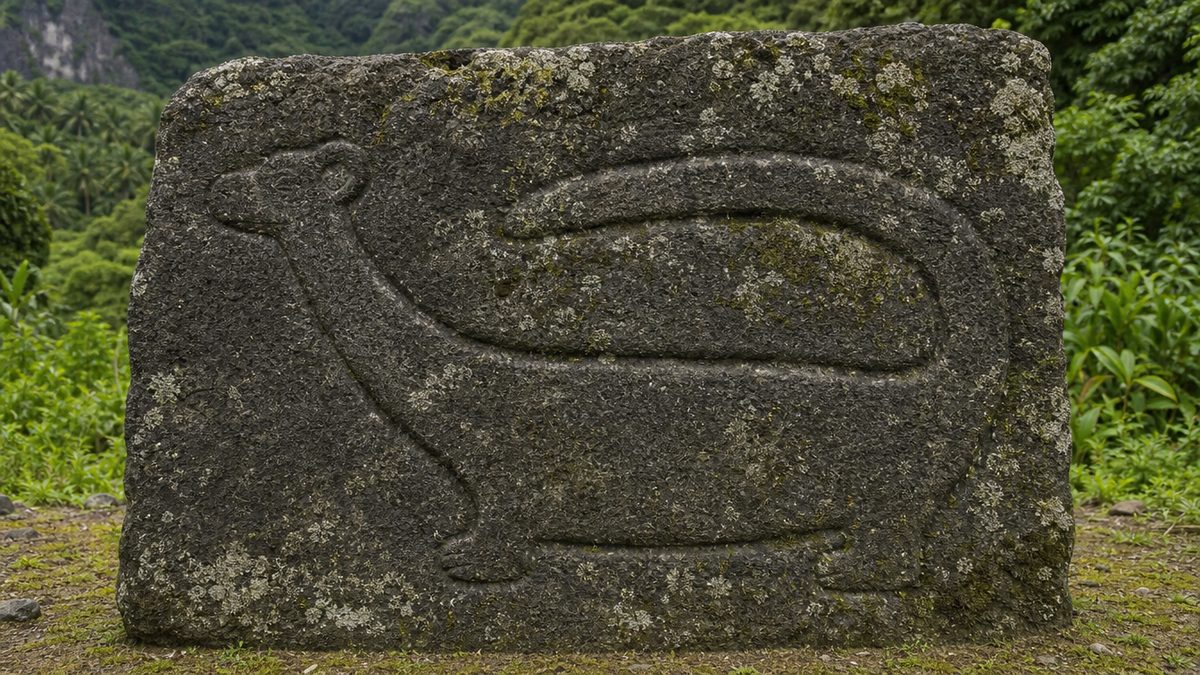
The only images of the Marquesan Dog are carvings, and the archaeologist who studied them said in print that they deviate from the typical Polynesian dog and asked whether they were meant to be realistic at all. Every modern description of this animal's appearance descends from images their own analyst questioned.
Her description of what the carvings show is worth reading in full, because it is quoted verbatim in the article that ranks first for this animal and it is the source of every appearance claim downstream.
The Marquesan dogs' images show that the necks and the bodies are exaggerated in length. The tails are long and curved over the back while the ears and muzzle may be pointed, square or rounded. The legs are short and in one case from Hatiheu Valley the paws were pointed in the wrong direction.
Then the question she puts to her own material: the early post-contact dog is white or spotted, small to medium size, with pointed snout and ears, and a long tail. Could the Marquesans of the past have forgotten what the dog looked like or did it matter how they depicted the dog? Wikipedia, Marquesan Dog, English article.
Read that carefully. The person who assembled the images is explicitly raising the possibility that the carvers had no living animal to look at, or were not attempting a likeness. A page that takes the carvings as a description of the animal is doing something its own source declined to do.
Where the carvings are, and why the distribution matters
The images are prehistoric and the survey behind them is recent. A survey found that most dog petroglyphs cluster in the valleys of ʻAʻakapa, Haʻatuatua and Hatiheu on the northern coast of Nuku Hiva, at the meʻae Vaikivi on Ua Huka, and at the meʻae Iʻipona and in the Eiaone Valley on Hiva Oa. They sit near religious centres and chiefly residential areas, and the reading offered is that they mark the dog as a tribal totem and a symbol of clan loyalty and identity, associated with the Nakiʻi tribe.
So the images are not portraits of a household animal. They are heraldry, and heraldic animals are not drawn to scale anywhere in the world.
Two Europeans looked at the same carvings and saw two other animals
The misidentification history is the best argument on this page for caution, and both cases involve a prior belief doing the work.
- Karl von den Steinen, 1897 to 1898, saw rats. The first European to record the evidence uncovered stone tiki at the meʻae Iʻipona bearing quadruped figures, was told locally that they could depict dogs, rats or pigs, and concluded they were rats, because at the time dogs were believed to have been introduced by Europeans. He was wrong because of what he already believed.
- Thor Heyerdahl, 1956, saw llamas or pumas. He claimed the reliefs on the Tiki Makiʻi Tauʻa Pepe were South American animals, which supported his theory that Polynesia was settled from South America. Unidentified later writers and rumours have insinuated that he altered and defaced the images while restoring them.
The modern consensus is that the carvings represent the extinct dog, and that they are neither llamas, pumas nor rats. That consensus is worth stating, and so is the fact that it took a century and two confident wrong answers to reach.
The Tiki Makiʻi Tauʻa Pepe at Iʻipona carried images of quadrupeds in bas-relief on each side of its square base. Only one of them is discernible now; the other has weathered away. The evidence base for this animal's appearance is not merely small, it is shrinking.
The **extinction date**: a 1960 sentence, a 1956 dig, and a 1998 find that complicates both
The date everybody repeats is 1595, and it comes from one sentence written in 1960 that hedges itself. Luomala wrote that the Marquesans apparently had no live dogs at European discovery in 1595, and separately that the archaeology showed dogs had become extinct or very rare there by then. Very rare is not extinct.
We went back to the source rather than quoting a summary, because on this animal the whole date rests on it. Luomala's 1960 paper is open access, and we downloaded and extracted it ourselves.
Her first statement, verbatim: the Marquesans apparently had no live dogs at the time of European discovery in 1595, but recent finds in 1956 of remains of dogs in what appear to be pre-European sites on the western coast of Nukuhiva Island point to their former presence in the Marquesas. She attributes those 1956 finds to a 1958 report by Shapiro.
Her second, later in the same paper: four Polynesian archipelagoes, Hawaii, New Zealand, Society, and Tuamotus, had living native dogs at the time of European discovery. Archeological evidence from the Marquesas now shows that dogs had become extinct or very rare there by 1595, when Europeans are first known to have discovered the islands.
Three things follow, and the third is the problem
- The hedge is in the original and has been dropped in transmission. Extinct or very rare became extinct. Apparently had no live dogs became did not exist. Neither compression is Luomala's.
- The date is a European arrival date, not an extinction date. 1595 is when Mendaña's expedition reached the islands. It marks the moment the record could have started and did not, which is a statement about observers rather than about dogs.
- Later fieldwork points the other way. In 1998 Rolett found dog bones in all levels of settlement at Hanamiai on Tahuata, read as the animal possibly continuing to exist on that island until the mid-nineteenth century. That is 250 years after the date everybody prints.
| Year | What happened | What it can support |
|---|---|---|
| 1595 | Mendaña's expedition reaches the islands. No dogs recorded | That Europeans did not report dogs, which is not the same as no dogs |
| 1956 | Suggs excavates Nuku Hiva and finds dog remains in apparently pre-European sites | That dogs were formerly present |
| 1958 | Shapiro reports those finds | The reporting of the above |
| 1960 | Luomala writes that the Marquesans apparently had no live dogs in 1595, and that dogs were extinct or very rare by then | A hedged inference from the 1956 fieldwork |
| 1998 | Rolett finds dog bone in all levels at Hanamiai, Tahuata | That the animal may have persisted on Tahuata until the mid-19th century |
| 2026 | Ranking pages print 'extinct before European contact' as a fact | Nothing. The hedge and the 1998 finding have both been lost |
Even the article that ranks first carries the contradiction inside itself. Its lead says these native dogs are thought to have become extinct before the arrival of Europeans, who did not record their presence on the islands. Its archaeology section, four screens down, reports the Hanamiai finding and the mid-nineteenth-century reading. Both sentences are correctly sourced. Nobody has put them beside each other.
That the Marquesan Dog is extinct, that it was already scarce or gone on most of the archipelago by the time Europeans arrived in 1595, that no European ever recorded a living one, and that a 1998 excavation on Tahuata suggests it may have survived on at least one island far longer. We will not print a single extinction date, and we will not repeat extinct before European contact as though the question were closed Wikipedia, Marquesan Dog, English article.
Why the dog was scarce: an economic argument that the rainfall supports
The best explanation on offer for why Marquesan dogs were rare is economic rather than cultural. A 1983 paper argues that Polynesian dogs ate agricultural food, so keeping them cost the same resources people ate, and that whether it stayed viable depended largely on how much protein the sea supplied.
The argument is Bay-Petersen's and it is the only published attempt to explain the discontinuous distribution of dogs across Polynesia. We could not read the full text: Persée serves the body as page images and its PDF sits behind a challenge that returned HTTP 403 to us, so we quote only the abstract it publishes as text and record the article's own printed structure.
The abstract, verbatim. The paper discusses the discontinuous distribution of pig and dog in Polynesia. It suggests that in some cases the absence of one or both species may result from economic causes. Since the diet of both pig and dog in Polynesia was based on agricultural foods, their exploitation required a heavy investment of economic resources. As human populations increased, with consequent economic pressure, so would the relative cost of animal husbandry. Whether animal exploitation remained viable was largely related to the availability of alternative sources of protein, in particular of marine resources.
The article carries a section headed Reasons for extinction on page 122, a section headed The exploitation of the Dog in New Zealand on page 126, and a Table One, Extinctions of Pig/Dog in Polynesia, on page 125. That structure tells you the question was being asked archipelago by archipelago in 1983, and that the Marquesas were one case in a pattern rather than a mystery on their own.
The climate data supports it, and that is not a coincidence
We queried NASA POWER by explicit latitude and longitude for the Marquesas and for Indian cities, and one figure stands out. Taiohae on Nuku Hiva receives about 1.01 mm of rain a day and Atuona on Hiva Oa about 1.07 mm. Kochi receives 7.26 mm, Port Blair 7.03 mm and Mumbai 6.87 mm. The Marquesas get roughly a seventh of the rainfall of comparably hot Indian coasts.
That is a dry tropical climate on steep volcanic islands with no coral reefs, and it is the exact setting Bay-Petersen's argument describes. Garden output is limited and unreliable; an animal fed from the garden competes directly with the people who tend it; and the alternative protein has to come from the sea.
What the sea actually supplies there
A great deal, as it happens, and from an authority with no stake in the dog question. UNESCO's inscription of Te Henua Enata records that the archipelago has one of the world's highest fish biomasses, averaging 3.30 tonnes per hectare with peaks of 20 tonnes per hectare, that its coastal marine province is among the most pristine on the planet, and that its waters are dominated by apex predators.
Put the two together and the picture is coherent. On islands where rain is scarce, gardens are precious and fish are abundant, a starch-fed dog is the first thing an economy stops paying for. That is an explanation for scarcity that does not require anybody to have disliked the animal, and it fits the fact that the dog was venerated rather than despised.
We have an abstract, a table of contents and a rainfall figure. We do not have the paper's actual treatment of the Marquesas, because we could not open it. What we can say is that the argument exists, that it was published in a peer-reviewed journal in 1983, and that an independent climate query is consistent with it. That is weaker than reading the paper and we are not pretending otherwise.
The dogs Europeans did see, and why quoting them is a mistake
European visitors to the Marquesas did describe dogs, and every one of those dogs was a reintroduced European animal. Melville's famous passage about the dogs of the Taipi valley is quoted on breed pages as though it described the extinct animal. It describes dogs that arrived on ships.
The sequence is documented and it starts with a criminal. Around 1798 Captain Edmund Fanning left a New Haven dog named Pato on Nuku Hiva, in the care of the British missionary William Pascoe Crook, who left him with a local ruler; Pato had been found guilty of sheep stealing about the year 1797 and was banished for the crime. On 8 June 1803 another American captain, Brinell, recalled Pato and replaced him with two other dogs.
Earlier still, the Spanish ships of 1595 carried dogs of their own. Marquesans on Hiva Oa attempted to take one of the small dogs aboard, and Luomala noted that nothing in the record suggests the Spanish left any behind Luomala K. A History of the Binomial…. During the Nuku Hiva campaign of 1813 the American naval captain David Porter reported a few dogs on the island and observed that the islanders were afraid of the two mastiffs on his ship.
The Melville passage, and what it is actually about
Herman Melville spent four months in the Marquesas in 1842 and wrote about the dogs he saw there in Typee. The passage is vivid and it is quoted on modern pages as a description of the Marquesan Dog.
Whence, in the name of Count Buffon and Baron Cuvier, came those dogs that I saw in Typee? Dogs! Big hairless rats rather; all with smooth, shining, speckled hides, fat sides, and very disagreeable faces. Whence could they have come? That they were not the indigenous production of the region, I am firmly convinced.
Melville answers the question himself in the same breath. He is convinced they were not indigenous, he calls them interlopers, and he says they seemed ashamed and out of place. He is describing ship dogs three generations after Pato, and he says so. Anybody quoting this as a description of the extinct animal has quoted a passage that explicitly denies being one.
One further caution on Typee: it is a semi-fictionalised work, and Melville drew on his experience, his imagination and on travel books when memory was inadequate Melville H. Typee.
One later observation that is genuinely about dog meat
By the 1890s the English traveller Frederick William Christian recorded an ideological split over eating dogs as island populations rose: Marquesans in the eastern valleys of Hiva Oa had resumed eating baked dog meat with delight, while those in the western valleys would barely touch it even in times of famine, and he observed dog being eaten on Tahuata and Fatu Hiva as well. Those are European dogs too, but the practice is Marquesan and the split is real information about the 1890s. We read Christian's book rather than the summary of it, because Wikipedia cites specific pages and specific pages can be checked. They hold. On page 124 he writes that when other food is not to hand, baked dog is always obtainable at the shortest notice. On pages 143 to 144 he records being offered a choice between baked dog and salted porpoise at Hana-paʻaoa and taking the porpoise, adding that he has tasted many strange dishes but has always left man's faithful four-footed friend severely alone, even though recommended by so high an authority as the great navigator. The authority is Cook, whom Christian quotes: the flesh of the South Sea Dog is a Meat not to be Despised. It is next to our English Lamb.
When a breed is extinct, the European accounts you find will usually be about its replacement. Check the date against the replacement's arrival before quoting anything. Here the replacement arrived from about 1798 and every European description of a Marquesan dog postdates it, which means the extinct animal has no eyewitness literature at all.
The Ènata are not extinct, the language is named in French statute, and the islands are World Heritage
The dog is gone. The people are not, the Marquesan language is named in the French statute governing French Polynesia, and UNESCO inscribed Te Henua Enata, the Marquesas Islands, on the World Heritage List in 2024 partly because its traditions remain alive.
This section exists because writing about an extinct animal of an Indigenous people makes one specific error easy: the past tense spreads outward from the dog. On this subject two current instruments make the correction for us.
What UNESCO's inscription actually says
Te Henua Enata means the land of the human beings, and UNESCO's own text explains the naming directly: the Ènata, meaning human beings in Marquesan, developed a sophisticated social structure based on chiefdoms, establishing settlements in valleys that stretched from the ridges down to the coastline and the sea. The property is a mixed serial listing of seven components, inscribed under criteria (iii), (vi), (vii), (ix) and (x).
Criterion (vi) is the one that matters here, and it is worth quoting. Despite the near disappearance of the Ènata following the demographic collapse and cultural assimilation caused by European contact, many tales, myths, and legends referring to real and cosmological landscapes remain alive today, passed down in the Marquesan language. All these living traditions and knowledge highlight the enduring connection the modern Marquesan population have with their environment.
Remain alive today. Modern Marquesan population. Those are UNESCO's words in a formal inscription document, not a journalist's.
What French statute says about the language
Article 57 of the organic law of 27 February 2004 that gives French Polynesia its statute of autonomy sits in a section headed L'identité culturelle. It makes French the official language, and then names the others in one sentence: le français, le tahitien, le marquisien, le paumotu et le mangarevien sont les langues de la Polynésie française, meaning French, Tahitian, Marquesan, Paumotu and Mangarevian are the languages of French Polynesia.
The same article provides that Tahitian is taught within normal school hours at every level, and that on a decision of the Assembly of French Polynesia, Tahitian may be replaced in certain schools by one of the other Polynesian languages. That is the legal route by which Marquesan is taught in the Marquesas.
And what protects the carvings
The carvings this page depends on are protected heritage, not curiosities. UNESCO's management requirements name a complete inventory of archaeological remains and the designation of key sites as historical monuments under the Polynesian Heritage Code as essential conditions, and record that governance is shared by a management committee co-chaired by French Polynesia's Minister of Culture, Environment and Marine Resources and the Communauté de Communes des Îles Marquises, with a World Heritage association in each of the six municipalities.
Write that the Marquesan Dog is extinct, that the Ènata are not, that Marquesan is one of the languages named in the French statute governing French Polynesia, and that the archipelago's archaeology is World Heritage under active local management Loi organique n. 2004-192 du 27 fevrier…. Extending the word extinct past the animal is the error, and an English breed template makes it very easy to fall into.
**Ancient DNA**: what the Polynesian dog genetics covers, and what it does not
No Marquesan specimen has ever been sequenced. The Polynesian dog genetics that exists is New Zealand material, and reading it across to the Marquesas is an inference, not a result. This section sets out what has actually been done so a reader can see the gap.
The work that does exist is good and it is worth knowing. Greig and colleagues sequenced complete mitochondrial genomes from fourteen dogs at Wairau Bar in New Zealand, found five closely related haplotypes, and reported that all fourteen carry the control-region haplotype A192, otherwise known only from modern village dogs in Bali. Oskarsson and colleagues mapped the founder haplotypes for dingoes and ancient Polynesian dogs and concluded a route through Mainland Southeast Asia into Indonesia before the Neolithic, rather than through Taiwan with the Austronesian expansion.
Neither study includes a Marquesan sample. There is no published mitogenome, no nuclear genome and no radiocarbon-dated genetic series from the Marquesas at all, and we found nothing in the literature we could reach that changes that.
The literature search, run with controls
We searched PubMed through the E-utilities endpoint on 2 September 2026 and read the query-translation line on every search.
| Query | Records | What it shows |
|---|---|---|
| "Marquesan dog" | 0 | The engine broadened it to Marquesan in all fields AND the dogs MeSH expansion, and still returned nothing |
| Marquesas AND dog AND archaeolog* | 0 | A second broadened form, also zero |
| "Marquesas Islands" | 126 | Control. The place term works: jumping spiders, reed warblers, coral hawkfish, French Polynesian health surveys |
| Labrador Retriever AND hip dysplasia | 126 | Control. The instrument works |
| Polynesian dog AND ancient DNA | 1 | Oskarsson 2012, which contains no Marquesan sample |
A broadened query that returns zero is a stronger negative than a narrow one, and this one was broadened by the engine itself. With the place term returning 126 records in the same session, the zero is about the dog rather than about the search.
What the species-level answer is
There is no taxonomic mystery here even though there is an evidential vacuum. The kurī, all Pacific dogs and the dingo are now included within the single domestic dog species, and the Marquesan animal belongs in the same place. What is unknown is everything below the species: whether Marquesan dogs were genetically distinguishable from Tahitian or New Zealand ones, how many founders reached the archipelago, and whether the Hanamiai population was continuous with the earliest one.
We will not say that the Marquesan Dog's origin has been established genetically, because no Marquesan specimen has been tested. We will not borrow the Wairau Bar haplotypes and attach them to this animal. And we will not describe it as a small pariah-like breed likely derived from Asian ancestors, which is how an AI-generated encyclopedia in the same result set describes it, because nobody has measured a single Marquesan dog bone against anything.
**Kennel club recognition**: none, and the check takes two minutes
No kennel club has ever registered the Marquesan Dog and no breed standard for it exists. The FCI nomenclature for the letter M returned eleven breeds on 2 September 2026 and neither Marquesan Dog nor Marquesas Islands Dog is among them.
The eleven the FCI returned were Macedonian Shepherd Dog Karaman 378, Magyar Agar 240, Maltese 65, Manchester Terrier 71, Mastiff 264, Mastín del Pirineo 92, Mastín Español 91, Mastino Napoletano 197, Miniature American Shepherd 367, Miniature Bull Terrier 359 and Mudi 238. Eleven real breeds returned, so the list loaded. The Marquesan Dog is absent.
Why the absence proves nothing about the animal
The FCI was founded in 1911. On every account in the extinction section this animal was scarce or gone by 1595 and at the very latest persisted on one island into the mid-nineteenth century, so there was never a moment when a registry could have recorded it. It was never bred to a written description at any point. Absence from a register is therefore evidence about the calendar.
The same reasoning covers the Kennel Club of India. India is a full FCI member and the KCI issues pedigrees against FCI nomenclature, so a breed absent from the FCI register has no route to a KCI pedigree. Here the question does not really arise, because there is no living population for any registry to record.
What the registers do settle
One narrow but useful thing. Any page presenting this animal with a group, a popularity rank, a purebred classification or a breed standard is describing something no registry ever constituted. Those fields are unsourced by construction, because there is no source they could come from. One page in the Indian result set displays Group: Extinct and Popularity/Rank: 205 on the same card, which is a rank in that site's own index and not a measure of anything.
Wikipedia's own list of extinct dog breeds handles the classification question well. It places the Marquesan Dog in the same table as the Hawaiian Poi Dog, the Kurī and the Tahitian Dog, and its Polynesian Dog row calls that name a catch-all term for four breeds on the list rather than a breed in its own right.
There is no studbook, but there is a real register: the archaeological and heritage record. UNESCO's inscription of Te Henua Enata covers the meʻae and the lithic engravings where the dog images sit, and requires a complete inventory of archaeological remains and the designation of key sites as historical monuments under the Polynesian Heritage Code. That is the closest thing this animal has to documentation, and unlike a pedigree it can be checked by anybody with a browser.
A top-ten page for this breed is entirely about a different dog
The sixth result in our India-located search publishes a full modern breed profile for the Marquesan Dog whose history, naming, material culture and museum claim are all about the kurī of Aotearoa New Zealand, 6,000 km away. It is the clearest case of breed substitution this site has documented.
We read the page in full at HTTP 200 on 2 September 2026 and checked its content against the sources for both animals. The substitution is not a stray sentence. It is the whole history.
| What the page publishes | Which animal that belongs to |
|---|---|
| Also known as: Kuri Kuri, Polynesian Dog | Kurī is the Māori name for the New Zealand dog |
| Originating from the migrations of the Maori people to New Zealand around 1280 AD | The kurī. The Marquesas were settled around 1000 CE and are 6,000 km away |
| Their skins were used to create cloaks (kahu kuri), belts, and decorative items | Kahu kurī are Māori dog-skin cloaks |
| The last known specimens preserved in the Museum of New Zealand Te Papa Tongarewa | The kurī, and Te Papa's own catalogue contradicts even that |
| The Marquesan Dog was historically used as a food source by the Maori people | Printed under the heading Fun Facts |
| The extinction of the Marquesan Dog in New Zealand following European settlement | There is no Marquesan Dog in New Zealand |
The Te Papa row deserves its own note. That sentence is copied from Wikipedia's kurī article, and Bonbeno's own Kurī page shows that Te Papa's catalogue record says the pup's skin and skeleton went to the British Museum and only the mother's skin was kept. So the claim is wrong about the animal, wrong about the country, and wrong about the museum holding.
And the numbers it invents on top of the substitution
The same page gives this animal a lifespan of 12 to 15 years, an adult weight of 18 to 27 kg, a height of 46 to 61 cm, a short double coat with low shedding, 60 minutes of exercise a day, two meals a day for adults and three for puppies at 2 to 3 cups a day, a weekly brush with a bath every few months and nails trimmed every 2 to 4 weeks, hip dysplasia and obesity as its common health issues with warning signs and treatment options, and a hip evaluation recommended annually for adults and more frequently for breeding dogs. It scores intelligence 5 out of 5, family fit 5 out of 5, kid-friendliness 4 out of 5 and tidiness 5 out of 5.
At the bottom of that same page sits a Conservation Status block reading Extinct, and a note saying this breed is extinct and no longer exists in its original form. A page that schedules annual hip radiographs for a breed it declares extinct in the next module is not making a mistake about a fact. It is generating fields.
The tell that closes it: the page's own Similar breeds module lists Kuri as a 90 percent match with its own separate profile on the same site. The site holds both animals, wrote one of them into the other, and then recommended the source material as an alternative to itself.
The rest of the result set, in one pass
- A page with careful prose and an absurd template. Creatures.com states in its own words that the Marquesan label is tied to cultural history as much as to physical breed description, that there is no ordinary ownership or breeding program in the modern kennel sense, and that careful wording matters because no verified modern pet breed exists under this name. Its title is Breed Facts, Prices & Breeders; it lists more than sixty coat colours including albino, blue merle, harlequin and leucistic; and it offers listing alerts, a herdbook, a breeder directory, a Dog Name Generator and a Dog Gestation Calculator preset for the breed.
- A popularity rank for an extinct animal. One card displays Group: Extinct and Popularity/Rank: 205 together.
- A word substitution. Another calls it The Marquesan Canine, a phrase no source uses, which is the signature of automated paraphrase.
- An affection level and a personality. A page published in February 2025 gives Affection Level: Average to High, highly affectionate, and Personality: Lazy.
- The present tense. Another describes it as a unique and intelligent breed that is highly praised for its loyalty, trainability, and child-friendly nature.
- An AI-generated encyclopedia describes it as a small, pariah-like breed likely derived from Asian ancestors carried across the Pacific, which is a plausible sentence resting on no measurement of any Marquesan specimen.
Read the history section of any extinct-breed page and ask which place it names. If a page about a Marquesas dog tells you about New Zealand, Māori migration and a museum in Wellington, you are reading a different animal. Then look for a number the page could not possibly have: a lifespan, a hip-evaluation schedule, a shedding rating. Those two checks separate every page in this result set into the ones worth reading and the ones that are not.
Marquesan Dog **price in india**: a poster at Rs 589 is the only thing for sale
No price in India exists for the Marquesan Dog, because the animal has been gone for centuries and was never here. An India-located price search on 2 September 2026 returned ten results and the only one carrying an Indian price was a poster.
The absence is earned rather than assumed. A search that returns nothing proves nothing unless the search is shown to work, so we ran labrador retriever price in india in the same tool and session. It returned real Indian price pages, the first of them a city-by-city table quoting INR 30,000 to INR 1,20,000 across Hyderabad, Bangalore, Delhi, Chennai, Lucknow, Mumbai, Jaipur and Pune. The instrument works.
| Result | What it is | Indian price shown |
|---|---|---|
| Wikipedia | The encyclopedia article | None |
| Etsy India | A Funny Marquesan Dog Print Definition wall art poster | Rs 589, reduced from Rs 1,180 |
| YouTube | A video on the most expensive dogs in India | None specific to this breed |
| A most-expensive-breeds reel listing Indian breeds | Indian Pariah Rs 500 to Rs 2,000, Mudhol Hound Rs 5,000 to Rs 12,000, Rajapalayam Rs 7,000 to Rs 15,000 | |
| An Indian pet-care blog | Five most expensive dog breeds in India | Tibetan Mastiff figures, nothing on this breed |
| HubPages | A 2015 costliest-breeds listicle | Generic Indian bands |
| Quora | A thread on the cost of buying a dog in India | Generic |
| YouTube, second video | A Kannada dog price list | Generic |
| YouTube, third video | A Bengaluru dog purchase story | None for this breed |
| Hindustan Times | Five most expensive dog breeds in India | Generic |
So the only thing purchasable in India under this name is a printed poster, and the query otherwise returns the Indian dog market in general because there is nothing specific for it to return India-located organic search results….
The document test, which is stronger than a search
A search result is a snippet. A document you can count inside is better, so we took India's most comprehensive published breed price list, retrieved it at HTTP 200, and machine-searched all 127,066 characters. Marquesan returns zero. Polynesian returns zero. Kuri returns zero. New Zealand returns zero. Labrador returns nine and Indian Pariah returns three, as controls in the same document.
Four zeros with two working controls in the same file is not a search that failed. It is a market that does not contain the animal.
Nobody can sell you a Marquesan Dog. If a seller uses the name they are selling you a different animal under a label that has been unavailable for centuries, and no register anywhere would issue a pedigree for it. Given that a top-ten page for this breed is itself describing the kurī, the label does not even reliably identify which extinct animal is meant.
**Cost of ownership** in India, using the only honest anchor available
There is no cost of ownership for a Marquesan Dog, because there is no Marquesan Dog and no recorded size for one. What Bonbeno can give you is the published Indian monthly cost for a medium dog, and an explanation of why we will not narrow that band any further.
Start with what you are not paying. Adopting an Indian dog costs ₹0 to ₹3,000, and that fee covers vaccinations, deworming and microchipping. City by city the same source gives Indie adoption as ₹0 to ₹2,000 in Delhi and NCR, ₹0 to ₹2,500 in Mumbai, ₹0 to ₹2,000 in Bangalore, ₹0 to ₹1,500 in Chennai, ₹0 to ₹2,000 in Hyderabad and ₹0 to ₹2,000 in Pune.
| Cost line | Small breed | Medium breed | Large breed |
|---|---|---|---|
| Dry or wet food | ₹1,500 to ₹2,500 | ₹2,500 to ₹4,000 | ₹4,000 to ₹6,000 |
| Routine vet visits | ₹500 to ₹1,000 | ₹800 to ₹1,500 | ₹1,000 to ₹2,000 |
| Vaccinations, annualised | ₹1,200 per year | ₹1,500 per year | ₹1,800 per year |
| Grooming | ₹1,500 to ₹3,000 | ₹800 to ₹1,500 | ₹500 to ₹1,200 |
| Flea, tick and deworming | ₹300 to ₹600 | ₹400 to ₹700 | ₹500 to ₹800 |
| Monthly total, published estimate | ₹4,000 to ₹8,000 | ₹6,000 to ₹10,000 | ₹8,000 to ₹14,000 |
Why we give you three columns and not one
Because nobody recorded this animal's size. Our Kurī page can put that dog in the medium column because Te Ara gives an average weight of 13 to 15 kg. Here there is no weight, no height and no comparison animal from any source we could read. A ranking page states 18 to 27 kg and 46 to 61 cm, which would put it in the large column, but those numbers are from the page whose history is about a different dog.
So the honest answer is that a dog of this animal's unknown size would cost somewhere between ₹4,000 and ₹14,000 a month in an Indian city on published 2026 figures, and that narrowing the range would mean pretending to know the size.
The wider Indian numbers those bands sit in
The same source reports that urban Indian households now spend ₹5,000 or more every month on a dog, that dog prices in India in 2026 run from ₹2,000 for an indie or native breed to over ₹1,50,000 for a KCI-registered show-quality dog, that monthly upkeep across all sizes runs ₹3,000 to ₹18,000, and that a first year including purchase, vaccinations, food, training and supplies should be budgeted at ₹80,000 to ₹2,00,000. Over twelve years the medium band alone is roughly ₹8,64,000 to ₹14,40,000.
One line that is higher in India than a global chart implies
Parasite prevention, and it should be year-round rather than seasonal. A Punjab survey of 719 dogs found Babesia gibsoni in 8.9 percent of samples by multiplex PCR against 5.0 percent by microscopy on the same samples, Hepatozoon canis in 5.1 against 1.0 percent, Ehrlichia canis in 2.6 against 1.4 percent and Babesia vogeli in 1.1 against 0.1 percent. Every PCR figure exceeds its microscopy figure, so a diagnosis resting on a blood smear alone under-detects the problem.
The two questions are different. There is no Indian price for a Marquesan Dog and inventing one would be fabrication. But Indian food, vaccination, consultation, grooming and parasite-prevention costs are real, published and dated, and they apply to any dog living here. Those are the numbers a reader can act on.
The Marquesas against India: nearly the same heat, a seventh of the rain
Taiohae on Nuku Hiva has an annual mean of 27.16C and a peak monthly mean wet-bulb temperature of 24.7C, which is only 1.4 points below Chennai's 26.1C. The real difference is rainfall: the Marquesas receive about 1.01 mm a day against Kochi's 7.26 mm.
Heat tolerance is the trait an Indian reader most needs and the one no global breed source rates, so we compute it rather than quoting it. We queried NASA POWER by explicit latitude and longitude for 2001 to 2020, checked the returned coordinates against those requested at every point, echoed back the returned grid-cell elevation, and derived wet-bulb from the returned monthly mean air temperature and relative humidity using the Stull formula.
| Place | Annual mean air temp | Annual range | Peak monthly wet-bulb | Rain, mm per day |
|---|---|---|---|---|
| Taiohae, Nuku Hiva | 27.16C | 1.36C | 24.7C in April | 1.01 |
| Atuona, Hiva Oa | 27.04C | 1.41C | 24.8C in April | 1.07 |
| Vaipaee, Ua Huka | 27.08C | 1.39C | 24.9C in April | 1.02 |
| Vaitahu, Tahuata | 27.20C | 1.38C | 24.8C in April | 1.08 |
| Port Blair, Andaman | 28.13C | 2.40C | 26.3C in May | 7.03 |
| Kochi | 27.31C | 3.51C | 25.8C in May | 7.26 |
| Chennai | 27.95C | 7.42C | 26.1C in May | 3.43 |
| Mumbai | 26.77C | 8.00C | 25.8C in June | 6.87 |
| Bengaluru | 23.74C | 8.15C | 21.9C in May | 2.31 |
| Kolkata | 25.81C | 14.22C | 27.1C in June | 4.29 |
| Delhi | 25.60C | 22.27C | 26.5C in July | 2.06 |
Read the second column, because it is the striking one
The Marquesas have an annual range of about 1.4C between their coldest and warmest months. Port Blair, the most seasonless Indian place we tested, has 2.40C. Delhi has 22.27C. This is a climate with essentially no year, and the nearest Indian equivalent is the Andamans rather than anywhere on the mainland.
Both places are humid: the Marquesan points we queried returned annual mean relative humidity of 75.5 to 77.0 percent against Chennai's 72.4 and Kochi's 78.8, so the difference between them is rainfall rather than moisture in the air. On heat itself, coastal India is genuinely close. A peak wet-bulb of 24.7C is 1.4 points below Chennai, 1.1 below Kochi and Mumbai, 1.6 below Port Blair and 2.4 below Kolkata, while sitting 2.8 above Bengaluru. Unlike a cold-climate breed, this animal came from heat an Indian coast can match, so whatever else was true of it, it is the one Polynesian dog on this site whose homeland says it must have been heat-tolerant.
The grid-cell check, which fired here
NASA POWER returns a grid cell, not a point, and the Marquesas are what UNESCO calls among the world's most vertical islands, with cliffs rising over 1,000 metres straight out of the ocean. Two of our query points, Taiohae and Hatiheu, are on opposite coasts of Nuku Hiva and returned byte-identical results, including the same cell elevation of 21.23 m. They are not identically warm. They fall inside one cell, so we cannot use them to distinguish anything and we do not present the match as a finding.
The elevations themselves came back plausible for coastal points: 21.23 m at Taiohae against a real 10 m, 5.15 m at Atuona, 1.59 m at Vaipaee and 6.63 m at Vaitahu. That is the shore, which is where the archaeological valleys reach, but it is not the island: a cell reporting 21 m over an island whose peaks exceed 1,000 m is describing the coastal fringe only.
What the heat evidence says about any dog in India
Hall and colleagues, working from 905,543 UK dogs under primary veterinary care in 2016, recorded 1,259 heat-related illness events from 1,222 dogs, and of the 879 events with a recorded trigger, 652, or 74.2 percent, were exertional rather than caused by a hot car. Their companion paper on the same cohort gives an odds ratio of 1.42, confidence interval 1.12 to 1.80, for dogs at or above their breed and sex mean bodyweight. Neither paper studied this animal and we quote only the transferable factor.
A ranking page gives this animal a Climate Preference of Temperate Warm, which is closer to the measured truth than most of what that page prints NASA Langley Research Center. It is on a page whose history describes New Zealand, so the coincidence is worth noting and not worth trusting.
**Temperament**: nothing was recorded, and one thing about status was
No behavioural observation of a Marquesan Dog exists. Nobody wrote down whether it barked, how it behaved around people, or what it was like to live with. The one thing the record does establish is its social position, and that is genuinely informative.
The absence is total and it has a clear cause. Temperament in the historical literature comes from eyewitnesses, and this animal has none: no European recorded seeing one alive, and the accounts that do describe dogs in the Marquesas are describing ship dogs from about 1798 onward Melville H. Typee.
Compare that with the neighbours to see how unusual it is. The kurī has an eyewitness who noted that it howled rather than barked and left a Māori word for each noise; the Hawaiian ʻīlio has a lieutenant on Cook's third voyage describing it at length. The Marquesan dog has neither.
What the record does establish, which is status rather than personality
Dog images cluster near religious centres and chiefly residential areas, the dog served as a tribal totem associated with the Nakiʻi tribe, and the reading offered is that its rarity is why it was venerated and closely associated with the high chiefs and the priestly classes. The four dog burials, one of them in a coffin beside human interments, point the same way.
So this was not a village animal that anybody would have had cause to describe casually. It was closer to a regalia animal, and regalia animals do not generate temperament literature.
What the ranking pages publish instead
A great deal. One page gives it a Core Temperament section describing a friendly and loyal animal that is affectionate, reserved with strangers, protective, intelligent and eager to please, plus a Vocal Tendencies section stating that it has a moderate noise level and barks to alert its owners. Another card in the same result set gives Affection Level: Average to High, highly affectionate, and Personality: Lazy.
Every word of that is generated. Nobody ever heard this animal make a noise and wrote it down.
We do not know what Marquesan Dogs were like and neither does anybody else. What the evidence supports is a scarce animal of high status, buried formally, carved into stone near sacred and chiefly places, and eaten occasionally rather than routinely. Anything more specific than that was written by somebody filling a field.
**Train**ing: no account exists, in either direction
No account of training a Marquesan Dog survives, and unlike some extinct breeds there is not even a working role to infer one from. No source we could reach records this animal hunting, herding, guarding or carrying.
That absence is worth stating precisely, because it differs from the neighbours. The kurī has detailed accounts of birds being caught with dogs held on a rope and released on cue. For the Marquesan dog there is nothing equivalent: the recorded roles are totemic, religious and occasionally dietary, and none of them implies trained work.
So this page publishes no trainability assessment. Its trait bar sits at 1 out of 5 and the note says explicitly that the number marks an absence of evidence rather than a judgement about the animal.
What a ranking page publishes instead
A full training section. It rates intelligence 5 out of 5 and training ease 3 out of 5, describes a moderate work drive stemming from historical roles as a hunting and companion dog, warns of stubbornness and a strong prey drive, and recommends positive reinforcement, early socialisation and short enjoyable sessions. The historical roles it names are the kurī's.
The transferable point for an Indian reader
When a breed description tells you how to train an animal, ask where the behavioural claim came from. For a living breed the answer is usually generations of owners and a parent club. For an extinct one it has to be a historical account, and if the page cannot name one, the training advice is a template. The same test works on any unfamiliar breed offered to you in India, and it is the reason the Indian Pariah Dog is easier to plan for than most imported dogs: you can watch one before you commit.
Whether this animal barked. The kurī howled and Māori had separate words for the two noises. The Marquesan dog left no such record in any source we could read, so a page telling you it has a moderate noise level and barks to alert its owners has invented a sound Snoutastic, 'Marquesan Dog Dog Breed….
**Exercise**: no requirement was recorded, and none can be inferred
No exercise requirement for the Marquesan Dog was ever written down, and there is no working role to estimate one from. What can be given honestly is the rule that applies to any dog in an Indian city, which is about the hour rather than the duration.
The geography is the only clue and it cuts both ways. The Marquesas are steep: UNESCO describes razor-sharp ridges, towering peaks and sheer cliffs rising over 1,000 metres above the ocean, with settlement valleys running from ridge to shore. A dog living in that terrain moved vertically. But a scarce, high-status animal associated with chiefs and priests may not have ranged at all, and nothing distinguishes the two possibilities.
So this page gives no daily figure. A ranking page gives 60 minutes a day, broken into two or three sessions, with agility training, obedience training, playing fetch, running, swimming and walking listed as preferred activities. Every item on that list is a modern dog-sport category.
The rule that does transfer, for any dog in India
- Move the work to first light and after dark for most of the year in Chennai, Mumbai, Kochi and Kolkata, where the peak monthly mean wet-bulb runs 25.8C to 27.1C and those are averages across day and night.
- Treat the middle of the day as unavailable rather than as a compromise. Delhi's warmest month averages 35.88C at the cell we queried, and the hottest reading in that cell's twenty-year record is 48.79C.
- Use the pavement test. Press the back of your hand to the ground and hold it for five seconds. If you cannot, neither can the dog.
- Watch bodyweight, because it is one of the few heat-risk factors an owner controls. Dogs at or above their breed and sex mean bodyweight carried an odds ratio of 1.42 for heat-related illness.
The reason to be strict is that exertion, not ambient weather, is what fills clinics: of the 879 heat-related illness events with a recorded trigger in a cohort of 905,543 dogs, 652, or 74.2 percent, were exertional, against 113 environmental and 46 involving confinement in a vehicle.
Not because the animal needed little. Because nothing is known, and a rating bar has to say something. The note on the trait reads the same way, and we would rather print an obviously conservative number with the reason attached than a confident one with nothing behind it.
**Groom**ing: no coat was ever described, and the carvings show outline only
No description of this animal's coat exists in any source we could reach. The carvings are outlines in stone and record no hair, no length and no colour. Everything published about grooming a Marquesan Dog has been generated.
It is worth being precise about what the carvings can and cannot show. The published description of them covers proportions and posture: exaggerated neck and body length, a long tail curved over the back, ears and muzzle that may be pointed, square or rounded, short legs, and in one case paws pointing the wrong way. Nothing about surface texture, because basalt relief does not record it.
For coat colours the record is the same. A single sentence in the archaeological literature describes the early post-contact dog as white or spotted, small to medium size, with pointed snout and ears and a long tail, but that is explicitly the post-contact animal, which is a European dog. It is not a description of the extinct one.
What is published anyway
One ranking page gives a short dense double coat with low shedding, a weekly brush, a bath every few months, nails every 2 to 4 weeks and ear cleaning, and rates grooming ease 4 out of 5 and tidiness 5 out of 5. Another lists more than sixty coat colours for the breed, including albino, blue merle, harlequin, leucistic, reverse brindle and tuxedo.
Sixty colours is the clearest possible statement that a field was auto-filled from a species-level list. The record contains zero.
What would actually matter in India, for any dog
- Dry to the skin and do not air dry. Overseas advice to towel a dog and let it dry is written for dry air. In Kochi, where mean rainfall is 7.26 mm a day and the peak wet-bulb is 25.8C, a damp coat stays damp for hours, which is what hot spots and yeast overgrowth need.
- Check for ticks by hand and treat year-round. The Punjab survey found Babesia gibsoni in 8.9 percent of 719 dogs by PCR against 5.0 percent by microscopy on the same samples, so clinic-level detection is itself part of the problem.
- Never shave a coat to cool a dog. Guard hairs block radiant heat and regrow more slowly than the coat beneath, so a shaved dog sunburns and gets hotter.
- Expect a smeared moult. India gives most coats no clear seasonal trigger, so shedding spreads across the year.
When a page gives you a grooming schedule, ask what it is a schedule for. If the animal has no recorded coat, the schedule is furniture. The same question applied to a living imported breed usually produces a real answer from a parent club, and the follow-up question is what climate that club is writing in.
**Health problems** and **life expectancy**: no record of any kind exists
No lifespan, disease, screening result, litter size or post-mortem finding was ever recorded for the Marquesan Dog. There is no zooarchaeological pathology study of the bones either, which is one of the specific gaps the only scholarly treatment of the subject asked to be filled.
This is the emptiest health section on this site and the reason is worth stating plainly. For the kurī there is a dental study of more than 100 individuals reporting caries, calculus, wear, fractures and enamel defects. For the Marquesan dog there is no morphological or pathological study of the excavated bone at all, and Millerstrom's own closing recommendation was that a study into the morphology of the bones and dog burials found in the Marquesan archaeology sites was needed Wikipedia, Marquesan Dog, English article. That was 2003.
The literature search confirms it. PubMed returns zero records for this animal on queries the engine itself broadened, against 126 for Marquesas Islands and 126 for the Labrador control in the same session. A broadened query returning zero against a working control is about as clean as an absence gets.
What gets published anyway
A ranking page gives an average life expectancy of 12 to 15 years, names hip dysplasia and obesity as the breed's common health issues with warning signs, diagnosis, treatment and management tips for each, and recommends a hip evaluation annually for adults and more frequently for breeding dogs, plus annual blood work at all ages. The same page's conservation block says the breed is extinct and no longer exists in its original form.
Breeding dogs. For an animal whose most recent possible survival date is the mid-nineteenth century.
What an Indian owner of any dog actually faces
Since no breed-specific risk can be stated, here is the Indian evidence that applies to any dog kept here. A molecular survey of 719 dogs in Punjab using multiplex PCR found Babesia gibsoni in 8.9 percent, Hepatozoon canis in 5.1 percent, Ehrlichia canis in 2.6 percent and Babesia vogeli in 1.1 percent, against microscopy figures of 5.0, 1.0, 1.4 and 0.1 percent respectively on the same samples, with breed, sex and location all significantly associated with B. gibsoni infection.
Compare the two columns on B. gibsoni. Microscopy found it in 5.0 percent and PCR in 8.9 percent, so a diagnosis resting on a blood smear alone missed roughly four in every nine infections the PCR detected. That is a concrete question to put to your own vet, and it is not breed-specific.
The Prevention of Cruelty to Animals (Dog Breeding and Marketing) Rules 2017 require, at Second Schedule Part III paragraph 8(10), that dogs shall have been tested for genetic defects, including hip dysplasia, progressive retinal atrophy, night blindness, hypothyroidism, entropion, ectropion, overshot, undershot jaw when incisors do not touch or mesh, wry mouth, two or more missing teeth, and unilateral or full cryptorchid males. The word is including, so the list is illustrative. We extracted the gazette ourselves, 14 pages and 51,953 characters, and searched it: patella appears zero times, luxation zero, BAER zero and deaf zero. There is no Indian patella-testing requirement and no hearing test in these Rules.
**Feed**ing: what the sources say the dog ate, and why it is not a diet plan
The one substantive statement about what Marquesan dogs ate is economic rather than nutritional: Polynesian dogs were fed on agricultural food, which competed with people. The only direct evidence about this animal and food runs the other way, as cut marks on its bones.
Start with the direct evidence, because it is short. Dogs were sometimes eaten in the Marquesas, though less often than elsewhere in the Pacific because of their scarcity, and the evidence for it is cut marks on dog bones found in archaeological excavations, specifically at Hanamiai. That is a statement about the dog as food, not about the dog's food.
For the dog's own diet the argument is Bay-Petersen's and it is regional: the diet of both pig and dog in Polynesia was based on agricultural foods, so their exploitation required a heavy investment of economic resources, and whether it remained viable was largely related to the availability of alternative sources of protein, in particular marine resources. On islands receiving about 1.01 mm of rain a day, garden output is the constraint.
No coprolite study, no stable-isotope analysis and no faunal dietary reconstruction has been published for a Marquesan dog. For the kurī all three exist. That is the measure of the difference between the two records.
Why none of this is advice
A starch-weighted diet for a scarce ceremonial animal on a dry Pacific island tells you nothing about what to put in a bowl in Chennai. What transfers is the rule that applies to any dog with no breed chart, which is most of the world's dogs. Feed to body condition rather than to a number on a packet: feel the ribs under light pressure, look from above for a waist behind the ribcage, look from the side for an abdominal tuck, and weigh monthly on the same scale.
A ranking page prescribes 2 to 3 cups a day divided into two meals for adults and three for puppies, with high-quality dry kibble, wet food and raw food listed as suitable. Portion advice requires a bodyweight, and this animal has none on record.
Bodyweight is one of the few heat-risk factors an owner controls directly. In 905,543 UK dogs under primary veterinary care, animals at or above the mean bodyweight for their breed and sex carried an odds ratio of 1.42 for heat-related illness. In a country where the peak monthly wet-bulb reaches 27.1C in Kolkata, that is not a cosmetic question.
The first year: nothing at all, and the Indian law that would apply anyway
No litter size, birth weight, whelping account or developmental record for the Marquesan Dog exists. Not one juvenile specimen has been described in print. This section is Indian law, because that is the only honest content it can carry.
The gap is worth naming precisely. The kurī has a developmental finding from teeth, that the most stressful period in a young animal's life coincided with weaning, drawn from more than 100 individuals. For the Marquesan dog there is no equivalent, because no morphological or pathological study of the excavated bone has been published.
| Stage | What the record contains | What Indian law requires of any puppy today |
|---|---|---|
| Birth to 8 weeks | Nothing. No litter size, no birth weight, no whelping account | Rule 8(1)(a): every breeder shall ensure that pups less than eight weeks in age are not sold |
| 7 to 18 weeks | Nothing | Second Schedule Part III para 8(9): all pups shall be vaccinated, starting at seven to eight weeks and usually completed at eighteen weeks |
| 3 to 6 months | Nothing | Second Schedule Part II para 6(8): no docking, cropping, de-barking, de-clawing or any change of appearance by artificial means |
| Over 6 months | Nothing | Rule 8(1)(b): dogs over six months in age are not sold without first being sterilised, unless sold to another licensed breeder |
| Adulthood and breeding | Nothing about maturity or breeding age | Second Schedule Part II para 6(3): in breeding and incest breeding are prohibited |
The clause most Indian buyers have never heard of
Rule 8(1)(b) is worth knowing whatever dog you are buying. It provides that dogs over six months in age are not sold without first being sterilised, unless they are being sold to another licensed breeder. We read that in our own extraction of the gazette, alongside 8(1)(a) on the eight-week minimum and 8(1)(d), which requires that only dogs in good health that have been provided the medical inoculations are sold. An unsterilised eight-month-old offered to a pet buyer by a registered breeder is a breach on its face, and almost nobody asks.
Say which instrument you are quoting
Rule 8(1)(a) and Rule 8(1)(b) are Rules in the main body of the 2017 Rules, which run from 1 to 13. Paragraphs 6(3), 6(8), 6(9), 8(9), 8(10) and 21(1) are paragraphs of the Second Schedule, which the Rules make binding through Rule 6, and they are not Rules. We searched our own extraction: the string Rule 21 occurs zero times in the gazette.
Because inventing a timeline for an animal with no recorded litter would be exactly what the audit section of this page criticises. A ranking page fills this space with a feeding schedule for puppies and an annual hip evaluation for breeding dogs; we would rather leave it as law and say why.
Indian law: nothing to **import**, and the clause a reconstruction would hit
No Marquesan Dog can be brought into India, because none exists. The law still matters, because it tells you what would happen if somebody offered you one and because Second Schedule Part II paragraph 6(9) would stop any attempt to breed the animal back on Indian soil.
Import, read from the notice itself
DGFT Trade Notice 22/2022-23 governs the import of pet animals. We downloaded the PDF and extracted it ourselves, five pages and 6,639 characters, and read the policy conditions directly. Mammals under ITC(HS) 01061900 are Restricted, subject to Policy Condition 6 of the chapter.
- Policy Condition 6. Import of Wild Animals, including their parts and products, as defined in the Wild Life (Protection) Act 1972, is prohibited, and species listed in CITES are subject to the provisions of CITES.
- Policy Condition 7. Import of dogs is allowed only for a pet dog with a valid pet book and relevant records in the name of the importer, for dogs imported by R and D organisations with the recommendation of CPCSEA, or for internal security by the Defence and Police Force.
- Policy Condition 8. Import of commercial dogs for breeding or any other commercial activities other than those purposes is not permitted.
- Paragraph 6 of the notice. Any applications for trading or breeding purposes, or applications made on behalf of some other person or entity, shall be duly rejected.
- Paragraph 7 of the notice. Import of pet animals is allowed only through the airports and seaports of Delhi, Mumbai, Chennai, Hyderabad, Bangalore and Kolkata. DAHD added a seventh port, Cochin International Airport at Kochi, for pets arriving under the baggage rules in October 2024. The full route is set out in how to import a dog to India.
No import licence exists for an animal with no living population, and no register would issue a pedigree for one.
The clause that would bite a reconstruction
Second Schedule Part II paragraph 6(9) reads, in full: breeding to create new breeds of dogs or unusual looks shall be strictly prohibited. That is one sentence and it covers reconstruction as squarely as it covers novelty. A programme that selected Indian dogs against a set of stone carvings in order to produce something resembling a Marquesan dog would be breeding to create a breed that does not currently exist, which is what the paragraph forbids. On this animal the point is sharper than usual, because the carvings themselves are what the archaeologist called exaggerated, so the target would be an image rather than an animal.
Paragraph 6(3) closes the other door. It prohibits two named mating techniques and defines both: in breeding, meaning breeding between relatives of the second to fourth grade in straight or side line within the first four generations, for example uncle to niece, nephew to aunt, cousin to cousin and grandparents to grandchildren; and incest breeding, meaning mating between parents and children or between brother and sister.
And the heritage side, which is the one people forget
The carvings and the archaeological sites are protected where they are. UNESCO's inscription of Te Henua Enata requires a complete inventory of archaeological remains and the designation of key sites as historical monuments under the Polynesian Heritage Code, applies a General Development Plan across the six Marquesan municipalities, and places governance with a committee co-chaired by French Polynesia's Minister of Culture, Environment and Marine Resources and the Communauté de Communes des Îles Marquises.
There is no lawful route to a Marquesan Dog because there is no Marquesan Dog, and there is no route to a Marquesan dog carving either, because the sites they sit in are World Heritage under an active management plan. Bonbeno does not recommend breeders, link listings or quote a live price as an offer, and on this animal there is nothing to recommend.
The Marquesan Dog against its three Polynesian neighbours, scored on evidence
Wikipedia's list of extinct dog breeds groups four Polynesian dogs under one catch-all name. They are not equivalent. Ranked by what anybody can actually check, the Marquesan Dog comes last of the four by a wide margin, and that is the most useful thing this page can tell you.
The grouping is real: the article's Polynesian Dog row calls that name a catch-all term for four breeds on the list, the Hawaiian Poi Dog, Kurī, Marquesan Dog and Tahitian Dog. What the grouping hides is that the evidence behind each is wildly different.
| Animal | Eyewitness description | Genetic evidence | Physical specimens | Available in India |
|---|---|---|---|---|
| Kurī, Aotearoa New Zealand | Yes, several | 14 complete mitogenomes from Wairau Bar, five haplotypes | A mounted skin, a carved figure, kahu kurī, teeth from 100+ individuals | No |
| Hawaiian Poi Dog | Yes, one substantial 1779 account | None. No Hawaiian specimen sequenced | Two skulls from Kauaʻi, described in 1931 | No |
| Tahitian Dog | Yes, described alive by Cook's naturalists | Within the wider Polynesian dog work only | One animal taken to England, fate unrecorded | No |
| Marquesan Dog | None. No European recorded seeing one alive | None. No Marquesan specimen sequenced | Bone fragments, four burials, one pre-molar, one drilled canine | No |
| Indian Pariah Dog | Living, so the question does not arise | Yes, within Indian village-dog studies | Millions | Yes, at any shelter for ₹0 to ₹3,000 |
The Tahitian entry in that table is the sharpest contrast. That animal was seen alive by European visitors, described, and one was even carried back towards England aboard Cook's second expedition Luomala K. A History of the Binomial…. Luomala's own framing supports the ranking. She recorded that four Polynesian archipelagoes, Hawaii, New Zealand, the Society Islands and the Tuamotus, still had living native dogs at European discovery, and that the Marquesas did not. That single sentence is why this animal has no eyewitness literature and the other three do.
Why two of the four People Also Ask questions cannot be answered
Two of the four questions Bing India shows for this animal ask a reader to distinguish the Marquesan dog from the Tahitian dog and from the Society Islands dog. Look at the table and the problem is obvious. The Tahitian and Society Islands animals were seen, handled and described alive; the Marquesan one was not seen at all. Comparing a described animal with an undescribed one produces a sentence, not a finding, and any page that answers those two questions confidently has written fiction.
Bonbeno answers both in the FAQ by saying exactly that. It is the correct answer and it is the one no other page in the result set gives.
The comparison that helps an Indian reader
Set the Marquesan Dog against the Indian Pariah Dog. Both are landrace animals shaped by a place rather than a breed club. One is documented by four burials and some carvings whose realism its own analyst doubted. The other is at your nearest shelter, already adapted to the climate this page measures, needs no paperwork, and costs an adoption fee of ₹0 to ₹3,000 covering vaccinations, deworming and microchipping.
Bonbeno's Kurī page carries five disagreeing extinction dates, fourteen sequenced genomes and a museum record. Its Hawaiian Poi Dog page traces a 1970 zoo director's one-line opinion becoming an eighteenth-century observation. This page has neither, and the difference between the three is not our writing. It is what four excavations, one 1960 paper and a set of eroding carvings can support.
Seven things people get wrong about the Marquesan Dog
The commonest mistake is describing a different dog. A top-ten page for this breed publishes the kurī of Aotearoa New Zealand under the Marquesan Dog's name, and most of the rest publish numbers no source could supply.
- Publishing the kurī under this name. One ranking page calls the Marquesan Dog Kuri Kuri, dates it to the Māori migration to New Zealand around 1280 AD, describes kahu kurī cloaks, and says the last known specimens are at Te Papa in Wellington.
- Printing extinct before European contact as settled. Luomala's 1960 wording was extinct or very rare, and a 1998 excavation at Hanamiai on Tahuata found dog bone in all levels, read as possible survival there into the mid-nineteenth century.
- Treating the carvings as a portrait. Their own analyst wrote that necks and bodies are exaggerated, that one carving shows the paws pointing the wrong way, and asked in print whether they were meant to be realistic.
- Quoting Melville's Typee as a description of this dog. He is describing ship dogs in 1842 and says in the same paragraph that he is firmly convinced they were not indigenous to the region.
- Giving it a lifespan, a weight or a coat. None exists. A ranking page prints 12 to 15 years, 18 to 27 kg, 46 to 61 cm and a short double coat with low shedding, and another lists more than sixty coat colours.
- Deriving peto from Spanish perro. The same false inference was drawn about the Māori pero, 6,000 km away, and a word turning up in both places is better evidence for a Polynesian root than for a Spanish loan Wikipedia, Marquesan Dog, English article.
- Extending the word extinct from the dog to the people. UNESCO's 2024 inscription states that many tales, myths and legends remain alive today, passed down in the Marquesan language, and French statute names le marquisien among the languages of French Polynesia Loi organique n. 2004-192 du 27 fevrier….
The check that catches most of them
Read the history section and ask which place it names. If a page about a Marquesas dog is telling you about New Zealand, that is the whole audit. Then look for a number the source could not have produced: a lifespan, a hip-evaluation schedule, a shedding rating. Two checks, thirty seconds, and they sort the result set.
Three mistakes we made ourselves
We guessed a French statute identifier and got a real, unrelated law. Reaching for Article 57 of the French Polynesian autonomy statute, our first Legifrance identifier returned HTTP 200 and a complete, correctly formatted article: Article 8 of the Loi n. 66-1069 of 31 December 1966 on urban communities, abrogated in 1996. Nothing errored. We caught it by reading the returned page title, found the correct article through a site-restricted search, and read its title back before quoting a word of it.
We asked NASA POWER about two different valleys and got one answer twice. Taiohae and Hatiheu sit on opposite coasts of Nuku Hiva and returned byte-identical results, including the same cell elevation of 21.23 m. They are not identically warm; they fall inside one grid cell. We report that rather than presenting the match as a finding.
We took a promising archaeology PDF and it was a 404. A ScienceDirect author manuscript on the Hane dune site looked like exactly the primary source this page needed. Its own metadata read statusCode 404 and its title read Page not found, so we discarded it rather than quoting anything from what came back.
Creatures.com's prose, which says in its own words that the Marquesan label is tied to cultural history as much as to physical breed description, that there is no ordinary ownership or breeding program in the modern kennel sense, and that careful wording matters because no verified modern pet breed exists under this name. Every one of those sentences is right. They sit inside a template offering a herdbook, a breeder directory and a gestation calculator, and the seam between the two is the most instructive thing on that page.
**Adopt**ion: there is no animal, so here is what to do instead
You cannot adopt a Marquesan Dog. It has been gone for centuries, no kennel club has ever registered it, and the only thing purchasable in India under the name is a poster at Rs 589. What you can do depends on what actually brought you here.
Say the first part plainly, because no other page in the result set does. There is no Marquesan Dog rescue, no breed club, no responsible breeder, no waiting list and no living population. That is not a gap in this page. It is the finding.
If you wanted a dog like this one
Then you cannot have wanted a dog like this one, because nobody knows what it was like, and that is worth sitting with for a moment. If what drew you was the idea of a landrace dog that belongs to its own place rather than to a breeder, India has one. The Indian Pariah Dog is available at every municipal and NGO shelter in the country, is adapted to the climate in the table above, and costs ₹0 to ₹3,000 including vaccinations, deworming and microchipping.
- Municipal and NGO shelters in your own city, which will let you meet an animal several times before you commit.
- Foster-to-adopt arrangements, which tell you in three weeks whether your flat and your routine suit the dog, in a way no breed label can.
- Veterinary clinics, which often know of an animal being rehomed by a client and can hand over its real medical history.
- Budget ₹4,000 to ₹14,000 a month depending on the size of dog you end up with, on the published Indian figures, and treat parasite prevention as year-round rather than seasonal.
If you wanted the history
Then the honest advice is to read about the islands rather than the dog, because the islands are far better documented. UNESCO's inscription file for Te Henua Enata is free, detailed and written by people who went there, and it covers the meʻae, the paepae, the tohua and the lithic engravings where the dog images sit. Luomala's 1960 paper is free and is the source the extinction date actually rests on. The Wikipedia article is unusually well referenced and its bibliography is the best route into the archaeological literature, provided you read its lead and its archaeology section against each other.
If you were offered something under this name
It is not a Marquesan Dog. No register would issue a pedigree for one, no import route exists, and there is nothing to verify it against. Given that a top-ten page for this breed is itself describing a different extinct animal, the name does not even reliably identify which dog a seller means.
If you buy rather than adopt, five checks that work on any Indian dog
Ask to see the dam on the premises with the litter. Ask for the breeder's registration under the Prevention of Cruelty to Animals (Dog Breeding and Marketing) Rules 2017, which requires registration with the State Animal Welfare Board. Ask which register the pedigree is issued by, then check that register yourself. Ask for the microchip number and verify it at a clinic before money moves. And confirm the pup is at least eight weeks old, because Rule 8(1)(a) requires every breeder to ensure that pups less than eight weeks in age are not sold.
Refuse any animal whose ears have been cropped or tail docked. Second Schedule Part II paragraph 6(8) forbids tail docking, ear cropping, de-barking, de-clawing, branding, dyeing and any change of appearance by artificial means, and a seller who has done one of those has told you what else they will do.
Bonbeno does not recommend breeders, link listings or quote a live price as an offer, and for this animal there is nothing to recommend. What the page gives you instead is a method. List the evidence before you summarise it. Read the history section and check which place it names. Go back to the source a date actually rests on and read the hedge. Query the climate by latitude and longitude and check the elevation and whether two points returned the same answer. And prove any absence with a control before you believe it.
Marquesan Dog: the questions people actually ask
What is a Marquesan Dog?
An extinct dog of the Marquesas Islands in French Polynesia, introduced by the archipelago's Polynesian settlers and known today only from stone carvings and petroglyphs, dog bone fragments from a few excavated sites, four documented dog burials and one drilled dog canine used as a pendant. No European visitor ever recorded seeing one alive.
Are Marquesan dogs extinct?
Yes, and the date is unsettled. Luomala wrote in 1960 that the Marquesans apparently had no live dogs when Europeans arrived in 1595, and separately that the archaeology showed dogs had become extinct or very rare by then. A 1998 excavation at Hanamiai on Tahuata later found dog bone in all levels, which the excavator read as the animal possibly persisting there until the mid-nineteenth century.
What was the difference between a Marquesan and a Tahitian Dog?
Nobody can answer that from evidence, and this page will not pretend otherwise. Tahitian dogs were seen and described alive by Cook's naturalists; Marquesan dogs were not seen alive by any European. Comparing a described animal with an undescribed one produces a sentence, not a finding, which is why we leave the question open.
What is the difference between a Marquesan and a Society Islands dog?
The same answer, for the same reason. Luomala records that four Polynesian archipelagoes, Hawaii, New Zealand, the Society Islands and the Tuamotus, still had living native dogs at European discovery, and that the Marquesas did not. So the Society Islands dog has eyewitness descriptions behind it and the Marquesan dog has none.
How much does a Marquesan Dog cost in India?
Nothing, because there is nothing to buy. India's most comprehensive published dog price list, covering more than 40 breeds across six metros, contains zero occurrences of Marquesan, Polynesian, kuri or New Zealand in either case, against nine for Labrador and three for Indian Pariah as controls in the same document.
What did the Marquesan Dog look like?
Nobody knows. The only images are carvings, and the archaeologist who studied them wrote that the necks and bodies are exaggerated in length, the tails long and curved over the back, the ears and muzzle pointed, square or rounded, the legs short, and in one case from Hatiheu Valley the paws pointed the wrong way. She then asked in print whether they were meant to be realistic at all.
Did Marquesans eat their dogs?
Sometimes, and less than elsewhere in Polynesia. The reason given is scarcity rather than taste: dogs were not an important food source in the Marquesas, though cut marks on dog bones from excavations show they were eaten on occasion. Their rarity is also why they were venerated and associated with chiefs and priests.
How long did a Marquesan Dog live?
Nobody recorded it and this page publishes no lifespan. A ranking breed profile gives 12 to 15 years, alongside a weight of 18 to 27 kg, a height of 46 to 61 cm and an annual hip evaluation schedule, on a page whose own conservation section says the breed is extinct and no longer exists in its original form.
Is the Marquesan Dog recognised by any kennel club?
No, and there was never anything for a registry to recognise. The FCI nomenclature for the letter M returned eleven breeds on 2 September 2026, among them the Maltese, the Mastiff and the Mudi, so the list loaded correctly, and neither Marquesan Dog nor Marquesas Islands Dog appears on it.
Why are there so many dog carvings if the dog was rare?
That is the most interesting question about this animal and the answer offered is that the two facts are connected. Dog images cluster near religious centres and chiefly residences, and the reading is that rarity is precisely why the dog was venerated and became a totem associated with high chiefs and the priestly classes rather than an ordinary domestic animal.
Could a Marquesan Dog have lived in India?
On climate alone, coastal India is close. Taiohae on Nuku Hiva has an annual mean of 27.16C and a peak monthly wet-bulb of 24.7C against Chennai's 26.1C and Kochi's 25.8C. The mismatch is rainfall rather than heat: the Marquesas receive about 1.01 mm a day against Kochi's 7.26 mm, so it is a dry tropical climate, not a monsoon one.
Are the Marquesan people extinct?
No. UNESCO inscribed Te Henua Enata, the Marquesas Islands, on the World Heritage List in 2024, and its criterion (vi) states that many tales, myths and legends remain alive today, passed down in the Marquesan language, and highlights the enduring connection the modern Marquesan population have with their environment. French statute names le marquisien among the languages of French Polynesia.
Compare with similar breeds
Marquesan Dog sits in 1 Bonbeno group. Each one compares it directly against the breeds it is genuinely an alternative to, on the same figures.