
Breed profile
Kurī (Kuri): The India Guide
The kurī, the dog Māori voyagers carried to Aotearoa New Zealand around the turn of the fourteenth century, kept for food, for kahu kurī and for hunting birds, and gone as a distinct animal by the second half of the nineteenth century after European dogs bred into it.
Quick answer
The kurī, often written kuri without the macron, was the dog Māori voyaging ancestors brought from East Polynesia to Aotearoa New Zealand around the beginning of the fourteenth century. It weighed about 13 to 15 kg, had prick ears, short legs and a bushy tail, and howled rather than barked. It is extinct: European dogs bred into the population during the nineteenth century, and no living kurī exists anywhere.
This page summarises archaeology, genetics, museum records, New Zealand and Indian statute, and Indian veterinary literature for general information. It is not a diagnosis and it is not treatment advice. Consult a registered veterinarian who has examined your own animal before acting on anything here. No clinical health data was ever recorded for the kurī, so nothing here should be read as a clinical description of it.
Kurī traits, rated for India, and what each rating rests on
What the kurī was, and how much of it we can actually check
The kurī was the dog Māori voyaging ancestors carried from East Polynesia to Aotearoa New Zealand, and it is extinct. It weighed about 13 to 15 kg, had a small head, prick ears and a bushy tail, howled instead of barking, and lived free-ranging in and around settlements for roughly 500 years before European dogs bred into the population.
Start with the size of the evidence, because that is the thing every ranking page hides. This is not a breed reconstructed from one paragraph and a drawing. It is one of the best-documented extinct dogs anywhere, and the reason is that New Zealand archaeology has been recovering its bones and teeth for a century.
- Fourteen complete mitochondrial genomes, sequenced from dog teeth taken from a single oven feature at the colonisation-era site of Wairau Bar.
- More than 100 individuals in one dental study, drawn from sites between Northland and the Bay of Plenty and carried out with the permission of the iwi whose collections they are.
- Coprolites, profiled both microscopically and by ancient DNA, from northern New Zealand.
- A mounted skin with a dated collection record, of a female shot in the Catlins in 1867 and given to the Colonial Museum.
- A carved kānuka figure of a kurī from Moncks Cave on Banks Peninsula, held by Canterbury Museum, which the Science Learning Hub describes as one of the oldest known artefacts found in Aotearoa New Zealand.
- Kahu kurī, cloaks made from the animal's hide and hair, in museum collections, plus belts, weapon decorations and poi made with dog skin and dog hair.
- A large body of narrative tradition, still passed on, in which kurī are ancestors and kaitiaki.
What is missing, and it is worth naming
There is no nuclear genome. There is no lifespan. There is no breed standard, because the animal predates the institution that writes them. There is no agreed extinction date, and this page devotes a whole section to the five that are in circulation. And there is no specimen anybody has sequenced from the final decades, so the genetic story stops at the colonisation era rather than running to the end.
The shape of the animal, in one paragraph
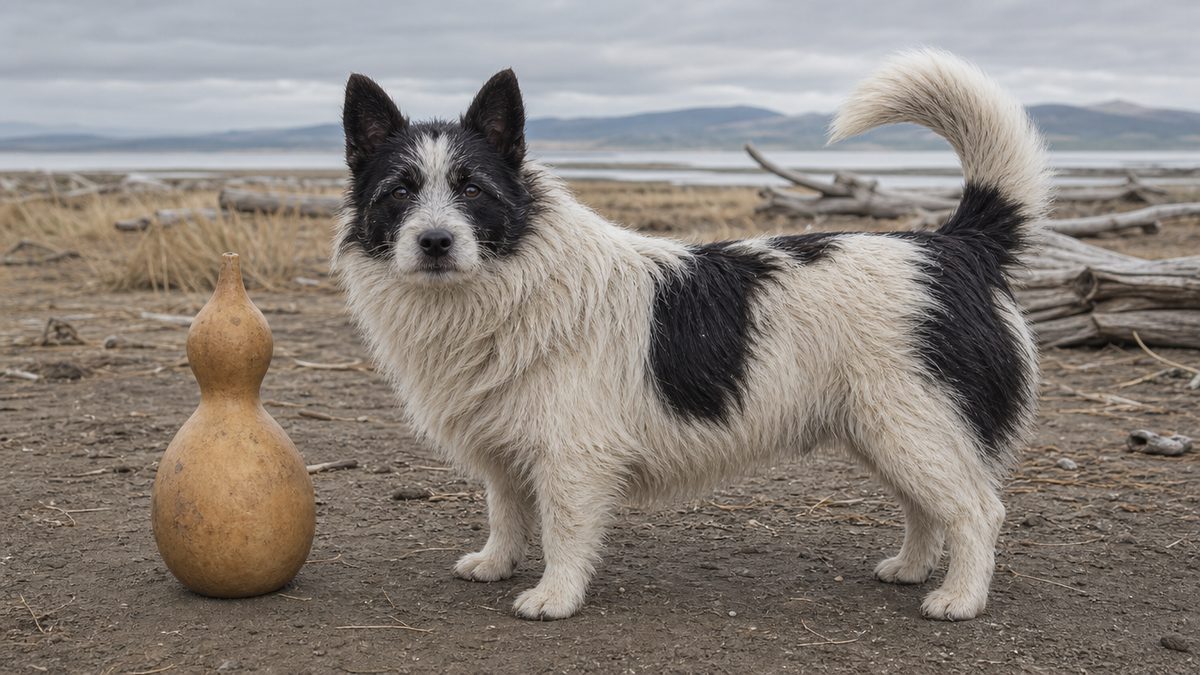
Te Ara, the New Zealand government encyclopedia, gives the fullest description: small, long-haired dogs with a small head, pricked ears, a terrier-like snout and a powerful jaw, with heavy shoulders and neck, short legs and a bushy tail, weighing on average 13 to 15 kg. Some were black, some white, some a combination with patches or spots, and some had yellow coats. Wikipedia's own summary is compatible and shorter: bushy-tailed, with short legs and powerful shoulders, coat colour ranging from yellowish brown to black, white or spotted.
The one behavioural detail every source agrees on is the voice. Kurī howled rather than barked, and te reo Māori keeps the two apart with separate words, auau for the kurī's howl and pahupahu for the European dog's bark.
Three reasons. It is the best-evidenced extinct dog we have written about, so it shows what an honest breed page looks like when the material is genuinely there. Its extinction question is a clean case study in an answer engine picking the most confident of five disagreeing sources. And an Indian reader who searches this name is usually reading a page that has quietly converted an unsettled question into a fact.
Kurī, gurī, pero, kararehe: the names, and why the macron matters
The animal's name is kurī, with a macron on the i, and the macron is not decoration. Te Ara records at least three further names, and one of them started a false story that Spanish settlers introduced the dog.
Te reo Māori uses the macron to mark a long vowel, and a long vowel changes a word. Kurī with the macron is the dog. Written kuri, without it, the string is what search engines see and what most of the English-language internet types, which is why this page carries both spellings and uses the macron everywhere the sources allow. The language itself is not a historical footnote: section 5 of Te Ture mō Te Reo Māori 2016 provides that the Māori language is an official language of New Zealand, and section 4 recognises it as a taonga of iwi and Māori, with iwi and Māori as its kaitiaki.
The other names, and what each one tells you
| Name | Where it comes from | What it actually means |
|---|---|---|
| Kurī | The standard name in te reo Māori | The dog itself |
| Gurī | Used by Māori in Te Waipounamu, the South Island | A regional variant of the same word |
| Pero | Recorded as another name | Its resemblance to the Spanish perro made some believe Spanish settlers introduced the dog |
| Kararehe | Later usage | Came to mean any four-legged animal, not this one |
| Māori dog | English, probably from kurī māori | Kurī māori actually means any ordinary dog, not a distinct breed |
The last row is the one worth pausing on. Te Ara says the English term Māori dog probably arose from kurī māori, but that kurī māori actually means any ordinary dog. So the English breed name is a mistranslation that turned a general word into a proper noun, which is the same failure mode as Hawaiian Poi Dog, where the English name records the diet rather than the animal.
The Spanish story, and why it is dead
The pero name is the reason a nineteenth-century idea circulated that these dogs arrived with Spanish ships. The genetics settles it in the other direction. All fourteen sequenced dogs from Wairau Bar carry the mitochondrial control-region haplotype A192, which had otherwise been reported only in modern village dogs from Bali in Indonesia, and every one of them falls into the ancient Polynesian short haplotype Arc2 rather than into anything European. That is an East Polynesian animal, not an Iberian one.
Kurī for the animal, kahu kurī for the cloak, Aotearoa New Zealand for the country, te reo Māori for the language, Te Waipounamu and Te Ika-a-Māui for the South and North Islands where the sources use them. Where a nineteenth-century document strips the macrons, we quote it as printed and note that it does.
Irawaru, kaitiaki and the sayings: what te ao Māori records about kurī
In Māori tradition the ancestor of kurī is Irawaru, and kurī are regarded both as ancestors and as kaitiaki, spiritual guardians, of particular hapū and kin groups. The Science Learning Hub records that these traditions are still passed on today, in the present tense.
That present tense is the whole point of this section. It is easy, writing about an extinct animal, to put an entire body of knowledge into the past with it, and that would be wrong. The kurī is gone. The traditions about it are not.
The kaupapa Māori summary published by the Science Learning Hub, developed by Professor Georgina Tuari Stewart of Auckland University of Technology and Dr Sally Birdsall of the University of Auckland with funding from New Zealand's Ministry for Primary Industries, puts it directly: kurī were of traditional, cultural and spiritual significance within te ao Māori as recorded in narrative traditions, the ancestor of kurī in terms of whakapapa was Irawaru, and kurī were regarded both as ancestors and as kaitiaki of particular hapū and kin groups.
The Irawaru account, and where versions differ
Te Ara records Irawaru as the guardian deity of kurī and the brother-in-law of the demigod Māui. In that telling Māui was angered at Irawaru's laziness and, while Irawaru slept, pulled his ears, nose and spine into the form of a dog; when Māui's two wives, Hinetūrepo and Hinetekahere, asked after their brother, he told them to call Moi, the call for a kurī, and Irawaru came running.
Rereata Mākiha, speaking to Te Ao Māori News in 2022, traces the same origin through a different relationship, describing Irawaru as the husband of Hinauri, the sister of Māui, and saying that in the stories we go back to Irawaru and that is the origin of the dog. Both accounts make Irawaru the origin; they place the marriage differently.
Bonbeno does not adjudicate between them. Traditions vary between iwi and between tellers, and an outside encyclopedia flattening two accounts into one would be doing exactly the thing this page criticises answer engines for. We name both and name who told each.
The whakataukī, and the trap in reading them
Several sayings use the kurī as a figure for an undesirable quality. The Science Learning Hub lists three: he whiore tahutahu, an often-singed tail, for idleness; he whiore hume, tail between its legs, for cowardice; and he kurī e pōtete ana, like a dog led around, for being dominated. Te Ara records the same three and adds he ihu kurī, he tangata haere, a dog's nose and a travelling man, which it says could be an insult about visitors sniffing out food, but which a traveller would sometimes use of himself to be sure of hospitality.
The trap is to read a set of sayings as an assessment of the animal. It is not. English does the same thing with dogs, and no reader takes a dog's dinner as veterinary information. Read alongside the archaeology, which shows a well-fed animal with little dental disease, the sayings are figures of speech rather than evidence.
Kurī in the traditions of voyaging
Te Ara records several. Kupe brought kurī on the canoe Matawhaorua and is said to have left one waiting so long at Hokianga Harbour that it turned to stone. Turi, captain of the Aotea canoe, gave a kahu kurī to his wife in exchange for the canoe. The Tokomaru, captained by Manaia, was guided to land in the night by the noise of a dog that had jumped overboard. Te Kurī-a-Pāoa, now Young Nick's Head, was named by Pāoa of the Horouta canoe after his lost kurī. The Science Learning Hub adds that traditional stories tell of kurī who guided their waka and people to safe landing.
Te Ara records that a northern iwi took its name from a dog-skin ruse: unable to take a fortified pā, they made the likeness of a stranded whale out of kahu kurī, and overcame the defenders who came out to harvest it. The iwi has been known as Ngāti Kurī ever since.
Where the kurī came from, and what fourteen sequenced dogs actually showed
The kurī descends from East Polynesian dogs, and the strongest evidence is a 2015 study that sequenced complete mitochondrial genomes from fourteen dogs at Wairau Bar. It found five closely related haplotypes and one control-region type, A192, otherwise reported only in modern village dogs from Bali.
Read the study carefully, because its most interesting finding is about how few dogs arrived, not where they came from. Greig and colleagues took dog teeth from one oven feature at Wairau Bar, one of the earliest archaeological sites in New Zealand and probably a central place during the colonisation phase, and sequenced fourteen complete or nearly complete mitogenomes.
Their own summary of what that means: the limited number of mitochondrial lineages present at Wairau Bar suggests that the founding population may have comprised only a few dogs, or that the arriving dogs were closely related. They are careful to leave both doors open, and they add a third possibility, that the source population itself had very limited diversity.
Why the mitogenomes mattered more than the older work
Earlier work on Polynesian dogs rested on short control-region fragments, and those fragments cannot separate individuals. The paper says it plainly: for populations such as that at Wairau Bar, which stemmed from relatively recent migration events, control region sequences have insufficient power to address questions about population structure and founding events. Sequencing the whole mitochondrial genome found five haplotypes where the short fragment alone would have found one.
| Marker | Result for the Wairau Bar dogs | What it tells you |
|---|---|---|
| Complete mitogenome | Five distinct but closely related haplotypes among 14 dogs | A small or closely related founding group |
| 582 bp control region | All 14 carry haplotype A192 | A192 has otherwise been reported only in modern village dogs from Bali |
| 263 bp ancient Polynesian fragment | All 14 assign to Arc2, none to Arc1 | Arc2 is the fragment that belongs to the A75 lineage found in modern Indonesian dogs |
Discount the insertions and deletions and A192 corresponds to A75, which has been found in small numbers in modern dogs in China and Thailand and at higher frequency, around 40 percent, in Indonesia.
The route, from the wider Polynesian work
The regional picture comes from Oskarsson and colleagues, who mapped the founder haplotypes for dingoes and ancient Polynesian dogs across Southern East Asia and Island Southeast Asia and concluded that Australian dingoes and Polynesian dogs originate from dogs introduced to Indonesia via Mainland Southeast Asia before the Neolithic, and not from Taiwan together with the Austronesian expansion. Greig and colleagues report their frequencies directly: the Arc1 and Arc2 short haplotypes were found in 10 percent of modern dogs sampled in South China, 16 percent in Mainland Southeast Asia and 42 percent in Indonesia.
What ended the lineage, in the geneticists' own words
The 2015 paper does not leave the extinction implicit. Its discussion says that this initial dog population was then subsumed by a new wave of dogs introduced during the European colonisation of New Zealand in the 19th century. Subsumed is the right verb, and it is not the same as died out.
We will state that kurī descend from East Polynesian dogs, that the fourteen sequenced Wairau Bar animals carry five closely related mitochondrial haplotypes and the A192 control-region type, and that A192 is otherwise known from Bali. We will not write that the kurī's origin has been settled by a genome, because no nuclear genome for this animal has been published, and we will not extend fourteen dogs from one oven feature at one site to the whole New Zealand population, which is a limit the authors themselves flag.
The archaeological record, and what teeth said that no document could
The kurī is known mainly from what archaeologists excavate, and the largest study of it looked at teeth. Patricia Pillay examined more than 100 individuals from sites between Northland and the Bay of Plenty and found an animal with almost no dental disease, which is evidence that kurī were fed well rather than left to scavenge.
Take the method first, because it is the reason the finding is trustworthy. Pillay looked for caries, dental calculus, tooth wear and fractures, and for linear enamel hypoplasia, a defect that forms when enamel growth is interrupted by poor diet, disease or serious infection. That last measure had never been applied to kurī before. The paper behind the release is Pillay, Allen and Littleton, Canine companions or competitors? A multi-proxy analysis of dog-human competition, in the Journal of Archaeological Science, volume 139, article 105556, and we resolved that record through Crossref rather than trusting a citation, because two 2021 SSRN preprints of the same work carry a slightly different title Crossref REST API.
| Measure | Result in Te Ika-a-Māui kurī | What it indicates |
|---|---|---|
| Cavities and plaque | Most animals had none | A low-sugar diet |
| Fractured or severely worn teeth | Few | Relatively soft foods, not bone-cracking or gritty scavenging |
| Evidence of malnutrition or disease | Little | Animals that were provisioned rather than left to fend |
| Linear enamel hypoplasia | Most stressful period coincided with weaning | Normal developmental stress, not chronic deprivation |
Pillay's own summary is that overall it seems kurī from times past were well looked after, findings which fit well with Māori histories. Emma Ash, a curator at Auckland War Memorial Museum, told Te Ao Māori News that it is the first study that has really looked into kurī diet.
How the study was allowed to happen, which is part of the finding
Pillay consulted local iwi, the museum and the archaeologists who care for the collections, and received permission to study the teeth. The published release names the groups: Ngāti Awa and Emeritus Professor Geoffrey Irwin for the Kohika assemblage; Ngāti Manuhiri, Ngāti Whātua o Ōrākei, Ngāti Whātua o Kaipara, Ngāti Maru, Ngāi Tai ki Tāmaki, Te Kawerau ā Maki and Ngāti Pāoa for Long Bay; Te Ākitai Waiohua for the airport runway assemblage; and Ngāti Hei with the Ahuahu Great Mercury Island Project for Te Mataku.
That list is not boilerplate. It is the difference between research done with a people and research done on their taonga, and it is why this page treats the resulting figures as solid.
What else the ground has produced
- Coprolites. Wood and colleagues profiled kurī coprolites from northern New Zealand both microscopically and with ancient DNA, and Greig and Rawlence report the Masonic Tavern material in Auckland as identifying fish, terrestrial and marine mollusc shell, charcoal, and wild and cultivated plant taxa.
- Isotopes. Preliminary carbon and nitrogen stable-isotope work on kurī bone supports a widely varied diet with both terrestrial and marine components.
- A whole-site study. Kramer and colleagues published an exploratory and integrative study of kurī at the Northern Runway Development site in 2022, covering the period AD 1400 to 1800.
- A carved figure. A small kānuka carving of a kurī from Moncks Cave on Banks Peninsula, held by Canterbury Museum, showing the tail curved upward, which the Science Learning Hub calls a characteristic of the animal.
The one taphonomic caveat the reviewers insist on
Greig and Rawlence flag it themselves: to date, the only published evidence of kurī skeletal remains is associated with archaeological evidence for human activities rather than with natural sites such as caves, pitfalls, swamps and dunes, which potentially creates a sampling bias in the available data. Every kurī anybody has studied was found where people were. That does not prove kurī were always with people, and the same review argues the opposite.
A breed page can tell you what somebody wrote about an animal. A tooth tells you what the animal ate. On this breed the tooth evidence exists, was gathered with permission, and says something no eighteenth-century observer recorded: that these dogs were provisioned well enough to have almost no dental disease.
**Size and weight**, **coat colours**, and the four different comparisons in print
The kurī weighed about 13 to 15 kg and stood low on short legs, with a small head, prick ears, a terrier-like snout, a powerful jaw and a bushy tail. Beyond the weight, the sources reach for four different comparison animals, and they do not agree with each other.
The weight figure is the firmest number on the page and it comes from Te Ara, which gives the average as between 13 and 15 kilograms and adds that kurī became bigger and more active than dogs on other Polynesian islands. That second clause matters for the comparison with the Hawaiian Poi Dog, where no weight was ever recorded at all.
| Source | Comparison | What kind of source it is |
|---|---|---|
| Te Ara, New Zealand government encyclopedia | About the size of a border collie | A national encyclopedia entry by a named historian |
| Science Learning Hub, kaupapa Māori summary | Similar in size to cocker spaniels | A funded education resource by two named academics |
| Doglime | Medium-sized | A breed aggregator, with no source given |
| The 1867 Te Papa specimen | Body length 1,000 mm as mounted | A measured museum record, not a live animal |
A border collie and a cocker spaniel are not the same dog, and a mounted skin is not a live measurement. The honest reading is that kurī sat in the 13 to 15 kg band, which in every Indian cost table is a medium dog, and that the comparison animal a writer reaches for tells you more about the writer than about the kurī Science Learning Hub Pokapū Akoranga… Museum of New Zealand Te Papa Tongarewa.
The coat, and the one thing that will not resolve
Te Ara describes small, long-haired dogs and lists the colours as black, white, combinations with patches or spots, and yellow. Wikipedia gives the range as yellowish brown to black, white or spotted. Those are compatible. What does not resolve is the tail: Te Ara and Wikipedia both call it bushy, while the Moncks Cave carving is described as depicting the dog's upwardly-curved tail as a characteristic of the species. Bushy and upwardly curved are not contradictory, but a carving is a stylised object and a written description is second-hand, and neither settles the carriage.
The picture that is genuinely contemporary
One image is worth more than any modern illustration. A print in the British Museum, drawn during James Cook's first voyage between 1768 and 1771, shows a white kurī sitting among warriors in a waka. A second, an Augustus Earle painting of an event in the Bay of Islands in 1827 and 1828, has a kurī in the foreground. Those are eyewitness images of the living animal, drawn by people who were there, and they are the reference this page's own illustration brief is built on.
It was not a spitz with a tail ringed flat on its back, not a smooth-coated pariah type and not a short-legged dog with a long low body like a dachshund. Every recorded description gives short legs under a normally proportioned body with heavy shoulders and neck, a long-haired coat, and prick ears. If an image you find looks like a recognisable modern breed, it is an illustration rather than evidence.
**Dog meat**, **dog skin cloaks** and **hunting birds**: what kurī were actually for
Kurī were kept for four things at once: as household companions, as a protein source, as the raw material for kahu kurī and other taonga, and as hunting dogs for ground birds. All four are documented, none cancels the others, and the way to write about them is plainly.
The Science Learning Hub puts the household role first and it is worth following that order. Kurī lived with Māori households as pets or companion animals that also provided an important protein food source, and there are also Māori accounts of feral kurī populations. Greig and Walter add the detail that makes the relationship unusual: dogs are unique in early New Zealand as the only animal that shared living space with humans.
As food, and the scale of it
Kurī flesh was considered a delicacy and places were named for feasts of it. Te Ara records that Hikawera, a chief at Waiohiki in Hawke's Bay, ordered 70 dogs slaughtered to feed travellers, that the scraps were thrown in the river, and that the river is called Tūtaekurī, meaning dog offal, for that reason. The place where the animals were cooked was called Te Umukurī, the kurī oven.
The European taste tests are on record too and they disagree with each other. James Cook wrote in 1769 that kurī tasted almost as good as lamb. Sydney Parkinson, an artist on the same voyage, compared it to coarse beef. The explorer Thomas Brunner, reduced to eating his own dog Rover, found the flavour very tasty, somewhere between mutton and pork, and Māori gave him the nickname Kai Kurī, dog eater.
In Te Waipounamu, Te Ara records, kurī were said to have been castrated to fatten them more quickly for eating.
As material, which is where the animal became taonga
- Kahu kurī, cloaks of dog skin, which Te Papa's own overview says the pelts made and which could only be worn by rangatira.
- A tāpahu o Irawaru, a garment to ward off weapons, named as the protective cloak of Irawaru, god of dogs.
- Circlets for mourners, made from the hair shaved from the long bushy tail, and the same hair used to adorn weapons.
- Awls, pendants and necklaces from the bones, and fish hooks from the jaw and teeth, with teeth also worn as ear pendants.
- Belts, weapon decorations and poi, all made with dog skin or dog hair, held in Te Papa's Taonga Māori collection.
Te Papa's own record for the mounted skin lists the same set in one sentence: the meat was a delicacy, the pelts made into cloaks that could only be worn by rangatira, the teeth fashioned into ornaments, and the bones made into matau, fish hooks.
As hunting dogs, and what they caught
The record here is specific rather than general. In the 1800s kurī were used to catch kiwi, kākāpō, weka, pūkeko and māunu, moulting ducks. The fowler would lure a kiwi by imitating its cry and release the dog, which he led on a rope. The Ngāi Tahu scholar Teone Taare Tīkao described hunting pūkeko by beating the swamp during a strong north-west wind so the birds tired of flying against it, at which point the dogs would catch them.
Whether kurī helped hunt moa is a different and unsettled question, and it is covered in the ecology section below.
In ritual
Kurī were sacrificed on ceremonial occasions, and tohunga would sacrifice a dog to appease Tūmatauenga, the god of war, or other gods. Dogs were also used as tapu food for tohunga. Te Ara records one dated instance: in the 1830s at Mangakāhia, when a high-born woman was to receive a moko, one of the last kurī in the district was killed as tapu food for the tattooer.
Because separating them produces a false animal. A page that leads with dog meat produces one caricature and a page that leads with cloaks produces another. Kurī were companions who shared living space, were eaten, were made into the most prized garments in the culture, and caught birds. Every one of those is sourced, and the combination is what an outsider finds hardest to hold.
Did kurī help wipe out New Zealand's birds? The argument, and where it stands
Nobody has settled it, and the disagreement is on the record in print. Anderson suggested kurī probably contributed to the extinction of moa; Worthy and Holdaway wrote that the Polynesian dog can be exonerated because it was kept so close to camps that it is not a factor; and Greig and Rawlence's 2021 review argues the exoneration rests on a wrong premise.
This is the most active scientific question about the animal, and it is worth an Indian reader's attention for a reason that has nothing to do with New Zealand: it is a clean example of a claim about a dog being settled by evidence about human behaviour rather than about the dog.
| Who | Position | As quoted by the 2021 review |
|---|---|---|
| Fleming, 1962 | Attribute all late Holocene extinction to human ecological change | The simplest explanation is to attribute all late Holocene extinction to the profound ecological changes brought about by man with fire, rats and dogs |
| Anderson, 1981 and 1989 | Kurī probably contributed to the extinction of moa | Reported as a suggestion, not a demonstration |
| Holdaway, 1999 | Nearly all extinctions were down to people and kiore, not kurī | Kurī probably had little effect on the biota |
| Worthy and Holdaway, 2002 | Kurī can be exonerated entirely | The Polynesian dog can be exonerated: it was kept so close to camps that it is not a factor |
The premise the 2021 review attacks
Greig and Rawlence go straight at the phrase kept so close to camps. Kurī seen by early European travellers were not restrained or tethered and had the freedom to roam throughout settlements and scavenge for food, and that freedom would have enabled kurī to forage beyond the close confines of Māori villages. They note that nineteenth-century villages were often observed with fenced enclosures or storehouses on poles built to keep dogs and pigs out, which is evidence that the dogs were roaming rather than confined.
They also point out that kurī could have formed feral self-sustaining populations, particularly in warmer northern regions, and that wild dogs were observed subsisting on kākāpō, weka and ground-dwelling birds in the nineteenth century.
The number that shows what one loose dog can do
The review's most quotable figure is modern and it is not about kurī at all. A single unrestrained dog in the Waitangi State Forest killed at least 23 kiwi over a six-month period, and the total is thought to have been as many as 500, which represented half of the total population at that time. Set that beside a global review the same paper cites, finding that dogs have contributed to 11 vertebrate extinctions and are a threat to at least 188 species worldwide.
Neither figure proves anything about kurī. Both show that the exoneration cannot rest on an assumption that dogs stay where they are put.
What the coprolites and isotopes actually contain
The direct dietary evidence is broad rather than decisive. Macroscopic analysis of kurī coprolites shows small bird, moa, fish, mollusc shell, charcoal and plant remains, and the ancient DNA study of Masonic Tavern material in Auckland found fish, terrestrial and marine mollusc shell, charcoal and both wild and cultivated plants Greig K, Rawlence NJ. The Contribution…. Moa in a coprolite is consistent with a dog eating scraps from a human meal, which is precisely why the question stays open.
Free-ranging dogs are the normal condition of dogs in India too, and the same argument applies here with the same weak point. A claim that a dog population is or is not affecting local wildlife has to rest on what the dogs actually do, not on where their owners believe they stay.
The **extinction date**: five answers in print, and one of them says nobody knows
No extinction date for the kurī is settled, and five different answers are in circulation from sources a reader would reasonably trust. The New Zealand government encyclopedia says plainly that it is unclear. An answer engine, asked the same question, printed one of the other four as a fact.
Every source agrees on the mechanism and disagrees on the timing. The mechanism is interbreeding: European dogs arrived from the early 1800s, bred into the kurī population, and the distinct animal stopped being distinguishable. Nobody records a last individual.
| Source | What it says | Kind of source |
|---|---|---|
| Te Ara, by Basil Keane | It is unclear when kurī died out. They probably became rare through cross-breeding and then disappeared | The New Zealand government encyclopedia |
| Greig and Rawlence, 2021 | By the mid-nineteenth century CE kurī were no longer identifiable as a distinct dog type | Peer-reviewed review, open access |
| Science Learning Hub, 2024 | Pure-bred kurī disappeared during the second half of the 19th century | Kaupapa Māori summary, funded by the Ministry for Primary Industries |
| English Wikipedia | The kurī became extinct in New Zealand in the 1860s | Encyclopedia, sourced to Elsdon Best 1924 at pages 433 to 435 |
| Doglime | The Kuri Dogs became extinct in the early 19th century | Breed aggregator, no source given |
Read the table as a spread rather than a conflict and it is less alarming than it looks. Early nineteenth century and the 1860s are not the same claim, but mid-century and second half of the century overlap, and Te Ara's unclear is compatible with all of them. What is not compatible is presenting any single one as settled Greig K, Rawlence NJ. The Contribution… Science Learning Hub Pokapū Akoranga… Wikipedia, Kurī, English article. Raw… Doglime, 'All About Kurī - Origin.
The second process, which is not interbreeding
Two things happened at once and they get merged. Alongside the genetic absorption, feral packs were shot. Te Ara says that in post-European times, feral packs of kurī and European dog cross-breeds were shot on sight and gradually exterminated. The Science Learning Hub dates that campaign: in the late 19th and early 20th centuries, feral dog packs believed to be kurī and European cross-breeds were seen as a great nuisance and shot on sight by shepherds and settlers, and these feral dogs were exterminated as settlement proceeded. Te Papa's own record adds that many were also shot by early run holders to protect livestock.
So the animals being shot in the late nineteenth century were already mixed breed by every account, which is exactly why the shooting cannot date the extinction of the pure population.
What the answer engine did with all this
On 2 September 2026 an India-located Bing search for when did kuri become extinct returned a generated answer box reading 1860s, attributed to Wikipedia, and described as generated by AI from multiple online sources. Four results down the same page, Te Ara's own snippet read: it is unclear when kurī became extinct, they probably became rare through cross-breeding with dogs brought by Europeans from the early 1800s Keane B. Kurī, Polynesian dogs. Te Ara.
The engine had both statements on screen and printed the confident one. That is the mechanism this site keeps documenting, and here it is caught in a single screenshot: a contested question resolved into a fact by preferring the source that sounded surest.
That kurī ceased to exist as a distinct population during the nineteenth century, through interbreeding with European dogs, and that the exact decade is not settled. We give the range and name who says what. We will not print a single year, and we will not repeat the 1860s as though the question were closed.
The 1867 skin, and the sentence Te Papa's own catalogue does not support
English Wikipedia states that the remains of the last known specimens, a female and her pup, are now in the collection of the Museum of New Zealand Te Papa Tongarewa. Te Papa's own catalogue entry for that animal says the pup's skin and skeleton went to the British Museum and only the mother's skin was kept.
We went to the museum record because Wikipedia names the museum, and a museum's own catalogue is the better source about its own holdings. The record is public.
| Field | What the record says |
|---|---|
| Registration number | LM000828 |
| Common and Māori name | Kuri, Maori dog |
| Scientific name | Canis lupus familiaris |
| Sex and life stage | Female, adult |
| Collected by | John Anderson, 1876 |
| Location collected | New Zealand, between Waikava and the Mataura plains, Catlins |
| Body length | 1,000 mm |
| Credit line | Gift of Mr Anderson, 1876 |
The record's overview says the animal was shot along with her pup by a farmer in 1867 and is one of only a few taxidermised kurī in existence, and it explains the poor condition: some time had elapsed between the animal being killed and it being mounted.
The 1876 account, quoted in the record
Te Papa reproduces the passage from the Transactions of the New Zealand Institute, volume 9, 1876. A bitch and full-grown pup were known for several years in the densely wooded country between Waikava and the Mataura plains, and did great damage among the flocks of sheep, but exhibited such cunning and daring that it was not till after hunting them for two years that they were shot by Mr Anderson, who presented them to the Colonial Museum. Of the smaller specimen both skin and skeleton were taken to the British Museum by Sir Grey, and the skin of the mother was preserved here, and has been recognized by many old Maoris as a genuine Kuri or ancient maori dog.
A second passage in the same record adds that the skull, which is the only part of the skeleton preserved, proves it to have been a very old individual, the canines being worn down to their stumps, and the processes and ridges of the cranium strongly developed.
Three things follow, and the third is a correction
- The animal was identified by Māori, not only by settlers. The 1876 account records that the skin has been recognised by many old Māori as a genuine kurī, which is the only identification in the whole record with any authority behind it.
- It was a sheep-killer, and it had been hunted for two years. This is not a household dog. It is a feral animal from the era when feral packs were being shot on sight, which is exactly the period in which a pure kurī is least likely to be found.
- The pup is not at Te Papa. The record says both its skin and its skeleton were taken to the British Museum by Sir Grey. English Wikipedia's sentence, that the remains of the last known specimens, a female and her pup, are now in the collection of Te Papa, is not supported by Te Papa's own catalogue.
We did try to read the source Wikipedia cites for that sentence, Elsdon Best's The Maori of 1924 at pages 433 to 435. Its host, the New Zealand Electronic Text Collection, returned an Incapsula challenge page of 1,042 characters to a direct fetch and refused every Firecrawl engine on 2 September 2026, so we could not open it. We therefore say only what Te Papa's catalogue says, and we do not claim to know what Best wrote.
Wikipedia cites collections.tepapa.govt.nz object id 68853 for a kahu kurī dog-skin cloak, under the retired objectdetails.aspx URL scheme. Under Te Papa's current scheme, object 68853 returns HTTP 200 and serves a dog specimen, registration LM000828/2, not a cloak Wikipedia, Kurī, English article. Raw…. We do not know whether the id was remapped when the site was rebuilt or whether the citation was always wrong, and we say that rather than guessing. What is certain is that following the citation as printed today does not reach a cloak.
The dog is gone. Te reo Māori is an official language and kurī taonga are protected by statute
The kurī is extinct. Māori are not, te reo Māori is an official language of New Zealand by statute, and objects made from kurī are protected as taonga tūturu under a law that makes them prima facie property of the Crown when found and restricts who may buy one.
This section exists because the English breed-page format makes a specific error easy. Writing about an extinct animal of an Indigenous people, the past tense creeps outward from the dog to everything around it, and the result reads as though a culture ended with its dog. On this subject the law itself is the clearest correction available.
The language, in the Act's own words
Te Ture mō Te Reo Māori 2016, the Māori Language Act 2016, is enacted in both languages side by side. Section 4 is headed Recognition of Māori language as taonga and reads: the Māori language is a taonga of iwi and Māori; iwi and Māori are the kaitiaki of the Māori language. Section 5 is a single sentence: the Māori language is an official language of New Zealand. In te reo Māori the same section reads: He reo whai mana ā-ture nō Niu Tireni te reo Māori.
The Act's purpose clause affirms the status of the language as the indigenous language of New Zealand, a taonga of iwi and Māori, a language valued by the nation, and an official language of New Zealand, and it establishes Te Mātāwai as an independent statutory entity to provide leadership on behalf of iwi and Māori in their role as kaitiaki of the language. Section 6 records the Crown's own acknowledgement of the detrimental effects of its past policies and practices, matters recorded in evidence given to the Waitangi Tribunal.
The taonga, and why you cannot buy one
The Protected Objects Act 1975 defines taonga tūturu as an object that relates to Māori culture, history or society, that was or appears to have been manufactured or modified in New Zealand by Māori, brought into New Zealand by Māori, or used by Māori, and that is more than 50 years old.
A kahu kurī, a kurī-tooth ear pendant, a kurī-bone matau and the Moncks Cave carving all sit squarely inside that definition. Three consequences follow, and they are the practical answer to any reader who wondered whether kurī material can be collected.
- Ownership. Any taonga tūturu found anywhere in New Zealand or within its territorial waters after the Act commenced is declared prima facie the property of the Crown, and where an object was recovered from a grave whose occupant is known, the matter goes to the Māori Land Court to determine who should hold custody.
- Reporting. A finder must notify either the chief executive or the nearest public museum within 28 days, and for a find during an authorised archaeological investigation, within 28 days of completing the field work.
- Sale. It is unlawful to sell or otherwise dispose of any taonga tūturu, knowing or having reasonable cause to suspect that it is one, other than to a registered collector, a public museum, or through a licensed auctioneer or secondhand dealer. The penalty is a fine of up to NZD 10,000 for each taonga tūturu for an individual and up to NZD 20,000 for a body corporate.
Consent, in current research practice
The same principle shows up in how the science is now done. The largest study of kurī teeth went ahead only after its author consulted local iwi, the museum and the archaeologists caring for the collections and received permission, and the published release names each iwi against each assemblage. That is not a courtesy line. It is the working form of the statutory position above.
Write that the kurī is extinct, that Māori are the kaitiaki of te reo Māori by statute, that te reo Māori is an official language of New Zealand under section 5 of Te Ture mō Te Reo Māori 2016, and that kurī taonga are protected under the Protected Objects Act 1975 Protected Objects Act 1975. All four are documented. Extending the word extinct past the animal is the error, and the English breed-page template makes it easy to fall into.
**Kennel club recognition**: none, and the question is close to meaningless here
No kennel club has ever registered the kurī and no breed standard for it exists. The FCI nomenclature for the letter K returned fourteen breeds on 2 September 2026 and neither Kurī nor Kuri is among them, which matters for an Indian reader because the Kennel Club of India issues pedigrees against FCI nomenclature.
Run the check properly and it takes two minutes. The FCI page for the letter K returned Kai 317, Kangal Çoban Köpegi 331, Karjalankarhukoira 48, Kavkazskaïa Ovtcharka 328, Kazakh Tazy 372, Kerry Blue Terrier 3, King Charles Spaniel 128, Kishu 318, Kleiner Münsterländer 102, Komondor 53, Korea Jindo Dog 334, Kraski Ovcar 278, Kromfohrländer 192 and Kuvasz 54. Fourteen real breeds returned, so the list loaded. The kurī is absent.
Why the absence proves less than it looks
The FCI was founded in 1911. The kurī was already gone as a distinct animal by then on every account in the extinction table above, and it had never been bred to a written description at any point. There was nothing for a registry to constitute. Absence from the FCI register is therefore evidence about the calendar, not about the animal.
The same reasoning applies to the Kennel Club of India. India is a full FCI member and the KCI issues pedigrees against FCI nomenclature, so a breed absent from the FCI register has no route to a KCI pedigree. Here the question barely arises, because there is no living population for any registry to record. A pedigree naming this animal would be describing something else.
What the animal is actually classified as
Not a breed at all, in the current scientific literature. Te Papa's specimen record files it as Canis lupus familiaris in the family Canidae. The Science Learning Hub puts it more directly: the kurī, along with all Pacific dogs and the dingo, is now included within the universal domestic dog species Canis familiaris. Wikipedia's own list of extinct dog breeds has a Polynesian Dog row that calls the name a catch-all term for four breeds on that list, the Hawaiian Poi Dog, Kurī, Marquesan Dog and Tahitian Dog.
| Register | Result | Proof the check worked |
|---|---|---|
| FCI nomenclature, letter K | Neither Kurī nor Kuri appears | The same page returned 14 real breeds including Kai 317, Kishu 318 and Kuvasz 54 |
| Kennel Club of India | No route exists, because the KCI issues pedigrees against FCI nomenclature | Derived from the FCI check above, not from a separate query |
| Species-level classification | Canis lupus familiaris, with no subspecies or breed status | Te Papa's own taxonomy field, and the Science Learning Hub's statement |
There is no studbook, but there is a register that matters: the museum catalogues. Te Papa's LM000828, Canterbury Museum's kānuka carving from Moncks Cave, and the kahu kurī in New Zealand collections are the closest thing to a documented record of this animal, and unlike a pedigree they can be checked by anybody with a browser Science Learning Hub Pokapū Akoranga…. No rare-breed premium can attach to an animal no register has ever listed.
What the breed sites publish about a dog nobody has seen for over a century
One page in the Indian result set runs a modern breed template over this animal, and its title promises Origin, Extinction, Behavior, Puppy and Facts. Two more are Wikipedia mirrors repeating the same contested sentence word for word, and a retail domain publishes a Māori history blog about the kurī.
The tell on an extinct-breed page is not usually a wrong fact. It is a filled field. A template designed for a dog you could buy has slots for puppies, behaviour and care, and something has to go in them.
| Page | What it is | What to do with it |
|---|---|---|
| Wikipedia | Six paragraphs and a long bibliography. Carries the 1860s date and the Te Papa claim | Useful for the bibliography. Check both load-bearing sentences before repeating them |
| Te Ara | The New Zealand government encyclopedia, by a named historian | The best free general account. Start here |
| Science Learning Hub | A kaupapa Māori summary by two named academics, publicly funded | The only ranking page that leads with whakapapa. Start here too |
| University of Auckland and Te Ao Māori News | Coverage of the dental study, with the iwi permissions named | The best route into the primary research |
| Frontiers in Ecology and Evolution | Greig and Rawlence 2021, open access | The detailed treatment. Free to read in full |
| Doglime | A breed template promising Origin, Extinction, Behavior, Puppy and Facts | Audited below |
| everything.explained.today and wikiwand.com | Two Wikipedia mirrors | Not independent sources. They repeat one sentence three times over |
| alinabasics.shop | A retail domain running a Māori history blog post | Read the domain before the article |
The one page with a breed template
Doglime's article is titled All About Kurī, Origin, Extinction, Behavior, Puppy and Facts, posted 1 April 2020, modified 28 May 2024, with the author credited only as DGM. Two things about it are worth reporting precisely, and one of them is a limit on us rather than on the page.
- We could not read its body. The page returned HTTP 200 on 2 September 2026 but its article content did not render for us, returning only a sidebar of unrelated posts. So we quote only the metadata we read directly and the body text the search engine itself displayed, and we say which is which.
- Its own meta description carries a typo, three times over. The description, og:description and ogDescription fields all read that the breed was extinct because od excessive crossbreeding, with od for of. That is a page nobody proofread, repeated into every social preview.
- Its extinction date is the outlier. The snippet the search engine displayed reads that the Kuri Dogs became extinct in the early 19th century because of excessive crossbreeding with other breeds brought from Europe, which is earlier than any other source in the table above.
- A Puppy heading for an extinct animal is the template speaking rather than the writer, and it is the clearest sign that a slot was filled because it existed.
The mirrors, and why they inflate confidence
Two of the ten results, everything.explained.today and wikiwand.com, reproduce Wikipedia's extinction sentence verbatim. A reader scanning the page sees three sources agreeing on the 1860s. There is one source, printed three times. That is the single most common way an unsourced or thinly-sourced claim acquires the appearance of consensus, and it is worth checking on any subject, not only this one.
And the answer box on top of all of it
Above the results, the same page printed a generated answer reading 1860s, with a note saying the summary was generated by AI from multiple online sources. The multiple sources it linked were Wikipedia plus two Wikipedia mirrors. That is one source presented as several, promoted to an answer, on a page that was simultaneously displaying Te Ara saying the question is unclear.
Before repeating a date, look at what the agreeing sources actually are. If two of them are mirrors of the third, you have one source. Then look for the government or university page in the same result set and read what it says, because on this subject it is right there and it says something different Science Learning Hub Pokapū Akoranga….
Kurī **price in india**: there is no animal, and the price lists prove it themselves
No price in India exists for the kurī, because the animal has been gone for over a century and was never here at any point before that. India's most comprehensive published dog price list, covering more than 40 breeds across six metros, contains zero occurrences of kuri in 127,066 characters.
The absence is earned rather than assumed. A search that returns nothing proves nothing unless the search is shown to work, so we ran a control in the same session. The query labrador retriever price in india returned real Indian price pages, the first of them a city-by-city table quoting INR 30,000 to INR 1,20,000 across Hyderabad, Bangalore, Delhi, Chennai, Lucknow, Mumbai, Jaipur and Pune, with bands of INR 30,000 to 60,000 for basic quality, INR 60,000 to 90,000 for KCI registered and INR 90,000 to 1,20,000 for champion bloodline. The instrument works.
The document test, which is stronger than a search
A search result is a snippet. A document you can count in is better, so we took India's largest published breed price list, retrieved it in full at HTTP 200, and machine-searched all 127,066 characters of it.
| String searched | Occurrences | Role |
|---|---|---|
| kuri | 0 | The target. Zero in either case |
| Polynesian | 0 | The wider group |
| New Zealand | 0 | The country of origin |
| Marquesan | 0 | A sibling Polynesian dog |
| Labrador | 9 | Control. Proves the search string works |
| Indian Pariah | 3 | Second control, and the dog you should actually be reading about |
Two controls returning 9 and 3 in the same document is what makes the four zeros mean something. This is not a search that failed. It is a market that does not contain the animal.
What the India-located price query actually returns
Ten results on 2 September 2026, and not one is a kurī of any kind. Two are generic Indian dog price lists, two are YouTube videos on Indian dog prices, one is a Quora thread about the cost of buying a dog in India, one is a most-expensive-breeds listicle, one is a Delhi marketplace, and two are posts about a Bengaluru purchase of a wolfdog reported at a very large figure. The tenth is a product page whose title reads Costly Dog Breeds In India Affordable Dog Breeds In India Dog Price, carrying a star rating and a pick-up-at-store option, which is a shopping template with a search phrase substituted into it.
So the honest answer to what a kurī costs in India is that the query returns the Indian dog market in general, because there is nothing specific for it to return.
Nobody can sell you a kurī. If a seller uses the name they are selling you a different animal under a label that has been unavailable for well over a century, and no register anywhere would issue a pedigree for it. If somebody offers you a kurī artefact instead, that is a separate and more serious problem, because a kahu kurī or a kurī-bone matau is taonga tūturu under New Zealand law and unlawful to sell outside a narrow channel.
**Cost of ownership** in India for a 13 to 15 kg dog, which is the useful version of this question
There is no cost of ownership for a kurī, because there is no kurī. What Bonbeno can give you honestly is the published Indian monthly cost for a medium dog of exactly this weight, because 13 to 15 kg is a medium dog on every Indian cost table and those figures are real, sourced and dated.
Start with what you are not paying. Adopting an Indian dog of comparable size costs ₹0 to ₹3,000, and that fee covers vaccinations, deworming and microchipping. City by city the same source gives Indie adoption as ₹0 to ₹2,000 in Delhi and NCR, ₹0 to ₹2,500 in Mumbai, ₹0 to ₹2,000 in Bangalore, ₹0 to ₹1,500 in Chennai, ₹0 to ₹2,000 in Hyderabad and ₹0 to ₹2,000 in Pune. Everything below is recurring cost that starts after that.
| Cost line | Medium breed, per month | What moves it for a coated dog |
|---|---|---|
| Dry or wet food | ₹2,500 to ₹4,000 | Kibble grade, and whether you home-cook part of the ration |
| Routine vet visits | ₹800 to ₹1,500 | Skin and ear problems in the monsoon dominate this line |
| Vaccinations, annualised | ₹1,500 per year | Core versus core plus rabies boosters, and clinic pricing by metro |
| Grooming | ₹800 to ₹1,500 | A long rough coat in Indian humidity. Higher if you do not dry at home |
| Training, over six months | ₹2,000 to ₹5,000 | One-off rather than monthly |
| Treats and toys | ₹500 to ₹1,000 | Discretionary |
| Flea, tick and deworming | ₹400 to ₹700 | Should be year-round in India, not seasonal |
| Monthly total, published estimate | ₹6,000 to ₹10,000 | The spread is driven by food grade and grooming, not by the dog |
Those bands are a published Indian size-band model dated March 2026, not a breed-specific figure and not ours. We use them because the kurī's recorded weight of 13 to 15 kg puts it squarely in the medium column, and because the alternative, quoting a cost for an animal nobody has kept for a century, would be invention.
The wider Indian context those numbers sit in
The same source reports that urban households in India now spend ₹5,000 or more every month on a dog, that dog prices in India in 2026 run from ₹2,000 for an indie or native breed to over ₹1,50,000 for a KCI-registered show-quality dog, that monthly upkeep across all sizes runs ₹3,000 to ₹18,000, and that a first year including purchase, vaccinations, food, training and supplies should be budgeted at ₹80,000 to ₹2,00,000. For a medium coated dog the twelve-year total on the published band is roughly ₹8,64,000 at the bottom and ₹14,40,000 at the top.
Two lines that would genuinely differ for a dog of this coat
Grooming would sit at the top of its band, not the bottom. A long rough coat in a climate where Mumbai's peak monthly wet-bulb is 25.8C holds water at the skin for hours after a soaking, and drying to the skin is the whole job. The difference between the ₹800 and the ₹1,500 end of that line is whether you own a dryer and use it.
Parasite prevention should be year-round rather than seasonal, and the Indian evidence is specific. A Punjab survey of 719 dogs found Babesia gibsoni in 8.9 percent of samples by multiplex PCR against 5.0 percent by microscopy on the same samples, Hepatozoon canis in 5.1 against 1.0 percent, Ehrlichia canis in 2.6 against 1.4 percent and Babesia vogeli in 1.1 against 0.1 percent. Every PCR figure exceeds its microscopy figure, which means a diagnosis resting on a blood smear alone under-detects the problem. A long coat makes ticks harder to find, not less likely.
Because the two questions are different. There is no Indian price for a kurī and inventing one would be fabrication. But Indian food, vaccination, consultation, grooming and parasite-prevention costs are real, published and dated, and they apply to any 13 to 15 kg coated dog living here. Those are the numbers a reader can act on, and they are the honest half of this page's India specificity.
Aotearoa against India: an 8 to 9 point wet-bulb gap, and a grid cell that says a river mouth is 396 m up
The warmest place we measured in Aotearoa, Kaitaia in the far north, has a peak monthly mean wet-bulb temperature of 17.7C. Kolkata's is 27.1C and Chennai's is 26.1C. That is a gap of nine and eight points for a long-haired dog, and no Indian city we tested comes close.
Heat tolerance is the trait an Indian reader most needs and the one no global breed source rates, so we compute it rather than quoting it. We queried NASA POWER by explicit latitude and longitude for 2001 to 2020, so no place name could be substituted for another, checked the returned coordinates against those requested at every point, and derived wet-bulb from the returned monthly mean air temperature and relative humidity using the Stull formula.
| Place | Annual mean air temp | Coldest month | Warmest month | Peak monthly wet-bulb |
|---|---|---|---|---|
| Kaitaia, Northland | 16.78C | August, 13.63C | February, 20.72C | 17.7C in February |
| Auckland | 15.66C | July, 11.40C | February, 20.38C | 17.1C in February |
| Wairau Bar, Marlborough | 10.88C, see the caveat below | July, 5.64C | January, 16.41C | 13.0C in February |
| Waikawa, Catlins | 9.74C | July, 5.81C | January, 13.51C | 11.1C in February |
| Bengaluru | 23.74C | December, 20.22C | April, 28.37C | 21.9C in May |
| Pune | 23.86C | December, 19.62C | April, 28.93C | 23.0C in June |
| Mumbai | 26.77C | January, 23.19C | May, 31.19C | 25.8C in June |
| Chennai | 27.95C | January, 24.09C | May, 31.51C | 26.1C in May |
| Delhi | 25.60C | January, 13.61C | June, 35.88C | 26.5C in July |
| Kolkata | 25.81C | January, 17.31C | May, 31.53C | 27.1C in June |
The caveat, because we checked the elevation and it failed
NASA POWER returns a grid cell, not a point, and at Wairau Bar it returned one that describes the wrong terrain. The cell reports an elevation of 396.50 m. Wairau Bar is a gravel bar at the mouth of the Wairau River, roughly 5 m above the sea, so the cell is about 392 m too high and has picked up the Marlborough hills behind the site. At the standard lapse rate of about 6.5C per 1,000 m that makes the returned figures roughly 2.5C too cold, which would put the real annual mean near 13.4C and the January mean near 18.9C. We publish the correction as an estimate and label it one.
The other points came back sane and we checked each. Kaitaia returned 29.57 m against a town near 80 m, Auckland 50.23 m against about 20 m, and Waikawa 131.72 m against a coastal settlement near 15 m. On the Indian side Delhi returned 206.37 m against 216 m, Kolkata 7.35 m against 9 m and Chennai 48.95 m against 7 m. Plains cities are the town; a river mouth with hills behind it is not.
What the gap actually means for a dog
Wet-bulb is the number that matters for a panting animal, because panting cools by evaporation and saturated warm air will not take the water. Kaitaia's worst month, at 17.7C, is 4.2 points below Bengaluru's mildest large-city peak of 21.9C and 9.4 points below Kolkata's 27.1C. Aotearoa is humid, at 78.5 percent annual mean relative humidity at Kaitaia against Chennai's 72.4, but it is humid and cool, which is a different problem from humid and hot. Nothing in the record suggests the kurī was heat-tolerant in the sense an Indian buyer needs, and the New Zealand population had spent roughly 500 years in a temperate climate by the time anybody described it.
The evidence on what heat does to dogs is British rather than Indian and it points one way. Hall and colleagues, working from 905,543 UK dogs under primary veterinary care in 2016, recorded 1,259 heat-related illness events from 1,222 dogs, and of the 879 events with a recorded trigger, 652, or 74.2 percent, were exertional rather than caused by a hot car. Their companion paper on the same cohort gives an odds ratio of 1.42, confidence interval 1.12 to 1.80, for dogs at or above their breed and sex mean bodyweight. Neither paper studied this animal, and we quote only the transferable factor.
Second Schedule Part IV paragraph 21(1) of the Prevention of Cruelty to Animals (Dog Breeding and Marketing) Rules 2017 provides that certain dogs shall not be kept in outdoor facilities unless the attending veterinary practitioner approves it in writing, and its category (ii) is dog breeds that cannot tolerate the temperatures prevalent in the area or region in question, such as long-haired breeds in high temperature locations. We extracted that clause from the gazette ourselves. A long-haired 15 kg dog from a 17.7C wet-bulb climate, kept outdoors in a Kolkata June, is the exact case the clause describes.
**Temperament**: what silence in the record actually tells you
The best statement anybody has made about kurī temperament is an argument from silence, and it is a good one. Early European travellers noted that kurī howled but did not bark, and the Science Learning Hub's reading is that the lack of other comments on kurī behaviour probably means they generally behaved like most other domestic dogs.
That sentence is worth sitting with, because it is the opposite of how extinct breeds usually get written about. The normal move is to fill a temperament field with adjectives. The careful move is to notice what a set of observant visitors did not think worth mentioning.
The one thing they did think worth mentioning is the voice. Te Ara records that kurī, like other Polynesian dogs, did not bark but howled, that the sound was described as a long, melancholy howl like that of a fox, and that te reo Māori has separate words for the two noises: auau for the kurī's howl and pahupahu for the European dog's bark. A language that coins a word for the new dog's noise is a language whose speakers found the difference obvious.
How the dogs actually lived, which constrains temperament more than any adjective
- They shared living space with people. Greig and Walter say dogs are unique in early New Zealand as the only animal that did, and that they did so as free-ranging populations, travelling with people and interacting in village life.
- They were not tied up. Kurī seen by early European travellers were not restrained or tethered and had the freedom to roam through settlements and scavenge.
- They were provisioned rather than left to fend. The dental study found little evidence of malnutrition or disease and few fractured or heavily worn teeth, which is not what a scavenging population looks like.
- Many had names and whakapapa. Patricia Pillay notes that in the 18th century many kurī had their own names and genealogies.
- Some were buried formally. Dogs are found in their own formal burials at some archaeological sites, which Pillay reads as suggesting a more complex relationship with humans.
Rereata Mākiha, speaking in 2022, put the household relationship in one line: they were kept as pets, and he remembers the stories that the kurī were fed better than the children. That is oral tradition rather than measurement, and it sits alongside a dental study that independently found well-fed animals.
The one place a temperament claim does exist, and why it is not one
Several whakataukī use the kurī as a figure for idleness, cowardice or being dominated. Those are proverbs about people. English does exactly the same with dogs, and nobody reads a dog's dinner as a nutritional claim. Reading a set of sayings as a breed profile is the mistake the Hawaiian Poi Dog page documents at length, where a single 1970 quotation became an animal's reputation.
We do not know what kurī were like, individually, and neither does anybody else. What the record supports is a free-ranging, well-provisioned, howling dog that lived in and around households, hunted birds with people, and was valued enough to be named, buried and made into the most prestigious garment in the culture. Anything more specific than that, in either direction, was written by somebody filling a field.
**Train**ing: no account survives, and the working record is the only clue
No account of training a kurī exists. What does exist is a detailed record of trained work, because kurī were used to catch specific birds by specific methods, and one of those methods required the dog to be held on a rope and released on cue.
Te Ara's kiwi-hunting description is the closest thing to a training account in the whole literature. The fowler would lure a kiwi by imitating its cry, and as the bird came close, would release the dog, which he led on a rope, or give it enough slack to catch the bird. A dog that waits on a rope while a person calls in a bird, then works on release, is a dog that has been taught something.
The pūkeko method described by the Ngāi Tahu scholar Teone Taare Tīkao is different work again: people beat the swamp during a strong north-west wind until the birds tired of flying against it, at which point the dogs caught them. That is coordinated hunting with humans setting the conditions, not a dog running loose.
What that does and does not license us to say
It licenses saying that kurī were trainable enough for cooperative bird hunting. It does not license a trainability rating dressed as a fact, and this page's trait bar sits at the middle with the reason printed on it. Every modern breed page that gives this animal a training difficulty score has invented it, because the sources contain no such assessment.
The transferable point for an Indian reader
The useful lesson is about how to read silence on any unfamiliar dog. When a historical record describes what an animal did but never describes its temperament, the work is the better evidence. Applied in India, that means judging a shelter dog on what you watch it do over three visits rather than on what a breed label predicts, and it is the same discipline the Indian Pariah Dog page argues for at length.
A dog that howls rather than barks is not a quieter dog in an Indian flat. Howling carries further than barking through shared walls, and it is harder to interrupt. Nothing about the kurī's voice would have made it a good apartment animal, and this page's noise rating sits in the middle rather than high for exactly that reason.
**Exercise**: no daily requirement was ever recorded, and the geography is the clue
No exercise requirement for the kurī was written down. What was written down is where the dogs went, and the answer is the length of the country and onto offshore islands, which is a great deal of low-intensity movement rather than a scheduled walk.
Patricia Pillay's summary of the spread is the useful one. According to Māori tradition Kupe brought his dog to Aotearoa around 650 years ago, and as others arrived their dogs were taken the length of the country, even onto large offshore islands like Ahuahu Great Mercury, Rangitoto ki te Tonga D'Urville and Rakiura Stewart Island. Dogs that reach Stewart Island were travelling with people who were travelling.
Greig and Walter describe the same thing as a way of living rather than a distance: free-ranging populations, travelling with people, interacting in village life, and playing diverse roles in Māori social, technological and ritual systems. Greig and Rawlence add that the animals were not restrained or tethered and could forage beyond the confines of a village.
What that would translate to in an Indian city
Not a duration. An hour. Any dog of this size and coat in an Indian metro has one exercise variable that outranks length, and it is the time of day. The UK data are blunt about why: of the 879 heat-related illness events with a recorded trigger in a cohort of 905,543 dogs, 652, or 74.2 percent, were exertional, against 113 environmental and 46 involving confinement in a vehicle. It is the work that fills clinics, not the weather on its own.
- Move the work to first light and after dark for most of the year in Chennai, Mumbai and Kolkata, where the peak monthly mean wet-bulb runs 25.8C to 27.1C and those are averages across day and night.
- Treat the middle of the day as unavailable rather than as a compromise, because Delhi's warmest month averages 35.88C at the cell we queried and the hottest reading in that cell's twenty-year record is 48.79C.
- Use the pavement test. Press the back of your hand to the ground and hold it for five seconds. If you cannot, neither can the dog.
- Watch bodyweight, because it is one of the few heat-risk factors an owner controls. Dogs at or above their breed and sex mean bodyweight carried an odds ratio of 1.42 for heat-related illness, confidence interval 1.12 to 1.80.
Because the record shows an animal that moved constantly at low intensity with people who were walking, hunting and travelling by waka, not one that lay in a village. A modern dog of that background in a flat with two short walks would be under-exercised, and this page's trait bar says so.
**Groom**ing: a long rough coat, and what an Indian monsoon does to one
The kurī carried a long-haired coat, and a long coat in a hot wet climate is a drying problem every single day. Nothing about grooming this animal was ever recorded, so this section covers what a coat of that description would need in India, which is a question a reader can act on.
The coat descriptions are consistent. Te Ara describes small, long-haired dogs with a bushy tail. Wikipedia describes them as bushy-tailed Wikipedia, Kurī, English article. Raw…. The hair itself had a use: Te Ara records that the long bushy tail was shaved for its hair, from which circlets for mourners were made and with which weapons were adorned. That is a coat with enough length and body to be worth harvesting.
The four things that change in Indian conditions
- Dry to the skin, always, and do not air dry. Overseas breed-club advice to towel a dog and let it air dry is written for dry air. In Mumbai in June, where the monthly mean wet-bulb is 25.8C, that leaves a long coat damp at the skin for hours, which is the condition hot spots and yeast overgrowth need.
- Check for ticks by hand, daily, and treat year-round. A long coat hides them from sight. The Punjab survey found Babesia gibsoni in 8.9 percent of 719 dogs by PCR against 5.0 percent by microscopy on the same samples, so the clinic-level detection rate is itself part of the problem.
- Never shave a long coat to cool the dog. Guard hairs block radiant heat and regrow more slowly than the coat underneath, so a shaved dog sunburns and gets hotter.
- Expect a smeared moult rather than two clean ones. India gives a temperate-climate coat no seasonal trigger, so the shed spreads across the year at a low level.
The one grooming fact that is genuinely on record
It is not about the living dog. Te Papa's record of the 1867 skin notes that the mount is in poor condition because some time had elapsed between the animal being killed and it being mounted. That is the only statement about kurī hair anybody made from the animal in hand, and it is about taxidermy rather than care.
Care advice written for an imported breed almost always assumes the climate it was written in. Ask what climate it assumes before you follow it. For a long-coated dog in India the adjustments are drying, timing, shade and year-round tick control, and none of them is something a brush fixes.
**Health problems** and **life expectancy**: no clinical record, one real dental dataset
No lifespan, disease prevalence or screening result was ever recorded for the kurī, so this page publishes none. What does exist is a dental dataset on more than 100 individuals, and it is a genuine health finding rather than a borrowed one.
Start with what the dental study found, because it is the only population-level health evidence about this animal that anybody has. Most kurī from Te Ika-a-Māui had no evidence of cavities and plaque, suggesting low-sugar diets, and few teeth were fractured or severely worn, suggesting relatively soft foods. There was little evidence of malnutrition or disease. The most stressful period in the lives of young kurī coincided with weaning, measured through linear enamel hypoplasia, a defect that forms when enamel growth is interrupted.
The last of those was the first time linear enamel hypoplasia had been examined in kurī teeth at all. Emma Ash of Auckland War Memorial Museum called it the first study that has really looked into kurī diet.
What that is and is not
It is evidence about provisioning and about developmental stress across a large sample. It is not a disease list, a lifespan, an inherited-condition profile or a screening recommendation, and no such thing exists for this animal. Any page giving the kurī a life expectancy in years has generated it.
The literature search, run properly, and what the name collides with
We searched PubMed through the E-utilities endpoint on 2 September 2026, read the query-translation line on every search, and ran a control in the same session. Labrador Retriever with hip dysplasia returned 126 records, so the instrument was working.
The searches on this animal's name returned nothing about it, and the reason is worth publishing because it is a textbook homonym collision.
| Query | Records | What they are about |
|---|---|---|
| kuri[Title/Abstract] AND dog | 1 | A systematic review of dog bite prevention strategies. Not this animal |
| kuri[Title/Abstract] | 29 | Kuri cattle skulls in Nigeria, the Kuri guinea pig in Peru, Abd al Kuri Island in the Socotra Archipelago, and authors surnamed Kuri |
| Maori dog | 13 | Dog-bite epidemiology in New Zealand, hydatid disease and leptospirosis. None about the kurī |
| Polynesian dog | 11 | Includes the genuinely relevant Oskarsson 2012 on dingo and Polynesian dog mitochondrial DNA |
| Labrador Retriever AND hip dysplasia | 126 | Control. The instrument works |
So the honest finding is that this animal's own literature is not in PubMed. That is not the same as no literature: Greig 2015 is indexed, and the rest sits in the Journal of Pacific Archaeology, the Journal of Archaeological Science, Human Ecology and Frontiers in Ecology and Evolution, none of which PubMed covers for this subject Greig K, Boocock J, Allen MS, Walter R Kramer RT, Greig K, Campbell M, Pillay P Greig K, Walter R. A Re-Assessment…. PubMed is one instrument, not the literature, and a zero from it says which instrument produced it.
What an Indian owner of any medium coated dog actually faces
Since no breed-specific risk can be stated, here is the Indian evidence that applies to any dog kept here. A molecular survey of 719 dogs in Punjab using multiplex PCR found Babesia gibsoni in 8.9 percent, Hepatozoon canis in 5.1 percent, Ehrlichia canis in 2.6 percent and Babesia vogeli in 1.1 percent, against microscopy figures of 5.0, 1.0, 1.4 and 0.1 percent respectively on the same samples, with breed, sex and location all significantly associated with B. gibsoni infection.
Compare the two columns on B. gibsoni. Microscopy found it in 5.0 percent and PCR in 8.9 percent, so a diagnosis resting on a blood smear alone missed roughly four in every nine infections the PCR detected. That is a concrete question to put to your own vet, and it is not breed-specific.
The Prevention of Cruelty to Animals (Dog Breeding and Marketing) Rules 2017 require, at Second Schedule Part III paragraph 8(10), that dogs shall have been tested for genetic defects, including hip dysplasia, progressive retinal atrophy, night blindness, hypothyroidism, entropion, ectropion, overshot, undershot jaw when incisors do not touch or mesh, wry mouth, two or more missing teeth, and unilateral or full cryptorchid males. The word is including, so the list is illustrative. We extracted the gazette ourselves, 14 pages and 51,953 characters, and searched it with a whitespace-tolerant pattern: patella appears zero times, luxation zero, BAER zero and deaf zero. There is no Indian patella-testing requirement and no hearing test in these Rules.
**Feed**ing: what kurī actually ate, and why it is not a diet plan
Kurī ate a varied diet with both terrestrial and marine components, evidenced by coprolites and stable isotopes rather than by anyone's opinion. That is a real finding about an eighteenth-century animal and it is not a model for feeding a dog in India in 2026.
The direct evidence is unusually good. Macroscopic analysis of kurī coprolites from archaeological sites shows small bird, moa, fish and mollusc shell, plus charcoal and plant remains that often do not survive in middens. The ancient DNA study of coprolites from the Masonic Tavern site in Auckland identified fish, terrestrial and marine mollusc shell, charcoal, and both wild and cultivated plant taxa Greig K, Rawlence NJ. The Contribution…. Preliminary carbon and nitrogen stable-isotope work on kurī bone supports the same picture, a widely varied diet incorporating terrestrial and marine components.
Te Ara adds a change over time. In early Māori settlements kurī probably had greater access to food, including moa and seals, than at later times, and were probably more plentiful, which would explain why such a high percentage of dogs slaughtered for food were young. During the later settlement period kurī were fed mainly on fish, and slaughtered dogs were more likely to be adults.
The teeth agree with the coprolites, which is what makes it solid
Two independent methods converge. The coprolites show soft, varied, largely marine and small-vertebrate material. The dental study found few fractured or severely worn teeth, which is what you would expect from relatively soft foods and not from bone-cracking scavenging. When a diet reconstruction from one method is confirmed by a completely different one, it is worth more than either alone.
Why none of this is advice
A fish-weighted diet for a free-ranging dog in a cool maritime climate 300 years ago tells you nothing useful about what to put in a bowl in Chennai. No nutritional analysis of what kurī consumed has ever been published, only a list of what turned up in their faeces, and a list of components is not a formulation.
The transferable rule is the one that applies to any dog with no breed chart, which is most of the world's dogs. Feed to body condition rather than to a number on a packet: feel the ribs under light pressure, look from above for a waist behind the ribcage, look from the side for an abdominal tuck, and weigh monthly on the same scale. That last one matters more than it sounds, because 1 kg on a 14 kg dog is invisible by eye and is 7 percent of bodyweight.
Bodyweight is one of the few heat-risk factors an owner controls directly. In 905,543 UK dogs under primary veterinary care, animals at or above the mean bodyweight for their breed and sex carried an odds ratio of 1.42 for heat-related illness. In a climate where the peak monthly wet-bulb runs 8 to 9 points above anything this animal's homeland produces, that is not a cosmetic question.
The first year: nothing recorded, one archaeological clue, and what Indian law fixes
No litter size, birth weight or whelping account for the kurī was ever written down. One developmental fact does exist and it comes from teeth: the most stressful period in a young kurī's life coincided with weaning. Everything else in this section is Indian law, because that is the honest content.
The weaning finding is real and it is the only thing in the whole literature that speaks to a kurī's first year. Linear enamel hypoplasia forms when enamel growth is interrupted, and in Pillay's sample the interruptions clustered at weaning, which is normal developmental stress rather than deprivation.
| Stage | What the kurī record contains | What Indian law requires of any puppy today |
|---|---|---|
| Birth to 8 weeks | Nothing. No litter size, no birth weight, no whelping account | Rule 8(1)(a): every breeder shall ensure that pups less than eight weeks in age are not sold |
| Weaning | The one clue. Enamel defects cluster here across more than 100 individuals | No specific rule, but this is when the vaccination course starts |
| 7 to 18 weeks | Nothing | Second Schedule Part III para 8(9): all pups shall be vaccinated, starting at seven to eight weeks and usually completed at eighteen weeks |
| 3 to 6 months | Nothing | Second Schedule Part II para 6(8): no docking, cropping, de-barking, de-clawing or any change of appearance by artificial means |
| Over 6 months | Nothing | Rule 8(1)(b): dogs over six months in age are not sold without first being sterilised, unless sold to another licensed breeder |
| Adulthood and breeding | Nothing about maturity or breeding age | Second Schedule Part II para 6(3): in breeding and incest breeding are prohibited |
The clause most Indian buyers have never heard of
Rule 8(1)(b) is worth knowing whatever dog you are buying. It provides that dogs over six months in age are not sold without first being sterilised, unless they are being sold to another licensed breeder. We read that clause in our own extraction of the gazette, alongside 8(1)(a) on the eight-week minimum and 8(1)(d), which requires that only dogs in good health that have been provided the medical inoculations are sold. An unsterilised eight-month-old offered to a pet buyer by a registered breeder is a breach on its face, and almost nobody asks.
Say which instrument you are quoting
Rule 8(1)(a) and Rule 8(1)(b) are Rules in the main body of the 2017 Rules, which run from 1 to 13. Paragraphs 6(3), 6(8), 6(9), 8(9), 8(10) and 21(1) are paragraphs of the Second Schedule, which the Rules make binding through Rule 6, and they are not Rules. Writing Rule 21 for the outdoor-housing clause sends anyone who checks to a provision that does not exist: we searched our own extraction and the string Rule 21 occurs zero times in the gazette.
Because that is the honest content. A month-by-month timeline for an animal with no recorded litter size would be invention, and the audit section above shows exactly what invention looks like when a template demands a Puppy heading.
Indian law: nothing to **import**, and the clause a revival project would hit
No kurī can be brought into India, because none exists. The law still matters here for two reasons: it tells you what would happen if somebody offered you one, and Second Schedule Part II paragraph 6(9) would stop any attempt to breed the animal back on Indian soil.
Import, from the notice itself
DGFT Trade Notice 22/2022-23 governs the import of pet animals. We downloaded the PDF and extracted it ourselves, five pages and 6,639 characters, and read the policy conditions directly. Mammals under ITC(HS) 01061900 are Restricted, subject to Policy Condition 6 of the chapter.
- Policy Condition 6. Import of Wild Animals, including their parts and products, as defined in the Wild Life (Protection) Act 1972, is prohibited, and species listed in CITES are subject to the provisions of CITES.
- Policy Condition 7. Import of dogs is allowed only for a pet dog with a valid pet book and relevant records in the name of the importer, for dogs imported by R and D organisations with the recommendation of CPCSEA, or for internal security by the Defence and Police Force.
- Policy Condition 8. Import of commercial dogs for breeding or any other commercial activities other than those purposes is not permitted.
- Paragraph 6 of the notice. Any applications for trading or breeding purposes, or applications made on behalf of some other person or entity, shall be duly rejected.
- Paragraph 7 of the notice. Import of pet animals is allowed only through the airports and seaports of Delhi, Mumbai, Chennai, Hyderabad, Bangalore and Kolkata, and animals may be quarantined at the government quarantine station of those ports. DAHD added a seventh port, Cochin International Airport at Kochi, for pets arriving under the baggage rules in October 2024. The full route is set out in how to import a dog to India.
No import licence exists for an animal with no living population, and no register would issue a pedigree for one. The notice also asks importers to start the authorisation process at least two months before travel, which is a useful detail for anybody importing a real dog.
The clause that would bite a revival project
Second Schedule Part II paragraph 6(9) reads, in full: breeding to create new breeds of dogs or unusual looks shall be strictly prohibited. That is one sentence and it covers reconstruction as squarely as it covers novelty. A programme that selected Indian dogs against an eighteenth-century description in order to produce something resembling a kurī would be breeding to create a breed that does not currently exist, which is what the paragraph forbids.
Paragraph 6(3) closes the other door. It prohibits two named mating techniques and defines both: in breeding, meaning breeding between relatives of the second to fourth grade in straight or side line within the first four generations, for example uncle to niece, nephew to aunt, cousin to cousin and grandparents to grandchildren; and incest breeding, meaning mating between parents and children or between brother and sister. Any attempt to found a population from a handful of animals would breach that inside two generations.
And the New Zealand side, which is the one people forget
Kurī material is protected where it is. A kahu kurī, a kurī-tooth pendant or a kurī-bone matau is taonga tūturu under the Protected Objects Act 1975, being an object that relates to Māori culture, history or society, that was manufactured or modified in New Zealand by Māori or used by Māori, and that is more than 50 years old. Any such object found in New Zealand is prima facie the property of the Crown, a finder must notify within 28 days, and selling one outside the narrow channel of registered collectors, public museums and licensed dealers is an offence carrying a fine of up to NZD 10,000 per object for an individual.
There is no lawful route to a kurī and no lawful route to a kurī artefact through a private sale. If either is offered to you, the offer is the problem. Bonbeno does not recommend breeders, link listings or quote a live price as an offer, and on this animal there is nothing to recommend anyway.
The kurī compared with the animals it sits beside
Four animals get set against the kurī, and separating them shows what the evidence supports. Three are its relatives elsewhere in Polynesia, and one is a living Indian dog you can meet this week.
Wikipedia's own list of extinct dog breeds puts three of them in a single row, calling Polynesian Dog a catch-all term for four breeds on that list: the Hawaiian Poi Dog, Kurī, Marquesan Dog and Tahitian Dog. That grouping is real, but the evidence behind each is not remotely equal, and the table below is the point of this section.
| Animal | Where | Status | Genetic evidence published | Available in India |
|---|---|---|---|---|
| Kurī | Aotearoa New Zealand | Extinct as a distinct population during the 19th century | 14 complete mitogenomes from Wairau Bar, five haplotypes, all A192 and Arc2 | No |
| Hawaiian Poi Dog | Hawaiian Islands | Extinct as a distinct animal by the early 20th century | None. No Hawaiian specimen has been sequenced | No |
| Marquesan Dog | Marquesas Islands | Extinct as a distinct population | None published. No Marquesan or Tahitian specimen has been sequenced | No |
| Tahitian Dog | Society Islands | Extinct as a distinct population | None published. No Marquesan or Tahitian specimen has been sequenced | No |
| Indian Pariah Dog | All of India | Living and everywhere | Yes, within Indian village-dog studies | Yes, at any shelter, for ₹0 to ₹3,000 |
Where this page disagrees with its own sibling
Bonbeno's Hawaiian Poi Dog page reports Wikipedia's statement that genetic studies on the New Zealand kurī indicate the origin of that dog, and therefore probably the Hawaiian poi dog, to be Indonesia. Having now read the kurī study itself, we would put it more narrowly. The Wairau Bar dogs carry A192, which had otherwise been reported only in modern village dogs from Bali, and discounting indels A192 corresponds to A75, found at around 40 percent in Indonesian dogs. That supports an Island Southeast Asian source for the New Zealand founding population specifically. Extending it to Hawaiʻi is an inference, which is what the word probably in Wikipedia's sentence is doing, and the poi dog page marks it the same way.
The two pages therefore agree on the fact and differ on emphasis, and we publish that rather than smoothing it. Neither page claims a Hawaiian specimen has been sequenced, because none has. One further correction, to a sibling page and to this one. Bonbeno's Hawaiian Poi Dog comparison table lists the Tahitian and Marquesan dogs as covered within the same Polynesian dog work. Having built the Marquesan Dog page and read that evidence base properly, we do not think the wording is safe: no Marquesan specimen appears in Greig 2015 or in the Oskarsson haplotype work, and we found no published sequence for one anywhere Oskarsson MCR, Klütsch CFC, Boonyaprakob U. The sequenced Polynesian dog material is New Zealand material. We have corrected the row above rather than leaving two Bonbeno pages implying different things.
The comparison that actually matters to an Indian reader
Set the kurī against the Indian Pariah Dog. Both are landrace populations shaped by a place rather than by a breed club. Both were free-ranging around human settlements rather than confined. Both were dismissed by outsiders while being valued by the people who lived with them. One is gone and its genome stops at the colonisation era. The other is at your nearest shelter, is already adapted to the climate this page measures, needs no import paperwork, and costs an adoption fee of ₹0 to ₹3,000 covering vaccinations, deworming and microchipping.
Fourteen sequenced genomes, more than 100 individuals in a dental study, profiled coprolites and a dated museum specimen is an extraordinary evidence base for an extinct dog Wood JR, Crown A, Cole TL Museum of New Zealand Te Papa Tongarewa. The Hawaiian Poi Dog page rests on one eyewitness paragraph and two skulls. Same ocean, same lineage, wildly different records, and the difference is that New Zealand archaeology kept digging.
Eight things people get wrong about the kurī
The commonest mistake is treating the extinction date as settled when five sourced answers disagree and one of them is the New Zealand government saying nobody knows. Every error below appears on a page currently ranking for this animal in India, and each has a check that takes under a minute.
- Printing the 1860s as a fact. Te Ara says it is unclear, Greig and Rawlence say mid-nineteenth century, the Science Learning Hub says the second half of the nineteenth century and Doglime says the early nineteenth century Science Learning Hub Pokapū Akoranga… Doglime, 'All About Kurī - Origin.
- Counting Wikipedia mirrors as agreement. Two of the ten India-located results reproduce Wikipedia's extinction sentence word for word, so a reader scanning the page sees three sources agreeing where there is one.
- Saying both last specimens are at Te Papa. Te Papa's own record says the pup's skin and skeleton were taken to the British Museum by Sir Grey and only the mother's skin was kept.
- Treating Māori dog as the animal's name. Te Ara says the English term probably arose from kurī māori, which actually means any ordinary dog rather than this one.
- Reading the whakataukī as a temperament assessment. Sayings that use the kurī as a figure for idleness or cowardice are proverbs about people, and the dental evidence describes well-provisioned animals.
- Calling it a Spanish introduction because of the name pero. All fourteen sequenced dogs carry the Arc2 haplotype and the A192 control-region type, which is East Polynesian and Island Southeast Asian, not Iberian.
- Extending the word extinct from the dog to the people or the language. Te reo Māori is an official language of New Zealand under section 5 of Te Ture mō Te Reo Māori 2016, and iwi and Māori are its kaitiaki under section 4.
- Assuming kurī material can be collected or sold. A kahu kurī or a kurī-bone matau is taonga tūturu, prima facie Crown property when found, notifiable within 28 days, and unlawful to sell outside a narrow channel.
The check that catches most of them
Look at what the agreeing sources actually are before you repeat a date. If two of the three are mirrors of the first, you have one source. Then find the government or university page in the same result set and read what it says, because on this subject Te Ara and the Science Learning Hub are both right there in the top five and both say something more careful than the confident version Keane B. Kurī, Polynesian dogs. Te Ara Science Learning Hub Pokapū Akoranga….
Two mistakes we made ourselves
We asked NASA POWER about a river mouth and it answered about a hill. Our first climate pull for Wairau Bar returned an annual mean of 10.88C, which looked reasonable until we echoed the elevation back. The cell reports 396.50 m for a gravel bar about 5 m above the sea, an error of roughly 392 m, so the figures are around 2.5C too cold for the site. We publish the corrected estimate and label it one, because a coordinate echo proves you asked about the right latitude, not that the model is standing at the right altitude.
We assumed the PubMed zero meant something it did not. Searching kuri in title or abstract returns 29 records, and every one of them is about Kuri cattle in Nigeria, the Kuri guinea pig in Peru, Abd al Kuri Island in the Socotra Archipelago, or an author surnamed Kuri. The instrument was working, the control returned 126, and the query was simply ambiguous. A name collision is not an absence, and saying what a name collides with is more useful to a reader than reporting a zero.
The Science Learning Hub's kaupapa Māori summary is the page in the ranking set we found nothing to correct in. It leads with whakapapa, dates the extinction as a range rather than a year, states the argument from silence about behaviour explicitly, names its authors and its funders, and carries a full academic reference. That is what a good page on a difficult subject looks like.
**Adopt**ion: the kurī no longer exists, so here is what to do instead
You cannot adopt a kurī. The animal has been gone as a distinct population since the nineteenth century, no kennel club has ever registered it, and nothing is for sale under the name anywhere in India. What you can do falls into three groups depending on what actually brought you here.
Say the first part plainly, because every other extinct-breed page buries it. There is no kurī rescue, no breed club, no responsible breeder, no waiting list and no living population. That is not a gap in this page. It is the finding.
If you wanted a dog like this one
Then you wanted a medium, free-ranging, self-sufficient landrace dog that fits its own environment, and India has one. The Indian Pariah Dog is the closest living equivalent on every axis this page has measured: shaped by a place rather than by a breed club, adapted to the climate in the table above, and available at every municipal and NGO shelter in the country. Adoption costs ₹0 to ₹3,000 and that fee covers vaccinations, deworming and microchipping.
- Municipal and NGO shelters in your own city, which will let you meet an animal several times before you commit.
- Foster-to-adopt arrangements, which tell you in three weeks whether your flat and your routine actually suit the dog, in a way no breed label can.
- Veterinary clinics, which often know of an animal being rehomed by a client and can hand over its real medical history.
- Budget ₹6,000 to ₹10,000 a month for a dog of the kurī's 13 to 15 kg size band, on the published Indian figures, and treat parasite prevention as year-round rather than seasonal Singh H, Padmaja M, Thomas AM, Panwar H.
If you wanted the history
Then the material is public and better than most breed histories. Te Ara's article is free, written by a named historian and published by the New Zealand government. The Science Learning Hub's kaupapa Māori summary is free and carries its academic reference. Greig and Rawlence's 2021 review is open access and reads well. Te Papa's catalogue record for LM000828 is open, including the 1876 account of how the animal was obtained. Greig and colleagues' 2015 genome paper is open access in PubMed Central.
If you were offered something under this name
Two different problems, and the second is the serious one.
- A live animal called a kurī is a different dog under an unavailable label. No register would issue a pedigree for it, no import route exists, and there is nothing to verify it against.
- A kurī artefact is taonga tūturu under New Zealand law. Selling one outside the channel of registered collectors, public museums and licensed auctioneers or secondhand dealers is an offence carrying a fine of up to NZD 10,000 per object for an individual and NZD 20,000 for a body corporate. Do not buy one, and if you are shown one, that is the information the seller most needs to hear.
If you buy rather than adopt, five checks that work on any Indian dog
Ask to see the dam on the premises with the litter. Ask for the breeder's registration under the Prevention of Cruelty to Animals (Dog Breeding and Marketing) Rules 2017, which requires registration with the State Animal Welfare Board. Ask which register the pedigree is issued by, then check that register yourself. Ask for the microchip number and verify it at a clinic before money moves. And confirm the pup is at least eight weeks old, because Rule 8(1)(a) requires every breeder to ensure that pups less than eight weeks in age are not sold.
Refuse any animal whose ears have been cropped or tail docked. Second Schedule Part II paragraph 6(8) forbids tail docking, ear cropping, de-barking, de-clawing, branding, dyeing, injecting substances to enhance visual appeal, and any change of appearance by artificial means, and a seller who has done one of those has told you what else they will do.
Bonbeno does not recommend breeders, link listings or quote a live price as an offer, and for this animal there is nothing to recommend. What the page can give you instead is a method that works on the next unfamiliar dog somebody offers you. Read the government or university source in the result set rather than the aggregator. Check whether the agreeing sources are mirrors of one source. Follow the citation to the museum's own catalogue. Run the climate query by latitude and longitude and check the elevation it returns. And prove any absence with a control before you believe it.
Kurī: the questions people actually ask
When did kuri dogs become extinct?
Nobody agrees, and five sourced answers are in circulation. Te Ara, the New Zealand government encyclopedia, says plainly that it is unclear. Greig and Rawlence say kurī were no longer identifiable as a distinct dog type by the mid-nineteenth century. The Science Learning Hub says pure-bred kurī disappeared during the second half of the nineteenth century. Wikipedia says the 1860s, and Doglime says the early nineteenth century.
Why is Kuri extinct?
Interbreeding with European dogs, not a die-off. Every serious source names the same mechanism: dogs arrived with European settlers from the early 1800s, bred into the kurī population, and the distinct animal stopped being distinguishable. A second process ran alongside it, because feral packs believed to be kurī and European crosses were shot on sight by shepherds and settlers as settlement proceeded.
When did Kur go extinct in New Zealand?
That question, missing a letter, is one Bing India actually printed, and the honest answer is the same as for the full spelling. No date is settled. The one hard anchor anybody can check is a museum record: a female shot by a farmer in 1867 in the Catlins, whose skin was recognised by many old Māori as a genuine kurī and is held by Te Papa.
Why did Kuri Polynesian dogs go extinct?
The same reason across Polynesia and a different one in Aotearoa. Patricia Pillay's work notes that on some small Pacific islands dogs were introduced and then disappeared, suggesting they sometimes competed with people for food and were perhaps intentionally removed. In Aotearoa the pattern is different: kurī persisted for roughly 500 years and then were absorbed by European dogs.
How much does a kuri cost in India?
Nothing, because there is nothing to buy. India's most comprehensive published dog price list, covering more than 40 breeds across six metros, contains zero occurrences of kuri, Polynesian, New Zealand or Marquesan in either case, against nine for Labrador and three for Indian Pariah as controls in the same document.
What did the kuri look like?
Small, with a small head, prick ears, a terrier-like snout, a powerful jaw, heavy neck and shoulders, short legs and a bushy tail, weighing about 13 to 15 kg. Coat colours recorded include black, white, yellow and combinations with patches or spots. The sources disagree on the size comparison, offering a border collie and a cocker spaniel.
Did the kuri bark?
No. Every source that mentions it says kurī howled rather than barked, and te reo Māori keeps the two apart: auau is the kurī's howl and pahupahu is the European dog's bark. Te Ara describes the sound as a long, melancholy howl, like that of a fox.
Where did the kuri come from?
From East Polynesia, carried by the voyaging ancestors of Māori. The one sequencing study of early New Zealand dogs found all fourteen animals from Wairau Bar carrying the control-region haplotype A192, which had otherwise been reported only in modern village dogs from Bali in Indonesia, and only Arc2 among the two ancient Polynesian short haplotypes.
Did Maori eat kuri?
Yes, and the record is explicit about it. Kurī flesh was considered a delicacy, places were named after feasts of it, and Te Ara records a chief at Waiohiki ordering 70 dogs slaughtered to feed travellers, giving the Tūtaekurī river its name. James Cook wrote in 1769 that it tasted almost as good as lamb.
Is the kuri recognised by any kennel club?
No, and there was never anything for a registry to recognise. The FCI nomenclature for the letter K returned fourteen breeds on 2 September 2026, among them Kai, Kishu, Komondor and Kuvasz, so the list loaded correctly, and neither Kurī nor Kuri appears on it. The Kennel Club of India issues pedigrees against FCI nomenclature.
Could a kuri have lived in India?
The climate says no. The warmest place we measured in Aotearoa, Kaitaia in the far north, has a peak monthly mean wet-bulb temperature of 17.7C, against 21.9C for Bengaluru, 26.1C for Chennai and 27.1C for Kolkata. That is a gap of four to nine points for a long-haired dog, and Indian law separately restricts outdoor housing for long-haired breeds in high temperature locations.
Are there any kuri left in museums?
Yes, and one of them is worth knowing about. Te Papa holds a mounted skin, registration LM000828, of a female shot in the Catlins in 1867. Canterbury Museum holds a carved kānuka figure of a kurī from Moncks Cave, and kahu kurī, cloaks made from kurī hide, survive in several New Zealand collections.
What is a kahu kuri?
A cloak made from kurī hide and hair, and one of the most prestigious garments in te ao Māori. The Science Learning Hub records that kurī hides were used for clothing and that a tupuna wearing a kahu kurī would also carry huia feathers and a mere, and Te Papa's own overview says the pelts made cloaks that could only be worn by rangatira, the leaders.
Compare with similar breeds
Kurī sits in 3 Bonbeno groups. Each one compares it directly against the breeds it is genuinely an alternative to, on the same figures.