
Breed profile
Georgian Shepherd (Nagazi): The India Guide
What the FCI, the Georgian federation and Georgia's own agricultural biodiversity catalogue each say about the Nagazi, why every Indian search for one returns a Caucasian Shepherd instead, and what a 2.7 degree homeland means on a Chennai afternoon.
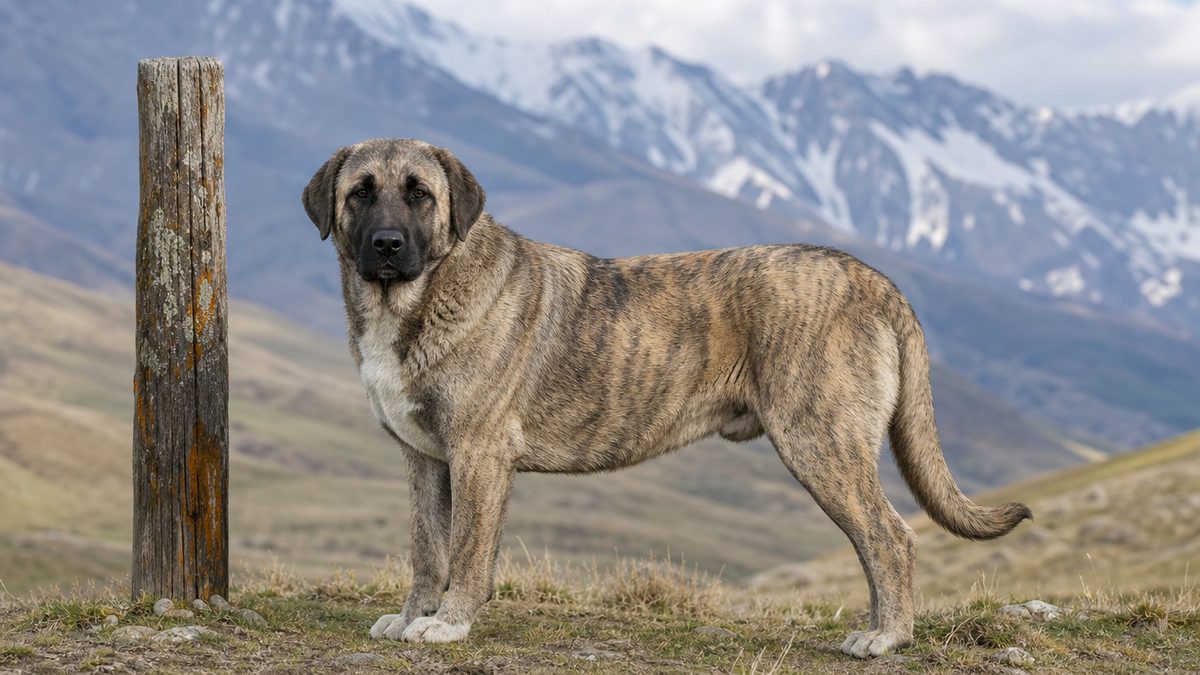
Quick answer
The Georgian Shepherd, or Kartuli Nagazi, is a Georgian livestock guardian dog recognised nationally by the Federation Cynologique de Georgie under a standard published on 1 June 2000, and not recognised by the FCI, which covers the whole Caucasus with one breed, the Caucasian Shepherd Dog, FCI 328. No Georgian Shepherd is offered for sale in India. Every Indian search for one returns Caucasian Shepherds instead.
This guide is general information for Indian pet owners and is not a diagnosis. Always consult a registered veterinarian near you before acting on anything you read here, and treat any sudden change in your dog's condition as urgent.
Georgian Shepherd trait ratings for Indian conditions
What the Georgian Shepherd is, and what is actually documented about it
The Georgian Shepherd is a large livestock guardian dog of the Georgian Caucasus, called Kartuli Nagazi in Georgian, standing a minimum 65 cm at the withers in males and 60 cm in females under the breed standard the Georgian federation published on 1 June 2000.
Georgia's own agricultural biodiversity catalogue, compiled by the Elkana farming association with GIZ, the Agricultural University of Georgia and the Ministry of Agriculture, is the most careful description of the breed in any language. It records the Nagazi as an ancient Georgian breed formed in the mountainous region of Georgia, closely related to the molossoid group by history, anatomy and genetics. It gives a body index of 100/108 in males and 100/110 in females, a minimum height at the withers of 65 cm and 60 cm respectively, and it treats a square outline as a fault.
The coat is the part most often described wrongly. The Georgian catalogue specifies a short coat with a well-developed undercoat and colour in any combination. So does the field manual written for Georgian sheep farmers by the Georgian Carnivore Conservation Project, which describes the coat as short and coarse, often slightly longer on the neck and withers, with a strongly developed undercoat, and notes wide variation in colouring. A coarse, close-lying double coat is the breed's own description of itself. The heavy bear-like fur that fills image searches belongs to the long-coated Caucasian Shepherd Dog.
Two types, and one of them is the older one
Georgian sources and English ones agree that two types exist. The short-haired Lion type is typically pure white or white with dark patches and is treated as the older, aboriginal variant, with pure white the rarest colour, and it was found predominantly in the north-east of Georgia. The long-haired Bear type usually carries a dark brown to black head with lighter brown over the rest of the body. Georgian political advocacy uses a narrower name again, the Kosa Kazbeguri Nagazi, meaning the beardless Kazbegi Nagazi, and treats that specific smooth mountain type as the animal needing protection.
Where the documented history stops and the folklore starts
The documented history of the Nagazi as a named, standardised breed begins in 2000, not in antiquity. That is not a slight, it is what the record supports. The Georgian catalogue dates the written standard to 1 June 2000 and cites three Georgian academic works behind its description, the most recent a 2013 conference paper by N. Mamukelashvili on Georgian aboriginal dog breeds. Everything before that is a landrace: real working dogs, kept and selected by Tushetian and other Georgian pastoralists for centuries, but with no register, no stud book and no standard.
First, that the breed is over 2,000 years old. The claim appears in a European Wilderness Society article on Georgian livestock guardians and carries no source. The FCI's own standard for the neighbouring Caucasian Shepherd Dog dates the first mention of large molossoid dogs in the region to the army of the Armenian Tsar Tigran the II in the first century BC, which is a reference to a type of dog, not to this breed. Second, that the Nagazi descends from the Tibetan Mastiff. English Wikipedia states it flatly with no citation attached to the sentence. Bonbeno found no genetic study supporting it.
The most reliable modern picture of the working population comes from a Georgian field survey rather than from a breed club. In March and April 2010 every one of the 69 livestock farms inside Vashlovani National Park, or within 2 km of its boundary, was surveyed, and every one kept at least one guardian dog, averaging eight and reaching a maximum of 27. Owners described their dogs as of mixed descent in 66 percent of cases, as Georgian shepherd dogs in 25 percent, as Caucasian in 10 percent and as a combination of pure and mixed in 4 percent. Those four figures sum to 105 rather than 100, so read them as approximate shares rather than as a clean partition.
Two further findings from that survey matter more than any measurement. Dogs were present at only 62 percent of the 105 predatory attacks for which detailed data existed, and where they were present they barked in 90 percent of cases and gave chase in 91 percent. And Georgian breeders and researchers quoted in the same report hold that working-farm dog quality has fallen, through crossbreeding and through the export of the best dogs during Soviet times. That is the honest state of a rare national breed: a real working population, thinly documented, with its own people worried about it.
Is the Georgian Shepherd a recognised breed? Checked register by register
The Georgian Shepherd holds national recognition in Georgia and holds no FCI standard number, and both halves of that sentence were read off the registers themselves on 31 August 2026 rather than taken from any article.
Recognition is the whole question for this breed, so Bonbeno opened four registers instead of four blog posts. Every check below carries a control, so that an absence means the breed is missing rather than that the query failed.
Georgia is a full FCI member, and it got there in three steps
The Federation Cynologique de Georgie is a full member of the FCI, listed at 39 Pekini Ave., Tbilisi. Its own history page dates the climb precisely: founded in 1991 when Georgian cynology gained official status, joined the FCI as a contract partner in 1997, became an associate member in 2001, and attained full membership in 2021. Recognition is not binary at the federation level either, and Georgia spent 24 years moving through three of its states.
The FCI does not carry the breed, on either register
Three letters of the definitive nomenclature and the provisional register were read in full, each with a control breed present to prove the page loaded.
| Register checked | Entries seen | Control present | Georgian Shepherd |
|---|---|---|---|
| Definitive nomenclature, letter G | 24 breeds | Golden Retriever 111, Gos d'Atura Catala 87 | Absent |
| Definitive nomenclature, letter K, for Kartuli | 14 breeds | Kangal Coban Kopegi 331, Komondor 53, Kuvasz 54 | Absent |
| Definitive nomenclature, letter N, for Nagazi | 13 breeds | Newfoundland 50, Norfolk Terrier 272 | Absent |
| Breeds recognised on a provisional basis | 20 breeds | Buldogue Campeiro 374 and Macedonian Shepherd Dog Karaman 378 | Absent |
The letter checks matter because the FCI files a breed under the name used in its country of origin, so a Georgian-named breed could sit under K for Kartuli or N for Nagazi rather than under G FCI breeds nomenclature. It does not sit under any of them. The provisional register is the route a new national breed takes, and its most recent four admissions were all dated 11 February 2026, so the list is live and maintained.
The Georgian federation's own breed directory is pure FCI
This is the finding that settles the practical question. The FCG's rebuilt website, launched in August 2026, publishes a breed directory of 364 breeds, 344 of them definitively recognised and 20 provisionally, filterable only by FCI group and by FCI recognition status. Its 20 provisional entries are FCI standards 351 and 360 to 378, which matches the FCI's own provisional register entry for entry. Not one of the 364 breeds is attributed to Georgia. The Caucasian Shepherd Dog appears there as FCI 328, Group 2, Russian Federation.
English Wikipedia's infobox links an FCG page as the Cynological Federation of Georgia standard for this breed. The live URL now redirects to the federation's new homepage. The Internet Archive capture of 16 May 2024 shows what was actually there: a page titled Georgian Mountain Dog containing a header image, nine clickable photographs and a Back link, with no height, no weight, no coat description and no date of adoption. A search of roughly 4,000 archived fcg.ge URLs returned no standard document for this breed at all, while the same query returned 495 judge pages and 95 document pages, so the search worked. The standard is real, but the citation everyone repeats points at a photo gallery.
So the honest formulation has three layers, and no page currently ranking states even one of them. Nationally, the breed has a written Georgian standard published on 1 June 2000 by the FCG. Regionally, there is no equivalent of the Nordic Kennel Union in the Caucasus, so no intermediate layer exists. Internationally, the breed is absent from both FCI registers, and Georgia's own FCI member federation publishes no national-breed category.
Georgian Shepherd vs Caucasian Shepherd Dog: what each register actually claims
The Georgian Shepherd and the Caucasian Shepherd Dog are the same animals to the FCI and two different breeds to Georgia, and the disagreement is not a matter of opinion but a matter of two documents that say different things.
Bonbeno already publishes a full Caucasian Shepherd Dog guide, and this section is the part that guide could not carry, because it is written from the Georgian side. Start with what the FCI document says on its own face.
FCI-Standard No. 328 gives ORIGIN: USSR and PATRONAGE: Russia. The FCI's live register page for the same breed prints Country of origin of the breed as RUSSIAN FEDERATION, accepted on a definitive basis on 23 August 1984, official valid standard published 13 October 2010. The breed is filed in the nomenclature under its Russian name, KAVKAZSKAIA OVTCHARKA, not under a Georgian one.
Bonbeno extracted the full text of FCI-Standard No. 328 and counted. The words Georgia and Georgian appear zero times across the whole 11,000-character document. Armenia appears once, in the reference to Tsar Tigran the II. Russia appears twice and USSR twice. The standard describes the breed's expansion as covering territories from the Caucasian Range and the steppe regions of Southern Russia. Whatever one thinks of the Georgian claim, the FCI's own text does not put Georgia in the breed's story at all.
The size figures are not the same, and that is the sharpest test
If the two were one breed, a Nagazi at its own minimum height would still be a legal Caucasian Shepherd Dog. It is not.
| Measure | FCI 328, Caucasian Shepherd Dog | Georgian standard, Kartuli Nagazi |
|---|---|---|
| Male height, minimum | 68 cm | 65 cm |
| Male height, desirable | 72 to 75 cm | not specified as a range |
| Female height, minimum | 64 cm | 60 cm |
| Female height, desirable | 67 to 70 cm | not specified as a range |
| Male weight | minimum 50 kg, no upper limit | not specified in the Georgian catalogue |
| Female weight | minimum 45 kg | not specified in the Georgian catalogue |
| Coat | short and long varieties, males of the long variety carry a mane | short, coarse, strong undercoat |
| Outline | body length exceeds height by 3 to 8 percent | square format counted a fault |
A male Nagazi at the Georgian minimum of 65 cm sits three centimetres below the FCI minimum of 68 cm, and a female at 60 cm sits four below the FCI minimum of 64 Agricultural Biodiversity of Georgia…. Under the FCI standard those dogs are undersized. Under the Georgian standard they are correct. That is a real, checkable divergence, and it is the reason Georgian handlers say their dogs cannot be judged internationally.
A third party that treats them as two breeds
The Georgian Carnivore Conservation Project's field manual, written for Georgian sheep farmers and not for any registry, lists the Georgian Shepherd Dog and the Caucasian Ovcharka as separate entries with separate descriptions. It gives the Nagazi as males not less than 65 cm and females not less than 60 cm, and gives the Caucasian Ovcharka as males 65 to 75 cm weighing over 55 kg, with the largest reaching 70 to 90 kg. The same survey counted its farm dogs in three buckets, Georgian, Caucasian and mixed, which only makes sense if the herders themselves tell them apart.
The Georgian grievance, stated by a Georgian
In August 2023 Ivane Norakidze, general secretary of the Georgian party Citizens, put the position in one sentence: the Caucasian Nagazi was registered by the Russians under that name, Russia is written in as its place of origin, and so Georgia has lost the ownership right over the breed. He added that since 2003 the Georgian federation is the only body that recognises the Kosa Kazbeguri Nagazi, that the dogs cannot enter international tournaments or shows, and that when they do reach an exposition they land in the unrecognised-breeds category.
Note the date conflict rather than smoothing it. The Georgian biodiversity catalogue dates the FCG standard for the Georgian Mountain Dog to 1 June 2000; Norakidze dates recognition of the Kosa Kazbeguri Nagazi to 2003. Both may be right about different documents or different types. Bonbeno publishes both dates and does not average them.
The American Kennel Club sits on the FCI side of the line. Its Caucasian Shepherd Dog page records the breed in the Foundation Stock Service since 1996 at 23 to 30 inches, and the words Georgian and Nagazi appear on it zero times.
Indian law on this breed: cropped ears, the 2024 circular, and the import route
Indian law does not ban the Georgian Shepherd, does prohibit the ear cropping its regional relatives traditionally carry, and effectively closes any lawful route by which one could be brought here to breed or sell.
Three separate instruments touch this breed, and Indian pages routinely blur them. Read each for what it actually says.
Ear cropping is prohibited, and the tradition is in the standard
The FCI standard for the Caucasian Shepherd Dog records that ears are traditionally cropped in country of origin, and adds that natural ears are of equal value. English Wikipedia states the tradition more baldly for the Nagazi: the ears are traditionally cropped. In India that procedure is forbidden outright.
"There shall be no tail docking, ear cropping de-barking, de-clawing, branding, dyeing, injecting substances to enhance visual appeal, performing a surgery or procedure to camouflage or hide any defect or infirmity or any other kind of mutilation of any body part of the pup and any change of appearance by artificial means is strictly forbidden." Bonbeno extracted this from the 14-page gazette text of G.S.R. 496(E) published by the Animal Welfare Board of India. It is a Second Schedule paragraph, not a Rule, so cite it as Second Schedule Part II para 6(8) and never as Rule 6(8).
The neighbouring paragraph matters for anyone tempted to breed toward the older Lion type. Second Schedule Part II para 6(9) reads, in full, that breeding to create new breeds of dogs or unusual looks shall be strictly prohibited.
What the Rules require you to have tested
Second Schedule Part III para 8(10) requires that breeding dogs have been tested for genetic defects, including hip dysplasia, progressive retinal atrophy, night blindness, hypothyroidism, entropion, ectropion, overshot, undershot jaw when incisors do not touch or mesh, wry mouth, two or more missing teeth, and unilateral or full cryptorchid males. The word including makes the list illustrative rather than closed. Two absences are worth stating because Indian pages invent them: across all 14 pages of the gazette, BAER appears zero times and deaf appears zero times, and patella appears zero times. There is no Indian patella-testing requirement and no Indian hearing-test requirement.
Rule 8(1)(a) of the same Rules, a genuine Rule and not a Schedule paragraph, requires every breeder to ensure that pups less than eight weeks in age are not sold.
The 2024 circular named the Caucasian Shepherd, and no court left it standing
On 12 March 2024 the Union Ministry of Fisheries, Animal Husbandry and Dairying asked states to stop issuing licences for the sale, breeding and keeping of dog breeds described as dangerous to human life, and the list printed by The Hindu names the Caucasian Shepherd Dog explicitly. The Karnataka High Court quashed that circular on 10 April 2024 and the Delhi High Court set it aside on 16 April 2024 The Indian Express. No Indian law in force today bans owning, breeding or selling any of these breeds. Karnataka expressly left the door open to a properly consulted Rules amendment, so treat a settled all-clear as wrong too.
Bonbeno has not seen the circular itself and the reported count of breeds on it varies between 19 and 25 across sources, so this page does not assert a number. The Georgian Shepherd is not on any reported version of the list. Since the FCI recognises no such breed, an Indian licensing officer looking at a large Caucasus guardian would have no register entry to distinguish one from the other.
Import: legal for a pet, closed for trade
DGFT Trade Notice 22/2022-23 classifies mammals under ITC(HS) 01061900 as Restricted, and Policy Condition (7) allows import of dogs only for a pet dog with a valid pet book and records in the importer's name, for R and D organisations with a CPCSEA recommendation, or for internal security by the Defence and Police Force. Policy Condition (8) states that import of commercial dogs for breeding or any other commercial activity is not permitted, and paragraph 6 states that applications for trading or breeding purposes shall be duly rejected. Import of pet animals is allowed only through the airports and seaports of Delhi, Mumbai, Chennai, Hyderabad, Bengaluru and Kolkata and, since October 2024, Kochi airport Department of Animal Husbandry…. The personal pet route runs separately, under the Livestock Importation Act 1898 and the quarantine service's baggage procedure. The full route is set out in how to import a dog to India.
Georgian Shepherd price in India: there isn't one, and here is the proof
No Georgian Shepherd is offered for sale anywhere in India, so this breed has no Indian price, and every rupee figure a search returns for it belongs to a different dog.
That is a strong claim, so it was tested the way an absence has to be tested, with a control query that returns results in the same session. Three separate instruments were used on 31 August 2026 and all three gave the same answer.
| Test | Georgian Shepherd | Control: Caucasian Shepherd Dog |
|---|---|---|
| Web search, India-located, ten results | Zero results about the breed. Positions filled by Caucasian Shepherd listings, a German Shepherd price blog and YouTube | Ten results, including two Indian marketplaces with rupee price tables |
| Marketplace URL, same site, same pattern | mrnmrspet.com/dogs/georgian-shepherd-puppies-for-sale redirects to a 404 page | mrnmrspet.com/dogs/caucasian-shepherd-puppies-for-sale serves a full price table with eight city rows |
| Google India autocomplete, prefix 'is georgian shepherd' | Ten completions, none naming the Georgian Shepherd | Nine of the same ten completions name the Caucasian Shepherd |
The marketplace test is the decisive one. Mr n Mrs Pet auto-generates a breed page for a long tail of breeds it does not stock, so a 404 there is not an oversight, it is the site declining to pretend. The autocomplete test is the one that will affect you personally: type the breed name into Google in India and the engine itself steers you to a different dog before you have finished the query.
What you would actually be offered, and why those numbers are not trustworthy either
Someone in India selling you a Georgian Shepherd is selling you a Caucasian Shepherd Dog, so the published Caucasian numbers are the relevant ones, and they disagree with each other by a factor of 750.
| Source | Published range | What it is |
|---|---|---|
| Mr n Mrs Pet, basic quality | Rs 3,50,000 to Rs 6,50,000 | Puppy marketplace, identical figures in all eight cities listed |
| Mr n Mrs Pet, KCI registered | Rs 6,50,000 to Rs 10,00,000 | Same page, same eight cities |
| Mr n Mrs Pet, champion bloodline | Rs 10,00,000 to Rs 15,00,000 | Same page, same eight cities |
| PetzLover India | Rs 2,000 to Rs 80,000 | Classifieds, seller-entered, dogs 2 months to 5 years |
| Working dog trainers quoted by News18 | Rs 50,000 to Rs 1,00,000 | Named trainers, for a dog of about eighteen months |
Apply the currency tests before believing any of it. None of Mr n Mrs Pet's four boundary figures divides cleanly at 84.38, giving 4,148, 7,703, 11,851 and 17,777 dollars, and none divides at 74 either. All four appear to divide at 80, but that proves nothing, because every figure ending in four zeros divides cleanly at 80 by construction. Look at the quotients instead: 4,375, 8,125, 12,500 and 18,750 US dollars. No seller anywhere prints those prices. The figures are rupee-native and arbitrary, not a converted foreign list, and the fact that all eight city rows carry the identical range is a template rather than a market.
The most credible number on the whole subject is also the smallest. Working dog trainers told News18 in 2023 that a one-and-a-half-year-old Caucasian Shepherd would cost Rs 50,000 to Rs 1,00,000, which is between one seventh and one thirtieth of the marketplace's cheapest band. PetzLover's classified floor of Rs 2,000 is lower still and is a seller-entered figure with no verification at all.
Why no lawful supply chain can form for this breed
Two facts close the loop. There is no FCI standard number for the Georgian Shepherd, so the Kennel Club of India, which is a full member of the FCI represented from Chennai, has no nomenclature entry against which to issue an Indian pedigree. And DGFT Trade Notice 22/2022-23 states that applications to import dogs for trading or breeding purposes shall be duly rejected. Between them, an Indian breeder cannot lawfully import foundation stock and could not register the offspring if they did.
Ask for the pedigree and read which breed name and which register are printed on it. A genuine Georgian dog carries an FCG document naming the Kartuli Nagazi, which converts into no Indian registration. Anything printed as KCI-registered is registered as something else, most likely a Caucasian Shepherd Dog. Bonbeno does not broker sales and does not recommend breeders. If the answer to the pedigree question is vague, that is the answer.
What a Caucasus guardian costs to keep in India each month
The monthly cost of ownership for a dog of this size is higher in India than for almost any other companion animal, and the two biggest lines are food and the electricity to keep it cool, not the purchase price.
Bonbeno publishes no rupee monthly total for this breed, because no Indian owner cohort exists to survey and any figure would be invented. What can be given honestly is the physical requirement, from a feeding table written for these dogs in their own country, and the Indian conditions that change it.
Energy requirement, from the Georgian working-dog manual
The Georgian Carnivore Conservation Project's manual for Georgian sheep farmers publishes a daily calorie table for growing guardian pups by bodyweight. It is the only feeding guidance written specifically for this type of dog by people who work with them.
| Bodyweight | Weaning to 3 months | 3 to 6 months |
|---|---|---|
| 5 kg | 915 kcal | 732 kcal |
| 11 kg | 1,670 kcal | 1,331 kcal |
| 15 kg | 2,179 kcal | 1,743 kcal |
| 23 kg | 3,062 kcal | 2,450 kcal |
| 33 kg | not given | 3,250 kcal |
| 37 kg | not given | 3,551 kcal |
Read the manual's own caveat with the table. It says larger breeds should be fed less than the table suggests, to hold a slower growth rate so that muscles and tendons develop at the same pace as bone. Overfeeding a giant puppy toward a bigger adult is the single most common expensive mistake, and it is expensive twice, first in food and then in orthopaedic treatment.
The lines an Indian owner pays that a Georgian shepherd does not
- Cooling. A room-level fan is not cooling for a 50 kg double-coated dog in a Chennai May. Air conditioning through the hot months is a real, recurring electricity cost and it is not optional for this coat.
- Tick and flea control, year round. A survey of canine tick-borne disease across India found Hepatozoon canis, Ehrlichia canis and Babesia species circulating widely in the Indian dog population, which makes continuous ectoparasite control a running cost rather than a seasonal one.
- Food volume at giant scale. A dog carrying 50 kg or more eats several times what a Labrador eats, and Indian large-breed diets are priced per kilogram, so the bill scales linearly with the dog.
- Deworming on the Georgian schedule. The Georgian manual recommends deworming pups at 2, 4, 6 and 8 weeks and then monthly to six months, with all adult dogs treated for roundworms and tapeworms every 3 to 6 months.
- Space. This is a cost even when it is not a bill. A guardian bred to patrol a mountain pasture in a flat is a welfare problem, not a saving.
The cost nobody prices in
The largest financial risk with this breed is not a monthly line at all, it is longevity. McMillan and colleagues, studying 584,734 dogs across 155 breeds in the UK, found the Caucasian Shepherd Dog to be the breed most at risk of early death in the entire study, with a median lifespan of 5.4 years and a hazard ratio of 2.4 (1.6 to 3.7). Whatever an owner spends on a puppy, the study's own finding is that a Caucasus guardian is statistically likely to be a short assignment.
That figure describes the Caucasian Shepherd Dog and not the Georgian Shepherd, which appears in no longevity dataset anywhere. Bonbeno will not silently transfer it. But it is the closest measured population, it comes from the register that treats the two as one breed, and an Indian buyer being shown a Caucasian Shepherd under a Georgian name is buying exactly the dog McMillan measured.
Heat tolerance: a homeland at 2.7 degrees against an Indian summer
The Georgian Shepherd rates 1 of 5 for heat tolerance in India, because its homeland averages 2.7 degrees Celsius across the year and its own national description says plainly that the breed adapts well to a cold climate.
Bonbeno queried NASA POWER by explicit latitude and longitude rather than by place name, because a climate site asked for one city will silently serve another. The Nagazi's home valley of Tusheti was queried at 42.3667 N, 45.6333 E, and each Indian city at its own coordinates. Figures are 2001 to 2020 monthly means.
| Location | Annual mean air temp | Annual mean RH | Peak monthly wet-bulb | Month of peak |
|---|---|---|---|---|
| Omalo, Tusheti, Georgia (42.37 N, 45.63 E) | 2.7 C | 77.6 % | 11.0 C | July |
| Leh (34.15 N, 77.58 E) | -2.8 C | 52.2 % | 5.0 C | July |
| Bengaluru (12.97 N, 77.59 E) | 23.7 C | 67.9 % | 21.9 C | May |
| Pune (18.52 N, 73.86 E) | 23.9 C | 66.8 % | 23.0 C | June |
| Mumbai (19.08 N, 72.88 E) | 26.8 C | 67.4 % | 25.8 C | June |
| Delhi (28.61 N, 77.21 E) | 25.6 C | 45.6 % | 26.5 C | July |
| Chennai (13.08 N, 80.27 E) | 27.9 C | 72.4 % | 26.1 C | May |
| Kolkata (22.57 N, 88.36 E) | 25.8 C | 73.9 % | 27.1 C | June |
Read the wet-bulb column, not the air-temperature column. Wet-bulb temperature combines heat and humidity into the single number that governs whether an animal can shed heat by evaporation, and a panting dog is an evaporative cooler. Tusheti peaks at 11.0 C wet-bulb in July. Kolkata peaks at 27.1 C, which is 16.1 degrees higher. Chennai peaks at 26.1 C, 15.1 degrees higher. Delhi, despite the lowest annual humidity in the table at 45.6 percent, still reaches 26.5 C in July once the monsoon arrives.
NASA POWER serves a gridded reanalysis at roughly half a degree, so a cell containing high mountains and low valleys returns the average of both. That is why the Shimla cell reads warmer than the hill station itself, at 21.1 C annual mean and a July wet-bulb of 23.3 C, and it is why the Tusheti cell may read slightly warmer than Omalo village at 1,900 m. The same smoothing applies to both ends of the comparison, so the 16-degree wet-bulb gap between Tusheti and Kolkata is if anything understated. Leh's cell is the reliable Indian mountain figure, because the whole cell is high plateau.
The Georgian description says the quiet part out loud
Georgia's own agricultural biodiversity entry for the Nagazi says the breed is undemanding as to keeping conditions and adapts well to a cold climate. A cold-adapted guardian is exactly what that sentence describes. It does not claim heat tolerance anywhere. The FCI standard for the regional breed makes the same point from the other direction, listing a dense and waterproof coat among the qualities cultivated by selection, and saying those qualities let the dogs work in all kinds of climatic conditions including the most severe. Severe, in a Caucasus standard, means cold.
What the heat-illness evidence supports, and what it does not
Hall, Carter and O'Neill studied 905,543 UK dogs under primary veterinary care in 2016 and found 395 confirmed heat-related illness events, with a case fatality rate of 14.18 percent, 95 percent CI 11.08 to 17.96. Two of their risk factors transfer to this breed on physiology rather than on breed identity. Dogs whose bodyweight was at or above the breed and sex mean had 1.42 times the odds of heat-related illness, 95 percent CI 1.12 to 1.80, and dogs over 50 kg had 3.42 times the odds, 95 percent CI 1.54 to 7.57, against dogs under 10 kg. Those figures come from Hall 2020 in *Scientific Reports*, 10:9128.
The same three authors published a second 2020 paper on the same 905,543-dog cohort, in *Animals*, 10(8):1324, using a different case definition. It counts 1,259 events from 1,222 dogs, and its odds ratios for exertional heat-related illness are 1.30 (1.09 to 1.55) for bodyweight at or above the breed mean and 2.21 (1.02 to 4.79) for dogs over 50 kg. Both sets are correct and neither corrects the other. The figures used above are from the *Scientific Reports* paper, and any page quoting 3.42 alongside a 1,259 event count has mixed the two.
Neither the Georgian Shepherd nor the Caucasian Shepherd Dog appears anywhere in either paper. The *Scientific Reports* study required at least five heat-related illness cases and at least 5,000 dogs for a breed to be modelled individually, and this breed clears neither bar in the UK. So the correct claim is narrow: a 50 kg-plus dog in India carries the bodyweight risk the paper measured, and no breed-specific odds ratio exists for this dog at all.
The *Animals* paper adds the finding that matters most for an Indian owner's daily routine. Of the 879 events that had a trigger recorded, 652, or 74.2 percent, were exertional rather than environmental or vehicular. Dogs do not mostly overheat locked in cars. They overheat being walked. In India that means the walk itself is the hazard, and the fix is the clock: before sunrise and after full dark, never between.
Temperament: an independent guardian that decides for itself
The Georgian Shepherd is an independent, protective livestock guardian that makes its own decisions about threat, which makes it an excellent working dog and a poor fit for almost every Indian household.
Georgia's own description is unusually candid, and it is the one worth reading before any breeder's pitch. The national catalogue gives the breed a strong, balanced nervous type with a great protective instinct, and lists it as alert, loyal, attentive, courageous, calm, independent in behaviour but obedient, with a characteristic wariness and distrust of strangers. The English-language consensus is the same: distrust of strangers, courage, a highly developed protective instinct, calmness, and confidence in its own strength.
Note what is not in that list. Nothing about biddability, nothing about wanting to please, nothing about tolerance of visitors. A guardian breed's job description is to assess a situation alone, at night, out of sight of any human, and act. Six centuries of selection for that produce a dog that treats your instruction as one input among several.
The field data on what these dogs actually do
The Georgian survey of 69 farms gives the only behavioural numbers that exist for the working population. Owners rated their dogs good in 61 percent of cases and partially good in 22 percent. A good dog was defined by owners as attentive to livestock in 51 percent of answers, aggressive to predators in 12 percent and not afraid of wolves in 7 percent. Where dogs were present at an attack, 90 percent barked and 91 percent gave chase, and in two cases dogs were said to have killed a marauding wolf.
The complaints are as informative as the praise. Of the 21 owners who rated their dogs only partly good or could not rate them, 38 percent said the dogs were not attentive enough, 33 percent that they were insufficiently protective and 19 percent that they were attentive but afraid of predators. Two thirds of all attacks happened in daylight when the flock was out, against only 15 percent under cover of darkness, which the report attributes partly to insufficient daytime attentiveness. Even in Georgia, on Georgian farms, these dogs are not uniformly reliable.
Who this breed suits, and who it does not
- Suits a farm, orchard or estate with real perimeter, secure fencing, cool shelter and an owner who has handled a dominant guardian breed before.
- Suits a household where every adult agrees on the rules, because a guardian tests inconsistency the way water tests a roof.
- Does not suit an apartment, at any size, in any Indian city.
- Does not suit a first-time owner, a household with frequent visitors, or a home where domestic staff, delivery riders and neighbours come and go daily.
- Does not suit anyone who wants a dog that is friendly with strangers. This breed is aloof by design and no amount of socialisation converts that into sociability.
On children the sources are warmer than you might expect and should still be read carefully. The Georgian material describes the dog as generally gentle with children, able to distinguish children from adults and to control its strength in play. That is a description of the breed's intent, not a safety guarantee, and it does not extend to visiting children the dog has not been raised with. A 50 kg dog that misjudges a game causes an injury without any aggression at all.
With other dogs the picture is harder. Georgian sources record that the breed will start fights over leadership with dogs of any breed, and that it can attack animals it does not consider part of its own group, including dogs living in close proximity. It is reported to get along with livestock, cats and birds it was raised alongside, which is exactly what a livestock guardian is selected for. In an Indian city, where free-roaming community dogs are present on almost every street, that combination is the single biggest practical liability the breed carries.
Training a guardian breed: what works, and what this dog refuses
Train a Georgian Shepherd by socialising it deliberately and early rather than by drilling obedience, because a livestock guardian is selected to act on its own judgement and will not be argued out of that by repetition.
Start with what the Georgian sources say the dog is. The national description gives a breed with a strong protective instinct, independent behaviour, and a tendency to dominate, and states that training requires perseverance and patience, with learning and socialisation beginning at an early age Wikipedia, Georgian Shepherd. That is a warning, not a marketing line.
How Georgian working dogs are actually trained, which is barely at all
The 69-farm Georgian survey found no special training regime in most cases. Owners said their dogs learned what to do by themselves in 40 percent of answers, from being brought up with the flock in 31 percent and from older dogs in 25 percent. Only two of 69 respondents named any deliberate action, and both were husbandry rather than obedience: encouraging the dog to accompany the flock, and feeding it near livestock.
That is the traditional method and it is also the reason the same survey found a third of dogs absent when predators attacked. An Indian owner cannot copy it, because there is no flock to raise the dog with, and should not want to, because the traditional method's own failure rate is visible in the data.
The realistic Indian training plan
- Weeks 8 to 16, the socialisation window. Introduce people, surfaces, vehicles, other animals and household noise at a rate the puppy stays relaxed at. This window does not reopen. A guardian that met twenty strangers calmly before sixteen weeks is a different adult from one that met three.
- Months 4 to 9, boundary work. Teach the perimeter you want the dog to consider its own, and make it a physical fence rather than a learned line. A guardian will defend what it believes it owns, so define that deliberately instead of letting the dog decide.
- Months 6 to 18, controlled visitor protocol. Every delivery, every guest, every domestic worker follows the same script, every time. Consistency is not a nicety with this breed, it is the whole method.
- Throughout, recall on a long line only. Off-lead recall in an Indian public space with community dogs present is not a realistic goal for this breed and treating it as one is how incidents happen.
- Never, at any age, use confrontation. A dog selected to face a wolf will not be intimidated, and the attempt teaches it that conflict with you is normal.
The legal boundary on training and appearance
One Indian rule bites here directly. Georgian and FCI sources both record that ears in the region are traditionally cropped Wikipedia, Georgian Shepherd, and a breeder may present a cropped dog as correct. It is not correct in India. Second Schedule Part II para 6(8) of the Dog Breeding and Marketing Rules 2017 forbids ear cropping, de-barking and any change of appearance by artificial means outright. De-barking in particular is worth naming, because a guardian breed barks for a living and an owner who cannot live with that has bought the wrong dog rather than a dog needing surgery.
The FCI standard itself removes the excuse. It records cropping only as a country-of-origin tradition and states that natural ears are of equal value. There is no showing advantage, no working advantage, and no lawful route to it in India.
Exercise: less than you expect, at hours that are not negotiable
A Georgian Shepherd needs patrol space and low-intensity movement rather than hard exercise, and in India the timing of that movement matters more than its quantity.
Livestock guardians are not endurance athletes in the way a herding breed is. They walk with a flock, lie down, watch, and conserve energy for the moment a threat arrives. The European Wilderness Society's summary of the Georgian dog puts it plainly: they need space to move and play but are not overly energetic. The Georgian catalogue notes natural endurance and increased efficiency as a farm helper, with no fear of low temperatures or prolonged exertion. Low temperatures is the operative phrase.
Why the walk is the hazard in India
The heat-illness evidence is unambiguous about where the risk sits. In the *Animals* paper by Hall, Carter and O'Neill, 652 of the 879 heat-related illness events with a recorded trigger, or 74.2 percent, were exertional. Environmental heat accounted for 113 and confinement in a vehicle for 46. The dog that overheats is overwhelmingly the dog that was being walked.
Combine that with the *Scientific Reports* finding that dogs over 50 kg carry 3.42 times the odds of heat-related illness against dogs under 10 kg, 95 percent CI 1.54 to 7.57, and the case fatality rate of 14.18 percent, and the Indian rule writes itself.
| City | Peak month wet-bulb | Practical window, hot season |
|---|---|---|
| Kolkata | 27.1 C in June | Before 05:30 and after 21:00, short and flat |
| Delhi | 26.5 C in July | Before 05:30 and after 21:00; dry May heat is safer than humid July |
| Chennai | 26.1 C in May | Before 05:30 and after 21:00, year round |
| Mumbai | 25.8 C in June | Before 06:00 and after 21:00 |
| Pune | 23.0 C in June | Before 06:30 and after 20:00 |
| Bengaluru | 21.9 C in May | Before 06:30 and after 20:00, the least hostile major city |
| Leh | 5.0 C in July | No practical restriction; this is the only Indian climate the breed is built for |
Heatstroke is a medical emergency and outcomes depend on how fast body temperature comes down. Watch for heavy or frantic panting, bright red gums, thick sticky saliva, staggering, vomiting or collapse. Move the dog into shade, pour or hose cool, not iced, water over the whole body including the belly and armpits, get air moving over the wet coat, and drive to a veterinarian while cooling continues. Do not wait to see whether it settles. In this breed you are working against a 50 kg body with a double coat and a very small evaporative surface.
What the dog actually needs each day
- Two low-intensity walks, 30 to 45 minutes each, at the hours above, on a flat route.
- A securely fenced patrol area available all day, with deep shade and free water. Patrolling is the exercise this breed was built for.
- Mental work in short blocks, since a guardian bores slowly and tires of drills fast.
- No running, cycling or fetch sessions in Indian heat, ever. Those are the exertional events the data counts.
- No forced exercise before 18 months, because a giant-breed skeleton is still closing and the OFA hip figures for the regional breed are among the worst published anywhere.
Grooming a coarse double coat through an Indian monsoon
Groom a Georgian Shepherd by brushing the undercoat out completely twice a week and drying the coat to the skin after every wetting, because the short outer coat hides an undercoat that holds water for hours in Indian humidity.
Get the coat type right first, because most Indian advice for this breed is written for the wrong dog. The Georgian catalogue specifies a short coat with a well-developed undercoat, and the Georgian working-dog manual describes it as short and coarse, often slightly longer on the neck and withers, with a strongly developed undercoat. That is a working double coat, not the long bear coat of the long-haired Caucasian Shepherd variety, which the FCI standard describes as giving males a distinctly pronounced mane.
The routine that actually works here
- Twice-weekly undercoat rake, more during the two annual moults. A short outer coat makes it easy to believe the dog does not need this. It does, and packed undercoat is what converts humidity into hot spots.
- Dry to the skin after every bath, swim or downpour. Towel first, then forced air, then check the skin under the coat with your fingers before you stop. A double coat that feels dry on the surface is often still wet underneath.
- Dry the ear canals every time, with a vet-approved drying solution rather than cotton buds. Pendant ears plus trapped moisture plus 30 degrees is the standard recipe for otitis externa.
- Check skin folds, armpits and groin weekly through the monsoon for the early red patch that becomes a hot spot within a day.
- Tick check daily, not weekly, and by hand rather than by eye. A dense undercoat hides attached ticks completely.
The Georgian advice that does not transfer, and one that surprisingly does
Care guidance written for a Caucasus climate assumes cold and low ectoparasite pressure. The Georgian working-dog manual, however, includes one line that is unusually well suited to India: during hot weather, it says, you may need to shear or brush the dog's coat. Shearing a double coat is contentious, and the safe reading is the manual's own ordering. Brushing out the undercoat completely gives most of the cooling benefit, because it is trapped dead undercoat rather than the guard coat that blocks airflow. Clipping to the skin removes the guard hair that shields against sun and can leave the coat regrowing badly.
Ear disease is the Indian condition to plan for
Two Indian datasets bracket the risk and they do not fully agree, which is worth showing rather than smoothing. A study of 281 dogs in and around Durg district, Chhattisgarh, found 51 cases of otitis externa, and the seasonal split by share of cases was 21 in summer, 41.18 percent, 17 in the rainy season, 33.33 percent, and 13 in winter, 25.49 percent. The three counts sum to 51 exactly and each percentage reproduces, so the arithmetic holds. Other Indian series report the monsoon as the peak. Bonbeno publishes both positions: the peak season is contested, the elevated risk from roughly March to October is not.
The Durg paper labels its column Prevalence percent, but 21 of 51 is 41.18 percent, so the figures are the share of the 51 cases falling in each season rather than the prevalence within each season's population. Read them as a distribution of cases across the year. The same applies to the paper's age table, where 23 of 51 cases, 45.10 percent, were in dogs aged five years and above.
Parasite pressure is the other running load and it does not pause. A national survey of canine tick-borne disease in India found Hepatozoon canis, Ehrlichia canis and Babesia species circulating in the Indian dog population, which is why a coat this dense needs a year-round tick programme rather than a seasonal one. The Georgian manual's own advice is to check for and control external parasites and to examine the dog's ears, eyes, mouth and feet regularly, which is correct everywhere and merely more urgent here.
Health, lifespan and what the registers know about this breed
No study of health issues, no screening dataset and no lifespan figure exists for the Georgian Shepherd anywhere, and the closest measured population, the Caucasian Shepherd Dog, has among the worst published hip results and the shortest median lifespan of any breed in a 155-breed UK study.
That absence was proved rather than assumed, with controls run in the same session so that a zero means the breed is missing rather than that the tool failed.
| Source searched | Result for this breed | Control run in the same session |
|---|---|---|
| PubMed, 'Georgian Shepherd dog' | 0 records, and PubMed broadened the query to georgian OR georgians AND shepherd OR shepherds AND dog | Labrador Retriever hip dysplasia, 126 records; livestock guardian dog, 80 |
| PubMed, 'Georgian Mountain Dog' | 0 records, also broadened by the engine | Caucasian Shepherd Dog, 9 records |
| PubMed, 'Kartuli Nagazi' | 2 records, both by a soft-matter physicist named M. Y. Nagazi, on mucus gels and on polymorphic materials. Zero about a dog | Fila Brasileiro, 7 records |
| OFA published statistics tables, full dump | GEORGIAN appears 0 times across 2.2 million characters, case-insensitively | LABRADOR 109 hits, TIBETAN MASTIFF 24 |
The PubMed result is worth pausing on, because a naive reading of the count would invert it. Two records for 'Kartuli Nagazi' looks like literature until you open them: PMID 34728565 is a 2021 PNAS paper on microscopic dynamics in mucus gels and PMID 30027189 is a 2018 Soft Matter paper on phase transitions in polymorphic materials, and Nagazi is a co-author's surname. The honest number is zero.
The hip figure the Georgian claim cannot escape
The Orthopedic Foundation for Animals publishes a hip dysplasia table across every breed with enough evaluations to appear. Bonbeno read the header row and matched it to the row rather than to a column position.
| Column, as OFA labels it | Value |
|---|---|
| Rank among all breeds | 10 |
| Evaluations | 118 |
| Normal % | 46.6 |
| Excellent % | 4.2 |
| Good % | 28.8 |
| Fair % | 13.6 |
| Dysplastic % | 49.2 |
| Mild % | 23.7 |
| Moderate % | 20.3 |
| Severe % | 5.1 |
Check the arithmetic before trusting it: 4.2 plus 28.8 plus 13.6 is 46.6, and 23.7 plus 20.3 plus 5.1 is 49.1 against a printed 49.2, which is rounding. Rank 10 means only nine breeds in OFA's whole published set return worse hips, and the nine above it are the Olde English Bulldogge, Pug, Bulldog, Brussels Griffon, Dogue de Bordeaux, Alapaha Bulldog, Tosa, St. Bernard and Neapolitan Mastiff. The sample is only 118 dogs, so publish the sample size beside the percentage and expect the figure to move.
It is the Caucasian Shepherd's, and Bonbeno will not transfer it silently. But the two facts that make it relevant are both established on this page: Georgia's own FCI member federation files the regional breed as FCI 328 with no Georgian entry beside it, and an Indian buyer offered a Georgian Shepherd is being offered a Caucasian Shepherd Dog. Screen hips before breeding regardless, which Indian law independently requires under Second Schedule Part III para 8(10).
Life expectancy, and the worst number in this guide
McMillan and colleagues studied 584,734 UK dogs, including 284,734 deceased, across 155 breeds. The Caucasian Shepherd Dog came out as the breed most at risk of early death in the entire dataset, with a median lifespan of 5.4 years and a hazard ratio of 2.4, 95 percent CI 1.6 to 3.7. The paper also places it in the lowest-lifespan clade of the canine phylogeny it maps. For comparison inside the same study, the next names on that list are the Presa Canario at 7.7 years and the Cane Corso at 8.1.
Bloat, and what the evidence does and does not say
Gastric dilatation-volvulus is the acute killer of deep-chested giant breeds. Glickman and colleagues followed 1,637 dogs of eleven large and giant breeds and recorded a cumulative GDV incidence of 6 percent, with risk raised by increasing age, a first-degree relative with a GDV history, faster eating speed and a raised feeding bowl, which was attributed roughly 20 percent of cases in large breeds and 52 percent in giant breeds. The eleven breeds studied were Akita, Bloodhound, Collie, Great Dane, Irish Setter, Irish Wolfhound, Newfoundland, Rottweiler, Saint Bernard, Standard Poodle and Weimaraner, and no Caucasus breed is among them. So take the husbandry finding, which is not breed-specific, and do not import an incidence figure for a breed nobody measured.
Feeding: slow growth, split meals, and the raw-meat rule from Georgia
Feed a Georgian Shepherd puppy deliberately below its calculated requirement to slow growth, split every adult meal in two, and never feed the raw sheep carcass its own homeland's manual warns against.
The Georgian working-dog manual gives the only feeding protocol written for this type of dog by people who keep them, and it is stricter than most Indian breeder advice. It sets three to four meals a day until six months of age on a diet particularly rich in protein, then twice daily from six months, then an adult diet with less protein and fewer calories and one to two feeds from one year. Working dogs, it adds, need a highly digestible diet with increased fat to hold stamina and body condition.
The instruction most Indian owners get backwards
Beside its own calorie table the manual states that larger breeds should be fed less than the table indicates, to keep growth slow enough that muscles and tendons develop at the same rate as bone. That is the opposite of the instinct to push a giant puppy toward size. It is also the cheapest orthopaedic intervention available, and it matters more in this group than in most, given that the closest measured population returns 49.2 percent dysplastic hips across 118 OFA evaluations.
The manual states plainly that raw meat, such as sheep carcasses including organs, should not be fed, because of the high risk of the dog picking up internal parasites or infectious disease, though it notes that eating afterbirth at lambing is not a problem. Indian raw-feeding advice for large guardians frequently recommends exactly what a Georgian livestock manual prohibits. In an Indian climate, with higher ambient parasite pressure and a shorter safe holding time for meat, the instruction transfers with more force, not less.
Body condition beats bodyweight, and the reason is in the heat data
Score the dog by hand every fortnight. You should feel the ribs under a thin fat cover without pressing, see a waist from above and a tuck from the side. That habit is worth more than any target weight, and the heat evidence explains why: dogs whose bodyweight was at or above their own breed and sex mean carried 1.42 times the odds of heat-related illness, 95 percent CI 1.12 to 1.80, in Hall 2020 in *Scientific Reports*. Being heavy for your own breed is itself a heat risk factor, before size is even considered.
Practical feeding for an Indian household
- Split every adult meal into two, morning and night, and never one large bowl. Faster eating speed was a significant GDV risk factor in Glickman's cohort of 1,637 large and giant dogs.
- Keep the bowl on the floor. A raised feeding bowl was attributed roughly 52 percent of GDV cases among giant breeds in that study. It is the single easiest thing to get wrong on the advice of a pet shop.
- Rest an hour either side of a meal, with no walk, no play and no car journey.
- Feed the cooler end of the day in summer. Digestion generates heat the dog then has to shed.
- Water in more than one place, refreshed twice daily. The manual's first health-care line is that pups dehydrate quickly and need fresh water available at all times.
On availability, large and giant breed diets are stocked across Indian metros and there is no supply problem for a dog of this size. The problem is the reverse: an owner buying a giant-breed growth formula and then feeding to the bag's chart, which assumes a dog you are trying to grow rather than a guardian you are trying to grow slowly.
The first year, month by month
Plan a Georgian Shepherd's first year around three fixed deadlines: the socialisation window that closes at sixteen weeks, the vaccination and deworming schedule, and the eighteen-month point before which no forced exercise happens.
The vaccination and deworming schedule below is the one published in the Georgian working-dog manual for these dogs specifically. Confirm every date with your own veterinarian, because Indian disease pressure differs and rabies timing in particular is governed by local practice and by state rules.
| Age | Vaccine |
|---|---|
| 5 to 6 weeks | Distemper, measles, parainfluenza |
| 8 to 12 weeks | DHPP: distemper, hepatitis, parainfluenza, parvovirus |
| 12 weeks | Rabies |
| 16 weeks | DHPP |
| 15 to 16 months | Rabies and DHPP |
| Annual, 12 months after the first | DHPP booster |
| Every 1 to 3 years | Rabies booster |
Months 0 to 3
The puppy stays with its litter until at least eight weeks, which Indian law requires: Rule 8(1)(a) of the Dog Breeding and Marketing Rules 2017 obliges every breeder to ensure that pups less than eight weeks in age are not sold. Deworming runs at 2, 4, 6 and 8 weeks and then monthly to six months, and a newly acquired dog is dewormed immediately and again after two weeks. Feed three to four times daily. Start climate conditioning now, meaning the dog learns where the cool room is before it needs it.
Months 3 to 6: the window that does not reopen
Socialisation is the whole job of this quarter and the Georgian sources agree that it must start early Wikipedia, Georgian Shepherd. Introduce people of different ages and dress, vehicles, surfaces, household noise, and calm adult dogs, at a rate the puppy stays relaxed at. Expect rapid growth: the Georgian calorie table runs from 915 kcal a day at 5 kg to 3,551 kcal at 37 kg in the three-to-six-month band, and the manual's instruction is to feed a large breed below those numbers. Keep exercise to free movement on soft ground.
Months 6 to 12
Drop to two meals a day. Adolescence in a guardian breed means the dog starts making its own assessments of visitors, and this is when the visitor protocol you set earlier either holds or fails. Coat changes now too, and the first full moult in an Indian summer is the moment most owners discover how much undercoat a short-coated dog carries. Book the hip and elbow discussion with your veterinarian around this point, because Second Schedule Part III para 8(10) requires testing for genetic defects including hip dysplasia before any breeding.
Months 12 to 18, and the growth-plate rule
Switch to an adult diet with less protein and fewer calories, at one to two feeds a day. Hold off on structured exercise until eighteen months. A giant-breed skeleton closes late and the hip statistics for the closest measured population, 49.2 percent dysplastic across 118 evaluations, are among the ten worst OFA publishes for any breed. There is no upside to jumping, stairs work or road running before the plates close.
A puppy born in October meets its first real heat at seven months, in a body that is close to adult size with a coat that has just come in. Have the cooling arrangement working before March, not after. In Kolkata the June wet-bulb peak is 27.1 C and in Chennai the May peak is 26.1 C, against 11.0 C in the breed's home valley.
Georgian Shepherd compared with the breeds Indian buyers cross-shop
Against every guardian an Indian buyer actually considers, the Georgian Shepherd loses on availability and on paperwork before temperament is even discussed, because it is the only one of them with no FCI number and no Indian supply.
The comparison that matters is not which dog is stronger. It is which dog you can lawfully obtain, register, insure and keep alive through an Indian summer.
| Breed | FCI status | Sold in India | Homeland peak wet-bulb | Ear cropping in the standard |
|---|---|---|---|---|
| Georgian Shepherd (Nagazi) | No FCI number, on either register | No listings found, with controls | 11.0 C, Tusheti | Traditional, prohibited in India |
| Caucasian Shepherd Dog | FCI 328, definitive since 23 Aug 1984, origin USSR, patronage Russia | Yes, widely, with a 750-fold price spread | 11.0 C, same region | Traditional in country of origin, natural ears of equal value |
| Kangal Shepherd Dog | FCI 331, definitive | Occasionally, and often mislabelled | Central Anatolia, hot summers | Traditional in Turkey, prohibited in India |
| Tibetan Mastiff | FCI 230, definitive | Yes, an established Indian market | Himalayan, cold | Not in the standard |
| Indian Pariah Dog | No FCI number, indigenous landrace | Free to adopt, everywhere | Indian, fully adapted | Not applicable |
Read the first two rows together, because they are the same animal to every register outside Georgia. The FCI files the regional breed as KAVKAZSKAIA OVTCHARKA, number 328, accepted definitively on 23 August 1984, country of origin Russian Federation. Georgia's own federation lists that breed and no Georgian one. So a buyer choosing between them in India is choosing between a name and a registered breed, and only one of those comes with a pedigree.
Georgian Shepherd against the Caucasian Shepherd Dog on paper
- Height. The Georgian standard sets minimums of 65 cm and 60 cm; FCI 328 sets 68 cm and 64 cm, with 72 to 75 cm desirable in males FCI-Standard N 328, Caucasian Shepherd Dog. The Nagazi is the smaller dog by its own standard.
- Weight. FCI 328 states minimum 50 kg for males and 45 kg for females with no upper limit. The Georgian catalogue gives no weight at all.
- Coat. The Georgian standard describes only a short coarse coat with a strong undercoat; FCI 328 recognises short and long varieties, the long one giving males a pronounced mane FCI-Standard N 328, Caucasian Shepherd Dog. The massive bear-coated dog in most image results is the long FCI variety.
- Paperwork in India. The Caucasian Shepherd Dog has an FCI number, so the Kennel Club of India, a full FCI member, has nomenclature to register it against. The Georgian Shepherd has none.
- Price signal. The Caucasian Shepherd's Indian price range spans Rs 2,000 to Rs 15,00,000 across published sources Mr n Mrs Pet, Caucasian Shepherd puppies…. A range that wide is not a market, it is an absence of one.
The comparison Bonbeno would actually make
If the appeal is a large, hardy, independent guardian for an Indian property, the honest recommendation is the Indian Pariah Dog, which is free to adopt, fully heat-adapted, alert, territorial and available in every Indian city today. If the appeal is specifically a Caucasus molosser, read the Caucasian Shepherd Dog guide and the Tibetan Mastiff guide before deciding, because both are obtainable with real paperwork. If the appeal is the Georgian national breed as such, the answer is that it is not currently obtainable in India by any lawful route, and that is not a gap in this guide, it is the finding.
Nine mistakes Indian buyers make with this breed
The commonest mistake with the Georgian Shepherd in India is believing you have found one, because every available instrument, including Google's own autocomplete, quietly substitutes a different breed.
- Accepting the substitution. A search for this breed in India returns Caucasian Shepherd listings at every position, and nine of the ten completions Google India offers for 'is georgian shepherd' name the Caucasian Shepherd instead. If a seller uses the two names interchangeably, they are selling the FCI breed.
- Treating a KCI paper as proof of the breed. India is an FCI full member represented by the Kennel Club of India from Chennai, so Indian pedigrees run against FCI nomenclature. There is no FCI entry for a Georgian Shepherd on either register FCI, Breeds recognised on a provisional…, so any Indian registration is for something else.
- Citing the standard nobody has read. The FCG page that English Wikipedia links as the Georgian standard is, in the Internet Archive capture of 16 May 2024, a photo gallery with nine images and no measurements at all. The standard exists and was published on 1 June 2000, but the link everyone repeats does not contain it.
- Buying a cropped dog. Ear cropping is forbidden outright in India by Second Schedule Part II para 6(8) of the Dog Breeding and Marketing Rules 2017, and the FCI's own regional standard says natural ears are of equal value. A cropped puppy tells you what else the breeder ignores.
- Assuming the breed is banned. The 12 March 2024 Union circular named the Caucasian Shepherd Dog, and the Karnataka High Court quashed it on 10 April 2024 while the Delhi High Court set it aside on 16 April 2024 The Indian Express. No ban is in force. That is not the same as a permanent all-clear.
- Believing the price. Four Indian marketplace figures for the substituted breed fail the 84.38 and 74 conversion tests and 'pass' at 80 only because they end in four zeros, giving quotients of 4,375, 8,125, 12,500 and 18,750 dollars, which no seller prints. Working trainers quoted a figure between one seventh and one thirtieth of the marketplace's floor.
- Walking the dog at the wrong hour. Exertional heat illness accounted for 652 of the 879 UK events with a recorded trigger, 74.2 percent, against 46 for vehicle confinement. Indian owners guard against the parked car and then walk the dog at four in the afternoon.
- Feeding to the bag chart. The Georgian working-dog manual tells you to feed a large breed less than its own calorie table, to slow growth. Indian giant-breed feeding advice usually says the opposite.
- Using a raised bowl. Roughly 52 percent of GDV cases among giant breeds in Glickman's 1,637-dog cohort were attributed to a raised feeding bowl. It is sold as an ergonomic upgrade.
There is a temptation, writing about a national breed, to settle the argument. Bonbeno does not. Georgia's position is that the Nagazi is a distinct Georgian breed and that the Russians registered it under another name with Russia written in as the country of origin, stated in those terms by the general secretary of a Georgian political party in August 2023. The FCI's position is a single breed, FCI 328, origin USSR, patronage Russia, in a standard whose text does not contain the word Georgia. Both positions are reported here with their sources. Neither is Bonbeno's.
Adoption and responsible sourcing: what to do instead
Adopt rather than import, because no lawful route exists to bring a Georgian Shepherd into India for breeding or sale, and the guardian temperament people want from this breed is already available in Indian shelters.
Take the legal position first, because it closes most of the options people ask about. DGFT Trade Notice 22/2022-23 places mammals under ITC(HS) 01061900 as Restricted, permits import of dogs only for a pet dog with a valid pet book in the importer's own name, for R and D with a CPCSEA recommendation, or for Defence and Police use, and states that applications for trading or breeding purposes shall be duly rejected. Policy Condition (8) adds that import of commercial dogs for breeding or any other commercial activity is not permitted.
Under those import rules there is exactly one lawful path by which a Georgian Shepherd could enter India: a person who already owns one abroad, relocating, importing their own pet under their own name with a valid pet book, through one of the seven named ports of Delhi, Mumbai, Chennai, Hyderabad, Bengaluru, Kolkata and, since October 2024, Kochi, with quarantine where required Animal Quarantine and Certification… Department of Animal Husbandry…. That is not a supply chain. It is a relocation.
What to ask any Indian seller who claims to have one
- Which register issued the pedigree, and what breed name is printed on it? Verify the document rather than the claim. A genuine Georgian dog carries a Federation Cynologique de Georgie document naming the Kartuli Nagazi, and that converts into no Indian registration.
- If it says KCI, which FCI number? There is none for this breed, so the answer will be 328, which is the Caucasian Shepherd Dog.
- Where did the parents enter India, and under whose name? The DGFT notice makes a breeding import unlawful, so a coherent answer is unlikely.
- Are the ears natural? Cropping is prohibited under Second Schedule Part II para 6(8).
- Is the puppy at least eight weeks old, with proof? Rule 8(1)(a) requires it.
The adoption route that actually delivers what buyers want
Almost everyone drawn to this breed wants the same four things: size, territorial alertness, low grooming demand and independence. Three of those are standard in the Indian free-ranging dog population, and the fourth is a matter of selection rather than of breed. Indian shelters and municipal adoption programmes in every metro carry large, aloof, territorially confident adult dogs that are already heat-adapted, already parasite-exposed and already the right size, and an adult comes with a known temperament rather than a projected one.
A guardian puppy is a fifteen-month bet on a temperament you cannot see yet, in a climate the breed was not selected for, from a supply chain that should not exist. An adult shelter dog of similar size shows you its actual response to strangers, to children and to other dogs on day one. Given that the closest measured population to this breed has a median lifespan of 5.4 years, the case for choosing a known adult over an unknown puppy is stronger here than for almost any other breed on this site.
If your interest is in the breed itself rather than in owning one, the useful thing an Indian reader can do is share accurate information about it. Georgian advocates have been asking their own state to fund the expertise and research an FCI application requires, arguing that the cost is small against the risk of losing the breed. Bonbeno takes no position on that campaign. It simply notes that the register is the only place the question will ever be settled, and that as of 31 August 2026 the register does not carry the breed.
Georgian Shepherd questions Indian readers actually search
georgian shepherd vs caucasian shepherd
The FCI treats them as one breed and Georgia does not. FCI 328 is filed as Kavkazkaia Ovtcharka with origin USSR and patronage Russia, and its text does not contain the word Georgia. Georgia's own standard, published on 1 June 2000, sets minimum heights of 65 cm and 60 cm against the FCI's 68 cm and 64 cm, so a correct Nagazi is undersized under FCI 328.
georgian shepherd dog price
There is no Georgian Shepherd price in India, because no Georgian Shepherd is offered for sale here. Three controlled tests confirmed it, including a marketplace whose Caucasian Shepherd page serves a full price table while its Georgian Shepherd URL redirects to a 404. Any rupee figure you are quoted is for a different breed.
what is a nagazi
Nagazi is the Georgian word used for the country's large livestock guardian dog, written Kartuli Nagazi for the Georgian Mountain Dog. Georgia's agricultural biodiversity catalogue records it as an ancient Georgian breed formed in the mountain regions, with a written standard published by the Georgian federation on 1 June 2000.
what is a nagazi in georgia
In Georgia the Nagazi is a working livestock guardian kept by pastoralist communities, most closely associated with Tusheti in the east. A 2010 survey of 69 farms in and around Vashlovani National Park found every farm kept at least one, averaging eight dogs and reaching 27, with 25 percent of owners describing their dogs as Georgian shepherds.
is caucasian shepherd banned in india
No. A Union circular of 12 March 2024 asked states to stop licensing the sale, breeding and keeping of the Caucasian Shepherd Dog among other breeds, but the Karnataka High Court quashed it on 10 April 2024 and the Delhi High Court set it aside on 16 April 2024. No nationwide ban is in force, and Karnataka left the door open to a properly consulted rule change.
is caucasian shepherd legal in india
Yes, owning one is legal in India today, and Bonbeno's Caucasian Shepherd Dog guide sets out the full litigation record. Import is the constrained part: DGFT Trade Notice 22/2022-23 permits import only for a personal pet with a valid pet book, for research with CPCSEA clearance, or for Defence and Police use.
georgian shepherd size
Georgia's standard sets a minimum height at the withers of 65 cm in males and 60 cm in females, with a body index of 100 to 108 in males and 100 to 110 in females, and it counts a square outline as a fault. English Wikipedia adds weights of about 50 kg for males and 45 kg for females, which the Georgian catalogue itself does not state.
georgian shepherd weight
No weight appears in the Georgian description of the breed at all, which is worth knowing before trusting a number. The FCI standard for the neighbouring Caucasian Shepherd Dog gives a floor rather than a range, at minimum 50 kg for males and 45 kg for females with no upper limit stated.
is caucasian shepherd a guard dog
Yes. FCI 328 gives the breed's utilisation in two words, guard and watchdog, and describes behaviour that is steady, active, self-confident, fearless and independent. The Georgian Nagazi is described the same way by Georgian sources, with a great protective instinct and characteristic distrust of strangers.
georgian shepherd bite force
No measured bite force exists for this breed, or for the Caucasian Shepherd Dog, in any peer-reviewed source Bonbeno could find. PubMed returns zero papers on the Georgian Shepherd under any of its names, against working controls of 126 records for Labrador hip dysplasia and 80 for livestock guardian dogs. Bite-force figures circulating online for Caucasus breeds are not traceable to a study.
is caucasian shepherd aggressive
The FCI standard calls the breed self-confident, fearless and independent rather than aggressive, and Georgian sources emphasise distrust of strangers and a strong protective instinct. In practice a guardian breed decides for itself what a threat is, which in an Indian city with free-roaming community dogs is the biggest practical liability the type carries.
Does the Georgian Shepherd have a kennel club standard?
Yes, a national one. The Federation Cynologique de Georgie published a Georgian standard on 1 June 2000, and the FCG has been an FCI full member since 2021. But the FCI carries no standard number for the breed on either its definitive or its provisional register, so Georgian handlers report that visiting foreign judges do not judge the Georgian Mountain Dog ring.
Can a Georgian Shepherd live in an Indian city?
Not well, and not in an apartment. The homeland averages 2.7 degrees Celsius annually against 27.9 in Chennai, and peak wet-bulb runs 11.0 degrees at home against 26.1 in Chennai and 27.1 in Kolkata. Bengaluru at 21.9 is the least hostile large Indian city and Leh at 5.0 is the only genuinely suitable Indian climate.
Are Georgian Shepherd ears cropped?
Traditionally yes in the Caucasus, and illegally in India. The FCI standard for the regional breed records that ears are traditionally cropped in the country of origin and states that natural ears are of equal value. In India, Second Schedule Part II paragraph 6(8) of the Dog Breeding and Marketing Rules 2017 forbids ear cropping, de-barking and any change of appearance by artificial means.
Compare with similar breeds
Georgian Shepherd sits in 1 Bonbeno group. Each one compares it directly against the breeds it is genuinely an alternative to, on the same figures.