
Dog breed profile
Canaan Dog in India: Price, Heat Tolerance and Full Breed Guide
The only free-living pariah dog a kennel club ever formally rescued, redomesticated out of the Negev from 1938, and the closest thing on the FCI register to India's own street dogs. Recognition preserved the type. It did not make the dog famous, and it did not make it healthy.
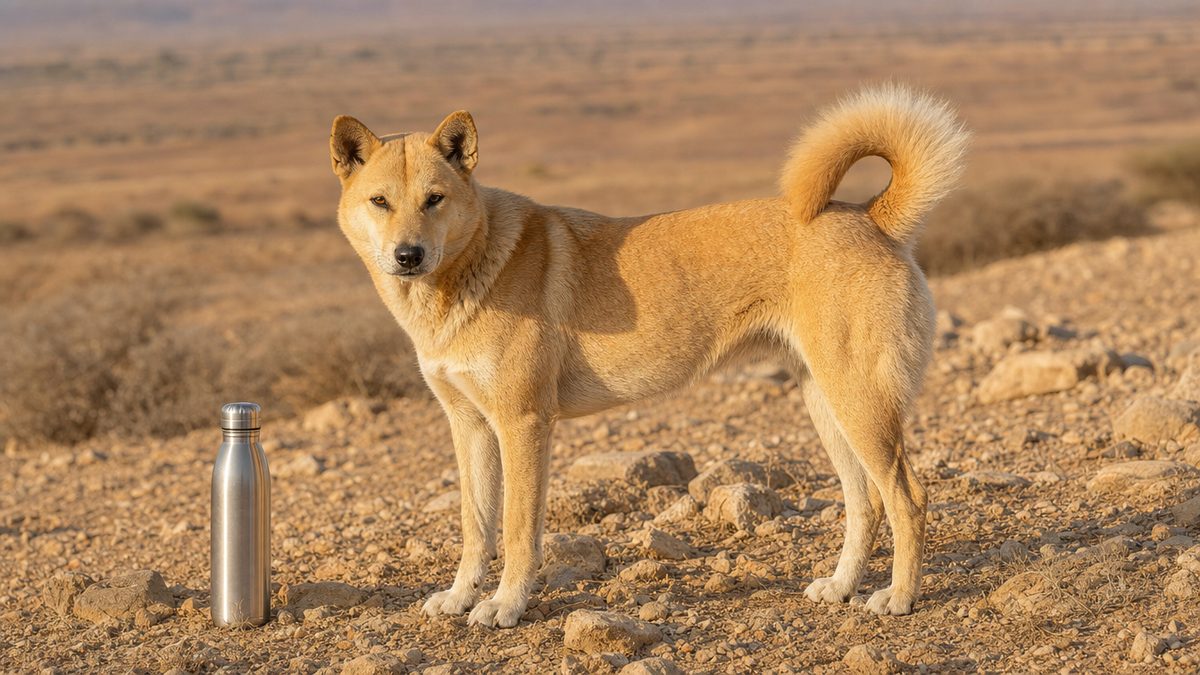
Quick answer
No verified canaan dog price in india exists. Not one Indian seller has a Canaan Dog, DGFT rules bar importing dogs for breeding, and India's oldest breeder noticeboard has no page for the breed at all. The Canaan Dog itself is FCI-273, a desert-adapted pariah landrace of 50 to 60 cm and 18 to 25 kg, redomesticated in Israel from free-living dogs.
This guide summarises breed standards, registry screening data, peer-reviewed veterinary literature, climate records and Indian government texts as general information for Indian pet owners. It is not a diagnosis and it is not treatment advice. Consult a registered veterinarian near you before acting on anything you read here, and treat collapse, laboured panting that will not settle, sudden hind-limb weakness or any bleeding that does not stop as an emergency.
Canaan Dog at a glance, for an Indian household
What a Canaan Dog actually is
The Canaan Dog is a medium, square, desert-adapted pariah landrace from Israel, recognised by the Fédération Cynologique Internationale as standard number 273 in Group 5, Spitz and primitive types, Section 6, primitive type, and accepted on a definitive basis on 23 November 1966. It is the only free-living pariah population a kennel club ever set out to rescue as a breed, which is why this page exists.
FCI-273 describes the dog in one sentence that does most of the work: "A medium sized, well balanced, strong and square dog resembling the wild dog type. Strong distinction between the sexes." Its stated utilisation is watch and security dog, and it carries no working trial.
The temperament clause is unusually blunt for a breed standard. FCI-273 asks for a dog that is "Alert, quick to react, distrustful of strangers, strongly defensive but not naturally aggressive", vigilant not only against people but against other animals, and "Extraordinarily devoted and amenable to training";. Read that as written. Distrustful of strangers is not a flaw the breeder failed to fix. It is the specification.
The measurements, straight from the standard
FCI-273 gives a height at withers of 50 to 60 cm, notes that males can be considerably larger than females, and gives a weight of 18 to 25 kg with no split by sex. The coat is a double coat: outer coat dense, harsh and straight, of short to medium length, over a close and profuse undercoat.
Colour is where the standard is strictest, and where every Indian page gets it wrong. FCI-273 permits sand to red-brown, white, black, or spotted, with or without a mask, and says a mask must be symmetrical. White markings are permitted on all colours and "Boston Terrier" patterns are common. Then it names four colours as unacceptable: grey, brindle, black-and-tan, or tricolour. It closes by saying the desert colours, sand, gold, red and cream, are most typical of the breed.
Petsworld, the Indian retailer holding position two for this query, lists the breed's coat colours as "Black, Black and Tan, Brown, Red";. Black-and-tan is one of the four colours FCI-273 declares unacceptable. A buyer using that page as a checklist would accept a dog the governing standard rejects, in a country whose kennel club answers to that standard.
Why the ears matter more than anything else
The ear set is the single feature that tells a Canaan Dog apart from the pariah-type dogs it resembles, including India's own. FCI-273 requires ears "Erect, relatively short and broad, slightly rounded at the tip and set low", and says the head appears broader than it is precisely because the ears sit low. The AKC standard is more specific still, asking that a straight line from the inner corner of the ear to the tip of the nose should just touch the inner corner of the eye.
The second cue is the tail. Set high, a thick brush, carried curled over the back. The AKC adds that one full curl is the ideal and that when extended the bone should reach the hocks. A high-set tail carried in a loose sickle is normal in an Indian street dog and is not this.
| Attribute | FCI-273, the standard the KCI answers to |
|---|---|
| Group | Group 5 Spitz and primitive types, Section 6 Primitive type, without working trial |
| Country of origin | Israel |
| Height at withers | 50 to 60 cm |
| Weight | 18 to 25 kg |
| Head | Blunt wedge of medium length, somewhat flattened skull, shallow but defined stop |
| Ears | Erect, relatively short and broad, slightly rounded at the tip, set low |
| Eyes | Dark brown, slightly slanted, almond-shaped, dark rims essential |
| Body | Square, level back, deep chest of moderate breadth, well tucked-up belly |
| Tail | Set high, thick brush, carried curled over the back |
| Coat | Dense, harsh, straight outer coat, short to medium; close profuse undercoat |
| Colour | Sand to red-brown, white, black or spotted; grey, brindle, black-and-tan and tricolour unacceptable |
| Utilisation | Watch and security dog |
India is a full member of the FCI, represented by the Kennel Club of India at Anna Nagar in Chennai. A KCI-registered Canaan Dog in India is judged against FCI-273, not against the American standard. Every Indian page we opened quotes American measurements instead, and the next section shows how far apart the two sets of numbers actually are.
Four size ranges for one dog, and only one of them governs India
The Canaan Dog is described by two governing breed standards and at least three commercial spec cards, and they do not agree at the bottom of the range. FCI-273 sets 50 to 60 cm and 18 to 25 kg. The AKC allows bitches down to 19 inches and 35 pounds, which is 48.3 cm and 15.9 kg, both below the FCI floor. Everything an Indian buyer reads sits on top of that disagreement.
This matters in a practical way. A buyer in Chennai reading an American spec card, holding a KCI pedigree, and standing in front of a 48 cm bitch is looking at a dog that is correct in Ohio and undersized in the ring she will actually be entered in.
| Source | Height | Weight | Reads as |
|---|---|---|---|
| FCI-273, binding in India | 50 to 60 cm, both sexes | 18 to 25 kg, both sexes | The governing text |
| AKC standard 2012 | Dogs 20 to 24 in (50.8 to 61.0 cm), bitches 19 to 23 in (48.3 to 58.4 cm) | Dogs 45 to 55 lb (20.4 to 24.9 kg), bitches about 35 to 45 lb (15.9 to 20.4 kg) | Lower floor for bitches on both measures |
| Petsworld (India) | Female 19 to 23 in, male 20 to 24 in | Female 15.9 to 20.4 kg, male 20.4 to 24.9 kg | The AKC pounds converted to kilograms, digit for digit |
| Asia Pets (India) | 48 to 61 cm | 18 to 25 kg | AKC inches converted, bolted to the FCI weight |
| Puppiezo (India) | 17 to 21 in (43.2 to 53.3 cm) | 14 to 20 kg | Below both standards at the bottom and the top |
| LancasterPuppies (US, position 1) | Male 19.5 to 24 in, female 16 to 20 in | 40 to 55 lb both sexes | A 40.6 cm female, which no standard allows |
A fourth published standard sits between them. The UKC gives 20 to 24 inches and 40 to 55 pounds with no split by sex, which is 50.8 to 61.0 cm and 18.1 to 24.9 kg, so it agrees with the FCI on the weight floor and with the AKC on height. Two of the Indian rows are worth naming precisely. Petsworld's kilogram figures are the AKC's pound figures run through a converter: 35 lb is 15.87 kg and 55 lb is 24.95 kg American Kennel Club. Asia Pets prints 48 to 61 cm, which is the AKC's 19 to 24 inches converted, beside 18 to 25 kg, which is the FCI weight. Neither page tells the reader it has spliced two standards together.
The seller with the smallest dog is the one selling it
Puppiezo's Canaan Dog spec card gives 17 to 21 inches and 14 to 20 kg. Seventeen inches is 43.2 cm, nearly 7 cm below the FCI minimum and 5 cm below the AKC minimum for a bitch. Fourteen kilograms is 4 kg below the FCI floor. The card is not describing a Canaan Dog. It is describing something smaller, and it sits on a page whose title tag is "Canaan Dog Price".
LancasterPuppies, which Google India ranks first for this query, prints a female range starting at 16 inches, or 40.6 cm. That is roughly the size of a Border Collie bitch at the low end, and no published standard for this breed permits it.
What real dogs measure, self-reported
OFA runs an owner-completed health survey for the breed, and it asks for height and weight. Among respondents, 39 percent reported 22 to 25 inches, 37 percent reported 20 to under 22 inches, 19 percent reported 18 to under 20 inches, 3 percent over 25 inches and 3 percent under 18 inches. On weight, 48 percent reported 40 to 50 lb, 27 percent reported 30 to 40 lb and 25 percent reported 50 lb or over.
OFA states plainly that its survey respondents are self-selected and that there is no verification and no duplicate checking. Take it as a shape rather than a measurement. The shape is that a real Canaan Dog population spreads across and slightly beyond both standards, with about one dog in five sitting below the FCI height floor.
If you are ever in a position to verify a Canaan Dog in India, measure to FCI-273 and nothing else, because that is the standard a KCI pedigree answers to. Fifty centimetres at the withers is the floor, 18 kg is the floor, and a black-and-tan, grey, brindle or tricolour dog is outside the standard whatever the seller's card says.
Rudolphina Menzel, and the date almost every breed page gets wrong
The Canaan Dog exists because one Austrian scientist decided that Europe's guarding breeds could not work in a desert. Rudolphina Menzel, born in Vienna in 1891, took a doctorate at the University of Vienna and built an international reputation in cynology before she ever saw the dogs that would carry her name. The year she reached Palestine is the detail the breed literature disagrees on, and the archives and the breed clubs give different answers.
The breed literature says 1934. Myrna Shiboleth of Shaar Hagai Kennels, who carried on Menzel's programme after her death, writes that "In 1934, Professor Rudolphina Menzel, a noted cynologist, immigrated to Palestine", was asked by the Haganah to build a network of service dogs, and began studying the local pariah dogs. That sentence, or a paraphrase of it, is on almost every Canaan Dog page on the internet.
The United Kennel Club agrees with the breed literature: its own standard states that "In 1934, Dr. Rudolf and Prof. Rudolphina Menzel immigrated to Israel, then known as Palestine";. Three independent sources say 1938. The Central Zionist Archives, which holds Menzel's personal papers as record group A293, states that "In 1938, following Hitler's demand that the couple lend their dog training services to the Nazi military, they fled from Austria to Palestine";. Brandeis University, writing about Susan M. Kahn's book on Menzel, dates the flight to August 1938, after the Anschluss, and says the couple left with forged papers and two of their hundreds of boxers. The American Kennel Club's own breed history opens in 1938 and has the Menzels reaching Palestine on the eve of Rosh Hashanah.
Brandeis records that Menzel stopped working for Austria and Germany in 1934, a year after Hitler came to power. The AKC adds that for more than a decade before she fled she had been selling trained dogs to Zionists in Palestine and hosting Haganah members who came to learn her methods. So 1934 is a real date in her life. It is the year she cut her German and Austrian clients, not the year she emigrated. Bonbeno publishes both dates rather than picking one, and notes that the archive holding her papers says 1938.
Why she went looking for a pariah dog at all
Menzel was asked to supply guarding, tracking and mine-detection dogs, and the European breeds failed. Shiboleth records that German Shepherds, Boxers and Dobermanns "suffered greatly from the dry heat and the hard, rocky ground";. The AKC puts the same finding in one line: as her training progressed she found that traditional guarding breeds struggled in the harsh desert climate.
That is the founding observation of this breed and it is the reason an Indian reader should care. A dog programme in a hot, dry, stony country tested the imported working breeds, watched them fail, and went looking for what was already living there. India has never run that experiment on its own street dogs.
What she was doing before the dogs
The scale of the work is worth stating because it is the reason the breed was built properly rather than sentimentally. Menzel designed a sixteen-year study observing hundreds of boxers to separate genetic from environmental influences on temperament, and in a 1930 paper demonstrated that trained dogs could discriminate the individual scent of particular people. She trained her dogs to obey commands only in Hebrew, which is why some of the first dogs of the German army took orders in Hebrew.
In Palestine she founded a canine research and training institution at Kiryat Motzkin, developed an evaluation system for assessing a dog's suitability for service, and guided the founding of the Haganah canine unit, which became the Israel Defense Forces' Oketz unit. In the early 1950s she shifted to guide dogs and founded the first guide-dog institute in the Middle East. She died in 1973.
Menzel's guide dogs were mostly Labrador Retrievers, not Canaan Dogs, because the Canaan Dogs she had spent thirty years redomesticating turned out to be too independent for the work. The woman who created the breed did not use it for the job she cared most about at the end of her life. If you are weighing this dog against a retriever, that is the most honest comparison available.
How the dogs were actually collected, in the words of the people who did it
Redomestication meant physically catching free-living dogs and proving they bred true. Menzel collected puppies and adults from the pariah groups living around settlements, Bedouin encampments and the open desert, found them highly receptive to change and quick to adjust, and set up breeding units from the Bedouin and Druse dog populations. The method is documented in enough detail to be checked, which is rare for any landrace anywhere.
The AKC's history records the first capture. Trekking into the Negev, Menzel lured adult dogs with food and collected whole litters. The first adult she caught took six months. She named him Dugma, which translates as "example", described him as "especially mistrustful", and after a few weeks of training he was tractable enough to ride the bus into town with her.
The three methods Shaar Hagai still uses
- Take very small puppies. Locate a new litter and remove the pups as soon as they can manage without the dam, because "a two to three month old puppy is already suspicious enough and fast and agile enough to evade being caught". Take them only when both parents can be identified, which the Bedouin often help with.
- Capture an adult. In practice this means adults attached to Bedouin camps, which are semi-wild and can usually only be approached by the camp's children. Bedouin families will sometimes catch and hand over a dog they do not need as a camp guard.
- Bring a bitch in season to the dogs. The hardest method and the one that mostly fails, because a suspicious desert dog will often refuse to approach a strange bitch at all. It has produced one litter.
The registration procedure that follows is the part that makes this a breed rather than a rescue. A desert-caught dog is examined as an adult against the breed requirements, then put to a trial breeding with a fully pedigreed, proven mate before it enters the stud book.
Shiboleth is explicit about what gets a dog rejected, and it is not cosmetic. Dogs have been discarded as breeding stock for ears that do not stand, incorrect bites, or structural faults that might interfere with effective survival. She writes that these are "not 'show points'";. Faults suggesting mixed blood also disqualify.
Over the years covered by Shiboleth's account, about 15 dogs in total were brought in from the wild or from the Bedouin, of which several proved valuable enough that their descendants are now themselves of breeding age. Fifteen dogs. That is the entire modern refresh of a landrace's gene pool, and it is why the numbers in the health section look the way they do.
Why the wild source is closing
Two forces are removing the free-living population, and neither is reversible. Israel's rabies control programme destroys feral dog packs, and Shiboleth's complaint is precise: the wardens do not distinguish between large scavenging packs of abandoned mixed-breed dogs, which can be aggressive and dangerous to livestock, and Canaan groups, which rarely number more than three or four and are not known to be aggressive to humans.
The second force is settlement. As Bedouin families move into towns and villages, other breeds arrive and mix into the local population, so the dogs still living the traditional way are further out and harder to find each year. The AKC's account agrees, adding that growing settlements have encroached on the habitat and that crossbreeding with non-native dogs has diluted a once-isolated population.
Rabies control that does not distinguish between dog types, urbanisation that mixes pedigree genes into a free-ranging population, and a shrinking window in which the original type can still be found. Every one of those is happening to India's pariah dogs right now, at a scale hundreds of times larger. Israel had a named scientist, a kennel club and a stud book in place before its window closed. That comparison is the point of the Indian Pariah Dog section further down this page.
What formal recognition actually did to this landrace
Recognition happened in four steps across forty-four years and produced one strange result: five registries accept the same dog and file it in five different places. The Israel Kennel Club accepted it in 1953, the FCI on a definitive basis on 23 November 1966, the British Kennel Club in 1970, and the American Kennel Club in 1997 Fédération Cynologique Internationale American Kennel Club.
The FCI's own record adds two dates the breed pages skip. The official valid standard was published on 28 November 1985, and the English text now in force is dated 16 June 1999 Fédération Cynologique Internationale. Shiboleth's account says the last revision was accepted in 1987. Those do not reconcile, and since the FCI is the body that publishes its own standards, Bonbeno reports the FCI dates and flags the disagreement rather than averaging it.
One dog, five groups
The classification is where recognition shows its seams. OFA's own breed markup records how four registries file this breed, and the FCI's nomenclature gives a fifth Fédération Cynologique Internationale.
| Registry | Group it puts the Canaan Dog in | What that implies the dog is for |
|---|---|---|
| FCI (and therefore the KCI) | Group 5, Spitz and primitive types, Section 6 Primitive type | An ancient landrace, judged as a type rather than a job |
| American Kennel Club | Herding Group | A stock dog |
| Canadian Kennel Club | Working Group | A guard and draught dog |
| United Kennel Club | Sighthound and Pariah Dog Group | A pariah dog, named as such |
| The Kennel Club (UK) | Utility Group | The group for breeds that fit nowhere else |
Only the UKC calls it what it is. The AKC's own standard opens by describing the breed as "a herding and flock sentry dog" and "a pariah dog type", then files it with the Border Collies. FCI-273 gives its utilisation as watch and security dog and attaches no working trial at all.
How it got out of Israel
The entire population outside Israel descends from a very small export. In 1965 Menzel sent the first four Canaan Dogs to Ursula Berkowitz of Oxnard, California, who helped found the Canaan Dog Club of America later that year; the four were named Birion, Belith, Toro and Waf. Shiboleth's account agrees on the year and adds that Germany followed shortly after.
Britain came later. LancasterPuppies attributes British recognition in 1970 to the breed enthusiast Connie Higgins. Bonbeno could not verify that attribution against a Kennel Club document and reports it as that page's claim rather than as a fact.
Shiboleth argues the case herself, and she is arguing against people inside her own world: "Although the idea of breeding and registering the natural land races of dog with recognized kennel clubs has a lot of opposition among those involved with these breeds, we feel that this is what has given us the opportunity to preserve the Canaan Dog." In the early years, she writes, it was very difficult to find homes for puppies at all. Only publicity and shows created enough demand for pets and family guard dogs to make "more widespread breeding and selection possible";.
Read that as an argument about incentives rather than about kennel clubs. Recognition did not make the dog better. It made the dog wanted, and being wanted is what funded the stud book, the health testing and the sixty years of record-keeping that let this page quote real denominators. The next two sections look at what that bought and what it did not.
The Canaan Dog against the Indian Pariah Dog: one landrace got a stud book
The Canaan Dog is the closest thing on the FCI register to India's own street dogs, and comparing the two is the most useful thing this page can do for an Indian reader. Both are pariah-type landraces shaped by survival rather than selection. One was written into a breed standard in 1966 and now has screening statistics with real denominators. The other has none of that, and India has roughly a thousand times more of them.
This is not a strained analogy. The INDog Project, the Indian native dog documentation project, publishes Myrna Shiboleth's account of the Canaan Dog on its own site, under its Articles index, alongside pieces on the Nilgiris aboriginal dogs, the New Guinea Singing Dog, the Santal Hound and the Basenji. India's landrace conservationists chose the Canaan Dog as their reference case before we did.
| Canaan Dog | Indian Pariah Dog | |
|---|---|---|
| FCI standard | FCI-273, definitive since 23 November 1966 | None |
| Written breed standard | Published by the FCI and by four national registries | Published by the INDog Project, not by a kennel club |
| National kennel club status | National dog of Israel, accepted by the Israel Kennel Club in 1953 | No KCI breed status |
| Screening statistics | 616 hip evaluations, 350 DM tests, 273 thyroid, 252 eyes, 243 patella | No registry screening data exists |
| Measured lifespan | 12.0 years, 95 percent CI 9.5 to 14.7, from 28 deaths in 46 dogs | No comparable cohort study |
| Peer-reviewed records naming it | 1 in PubMed, from 1989 | A continuing behavioural research programme |
| Population | 85 UK registrations across ten years | Free-ranging dogs are about 80 percent of the world's dogs |
| Available in India | Zero, at any price | Free to adopt, in every city |
What recognition genuinely delivered
Three things, and they are worth having.
- A type that stopped drifting. Shiboleth's stated goal is "to try and keep the breed as it is, without the changes and deterioration that has occurred in many other breeds", and the mechanism is a stud book that rejects desert-caught dogs for structural faults "that might interfere with effective survival" rather than for show points.
- Numbers a buyer can check. Because the breed sits inside OFA, a stranger in Pune can read that 20 of 616 evaluated Canaan Dogs had dysplastic hips, and can see the sample size beside the percentage. No such sentence can be written about an Indian street dog.
- A route back to the source. The breed's own rules let a caught desert dog enter the register after a trial breeding, so the gene pool is not closed. Almost no recognised breed can say that, and it is the single most valuable thing recognition preserved.
Recognition did not make the dog common, and it did not make it healthy. Sixty years after the FCI accepted it, The Kennel Club registered 85 Canaan Dogs in the entire United Kingdom across the decade to 2025, including zero in 2024, the AKC ranks it 193rd of 210 breeds, and its measured median lifespan of 12.0 years is statistically indistinguishable from a crossbred dog's, at a hazard ratio of 1.07 and p = 0.74. Anyone arguing that India should get its pariah dogs registered in order to save them should look hard at those three numbers first.
India already has a written standard, and it describes almost the same dog
India's landrace is not undocumented. The INDog Project publishes a written Breed Standard of the Indian Native Dog by Aditya Panda, and read against FCI-273 the two describe animals that overlap in build, coat, ear set, tail carriage and temperament Fédération Cynologique Internationale. The differences are narrow, specific and worth knowing, because they are how you tell the two apart.
The INDog standard opens by refusing the framing this whole page is arguing against: the Indian Native Dog is "commonly referred to as the 'pariah' dog, and erroneously referred to as 'mongrel', 'mutt' or 'stray'", and is described as "the naturally evolved and perfected prototype of the domestic dog";. It also does something no kennel club would: it says the standard "deliberately remains flexible to make room for natural variations in size, colour, etc. observed among individuals, depending on various factors, mostly geographical".
| Point | Canaan Dog, FCI-273 | Indian Native Dog, INDog standard |
|---|---|---|
| Build | Square | Square to slightly rectangular |
| Coat | Dense harsh straight outer, close profuse undercoat | Double coat, coarse upper coat, soft undercoat |
| Head | Blunt wedge of medium length | Medium sized, wedge shaped, pointed muzzle |
| Ears | Erect, short, broad, slightly ROUNDED at the tips, set low | Erect, POINTED at the tips, broad base, set low |
| Eyes | Dark brown, almond, slightly slanted | Almond shaped, dark brown |
| Tail | Set high, thick brush, curled over the back | Curled and held high when excited |
| Dogs' size | 50 to 60 cm, 18 to 25 kg, both sexes | 20 to 25 in (50.8 to 63.5 cm), 20 to 30 kg |
| Bitches' size | Same range as dogs | 18 to 23 in (45.7 to 58.4 cm), 15 to 25 kg |
| White | A standard colour, often with a symmetrical mask | A FAULT |
| Spotted | "Boston Terrier" patterns are common | A FAULT |
| Brindle | Unacceptable | A fault |
Colour, not conformation. A predominantly white dog with a symmetrical dark mask over the eyes and ears is a correct Canaan Dog and a faulty Indian Native Dog Aditya Panda, Breed Standard of the Indian…. So is a spotted one. Everything else, the low-set erect ears, the wedge head, the curled tail, the double coat and the square build, is shared. If you are looking at a sand or fawn dog with low erect ears and a curled tail on an Indian street, the honest answer is that you cannot tell by looking.
The temperament sections could be swapped
Read these two side by side. FCI-273: "Alert, quick to react, distrustful of strangers, strongly defensive but not naturally aggressive";. The INDog standard: "an extremely alert, very social dog" made "an extremely cautious breed" by rural evolution near predators, which makes "excellent watch dogs", is "very territorial and defensive of their pack/family", needs good socialising as a pup, is "not comfortable around strangers and can get defensive", is "highly intelligent and easily trainable, but can get bored equally easily", and will "bark at the slightest doubt or provocation and can hence, be noisy";.
Even the training warning is the same one this page gave three sections ago. The INDog standard says these dogs "not want to play typical, repetitive dog games like 'fetch'" and that owners "are frequently outsmarted by this expert of escape";.
It states that "average life expectancy is over 15 years under good care" and that genetic ailments like hip dysplasia are "extremely rare";. No denominator, no cohort and no study is offered for either, and this page has just spent a section showing that the equivalent breeder claim about the Canaan Dog survived contact with 616 OFA hip evaluations but that its lifespan claim did not survive contact with 28 recorded deaths McMillan KM et al.. Bonbeno reports the INDog figure as the standard's assertion and notes that the study which would test it has never been run in India.
One further detail is genuinely useful for an Indian owner and appears in neither breed's overseas literature. The INDog standard records that the pariah group "breeds only once a year", with bitches coming into season with the south-west monsoon around July to October and pups whelped from October to December. A once-yearly monsoon-timed season is a landrace adaptation to the Indian calendar, and it is the kind of thing a written standard captures and a kennel club register would eventually breed out.
The unrecognised landrace is the better studied one
Formal recognition did not bring scientific attention, and the evidence for that is uncomfortable for anyone who assumes it would. PubMed holds exactly one record about the Canaan Dog and a continuing research programme on India's free-ranging dogs. The registry gave the Israeli breed a stud book. It did not give it a literature.
The Canaan Dog search is worth showing in full because the trap in it is instructive. Searching Canaan[Title] on PubMed returns 8 records, and the E-utilities API prints its own query translation as "Canaan"[Title], so nothing was silently rewritten. Open the eight and only one is about a dog: a 1989 treadmill study of eight Canaan dogs at Onderstepoort. The other seven include a 2016 paper on Old Kingdom Egyptian animal trade, a 1956 item titled "CURSED be Canaan...", an 1885 note on Silurian fossils at Canaan, New York, and a 2006 radiotherapy paper that matched only because it contains the string "cana--an" across a line break.
The broader search behaves the same way. Searching for the phrase Canaan dog without the title restriction returns 6 records, and the translation shows PubMed collapsed the phrase into "Canaan"[All Fields] AND dogs, which surfaced papers by an author surnamed Canaan working on gastric lipases. A raw count of 6 would have looked like coverage. The real figure is one.
Searching Labrador Retriever[Title] in the same tool on the same day returned 229 records with a clean translation, so the search instrument was working. An absence is only evidence when the control passes, and this one did.
What India has instead
One laboratory at IISER Kolkata has built a sustained experimental programme on Indian free-ranging dogs, and it produces the kind of data no breed club generates. A 2026 study ran field trials on 61 adult free-ranging dogs to test whether food or petting is the stronger reward, and found that dogs preferred the food provider on day one but that from day two onward the preference was no different from chance. A 2020 study observed twelve groups across zones of differing human traffic and found that dog-human interactions outnumbered dog-dog interactions, with humans initiating both the positive and the negative ones significantly more often than the dogs did.
Indian veterinary anatomy has started too. A 2026 study at the ICAR-Indian Veterinary Research Institute in Bareilly measured 72 cadaveric specimens, 24 each of German Shepherd, Labrador Retriever and Indian Pariah Dog, across fourteen coxofemoral parameters by both radiography and CT, and reported inter-observer agreement of 0.96 to 1.00. That is a breed-specific orthopaedic reference for the Indian pariah dog, produced by a government institute, with a denominator. Nothing equivalent exists for the Canaan Dog.
| Question | Canaan Dog | Indian free-ranging dog |
|---|---|---|
| Records in PubMed naming it | 1, from 1989 | An active programme, including 2020 and 2026 papers Nandi S, Lahiri A, Pal TS, Roy |
| Largest experimental sample found | 8 dogs on a treadmill | 61 dogs in reward trials |
| Anatomical reference data | None found | 72 cadaveric specimens, 24 of them pariah dogs |
| Registry screening data | 616 hip evaluations and four other registries | None |
| Measured survival cohort | 46 UK dogs | None comparable |
Recognition and research are two different machines, and India has been running the second one without the first. A stud book buys you screening statistics, a written type and a route to verify a dog. It does not buy you behavioural science, and it plainly did not make the Canaan Dog popular. If the goal is to protect the Indian pariah dog, the Israeli case says the useful parts are the written standard, the archaeological record and the discipline of recording what you catch. The show ring is not the part that did the work.
How many Canaan Dogs there are, counted rather than claimed
Every source calls this breed rare and almost none of them puts a number on it. Here are the numbers that exist. The Kennel Club registered 85 Canaan Dogs in the whole United Kingdom across the ten years to 2025, the AKC ranks it 193rd of 210 breeds, and a 192-breed British health survey captured 6 dogs American Kennel Club Wiles BM, Llewellyn-Zaidi AM, Evans KM.
| Year | Canaan Dogs registered | French Bulldogs registered the same year |
|---|---|---|
| 2016 | 2 | 21,470 |
| 2017 | 7 | 30,887 |
| 2018 | 19 | 36,785 |
| 2019 | 24 | 33,661 |
| 2020 | 6 | 39,266 |
| 2021 | 8 | 54,074 |
| 2022 | 8 | 42,538 |
| 2023 | 6 | 26,704 |
| 2024 | 0 | 13,789 |
| 2025 | 5 | 7,750 |
| Ten-year total | 85 | 307,000 plus |
Read the 2024 row twice. Not one Canaan Dog was registered in the United Kingdom in 2024. The peak across the decade was 24 dogs in 2019. For scale, the Utility Group's own French Bulldog column in the same table ran to five figures every year until 2024.
One caution on that document. Its header reads "COMPARATIVE TABLES OF REGISTRATIONS FOR THE YEARS 2015 - 2024 INCLUSIVE" while the ten columns are labelled 2016 to 2025. The figures above follow the column labels, which is what the data is actually keyed to. Anyone quoting this table should say which they used.
How many left Britain, and where they went
The Kennel Club also publishes export pedigrees, which is the closest thing to a shipping manifest for pedigree dogs. In 2025 the whole Utility Group produced 234 export pedigrees across 20 breeds and 31 destination countries, and the Canaan Dog column total was 1.
India does not appear as a destination anywhere in that table, for any of the 234 dogs. Israel appears once. So in the most recent full year of record, British breeders exported exactly one Canaan Dog to anywhere on earth, and shipped no Utility Group dog at all to India.
Where the breed's own dogs are born
OFA's owner-completed breed health survey asks which country each dog was born in, and the answers are a rough census of where the breed lives. Among 248 responses: USA 180, Sweden 18, Canada 16, United Kingdom 12, Italy 8, Israel 8, Saudi Arabia 2, France 2, Iran 1 and the United Arab Emirates 1.
India is not on that list. Neither is any other South Asian country. OFA states that its survey respondents are self-selected and unverified, so treat this as where owners who fill in forms live rather than as a true census. Even allowing for that, a survey that reaches Iran, Saudi Arabia, the UAE and Bermuda and reaches no Indian owner is telling you something.
LancasterPuppies, the page Google India ranks first for this query, states that the breed has "a global population of under 3,000";. Bonbeno could not trace that figure to a registry, a census or a study, and no kennel club we opened publishes a worldwide total. It is plausible and it may well be right. It is recorded here as that page's claim, not as a verified number, and the registry counts above are what a reader can actually check.
Popularity is also falling rather than rising. The AKC's own breed history, updated in 2020, said the breed "last year ranked 179th out of AKC's 193 recognized breeds";. The AKC's live breed page now prints 193 of 210. Both the rank and the position within the roster have moved the wrong way.
Canaan Dog price in India, and what the sellers are actually offering
No verified canaan dog price in india exists, because on 24 August 2026 not one Indian seller had a Canaan Dog. Asia Pets prints "Showing 0 results", Puppiezo's Canaan Dog category page carries a single product card with no price and its product page fills the space with eight other breeds, and India's two oldest breed noticeboards have no Canaan Dog page to print a price on Puppiezo, Canaan Dog Puppies For Sale.
The query itself is being misread. Six of the ten results Google India returns for "canaan dog price in india" are about the Cane Corso: a YouTube video on Cane Corso puppy prices, a Quora thread on a male Cane Corso in Mumbai, an Instagram hashtag page for "cane corso india price" appearing twice, and a Cane Corso sales page quoting ₹70,000 to ₹2,20,000. A seventh is a listicle about Indian breeds. That leaves three pages actually about this breed, and two of them are American.
| Source | Price it prints for a Canaan Dog | Canaan Dogs actually listed | What it offers instead |
|---|---|---|---|
| Puppiezo, product page | None | 0 | Eight puppies: two Maltipoos, two Poodles, a Cane Corso, a Goldendoodle, a Rottweiler and a Doxiepoo |
| Puppiezo, category page | None | 0 | One product card with no price |
| Asia Pets | None | "Showing 0 results" | A Chihuahua, a Yorkshire Terrier and a Toy Pom |
| Petsworld | None | Not a marketplace | Breed facts only, with a disqualifying colour listed |
| Supertails, Top 40 Breeds | Breed absent from the list | Not a marketplace | 40 other breeds |
| Mr n Mrs Pet | No page exists | No page exists | HTTP 404 |
| Dogs India | No page exists | No page exists | HTTP 404 |
The two 404s are the strongest evidence on this page
An empty search result can mean the site is broken. A missing page cannot. Dogs India has run a per-breed breeder noticeboard for decades at a fixed URL pattern, and dogsindia.com/canaan_dog.htm returns HTTP 404 while the control, dogsindia.com/beagle.htm, returns HTTP 200 with a live page. Mr n Mrs Pet does the same: /dogs/canaan-dog-puppies-for-sale resolves to the site's 404 page, while the control /dogs/cane-corso-puppies-for-sale returns a full listing page.
Justdial does have a page, and it is worse than nothing. Its "Top Pet Shops For Canaan Dog in Coimbatore" category lists ten businesses, and their own listed categories are Pet Shops, Pet Shops For Dog, Pet Grooming Services, Pet Care Takers, Pet Shops For Birds and Veterinarians; not one carries a Canaan Dog category, and the customer reviews printed underneath are about aquarium fish, pet food and boarding. The prose beneath the listing, "Pet shops in Coimbatore offer a variety of products tailored to the needs of Canaan Dogs", is a template into which any breed name can be dropped. Both marketplace platforms, by contrast, generate a page per breed they carry, and neither has ever generated one for this breed. That is not zero stock. That is the breed never having entered the Indian market at all.
Asia Pets contradicts itself in four lines
Asia Pets opens its Canaan Dog page with "We've been helping families across India find their perfect Canaan Dog companion for years now. Every Canaan Dog pup you see here comes with proper vaccination papers, a vet health certificate, and genuine pedigree documents". Four lines below, the listing module prints "Showing 0 results", then offers three dogs under the heading "Here are available pets of the same breed from other locations": a Chihuahua, a Yorkshire Terrier and a Toy Pom.
None of those three is the same breed as a Canaan Dog, and the same trio appears on this site's page for a completely different rare terrier, which tells you the fallback is a fixed house template rather than anything to do with the breed you searched for.
The two United States pages that do quote a figure give $1,000 to $2,500 and $1,500 to $2,000 respectively. Do not convert those into rupees and treat the result as an Indian price. There is no lawful route to import a dog into India for breeding, so a converted American figure describes a transaction that cannot legally happen here. The import section sets out exactly which clause closes that door.
Testing the rupee figures on the Canaan Dog pages, one by one
Every rupee figure printed on an Indian Canaan Dog page belongs to a different breed, and none of them is a converted American price. Bonbeno divides suspicious Indian figures by 84.38 and by 74, the two exchange rates that have exposed converted price lists on this site before. On this breed both tests come back clean, which points at something else: rupee-native charm pricing attached to whichever puppy is in stock.
Puppiezo's Canaan Dog product page carries a module headed "Other Available Pets". On 24 August 2026 it held eight puppies, all listed at 8 weeks old, and not one of them was a Canaan Dog.
| Name | Breed actually offered | Price | Divided by 84.38 | Divided by 74 |
|---|---|---|---|---|
| Fizey | Maltipoo | ₹98,999 | $1,173.25 | $1,337.82 |
| Kuzo | Poodle | ₹92,599 | $1,097.40 | $1,251.34 |
| Dugu | Poodle | ₹92,599 | $1,097.40 | $1,251.34 |
| Kazuka | Cane Corso | ₹94,999 | $1,125.85 | $1,283.77 |
| Doir | Goldendoodle | ₹1,20,000 | $1,422.14 | $1,621.62 |
| Samy | Maltipoo | ₹98,999 | $1,173.25 | $1,337.82 |
| Tugi | Rottweiler | ₹76,499 | $906.60 | $1,033.77 |
| Yoki | Doxiepoo | ₹98,999 | $1,173.25 | $1,337.82 |
Not one row divides to a round dollar figure at either rate, so this is not an American price list run through a converter. It is Indian charm pricing: every figure ends in 999, 599 or 499. ₹98,999 appears three times on a single page, attached to two Maltipoos and a Doxiepoo, which is the clearest possible demonstration that the number belongs to the seller's price ladder rather than to any breed.
Bonbeno has now recorded this exact figure across many pages of this one seller, always beside the same small cast of animals, including Maltipoos named Fizey and Samy and a Doxiepoo named Yoki, and always on pages for breeds the site does not stock. If you are ever quoted ₹98,999 for any dog, you are being read the top of a carousel, not a valuation. Never treat it as a Canaan Dog price.
The number one result is selling something else entirely
LancasterPuppies holds position one in India for this query and quotes $1,000 to $2,500 for a well-bred puppy. Its own Canaan Dog listing module told a different story on 24 August 2026. Two puppies, both in Brooklyn, New York, both 13 weeks old, both female, both priced $350, and both carrying the seller's own description word for word: "I have the father and mom blue nose mix bully and I'm selling them at 6 weeks old";.
A blue nose bully cross is not a Canaan Dog by any standard published anywhere. Two things follow. The site's own inventory contradicts its own price band by a factor of three to seven. And the seller states in writing that the puppies go home at six weeks, which under Indian law would breach Rule 8(1)(a) of the Prevention of Cruelty to Animals (Dog Breeding and Marketing) Rules 2017, which requires that "pups less than eight weeks in age are not sold";.
What the American band would come to, if it applied
For completeness, and only as arithmetic. At 84.38 rupees to the dollar, $1,000 to $2,500 is ₹84,380 to ₹2,10,950, and the $1,500 to $2,000 band on the second American page is ₹1,26,570 to ₹1,68,760 DogBreedsList, Canaan Dog: Price. At 74 the same bands come to ₹74,000 to ₹1,85,000 and ₹1,11,000 to ₹1,48,000.
They are printed here so that a reader who sees a converted figure quoted somewhere recognises where it came from. No Indian seller has this breed, no lawful import route exists for breeding stock, and a converted American price describes a transaction that cannot legally happen in India. If you want a price you can act on, the adoption section at the end of this page has one.
Importing a Canaan Dog into India, and the door that is closed
You cannot lawfully import a Canaan Dog into India to breed from, and the text that says so is short. DGFT Trade Notice No. 22/2022-23 of 19 December 2022 lists ITC(HS) 01061900, "Mammals: Other", as Restricted, and its Policy Condition (8) states that "Import of commercial dogs for breeding or any other commercial activities other than the purposes mentioned above is not permitted";.
Policy Condition (7) sets out the only three purposes for which a dog may enter India at all.
- A pet dog with a valid pet book and relevant records or documents in the name of the importer.
- A dog imported by an R&D organisation for conducting research, with the recommendation of the CPCSEA.
- A dog for internal security by the Defence and Police Force.
Paragraph 6 removes the remaining ambiguity: "any applications for trading/breeding purposes, or applications made on behalf of some another person/entity shall be duly rejected". There is no discretionary route, no premium tier and no breeder exemption.
What is actually allowed, in practice
One narrow path exists and it is a personal one. A person transferring residence to India after two years of continuous stay abroad may bring in up to two pets as passenger baggage without a DGFT import authorisation, cats and dogs only, under the baggage rules read with CBIC Circular No. 15/2013-Customs. Anything outside that, fewer than two years abroad, more than two animals, or an animal not travelling as accompanied baggage, needs an import authorisation from DGFT, applied for against an Importer Exporter Code or against the permanent IEC IIHIE0153E for personal, non-trade imports.
| Step | Requirement |
|---|---|
| Policy status | ITC(HS) 01061900 is Restricted, subject to Policy Condition 6 |
| Purpose allowed | Pet with valid pet book, CPCSEA-recommended research, or Defence and Police use |
| Purpose refused | Trading or breeding applications shall be duly rejected |
| Without authorisation | Up to two pets, transfer of residence after 2 years abroad, as passenger baggage |
| With authorisation | Apply via ANF-2M with the pet book, pet passport and pet's passport; DAH&D examines the justification |
| Lead time | Start the import authorisation at least 2 months before travel |
| Ports | Airports and seaports of Delhi, Mumbai, Chennai, Hyderabad, Bangalore and Kolkata only; DAHD added Kochi for pets arriving under the baggage rules in October 2024 |
| Quarantine | Where required, at the government quarantine station of that port |
| Advance NOC | From the Regional or Quarantine Officer (AQCS) 7 days before travel, relaxable to 3 |
Seven ports. Delhi, Mumbai, Chennai, Hyderabad, Bengaluru, Kolkata and, since October 2024, Kochi Department of Animal Husbandry…. If you are moving to Kochi or Guwahati with a dog, you still land it at one of those six. The full route is set out in how to import a dog to India.
Most rare breeds could in principle arrive in India one returning-resident dog at a time and eventually form a population. This one cannot, and the reason is in its own preservation model. The Canaan Dog's gene pool is maintained by periodically adding desert-caught stock through a trial breeding into the stud book. That refresh route requires importing breeding animals, which Policy Condition (8) forbids. A pair brought in as personal pets would be the founding and terminal population of Indian Canaan Dogs at the same time.
The Kennel Club's export figures say the same thing from the other end. Across 234 Utility Group export pedigrees issued in 2025 to 31 destination countries, India received none, and the Canaan Dog column total across all destinations was one dog. There is no supply, and there is no lawful demand channel to meet it with.
Indian law on this dog, including the clause the AKC standard runs into
Indian law forbids one procedure the American breed standard requires. Second Schedule Part II paragraph 6(8) of the Prevention of Cruelty to Animals (Dog Breeding and Marketing) Rules 2017 forbids "de-clawing" and "any other kind of mutilation of any body part of the pup and any change of appearance by artificial means";. The AKC standard, under Hindquarters, says "Dewclaws must be removed";.
Take the two texts exactly as written. Paragraph 6(8) reads in full: "There shall be no tail docking, ear cropping de-barking, de-clawing, branding, dyeing, injecting substances to enhance visual appeal, performing a surgery or procedure to camouflage or hide any defect or infirmity or any other kind of mutilation of any body part of the pup and any change of appearance by artificial means is strictly forbidden";.
The AKC standard is equally plain. Forequarters: "Dewclaws may be removed." Hindquarters: "Dewclaws must be removed";. FCI-273, the standard that actually governs a KCI-registered dog in India, says nothing about dewclaws at all, and the UKC standard says only that "Dewclaws may be removed";. Of the three published standards, the AKC is alone in making the amputation compulsory.
Bonbeno is not a law firm and this is not legal advice. What is verifiable is this. The clause names de-clawing and closes with a catch-all covering "any change of appearance by artificial means". An Indian breeder amputating a hind dewclaw purely because an American standard demands it is performing an elective cosmetic amputation on a pup, which is exactly the category the paragraph describes. The standard that binds a KCI dog does not ask for it. The safe course is obvious: leave the dewclaws on, and register to FCI-273.
Eight weeks, and the listings that sit exactly on it
Rule 8(1)(a) requires that "pups less than eight weeks in age are not sold". Note that this is Rule 8, in the body of the Rules, and not Second Schedule paragraph 8, which is the Veterinary care paragraph. The Rules number things twice and quoting the wrong one sends a reader to the wrong text.
Every one of the eight puppies in Puppiezo's carousel on the Canaan Dog page was listed at exactly 8 weeks. Not seven, not ten. Eight, uniformly, across two Maltipoos, two Poodles, a Cane Corso, a Goldendoodle, a Rottweiler and a Doxiepoo. When a whole inventory sits precisely on a legal minimum, treat the age as a compliance label rather than as a fact about those particular litters, and ask for the dam's vaccination record and the litter's date of birth in writing.
The genetic tests Indian law mandates, and the two it misses
Second Schedule Part III paragraph 8(10) requires that breeding dogs "shall have been tested for genetic defects, including hip dysplasia, progressive retinal atrophy, night blindness, hypothyroidism, entropion, ectropion, overshot, undershot jaw (when incisors do not touch or mesh), wry mouth, two or more missing teeth, unilateral cryptorchid or full cryptorchid males";.
| Condition | Required by para 8(10)? | What the Canaan Dog data shows |
|---|---|---|
| Hip dysplasia | Yes | 3.2 percent of 616 OFA evaluations |
| Progressive retinal atrophy | Yes | 2 owner-reported cases in the OFA health survey |
| Hypothyroidism | Yes | 5.5 percent abnormal and 7.3 percent equivocal of 273 thyroid tests |
| Degenerative myelopathy | No | 36.6 percent carriers and 4.9 percent at risk of 350 tested |
| von Willebrand's disease type 2 | No | 35.3 percent carrier frequency in a sample of 17 |
| Patellar luxation | No | 0.8 percent of 243 OFA evaluations |
| Elbow dysplasia | No | 1.0 percent of 301 OFA evaluations |
The mandated list was written for the Indian pedigree market of 2017 and it is generic. The two variants that are genuinely frequent in this breed, the SOD1 risk allele behind degenerative myelopathy and the von Willebrand's type 2 variant, are not on it. A breeder who satisfied paragraph 8(10) to the letter would have tested for none of the things this particular breed is actually carrying.
Why this breed's own survival strategy is unlawful in India
The Canaan Dog keeps a tiny global gene pool viable by two means, and Indian law forbids both. Shipped semen holds the international population together, and Second Schedule Part II paragraph 5(5) bans artificial insemination outright. Close matings within a small founder base are the alternative, and paragraph 6(3) bans those too.
Start with the breeding techniques the Rules actually permit. Paragraph 6(2) allows exactly two: out breeding, the mating of dogs not related at all, and line breeding, mating between dogs that are marginally related and chosen for particular attributes.
Paragraph 6(3) then prohibits the other two, and defines them tightly.
- In breeding is "mating between dogs that are related, which means that at least one ancestor of either is present on the side of both sire and dam", and specifically "breeding between relatives of the 2nd to 4th grade in straight or side line within the first four generations e.g. uncle to niece, nephew to aunt, cousin to cousin, grandparents to grandchildren".
- Incest breeding is "mating between parents and children or between brother and sister, i.e. 1st grade relatives".
Cousin to cousin, within four generations, is prohibited. In a breed where The Kennel Club registered 85 dogs across a decade in an entire country, and where an American population founded on four imports in 1965 has never risen above 193rd of 210 American Kennel Club, almost any two Canaan Dogs you could physically put together in India would be cousins within four generations.
Paragraph 5(5) reads: "Only one litter shall be produced in one year and artificial or unnatural techniques such as artificial insemination and rape stands shall not be used to impregnate dogs". OFA's own breed health survey records that 11 of 221 Canaan Dogs reported on were bred by artificial insemination, and that the commonest reason given was shipped semen, at 6 of 11. Shipped semen is how a breed of a few thousand dogs spread across ten countries avoids mating cousins. In India that method is not available, so the only remaining way to produce a litter is the one paragraph 6(3) prohibits.
The rest of the breeding rules, for completeness
| Paragraph | Requirement |
|---|---|
| 5(2) | Only normal, healthy, mature females that have reached their eighteenth month may be bred, certified healthy by a vet at least ten days before mating |
| 5(3) | No female may be made to produce litters in two consecutive breeding seasons |
| 5(4) | No litter before twelve months have passed since the last one |
| 5(5) | One litter a year, and no artificial insemination or rape stands |
| 5(6) | No more than five litters in a female's lifetime |
| 5(7) | Males only after their eighteenth month, certified healthy ten days before mating |
| 6(3) | In breeding and incest breeding prohibited; only out breeding and line breeding permitted |
| 6(4) | No female mated after the age of eight years |
| 6(8) | No docking, cropping, de-barking, de-clawing or any change of appearance by artificial means |
| 6(9) | Breeding to create new breeds of dogs or unusual looks strictly prohibited |
Paragraph 6(9) deserves one line of its own. "Breeding to create new breeds of dogs or unusual looks shall be strictly prohibited";. Anyone who proposes to cross a Canaan Dog with an Indian street dog to make something hardier is proposing exactly that, and the Rules say no.
Between DGFT Policy Condition (8), which refuses breeding imports, paragraph 5(5), which refuses artificial insemination, and paragraph 6(3), which refuses close matings, there is no lawful sequence of steps by which a Canaan Dog population can be established in India. That is not an obstacle to work around. It is the answer to the question the page title asks, and it is why the honest recommendation at the end of this page points somewhere else.
What a dog this size costs every month in India
No Indian source publishes a monthly cost for a Canaan Dog, because no Indian household has one. What can be stated is the cost structure for an 18 to 25 kg working-type dog with a harsh double coat, and where this breed sits cheaper and dearer than the imports Indian buyers usually compare it with. Supertails puts monthly upkeep for a dog in India at ₹3,000 to ₹18,000 depending on size and grooming load.
That same source says urban Indian households now spend ₹5,000 or more a month on a dog, and suggests budgeting ₹80,000 to ₹2,00,000 for the first year including purchase, vaccination, food, training and supplies. A Canaan Dog would sit in the medium-to-large band of that range on food and veterinary care, and near the bottom of it on grooming.
| Line | Position for this breed | Why |
|---|---|---|
| Food | The largest recurring line | 18 to 25 kg of dog on a complete diet |
| Tick and flea control | Higher than owners expect, year round | Babesia was found in 66.7 percent of 120 clinically affected south Indian dogs |
| Professional grooming | Close to nil | The standard says trimming that alters the natural appearance is undesirable |
| Coat drying and airflow | A real and recurring cost in the monsoon | A close, profuse undercoat that stays damp is where skin trouble starts |
| Training | Budget the upper end | An independent primitive breed that resists repetition |
| Secure fencing or lead gear | One-off but not optional | High prey drive and a documented tendency to escape |
| Screening tests | Front-loaded, not monthly | Hips, elbows, patella, ACVO eye exam and autoimmune thyroiditis are the CHIC set |
The one saving that is real
Grooming. A harsh straight double coat over a close undercoat is a weekly-brush coat, not a salon coat, and both governing standards actively discourage trimming: the AKC calls "any trimming that alters the natural appearance of the dog" undesirable. Compare that against the hand-stripped terriers, where Indian owners struggle to find a groomer who can do the job at all, or against the long-coated imports that need professional attention through the humid months. This breed is at the cheap end of the grooming ladder.
The two costs that are higher than the brochure says
Parasite control. A 2026 study of 120 clinically affected dogs in southern India found Babesia species in 66.7 percent, with co-infections of *Babesia gibsoni* and *Babesia vogeli* in 76.3 percent of the Babesia-positive cases, and a case peak in the pre-monsoon months of March to May. A general-population survey of 719 dogs in Punjab found *B. gibsoni* in 8.9 percent and *Hepatozoon canis* in 5.1 percent by multiplex PCR. Neither figure is a Canaan Dog figure, and the two denominators are different in kind. What they establish is that year-round tick control in India is a health line, not a luxury.
Veterinary access for an unfamiliar breed. Nobody in India has treated one. That is not a bill you can quote, but it is a real cost: expect to explain the breed to your vet, to supply the CHIC screening list yourself, and to have no local reference range for anything.
For an American cost baseline, the top-ranked page for this query budgets roughly $90 to $130 a month for upkeep excluding purchase, with food at $50 to $60 and annual veterinary care above $1,200. Do not convert those. Indian veterinary and food pricing is structurally different, and the point of quoting them is only to show that even in the country where the breed is commonest, this is a mid-cost dog rather than a cheap one.
Can a Canaan Dog handle the Indian climate? For once, mostly yes
The Canaan Dog handles Indian heat better than almost any imported breed on this site, and the climate record supports the claim rather than merely repeating it. NASA POWER, queried by explicit coordinates for Beersheba in the northern Negev, returns a climatological maximum air temperature of 44.9 °C for the 2001 to 2020 period. Mumbai's is 44.91, Chennai's 42.7 and Bengaluru's 40.4 NASA Langley Research Center NASA Langley Research Center.
This is the rare breed page where the desert-adapted claim survives contact with the data. Every figure below was pulled by latitude and longitude, and each query echoed back the coordinates it answered on, so no city was substituted for another.
| Location | Annual mean air temp | Peak monthly max | Annual mean relative humidity | Wettest month, mm/day |
|---|---|---|---|---|
| Beersheba, northern Negev | 19.5 °C | 44.9 °C (September) | 63.2 percent | 1.91 (January) |
| Jodhpur, Thar desert | 26.7 °C | 48.1 °C (May) | 40.1 percent | 4.20 (August) |
| New Delhi | 25.6 °C | 48.8 °C (June) | 45.6 percent | 7.00 (July) |
| Mumbai | 26.8 °C | 44.9 °C (April) | 67.4 percent | 26.90 (July) |
| Chennai | 28.0 °C | 42.7 °C (May) | 72.4 percent | 9.73 (November) |
| Bengaluru | 23.7 °C | 40.4 °C (April) | 67.9 percent | 5.05 (September) |
Three things fall out of that table and they are not the things breed pages usually say.
- Peak heat is not the problem. The breed's own home range tops out at the same temperature as Mumbai and two degrees above Chennai NASA Langley Research Center. A dog whose ancestors survived 44.9 °C unassisted is not going to be undone by a Chennai May afternoon on physics alone.
- Annual mean temperature is the real gap. Beersheba averages 19.5 °C across the year against Chennai's 28.0 NASA Langley Research Center. The Negev is not hot all the time; it is hot for part of the day for part of the year, and it falls to a January mean of 10.4 °C with recorded minima of minus 2.4.
- The closest Indian analogue is Rajasthan, not the metros. Jodhpur at 26.7 °C mean, 48.1 °C peak and 40.1 percent mean humidity is the Indian place that most resembles the Negev's shape, being hotter and drier rather than hotter and wetter.
A profuse undercoat sounds like the wrong equipment for India until you look at the winter. Beersheba's January climatological minimum is minus 2.41 °C. This landrace evolved under a swing from below freezing in January to the high forties in September, so the double coat is insulation in both directions rather than a cold-climate accident. The AKC standard makes the same point in four words: undercoat "density varying with climate";.
Set that against the imports Indian buyers actually cross-shop. A Siberian Husky's home is not the Negev, and a Golden Retriever's is not either. This is the only breed on Bonbeno whose founding record includes a scientist watching German Shepherds, Boxers and Dobermanns fail in exactly these conditions and going to look for something better Denise Flaim, Canaan Dog History.
The rating on this page is 4 out of 5 rather than 5, and the missing point is not about temperature at all. It is about water in the air, which the next section takes apart.
Humidity is the constraint, not heat, and the numbers show why
A desert dog cools by panting, panting is evaporative, and evaporation fails in wet air. The decisive fact about the Canaan Dog's home range is not that it is hot but that its hot months are its driest months. Beersheba's relative humidity bottoms out at 54.3 percent in May and stays between 54 and 63 percent right through the hot season. Chennai never drops below 64.4 percent in any month of the year.
Read the Beersheba row against the Mumbai row. In the Negev, August is 62.4 percent humidity at a mean of 27.1 °C. In Mumbai, August is 90.4 percent at a mean of 26.1 °C NASA Langley Research Center. The air is a degree cooler and the dog's only cooling mechanism is roughly half as effective.
The four cities, ranked honestly for this breed
- Rajasthan and inland north India: the best fit in the country. Jodhpur runs 21.5 to 28.1 percent humidity through April and May at peaks of 45 to 48 °C, and Delhi is 23.4 percent in May. Hot and bone dry is exactly the shape this dog is built for, and the summer here is closer to the Negev than the Negev's own winter is.
- Bengaluru: workable. A 40.4 °C peak is the mildest on the table and the 841 m elevation shows in the numbers, but 74 to 79 percent humidity from June to August is a real load.
- Chennai: hard, and hard all year. The humidity floor is 64.4 percent, and it climbs to 82.3 percent in November. There is no dry season to recover in.
- Mumbai: the worst on this list. Peak heat equal to the Negev's, followed by three months at 88 to 90 percent humidity. This is the one city where the breed's advantage is fully cancelled.
The one physiology study anyone has run on this breed
It is from 1989 and it is short, but it gives a real thermal marker. Sneddon and colleagues at the Faculty of Veterinary Science, Onderstepoort, studied eight Canaan dogs on a motorised treadmill and defined fitness as the ability to run for one hour at 8.65 km per hour on a 10 degree incline while keeping rectal temperature below 41 °C and heart rate below 250 beats per minute.
Two findings transfer. Some dogs could not complete the test at all, and the between-dog differences in heart rate and rectal temperature disappeared after eight weeks of training. Fitness then deteriorated after three to five weeks without work. The authors concluded that heart rate and rectal temperature were the most sensitive indicators of fitness and that the haematological and biochemical measures were of limited use.
Buy a rectal thermometer and know your dog's resting reading, because the only cheap objective measure of heat load is the one the study used. Purina India puts a raised temperature of 40.5 °C or above among the signs of heat stroke, alongside severe panting, difficulty breathing, severe salivating, vomiting and collapse, and says to stop active cooling once the temperature returns to 39.4 °C and never to plunge a dog into an ice bath, because that prevents the core temperature coming down. And treat conditioning as perishable: a dog kept indoors through a Mumbai monsoon loses measurable fitness in three to five weeks, so the October dog is not the September dog and should not be walked as though it were.
The monsoon is the season this breed has no experience of
A Canaan Dog's ancestors never saw rain in summer. Beersheba's June, July and August precipitation averages 0.01 to 0.02 mm a day, which rounds to nothing, and the wettest month of its year is January at 1.91 mm a day. Mumbai's July averages 26.9 mm a day. That is the single largest environmental difference between where this dog comes from and where you are proposing to keep it.
Mumbai's July is roughly 1,300 times the daily rainfall of the Negev's July. Even Jodhpur, the driest Indian city on this table, is around 190 times wetter in August than Beersheba is.
Why a close, profuse undercoat is the problem
FCI-273 requires an undercoat that is "close and profuse" under a dense harsh outer coat. In a dry hot climate that is an insulating layer that traps a boundary of still air. In an Indian monsoon it is a sponge that sits against the skin and does not dry, and a warm damp layer against skin is how hot spots, seborrhoea and secondary yeast and bacterial infections start.
The breed's own owner survey hints at the vulnerability even in temperate countries. Of Canaan Dogs reported to OFA with skin disorders, seasonal allergies accounted for 16 of 32 cases and seborrhoea for 15 of 32, with yeast infections, staph infections and demodectic mange behind them. Those are self-selected, unverified owner reports and OFA says so, but seborrhoea appearing in nearly half the reported skin cases in dry countries is not a comforting starting point for a Chennai November at 82.3 percent humidity.
Overseas guidance for this breed treats grooming as a weekly brush and occasional bath and stops there. That advice is written for a climate where a coat dries by itself. In an Indian monsoon it does not. Dry this dog actively after every wet walk, down to the skin and not just the guard hairs, with a towel first and moving air after. Check the ruff, the tail base, the groin and behind the ears, which are the four places an undercoat stays wet longest.
The season the ticks arrive is the season before the rain
The southern Indian study of 120 clinically affected dogs found the case peak in the pre-monsoon months of March to May, with tick infestation frequently observed among cases. That places the parasite peak in the same window as the heat peak, which for an owner means March to May is the month range where both the heat plan and the tick plan have to be running at once, and June to September is where the coat plan takes over.
- March to May. Walk before dawn and after dusk, carry water, know the resting rectal temperature, and run tick prevention at full strength.
- June to September. Dry the coat to the skin after every soaking, keep bedding off damp floors, and inspect skin weekly rather than monthly.
- October to February. The only comfortable window in most of India, and the right time to build the conditioning that will be lost again by the following monsoon.
Temperament, and who should not buy this breed
Buy a Canaan Dog only if you want a suspicious, territorial, self-directed guardian and are prepared to socialise it for life. Both governing standards say so in almost the same words. FCI-273 asks for a dog "Alert, quick to react, distrustful of strangers, strongly defensive but not naturally aggressive";. The AKC asks for one "Alert, vigilant, devoted and docile with his family. Reserved and aloof with strangers. Highly territorial";.
Notice what neither standard says. Neither promises a friendly dog, a biddable dog or a dog that likes visitors. Distrust of strangers is written into the specification of the breed, and a Canaan Dog that greets everyone at the gate is not a well-socialised Canaan Dog; it is an atypical one.
Both standards also draw the line in the same place. FCI-273's only disqualifying faults are "Aggressive or overly shy dogs" and any dog clearly showing physical or behavioural abnormalities. The AKC faults "Shyness or dominance toward people";. Reserved is correct; frightened is a fault, and so is aggressive.
What owners actually report
OFA's owner-completed survey asked whether the dog had shown temperament issues, and 33 of 246 respondents said yes, about 13 percent. Within those cases the pattern is worth reading because it is not the pattern the marketing implies.
| Reported issue | Dogs | Share of those reporting an issue |
|---|---|---|
| Excessive shyness or fearfulness | 13 | 41 percent |
| Reactive to dogs outside the household | 12 | 38 percent |
| Other | 12 | 38 percent |
| Aggressive to dogs within the household | 6 | 19 percent |
| Fear of noise | 6 | 19 percent |
| Has bitten a person | 5 | 16 percent |
| Aggressive to dogs outside the household | 4 | 13 percent |
| Resource guarding directed at humans | 4 | 13 percent |
| Fear of storms | 4 | 13 percent |
| Separation anxiety causing destruction | 3 | 9 percent |
The largest single category is fear, not aggression. That matters, because a fearful primitive dog in a crowded Indian environment is a bite risk in a way that a confident one is not, and because shyness is the fault both standards name. OFA states that these respondents are self-selected and unverified, so read the ranking rather than the percentages.
Myrna Shiboleth, writing from sixty years inside the breed, says Canaans are "very reliable with children" and "not highly aggressive";. The AKC standard says reserved and aloof with strangers. The owner survey records five dogs that have bitten a person, out of 246 respondents. These are not contradictory so much as differently scoped: reliable with its own children, aloof with yours. Bonbeno publishes all three rather than picking the friendliest.
Who should not buy this dog
- A first-time owner. Every source agrees, including the top-ranked page, which places the breed with experienced owners who value an independent working background.
- Anyone in a shared-corridor apartment. Highly territorial plus very vocal plus a stream of strangers past your door is the combination that ends in a rehoming.
- Anyone who wants a dog that likes everybody. That dog exists and it is a retriever. Menzel used Labradors for her guide-dog programme for exactly this reason.
- Anyone with free-roaming cats, poultry or rabbits. A landrace that fed itself has a working prey drive.
Two ages are worth knowing in advance. The breed is reported to go through an insecure phase in adolescence around ten months, and not to reach full maturity until three to four years. Judge the adult, not the eighteen-month-old.
Barking, territory and the Indian apartment problem
The AKC standard describes this breed's voice in three words: "Very vocal, persistent";. That is not a warning tucked into a care guide, it is part of the official description of what the breed is, and in an Indian flat with shared walls, a common corridor and a stream of deliveries it is the single most likely reason a Canaan Dog would be given up.
The barking is functional, not neurotic. A pariah dog that survived on the edge of human settlement earned its keep by announcing intruders, and Shiboleth describes the modern Israeli demand for the breed in exactly those terms: "extremely alert watchdogs that are very territorial but not highly aggressive";. Selection has never removed the alert, because nobody ever wanted it removed.
The ranking pages add the mechanism. Excellent hearing predisposes the breed to bark at unfamiliar sounds, and owners are advised to manage the habit gently and early rather than expecting it to fade. In a detached house on the edge of a desert that is an asset. In a Bengaluru apartment tower it is nine hours a day of unfamiliar sounds.
Second Schedule Part II paragraph 6(8) of the Prevention of Cruelty to Animals (Dog Breeding and Marketing) Rules 2017 lists de-barking among the procedures that are "strictly forbidden", alongside tail docking, ear cropping and de-clawing. If a trainer, breeder or clinic ever raises it as a solution for this breed, the conversation is over.
What actually reduces it
- Remove the sightline. A territorial dog that can see the corridor, the gate or the lift lobby will work that boundary all day. Frosted film on the lower half of a grille door does more than any training protocol.
- Pay for quiet, not against noise. Reward the two seconds after the first bark rather than correcting the bark, because correction from a person the dog trusts is the fastest way to damage the relationship this breed runs on.
- Give the alert somewhere to go. Teach a single alert bark followed by coming to you. The breed will not stop announcing; it can learn to announce once and report.
- Fix the boredom first. Both the parent-club material and the ranking pages tie destructive and noisy behaviour to under-occupied dogs rather than to the breed itself.
The seller's own spec card agrees with us
Puppiezo, the Indian site whose page carries the words "Canaan Dog Price" in its title tag, prints an "Ideal Space" field on that page. The value is "Farmhouse";. The seller with the strongest commercial reason to call this an apartment dog does not call it one.
Petsworld goes further. Its Canaan Dog spec card prints "Apartment Friendly: No", "Children Friendly: No" and "Space Requirements: House with Yard", on an Indian retailer's own breed page. Those are the three most useful lines on any Indian page about this breed, and they contradict the marketing on every page that is actually trying to sell you one.
Most Indian apartment complexes run on a managing committee, and a persistent barker is the fastest route to a complaint, a notice and a forced rehoming. If you live in a society, resolve the barking question before the dog arrives: talk to the committee, know the by-law, and be honest that you are bringing home a breed whose official standard describes it as very vocal and persistent. A Indian Pariah Dog adopted from a local shelter is a quieter neighbour and is already acclimatised to the corridor.
Training a Canaan Dog, and the contradiction in the sources
Train this breed in short varied sessions with food and never with force, because it learns quickly and complies selectively. The sources disagree sharply on how hard that is. FCI-273 calls the breed "Extraordinarily devoted and amenable to training", the AKC standard says "Easily trained", and an Indian retailer's card says "Very Easy To Train"; American Kennel Club Petsworld, Canaan Dog. The pages written by people who live with them say the opposite.
The top-ranked page states that the breed "is intelligent but characterized by an independent streak, which can challenge novice trainers", responds best to varied programmes that avoid repetition, and does not tolerate harsh corrections. Menzel's own record settles the argument: she trained Canaan Dogs for patrol, perimeter guard, messenger work and mine detection, and then used Labrador Retrievers for her guide-dog institute because the Canaan Dogs were too independent for that work.
Both are true and they are measuring different things. "Amenable to training" describes acquisition: this dog understands a new behaviour fast, which is why it took to mine detection when European breeds could not work the ground at all. "Independent" describes compliance: having learned it, the dog decides each time whether the request is worth answering. Train for reliability, not for understanding, because understanding was never the bottleneck.
What this breed will resist
- Repetition. Drilling a known behaviour ten times is how you teach a primitive dog that you are not worth listening to. Three good repetitions and stop.
- Correction from someone it trusts. Harsh handling costs you the relationship the whole training model runs on, and the sources are unanimous that this breed is sensitive to it.
- Recall away from prey. A landrace that fed itself does not have a recall that beats a street cat. Manage it with a long line and a fence rather than with training alone.
- Inconsistent house rules. An intelligent independent dog finds the gap in an inconsistent rule faster than a biddable one does.
What this breed takes to well
The breed's own club records what its members actually do with their dogs, and the spread is wide. Among survey respondents, 99 dogs were shown in the breed ring, 56 did obedience, 44 rally, 43 herding, 42 agility and 23 tracking. Herding at 28 percent is notable for a dog the AKC files in the Herding Group on the strength of a standard that calls it a "flock sentry";.
Nose work is the strongest bet for an Indian owner with no access to livestock or an agility club. It uses what Menzel selected for, it can be done on a balcony or in a stairwell, and it tires an intelligent dog far faster than distance walking in heat does.
The socialisation window closes early, and this is a breed whose standard describes it as distrustful of strangers by design. That does not mean skip socialisation; it means socialisation is the only tool that separates *reserved*, which is correct, from *fearful*, which both standards call a fault American Kennel Club. In OFA's owner survey, excessive shyness or fearfulness was the most commonly reported temperament issue, at 13 of the 32 dogs whose owners reported one.
What Indian free-ranging dog research adds to training a primitive breed
The best available experimental evidence on how a pariah-type dog forms a bond with a stranger comes from India, not from the Canaan Dog's breed clubs. IISER Kolkata has been running field trials on Indian free-ranging dogs for years, and two of their findings change how you should plan the first month with any suspicious, self-directed dog Bhattacharjee D, Bhadra A. Humans Dominate….
The first is about what a reward is actually doing. In a 2026 study, 61 adult free-ranging dogs met two unfamiliar people over five days, one offering food and one offering petting, and then chose between them across ten days of tests. On day one the dogs significantly preferred the food provider. From day two onward the preference was no different from chance.
The authors' reading is that food is a stronger short-term motivator, while repeated interaction of either kind builds the positive association equally over time. For a Canaan Dog owner that is a precise instruction rather than a platitude: use food to buy the first session, and stop assuming that food is what is doing the work by the second week.
Its subjects are dogs that have never been owned, never been trained and have every reason to be suspicious of a stranger, which is exactly the psychological starting point both breed standards describe for this breed American Kennel Club. A study of pet Labradors in a laboratory would not transfer. This one does, and it was done in Indian conditions with Indian dogs.
The second finding is about who starts things
A 2020 study observed twelve groups of urban free-ranging dogs across zones of low and high human traffic and analysed the interaction network. Dog-human interactions outnumbered dog-dog interactions in both zones, and humans initiated both the positive and the negative interactions significantly more often than the dogs did.
In an Indian street environment, in other words, most of what happens to a free-ranging dog is started by a person, and a meaningful share of it is unpleasant. A newly imported or newly adopted primitive dog is arriving into that environment. Its default caution around approaching strangers is a calibrated response to a real pattern, not a training failure.
What that means for your first eight weeks
- Control who approaches, not how the dog reacts. Stop strangers reaching for the dog. In a country where humans initiate most interactions, the owner's job is gatekeeping.
- Use food on day one and presence thereafter. The preference for the food-giver did not persist past the first day, so quiet repeated contact is doing as much work as treats by week two.
- Judge the dog at week eight, not week one. This is the standing Bonbeno advice for any adopted Indian Pariah Dog and it applies with more force to a breed whose standard specifies distrust of strangers.
- Socialise to sounds, not just to people. Fear of noise and fear of storms together accounted for 10 of the 32 temperament cases reported to OFA, and an Indian festival season is louder than anything the Negev produces.
If the research that best explains how to train this breed was done on India's street dogs, then India already has, free and in every neighbourhood, an animal with the same behavioural profile, the same climate adaptation and a far better evidence base behind it. That is not a rhetorical flourish. It is what the citation list on this page actually looks like.
How much exercise a Canaan Dog actually needs in India
Plan on 60 to 90 minutes a day, split across the two cool ends of an Indian day, plus real mental work. That figure comes from the top-ranked page, which specifies 60 to 90 minutes of vigorous exercise split between morning and afternoon, and from the Indian seller's own card, which prints 60 minutes per day and an energy level of High Puppiezo, Canaan Dog Puppies For Sale.
Both breed standards describe the gait rather than the duration, and the description tells you what kind of exercise this is. FCI-273 asks for a "Quick, light and energetic trot" showing "marked agility and stamina";. The AKC calls it "a brisk and tireless trot covering more ground than expected", an endurance trot in which the rear paw steps into the footprint of the front paw. This is a distance-covering trotter, not a sprinter, so long steady work suits it and short bursts do not.
The only measured exercise data on this breed
Sneddon and colleagues in 1989 put eight Canaan dogs on a treadmill and defined fitness as an hour at 8.65 km per hour on a 10 degree incline while holding rectal temperature under 41 °C and heart rate under 250 beats per minute. Three findings from that study are directly usable.
- Fit dogs ran cooler and calmer. They showed consistently lower heart rate and rectal temperature during exercise and recovery, and significantly smaller rises in post-exercise plasma creatine kinase and lactate.
- Eight weeks of training closed the gap between individuals. Differences in heart rate and rectal temperature between dogs disappeared after eight weeks of conditioning.
- Three to five weeks off undoes it. Fitness deteriorated after three to five weeks of detraining.
An Indian monsoon lasts far longer than five weeks in most of the country, and Mumbai's July alone averages 26.9 mm of rain a day. A dog that has been walking twenty minutes a day in the rain since June is not the dog you were walking in May, and the temptation in a bright October morning is to pick up where you left off. Rebuild over eight weeks, which is what the study says it takes.
| Season | Morning | Evening | Mental work |
|---|---|---|---|
| October to February | 40 to 50 minutes brisk | 30 to 40 minutes | 2 to 3 short sessions |
| March to May | Pre-dawn, 30 to 40 minutes | After dusk, 30 minutes | Increase, because walking time falls |
| June to September | Whatever the rain allows | Whatever the rain allows | Carries most of the load |
| Puppy under 12 months | Short and frequent | Short and frequent | Free play over forced distance |
| Senior | Shorter, kept daily | Shorter, kept daily | Scent games, unchanged |
Two India-specific rules override everything above. Test the road surface with the back of your hand before you walk, because tarmac that is comfortable at 6 am is not at 9 am and a desert-adapted dog's pads are not immune to burns. And carry water on every walk from March onward, because the breed's evolutionary tolerance for water scarcity is not permission to withhold it.
Not a calm dog. The ranking pages tie boredom in this breed directly to destructive behaviour, and the parent club's essay makes the same point about an under-occupied intelligent dog Canaan Dog Club of America. In a flat, the visible symptoms are barking at the corridor, digging at the balcony planters and shredding. Add mental work before you add distance.
Grooming a Canaan Dog in Indian humidity: brush it, dry it, never clip it
Groom this dog once or twice a week with a brush that reaches the undercoat, and spend the rest of your effort on drying rather than styling. FCI-273 specifies a dense, harsh, straight outer coat of short to medium length over a close and profuse undercoat, and the AKC adds that "any trimming that alters the natural appearance of the dog" is undesirable. This is one of the cheapest coats on Bonbeno to maintain and one of the easiest to ruin.
The Indian sources agree on frequency. Petsworld says the coat "needs brushing once a week so as to remove dead hairs" and puts grooming at "A Couple Times a Week";. The top-ranked page specifies a weekly brush with a slicker or bristle brush, increasing during the spring and autumn shedding periods when the undercoat drops heavily.
Owners in Indian metros clip double-coated dogs every summer in the belief that it cools them, and it does the opposite. The outer coat is what stops solar radiation reaching the skin, and the undercoat is the still-air layer that slows heat transfer in both directions. Remove them and you have a sunburn risk with no insulation, and the regrowth comes back uneven. Both standards make the point in their own way: the AKC calls excessive coat that masks the outline undesirable, then adds that trimming which alters the natural appearance is equally undesirable. Undesirable, not compulsory to remove.
The routine, adapted for India
- Brush weekly to the skin, not across the guard hairs, using an undercoat rake through the ruff and the trousers. Twice a week during a coat drop.
- Dry actively after every wet walk. Towel first, then moving air. This is the single most important line in this section for anyone in Mumbai, Chennai or Kochi, and it is the one no overseas care guide mentions because it does not need to.
- Bathe rarely and only when genuinely dirty. Over-bathing strips the coat's oils and causes more skin trouble than it prevents.
- Check ears at every brush. The breed's erect low-set ears drain and ventilate well, which is a real advantage in an Indian monsoon, but wax builds up and the ranking guidance specifically recommends ear cleaning to prevent it.
- Inspect skin weekly from June to September, looking at the ruff, tail base, groin and behind the ears, which are the four sites an undercoat stays damp longest.
What the owner survey says about skin
Of the Canaan Dogs whose owners reported a skin disorder to OFA, seborrhoea accounted for 15 of 32 cases and seasonal allergies for 16 of 32, with environmental allergies at 9, sebaceous cysts at 6, yeast infections at 4, and demodectic mange and staph infections at 3 each. Skin disorders overall were reported for 33 of 246 dogs, and allergy-related disorders for 39 of 244.
Those are self-selected, unverified owner reports and OFA says so plainly. Even so, the ranking is informative, because seborrhoea and yeast are exactly the conditions a warm damp undercoat produces, and those figures come from owners in the United States, Sweden, Canada and the United Kingdom rather than from anyone living through a monsoon.
No hand stripping, no clipper work, no salon appointment, no coat that mats to the skin. The breed is described as generally clean and close to odour-free, and both standards want it to look natural rather than shaped American Kennel Club. In a country where finding a competent groomer for a harsh-coated breed is a genuine problem, this dog does not need one. Buy a rake, a bristle brush, a towel and a fan, and you have the entire grooming kit.
Canaan Dog health: what the screening registry actually shows
The Canaan Dog's orthopaedic screening results are genuinely excellent and its neurological genetics are not. Under OFA registry code CA, 20 of 616 evaluated dogs had dysplastic hips, which is 3.2 percent and ranks the breed 201st. In the same table, 128 of 350 dogs tested are carriers of the degenerative myelopathy risk allele and 17 are at risk, which ranks the breed 32nd.
OFA short codes collide, and a guessed code returns a complete, plausible table for a different breed. The code here was read out of OFA's own filter markup, which prints `value="CA" data-name="CANAAN"` with the breed's registry groupings attached. The returned statistics page is titled CANAAN, carries the heading CANAAN, and contains the line "Welcome to the Canaan Dog Health Survey";. The breed name is printed on the face of the document these numbers come from.
| Test | Total tested | Normal | Abnormal | Other | OFA rank |
|---|---|---|---|---|---|
| Hips | 616 | 593 (96.3 percent) | 20 dysplastic (3.2 percent) | 3 equivocal (0.5 percent) | 201 |
| Elbows | 301 | 298 (99.0 percent) | 3 dysplastic (1.0 percent), all grade 1 | 144 | |
| Patella | 243 | 241 (99.2 percent) | 2 (0.8 percent) | 119 | |
| Eyes (ACVO) | 252 | 247 (98.0 percent) | 5 (2.0 percent) | 209 | |
| Thyroid | 273 | 238 (87.2 percent) | 15 (5.5 percent) | 20 equivocal (7.3 percent) | 33 |
| Degenerative myelopathy | 350 | 205 clear (58.6 percent) | 17 at risk (4.9 percent) | 128 carriers (36.6 percent) | 32 |
Every one of those six clears OFA's own reporting threshold, which requires 100 hip evaluations or 50 evaluations in the other databases before a breed appears in the statistics at all. Within the hip figures, 116 dogs graded Excellent (18.8 percent), 443 Good (71.9 percent) and 34 Fair (5.5 percent), and of the 20 dysplastic dogs, 13 were mild, 5 moderate and 2 severe. The arithmetic closes: 593 plus 20 plus 3 is 616, and 13 plus 5 plus 2 is 20.
The hip figure supports the breed's own claim, with a real denominator
Shiboleth wrote that a series of examinations over the years "seems to indicate that hip dysplasia is nearly non-existent in the breed" and that there are few indications of other health or genetic problems. That is a breeder's assertion without a denominator, which on this site is normally where a claim gets challenged. Here it survives: 3.2 percent of 616 evaluations is a good result by any standard, and rank 201 places the breed near the clean end of OFA's list.
One caveat sits inside the trend line. OFA's percentage-by-birth-year row for all dysplastic hips reads 2.0, 6.1, 1.0, 2.2, 2.6, 1.5, 12.5 and 3.6 across the cohorts from 1990 to 2021 and later. The 2016 to 2020 cohort is an eightfold jump on the one before it. OFA does not publish the per-cohort sample size on that view, and in a breed this rare a single cohort may rest on very few dogs, so treat the spike as something to watch rather than as a trend.
OFA is a live register and its counts move as evaluations are added. Every figure on this page is quoted with the number it is built on, and all of them were read on 24 August 2026. If you check them later and the decimals have shifted slightly, that is the register working, not an error. Never quote a bare percentage from a live register as though it were fixed.
The parent club's CHIC requirements name five screens for breeding stock: hips by OFA radiograph or PennHIP, elbows, patellar luxation, an ACVO eye examination and an autoimmune thyroiditis evaluation from an approved lab, with permanent identification by microchip or tattoo as a condition across all breeds. Notably absent from that list is the one test with the highest abnormal rate in the whole table, which the next section takes up.
Degenerative myelopathy: the number that breaks the healthy-landrace story
More than a third of tested Canaan Dogs carry the risk allele for degenerative myelopathy, and two independent datasets agree. OFA records 128 carriers and 17 at risk among 350 dogs tested, which is 36.6 percent and 4.9 percent, and ranks the breed 32nd across all breeds in its register. A 2014 study of 169 Canaan Dogs found the same allele at a frequency of 0.29.
Degenerative myelopathy is a late-onset, progressive disease of the spinal cord. It typically begins with hind-limb weakness and loss of coordination in an older dog, progresses to paralysis, is not painful in its early stages and has no cure. The risk allele is *SOD1*:c.118A, and the canine disease is studied partly because the same gene is implicated in human amyotrophic lateral sclerosis.
The second dataset, and why it matters that it agrees
Zeng and colleagues genotyped 33,747 dogs across 222 breeds at *SOD1*:c.118 and *SOD1*:c.52 and published the breed-by-breed distribution. The Canaan Dog row reads: 169 dogs tested, 87 homozygous normal, 67 heterozygous carriers, 15 homozygous at risk, allele frequency 0.29.
Check that arithmetic, because it is what makes the figure trustworthy. 87 plus 67 plus 15 is 169. The risk-allele frequency is (67 + 2 x 15) / (2 x 169), which is 97 / 338, which is 0.287. It rounds to the 0.29 the paper prints.
The two disagree a little and that is expected, because OFA's sample is enriched with dogs whose owners were breeding responsibly and testing before mating, while Zeng's included samples submitted for diagnostic reasons. The direction is the same in both. Roughly one Canaan Dog in three carries the allele, and somewhere between one in eleven and one in twenty is homozygous.
The authors found that homozygotes are at much higher risk of developing the disease than heterozygotes, and concluded that "breeding to avoid the production of SOD1:c.118A homozygotes is a rational strategy";. That is a low bar and it is achievable: a carrier can be safely bred to a clear dog, and no puppy in that litter will be at risk. It requires only that both parents were tested, and a DNA test has existed for years. Ask for both parents' DM results in writing. A breeder who cannot produce them has not done the one thing this breed's data most obviously calls for.
Indian law does not require this test
Second Schedule Part III paragraph 8(10) of the Dog Breeding and Marketing Rules 2017 lists the genetic defects an Indian breeder must test for, and degenerative myelopathy is not among them. The list names hip dysplasia, progressive retinal atrophy, night blindness, hypothyroidism, entropion, ectropion, overshot and undershot jaw, wry mouth, two or more missing teeth and cryptorchidism.
So the single most prevalent identified genetic risk in this breed, at 36.6 percent of 350 tested dogs, is outside the Indian mandatory testing regime entirely. That is not a criticism of the drafters; the list is generic and was written before any of this breed's data was relevant to India. It does mean that legal compliance and adequate screening are two different things here, and an Indian buyer has to ask for the second one themselves.
The Canaan Dog Club of America says this itself, in a sentence written for people thinking of breeding: "Yes, even the Kelev Canaani, so recently a pariah dog surviving by luck and strength, has health problems that can be passed on";. Natural selection removed the alleles that killed a dog before it bred. A late-onset spinal disease that presents at eight or ten years old is invisible to that filter, which is exactly why it is still here.
von Willebrand's disease type 2, discovered in this breed by accident
A 2018 survey of over 100,000 dogs found the von Willebrand's disease type 2 variant in the Canaan Dog at a carrier frequency of 35.3 percent, which is 6 of 17 dogs tested, in a breed where it had never been reported before. The same study found the hyperuricosuria variant in the breed at 5.9 percent, 1 of 17. Seventeen is a small denominator and this section says so more than once.
Donner and colleagues screened 101,322 dogs for 152 disease variants and published, in Table 3, a list of breeds in which known variants turned up that had not previously been reported in the peer-reviewed literature for those breeds. The Canaan Dog appears twice on that list, for vWD type 2 and for hyperuricosuria.
The arithmetic checks. 6 divided by 17 is 0.3529, which the paper prints as 35.3 percent. 1 divided by 17 is 0.0588, printed as 5.9 percent.
Seventeen dogs is a very small sample, and a point estimate from seventeen animals moves a long way if one more dog is tested. What 6 of 17 establishes reliably is that the variant is present in the breed, which nobody knew before 2018. What it does not establish is that a third of all Canaan Dogs carry it. Bonbeno reports it because presence is the actionable fact: a variant that is in the population is a variant your dog's parents should have been tested for.
Why this one matters more than its prevalence suggests
von Willebrand's disease is an inherited bleeding disorder caused by a deficiency of von Willebrand factor, the protein that lets platelets stick to a damaged vessel wall. Type 2 is the qualitative form, in which the protein present does not work properly, and it is generally more severe than the common type 1. The clinical consequence is bleeding that will not stop after a routine event: a spay, a neuter, a dental extraction, a torn dewclaw.
That gives an Indian owner one very specific instruction. Raise it before any elective surgery, especially before a spay or neuter, and especially with a veterinarian who has never seen this breed. There is nothing exotic about the precaution; there is something exotic about expecting an Indian clinic to know it unprompted about a dog nobody in the country has treated.
| Variant | Frequency in this breed | Dogs tested | Source |
|---|---|---|---|
| Degenerative myelopathy, SOD1:c.118A | 36.6 percent carriers, 4.9 percent at risk | 350 | OFA register |
| Degenerative myelopathy, SOD1:c.118A | Allele frequency 0.29 | 169 | Zeng et al. 2014 |
| von Willebrand's disease type 2 | 35.3 percent carriers | 17 | Donner et al. 2018 |
| Hyperuricosuria | 5.9 percent carriers | 17 | Donner et al. 2018 |
| Autoimmune thyroiditis | 5.5 percent abnormal, 7.3 percent equivocal | 273 | OFA register |
Hyperuricosuria, briefly
Hyperuricosuria is a defect in urate transport that predisposes a dog to urate bladder stones. It is common across more than thirty breeds and Donner's study confirmed it in the Canaan Dog at 1 of 17. It is manageable, it is testable, and in a hot country where a dog may drink less than it should it is worth knowing about, because concentrated urine is what turns a predisposition into a stone.
This breed's orthopaedic screening is excellent and its genetics are ordinary. That combination is what you would expect from a landrace: natural selection removed the structural faults that stopped a dog running down a wadi, and left alone the late-onset and recessive conditions that never affected whether an animal bred. "Primitive" and "genetically clean" are two different claims, and only the first one is true here.
How long a Canaan Dog lives, measured rather than claimed
The measured median lifespan of a Canaan Dog is 12.0 years, with a 95 percent confidence interval of 9.5 to 14.7, from 28 recorded deaths among 46 UK dogs McMillan KM et al.. The crossbred median in the same study is also 12.0 years, and the hazard ratio for the Canaan Dog against crossbreds is 1.07 with a p-value of 0.74. Statistically, this breed does not live longer than a mongrel.
That figure comes from the largest UK longevity study of its kind. McMillan and colleagues at Dogs Trust analysed 584,734 dogs covering 155 recognised purebreds and a crossbred group, giving a purebred median of 12.7 years against a crossbred median of 12.0.
Every seller and breed page prints 12 to 15 years. The AKC's life expectancy figure is 12 to 15, Asia Pets gives 12 to 15, Petsworld gives 12 to 15, Puppiezo prints a Life Expectancy field of 12 to 15 and the top-ranked page gives 12 to 14. None of them cites a source. The measured median sits at the very bottom of every one of those ranges.
| Breed | Dogs | Deaths | Median survival | 95 percent CI | Hazard ratio vs crossbred |
|---|---|---|---|---|---|
| Crossbred (the reference) | 111,053 | 72,445 | 12.0 years | 12.0 to 12.1 | reference |
| Canaan Dog | 45 | 28 | 12.0 years | 9.5 to 14.7 | 1.07 (0.74 to 1.54), p = 0.74 |
| Basenji | 92 | 30 | 12.1 years | 11.3 to 15.8 | 0.88 (0.61 to 1.25), p = 0.47 |
| Pharaoh Hound | 36 | 23 | 10.0 years | 6.9 to 13.3 | 1.87 (1.24 to 2.81), p < 0.01 |
| Shiba Inu | 423 | 91 | 14.6 years | 14.0 to 15.1 | 0.45, p < 0.001 |
| Labrador Retriever | 43,428 | 16,155 | 13.1 years | 13.0 to 13.1 | 0.80, p < 0.001 |
| Golden Retriever | 11,506 | 4,252 | 13.2 years | 13.1 to 13.2 | 0.76, p < 0.001 |
| German Shepherd Dog | 19,908 | 10,773 | 11.3 years | 11.3 to 11.4 | 1.24, p < 0.001 |
| Siberian Husky | 4,453 | 1,947 | 11.9 years | 11.7 to 12.0 | 1.15, p < 0.001 |
First, the sample is small. Forty-six Canaan Dogs and 28 deaths produce a confidence interval running from 9.5 to 14.7 years, which is wide enough to contain almost every claim on the internet. Second, the paper's own two supplementary tables disagree slightly on the count: Table S6 gives 18 alive plus 28 deceased, which is 46, while Table S3 prints 45 McMillan KM et al.. The same one-or-two-dog discrepancy appears for other breeds, including the Cairn Terrier at 2,585 against 2,560, so it looks like a systematic difference in how the two tables were built rather than an error specific to this breed.
The comparison that actually tests the landrace claim
Look at the Basenji row. The Basenji is the other primitive African landrace on the FCI register, it sits in the same Group 5, and its measured median is 12.1 years with a hazard ratio of 0.88 that does not reach significance, p = 0.47. Two independent pariah-type landraces, two results indistinguishable from a crossbred dog.
That is the strongest available evidence against the idea that primitive breeds are longer-lived. What they are is *not shortened*. Compare the Pharaoh Hound at 10.0 years and a hazard ratio of 1.87, or the Cane Corso at 8.1 years and 2.44, or the Bulldog at 9.8 and 1.78. The landraces are sitting at the crossbred baseline while several heavily selected breeds sit well below it.
A Canaan Dog is likely to live about as long as an adopted Indian Pariah Dog, which is the whole point. If a seller quotes 15 years, ask what the figure is measured against. The only published cohort figure for this breed is 12.0 years with a 95 percent confidence interval of 9.5 to 14.7 from 28 deaths, and it is worth more than five sellers agreeing with each other.
The Indian health problems this breed would actually meet
Nothing on the inherited-disease list is what would send a Canaan Dog to an Indian clinic. Tick-borne disease would. A 2026 study of 120 clinically affected dogs in southern India found *Babesia* species in 66.7 percent, with co-infections of *B. gibsoni* and *B. vogeli* in 76.3 percent of those positives, and the case peak in the pre-monsoon months of March to May.
Set that against the general-population picture from the other end of the country. A survey of 719 blood samples in Punjab found, by multiplex PCR, *B. gibsoni* in 8.9 percent, *Hepatozoon canis* in 5.1 percent, *Ehrlichia canis* in 2.6 percent and *B. vogeli* in 1.1 percent, with concurrent infections in under 1 percent. Microscopy alone found far less: 5.0 percent, 1.0 percent, 1.4 percent and 0.1 percent respectively.
The 66.7 percent figure comes from 120 dogs already presenting with fever, anorexia and thrombocytopenia. The 8.9 percent figure comes from 719 samples across a general population. One tells you how likely a sick dog's illness is babesiosis; the other tells you how likely any dog is to be carrying it. Quoting either as "the Indian prevalence" without the denominator is how a real figure becomes a wrong one, which is why both are printed here.
The Punjab study also found that **breed, sex and location were significantly associated with *B. gibsoni* infection**. It did not include a Canaan Dog, and no study anywhere has, so nobody can tell you where this breed sits on that gradient.
What this means for a desert dog in an Indian summer
The tick peak and the heat peak are the same months. March to May is when the southern Indian case load rises and it is also when Jodhpur hits 48.1 °C and Delhi 48.8 °C NASA Langley Research Center. An owner running a heat-management routine in those months has to run a tick-management routine on top of it, not instead of it.
For comparison, only 9 of 251 Canaan Dog owners responding to OFA reported that their dog had ever had a tick-borne illness, about 4 percent, and 73 percent of those respondents were in the United States. Whatever the breed's owners abroad think they know about ticks does not describe India.
| Priority | Why it comes here | What to do |
|---|---|---|
| Year-round tick control | Babesia in 66.7 percent of 120 clinically affected south Indian dogs | Never seasonal, never lapsed, and check the dog by hand weekly |
| Heat load management | Home range peaks at 44.9 °C but at 54 to 63 percent humidity | Pre-dawn and post-dusk walking March to May, know the resting rectal temperature |
| Coat drying | June to September rain 1,000 times the breed's home baseline | Dry to the skin after every soaking, inspect the four damp sites weekly |
| Bleeding risk before surgery | vWD type 2 present in the breed at 6 of 17 tested | Raise it with the vet before any spay, neuter or dental |
| Core vaccination | Not optional in a country with endemic rabies | Full course; OFA respondents report rabies at 85 percent, distemper and parvovirus at 82 percent |
No Indian veterinarian has treated this breed, because none exists here The Kennel Club (United Kingdom). There is no local reference range, no clinic that has seen a Canaan Dog's normal bloodwork, and nobody to compare a dog against. Bring the OFA CHIC screening list to your first appointment, bring both parents' DM and vWD results if they exist, and expect to be the source of breed information in the consulting room rather than the recipient of it.
Feeding a Canaan Dog in India
Feed a Canaan Dog as a normal 18 to 25 kg working-build dog on a complete balanced diet, split across two meals, and feed to body condition rather than to a chart. The published guidance is thin and it disagrees with itself: Petsworld says 1.5 to 2.5 cups of dry food a day in two meals, while the top-ranked page suggests roughly 207 to 327 grams a day for an adult, adjusted for weight and activity.
Those two are not really in conflict, because a cup of dry food is not a unit of mass and varies with kibble density. What they agree on is the shape: two meals a day for an adult, three to four small meals for a puppy, and portions adjusted to the individual rather than to the label LancasterPuppies.com.
What Canaan Dog owners actually feed
OFA's owner survey records the diets of respondents' dogs, and the mix is unusually varied for a modern breed: dry food 202 of 252, raw or BARF 65, home cooked 62, canned 49. A quarter of these owners are feeding raw and a quarter home-cooked, which is a much higher share than most pedigree breeds report.
Raw feeding is a cold-chain problem, and Indian cold chains are not the Swedish or American ones those survey respondents are working with. Ambient temperatures above 40 °C for three months of the year change the risk calculation on thawing, storage and leftovers entirely. If you want to feed home-cooked or raw in India, do it with a veterinary nutritionist and a fridge you trust, not because a survey of American owners says a quarter of them do it.
Life-stage feeding, and the two Indian adjustments
| Stage | Meals a day | Focus |
|---|---|---|
| 8 weeks to 4 months | 3 to 4 small meals | Growth diet appropriate to adult size, never adult maintenance food |
| 4 to 12 months | 3 falling to 2 | Watch the elbows and hips; do not push growth rate on a working-build dog |
| 12 months onward | 2 | Feed to condition; you should feel the ribs easily without seeing them |
| Peak summer | 2, weighted to the cool end of the day | Appetite falls in heat; move the larger meal to the evening |
| Monsoon | 2 | Activity falls, so the portion should too, or the dog gains through the rains |
| Senior | 2 | Reassess portion as activity drops; joint and weight management together |
The two India-specific adjustments are seasonal, and they are the ones owners of imported breeds routinely miss. Appetite genuinely falls in a March to May heat wave, so a dog that leaves food at midday is often thermoregulating rather than being fussy; move the bigger meal to after dusk. And activity collapses through a monsoon, which is exactly when the portion needs to come down, not up.
Water, and why the desert reputation is a trap
This breed's marketing leans hard on its ability to survive with little water. Shiboleth cites studies at Tel Aviv University and Ben Gurion University of the Negev indicating an astonishing ability to survive the range of temperatures and the lack of water of a desert habitat. Bonbeno could not retrieve those studies to check them and reports them as her citation rather than as verified findings.
Evolutionary tolerance for water scarcity is not a reason to provide less water. It is a reason the dog may not tell you it needs more. Keep water available at all times, carry it on every walk from March onward, and remember that a hyperuricosuria-prone breed concentrating its urine in an Indian summer is how a manageable predisposition turns into a bladder stone.
The first year, month by month
Plan the first year around three fixed points: the socialisation window that closes at about sixteen weeks, the adolescent insecurity the breed is reported to hit around ten months, and the fact that a Canaan Dog is not mentally mature until three to four years. Everything else moves; those three do not.
Rule 8(1)(a) of the Prevention of Cruelty to Animals (Dog Breeding and Marketing) Rules 2017 requires that "pups less than eight weeks in age are not sold";. Second Schedule Part III paragraph 8(9) adds that vaccination "can start at the age of seven-eight weeks, and are usually completed at the age of eighteen weeks";. A puppy offered at six weeks, as the top-ranked page's own listings openly are, is being sold in breach of the Indian rule and before its vaccination course can begin.
| Age | What matters most | India-specific |
|---|---|---|
| 8 to 12 weeks | Core vaccination course begins; quiet, controlled exposure to household life | Do not start in peak May heat if you can choose the month |
| 12 to 16 weeks | The socialisation window. People, surfaces, corridors, lifts, traffic, cattle, festival noise | This is the only window that separates reserved from fearful in this breed |
| 16 to 18 weeks | Vaccination course completes, usually by eighteen weeks | Tick prevention starts and never stops |
| 4 to 6 months | Lead manners, name recall, handling for grooming and ears | First hot season: build the pre-dawn walking habit now |
| 6 to 9 months | Prey drive surfaces. Long line, secure fencing, no off-lead in unfenced space | Monsoon coat-drying routine becomes a daily habit |
| Around 10 months | Reported adolescent insecurity | Do not add pressure here; go back to easy wins |
| 9 to 12 months | Territorial behaviour and barking at the corridor consolidate | Fix the sightline before the habit sets |
| 12 months | Adult routine at 60 to 90 minutes daily | Rebuild conditioning over eight weeks after the rains |
| 18 months and later | Screening age. Hips, elbows, patella, ACVO eyes, thyroid | Also the earliest legal breeding age in India, at eighteen months |
| 3 to 4 years | Full mental maturity | Judge the dog now, not at eighteen months |
The socialisation window is the whole ball game for this breed
Most breeds tolerate a thin socialisation period and turn out fine. This one does not, because its standard specifies distrust of strangers and its owner survey shows fear as the single most reported temperament problem, at 13 of the 32 dogs whose owners reported an issue. The window is where the difference between correct reserve and clinical fearfulness is decided.
In an Indian context that means deliberately exposing the puppy to the specific things it will spend its life among: the building's lift and stairwell, the security guard, delivery riders, autorickshaw noise, cattle and street dogs at a distance, temple loudspeakers, and the sound of monsoon rain on a metal awning. Neutral exposure at a distance the puppy can handle, ended before it is overwhelmed, and repeated.
Not grooming. Budget instead for a long line and a secure gate, a competent force-free trainer through the socialisation window, year-round tick prevention from sixteen weeks, and the screening panel at eighteen months Venugopal V, Deepa PM, Muhasin Asaf VN. Those four buy you far more than a bigger crate or a premium food does.
Canaan Dog against the dogs an Indian buyer can actually get
Since no Canaan Dog is for sale in India, the honest comparison is not between this breed and another import; it is between this breed and what you would realistically bring home instead. The three candidates are an adopted Indian Pariah Dog at ₹0 to ₹3,000, a German Shepherd at ₹20,000 to ₹75,000, and a Rajapalayam at ₹5,000 to ₹20,000.
The German Shepherd belongs in this table for a historical reason. It is one of the three breeds Menzel tested in Palestine before she gave up on European guarding stock, alongside the Boxer and the Dobermann, and the reason she gave was that they suffered from the dry heat and the hard rocky ground. If you are choosing between a desert landrace and a German Shepherd for a hot Indian city, that experiment has already been run once.
| Factor | Canaan Dog | Indian Pariah Dog | German Shepherd | Rajapalayam |
|---|---|---|---|---|
| Price in India | None exists; not for sale | ₹0 to ₹3,000 adoption | ₹20,000 to ₹75,000 | ₹5,000 to ₹20,000 |
| Can you legally get one? | No lawful breeding import route | Yes, from any shelter | Yes | Yes |
| Measured median lifespan | 12.0 years, CI 9.5 to 14.7 | No cohort study exists | 11.3 years, HR 1.24 | No cohort study exists |
| Heat tolerance | High; home range peaks at 44.9 °C | Highest; evolved here | The breed Menzel rejected for heat | High; bred in Tamil Nadu |
| Humidity tolerance | Moderate; home humidity is 63.2 percent | High; evolved in it | Low | High |
| Grooming load | Weekly brush, never clip | Minimal, short coat | Heavy double coat, year-round shedding | Minimal, short coat |
| Inherited-risk data available | Six OFA screens with denominators | None published | Extensive | None published |
| Known genetic burden | 36.6 percent DM carriers of 350 | Unknown, unstudied | Hip and elbow dysplasia, DM | Unknown, unstudied |
| Barking | "Very vocal, persistent"; | Alert but variable | Vocal | Alert |
| Suits an apartment | No, per two Indian spec cards Puppiezo, Canaan Dog Puppies For Sale | Yes, with walks | Marginal | No |
| Local vet familiarity | None in India | Universal | Universal | Good in Tamil Nadu |
Reading that table honestly
Both are heat-tolerant to a degree no European guarding breed matches, so the Canaan Dog wins exactly one column outright against the indie, and it is the data column. Six OFA screening panels with published denominators, a measured survival cohort and two peer-reviewed variant studies are things you simply cannot obtain about an Indian street dog McMillan KM et al. Zeng R, Coates JR, Johnson GC Donner J, Anderson H, Davison S. If what you want is a dog whose risks are knowable in advance, recognition delivered that and only that.
On everything an Indian household actually experiences, the indie is level or ahead. It handles the humidity better, it costs nothing, its vet has seen a thousand of them, and its measured disadvantage on lifespan is unknown rather than proven, because the study that would settle it has never been done.
If the Canaan Dog appeals to you, what appeals is a desert-adapted, alert, independent, low-grooming, medium-sized pariah dog that does not look like anyone else's dog. India has that animal in every neighbourhood and it costs nothing. Adopt an Indian Pariah Dog and you get the same package with better humidity tolerance, a vet who knows the type and no import law in the way. What you give up is the screening data, and you can partly buy that back with a good intake examination and honest expectations.
Ten mistakes Indian buyers make with this breed
Most of the mistakes below are made before the dog arrives, which is unusual and which is good news, because they are the cheapest kind to avoid. They come from what the ranking pages print, what the sellers offer and what the registry data actually says.
- Believing a seller who has no Canaan Dog. Asia Pets prints "Showing 0 results" four lines below a paragraph about the families it has helped find one. Puppiezo's Canaan Dog page offers two Maltipoos, two Poodles, a Cane Corso, a Goldendoodle, a Rottweiler and a Doxiepoo. Read the inventory, not the copy.
- Treating ₹98,999 as a price for this breed. It appears three times on one Puppiezo page, against two Maltipoos and a Doxiepoo, and it does not divide cleanly at any exchange rate. It is a house price point on a carousel.
- Converting the American band into rupees. $1,000 to $2,500 is a real American figure and a meaningless Indian one, because DGFT Policy Condition (8) does not permit importing a dog for breeding.
- Buying to the wrong standard. India is a full FCI member through the Kennel Club of India, so a KCI dog answers to FCI-273 at 50 to 60 cm and 18 to 25 kg, not to the American figures every Indian page reprints.
- Accepting a disqualifying colour. Grey, brindle, black-and-tan and tricolour are all unacceptable under FCI-273, and an Indian retailer's own card lists black-and-tan as a breed colour.
- Amputating hind dewclaws because the American standard says to. The AKC standard requires it; the Rules forbid de-clawing and "any change of appearance by artificial means" in Second Schedule Part II paragraph 6(8); and FCI-273 does not ask for it at all.
- Skipping the DM test because Indian law does not name it. The mandatory list in Second Schedule Part III paragraph 8(10) omits degenerative myelopathy, and 36.6 percent of 350 tested Canaan Dogs are carriers. Ask for both parents' results.
- Not mentioning bleeding risk before a spay. von Willebrand's disease type 2 was found in 6 of 17 Canaan Dogs tested, and no Indian vet has a reason to think of it unprompted.
- Clipping the coat for summer. The outer coat blocks radiation and the undercoat is the still-air layer; both standards want the dog left natural. Brush it and dry it instead.
- Putting a very vocal territorial guardian in a shared-wall flat. The AKC standard's own words are "Very vocal, persistent" and "Highly territorial", and two Indian spec cards independently say no to apartments Puppiezo, Canaan Dog Puppies For Sale.
Taking a puppy home at six weeks. The number one result for this query carries two listings whose seller writes, in his own words, "I have the father and mom blue nose mix bully and I'm selling them at 6 weeks old";. In India that sale would breach Rule 8(1)(a), which requires that pups under eight weeks are not sold, and it takes the puppy away before its vaccination course can even begin, which paragraph 8(9) puts at seven to eight weeks.
The mistake that is not on that list
Underestimating the heat is not on the list, because for once it is not the risk. This is the rare imported breed whose home range is genuinely as hot as an Indian metro NASA Langley Research Center. The thing Indian owners will underestimate is the water in the air and the water on the ground: a bone-dry hot season replaced by three months at 90 percent humidity and 26.9 mm of rain a day NASA Langley Research Center. Plan the monsoon, not the summer.
Adoption and responsible sourcing: what to do instead
Adopt an Indian Pariah Dog, because it is the same animal in every way that matters to an Indian household and it is available today. There is no Canaan Dog to buy in India, there is no lawful route to import one for breeding, and the country already holds a free-living pariah population that the Canaan Dog's own founding story says is worth taking seriously Myrna Shiboleth (Shaar Hagai Kennels.
This is not a consolation prize and this page has spent 15,000 words earning the right to say so. The Canaan Dog exists because a scientist in a hot dry country watched imported European breeds fail and went looking for the local dogs instead Myrna Shiboleth (Shaar Hagai Kennels. An Indian reader who takes that story seriously ends up at a shelter, not at an import agent.
If you are set on this breed anyway
Two lawful routes exist and both are narrow.
- Bring your own dog when you move. A person transferring residence to India after two years of continuous stay abroad may import up to two pets as accompanied baggage without a DGFT authorisation, cats and dogs only, through one of seven ports. Start the paperwork two months before you fly and get the advance AQCS NOC seven days out.
- Apply for an import authorisation as a pet owner. Outside the baggage route, apply on ANF-2M with a pet book, pet passport and the pet's own passport, against your IEC or the permanent personal IEC IIHIE0153E. Applications made for trading or breeding, or on behalf of another person, "shall be duly rejected".
Neither route creates a breeding population, and that is deliberate. If you bring one dog in, plan for one dog, sterilised, with no expectation of a second.
What a serious breeder looks like, in the breed's own words
The Canaan Dog Club of America sets the expectation clearly for anyone abroad. Prospective buyers "may find that purchasing a Canaan Dog is not as simple as purchasing a dog of another breed", breeders "tend to be highly selective and maintain lengthy evaluation processes", it is not uncommon to wait 6 to 12 months for the right puppy, and it is not uncommon for the breeder to choose the puppy for you rather than the other way around.
Puppiezo's Canaan Dog page carries a tiered comparison chart with a "Replacement Guarantee" of one to two weeks, explained as follows: "If your pet perishes because of any health concern (covered under our vet-approved conditions) arises within the guarantee period and is confirmed by a licensed vet, we'll happily offer a replacement";. A seller offering to swap a dead puppy for a live one is describing stock, not an animal. No parent club anywhere offers that, and the CDCA's model is the opposite: a lengthy evaluation of you.
The adoption checklist that actually applies here
- Go through a registered shelter or rescue, which handles vaccination, sterilisation and a basic temperament assessment before placement.
- Book your own veterinary intake examination in the first week, whatever the shelter tells you, and start year-round tick prevention immediately.
- Meet the dog more than once. A first meeting shows you a stressed animal, and with a wary landrace type that is the least informative view you will ever get.
- Expect a settling period of weeks. Use food to buy the first session and quiet repetition thereafter, which is what the Indian free-ranging dog trials actually measured.
- Never pay for a street-born puppy. There is no legitimate market in them, and an adopted indie costs ₹0 to ₹3,000 in fees.
We do not broker sales and we earn nothing from this recommendation. The evidence on this page points one way: a desert-adapted, alert, independent, low-grooming pariah dog is an excellent fit for an Indian home, and the one you can actually get is already here. Read the Indian Pariah Dog guide next, and if you want the closest recognised breed with a real Indian market instead, the Indian Spitz and the Rajapalayam are the honest starting points.
Canaan Dog questions Indian buyers actually ask
What is the price of a Canaan Dog in India?
There is no Canaan Dog price in India, because no Indian seller has one. Asia Pets prints Showing 0 results, Puppiezo's Canaan Dog page offers eight puppies of seven other breeds and no price for this one, and Mr n Mrs Pet and Dogs India have no Canaan Dog page at all, both returning 404 while their control pages load normally.
Are Canaan dogs expensive?
In the United States, published bands are $1,000 to $2,500 and $1,500 to $2,000 from breeders, with long waiting lists. Do not convert those into rupees. India permits no import of dogs for breeding, so a converted figure describes a transaction that cannot lawfully happen here.
As a first-time dog owner, is it a good idea to get a Canaan dog because I live in a hot and humid location? What should I know before getting this breed of dog
The heat is fine and the humidity is the problem. Its home range at Beersheba peaks at 44.9 degrees Celsius but at 54 to 63 percent humidity, while Mumbai's August sits at 90.4 percent, and panting fails in wet air. Separately, every source places this breed with experienced owners, not first-time ones.
What is a Canaan Dog?
The Canaan Dog is the national dog of Israel and FCI standard 273, a medium square pariah landrace of 50 to 60 cm and 18 to 25 kg with a harsh double coat, low-set erect ears and a brush tail curled over the back. It was redomesticated from free-living desert dogs and accepted by the FCI on 23 November 1966.
Is the Canaan Dog good with children and other pets?
With its own family, yes; with unfamiliar children and animals, treat it as a working guardian. The AKC standard calls it devoted and docile with family, reserved and aloof with strangers, and highly territorial. Owners report food guarding and a working prey drive, so free-roaming cats and poultry are a poor match.
What breeds are available for canaan dog puppies for sale in india?
Not the Canaan Dog. On Puppiezo's own Canaan Dog page the eight puppies actually available were two Maltipoos, two Poodles, a Cane Corso, a Goldendoodle, a Rottweiler and a Doxiepoo, priced from Rs 76,499 to Rs 1,20,000, with Rs 98,999 printed three separate times.
Which dog is best under 5000 in India?
Not a Canaan Dog, which is not sold here at any price. Under Rs 5,000 the honest Indian answer is an adopted Indian Pariah Dog at Rs 0 to Rs 3,000 in fees covering vaccination and sterilisation, or a Mudhol Hound or Kanni at Rs 3,000 upward, all three already adapted to the climate.
Can I import a Canaan Dog into India?
Only as your own pet, and only under narrow conditions. DGFT Trade Notice 22/2022-23 makes dogs a Restricted import, allows entry only for a pet with a valid pet book in the importer's name, CPCSEA-recommended research or Defence and Police use, and directs that applications for trading or breeding purposes shall be duly rejected.
Is the Canaan Dog the same as an Indian Pariah Dog?
They are the same kind of animal and different populations. Both are pariah-type landraces shaped by survival rather than selection, but the Canaan Dog was written into FCI standard 273 in 1966 and now carries screening statistics, while the Indian Pariah Dog has no kennel club standard and no registry data at all.
How long do Canaan Dogs live?
The measured median is 12.0 years, with a 95 percent confidence interval of 9.5 to 14.7, from 28 recorded deaths among 46 UK dogs. That is identical to the crossbred median in the same study, at a hazard ratio of 1.07 and p equal to 0.74. Sellers print 12 to 15 years without citing anything.
Are Canaan Dogs healthy?
Their joints are excellent and their genetics are ordinary. OFA records dysplastic hips in 3.2 percent of 616 evaluations and abnormal elbows in 1.0 percent of 301, but also 36.6 percent degenerative myelopathy carriers among 350 tested, and a separate study found von Willebrand's disease type 2 in 6 of 17 dogs.
Do Canaan dogs bark a lot?
Yes, and it is written into the breed standard rather than being a training failure. The AKC standard describes the breed as very vocal and persistent and highly territorial. You can teach a single alert bark followed by coming to you, but de-barking is a prohibited mutilation under Indian law.
Can a Canaan Dog live in an Indian apartment?
Two Indian sources say no, and they are the ones selling the breed. Petsworld's spec card prints Apartment Friendly No and Space Requirements House with Yard, and Puppiezo's card names the ideal space as a farmhouse. The limiting factor is territorial barking in a shared corridor, not floor area.
How much exercise does a Canaan Dog need?
Sixty to ninety minutes a day, split across the cool ends of an Indian day, plus real mental work. The only measured study on the breed defined fitness as an hour on a treadmill at 8.65 km per hour on a 10 degree incline while holding rectal temperature below 41 degrees Celsius.
Is a Canaan Dog registered with the Kennel Club of India?
No Canaan Dog is known to be registered in India, and India is a full FCI member through the Kennel Club of India in Chennai, so any Indian registration would be judged against FCI-273 rather than the American standard. That matters, because every Indian page quotes American measurements instead.
Do Canaan Dogs handle Indian heat well?
Better than almost any imported breed, and the climate record supports it. Beersheba in the northern Negev records a climatological maximum of 44.9 degrees Celsius, which matches Mumbai and beats Chennai and Bengaluru. The catch is humidity and the monsoon, where its home range averages effectively zero summer rain.
Are Canaan dogs good pets?
With their own household, yes; as a general-purpose pet, only for an owner who reads the standard first. FCI-273 asks for a dog that is alert, quick to react, distrustful of strangers, strongly defensive but not naturally aggressive, and extraordinarily devoted and amenable to training, and the AKC standard calls it devoted and docile with its own family and reserved with strangers. It is very vocal by standard, two Indian sellers' own spec cards mark it not apartment friendly, and it guards food, so supervise it around children.
Are Canaan dogs rare?
Yes, everywhere outside Israel. The Kennel Club registered 85 Canaan Dogs in the United Kingdom across the whole decade from 2016 to 2025, with zero in 2024, the American population founded on four dogs exported in 1965 has never risen above 193rd of 210 breeds in AKC ranking, and the entire population outside Israel descends from that small export. A ranking page's claim of a global population under 3,000 could not be traced to any registry or census, so the registry counts are the figures a reader can check.
Compare with similar breeds
Canaan Dog sits in 1 Bonbeno group. Each one compares it directly against the breeds it is genuinely an alternative to, on the same figures.