
Breed profile
Aidi Dog (Atlas Mountain Dog): The Honest India Guide
A Moroccan mountain guardian with an FCI standard, almost no published health data, and no Indian market at all.
Quick answer
The aidi dog, known formally as the Atlas Mountain Dog, is a Moroccan livestock guardian standing 52 to 62 cm under FCI-Standard No. 247. It guards flocks and camps in the Atlas Mountains rather than herding them. India has no Aidi market: no Indian marketplace lists the breed, and no importer, breeder or kennel records one.
This page summarises published veterinary literature and breed-standard documents for general information. It is not a diagnosis and it is not a treatment plan. Almost no breed-specific health data exists for the Aidi, so nothing here should be read as a prediction about an individual dog. Consult your nearby vet before acting on anything in this section, and take any dog showing signs of heat stress to a veterinary hospital immediately.
Aidi at a glance
What an Aidi actually is, straight from the breed standard
The Aidi is a Moroccan livestock guardian recognised by the Federation Cynologique Internationale as FCI-Standard No. 247, placed in Group 2, Section 2.2, Molossoid breeds of mountain type, and accepted on a definitive basis on 13 June 1963. Its job, in the standard's own words, is guarding and protecting his master's flocks and belongings. It stands 52 to 62 cm at the withers, and the standard gives no weight at all.
Start with the document rather than the breed pages, because on this breed the two disagree constantly. The valid standard was published on 25 March 2003, the official authentic language is French, and the country of origin is Morocco, which holds the standard. The English title is Atlas Mountain Dog (Aidi), translating Chien de Montagne de l'Atlas. The word aidi simply means dog in Berber.
The Aidi is not a sheepdog, and that is a documented correction
The single most repeated error about this breed is that it herds. The FCI standard closes the door on it in three sentences: There are no sheepdogs in the Atlas region. The Moroccan dog which lives in our mountains has never guarded flocks in the European sense of the world (herding flocks). The United Kennel Club standard says the same thing in its history section, that the breed has never been used in the traditional flock herding sense. The breed was initially called the Atlas Sheepdog in the 1963 standard, and that misnomer was formally corrected in 1969. A Moroccan writer covering the breed dates the correction to the same year and attributes the original mistake to the thick coat, which looked like a European sheepdog's.
Two of the pages currently ranking for this breed still get it wrong. Dogster opens its temperament section by calling the Aidi a brilliant herding dog from North Africa, and Wamiz says it is used as a herder Wamiz UK, Atlas Mountain Dog. The distinction is not pedantry. A herding dog moves stock and takes direction from a handler. A livestock guardian lives with the stock, works without direction, and makes its own decisions about threat. That difference drives everything on this page, from training timelines to whether the dog is safe with your neighbour's visitors.
What the standard says the dog looks like
| Point | FCI-Standard No. 247 | UKC standard |
|---|---|---|
| Height at withers | 52 to 62 cm, no separate figure by sex | 20.5 to 24.5 inches, ideal for both sexes |
| Weight | Not stated anywhere in the standard | Not stated anywhere in the standard |
| Coat | Thick, rather harsh, half-long, about 6 cm, short and finer on face and ears | Thick and rather harsh, moderate length on the body |
| Mane | Forms on the neck and under the throat, especially in males | A distinct mane, especially in males |
| Ears | Medium length, carried half-dropped, raised forward when alert | Carried semi-prick; prick ears are a disqualification |
| Tail | Long, at least to the hocks, carried low, scimitar fashion, very bushy | Never permanently curled over the back; lack of tail plume disqualifies |
| Body proportion | Body length to height 10:9; chest depth to height 1:2 | Longer than tall in a ratio of 10:9 |
| Bite | Pincer, edge to edge; scissor or reverse scissor tolerated | Level bite ideal; scissors or reverse scissors acceptable |
| Colour | Fawn, brown or black, any spotted with white; harlequin, blue and isabella not acceptable | Same three colour families, same three disqualifications |
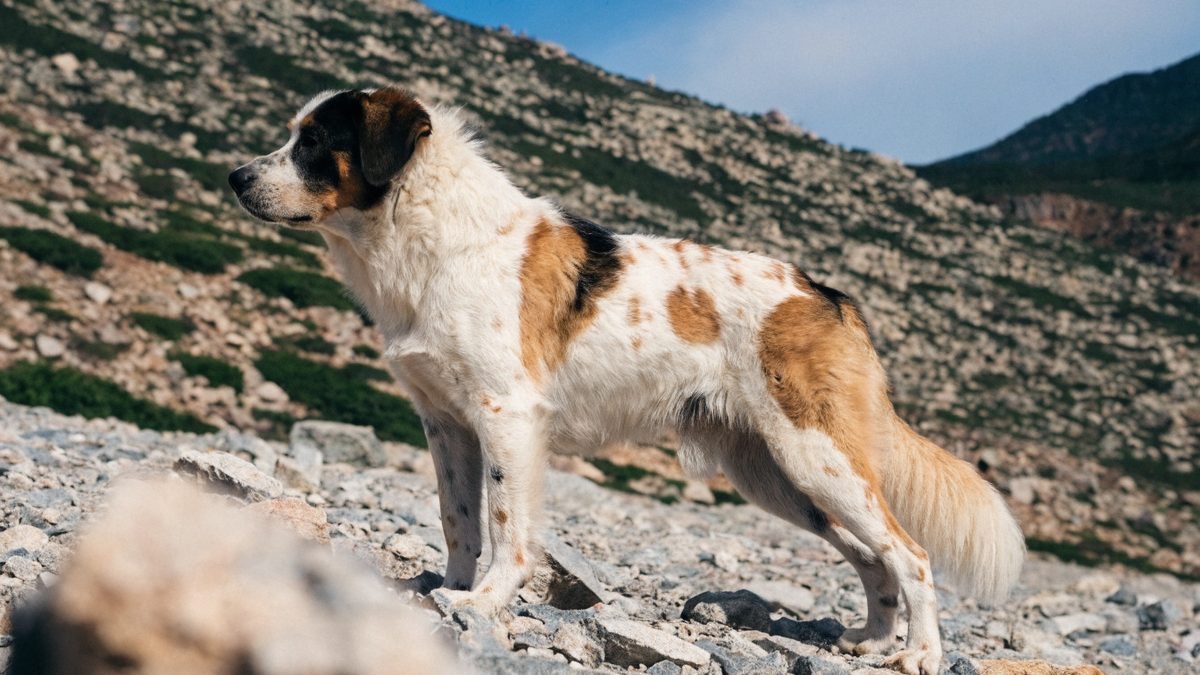
The general appearance clause is worth quoting because the rest of this page keeps returning to it. The standard calls the Aidi a solid, very hardy dog, noted for its power and mobility, well-muscled, sinewy, strongly built but not cumbersome, and possessing a thick bushy coat which protects it equally from the sun and from the cold of its native mountains. That same clause explains what the coat is for beyond weather: this fleece provides a protective armour in the fights which the Atlas dog has to undertake against jackals and other predators. A Moroccan account puts the coat at about 6 centimetres, thick enough to protect against harsh mountain weather and against bites from predators, which matches the standard exactly.
This matters more than it sounds. FCI-Standard No. 247 specifies height, proportions, coat length and even the scapulo-humeral angle, and never states a bodyweight. The UKC standard is the same. So the figures circulating are secondary estimates, and they do not agree: Wikipedia says around 25 kg, Dog Breeds List says 23 to 25 kg, PlexiDor says 50 to 55 lb, Wamiz says 55 to 77 lb, which tops out at 35 kg, and A-Z Animals prints 35 lb, about 16 kg, in its data widget. Bonbeno's working figure is 23 to 30 kg for a correctly built adult, stated as an estimate because that is what it is.
History, and why the breed is scarce even at home
The Atlas dog has existed since time immemorial in the mountains and on the plateaux of North Africa, and is at present found in large numbers in the Atlas Mountains of Morocco. The breed is also present in Algeria, Tunisia and Libya. It is closely linked to the semi-nomadic pastoral populations of the mountainous regions and has the clear role of defending its masters' tent and belongings as well as protecting the flocks from wild beasts. It possesses hunting capabilities and good scenting ability, and in Morocco it is often paired in hunting with the Sloughi, which chases down prey that the Aidi has located by scent. The Sloughi is Morocco's other native breed, FCI-Standard No. 188, a Group 10 sighthound.
Historically the Aidi did not receive the admiration the tribes gave the Sloughi, which was considered noble, and a club was later formed in Morocco to preserve the breed's purity. The Club du chien de l'Atlas was created in 1985 under the tutelage of the Ministry of Agriculture, and its field surveys did much to make the breed known and to establish a census and health monitoring for it. Despite that, Moroccan coverage describes the Aidi as a purely national breed that Moroccans themselves do not know, now living mainly in the Ifrane region and tending to disappear. A Moroccan writer is blunter still: once guarding the homes of kings, tribal leaders and nomadic tribes, the Aidi today is often seen wandering mountain villages, neglected or mistaken for a stray, while imported breeds are preferred for their modern look.
Scholarly work on North African dogs pushes that history much further back than any breed page does. The Encyclopedie berbere devotes a section of its Chien entry to the Standard du Berger de l'Atlas, also called the Chien Kabyle or Chien des douars, and describes it as a very vigilant guard dog, aggressive when in a pack, which appears to have performed that role since Antiquity. It cites Valerius Maximus for Massinissa being guarded by dogs, and Pliny the Elder for the Garamantes training the breed for war. The same authors record the dog in rock engravings of the Atlas Mountains at Ain Marshal, Tiout, Merdoufa and Khanguet el Hadjar, and conclude that the Berger de l'Atlas and the sighthound known as the tessem are the only two autochthonous breeds of North Africa, surviving despite many later introductions. They also give aydi as the generic pan-Berber word for dog, which is the same root Moroccan reporting gives for the breed's name.
The registry numbers make the scarcity concrete, and this comparison is the point at which an Indian reader should stop and recalibrate. The Societe Centrale Canine Marocaine, Morocco's FCI member, registered 1,621 puppies of all breeds combined in 2025, and has registered 32,903 pure-bred dogs in total since its studbook was created. The Kennel Club of India registered 32,219 puppies in 2025 alone and has 1,425,001 pure-bred dogs on its studbook since inception. Morocco's entire pedigree history, across every breed it registers, is roughly one year of Indian registrations. The Aidi is a small fraction of that small number.
- Recognition: FCI Group 2, Section 2.2 Molossoid breeds of mountain type, not subject to a working trial
- Registration: accepted on a definitive basis by the FCI on 13 June 1963; recognised by the United Kennel Club in the Guardian Dog Group on 1 July 2006 United Kennel Club
- Other names: Aidi, Atlas Mountain Dog, Atlas Shepherd Dog, Berber Dog, Chien de l'Atlas, Kabyle Dog
- Registration in the United States: not a breed the American Kennel Club registers
- Status in India: no recognised population, no marketplace listing, no recorded import
One more detail from the standard belongs here because it is a live welfare issue in India. In some regions of Morocco it is customary to crop the ears and even dock the tail of working dogs Wikipedia, Aidi, citing Grandjean D.…. Both procedures are cosmetic mutilations when done for appearance, and both are treated as such by Indian animal-welfare law. Anyone importing a cropped or docked Aidi into India should expect that history to be questioned, not admired.
Aidi price in India: there is no Indian market, and here is the evidence
No Aidi price in India exists, because no Indian seller offers the breed. Bonbeno checked the marketplaces, the search results and the registry statistics, and found no listing, no price band and no recorded import. That is a finding, not a gap, and it is the single most useful thing this page can tell an Indian buyer.
Publishing an invented rupee figure would be the easy move here, and it is what a breed page normally does. Bonbeno will not, because a price in India for a dog nobody sells is a fabrication dressed as research. Instead, here are the four checks, each of which you can repeat.
Check one: India's largest purebred marketplace does not list the breed
Mr n Mrs Pet runs the biggest verified-breeder listing operation in the country, and its dogs-for-sale page carries a breed filter that runs alphabetically from Affenpinscher to Yorkshire Terrier. The filter is not a short list of popular dogs. It includes designer crosses almost nobody asks for, such as the Chorkie, the Bichonpoo, the Corman Shepherd and the Beaglier, and it includes obscure imports such as the Alapaha Blue Blood Bulldog, the Entlebucher Mountain Dog, the Cirneco dell'Etna and the Mountain Cur.
It also includes eight livestock guardian breeds, which is the comparison that matters. Alabai, Anatolian Shepherds, Caucasian Shepherd, Great Pyrenees, Komondor, Kuvasz, Spanish Mastiff and Tibetan Mastiff all have listing pages. The Aidi does not, and neither does the Atlas Mountain Dog under any of its alternate names. A marketplace willing to build a page for the Cirneco dell'Etna has not built one for this breed, which tells you the demand is zero rather than merely small.
Check two: the commercial search result returns a book, not a dog
Searching the exact commercial phrase from India returns a result set with no Indian seller in it. The top organic result is an Amazon India listing for a printed trick-training workbook titled Atlas Mountain Dog (Aidi), priced in rupees because it is a paperback. Position four is a UK breed profile quoting pounds sterling. Positions six and ten are Indian dog-price roundups, one covering the top 40 breeds and the other the most expensive breeds in India, and neither mentions the Aidi at all. When the commercial query for a dog surfaces a book about the dog, the market does not exist.
Check three: the breed price databases cannot state a price either
Dog Breeds List maintains a structured breed record for the Aidi with fields for height, weight, litter size and puppy prices. Its Puppy Prices field reads Average (Unknown). Its popularity rows for 2015 through 2022 are all blank. A database whose entire purpose is publishing breed prices has declined to publish one, which is the most honest thing any page in this SERP does.
| Source | Figure published | What it covers | Does it apply in India |
|---|---|---|---|
| Dog Breeds List | Average (Unknown) | No market data held | No price stated at all |
| Wamiz UK | Around GBP 400 to purchase | United Kingdom | No. There is no UK-to-India puppy trade in this breed |
| Wamiz UK | GBP 80 to 110 per month of care | United Kingdom cost of living | No. Indian food, vet and grooming costs differ entirely |
| A-Z Animals | Around USD 800 from a breeder | United States, source unstated | No. No US breeder exports to India |
| A-Z Animals | USD 400 to 700 yearly vet cost | United States veterinary pricing | No |
| A-Z Animals | USD 30 to 50 monthly food budget | United States retail | No |
| Indian marketplaces | No listing found | India | This is the answer for India |
Do not convert those foreign figures into rupees and call the result an Indian price. A currency conversion of a UK purchase price is a currency conversion, not a market. Indian pricing for an imported dog is set by import logistics, breeder scarcity and dealer margin, none of which the GBP 400 figure contains.
Check four: the registry numbers explain why the market cannot form
The Kennel Club of India is the FCI member body for India, and the FCI publishes its registration statistics openly. India registered 32,219 puppies with the KCI studbook in 2025, with 33,880 pure-bred dogs registered that year and 1,425,001 on the studbook since its creation. Those are large numbers, and they are the pool a rare imported breed would have to be drawn into.
Now look at the supply side. Morocco's FCI member, the Societe Centrale Canine Marocaine, registered 1,621 puppies of all breeds in 2025, from 281 litters, with just five member clubs and eleven FCI judges in the entire country. Its cumulative studbook since inception holds 32,903 dogs across every breed it has ever registered. The Aidi is one breed inside that total, and Moroccan reporting describes it as tending to disappear even in its home range. There is no exportable surplus. An Indian dealer cannot source what Morocco itself is struggling to keep.
If you genuinely want one, the route is import, and it is narrow
To import a dog into India as a pet, the Animal Quarantine and Certification Service permits up to two dogs or cats per passenger under the baggage rule. The consignment needs an official health certificate from the country of origin certifying the dog is free from clinical signs and symptoms of all infectious and contagious diseases including rabies, canine distemper, parvovirus infection and leptospirosis. A dog three months of age or older must be vaccinated against rabies more than one month but within twelve months prior to actual embarkation, with the details officially certified in the health certificate. AQCS states that all decisions are taken as per the notifications, rules, orders and procedures applicable at the time the application is actually filed, so confirm the current position with AQCS directly rather than relying on any web summary, including this one.
This is the practical risk the absence of a market creates. A rare foreign breed name with no Indian reference population is exactly the kind of label that gets attached to an unrelated litter. Ask for the FCI-issued export pedigree from the Societe Centrale Canine Marocaine, the AQCS import documentation, and the rabies certification dates. If the seller cannot produce all three, you are not being offered an Aidi. Verify the paperwork before any money moves, and remember that Bonbeno does not broker sales and does not recommend breeders.
For most Indian readers who arrived here wanting a big, loyal, weather-hardy guardian, the honest conclusion is that this specific breed is not obtainable and the search should move to a dog you can actually see, meet and verify. The Indian Pariah Dog is free to adopt, genuinely heat-adapted and available in every Indian city. If the requirement is a large guardian specifically, the Himalayan Sheepdog is an Indian mountain guardian with a real domestic population, and the Bully Kutta and Kombai are indigenous guarding breeds you can inspect in person.
Monthly cost of keeping an Aidi in India, bounded honestly
Running an Aidi in India costs what any 25 to 30 kg double-coated working dog costs, roughly Rs 9,000 to Rs 16,000 a month on food, preventives, grooming and routine veterinary care. Bonbeno is labelling that a modelled range, not a market figure, because there is no Indian owner base to survey and the only published cost figures for this breed are British and American.
Read the number that follows as arithmetic you can check rather than a survey result. Every input below is either a price you can look up today or a stated assumption. Where a figure is Bonbeno's estimate, it says so.
Food, the largest and most checkable line
A correctly built adult sits somewhere between 23 and 30 kg on the secondary estimates, which straddles two product tiers. Royal Canin Maxi Adult is formulated for large adult dogs of 26 to 44 kg, so a heavier Aidi fits it and a lighter one belongs in a medium-breed formula. On Supertails, the Maxi Adult 20 kg pack is listed at Rs 13,816, the 15 kg at Rs 10,121, the 10 kg at Rs 6,909 and the 4 kg at Rs 3,177. The 20 kg pack works out at roughly Rs 691 per kilogram of food.
A working-build dog of that size on a premium dry diet eats in the region of 300 to 350 g a day, which is Bonbeno's estimate rather than a figure from any breed document, and it varies with activity, neutering status and individual metabolism. At 300 to 350 g a day the dog eats 9 to 10.5 kg a month, which on the 20 kg pack price is about Rs 6,200 to Rs 7,300 a month on food alone. Feeding an Indian mid-tier kibble instead roughly halves that. Feeding a home-cooked diet can cost less again but needs veterinary formulation to stay balanced.
| Line item | Monthly range | Basis |
|---|---|---|
| Premium imported dry food, 300 to 350 g a day | Rs 6,200 to Rs 7,300 | Calculated from the Supertails Royal Canin Maxi Adult 20 kg price of Rs 13,816 |
| Indian mid-tier dry food alternative | Rs 3,000 to Rs 4,000 | Bonbeno estimate, substitute for the line above |
| Tick and flea preventives, year round | Rs 700 to Rs 1,500 | Bonbeno estimate. Not optional in India, see the health section |
| Deworming and routine vaccination, amortised | Rs 400 to Rs 900 | Bonbeno estimate |
| Professional grooming or de-shedding, one session | Rs 1,200 to Rs 3,000 | Bonbeno estimate for a coated dog of this size |
| Routine veterinary consultation, amortised | Rs 500 to Rs 1,200 | Bonbeno estimate |
| Cooling load, fan or air conditioning through summer | Rs 800 to Rs 2,500 | Bonbeno estimate, and see the climate section for why this line is not discretionary |
| Modelled total | Rs 9,000 to Rs 16,400 | Sum of the above using the premium food line |
The one-off costs that dwarf the monthly ones
Because the only route to an Aidi in India is import, the acquisition cost is not a puppy price. It is a puppy price plus international transport, an FCI export pedigree, veterinary certification, and quarantine paperwork. The Animal Quarantine and Certification Service requires an official health certificate from the country of origin covering rabies, canine distemper, parvovirus infection and leptospirosis, plus rabies vaccination more than one month and within twelve months before embarkation. Bonbeno is not going to model a rupee figure for that, because the number depends entirely on route, airline, crate size and current rules, and any figure published here would be a guess presented as research.
Wamiz puts the cost of care at GBP 80 to 110 per month in the United Kingdom. A-Z Animals puts the annual veterinary cost at USD 400 to 700 and the monthly food budget at USD 30 to 50 in the United States. Both are useful for one purpose only: they confirm the Aidi is an ordinary medium-to-large dog to run, not an exotic with special requirements. What they do not do is price anything in India, where food is imported at a premium and year-round parasite control is a bigger line than it is in Britain.
Two Indian cost lines are higher for this breed than for a short-coated dog of the same weight. The first is grooming, because a 6 cm harsh coat with a throat mane and heavy breeches sheds seasonally and mats in humidity. The second is cooling, because a heavy-coated dog in Delhi or Chennai needs an indoor cooled space through the hot months rather than a shaded corner of the compound, and that is a genuine electricity cost rather than a nice-to-have.
Heat tolerance in India, rated 3 of 5, and reasoned from the coat
Bonbeno rates the Aidi 3 of 5 for heat tolerance, the middle of the scale and the highest rating any thick-coated mountain guardian gets on this site. Two facts pull in opposite directions. The breed is roughly 25 kg, far below the bodyweight band that carries the highest heat-related illness risk, and its standard explicitly says the coat protects it from the sun. It also carries about 6 cm of harsh coat plus a throat mane, and heavy-coated dogs are named as being at particular risk of heat stroke Purina India, Heat Stroke in Dogs.
Most breed pages resolve that tension by picking whichever half suits the sentence they are writing. Wamiz states flatly that the Aidi is incredibly tolerant of the heat, and in the very next block states that it does not tolerate cold and wet weather particularly well. Both halves are wrong, and the second is wrong in a way the primary documents settle immediately.
The cold claim is backwards, and that matters for the heat claim
FCI-Standard No. 247 says the thick bushy coat protects the dog equally from the sun and from the cold of its native mountains. The UKC standard repeats it: a thick, bushy coat that protects it from sun and cold. Moroccan reporting says the same, that the Aidi has a thick fur which protects it from the glacial cold of the mountains, from the summer heat, and from the attacks of wild beasts.
Then look at where those mountains are. Le360 places the surviving population mainly in the Ifrane region of the Middle Atlas. Ifrane sits at an elevation of more than 1,650 metres, has a continental-influenced hot-summer Mediterranean climate, receives snow from as early as October and well into spring, and is nicknamed Little Switzerland locally because of its severe cold. Ifrane also holds the record for the lowest temperature ever observed in Africa and the Arab world, minus 23.9 degrees Celsius. A breed whose home range holds the African cold record is not a breed that struggles with cold.
The coat does protect against sun. The sun in question is Middle Atlas sun at 1,650 metres in a dry, hot-summer Mediterranean climate Federation Cynologique Internationale. That is genuine heat, and it is why this breed rates 3 rather than 1. It is not Chennai in August at high humidity, and it is not the Gangetic plain in May. Insulation slows heat gain. It does not remove heat, and a coat that works in dry mountain air performs differently when the air is already saturated and evaporative cooling stops working.
Where the Aidi genuinely beats the giant guardians
The largest study of heat-related illness in dogs examined the clinical records of 905,543 dogs under primary veterinary care in the UK in 2016 and identified 395 confirmed heat-related illness events, with an event fatality rate of 14.18 percent, confidence interval 11.08 to 17.96 percent. Roughly one dog in seven that developed heat-related illness died of it. The multivariable analysis found that dogs over 50 kg had 3.42 times the odds of heat-related illness, confidence interval 1.54 to 7.57, compared with dogs under 10 kg.
An Aidi does not reach that band. On every published estimate the breed sits between about 16 and 35 kg, and the working figure is 23 to 30 kg Dog Breeds List, Aidi, Price, Temperament Wamiz UK, Atlas Mountain Dog. Compare that with the Caucasian Shepherd Dog, whose FCI standard sets a minimum male weight that starts inside the highest-risk band, or the Tibetan Mastiff. The Aidi is roughly half the dog by mass, and mass is the variable the study actually isolated. That single fact is worth two full points on the Bonbeno scale.
The coat detail every other page gets slightly wrong
Here is a precision point no ranking page makes. Neither breed standard requires an undercoat. FCI-Standard No. 247 describes the hair as thick, rather harsh, half-long, about 6 cm long apart from on the face and ears where it is short and finer, forming a mane on the neck and under the throat especially in males, with well-furnished and very long hairs on the breeches and tail. The UKC standard describes it as thick and rather harsh, moderate length on the body, with a distinct mane. Neither mentions an undercoat, and neither treats absence of undercoat as a fault. What both do disqualify is a distinctly short coat.
Secondary sources nonetheless describe a double coat. Pets4Homes calls it a dense double coat of about 2 to 3 inches consisting of a coarse outer layer and a softer undercoat, and A-Z Animals calls it a dense, weather-resistant double coat suited to mountain climates. Those descriptions are probably accurate for most individuals and they are not in the standard, so treat coat density as variable between dogs rather than fixed by the breed. In practice that means you assess the dog in front of you, not the breed page.
Whatever the density, do not shave it. The American Kennel Club explains the mechanism plainly: the soft inner coat close to the skin serves as an insulating layer that helps keep a dog warm in cold weather and cool in hot weather, and in summer the dog sheds much of that under-layer while what remains captures air between the two coat layers, letting the dog keep the heat at bay and regulate its body temperature. Shaving eliminates that insulating layer, makes the dog susceptible to heat stroke, and can result in improper hair growth and follicle damage. Shaved-down undercoat also grows back faster and crowds out the slower-growing guard hairs, permanently changing coat texture and colour.
The Indian numbers that define an emergency
Purina India names the categories at particular risk of heat stroke and puts dogs with heavy coats in the same sentence as short-faced breeds, giving huskies and Newfoundlands as the heavy-coated examples. Its threshold for heat stroke is a raised temperature of 40.5 degrees Celsius or above. Cornell gives the same threshold in Fahrenheit: normal canine body temperature runs 100.5 to 102.5 degrees Fahrenheit, and heatstroke results when the dog cannot regulate and temperature reaches 105 degrees Fahrenheit or higher.
- Walk before sunrise and after dark, never between. A dog can develop heat stroke in as little as 30 minutes of vigorous exercise in hot weather.
- Keep the dog indoors and cooled during the day. Cornell lists remaining indoors during periods of extreme heat and humidity among its core prevention measures, alongside avoiding strenuous exercise in hot and humid weather and avoiding walks during the hottest part of the day.
- Never leave the dog in a car. At an outside temperature of 26 degrees Celsius, a car interior reaches 32 degrees in five minutes and 43 degrees in 25 minutes. Indian afternoons start well above 26.
- Watch for the signs. Heavy panting, drooling, vomiting, bloody diarrhoea, weakness, confusion, seizures and collapse.
- Cool correctly on the way to the vet. Spray or sponge the body with cool but not cold water, making sure it reaches the skin rather than running off the coat, and thoroughly wet the belly and inside the legs. Do not plunge the dog into cold water or an ice bath, which prevents the core temperature coming down. Stop cooling at 39.4 degrees Celsius to avoid hypothermia.
- Treat a survivor as permanently more fragile. Patients that survive heatstroke are at greater risk of heatstroke again in the future.
Cornell adds the part owners rarely hear. If elevated body temperatures are prolonged they damage every organ in the body, and heat stroke commonly leads to acute kidney injury, blood clotting problems and shock. Chances of survival improve with early recognition and intensive treatment, but many do not survive.
What Indian law says about keeping this dog outside
Second Schedule Part IV paragraph 21 of the Prevention of Cruelty to Animals (Dog Breeding and Marketing) Rules, 2017 governs outdoor housing, and it names this exact situation. Three categories of dog shall not be kept in outdoor facilities unless the practice is specifically approved by the attending veterinary practitioner in writing: dogs not accustomed to the temperatures prevalent in the area, dog breeds that cannot tolerate the temperatures prevalent in the area, such as long-haired breeds in high temperature locations, and sick, infirm, aged or young animals. A 6 cm-coated Atlas mountain dog kept in a compound in Nagpur is the textbook illustration of the second category Second Schedule Part IV paragraph 21.
Where outdoor keeping is approved, the same rule sets the standard. Outdoor facilities must include roofed shelters accessible to each animal, large enough to sit, stand, lie down and turn about freely, plus one or more separate outside areas of shade large enough to contain all the animals at once and protect them from the direct rays of the sun. Shelters must have a roof, four sides and a floor, and must provide adequate protection from heat and cold and from direct sun, wind, rain and snow.
Section 11 of the Prevention of Cruelty to Animals Act, 1960 makes it an offence to keep for an unreasonable time any animal chained or tethered upon an unreasonably short or unreasonably heavy chain or cord, and separately makes it an offence for an owner to neglect to exercise reasonably any dog habitually chained up or kept in close confinement. The same section covers failing to provide sufficient food, drink or shelter. The penalty is small, a fine of ten to fifty rupees for a first offence rising to twenty-five to one hundred rupees or up to three months imprisonment for a repeat within three years, but the standard of care the section describes is the right one regardless of the fine. Indian guard dogs are very commonly kept exactly this way, and a heavy-coated import kept this way through an Indian summer is at real risk.
| Region | Verdict | Reasoning |
|---|---|---|
| Himalayan belt: Ladakh, Himachal, Uttarakhand hills, Sikkim | The closest match India offers | Elevation, a real winter and low humidity approximate the Middle Atlas conditions the breed was selected in |
| Deccan plateau: Pune, Bengaluru, Hyderabad | Workable with indoor cooling in summer | Moderate humidity and cooler nights. At 25 kg the dog is well below the high-risk bodyweight band |
| Northern plains: Delhi NCR, Punjab, Haryana, western Uttar Pradesh | Difficult, indoors only through summer | Long, very hot summers. Second Schedule Part IV paragraph 21 effectively rules out unapproved outdoor kennelling for a long-haired breed here |
| Coastal and humid: Mumbai, Chennai, Kochi, Kolkata, Goa | Bonbeno advises against it | Sustained high humidity removes the evaporative cooling a panting dog depends on, and heavy-coated dogs are a named heat stroke risk group |
The summary line is worth stating plainly, because it is the one thing an Indian reader should carry away from this section. The Aidi is heat-tolerant by the standards of mountain guardians and not heat-tolerant by the standards of India. It handles dry heat far better than a northern breed and far worse than a short-coated indigenous dog. If your requirement is a dog that copes with an Indian summer without engineering around it, the Indian Pariah Dog and the Rajapalayam both do that natively, and neither needs importing.
Temperament and household fit, said plainly
The Aidi is very faithful, affectionate and docile with its owner and family members, and it displays inherent guarding and remarkable protective behaviour toward everyone else. Always alert, it instinctively measures the gravity and proximity of any danger and fearlessly provides an appropriate and efficient response. That last sentence is the whole temperament in one line, and it describes a dog that decides for itself.
Both breed standards say the same thing in different words. The UKC calls the Atlas dog always alert and very instinctive in assessing the threat of danger, with inherent guarding and protective behaviour, and very docile and affectionate with its family. Moroccan reporting adds that the breed's proof-against-anything loyalty to its master is equalled only by its great mistrust of strangers.
Independent is the word that matters, and no ranking page uses it correctly
A livestock guardian was selected to work alone, at night, at distance from any handler, and to escalate without being told to. FCI-Standard No. 247 encodes that: the dog measures the gravity and proximity of danger itself, and responds fearlessly. Read as an owner rather than a judge, that means the dog will make threat decisions in your driveway using its own judgement, on its own timescale, about people you have not introduced it to.
This is a fundamentally different animal from a biddable working breed. It is closer to the Himalayan Sheepdog or the Caucasian Shepherd Dog in decision-making style than to a retriever, even though it weighs a third to a half of what the Caucasian does. An independent guardian in an Indian gated society meets domestic help, delivery riders, plumbers, society security and visiting relatives on a near-daily basis, and each of those is a threat assessment the dog will make.
The ranking pages contradict each other on children, and the disagreement is unresolved
| Question | Wamiz | Dogster | Dog Breeds List |
|---|---|---|---|
| Good with young children | Good with older children, but its dislike of boisterous play and teasing makes it an unsuitable playmate of young children | Developed to be very excellent with children, and a good caretaker | Four of five stars, a suitable breed for kids, playful and affectionate around them |
| Good with other dogs | Not very compatible, very territorial | Aidis do not really like other dogs and may be aggressive or territorial; best as the only dog | Three of five stars |
| Suits a flat | Not very compatible with living in a flat | Not addressed directly | One of five stars, needs a minimum of a quarter acre and a five foot fence, semi-rural or rural |
| Tolerates being alone | Cannot tolerate it; hates and fears solitude, follows its owner room to room | Not addressed directly | Not addressed directly |
| Barking | Moderately vocal, barks at anything it thinks is threatening the household | Vigilant, on call at all times | Two of five stars, occasional |
| First-time owner | Not recommended, though it could be considered with essential training | Not addressed directly | Not addressed directly |
Bonbeno will not average those. On children, the sources genuinely disagree, none of them cites data, and the honest answer is that a guard dog bred to make autonomous threat decisions should be supervised around young children regardless of which page you believe. On other dogs, two of three sources warn about territoriality, and both breed standards describe an animal selected to drive off predators, so plan for a single-dog household and treat any exception as a bonus.
Where the sources do agree, and what that means in an Indian flat
Three points survive every source. The Aidi is not an apartment dog, it is strongly bonded and dislikes isolation, and it is an outstanding watchdog. Dog Breeds List rates watchdog ability five of five and describes a dog that will bark and alert its owners when an intruder is present, act fearlessly toward any aggressor, and do what it takes to guard and protect its family. Pets4Homes says these dogs thrive best in rural settings or homes with spacious gardens, not in apartments.
In an Indian 2BHK that combination is a problem rather than a feature. A dog that alerts on every corridor footfall is vocal enough to generate complaints in a shared building, and a dog that cannot tolerate being alone does not cope with a household that leaves for ten hours. The breed is also, per Wamiz, prone to causing extensive damage indoors if not properly looked after.
Wamiz describes a nervous dog that startles easily, does not enjoy rough play, will not appreciate being teased, and becomes painfully shy and withdrawn if subjected to harsh training. Dogster says the breed is particularly sensitive to criticism and that you will not need force to get cooperation. The UKC standard backs this up from the other direction: viciousness or extreme shyness is a disqualification, and the FCI lists aggressive or overly shy as an eliminating fault. A correctly built Aidi is neither a pushover nor a hair-trigger, and heavy-handed handling pushes it toward the shy end, which the standards treat as a fault.
Early socialisation is the single highest-leverage thing an owner does with this breed. Dogster says these dogs are friendly but can be aloof and territorial without exposure to strangers and animals. Pets4Homes says early socialisation and patient training with a firm yet gentle approach are essential to guide their dominant nature positively. In Indian conditions that means deliberately arranging for the puppy to meet the specific categories it will spend its life around, which is exactly what the training section covers next.
Training an Aidi, and the two things this breed resists
To train an Aidi, socialise it hard and early, use positive reinforcement only, and accept that a livestock guardian will always weigh your instruction against its own read of the situation. The breed resists exactly two things: harsh correction, which pushes it toward the shyness both standards treat as a fault, and repetitive drilling, because it bores easily and switches off.
Everything that follows sits on one structural fact from the standard. This dog was selected to assess danger and act without instruction. You are not training obedience into a blank slate; you are negotiating with a decision-maker. That reframes what success looks like. A reliable recall away from a perceived intruder is a genuine achievement with this breed. A crisp competition heel is not the point.
What the sources agree works
- Use positive reinforcement exclusively. Dogster says to always use positive reinforcement methods, avoid over-correcting, and notes the breed is particularly sensitive to criticism, so little force is needed to gain cooperation.
- Stay calm and consistent rather than forceful. Wamiz says firmness and confidence are needed of a trainer, and that a dog subjected to harsh training is likely to become painfully shy and withdrawn.
- Start socialising in the first weeks home. Pets4Homes calls early socialisation and patient training with a firm yet gentle approach essential to guide the breed's dominant nature positively.
- Keep sessions short and varied. Wamiz describes a dog that is easily distracted and easily bored, and Dogster says Aidis love having tasks on the to-do list.
- Give the dog a job. Dogster reports the breed will gladly accompany you on errands and excels at yard games, and that its intensity and playfulness suit structured activity.
The published trainability ratings sit in the middle rather than at either extreme. Wamiz calls the breed moderately easy to train and Dog Breeds List rates trainability three of five while listing the intelligence ranking as not available. Dogster is the outlier, claiming the breed does very well with training and follows directions effortlessly once boundaries are learned, while also conceding a stubborn, independent streak that may make an individual dog more challenging. Read the concession, not the headline.
The Indian socialisation list, written for Indian life
Generic advice to socialise the puppy is useless without a list. The categories below are the ones an Indian household actually generates, and a guardian breed will form a lasting opinion about each of them in its first year.
- Domestic staff who enter daily. Cook, cleaner, driver. These people must be paired with food and calm attention from week one, not managed by shutting the dog away.
- Delivery and gig workers at the gate. A different person every day in a helmet, often in a hurry. This is the single most common trigger category in Indian urban dog-bite incidents.
- Society security, plumbers, electricians, gas delivery. Irregular, uniformed, often carrying equipment.
- Building corridors, lifts and stairwells. Confined spaces with sudden appearances, which is the worst possible context for a guardian to meet a stranger.
- Children who are not yours. Given the unresolved disagreement between sources on child compatibility, treat this as a supervised category permanently.
- Other dogs on lead. Two of three sources warn of territoriality toward other dogs, so this needs structured, distance-first work rather than a free-for-all at the park.
- Festival noise. Firecrackers and amplified music, introduced gradually and long before the season, because Wamiz describes a dog that startles easily.
Realistic timelines
| Stage | Realistic goal | What not to expect |
|---|---|---|
| 8 to 16 weeks | Broad, positive exposure to the categories listed above. Name, crate, toilet routine | Any reliability. This window is about associations, not obedience |
| 4 to 8 months | Loose-lead walking, sit and down under mild distraction, calm on the gate | Recall around a perceived intruder |
| 8 to 14 months | Guarding instinct emerges and hardens. Barking at the gate becomes purposeful | That the friendly puppy phase continues. This is when owners get surprised |
| 14 months to 2 years | Consolidation. The dog's adult threat threshold settles | A dog that defers to you against its own judgement |
| Throughout | Maintain socialisation. Guardian breeds narrow their circle if exposure stops | A one-and-done training course to fix it later |
Dominance-based and correction-heavy methods remain common in Indian dog training, and they are precisely wrong for this breed. Both standards disqualify or eliminate extreme shyness Federation Cynologique Internationale, and Wamiz warns that harsh training produces exactly that outcome. There is also essentially no Indian trainer with hands-on Aidi experience, because there are no Aidis in India. Anyone hiring help should screen for livestock-guardian experience generally, ask what the trainer does when a dog refuses, and walk away from anyone who reaches for a prong collar or an e-collar.
How much exercise an Aidi actually needs, and when in India
An Aidi needs roughly 60 to 90 minutes of daily exercise, taken as sustained walking rather than sprinting, and in most of India all of it has to fit before sunrise and after dark for five to seven months of the year. The breed's natural gait tells you what kind of work it wants: a short, fast trot, single-tracking, at which the standard says the Atlas Dog seems tireless.
That gait clause is the most useful exercise guidance in any document about this breed, and no ranking page quotes it. The UKC repeats it as a tireless, single tracking trot with reasonable reach and the feet kept close to the ground. This is an endurance animal built to cover ground at a steady pace beside a flock, not an explosive dog that needs a hard sprint. Long, unhurried walks satisfy it. Twenty minutes of frantic fetch does not.
The published figures, and why two of them are not the same claim
| Source | As published | Per day | Bonbeno read |
|---|---|---|---|
| Wamiz | Needs a lot of exercise; 10 to 12 miles of walking or running a week recommended | About 2.3 to 2.8 km a day | The headline says a lot, the number says moderate. The two halves do not match |
| Dogster | At least 1 hour of exercise to burn off daily steam | 60 minutes | The clearest and most usable figure in the set |
| Dog Breeds List | Exercise needs three of five stars; should be taken for long daily walks | Unquantified | Consistent with an endurance trotter |
| PlexiDor | Ample amounts of exercise, long daily walks, prefers a large yard | Unquantified | Written by a dog-door retailer, so read the yard emphasis with that in mind |
| Bonbeno | 60 to 90 minutes daily, split across two sessions, walking pace | 60 to 90 minutes | Derived from the standard's endurance gait plus the one quantified source Dogster, Aidi Dog Breed: Info, Pictures |
Note the internal problem in the Wamiz entry, because it is instructive about the quality of the ranking set. Ten to twelve miles a week is about 2.3 to 2.8 kilometres a day, which is a comfortable single walk for a medium dog and nobody's definition of needing a great deal of exercise. Either the descriptor or the number is wrong, and the page does not notice.
The Indian scheduling problem is the real constraint
In Delhi, Nagpur, Ahmedabad, Hyderabad or Chennai, the window in which it is safe to exercise a heavy-coated 25 kg dog is narrow for much of the year. Purina India warns that a dog can develop heat stroke in as little as 30 minutes of vigorous exercise in hot weather, and Cornell's prevention list names avoiding strenuous exercise in hot and humid weather and avoiding walks during the hottest time of the day. That leaves pre-dawn and post-dusk.
One companion study reorders Indian heat advice completely, and it is the reason the timing rules above are not optional. Reviewing the same 905,543 dogs, the authors identified 1,259 heat-related illness events from 1,222 dogs and found that exertional heat-related illness was the predominant trigger at 74.2 percent of the 879 events where a cause was recorded, followed by environmental at 12.9 percent and vehicular confinement at just 5.2 percent. Their conclusion is the paper's title: in the UK, exertional heat-related illness affects more dogs, and kills more dogs, than confinement in a hot vehicle. Public awareness in India, where it exists at all, is about dogs left in parked cars. The evidence says the bigger killer is a dog being walked. For a heavy-coated guardian in Nagpur, the dangerous act is not the car. It is the 11 am walk.
- Split the requirement into two sessions, 30 to 45 minutes each, one before sunrise and one at least an hour after sunset when the ground has cooled.
- Check the ground with your hand, not the air temperature. Indian concrete and tarmac hold heat long after dusk, and paw pads take the damage first.
- Carry water on every walk. Cornell lists offering frequent opportunities to drink among core prevention measures.
- Drop the intensity, not the duration, in summer. An endurance trotter tolerates a longer slow walk better than a short fast one.
- Substitute indoor mental work on the worst days. Scent games suit a breed with documented scenting ability that was traditionally used to locate prey for the Sloughi.
- Never exercise the dog to tire it out in the heat. That is the exact mechanism the heat-related illness literature identifies as the biggest risk.
What happens if the requirement is not met
Under-exercised, this breed goes to work on your house. Wamiz says the Aidi has a tendency to be destructive and that if it is not properly looked after it can cause extensive damage inside the house. Dogster says that without enough physical outlet time the result is unwanted destructive tendencies, and recommends space, a variety of toys and interaction to avoid it. Wamiz also notes the breed becomes obese if not exercised as regularly as it should be and fed too much human or substandard food.
Dog Breeds List rates apartment friendliness one of five and specifies a minimum of a quarter acre with at least a five foot fence, in a semi-rural or rural setting. Wamiz goes further and says a well-fenced garden is by itself insufficient provision for this dog. For an Indian buyer the practical translation is that a farmhouse, a large independent plot or a hill property works, and a flat does not, no matter how many walks you promise yourself you will do.
Grooming a 6 cm mountain coat in Indian humidity
Brush an Aidi at least twice a week, daily through a seasonal shed, and never shave it. The coat is thick, rather harsh and half-long at about 6 cm, short and finer only on the face and ears, with a mane on the neck and under the throat and very long hair on the breeches and tail. In Indian humidity that structure traps moisture, and moisture is what turns a healthy coat into a skin problem.
The ranking pages disagree about grooming more sharply than about anything else except lifespan, and the disagreement is not a matter of emphasis. One page says the coat needs little attention. Another says brush it at least twice a week with a firm bristle brush. Both cannot be describing the same 6 cm double-layered coat.
| Source | Brushing | Bathing | Shedding rating |
|---|---|---|---|
| Wamiz | At least twice weekly with a firm bristle brush | Only when necessary, mild dog shampoo | Labelled Heavy, while the text says a moderate amount of fur. The page contradicts itself |
| Dogster | A weekly brush to avoid matting | Every 4 to 6 weeks for optimal coat health | Dense coats need weekly care |
| Dog Breeds List | Occasionally, with a firm bristle brush; the coat is easy to groom and needs little attention | Only when necessary | Three of five, moderate; described as an average shedder |
| Pets4Homes | Regular grooming, especially in spring and autumn when shedding peaks | Not specified | Shedding peaks seasonally |
| Bonbeno for India | Twice weekly minimum, daily during a shed, line-brushing the mane and breeches | Every 4 to 6 weeks, dried thoroughly to the skin | Plan for a heavy seasonal shed and constant light shedding |
Bonbeno sides with the twice-weekly minimum, and the reason is structural rather than editorial. A coat described by its own standard as forming a mane, with well-furnished and very long hairs on the breeches and tail, has three distinct areas that mat first. Advice to brush occasionally was written for a flat single coat, not for this.
Why Indian humidity changes the job
In the Middle Atlas the coat dries. Ifrane sits above 1,650 metres in a hot-summer Mediterranean climate with cool, damp winters and dry summers. In Mumbai, Kochi or Kolkata during the monsoon, a thick, weather-resistant coat that gets wet stays wet at the skin for hours. That is the precondition for matting, for hot spots, and for a tick to attach and feed undisturbed.
- Line-brush rather than surface-brush. Part the coat down to the skin in rows and work outward, because a brush skated over the top of a 6 cm coat leaves the mat forming underneath it.
- Prioritise the four failure points. The throat mane, behind the ears, the breeches and the tail plume are where the standard says the hair is longest and thickest, and they are where mats and ticks appear first.
- Dry to the skin after every bath and every soaking. A towel-dried double coat is still wet underneath. Use a dryer on cool, or do not bathe the dog before a humid evening.
- Run a tick check into every grooming session. In a 525-dog Indian study, 53 percent of dogs were visibly infested with ticks. On a coated dog you find them by hand, not by eye.
- Watch for hot spots through the monsoon. Sudden localised licking or a damp, smelly patch under the coat needs a vet, not more brushing.
- Trim nails, clean ears and brush teeth on the same schedule, which Dogster recommends folding into bath time.
The one rule with no exceptions
Do not shave the coat to keep the dog cool. The American Kennel Club sets out why: a double-coated dog has a soft inner coat close to the skin that serves as an insulating layer, keeping the dog warm in cold weather and cool in hot weather, and in summer the dog sheds much of that under-layer while what remains captures air between the two coat layers, letting the dog keep the heat at bay and regulate its body temperature. Shaving eliminates that layer, makes the dog susceptible to heat stroke, and can cause improper hair growth and follicle damage. Shaved undercoat also regrows faster than the guard hairs and crowds them out, permanently changing texture and colour and leaving the coat patchy.
The summer shave is standard practice in many Indian grooming salons for coated breeds, and it is sold as a kindness. For a double coat it is the opposite: it removes the insulating layer and increases heat stroke risk while also exposing skin that has never seen direct sun to Indian UV. The correct summer intervention is de-shedding, which removes dead undercoat and leaves the guard coat intact, plus indoor cooling. If a salon cannot tell you the difference between de-shedding and shaving, find another salon.
One coat-related point sits outside grooming but belongs here. The standard notes that in some regions of Morocco it is customary to crop the ears and dock the tail of working dogs Wikipedia, Aidi, citing Grandjean D.…. The tail plume is a breed feature the standards actively protect, with the FCI treating insufficient plume as an eliminating fault and the UKC disqualifying lack of tail plume United Kennel Club. A docked Aidi has lost a trait its own standard requires, which is worth knowing if anyone presents a docked dog to you as a superior working specimen.
Health risks and lifespan: what is genuinely known, which is very little
No breed-specific health data exists for the Aidi. There is no cohort study, no breed health survey, and no screening database entry. The Orthopedic Foundation for Animals, which publishes hip, elbow, eye and cardiac statistics for hundreds of breeds, holds no entry for the Aidi or the Atlas Mountain Dog at all. Neither breed standard states a lifespan or names a single hereditary condition United Kennel Club. Everything else you will read about this breed's health is an assertion.
This is the section where a breed page normally borrows. It takes the hip dysplasia percentage from a comparable livestock guardian, presents it under the rare breed's name, and nobody checks. Bonbeno will not do that. A number generated for the Caucasian Shepherd or the Anatolian describes those populations, not this one, and passing it off as Aidi data would be a fabrication with a citation attached to make it look otherwise.
The OFA check, and what an absent entry means
OFA's advanced search carries a breed selector listing every breed for which it holds published screening statistics. Reading that list directly, it runs alphabetically through Airedale Terrier, Akbash Dog, Akita, Alano, Alapaha Bulldog, Alaskan Husky and onward. There is no Aidi. There is no Atlas Mountain Dog. The Akbash Dog, another livestock guardian from a similarly small population, is there. This one is not.
That absence means no North American screening has been submitted in sufficient volume to generate a statistic. It does not mean the breed is free of orthopaedic disease. It means nobody has counted, which is a different sentence with a very different meaning.
Pets4Homes states that the Aidi is known as one of the healthiest dog breeds, free from hereditary or congenital issues often affecting other breeds. Dogster says Aidis are generally very healthy dogs with no known health issues to speak of, and that you will likely save tremendously on vet bills. Neither page cites anything. A breed with no registry surveillance, no health survey and no OFA entry will always produce zero recorded disorders, because there is no mechanism recording them. Read those claims as an absence of data, not as evidence of robustness.
Lifespan: six published figures, no source behind any of them
| Source | Lifespan published | Evidence offered |
|---|---|---|
| Dog Breeds List | 10 to 12 years | None. The page's only listed reference is a YouTube video |
| PlexiDor | Average life span of 12 years | None. Page written by a dog-door retailer |
| Wamiz | 12 to 13 years | None |
| Pets4Homes | Can live well beyond 12 years | None |
| Dogster | 12 to 15 years | None |
| A-Z Animals, FAQ | 12 to 15 years | None |
| A-Z Animals, data widget on the same page | 4 years | None, and it contradicts the FAQ directly above it |
| Bonbeno | No reliable figure exists | Stated because it is true |
The A-Z Animals contradiction is worth pausing on, because it is the clearest possible demonstration of the problem. The same page, at the same moment, printed 4 years in its structured lifespan field and 12 to 15 years in its FAQ answer to how long an Aidi lives. Neither number came from anywhere. This is what breed data looks like when it is generated rather than measured.
For context rather than substitution, the largest study of companion dog longevity analysed 584,734 dogs in the UK, including 284,734 deceased, across 155 breeds, and estimated median survival across all individuals at 12.5 years. Four of the six Aidi claims sit at or above that all-breed median, which would be a notable finding if any of them rested on anything. None does.
The conditions the sources name, with the honest caveat attached
Two ranking pages name the same short list. Dogster lists hip and elbow dysplasia as serious conditions and eye problems including glaucoma and cataracts as minor ones. Wamiz lists hip and elbow dysplasia and eye problems as common illnesses. Neither gives a prevalence figure, a study, or a sample size, and the two lists are close enough to be copies of one another.
Hip dysplasia is worth screening for regardless, because it is common across medium and large working breeds generally and because a hip score is cheap next to the cost of discovering the problem at four years old. The same applies to elbows and to a basic ophthalmic examination. Bonbeno's position is that you screen because screening is prudent for any medium-to-large working dog, not because anyone has demonstrated this breed carries elevated risk.
- Screen hips and elbows at the age your vet advises, and keep the report. On a breed with no data, your dog's results are the data.
- Get a baseline ophthalmic examination, since eye problems are the other condition both sources name.
- Weigh and body-score every month. Wamiz warns the breed becomes obese if under-exercised and fed too much human or substandard food.
- Take a rectal temperature reading if the dog is off through summer. Heat stroke is defined at 40.5 degrees Celsius or above, and 105 degrees Fahrenheit or higher.
- Keep tick prevention running all year, not seasonally. See the Indian disease load below.
- Verify any health claim a seller makes against paperwork, because there is no breed database to check it against.
The Indian health risks that are actually measured
Here is the reversal that matters. The inherited risks for this breed are unmeasured, but the environmental risks in India are measured, and they are large. A survey of canine tick-borne disease in India tested 525 dogs by polymerase chain reaction and found 261, or 49.7 percent, infected with one or more tick-borne pathogen, confidence interval 45.4 to 54.1 percent. On visual inspection, 278 of the 525 dogs, or 53 percent, were infested with ticks.
| Pathogen | Prevalence | 95 percent confidence interval |
|---|---|---|
| Hepatozoon canis | 30 percent | 26.0 to 34.0 |
| Ehrlichia canis | 20.6 percent | 17.2 to 24.3 |
| Mycoplasma haemocanis | 12.2 percent | 9.5 to 15.3 |
| Anaplasma platys | 6.5 percent | 4.5 to 8.9 |
| Babesia vogeli | 5.5 percent | 3.7 to 7.8 |
| Babesia gibsoni | 0.2 percent | 0.01 to 1.06 |
| Any pathogen | 49.7 percent | 45.4 to 54.1 |
The study concludes that at least six species of canine tick-borne pathogen are present in India. For a dog with a 6 cm coat, a throat mane and heavy breeches, this is not a background risk. It is the most likely thing to make the dog seriously ill, and a tick that attaches deep in the mane on a dog nobody has hand-checked will feed for days.
The second measured risk is heat. The UK heat-related illness study put the event fatality rate at 14.18 percent, and Cornell notes that prolonged elevated body temperature damages every organ, commonly causing acute kidney injury, blood clotting problems and shock, with many dogs not surviving. An Aidi's moderate bodyweight helps here, since the 3.42-fold odds increase applied to dogs over 50 kg, but a heavy coat is separately named as a risk factor.
Nothing in this section is a diagnosis or a treatment plan, and none of it predicts what any individual dog will experience. Because there is no breed-level evidence for the Aidi, the value of a veterinary relationship is higher here than for a well-documented breed, not lower. Consult your nearby vet to set a screening schedule, choose a tick preventive appropriate to your city and season, and agree what to do on a hot-weather emergency before you need the plan. If a dog shows heavy panting, drooling, vomiting, bloody diarrhoea, weakness, confusion, seizures or collapse, treat it as an emergency and get to a veterinary hospital.
Feeding an Aidi in India, by life stage and body condition
Feed an Aidi to body condition, not to a chart, because the breed has no published weight standard to feed toward. FCI-Standard No. 247 states height but never states a weight, and the UKC standard does the same United Kennel Club. That removes the usual anchor, so the ribs and the waistline become the instrument instead of the bag.
There is one piece of genuinely breed-specific feeding guidance in the whole ranking set, and it is worth acting on. Wamiz reports that the Aidi is not known to be a glutton, and that its stomach is sensitive to changes of diet and of frequency of feeding. Dogster says the breed has no dietary restrictions that are breed-specific and recommends feeding according to weight and life stage. Taken together: an ordinary diet, fed consistently, with transitions made slowly.
Choosing a formula when the dog sits between two size tiers
A 23 to 30 kg adult straddles the medium and large product bands. Royal Canin Maxi Adult, one of the most widely stocked large-breed formulas in India, is tailored for large adult dogs of 26 to 44 kg. An Aidi at the lower end of the weight estimates belongs in a medium-breed formula instead. Pick by the dog's actual adult weight, not by the impression that a guardian breed must need a giant-breed food.
| Life stage | Meals per day | Focus | Bonbeno note |
|---|---|---|---|
| 8 to 16 weeks | 4 | Large or medium-breed puppy formula, transitioned gradually from the breeder's food | Sudden changes are the main cause of loose stools at this age, and this breed's stomach is described as sensitive to diet change |
| 4 to 6 months | 3 | Controlled growth. Avoid over-supplementing calcium | Fast growth in a medium-to-large breed is a joint risk regardless of what the breed data does or does not say |
| 6 to 12 months | 2 to 3 | Steady growth, body condition checked monthly | Growth plates are still closing. Keep the dog lean rather than filled out |
| 12 to 18 months | 2 | Transition to adult formula on your vet's timing | The dog is still maturing mentally well past this point |
| Adult, 25 to 30 kg | 2 | Roughly 300 to 350 g a day of a premium dry food, adjusted to condition | This gram figure is a Bonbeno estimate, not a breed standard figure. Adjust it by what you see and feel |
| Senior | 2 | Lower calorie density, joint support if advised | No breed-specific senior guidance exists, because no breed-specific data exists |
How to read body condition on a coated dog
Body condition scoring is harder on a 6 cm coat than on a short-coated dog, and this is where Indian owners of coated breeds most often go wrong. You cannot assess this dog by looking at it. The coat forms a mane at the neck and throat and long hair on the breeches, which visually fills out the outline regardless of what is underneath.
- Feel the ribs with flat hands, not fingertips. You should find them under a thin layer, with light pressure, the way knuckles feel through the back of your hand.
- Check the waist from above with your hands on the flanks, pressing through the coat rather than judging the silhouette.
- Check the abdominal tuck from the side by touch. The standard describes an underline rising behind the false ribs without being whippety, which is the correct adult outline.
- Weigh monthly and record it. On a breed with no published weight range, your own trend line is the only reference you have.
- Act on a five percent gain. Wamiz names obesity as the consequence of under-exercising and over-feeding this breed.
Feeding through an Indian summer
Two adjustments matter through the hot months. First, move the larger meal to the cooler end of the day, because a full stomach and a hot afternoon are a poor combination for any deep-chested dog. FCI-Standard No. 247 describes a chest that is long and well let-down, reaching at least as far as the elbows, with a chest depth to height ratio of 1:2, so a conservative feeding-and-rest routine is prudent even though no bloat incidence data exists for this breed.
Second, keep water available constantly and in more than one place. Wamiz's own note on heat says that whatever else is true, you must make sure there is plenty of fresh water on hand, and Cornell lists offering frequent opportunities to drink among core heat prevention measures.
Large-breed dry food is easy to source in Indian metros. The Royal Canin Maxi Adult line alone is listed in pack sizes from 220 g up to 20 kg, priced from Rs 238 to Rs 13,816. Buying the largest pack is the cheapest per kilogram, but a 20 kg bag opened in a humid Indian summer goes stale and can grow mould before a single dog finishes it. For one Aidi, the 10 kg or 15 kg pack is usually the better balance, stored sealed and off the floor. If you feed a home-prepared diet instead, have it formulated by a veterinary nutritionist rather than assembled from social media recipes.
Aidi puppy: the first year, month by month
An Aidi puppy arrives from a litter of typically 5 to 8, and its first year runs in three phases: exposure, growth, and the emergence of the guarding instinct somewhere between eight and fourteen months. In India there is a fourth variable overlaying all of it, which is the season you bring the puppy home in.
Read this timeline as a plan for a guardian breed generally, calibrated with what the two standards say about this specific dog. There is no Aidi puppy development study, and Bonbeno is not going to invent milestones to fill a table. What is documented is the adult temperament the puppy is heading toward: a dog that measures danger itself and responds without instruction.
| Age | What is happening | What you do |
|---|---|---|
| Before arrival | Litter of 5 to 8 raised with the dam | Confirm the export pedigree and the AQCS import documentation before anything else. Time the arrival for October to February if you can |
| Month 2, 8 to 9 weeks | Settling, first vaccinations, sensitive to everything | Keep the existing food and transition slowly, because this breed's stomach is described as sensitive to diet change. Four meals a day |
| Month 3 | Peak socialisation value | Start the Indian socialisation list in earnest: domestic staff, delivery riders, corridors, lifts. Positive reinforcement only |
| Month 4 | Teething, boundary testing | Introduce grooming as a routine now, before the coat gets long. Handle the ears, feet, throat and breeches daily |
| Months 5 to 6 | Rapid growth, ears settling toward the half-dropped carriage the standard requires | Drop to three meals. Keep the puppy lean. Begin loose-lead work |
| Months 7 to 8 | Coat thickening, mane starting to show in males | Move to twice-weekly brushing. Start a year-round tick preventive |
| Months 8 to 10 | Guarding instinct begins to emerge. Barking at the gate becomes purposeful | Do not suppress it with punishment. Redirect and reward calm. Harsh correction here produces the shyness both standards fault Federation Cynologique Internationale |
| Months 11 to 12 | Approaching adult height, 52 to 62 cm | Transition to adult food on your vet's timing. Two meals. Book the first orthopaedic screening discussion |
| Months 12 to 24 | Mental maturation continues well past physical maturity | Maintain socialisation. This is where owners stop and where guardian breeds narrow their circle |
The Indian seasonal question nobody asks
Bring a heavy-coated puppy home in October or November rather than in April. The reason is not comfort, it is the socialisation window. Months two through four are when exposure does the most work, and in an Indian summer those are exactly the months when you cannot take the puppy outside during daylight Cornell University College of Veterinary…. A puppy that arrives in April spends its highest-value learning period indoors, and the deficit shows up at ten months as a dog that is suspicious of everything.
- Book the socialisation outings for dawn and after dark through the hot months, exactly as you would an adult's exercise.
- Use car-free indoor environments for exposure when outdoor time is unsafe. Lift lobbies, stairwells and covered parking still teach the dog about strangers.
- Never leave a puppy in a parked car, even for a moment. A car interior goes from 26 to 43 degrees Celsius in 25 minutes.
- Introduce water and cooling as normal, not as an emergency response, so the dog accepts being wetted down before it ever needs it.
- Check the puppy's temperature if it is dull on a hot day. Heat stroke starts at 40.5 degrees Celsius.
Every row above assumes you have somehow legitimately imported a documented puppy, which is a narrow and expensive path Federation Cynologique Internationale. Bonbeno publishes the timeline because an encyclopedia should be complete, not because it is recommending the acquisition. If you are reading this because you saw an Indian listing for an Aidi puppy, go back to the price section: no Indian marketplace lists this breed, and a puppy offered under that name without a Moroccan export pedigree is something else.
Aidi vs the guardians Indian buyers actually cross-shop
The Aidi's real advantage over the guardian breeds Indian buyers consider is mass, and it is a large advantage. At roughly 23 to 30 kg it sits far below the Caucasian Shepherd, whose FCI standard sets a minimum weight of 50 kg for males and 45 kg for females, and below the Tibetan Mastiff, whose standard sets a minimum height of 66 cm for dogs. Its disadvantage is equally simple: you cannot get one.
Anyone searching this breed in India is usually working through a list of large protective dogs. The comparison below is built on the primary standards rather than on breed-page summaries, which is why the weights and heights here can be checked against a document rather than against another blog.
| Breed | Size per the standard | Heat tolerance for India | Available in India | The trade-off |
|---|---|---|---|---|
| Aidi | 52 to 62 cm; no weight stated | 3 of 5 | No. Not listed by any Indian marketplace | The best heat profile of any mountain guardian here, and the only one you cannot buy |
| Caucasian Shepherd Dog | Males 72 to 75 cm desirable, minimum 50 kg; guard coat and undercoat each not less than 5 cm | 1 of 5 | Yes, listed and sold | Starts inside the bodyweight band with 3.42 times the odds of heat-related illness |
| Tibetan Mastiff | Dogs 66 cm minimum, bitches 61 cm minimum | 1 of 5 | Yes, widely listed | Another Group 2 Section 2.2 mountain molossoid, far heavier and far more coated |
| Himalayan Sheepdog | No FCI standard; Indian mountain guardian | 2 of 5 | Yes, in its home range | India's own mountain guardian, and the closest domestic analogue to what an Aidi does |
| Bully Kutta | No FCI standard; subcontinental guarding mastiff | 2 of 5 | Yes, listed as Indian Mastiff | Native, but a substantially heavier and harder-edged guarding dog |
| Kombai | No FCI standard; South Indian guarding breed | 4 of 5 | Yes, listed | Genuinely adapted to South Indian heat, short-coated, and obtainable |
| Indian Pariah Dog | Landrace, no standard weight | 5 of 5 | Yes, free to adopt everywhere | Not a specialist guardian, but the best heat and health profile on this list |
Aidi vs Caucasian Shepherd, the comparison that matters most
These two are both Group 2 mountain guardians, and the gap between them is larger than the shared label suggests. FCI-Standard No. 328 sets the Caucasian Shepherd's guard coat and undercoat each at not less than 5 cm, on a dog with a minimum weight of 50 kg. FCI-Standard No. 247 gives the Aidi a coat of about 6 cm total, on a dog of unstated but far lower weight.
That difference lands directly on the heat evidence. The heat-related illness study found the 3.42-fold odds increase specifically in dogs over 50 kg, which is where a correctly built male Caucasian Shepherd begins its adult life and where an Aidi never arrives. If the requirement is a mountain guardian that has any business in an Indian city, the Aidi is the better-designed animal on paper. It is also the one with no supply, no health data and no Indian veterinary familiarity, which is why the practical recommendation still points elsewhere.
Aidi vs Sloughi, Morocco's other native breed
Indian readers who reach the Aidi through North African breed lists usually meet the Sloughi at the same time, and the two are complementary rather than competing. The Sloughi is FCI-Standard No. 188, origin Morocco, a Group 10 Section 3 short-haired sighthound. The Aidi is a Group 2 Section 2.2 mountain molossoid. In Morocco they are worked together, the Aidi locating prey by scent and the Sloughi running it down.
For Indian conditions the Sloughi is the more heat-suited of the two by a wide margin, being a short-coated desert sighthound rather than a mountain dog in a 6 cm fleece Federation Cynologique Internationale. Neither has an Indian market. If the appeal is North African heritage rather than guarding function, that is worth knowing before you fix on the Aidi.
If the requirement is a guard dog you can actually acquire, verify and treat in India, the honest shortlist is the Himalayan Sheepdog for a mountain guardian in the hills, the Kombai or Rajapalayam for a heat-adapted indigenous guarding dog in the south, and the Indian Pariah Dog if the real requirement is an alert, healthy, hardy companion rather than a specialist protector. All four are obtainable, all four have Indian veterinary familiarity behind them, and three of the four cost nothing to adopt.
Mistakes Indian buyers make with this breed, starting before the dog arrives
The most expensive Aidi mistake in India happens before any dog exists: paying for a puppy sold under this name without a Moroccan export pedigree. No Indian marketplace lists the breed, Morocco's entire national registry recorded 1,621 puppies of all breeds in 2025, and a name with no local reference population is the easiest label in the world to attach to an unrelated litter.
The remaining mistakes are the ones that appear once a heavy-coated mountain guardian is actually living in an Indian household. Each one below is traceable to something a primary document or a study says, rather than to general advice.
Nine mistakes, and what the evidence says instead
- Believing the coat makes the dog heat-proof. The standard says the coat protects from the sun of its native mountains, and those mountains sit above 1,650 metres in a dry climate that holds Africa's cold record Wikipedia, Ifrane, Middle Atlas, Morocco. Purina India separately names heavy-coated dogs among the groups at particular risk of heat stroke.
- Shaving the coat in April. This removes the insulating layer, makes the dog susceptible to heat stroke, and can cause improper hair growth and follicle damage. De-shed instead, and cool the room rather than the dog.
- Calling it a herding dog and training it like one. The FCI standard states outright that the Moroccan dog has never guarded flocks in the European herding sense, and the UKC says the same. Two currently-ranking pages still repeat the error Wamiz UK, Atlas Mountain Dog.
- Using correction-based training on a sensitive guardian. Harsh training makes this dog painfully shy and withdrawn, and extreme shyness is a UKC disqualification and an FCI eliminating fault Federation Cynologique Internationale.
- Skipping socialisation because the dog is meant to guard. Without exposure to strangers and animals the breed becomes aloof and territorial, and early socialisation is described as essential to guide its dominant nature positively.
- Keeping it chained or tethered in a compound. Second Schedule Part IV paragraph 21 bars long-haired breeds from outdoor facilities in high temperature locations without written veterinary approval, and Section 11 of the 1960 Act makes chaining for an unreasonable time and failing to exercise a habitually chained dog offences in themselves.
- Exercising the dog at 11 am. Heat stroke can develop in as little as 30 minutes of vigorous exercise in hot weather, and Cornell names avoiding strenuous exercise in hot, humid weather among its core prevention measures.
- Treating tick prevention as seasonal. Nearly half of dogs in a 525-dog Indian survey carried at least one tick-borne pathogen, and 53 percent were visibly infested. On a 6 cm coat with a throat mane, you find ticks by hand or not at all.
- Assuming the breed is healthy because no page lists problems. There is no OFA entry, no breed health survey and no cohort study for the Aidi. Sources claiming it is one of the healthiest breeds cite nothing Dogster, Aidi Dog Breed: Info, Pictures.
The apartment mistake, which is the most common Indian one
Every source that addresses housing agrees, which almost nothing else about this breed does. Dog Breeds List rates apartment friendliness one of five and specifies a minimum of a quarter acre with a five foot fence in a semi-rural or rural setting. Wamiz says a flat is too small and confined for such a highly-strung animal, and that even a well-fenced garden is insufficient by itself. Pets4Homes says these dogs thrive in rural settings or homes with spacious gardens, not in apartments.
Combine that with a dog that Wamiz says cannot tolerate being left alone and hates solitude, and a dog rated five of five for watchdog ability that will bark and alert whenever it perceives an intruder, and the Indian flat outcome writes itself. The dog alerts on corridor traffic all day, the neighbours complain, the owner starts confining the dog, and a breed with a documented destructive tendency when under-stimulated takes the house apart.
Do not send money for an Aidi puppy on the strength of a photograph and a WhatsApp conversation. There is no Indian supply chain for this breed, the Moroccan registry is small enough that legitimate exports are traceable, and the Animal Quarantine and Certification Service leaves a documentary trail for every legally imported pet. If the seller cannot show you the export pedigree, the AQCS paperwork and the rabies certification dates, the transaction is not what it claims to be. Bonbeno does not broker sales and does not recommend breeders.
Adoption and responsible sourcing, when the breed itself is unavailable
You cannot adopt an Aidi in India, and you almost certainly cannot buy one either. Wamiz, which runs an adoption listing service in the United Kingdom, shows zero Atlas Mountain Dog adoption profiles. No Indian marketplace lists the breed. The useful version of this section is therefore about what to do with the impulse that brought you here.
Dogster's advice on sourcing is the standard line, and it is worth quoting because of what it concedes. Aidis are incredibly rare and therefore hard to find, and even though the breed is uncommon you might be able to find an Aidi or Aidi mix at a local rescue. That is written for a North American reader. In India the second half does not apply, because there is no founding population from which a mix could arise.
If you want to help this breed, the work is in Morocco
The Aidi's conservation problem is real and documented. Moroccan reporting describes a purely national breed unknown to Moroccans themselves, now concentrated in the Ifrane region and tending to disappear. A Moroccan writer describes the breed as once guarding the homes of kings, tribal leaders and nomadic tribes, and today often seen wandering mountain villages, neglected or mistaken for a stray, while imported breeds are chosen for their modern look. The Club du chien de l'Atlas, created in 1985 under the Ministry of Agriculture, ran the field surveys that established a census and health monitoring for the breed.
The registry numbers show how thin the base is. Morocco's FCI member registered 1,621 puppies of all breeds in 2025 from 281 litters, with five member clubs in the entire country. Buying a puppy and importing it to a climate the breed was not selected for does not help that situation. Supporting the Moroccan preservation effort does.
The Indian adoption route, which is the one that actually exists
Every Indian city has adoptable dogs today, and a share of them are large, alert, coated and protective. If the appeal of the Aidi was a loyal guardian rather than a rare pedigree, the Indian Pariah Dog delivers most of it with a heat profile no imported mountain breed can match, and it costs nothing to adopt.
- Contact the municipal shelter and two local rescues rather than searching breed names. Describe the dog you want by temperament and size, not by breed.
- Ask for the sterilisation and rabies vaccination records and keep them, since these travel with the dog and matter for boarding and travel later.
- Meet the dog three times before deciding, including once in the evening when it is alert rather than sleepy.
- Budget the same monthly cost as the modelled range in the cost section, because an adopted 25 kg dog eats what a bought one eats.
- Start a year-round tick preventive on day one, given the Indian pathogen load.
- Book a full veterinary examination in the first week, and use it to set the screening and vaccination schedule with your nearby vet.
If you still intend to import, here is the verification checklist
Bonbeno does not recommend this route and does not recommend any breeder. If you proceed anyway, these are the documents that separate a real Aidi from a claim, and you should hold all of them before any money moves.
| Document | Who issues it | What it proves |
|---|---|---|
| FCI export pedigree | Societe Centrale Canine Marocaine, Morocco's FCI member | That the dog is a registered Aidi with recorded parentage, not a similar-looking local dog |
| Official health certificate from the country of origin | Government veterinary authority of the exporting country | Freedom from clinical signs of infectious and contagious disease including rabies, canine distemper, parvovirus and leptospirosis |
| Rabies vaccination record with dates | Attending veterinarian, certified in the health certificate | Vaccination more than one month and within twelve months before embarkation, for a dog three months or older |
| AQCS import clearance | Animal Quarantine and Certification Service, Department of Animal Husbandry and Dairying | That the import is lawful. Up to two pets per passenger under the baggage rule |
| Hip and elbow screening on both parents | A veterinary radiologist | The only orthopaedic evidence that will ever exist for this breed, since OFA holds no entry for it |
| Photographs of the dam and sire against the standard | You, checking them yourself | Coat about 6 cm with mane and tail plume, ears half-dropped not pricked, tail not curled over the back United Kennel Club |
That last row is a genuine test you can run. FCI-Standard No. 247 lists permanently pricked ears, a tail permanently curled over the back, insufficient plume and a short coat as eliminating faults, and the UKC makes prick ears, lack of tail plume and a distinctly short coat outright disqualifications. A dog offered to you with pricked ears and a curled tail fails its own breed standard, whatever the paperwork says.
Bonbeno's position on the Aidi in India is that this is a genuinely interesting breed, well designed for a job in a place that is not India, with no supply chain, no health data and no veterinary familiarity here Mr n Mrs Pet, Find Healthy Dogs for Sale…. We publish the page because an encyclopedia of dogs should contain every breed, including the ones you should not buy. If you came here to find one, the better outcome is that you leave with an accurate picture of a Moroccan mountain guardian and an adopted Indian dog. Verify everything, import nothing you cannot document, and consult your nearby vet before committing to any large working breed in an Indian climate.
Aidi dog questions Indian readers actually ask
What is the Aidi dog price in India?
There is no Aidi price in India, because no Indian seller offers the breed. India's largest verified-breeder marketplace lists breeds alphabetically from Affenpinscher to Yorkshire Terrier, including eight other livestock guardian breeds, and carries no Aidi page at all. The only published prices are British and American.
Can you buy an Aidi in India?
No Indian breeder or marketplace offers the Aidi, and the only lawful route is import. That needs a Moroccan export pedigree, an official health certificate covering rabies, distemper, parvovirus and leptospirosis, and clearance under the Animal Quarantine and Certification Service baggage rule, which permits up to two pets per passenger.
Is the Aidi a good dog for Indian weather?
The Aidi handles heat better than most mountain guardians and worse than any Indian breed. Bonbeno rates it 3 of 5. At roughly 25 kg it avoids the over-50 kg band that carried 3.42 times the odds of heat-related illness, but its 6 cm coat is a real liability in humidity.
Is the Aidi a herding dog?
No, the Aidi has never been a herding dog. FCI-Standard No. 247 states there are no sheepdogs in the Atlas region and that the Moroccan mountain dog has never guarded flocks in the European herding sense. The breed was called Atlas Sheepdog in 1963 and that misnomer was corrected in 1969.
How long does an Aidi live?
No reliable Aidi lifespan figure exists. Published claims range across 10 to 12, 12, 12 to 13 and 12 to 15 years, and one site prints 4 years in its data widget while its own FAQ on the same page says 12 to 15. None of these figures cites a study, a survey or a sample.
How big is an Aidi dog?
An Aidi stands 52 to 62 cm at the withers under FCI-Standard No. 247, and the UKC gives 20.5 to 24.5 inches for both sexes. Neither standard states a weight, so every published weight is an estimate. Bonbeno's working range is 23 to 30 kg on a muscular, sinewy build.
Is the Aidi a healthy breed?
Nobody knows, because nobody has measured. The Orthopedic Foundation for Animals holds no breed entry for the Aidi or the Atlas Mountain Dog, there is no breed health survey, and neither standard names a hereditary condition. Claims that it is one of the healthiest breeds cite nothing and reflect absent data, not proven robustness.
Can an Aidi live in an apartment?
No, and this is the one point every source agrees on. One rates apartment suitability 1 of 5 and specifies a quarter acre with a five foot fence in a semi-rural setting, another calls a flat too small and confined, and a third says the breed thrives in rural settings rather than apartments.
How much exercise does an Aidi need?
Plan on 60 to 90 minutes daily at walking pace, split across two sessions. The standard describes a short, fast, single-tracking trot at which the dog seems tireless, so this is an endurance breed rather than a sprinter. In most Indian cities the whole requirement must fit before sunrise and after dark.
Should I shave my Aidi in summer?
Never shave a double-coated dog to cool it. The American Kennel Club explains that shaving removes the insulating layer, makes the dog susceptible to heat stroke, and can cause improper hair growth and follicle damage. De-shed to remove dead undercoat instead, and cool the room rather than the dog.
Is the Aidi good with children?
The sources genuinely disagree and none of them cites evidence. One rates child friendliness 4 of 5 and calls the breed suitable for kids, while another says its dislike of boisterous play and teasing makes it an unsuitable playmate for young children. Supervise a guardian breed around children regardless.
Is the Aidi recognised by the AKC or the Kennel Club of India?
The Aidi is not registrable with the American Kennel Club. It is recognised by the FCI as Standard No. 247 and by the United Kennel Club in the Guardian Dog Group since 2006. The Kennel Club of India is an FCI member, so recognition exists in principle, but no Indian registration is recorded.
What is the difference between an Aidi and a Caucasian Shepherd?
Mass is the main difference. FCI-Standard No. 328 sets a minimum weight of 50 kg for male Caucasian Shepherds with guard coat and undercoat each not less than 5 cm, while the Aidi stands 52 to 62 cm with no stated weight and about 6 cm of coat in total. The Aidi is roughly half the dog.
How intelligent is the Aidi dog breed?
Intelligent in the way a livestock guardian is, which means independent judgement rather than eagerness to obey, and no published intelligence ranking exists. Dog Breeds List rates trainability three of five and lists the intelligence ranking as not available, Wamiz calls the breed moderately easy to train but easily distracted and easily bored, and Dogster concedes a stubborn, independent streak. The structural fact sits in FCI-Standard No. 247: this dog was selected to assess danger and act without instruction, so a reliable recall away from a perceived intruder is a genuine achievement. Harsh correction pushes it toward the shyness both standards treat as a fault.
What is the national dog of Morocco?
The Aidi is the breed Morocco holds the FCI standard for, No. 247, and Moroccan coverage describes it as a purely national breed that Moroccans themselves do not know, now living mainly in the Ifrane region and tending to disappear. The Club du chien de l'Atlas was created in 1985 under the Ministry of Agriculture to preserve it and ran the field surveys that established a census and health monitoring. Historically the tribes admired the Sloughi, the Moroccan sighthound, as the noble dog and gave the Aidi less regard, so which of the two counts as the national dog depends on who in Morocco you ask.
Compare with similar breeds
Aidi sits in 1 Bonbeno group. Each one compares it directly against the breeds it is genuinely an alternative to, on the same figures.