
Research report
Veterinarians in India by state: 87,914 registered vets, 67,889 government institutions, 4,016 mobile units and one post in four vacant. The Vet Access Index, 2026
India's veterinary workforce has grown faster than its herd, yet one government post in four is empty, three large states run no mobile unit and eleven states and territories have no college. This report puts every state's registered vets, hospitals, vacancies, vans and seats on one table, divides them by the animals and the people they serve, and adds the only private-sector layer available: what 297 clinics in eight cities say about themselves.
Quick answer
Veterinarians in India numbered 87,914 on 31 March 2024, one for every 6,106 livestock against the 1976 norm of one per 5,000. Jharkhand has 24,295 livestock per registered vet and Kerala 539. The states run 67,889 government veterinary institutions, but 10,474 of their 40,603 sanctioned doctor posts were vacant in December 2025, 55.9 percent in Gujarat. The 4,016 mobile units reach 0.7 per lakh livestock against a norm of 1.0; Odisha, Punjab and Telangana run none.
The data behind this report
One row per state or union territory plus an all-India row, ranked from fewest to most livestock per registered veterinary practitioner. Registered practitioners (31 March 2024) and sanctioned and vacant posts (December 2025) are Annexures I and II of Lok Sabha Unstarred Question 279 of 2 December 2025; registered practitioners as on 31 March 2021 are the Rajya Sabha table published on data.gov.in; hospitals and polyclinics, dispensaries and aid centres as on 31 March 2024 are Annexure I of Rajya Sabha Starred Question 206 of 19 March 2025 as published on data.gov.in; mobile veterinary units operational as on 31 January 2025 are Annexure I of Lok Sabha Unstarred Question 1287 of 11 February 2025; livestock is the 20th Livestock Census (2019) state table in Annexure I of Lok Sabha Unstarred Question 4449 of 28 March 2023, with Jammu and Kashmir including Ladakh because the census counted the undivided state and Dadra and Nagar Haveli and Daman and Diu added together; population is the National Commission on Population's projection for 1 March 2024 in thousands; stray dogs are the 20th Livestock Census counts laid before the Rajya Sabha on 6 August 2025; colleges and seats are the Veterinary Council of India's list of recognised colleges. The ratios were computed by Bonbeno from those columns. A blank means the denominator is not published separately (Ladakh) or is zero.
Compiled from Lok Sabha, Unstarred Question 279, Open Government Data Platform India, Open Government Data Platform India, Lok Sabha, Unstarred Question 1287, Lok Sabha, Unstarred Question 4449, National Commission on Population, Rajya Sabha, Starred Question 190, Veterinary Council of India.
Download the dataset (CSV, 37 rows, 20 columns)Free to reuse under CC BY 4.0 with attribution to Bonbeno. Data as of 31 October 2026.Veterinarians in India: 87,914 on the registers, one for every 6,106 livestock
India's veterinary workforce is counted three ways, and the three numbers tell one story: more vets than ever, still fewer than the country's own norm.
The state veterinary councils carried 87,914 registered veterinary practitioners on 31 March 2024, the figure the Department of Animal Husbandry and Dairying gave the Lok Sabha on 2 December 2025. That is 11,817 more than the 76,097 reported for 31 March 2021 and 20,130 more than the 67,784 of 31 March 2015, a rise of 29.7 percent in nine years. In 2016 the department set the 2015 count against an estimated requirement of 67,200 veterinary doctors and reported the requirement met.
The animals did not grow at anything like that pace. The 20th Livestock Census counted 53,67,61,343 livestock in 2019, 4.6 percent more than in 2012. Divided by the 2024 register, that is 6,106 livestock for every registered veterinarian, and 7,906 for every one of the 67,889 government veterinary institutions standing on 31 March 2024. The National Commission on Agriculture recommended in 1976 that India reach one veterinary doctor or institution for every 5,000 cattle units by the year 2000, a target the Lok Sabha's Standing Committee on Agriculture was still measuring the country against in December 2022. Against the 2019 herd, meeting it would take 1,07,352 institutions, 39,463 more than exist.
Set against people rather than animals, India has 6.3 registered veterinarians for every lakh of population, using the National Commission on Population's projection of 139.86 crore for 1 March 2024. Five states hold 41.6 percent of the register: Maharashtra with 11,257, Uttar Pradesh with 7,421, Tamil Nadu with 6,610, Rajasthan with 5,669 and Andhra Pradesh with 5,643.
| Count as on | Registered practitioners | Basis stated in the reply | Where it was said |
|---|---|---|---|
| 31 March 2015 | 67,784 | Register entries; requirement put at 67,200 | Lok Sabha reply, 26 July 2016 |
| Up to 2020 | 85,392 | Register, cumulative | Lok Sabha reply, 14 December 2021 |
| 31 March 2021 | 76,097 | Electoral roll 2019 plus the 2021 register | Rajya Sabha reply, on data.gov.in |
| 31 March 2024 | 87,914 | State registers | Lok Sabha USQ 279, 2 December 2025 |
The Indian Veterinary Council Act, 1984 requires the Veterinary Council of India to keep the Indian Veterinary Practitioners Register, a compilation of everyone holding a recognised qualification who is enrolled on a state veterinary register, and the Council publishes each year's additions as a supplement in the Gazette of India listing each practitioner's name, registration number, address, qualification and date of birth. A registration is a licence to practise, not a job: the register includes teachers, researchers, army and central government vets, industry employees, the retired and the emigrated. It also counts a practitioner in the state whose council enrolled them, which is why Puducherry, home to one veterinary college and 16.8 lakh people, shows 592 registered vets. The 85,392 the department quoted for the register 'up to 2020' against the 76,097 enrolled on state registers in March 2021 is most likely the gap between everyone ever entered and everyone currently enrolled; the department has not said.
The Vet Access Index: livestock per registered veterinarian, state by state
Ranked on the one ratio that has an official norm, the states split into 21 at or under 5,000 livestock per vet and 15 above it, with Jharkhand nearly five times over the line.
Jharkhand has 24,295 livestock for each of its 972 registered veterinarians, the worst ratio of any state and nearly five times the 1976 norm. Telangana follows at 14,155, West Bengal at 13,760, Madhya Pradesh at 12,443 and Chhattisgarh at 12,228. Three of the four largest herds are in this group too: Uttar Pradesh at 9,165, Rajasthan at 10,020 and Bihar at 10,190 together hold 30 percent of India's livestock and 19 percent of its registered vets.
At the other end, Kerala has 539 livestock per registered veterinarian and the lowest vacancy of any large state, Punjab 1,425, Haryana 2,741, Maharashtra 2,939 and Tamil Nadu 3,707. Goa at 507, Puducherry at 256 and Delhi at 616 look better still, but each is a small territory whose register is swollen by a college, a capital or both, and Delhi's livestock count is the 2012 figure carried forward because the 2019 census was not completed there. The index is a ranking of registers against herds, and the limits section says what that does and does not measure.
| Rank and state | Vets | Livestock per vet | Vacant % | Per lakh people |
|---|---|---|---|---|
| 1. Puducherry | 592 | 256 | 84.8 | 35.2 |
| 2. Goa | 261 | 507 | 37.1 | 16.5 |
| 3. Kerala | 5,395 | 539 | 2.8 | 15.0 |
| 4. Delhi | 585 | 616 | 23.4 | 2.7 |
| 5. Manipur | 582 | 946 | 43.2 | 17.9 |
| 6. Mizoram | 379 | 949 | 34.8 | 30.3 |
| 7. Lakshadweep | 35 | 1,306 | 92.3 | 50.7 |
| 8. Punjab | 4,947 | 1,425 | 37.1 | 16.0 |
| 9. Sikkim | 191 | 1,436 | 10.2 | 27.5 |
| 10. Nagaland | 368 | 1,505 | 8.5 | 16.3 |
| 11. Chandigarh | 13 | 2,076 | 0.0 | 1.0 |
| 12. Andaman & Nicobar | 66 | 2,203 | 31.1 | 16.3 |
| 13. Tripura | 558 | 2,362 | 46.3 | 13.3 |
| 14. Haryana | 2,571 | 2,741 | 19.2 | 8.4 |
| 15. Maharashtra | 11,257 | 2,939 | 38.5 | 8.8 |
| 16. Himachal Pradesh | 1,450 | 3,043 | 7.1 | 19.3 |
| 17. Uttarakhand | 1,236 | 3,582 | 6.5 | 10.5 |
| 18. Tamil Nadu | 6,610 | 3,707 | 10.0 | 8.6 |
| 19. Meghalaya | 449 | 4,541 | 1.1 | 13.3 |
| 20. Arunachal Pradesh | 245 | 4,741 | 0.0 | 15.5 |
| 21. Assam | 3,208 | 5,640 | 11.2 | 8.9 |
| 22. Gujarat | 4,743 | 5,670 | 55.9 | 6.6 |
| 23. Karnataka | 5,082 | 5,709 | 34.2 | 7.5 |
| 24. Andhra Pradesh | 5,643 | 6,037 | 16.5 | 10.6 |
| 25. Odisha | 2,882 | 6,305 | 25.8 | 6.5 |
| 26. Jammu & Kashmir | 1,242 | 6,703 | 3.2 | 9.1 |
| 27. Uttar Pradesh | 7,421 | 9,165 | 21.4 | 3.1 |
| 28. Rajasthan | 5,669 | 10,020 | 37.0 | 6.9 |
| 29. Bihar | 3,586 | 10,190 | 41.6 | 2.8 |
| 30. DNH and Daman & Diu | 5 | 10,338 | 75.0 | 0.4 |
| 31. Chhattisgarh | 1,298 | 12,228 | 8.8 | 4.3 |
| 32. Madhya Pradesh | 3,266 | 12,443 | 17.3 | 3.7 |
| 33. West Bengal | 2,724 | 13,760 | 15.5 | 2.7 |
| 34. Telangana | 2,306 | 14,155 | 15.5 | 6.0 |
| 35. Jharkhand | 972 | 24,295 | 30.6 | 2.4 |
| Ladakh (not ranked) | 77 | 42.7 | 25.5 | |
| India | 87,914 | 6,106 | 25.8 | 6.3 |
Two companion columns in that table matter as much as the ranking. Himachal Pradesh runs the densest fixed network of any state, 3,456 institutions for 44.1 lakh livestock, 1,277 animals per institution; Jharkhand's 892 institutions serve 26,474 each. And registered vets per lakh people, which is what a pet owner in a city actually feels, runs from 2.4 in Jharkhand, 2.7 in Delhi and West Bengal and 2.8 in Bihar to 15.0 in Kerala, 16.0 in Punjab and 19.3 in Himachal Pradesh.
67,889 government veterinary institutions, and why Rajasthan holds one in seven of them
The fixed network grew by 2,899 institutions in four years, and the way the states classify it says as much as the count.
On 31 March 2024 the states ran 13,173 veterinary hospitals and polyclinics, 30,184 veterinary dispensaries and 24,532 veterinary aid centres, 67,889 institutions in all, the figure the department gave the Rajya Sabha on 19 March 2025 in answer to a question about the ratio of clinics to livestock. The Standing Committee had recorded 64,990 institutions in 2019-20 and 65,894 in 2020-21, so the network added 1,995 institutions in about three years, 3 percent, while the register added 15 percent between March 2021 and March 2024.
Rajasthan has 10,335 of them, 15.2 percent of the national network and 23.3 percent of all hospitals and polyclinics, with 3,066 hospitals and 7,167 dispensaries for a herd of 5.68 crore. Uttar Pradesh follows with 5,050, Maharashtra with 4,856, Karnataka with 4,254 and Odisha with 4,094. Per animal the order inverts: Odisha's 4,094 includes 3,553 aid centres and only 62 hospitals, Maharashtra's 4,856 has 39 hospitals against 2,841 aid centres, while Bihar reports 1,096 hospitals and 39 dispensaries and Uttarakhand 331 hospitals and 10 dispensaries. A hospital in Bihar and a hospital in Maharashtra are not the same building, and the totals should be read with that in mind.
The Standing Committee's thirtieth report put the national average at 9.86 villages per veterinary institution up to 2018-19, with Jharkhand at 36.3, Meghalaya at 28.5, Assam at 21.6, Madhya Pradesh at 20.2 and Uttar Pradesh at 18.2, and asked for at least one multi-speciality veterinary hospital in every district. The department's action-taken reply did not answer that recommendation, which the committee recorded with disapproval in December 2022.
The department has since written national norms. Its reply of 2 December 2025 says Guidelines for Minimum Standards of Veterinary Infrastructure in India were framed and communicated to the states on 26 November 2025 with a request for adoption. The guideline document itself was not served by the department's website on the day we checked, since every dahd.gov.in file returned 404 on this attempt, so this report does not describe its tiers.
One government veterinary doctor post in four is vacant
The register has more than twice as many names as the states have posts, and the states cannot fill the posts they have.
The states had sanctioned 40,603 posts of veterinary doctor and left 10,474 of them vacant when the department answered the Lok Sabha on 2 December 2025, a vacancy of 25.8 percent. Gujarat had 923 of 1,652 posts empty, 55.9 percent; Tripura 46.3 percent, Manipur 43.2, Bihar 41.6 and Maharashtra 38.5, where 2,165 of 5,622 posts were vacant, the largest absolute gap in the country. At the other end Kerala had 46 vacancies in 1,637 posts, Jammu and Kashmir 42 in 1,331, Meghalaya 3 in 262 and Arunachal Pradesh none in 176.
The same reply shows how far the register sits from the payroll. India had 87,914 registered practitioners and 30,129 filled government doctor posts, so at most 34 percent of registered veterinarians hold a sanctioned state post; the rest teach, research, work for the centre, the army or industry, run private clinics, have retired or have left. In Delhi the register carries 585 names against 49 filled posts, in Kerala 5,395 against 1,591 and in Maharashtra 11,257 against 3,457. Three years earlier the Standing Committee had recorded 28,328 field veterinarians against 36,623 sanctioned posts, 54,928 para-veterinarians against a requirement of 78,013, and 4,915 cattle head units per registered veterinarian. Sanctioned posts rose by 3,980 between the two counts and filled posts by 1,801.
Vacancy and the index compound. Gujarat has 5,670 livestock per registered vet and 55.9 percent of its posts empty; Bihar 10,190 and 41.6 percent; Rajasthan 10,020 and 37.0 percent; Karnataka 5,709 and 34.2 percent. Uttar Pradesh, with the largest herd in the country, has sanctioned 2,621 doctor posts for 6.8 crore livestock, one post for every 25,949 animals before a single vacancy is counted.
Mobile veterinary units and the 1962 helpline: 4,016 vans, and three large states with none
The centre's answer to the fixed network's gaps is a van with a vet, a para-vet and a driver, funded at one per lakh livestock.
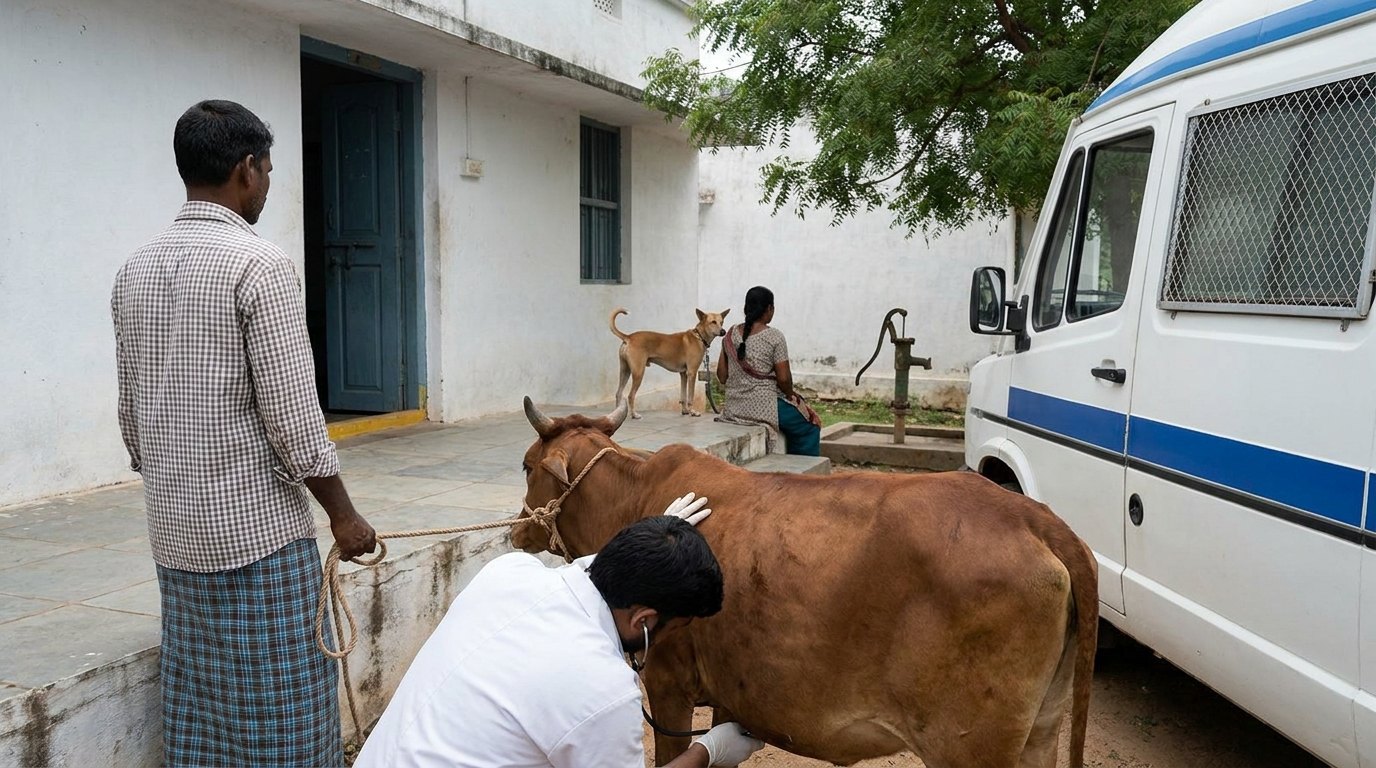
Under the Livestock Health and Disease Control Programme the centre funds one mobile veterinary unit for roughly every one lakh livestock, dispatched by a state call centre on the toll-free number 1962. The scheme began in 2021-22; by 31 January 2025, 4,340 units had been sanctioned and 4,016 were operational across 28 states and union territories, with Rs 997.59 crore sanctioned and released. The department had told the Standing Committee it expected to fund around 5,000 units over the scheme's 2021-22 to 2025-26 life. Against the 2019 herd the 4,016 vans are 0.7 per lakh livestock.
Coverage is at the norm in Madhya Pradesh (406 units), Andhra Pradesh (340), Tamil Nadu (245), Jharkhand (236), Chhattisgarh (163), Haryana (70), Himachal Pradesh (44), Kerala (29) and Tripura (13), and well above it in the north-east, where Mizoram's 26 units are 7.2 per lakh and Manipur's 33 are 6.0. Uttar Pradesh's 520 and Rajasthan's 536 are the largest fleets but 0.8 and 0.9 per lakh. Maharashtra, with 3.3 crore livestock, runs 80 units, 0.2 per lakh, the thinnest coverage of any state that runs the scheme at all. Karnataka's 275 units are the fleet the minister inaugurated in May 2022, when the state was sanctioned 290 vehicles against 289 lakh animals.
- Odisha was sanctioned 181 units and returned the funds released; it has 1.8 crore livestock and 17.3 lakh stray dogs, the second-largest stray count in India.
- Telangana was sanctioned 100 and returned the funds, leaving its 3.3 crore livestock, the eighth-largest herd, with no central mobile unit.
- Punjab was sanctioned 70 and returned the funds; its 1,425 livestock per registered vet is among the best ratios in the country, so the state may have judged the vans unnecessary, but it has not said so in the reply.
- Lakshadweep was sanctioned 9 and returned the funds; Delhi was sanctioned 3 and had none operational; the Andaman and Nicobar Islands had not yet asked for the money for their 5.
- Jammu and Kashmir had 6 sanctioned but 50 on the road, because the centre is bearing the running cost of 44 vans the union territory bought itself.
The annex also counts the people served: 66,54,662 farmers had received veterinary services at the doorstep by 31 January 2025, 21.9 lakh of them in Uttar Pradesh and 16.1 lakh in Andhra Pradesh, which runs 340 units across its 26 districts. The scheme is written for livestock owners. A dog or cat owner who dials 1962 is calling a farm service, and the private layer below is where companion animals are actually seen.
73 veterinary colleges and 6,504 seats: the pipeline, and the eleven states and territories with no college
The number of recognised colleges has doubled since 2014, and almost all of the new private capacity is in two states.
The Veterinary Council of India's list of recognised colleges names 73 colleges with 6,504 BVSc and AH seats approved by the central government. There were 36 recognised colleges in 2014 and 46 by July 2016, 54 in December 2021, and the Standing Committee recorded 4,320 graduates a year from those 54. Fourteen colleges on the current list are marked as private, with 1,200 seats, eight of them in Rajasthan and four in Haryana.
Where the colleges are
| State or UT | Recognised colleges | Approved seats | Of which marked private | Private seats |
|---|---|---|---|---|
| Rajasthan | 11 | 1,000 | 8 | 700 |
| Tamil Nadu | 7 | 640 | 0 | 0 |
| Karnataka | 5 | 455 | 0 | 0 |
| Maharashtra | 5 | 455 | 0 | 0 |
| Haryana | 5 | 440 | 4 | 340 |
| Uttar Pradesh | 5 | 390 | 0 | 0 |
| Gujarat | 4 | 375 | 0 | 0 |
| Andhra Pradesh | 3 | 300 | 0 | 0 |
| Madhya Pradesh | 3 | 300 | 0 | 0 |
| Punjab | 3 | 280 | 0 | 0 |
| Telangana | 3 | 280 | 0 | 0 |
| Odisha | 3 | 260 | 2 | 160 |
| Kerala | 2 | 225 | 0 | 0 |
| Jammu & Kashmir | 2 | 163 | 0 | 0 |
| Assam | 2 | 140 | 0 | 0 |
| Chhattisgarh | 1 | 100 | 0 | 0 |
| Mizoram | 1 | 100 | 0 | 0 |
| Puducherry | 1 | 100 | 0 | 0 |
| West Bengal | 1 | 100 | 0 | 0 |
| Uttarakhand | 1 | 76 | 0 | 0 |
| Bihar | 1 | 75 | 0 | 0 |
| Himachal Pradesh | 1 | 75 | 0 | 0 |
| Jharkhand | 1 | 75 | 0 | 0 |
| Tripura | 1 | 63 | 0 | 0 |
| Nagaland | 1 | 37 | 0 | 0 |
| India | 73 | 6,504 | 14 | 1,200 |
Rajasthan has 11 colleges and 1,000 seats, more than Tamil Nadu's 7 and 640, and 700 of those seats are private. Eleven states and union territories have no recognised college at all: Delhi, Goa, Sikkim, Manipur, Meghalaya, Arunachal Pradesh, Ladakh, Chandigarh, the Andaman and Nicobar Islands, Lakshadweep, and Dadra and Nagar Haveli and Daman and Diu. Bihar, with 3.65 crore livestock and 860 vacant posts, has one college with 75 seats; West Bengal, with 3.75 crore livestock, has one with 100.
The next intake is already on paper. The Council's list of provisionally recognised colleges dated 14 May 2026 names 25 colleges holding a letter of permission, 9 government and 16 private, including Goa's first veterinary college at Curli-Ponda from the 2026-27 session, new government colleges at Kishanganj in Bihar, Bilaspur in Chhattisgarh, Himmatnagar and Bhuj in Gujarat, Athani in Karnataka, Akola in Maharashtra and Banda in Uttar Pradesh, and private colleges in Haryana, Himachal Pradesh, Maharashtra, Odisha, Rajasthan, Uttar Pradesh and West Bengal. One Bilaspur college appears in both halves of that list. A college admitted in 2026 graduates its first class in 2031 or 2032; none of it changes the 2024 register.
The private layer: what 297 clinics in eight cities publish about themselves
No government table counts private veterinary clinics. Bonbeno's own directory is a small, verified window on them.
The Standing Committee called private-sector involvement in veterinary services negligible and found the department funding none of it, and no census, register or parliamentary reply counts private clinics. Bonbeno's vet directory lists clinics in eight cities, each checked against its Google listing between 14 and 16 October 2026 for an address, a live phone number and the hours the clinic itself publishes. It is not a census of any city. Across the eight it holds 297 clinics, of which 70, or 23.6 percent, publish 24-hour opening, and 1,29,325 Google reviews sit behind their ratings.
| City | Listed | 24-hour | Hospitals | Avg rating | Reviews |
|---|---|---|---|---|---|
| Bengaluru | 55 | 18 | 33 | 4.56 | 45,374 |
| Pune | 57 | 9 | 11 | 4.43 | 19,274 |
| Hyderabad | 47 | 14 | 22 | 4.63 | 20,347 |
| Kolkata | 41 | 12 | 14 | 4.32 | 12,498 |
| Delhi | 38 | 7 | 18 | 4.14 | 10,178 |
| Chennai | 23 | 2 | 10 | 4.30 | 6,278 |
| Mumbai | 19 | 5 | 2 | 4.58 | 12,317 |
| Ahmedabad | 17 | 3 | 3 | 4.65 | 3,059 |
| Eight cities | 297 | 70 | 113 | 1,29,325 |
Bengaluru and Hyderabad: the deepest 24-hour cover
Bengaluru lists 55 clinics, 18 of them open round the clock and 33 describing themselves as hospitals, with 45,374 reviews behind an average rating of 4.56; Hyderabad lists 47, 14 of them 24-hour, at 4.63. Karnataka and Telangana are two of the fifteen states above the 5,000 line in the index, and Telangana runs no mobile unit; their capitals have the thickest private night cover in the directory.
Mumbai, Pune and Ahmedabad: strong ratings, thinner nights
Mumbai lists 19 clinics, 5 of them 24-hour, including the Bombay SPCA's charitable hospital at Parel; Pune lists 57, the most of any city, but only 9 publish 24-hour opening; Ahmedabad lists 17, 3 of them round the clock, at the highest average rating of the eight, 4.65. Maharashtra has 11,257 registered vets, more than any state, and 80 mobile units; Gujarat has the highest vacancy in the country. In both, a pet owner's night-time option is private.
Delhi, Kolkata and Chennai: the capital's register is private
Delhi lists 38 clinics, 7 of them 24-hour, at the lowest average rating of the eight, 4.14; the city has 585 registered vets, 49 filled government posts and 77 government institutions, so about nine in ten of its vets work outside the state department. Kolkata lists 41 with 12 open all night, in a state with 2.7 vets per lakh people and 13,760 livestock per vet. Chennai lists 23 with 2 publishing 24-hour opening, the thinnest night cover in the directory, in the state with the largest register in the south.
What a pet owner can do with these numbers
The government network is sized for cattle. Six things follow for anyone whose animal is a dog or a cat.
- Ask for the registration number. Every practising vet is enrolled on a state veterinary register and appears in the Indian Veterinary Practitioners Register that the Council publishes in the Gazette. The number is on the clinic's certificate and on a prescription; Bonbeno's guide to choosing a vet in India covers what else to check.
- Find the 24-hour clinic before you need it. 70 of the 297 clinics in the vet directory publish round-the-clock opening, and the share runs from one in three in Bengaluru to one in twelve in Chennai. Save the number and the route; published hours are a snapshot, so phone ahead.
- Do not expect the 1962 van. Mobile veterinary units are funded for livestock at one per lakh animals and serve farmers at their doorstep; in Odisha, Punjab and Telangana there are none. A collapsed dog needs a clinic, and the pet first aid guide covers the drive there.
- Read your state's vacancy before relying on a government hospital. A district veterinary hospital in Gujarat, Bihar, Maharashtra, Punjab or Rajasthan sits in a cadre with more than one post in three empty; in Kerala, Tamil Nadu and Himachal Pradesh fewer than one in ten is.
- Budget for private care. Where the register is private, as in Delhi, prices are private too. What a vet visit costs in India sets out consultation, vaccination and surgery ranges, building an emergency vet fund sizes the reserve, and pet insurance in India covers what the policies actually pay.
- Count the vets against the strays where you live. India has 174 census-counted stray dogs for every registered veterinarian; Odisha has 602, Jharkhand 449, West Bengal 419 and Kerala 54. Every sterilisation under the Animal Birth Control Rules is a surgery by a registered vet, so the ratio is one measure of how much capacity a state can field, and the street dog report shows how far each state's programme has got.
Call before you travel, even to a clinic that publishes 24-hour opening; a door that is open at 3 am may not have a vet behind it. Treat collapse, laboured breathing, a hard or swollen abdomen, seizures, suspected poisoning, inability to urinate and heat stroke as immediate. The vet directory marks the clinics that publish round-the-clock hours in each city.
What this data does not measure
Each number here comes from a different document with its own date and definition, and the ratios inherit all of them.
- A register counts enrolments, not working veterinarians, and counts them where they enrolled. The Indian Veterinary Practitioners Register includes academics, central and army vets, industry staff, the retired and the emigrated, and a practitioner registered in Puducherry may work in Chennai. The state ratios are therefore ratios of registers to herds, which is the best Parliament has published and not a headcount of vets in clinics.
- The herd is from 2019 and the register from 2024. The 21st Livestock Census began fieldwork in October 2024 and had published no state-wise results by 31 October 2026, so every per-animal ratio divides a 2024 numerator by a 2019 denominator. Delhi's livestock is the 2012 figure carried forward, and Ladakh's is inside Jammu and Kashmir's because the 2019 census counted the undivided state.
- Hospital, dispensary and aid centre are state labels. Bihar reports 1,096 hospitals and 39 dispensaries, Uttarakhand 331 and 10, Odisha 62 hospitals and 3,553 aid centres. The total is comparable across states; the mix is not.
- Vacancy is a snapshot of state returns. The December 2025 annex reproduces what each state reported, without a common reference date, and a state that has advertised posts still shows them vacant until they are filled.
- The mobile unit counts are as on 31 January 2025, and the states that returned funds could re-enter the scheme; the roughly 5,000 units the department planned is a scheme-life figure, not a count.
- The directory is a window, not a census. Each city's list is drawn from up to 60 Google Places results checked by hand, so a city with 57 listings is not a city with 57 clinics, 24-hour opening is what the clinic publishes rather than what we observed at night, and the ratings are Google's. No official count of private clinics or of veterinarians in private practice exists, and this report does not invent one.
- Para-veterinarians are not covered. The Committee's 54,928 against a requirement of 78,013 is the only national figure we found, and no state table has been published.
How this report was built
Every figure was read from the primary document, and every ratio was computed from the columns in the dataset beside this report.
- Registered practitioners by state as on 31 March 2024 and sanctioned and vacant posts by state were read from Annexures I and II of Lok Sabha Unstarred Question 279, answered on 2 December 2025. The state rows sum to the stated totals of 87,914, 40,603 and 10,474.
- Government veterinary institutions by state as on 31 March 2024 were read from the Open Government Data platform's publication of Annexure I to Rajya Sabha Starred Question 206 of 19 March 2025, because the department's own copy of the reply returned 404 on this attempt. The 36 rows sum to 13,173, 30,184, 24,532 and 67,889. Registered practitioners as on 31 March 2021 come from the same platform's publication of a Rajya Sabha table, and sum to 76,097.
- Mobile veterinary units sanctioned and operational, funds released and farmers served were read from Annexures I and III of Lok Sabha Unstarred Question 1287 of 11 February 2025. The farmers column is printed with inconsistent comma grouping; read digit by digit, the states sum to the printed total of 66,54,662.
- Livestock by state is Annexure I of Lok Sabha Unstarred Question 4449 of 28 March 2023, the 20th Livestock Census figures, total 53,67,61,343; the census key results give the provisional 535.78 million the Standing Committee used. Dadra and Nagar Haveli and Daman and Diu are added together to match the 2024 tables.
- Population for 1 March 2024 is the National Commission on Population's projection in thousands, with Goa, Telangana, Ladakh and the small union territories interpolated from its consolidated table, as in Bonbeno's dog bite report. Stray dogs are the 20th Livestock Census state table laid before the Rajya Sabha on 6 August 2025.
- Colleges and seats were read college by college from the Veterinary Council of India's list of recognised colleges, 73 entries and 6,504 seats, and the provisional list of 14 May 2026. The 1976 norm, the villages-per-institution figures, the 2021 and 2022 workforce figures and the department's 5,000-unit plan were read from the Standing Committee's forty-fifth report of December 2022.
- Livestock per practitioner is livestock divided by the 2024 register; livestock per institution divides by the 2024 total; mobile units per lakh livestock is units times one lakh divided by livestock; practitioners per lakh people is the register times 100 divided by population in thousands. The directory figures are counts over the eight city files in Bonbeno's own data, and the script that rebuilds the whole table is kept with the report.
Common questions about veterinarians in India
How many veterinarians are there in India?
India had 87,914 registered veterinary practitioners on 31 March 2024, the figure the Department of Animal Husbandry and Dairying gave the Lok Sabha on 2 December 2025, up from 76,097 in March 2021 and 67,784 in March 2015. That is about 6.3 for every lakh people and one for every 6,106 livestock counted in the 2019 census. The register counts everyone enrolled with a state veterinary council, including teachers, researchers and the retired, not only vets in clinics.
How many veterinary hospitals are there in India?
The states ran 13,173 veterinary hospitals and polyclinics, 30,184 veterinary dispensaries and 24,532 veterinary aid centres on 31 March 2024, a total of 67,889 government veterinary institutions, plus 4,016 mobile veterinary units operational by January 2025. Rajasthan alone has 10,335 institutions, 15 percent of the national network. No official count of private veterinary clinics exists.
How many veterinary colleges are there in India?
The Veterinary Council of India's list of recognised colleges names 73 colleges with 6,504 approved BVSc and AH seats, 14 of them marked private with 1,200 seats. There were 36 recognised colleges in 2014, 46 in 2016 and 54 in 2021. A further 25 colleges, 9 government and 16 private, held a letter of permission on 14 May 2026, including Goa's first veterinary college from the 2026-27 session. Eleven states and union territories, including Delhi, Goa, Sikkim, Manipur and Meghalaya, have no recognised college.
Which state has the most veterinary doctors in India?
Maharashtra, with 11,257 registered veterinary practitioners on 31 March 2024, followed by Uttar Pradesh with 7,421, Tamil Nadu with 6,610, Rajasthan with 5,669, Andhra Pradesh with 5,643, Kerala with 5,395 and Karnataka with 5,082. Relative to people the order changes: among large states Himachal Pradesh has 19.3 registered vets per lakh people, Punjab 16.0 and Kerala 15.0, while Jharkhand has 2.4, Delhi and West Bengal 2.7 and Bihar 2.8.
What is the recommended ratio of veterinarians to animals in India?
The National Commission on Agriculture recommended in 1976 that India have at least one veterinary doctor or institution for every 5,000 cattle units by the year 2000, and the Lok Sabha's Standing Committee on Agriculture still measures the country against it. On the 2019 census herd of 53.68 crore livestock, India has 6,106 livestock per registered veterinarian and 7,906 per government institution; meeting the norm would take about 1,07,352 institutions against the 67,889 that exist.
Is there a shortage of veterinary doctors in India?
In the government service, yes: 10,474 of the 40,603 sanctioned posts of veterinary doctor were vacant in December 2025, 25.8 percent, and 55.9 percent in Gujarat, 41.6 percent in Bihar and 38.5 percent in Maharashtra. The Standing Committee had recorded 28,328 field veterinarians against 36,623 posts in 2022, and 54,928 para-veterinarians against a requirement of 78,013. The register as a whole, 87,914 names, is more than twice the number of sanctioned posts, so the shortage is of filled posts and of vets where the animals are, with fifteen states above the 5,000-livestock-per-vet norm.
How many mobile veterinary units are there in India?
4,340 mobile veterinary units had been sanctioned and 4,016 were operational across 28 states and union territories on 31 January 2025, funded under the Livestock Health and Disease Control Programme at about one unit per lakh livestock and dispatched through each state's 1962 call centre, with Rs 997.59 crore sanctioned and released and 66,54,662 farmers served. Odisha, Punjab, Telangana and Lakshadweep returned the funds and run none; Delhi had none operational.