
Breed profile
Tahltan Bear Dog: Nine Registrations and One Last Female
The only breed on this list that passes Bonbeno's two-condition test, and the only one whose own records say what heat did to it.
Quick answer
The Tahltan Bear Dog is extinct. It was a small black-and-white hunting dog of northwestern British Columbia, standing 30 to 40.5 cm and weighing 4.5 to 8 kg, used to bail up bears until hunters arrived. The Canadian Kennel Club recognised it on 5 February 1941, only nine dogs were ever registered, and the register closed in 1979. It is the one breed on this list that passes both conditions of this site's breed test.
Nothing on this page is veterinary advice. No Tahltan Bear Dog exists, so every health figure here describes other breeds an Indian reader can actually acquire, and a figure measured in one population does not transfer cleanly to another animal. For any decision about a real dog in front of you, consult your nearby vet, who can examine the animal and knows local disease pressure.
How the Tahltan Bear Dog rates for an Indian household
What the Tahltan Bear Dog was, and why it is the exception on this list
The Tahltan Bear Dog was a small black-and-white pricked-ear hunting dog of northwestern British Columbia, used to bail up bears, and it is extinct. Unlike every other breed in this site's extinct set, it genuinely was a breed: a standard of characteristics was written and a national kennel club registered it.
Most extinct dogs fail this site's breed test on the paperwork. This one passes it. The Canadian Kennel Club recognised the Tahltan Bear Dog as an Indigenous breed on 5 February 1941, five dogs were entered as foundation stock that October, and the register stayed open until the club removed the breed in 1979. That is a written standard plus a studbook, which is the whole test.
It is also the smallest working dog on this list by a wide margin. The Canadian Encyclopedia gives 30 to 40.5 cm and 4.5 to 8 kg, about the size of a fox terrier. The Canadian Kennel Club's own account gives 12 to 16 inches and 10 to 18 pounds, and those convert to 30.5 to 40.6 cm and 4.54 to 8.16 kg, which is the same animal measured in two systems. Two independent sources agreeing after a unit conversion is a stronger check than two sources printing the same numbers.
The job, in one sentence
These dogs did not fight bears. Working in pairs or small packs, they harried a bear with fast, high yapping and quick nips, dodged its bites and cuffs, and held it in place until a hunter arrived. An ethnographic account records them as small, quick, terrier-like animals, quite different from the larger wolflike dogs used for ordinary hunting and carrying packs. Hunters carried them to the ground in sacks on their backs, which tells you both how small they were and how much they were worth.
The name collision to clear up first
Three different things are called bear dogs and only one of them is this breed. The Karelian Bear Dog is a large living Finnish spitz. The Amphicyonidae are an extinct family of prehistoric carnivores nicknamed bear-dogs, tens of millions of years old and not dogs at all. The Tahltan Bear Dog is a domestic breed that a Canadian registry held for thirty-eight years.
The confusion is not a straw man. The Canadian Kennel Club's own writer records first mistaking a painting of a Tahltan Bear Dog for a Karelian, and Google India's question box for this breed returns nothing on-breed at all, offering instead the biggest extinct dog and whether a Karelian Bear Dog is a good family dog.
Why an Indian reader should care
Because this is the one extinct breed on this site whose own records say what happened when it was moved to a warmer place. The Canadian Encyclopedia records testimony from members of the Tahltan Nation that the dogs died or became ill once away from their native land, with change of climate and diet among the suspected causes. Dogs that failed in southern Ontario are not dogs that would have managed an Indian summer, and the page takes that seriously rather than treating it as folklore.
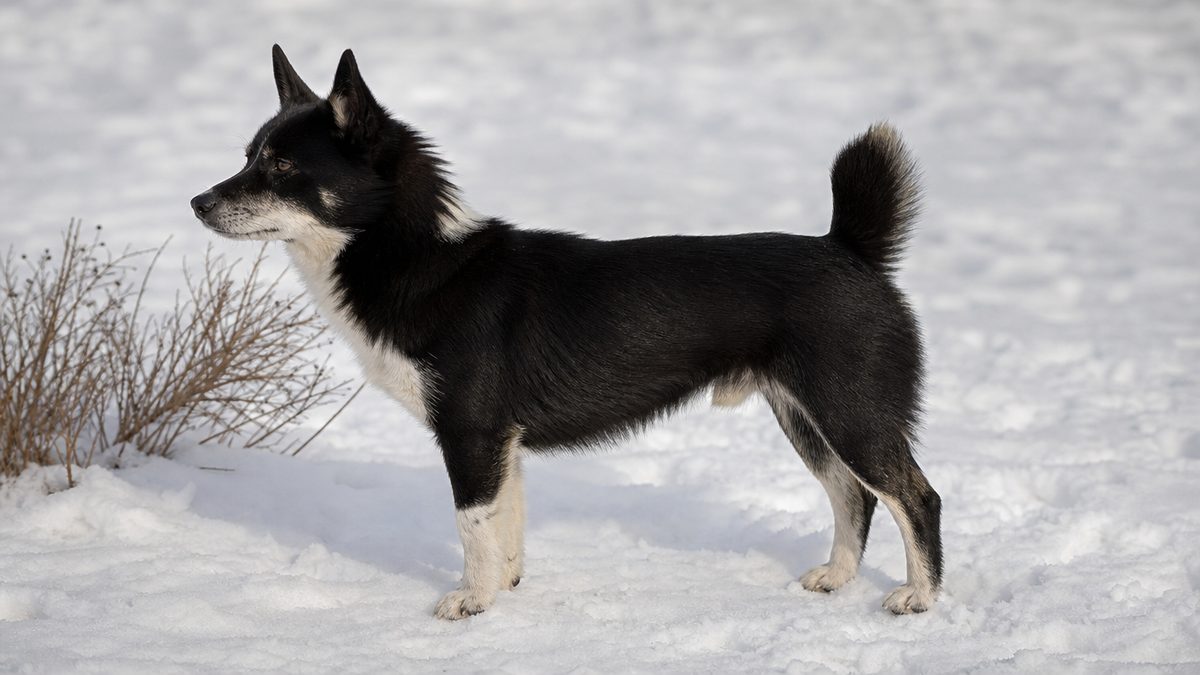
Real photographs of Tahltan Bear Dogs exist in the Royal British Columbia Museum archives, including images of named Tahltan people holding them. The image at the top of this page is not one of those. It is a reconstruction and is labelled as one, because this site generates its own illustrations rather than reusing archival material.
The sources, and why the best one is not the kennel club
Four sources carry almost everything reliably known about this breed, and they differ sharply in what they can establish. The strongest is a Royal BC Museum curator's compilation of named archival testimony. The weakest is a registry blog post that disclaims itself.
Sorting them matters because they disagree on a date that decides the extinction story, and because the most authoritative-looking source is not the most reliable one.
Start with what the top-ranking page leaves out. English Wikipedia holds position 1 on the Indian result set for this breed, carries a maintenance banner saying the article needs more citations, and gives extinction as 'sometime in the 1970s or 1980s' with a last registration in 1953. Counted directly in its extracted text, the string 1941 appears zero times and the string 1979 appears zero times. The recognition date, the deregistration year, the nine registrations and the name of the last intact female are all missing from the page most Indian readers will see first.
| Source | What it is | What it can establish | Weight |
|---|---|---|---|
| Grant Keddie, Indigenous Bear Dogs of Northwestern Canada, 2024 | A 73,920-character compilation by the Curator Emeritus of Archaeology at the Royal British Columbia Museum, quoting Emmons, de Laguna, Crisp 1956, Kopas 1982 and Bennett 2002 with attribution and naming Indigenous consultants | Registration counts and dates, named individual dogs and people, archival photograph numbers, and direct ethnographic quotation | Highest. It names its sources and its informants, which is exactly what the kennel-club account does not |
| The Canadian Encyclopedia, 2021 | A signed reference article | Measurements, the 1824 first written record, the 1969 distribution, causes of decline, and Tahltan testimony about the dogs failing away from home | High. Independent of Keddie and it disagrees with him on one date, which is useful |
| Canadian Kennel Club blog, 2020 | A post by a club member, published on the registry's site | Dates and figures broadly consistent with the other two | Moderate at best, and read the disclaimer. The CKC prints that blog opinions are the author's own, and nearly every fact is footnoted to an unpublished 2009 conference presentation |
| PubMed | The biomedical literature | Nothing about this dog at all | A clean, controlled zero, and the way it fails is itself worth reading |
The registry source is weaker than it looks, and this matters
It would be easy to treat the Canadian Kennel Club page as the authoritative record, because it sits on the registry's own domain and covers the registry's own decisions. It is not a registry record. The page carries the CKC's standing disclaimer that opinions expressed by blog authors are theirs alone and do not reflect the club's, and its footnotes attribute almost every fact to a Canada Day presentation given at a Toronto venue in 2009, which is not a published document anybody can check.
That is not a reason to discard it. It is a reason to cite it for what it is, which is a registry-hosted account rather than a registry record, and to prefer Keddie where the two overlap.
The literature search, and the lichen
The scientific absence here is total and it fails in an entertaining way. A PubMed search on Tahltan[tiab] returns two records and neither is about a dog: one is a Society of Obstetricians and Gynaecologists guideline retirement notice, and the other is a lichen taxonomy paper that describes a new fungal species, Melanohalea tahltan, named in the Nation's honour. The exact phrase Tahltan Bear Dog returns zero. The control run in the same session returned 108 records, so the instrument was working.
Set that against the other extinct Indigenous dog of British Columbia. The Salish Wool Dog has a nuclear genome, an ancestry proportion and a set of candidate coat genes, published in Science in 2023. The Tahltan Bear Dog has none of that, and no page anywhere seems to have noticed the asymmetry.
There is no lifespan figure, no screening data, no genetic study and no population count beyond the nine registrations. A page offering you a Tahltan Bear Dog's life expectancy has taken it from a template. The honest output for a breed with zero biomedical literature is a blank, and this page prints blanks.
Bonbeno's two-condition test, and the one extinct dog that passes it
To count as a breed on this site an animal needs two documents: a written breed standard and a studbook. The Tahltan Bear Dog had both, for thirty-eight years, and it is the only breed in this site's extinct set that clears the test outright.
Every other extinct dog covered here fails on paperwork. The Salish Wool Dog was managed for five thousand years without a document. The Tesem is a depiction type from tomb walls. The Paisley Terrier was a variety of another breed. The Toy Bulldog's status was contested while it existed. This one was recognised, standardised and registered, and then it ran out of dogs.
| Condition | Verdict | Evidence |
|---|---|---|
| A written breed standard | Yes | A standard of characteristics was drawn up when the dogs were sent south and recognised, recorded by Crisp in 1956 and quoted in the Royal BC Museum compilation. The same account notes drily that they never distinguished themselves in the show ring |
| A studbook | Yes | The Canadian Kennel Club register held the breed from October 1941. Nine dogs were registered in total: five as foundation stock in October 1941, three more in 1944 and one in 1948 |
| Recognition date | 5 February 1941 | The CKC recognised it as an Indigenous breed on that date, the first dog of native origin recognised in Canada |
| Deregistration date | 1979 | The CKC removed it from the recognised list that year, on the assumption that it was extinct |
| Population at recognition | Already tiny | The officer who collected the foundation stock wrote that after combing every Tahltan encampment in the Cassiar over four years, there were 'but a mere handful of the true Tahltan dogs in existence' |
| Formal verdict | Breed | It is the only extinct breed on this site that satisfies both conditions. It did not fail to become a breed. It became one and then ended |
Nine registrations, and the arithmetic that makes the figure checkable
The number that matters is nine, and the reason to trust it is that it closes. Five foundation-stock dogs were registered by the British Columbia police constable who collected them in October 1941. The Ontario breeder who took the project over registered three in 1944 and one more in 1948. Five plus three plus one is nine, which is exactly the total the same source reports.
That check matters more than it looks. This project has repeatedly found registration figures that do not reconcile with their own components, and a total that reproduces from its parts is worth more than a total quoted on its own.
What a nine-dog register actually means
It means the breed was recognised at the point of collapse rather than at the point of health. The recognition was a rescue attempt, not a celebration. Reading the officer's own words, he intended to establish the breed and then return the dog to its nomadic master, for such is its rightful heritage. That is the language of preservation, and it failed.
The comparison worth drawing is with a preservation effort that worked. Japan's native breeds survived because single-breed preservation societies were founded while populations were still large enough to sustain themselves, and several of those societies still publish annual registration counts. Nine dogs is not a foundation. It is a record of what was left.
The register closed in 1979 and no other registry has ever held the breed, so no valid pedigree can exist for a dog sold under this name today. A document offered with such a dog is either for a different breed or is not a registry document at all. Ask which register, which year and which number, and check that register directly.
When the Tahltan Bear Dog ended, dated from the register
The breed became reproductively extinct in 1979, when the last intact female died without producing pups and the Canadian Kennel Club removed it from its recognised list. The date of the last registration is disputed between two credible sources, at 1948 and 1953, and this page publishes both.
This is the rarest thing on any extinct-breed page: an extinction that can be dated from a register rather than inferred from a silence. The dates below come from documents about registrations and named animals, not from a general sense that a breed faded.
| Date | Event | Source | How firm |
|---|---|---|---|
| 1824 | Samuel Black documents the dog, the first written record | The Canadian Encyclopedia | Firm as a first record. It says nothing about numbers |
| 1936 to 1940 | Constable J.B. Gray buys ten dogs while posted at Telegraph Creek | Canadian Kennel Club account | Moderate. Footnoted to an unpublished 2009 presentation |
| 5 February 1941 | CKC recognises the breed as Indigenous, the first native-origin breed recognised in Canada | Royal BC Museum compilation | Firm. A dated registry decision |
| October 1941 | Five dogs registered as foundation stock | Royal BC Museum compilation | Firm, and it reconciles with the total |
| 1942 | Flu and measles epidemic at Telegraph Creek kills many of the elders who owned bear dogs; many loose dogs are shot afterwards | The Canadian Encyclopedia | Firm as a cause, and it is the human event that drove the canine one |
| 1944 and 1948 | Three more dogs registered, then one more, by Harriet Morgon in Windsor, Ontario | Royal BC Museum compilation | Firm, and on this account 1948 is the last registration |
| Late 1940s | A distemper outbreak kills a number of the remaining dogs | The Canadian Encyclopedia | Firm as a cause |
| 1953 | The last registration of a Tahltan bear dog with the CKC, on a different account | The Canadian Encyclopedia | Firm as a published claim, and it disagrees with the 1948 figure above |
| 1956 | Crisp writes that in its native habitat the dog 'has by now become mongrelized to the extent that it is unrecognized as a distinct type' | Quoted in the Royal BC Museum compilation | Firm as a contemporaneous judgement |
| 1969 | Still present in small numbers at Telegraph Creek, Iskut and Atlin in BC, and Carcross, Whitehorse and Keno in Yukon | The Canadian Encyclopedia | Firm as a distribution record, and the last one |
| 1975 | Six known to exist, all male or spayed females except one | Royal BC Museum compilation, citing Bennett 2002 | Firm, and this is the sentence that dates the real end |
| 1979 | Nancy Dill, the last remaining intact female, dies without producing pups. The CKC removes the breed the same year | Royal BC Museum compilation and the CKC account | Firmest. A named animal and a registry decision in the same year |
1948 or 1953, and why the disagreement is worth publishing
Two credible sources give different years for the last CKC registration. The Royal BC Museum compilation traces registrations to a single dog entered in 1948 and states a total of nine. The Canadian Encyclopedia states plainly that the last registration was in 1953.
A third statement constrains both. The Canadian Kennel Club's own account says the breed was removed in 1979 after more than a quarter of a century of no new registrations, which puts the last entry at 1954 or earlier. That is consistent with either year, so it cannot settle the question, and neither can this page. Both are recorded, with their sources named.
Reproductive extinction and biological extinction are different dates
This distinction is the one nearly every summary loses. The Canadian Kennel Club account says the final dog died in 1979. The Royal BC Museum compilation is more precise: six dogs were known in 1975, all male or spayed females except one, and it was that one, a bitch named Nancy Dill, who died in 1979 without producing pups.
Read carefully, those two statements say different things. The breed's ability to continue ended in 1979 with Nancy Dill. Whether every individual animal was dead by that date is a separate question the sources do not settle, and the Canadian Encyclopedia hedges it as 'sometime in the 1970s or 80s'. A breed can be finished while individuals are still alive, and for this one that is exactly what the record describes.
Quote 1979 for the end of the breed, and say what it means: the last intact female died and the register closed. Avoid a bare 'extinct in the 1970s', which loses the mechanism, and avoid asserting a last-registration year without saying which source you followed, because the two published years differ by five.
What the Tahltan Bear Dog looked like, with two sources that agree after conversion
The Tahltan Bear Dog stood 30 to 40.5 cm and weighed 4.5 to 8 kg, black and white, with pricked ears, a sharp nose, a dense mid-length coat with a longer ruff at the neck, and a short upright tail that contemporaries compared to a shaving brush.
Two independent sources give measurements, in different units, and they describe the same dog. That is a better check than agreement, because a shared number can be copied while a conversion cannot be copied by accident.
| Measure | The Canadian Encyclopedia | Canadian Kennel Club account | Converted | Agreement |
|---|---|---|---|---|
| Height | 30 to 40.5 cm | 12 to 16 inches | 12 to 16 inches is 30.5 to 40.6 cm | Agrees to within a millimetre at both ends |
| Weight | 4.5 to 8 kg | 10 to 18 pounds | 10 to 18 pounds is 4.54 to 8.16 kg | Agrees to within 0.16 kg at the top and 0.04 kg at the bottom |
| Size comparison | About the size of a fox terrier | Not given | Consistent with the figures | |
| Colour | Typically black and white | Black and white | Agrees | |
| Ears | Pricked up | Large pricked | Agrees | |
| Tail | Short and upright, resembling a shaving brush | Distinctive bushy tail resembling a shaving brush | Agrees, and the same simile appears in both | |
| Coat | Mid-length and dense, with a longer ruff around the neck | Not detailed | Only one source, so reported rather than corroborated |
The shaving-brush tail, and a caution about it
Both accounts reach for the same image, which raises a question this project takes seriously: are these two sources or one? The simile is distinctive enough that its appearance in both could mean the later writer read the earlier one. The Canadian Kennel Club account footnotes its description to a 2009 conference presentation rather than to the Canadian Encyclopedia, so the chain is not established either way, and the honest reading is that the tail description may be one observation reported twice.
The measurements are different. Those are in different unit systems and reconcile by arithmetic, which is what independent measurement of the same animal looks like.
The build that made the job possible
Every feature in the table serves the work. A dog of 4.5 to 8 kg can be carried to the hunting ground in a sack on a hunter's back, which is exactly what was done. A dog light enough to run on thin-crusted snow can reach a bear that a heavier dog would break through to chase. A high, carrying yap holds a bear's attention and tells a hunter where the animal is. Contemporary observers called the dogs fearless, and de Laguna's account describes them dodging a bear's bites and cuffs rather than closing with it.
That is a specialist, and specialists are exactly the dogs that vanish when the job does.
What the size means in an Indian context
It matters for one specific reason. Small size is often read as heat tolerance, on the assumption that a small dog carries less mass to cool. That reasoning does not hold here, because the coat was mid-length and dense with a neck ruff, which is northern insulation on a small frame, and because a small dog carries its chest close to hot ground. Do not read 4.5 kg as tropical.
The Royal British Columbia Museum archives hold photographs of Tahltan Bear Dogs with named Tahltan people, including Mary Jackson and Charlie Quash of Telegraph Creek, both of whom died in November 1942, and images of the police officer's young dogs from about 1940. That is an unusually good visual record for an extinct breed, and it is why the appearance section here can be specific where other pages on this site cannot.
What the dog actually did, in the words of the people who used it
The Tahltan Bear Dog held game rather than killed it, and it was valuable enough that its owners housed it and let it sleep in their tents. The best evidence for both is direct testimony from named Tahltan people and from ethnographers who watched the dogs work.
This section exists because a hunting-dog page that describes a job in the abstract tells a reader nothing. What follows is quoted from the people closest to it, and it rests on oral history recorded from named Tahltan people rather than on a breed club's account of itself. That is an unusual evidence base for a kennel-club breed and a better one than most standards provide.
A Tahltan elder on what the dog was for
John Carlick, a Tahltan elder born 25 October 1897, described the dogs to the anthropologist Leslie Kopas: "They were very smart dogs. They could find a bear's den through deep snow, chase up grouse and ptarmigan. They could find rabbits, anything. In the old days they kept the Indian alive. If you had a bear dog you could find game. If you didn't have a bear dog, you starved."
Two things in that quotation cut against the breed's own name. The dog is described finding grouse, ptarmigan and rabbits as well as bear dens, so it was a general hunting dog rather than a bear specialist alone. And the stakes are stated plainly: this was food security, not sport.
An ethnographer on the technique
Frederica de Laguna's account, recorded through Emmons, describes them as small, quick, terrier-like animals, quite different from the larger wolflike dogs used for ordinary hunting and carrying packs, and explains the method: "These small dogs, with quick, fearless nips and yapping, could immobilize a bear, dodging his ferocious bites and cuffs, and holding him at bay until the hunter could arrive and kill him. These animals were highly prized".
That is bailing, and it is a recognisable working style. The dog's job is to make a bear stand still and make a noise the hunter can walk towards. Weight and strength are irrelevant. Speed, nerve and voice are everything.
How the dogs were treated, and why it is unusual
Northern working dogs in this period were, by the same sources' account, frequently left to scavenge and treated as expendable. The Tahltan Bear Dog was not. "Unlike other working dogs, owners revered the Tahltan dogs, making shelters for them and allowing them to sleep in their tents". The Canadian Encyclopedia records the same practice and notes that the dogs' bravery is celebrated in the region's mythology.
The Tahltan people's own name for the animal was, in translation, our dog, and that is where the breed's English name comes from.
The job that ended, and the dog that ended with it
Rifles closed this line of work. Once a hunter could shoot big game without help, a specialist bailing dog stopped earning its keep, and sled dogs mattered more than bear dogs for the transport that remained. That is the ordinary way a working breed dies, and this site records the same mechanism for turnspit dogs and for scent hounds whose quarry laws changed.
What is not ordinary is what followed. The sled dogs that replaced them killed bear dogs when they caught them, which is a direct rather than an economic mechanism, and then snowmobiles replaced the sled dogs too.
A breed built around one job is only as durable as the job. India's own working breeds face the same arithmetic right now: the Rajapalayam, Mudhol Hound, Chippiparai, Kanni and Kombai were all built for hunting and guarding roles that are shrinking, and the ones doing best are the ones that found a second purpose. The Rajapalayam and Mudhol Hound pages set out where each stands today.
Registry recognition: held by one club for thirty-eight years, held by nobody now
The Canadian Kennel Club recognised the Tahltan Bear Dog on 5 February 1941 and removed it in 1979. No registry anywhere holds it today, and four registers were read with in-document controls to establish that rather than assume it.
This breed's recognition history is the reverse of most pages on this site. Elsewhere the question is whether a breed ever got in, and the answer for an unrecognised type is that it never did. Here it got in, stayed for thirty-eight years, and was taken out because there was nothing left to register. Today it is unrecognised everywhere, which is a different condition from never having been recognised at all.
| Register | Status | Evidence |
|---|---|---|
| Canadian Kennel Club, 1941 to 1979 | Recognised, then removed | Recognised as an Indigenous breed on 5 February 1941, the first native-origin breed recognised in Canada. Nine dogs registered in total. Removed in 1979 on the assumption of extinction |
| Canadian Kennel Club, today | Not held | The Canadian Encyclopedia records five Canadian dog breeds of which one, this, is extinct. The four surviving are the Canadian Inuit Dog, the Nova Scotia Duck Tolling Retriever, the Newfoundland and the Labrador Retriever |
| The Royal Kennel Club, complete Breeds A to Z, 75,388 characters | No, zero occurrences | Controls returning in the same fetch: Labrador 1, Beagle 1, Bulldog 2, Skye Terrier 1, Yorkshire Terrier 1, Harrier 1, Otterhound 1, Whippet 1, Greyhound 2, Terrier 62 |
| American Kennel Club, full breed index, 16,981 characters | No, zero occurrences | Controls: Labrador 2, Beagle 2, Bulldog 8, Skye Terrier 2, Saluki 2, Basenji 2, Pharaoh Hound 2, Terrier 93 |
| FCI nomenclature, letter T index, returned in English | No, zero occurrences | The whole index holds fifteen breeds from TAIWAN DOG to TOSA. TIBETAN TERRIER, TORNJAK and TOSA all present as controls |
| FCI provisional register | No, zero occurrences | A 4,272-character list of provisional entries holding none of the extinct names checked against it |
A name-form trap sitting inside the same register
The FCI's letter K index makes a point worth carrying to any registry search. Looking for the Karelian Bear Dog by that name returns zero, because the FCI files it under its Finnish name, KARJALANKARHUKOIRA. The breed is fully recognised; the query was wrong. In-document controls in the same index, including KAI, KOMONDOR, KUVASZ, KISHU and KING CHARLES SPANIEL, all returned.
This is why every absence on this page is published with its controls. A zero from a search that was never going to match is worth nothing, and on a page whose whole subject is a breed confused with the Karelian, it would have been an easy mistake to make in the other direction. The Tahltan returns zero on that index too, and that zero is real.
Being recognised did not save it, and that is the point
A registry entry is a record, not a life support system. The breed was recognised in 1941 when the officer who collected the foundation stock had already reported that four years of searching every Tahltan encampment in the Cassiar had turned up but a mere handful of the true Tahltan dogs in existence. Recognition arrived after the population had already failed.
The contrast worth drawing is with the other four Canadian breeds, none of which needed rescuing at the point of recognition, and with Japan's native breeds, where single-breed preservation societies were founded while populations were still large. Recognition works as preservation only when it happens early.
What this means for the Kennel Club of India
India is a full member of the FCI, represented by the Kennel Club of India in Chennai, and the KCI issues pedigrees against FCI nomenclature. The FCI has never held the Tahltan Bear Dog, so there is no KCI pedigree route for it and there never was one, even during the thirty-eight years the Canadian register was open.
The KCI's own limitation should be stated too. It publishes no public breed list, so a query against it returns nothing for this breed and nothing for every control breed. That is a broken instrument rather than a finding, which is why this page reports the FCI route, where an absence is checkable.
Most extinct breeds cannot be dated from a register because no register ever held them. This one can. If you want a single sentence that captures the difference between this page and the rest of this site's extinct set: for the Tahltan Bear Dog there is a year in which a national kennel club formally stopped recognising it, and that year is 1979.
The dogs that died when they were moved, and what that says to an Indian buyer
The Tahltan Bear Dog is the one extinct breed on this site with contemporaneous testimony about what happened when it was taken to a warmer place. According to members of the Tahltan Nation, the dogs died or became ill once away from their native land.
This is the most India-relevant fact in the whole record and no page ranking for this breed uses it. The Canadian Encyclopedia states that although fearless, the Tahltan dog did not do well when removed from its northern habitat, and that according to testimonies from members of the Tahltan Nation, the dogs died or became ill once away from their native land. It also names the suspected reasons and, importantly, says they remain unclear.
| Suspected cause | What it meant in Canada | How it reads in India |
|---|---|---|
| Change of climate | Dogs from the Stikine were taken to southern Ontario and California | The relevant Indian comparison is far more extreme. Southern Ontario is temperate; Chennai's coolest month is 24.09 C |
| Change of diet | A move from a hunting and fish-based diet to whatever a southern kennel fed | Directly transferable, and it is why an imported dog's diet transition is a real veterinary concern rather than a formality |
| Exposure to new diseases | Diseases not previously encountered in an isolated northern population | Sharply transferable. India's tick-borne burden is the specific example, and an animal with no prior exposure meets it all at once |
| The Canadian Kennel Club's version | Most dogs taken from their northern habitat are presumed to have died from a change in diet or climate, and others from diseases they had not previously been exposed to | Same three causes, from a second account |
Read the hedge, and keep it
The Canadian Encyclopedia says the reasons remain unclear, and that hedge should travel with the claim. What is established is the outcome: dogs moved south sickened and died, repeatedly, and the breeding programme in Windsor, Ontario failed. What is not established is which of the three causes did it, or in what proportion.
This project has a standing rule that when a source hedges, the hedge is carried across, because a hardened version of a hedged claim is how a folk explanation becomes a fact. A page asserting that the Tahltan Bear Dog died of heat has gone past the evidence.
Why an Indian reader should generalise this carefully
The transferable lesson is not that northern dogs cannot live in India. Plenty do, in cooled flats, on dawn and dusk walks, in the care of owners who plan around the coat. The lesson is narrower and more useful: a dog from a small, isolated, disease-naive population carries a risk that a dog from a large, mixed, widely traded population does not, and that risk is about immunity and adaptation together rather than temperature alone.
The Indian version of this is not an imported rare breed. It is the vaccination and parasite plan for any dog arriving into a new disease environment, whether it flew in from abroad or came from a hill station to a coastal city. A West Bengal study found 72.9 percent of 584 dogs screened carrying two or more tick-borne pathogens simultaneously. A naive animal meets that on arrival.
The one number that puts the homeland gap in scale
Even using the uncorrected grid cell for Telegraph Creek, which sits 971.86 m too high and therefore reads far too cold, the July mean is 9.49 C and the peak wet-bulb load is about 7.56 C. Kolkata's peak wet-bulb load is 27.09 C. Correcting the cell for elevation raises the homeland figures substantially and does not close a gap of that size.
Plan the arrival with your nearby vet before the animal lands, not after. Ask specifically about the parasite prevention schedule from day one, the vaccination gaps between the origin country's protocol and India's, and a diet transition run over weeks rather than days. The Tahltan record is a century old and its three suspected causes are still the three things that go wrong.
Price in India: none exists, and the register closing in 1979 is why
The Tahltan Bear Dog has no price in India and no price anywhere. This page quotes no rupee figure for it, because the register that could have supported a pedigree closed in 1979 and no register has held the breed since.
Unusually for an extinct breed, the reason can be stated as a dated fact rather than as an argument. The Canadian Kennel Club removed the breed from its recognised list in 1979. No other kennel club has ever held it, checked here against the Royal Kennel Club's complete A to Z, the American Kennel Club's full index, and the FCI's letter T and provisional registers.
Why no price can form, in three steps
- No animal. Six were known in 1975, all male or spayed except one, and that last intact female died in 1979 without pups.
- No register. A pedigree requires a body that keeps one, and none does. The Kennel Club of India issues against FCI nomenclature, which has never contained this breed.
- No lawful import even in principle. DGFT Trade Notice 22/2022-23 makes live dogs a Restricted import under ITC(HS) 01061900 and states at paragraph 6 that applications for trading or breeding purposes shall be duly rejected.
The revival claim, and how it was tested
This breed attracts survival claims more than most, and one of them has been checked in public. In 2010 a seller in Carmacks, Yukon advertised a litter whose grandfather was claimed to be five eighths Tahltan Bear Dog. A Whitehorse-based writer and historian who had been investigating such claims since the late 1990s concluded that the breed does not survive, and said of that litter that the Tahltan Bear Dog was bred under very specific circumstances that cannot be recreated.
Notice the shape of the claim rather than its content. A fractional descent figure with no named registered ancestor is not evidence, because the fraction implies a pedigree that would have to exist somewhere, and the register it would have to exist in closed in 1979.
The conversion test, run on the Indian price lists this page does cite
Where an Indian price list exists, it is worth testing whether the numbers are Indian at all. Forty-seven distinct rupee figures between Rs 1,000 and Rs 5,00,000 from the two lists cited here were divided by the rates this project has caught converted lists using. None divides to a whole number of US dollars at 84.38, none at 74.00 and none at 91.00.
Twenty-six appear to divide at a flat 80.00, which proves nothing: 1,000 divided by 80 is 12.5, so any figure ending in three zeros passes by construction, and the quotients include 15, 25, 50 and 75. These are rupee-native round numbers rather than a converted American list, and that is a negative result reported as one.
An answer engine that says no Indian price exists and then prints a confident rupee band in the next sentence has converted a foreign asking price. The sequence is the tell, not any particular divisor. This page prints no band for the breed in its title, and prints the division test above so you can run the same check on the next page you read.
What a small Indian working dog costs, and why that is the right comparison
The Indian breeds that do what the Tahltan Bear Dog did, at roughly its size and in its role, cost Rs 8,000 to Rs 35,000 on one Indian price list, and an Indian Pariah Dog costs between nothing and Rs 5,000. Those are the honest comparison points, not an imported spitz.
A reader who arrived here because they liked the idea of a small, gutsy, pricked-ear hunting dog has a genuinely good set of Indian options, and this is the section that names them.
| Breed | PawSpace | Wrapinfur | Note |
|---|---|---|---|
| Indian Pariah Dog | Rs 0 to Rs 5,000 | Not compared here | Free from a shelter this week, and climate-matched by evolution rather than by management |
| Rajapalayam | Rs 8,000 to Rs 30,000 | Not compared here | A state-backed Indian breed with an actual preservation programme behind it |
| Mudhol Hound | Rs 8,000 to Rs 30,000 | Not compared here | Same band, and the identical band across four Indian breeds is a template signature |
| Chippiparai | Rs 8,000 to Rs 30,000 | Not compared here | Same band again |
| Kanni | Rs 8,000 to Rs 30,000 | Not compared here | Same band a fourth time |
| Kombai | Rs 10,000 to Rs 35,000 | Not compared here | The closest Indian analogue in role, a holding and guarding dog rather than a courser |
| Indian Spitz | Rs 8,000 to Rs 30,000 | Not compared here | The closest Indian analogue in shape: small, pricked-ear, double-coated |
| Pomeranian | Rs 8,000 to Rs 35,000 | Rs 8,000 to Rs 25,000 | Two independent lists, and they disagree at the ceiling by Rs 10,000, which is what independence looks like |
| Siberian Husky | Rs 45,000 to Rs 2,00,000+ | Rs 40,000 to Rs 1,00,000 | A full lakh apart at the ceiling. Included because it is what people are shown when they ask for a northern dog |
Four identical bands are one data point
The Rajapalayam, Mudhol Hound, Chippiparai and Kanni share a byte-identical Rs 8,000 to Rs 30,000 band on one list. Identical bands across several unrelated breeds are a template signature, and this project has repeatedly found Indian sites assembling rows from a small set of preset lines rather than costing any animal. Read that band as one statement about how the site prices Indian breeds, not as four independent market readings.
The Pomeranian row is the useful contrast. Two sites give overlapping but different bands, Rs 8,000 to Rs 35,000 against Rs 8,000 to Rs 25,000, and disagreement at the edges is what genuinely independent sampling produces.
The comparison an Indian buyer should actually run
Not price against price, but price against what it buys you in verification. A shelter dog costs nothing and lets you meet the adult animal, which is the only way to know a temperament. An Indian breed at Rs 8,000 to Rs 30,000 usually lets you see the parents locally. An imported northern breed at Rs 45,000 to Rs 2,00,000 buys a coat that will fight the climate for fifteen years.
For a dog that will actually do a small-hunting-dog job in Indian conditions, the Kombai and Rajapalayam pages are the place to start, and the Indian Pariah Dog page explains why the free option is frequently the right one.
A published range tells you what a category costs, not what a specific dog is worth. What decides value is whether the seller will show you the parents, the date of birth and a health record. All three are free to ask for and none appears in any table on this page.
Monthly cost of ownership in India for a small working dog
Budget roughly Rs 4,000 to Rs 8,000 a month for a 5 to 10 kg working dog in an Indian metro, built from named line items rather than from a quoted total. A small dog is cheaper on food and dosage-priced medicines and no cheaper at all on the fixed lines.
Every line below was priced from its own source on 9 September 2026, because Indian breed pages routinely publish monthly totals that are the sum of a small set of preset components rather than a costing of any animal. Components can be checked; a round total cannot.
| Line | Figure | Source and caveat |
|---|---|---|
| Tick, flea and worm cover | Scales down with weight, but not to nothing | The 15 to 30 kg NexGard Spectra pack is Rs 3,308 for three tablets against an MRP of Rs 3,375, about Rs 1,103 a month. A small-dog pack costs less, and the schedule is identical |
| Deworming, if used separately | Rs 813 a strip of six, about Rs 135.50 a tablet at one per 10 kg | Drontal Plus. A 5 to 10 kg dog needs one tablet where a 30 kg dog needs three, so this is the one line where small size genuinely halves the cost |
| Vaccination, spread monthly | Rs 699 anti-rabies, Rs 899 for the 9-in-1 DHPPiL, Rs 899 canine corona | Vetic's national page, quoted as 'starts at'. Vaccination is priced per dog and not per kilogram, so a small dog saves nothing here |
| Grooming | Rs 934 bathing, Rs 1,359 haircut, Rs 99 add-ons | Vetic Delhi price list. A dense mid-length double coat needs the bathing and drying line rather than the haircut line |
| Municipal registration | Rs 500 in Delhi, Rs 50 in Chennai | MCD new registration and renewal are both Rs 500, with a Rs 100 per month late fee and one month of grace. Greater Chennai Corporation licenses a pet animal at Rs 50 |
| Food | Not quoted here | No current Indian retail food figure was re-priced for this page, and a stale food price is worse than none. This is the line where a 6 kg dog genuinely is cheap |
Distemper is the line this breed's own history argues for
A distemper outbreak in the late 1940s killed a number of the surviving Tahltan Bear Dogs and is listed among the causes of the breed's decline. That is not a historical curiosity for an Indian owner. Distemper is one of the diseases the 9-in-1 DHPPiL vaccine covers, at Rs 899 as a starting price at one national chain, and it is still circulating in India.
A breed that was partly finished by an outbreak in a population of a few dozen dogs is a reasonable argument for not skipping a vaccine that costs less than a restaurant meal.
The two lines people skip
Municipal registration is the first, and it is trivially cheap for what it does. Delhi charges Rs 500 to register and Rs 500 to renew, tied to the anti-rabies certificate's validity. Greater Chennai Corporation charges Rs 50 and issued 9,115 licences in 2024. Proof of ownership costs almost nothing until you need it.
The second is drying. A mid-length dense coat with a neck ruff holds water at the skin in Indian humidity, and towel-and-leave is the route to hot spots. Budget for a blaster or for salon drying, not for more shampoo.
One line on this table moved while the page was being written, which is the reason none of it was inherited from a sibling page. Drontal Plus went from Rs 754 to Rs 813 against an unchanged MRP of Rs 838 inside a single week. Municipal fees barely move; retail medicine prices move constantly, and a cost table that was copied rather than re-priced is out of date before it publishes.
This project has repeatedly found Indian breed sites publishing identical monthly totals across unrelated breeds, because the totals are assembled from preset lines. One documented set gave a Pug and a hand-stripped wire terrier the same grooming line, which is the one cost that cannot possibly match. Where a total is quoted here it is a range built from lines you can price yourself.
Suitability for the Indian climate, and a homeland figure this page refuses to print flat
The Tahltan Bear Dog came from the Stikine country of northwestern British Columbia, and the climate model most often used for this kind of comparison gets that region badly wrong. Its grid cell for Telegraph Creek sits 971.86 m above the real town, so this page reports the error before it reports any number.
NASA POWER returns a grid cell rather than a point, and in mountainous terrain the cell's mean elevation can miss the town beneath it by more than a kilometre. Temperature falls with elevation at roughly 6.5 C per 1,000 m, so a cell that high returns a climate that is right for the mountain and wrong for the place.
| Point | Cell elevation returned | Real elevation | Error | Usable? |
|---|---|---|---|---|
| Telegraph Creek, BC (57.9000 N, 131.1667 W) | 1,171.86 m | About 200 m | +971.86 m | No. This is a mountain cell describing the ground above the Stikine valley |
| Dease Lake, BC (58.4378 N, 129.9994 W) | 1,227.51 m | About 802 m | +425.51 m | No. Better, and still not the town |
| Chennai (13.0827 N, 80.2707 E) | 48.95 m | About 7 m | +41.95 m | Yes |
| Delhi (28.6139 N, 77.2090 E) | 206.37 m | About 216 m | -9.63 m | Yes, excellent |
| Kolkata (22.5726 N, 88.3639 E) | 7.35 m | About 9 m | -1.65 m | Yes, excellent |
| Bengaluru (12.9716 N, 77.5946 E) | 841.72 m | About 920 m | -78.28 m | Yes |
What the bad cell says, and what it probably should say
Taken at face value the Telegraph Creek cell gives an annual mean of minus 2.95 C, a July mean of 9.49 C and a December mean of minus 13.88 C. Applying the standard lapse-rate correction of about 6.5 C per 1,000 m to a 971.86 m error raises each of those by roughly 6.3 C, which would put the real July mean near 15.8 C and the annual mean near 3.4 C.
That correction is published here as an estimate and labelled as one. What it does not do is change the conclusion, because the gap it has to close is enormous.
| Place | Annual mean | Hottest month | Note |
|---|---|---|---|
| Stikine country, cell as returned | -2.95 C | July, 9.49 C | A mountain cell, 971.86 m too high |
| Stikine country, lapse-rate corrected estimate | About 3.4 C | July, about 15.8 C | An estimate, labelled as one |
| Chennai | 27.95 C | May, 31.51 C | Coolest month January at 24.09 C |
| Delhi | 25.60 C | June, 35.88 C | Peaks in June, not May |
| Bengaluru | 23.74 C | April, 28.37 C | Coolest month December, not January |
| Kolkata | 25.81 C | May, 31.53 C | Highest peak wet-bulb load of the four |
Two Indian months that catch people out
Delhi peaks in June, not May, at 35.88 C, and Bengaluru peaks in April, at 28.37 C, and is coolest in December rather than January. Chennai and Kolkata genuinely do peak in May. A page that labels every Indian peak as May is right often enough to look correct and wrong exactly where a heavy-coated dog needs it to be right.
Calling a dog from this region heat-sensitive is not a soft judgement, it is what the arithmetic forces. Even the corrected homeland estimate leaves Bengaluru, the mildest city here, about 20 C warmer on an annual mean. There is no Indian plain that resembles the Stikine, and this page does not offer a hill station as a substitute, because the same grid-cell problem that ruins the Canadian figure ruins the Indian hill figures too.
In a study of 905,543 UK dogs, being at or above the mean bodyweight for the breed and sex carried 1.42 times the odds of heat-related illness, with an event fatality rate of 14.18 percent overall. Coat and climate are fixed. Weight is not, and your nearby vet can body-condition score a dog in a minute.
Humidity and wet-bulb load: damp cold is not damp heat
The Stikine country is extremely humid and extremely cold, running 79 to 97 percent relative humidity at temperatures between minus 14 C and plus 10 C. Its peak wet-bulb load is about 7.56 C against Kolkata's 27.09 C, a gap of nearly twenty degrees.
Humidity on its own tells you almost nothing about whether a dog will cope, and this homeland is the clearest demonstration of that anywhere on this site. By relative humidity alone, the Stikine is far damper than any Indian city. By wet-bulb temperature, which is what actually limits a panting animal, it is the mildest place in the table by a factor no Indian city approaches.
Every wet-bulb figure here is computed by the Stull method from POWER's own T2M and RH2M for 2001 to 2020, and the method is named because two different wet-bulb sources are in circulation and they disagree by more than a degree.
| Place | Annual relative humidity | Peak wet bulb | Month of the peak |
|---|---|---|---|
| Stikine country cell, as returned | 90.14 percent | 7.56 C | July |
| Kolkata | 73.93 percent | 27.09 C | June |
| Delhi | 45.56 percent | 26.50 C | July |
| Chennai | 72.39 percent | 26.11 C | May |
| Ahmedabad | 48.32 percent | 26.11 C | June |
| Mumbai | 67.39 percent | 25.77 C | June |
| Hyderabad | 60.30 percent | 23.35 C | June |
| Pune | 66.80 percent | 22.97 C | June |
| Bengaluru | 67.94 percent | 21.86 C | May |
The homeland is the wettest place in the table and the easiest to live in
At 90.14 percent annual relative humidity, the Stikine cell is damper than Kolkata at 73.93 and far damper than Delhi at 45.56 NASA POWER climatology 2001-2020…. It is also the only entry whose peak wet-bulb load sits in single figures. Delhi, the driest city in the table, still reaches 26.50 C in July, because it is hot enough that even modest humidity produces a punishing wet bulb.
So the sentence to avoid on any northern-breed page is that Indian humidity will be the problem. Heat is the problem, and humidity is what makes heat unsurvivable rather than merely uncomfortable.
Two Indian cities share a peak, and both figures are correct
Chennai in May and Ahmedabad in June both compute to 26.11 C, to the hundredth, from very different monthly profiles: Chennai at 31.51 C and 64.5 percent humidity, Ahmedabad at 33.62 C and 53.7 percent. That is a coincidence rather than a copied number, and it is recorded because an identical value in two places is exactly the sort of thing that gets wrongly corrected by somebody who recomputes neither.
What an owner does with the wet-bulb column
Follow it rather than the thermometer. The dangerous window in Kolkata, Chennai and Mumbai is a humid morning after a hot night, because the dog has not been able to shed heat overnight, and not the hottest hour of the afternoon. Bengaluru and Pune are genuinely easier, and their peaks fall in April and June rather than May.
The dominant trigger is exertion, not confinement. Of 1,259 heat-related illness events in 905,543 UK dogs, 879 had a recorded trigger and 652 of those, or 74.2 percent, were exertional, against 12.9 percent environmental and 5.2 percent from vehicle confinement. Those percentages are computed on the 879 with a recorded trigger, not on the 1,259, and most repetitions of this statistic use the wrong denominator.
The undercoat that traps warmth also holds still air against the skin, slowing heat gain and blocking sun. Clipping removes the insulation in both directions and exposes skin that has never seen Indian sun. Line brush to the skin instead, dry thoroughly after every wash, and take the clipper question to your nearby vet rather than to a groomer in April.
Temperament: fearless with bears, gentle in the tent, and loud by design
The Tahltan Bear Dog is described consistently as brave, agile, intelligent and tenacious in the field, and as gentle enough with people to sleep in the tent. Both halves come from named testimony rather than from a template, and the third quality, a carrying voice, is the one an Indian flat cannot absorb.
Temperament claims on extinct-breed pages are usually invention. These are not, and it is worth saying where each one comes from before repeating it.
What the record supports
- Bravery and tenacity in the field. The Canadian Encyclopedia records that owners valued the breed's bravery, agility, intelligence and tenacity, and that the dogs were often bred for specific abilities including hunting particular prey.
- Fearlessness with a bear specifically. De Laguna's account describes quick, fearless nips and yapping, dodging a bear's bites and cuffs.
- Gentleness with people. The dogs were kept in shelters made for them and allowed to sleep in their owners' tents, which is not how expendable working dogs were treated in the same communities at the same time.
- Alertness and noise. The police officer who collected the foundation stock described a small, alert, fox-like dog which unfailingly created a great deal of noise when a stranger approached the tent. That is a working feature, not a fault.
- Range of quarry. John Carlick's account has them finding bear dens through deep snow and also chasing grouse, ptarmigan and rabbits, so the bear specialism was one job among several.
The trait that would decide it in an Indian flat
Voice. A dog selected across generations for a yap that carries far enough to bring a hunter across broken country is not a dog that will be quiet in an apartment block, and no amount of training removes a selected behaviour. Every account of this breed mentions the noise, and two of them mention it approvingly, because it was the point.
That is the single most transferable lesson here, and it applies to living breeds an Indian buyer will actually be offered. Terriers, small spitz breeds and hound types were all selected to be heard. Buying one into a flat and then trying to train the voice out is a plan that starts by fighting the breed.
What cannot be said
No source consulted supports a claim about this breed's behaviour with children, its separation tolerance, its trainability in a modern obedience sense, or its dog-to-dog sociability, and one relevant fact cuts against optimism on that last point: sled dogs killed bear dogs when they caught them, which says something about how the two populations coexisted rather than about the bear dog's own temperament.
Where you meet those four claims attached to this name, you are reading a template. They are precisely the four fields a breed-page generator fills automatically.
A small, brave, alert, vocal dog with a job is a real category and India has good examples. The Kombai is the closest in role, and the Indian Pariah Dog is the closest in size, hardiness and price. Both let you meet the adult animal, which is the only reliable temperament test there is.
Training a small alert working dog in India
To train a dog of this type in India, work on the voice first and the recall second, and move every session outside daylight from April onwards. Nothing is recorded about training the Tahltan Bear Dog specifically, so this covers the living small working breeds an Indian reader will actually own.
The order matters. On a selected-to-bark breed, an owner who leaves the noise until it becomes a neighbour complaint has already lost the easy version of the problem.
Managing a voice you cannot remove
- Teach a cue for barking before you teach quiet. A behaviour you can ask for is a behaviour you can ask to stop, and this is far easier than suppression.
- Pay silence at the trigger. Reward the moment the dog notices something and does not sound, rather than waiting for it to stop after it starts.
- Remove the trigger where you can. Frosted film on a gate-facing window does more for a watchful dog in a flat than a month of training.
- Never punish the alarm. A dog that is corrected for barking at strangers often escalates rather than quietens, because the arousal is unchanged and the outlet is gone.
- Expect a floor. A selected alert dog will always tell you somebody is at the door. The realistic goal is three barks and a look at you, not silence.
The Indian timetable
Exertional heat illness is the dominant trigger of heat-related illness in dogs, accounting for 652 of the 879 events with a recorded trigger in a 905,543-dog study, which is 74.2 percent. Training is exertion. From April, run sessions at dawn and after dark, keep them to five or ten minutes, and do the thinking work indoors on a cool floor.
Small dogs are not exempt from this and are in one way worse off. A dog whose chest sits fifteen centimetres above Indian tarmac is working in a hotter microclimate than its handler is standing in, and the back-of-the-hand test on the ground surface matters more for a short-legged dog than for a tall one.
What a working small breed resists
Prey drive and independence, in that order. A dog bred to make its own decisions at a bear's face is not a dog with a fast, automatic recall, and the Indian street environment supplies more prey stimulus than a British field ever did. Build recall on a long line for months rather than weeks, pay every single time, and never call a dog away from something exciting towards something dull.
The overseas advice worth discarding is any suggestion of long endurance work as a settling routine. That is written for a temperate climate. In Chennai in May, where the peak wet-bulb load reaches 26.11 C, it is not a settling routine.
What Indian law says about the tools
The Prevention of Cruelty to Animals (Dog Breeding and Marketing) Rules, 2017 are worth reading before hiring a trainer or booking a boarding kennel. Second Schedule Part IV requires separate housing for a vicious or aggressive dog and forbids the use of sedation to control its behaviour. A facility proposing chemical restraint for a noisy or difficult dog is proposing something the Rules address directly.
Sudden noise sensitivity, new reactivity, or a dog that stops responding to cues it knew are medical signs at least as often as they are training failures, and pain is the commonest hidden cause. Heat load produces the same picture. Get the animal examined before rebuilding a training plan around it.
Daily exercise requirement, and why a small dog is not an easy one
Plan 45 to 75 minutes a day for a small working dog in an Indian city, split into two sessions outside daylight, and treat that as a ceiling from April to June rather than a target. Small size lowers the total but does not lower the intensity a working brain needs.
The commonest Indian mistake with a small working breed is treating size as a proxy for need. A 6 kg dog bred to hold a bear is not a lap dog with less range; it is a working dog with a smaller stride, and it will find its own job if you do not give it one.
The Indian schedule
- Before sunrise: the main session, 25 to 40 minutes, at the dog's pace rather than a set distance.
- After dark: the second session, 20 to 35 minutes, slower, on a surface you have touched with the back of your hand first.
- Through the day: scent work, food puzzles and short trick sessions indoors. For a working brain these count as real work and cost nothing in heat load.
- April to June: cut the totals, not the frequency. Two short outings beat one long one.
- Monsoon: shorter and drier, with a full dry afterwards. A soaked double coat in humid heat is worse than a dry one in dry heat.
The seven-second ground test
Indian tarmac and concrete hold heat long after the air cools, and a short-legged dog spends its whole walk in that layer. Put the back of your hand flat on the surface for seven seconds. If you want to lift it off, so does the dog. This single check moves more walks onto grass and into later hours than any weather app.
Scent work is the Indian answer
For a dog descended in type from animals that found bear dens under deep snow, nose work is the highest-value low-heat activity available. Hide food in a room, scatter-feed in grass at dusk, teach a find-the-toy game. Twenty minutes of searching tires a working dog more thoroughly than an hour of walking and adds almost nothing to core temperature.
This is also the honest answer to the flat-dweller's problem. You cannot give an Indian city dog the terrain its ancestors worked. You can give it the problem-solving, and most owners underestimate how far that goes.
Weight, again, because it is the one lever you hold
In 905,543 UK dogs, being at or above the mean bodyweight for the breed and sex carried 1.42 times the odds of heat-related illness. On a 6 kg dog, half a kilogram is a large proportion of body weight and is very easy to add through treats used in the training the previous section recommends. Weigh the training treats out of the daily ration rather than adding them to it.
Stop and cool the dog if you see hard panting with a wide flat tongue, drooling that turns thick or ropey, staggering, brick-red or very pale gums, or a dog that lies down and will not get up. Wet it with cool rather than iced water, move it into moving air, and get to your nearby vet. The event fatality rate for heat-related illness in that UK study was 14.18 percent, in a far cooler country.
Grooming a dense mid-length double coat in Indian humidity
The Tahltan Bear Dog carried a dense mid-length coat with a longer ruff around the neck, which is a working double coat rather than a show coat. For a living dog of that pattern in India, the routine is line brushing to the skin, complete drying after every wash, and no clippers.
The description is the Canadian Encyclopedia's and it is the only detailed coat account available. A mid-length dense coat with a neck ruff is the standard northern arrangement: a coarse outer layer that sheds water and blocks sun, over a fine undercoat that traps air.
The routine, in order
- Line brush to the skin, twice a week and daily in a moult, lifting the top coat in sections so the tool actually reaches the undercoat rather than skating over it.
- Use an undercoat rake as well as a slicker. A slicker alone grooms the guard coat and leaves the mat forming underneath, which is where trouble starts.
- Pay particular attention to the ruff. A longer collar of coat over the neck and shoulders is the first place to mat and the last place to dry, and on a small dog it sits right under the collar.
- Bathe less often than you think, dry far more thoroughly than you think. In Indian humidity the problem is water at the skin rather than dirt on the coat.
- Dry with moving air to the skin. A blaster at home or salon drying. Towel-dry-and-leave is normal advice in cool countries and wrong in an Indian monsoon.
- Plug and dry the ears after every wash or swim, because ear canals that stay damp are where otitis begins.
- Never shave the coat down for summer. Line brushing removes the trapped dead undercoat that actually causes overheating. Clipping removes the sun barrier and the insulation together.
Line brushing is a tick check as well
This is the point Indian owners of coated dogs most often miss. Given a West Bengal screening study where 76.54 percent of 584 dogs carried Babesia gibsoni and 72.9 percent carried two or more tick-borne pathogens at once, the single most useful thing a weekly grooming session does is put your fingers on the skin of a dog you would otherwise only see the outside of.
A tick attached under a neck ruff on a small dog is genuinely hard to find by looking. It is easy to find by parting the coat in sections, which is what line brushing already requires you to do.
What it costs in India
Professional bathing in Delhi starts at Rs 934 against Rs 1,099, add-on services including nail clipping, anal gland expression, ear cleaning and tooth brushing start at Rs 99, and a full bath and styling package starts at Rs 1,869 against Rs 2,199. A double-coated working dog needs the bathing and drying line and essentially never needs the Rs 1,359 haircut line, so the realistic figure sits at the low end plus your own time with a rake.
The overseas instruction that does not transfer
Breed clubs in cool countries routinely advise towelling a dog and letting it air dry. That is correct in a Canadian autumn and wrong in an Indian monsoon, where a dense undercoat simply does not dry and the result is moist dermatitis and otitis. Where a club's grooming guidance assumes a climate, ask which one, and change the instruction rather than repeating it.
A hot spot can go from a damp patch to an open lesion in under a day in Indian humidity, and a thick-coated dog can hide one until it smells. Part the coat and look at the skin every time you brush, especially behind the ears, under the collar, in the armpits and at the base of the tail, and take anything red, weeping or painful to your nearby vet.
Health and lifespan: no data exists, and one outbreak is on the record
No lifespan figure, no screening data and no genetic study exists for the Tahltan Bear Dog. What the record does contain is a disease event that helped end the breed: a distemper outbreak in the late 1940s that killed a number of the survivors.
The absence is total and stating it is the correct output. A PubMed search on the breed name returns two records, neither about a dog, and the exact phrase returns zero, with a control returning 108 in the same session. Any page listing this breed's health issues, or giving it a life expectancy, has taken them from a template rather than from a source.
The distinction worth holding is between health issues that were recorded in this population and health issues invented for it afterwards. Exactly one is on the record, an infectious disease outbreak, and it is described below. Everything else a template would offer, from hip scores to inherited eye disease, rests on nothing at all, because the breed's whole gene pool amounted to nine registered animals and no veterinary study was ever run on any of them.
| Question | For the Tahltan Bear Dog | For living breeds |
|---|---|---|
| Lifespan | No figure exists and none was ever measured | UK life tables give 11.23 years (11.19-11.27) at age 0 across 30,563 deaths, ranging from 4.53 years for the French Bulldog to 12.72 for the Jack Russell Terrier |
| Breed-level longevity | None. Nine registered dogs is not a study population | A 584,734-dog study covering 155 purebred breeds gives breed medians, with hazard ratios against the crossbred group |
| Inherited disease screening | None. The register closed in 1979 and no scheme ever applied | Hip, elbow and eye schemes exist, and parent clubs publish which are advised |
| Infectious disease on the record | Yes. A distemper outbreak in the late 1940s killed a number of the remaining dogs | Distemper is covered by the 9-in-1 DHPPiL vaccine, from about Rs 899 at one Indian chain |
| Heat-related illness risk | Not modelled, and the breed predates every study population | Weight at or above the breed and sex mean carries 1.42 times the odds in 905,543 UK dogs |
| Anaesthetic risk | Not modelled | Overall mortality 0.69 percent across 54,542 anaesthetics, with most between-breed differences reflecting case severity |
The distemper outbreak, and why it matters to an Indian owner
The Canadian Encyclopedia lists a distemper outbreak in the late 1940s among the causes of the breed's decline. Set that beside the register: nine dogs were ever registered, and the population in the field was already described in 1940 as a mere handful. An outbreak in a population that small is not a setback, it is the end.
The Indian reading is direct. Distemper still circulates here, the vaccine that covers it starts at about Rs 899 at one national chain, and the cost of the vaccine is trivial against what it prevents. A page about an extinct breed that was partly finished by distemper is the right place to say so plainly.
What the longevity literature can and cannot tell you here
It can tell you the shape of the risk for the living breeds you might buy instead. UK life tables built on 30,563 deaths give a life expectancy at age 0 of 11.23 years overall, and a separate study of 584,734 dogs including 284,734 deceased produces medians across 155 purebred breeds. Neither contains the Tahltan Bear Dog, because neither could.
On anaesthesia, the best recent evidence argues against most breed-level claims: in 54,542 anaesthetics, overall mortality was 0.69 percent, and after adjustment for the animal's physical status most between-breed differences disappeared. The useful conversation with your vet is about the individual dog rather than its breed label.
Nothing here is a diagnosis or a treatment plan, and no figure measured in a UK primary-care population transfers cleanly to a specific animal in an Indian city, where climate, disease pressure and caseload all differ. For any decision about a dog in front of you, consult your nearby vet.
The Indian disease picture, and why a naive dog meets it all at once
Two Indian studies published in 2026 give the clearest recent picture of what a dog faces here. Tick-borne infection dominates, carrying two or more pathogens at once is normal rather than exceptional, and microscopy alone misses a large share of it.
This section connects directly to the breed's own history. The Tahltan Bear Dog is recorded as failing when moved, with exposure to diseases it had not previously encountered among the suspected causes. India is where that risk is largest for any newly arrived dog, and the numbers below are why.
West Bengal: 584 dogs, five pathogens, and a diagnostic gap
A study at the State Animal Health Centre in Salt Lake, Kolkata screened 584 client-owned dogs between July 2024 and December 2025 with both microscopy and a five-target real-time PCR panel. Molecular prevalence was Babesia gibsoni 76.54 percent (447 of 584), Anaplasma species 55.75 percent (325 of 583), Hepatozoon 28.94 percent (169 of 584), Babesia canis 27.10 percent (158 of 583) and Ehrlichia canis 16.61 percent (97 of 584).
72.9 percent of the dogs screened carried two or more pathogens at once and 34.9 percent carried three or more. The denominator is the 584 screened, not the dogs found infected, and those are materially different claims.
The finding an owner can act on is diagnostic. Microscopy missed 130 of the 158 Babesia canis positives, and the missed samples had a significantly higher median cycle threshold, meaning microscopy fails at low parasite loads. A clean blood smear in an unwell dog is not a negative result.
Southern India: a different profile and a pre-monsoon peak
A second 2026 study screened 120 clinically affected dogs in southern India between November 2023 and September 2024, all presenting with pyrexia, anorexia and thrombocytopenia. Babesia species appeared in 66.7 percent (80 of 120), with B. gibsoni and B. vogeli co-infecting in 76.3 percent of Babesia-positive cases, while E. canis appeared in 5.0 percent, A. platys in 1.7 percent and H. canis in 1.7 percent, with no Rickettsia detected.
Cases peaked in the pre-monsoon months of March to May, which is the opposite of the intuition that monsoon means ticks. Both studies are clinic caseloads of dogs already showing signs rather than population surveys, and must be read that way.
| Measure | West Bengal, 584 dogs | Southern India, 120 dogs |
|---|---|---|
| Design | Client-owned dogs at one state centre, microscopy plus five-target qPCR | Clinically affected dogs with pyrexia and thrombocytopenia, smear plus PCR |
| Babesia gibsoni | 76.54 percent of 584 screened | Co-infecting with B. vogeli in 76.3 percent of Babesia positives |
| Ehrlichia canis | 16.61 percent of 584 screened | 5.0 percent of 120 |
| Co-infection | 72.9 percent with two or more, 34.9 percent with three or more | 76.3 percent of Babesia positives carried two Babesia species |
| Seasonality | Not the study's focus | Peak in the pre-monsoon months, March to May |
| Diagnostic warning | Microscopy missed 130 of 158 B. canis positives | Both smear and PCR used, with PCR resolving species |
What this means for a dog arriving from anywhere else
It means the first year is the risky one and the plan has to start before arrival. Parasite cover from day one, at about Rs 1,103 a month in the 15 to 30 kg band and less for a small dog, is not an optional line for a naive animal. Nor is a vaccination schedule aligned to Indian practice rather than to the origin country's.
The Tahltan record says three things went wrong when those dogs were moved: climate, diet and new diseases. A century later, those are still the three things to plan for, and an Indian owner can control all three.
Fever, pale gums, lethargy, bruising or nosebleeds in an Indian dog are tick-borne disease until proven otherwise, and the West Bengal data shows a clean smear does not rule it out. Ask your nearby vet about PCR testing where the clinical picture fits and the smear does not, and keep parasite cover running all year rather than seasonally.
Feeding: the diet change that is on this breed's own charge sheet
Feed a small working dog in India to body condition and change its diet slowly, because a change in diet is one of the three suspected causes of Tahltan Bear Dogs dying after they were moved south. That is a century-old warning that still applies to any dog arriving in a new place.
Both accounts of the breed's collapse name diet alongside climate and disease. The Canadian Kennel Club's version is that most of the dogs taken from their northern habitat are presumed to have died from a change in diet or climate, and the Canadian Encyclopedia records the same from Tahltan testimony while noting the reasons remain unclear.
Nobody knows which cause did the work, and the hedge travels with the claim. What survives as practical advice is simple: a dog moving to a new place, a new climate and a new food supply is being asked to change three things at once, and diet is the one an owner controls completely.
Feeding a small working dog in India
- Transition over ten to fourteen days, not two. A quarter of the new food for three days, then half, then three quarters, watching stools at each step.
- Feed to body condition, not to the bag. You should feel ribs easily under a thin layer and see a waist from above. On a 6 kg dog, half a kilogram is a large proportion of body weight.
- Weigh training treats out of the daily ration, because a small working dog that is being trained properly is receiving a meaningful share of its calories as rewards.
- Split into two meals and move the larger to the cool end of the day, since digestion itself generates heat.
- Keep water in more than one place, refreshed rather than topped up. A dog drinking less in the heat is a dog heading for trouble.
- Do not add oil for a dull coat before a vet has looked at the skin. In Indian humidity a dull coat is more often a skin problem than a nutritional one.
What the historical diet was, and why it is not a model
Northern working dogs of this region were fed principally on fish, and the same ethnographic sources record that much of the time the animals had to scavenge for themselves. That is a description of a subsistence economy, not a feeding recommendation, and it should not be turned into one. A page that translates 'they ate fish' into a raw-fish diet for a modern pet has crossed from history into advice without any evidence to support the crossing.
Indian availability
Small-breed and all-life-stage complete diets are widely stocked in Indian metros through the same retailers priced elsewhere on this page, and the real constraint is storage rather than supply. A large bag opened in a humid Indian kitchen goes stale and can grow mould, so buy the size you will finish in about a month and keep it sealed and off the floor. For a 6 kg dog that is a small bag, which usually costs more per kilogram and is still the right choice.
No current Indian retail food price is quoted here, because food is the fastest-moving line in the budget and a stale figure is worse than no figure.
Ask for a body condition score out of nine and write it down. It is free, it takes a minute, and on a small dog it catches drift that a bathroom scale at home will miss. Any change in appetite, thirst or weight you did not intend is a reason to consult your nearby vet rather than to adjust the bowl yourself.
Month by month through the first year, for the dog you can actually buy
No Tahltan Bear Dog puppy timeline exists or can exist. This covers a small working puppy in an Indian city, built around two Indian constraints the overseas versions ignore: the eight-week legal minimum, and the month the puppy meets its first hot season.
The date that matters most is not in the table. It is the date of birth, and an Indian buyer should get it in writing before anything else, because Rule 8(1)(a) of the Prevention of Cruelty to Animals (Dog Breeding and Marketing) Rules, 2017 prohibits the sale of pups less than eight weeks of age.
| Age | What happens | The Indian adjustment |
|---|---|---|
| Under 8 weeks | Still with the mother and litter | Sale below this age is prohibited under Rule 8(1)(a). A seller offering a six-week puppy has told you what kind of seller they are |
| 8 to 10 weeks | Home, first vaccinations begin, socialisation window wide open | Anti-rabies from about Rs 699 and the 9-in-1 from about Rs 899 at one national chain. Start handling, brushing and quiet-at-the-door work on day one |
| 10 to 16 weeks | Core vaccination course completes, socialisation window closes | Carry the puppy to see traffic, lifts, markets and stairs before it can walk there safely. In summer, do this at dawn or after dark |
| 3 to 4 months | Teething, first serious chewing, alarm barking begins in earnest | This is when to teach a bark cue and pay silence at the trigger, months before it becomes a neighbour problem |
| 4 to 6 months | Growth is fast and judgement lags energy | Municipal registration becomes relevant. Delhi charges Rs 500 tied to the vaccination date, Chennai charges Rs 50 |
| 6 to 9 months | The adult double coat comes in and the grooming job changes completely | Establish line brushing and full drying now. A dog that learns to be dried at seven months tolerates it for fifteen years |
| 9 to 12 months | First adult moult, and usually the first real hot season | Plan April to June around the exercise timetable, and go into April lean rather than trying to slim the dog through it |
| Through the year | Parasite cover monthly, without gaps | The southern Indian data shows a pre-monsoon peak, so March to May is exactly the wrong window to lapse |
Two clauses a seller may not mention
Beyond the eight-week rule, Second Schedule Part II paragraph 6(3) prohibits in-breeding and incest breeding, defined as mating between relatives of the second to fourth grade within the first four generations, including uncle to niece, nephew to aunt, cousin to cousin and grandparent to grandchild, and separately mating between parents and children or between brother and sister. A seller who cannot describe how the parents are related cannot tell you whether the litter complies.
Paragraph 6(8) of the same Schedule makes tail docking, ear cropping, de-barking, de-clawing, branding, dyeing and any change of appearance by artificial means strictly forbidden. De-barking is on that list, which is worth knowing on a page about a breed selected for its voice: the legal answer to a noisy dog in India is training and management, never surgery.
Work out which month the hot season lands in
Whatever month the puppy arrives, calculate when it will be six to nine months old and check that against the climate table. A puppy hitting its first adult moult and its first 35 C week in the same fortnight, in Delhi in June, is a much harder first year than one reaching the same stage in November.
The date of birth in writing, the vaccination record with product names and dates, and the chance to see the mother with the litter. All three are free to ask for, none can be produced retrospectively, and a seller who supplies all three has already answered most of what this page cannot answer for you.
Indian law: import, recreation and the clause that bans rebuilding a breed
Three Indian instruments settle every practical question raised by this page. Import of live dogs is Restricted, breeding to recreate or create a breed is prohibited outright, and outdoor housing of a dog unsuited to local temperatures requires written veterinary approval.
The middle one matters more here than on most pages, because the Tahltan Bear Dog attracts revival proposals and India's position on those is not neutral.
1. Import is Restricted, and trading applications are rejected
DGFT Trade Notice No. 22/2022-23 places live dogs under ITC(HS) 01061900 as a Restricted import subject to Policy Conditions 7 and 8. Entry is permitted in three narrow cases only: a pet accompanying its owner with a valid pet book in the importer's name, research use with a CPCSEA recommendation, or Defence and Police use. Paragraph 6 states that applications for trading or breeding purposes shall be duly rejected, and entry is limited to seven ports. The full route is set out in how to import a dog to India.
A seller claiming an import authorisation is being arranged for a rare foreign breed is describing a document the notice says will be refused. Ask which of the three permitted grounds is being used before any money moves.
2. Creating a breed is prohibited, and that reaches revival programmes
Second Schedule Part II paragraph 6(9) of the Prevention of Cruelty to Animals (Dog Breeding and Marketing) Rules, 2017 is a single sentence: breeding to create new breeds of dogs or unusual looks shall be strictly prohibited. Cite it in that form, because it is a Schedule paragraph and not a Rule. The Rules themselves stop at Rule 13, so any citation reading 'Rule 6(9)' or 'Rule 21' is wrong by construction.
Anybody proposing to recreate the Tahltan Bear Dog in India by crossing living dogs towards a target is describing exactly the activity that clause prohibits. That is a more useful thing to tell an Indian reader than an argument about whether the result would be authentic, and the historian's verdict on the last such claim was that the breed was produced under circumstances that cannot be recreated.
3. Outdoor housing and heat
Second Schedule Part IV paragraph 21(1) bars keeping in outdoor facilities, without the written approval of the attending veterinary practitioner, dogs not accustomed to local temperatures, breeds that cannot tolerate them such as long-haired breeds in high-temperature locations, and animals that are sick, infirm, aged or young. A dense-coated dog in an Indian summer is named in that clause almost word for word, and it is worth quoting to a boarding kennel.
| Provision | What it does | Correct citation form |
|---|---|---|
| DGFT Trade Notice 22/2022-23 | Live dogs Restricted, six ports, trading and breeding applications rejected; DAHD added Kochi for pets arriving under the baggage rules in October 2024 | Cite the Trade Notice and paragraph, not a customs circular |
| PCA (Dog Breeding and Marketing) Rules 2017, Rule 8(1)(a) | No sale of pups below eight weeks | This one genuinely is a Rule and must not be rewritten as a Schedule paragraph |
| Second Schedule Part II para 6(3) | In-breeding within four generations and incest breeding prohibited | Second Schedule Part II paragraph 6(3), never 'Rule 6(3)' |
| Second Schedule Part II para 6(8) | Docking, cropping, de-barking, de-clawing, dyeing and any artificial change of appearance forbidden | Second Schedule Part II paragraph 6(8) |
| Second Schedule Part II para 6(9) | Breeding to create new breeds or unusual looks prohibited | Second Schedule Part II paragraph 6(9) |
| Second Schedule Part III para 8(10) | Mandatory genetic-defect testing for an illustrative list introduced by the word 'including' | Second Schedule Part III paragraph 8(10) |
| Second Schedule Part IV para 21(1) | Outdoor housing of dogs unsuited to local temperature needs written veterinary approval | Second Schedule Part IV paragraph 21(1), never 'Rule 21' |
What the Rules do not contain
Two absences are citable and worth knowing. The genetic-defect testing clause at paragraph 8(10) names hip dysplasia, progressive retinal atrophy, night blindness, hypothyroidism, entropion, ectropion, overshot and undershot jaw, wry mouth, missing teeth and cryptorchidism, and it is introduced by the word including, so the list is illustrative rather than closed. The Rules contain no patella-testing requirement, no dental requirement and no mention of deafness testing at all. Nobody should tell an Indian buyer that the law requires a patella grade.
Everything above is what the instruments say. Enforcement of the 2017 Rules is uneven across states and this page makes no claim about it. Read the clauses as what you are entitled to ask a breeder, boarding kennel or importer to meet, rather than as a guarantee that somebody has already checked.
Head to head against the breeds an Indian buyer actually cross-shops
A reader who reached this page wants either a small gutsy working dog or an answer about bear dogs. This table compares the Tahltan Bear Dog against five living options on the things that decide an Indian purchase, and the last row is the one that should settle it.
The Tahltan column is a baseline of absences rather than a candidate. Every other column describes an animal that can be bought, registered and treated in India today.
| Tahltan Bear Dog | Karelian Bear Dog | Canadian Eskimo Dog | Kombai | Indian Pariah Dog | |
|---|---|---|---|---|---|
| Available in India | No. Extinct since 1979 | Rarely, and imported | Rarely, and imported | Yes, in Tamil Nadu and beyond | Yes, free from shelters in every metro |
| Price band | None exists | No reliable Indian band | No reliable Indian band | Rs 10,000 to Rs 35,000 | Rs 0 to Rs 5,000 |
| Registry recognition | CKC 1941 to 1979, none since | FCI recognised, so a KCI route exists | Recognised, and it survived | Not FCI recognised, and it does not need to be | Not a registry breed |
| Size | 30 to 40.5 cm, 4.5 to 8 kg | Large | Large | Medium | Medium |
| Original job | Bailing bears until the hunter arrived | Holding bear and moose | Hauling and hunting | Holding boar and guarding | Village generalist |
| Heat suitability in Indian plains | Rated 1 of 5, and its own record says dogs died when moved | Low | Lowest of these five | High. Bred in Tamil Nadu | Highest. It evolved here |
| Grooming load | Moderate double coat | High | Very high | Minimal | Minimal |
| What you can verify before buying | Nothing. There is no register and no animal | Pedigree, parents, health record | Pedigree, parents, health record | Parents, and often the working line locally | The adult animal itself, in front of you |
The row that should decide it
The bottom one. For the extinct breed there is nothing to check, which is the whole argument of this page. For the two imported northern breeds there is paperwork. For the Kombai there is usually a local working line whose adults you can meet. For the Indian Pariah Dog there is something better than any document, which is the adult animal at the age when temperament is settled.
The heat row is the second to weigh, and it is where the extinct breed's own history is unusually informative. Two independent accounts record Tahltan Bear Dogs sickening and dying when moved from northern British Columbia to southern Ontario and California Lynch I. The Tahltan Bear Dog. Canadian…. Southern Ontario is a temperate climate. The relevant Indian comparison is far harsher.
The Karelian confusion, resolved
If you arrived here having searched for a bear dog, the living animal you probably mean is the Karelian Bear Dog, and it is a completely different proposition: a large, independent, strongly game-driven Finnish spitz bred to hold big game, FCI recognised, and suited to an experienced working home rather than a family flat. The Karelian Bear Dog page sets out what that costs in Indian conditions.
Where the extinct breed wins, honestly
On one measure only. Its extinction is better documented than most living Indian breeds' populations are. There is a recognition date, a registration count that reconciles with its own components, a named last female and a deregistration year. Very few Indian breeds have a published population figure of any kind, which is a point about record-keeping rather than about dogs.
Ask what the same money buys in adoption plus a year of proper care. A shelter dog costs nothing, a year of parasite cover runs about Rs 1,103 a month at the 15 to 30 kg pack size and less for a small dog, and a full core vaccination course starts around Rs 1,600. The purchase price of one imported northern puppy funds several years of excellent care for a dog already suited to the climate.
Mistakes Indian readers actually make with this breed and its substitutes
Eight mistakes recur, and the first three are about the Tahltan Bear Dog itself while the rest are about the living dogs people buy after reading about it.
- Confusing it with the Karelian Bear Dog. One is a small extinct Canadian breed and the other is a large living Finnish spitz. The Canadian Kennel Club's own writer records making this mistake, and Google India's question box for the Tahltan asks about the Karelian rather than about the Tahltan.
- Confusing it with the prehistoric bear-dogs. The Amphicyonidae are an extinct family of carnivores from tens of millions of years ago and are not dogs. Google's own AI panel answered a Tahltan query with Epicyon haydeni and Amphicyon ingens.
- Buying a revival claim. The register closed in 1979, no valid pedigree can exist, and the one public revival claim of recent years, a 2010 Yukon litter said to have a five-eighths Tahltan grandfather, was investigated and rejected by a historian who had been checking such claims for a decade.
- Quoting a single last-registration year. Two credible sources give 1948 and 1953, and the registry's own account only constrains it to 1954 or earlier Tahltan Bear Dog. The Canadian…. Say which source you followed.
- Reading small as heat-tolerant. A 6 kg dog with a dense mid-length coat and a neck ruff is northern insulation on a small frame, and a short-legged dog walks in the hottest layer of air above Indian tarmac.
- Shaving a double coat for summer. It removes the sun barrier and the insulation together and exposes skin that has never seen Indian sun. Line brush to the skin and dry thoroughly instead, and take the clipper question to your nearby vet.
- Exercising at the wrong hour. Exertion accounted for 652 of the 879 heat-related illness events with a recorded trigger in a 905,543-dog study, which is 74.2 percent. From April, move sessions to dawn and after dark, and remember Delhi peaks in June rather than May.
- Trying to train the voice out. This shape of dog was selected to be heard. Teach a bark cue, pay silence at the trigger, manage the sightlines, and accept a floor of three barks and a look at you. De-barking is not an option in India: Second Schedule Part II paragraph 6(8) forbids it outright.
The research mistake behind most of the others
Reading one source and stopping. On this breed the single most authoritative-looking source, a post on a national kennel club's own website, carries the club's disclaimer that the opinions are the author's own and footnotes nearly every fact to an unpublished 2009 conference talk. The most reliable source is a museum curator's compilation on a personal domain, which looks less official and names every one of its own sources.
Judge the page, not the domain. That rule has now been demonstrated in both directions on this project, and this breed is a clean example of the authoritative-looking source being the weaker one.
Before acting on any number about a dog, ask where it came from and open that place. A figure from a search snippet, an AI summary or a spec card is not a figure from a document. On this breed the difference is stark: the documents give you a recognition date, nine registrations and a named last female, while the summaries give you a decade.
Adoption and responsible sourcing, and what nine registrations should teach a buyer
You cannot adopt a Tahltan Bear Dog and you cannot buy one. What you can do is adopt a climate-matched dog for nothing, or verify a living breed properly, and this breed's own record is an unusually good argument for doing the second thing carefully.
Adoption is the only route on this page that ends with an actual dog. It is also the route that gives you the one thing a nine-dog register could not give the people trying to save this breed, which is a population large enough to choose from.
The adoption route, in order
- Start with a municipal or established shelter in your city rather than an online listing. Greater Chennai Corporation, for one, runs veterinary clinics through its own zones and licenses pet animals at Rs 50.
- Meet the adult animal. This is adoption's structural advantage over every certificate: the temperament in front of you is the temperament you get, at an age when it is settled.
- Ask what the shelter has treated it for. Given that 72.9 percent of 584 dogs screened in one Kolkata study carried two or more tick-borne pathogens, a treatment history is more useful than a pedigree would be.
- Register the dog. Delhi charges Rs 500 to register and Rs 500 to renew with a Rs 100 per month late fee. Chennai charges Rs 50. Both are trivial against the cost of not being able to prove ownership.
- Budget the running cost honestly, starting with parasite cover before food.
If you are buying instead, verify five things
- Date of birth in writing, because sale of pups under eight weeks is prohibited under Rule 8(1)(a) of the 2017 Rules.
- The mother, with the litter, where they live. A seller who will only meet you elsewhere has told you something.
- How the parents are related, since in-breeding within four generations and incest breeding are both prohibited under Second Schedule Part II paragraph 6(3).
- Health testing on both parents, naming the scheme and the date rather than the word healthy.
- A vaccination record with product names and dates, not a card with ticks on it.
What Bonbeno will not do
This site does not recommend breeders, link puppy listings or quote a live price as an offer. It reports published price ranges as editorial content and does not broker sales. Where a page carries no price, as this one does not for the breed in its title, that is because no honest figure exists rather than because we are withholding one.
The last word on the Tahltan Bear Dog
This is the only breed in this site's extinct set that had everything a breed is supposed to have. It had a name its own people gave it, meaning our dog. It had a written standard. It had a national register, opened on 5 February 1941 and closed in 1979. It had a police officer who spent four years collecting the last of them and wrote that he hoped one day to return the dog to its rightful heritage.
It still went, because recognition arrived after the population had already failed, and because the people who kept it were hit by an epidemic in 1942 before the dogs were hit by distemper in the late 1940s. A register records a breed. It does not sustain one, and that is worth carrying to any conversation about preserving India's own working dogs.
For the living bear dog, see Karelian Bear Dog. For the Indigenous Canadian breed that survived, see Canadian Eskimo Dog. For the other extinct Indigenous dog of British Columbia, one that fails the breed test this one passes, see Salish Wool Dog. For Indian working breeds with live preservation efforts behind them, start at Rajapalayam and Mudhol Hound.
Questions people actually ask about the Tahltan Bear Dog
What was the biggest extinct dog?
Not this one, and the question is worth answering because it is what Google asks alongside this breed. The Tahltan Bear Dog was among the smallest working dogs ever registered anywhere, at 30 to 40.5 cm and 4.5 to 8 kg. The very large extinct canids people mean by this question are prehistoric genera rather than dog breeds, which is a different category entirely. Among domestic breeds, the largest documented extinct types were mastiff and molosser forms rather than anything from northern Canada.
Is a Karelian Bear Dog a good family dog?
The Karelian Bear Dog is a living Finnish breed and it is not the Tahltan Bear Dog, though the names collide constantly. It is a large, independent, strongly game-driven spitz bred to hold bear and moose, it is recognised by the FCI, and it suits an experienced working home rather than a first-time family. The confusion is documented even at registry level: the author of the Canadian Kennel Club's own article on the Tahltan says he first mistook a painting of one for the other.
What is the rarest dog alive?
The Tahltan Bear Dog is not a candidate, because it is not alive. That distinction matters here more than on most pages, since this breed has attracted survival claims for decades. Six were known to exist in 1975, the last intact female died in 1979 without producing pups, and the Canadian Kennel Club removed the breed that same year. For living rarity, the useful instruments are national studbooks that publish per-breed counts, and no Indian register publishes one.
Was the Tahltan Bear Dog a real recognised breed?
Yes, and it is the only breed on this site's extinct list that clears both conditions of the breed test. The Canadian Kennel Club recognised it as an Indigenous breed on 5 February 1941, a standard of characteristics was drawn up, and dogs were entered in the register from October 1941. That is a written standard plus a studbook, which is exactly what this site requires before it will call something a breed.
How many Tahltan Bear Dogs were ever registered?
Nine, in total, ever. Five were registered as foundation stock in October 1941 by the British Columbia police constable who collected them, three more were registered in 1944 and one in 1948 by the Ontario breeder who took the project over. Five plus three plus one is nine, and the arithmetic closing exactly is what makes that figure trustworthy rather than approximate.
When did the Tahltan Bear Dog go extinct?
The breed was reproductively finished in 1979, when the last intact female died without producing pups and the Canadian Kennel Club removed it from its recognised list. The date of the last registration is disputed: a Royal BC Museum account traces registrations to 1948, while the Canadian Encyclopedia states 1953. Both are consistent with the CKC's own description of removing the breed after more than a quarter of a century with no new registrations.
Why did the Tahltan Bear Dog die out?
Several causes stack, and firearms are only the first. Rifles removed the dog's job. A distemper outbreak killed a number of them in the late 1940s. A flu and measles epidemic at Telegraph Creek in 1942 killed many of the elders who owned them, after which many loose dogs were shot. Sled dogs killed bear dogs when they caught them, snowmobiles replaced dog teams, and the small remaining population in the late 1960s simply stopped being bred.
Could a Tahltan Bear Dog have lived in India?
Almost certainly not, and this is the one extinct breed with contemporaneous testimony on the point. The Canadian Encyclopedia records that the dogs did not do well when removed from their northern habitat, and that according to testimony from members of the Tahltan Nation they died or became ill once away from their native land, with change of climate and diet among the suspected reasons. Dogs that failed in southern Ontario would not have managed Chennai.
What did the Tahltan Bear Dog actually do to a bear?
It bailed the bear up rather than fighting it. Working as a pair or a small pack, the dogs harried a bear with fast yapping and quick nips, dodging its bites and cuffs, and held it in place until the hunter arrived. An ethnographic account describes them as small, quick, terrier-like animals, entirely different from the larger wolf-like dogs used for ordinary hunting and for carrying packs.
Is there any Tahltan Bear Dog DNA study?
No, and the absence is worth stating precisely. A PubMed search on the breed name returns two records and neither is about a dog: one is an obstetrics guideline retirement notice and the other is a lichen taxonomy paper that names a new fungal species Melanohalea tahltan. The exact phrase Tahltan Bear Dog returns zero. There is no equivalent here of the 2023 genome that exists for the Salish Wool Dog.
Can the Tahltan Bear Dog be brought back?
No living population exists to breed from, and claims otherwise have been checked and rejected. A Yukon seller advertised a litter in 2010 claiming a grandfather that was five eighths Tahltan Bear Dog, and a historian who had investigated such claims since the late 1990s concluded the breed cannot be recreated. In India, a revival programme would also run into Second Schedule Part II paragraph 6(9) of the 2017 Rules, which prohibits breeding to create new breeds outright.
What would a Tahltan Bear Dog cost in India?
Nothing, because there is nothing to buy, and any price quoted for one is fabricated. This page carries no rupee figure for the breed. What it does carry is the real Indian cost of the small pricked-ear working breeds people look at instead, and the honest observation that the Indian sighthound breeds are available at Rs 8,000 to Rs 30,000 while a shelter dog costs nothing at all.
Which living breed is closest to the Tahltan Bear Dog?
None is a descendant, and no genetic work exists to establish relatedness either way. In outline and in job, the closest living comparisons are the small northern spitz breeds and the working terriers, since the Tahltan's own contemporaries described it as terrier-like and about the size of a fox terrier. Treat that as a description of shape and function rather than as a claim about ancestry.
Compare with similar breeds
Tahltan Bear Dog sits in 2 Bonbeno groups. Each one compares it directly against the breeds it is genuinely an alternative to, on the same figures.