
Breed profile
English Pointer: the full India guide
Britain's oldest pointing breed, now on the Royal Kennel Club's at-watch list, and almost never what an Indian listing is actually selling.
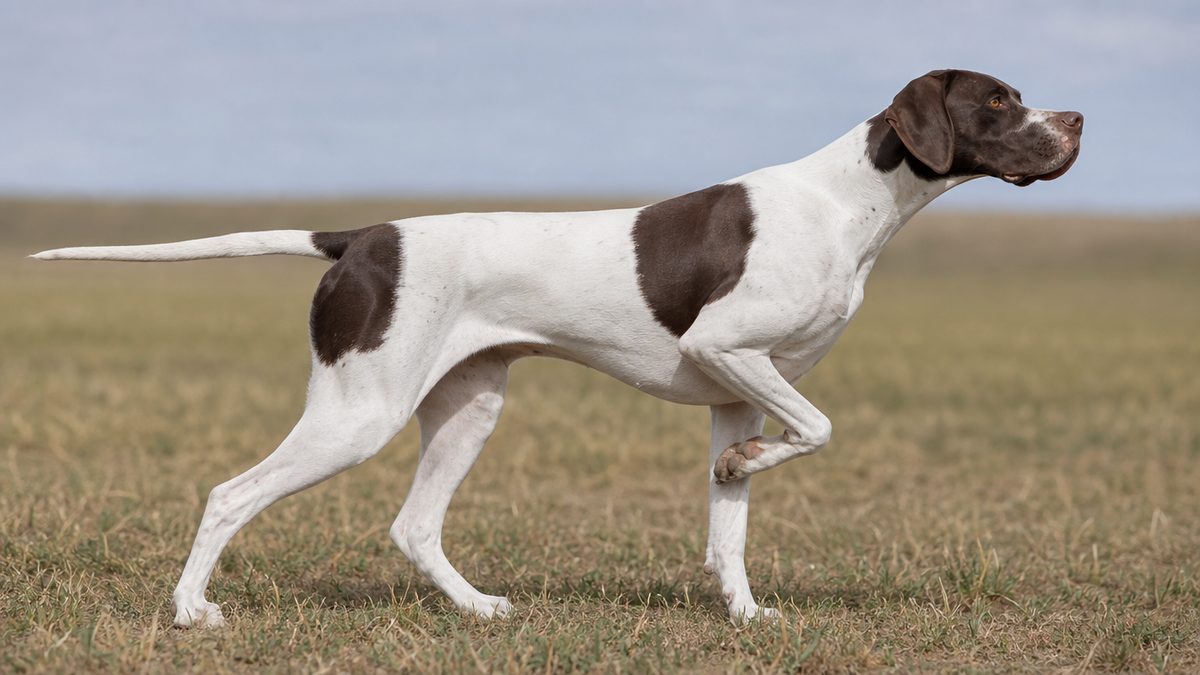
Quick answer
The english pointer is a large, short-coated British bird dog that needs 60 to 90 minutes of hard daily exercise and cannot be worked through an Indian afternoon. Its short coat helps in heat but does not make it heat-proof. Almost every Indian listing sold as a Pointer is a German Shorthaired Pointer, so verify the breed before you verify the price.
This page reports registry records, screening statistics and published veterinary literature. It is not veterinary advice, and no Bonbeno page can diagnose or treat an animal. Heat stress, tick-borne disease, hip and elbow disease and any suspected hearing loss all need a qualified veterinarian who has examined your dog, and screening decisions belong with your own veterinary surgeon.
Pointer at a glance
What the English Pointer is, and what it is not
The english pointer is FCI standard number 1, a large short-coated British bird dog whose whole job is to find game at a gallop and freeze on it. Every other pointing breed in the world is measured against it, and in India almost nobody is actually selling one.
The Fédération Cynologique Internationale files the breed as ENGLISH POINTER, number 1, in Group 7 Pointing Dogs, Section 2.1 British and Irish Pointers and Setters, with working trial. Number 1 is not a ranking; it is simply where the breed sits in the nomenclature. What the number does tell you is that this dog was in the register from the beginning, and that every continental pointing breed built after it was built partly out of it.
The FCI standard gives height at the withers as 63 to 69 cm for dogs and 61 to 66 cm for bitches, and gives no weight figure at all. That absence matters, because three other bodies do give weights and they do not agree with the FCI on height either. The American Kennel Club allows 25 to 28 inches for males, which reaches 71.1 cm and overshoots the FCI ceiling by 2.1 cm, and 23 to 26 inches for females, which starts at 58.4 cm and undercuts the FCI floor by 2.6 cm. The United Kennel Club sets 25 to 27 inches and 23 to 25 inches. A dog that is correct in Delhi under one standard can be oversized or undersized under another, and no ranking page in India mentions it.
| Body | Males | Females | Weight |
|---|---|---|---|
| FCI Standard 1 | 63 to 69 cm | 61 to 66 cm | Not stated anywhere in the document |
| American Kennel Club | 25 to 28 in (63.5 to 71.1 cm) | 23 to 26 in (58.4 to 66.0 cm) | 55 to 75 lb / 45 to 65 lb |
| United Kennel Club | 25 to 27 in (63.5 to 68.6 cm) | 23 to 25 in (58.4 to 63.5 cm) | 55 to 75 lb / 44 to 65 lb |
| Happy Pet Care (India) | 23 to 28 in, both sexes | 23 to 28 in, both sexes | 20 to 34 kg |
The Indian row in that table is the odd one out, and it is worth naming why. Happy Pet Care prints one height band for both sexes and a weight floor of 20 kg, which is below the AKC's female floor of 45 lb. It is a template value rather than a measurement, and the rest of this page shows how far that template goes.
The coat is the point
The FCI standard describes hair that is fine, short, hard and evenly distributed, perfectly smooth and straight, with a decided sheen. There is no undercoat. Usual colours are lemon and white, orange and white, liver and white, and black and white, with self colours and tricolours also correct. The UKC adds the trade names an Indian buyer will hear: a yellow or yellow and white dog with a black nose is called orange, and the same dog with a liver nose is called lemon. Nothing about the colour changes the dog, and a seller who prices by colour is pricing fashion.
The other signature is the tail. The UKC calls it a bee-sting tail, short, thick at the base, tapering, carried no more than 20 degrees above the topline and lashing side to side on the move. The FCI puts it the same way. The UKC then makes a docked tail a disqualification for this breed, which is worth holding on to, because the same registry says the opposite about the Pudelpointer, and Indian law says something different again.
Where the breed came from, and why two registries disagree
The FCI standard gives ORIGIN: Great Britain and carries no history section at all. The UKC standard does carry one, and it credits Spain as the country of origin, describing the English Pointer as the result of crosses between Spanish pointers and, most probably, Foxhounds and Bloodhounds for scenting, Greyhounds for speed and Bull Terriers for tenacity. The AKC dates the first Pointers in England to about 1650 and records that Pointers were among the first eight breeds registered in America in 1878, and were recognised by the AKC when it was founded in 1884.
Neither account is wrong. The FCI is stating where the modern breed was made; the UKC is stating where its raw material came from. Publish both, because a page that picks one is quietly discarding a primary document. The AKC also records the detail that explains the dog's build: Pointers were originally used with Greyhounds in the 17th century, pointing hares for the sighthounds to course, before wing shooting existed. A dog bred to hold a point until a Greyhound arrives is a dog bred to be motionless under enormous excitement, which is exactly the temperament described below.
Five bodies, five different names for one dog
Every major registry holds this breed, and no two file it under the same name, which is the first practical problem an Indian buyer hits. Search the wrong string and you will get a confident zero.
The FCI calls it ENGLISH POINTER and files it under E. Its letter-P index runs to 27 entries and contains no Pointer at all, which reads exactly like non-recognition until you check the letter E and find ENGLISH POINTER 1 sitting beside ENGLISH SETTER 2. The United Kennel Club does the same thing: it holds the breed as English Pointer in its Gun Dog group, and there is no ukcdogs.com/pointer path to find. The AKC calls it simply Pointer. The Royal Kennel Club also calls it Pointer, and files it in the Gundog group. The Orthopedic Foundation for Animals calls it POINTER but codes it EPT, a code you could not derive from the name. The North American Versatile Hunting Dog Association calls it Pointer and codes it PT. North American Versatile Hunting Dog…
| Body | Name used | Group or code | Notes |
|---|---|---|---|
| FCI | ENGLISH POINTER | 1, Group 7, Section 2.1 | Files under E, not P. Definitive acceptance 5 March 1963. |
| Royal Kennel Club | Pointer | Gundog | 321 registrations in 2025, in the at-watch band. |
| American Kennel Club | Pointer | Sporting | Among the first eight breeds registered in America, 1878. |
| United Kennel Club | English Pointer | Gun Dog | Standard copyright 1992, revised 1 May 2017. Docked tail disqualifies. |
| OFA | POINTER | Code EPT | Nine other OFA breeds carry Pointer in the name. |
| NAVHDA | Pointer | Code PT | One of 35 recognised versatile hunting breeds. |
The UKC runs nine groups, and the ninth is the Bloodlines Listing Service group: ten breeds the club will register while stating that no breed standard exists for them. Reading all nine groups in one fetch confirms the English Pointer sits in Gun Dog with a full standard, and so does the Pudelpointer. Neither is in the register-without-standard state, and saying so is a check that was actually run rather than an assumption.
The FCI record settles two dates that circulate wrongly. Definitive acceptance is 5 March 1963, and the currently valid standard was published on 28 July 2009, with the English text stamped 28 October 2009. The record writes those dates as 3/5/1963 and 7/28/2009, and the standard PDF writes them as 28.07.2009 and 28.10.2009. Both forms are in the same file set and they run in opposite directions, which is the single easiest way to publish a wrong month.
Proving a date format from the document in front of you
The FCI web record proves its own format on its own face. Four of its dates read 10/28/2009, 11/23/2009, 1/27/2010 and 7/28/2009, and 28, 23, 27 and 28 cannot be months, so the first field is the month and the record is M/D/YYYY. The standard PDF proves the opposite convention the same way: it prints 28.10.2009 and 28.07.2009, and 28 cannot be a month, so the first field is the day and the PDF is D.M.YYYY. The French translation, stamped 23.11.2009, confirms it with a second value above twelve.
The two documents agree on the underlying dates once each is read in its own format. That is worth stating plainly, because it is not guaranteed: the same registry has been caught giving one breed two different acceptance dates in its register and its standard. Here the register and the standard do not disagree, and a negative result of that kind is worth recording rather than leaving unsaid.
For an Indian reader the recognition question resolves through the FCI. The Kennel Club of India is India's FCI member, so KCI pedigrees run against FCI nomenclature, which means FCI standard 1 is the document that governs a KCI-registered Pointer. The KCI publishes no public breed list, so a search there returns zero for this breed and zero for every control breed as well. That is a broken instrument, not a finding, and it should never be reported as the breed being unrecognised in India.
The registration figure, reconciled across four documents
The Royal Kennel Club registered 321 Pointers in 2025, and that number holds in every club document that prints it. Getting to a figure you can trust took four documents and one arithmetic check, and the method matters more than the number.
The club's ten-yearly Gundog table gives the Pointer's decade as 574, 609, 636, 499, 507, 754, 585, 437, 316 and 321 for 2016 to 2025. The 2025 vulnerable-breed statistics PDF prints an identical row, under its own separate AT WATCH sub-heading. The club's web table prints the same ten values again. And the quarterly Gundog table gives the four 2025 quarters as 80, 86, 59 and 96, which sum to exactly 321. Four documents, one figure, and the quarterly table corroborates itself.
| Year | Registrations | Band |
|---|---|---|
| 2016 | 574 | Above at watch |
| 2017 | 609 | Above at watch |
| 2018 | 636 | Above at watch |
| 2019 | 499 | Above at watch |
| 2020 | 507 | Above at watch |
| 2021 | 754 | Above at watch |
| 2022 | 585 | Above at watch |
| 2023 | 437 | At watch |
| 2024 | 316 | At watch |
| 2025 | 321 | At watch |
The bands are the club's own: fewer than 300 registrations a year is vulnerable, and 300 to 450 is at watch. At 321 the Pointer is at watch, not vulnerable, and it has been in that band since 2023. The 2021 spike to 754 is the pandemic puppy year that shows in every British breed, and measuring the fall from it overstates the decline; measured from 2018's 636 the drop to 2025 is 49.5 percent, and measured from the 2021 peak it is 57.4 percent. The 2026 part-year is worse again: 58 in the first quarter and 54 in the second, against 80 and 86 in the same quarters of 2025.
Why four documents, and not one
Because the club's web table and its own PDFs do not always agree. Diffing all 47 vulnerable and at-watch rows cell by cell in one session found 19 differing cells across four breeds. Sixteen of them are a clean transposition: the Bullmastiff and the Bull Terrier (Miniature) have their 2017 to 2024 values swapped between them on the web, while 2016 and 2025 sit correctly in both rows. The other three are single substitutions: Manchester Terrier 2019 reads 243 on the web against 133 in the PDF, King Charles Spaniel 2023 reads 36 against 39, and Irish Wolfhound 2019 reads 225 against 229.
The Pointer is in none of them. Its row is identical in all three ten-year documents, which is why this page quotes it without hedging. This page quotes the ten-yearly Gundog PDF, dated to the 2016 to 2025 series, because it is the document whose column totals can be checked.
The extraction trap that would have moved every figure by two years
The ten-yearly PDFs use dashes where a breed was not yet registered, and the extractor silently drops the dashes rather than the values, so a short row left-aligns and every value in it is dated wrongly. In the Gundog table the Barbet is the short row, carrying eight values against ten columns. Summing the 37 full-width rows per column and subtracting from the club's own printed totals leaves residuals of 0, 0, 14, 35, 18, 31, 33, 50, 46 and 25, and those eight non-zero residuals are the Barbet's eight kept values in order, which places them at 2018 to 2025. Read left-aligned, the Barbet's 14 would have been dated 2016 instead of 2018.
All ten printed column totals then close exactly, which is what makes the Gundog group safe to quote. The eight kept values sum to 252 and the ten residuals sum to 252. That is the whole check, it costs one subtraction per column, and it converts a table you are told to distrust into one you can use.
Pointer price in india: what the numbers actually are
There is no dependable Pointer price in india, because the site that ranks for the query publishes the same figures for the whole country and for individual cities, and calls the dog a Poodle blend while doing it. The honest answer is a spread with its provenance attached.
Mr n Mrs Pet is the page Google's own AI Mode quotes when asked what a Pointer costs in India, and it gives INR 40,000 to 1,40,000+ across three quality tiers: basic 40,000 to 90,000, pet quality 90,000 to 1,20,000 and standard quality 1,20,000 to 1,40,000. Those figures are real in the sense that they appear verbatim in the page's own markup. What they are not is city-specific. Fetching the India page, the Bangalore page and the Delhi page in one session and comparing them as raw text gives identical rupee figures on all three, and after substituting the city name the Bangalore and Delhi pages are 96.7 percent identical.
Two of the three price tiers on that page describe the dog as "Good representation of the Poodle blend, often with a clearer lineage of purebred parents". The English Pointer has no Poodle in it. That sentence is the seam between what the software filled in from the URL slug and what a human pasted from another breed's template, and it appears on the Bangalore and Delhi pages word for word.
| Source | Figure | Divides at 84.38? | At 80? | Verdict |
|---|---|---|---|---|
| Mr n Mrs Pet, basic | Rs 40,000 | No (474.05) | Yes, 500 | Passes at 80 by construction; quotient is a price a seller would print |
| Mr n Mrs Pet, standard floor | Rs 1,20,000 | No (1,422.13) | Yes, 1,500 | Same. Weak evidence either way |
| Mr n Mrs Pet, ceiling | Rs 1,40,000 | No (1,659.16) | Yes, 1,750 | Same |
| Happy Pet Care | Rs 10,000 to 50,000 | No | Yes by construction | Template row shared with other breeds |
| Google AI Mode | Rs 40,000 to 1,40,000+ | n/a | n/a | Quotes Mr n Mrs Pet; adds no independent figure |
Run the division tests and the result is honest rather than dramatic. None of these figures divides cleanly at 84.38, and none at 74. They all divide at a flat 80, but every one of them ends in at least three zeros, and 1,000 divided by 80 is 12.5, so a match at 80 is arithmetic rather than evidence. The quotients, 500 and 1,500 and 1,750, are prices a real seller would print, so the flat-80 reading is plausible without being provable. What can be said with confidence is that no Indian figure for this breed survives the strong test.
The bigger problem is that the dogs are not Pointers
The organic results for the commercial query are dominated by a different breed. The pages that rank sell German Shorthaired Pointer puppies, one advertises a German Short Haired Pointer litter and calls the breed rare in India, and one video offers an American Pointer puppy in Punjab. The Indian market for the word Pointer is largely a German Shorthaired Pointer market wearing an English name. That is a homonym problem living inside the breed name itself, and it is the single most useful thing this page can tell an Indian buyer.
Google's own People also ask box on that commercial query returned four questions, and not one of them mentions this breed: which dog is under 4000, which dog price is 2000, which dog under 3000, and which dog is best under 5000 in India. Asking the same engine an informational question about the same breed in the same session returned a clean box of three on-breed questions. The commercial query has no breed-specific demand behind it in India, and the price you are being quoted is filling that vacuum.
We do not recommend breeders, link puppy listings or convert a foreign price into rupees and present it as an Indian one. A well-bred Pointer in the United States sells for roughly USD 1,000 to 1,500 on the sources that rank for it, and multiplying that by an exchange rate would produce a confident number describing nothing. Where no reliable Indian price exists, this page says so.
Monthly cost of keeping a Pointer in India
Budget roughly Rs 6,000 to 11,000 a month for a 25 to 30 kg Pointer in an Indian metro, built from figures you can check rather than from a single quoted range. The one published monthly cost for this breed is a template constant shared with unrelated dogs, and this section shows how to tell.
Happy Pet Care gives the Pointer a monthly cost of Rs 3,550 to 5,400, assembled from food Rs 2,250 to 3,000, health Rs 600 to 1,200 and grooming Rs 700 to 1,200. The arithmetic closes exactly, 2,250 plus 700 plus 600 is 3,550 and 3,000 plus 1,200 plus 1,200 is 5,400, which looks like careful work until you pull another breed from the same site. The Whippet prints the identical row to the rupee, all three component lines included, and so does the Pudelpointer. A 12 kg sighthound, a 30 kg bird dog and a 30 kg wirehaired gundog cannot share one grooming line, let alone one food line.
The control that makes this a finding rather than a suspicion is the Labrador Retriever page on the same site in the same session, which prints a different row, Rs 4,900 to 7,650, from food 3,000/4,500, vet 1,200/1,950 and grooming 700/1,200. So the site is not printing one number for everything; it is assigning each breed a tier from a small preset table. Quote the Rs 3,550 to 5,400 figure if you like, but quote it as a template constant shared with named other breeds, not as an observation of this dog.
Building the number from figures that are real
The costs below are all published Indian figures with a source attached, and they are what an Indian owner actually pays.
| Item | Published figure | Monthly equivalent |
|---|---|---|
| Anti-rabies vaccine, single | Rs 699 | About Rs 58 |
| 9-in-1 DHPPiL | Rs 899 | About Rs 75 |
| Kennel cough | Rs 1,349 | About Rs 112 |
| NexGard Spectra 15-30 kg, 3 tablets | Rs 3,308 (MRP Rs 3,375) | Rs 1,103 a month |
| Grooming, bath and styling, Delhi | From Rs 1,869 | Optional; this breed rarely needs it |
| Delhi MCD pet dog registration | Rs 500 new, Rs 500 renewal | About Rs 42 |
| Chennai GCC pet licence | Rs 50 | Negligible |
Parasite control is the line that dominates, and for this breed it should. NexGard Spectra at Rs 3,308 for three tablets in the 15 to 30 kg band works out at about Rs 1,103 a month, and it covers the tick and flea role together with roundworm and hookworm in one product. For a dog that will spend its life outdoors in Indian grass, that is not an optional line, and the tick-borne disease numbers later on this page explain why.
Vaccination is the line where an Indian owner has the most control, and the spread is enormous. Vetic's clinic price for the 9-in-1 is from Rs 899 and for anti-rabies Rs 699. Greater Chennai Corporation's six municipal pet clinics provide all treatment and anti-rabies vaccination free of cost, and issued 9,115 pet licences in 2024. The same vaccine, delivered three ways, differs by a multiple, and the difference is the delivery model rather than the drug.
Delhi's Municipal Corporation charges Rs 500 to register a pet dog and Rs 500 to renew, with a Rs 100 a month late fee. Greater Chennai Corporation charges Rs 50 for a pet licence. Both are trivial against the cost of the dog, both are legal requirements in those cities, and both give you a paper trail if a housing society challenges a large gundog.
Grooming is the one place a Pointer saves you money. The coat is short, hard and single, the AKC's own advice is a weekly brush with a soft-bristle brush or hound glove, and the Rs 1,869 Delhi styling package is simply not needed. Vetic Pet Clinic Redirect that money to parasite control and to a good ear routine, because the ears are where an Indian monsoon actually costs you.
Heat tolerance in Indian cities, worked from the data
The English Pointer handles Indian heat better than most northern gundogs and worse than almost any Indian dog, and the limit is not the coat. It is that this breed's entire function is sustained hard galloping, and exertion is what heat-related illness actually punishes.
Start with the homeland, because the usual claim about it is wrong. Norwich, in the English country where this breed was made, returns a NASA POWER grid cell at 30.68 m against a real elevation near 18 m, an annual mean of 10.08 C and annual relative humidity of 85.42 percent. That is far damper than Chennai at 72.39 percent or Delhi at 45.51. So the line that Indian humidity will finish a British bird dog is simply not true: the dog comes from a wetter place than most of India. What it does not come from is a hot one. Norwich peaks in July at a mean of 17.13 C. Delhi peaks in June at 35.88 C, a gap of 18.75 C between the hottest month at each end.
| Place | Cell elevation | Annual mean | Hottest month | Coolest month | Peak wet bulb |
|---|---|---|---|---|---|
| Norwich, England | 30.68 m | 10.08 C | 17.13 C (July) | 3.96 C (January) | 14.72 C (July) |
| Delhi | 206.37 m | 25.57 C | 35.88 C (June) | 13.61 C (January) | 26.50 C (July) |
| Kolkata | 7.35 m | 25.80 C | 31.53 C (May) | 17.31 C (January) | 27.09 C (June) |
| Chennai | 48.95 m | 27.94 C | 31.51 C (May) | 24.09 C (January) | 26.11 C (May) |
| Mumbai | 97.15 m | 26.77 C | 31.19 C (May) | 23.19 C (January) | 25.77 C (June) |
| Pune | 635.99 m | 23.86 C | 28.93 C (April) | 19.62 C (December) | 22.97 C (June) |
| Bengaluru | 841.72 m | 23.74 C | 28.37 C (April) | 20.22 C (December) | 21.86 C (May) |
Every figure above is echoed with the grid-cell elevation NASA POWER reports, because the model returns a cell rather than a point. All six Indian cells sit within 83 m of the real town, which is what makes them usable; the same query over a hill station can be out by more than a kilometre and would make the place look habitable for this breed when it is not.
The wet-bulb column is the one to act on. Wet bulb combines heat and humidity into the number that decides whether a working dog can shed heat at all, and it is computed here from the monthly mean temperature with the monthly mean humidity, never from the period maximum. Kolkata peaks at 27.09 C in June and Delhi at 26.50 C in July, against 14.72 C in the English homeland. Bengaluru's 21.86 C and Pune's 22.97 C are the mildest in the table, and that is the real reason those two cities suit this breed better than Chennai or Kolkata, not any difference in air temperature.
Why exertion matters more than ambient heat here
The largest study of heat-related illness in dogs looked at 905,543 UK dogs under primary veterinary care in 2016 and recorded 1,259 heat-related illness events in 1,222 dogs. Of the 879 events that had a recorded trigger, 652, or 74.2 percent, were exertional, against 113 environmental and 46 from vehicular confinement. The companion paper on the same cohort, using a stricter case definition and 395 confirmed events, found that a dog at or above the mean bodyweight for its breed and sex carried an odds ratio of 1.42 (1.12 to 1.80), rising to 3.42 (1.54 to 7.57) above 50 kg.
A Pointer is not a 50 kg dog, so the second odds ratio does not apply to it. The first one does, and the exertional finding applies with force, because a Pointer that is being used as a Pointer is doing the exact thing the study identifies as the dominant trigger. In Britain, at 17 C. The practical rule follows directly: in India, work this dog before sunrise and after dark, and treat any afternoon above about 30 C as off limits, whatever the humidity is doing.
City by city
- Bengaluru and Pune are the two best Indian cities for this breed, on a peak wet bulb of 21.86 C and 22.97 C and hottest months of April rather than May or June. Both still need pre-dawn work in April.
- Delhi is the hardest, because June's 35.88 C mean is the highest in the table and the July wet-bulb peak of 26.50 C arrives while the heat is still on. Delhi also has the widest annual swing, from 13.61 C in January, so the dog gets a genuinely usable winter.
- Chennai offers no winter relief at all: the coolest month still averages 24.09 C, so there is no season in which a Pointer can be worked in the middle of the day.
- Mumbai and Kolkata sit between the two, with Kolkata carrying the highest wet bulb in the table at 27.09 C in June and a usable January at 17.31 C.
- Hill stations are the obvious answer and the one to check hardest, because grid-cell elevation errors in Indian hill country run to more than a kilometre in both directions. Verify the elevation before assuming a hill town is cool enough.
Indian law reaches this directly. The Prevention of Cruelty to Animals (Dog Breeding and Marketing) Rules, 2017, Second Schedule Part IV paragraph 21(1), bars keeping in outdoor facilities, without the attending veterinary practitioner's written approval, dogs not accustomed to the temperatures prevalent in the area, breeds that cannot tolerate them such as long-haired breeds in high temperature locations, and sick, infirm, aged or young animals. A short-coated Pointer is not the long-haired case the clause names, but clause (i) reaches any dog that is not accustomed to the temperature, and a freshly imported Pointer is exactly that.
Temperament and who should not buy one
The English Pointer is an even-tempered, affectionate dog that is genuinely good with children and genuinely unsuited to a sedentary household. The temperament problem in India is almost never aggression; it is a dog with nothing to do.
The FCI standard describes the behaviour in four words that are worth keeping: aristocratic, alert with appearance of strength, endurance and speed, and a kind, even disposition. The UKC adds that the breed can be somewhat aloof with strangers but is an excellent family companion, eager to please and particularly good with children. Both standards make aggressive or overly shy dogs a disqualifying fault, which places genuine aggression outside the breed rather than inside it.
Aloof is the word to sit with. A Pointer is not a guard dog and will not become one; it is reserved rather than suspicious, and it warms up. Indian buyers who want a dog that challenges visitors are buying the wrong breed, and a Pointer trained to do it is a Pointer being asked to work against its own selection.
The three failure modes in Indian homes
- Under-exercise. Every one of the other two failure modes grows out of this one. The AKC states plainly that the breed requires lots of exercise every day, and a securely fenced space where it can run flat out is described as beneficial rather than optional. The ranking Indian care pages already field separation-anxiety questions about Pointer types, which is what an under-exercised gundog looks like from the owner's side.
- Being left alone all day. This breed was selected to work in continuous partnership with one handler over open ground. Nine hours alone in a flat is the opposite of that, and no amount of toys substitutes for it.
- Correction-heavy handling. A Pointer under pressure goes quiet and stops offering behaviour rather than arguing. Owners read the shutdown as stubbornness and escalate, and the dog gets worse. The training section below deals with what works instead.
Anyone in a flat without daily access to secure open ground; anyone who is out of the house for a full working day; anyone who wants a guard dog; anyone who wants a dog that will be walked twice a day on a lead and no more; and anyone buying on the strength of the short coat alone, because the coat is the least demanding thing about this dog.
The prey drive is real and it is the safety question that matters in an Indian city. This is a dog bred to lock on to a bird at 200 metres, and the same wiring turns on street cats, poultry and free-ranging dogs. Off-lead work belongs in enclosed ground only, and recall training is not a nice-to-have for this breed but the single skill the whole relationship rests on.
Against all that, the household picture is genuinely good. The dog is quiet indoors once worked, sheds little, takes almost no grooming, is clean, and is described by two separate registries as particularly good with children. A Pointer in the right Indian home is one of the easiest large dogs to live with. The problem is that the right Indian home is uncommon.
Training a Pointer, and the two things it resists
To train a Pointer, build recall first and everything else second, and keep every session short, novel and reward-led. The breed is highly trainable and it resists exactly two things: repetition and pressure.
The AKC describes an amiable, even temperament and alert good sense that make the Pointer congenial and trainable, and records the breed taking multiple titles in obedience, tracking, agility and rally, as well as work in service, therapy and search-and-rescue. That is a wide range for a specialist bird dog, and it tells you the raw material is there. What it does not tell you is how fast the dog switches off.
Recall is the whole job
Everything a Pointer does happens at distance. A dog that quarters 200 metres out and freezes on a scent is a dog whose obedience has to work at 200 metres, and in an Indian city the consequence of a failed recall is traffic rather than a lost bird. Build it in this order, and do not skip forward.
- Charge the recall word indoors for two weeks before it is ever used outdoors, always paying, never calling the dog to end anything good.
- Move to a long line in an enclosed space, at 5 m, then 15 m, then 30 m, with the line always attached and never tightened as a correction.
- Add distraction in one dimension at a time: distance, or duration, or excitement, never two together.
- Proof against birds and cats last, and accept that a Pointer on a live scent is the hardest recall in dog training. If it is not reliable there, the dog does not go off lead there.
- Keep the long line on in unenclosed ground for the whole of the first year, and longer if the recall is not paid every single time.
What the breed resists
Repetition first. Ten repetitions of a sit is nine too many for a dog selected to solve a new field every day, and a Pointer that has decided a session is boring will disengage without any drama. Sessions of five to eight minutes, two or three times a day, beat one thirty-minute block. In India that fits neatly around the same pre-dawn and post-dusk windows the exercise has to happen in anyway.
Pressure second. This is a sensitive breed, and the failure signal is silence: the dog stops offering behaviour, looks away, and slows down. Owners commonly read that as defiance. It is not, and increasing the pressure makes it permanent. Reward-led shaping with a high rate of reinforcement is what this dog is built for, and every ranking care page that recommends firmness for gundogs is repeating a habit rather than a finding.
The AKC records that Pointers seem to display the hunting instinct at around 2 months of age. You do not train the point into the dog, and you cannot train it out. An Indian owner with no interest in shooting will still meet a puppy freezing rigid at a pigeon on a balcony rail at eight weeks, and the right response is to let it happen and then reward the release.
The one thing worth adding for an Indian household is a settled indoor default. A Pointer that has run hard will lie down for hours, but it needs to be taught where. Mat work, five minutes at a time, paid generously, turns an excitable gundog into a dog that a housing society will tolerate. Teach it in the first six months, when the puppy is tired anyway.
The daily exercise requirement, and what happens without it
A Pointer needs 60 to 90 minutes of hard exercise a day, of which at least half has to be free running rather than lead walking, and in India that has to be delivered in two windows either side of the heat. A Pointer that does not get it becomes destructive, vocal and anxious rather than merely lively.
The AKC is unusually direct about this breed: it is a very active sporting breed and requires lots of exercise every day, delivered as long daily walks and vigorous play, with a securely fenced yard where the dog can run flat out described as beneficial and productive of a calmer dog indoors. The FCI standard describes the movement that requirement comes from: smooth, covering plenty of ground, with driving hind action and definitely not a hackney action. This is a dog engineered to cover ground economically for hours.
| Season | Morning window | Evening window | Notes |
|---|---|---|---|
| Winter, December to February | 06:30 to 08:30 | 17:00 to 19:00 | The only season in Delhi, Pune and Bengaluru with a usable middle of the day |
| Pre-monsoon, March to May | 05:15 to 06:45 | 19:00 to 20:30 | Bengaluru and Pune peak in April, not May. Chennai and Mumbai peak in May |
| Peak heat, May to June | 05:00 to 06:15 | 20:00 to 21:00 | Delhi's hottest month is June. Shorten sessions and carry water |
| Monsoon, July to September | 05:30 to 07:00 | 19:30 to 21:00 | Wet bulb peaks now, not in the hottest month. Dry the ears after every session |
| Post-monsoon, October to November | 06:00 to 08:00 | 18:00 to 20:00 | The easiest running weather of the Indian year |
What counts and what does not
- Free galloping on enclosed ground is the only thing that genuinely meets the requirement, and 20 to 30 minutes of it is worth an hour on a lead.
- Lead walking maintains condition and does nothing for the dog's head. Two long lead walks a day will not stop a Pointer chewing your sofa.
- Scent games are the highest-value indoor substitute, because they use the part of the dog that a Pointer actually is. Ten minutes of finding hidden food tires this breed more than half an hour of fetch.
- Fetch on hard ground should be rationed. Repeated hard stops on tile or concrete are how young gundogs damage shoulders and cruciate ligaments.
- Swimming is excellent and this breed generally takes to it, but Indian urban water bodies carry leptospirosis risk that a rural British river does not.
The heat constraint changes the shape of the requirement rather than its size. A Pointer in Bengaluru in April, where the hottest month averages 28.37 C and peak wet bulb is 21.86 C, can be worked comfortably twice a day. The same dog in Delhi in June, at a 35.88 C mean, has perhaps ninety usable minutes in twenty-four hours, and both of them fall in the dark. Owners who cannot commit to a 05:00 alarm for four months of the year should not buy this breed in North India.
Of the 879 heat-related illness events with a recorded trigger in a 905,543-dog UK study, 652 were exertional, which is 74.2 percent, against 46 from vehicular confinement. The dominant cause of canine heatstroke is not a hot car; it is a dog being exercised. That finding was made in Britain. Applied to a breed whose whole purpose is sustained galloping, in a country where June means 35.88 C in Delhi, it is the single most important sentence on this page.
Young dogs need the opposite of what their energy suggests. Growth plates in a large gundog close between about 12 and 18 months, and forced road work or long runs before then is how a dog with clean hip radiographs at 12 months becomes a lame dog at four. The puppy timeline further down this page sets out what to do month by month.
Grooming a short coat in Indian humidity
Grooming a Pointer takes about ten minutes a week, and the coat is not where the work is. In Indian humidity the ears, the feet and the skin folds under the collar are what actually need attention, and the standard advice imported from Britain gets one of them wrong.
The coat itself is genuinely low maintenance. The FCI standard describes hair that is fine, short, hard, evenly distributed, perfectly smooth and straight with a decided sheen, and there is no undercoat to blow. The AKC's advice is a weekly brushing with a soft-bristle brush or a hound glove to lift dirt and loose hair. That is the whole coat routine, and the Rs 1,869 full grooming package a Delhi salon offers is money this breed does not need spent.
The ears are the Indian problem
The FCI standard describes ear leathers that are thin, set on fairly high and lying close to the head. A close-lying drop ear over a warm humid ear canal is the classic setup for otitis externa, and the AKC's own advice for this breed is to check the ears regularly for signs of infection. The instruction that does not transfer is the towel-and-air-dry routine that overseas gundog clubs publish for their own climate. In a British autumn a damp ear dries. In an Indian monsoon it does not.
- Dry the ear canal after every swim and every bath, with cotton wool at the entrance only, never a cotton bud pushed down.
- Check weekly for smell, redness, head shaking or a dog rubbing an ear along the floor, and treat any of the four as a veterinary visit rather than a wait-and-see.
- Do not flush an ear on your own initiative if the eardrum status is unknown, because several common cleaners are ototoxic behind a ruptured drum.
- Keep the collar area dry in the monsoon; a wet nylon collar on a short coat produces a friction dermatitis that owners routinely mistake for mange.
There is no published Indian figure for canine otitis externa seasonality that survives checking, so this page does not quote one. What it can say is that the mechanism is straightforward and the AKC's own care note already flags it for this breed.
Feet, skin and sun
Indian pavement is the other thing the standard did not anticipate. The FCI describes oval, well-knit feet with arched toes and good cushioning, built for turf and stubble. Concrete at 45 C surface temperature burns pads, and the test is the back of your hand held on the ground for five seconds. If you cannot, the dog cannot.
White and lightly marked Pointers sunburn. The breed comes in lemon and white, orange and white, liver and white and black and white, and self colours, so a large proportion of the dogs carry substantial white. A thinly coated pink nose, ear tips and belly on a dog lying in Indian sun is a real risk, and it is one more argument for the pre-dawn and post-dusk schedule the climate section already required.
A single short hard coat with no undercoat is already the most heat-efficient thing about the dog. Clipping it removes the layer that reflects radiant heat and exposes skin that has never seen sun, and it does not grow back the same. Every Indian grooming salon that offers a summer shave is offering to make a Pointer hotter.
Health, screening and what the OFA tables actually say
The Pointer is a robust breed by large-gundog standards, with 6.9 percent hip dysplasia across 2,369 OFA evaluations, and its four screening tests are the four the national breed club names. The one number nobody should quote unqualified is the eye figure, because OFA's own summary and detail rows disagree by ten points.
The AKC's national breed club recommends four health tests for this breed: hip evaluation, elbow evaluation, thyroid evaluation and eye evaluation. All four have published OFA tables, which is unusual and useful, because it means a breeder can show you numbers you can compare against a published denominator rather than an assurance.
| Database | Evaluations | Normal | Abnormal | Detail |
|---|---|---|---|---|
| Hips | 2,369 | 92.4% | 6.9% dysplastic | Excellent 17.3, Good 63.6, Fair 11.6; Mild 4.5, Moderate 2.2, Severe 0.2 |
| Elbows | 771 | 94.6% | 5.4% | Grade 1 4.4, Grade 2 1.0, Grade 3 0.0 |
| Eyes (summary line) | 452 | 96.9% | 3.1% | See the note below |
| Thyroid | 420 | 89.8% | 4.3% affected | Autoimmune thyroiditis 1.0, compensative 3.3, idiopathic 0.0, equivocal 6.0 |
| Advanced cardiac | 50 | 84.0% | 10.0% | Equivocal 6.0. Small denominator, treat with care |
| Congenital cardiac | 79 | 98.7% | 1.3% | |
| Basic cardiac | 69 | 100.0% | 0.0% |
Both the hip and elbow rows add up, which is the first thing to check on any OFA table. Excellent 17.3 plus Good 63.6 plus Fair 11.6 is 92.5 against a printed 92.4, and mild 4.5 plus moderate 2.2 plus severe 0.2 is exactly 6.9. At 6.9 percent dysplastic on 2,369 evaluations the Pointer sits well inside the healthy half of the large-gundog range, and the elbow figure of 5.4 percent on 771 is similarly unremarkable in the good sense.
OFA's eye summary for the Pointer reads 96.9 percent normal across 452 evaluations. Its own per-diagnosis detail rows, on the same denominator of 452, record NORMAL at 393 dogs, which is 86.9 percent. That is a ten-point gap inside one source, and it is a known property of these tables rather than anything about this breed. Publish both figures with the arithmetic and quote neither as the rate.
The detail rows are worth reading for what they name rather than for the percentages. On 452 dogs OFA records corneal dystrophy in 11 (2.4 percent), cataract of unknown significance in 6 (1.3 percent), persistent pupillary membranes iris to iris in 4 (0.9 percent), punctate nucleus cataract in 5 (1.1 percent), entropion in 2 (0.4 percent) and retinal dysplasia folds in 2 (0.4 percent). None of those is a breed-defining problem, and the largest single category, 19 dogs at 4.2 percent, is OFA's own OTHER, SUSPECTED AS NOT INHERITED.
Lifespan, and why nobody can give you a Pointer figure
The AKC gives 12 to 15 years. That is a breed-club estimate rather than a study, and the two large UK studies that could settle it both come up short in interesting ways.
McMillan 2024 has no Pointer row at all. Its supplementary Table S5 lists every breed and whether it entered the survival analysis, and the German Shorthaired Pointer's phylogeny reclassification column reads "Pointer", which means the two breeds were folded into one group. The merged German Shorthaired Pointer figure, a median of 13.4 years with a 13.3 to 13.6 interval on 947 deaths, therefore covers two separately recognised breeds, and no page anywhere says so. There is no Pointer-specific median in that paper to quote, and this page does not invent one.
Teng 2022 does not cover the breed either. Its breed-level life tables run to only 18 breeds, accounting for 50.6 percent of the population, and the Pointer is not among them. What Teng does give, and what is honestly transferable, is the Kennel Club group table: Gundog life expectancy at age 0 is 11.67 years, 95 percent confidence interval 11.59 to 11.76, from 5,354 gundogs in a 30,563-dog deceased cohort. Use that as the group baseline, and treat the AKC's 12 to 15 as the breed club's estimate that it is.
The one figure worth knowing about McMillan's tables
The same paper's supplementary tables disagree with each other on sample size while agreeing on deaths, and the German Shorthaired Pointer group is a fresh example: Table S3 gives 3,313 dogs against 3,283 elsewhere in the supplement, while the death count is 947 in both. The German Wirehaired Pointer shows the same shape, 562 against 628, with 138 deaths in both. Where those tables disagree, quote the death count, which is the figure they agree on.
Bloat, and the size rule
The AKC flags gastric dilatation-volvulus for this breed on the general grounds that Pointers are large and deep-chested, and asks owners to learn the signs. The FCI standard confirms the shape: brisket well let down to elbow level, ribs well sprung and carried well back. The practical measures are the same as for any deep-chested dog and are set out in the feeding section: split the daily ration, do not exercise hard around meals, and treat unproductive retching with a distended abdomen as an emergency at any hour.
The nervous Pointer colony, and the deafness nobody mentions
The largest body of published science about this breed is not about hunting at all. For roughly two decades a research colony of Pointers bred for extreme fearfulness served as a genetic animal model of anxiety, and it produced a finding that matters to any buyer: inherited deafness, segregating as an autosomal recessive.
Searching the literature for this breed is a lesson in itself, and the numbers are worth printing. The bare word pointer returns 4,811 PubMed records, almost all of them from computer science and clinical trial statistics. Quoting and scoping it to title and abstract, `"Pointer"[tiab]`, still returns 2,339. Only `"English Pointer"[tiab]` narrows it to a tractable 31 records. A Labrador Retriever control run in the same session returned 1,109 for the quoted breed name and 126 for the classic hip dysplasia query, so the instrument was working and the collapse from 4,811 to 31 is the homonym, not the tool.
Opening them shows something no breed page mentions: a large share of the English Pointer literature is not about Pointers as a breed at all. The breed is a common laboratory colony animal, so the records include nutrient digestibility trials, probiotic supplementation studies and haemorrhage resuscitation work in which English Pointers were simply the dogs available. The genuinely breed-relevant papers are a small subset, and they are named below.
A colony bred for fear
From the early 1980s a line of Pointers was selectively bred for excessive nervous behaviour and studied as a genetic animal model of anxiety. The published output is substantial: brain biogenic amine distribution in nervous against normal Pointers, the relationship between genetic deafness and fear-related behaviours, and inner ear histopathology in nervous Pointer dogs with severe hearing loss. That is a body of work on one breed that has essentially never reached a breed page.
The finding a buyer needs is the deafness. Steinberg, Klein, Killens and Uhde reported in the Journal of Heredity in 1994 that a high incidence of deafness, confirmed by brainstem auditory evoked response testing, was found in that colony, and that outcross and F1 backcross results were consistent with an autosomal recessive mode of inheritance.
What this does and does not mean for a puppy buyer
It does not mean the pet Pointer population is deaf. The colony was deliberately bred for an extreme behavioural phenotype, and deafness travelled with that selection; nothing in the paper claims a population prevalence for ordinary Pointers, and this page does not either. What it does mean is that a recessive deafness allele is documented in the breed, and that it was detected by BAER testing rather than by anyone noticing at home.
It also matters that Indian law does not reach it. Across the whole of the Dog Breeding and Marketing Rules, 2017 gazette, the word BAER appears zero times and deaf appears zero times, and the only occurrence of hearing is an appeal hearing before the Secretary, Animal Husbandry. The mandatory genetic-defect testing clause, Second Schedule Part III paragraph 8(10), lists hip dysplasia, progressive retinal atrophy, night blindness, hypothyroidism, entropion, ectropion, overshot, undershot jaw, wry mouth, two or more missing teeth and cryptorchidism, and no hearing test at all. So there is no Indian legal requirement to BAER test any breed, and a buyer who wants it has to ask for it.
- Ask whether the litter was BAER tested, and treat a blank look as an answer. Unilateral deafness in particular is invisible to an owner and to most puppy assessments.
- Test the puppy yourself, crudely, in the room: a hand clap out of the visual field, from both sides, with the puppy awake and not watching littermates.
- Do not confuse deafness with the breed's known aloofness. A Pointer that ignores you at 100 metres on a scent is behaving normally; a puppy that does not orient to sound at three metres is not.
- Ask about temperament in the parents, since the same literature ties the fearful phenotype and the hearing loss together in one selected line.
None of this makes the Pointer a nervous breed. Both governing standards describe an even disposition and disqualify overly shy dogs. United Kennel Club The point is narrower and more useful: this breed has been studied harder for fear and hearing than almost any other, the results are published and free to read, and no page selling you a puppy will mention them.
Feeding a working-built dog in an Indian climate
Feed a Pointer twice a day, never around hard exercise, and manage to a visible waist rather than to a number on a bag. The breed carries no metabolic quirk of its own, so the two things that actually matter in India are bloat risk and the water the dog is not drinking.
The AKC's guidance for this breed is deliberately unremarkable: a high-quality food appropriate to the life stage, watched calorie intake because some dogs run to overweight, treats counted as food, and clean fresh water available at all times. There is no breed-specific dietary requirement, and any Indian page that gives you one is filling space. What the breed does have is a shape: brisket well let down to the elbows, ribs well sprung and carried well back, and a marked tuck-up. That is a deep-chested dog, and deep-chested dogs bloat.
Bloat management, which is a feeding decision
- Split the daily ration into two meals, and three for a growing puppy under six months.
- Leave a clear hour either side of hard exercise, which in India means feeding after the pre-dawn run and after the post-dusk one rather than before either.
- Feed at floor level unless a veterinarian has advised otherwise for an orthopaedic reason.
- Slow a fast eater with a maze bowl or a scattered feed rather than by restricting the amount.
- Know the emergency signs: unproductive retching, a distended and drum-tight abdomen, restlessness and drooling. That is a same-hour veterinary emergency at 03:00 as much as at 15:00.
Water is the Indian variable
A dog that is working in Delhi in June at a 35.88 C monthly mean loses water far faster than the same dog in Norwich at 17.13 C, and the two behave differently about drinking. Pointers in drive frequently will not stop to drink, which is precisely the population the heat-illness literature identifies: 652 of 879 recorded heat-related illness events with a known trigger were exertional. Carry water on every session, offer it at fixed intervals rather than waiting for the dog to ask, and end the session when the dog stops taking it.
| Age | Meals a day | Focus | Watch for |
|---|---|---|---|
| 8 to 16 weeks | 4 then 3 | Growth food for large breeds, controlled calcium | Loose stools in the first fortnight after any diet change |
| 4 to 12 months | 3 then 2 | Steady growth, not fast growth | Ribs should be easy to feel through a thin cover at all times |
| 12 to 18 months | 2 | Transition to adult food as growth plates close | Weight gain once the puppy metabolism slows |
| Adult, 18 months to 8 years | 2 | Match intake to the actual work done that week | A dog fed for a working week that only walked |
| Senior, 8 years on | 2 | Joint support and protein maintained, not cut | Muscle loss over the hindquarters, which is not the same as fat loss |
Indian availability is not a constraint for this breed. Large-breed foods from Royal Canin, Farmina, Drools and Pedigree are all sold nationally, and a home-prepared diet formulated with a veterinarian is equally workable. What is a constraint is the cost line: the Rs 2,250 to 3,000 food figure the one Indian template publishes for this breed is the same figure it publishes for a 12 kg Whippet, so it should not be used as a budget. Price the actual bag your dog eats.
You should be able to feel a Pointer's ribs through a thin covering without pressing, see a waist from above and a tuck-up from the side. A Pointer at or above the mean bodyweight for its breed and sex carried an odds ratio of 1.42 for heat-related illness in a 905,543-dog UK study. In an Indian summer, keeping this dog lean is not cosmetic.
Month by month through the first year
A Pointer puppy's first year in India is organised around two things the breed makes urgent: socialisation before 16 weeks, and joint protection until the growth plates close. Everything else can be caught up later; those two cannot.
| Age | What matters most | Health and legal |
|---|---|---|
| Before 8 weeks | The puppy stays with the litter. Indian law forbids sale below eight weeks under Rule 8(1)(a), and Rule 8(1)(e) requires every pup sold to be microchipped | Ask to see the dam. A seller who will not show her is telling you something |
| 8 to 10 weeks | Home, crate, name, house training. Short carried outings for sights and sounds before vaccination finishes | Core vaccination course begins. Vetic prices the 9-in-1 from Rs 899 and anti-rabies at Rs 699 |
| 10 to 16 weeks | The socialisation window. Traffic, lifts, autos, cows, other dogs, monsoon rain, tiled floors, the pressure cooker | Complete the core course. Start monthly parasite prevention |
| 4 to 6 months | Recall on a long line. Mat settle. First swim if water is clean | Teething. Delhi MCD registration at Rs 500, or a Chennai GCC licence at Rs 50 |
| 6 to 9 months | Impulse control around birds and cats. Adolescence arrives and recall degrades | Neutering timing is a conversation with your vet, not a default |
| 9 to 12 months | Distance work, still on a long line in open ground. Build stamina gradually | First hip and elbow radiographs are usually taken from 12 months |
| 12 to 18 months | Free galloping distance increases as growth plates close | Move to adult food. Screening radiographs if the dog may be bred |
The socialisation window is short and India is loud
Between roughly four and sixteen weeks a puppy forms its default response to novelty, and after it the same experiences cost ten times the work. An Indian city offers more novelty per minute than the countryside this breed was designed for: horns, construction, temple loudspeakers, free-ranging dogs, cattle, monsoon thunder. Get all of it in before 16 weeks, at a distance the puppy can handle, paying for calm rather than forcing exposure.
The one thing to be careful about is the free-ranging dog population. A Pointer puppy that has a frightening encounter at 12 weeks can carry it for life, and this is a breed that will not fight back so much as freeze and generalise. Choose the encounters; do not let them choose you.
Joint protection is a timing problem, not an exercise ban
- Free play on grass at any age, for as long as the puppy chooses to keep going.
- No forced road running, cycling alongside or long repetitive fetch before about 12 months, and build slowly to 18.
- Limit stairs and jumping off furniture in the first six months, which is easier said than done in an Indian flat.
- Keep the puppy lean. A fat gundog puppy is loading immature joints every step.
- Radiograph at 12 months if there is any question, since that is the minimum age most schemes accept and the OFA figures on this page give you a denominator to compare against.
Two legal points close the year. Indian law prohibits mating a bitch after the age of eight years, and prohibits in-breeding and incest breeding as defined in the gazette, which reaches uncle to niece, cousin to cousin and grandparent to grandchild within four generations. If you are buying from an Indian breeder, those are questions you are entitled to ask before the deposit rather than after.
Tick-borne disease, apartment living and the Indian environment
The biggest health risk to a Pointer in India is not inherited at all. It is what lives in the grass this athletic bird dog will spend its life crossing, and the published Indian numbers are large enough that year-round prevention is not optional.
Four Indian studies give the shape of the problem, and all four sampled clinically suspected dogs or clinic caseloads rather than random populations, so the percentages describe the dogs a vet sees rather than every dog in the country. That caveat is mandatory and it does not make the numbers small.
| Study | Place | Dogs tested | Finding |
|---|---|---|---|
| PMID 42357766 | Andhra Pradesh | 442 | Ehrlichia canis 37 of 442 on microscopy (8.37%), 51 of 442 by PCR (11.54%) |
| PMID 39338994 | Odisha | 178 | Ehrlichia canis 56 of 178 (31.46%); 75% of infected dogs weighed over 20 kg; 79% had a tick history |
| PMID 41651622 | Kerala | 120 | Babesia in 80 of 120 (66.7%), with a pre-monsoon March to May peak |
| PMID 42276665 | West Bengal | 584 | Babesia gibsoni 76.54%, Anaplasma 55.75%, and 72.9% of the 584 screened carrying two or more pathogens |
The Odisha figure is the one that speaks directly to this breed: 75 percent of the infected dogs weighed more than 20 kg and 79 percent had a tick history. A Pointer is a 20 to 34 kg dog whose exercise requirement puts it in long grass twice a day. The Andhra Pradesh study found Ehrlichia canis in 11.54 percent of 442 clinically suspected dogs by PCR. Kerala's series found Babesia in 66.7 percent of 120 dogs with a pre-monsoon peak. And in West Bengal, 72.9 percent of the 584 dogs screened carried two or more pathogens at once.
An 8-year-old neutered female English Pointer in south-west England presented with four to five months of faecal incontinence and then deteriorated neurologically. Magnetic resonance imaging found an intramedullary lesion at C7, a cystic forebrain lesion and bilateral thalamic lesions, and cerebrospinal fluid cytology showed morulae inside neutrophils and monocytes which PCR identified as Ehrlichia canis. The authors report it as the first confirmed case of Ehrlichia canis morulae within neutrophils in canine cerebrospinal fluid. That happened in a country with almost no tick-borne Ehrlichia pressure at all.
Read the two together and the conclusion is straightforward: the organism reaches the central nervous system, the Indian exposure figures are an order of magnitude above the British ones, and the dog in the published case was this breed. Year-round prevention is the cheapest intervention on this page. NexGard Spectra at Rs 3,308 for three tablets in the 15 to 30 kg band covers ticks and fleas together with roundworm and hookworm, at about Rs 1,103 a month.
Apartment living, honestly assessed
Apartment living with a Pointer is possible and it is not easy, and the difficulty is not what most Indian buyers expect. Inside a flat this is a quiet, clean, short-coated dog that lies down for hours once it has run. It does not bark at every passing sound, it does not shed heavily, and it takes up less floor space than its height suggests. A well-exercised Pointer is a gentle housemate.
The problem is the word well-exercised. This is a high-energy working breed, and a flat-kept Pointer that misses its running window becomes a different animal within days: pacing, chewing, vocal and increasingly anxious about being left. Nothing about the coat or the size decides whether apartment living works. The two questions that decide it are whether you have secure open ground within reach and whether you will get up at five in the morning for four months of the year.
- Socialise the puppy to lift doors, tiled floors and corridors before 16 weeks, because a flat-raised dog meets all three daily and a rural-raised one meets none of them.
- Give the dog one settled indoor place, taught deliberately, so that a housing society sees a calm dog rather than a large one.
- Treat the balcony as a hazard, not as exercise. A heat-sensitive dog lying in direct Indian sun on a concrete balcony is in the wrong place, and a Pointer will point at pigeons from a railing without any thought about the drop.
- Accept that this is not a hardy street-adapted dog. An Indian pariah dog thrives in conditions that a Pointer merely survives, and there is no shame in choosing the animal that fits the flat.
What the registration numbers mean for a buyer here
The Royal Kennel Club's registration numbers put this dog on its at-watch list rather than its vulnerable native breed list, at 321 in 2025 against a vulnerable threshold of 300. That is a British measure and it has an Indian consequence: a breed producing a few hundred puppies a year in its own country produces effectively none for export as pets, and India's import rules bar bringing dogs in to breed or sell at all, through Policy Condition (8) of the trade notice that governs the category. So the scarcity is real at both ends, and the adverts that fill the gap are selling something else.
Pointer against the breeds Indian buyers actually cross-shop
The English Pointer is cross-shopped against the German Shorthaired Pointer more than any other breed, and in India the two are frequently the same advert. This table sets out what genuinely separates them, and where a Labrador is the better answer.
| English Pointer | German Shorthaired Pointer | Pudelpointer | Labrador Retriever | |
|---|---|---|---|---|
| FCI number and section | 1, Section 2.1 British and Irish | 119, Section 1.1 Continental | 216, Section 1.1 Continental | 122, Group 8 Retrievers |
| Coat | Short, hard, single, no undercoat | Short, dense, harsh | Rough, 4 to 6 cm at the withers, dense undercoat | Short dense double coat |
| Grooming load in Indian humidity | Lowest | Low | Moderate; the beard and undercoat hold water | Moderate; the undercoat sheds heavily |
| Job it was bred for | Find and point at distance | Find, point, retrieve, track | Find, point, retrieve on land and in water | Retrieve shot game, mostly from water |
| Availability in India | Effectively none; the adverts are usually the German breed | Real but limited, KCI registered litters advertised | None found | Ubiquitous |
| Docked tail at the UKC | Disqualification | Permitted | Generally docked | Not docked |
| Realistic Indian verdict | For an experienced rural or peri-urban owner only | The practical choice if you want a pointing breed here | Not obtainable, and legally awkward to produce here | The default for most Indian homes, for good reasons |
Why the German breed keeps appearing under an English name
Run the commercial query in India and the organic results are dominated by German Shorthaired Pointer listings, one of which describes the breed as rare in India, alongside an American Pointer puppy video from Punjab. The word Pointer in an Indian advert is doing the work of a category rather than a breed, and there are nine other breeds in the OFA register alone whose names contain it. Ask for the pedigree, and read the FCI number on it: 1 is this breed, 119 is the German Shorthaired, 216 is the Pudelpointer.
The honest recommendation
The Pudelpointer belongs on that list for one reason: half of it is this breed. Its German club records that the founding 1881 mating was a Poodle bitch covered by a Pointer, and that the club still breeds for the Pointer's nose and field manner inside a rough coat. It is not obtainable in India, but it is the clearest illustration of what this breed contributed to the continental gundogs that are. For most Indian households the Labrador is the better dog, and saying so on a Pointer page costs nothing. It is available, it is understood by Indian vets, its literature is enormous, and it does not need ninety minutes of galloping to be liveable. The reasons to choose a Pointer instead are narrow and real: you have secure open ground, you can run the dog twice a day for a decade, and you want a dog that works at distance rather than at heel.
If the pointing work itself is what attracts you, the German Shorthaired Pointer is the pragmatic Indian answer. It is genuinely available here through KCI-registered litters, it does the same job plus retrieving, and you will not spend the dog's life explaining which breed it is. The English Pointer's case is aesthetic and historical rather than practical, and an honest page should say that out loud.
What Indian owners actually get wrong with this breed
Five mistakes account for almost every Pointer that fails in an Indian home, and four of them are made before the dog arrives. None of them is about the coat.
- Buying the wrong breed and not knowing it. The single most common Indian Pointer mistake is paying for an English Pointer and receiving a German Shorthaired Pointer, or a cross. The adverts that rank are mostly for the German breed, and the top-ranking price page describes the dog as a Poodle blend in two of its three tiers, which is a template left over from another breed entirely.
- Trusting a price band that is the same in every city. The India page, the Bangalore page and the Delhi page of the site Google's own AI Mode cites carry identical rupee figures, and after substituting the city name two of them are 96.7 percent identical. A price that does not vary between Bangalore and Delhi is not a market observation.
- Treating the short coat as heat proofing. The coat helps, and the homeland still peaks at a July mean of 17.13 C against Delhi's June 35.88 C. The dominant trigger for canine heat-related illness is exertion, not ambient heat, and this breed's whole purpose is exertion.
- Exercising at the wrong hour, then blaming the dog. A Pointer walked twice on a lead in the evening is an under-exercised Pointer, and it will chew, bark and pace. The requirement is 60 to 90 minutes with free galloping in it, delivered before sunrise and after dark for most of the Indian year.
- Escalating pressure when the dog goes quiet. A Pointer under training pressure stops offering behaviour. Owners read that as stubbornness, get firmer, and make it permanent. The breed is sensitive and reward-led, and the standards that describe it as eager to please are describing something real.
Three smaller ones worth naming
- Skipping the ears in the monsoon. A thin close-lying drop ear over a warm humid canal is a predictable problem, and the overseas advice to towel a dog and let it air dry does not transfer to an Indian July.
- Shaving the coat in summer. A single hard coat with no undercoat is already the most heat-efficient thing about the dog, and clipping it exposes skin that has never seen sun.
- Assuming a quiet puppy is a calm puppy. The literature on this breed includes a documented autosomal recessive deafness in a selectively bred colony, detected by BAER testing rather than by owners noticing. A puppy that does not orient to sound at three metres needs testing, not reassurance.
A dog that spends its life in Indian grass without year-round parasite prevention is the most expensive mistake on this list. Among clinically suspected dogs tested at Indian veterinary clinics, Ehrlichia canis was confirmed by PCR in 51 of 442 dogs in Andhra Pradesh and in 56 of 178 in Odisha, and in West Bengal 72.9 percent of 584 dogs screened carried two or more pathogens. Those are clinic caseloads rather than random populations, and they still describe the environment this breed will work in.
Adoption, import law and how to source responsibly
Adopting an English Pointer in India is unlikely, and adopting a Pointer type is not. Before you look for a breeder, read the import position, because it decides what can lawfully exist here at all.
India makes dogs a Restricted import. DGFT Trade Notice No. 22/2022-23 of 19 December 2022 places ITC(HS) 01061900, Mammals: Other, under Restricted, and its Policy Condition (7) permits the import of dogs only in three situations: a pet dog with a valid pet book and records in the importer's own name, dogs imported by R&D organisations with a CPCSEA recommendation, or dogs for internal security by the Defence and Police Force. Policy Condition (8) adds that import of commercial dogs for breeding or any other commercial activity is not permitted, and paragraph 6 states that any applications for trading or breeding purposes, or made on behalf of another person or entity, shall be duly rejected. Paragraph 7 limits entry to the airports and seaports of Delhi, Mumbai, Chennai, Hyderabad, Bangalore and Kolkata, six ports in total, with quarantine at the port where required. DAHD added a seventh port, Cochin International Airport at Kochi, for pets arriving under the baggage rules in October 2024. Directorate General of Foreign Trade A separate route exists for personal pet import under the Livestock Importation Act, and it is not the same instrument; do not read one as amending the other. The full route is set out in how to import a dog to India.
What follows is simple. Nobody can lawfully import English Pointers into India to breed or sell them. Any Indian population has to descend from dogs brought in as accompanied pets, which is why the breed is effectively absent here and why the adverts are for a different dog.
The adoption route, which is the honest one
- Start with breed-agnostic rescue. Indian shelters rehome large active dogs constantly, and a young Indian dog of Pointer build is already adapted to the heat that limits this breed.
- Ask gundog and hunting-dog groups, not general pet groups. Where a Pointer type turns up in India it is usually through a working-dog network rather than a shelter listing.
- Check the municipal clinics. Greater Chennai Corporation runs six pet clinics providing treatment and anti-rabies vaccination free of cost, and issued 9,115 pet licences in 2024. They are a better first call than any classified site.
- Register the dog. Delhi's MCD charges Rs 500 for new registration and Rs 500 to renew, with a Rs 100 per month late fee. It is cheap, it is required, and it is proof of ownership.
- Budget for the recurring cost, not the acquisition. A 25 to 30 kg dog in India runs to roughly Rs 6,000 to 11,000 a month once real vaccination, parasite prevention and food figures are used rather than a template row.
If you are buying, what to verify
- The FCI number on the pedigree. 1 is the English Pointer. 119 is the German Shorthaired Pointer. If the paperwork does not name a number, it is not telling you the breed.
- Four screening results, because the AKC's national breed club names four: hips, elbows, thyroid and eyes. All four have published OFA denominators you can compare against.
- BAER status of the litter, given the documented recessive deafness in the research line and the complete absence of any Indian legal requirement to test hearing.
- Age at sale and the microchip, both of which Indian law requires: no sale below eight weeks, and every pup sold micro-chipped with the number recorded on the receipt.
- That the dam is on the premises and can be seen with the litter. No document substitutes for this.
Second Schedule Part II paragraph 6(8) of the 2017 Rules forbids tail docking, ear cropping, de-barking, de-clawing, branding, dyeing and any change of appearance by artificial means, in those words. The UKC also makes a docked tail a disqualification for this breed. So a docked Pointer in India is both outside the standard and outside the law, and any seller offering one has answered a different question than the one you asked.
The last word belongs to the numbers this page opened with. The Royal Kennel Club registered 321 Pointers in 2025, in its at-watch band, down from 636 in 2018. A breed in that position does not need more casual buyers in a climate it was not built for. It needs the small number of homes that can genuinely work it, and everyone else adopting instead.
Common questions
Can English pointers be aggressive?
No, aggression is not a breed trait and both the UKC standard and the FCI standard describe an even-tempered dog. The FCI standard makes aggressive or overly shy dogs a disqualifying fault, which means a genuinely aggressive Pointer is outside the standard rather than typical of it. What Indian owners more often meet is an under-exercised dog that is frantic rather than hostile.
Do English pointers make good family dogs?
Yes, for an active family with secure space and two exercise windows a day. The UKC standard calls the breed an excellent family companion, eager to please and particularly good with children. The honest caveat for India is physical rather than temperamental: this is a 25 to 28 inch dog that moves fast, and it needs an hour of real running before it is safe company for a toddler.
What is the #1 best family dog?
There is no single answer, and Google asks this question on Pointer searches because the query space around rare gundogs is thin rather than because it has a candidate. In India the practical answer for most flats is an adopted Indian dog, which is already heat-adapted, costs nothing to acquire and is covered on the adoption section of this page.
Which Pointer is the calmest?
Among the pointing breeds an Indian buyer can realistically meet, the German Shorthaired Pointer and the English Pointer are close, and the difference within a breed is larger than the difference between them. Field-bred lines of either are markedly more driven than show lines, so ask which line a puppy comes from rather than which breed name is on the receipt.
Which dog is under 4000?
Google returns this question on Pointer price searches, and it is not about this breed at all. No Pointer of any kind sells for under Rs 4,000 in India. An adopted Indian dog from a municipal shelter costs nothing to acquire, and Greater Chennai Corporation's own pet licence is Rs 50, so the honest answer to a sub-4,000 budget is adoption.
Which dog price is 2000?
Nothing that is genuinely a Pointer. This is one of four generic Indian price questions Google returned on the commercial Pointer query, none of which mentions the breed. The only rupee figures reliably attached to a Pointer at that level in India are merchandise and books, not dogs, and a Rs 2,000 puppy advert is a warning rather than a bargain.
Which dog under 3000?
Again, not this breed. Indian shelters rehome healthy vaccinated dogs for a nominal fee or free, and the recurring cost is what actually matters: a Pointer-sized dog in India runs to roughly Rs 3,550 to 5,400 a month on one published template, before vaccination, parasite control and any heat-related veterinary care.
Which dog is best under 5000 in India?
For a purchase budget under Rs 5,000 the answer is an adopted dog, and that is not a consolation prize in India: an Indian dog is already adapted to the heat that limits this breed. The four questions Google returns on the Pointer price query are all budget questions of this shape, which tells you the query has no real Indian market behind it.
Is the English Pointer the same as the German Shorthaired Pointer?
No. They are two separate breeds with different FCI numbers, the English Pointer at 1 in Section 2.1 British and Irish Pointers and Setters and the German Shorthaired Pointer at 119 in Section 1.1 Continental Pointing Dogs. Most Indian adverts headed Pointer are selling the German breed, so read the pedigree rather than the headline.
How rare is the English Pointer in the United Kingdom?
The Royal Kennel Club registered 321 Pointers in 2025, which places the breed in its at-watch band of 300 to 450 registrations a year rather than in the vulnerable band below 300. That figure agrees across three separate club documents, and the quarterly table's four 2025 quarters sum to it exactly.
What is a fair Pointer price in India?
There is no reliable Indian market price for this breed, because the site that ranks for the query publishes identical figures for India, Bangalore and Delhi and describes the dog as a Poodle blend in two of its three price tiers. Treat any quoted band as a template value, not an observation, and read the price section on this page before paying anything.
Does the English Pointer cope with Indian heat?
Partly. The short coat and long muzzle both help, and this is not a brachycephalic breed, but the homeland is cool: the English heartland peaks at a July mean of 17.13 C while Delhi peaks in June at 35.88 C. Work the dog before sunrise and after dark, and treat any Indian afternoon above about 30 C as off limits.
What health tests should a Pointer breeder show me?
Four, and they are the ones the AKC's national breed club names: hip evaluation, elbow evaluation, thyroid evaluation and eye evaluation. All four have published OFA tables for this breed, so a breeder can show you real numbers to compare against, and a breeder who has none of the four has not screened.
Is the Pointer a good first dog in an Indian flat?
Rarely. The dog is clean and quiet indoors, sheds little and takes almost no grooming, so the flat itself is not the obstacle. The obstacle is delivering 60 to 90 minutes of hard running every day in a city where the safe hours are before sunrise and after dark, for 12 to 15 years.
Compare with similar breeds
Pointer sits in 3 Bonbeno groups. Each one compares it directly against the breeds it is genuinely an alternative to, on the same figures.