
Breed profile
Molossus of Epirus: Price in India, Registry and Heat
A Greek mountain guardian read off its own kennel club's Greek text and off the ancient authors, rather than off the pages that turn it into a war dog.
Quick answer
No Molossus of Epirus price in india exists, because no Indian listing for a live dog exists and no lawful route to import one for breeding does either. The breed is a large Greek mountain guardian with a national standard published by the Kennel Club of Greece, which gives 66 to 75 cm for males and 64 to 74 cm for females and no weight figure at all, and it appears in neither FCI register.
This page reports published veterinary evidence and is not a diagnosis. No inherited-disease data exists for this breed, so nothing here can substitute for examining an individual dog. Consult a registered veterinarian before acting on any health, feeding or vaccination decision, and take any dog showing collapse, laboured breathing or a rectal temperature above 40 C to a veterinarian immediately.
Molossus of Epirus at a glance
What the Molossus of Epirus is
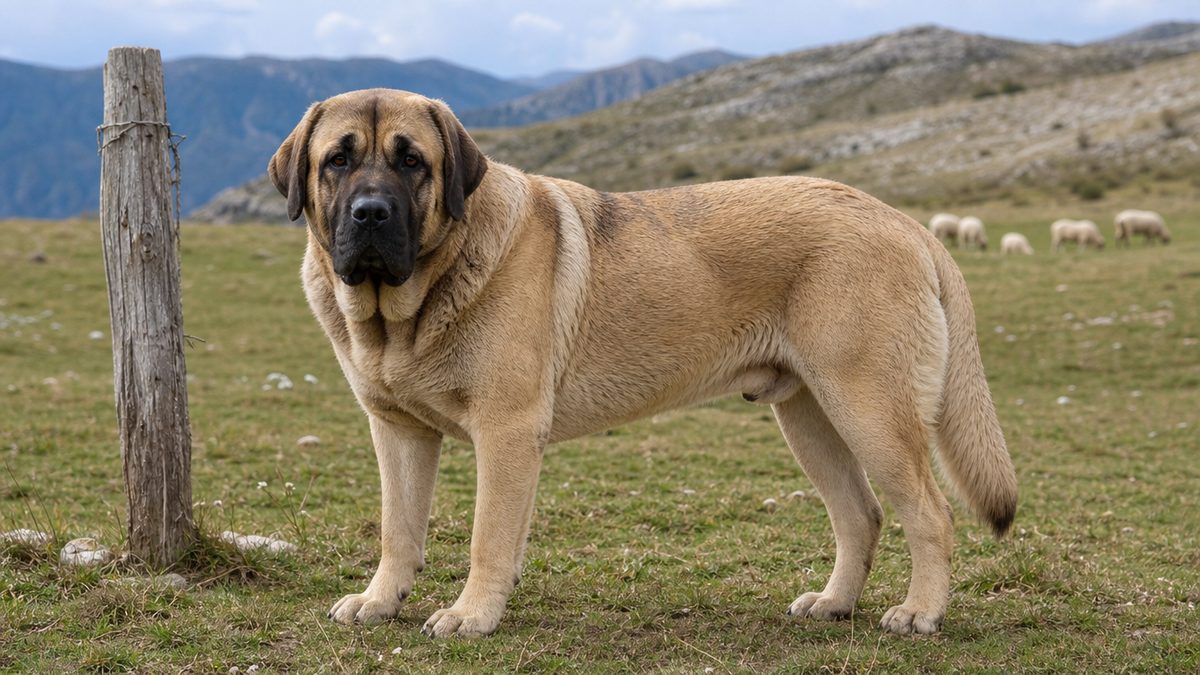
The Molossus of Epirus is a large Greek livestock guardian dog from the mountains of Epirus, bred to live with a flock and repel jackal, wolf and bear. It has a full national breed standard published by the Kennel Club of Greece and no entry in either register of the Federation Cynologique Internationale Federation Cynologique Internationale.
Start with the job, because the standard does. Its Greek text opens by giving the origin as Greek, and specifically Epirus and the surrounding mountain regions, and the utility as the guarding and protection of flocks from large wild animals such as jackal, wolf and bear, a role it has held for thousands of years. Everything else in the document follows from that sentence: a heavy skeleton, a large head, a thick loose-skinned neck with a double dewlap, and a temperament built to hold a boundary rather than to obey one.
The general appearance clause describes a dog of large size and medium proportions, compact, with a strong body and strong bones, a large head and a medium-length coat, of steady character and also dynamic. Its important proportions are unusually specific for a landrace standard: a muzzle-to-skull length ratio of 4 to 6, a skull whose width equals or exceeds its length, and a body longer than the height at the withers.
Names, and which one to search
In Greek the breed is the Molossos tis Ipirou, and English pages use Molossus of Epirus, Epirus Mastiff, Epirote Molosser and simply Molossus. Search the last of those and you will mostly meet a bat: Molossus is a genus of free-tailed bats, and a PubMed search for the bare word returns 263 records of which 135 are Molossus molossus alone. The dog needs its qualifier every time you look for it, in a search engine and in a database.
A second name problem sits closer to home. English Wikipedia keeps two separate articles and opens the ancient one with a hatnote reading not to be confused with the Molossus of Epirus. One is an extinct dog of classical antiquity. The other is a living Greek breed with a 21st-century kennel club standard. Most pages ranking in India merge them, and the merge is where nearly every wrong claim on the internet about this dog begins.
How rare is rare
Rare here has a documented history rather than a marketing adjective. A 2014 Greek report, carried by the forestry news site Dasarxeio and sourced to the Athens News Agency, records that a private effort by a few friends in early 1997 to save the Greek shepherd dogs by collecting the last surviving specimens led in 2006 to the founding of the Rescue Club of the Molossus of Epirus. The last archaic specimens, it says, were encountered in the early 1980s, and the population had been reduced by migration to the cities, the introduction of other breeds, disease, poison bait and a change in how flocks are managed.
The same report describes a donation of four molossoid shepherd puppies and one Greek Shepherd to livestock farmers in the North Pindus National Park, arranged with the Rescue Club, the management body of the Vikos-Aoos and Pindos national forests and the environmental organisation Kallisto. The club states that its programme is unsubsidised and that its aim is the rescue, spread and international recognition of the breed by the FCI. Twelve years on, that recognition has not arrived.
For most breeds the useful questions are care questions. For this one the useful question is what the animal actually is, because an extinct ancient dog, a modern Greek landrace, a kennel club classification row that looks like an FCI grant, and a war-dog legend with no source behind it all sit between a reader and a straight answer. Sorting those out is the work here, and the care advice follows from it.
Which registries recognise the Molossus of Epirus
Breed recognition for the Molossus of Epirus stops at the Greek border: it is recognised in Greece and unrecognised everywhere else. The Kennel Club of Greece publishes a complete national standard for it, and Bonbeno found it in no FCI register. Both halves of that sentence are read off the documents themselves rather than off any page describing them.
What the Kennel Club of Greece publishes
The Kennel Club of Greece, the Kynologikos Omilos Ellados, maintains a Greek Breeds section and gives the Molossus of Epirus a full standard there, running from origin and utility through head, body, limbs, coat, colour, height and faults to the testicle note that closes a conventional standard. It is a real breed standard. Nothing about it is provisional or informal.
One field is informative by being empty. The document prints a heading reading date of publication of the standard and leaves the value blank. The same is true of the club's White Greek Sheepdog and Cretan Hound standards Kynologikos Omilos Ellados. So it is impossible to say from the documents when any of these standards was adopted or last revised, which matters when a seller tells you a dog conforms to the current standard.
What the FCI does not list
The FCI lists breeds under their original-language names, so a Greek entry would appear as Molossos rather than as Molossus. Bonbeno read the letter-M index in full. It holds eleven breeds, running from Macedonian Shepherd Dog Karaman at number 378 to Mudi at 238, and it contains no Molossos of any kind. The controls sit on the same page: Mastiff at 264, Mastin del Pirineo at 92, Mastin Espanol at 91 and Mastino Napoletano at 197 are all present, so this is a populated index rather than a broken one.
The provisional register is the one that matters most for a national breed working toward recognition, because that is where it would sit while it worked. Bonbeno read it and it contains no Greek entry at all, with the Macedonian Shepherd Dog Karaman at 378 and the Tatransky Duric at 377 present as controls. So the answer is not that the breed is provisionally recognised. It is that the FCI does not hold it in any status.
The one Greek breed the FCI does hold
Greece has exactly one breed in the FCI nomenclature and it is not this one. The FCI's record for HELLINIKOS ICHNILATIS at 214 gives group 6, section scent hounds, subsection medium-sized hounds, country of origin Greece, breed status recognised on a definitive basis, and the working-trial position as subject to a working trial. That record is the yardstick this page uses in the next section, because the Kennel Club of Greece's own page for the same breed matches it exactly, which tells you what a genuine classification row looks like on that site.
India is a full FCI member represented by the Kennel Club of India, so KCI pedigrees are issued against FCI nomenclature. A breed the FCI does not list has no place in that nomenclature, which means there is no FCI pedigree for a Molossus of Epirus anywhere in the world and none can be issued in India. If a seller offers you FCI or KCI papers for one, the papers describe a different dog, a different registry, or nothing at all.
The FCI classification row, and what it actually proves
The Kennel Club of Greece prints an FCI classification on a breed the FCI has never granted, and the honest reading is neither that the club fabricates recognition nor that the row is meaningless boilerplate. Bonbeno read all seven of the club's Greek breed standards from raw markup on 2 September 2026 to settle it, and the row is populated per breed.
Bonbeno's own earlier pages recorded a weaker version of this. The working theory across the Cretan Hound, Greek Shepherd and Kokoni guides was that the club uses one template for all seven breeds, so an identical classification row appears everywhere and happens to be true only for the Hellenic Hound. Reading the seven documents side by side falsifies that. There is no single template, the values differ, and the label above them differs too.
| Breed | Label used | Group and section | Working trial line | Date field |
|---|---|---|---|---|
| Hellenic Hound | TAXINOMISI D.K.O. | Group 6, section 1.2, medium-sized hounds | Subject to a working trial | 16.10.1959, filled |
| Molossus of Epirus | KATATAXI F.C.I. | Group 2, subgroup 2.2, mountain molossoid | Without working trials | Printed and blank |
| White Greek Sheepdog | KATATAXI F.C.I. | Group 1, subgroup 1.1, sheepdogs | Without working trials | Printed and blank |
| Cretan Hound | KATATAXI F.C.I. | Group 5, subgroup 7, primitive hunting | With a working trial | Printed and blank |
| Kokoni | KATATAXI F. C. I. | Group 9, companion dogs | Without working trials | No date field at all |
| Rhodian Hound | KATATAXI F.C.I. | Group 10, subgroup 1, long-haired sighthounds | Without working trials | Printed and blank |
| Greek Shepherd | No front-matter row | Stated as Group 2 in a closing paragraph | Not stated | No date field at all |
Six different group numbers appear across seven documents, the working-trial line varies, and the Cretan Hound's says the opposite of the Molossus of Epirus's Kynologikos Omilos Ellados. A copied row cannot do that. Somebody chose Group 2, subgroup 2.2 for this breed, chose Group 5 for the Cretan Hound and Group 9 for the Kokoni, and wrote a working-trial position for each.
The label is the tell, and only one row is a grant
The sharper observation is in the wording. The Hellenic Hound's page is headed Protypo F.C.I. No 214 / 22.04.1996, gives origin under the label PROELEFSI, dates the standard in force to 16.10.1959, and calls its classification TAXINOMISI D.K.O., using the Greek initials for the international federation. It also closes with a hundred-point marking scale and a title-award table, which is the FCI's own 1959 document translated. The other six use KATATAXI F.C.I. with the Latin initials, label origin as KATAGOGI, and carry no standard number and no scale of points.
Check the one row that could be a grant against the register and it holds. The FCI's record for 214 gives group 6, section scent hounds, subsection medium-sized hounds, and subject to a working trial, which is exactly what the club prints. So on the Hellenic Hound the row is genuine, verified against the FCI's own document with the FCI's own controls present on it. On the Molossus of Epirus the identical-looking row corresponds to nothing in either register Federation Cynologique Internationale.
That distinction is worth carrying beyond Greece. When a national body prints a classification in FCI vocabulary, do not ask whether the row is boilerplate. Ask whether the register contains the breed, and read the label the row is printed under, because a club translating a real FCI document tends to keep the FCI's own field names and a club filing its own breed tends not to.
Only one of the seven Greek breeds is FCI-recognised, so the observation that the TAXINOMISI D.K.O. label appears only on the recognised one rests on a single case. Treat it as a prompt to check the label, not as a rule. What does not rest on one case is the finding that the classification values are chosen per breed, which six differing group numbers establish on their own.
What the Kennel Club of Greece standard says, measurement by measurement
Read the standard itself and two things become clear immediately. It contains no weight figure and no life expectancy, and its disqualifications include one that puts it directly at odds with the Greek Shepherd standard published by the same club.
| Point | What the standard says |
|---|---|
| Height, males | 66-75 cm at the withers |
| Height, females | 64-74 cm at the withers |
| Weight | No figure. In harmony with the size of the dog |
| Muzzle to skull ratio | 4 to 6, with a moderately marked stop |
| Skull | Width equal to or greater than its length |
| Body | Longer than the height at the withers |
| Coat | Dense, tight, straight, about 5-6 cm on the body, with a rich soft undercoat |
| Colour | Solid colours only, with or without a black mask; the less white the better |
| Tail | Thick at the base, reaching the hock, carried low at rest; must not be cut |
| Ears | Medium, triangular, flat, set above the eye line; must not be cut |
| Rear dewclaws | Single or double; a double dewclaw preferred between equal specimens |
| Bite | Scissor, with strong white teeth, large canines and full dentition |
| Shoulder angle | About 110 degrees; elbow about 130 to 135 degrees |
| Standard number and date | No number; the date field is printed and left blank |
The weight that exists in no document
The standard's height and weight clause reads, in full, that height is 66 to 75 cm for males and 64 to 74 cm for females, and that weight should be in harmony with the size of the dog, giving the impression of a strong and compact animal. There is no number. So every kilogram range published for this breed was supplied by somebody other than the registry.
101dogbreeds prints female weight as 88 to 132 lb and male weight as 99 to 143 lb. Convert those and the source becomes visible: 88 lb is 39.9 kg, 132 lb is 59.9, 99 lb is 44.9 and 143 lb is 64.9, so the underlying set is a tidy 40 to 60 kg and 45 to 65 kg that somebody converted outward into pounds. Its heights, 25 to 29 inches and 26 to 30 inches, are round inches rather than round centimetres, so the two fields did not come from the same place. Neither came from the standard.
Greek Wikipedia fails from the other direction, and more oddly. It gives height as 67 to 78 cm for males and 65 to 74 cm for females, and weight as 40 to 75 kg for males and 38 to 65 for females, with the female figure printed in centimetres rather than kilograms. Its Great Greek Mastiff paragraph, which asserts a 74 cm-plus form, carries a reference that resolves to the English Wikipedia Main Page. The article has carried a sources-needed tag since 28 May 2022.
| Measurement | Kennel Club of Greece | Greek Wikipedia | 101dogbreeds |
|---|---|---|---|
| Male height | 66-75 cm | 67-78 cm | 26-30 in, that is 66.0-76.2 cm |
| Female height | 64-74 cm | 65-74 cm | 25-29 in, that is 63.5-73.7 cm |
| Male weight | No figure given | 40-75 kg | 99-143 lb, that is 44.9-64.9 kg |
| Female weight | No figure given | 38-65, printed as centimetres | 88-132 lb, that is 39.9-59.9 kg |
| Life expectancy | No figure given | Not stated | Approximately 15 years |
A standard that fixes height and refuses to fix weight is telling you that condition is judged by proportion, not by the scale. That is the correct approach for a working guardian and it is also the gap that lets a seller present an overweight dog as a big one. Measure the height, then judge the body condition against the frame, and treat any quoted kilogram range as somebody's estimate rather than the breed's specification.
History and origins: what the ancient authors actually wrote
Aristotle is the earliest and clearest witness, and what he describes is a flock-guarding dog rather than a war dog. Bonbeno read the Greek and Latin primary texts instead of the breed pages that summarise them, and three of the four claims those pages make do not survive contact with the sources.
Aristotle's Historia animalium names the Molossian exactly twice, both times inside one sentence. The Greek reads that the kind of dogs found in Molossia, in respect of hunting, differ in no way from those found elsewhere, but that the kind which follows the sheep is superior in size and in courage against wild beasts, and that dogs bred from both, the Molossian and the Laconian, are outstanding in courage and endurance of labour. D'Arcy Wentworth Thompson's English renders the same passage as sheep-dogs of this breed being superior to the others in size, and in the courage with which they face the attacks of wild animals.
Two things follow that no ranking page reports. Aristotle writes of a kind of dog found in a place, not of a breed in the modern sense, and he separates a hunting type he finds unremarkable from a flock-following type he finds exceptional. The livestock guardian is the impressive one in the earliest source, which is the opposite of the war-mastiff story.
Aristotle on Epirus, in a passage about pasture
The same work says something about Epirus itself that almost nobody quotes. Discussing milk yields, Aristotle notes that the large cows of Epirus each give a great quantity, that with the exception of the ass all the quadrupeds in Epirus are of large size, and that the cattle and the dogs are the largest. He attributes the size to the country having abundant pasture and grounds suited to each season, and mentions the sheep called Pyrrhic after King Pyrrhus.
So the ancient explanation for large Epirote dogs is grazing, not breeding programmes and not conquest. That is a more useful line for a modern reader than any of the legends, because it is the same argument a livestock scientist would make today about a landrace shaped by its own terrain.
The manual that never mentions it
Xenophon's Kynegetikos is the one surviving Greek hunting manual of Aristotle's century, and the Molossian appears in it zero times. Bonbeno searched the whole Greek text, 55,731 characters, for both the Attic and the Ionic spellings and found nothing. What Xenophon does name is Castorian and Vulpine hounds, both Laconian varieties, and for boar hunting a list of Indian, Cretan, Locrian and Laconian dogs.
That absence is worth something precisely because Xenophon names dogs by region and is writing about the working use of dogs. A famous Greek regional type is missing from the period's only Greek hunting handbook. One word in that text does look like a hit and is not: the Greek epeiros, which gives Epirus its name, is the ordinary noun for mainland, and its single occurrence there contrasts islands with mainlands rather than naming the region.
The Latin poets, who put it with the shepherds
Virgil names the Molossian once in the whole of the Georgics, at book 3, and the context is guarding. He tells the farmer to feed the swift whelps of Sparta and the fierce Molossian on rich whey, and says that with such guards you will never fear a night thief in the stalls, an attack of wolves, or restless Iberians at your back. Epirus appears twice more in the same poem and both times it is about horses, never dogs.
Horace names it once, in Epode 6, and again with a shepherd: like a Molossian or a tawny Laconian, a strength friendly to shepherds, he will drive through deep snow whatever beast runs before him. In all three classical passages the Molossian is paired with a Laconian and set to work at a flock. In none of them is it a war dog.
Greek Wikipedia states that Plato wrote about dogs of similar form known in the region of Epirus as early as 800 BC, sourced to Bruce Fogle's Encyclopedia of the Dog. Bonbeno enumerated every Greek work of Plato in the Perseus canonical corpus and searched all of them for both spellings of Molossian. The count is zero. The sentence is also chronologically impossible as written, since Plato lived roughly 428 to 348 BC and could not have written anything in 800 BC.
Two dogs, one name, and why the confusion is built into the FCI
The ancient Molossus and the modern Molossus of Epirus are not the same animal, and the strongest argument that they are is a group name rather than a piece of evidence. English Wikipedia identifies the mechanism plainly and it is worth quoting properly.
English Wikipedia's Molossian hound article records that a number of modern kennel clubs, including the FCI, group the distinct mastiffs with livestock guardian dogs as a single type they call molossoid, and that this confusion has been theorised to arise from mistranslations of ancient texts and from assumptions based purely on size. The same article says the theory that all mastiff-type dogs descend from the Molossus has been questioned by many experts on the grounds that it relies on guesswork and lacks historical evidence.
Now notice what the Kennel Club of Greece writes on its own standard. It files the Molossus of Epirus into Group 2, subgroup 2.2, mountain type molossoid. The breed is therefore classified into an FCI group whose name is itself the source of the confusion Wikipedia describes. That is not dishonest and it is not evidence of descent. It is a modern taxonomic label being read backwards as an ancestry claim.
What can and cannot be said about continuity
| Claim commonly published | What the primary sources support |
|---|---|
| The Molossians kept a famous large dog | Supported. Aristotle names it and Virgil and Horace both know it |
| That dog guarded flocks | Supported, and it is the only role the three classical passages give it |
| It was a war dog taken to India by Alexander | Not supported by any of the texts read here; Wikipedia files it as a story |
| Plato described it around 800 BC | Not supported. Zero occurrences across Plato's Perseus corpus |
| Today's breed is the same animal, continuously | Untestable. No genetic study of the modern breed exists |
The honest position is the one the Creatures profile takes, and it is the only ranking page in the Indian result set that takes it. That page separates the ancient Molossian hound from the living Greek breed, calls the ancient animal extinct as a distinct type, says what is known about it is thinner than the confident breed profiles suggest, and states that the modern breed is recognised by the Kennel Club of Greece and not by the FCI or the AKC. Its height figures, 66 to 75 cm for males and roughly 64 to 74 for females, match the standard.
Bonbeno normally treats that domain's breed pages with suspicion, because its listing furniture appears whether or not there is anything to list. Here the furniture is at least honest about itself: its for-sale, herdbook, profile and breeder counters all read zero. Judge the page in front of you rather than the domain, and this page is careful.
What this means when you are looking at a dog
None of the antiquity argument tells you anything about the animal offered to you. There is no FCI pedigree, no genetic test panel for the breed, and no international register to check a claim against. What you can check is the standard: height, a skull as wide as it is long, a 4 to 6 muzzle ratio, solid colour, uncut ears, an uncut tail reaching the hock, and a scissor bite with full dentition. Those are observable. Descent from a dog Aristotle saw is not.
Aristotle, Virgil and Horace all name a Laconian alongside the Molossian, and Aristotle adds that the cross of the two is outstanding for courage and stamina. Bonbeno's Laconian Hound page works through what the sources say about that dog, including the finding that the chapter universally cited for it does not mention it. The two ancient Greek dogs have to be read together, because the ancient authors never separated them.
Molossus of Epirus price in India
No Molossus of Epirus price in india exists, because no Indian listing for a live dog exists. That is the answer, and the composition of what a search does return is worth more to a buyer than an invented number would be.
Two India-targeted searches were run on 2 September 2026, one for the breed term and one for the price query. Between them they returned twenty organic results and not one was a listing for a live dog anywhere in India. What ranked instead was an Etsy marketplace page, an Amazon.in paperback, two Facebook posts, a Pinterest board, a Quora thread, a YouTube video and a set of overseas breed profiles. To prove the search itself works, a labrador retriever price in india control was run in the same tool in the same session and returned ten Indian pages carrying real rupee bands, including Supertails at 8,000 to 70,000 rupees and Mr n Mrs Pet's tiered table at ₹30,000 to ₹1,20,000. The instrument is fine. The market is absent.
The rupee figures attached to this breed are print-on-demand goods
The one Amazon.in item carrying the breed's name is a book, and not even a book about the breed. It is Molossus of Epirus 20 Milestone Challenges, a 44-page paperback photo journal by an author credited as Todays Doggy, published by Original Milestones on 23 September 2019, ISBN 978-1395539672, imported and packed by Bookswagon of Daryaganj, New Delhi. Its own description tells the reader to use props to set the stage for each photo. On 2 September 2026 the listing showed no price at all and read currently unavailable.
The other rupee figures come from Etsy India, which carries downloadable wall-art prints under the breed's name at prices around 1,375 to 1,618 rupees. Those are files, not animals. Anyone quoting either number as a puppy price has quoted a photo album or a poster.
| What is being sold | Where | Price shown | Is it a dog |
|---|---|---|---|
| 44-page milestone photo journal, paperback | Amazon.in | None displayed; currently unavailable | No |
| Downloadable wall-art print | Etsy India | About 1,375 to 1,618 rupees | No |
| A live Molossus of Epirus puppy | Nowhere found | No figure exists | Not offered |
Why no currency test is run here
Indian breed pages routinely publish a converted dollar list as a local price, and this site divides every suspicious rupee figure by 84.38, 74.00, 80.00 and 66.67 to test for it. No such test is run on this page, because there is no candidate price to test. A figure attached to a poster is not a mispriced dog; it is a poster. Running arithmetic on it would dress up a non-finding as a finding.
What can be said is that the absence has a cause rather than being an accident of indexing. India's import rules make dogs Restricted under ITC(HS) 01061900 and permit import only for a pet dog with a valid pet book in the importer's name, for research with CPCSEA recommendation, or for internal security by the Defence and Police Force, while paragraph 6 of the same trade notice states that any applications for trading or breeding purposes shall be duly rejected. No lawful founding stock means no Indian litters, and no Indian litters means no price.
Given that no lawful commercial import route exists and no Indian breeder is documented, a large shaggy guardian offered here as a Molossus of Epirus is more likely to be a Caucasian Shepherd, a Central Asian Shepherd, a Himalayan Sheepdog, a Bakharwal or a cross. Several of those are better dogs for Indian conditions. The point is not that they are lesser animals; it is that you should know which one you are buying before you pay for it.
What a Molossus of Epirus would cost to keep in India each month
Budget roughly ₹14,000 to ₹28,000 a month for a guardian of this size in an Indian metro, before one-off costs. Food and cooling dominate, and in the plains the cooling line is not optional, which is what makes a mountain guardian one of the most expensive dogs to keep properly in India.
The model below prices a dog at the standard's own height range of 66 to 75 cm for males and 64 to 74 cm for females. Since the standard gives no weight, the food line is built on the body mass a dog of that frame carries in working condition rather than on a quoted kilogram figure. This is a cost model, not a quotation, and no Indian owner of this breed was available to check it against because Bonbeno could not find one.
| Item | Lower | Upper | What drives the spread |
|---|---|---|---|
| Food, quality dry diet | ₹7,000 | ₹13,000 | A guardian of this frame eats roughly twice what a Labrador does |
| Cooling, electricity share | ₹1,500 | ₹5,000 | A double-coated mountain dog in a plains summer needs a cooled room |
| Preventive parasite control | ₹1,200 | ₹2,200 | Large-dog dosing, and it runs all year in India |
| Routine veterinary care, amortised | ₹1,200 | ₹2,400 | Vaccination, deworming and a check-up spread across twelve months |
| Grooming | ₹500 | ₹2,000 | A dense double coat with a seasonal moult, at large-dog salon rates |
| Joint and skin support | ₹600 | ₹1,800 | Large-breed supplements and monsoon skin management |
| Containment and equipment | ₹500 | ₹1,500 | Fencing maintenance, a strong harness and a long line |
| Contingency | ₹1,500 | ₹3,000 | Tick-borne disease testing is the likeliest unplanned cost |
| Monthly total | ₹14,000 | ₹28,000 |
The cooling row is the one Indian buyers leave out of the sum and it is the row that decides whether the dog is well kept. A dense coat about 5 to 6 cm long over a rich soft undercoat is thermally the opposite of what an Indian plains summer asks for, and the honest monthly cost of keeping such a dog comfortable in Delhi or Chennai includes running a cooled room for several months of the year.
One-off costs the table does not carry
- Fencing, because a guardian that patrols a perimeter will find every weak point in it
- Import authorisation and travel if you are bringing your own dog in, which the trade notice advises beginning at least two months before the travel date
- Quarantine at a government station at one of the permitted ports where required
- Sterilisation, which Rule 8(1)(b) of the 2017 Rules makes a condition of sale for dogs over six months in most circumstances
- Microchipping, which Rule 8(1)(e) requires of every pup sold
- A crate and a vehicle that can carry a 70 cm dog to a veterinary hospital in an emergency
For scale on the Indian side, a KCI-registered Labrador Retriever puppy is published at ₹60,000 to ₹90,000 and a champion-bloodline one at ₹90,000 to ₹1,20,000. That is what a real Indian market looks like: tiered, documented and attached to a registry a buyer can query. None of those three tiers exists for this breed, because the registry tier does not exist for it at all.
A dog bred to hold a mountain perimeter against wolves needs space and a job, and neither is purchasable in a housing society. Price the property and the routine before you price the animal. An owner who cannot provide a securely fenced area the dog can patrol has not saved money by buying a cheaper guardian; they have bought a welfare problem.
Molossus of Epirus heat tolerance in India, tested against real data
This breed comes from a cold-winter mountain climate, not a hot Mediterranean one, and the difference decides everything about keeping it in India. Ioannina in Epirus averages 15.3 C across the year at an annual wet bulb of 11.8 C, with a January mean of 5.6 C. Chennai averages 27.9 C at a wet bulb of 24.0 C and never drops below 24 C in any month.
Every figure here comes from NASA POWER's Source Native Resolution Climatology, queried by explicit latitude and longitude, with the returned coordinates and the grid cell's own elevation checked against the real elevation of each place. Wet-bulb values are computed from the returned air temperature and relative humidity using the Stull approximation published in the Journal of Applied Meteorology and Climatology. Nothing is copied from a climate directory.
| Place | Cell elevation m | Mean air temp C | Mean RH percent | Annual wet bulb C | Gap vs Ioannina |
|---|---|---|---|---|---|
| Ioannina, Epirus | 445 | 15.3 | 68.7 | 11.8 | - |
| Metsovo, Pindus | 971 | 11.2 | 71.7 | 8.3 | -3.5 |
| Igoumenitsa, Epirote coast | 70 | 18.3 | 70.6 | 14.8 | +3.0 |
| Pune | 636 | 23.9 | 66.8 | 19.4 | +7.6 |
| Bengaluru | 842 | 23.7 | 67.9 | 19.5 | +7.7 |
| Delhi | 206 | 25.6 | 45.6 | 17.8 | +6.0 |
| Mumbai | 97 | 26.8 | 67.4 | 22.2 | +10.4 |
| Chennai | 49 | 28.0 | 72.4 | 24.0 | +12.2 |
Look at the Greek winter before the Greek summer. Ioannina's January mean is 5.6 C at 81.7 percent relative humidity and its December mean is 7.1 C. Up at Metsovo in the Pindus, January averages 0.5 C at 87.7 percent humidity. This is a coat selected for a wet, cold mountain winter, and the standard's rich soft undercoat is what that selection produced.
The Greek summer is genuinely hot and genuinely dry, and the dryness is the whole point. Ioannina in August averages 26.5 C at 47.0 percent relative humidity, a wet bulb of 18.8 C, with a mean monthly maximum of 42.1 C. A dog can pant its way through 42 C at 47 percent humidity. It cannot pant its way through Delhi in July, which averages 32.3 C at 62.7 percent, a wet bulb of 26.5 C, the highest mean monthly wet bulb of any city in this table.
| City | Worst month | Mean air temp C | Mean RH percent | Mean wet bulb C |
|---|---|---|---|---|
| Ioannina | August | 26.5 | 47.0 | 18.8 |
| Metsovo | July | 23.0 | 49.1 | 16.1 |
| Delhi | July | 32.3 | 62.7 | 26.5 |
| Chennai | May | 31.5 | 64.5 | 26.1 |
| Mumbai | June | 28.7 | 79.5 | 25.8 |
| Pune | June | 25.6 | 80.3 | 23.0 |
| Bengaluru | May | 27.0 | 63.8 | 21.9 |
Delhi in July sits 7.7 wet-bulb points above the worst month this breed evolved with. Bengaluru's May, the mildest Indian worst month in the table, is still 3.1 points above it. There is no Indian metro where this dog's summer resembles anything in its evolutionary history, and the humid ones are worse than the hot ones: Mumbai holds 89.6 percent relative humidity in July and Pune 90.8 percent in August.
The India Meteorological Department does not classify a day as a heat wave until the maximum reaches at least 40 C in the plains or 30 C in hilly regions, and grades it severe at a departure from normal of 7 C or more. Ioannina's mean monthly maximum already reaches 42.6 C in July, so this breed is not unfamiliar with a hot day. What it has never met is a hot day at 63 percent humidity, several weeks running, with no cool night behind it.
A warning about the climate data itself, which fired hard here
NASA POWER returns a grid cell rather than a point, and in the Pindus that cell is badly wrong about the mountains this breed actually works on. Three separate Epirote locations came back byte-identical, and one of them was a 2,637 metre summit reported as a 928 metre hill.
Bonbeno queried six points across Epirus by explicit latitude and longitude and echoed back the elevation the model reported for each. Three of them, Konitsa, the village of Papingo in Zagori and a point on the summit of Mount Smolikas, returned the same cell elevation of 928.30 metres and the same annual mean of 11.75 C, the same relative humidity of 71.92 percent and the same worst month, to the decimal. They are not identically warm. They fall inside one cell.
| Point queried | Cell elevation m | Real elevation m | Error m |
|---|---|---|---|
| Mount Smolikas summit | 928.30 | 2,637 | -1,709 |
| Konitsa, Epirus | 928.30 | 600 | +328 |
| Papingo, Zagori | 928.30 | 950 | -22 |
| Metsovo, Pindus | 970.70 | 1,156 | -185 |
| Ioannina, Epirus | 445.44 | 480 | -35 |
| Igoumenitsa, coast | 69.96 | 5 | +65 |
| Delhi | 206.37 | 216 | -10 |
| Chennai | 48.95 | 6 | +43 |
| Manali | 3,984.73 | 2,050 | +1,935 |
| Ooty | 784.64 | 2,240 | -1,455 |
Two tells fired together, which is what makes the diagnosis solid rather than a guess. Three different places returned identical series, and one returned an impossible elevation for a mountain that is the second highest in Greece. Temperature falls with altitude at roughly 6.5 C per 1,000 metres, so a cell sitting 1,709 metres below a summit reports that summit as about 11 C too warm.
The Indian half of the table behaves exactly as this site has found before. The plains cities are effectively exact: Delhi 10 metres low, Chennai 43 high, Mumbai 83 high, Bengaluru 78 low and Pune 76 high. The hill stations are not: Manali comes back 1,935 metres too high and therefore far too cold, while Ooty comes back 1,455 metres too low and therefore too warm. So the plains figures in the previous section can be used as they stand, and any hill-station comparison has to be corrected.
What that means for the breed's real working range
Use Metsovo rather than the shared 928 metre cell when you want a number for the mountain country this dog works in, because Metsovo's cell is only 185 metres low. Its January mean of 0.5 C and July wet bulb of 16.1 C describe the breed's actual environment better than Ioannina does, and both are colder than the valley figures most pages would quote. Applying the standard lapse rate, the true summer pastures at 1,500 to 2,000 metres are colder again by roughly 3 to 6 C, which is an estimate and is labelled one here.
A wrong homeland baseline corrupts the India comparison exactly as badly as a wrong Indian one, and it is the half that gets skipped. If this page had taken the 928 metre cell as the breed's home climate it would have understated the cold this coat was built for, and every heat conclusion downstream would have been softer than the evidence supports. Echo the elevation, not just the coordinates.
Keeping a Molossus of Epirus alive in Indian heat
Manage heat by body mass, by coat and by the clock, because those are the three factors the evidence actually measures. Dogs over 50 kg carried 3.42 times the odds of heat-related illness compared with dogs under 10 kg in the UK VetCompass data, and a guardian standing 66 to 75 cm tall in working condition sits at or across that threshold.
Start with what the evidence is and is not. Hall and colleagues, writing in Scientific Reports, analysed 905,543 UK dogs under primary veterinary care in 2016 and identified 395 confirmed heat-related illness events, giving a 2016 incidence of 0.04 percent and an event fatality rate of 14.18 percent. In their multivariable model, dogs over 50 kg carried an odds ratio of 3.42 with a confidence interval of 1.54 to 7.57 against dogs under 10 kg, dogs at or above their breed and sex mean bodyweight carried 1.42, purebred dogs carried 1.86 times the odds of crossbreds, and brachycephalic dogs carried 2.10 against mesocephalic ones.
What transfers to this breed and what does not
The Molossus of Epirus is not in that model. It has no meaningful UK population and could not have met the study's inclusion threshold, so this page borrows no breed-level odds ratio for it. What does transfer are the factors defined by the individual dog rather than by the label: a heavy body, a bodyweight at or above its own breed and sex mean, and purebred status. None of those depends on the breed having been studied.
The skull factor works in the breed's favour and should be said fairly. Its standard gives a muzzle-to-skull ratio of 4 to 6 with a moderately marked stop, which is a mesocephalic head, so it does not carry the brachycephalic penalty. Its problem is mass and coat, not airway. That distinguishes it sharply from the flat-faced molossoids it is grouped with, and it is one more reason the molossoid group label is a poor guide to anything physiological.
The trigger data, and why walks matter more than cars
The companion paper in Animals analysed what actually set off 1,259 heat-related illness events from 1,222 dogs. Of those, 380 had no trigger recorded, leaving 879 with one. Exertional heat illness accounted for 652 of the 879 with a recorded trigger, or 74.2 percent, environmental heat for 113 at 12.9 percent, and confinement in a vehicle for 46 at 5.2 percent. Within the 652 exercise-triggered events the exercise type was recorded for 551, and 372 of those, 67.5 percent, followed an ordinary walk.
For a guardian that reads differently than it does for a hound. This dog will not run itself into heatstroke chasing something. It will overheat standing in a compound in the afternoon sun doing exactly what it was bred to do, or walking with its owner at ten in the morning because that was convenient. The 12.9 percent environmental category is the one that fits a patrolling guardian, and a dog that considers the perimeter its responsibility will not take itself indoors.
The management plan
- Give the dog an air-conditioned or evaporatively cooled indoor space and require it to use that space between 10am and 5pm from March to October in the plains
- Walk before sunrise and after full dark, and treat any morning with a wet bulb above 24 C as an indoor day
- Keep the dog lean, since bodyweight at or above the breed mean carries an odds ratio of 1.42 and is the one factor an owner directly controls
- Brush the undercoat out thoroughly through the moult so trapped dead coat cannot act as a heat blanket, and never shave the dog
- Provide shade with airflow rather than shade alone, because still shade at 80 percent humidity does very little
- Keep water in more than one place, because a guardian will not leave its post to cross a compound for a drink
- Cool an overheated dog with room-temperature water over paws, groin and armpits, move it into moving air, and only then travel
- Learn the stop signs: a rectal temperature above 40 C, brick-red or grey gums, staggering, vomiting or collapse
Think in wet bulb rather than in temperature. A 33 C afternoon at 40 percent humidity and a 29 C afternoon at 85 percent feel similar to a person in a car and are completely different to a large double-coated dog, because the second offers almost no evaporative headroom. Dew point, which most weather apps now show, is a serviceable proxy: above 24 C, a guardian of this size belongs indoors and cool.
Second Schedule Part IV paragraph 21(1) of the Prevention of Cruelty to Animals (Dog Breeding and Marketing) Rules, 2017, headed Outdoor housing facilities, provides that dogs not accustomed to the temperatures prevalent in the area, dog breeds that cannot tolerate them such as long-haired breeds in high temperature locations, and sick, infirm, aged or young animals shall not be kept in outdoor facilities without the attending veterinary practitioner's written approval. A mountain guardian in a coat 5 to 6 cm deep, kennelled outdoors through a Chennai May, is the case that clause describes.
Temperament, and who must not buy this breed
The standard's temperament clause is short, and every word of it is a working specification rather than a personality sketch. It calls the breed intelligent, faithful, devoted and bonded to its flock and its master, friendly to the people of its own environment, and capable when needed of protecting the flock or the property it guards.
That is the whole clause, and its shape matters. Notice what is in it: a strong in-group bond, sociability inside that group, and conditional protective action. Notice what is not in it: any promise of tolerance toward people outside the circle, any claim of biddability, and any suggestion that the dog is a companion animal first.
The faults list fills in the rest by exclusion. A fearful or aggressive character is a disqualifying fault, which tells you the breed is not selected for indiscriminate aggression and that a dog showing it should not be bred. That is a meaningful signal in a guardian standard, and it is the difference between a dog that assesses and a dog that reacts.
Reading that honestly for an Indian household
Nothing in the description is a defect. It is a precise account of what makes a livestock guardian effective. The problem is that very little of it maps onto an Indian urban household. A dog whose social circle is defined by who belongs to its environment has to be taught, deliberately and early, that the household staff, the delivery worker and the neighbour's family all belong to that environment. A dog that is decisive about intruders in a compound is a dog that will make a decision about a visitor at a gate.
The Greek sources add a detail that English pages miss. The 2014 report on the rescue programme records that Sarakatsani herders traditionally kept the Greek Shepherds while Vlach herders as a rule kept shorter-bodied, stronger, short-coated animals called zarka. Working guardians in Epirus were selected by communities with specific herding practices, which is why temperament varies between lines more than a single standard suggests.
Who this breed suits
- A working livestock operation in an Indian hill state, with stock to guard and predators to guard against
- A rural property of real acreage where the dog can patrol a boundary it understands
- An owner who has kept a guardian breed before and treats independence as the design rather than as disobedience
- A household prepared to manage arrivals deliberately, with a gate protocol rather than an open door
Who must not
- Anyone in an apartment, where a dog bred to hold a mountain perimeter has no perimeter and no job
- A first-time dog owner, without exception
- A household with constant visitor traffic that cannot be introduced in advance
- Anyone in Chennai or Mumbai, on climate grounds alone
- A family wanting a dog that greets guests warmly or boards comfortably with strangers
One point deserves emphasis because Indian buyers get it backwards. This dog is not aggressive toward its own stock or household. The standard says it is bonded to the flock and to its master and friendly to the people of its environment. The protective behaviour points outward at whatever the dog classifies as a threat to what it holds, and an alert guardian in a compound is scanning the boundary rather than the sofa. The failure mode in a city is not that the dog turns on the family; it is that the dog decides the courier is a wolf.
The Kennel Club of Greece's Greek Shepherd standard runs to a long, candid temperament section describing a strongly dominant dog that submits to one person, is suspicious of strangers and intervenes with abrupt outbursts of aggression. The Molossus of Epirus standard is far shorter and considerably warmer. Whether that reflects a genuinely different dog or a differently written document is not something the two texts can settle, and no behavioural study of either breed exists.
Training a Molossus of Epirus, and what it will never do
Train management and containment, not obedience. A livestock guardian is selected to be left alone with stock and to make correct decisions with no handler present, and selection for independent judgment is selection against reflexive compliance.
Everything difficult about training this dog follows from its job description, and none of it is a fault in the individual animal. The standard describes a dog bonded to its flock and its master, intelligent and faithful, and capable of protecting what it holds when it decides that is needed. A dog that decides is a dog that sometimes decides differently from you.
What works
- Socialise the puppy early and heavily, weighted toward every category of person who will regularly arrive at your boundary
- Calm, consistent handling from one primary person, because the dog will pick one regardless
- Food and access as rewards, delivered in very short sessions rather than long ones
- A rock-solid gate and door protocol, taught as a household habit rather than as a dog trick
- Cooperative-care training from puppyhood, since a 70 cm dog that resents being handled cannot be safely examined
- Structured routine, because a guardian with a defined territory and a predictable day is far calmer than one improvising
What it will resist
Recall in the presence of a perceived threat. Sharing space with unfamiliar same-sex adult dogs. Being handled by strangers, including at a veterinary clinic. And boarding, since a guardian removed from its territory and left with strangers is being asked to do the one thing it was selected not to do. Plan for a house-sitter the dog already knows, not a kennel.
Three Indian legal points that come up in training and in buying
De-barking is the intervention Indian owners reach for with a night-barking guardian, and it is expressly forbidden. Second Schedule Part II paragraph 6(8) of the Prevention of Cruelty to Animals (Dog Breeding and Marketing) Rules, 2017 states that there shall be no tail docking, ear cropping, de-barking, de-clawing, branding, dyeing, injecting substances to enhance visual appeal, performing a surgery or procedure to camouflage or hide any defect or infirmity or any other kind of mutilation of any body part of the pup, and that any change of appearance by artificial means is strictly forbidden.
Ear cropping is forbidden twice over for this breed, which is unusual and worth knowing. The Greek standard states plainly that the ears must not be cut and lists cut ears among its serious faults, and the same document says the tail must not be cut. So a seller offering to crop or dock is offering to break Indian law and to make the dog unshowable in its country of origin at the same time.
Tethering has a rule of its own that guardian owners should read. Second Schedule Part IV paragraph 22 permits dogs to be kept on tethers only in outside housing facilities meeting the Rules, requires the tether to be attached to the front of the shelter structure or a post in front of it, and requires it to be at least three times the length of the dog measured from the tip of the nose to the base of the tail. For a 75 cm guardian that is a long tether, and a short chain is not a lawful containment plan.
| Period | Realistic goal | What will not happen |
|---|---|---|
| 8-16 weeks | Sixty novel experiences, daily handling, crate and gate routine | Any guarding judgment worth trusting |
| 4-8 months | Loose-lead walking, settle on a mat, cooperative veterinary handling | Off-lead reliability |
| 8-18 months | Boundary awareness, visitor protocol rehearsed weekly | Adult judgment; this is a large puppy, not a small adult |
| 18-30 months | Territory understood, barking becomes purposeful rather than constant | A dog that greets strangers warmly |
| 30 months plus | Settled adult guardian in a routine it understands | A dog you can leave with a boarding kennel |
Guardian breeds acquire their bite histories in adolescence and the mechanism is predictable. The instinct to classify and exclude arrives before the judgment to classify correctly. A dog that was friendly at eight months starts barking at the neighbour at thirteen and lunging at fifteen, and the owner experiences it as a personality change. It is not. It is the breed arriving on schedule, and the management has to be in place before the window opens.
Exercise: territory rather than distance
A Molossus of Epirus does not need a runner, it needs a perimeter. Its standard describes the gait in two registers: a dynamic and free trot when moving, and a slow, heavy walk otherwise. That is a patrol animal, not an athlete.
The energy budget of a livestock guardian goes on covering ground repeatedly at low intensity for many hours, which is a completely different requirement from the two hard hours a working hound wants. An owner who tries to satisfy a guardian with distance produces a tired dog that is still restless, because the need being met is not cardiovascular.
What a day should contain
- Free access to a securely fenced area the dog can patrol at its own pace, which is the single most important provision and cannot be substituted
- Forty-five to sixty minutes of on-lead walking in cool hours, for stimulation and for the relationship rather than for fitness
- A predictable daily routine, since guardians settle around routine and unsettle without it
- Scent games or food puzzles on days when the outdoors is unusable, which in the plains is most of the summer
- Human presence, because a bonded guardian left alone all day is a guardian with nothing to bond to
The fence deserves its own sentence. A guardian that decides its territory extends past your boundary will go and patrol it, and a 70 cm dog loose in an Indian neighbourhood is a serious incident waiting to happen. Fencing is not an exercise nicety here, it is the containment that makes the breed keepable at all, and it is the reason the cost table carries a containment line.
| Season | Outdoor access | Lead walk | Indoor requirement |
|---|---|---|---|
| November to February | Most of the day | 45-60 min at either end of the day | Shelter and water |
| March to May | Early morning and after dark only | 30-45 min pre-dawn | Cooled room from mid-morning |
| June to September | Pre-dawn and late night only | 20-30 min on cooler nights | Cooled room most of the day |
| October | Mornings and evenings | 45 min | Cooled room on humid afternoons |
That table is not a comfortable read and it should not be. For roughly seven months of the year in the plains, this breed's core need, free patrol of a territory, has to be withdrawn for its own safety, and the dog has to be confined indoors during the hours it most wants to work. The mismatch between what the animal needs and what the climate permits is the strongest single argument against keeping it in most of India, and no budget solves it.
What under-provision looks like
Digging, chewing structural fixtures rather than toys, obsessive fence-line patrolling, escalating night barking, and in the worst cases redirected aggression at whatever is nearest when the dog is frustrated. DogZone, the page ranking first in India for this breed, names ear infections, bloat and hip dysplasia as its health concerns without citing anything for any of them, and a bored under-exercised guardian is a far likelier problem than two of those three. A guardian without territory is not a lazy dog. It is a dog with a job description and no job, and that is the commonest welfare failure across every breed in this group.
A hill-state livestock holding with real acreage, predators to deter and a family living on site is a genuinely good home for a guardian of this type. That is also precisely the niche India's own Himalayan Sheepdog and Bakharwal already fill, with local acclimatisation, no import file and generations of selection under Indian conditions. The right answer for that brief is usually the local dog.
Grooming a mountain coat in Indian humidity
Brush weekly, brush daily through the moult, and never shave. The standard describes a dense, tight, medium-length straight coat, very short on the head, ears and legs and reaching about 5 to 6 cm on the body, slightly longer on the underside of the tail, over a rich and soft undercoat.
Two of the coat faults tell you what the breed should not look like. A coat longer than 8 cm on the body is a serious fault, and a wavy or curly coat is a serious fault. So this is not a long-haired guardian in the Maremmano or Kuvasz sense, and a very shaggy dog offered under this name is outside its own standard. That is a check a buyer can make with a tape measure.
The moult is the whole job
A double-coated dog in India sheds heavily and somewhat unpredictably, because the seasonal cues that drive a clean spring moult in a mountain climate are much weaker here. The practical consequence is that dead undercoat accumulates instead of releasing cleanly, and trapped dead undercoat is an insulating mat that makes a hot dog hotter. In India, undercoat removal is a cooling intervention rather than a cosmetic one.
- Use an undercoat rake and a slicker, working in sections down to the skin, weekly as a minimum
- Move to daily through any heavy shed, and expect to fill a bag
- Check the neck folds, because the standard describes thick loose skin forming a double dewlap and moisture sits in it
- Bathe only when genuinely dirty, and dry the dog actively rather than letting it air dry
- Never shave, clip short or strip the coat to cool the dog
That last point is worth defending, because Indian groomers offer summer shaves for double-coated breeds constantly. The undercoat insulates in both directions and the guard coat shields skin that has never been exposed to direct sun. Removing them raises sunburn risk without improving evaporative cooling, which happens through panting rather than through the skin, and a shaved double coat often grows back with an altered texture. Brush it out instead.
The European advice that does not transfer
Guardian-breed guidance written in Europe and North America routinely says to towel the dog and let it air dry. In a climate where outdoor air sits at 89 to 91 percent relative humidity for months, as it does in Mumbai in July and Pune in August, air drying a dense coat is not drying at all. It is holding moisture against skin. Dry actively, get airflow into the coat, and pay attention to the skin under the dewlap and behind the thighs through the monsoon.
| Task | Frequency | Why |
|---|---|---|
| Undercoat rake, full body | Weekly, daily in moult | Trapped dead coat is a heat blanket |
| Dewlap and neck-fold check | Weekly | Thick loose skin traps moisture in humid heat |
| Tick check | After every outdoor session | Potential tick vectors were found on 53 percent of dogs in an Indian survey |
| Nail trim | Every 3-4 weeks | A heavy dog on unworn nails develops splayed feet |
| Skin check under coat | Weekly in monsoon | Humid heat plus a dense coat is a hot-spot recipe |
| Bath | When dirty | Over-bathing a double coat strips its oils |
| Teeth | Several times a week | Indian law lists two or more missing teeth as a defect to test for |
The standard permits solid colours only: red, fawn, yellow, black, black-and-tan, black brindle, brindle, wolf colour and deer colour with their tones and shades, with or without a black mask. A small white spot on the chest and white on the toe tips are tolerated but not desirable, and the less white the better. White with patches of various colours is a disqualifying fault, so a piebald or heavily marked dog offered under this name does not meet the standard it is being sold against.
Health and life expectancy, and the complete absence of data
No health data of any kind exists for the Molossus of Epirus. No peer-reviewed paper names the breed, no screening registry publishes a row or even holds a code for it, and no life-expectancy study covers it. The only health-adjacent content in the standard is its list of disqualifying faults.
The literature, proved with controls and with the homonym handled
Bonbeno searched PubMed through the E-utilities interface, which returns the query translation and any warning list alongside the count, because a bare count is not evidence. Molossus of Epirus returned zero, and the warning list showed the quoted phrase was not found. Molossus AND Epirus returned zero. Epirus Mastiff returned zero. Molossos tis Ipirou returned zero. Molossikos returned zero.
The homonym is the interesting part and it is a large one. The bare word Molossus returns 263 records, because Molossus is a genus of free-tailed bats, and Molossus molossus alone accounts for 135 of them. Restrict the search to dogs and the count collapses: Molossus AND dog in title or abstract, excluding Chiroptera, returns zero. So a reader who searches the breed's short name in the literature gets bats, and a writer who reports 263 records as evidence of a literature has reported a bat colony.
Molossian AND dog returns two records and neither is about this breed: a 2017 blood-typing survey of Italian dogs and a 2003 Danish mortality study, both using molossian as a breed-group label. Epirus AND dog in title or abstract returns one, a 2025 study of pseudorabies virus in hunting dogs in Greece. The controls run in the same session behaved normally: Labrador Retriever with hip dysplasia returned 54, Bergamasco with dog returned 13, and Sarplaninac or Karst Shepherd returned 3. The instrument works, and the honest answer is zero genuine records.
The screening registries, and a code trap
The Orthopedic Foundation for Animals holds no breed code for this dog. Bonbeno read the raw markup of OFA's browse-by-breed list, which carries 482 data-name attributes, and searched it case-insensitively. EPIR, GREEK, HELLEN and POIMEN each returned zero, while the controls behaved: LABRADOR RETRIEVER reads as code LR, KUVASZ as KU and TORNJAK as TJ, and Bergamasco, Maremma, Caucasian, Central Asian and Sarplaninac are all present.
MOLOSS returns two hits and both are a trap. They are AMERICAN MOLOSSUS, code AMM, a modern American breed with no connection to Greece. An agent searching a fragment and taking the first code would have published another breed's registry identifier as this one's. Search the fragment, then read what came back.
Life expectancy: no figure, and here is why
| Source | Claim | Evidence behind it |
|---|---|---|
| Kennel Club of Greece standard | Nothing. No lifespan clause exists | The document contains no figure |
| 101dogbreeds | Approximately 15 years | Uncited, and implausible for a 66-75 cm dog |
| Any life-expectancy study | No entry for this breed | None exists |
| UK life tables, all companion dogs | 11.23 years at age 0, CI 11.19-11.27 | 30,563 dogs that died 2016-2020 |
Bonbeno publishes no life expectancy for this breed. The UK life-table figure of 11.23 years across all companion dogs, with females at 11.41 and males at 11.07, is the only sound reference point available. Large breeds generally sit below the all-dog average, so an expectation somewhat under 11 years would be reasonable for a dog of this frame. That is reasoning, not measurement, and this page will not dress it as one. The 15-year figure on the ranking page is roughly four years above the average for all dogs of every size.
A breed with a long documented condition list has one because thousands of dogs were examined. A breed with an empty list has an empty list because nobody looked. The disqualifying faults in the standard, prognathism, retrognathism, entropion, ectropion, taillessness, depigmented mucous membranes and the absence of many teeth, are the closest thing to a screening list this breed has, and four of them appear in India's own mandatory testing clause Prevention of Cruelty to Animals. Screen the individual animal, and never accept a breed's reputation as a substitute.
The Indian disease pressure a mountain guardian would meet
Tick-borne disease is the measurable Indian risk for this breed, and a dense-coated dog that lies in vegetation sits on the wrong side of it. Half the owned dogs in one nationwide Indian survey carried at least one tick-borne pathogen, detected by PCR where blood-smear microscopy found almost nothing.
The study examined 525 owned dogs across India. Microscopy alone found Hepatozoon gamonts in only 12 of the 525 smears, which is 2.3 percent. PCR found 261 of the 525 dogs, or 49.7 percent with a confidence interval of 45.4 to 54.1, infected with one or more canine tick-borne pathogen. That gap between 2.3 and 49.7 percent is the paper's central practical point, and it means a negative smear tells an Indian owner very little.
| Pathogen | Prevalence | 95 percent confidence interval |
|---|---|---|
| Hepatozoon canis | 30.0 percent | 26.0 to 34.0 |
| Ehrlichia canis | 20.6 percent | 17.2 to 24.3 |
| Mycoplasma haemocanis | 12.2 percent | 9.5 to 15.3 |
| Anaplasma platys | 6.5 percent | 4.5 to 8.9 |
| Babesia vogeli | 5.5 percent | 3.7 to 7.8 |
| Babesia gibsoni | 0.2 percent | 0.01 to 1.06 |
| Any of the above | 49.7 percent | 45.4 to 54.1 |
Two details change behaviour. Concurrent infection with more than one pathogen occurred in 39 percent of infected cases, so finding one pathogen does not close the investigation. And potential tick vectors, most often Rhipicephalus and sometimes Haemaphysalis, were found on 278 of the dogs examined, which is 53 percent. These were owned dogs under veterinary care, not strays.
Why the coat makes this worse than for a short-coated breed
A body coat of 5 to 6 cm over a rich soft undercoat, with a thick loose-skinned neck forming a double dewlap, is an excellent place for a tick to attach unnoticed. On a short-coated dog a hand run over the body finds a tick in seconds. On this one it does not. The practical answer is to lean on a year-round veterinary preventive rather than on inspection, and to do the inspection anyway.
- Year-round veterinary tick preventive at large-dog dosing, chosen with your vet rather than a seasonal product
- A PCR-based tick-borne disease panel at least annually, because a smear alone missed most infections in the study above
- Immediate testing on lethargy, pale gums, nosebleed, shifting lameness or unexplained fever
- Skin checks under the dewlap and behind the thighs weekly through the monsoon, since humid heat under a dense coat produces hot spots
- Awareness that a negative smear is not a negative result
Vaccination and the eight-week rule
Vaccinate on your veterinarian's schedule for local disease pressure, which in most of India means core vaccines plus consideration of leptospirosis given the monsoon and the outdoor life a guardian leads. The 2017 Rules give a useful timing reference in Second Schedule Part III paragraph 8(9), stating that all pups shall be vaccinated, which can start at the age of seven to eight weeks and is usually completed at the age of eighteen weeks. Rule 8(1)(a) separately provides that pups less than eight weeks in age are not sold, so a seller offering a six-week-old guardian puppy is breaking a Rule regardless of breed.
Second Schedule Part III paragraph 8(10) requires breeding dogs to have been tested for genetic defects including hip dysplasia, progressive retinal atrophy, night blindness, hypothyroidism, entropion, ectropion, overshot and undershot jaw when incisors do not touch or mesh, wry mouth, two or more missing teeth and unilateral or full cryptorchid males. Four of those overlap the Greek standard's own disqualifications. Note what the gazette does not contain anywhere: patella and luxation appear zero times, and BAER and deaf appear zero times, so there is no Indian patella-grading or hearing-test requirement for any breed.
Feeding a mountain guardian in India
Feed to condition and keep the dog lean, because bodyweight at or above the breed mean carries an odds ratio of 1.42 for heat-related illness and body condition is the single risk factor an owner directly controls. For a dog of this frame that usually means two meals totalling roughly 700 grams to 1.1 kg of a good large-breed dry diet.
The standard gives no weight target, saying only that weight should be in harmony with the size of the dog and give the impression of a strong and compact animal. That is a condition instruction rather than a number, and it is the right one for a working guardian. It also means the scale cannot tell you whether your dog is right; the ribs and the waist have to.
Why the condition target is a heat decision
The link is direct. In the UK VetCompass analysis of 905,543 dogs, dogs with bodyweight at or above the relative breed and sex mean had 1.42 times the odds of heat-related illness with a confidence interval of 1.12 to 1.80, and dogs over 50 kg had 3.42 times the odds of dogs under 10 kg. In a country where the annual wet bulb runs 12.2 points above the breed's homeland, a few extra kilograms is not a cosmetic question.
| Stage | Meals per day | Approximate daily quantity | Watch for |
|---|---|---|---|
| 8-16 weeks | 4 | Large-breed puppy formula, per chart | Rapid growth; do not over-feed a giant puppy |
| 4-8 months | 3 | Large-breed puppy formula | Joint strain from excess weight during growth |
| 8-18 months | 2-3 | Transition to adult around 15-18 months | Ribs becoming hard to feel |
| 18 months to 6 years | 2 | Roughly 700 g to 1.1 kg dry, by size and season | Waist visible from above; keep to the lean end |
| 6 years plus | 2 | Reduce 10-15 percent, keep protein up | Muscle loss mistaken for successful dieting |
Practical Indian points
- Use a large-breed puppy formulation through growth, since controlled calcium and controlled growth rate matter more in a giant breed than in a medium one
- Split the daily ration into two meals and never one, because a deep-chested dog fed a single large meal is at higher risk of gastric dilatation and volvulus
- Do not exercise within an hour either side of a meal, which is standard advice for deep-chested breeds and matters more in heat
- Feed the larger meal at night in summer, when the dog will actually be active
- Water in at least two places, refilled twice daily, because a patrolling guardian will not cross a compound for a drink
- Home-cooked Indian diets can work for a giant breed only with a veterinary nutritionist balancing calcium and phosphorus during growth
- Weigh monthly on the same scale and write it down, because drift on a dog this size is invisible week to week
One caution on packet charts. Indian large-breed feeding guides are calculated for an average pet dog, and a guardian patrolling an acre in a Himachal winter needs considerably more than the same dog confined to a cooled room through a Delhi July. Let the ribs decide. You should feel them the way you feel your own knuckles through the back of your hand, with a thin covering, and you should see a waist from above.
Keeping a guardian lean costs nothing, reduces joint loading, reduces heat-illness odds by the 1.42 factor the data actually measures, and is entirely within the owner's control. On a breed with no screening data, no published lifespan and no veterinary literature, body condition is the one lever with evidence behind it. Use it.
The first eighteen months with a Molossus of Epirus puppy
Plan around three things: socialisation before sixteen weeks, joint protection through a long slow growth, and a visitor protocol built before the guarding instinct switches on. A dog that will stand 66 to 75 cm at the withers is an eighteen-month project rather than a twelve-month one.
| Age | What is happening | What you do |
|---|---|---|
| 8-10 weeks | Legal minimum age for sale in India is eight weeks under Rule 8(1)(a); vaccination usually starts at seven to eight weeks | Daily handling of ears, feet and mouth; crate and gate routine established |
| 10-16 weeks | The socialisation window is open and closing | Sixty novel experiences, weighted toward people arriving at a boundary |
| 4-6 months | Fast growth and vulnerable joints | Short walks, roughly five minutes per month of age twice daily; no stair drills, no jumping |
| 6-10 months | Body outpaces judgment | Cooperative veterinary handling trained deliberately; fence integrity checked |
| 10-18 months | Guarding instinct switches on; this is the risk window | Visitor protocol rehearsed weekly; never leave the dog to make first decisions unsupervised |
| 18-30 months | Maturation completes in a large frame | Territory settles; barking becomes purposeful; full adult routine |
| Throughout | Heat exposure is cumulative and invisible | Cooled indoor space from March to October in the plains, no exceptions |
The socialisation window against the vaccination course
The critical window closes around sixteen weeks and the vaccination course, per the 2017 Rules, usually completes around eighteen weeks. Keeping a guardian puppy indoors until it is fully covered is the wrong trade, because an unsocialised guardian is a far larger long-term hazard than the residual infection risk. Carry the puppy, let it watch a gate, invite vaccinated adult dogs to your home, and take veterinary advice on where it may walk.
Weight the socialisation toward the exact scenario the adult will have to judge, which is a person arriving at your boundary. A guardian that has met two hundred people at a gate as a puppy makes better decisions at eighteen months than one that has met two hundred people in a park.
Buying, in the order that protects you
- Establish what registry the seller claims. No FCI pedigree exists for this breed anywhere, so a claim of FCI or KCI papers describes a different dog
- Ask for import authorisation for the parents, since no lawful commercial breeding route into India exists
- Refuse any puppy under eight weeks, which Rule 8(1)(a) prohibits from being sold
- Measure the parents against the standard: males 66 to 75 cm and females 64 to 74 cm at the withers, with a skull as wide as it is long
- Check both parents have natural, uncut ears and a full undocked tail reaching the hock, because both procedures are unlawful in India and both are barred by the standard
- Look at the coat with a ruler: about 5 to 6 cm on the body, and longer than 8 cm is a serious fault
- Ask what the parents were screened for and check it against Second Schedule Part III paragraph 8(10)
- Walk away from any seller who offers to crop, dock or de-bark, all of which Second Schedule Part II paragraph 6(8) forbids
For nearly every reader this timeline is hypothetical, because the dog is not obtainable in India. What transfers completely is the guardian-adolescence window, which behaves identically in a Himalayan Sheepdog, a Bakharwal, a Caucasian Shepherd or a large protective crossbreed from a shelter. If you take one thing from this page into a real Indian household, take that.
Molossus of Epirus compared with the guardians you can actually get
Set this breed beside the guardians an Indian buyer can realistically obtain and the difference is not temperament, it is paperwork and evidence. The Caucasian and Central Asian Shepherds have FCI standards and published screening statistics. The Molossus of Epirus has one undated national standard and nothing else.
| Molossus of Epirus | Caucasian Shepherd | Central Asian Shepherd | Himalayan Sheepdog | |
|---|---|---|---|---|
| FCI status | Absent from both registers | Definitive, standard 328 | Definitive, standard 335 | Not in the FCI nomenclature |
| National standard | Kennel Club of Greece, undated | Yes | Yes | No formal standard |
| OFA breed code | None; MOLOSS returns the American Molossus | Present | Present | None |
| Male height | 66-75 cm | 68 cm minimum | 70 cm minimum | Roughly 64-76 cm as published |
| Weight in the standard | No figure at all | Given | Not fixed by weight | No formal standard |
| Peer-reviewed literature | Zero records | Present | Present | Sparse |
| Availability in India | None verified | Present, with Indian prices | Present | Native and present |
The two FCI numbers in that table were read off the register's own letter indexes today, where the Caucasian Shepherd Dog is listed under KAVKAZSKAIA OVTCHARKA at 328 and the Central Asia Shepherd Dog under SREDNEASIATSKAYA OVTCHARKA at 335. The row that decides most purchases is the last one. Two of these four are obtainable in India through ordinary channels, one is native to India, and this breed is not obtainable at all. Every other comparison is downstream of that, and a buyer who wants a documented guardian has three better options before this one is even a candidate.
Against its own countrymen, which is the more revealing comparison
The Kennel Club of Greece publishes three large guardian standards whose height ranges overlap almost completely, and they disagree with each other on traits a judge has to score. Reading them side by side is the fastest way to see how unsettled Greek guardian cynology still is.
| Trait | Molossus of Epirus | Greek Shepherd | White Greek Sheepdog |
|---|---|---|---|
| Male height | 66-75 cm | 66 cm minimum, usually 70-75 | 68-75 cm |
| Taillessness | Disqualifying fault | Accepted, and matings between bobtails desirable | Disqualifying fault |
| Rear dewclaws | Double dewclaw preferred between equal specimens | Presence or absence is indifferent | One acceptable, absence desirable |
| Colour | Solid colours only; the less white the better | Black, brown-grey, white and particolour, all equal | Pure white only |
| Coat length on body | About 5-6 cm; over 8 cm a serious fault | Two varieties, medium and long | About 9-12 cm, mane 14-25 cm |
| Ear cropping | The ears must not be cut | Not permitted; earless dogs cannot be judged | Cropped ears a serious fault |
The tail row is the sharpest disagreement and Bonbeno tested it in both directions. The Greek Shepherd standard accepts naturally bobtailed and tailless dogs as equal to long-tailed ones and calls matings between them desirable. This breed's standard lists anouria, taillessness, among its disqualifying faults, and so does the White Greek Sheepdog's, and so does the Kokoni's Kynologikos Omilos Ellados Kynologikos Omilos Ellados, Kokoni. So one club, in one country, has written one standard that stabilises a bobtail and three that exclude it.
That confirms what the Greek Shepherd page on this site already reported, and extends it: the disagreement is not a two-breed quirk but a four-breed pattern, with the Greek Shepherd as the single outlier. For a buyer the practical consequence is that a short-tailed dog can be a perfectly correct Greek Shepherd and is disqualified as a Molossus of Epirus, so the same animal changes status depending on which name the seller uses.
For a working brief, the Himalayan Sheepdog and the Bakharwal do this job here, in Indian conditions, with local acclimatisation and shepherds who can tell you how the dogs behave. For a property-guarding brief, the Caucasian Shepherd and Central Asian Shepherd are available, documented and screenable, though both carry the same heat problem this page describes. For a family brief, none of these breeds is the answer.
Mistakes Indian buyers make with the Molossus of Epirus
Almost every mistake on this list comes from repeating a figure nobody has checked against the standard, or from repeating a legend nobody has checked against the ancient text. The rest come from underestimating a mountain guardian in a country whose annual wet bulb runs twelve points above its homeland.
1. Quoting a weight the standard does not contain
The Kennel Club of Greece standard fixes height and refuses to fix weight, saying only that weight should be in harmony with the size of the dog. Every kilogram range in circulation therefore came from somewhere else. 101dogbreeds prints 99 to 143 lb for males, which is a tidy 45 to 65 kg converted outward, and Greek Wikipedia prints 40 to 75 kg with the female range accidentally labelled in centimetres Greek Wikipedia, Molossos tis Ipirou. Buy on frame and body condition, not on somebody's estimate of mass.
2. Believing the FCI recognises the breed because the standard says Group 2
The Greek standard files the breed in FCI Group 2, subgroup 2.2, mountain type molossoid, without working trials. Read quickly, that says the FCI recognises the breed. It does not. Bonbeno read the FCI's letter-M nomenclature index in full, with Mastiff, Mastin Espanol and Mastino Napoletano present as controls, and the complete provisional register, and found no Greek entry in either Federation Cynologique Internationale. The row describes where the club files the breed, not where the FCI holds it.
3. Repeating the war-dog story
Aristotle, the earliest witness, names the Molossian twice in the whole of Historia animalium and says the hunting type is unremarkable while the flock-following type is larger and braver against wild beasts. Virgil sets it to guard stalls against wolves and thieves, and Horace calls it a strength friendly to shepherds Horace, Epodon liber. Xenophon's hunting manual does not mention it at all. The Alexander story is filed even on English Wikipedia as a story rather than a finding.
4. Searching for Molossus and reading the results
Molossus is a genus of free-tailed bats, and the bare word returns 263 PubMed records of which 135 are Molossus molossus. On OFA, a fragment search for MOLOSS returns two hits and both are the AMERICAN MOLOSSUS, an unrelated modern American breed. In both cases the search works perfectly and the string simply means something else. Always add the qualifier, and read what comes back before counting it.
5. Assuming a big double-coated guardian is heat-hardy because it is a working dog
This is the error that kills dogs. A body in the highest measured heat-illness weight band, in a coat 5 to 6 cm deep over a rich undercoat, from a homeland whose annual wet bulb is 11.8 C against Chennai's 24.0 C, is not a heat-tolerant animal. Working hard in a cold place is not the same as working hard in a hot one, and no amount of acclimatisation converts one into the other.
6. Shaving the coat in April
Indian owners of double-coated dogs shave them every summer and it makes things worse. The undercoat slows heat entering as well as leaving, and the guard coat is a radiant barrier over skin that has never seen direct sun. Shaving removes both and raises sunburn risk without improving evaporative cooling, which happens through panting. Brush the dead coat out instead, which is the intervention that actually cools the dog.
7. Confusing this breed with the Greek Shepherd on the tail
A naturally short tail is acceptable in a Greek Shepherd and disqualifying in a Molossus of Epirus, under two standards published by the same club Kynologikos Omilos Ellados. In India, where docking is prohibited outright, a short tail also raises a legal question about how it got that way. Ask to see the litter and the parents rather than accepting an explanation.
8. Treating an indexed rupee figure as a price
The only India-facing rupee figures under this breed's name belong to downloadable Etsy prints and to a 44-page photo journal on Amazon.in that was showing no price and reading currently unavailable when Bonbeno opened it Amazon.in, Molossus of Epirus 20 Milestone…. Neither describes an animal. A price for a breed with no lawful supply chain is not a bargain; it is a different product with the breed's name in the title.
Every error above survives because the source is in Greek, in ancient Greek, in Latin or behind a register that has to be read rather than searched. The pages ranking in India are not lying on purpose. They are copying each other because nobody opened the document, and the fix is available to any reader: open the standard, open the register, and read the breed name printed on what comes back.
Adoption, sourcing and what Indian law permits
The realistic route to this breed is a Greek working placement, not a purchase, and the realistic route for an Indian reader is a different dog. What follows is what the conservation programme actually does, what Indian law actually permits, and how to verify any animal offered under this name.
The rescue club, and what the breed is worth where it lives
A Greek report of 3 April 2014, carried by the forestry site Dasarxeio and sourced to the Athens News Agency, sets out the conservation position. A private effort begun in early 1997 by a few friends, collecting the last surviving specimens, led in 2006 to the founding of the Rescue Club of the Molossus of Epirus. The club states that its programme is unsubsidised, that it follows international rules for the animals' reproduction in order to keep the population purebred, and that its aim is the rescue, the spread and international recognition of the breed by the FCI.
The same report describes the club donating four molossoid shepherd puppies and one Greek Shepherd to livestock farmers around the North Pindus National Park, jointly with the national park management body and the environmental organisation Kallisto. That is what placement looks like for this breed: working dogs going to working flocks in the terrain the breed was shaped by. It is a conservation placement rather than a sale, and it is not open to a buyer in an Indian city.
The Indian import position, in the documents' own words
India's import rules for dogs are set by Directorate General of Foreign Trade Trade Notice No. 22/2022-23 of 19 December 2022. Under ITC(HS) 01061900, mammals other than those separately listed, the import policy is Restricted subject to Policy Condition 6. Policy Condition 7 permits the import of dogs only for three purposes: a pet dog with a valid pet book and relevant records in the name of the importer, dogs imported by research and development organisations with the recommendation of CPCSEA, and dogs for internal security by the Defence and Police Force. Policy Condition 8 states that import of commercial dogs for breeding or any other commercial activity is not permitted.
The operative sentences sit further down the same notice. Paragraph 6 provides that any applications for trading or breeding purposes, or applications made on behalf of some other person or entity, shall be duly rejected. Paragraph 7 restricts entry to the airports and seaports of Delhi, Mumbai, Chennai, Hyderabad, Bangalore and Kolkata, with quarantine at the government station of those ports where required, and the notice advises beginning the process at least two months before the travel date.
A separate instrument covers the personal pet route and should not be conflated with the commercial one. An office memorandum of the Department of Animal Husbandry and Dairying dated 11 October 2024 encloses Notification S.O. 4396(E) of 10 October 2024, issued under the Live-stock Importation Act, 1898, notifying that a pet dog or pet cat as permitted under the applicable baggage rules may be imported through Cochin International Airport, Kochi, under the jurisdiction of the Animal Quarantine and Certification Station in Chennai. Whether that changes the trade notice's own six-port list is a separate question this page does not answer, because the notice text read here has not been amended.
How to verify a dog offered as a Molossus of Epirus
- Ask which registry issued the pedigree. No FCI pedigree exists for this breed, so a pedigree claiming FCI recognition describes a different dog or a different registry
- Measure. Males 66 to 75 cm and females 64 to 74 cm at the withers, with a skull as wide as it is long and a muzzle-to-skull ratio near 4 to 6
- Check the colour. Solid only, black mask optional, a small white chest spot tolerated; white with coloured patches is a disqualifying fault
- Check the coat with a ruler. About 5 to 6 cm on the body, and anything over 8 cm is a serious fault; wavy or curly is a serious fault too
- Check the ears are natural and the tail is full and reaches the hock, because the standard bars cutting either and Indian law bars both
- Ask whether the rear dewclaws are single or double, since the standard prefers a double dewclaw between otherwise equal specimens
- Ask for the import authorisation for the parents, since no lawful commercial breeding route into India exists
- Refuse any puppy under eight weeks, which Rule 8(1)(a) of the 2017 Rules prohibits from being sold
The honest recommendation
If you keep livestock in an Indian hill state and want a guardian, adopt or buy a Himalayan Sheepdog or a Bakharwal from a working line. They do this job here, they are acclimatised, and they arrive without an import file. If you want a large protective dog for property in the plains, the Caucasian Shepherd and the Central Asian Shepherd are available and documented, though both carry the same heat problem this page describes and neither is a good idea in Chennai. If you want a Molossus of Epirus specifically, the realistic path is to keep a flock in Epirus.
Indian shelters are full of large, protective, short-to-medium coated dogs of unknown ancestry that already handle Indian heat, already carry local immunity, and already know what a gate is. A reader drawn to a mountain guardian usually wants a serious dog that takes its household seriously. That dog is available for an adoption fee in every Indian metro, and it will outlive an imported guardian in a plains summer.
Molossus of Epirus questions an Indian buyer should ask
What is the Molossus of Epirus price in india?
There is none that can be quoted honestly. Two India-targeted searches on 2 September 2026 returned no listing for a live dog anywhere in India, while a labrador retriever price in india control run in the same session returned ten Indian pages carrying real rupee bands. The market is absent, not the instrument.
Is the Molossus of Epirus recognised by the FCI?
No. Bonbeno read the FCI's own letter-M nomenclature index, which runs from Macedonian Shepherd Dog Karaman to Mudi and contains no Molossos of any kind, with Mastiff, Mastin Espanol and Mastino Napoletano present as controls. The provisional register contains no Greek breed either.
How big does a Molossus of Epirus get?
The Kennel Club of Greece standard gives 66 to 75 cm at the withers for males and 64 to 74 cm for females. It gives no weight figure at all, saying only that weight should be in harmony with the size of the dog, so any kilogram range you are quoted came from somewhere other than the standard.
How long does a Molossus of Epirus live?
Nobody has measured it. The standard contains no life expectancy, no screening requirement and no health data, and no study covers the breed. The 15-year figure circulating on breed directories is uncited and implausible for a dog of this size.
Is the Molossus of Epirus the same dog Alexander the Great used in war?
No source supports that. Aristotle, the earliest and closest witness, names the Molossian twice in the whole of his Historia animalium and says the hunting type is unremarkable while the flock-following type is larger and braver against wild beasts. That is a livestock guardian description, not a war dog.
Can a Molossus of Epirus handle Indian heat?
Poorly. Ioannina in Epirus averages 15.3 C across the year at an annual wet bulb of 11.8 C, against Chennai at 27.9 C and a wet bulb of 24.0 C, a gap of 12.2 points. Add a dense double coat and a body in the highest measured heat-illness weight band and the risk is severe.
Can you crop the ears or dock the tail of a Molossus of Epirus?
No, and two separate authorities forbid it. The Greek standard states plainly that the ears must not be cut and the tail must not be cut, and lists cut ears among its serious faults. Indian law forbids both under Second Schedule Part II paragraph 6(8) of the 2017 breeding Rules.
Why does the Greek standard say FCI Group 2 if the FCI does not list the breed?
Because the row is the club's own filing in the international system's vocabulary. The Kennel Club of Greece prints a KATATAXI F.C.I. line on six of its seven Greek breeds with six different group values, and only the Hellenic Hound's row corresponds to an actual FCI record.
Does the Molossus of Epirus have double dewclaws?
Some do, and the standard prefers them. It says the rear pasterns carry a double or single rear dewclaw and that where two specimens are otherwise of equal merit, the one with a double dewclaw is preferred. The Greek Shepherd standard, by contrast, calls dewclaws irrelevant.
What colours does a Molossus of Epirus come in?
Solid colours only. The standard lists red, fawn, yellow, black, black-and-tan, black brindle, brindle, wolf colour and deer colour with their tones and shades, with or without a black mask. A small white chest spot and white toe tips are tolerated but not desirable, and the less white the better.
Can I import a Molossus of Epirus into India?
Only as your own pet, never to breed or sell. India's import rules make dogs Restricted under ITC(HS) 01061900 and permit entry only for a pet dog with a valid pet book in the importer's name, for CPCSEA-recommended research, or for Defence and Police use, with trading and breeding applications duly rejected.
Is the Molossus of Epirus a rare breed?
Yes, and it nearly disappeared. A Greek report of 2014 records that the last archaic specimens were found in the early 1980s, that the population was reduced by urban migration, imported breeds, disease, poison bait and changed flock management, and that a rescue club was founded in 2006 to hold it together.
Do Molossian dogs still exist?
Yes and no, because the name covers two animals. English Wikipedia keeps two separate articles and opens the ancient one with a hatnote reading not to be confused with the Molossus of Epirus: one is an extinct dog of classical antiquity, the other is a living Greek breed with a 21st-century Kennel Club of Greece standard. The living breed nearly went too. A 2014 Greek report records the last archaic specimens in the early 1980s and a rescue club founded in 2006 to hold the population together.
How big was a Molossus?
No ancient author gives a measurement. Aristotle, the earliest witness, says only that the flock-following kind is superior in size and courage to the hunting kind, and that in Epirus the cattle and the dogs are the largest of all the quadrupeds, which he attributes to abundant pasture. The modern Molossus of Epirus standard is the first document to print a number: 66 to 75 cm at the withers for males and 64 to 74 cm for females, with no weight figure at all.
Was the Molossus an extinct dog breed?
The ancient Molossian hound is extinct as a distinct type, and English Wikipedia treats it as a separate animal from the living Molossus of Epirus. The same article records that modern kennel clubs group mastiffs and livestock guardians together as molossoid, that this confusion is theorised to arise from mistranslated ancient texts and assumptions based purely on size, and that the theory that all mastiff-type dogs descend from the Molossus has been questioned by many experts as guesswork lacking historical evidence.
Compare with similar breeds
Molossus of Epirus sits in 1 Bonbeno group. Each one compares it directly against the breeds it is genuinely an alternative to, on the same figures.