
Breed profile
Mackenzie River Husky: is it a breed, and can it live in India?
A northern freighting dog of the Deh Cho valley, tested here against Bonbeno's own two-condition rule for what makes a breed rather than against anyone's opinion.
Quick answer
No Mackenzie River Husky price in India exists to quote, and the two pages ranking highest for that query in India are dead URLs whose snippets sell a Siberian Husky in dollars. On Bonbeno's two-condition test this dog is a type rather than a breed, because no register anywhere holds it and no club publishes a standard. It is a cold-adapted northern freight dog. Heat tolerance 1 of 5.
This page reports published research, registry records and primary documents for general information. It is not a diagnosis and it is not a treatment plan. No veterinary health survey, screening database or lifespan study exists for this dog, so nothing here is breed-specific medical guidance, and heat stress in a heavy northern coat can become an emergency within hours in Indian conditions. Consult a qualified veterinarian in your own city before acting on anything here, and treat any collapsed, distressed or non-responsive dog as an emergency rather than looking anything up.
Mackenzie River Husky at a glance
What the Mackenzie River Husky is, and what nobody can tell you about it
The Mackenzie River Husky is a North American freight dog described under several overlapping regional names, and no document anywhere defines it. English Wikipedia opens by calling it several overlapping historical populations of Arctic and sub-Arctic sled dog, bred to support Hudson's Bay Company fur traders and later Klondike prospectors. That plural is the whole page in one word.
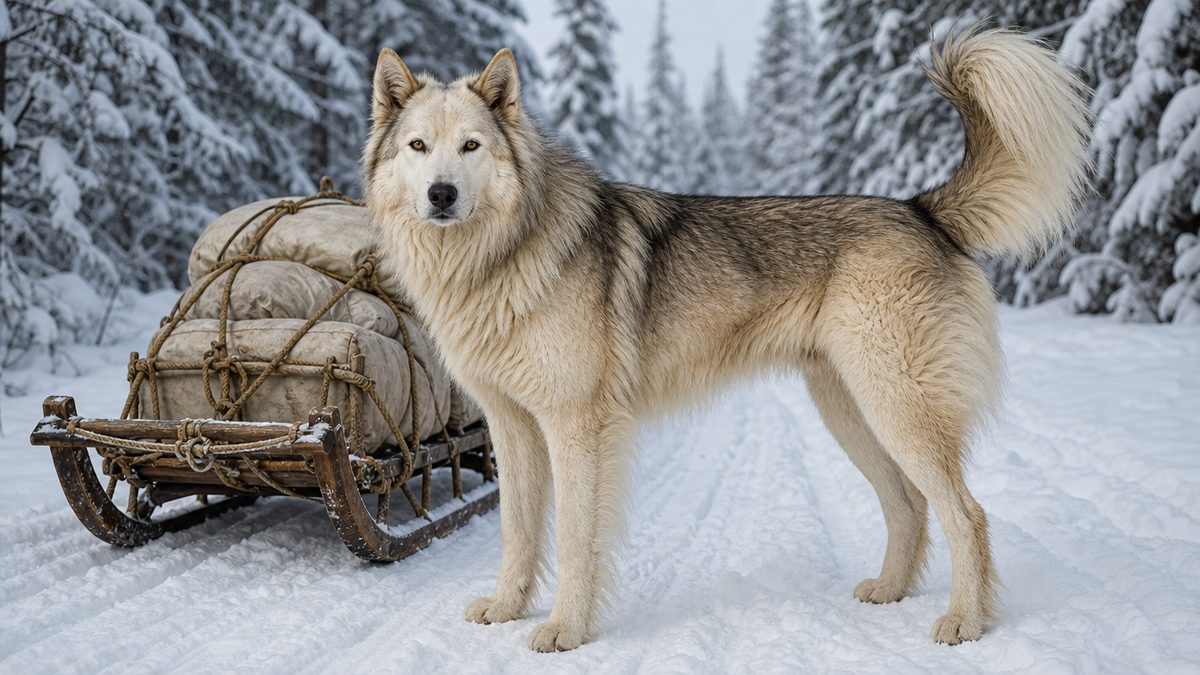
Start with what is agreed. This was a big, rangy, long-legged, deep-chested northern dog built to haul heavy loads long distances in deep snow with minimal care, usually long-haired, in the ordinary northern-dog colour range of black and white, grey, sable, tan, blond and red. It made a poor watchdog and enjoyed its work. Mechanised Arctic travel ended the job, and only small populations still exist.
Now the part the ranking pages skip. Three sources give three different sets of measurements for this dog, and no standard exists to settle which is right. Bonbeno prints all three rather than averaging them, because averaging invented numbers produces one more invented number.
| Source | Height | Weight | What kind of document this is |
|---|---|---|---|
| English Wikipedia | 66-74 cm (26-29 in) | 29-47 kg (63-104 lb) | An encyclopedia infobox, sourced to a private kennel's web page |
| GoofyTails, India | Male 66-81 cm, female 61-76 cm | Male 36-57 kg, female 30-45 kg | An Indian pet retailer's breed page, sex-split, with no source given |
| Ali and colleagues, 2022 | 25-32 inches (63-81 cm) | 70-120 lb (32-54 kg) | A peer-reviewed genetics paper that measured living dogs |
| Northern Quest Kennels | 27-32 inches (69-81 cm) | 70-125 lb, averaging about 90 lb | The breeding programme the genetics paper sampled |
Read the table as a whole and a pattern appears. The two sources that actually handled dogs, the Fairbanks kennel and the laboratory that sampled it, agree closely at roughly 63 to 81 cm and 32 to 54 kg. Wikipedia's narrower band and the Indian retailer's sex-split centimetres are downstream restatements, and the Indian page adds a life expectancy of 10 to 14 years for an animal that has never been the subject of a mortality study. That number has no measurement behind it anywhere that Bonbeno could find.
The one thing every source agrees on
No kennel club anywhere recognises this dog. Wikipedia's infobox states it in a single line, and the 2022 genetics paper states it at greater length: the American Kennel Club does not recognise the Mackenzie River Husky, nor is there a club with defined standards, because these dogs were historically bred by different kennels seeking different attributes Ali MB, Dreger DL, Buckley RM, Mansoor S. The paper puts the word breed in quotation marks when it uses it, which is a decision no ranking page copies.
The only researchers who have counted state that the overall number of Mackenzie River Huskies alive today is unknown, but is estimated to be fewer than 100. Their own genetic sample was 21 dogs, all from one kennel in Fairbanks, Alaska, and the authors say plainly that this limits how far their results can be extrapolated. Every confident sentence you will read about this dog rests on that base.
For an Indian reader the practical consequence arrives immediately and it is not about temperament. There is no lawful way to obtain one, no document that could accompany one, and no register that could confirm what you had bought. The rest of this guide sets out what is genuinely known, what is contested, and what an Indian buyer is actually being offered when this name appears in a search box.
The names: Deh Cho, Nagwichoonjik, and the villages the dogs were actually named after
The name Mackenzie River Husky records a Scottish explorer and a Hudson's Bay Company trading district, not what the people who bred these dogs called them. The river itself carries three indigenous names that predate the English one: Deh Cho in Slavey, Nagwichoonjik in Gwich'in and Kuukpak in Inuvialuktun.
Alexander Mackenzie reached the river's mouth on the Arctic Ocean on 14 July 1789, hoping it would lead to the Pacific, and the river was eventually named after him. Bonbeno uses Mackenzie River Husky throughout this page because that is the term readers search and the term the scientific literature uses. It is worth knowing that the label is a colonial one twice over: an explorer's surname attached to a company's fur district, applied to dogs kept by Dene and Inuvialuit families along a river they called something else.
Custom named freight dogs by village, and the outsiders flattened that
Nineteenth-century writers did not use one name. Custom dictated naming freight dogs by place of origin, and writers described numerous distinct types across northern Canada and Alaska, of which the Hudson's Bay Company's Mackenzie River District dogs were simply the most celebrated. The Fairbanks kennel that holds the modern population lists what the locals actually said: Old Crow dogs, Fort McPherson dogs, Arctic Red dogs, Porcupine River dogs, Hay River dogs. A separate sled-dog history adds Peel River Dogs, the Peel being a tributary of the Mackenzie.
- Old Crow dogs name a Vuntut Gwitchin community in the northern Yukon.
- Fort McPherson dogs name a Teetl'it Gwich'in community on the Peel River.
- Arctic Red dogs name the settlement now called Tsiigehtchic, at the Mackenzie and Arctic Red confluence.
- Hay River dogs name a community on Great Slave Lake, in Dehcho territory.
- Porcupine River dogs and Peel River dogs name tributaries rather than settlements.
The dog also travels under several English aliases. A breed-identification app lists it as Freight Husky, Mackenzie Freight Husky and Mackenzie Husky, and opens its own summary by stating that the term describes several overlapping local populations of Arctic and sub-Arctic sled dog-type dogs, none of which constitutes a breed. Bonbeno searched every one of those forms before concluding anything about absence.
The village-naming custom is not a North American eccentricity either, and the parallel is worth knowing. Russian cynologists classified their own sled dogs on exactly the same ethno-geographic principle, distinguishing Gilyak, Kamchatka, Anadyr, Chukotka, Kolymo-Indigirka and Yenissei breeds between 1946 and 1957, on the reasoning that each ethnic group living along a seacoast or major river had its own dogs. The difference is that Russia later wrote standards for two of those and registered them. Canada never wrote one for its own river dogs.
Every one of those names is a place a family lived in, and the dogs differed accordingly. The name that survived is the one strangers used. The Klondike Gold Rush is where the flattening happened: newcomers could not discern between the various dog populations and defaulted to calling all freighting sled dogs Mackenzie River Huskies regardless of point of origin. The Fairbanks kennel dates the takeover more precisely, to the 1960s, and says that is when the distortions grew.
A breed name points at one managed population. This name points at several, and always has. The 2022 genetics paper describes it in exactly those terms, as a catch-all name used to describe several populations of similar-appearing Arctic freight hauling dogs. That is not a criticism of the dogs. It is the reason no standard was ever written: there was never one population to write a standard about.
One further name belongs here because it is constantly confused with this one. The word husky itself is a phonological permutation of the French Esquimaux, and in the nineteenth century almost any remotely indigenous northern sled dog was called a husky, which is why the malamute and the husky were used interchangeably in period writing. A modern Indian search for this term inherits that confusion directly, and the price section shows exactly what it returns.
Is the Mackenzie River Husky a breed? Tested against Bonbeno's own rule
The Mackenzie River Husky fails Bonbeno's two-condition test, so this site treats it as a type rather than a breed. The rule is published on Bonbeno's own page for names used like breeds that are not breeds, and it is short: a breed has a written standard and a studbook behind it, so a puppy can be measured against something. This dog has neither, and a peer-reviewed paper says so in print.
Take the conditions one at a time, because a test only means something if it can come out either way. Bonbeno applied the same rule to the Koolie, another working dog no national kennel club recognises, and concluded that the Koolie is a breed, because three Australian organisations register it and its club publishes a written conformation document. The rule is not a way of dismissing unrecognised dogs. It asks a narrow question about paperwork, and here it gets a different answer.
Condition one: is there a written standard?
No, and the scientists who studied the dog say so. Ali and colleagues, writing in the Journal of Heredity in 2022, state that the American Kennel Club does not recognise the Mackenzie River Husky, nor is there a club with defined standards, because the dogs were historically bred by different kennels seeking different attributes. That is not a registry's silence being read as absence. It is an explicit finding in a peer-reviewed paper whose authors sampled the population.
Bonbeno checked the four registers that could plausibly hold a written standard, and confirmed each page's own printed title before reading anything off it.
| Register | What it holds | Control present on the same document | Mackenzie River Husky |
|---|---|---|---|
| FCI Group 5, Section 1 Nordic Sledge Dogs | Five breeds from four countries | Canadian Eskimo Dog 211, Greenland Dog 274, Samoyed 212, Alaskan Malamute 243, Siberian Husky 270 | Absent |
| FCI provisional register | 21 breeds awaiting definitive recognition | Yakutian Laika 365, a northern Russian sled breed | Absent |
| AKC Foundation Stock Service | 88 breeds, list revised 1 September 2026 | Canadian Eskimo Dog and Yakutian Laika, both in the Working group | Absent |
| UKC breed standards | Over 300 breeds plus a separate Bloodlines Listing Service tier | 35 breeds in the Northern Breed group, including Canadian Eskimo Dog and Greenland Dog | Absent |
The UKC row deserves a second look, because it is the strongest of the four. The UKC runs a lower tier, the Bloodlines Listing Service, which holds ten dogs that no other body would call breeds, including the Armenian Gampr, the Phu Quoc Ridgeback and the Yakutian Laika. Even that permissive tier does not hold this name. An absence from a register that admits almost anything is worth more than an absence from a strict one.
Condition two: is there a studbook?
No, and the register that would keep one is Canadian. The Canadian Kennel Club's own breed index runs to 225 entries across seven groups, and its Working group holds 36 dogs including the Canadian Eskimo Dog, the Greenland Dog, the Alaskan Malamute, the Siberian Husky, the Samoyed and even the Russian Yakutian Laika. The Mackenzie River Husky is not among them, and neither is the Alaskan Husky. The CKC also runs a Listed tier, which currently holds the Cane Corso, so its lower shelf was checked as well.
That is the finding that decides the section. The national registry of the country whose river this dog is named after, which recognises the Canadian Eskimo Dog as one of five uniquely Canadian breeds, has never held a studbook for it. No other register does either, and no breed club exists anywhere to keep a private one.
| Condition | Koolie | Mackenzie River Husky |
|---|---|---|
| A written standard | Yes, an unofficial conformation document published by its club | No. A peer-reviewed paper states there is no club with defined standards |
| A studbook | Yes, three Australian registers issuing five-generation certificates | No. No registry anywhere, and no club to keep one |
| National kennel club recognition | No | No |
| Verdict on Bonbeno's rule | A breed | A type, not a breed |
Bonbeno's two conditions are not a house eccentricity. A 2024 population-genomics paper on Arctic sled dogs states the same test from the other direction: the recognition of a breed by a kennel club primarily serves two purposes, gene pool isolation and pedigree record keeping. Gene-pool isolation is what a standard and a closed register achieve between them; pedigree record keeping is the studbook. A dog with neither has no boundary and no record, which is precisely this dog's position.
Two sled-dog specialists reach the same verdict independently, in plainer words. A British sled-dog information site states that the Mackenzie River Husky is not really a breed, that there is no official breed standard, no registry and no single look that defines them, and that it is more of an old working tradition than a breed. The dog-identification app that carries an entry for it opens by saying the same thing. Neither is a register, and neither is being cited here as one. They are cited because the people who work with these dogs already know what the registers confirm.
One thing the verdict does not mean. These are hardy, capable animals with a documented working record, and a purebred label would not make them better at the job. What it would make them is checkable. A buyer holding a pedigree can trace three generations; a buyer holding nothing can trace nothing, and in a market where the paperwork is the pitch, that asymmetry falls entirely on the buyer.
Landrace status is not the reason, and this is where most writers go wrong. Being a landrace does not put a dog on Bonbeno's types-not-breeds page. The English Shepherd is a landrace with United Kennel Club registration since 1927, and the Africanis is a landrace with a published Kennel Union of Southern Africa emerging-breed standard. Both are landraces and both have a document, so neither belongs there. What puts a dog on that page is a missing standard, not the way the population was shaped.
The Chinook: the same job, the same century, and the opposite answer
Compare the Mackenzie River Husky with the Chinook and the test stops being abstract. The 2022 genetics paper studied both together precisely because they are the two North American freight dog populations, developed in the same era for the same work, with reportedly overlapping heritage. One of them is an American Kennel Club breed and the other is not, and the difference is documents rather than dogs.
The Chinook owes its existence to one man, Arthur Treadwell Walden of Wonalancet, New Hampshire, and derives principally from a single male ancestor born in 1917 named Chinook. It entered the AKC Foundation Stock Service in 2001, moved to the Miscellaneous Class in 2010, and in January 2013 became the AKC's 176th breed, joining the working group. It is the state dog of New Hampshire.
| Mackenzie River Husky | Chinook | |
|---|---|---|
| Written standard | None anywhere | AKC and UKC standards published |
| Studbook | None anywhere | AKC studbook since 2013, UKC register |
| Founding population | Several regional village populations | One male born 1917 |
| Living population | Unknown, estimated under 100 | About 800 to 900 |
| Height | 25-32 in, no standard to fix it | 22-27 in, fixed by standard |
| Genetic ancestry found | Husky, Greenland Dog, Malamute, German Shepherd, Collie | Husky, Greenland Dog, Belgian and German Shepherd, mastiff |
| Popularity rank, 2020 AKC | Not applicable | 186th of 195 breeds |
| Can a puppy be checked against a document? | No | Yes |
Read the last row and the two-condition test becomes concrete. Both dogs are rare. Both were bred for freight. Both have a documented mixture of the same northern breeds behind them. A Chinook buyer can hold a pedigree, read a standard and measure the animal in front of them against both. A Mackenzie River Husky buyer cannot do any of those three things, anywhere in the world, at any price.
The two dogs an Indian buyer will actually be offered
Neither of the above, in practice. Searching the target term with results restricted to India returns a Siberian Husky market rather than this dog: two dead parasite URLs at positions one and four Ranked fourth on the India-restricted…, then a classifieds listing, an Instagram reel and a YouTube video, all about Siberian Huskies. A second engine returned ten results for the same question and every one of them was a Siberian Husky page. The dog you asked about appears nowhere on either page of results.
| Dog | Available in India | Documents available | Heat tolerance |
|---|---|---|---|
| Mackenzie River Husky | No, fewer than 100 exist worldwide | None of any kind | 1 of 5 |
| Siberian Husky | Yes, widely and cheaply | KCI pedigree against FCI standard 270 | 1 of 5, and no better |
| Alaskan Malamute | Yes | KCI pedigree against FCI standard 243 | 1 of 5 |
| Chinook | No verified Indian presence | AKC and UKC pedigrees exist | Unrated here, and northern |
| Indian Pariah Dog | Yes, free from any shelter | None needed | 5 of 5 |
The Siberian Husky an Indian seller will offer instead is not a warmer-climate alternative. It carries the same double coat and the same northern thermal design, and Bonbeno rates it 1 of 5 for heat tolerance too. Swapping an unavailable northern dog for an available one changes the paperwork and the price, not the welfare question.
The genetics: 21 dogs, one kennel, and a correction to the origin story
One peer-reviewed genetic study of the Mackenzie River Husky exists, and it overturns the origin story every other page repeats. Ali, Dreger, Buckley, Mansoor, Khan and Ostrander published it in the Journal of Heredity in 2022, comparing the two North American freight dog populations, and their admixture analysis found no substantial molossoid or retriever contribution at all.
The received account is old and consistent. Wikipedia says dog mushers intentionally mixed indigenous North American sled dogs with European drafting breeds such as mastiffs, Newfoundland Dogs and Saint Bernards from the mid-1800s, when Hudson's Bay Company administrator George Simpson's efficiency incentives pushed mushers to demand larger, stronger dogs. The Fairbanks kennel reports the same claims from the Sled Dog Encyclopedia, which described these dogs as anything from part Eskimo dog and wolf to a mixture of Labrador, Newfoundland and Saint Bernard.
The genetics say something narrower. The MKRH ancestry includes the Siberian Husky, the Greenland Dog and the Alaskan Malamute, together with the German Shepherd Dog and the Collie, without substantial contribution from the molossoid or retriever breeds. Two of those five, the German Shepherd and the Collie, the authors call unexpected. Three of them are the sled breeds you would predict. None of them is a mastiff.
Why the old story is not simply wrong
The paper offers a reconciliation rather than a refutation, and it is the Fairbanks kennel's own. Those claims may reflect confusion between the Mackenzie River Husky, bred specifically for long-distance travel, and the Mackenzie hound, a product of less directed breeding used for local or personal conveyance. The kennel puts it more bluntly: the Mackenzie Hound was a mix of Saint Bernards, Newfoundlands or Mastiffs with huskies to produce a townie dog, far different from the trail-proven freight huskies, and these Hounds are not freight huskies.
So both accounts can be true of different dogs. The molossoid crosses happened; they produced the hound. The freight lines the modern population descends from did not carry them in any quantity a genome-wide array can see.
| Claimed ancestor | Nineteenth-century and secondary accounts | Found in the 2022 admixture analysis |
|---|---|---|
| Siberian Husky | Implied, all northern dogs called huskies | Yes |
| Greenland Dog | Rarely named | Yes |
| Alaskan Malamute | Named, though the breed was unrecognised at the time | Yes |
| German Shepherd Dog | Not claimed | Yes, described as unexpected |
| Collie | Not claimed | Yes, described as unexpected |
| Saint Bernard | Named repeatedly | No substantial contribution |
| Newfoundland | Named repeatedly | No substantial contribution |
| Mastiff | Named repeatedly | No substantial contribution |
| Labrador Retriever | Named in the Sled Dog Encyclopedia | No substantial contribution |
How thin the evidence base is, in the authors' own words
Blood samples from 21 Mackenzie River Huskies were provided by Northern Quest Kennels in Fairbanks, Alaska, and merged into a previously reported dataset of 1,346 dogs genotyped at 150,112 single-nucleotide polymorphisms, giving a final set of 1,377 domestic dogs. The authors state that all the dogs studied were, of necessity, from the same kennel, which limits extrapolation, and that the 21 were themselves related samples. They add that those dogs most likely represent the genetic makeup of a substantial portion of the modern population, which is a statement about how small that population is rather than about how good the sample is.
The kennel that supplied the DNA is the same kennel whose web page Wikipedia cites as its main source for the breed, and which the genetics paper itself cites for the animal's history Mackenzie River husky, English Wikipedia Ali MB, Dreger DL, Buckley RM, Mansoor S. One private breeding programme in Fairbanks is therefore the origin of the encyclopedia entry, the scientific sample and most of the secondary web writing about this dog. That is not a criticism of the kennel, whose account is careful and self-critical. It is a warning about how narrow the base is.
One arithmetic note, because this site checks the numbers it quotes. The paper's methods describe the source dataset as including 9 wild canids, which included 7 gray wolves and 3 golden jackals. Seven plus three is ten. The dog counts reconcile exactly, since 1,346 plus 21 Mackenzie River Huskies plus 10 Chinooks gives the stated 1,377, so the discrepancy is confined to the wild-canid line and does not touch any result used on this page. Bonbeno reports it rather than repeating it silently.
History: a company incentive, a gold rush, and a territorial ordinance
The Mackenzie River Husky emerged in the mid-1800s because a fur company wanted fewer men moving more cargo. Hudson's Bay Company administrator George Simpson offered incentives to reduce staffing and improve efficiency, and mushers responded by demanding larger, stronger dogs capable of longer distances and heavier loads.
By the 1860s the Mackenzie River District dogs were prized throughout northern Canada and Alaska. A separate sled-dog history dates the reputation to the same decade and notes that these were only the most notable of numerous distinct freighting types. The dogs did what the name says: they hauled freight, in single file, through deep snow, on food that was limited and erratic.
The Klondike, and the moment the name stopped meaning anything
The sudden influx of prospectors during the Klondike Gold Rush solidified the reputation and destroyed the precision at the same time. Newcomers could not tell the village populations apart and called every freighting sled dog a Mackenzie River Husky regardless of where it came from. The missionary and musher Hudson Stuck described the resulting confusion in 1914, writing that cross-breeding with setters, pointers, hounds, mastiffs, Saint Bernards and Newfoundlands had left the work dogs of Alaska a heterogenous lot, and that the terms malamute and husky were very generally confused and often used interchangeably.
Bonbeno flags one thing about that quotation. It is a period observation about mixed working stock, not a genetic finding, and the 2022 admixture analysis found no substantial mastiff, Saint Bernard, Newfoundland or retriever contribution in the surviving freight population. Stuck was describing what he saw on Alaskan trails. The dogs that were kept and bred forward were a narrower set.
The collapse, and the law that sits behind part of it
Populations were already declining after the gold rush, but the fall became steep in the 1950s and 1960s. Wikipedia names two causes together: mechanised Arctic travel, and the Canadian government's attempts to eradicate native dog teams. The Fairbanks kennel names four: the snowmachine, oil money and Native Corporation dividends that made snowmachines affordable, Canadian government efforts to stop native sovereignty by the mass killing of dog teams in the 1950s and 1960s under the guise of eradicating rabies, and the rise of sled-dog racing, which selected for small, fast, high-strung animals instead.
The best-documented dog killings in northern Canada concern Inuit qimmiit rather than the Dene and Gwich'in communities of the Mackenzie valley, and Bonbeno will not extend one record onto the other. What is documented for the region is a legal instrument: the Ordinance Respecting Dogs, enacted in the Northwest Territories in 1929, which the RCMP were enforcing when dogs were destroyed. In the 1920s between 10,000 and 20,000 Canadian Inuit dogs were estimated to live in northern Canada; by 1963 one Canadian Eskimo Dog was registered with the Canadian Kennel Club and the breed was declared extinct. In 2019 the Canadian government apologised to Inuit in the Eastern Arctic for the dog slaughter and committed to funding a revitalisation programme.
| Canadian Eskimo Dog | Mackenzie River Husky | |
|---|---|---|
| Declared extinct | 1963, one dog registered with the CKC | Never formally declared anything |
| Rescue programme | Eskimo Dog Research Foundation, from 1972 | One private kennel's breeding programme, from 1990 |
| Government funding | Yes, six years of federal and territorial money | None recorded |
| Standard written | Yes, held by the CKC and the FCI | Never |
| Studbook opened | Yes | Never |
| Formal apology | 2019, to Inuit in the Eastern Arctic | None |
| Population today | Registered annually, countable | Unknown, estimated under 100 |
That table is the argument of this whole page in one frame. Two northern Canadian dogs collapsed for overlapping reasons in the same decades. One was written up, registered, funded and recovered as a breed. The other was rebuilt privately, in Alaska, by one family, without a document of any kind. The difference in outcome is not a difference in the animals.
Mackenzie River Husky price in India: the top two results are dead pages
No Mackenzie River Husky price in India exists, and the reason is worth reading in full because it is unusually well evidenced. Bonbeno opened the India-restricted result page for this exact query and fetched what was there. The pages ranking first and fourth both return HTTP 404, and their advertised snippets quote dollar prices for a Siberian Husky.
Take the first result. It is served from bloemenverlinde.be, a Belgian domain, under a title reading Mackenzie River Husky Price Siberian Husky Dog Price In India, with a snippet quoting 28 USD. Fetched on 2 September 2026, that URL returns HTTP 404 with a Dutch error page, and the domain root returns a body of one character declaring lang=id. The fourth result is served from campusdinamo.es, with a snippet quoting US$ 17.4 to 29. That URL also returns HTTP 404, and the domain root is a Spanish login screen for a service called DINAMO.
Neither page exists. Both are indexed. The snippets are drawn from a crawler's stored copy, and a stored copy can outlive the address it came from by a long way. A price in a search snippet is not a price on a page, and on this query it is not even a page.
| Position | Domain | What it is | Rupee price for this dog |
|---|---|---|---|
| 1 | bloemenverlinde.be | Dead URL, HTTP 404, Belgian florist domain | None |
| 2 | facebook.com | A group thread asking whether a member's dog is one | None |
| 3 | tradeindia.com | Siberian Husky puppies | Not this dog |
| 4 | campusdinamo.es | Dead URL, HTTP 404, Spanish login page | None |
| 5-6 | instagram.com, youtube.com | Siberian Husky price content | Not this dog |
| 7 | supertails.com | Husky Dog Price in India | Not this dog |
| 8 | spiritdogtraining.com | 22 Types of Huskies, a US list article | None |
| 9 | petlur.com | A breed profile quoting US dollars | None |
| 10 | instagram.com | Husky price in India | Not this dog |
The only price figure anyone publishes is in dollars
Petlur, at position nine, gives the figure that circulates: expect to pay between $1,000 and $1,500 from a reputable breeder, rising if the dog has a strong pedigree. Bonbeno prints that band as a US figure and refuses to convert it. Converting a foreign price into rupees and presenting the quotient as an Indian price is the single most common fabrication in this market, and this site has caught it repeatedly at exchange rates of 84.38, 80, 74 and 66.67. There is nothing to divide here, because no Indian rupee figure for this dog exists to test.
Note also what the dollar band assumes. It assumes a reputable breeder and a strong pedigree, and neither can exist: there is no register to issue a pedigree and no standard against which a breeder could be reputable in the sense the sentence implies. The one historical price Bonbeno could find that is attached to real animals is the Fairbanks kennel's own, which listed puppies at $250 including worming, first shots and a vet exam, on a page carrying a 1997 to 2020 copyright notice. That is a private programme's undated cost-recovery figure, not a market price, and Bonbeno reports it as exactly that.
The multi-breed Indian price lists do not carry it either
India's fullest published price list is the sort of page that names 40 to 50 breeds with a rupee band each. Bonbeno opened one that prints 222 separate rupee figures across its 40 breeds. The Mackenzie River Husky appears zero times on it, while Labrador appears ten times and Husky six. That is the useful shape of the evidence: not a low price, not a high price, but an absence from the document where an Indian price would live.
Ask for the pedigree and the register that issued it, then check that register yourself. Five were opened for this page and none holds the name, so there is no honest answer to that question. What you are being offered is most likely a Siberian Husky, a Malamute cross or an unregistered northern-looking dog, and the price you are quoted belongs to whichever of those it actually is. That is worth knowing before money moves, and it is why this page prints no rupee figure of its own.
Cost of ownership in India for a 32 to 54 kg northern dog
Budget Rs 6,000 to Rs 11,000 a month to keep a dog of this size properly in an Indian metro, before the cooling bill. There is no purchase price to quote, but the recurring cost of ownership is real, published and sourceable, because every line applies to any large heavy-coated dog living in this country.
The Indian baseline comes from VOSD, which prices each line separately. Across all dogs it puts the total monthly cost at Rs 3,000 to Rs 10,000 and beyond, and the annual cost at Rs 25,000 to Rs 80,000 or more, varying by breed, city and standard of care. A dog at the top of this type's published weight range sits at the top of every one of those ranges, and then adds a line no Indian cost guide includes.
| Line | Published Indian figure | Where this dog lands |
|---|---|---|
| Food, per month | Rs 1,500-4,000 for a medium dog; large working breeds push to Rs 5,000 or more | At or above the top of that range, and higher again for a working ration |
| Vet consultation | Rs 500-1,000 at a good clinic | Same, with more visits in the humid months |
| Annual vaccination | Rs 1,500-3,000 | Same, and non-negotiable |
| Grooming, per session | Rs 300 basic wash to Rs 2,000 for a large long-haired breed | Top of the range. A mane and leg feathering are the expensive part |
| Boarding, per day | Rs 500-2,000 | Top end, and many facilities will decline an undeclarable large dog |
| Training and behaviourist | Rs 5,000-15,000 for a course; Rs 3,000-10,000 for a behaviourist | Budget the course; the behaviourist is optional here |
| Emergency hospitalisation | Rs 8,000-30,000 for one to three days | Top end. Anaesthetic and drug dosing scale with body weight |
| Cooling | Not costed by any Indian guide | The line that decides everything. See the climate section |
Two lines behave differently on this page than on a recognised breed's. Screening costs less, because there is no breed-specific panel to run: no registry holds hip or elbow data for this dog, so a result would have nothing to be compared against. That is a saving and a warning at once, and the health section explains why the warning is the bigger half.
Insurance is harder. Indian pet insurers underwrite by breed, and a dog no registry recognises cannot be declared accurately on a proposal form. Expect to be asked for a breed name that does not appear on the insurer's list, and expect the honest answer, a large unregistered northern crossbreed, to change the quote or the acceptance.
Registration, and the one Indian document that is actually available
You cannot register this dog as a breed anywhere, but the Kennel Club of India does publish a tariff line for a dog without papers. Its schedule effective 1 April 2024 prices registration with unknown pedigree at Rs 1,000, an import dog registration at Rs 2,500, a four-generation certified pedigree at Rs 1,000 and a five-generation one at Rs 1,500. The first of those is the only line on that sheet a dog of this description could ever use, and it records an individual animal rather than a breed.
VOSD's own comparison is the useful one: a dog costing Rs 4,000 a month to maintain in Pune may cost Rs 7,000 a month in South Delhi, with grooming, boarding and training following the same pattern. For a heavy-coated northern dog the metro premium bites hardest on grooming and boarding, and the electricity bill for keeping one room cool through a Delhi summer is a bigger line than all of them together.
First-year setup follows the same source. VOSD budgets Rs 2,000 to 5,000 for a starter kit and another Rs 2,000 to 5,000 for first vaccinations, deworming and a health check, putting the first month at Rs 15,000 to 25,000 before anything unexpected. For this dog, spend the discretionary part of that on airflow and shade rather than on bedding.
Can a Mackenzie River Husky live in the Indian climate
No plains Indian city can supply this dog's thermal environment, and the gap is 32 degrees wide. Bonbeno queried NASA POWER by explicit latitude and longitude for four homeland points and five Indian ones, and echoed the elevation each cell reports so a reader can check the model was standing in the right place.
The homeland is the Mackenzie valley and the Peel and Porcupine drainages, so those are the points that were queried rather than a generic Arctic coordinate.
| Place | Cell elevation | Annual mean | Coldest month | Warmest month | Annual humidity |
|---|---|---|---|---|---|
| Fort Simpson, NWT | 257.63 m | -4.22 C | -24.63 C (Jan) | 16.39 C (Jul) | 88.4% |
| Fort McPherson, NWT | 184.48 m | -6.96 C | -25.03 C (Jan) | 14.70 C (Jul) | 86.2% |
| Aklavik, NWT | 152.89 m | -7.16 C | -24.92 C (Jan) | 14.15 C (Jul) | 86.6% |
| Old Crow, Yukon | 444.20 m | -7.34 C | -25.97 C (Jan) | 14.23 C (Jul) | 87.8% |
| Delhi | 206.37 m | 25.60 C | 13.61 C (Jan) | 35.88 C (Jun) | 45.6% |
| Chennai | 48.95 m | 27.95 C | 24.09 C (Jan) | 31.51 C (May) | 72.4% |
| Mumbai | 97.15 m | 26.77 C | 23.19 C (Jan) | 31.19 C (May) | 67.4% |
| Bengaluru | 841.72 m | 23.74 C | 20.22 C (Dec) | 28.37 C (Apr) | 67.9% |
| Kolkata | 7.35 m | 25.81 C | 17.31 C (Jan) | 31.53 C (May) | 73.9% |
Read the first and sixth rows together. Fort Simpson averages minus 4.22 degrees Celsius across the year and Chennai averages 27.95, a gap of 32.17 degrees. That is wider than the gap this site measured for the Greenland Dog, whose Ilulissat baseline is minus 3.38. Chennai's coldest month, at 24.09, is 7.7 degrees warmer than Fort Simpson's warmest.
The elevation check, and why it matters here
NASA POWER returns a grid cell rather than a point, and in broken terrain the cell's mean elevation can miss the town underneath it badly. Bonbeno therefore echoed the elevation with every query. The four northern cells are honest: Hay River returns 164.71 m against a Great Slave Lake shoreline near 156 m, and Fort Simpson's 257.63 m sits above a confluence closer to 130 m, which is a modest and non-distorting offset. Aklavik is the one to flag, because the cell reports 152.89 m for a settlement sitting in the Mackenzie Delta at close to sea level, so its figures should be read as the surrounding uplands rather than the delta floor.
The Indian cells behave as this site has recorded before. Delhi comes back 10 m below its real elevation, Chennai 43 m above, Mumbai 83 m above and Bengaluru 78 m below, all of which are within noise. Ladakh is the exception and it is a large one: the Leh cell reports 4,532.61 m for a town near 3,500 m, so POWER's Leh series runs roughly 1,033 m too high and therefore too cold. Correcting at the standard lapse rate of about 6.5 degrees per 1,000 m lifts the reported annual mean of minus 2.75 to roughly plus 3.9, and July's 10.18 to roughly 16.9.
Corrected for the elevation error, Leh's July mean of about 16.9 C is within a degree of Fort Simpson's July mean of 16.39 C, and Leh's corrected January of about minus 9.3 C is much milder than Fort Simpson's minus 24.63 C. So a Ladakhi summer is the right temperature and a Ladakhi winter is too warm, which is an unusual verdict and an honest one. Ladakh is also far drier at 52.2 percent annual humidity against the homeland's 86 to 88 percent, and that difference cuts in this dog's favour, because a dry 17 degrees is far easier for a heavy coat than a humid 17.
One nuance the plains-versus-Arctic framing hides. The homeland is continental, not polar, and its summers are not cold: the Fort Simpson cell records a maximum daily temperature reaching 31.50 C at the top of its record. A freighting dog from the Deh Cho valley has met 31 degrees before. What it has never met is 31 degrees in June, and then again in July, and again in August, at 72 percent humidity, with no cold night to recover in. Indian heat is not hotter than the homeland's peak. It is longer, wetter and unbroken, and that is the part that kills.
What the heat evidence actually supports for a dog this size
The largest study of heat-related illness in dogs did not include this animal, so Bonbeno claims only the factors that genuinely transfer. Hall, Carter and O'Neill reviewed 905,543 UK dogs under primary veterinary care in 2016 and identified 395 confirmed heat-related illness events, giving an incidence of 0.04 percent and an event fatality rate of 14.18 percent.
Two findings from that paper transfer to a dog of this description, and Bonbeno uses only those two. The multivariable analysis identified higher bodyweight relative to the breed and sex mean and weighing over 50 kg as significant risk factors, alongside brachycephalic skull shape and being over two years of age. This dog is not brachycephalic, so that factor is irrelevant here. The weight factors are not.
- The top of the published weight range crosses the threshold. The genetics paper gives 70 to 120 lb, which is 31.8 to 54.4 kg. A dog at 120 lb sits inside the over-50 kg band the study flagged.
- The breed-mean factor cannot be applied at all, and that is itself a finding. Higher bodyweight relative to the breed mean requires a breed mean, and no standard exists to set one. There is no number to be above.
- The breed was not modelled. It does not appear in the UK cohort, so no odds ratio published in that paper belongs to it. Bonbeno names the transferable factors and stops there.
The companion paper matters more for how an Indian owner will actually lose a dog. Reviewing the same 905,543-dog cohort, Hall and colleagues identified 1,259 heat-related illness events from 1,222 dogs and found that exertional heat-related illness was the predominant trigger at 74.2 percent of events, ahead of environmental at 12.9 percent and vehicular confinement at 5.2 percent. Their conclusion is the title: in the UK, exertional heat illness affects more dogs and kills more dogs than confinement in a hot car.
This is an animal whose entire selection history is exertion, and whose owner will be told it needs hours of exercise. The predominant trigger of fatal heat illness in a large cohort was exercise, not a parked car. A northern freight dog jogged in an Indian park at nine in the morning is the exact scenario the paper describes. Move every session to before sunrise and after dark, and treat any dog that stops, staggers or will not settle as an emergency.
India's own threshold sits well above where a dog of this description is already in trouble. The World Health Organization's India page reproduces the India Meteorological Department criteria, under which a heat wave is declared when the actual maximum temperature reaches 45 degrees Celsius and a severe heat wave at 47, or when the departure from normal is 4.5 to 6.4 degrees and above 6.4 respectively. Those numbers describe human public-health emergencies. A dog built for a January mean of minus 24.63 is in difficulty at temperatures no Indian weather service would remark on.
Indian law and this dog: import, housing, and what nobody requires
Indian law makes it impossible to build a lawful supply of this dog and, separately, restricts how one already here may be kept. Both provisions were read from the primary documents rather than from summaries, because both have been misquoted repeatedly.
Start with import. Indian policy files dogs under ITC(HS) 01061900, Mammals: Other, as a Restricted item subject to Policy Condition 6, and Policy Condition 7 permits import only for three purposes: a pet dog with a valid pet book and relevant records in the importer's name, dogs imported by R&D organisations with a CPCSEA recommendation, and internal security by the Defence and Police Force. Policy Condition 8 states that import of commercial dogs for breeding or any other commercial activity outside those purposes is not permitted.
The operative sentence is blunter still. Any applications for trading or breeding purposes, or applications made on behalf of some other person or entity, shall be duly rejected. Import of pet animals is allowed only through the airports and seaports of Delhi, Mumbai, Chennai, Hyderabad, Bengaluru and Kolkata and, since October 2024, Kochi airport, with quarantine at the government station of the said ports where required, and applicants are advised to start the process at least two months before travel and to obtain an advance No Objection Certificate from the AQCS Regional or Quarantine Officer. The full route is set out in how to import a dog to India.
There is no FCI, AKC, UKC or CKC recognition for this dog anywhere in the world, so the Kennel Club of India cannot issue a pedigree for it. And no dog of any breed may be imported into India to breed or sell. Between them, those two facts mean no lawful Indian supply chain for this animal can form. Not that it is hard. That there is no route.
The housing clause, and the exact citation for it
One clause of Indian law bites directly on a heavy northern coat. It sits in the Second Schedule, Part IV, paragraph 21(1) of the Prevention of Cruelty to Animals (Dog Breeding and Marketing) Rules 2017, headed Outdoor housing facilities, and Bonbeno quotes it from its own extraction of the gazette rather than from any secondary source:
> "(1) The following categories of dogs shall not be kept in outdoor facilities, unless that practice is specifically approved by the attending veterinary practitioner in writing:- (i) dogs that are not accustomed to the temperatures prevalent in the area or region in question; (ii) dog breeds that cannot tolerate the temperatures prevalent in the area or region in question, such as long-haired breeds in high temperature locations; and (iii) sick, infirm, aged or young animals."
All three limbs fit. A northern freight dog in an Indian city is not accustomed to local temperatures, is long-haired in a high-temperature location, and the clause names that case explicitly. The Rules also require outdoor facilities to include roofed shelters accessible to each animal and separate shaded areas large enough for all the animals at once.
This provision is widely quoted as "Rule 21". The string Rule 21 appears zero times in the gazette, which Bonbeno confirmed by extracting all 14 pages and searching them. The 2017 Rules themselves stop at Rule 13, No licence without registration, and everything numbered higher is a Second Schedule paragraph. Cite it as Second Schedule Part IV paragraph 21(1).
What Indian law does not require, which is also worth knowing
Two absences are citable. The Rules mandate testing for genetic defects at Second Schedule Part III paragraph 8(10), a clause that lists hip dysplasia, progressive retinal atrophy, night blindness, hypothyroidism, entropion, ectropion, overshot and undershot jaw, wry mouth, two or more missing teeth and cryptorchidism. That obligation falls on registered breeders, and there are none for this dog anywhere in India. Second Schedule Part II paragraph 6(8) separately forbids tail docking, ear cropping, de-barking, de-clawing and any change of appearance by artificial means, which is why every image on this page shows natural ears and an undocked tail.
Temperament and household fit, from the only two accounts that exist
Two sources describe this dog's character and both describe a working animal rather than a companion. Contemporary nineteenth-century sources called Mackenzie River Huskies solid and dependable, rarely aggressive towards humans but prone to scuffles with other dogs, and noted that they make poor watchdogs but enjoy their work as sled dogs.
The second account is the Fairbanks kennel's, and it is the more detailed. It describes a high social order, dogs raising pups together, working well with team members once hierarchy is established, and viewing their people as extensions of the pack. They are willing workers once they realise they get to run with their pack and see you as the leader, and that respect is earned or learned from the others rather than automatically given. The same page says plainly that these dogs are not for the first-time dog owner.
That kennel also records a deliberate exclusion worth quoting, because it is the opposite of what a wolf-hybrid marketing pitch would say. Wolf traits such as being unpredictable, unmanageable, skittish or untrustworthy with children were culled out. The programme's stated guarantee is temperament: dogs completely trustworthy with children, intelligent and eager to work, with an independent thought process that will take the leadership role in the family if the family does not.
| What a household wants | What this dog offers | Verdict |
|---|---|---|
| A guard dog | Poor watchdog by every account, friendly to people | Wrong dog |
| A dog that tolerates other dogs | Prone to scuffles with other dogs | Wrong dog for a multi-dog flat |
| A dog safe around children | Trustworthy with children in the one programme that selects for it | Acceptable, with the usual supervision |
| A dog that settles indoors | Bred for multi-day hauling, independent, will lead if you do not | Wrong dog |
| A dog that can be left alone | A pack animal with a documented pack orientation | Wrong dog |
| A first dog | The reference kennel says explicitly not for a first-time owner | Wrong dog |
Both accounts describe fewer than a hundred living animals, most of them from one breeding programme with a stated temperament goal. There is no temperament survey, no behavioural study and no independent sample. Read the descriptions as what a careful breeder selects for, not as a measured population trait, and be sceptical of any Indian listing that repeats them about a dog whose parents nobody can name.
Training: a working contract rather than obedience, and one Indian constraint
Train this dog by giving it a job and a hierarchy, because that is what the only detailed account describes it responding to. The Fairbanks kennel reports dogs that work willingly once they understand they get to run with their pack and once leadership is established, and that leadership is earned rather than assumed.
There is no published training protocol for this animal, no breed club to publish one and no trial system to test one against, so the practical guidance below is drawn from what the source material actually supports and is labelled as such.
- Socialise early and widely, because the account describes a dog that is fine with people and difficult with other dogs. In an Indian city the second half is the problem, not the first.
- Train recall on a long line and never off it. This is an animal selected to run ahead in a straight track for hours. Nothing in that history rewards coming back.
- Give it a haul job. Weight pull, a loaded harness on a cool morning, a cart on a private track. A dog bred to haul and given nothing to haul finds its own project.
- Establish the hierarchy without confrontation. The account is explicit that respect is earned or learned from the other dogs, which is a description of consistency rather than force.
- Do not train in the heat. The largest study of the subject found exertion to be the predominant trigger of heat-related illness, so every session in India runs before dawn or after dark.
The Indian legal constraint on one traditional practice
The reference kennel mentions a traditional northern management practice that Indian readers should know about only so they can avoid a bad analogy: nothing in the Mackenzie record involves surgical modification, and Indian law forbids the whole category anyway. Second Schedule Part II paragraph 6(8) of the 2017 Rules strictly forbids tail docking, ear cropping, de-barking, de-clawing, branding, dyeing, injecting substances to enhance visual appeal, and any change of appearance by artificial means. De-barking in particular is the shortcut some owners of vocal northern dogs reach for, and it is prohibited.
Judge progress by whether the dog will work with you in harness and settle afterwards, not by whether it heels in a park. An independent freight dog that pulls willingly, tolerates handling and comes back on a long line is trained. One that sits on command and then bolts at a street dog is not.
Exercise: a freight requirement India can only meet at night
Plan on two or more hours a day of real work, and accept that India can supply it only in darkness for most of the year. No breed club has ever set a figure for this dog because no breed club exists, so Bonbeno derives the requirement from the job it was selected for rather than inventing a number.
The job is specific. These were dogs developed for small working teams capable of hauling large loads through deep snow, woodland trails and hilly or mountainous terrain on limited and erratic food, standing 27 to 32 inches at the shoulder, long-legged and rangy, built to run in a single track with a foot-in-front-of-foot gait. Wikipedia's description matches: rangy, deep-chested and long-legged, built for heavy freighting in single file through deep snow.
| Season | Window that works | What to do | What to avoid |
|---|---|---|---|
| October to February | Before 07:00 and after 19:00 | Long walks, harness work, weight pull on cool days | Midday sun even in winter |
| March to May | Before 05:30 and after 21:00 | Short brisk work only, on grass rather than tar | Any exertion above 25 C |
| June to September | Before 05:30 and after 21:30 | Shade, indoor enrichment, water play if the dog likes it | Monsoon humidity plus exertion, the worst combination |
| Any heat-wave day | None | Rest indoors with airflow | Everything |
The tar surface point is not a detail. An Indian road holds heat long after sunset, and a dog running on it is loading its feet and its core at the same time. Test the surface with the back of your hand for five seconds before every session.
What happens without the work
The honest answer is that nobody has studied it in this dog, and Bonbeno will not manufacture a behavioural claim. What the Indian retail page asserts, that the breed may become destructive or difficult to manage without sufficient exercise and purpose, is a generic working-dog statement applied to this name without evidence. It is probably true of any large working dog. It is not a measured finding about this one, and the difference matters on a page whose whole argument is about what is documented.
This is the central practical contradiction of owning a northern freight dog in India, and it has no clean solution. The dog needs hours of exertion. Exertion is the predominant trigger of fatal heat illness in the largest cohort ever studied. Every hour you give it in Indian daylight increases the risk the exercise was supposed to reduce. That is a reason not to bring one here, not a scheduling problem to solve.
Grooming an Arctic double coat in Indian humidity
Brush this dog two or three times a week, never clip it, and dry it to the skin after every wash. The coat is a heavy northern double coat, and the freight lines were selected for the long-haired version rather than against it, which is the opposite of what most secondary pages assume.
The long-hair question has a documented history. The Fairbanks kennel records a common misconception that the Mackenzie River Husky is a long-haired dog, explains that the long-haired gene occurs in all husky populations and in the wolf, and says working people considered it a fault and gave those dogs away, which is why long-haired individuals were the ones outsiders saw. The same page then states that the programme deliberately breeds for the long coat, describing a long mane of fur round the neck and shoulders, feathering down the legs front and back and under the belly, with fur soft in texture and odourless.
Wikipedia agrees on the outcome, describing the dog as usually long-coated. So the modern population an Indian reader might meet carries more coat, not less.
| Task | Frequency | Why it changes in India |
|---|---|---|
| Line brushing to the skin | 2-3 times a week, daily in shedding phases | No seasonal cue means shedding spreads across the year rather than one moult |
| Undercoat rake | Weekly through the mane and trousers | Trapped undercoat holds heat and moisture against the skin |
| Bathing | Only when genuinely dirty | Over-bathing strips the coat that insulates against heat as well as cold |
| Drying after any wash or rain | Every time, to the skin, with a forced-air dryer or towels and a fan | A dense undercoat will not air dry in Indian humidity |
| Ear check | Weekly, and after every soaking | Monsoon humidity and a damp coat are the standard Indian otitis setup |
| Clipping | Never | Removing the coat removes the shade layer and exposes skin to sun |
Northern-breed care written for Canada or Alaska routinely says to towel a dog off and let it air dry. That instruction is written for dry cold air. In an Indian monsoon a dense undercoat left damp is a fungal and bacterial incubator against the skin, and a dog washed without its ears being dried afterwards is the commonest presentation in Indian ear clinics through the wet months. Dry to the skin, every time, whatever the overseas guide says.
The other Indian complication is the one nobody mentions. Shaving a northern dog to cool it down makes it hotter. The double coat works as insulation in both directions and as a physical barrier against direct sun, and a clipped northern dog in Indian daylight is a sunburn risk with no thermal advantage to show for it. If the dog is overheating, the answer is airflow, shade, water and a changed schedule, not a clipper.
Health: what is known, what is not, and why the gap is the finding
No health survey, no screening database entry and no lifespan study exists for the Mackenzie River Husky. Bonbeno checked the databases that would hold each, with controls, and reports the absences as absences rather than filling them with a related breed's numbers.
Start with the screening database. The Orthopedic Foundation for Animals publishes statistics for around 300 breeds, and Bonbeno retrieved the complete dump, 2,232,741 characters, and searched it case-insensitively. The string Mackenzie returns zero. In the same file Labrador returns 109 hits, Siberian Husky 87, Samoyed 76 and Alaskan Malamute 65. The controls are unambiguous and the absence is real.
OFA does not hold a breed code for it either, which is the sharper finding. Read from OFA's own raw markup rather than from any extraction, its breed filter list carries ALASKAN HUSKY as AKH, AMERICAN HUSKY as AMH, HEDLUND HUSKY as HH and GREENLAND DOG as GLD. None of the first three is recognised by any kennel club. OFA's list is therefore permissive enough to hold unrecognised North American husky types, and it still does not hold this one.
| Question | Where the answer would live | What was found |
|---|---|---|
| Hip dysplasia rate | OFA statistics tables | No row. Zero hits against 109 for the Labrador |
| OFA breed code | OFA breed filter markup | None, though three other husky types hold one |
| Inherited disease survey | A parent club health survey | No parent club exists |
| Median lifespan | A mortality cohort study | None published. No cohort has ever included the breed |
| Life expectancy figures in circulation | Secondary breed pages | 10 to 14 years, asserted with no source |
| Genetic characterisation | Peer-reviewed literature | One paper, 21 related dogs from one kennel |
The one health-adjacent genetic finding that does exist
The 2022 paper tested eight dietary lipid genes in response to reports about their importance in Arctic dogs, and observed signatures of selection in both freight populations at the MLXIPL gene locus. That is a finding about metabolic adaptation to a high-fat northern diet, not a disease risk, and Bonbeno reports it as such. It is the only molecular health-adjacent result published for this dog.
A recognised breed with a 40 percent hip dysplasia rate is a breed you can screen for, breed away from and insure against. A dog with no screening data at all offers none of those. You cannot compare a radiograph to a population, cannot know whether a condition in your dog is familial, and cannot warn the next owner. The saving on screening costs described in the cost section is real, and this is what it buys you.
Two conditions deserve mention on general grounds rather than breed-specific evidence, and Bonbeno labels them as inference. Any large deep-chested dog carries elevated risk of gastric dilatation volvulus, and any heavy-boned working dog is a candidate for hip dysplasia, which is why that condition heads the list Indian law requires registered breeders to test for. The Indian retail page lists both, plus joint strain and eye disorders, without citing anything. Treat those as sensible precautions for a dog of this build, not as documented breed risks.
Feeding a northern working dog in India
Feed to body condition on a high-quality diet, and do not assume a working ration for a dog that is not working. The historical feeding pattern is documented and it does not transfer: these dogs were selected to stay alive on limited and erratic food while hauling, which is a different problem from feeding a large dog in a Bengaluru flat.
The Indian cost baseline sets the frame. VOSD prices food at Rs 1,500 to 4,000 a month for a medium dog, with large working breeds pushing to Rs 5,000 or more, and notes that a homemade diet still costs real money in ingredients and time. A 45 kg dog sits at or above the top of that band.
- Split the daily ration into two or three meals, never one, because a deep-chested dog fed a single large meal is the classic bloat presentation.
- Feed the coldest part of the day. An Indian dog that eats at 2 pm in May then tries to thermoregulate on a full stomach is being asked to do two hard things at once.
- Do not free-feed. Bodyweight above the breed and sex mean was a significant heat-illness risk factor in the largest study of the subject, and on a dog with no breed mean the only defence is a lean body condition score.
- Water first, always. Cool water available at all times, in more than one place, and refreshed rather than left standing in the heat.
- Ignore the salmon romance. Northern feeding traditions built around fish scraps are documented history, not a modern nutrition plan, and Indian fish supply chains are not a substitute for a complete diet.
Life stage, without a breed timetable to follow
There is no breed-specific growth chart, because there is no breed. Feed a large-breed puppy formulation to control growth rate, transition to adult food when growth plateaus rather than on a fixed date, and let your veterinarian set the schedule from the individual animal. Any page that gives you a month-by-month gram figure for this dog has invented it.
You cannot screen this dog, cannot insure it accurately and cannot compare it to a population. You can keep it lean. Ribs easily felt under a thin fat cover, a visible waist from above and a tucked abdomen from the side. On a dog whose only quantified heat-illness risk factors are about weight, body condition is the whole of preventive medicine you actually have.
Month by month through the first year, if one ever arrived in India
This timeline is written as a planning tool, not as a purchase guide, because Bonbeno could find no lawful route by which such a puppy reaches India. Read it as what would have to be managed, and note how much of it is climate management rather than dog raising.
Every month below assumes the animal is here as an accompanied pet under Policy Condition 7, since import for breeding or sale shall be duly rejected.
| Age | What matters most | The Indian complication |
|---|---|---|
| 8-12 weeks | Vaccination course, which Indian law notes can start at seven to eight weeks and usually completes by eighteen | Sale below eight weeks is prohibited under Rule 8(1)(a); no Indian breeder should exist for this dog at all |
| 3-4 months | Socialisation to people, traffic, surfaces and other dogs | The other-dog half is the hard half, given the documented tendency to scuffle |
| 4-6 months | Long-line recall, harness introduction, handling for grooming | Every session before dawn or after dark from March onward |
| 6-9 months | Growth control on a large-breed diet, no heavy loads | First full Indian summer. Cooling, not training, is the priority |
| 9-12 months | Coat comes in properly; establish the weekly brushing routine | No seasonal moult cue, so shedding is continuous rather than a single blow |
| 12 months | Light hauling work may begin under veterinary guidance | There is no breed maturity guideline to follow, because no club publishes one |
Three things on that table have no breed-specific source and Bonbeno says so rather than dressing them up. The maturity age, the load-bearing age and the coat timetable are all inferred from comparable large northern dogs, because this animal has no club, no standard and no published developmental data of any kind. A page that gives you confident month-by-month numbers for this dog is giving you another breed's.
A northern puppy will get through an Indian winter looking fine and will convince its owner that the warnings were overblown. The test is the following May and June, when a growing dog with a thickening double coat meets 35 degrees and rising humidity while still needing exercise to develop properly. Plan the cooling before the puppy arrives, not when the dog starts panting.
Eight mistakes Indian readers make about this dog, and how to catch each
Most errors about the Mackenzie River Husky come from treating a type name as a breed name. The list below is drawn from what the ranking pages actually print and what the primary sources actually say, and each entry names the check that catches it.
- Believing the size figures. Three sources give three ranges and no standard exists to settle them GoofyTails, Mackenzie River Husky breed…. Catch it by asking which document a figure comes from. If the answer is a breed standard, there isn't one.
- Repeating the Saint Bernard and Newfoundland origin story. The admixture analysis found no substantial molossoid or retriever contribution. Catch it by noticing that the claim predates any genetic test and that the paper reassigns it to the Mackenzie hound.
- Quoting a price from a search snippet. The two highest-ranked Indian results are dead URLs. Catch it by opening the page. If it 404s, the price never existed.
- Converting the dollar band into rupees. Petlur's $1,000 to $1,500 is a US figure for a dog with no register behind it. Catch it by refusing to divide. A converted price is not an Indian price.
- Accepting a life expectancy of 10 to 14 years. That figure appears on an Indian retail page with no source and no cohort behind it. Catch it by asking which study measured it. None has.
- Assuming it is a kind of Siberian Husky. A popular list article files it among 22 types of huskies alongside the Sakhalin Husky and the Labrador Husky. Catch it by remembering that husky is a word for a job, from the French Esquimaux, not a taxonomic rank.
- Shaving the coat for the Indian summer. The double coat is a barrier as well as insulation. Catch it by treating heat as an airflow, shade and schedule problem rather than a hair problem.
- Buying paperwork. No register on earth issues a pedigree for this name, so any document offered is either for a different breed or worthless. Catch it by looking the issuing register up yourself before money moves.
Bonbeno's own first search for this breed's literature nearly reported zero papers. PubMed returned a single record for the phrase with a quotedphrasesnotfound warning, which is the shape of a false positive. Opening it showed a genuine Journal of Heredity paper on the two North American freight dog populations, which turned out to be the most important source on this page. A search warning is a prompt to open the record, not a verdict.
One more caution belongs here because it caught this page. The Journal of Heredity's own landing-page metadata declares a PubMed identifier of 35079794 for this article, which returns no record from NCBI, while the PMC copy of the same paper prints PMID 35575082, which resolves correctly to the right title, journal, volume and author list Ali MB, Dreger DL, Buckley RM, Mansoor S. Even a publisher's machine-readable metadata can carry a wrong identifier, which is why every identifier on this page was resolved and read back rather than copied.
Adoption and responsible sourcing: what to do instead
Adopt an Indian dog, and do it for reasons that survive scrutiny rather than out of resignation. There is no lawful Indian source for a Mackenzie River Husky, no register to verify one against, and fewer than 100 believed to exist anywhere on earth.
Bonbeno does not broker sales and does not link listings. What follows is a sequence of checks, in the order they save you the most.
- Ask which register issued the pedigree, then open that register. The FCI, AKC Foundation Stock Service, UKC, Canadian Kennel Club and OFA were all opened for this page with working controls and none holds the name United Kennel Club, Breed Standards index Canadian Kennel Club, Choosing a Breed Orthopedic Foundation for Animals.
- Ask to see the import authorisation. A dog lawfully in India from abroad came in as an accompanied pet with a pet book in the importer's name, through one of seven named ports. There is no other route for a dog like this.
- Ask what the dog actually is. An honest seller of a large northern crossbreed can say so. A seller insisting on a breed name that no register holds is telling you something either way.
- Ask where the dog will live in May. If the answer does not include a cooled room, the conversation is over regardless of the paperwork.
- Then consider not buying at all, and read the next paragraph.
The Indian alternative, argued rather than assumed
The Indian Pariah Dog is the dog this climate produced, and Bonbeno rates it 5 of 5 for heat tolerance against this breed's 1. It is free from any Indian shelter, needs no import authorisation, no pedigree and no register, and its lack of documentation is not a defect because nobody is charging you for documents. That last clause is the difference between an honest unregistered dog and a sold one.
| A dog sold as a Mackenzie River Husky in India | An adopted Indian dog | |
|---|---|---|
| Purchase | A price for a name no register holds | Rs 500 or free, per the published Indian cost guide |
| Pedigree | None can exist | None needed |
| Heat tolerance | 1 of 5 | 5 of 5 |
| Monthly cost | Rs 6,000-11,000 plus cooling | Rs 3,000-10,000 per the same guide |
| Screening data available | None anywhere | None, and none is being sold to you |
| What you actually get | Probably a husky cross | The dog you met |
Nothing on this page is an argument for giving up a dog you have. Move exercise to darkness, keep the animal lean, brush to the skin twice a week, dry it properly after every soaking, keep one cooled room available through the hot months and learn what early heat distress looks like before you need to recognise it. Consult a veterinarian in your own city on a heat plan specific to your dog, because the largest study of the subject found that exertion, not a parked car, is what most often kills Hall EJ, Carter AJ.
One closing note on the animals themselves. None of this is a criticism of the dog. A Mackenzie River Husky hauls, and an unregistered dog is not an inferior one. What this page establishes is narrower and more useful: there is no document to check, in a market where the document is usually the pitch, and the country where these dogs still work is 32 degrees colder than the country you are reading this in.
Mackenzie River Husky: common questions
Is the Mackenzie River Husky a real breed?
No. On Bonbeno's two-condition test a breed needs a written standard and a studbook, and this dog has neither. The peer-reviewed genetics paper says so in print: the American Kennel Club does not recognise it, nor is there a club with defined standards. Five registers were opened for this page with working controls and none holds the name.
What is the Mackenzie River Husky price in India?
There is none. No Indian seller lists this dog, the breed is absent from India's fullest published 40-breed price list, and the two pages ranking highest in India for the query are dead URLs on unrelated domains whose snippets quote dollar prices for a Siberian Husky. Bonbeno publishes no rupee figure because none exists.
How many Mackenzie River Huskies are left?
Nobody knows, and the only researchers who have counted say so. The 2022 genetics paper states that the overall number alive today is unknown but is estimated to be fewer than 100, and its own sample of 21 dogs came from a single kennel in Fairbanks, Alaska.
Is the Mackenzie River Husky part Saint Bernard or Newfoundland?
The nineteenth-century accounts say yes and the genetics say no. Wikipedia and the reference kennel both report crosses to mastiffs, Newfoundlands and Saint Bernards, but the 2022 admixture analysis found Siberian Husky, Greenland Dog and Alaskan Malamute ancestry plus German Shepherd and Collie, without substantial contribution from the molossoid or retriever breeds.
Can a Mackenzie River Husky survive in India?
Not in a plains city without permanent cooling. The homeland cell on the Deh Cho averages minus 4.22 degrees Celsius across the year against Chennai's 27.95, and a dog at the top of the published weight range sits above 50 kg, the band the largest UK heat-illness study identified as carrying greater risk.
Can I import a Mackenzie River Husky to India?
Only as your own accompanied pet, and never to breed or sell. Indian import policy makes dogs a restricted item and permits entry for a pet dog with a valid pet book in the importer's name, for research with a CPCSEA recommendation, or for Defence and Police use. Applications made for trading or breeding purposes shall be duly rejected.
Can a Mackenzie River Husky be registered with the Kennel Club of India?
No. The Kennel Club of India issues pedigrees against FCI nomenclature, and the FCI's Nordic Sledge Dogs section holds five breeds from four countries with this dog among none of them. The KCI does publish a tariff for registering a dog of unknown pedigree at Rs 1,000, which is a different document from a breed pedigree.
How big is a Mackenzie River Husky?
Three sources give three answers and Bonbeno prints all of them. Wikipedia says 66 to 74 cm and 29 to 47 kg, an Indian retail page says 66 to 81 cm and 36 to 57 kg for males, and the genetics paper says 25 to 32 inches and 70 to 120 lb. No standard exists to settle it.
What is the difference between a Mackenzie River Husky and a Mackenzie hound?
The husky was a trail-proven freight dog and the hound was a town dog. The reference kennel draws that line explicitly, and the 2022 genetics paper endorses it, suggesting the mastiff and Saint Bernard stories attach to the hound rather than to the freighting husky.
Does the Mackenzie River Husky have any health screening data?
None at all. The Orthopedic Foundation for Animals statistics dump of 2.2 million characters returns zero rows for this name, against 109 for the Labrador Retriever and 65 for the Alaskan Malamute in the same file, and OFA does not even hold a breed code for it while it holds codes for the Alaskan Husky, American Husky and Hedlund Husky.
Is the Mackenzie River Husky the same as an Alaskan Husky?
No, though both are unrecognised North American sled-dog names. The Alaskan Husky is a racing type selected for speed and does hold an OFA breed code, AKH. The Mackenzie River Husky is a freighting type, holds no OFA code at all, and is estimated at fewer than 100 living animals.
Which breed should an Indian buyer consider instead?
None of the northern freight dogs, and that is the honest answer. If the appeal is the look, an Indian shelter can offer a dog suited to the climate today. If the appeal is the work, no Indian city can supply a freighting job, and a heavy northern coat in a plains summer is a welfare problem rather than a training problem.
Which dog breed is Mackenzie?
If the name means the Mackenzie River Husky, it is not a breed at all but a North American freight dog type described under several overlapping regional names. The one peer-reviewed genetics paper states that the American Kennel Club does not recognise it and that no club with defined standards exists, because different kennels bred for different attributes, and five registers opened for this page with working controls hold no such name. Fewer than 100 are believed to exist, and the modern population sits in one kennel in Fairbanks, Alaska.
What is special about the Mackenzie River?
For this dog, it is the trading district the name records. Alexander Mackenzie reached the river's mouth on the Arctic Ocean on 14 July 1789 and it was eventually named after him, but it carries three indigenous names that predate the English one, Deh Cho in Slavey, Nagwichoonjik in Gwich'in and Kuukpak in Inuvialuktun. The Hudson's Bay Company's Mackenzie River District dogs were the most celebrated of many freighting types, and the valley averages minus 4.22 degrees Celsius across the year.
Compare with similar breeds
Mackenzie River Husky sits in 2 Bonbeno groups. Each one compares it directly against the breeds it is genuinely an alternative to, on the same figures.