
Breed profile
Tiffanie Cat in India: The British One, Not the Extinct One
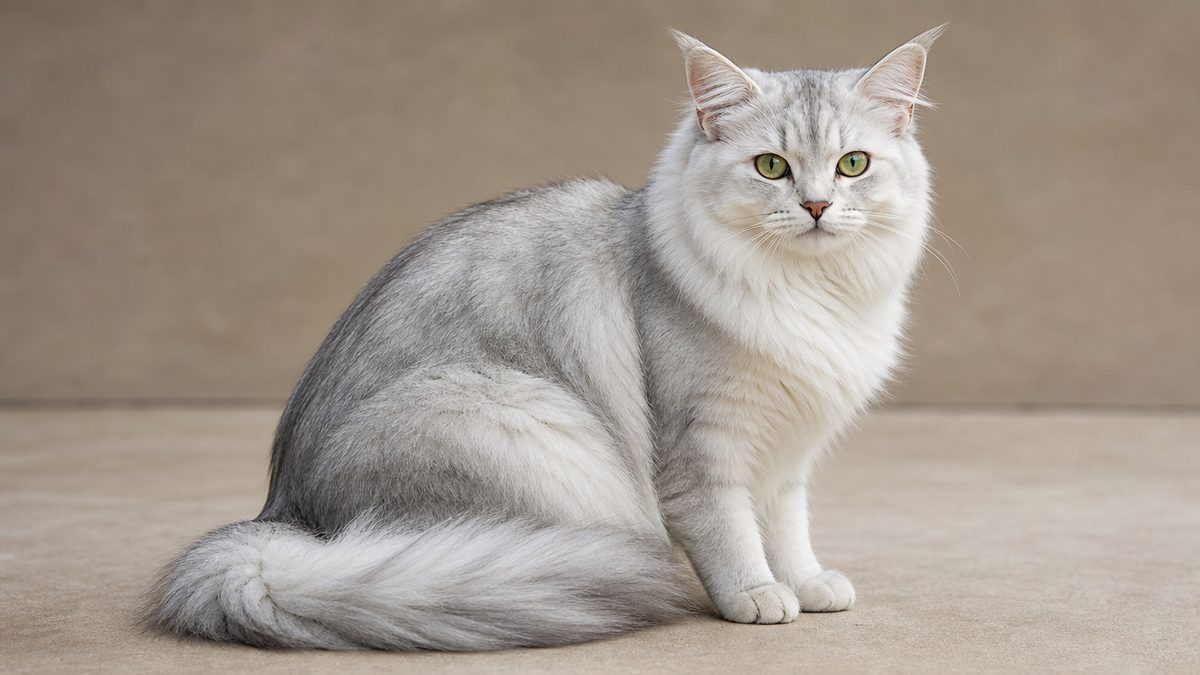
The semi-longhaired variety of the British Asian cat, held at GCCF championship since 2003, down to 20 registrations a year, and routinely confused with an unrelated North American breed that no longer exists.
Quick answer
No tiffanie cat price in India could be sourced on 9 September 2026, and the supply explains why. The GCCF registered 20 Asian Longhairs in the whole of 2025 against 30 in 2024, and India's leading cat pricing guide never uses the words Tiffanie, Tiffany, Asian or Burmilla across 206,421 characters. The Tiffanie is the semi-longhaired variety of the British Asian cat and is a different breed from the North American Chantilly-Tiffany.
This page reports published veterinary research on periodic hypokalaemic polymyopathy, an inherited condition of Burmese and closely related cats for which a DNA test exists. It is reference material, not a diagnosis and not a treatment plan, and no figure here should be used to decide whether an animal needs care. Consult your nearby vet, a registered veterinarian who can examine your own cat, before acting on anything you read here, and treat episodic weakness or a downward-flexed neck in a young cat as urgent.
Tiffanie at a glance
What a Tiffanie actually is
A Tiffanie is the semi-longhaired variety of the British Asian cat, and the GCCF's Standard of Points says exactly that in five words: TIFFANIE, the semi-Longhaired variety of the Asian cat. It descends from the Burmese and the Chinchilla Persian, it must be Burmese in type, and it is a different animal from the North American Chantilly-Tiffany that shares most of its name.
The Asian group holds five varieties. Four are shorthaired, being the Self and Tortie group that includes the Bombay, the Smoke, the Shaded variety called the Burmilla, and the Tabbies. The fifth is the Tiffanie, and coat length is the only thing that separates it from the other four The Governing Council of the Cat Fancy.
Size and build are Burmese. The GCCF gives the group 12 to 15 lbs and calls it exactly similar to the Burmese in type, a slender athletic cat of medium size but heavy for its size, muscular and lithe with a broad rounded chest and a short wide blunt wedge of a head. Purina UK puts the weight at 3.5 to 5.5 kg.
The coat clause, and why it matters in India
The standard is specific and the specification is good news for an Indian owner. The Tiffanie should have a fine and silky coat, medium long, except over the shoulders and without a woolly undercoat, and certificates are withheld for a coat too shaggy, that is with excessive undercoat. A registry that penalises undercoat is describing a semi-longhair that behaves far more like a shorthair in heat than a Persian coat does.
Ear tufts and streamers are preferable in the Tiffanie, and the tail is heavily furnished and plumed Purina UK, Tiffanie Cat Breed Information…. In practice a semi-longhair coat of this pattern carries most of its hair in three places, being the neck ruff, the britches and the tail, with the shoulders deliberately short. Heat tolerance follows directly from that distribution, and the climate section below sets out why.
The Tiffanie and the Chantilly-Tiffany are separate breeds from separate continents with no shared ancestry. On 9 September 2026 Google India's own generated answer to the People Also Ask question Are Tiffany cats rare?, returned on a page whose organic results were all about the British cat, was an account of the North American Chantilly instead, complete with its 2015 extinction date. Bonbeno keeps them on separate pages for that reason, and the comparison section below gives four tests that separate them in front of an actual cat.
Which registries hold the Tiffanie, one by one
The GCCF holds the Tiffanie at full Championship status and has done since 2003, and it is the only major registry that holds this cat under this name. TICA carries Asian LH (Tiffanie) in its Registration Only class, the CFA holds the Burmilla but not the Tiffanie, and FIFe holds neither the Asian group nor a longhaired Burmilla at all.
Read the difference between the GCCF position and every other position carefully, because it is the whole story. In Britain this is a championship breed with a scale of points, a withhold list, a registration rank and a published annual count. Everywhere else registry recognition amounts to either a book entry, a longhaired division of the Burmilla, or nothing at all.
Two of those bodies are worth checking in their own words rather than through an index. TICA's public Find a Breed navigation carries Burmilla and Burmilla Longhair as separate entries and no Tiffanie, no Asian and no Asian Longhair entry at all, so a buyer who checks the shop window sees nothing while the rulebook behind it holds a Registration Only line. The GCCF's own breed index marks the Asian with an asterisk denoting a breed with short and long haired variations, which is the registry saying in a single character that the Tiffanie is a coat length rather than a separate breed. Wikipedia reaches the same conclusion in words, describing the Tiffanie as a breed similar to the Asian Shorthair except with semi-long fur, belonging to the Asian Group and recognised in any of the Asian Shorthair or Burmese colours and patterns.
| Registry | Position | Document and date |
|---|---|---|
| GCCF | Championship. The semi-longhaired variety of the Asian cat, with its own scale of points and withhold list | Standard of Points, June 2026, Section 5 Group B. All five Asian varieties reached Championship by 2003 |
| TICA | Category VI, Experimental (Developing), Registration Only, listed as Asian LH (Tiffanie) | Registration Rules Version B, 22 November 2024, Standing Rule 307.7. No standard exists, and Tiffan returns zero in the standards book |
| CFA | Not held. The CFA runs a Burmilla breed council and no Asian or Tiffanie council | Declared Candidates for Breed Council Secretary, modified 31 July 2026 |
| FIFe | Not held. BML is the Burmilla, a shorthair, and there is no longhair row and no Asian row | Breeds index parsed on the EMS code, 52 rows, read 9 September 2026 |
| LOOF | Held inside the group Burmese anglais, Asian et Burmilla, which issued 51 pedigrees in the whole of 2025 | Nombre de chats, pedigrees issued 2025 |
| WCF | Asian Longhair, code ALH, credited to GCCF, NZCF, SACC and LOOF | WCF EMS code table, 198 rows pulled 9 September 2026 |
One thing on that WCF row worth flagging
The WCF's cross-registry map does not credit TICA on the Asian Longhair row, while TICA's own rulebook names Asian LH (Tiffanie) in Category VI The International Cat Association. Whether that is an omission or a defensible line is a real question rather than a clear error, because Category VI is a Registration Only class in which no championship requirements have been defined at all. The map is an index of who recognises a breed, and a book entry with no standard is arguably not recognition. Read the WCF map as a guide to where to look, then check the registry's own document.
Three separate rows on that same map carry a version of this name, which is the clearest single picture of the confusion. Row 14 is Asian Longhair (ALH), row 16 is Burmese Longhair (Tiffany) at the New Zealand and South African registries, and row 17 is Burmilla Longhair (BML) at TICA, ACF, NZCF and SACC. The same physical cat is filed under three names by different bodies, and a fourth name, Chantilly, belongs to a different cat entirely.
How the Tiffanie happened, and how it got its name
The Tiffanie is a by-product. Burmilla breeders crossing Burmese with Chinchilla Persian to get a short silver-shaded coat also carried the longhair gene across, and the long-coated kittens from those litters became the Tiffanie. The British breed was recognised in 1986 and was originally called the Tiffany, until the clash with the American cat forced the spelling change.
The history is documented well enough to date, which is unusual for a modern breed. The founding accident is a good story. A Chinchilla Persian male named Sanquist and a Lilac Burmese female named Faberge, both belonging to Baroness Miranda von Kirchberg, mated when neither was supposed to. Faberge was sent away to be mated to a Burmese and produced a litter of four female kittens, Galatea, Gemma, Gabriela and Gisella, that were clearly not Burmese. Instead of neutering them the Baroness developed them as the foundation of a new breed.
The register followed steadily rather than quickly. Therese Clarke, who adopted Gemma, formed the Burmilla Cat Club in 1984. The Burmilla reached preliminary Championship Status with the GCCF in 1990, and by 2003 all five varieties of the Asian group, the Tiffanie among them, held full GCCF Championship Status.
The rename, and who moved
Both breeds changed names, six years apart, and that is why the confusion is so durable. Britain recognised the Asian Longhair in 1986 under the name Tiffany, then changed it to Tiffanie to avoid a clash with the older American breed. Canadian breeders rebuilding the American cat in 1992 then renamed theirs Chantilly/Tiffany, because Britain had the Tiffanie and the name Foreign Longhair had passed to semi-longhaired Oriental cats.
A third variant exists and is worth knowing before you read an Australian or New Zealand source. The Australian Tiffanie came from the Australian Burmilla programme and is a cobbier cat carrying more Chinchilla Persian blood than the European Tiffanie. The World Cat Federation's table files a related row as Burmese Longhair (Tiffany), code TIF, at the New Zealand and South African registries. So a page describing a Tiffanie may be describing a British cat, an Australasian cat, or the extinct American one, and the country of the source tells you which.
Tiffanie cat price in India, and why no figure exists
No Tiffanie cat price in India could be sourced on 9 September 2026. India's most-read cat pricing guide runs to 206,421 characters and never uses the words Tiffanie, Tiffany, Asian or Burmilla anywhere in it, while using Persian 22 times and Siamese 9 times on the same page. That is a controlled absence, not a gap in our searching.
The supply side explains it. In the breed's home country the GCCF registered 20 Asian Longhairs in the whole of 2025, against 30 the year before, a fall of 33 percent, placing it 32nd of 66 rows in a register that issued 17,464 pedigrees in total. In France the entire Burmese anglais, Asian et Burmilla group produced 51 pedigrees in 2025. A breed producing dozens of kittens a year in Europe has nothing spare for an Indian market.
| Figure | Where it comes from | What it is worth in India |
|---|---|---|
| 500 to 1,200 pounds | Quoted for the British Tiffanie by UK classified sources, restated by Google India's generated answer | A British asking price. Converting it to rupees would invent an Indian price nobody has paid |
| 300 to 800 US dollars | Quoted for the Chantilly / Tiffany, which is the other cat | Belongs on the Chantilly-Tiffany page, and that breed has no living breeding stock |
| From 800 Australian dollars | Quoted for the Australian Tiffanie, a third variant with more Chinchilla Persian behind it | A different cat again, from a different breeding programme |
| Rs 10,000 to Rs 30,000 | Supertails' 2026 table, for the Bombay | The closest Indian comparison available, because the Bombay is the Black Self of the same Asian group |
| Rs 0 to Rs 2,000 | Supertails' 2026 table, for the Indian Domestic or Desi cat | The realistic price of the semi-longhaired cat an Indian buyer will actually be offered under this name |
This is the one genuinely useful Indian price fact about the Tiffanie, and no ranking page carries it. The Bombay is not a separate breed at the GCCF; it is the Black Self variety of the Asian group, the same group the Tiffanie belongs to. Supertails prices the Bombay at Rs 10,000 to Rs 30,000 in India. So an Indian buyer who wants Asian-group temperament and build at an Indian price already has a route to it, and the only thing the Tiffanie adds on top is coat length.
Import is not a workaround. Live cats are a Restricted import in India under ITC(HS) code 01061900, and anything outside the personal pet baggage route is referred to the Exim Facilitation Committee. Nothing about a 20-kitten breed makes that route easier.
Monthly cost of keeping an Asian-group cat in India
Budget roughly Rs 3,000 to Rs 8,000 a month for a medium semi-longhaired cat in an Indian metro, with the first year carrying the vaccination course on top. The monthly cost of this cat is the monthly cost of any 3.5 to 5.5 kg cat, because nothing in the standard adds a special requirement.
Vaccination has the clearest published rate card. Vetic, a chain with clinics across eleven Indian cities, prices a kitten course of three visits at days 60, 90 and 120 from Rs 3,999 against a struck-through list price of Rs 5,065, an adult annual booster from Rs 1,899, anti-rabies alone at Rs 699 and a feline CRP at Rs 1,249.
- Licence, Rs 50 in Chennai. The Greater Chennai Corporation licenses pet animals generally rather than dogs only, and issued 9,115 licences in Tamil Nadu during 2024.
- Free municipal treatment in Chennai. The Corporation's pet clinics provide all treatment and anti-rabies vaccination free of cost.
- Microchipping, Rs 1,250. A Chennai clinic's own transacted price, not a converted one.
- No statutory microchip duty for a kitten. Rule 7(16) of the Pet Shop Rules, 2018 makes microchipping mandatory for puppies only.
- One WNK4 PCR test, once, if the cat is Burmese-derived. The rupee cost varies by laboratory in Bengaluru, Mumbai and Hyderabad, but a single test on a breeding cat settles a lifetime question.
Most breed-specific health spending in India buys reassurance rather than information. This one does not. An inexpensive PCR test identifies both affected homozygous cats and carriers of the WNK4 nonsense mutation behind hypokalaemic polymyopathy, and the paper that reviewed the genetics names the Tiffanie by name among the Burmese-infused breeds from which the condition should be eliminable. If you are buying an Asian-group kitten anywhere, ask whether the parents were tested and ask to see the result.
Heat tolerance and the Indian climate
A Tiffanie handles Indian heat better than its coat length suggests, and the reason is written into its own breed standard. The GCCF requires a fine silky coat, medium long, without a woolly undercoat, and withholds certificates for a coat too shaggy with excessive undercoat. A single-layer semi-long coat sheds heat far more like a shorthair than like a Persian.
The Burmese ancestry helps too. The Burmese is a Southeast Asian-derived type built for a warm climate, and the Asian group is exactly similar to the Burmese in type. Coat colour has no effect on any of this; coat structure does.
What actually goes wrong in an Indian summer
Mats, not heatstroke. A ruffed semi-longhaired cat cannot reach its own collar, britches or tail base, and in Mumbai, Chennai or Kolkata humidity a mat that forms in July is a skin infection by August. The shoulders, which the standard deliberately keeps short, are the one region that looks after itself.
Indian law puts the temperature duty on the seller rather than on you. Rule 6(5) of the Pet Shop Rules, 2018 sets the obligation breed by breed rather than fixing one number for all animals, and rule 7(1) requires a species-suitable environment. A shop keeping an Asian-group cat in an unventilated Karnataka summer is in breach of its own licence conditions.
- Give the cat a cool floor it can reach when you are out. Shaded tile beats a locked air-conditioned room.
- Comb the ruff before the monsoon rather than during it. A coat opened up in April mats far less in July.
- Dry the ruff and britches completely after any bath. Damp long hair in 90 percent humidity is where skin trouble starts.
- Watch for ventroflexion of the head and neck in a cat under a year. That is the characteristic sign of the one inherited condition this breed group actually carries, and heat has nothing to do with it.
Temperament, household fit and who should not buy one
A Tiffanie is more laid back than its Burmese ancestors and more outgoing than its Chinchilla Persian relatives, which is a moderate mix of two very different cats. The GCCF describes the wider Asian group as sociable and interactive, lively and energetic, and the two descriptions are not contradictory so much as measuring different ends of the same range.
The standard takes temperament seriously enough to police it. All awards are withheld for extreme aggressive temperament, and the standard adds that any extreme or aggressive temperament should not be encouraged by breeding and should be penalised by judges on the show bench. Very few cat standards go that far, and it is worth knowing that this one does.
Household fit has one hard limit. Purina UK records that the Tiffanie is not overly happy about being left for long periods even with another cat for company, and is likely to find catteries or pet sitters quite stressful, which can lead to behaviour problems. For an Indian household that travels often, that is the deciding fact rather than the coat or the price.
Anyone who travels most weekends should choose a different cat, because this one does badly in boarding and does badly alone. Anyone with very small children should also think twice, since Purina notes the breed is likely to find busy chaotic homes too much and will not appreciate the attentions of very small children who find it hard to understand that such a quiet cat is not a toy.
Training a Tiffanie, and the one lesson that matters
Train the grooming first. For a semi-longhaired cat in an Indian climate, teaching the animal to accept a steel comb through the ruff, the britches and the tail base is worth more than every trick combined, and the window that makes it easy is the first sixteen weeks.
- Comb after a meal, never before one. A fed kitten does not treat the comb as an ambush.
- One region per session for the first fortnight. Shoulders, then flank, then tail base, and never chase a knot on day one.
- Stop while the cat still wants more. Ten good seconds daily beats two minutes that end in a scratch.
- Handle every paw, every session. A cat that lets you hold a foot is a cat whose claws you can clip at home for free.
- Reward with food, not with release. Letting a struggling cat go teaches it that struggling works.
Enrichment needs deliberate effort with this breed rather than the usual restraint. Purina describes the Tiffanie as inclined towards laziness and says it is more likely to need to be encouraged to exercise than encouraged to chill. In an Indian flat with free-choice dry food that combination puts weight on quietly.
Carrier training pays for itself the first time you need a vet on a Chennai afternoon. A cat that walks into a carrier calmly arrives without heat stress on top of whatever is already wrong.
How much exercise a Tiffanie actually needs
Budget 20 to 40 minutes of interactive play a day, split into two or three sessions, and expect to start most of them yourself. This is a cat that has to be encouraged to exercise rather than restrained.
- Wand toys along the floor first, then two or three lifts. Horizontal running before vertical work.
- A cat tree, and Purina names it specifically. The breed is described as low-chaos as long as toys and a cat tree are provided.
- Food puzzles for the working day. They do the job while you are out and the cat is not.
- Ten minutes before your bedtime. A cat played out at 10 pm does not wake a Bengaluru household at 4 am.
Play in the cool hours in Delhi, Pune, Ahmedabad and Chennai. A cat pushed to chase a wand at two in the afternoon in an unairconditioned flat in May is being asked to overheat, whatever its coat is doing.
Weight matters more here than in most breeds, because a laziness-inclined cat of 3.5 to 5.5 kg carrying an extra 500 g is carrying roughly a tenth of its body weight. Weigh the food once with a kitchen scale so you know what your scoop holds.
Grooming a Tiffanie coat in Indian humidity
Comb twice a week with a steel comb and concentrate on the ruff, the britches and the tail base. The GCCF describes the coat as fine and silky and medium long except over the shoulders, so the shoulders look after themselves and the other three regions do not.
The absence of a woolly undercoat is the reason this is a manageable coat rather than a Persian coat. Certificates are withheld for excessive undercoat, which means a correctly bred Tiffanie has nothing dense to felt. Where an Indian owner does get mats it is almost always in the plumed tail and behind the ears rather than across the body.
The monsoon adjustment
Between June and September, add a proper dry-off and drop the bath. British and Australian breed guidance routinely tells owners to towel a cat and let it air dry, which is written for a temperate climate and does not transfer to Kochi or Mumbai. Towel, then comb, then let the cat finish somewhere with moving air.
- A steel comb with close and wide teeth, not a slicker brush, because a slicker rides over a forming mat.
- Clip a mat out rather than bathing it out, with a comb held between the mat and the skin.
- Check behind the ears and between the front legs weekly. These are missed more than any other spot.
- Nails every two to three weeks. Long nails hook the coat and create the mats you are trying to prevent.
Professional grooming is rarely necessary for this coat in India. A chain clinic bath in Delhi starts around Rs 934, and an owner who combs twice a week will almost never need one.
Tiffanie health, the WNK4 test and what the literature contains
One inherited disease matters for this breed and it has a cheap DNA test. Periodic hypokalaemic polymyopathy is caused by a single nonsense mutation in WNK4, and the review that identified it names the Tiffanie by name among the Burmese-infused breeds from which the condition should be eliminable. That paper is also the entire peer-reviewed literature the breed name returns.
The clinical picture is specific enough to act on. Affected cats usually present with muscle weakness and muscle pain in the first year of life, with ventroflexion of the head and neck especially characteristic, although some cats do not show that sign. Weakness is usually periodic or episodic and occasionally incessant, and signs have historically waxed and waned in response to dietary factors and stress, with some cats appearing to grow out of it.
The mechanism explains why diagnosis used to be so hard. WNK4 codes for lysine-deficient 4 protein kinase, an enzyme present primarily in the distal nephron, so the underlying problem is a potassium-wasting nephropathy rather than a muscle disease. Before the gene was found, clinical signs and a lowered serum potassium concentration were not always observed at the same time, which meant serial potassium measurements, creatine kinase testing and the exclusion of muscular dystrophies, Toxoplasma myositis, immune-mediated polymyositis, organophosphorus intoxication and envenomation.
Ask whether both parents were PCR tested for the WNK4 variant and ask to see the certificates. The test is inexpensive and identifies affected homozygous individuals as well as carriers, so a breeder who has not run it on Burmese-line breeding cats has skipped the single cheapest thing available. If you already own an Asian-group cat under a year old and it shows episodic weakness or holds its head and neck flexed downward, consult your nearby vet the same week and mention this condition by name.
What no study has measured for this breed
No breed-specific life expectancy exists. The Tiffanie is not among the 12 breeds that reached the 15-death threshold in the largest UK feline life-table study, which means it sits inside the grouped other category holding 111 of that study's 7,936 confirmed deaths. That is not a finding about the breed's longevity in either direction.
The parent breed is in that table, and it is the good news. Burmese leads all 12 rows at 14.42 years of life expectancy at age 0, with a 95 percent confidence interval of 12.91 to 15.93 on 45 deaths and an observed lifespan range running from 0.74 to 21.29 years. The Tiffanie is Burmese in type and largely Burmese in ancestry, so that figure is the most relevant measured number available, and it is a figure about the Burmese rather than about this breed.
| Source | Figure | What it is |
|---|---|---|
| GCCF Asian breed page | 16 years | A registry's breed-characteristics field for the whole Asian group |
| Purina UK Tiffanie page | 7 to 12 years | A commercial breed library's lifespan field for the Tiffanie specifically |
| Teng 2024, Burmese row | 14.42 years (12.91 to 15.93) | A measured life expectancy at age 0 from 45 Burmese deaths in UK primary veterinary care |
| Teng 2024, this breed | Not among the 12 rows | Fewer than 15 deaths, so grouped into other |
Nine years separate the two breed-guide figures for the same cat, which is a wider gap than either page acknowledges. Neither is a measurement. The only measured number in that table is the Burmese row, and it sits between them.
Nothing on this page is a diagnosis or a treatment plan, and no figure here should be used to decide whether an animal needs care. Episodic weakness, muscle pain or a downward-flexed neck in a cat under a year old is a same-week veterinary appointment, not something to monitor. Consult your nearby vet, a registered veterinarian who can examine your own cat, before acting on anything you read here.
Feeding an Asian-group cat in India
Feed a complete commercial diet appropriate to the life stage in measured meals, and weigh the portion rather than trusting a scoop. A 3.5 to 5.5 kg cat inclined towards laziness has very little margin on portion size.
- Kitten to twelve months, three to four small meals daily. Growth demand peaks in the first six months.
- Adult, two measured meals rather than a permanently full bowl. Free-choice feeding is how a lazy cat gains weight unnoticed.
- Wet food daily where the budget allows. In an Indian summer the water in wet food matters as much as the protein.
- Treats under ten percent of daily calories. On a cat this size that is a very small number.
- Water bowl at least three feet from the food. Cats drink less when they can smell food nearby.
Body condition beats any feeding chart. Feel the ribs easily under a thin fat cover and see a waist from above, and check by hand rather than by eye, because a ruff hides a rising weight for months.
One nutritional note belongs to the WNK4 story rather than to any label. Signs in affected cats have historically waxed and waned in response to dietary factors and stress, so a cat with a confirmed or suspected diagnosis needs its diet managed by the vet treating it rather than by a breed feeding guide.
Kitten timeline, month by month through the first year
The first year of an Asian-group kitten has five fixed points, and two of them are set by Indian law rather than by the breed. The single breed-specific one is the WNK4 question, and it belongs at the start rather than at the end.
- Before you pay, ask for the parents' WNK4 results. The test identifies carriers as well as affected cats and is inexpensive.
- Weeks 0 to 8, do not take the kitten. The Pet Shop Rules, 2018 treat kittens below eight weeks as un-weaned and rule 7(15) bars their sale.
- Week 8 to 9, home and settle. One room, one tray, one hiding place, no visitors for three days.
- Day 60, first vaccination. Vetic's kitten course runs three visits from Rs 3,999.
- Weeks 9 to 16, the comb window. Everything taught about handling now saves fifteen years of argument.
- Day 90 and day 120, visits two and three, adding anti-rabies at Rs 699 when your vet advises.
- Months 4 to 12, watch for episodic weakness. Signs of hypokalaemic polymyopathy usually appear in the first year of life.
- Month 4 to 5, microchip at Rs 1,250 and licence at Rs 50 where your municipality issues one.
- Month 5 to 7, neuter. Sex and neuter status are better evidenced influences on allergen output than breed.
- Month 8 to 12, the adult ruff arrives. This is when twice-weekly combing stops being optional.
- Month 12, first annual booster from Rs 1,899.
One extra job for anyone buying in India. Ask which registry issued the pedigree and check what that registry actually does with the breed, because a TICA document for this cat is a Category VI Registration Only entry with no standard behind it, while a GCCF document is a championship registration The Governing Council of the Cat Fancy.
Tiffanie versus Chantilly-Tiffany, Burmilla and Burmese
Four tests separate a Tiffanie from a Chantilly-Tiffany in front of an actual cat, and none of them is the one the biggest breed guide prints. Purina UK names the discriminator as the undercoat, saying the Chantilly had a distinctive coat that lacked undercoat, but the GCCF's own standard requires the Tiffanie to be without a woolly undercoat too and withholds certificates for excessive undercoat. Both cats lack undercoat, so that test does not work.
| Test | Tiffanie | Chantilly-Tiffany | Verdict |
|---|---|---|---|
| Ancestry | Burmese crossed with Chinchilla Persian, and required to be Burmese in type | No Burmese blood at all, never bred to the Burmese, semi-foreign rather than Burmese type | Decisive, and it is the origin of the whole confusion |
| Colour range | Over 400 colour combinations, including red, cream, apricot, torties and silvers | Eumelanistic colours only, being chocolate, cinnamon, blue, lilac and fawn, with no silver and no red-based colour | Decisive. A red or silver cat cannot be a Chantilly |
| Does it exist | 20 registered with the GCCF in 2025 | No intact cats and no breeders anywhere | Decisive in practice, whatever the paperwork says |
| Registry home | GCCF Championship since 2003 | TICA Registration Only, listed twice, as Chantilly and Tiffany | Decisive on paperwork |
| Undercoat | Fine silky coat without a woolly undercoat, certificates withheld for excess | Also described as lacking undercoat | Does NOT work, despite being the test Purina prints |
The living cats to cross-shop instead
| Breed | Relationship | What differs | Availability |
|---|---|---|---|
| Burmilla | The same breed, shorthaired. The Shaded variety of the Asian group | Short coat, silver shaded | Far wider. Recognised by every body on the WCF map, and the CFA runs a breed council for it The Cat Fanciers' Association |
| Asian | The parent group, holding all five varieties | Four of the five are shorthaired | GCCF registered 101 Asian Shorthairs in 2025 against 20 Tiffanies |
| Burmese | The type the standard requires the Tiffanie to match | Short coat, and the only one of these with a measured life expectancy | Widely available, and 14.42 years at age 0 in UK life tables |
| Bombay | The Black Self of the same Asian group | Short black coat | Priced in India at Rs 10,000 to Rs 30,000 |
| Chantilly-Tiffany | Not related at all, despite the name | Chocolate-based only, no Burmese ancestry, and no living breeding cats | None |
Mistakes Indian buyers make with this breed
Five mistakes account for almost every bad outcome attached to this name in India, and the first two are identification errors rather than care errors.
- Treating the Tiffanie and the Chantilly-Tiffany as one cat. They are unrelated breeds from two continents, and both were renamed in the 1980s and 1990s precisely because of the clash.
- Using the undercoat as the test. Both breeds are specified without a woolly undercoat, so it separates nothing.
- Reading a TICA registration as recognition. Asian LH (Tiffanie) sits in Category VI, the Registration Only class, with no championship requirements defined and no standard in the standards book.
- Skipping the WNK4 test because the cat looks healthy. Carriers look completely normal, and the test identifies them.
- Believing the hypoallergenic claim. There is no scientific evidence for a hypoallergenic cat breed.
A sixth mistake belongs to research rather than buying. Do not treat a generated answer as a source here. Asked about the Tiffanie on 9 September 2026, Google India returned an account of the North American Chantilly, on a result page whose organic listings were all about the British cat. If the engine cannot keep the two apart, a buyer working from its summaries will not either.
One further caution about sources by country. A page describing a Tiffanie may be describing the British cat, the cobbier Australian variant with more Chinchilla Persian behind it, or the extinct American breed, and the country of publication is usually the fastest way to tell which World Cat Federation, WCF EMS code table.
Adoption, sourcing and the honest Indian answer
No Tiffanie breeder operates in India, and adoption of a semi-longhaired domestic cat is the route that actually exists. With 20 kittens registered in the breed's home country in a whole year and 51 pedigrees across the entire Asian and Burmilla group in France, there is no surplus anywhere for an export market.
- Ask which registry issued the pedigree and verify it with that registry. A GCCF championship registration and a TICA Category VI entry are very different documents.
- Check the kitten's age first. Sale below eight weeks is prohibited outright.
- Ask for both parents' WNK4 genetic test certificates before anything else, if the cat is presented as Asian, Burmilla, Bombay, Tonkinese or Tiffanie. A breeder who does not screen for it has skipped the cheapest thing available.
- Assume an unregistered or imported cat carries no health history at all. Compare what you are actually being offered against a healthy Indian shelter cat before you pay a rare-breed premium, because an affectionate semi-longhair with no papers is exactly what most of these listings turn out to be.
- Consider the Bombay instead. It is the Black Self of the same breed group, it is priced in India, and it is a short-coated cat in a hot country.
- Use the municipal route where it exists. Chennai licenses pet animals at Rs 50 and treats and vaccinates them free at its own clinics.
Adoption is not a lesser outcome on this page. Indian shelters carry semi-longhaired cats in every coat colour, and the temperament Purina describes, a moderate cat that wants company and dislikes being left, is common in rescued adults who have already learned to live with people. Bonbeno does not broker cats and does not recommend breeders.
Import is not a realistic workaround either. Live cats are Restricted under ITC(HS) 01061900, and the personal pet baggage route exists for a pet you already own rather than for acquiring one abroad.
Tiffanie questions Indian buyers actually ask
Are Tiffany cats rare?
Yes, and the question is answered differently depending on which cat you mean. The British Tiffanie is rare but alive: the GCCF registered 20 in 2025 against 30 in 2024, a 33 percent fall, ranking it 32nd in a register that issued 17,464 pedigrees in total. The North American Chantilly-Tiffany is a different breed with no intact cats and no breeders left anywhere, so it is not rare, it is gone.
How much is a Tiffanie cat?
No Indian price exists. India's most-read cat pricing guide runs to 206,421 characters and never uses the word Tiffanie, Tiffany, Asian or Burmilla, while naming the Persian 22 times on the same page. British classified sources quote 500 to 1,200 pounds, which is a British asking price rather than an Indian one, and converting it into rupees would invent a figure nobody in India has paid.
How much does a Tiffany cat cost?
It depends entirely on which cat the question means, and most published answers do not say. Google India's own answer to this question on 9 September 2026 gave 300 to 800 US dollars, a figure for the extinct North American Chantilly-Tiffany, while noting separately that readers should make sure they are not confusing that breed with the British Tiffanie of the Asian cat group. In India neither figure applies, because no Indian source prices either cat.
What is the difference between a Tiffanie and a Chantilly-Tiffany?
They are unrelated breeds from two continents. The Tiffanie is British, arose in the mid-1980s from the Burmilla programme crossing Burmese with Chinchilla Persian, and is required to be Burmese in type. The Chantilly-Tiffany is North American, began in New York in 1967 from cats of unknown ancestry, was never bred to the Burmese and admitted only chocolate-based colours. Britain renamed its cat from Tiffany to Tiffanie, and Canada renamed the American breed to Chantilly/Tiffany in 1992, both to end the clash.
Is the Tiffanie the same as the Asian Longhair?
Yes. The GCCF's Standard of Points files the breed as ASIAN SH and LH, with the longhair abbreviated ALH and named Tiffanie in the heading itself, and defines it as the semi-longhaired variety of the Asian cat. The World Cat Federation's cross-registry table uses the name Asian Longhair with the code ALH for the same animal, credited to the GCCF, the New Zealand and South African registries and the French studbook.
Which registries recognise the Tiffanie?
One of six holds it at championship. The GCCF has held all five Asian varieties at full Championship status since 2003. TICA carries Asian LH (Tiffanie) in Category VI, its Registration Only class, with no standard and no championship requirements defined. The CFA runs a Burmilla council but no Asian or Tiffanie council, FIFe holds neither the Asian group nor a longhaired Burmilla, LOOF registers it inside a combined Burmese, Asian and Burmilla group, and the WCF lists it as the Asian Longhair.
What health tests should a Tiffanie breeder have done?
Ask for the WNK4 PCR test on both parents. Periodic hypokalaemic polymyopathy in Burmese and closely related cats is caused by a single nonsense mutation in WNK4, producing a potassium-wasting nephropathy rather than a primary muscle disease, and an inexpensive PCR test identifies affected homozygous cats as well as carriers. The review that set out the genetics names the Tiffanie among the Burmese-infused breeds from which the condition should be eliminable.
How long do Tiffanie cats live?
No measured figure exists for the breed, and the two published estimates disagree by nine years. The GCCF gives the Asian group 16 years and Purina UK gives the Tiffanie 7 to 12 years, and neither is a measurement. The Tiffanie is not among the 12 breeds that reached the 15-death threshold in the largest UK feline life-table study. The nearest measured number is the Burmese, which leads that table at 14.42 years of life expectancy at age 0.
Are Tiffanie cats hypoallergenic?
No, and no cat breed is. A 2024 review in Allergologie Select states in its full text that to date there is no scientific evidence for a hypoallergenic cat breed, and that even hairless Sphynx cats produce Fel d 1. Its conclusion adds that dander analyses across breeds show high individual variation but no evidence for the concept at all. Sex and neuter status are better evidenced than breed, since unneutered males average more Fel d 1 than females.
Can I buy a Tiffanie cat in India?
Not realistically. No Indian source prices or lists the breed, and the global supply is tiny, with 20 GCCF registrations in 2025 and 51 pedigrees across the whole Burmese, Asian and Burmilla group in France that year. Live cats are also a Restricted import under ITC(HS) 01061900. The Bombay, which is the Black Self variety of the same Asian group, is available in India at Rs 10,000 to Rs 30,000 and gives you the same group's type and temperament in a short coat.
Is a Tiffanie a good cat for an Indian apartment?
Yes for a quiet home where somebody is usually there, and no for a household that travels. Purina UK records that the breed is happy to spend most of its time indoors and is low-chaos as long as toys and a cat tree are provided, but is not overly happy about being left for long periods even with another cat, and finds catteries and pet sitters stressful enough to cause behaviour problems. The coat, being fine and silky without a woolly undercoat, is well suited to Indian heat.
Does a Tiffanie need more grooming than a shorthair?
Somewhat, and less than most people expect. The GCCF describes the coat as fine and silky and medium long except over the shoulders, and withholds show certificates for excessive undercoat, so a correctly bred Tiffanie has nothing dense to felt. Twice a week with a steel comb through the ruff, the britches and the tail base is enough, and those are the three regions the cat cannot reach for itself.
Compare with similar breeds
Tiffanie sits in 1 Bonbeno group. Each one compares it directly against the breeds it is genuinely an alternative to, on the same figures.