
Breed profile
Burmilla Cat in India: Price, Health Tests and Heat Fit
The 1981 accident that made the breed, what the registries actually require a breeder to test for, and whether a silver Burmese-type shorthair suits an Indian summer.
Quick answer
No published Burmilla cat price in India exists in 2026, and the useful answer is what the registries make a breeder do instead. The Burmilla came from a documented accident in 1981 between a Chinchilla Persian male and a lilac Burmese female. GCCF has required hypokalaemia DNA testing for active-register Asians since 1 January 2018, and requires imports carrying a Chinchilla Persian grandparent to be tested clear of the PKD gene.
This guide is general information for Indian cat owners and is not a diagnosis. Episodic weakness, a lowered head and neck, stiffness or reluctance to walk in a young cat of Burmese ancestry needs a registered veterinarian the same day, because those are the described signs of hypokalaemic polymyopathy. Always consult a veterinarian near you before acting on anything you read here.
Burmilla traits, rated for Indian homes
What a Burmilla actually is
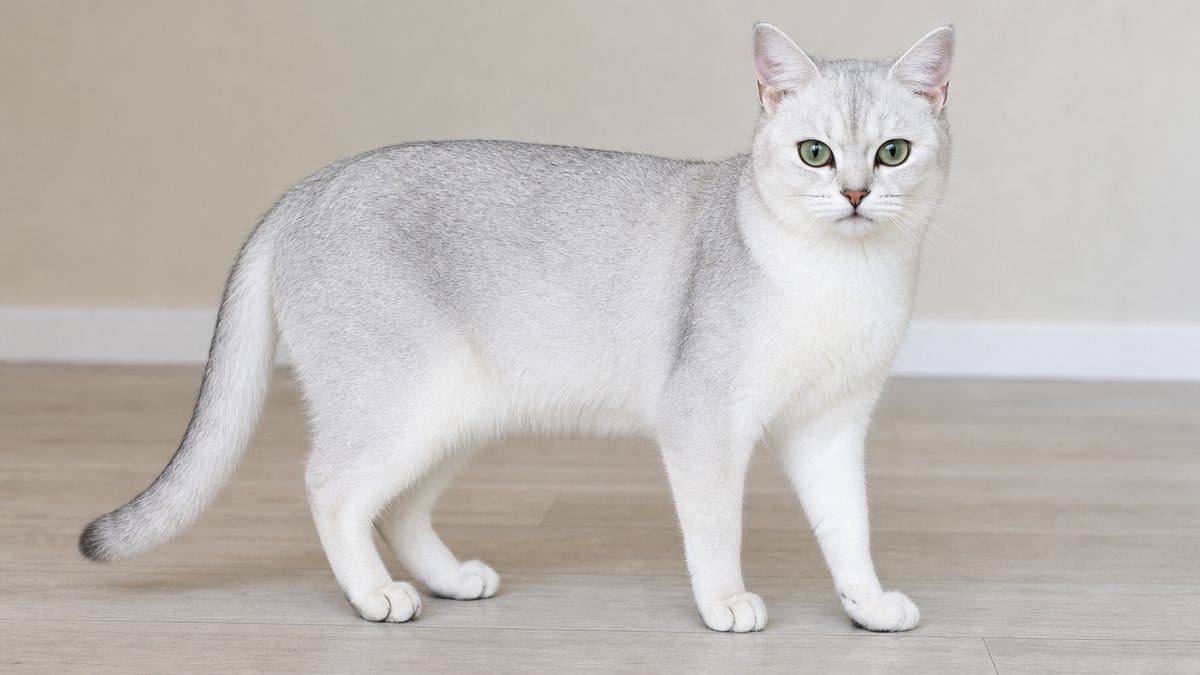
The Burmilla is a medium-sized cat of Burmese type carrying a sparkling silver or golden shaded coat and clear green eyes, created in Britain in 1981 and registered by five major registries, though two of them file it differently from the other three.
Start with the body, because that is the half of the breed that is not Persian. CFA describes a medium-sized cat with a muscular yet elegant body, a sculptured head where the rounded top, nose profile, medium broad muzzle and well-developed chin set the balance, luminescent eyes in any shade of green, and a mature male's weight reaching or exceeding ten pounds. FIFe's standard opens with the phrase an elegant cat of foreign type of medium size and lists cobby or oriental as body faults, which is a registry saying in three words that the breed must not drift back towards either parent.
Coat and colour, which is where the breed's whole identity sits
The Burmilla is defined by a silver coat that is shaded or tipped rather than tabby. FIFe requires a ground colour of pure silver-white or warm golden, shaded and shell, in the recognised orange and non-orange colour varieties, and describes the coat as short and dense with a silky texture, smooth lying with sufficient undercoat to give a slight lift. CFA's most distinguishing feature is that same silky, sparkling coat, pale at the roots and tipped with colour, plus the distinctive make-up lines that accent the nose, lips and eyes.
GCCF's registration policy is the document that shows how wide the colour range actually runs. Asians are recognised in 17 colours, and Asian Shadeds, which is the policy's own parenthetical for Burmillas, exist in all 17, in both Burmese Colour Restriction and Full Expression, and in both Standard and Silver. So a Burmilla is not necessarily silver at all in GCCF terms; a golden, non-silver shaded Asian is the same variety.
Because of the Chinchilla Persian ancestry the breed carries a recessive longhair gene, so semi-longhaired kittens appear in litters. TICA calls the Burmilla Longhair a true semi-longhair with a fine silky coat feathering to the underside, britches, plume and bib, and says explicitly that it should not look like a pet-quality Chinchilla with a big full coat, short legs, cobby body, extreme short face and little ears; it should be a Burmilla in fancy dress. In Indian humidity that distinction is the difference between a weekly comb and a daily one.
Green eyes, and how long they take
Eye colour is a slower business than buyers expect. FIFe accepts any shade of green while preferring clear green, allows a yellow tinge in kittens and young cats under two years, and permits amber in red, cream and tortie varieties. TICA puts it more usefully for a buyer: the colour of the Burmilla's eyes can take up to two years to develop, and the eyes are often greenish gold to yellowish in youth. A twelve-week-old kitten with yellow eyes is not a mis-bred cat.
The scale of points tells you what each registry is really judging. FIFe gives head 20, ears 10, eyes 20, body 25, coat texture and length 10 and evenness of shading or tipping 10, for 100 with condition. CFA gives head 20, ears 10, eyes 20, body 25, coat texture and length 10 and evenness of shading or tipping 15. Both put a fifth of the score on the eyes and a tenth to a sixth on how evenly the tipping falls, which is why an uneven coat drops a show cat's price and changes nothing about the pet in front of you.
The 1981 accident, documented by three registries
A Chinchilla Persian male and a lilac Burmese female mated by accident in Britain in 1981, and the four female kittens that resulted became the foundation of the breed. Three registries record the story and they differ on the details worth knowing.
TICA gives the fullest account, and names the cats. Baroness Miranda Von Kirchberg bought a Chinchilla Persian male, Jemari Sanquist, as a pet for her husband. Shortly before he was neutered, a cleaner left the door of a lilac Burmese female, Bambino Lilac Faberge, open. She escaped and mated with Sanquist, and the resulting litter of four female kittens, all shorthair and black shaded silver, was born on 11 September 1981.
CFA's account matches on substance and differs on one word. It dates the accidental breeding to 1981, names the Baroness, describes the Persian male being purchased as a pet for her husband and meeting a precocious lilac European Burmese female shortly before neutering, and records the same four shorthaired female kittens, all black shaded silver. CFA says European Burmese; TICA and GCCF say Burmese. That is a real distinction in the cat fancy, because CFA registers American Burmese and European Burmese as separate breeds, and it matters if you are reading a modern pedigree.
What GCCF adds, and what it leaves out
GCCF's Asian page names the two cats as Sanquist and Faberge, tells the same escape story with the detail that Faberge had already been sent away to be mated to another Burmese, and names the four kittens: Galatea, Gemma, Gabriela and Gisella. It records that the kittens were back-crossed with the Burmese so the breed characteristics were retained, that the Baroness formed the Burmilla Association, and that another breeder, Therese Clarke, who adopted Gemma from the original litter, formed the Burmilla Cat Club in 1984.
GCCF's page carries no year for the mating itself, while TICA gives a full date and CFA gives the year. So the 11 September 1981 birth date rests on TICA's account alone, and a careful reader should treat it as one registry's record rather than as a triple-sourced fact.
From one litter to a five-variety group
The breed then did something unusual. In 1990 the Burmilla was recognised for preliminary championship status with GCCF, and that recognition became the beginning of the Asian breed, developed from the original Burmilla to encompass diverse colours and patterns and two hair lengths but with Burmese head and body type. By 2003 all five varieties had been granted GCCF championship status. CFA moved much later, accepting both coat lengths for registration in 2011 and advancing them to championship in 2014. FIFe recognised the breed in 1995.
A breed founded on one litter in 1984, with a club formed around a single surviving foundation kitten, has a narrow gene pool by construction. CFA says so in its own words, noting that responsible breeders are aware of the small gene pool for Burmillas and continuously incorporate non-related cats through new lines, outcrosses and imports from other countries. That is the reason GCCF publishes a formal permitted outcross list rather than closing the studbook, and it is a question worth asking any breeder.
Burmilla cat price in India, and the figures that do exist
No published Burmilla cat price in India exists in 2026. The only real figures are American, and Bonbeno reports them in dollars rather than converting them into a rupee number that nobody is charging.
India's largest cat price reference runs a 14-breed table reviewed by a named senior veterinarian, prices the Persian at Rs 12,000 to Rs 50,000, the Bombay at Rs 10,000 to Rs 30,000 and the Sphynx at Rs 50,000 to Rs 1,50,000, and has no Burmilla row. Heads Up For Tails lists the Burmilla as entry 39 in a 50-breed article with a United Kingdom origin, a life expectancy of 10 to 15 years and the note that it is suitable for the Indian climate, and gives no figure. Whiskas' own Indian domain carries a Burmilla profile that is a global text with no Indian price and no Indian climate content at all.
The published American figures, in dollars
| Source of the kitten | Published US price | What the price is said to include |
|---|---|---|
| Registered breeder, pet quality | USD 800 to 1,200 | Vaccinations, vet check, registration papers, early socialisation |
| Registered breeder, show or breeding quality | USD 1,500 to 4,000 | Champion pedigree, breeding rights, full health screening |
| Semi-longhair Tiffanie lines | USD 1,200 to 2,500 | Rarer coat, smaller breeder pool |
| Shelter or breed rescue | USD 100 to 300 | Spay or neuter, core vaccines, microchip, deworming |
| Online or unregistered seller | USD 300 to 700 | Often no papers and no health testing |
Those are American numbers for an American market, stated as such on the page they came from. Running them through an exchange rate and printing the result as an Indian price is the commonest fabrication in Indian breed content, and this site does not do it. If an Indian seller quotes you a rupee figure for a Burmilla, that figure is their asking price and nothing else.
What the Indian search result actually returns
The result set is its own evidence. On an India-localised search for the exact commercial query, position one is an Indian pet-shop category page that sells accessories rather than cats, position seven is a Flipkart listing for a book titled Burmilla Cat Presents, and the substantive results are American and European breed guides quoting dollars and euros. A merchandise listing sitting in a price result set is exactly the contamination pattern this site watches for, because the number attached to it is plausible and describes a book.
If you want a comparable cat with a real Indian price, the British Shorthair sits at Rs 20,000 to Rs 60,000 on the same Indian table, is similarly calm and short-coated, and is actually available here. If what draws you is the Burmese half of the ancestry, read the Burmese guide.
The highest-ranking dedicated Burmilla breed page on that India-localised search is an American consumer guide whose own health section is headed with polycystic kidney disease, allergies and lifespan, and whose price section answers in dollars. It is a competent page. It is simply not written for a reader in Pune.
Monthly cost of a Burmilla in India
Budget roughly Rs 3,500 to Rs 7,500 a month for a Burmilla in an Indian city. It is a cheaper cat to run than a Persian and about the same as any other short-coated pedigree.
The monthly cost of this breed differs from a Persian's in exactly one line, which is grooming. A Persian in Indian humidity needs daily brushing and periodic professional work; a Burmilla needs a stainless-steel comb once a week, which CFA states is enough for both coat lengths. Everything else on the bill is what any Indian cat costs.
| Line | Published Indian figure | Source |
|---|---|---|
| Kitten vaccination course, three visits at days 60, 90 and 120 | Starts at Rs 3,999 | Vetic, 11 Indian cities |
| Annual adult booster, CRP plus anti-rabies | Starts at Rs 1,899 | Vetic |
| Pet licence, Chennai | Rs 50, with 9,115 issued in 2024 | Greater Chennai Corporation |
| Pet registration, Delhi | Rs 500 for dogs; there is no cat registration | MCD Delhi |
| Boarding, Bengaluru, up to 24 hours | Rs 899 | PawSpace |
| Daycare, Bengaluru, up to 10 hours | Rs 799 | PawSpace |
Read those vaccination prices as one chain's promotional floors rather than a market average. Vetic's own pages carry struck-through list prices of Rs 5,065 and Rs 1,908 against those figures and vary by city. Outside a metro, expect to pay more and get less packaging.
The two costs specific to this breed
- The genetic test bill, once. A hypokalaemia DNA result on both parents is the breeder's cost rather than yours, but if you buy an untested cat you will pay for the test yourself or live without the answer.
- Renal monitoring, if the pedigree carries a Chinchilla Persian. A PKD status is either on the paperwork or it is not, and if it is not, the honest budget line is an ultrasound and a conversation with your vet rather than an assumption.
The Greater Chennai Corporation runs six veterinary pet clinics providing all treatment and anti-rabies vaccination free of cost for pet animals, and issues a pet animal licence for Rs 50. Delhi's municipal portal, by contrast, registers pet dogs only, at Rs 500 for a new certificate with a Rs 100 per month late fee on renewal, so a Delhi cat owner has nothing to register and nothing to pay.
One line you can delete from a Persian budget. There is no professional grooming cost here, no de-matting, no sanitary clip and no seasonal shave, which in an Indian metro salon is a recurring saving rather than a one-off. Put that money into a second annual veterinary check instead, since a breed with two testable inherited conditions rewards being seen twice a year.
Heat tolerance: a British breed with a tropical parent
The Burmilla handles Indian heat better than most pedigree cats, and the reason is the coat rather than the passport. A short, dense, close-lying coat with only a slight lift from the undercoat is a working heat-exchange surface, not a heat trap.
Bonbeno queried NASA POWER by explicit latitude and longitude for the breed's home city and six Indian metros, using 2001 to 2020 monthly climatology, and echoed the grid-cell elevation back on each point so a hill cell cannot be mistaken for a town. London's cell returned 73.15 m against a real city elevation near 11 m, and every Indian point landed within about 80 m of its city, so all seven cells describe the places asked for.
| Place | Cell elevation | Annual mean T2M | Annual mean RH2M | Warmest month |
|---|---|---|---|---|
| London, United Kingdom | 73.15 m | 10.39 C | 84.59 percent | July, 17.6 C |
| Bengaluru | 841.72 m | 23.74 C | 67.94 percent | April, 28.4 C |
| Pune | 635.99 m | 23.86 C | 66.80 percent | April, 28.9 C |
| Delhi | 206.37 m | 25.60 C | 45.56 percent | June, 35.9 C |
| Kolkata | 7.35 m | 25.81 C | 73.93 percent | May, 31.5 C |
| Mumbai | 97.15 m | 26.77 C | 67.39 percent | May, 31.2 C |
| Chennai | 48.95 m | 27.95 C | 72.39 percent | May, 31.5 C |
Humidity is not the problem, and asserting otherwise would be wrong
Indian breed pages reflexively warn that a British breed will struggle in Indian humidity. On this breed the data says the opposite. London's annual mean relative humidity is 84.59 percent, higher than every Indian metro measured, including Kolkata at 73.93 and Chennai at 72.39. A Burmilla's ancestors were bred in a wetter place than Chennai. What changes in India is heat, by about 17.5 C on an annual mean, and it is the combination of heat with humidity that raises wet-bulb load rather than damp air on its own.
The sharpest single comparison is this. London's warmest month, July at 17.6 C, is 2.6 C cooler than Bengaluru's coolest month, December at 20.2 C. Bengaluru is the mildest metro on the list.
Why the coat still works here
A coat is not simply insulation. Hair, feathers and glabrous skin each play different roles in heat exchange, and coat structure changes how an animal loses heat as well as how it retains it. The Burmilla's coat is short and dense with a silky texture, smooth lying, with sufficient undercoat to give a slight lift. That is a thin, ventilated layer over skin, which shades the skin from ultraviolet light while adding little thermal resistance. It is the reason a short-coated cat outperforms both a Persian and a hairless breed in an Indian summer, and it is why Bonbeno rates this breed's heat tolerance at four out of five rather than three.
Practical Indian handling
- Give access to a tiled or stone floor in the coolest room, because a cat regulates by choosing surfaces before it regulates by anything else.
- Put water in a wide, shallow bowl at least three feet from the food, and add a second bowl in a different room.
- Move play to early morning and after sunset in April and May, when Chennai and Mumbai both peak.
- Treat panting as an emergency. Panting in cats is not the routine cooling behaviour it is in dogs.
- Do not read a skin-surface infrared reading as a body temperature. A 2024 model built on cats with different baseline characteristics found non-contact infrared readings need individual correction before they predict rectal temperature.
For cats the applicable Indian instrument is the Prevention of Cruelty to Animals (Pet Shop) Rules, 2018. Rule 7(1) requires animals for sale to be housed in accommodation and environment suitable to their species with respect to situation, size, temperature, lighting, ventilation and cleanliness, and rule 6(5) makes it incumbent on the pet shop owner to familiarise himself with the requirements of the breeds he deals in and provide ambient and comfortable temperature for them. The clause Indian pages usually quote, Second Schedule Part IV paragraph 21(1) on outdoor housing, belongs to the Dog Breeding and Marketing Rules, 2017 and governs dogs.
Health: testing the polycystic kidney disease claim against the literature
The Burmilla inherits one documented, testable disease from its Burmese side and a contested one from its Persian side. Hypokalaemia is real, common enough to be compulsory to test for, and screenable. Polycystic kidney disease is the one every page asserts and almost none checks.
Hypokalaemic polymyopathy, the one the registry made mandatory
Gandolfi and colleagues ran a genome-wide case-control study on 35 affected and 25 control Burmese using the Illumina Infinium Feline 63K array, mapped a locus on chromosome E1, and sequenced two candidate genes to find a nonsense mutation in WNK4, c.2899C>T, producing a truncated protein; all cases were homozygous. Malik and colleagues reviewed the clinical picture, describing muscle weakness and pain in the first year of life, characteristic ventroflexion of the head and neck, and episodic signs that wax and wane, and noted that elimination of the condition from breeds infused with Burmese lines should be possible now that an inexpensive PCR test identifies affected homozygotes and carriers.
The GCCF turned that into a rule. From 1 January 2018, Asian cats may be registered on the Active Register only if they have themselves been tested normal for hypokalaemia with the certificate supplied, or both parents have been so tested, or they can be deemed normal from testing on every pedigree line in previous generations, where a pedigree line means both parents, four grandparents, eight great-grandparents and so on. That is one of the few genuinely mandatory genetic test regimes in the cat fancy, and it applies to this breed.
Episodic weakness, a head and neck held low, a stiff or reluctant walk, and muscle pain in a cat under a year old. Signs may come and go and some cats appear to grow out of it. Any of that in a Burmilla or Asian is a same-day veterinary visit, and it is worth telling the vet the breed's Burmese ancestry, because a serum potassium and a creatine kinase are cheap and the diagnosis is easy to miss without the prompt.
Lymphoma, reported precisely
One more finding gets misquoted, so here it is exactly. An Australian study of 1,705 feline lymphoma cases against a reference population of 85,741 cats identified eight breeds at increased potential risk and three at decreased risk. The Burmilla was in neither list. What the Burmilla appears in is Table 3, breeds whose lymphoma occurred proportionately more at some anatomical sites than others, where nasal lymphoma was proportionately more common than gastrointestinal at p equal to 0.006. That is a statement about where the disease showed up, not about how often.
Life expectancy: three numbers, none of them measured on this breed
TICA gives 15 to 18+ years, GCCF's Asian care panel gives about 16 to 18 years, and an Indian retailer's list gives 10 to 15. None is a study. The UK life tables that did measure lifespan, from 7,936 confirmed deaths, put all UK companion cats at 11.74 years and did not include the Burmilla among the twelve breeds analysed. Its Burmese parent breed came top of that list at 14.42 years, with a 95 percent confidence interval of 12.91 to 15.93. Being entire, purebred and of non-ideal body weight were each linked to a shorter life.
Does the Burmilla inherit polycystic kidney disease from the Persian side?
Some Burmillas carry polycystic kidney disease and most published claims about it are asserted rather than checked. The primary literature gives a small, specific number, and the recognising registry says two things that have to be read together.
The Burmilla's Persian ancestry raises the question, so here is what the literature actually says. Lyons and colleagues identified the feline PKD1 mutation, a C>A transversion at c.10063 in exon 29, found it in the heterozygous state in 48 affected cats including 41 Persians, a Siamese and several other breeds known to outcross with Persians, reported PKD affecting approximately 38 percent of Persian cats worldwide, and found no homozygous cats, which supports the mutation being embryonic lethal.
Then Barrs and colleagues ultrasounded 320 cats in Sydney and Brisbane, comprising 230 Persians, 48 Himalayans, 17 Exotics, 14 Burmillas, 6 Ragdolls and 5 Chinchillas. Prevalence was 45 percent in Sydney and 42 percent in Brisbane. Two of the 14 Burmillas were positive, which is 14 percent, and the authors drew the conclusion that long hair and brachycephalic features do not segregate with the polycystic kidney disease trait.
| Source | Statement | What it is measuring |
|---|---|---|
| Barrs 2001, Australia | 2 of 14 Burmillas positive on ultrasound, 14 percent | A small convenience sample of pedigree cats in two cities |
| Lyons 2004 | About 38 percent of Persians worldwide; other outcrossed breeds carry the same variant | The PKD1 mutation itself, across breeds |
| GCCF Asian breed page | PKD and PRA identified in ancestral breeds; so far only hypokalaemia has arisen in the Asian | A registry's summary of its own breed's health record |
| GCCF Asian registration policy | Imports with a Chinchilla Persian grandparent should be tested clear of the PKD gene | A rule the same registry enforces at registration |
Those last two rows are the finding. The GCCF's public breed page tells a buyer that only hypokalaemia has so far arisen in the Asian, while the same registry's registration policy requires a clear PKD result from any imported cat carrying a Chinchilla Persian at the grandparent or great-grandparent level. Both statements are defensible: the UK breeding population may genuinely be clear while the route by which the gene could re-enter is still guarded. A buyer should read them together rather than picking one.
The reassuring half is that this is a solved problem where people bother. A 2026 Japanese study of 110,325 insured cats and 61,968 genetically tested cats across 14 breeds found the carrier frequency of the PKD1 variant fell by 42.6 percent between 2019 and 2022 after full-scale kitten testing began, with significant reductions in Scottish Folds, Persians and Ragamuffins, and no substantial change in overall genetic structure or inbreeding. Testing works and does not narrow the gene pool.
Breed recognition: five registries, two different ways of filing it
All five major cat registries recognise the Burmilla, and they disagree about what it is. CFA, TICA, FIFe and WCF register it as a breed; GCCF files it as one variety inside the Asian group.
The FCI does not appear here at all. It registers dogs and not cats, so the shortcut of checking one international body has no feline equivalent and each registry has to be read separately with a control that passes on the same document.
| Registry | How the Burmilla is filed | Control on the same document | Status |
|---|---|---|---|
| CFA | Burmilla, own breed council, both coat lengths | Burmese and Sphynx councils present; Donskoy absent | Registration 2011, championship 2014 |
| GCCF | Asian Shaded, inside the Asian group, Section 5 Burmese Group 2 | Sphynx present in the same 39-entry index | Preliminary championship 1990, all five varieties by 2003 |
| TICA | Burmilla and Burmilla Longhair, joint SH/LH breed committee | Burmese and Persian both present | Recognised |
| FIFe | BML, Category 3 | Burmese, Bombay and Persian in the same index | Recognised 1995 |
| WCF | Burmilla BMS in Category 3; Burmilla Longhair BML in Category 2 | Asian ASI and Burmese European BUR listed alongside | Recognised |
The code collision worth knowing before you import
FIFe's own standard prints BML for the Burmilla and files it in Category 3, which is the shorthair category. The World Cat Federation's EMS table gives BML to the Burmilla Longhair in Category 2 and BMS to the Burmilla in Category 3. So the same three letters mean the shorthair in one registry and the semi-longhair in another. If you are reading a pedigree issued abroad, check the code against the issuing registry's own table rather than against whichever table you happen to have open.
How the GCCF filing changes what you buy
The GCCF route matters because it comes with rules attached. The Asian group holds five varieties, being Asian Self and Tortie which includes the Bombay, Asian Smoke, Asian Shaded which is the Burmilla, Asian Tabby, and the semi-longhaired Tiffanie. Registration runs across a Full Register, a Supplementary Register and a Reference Register, with a four-generation ladder from a permitted outcross back to full Asian status.
That policy also publishes the permitted outcross list with the health tests attached to each, which is unusual and useful. Korat or Thai Lilac must be tested clear of carrying the Himalayan gene and GM1/GM2 gangliosidosis; Abyssinian, Ocicat and Ocicat Classic, Australian Mist and Somali must be tested clear of PKdef, PRA rdAC and PRA Rdy; Egyptian Mau must be clear of PKdef; Tonkinese must carry Burmese colour restriction; and any imported Burmese used in Asian breeding should be DNA tested clear of the Burmese Head Defect.
A named permitted outcross list with a mandatory test beside each entry is what a well-managed small gene pool looks like. Set it against the Donskoy, which has one permitted outcross, no identified hairless gene and therefore no test at all, and the value of the paperwork becomes obvious. Buying a Burmilla means buying into a system that has already asked the awkward questions.
A word on how each list was actually read, because an absence read off a half-loaded page is not an absence. CFA's public breed directory paginates twelve breeds at a time behind an infinite scroll, so a raw fetch returns only Abyssinian through Burmilla and the Burmilla row is visible by luck of the alphabet rather than by design; the breed-council roster is the document that settles it. GCCF's cat-breeds index renders all 39 entries in one document, with Asian carrying an asterisk to mark it as a group rather than a single breed. FIFe's breeds index likewise renders in one pass, which is how BML and its Category 3 neighbours could be read together.
Temperament and household fit
The Burmilla is affectionate without being needy, quiet, playful into old age, and unusually tolerant of being left alone for a Burmese-derived cat. That last trait is the one that decides whether it fits an Indian working household.
CFA describes a temperament that mixes the outgoing and mischievous nature of the European Burmese with the mellow placidity of the Chinchilla Persian, calls the result energetic but not hyperactive, and says it is quite content to lounge on the couch for long naps after regular bursts of spirited play. The sentence that matters most to an Indian buyer follows: though they are quite gregarious, they do enjoy some independence and can be left alone during your work day.
TICA's description agrees and adds that Burmillas remain playful and kitten-like into adulthood, are intelligent and inquisitive enough to learn tricks and work interactive toys, and are good climbers and jumpers for which cat trees and perches are recommended. GCCF's Asian panel is blunter about the group, describing a lively, chatty cat that will readily answer its owner, that generally lives contentedly with other cats but can be wilful about the pecking order, and that co-exists most successfully with breeds of a similar confident, lively disposition.
Apartment living is where that independence pays. A medium cat that plays in bursts, sleeps long, keeps a quiet voice and tolerates a working day is a genuinely good fit for the two-bedroom flats most Indian pedigree buyers actually live in, provided the flat gives it height. The failure mode of apartment living with this breed is a bare room, not a small one.
Households this breed suits
- Working couples in flats, because this is one of the few pedigree cats whose own registry says it tolerates a working day.
- Families with children old enough to play rather than grab, since all three registries describe a cat that gets on with children.
- Homes that already keep a dog, which CFA and GCCF both note the breed manages well when introductions are done properly.
- First-time pedigree buyers who want a manageable health picture with two named, testable conditions rather than a list of unknowns.
Who should look elsewhere
- Anyone who wants a silent, low-interaction cat, because this one talks back and follows you.
- Anyone who cannot supply vertical space, since a climbing breed in a bare flat becomes a curtain problem.
- Anyone unwilling to read a pedigree, because the whole safety margin on this breed lives in the paperwork.
GCCF warns that Asians mature sexually at a young age and advises consulting your vet about neutering or spaying at the earliest opportunity. In India, where the default assumption is often that a cat can wait until a year, that advice is worth acting on rather than filing away.
Training: what a Burmilla learns and what it ignores
Train a Burmilla with food and interactive toys rather than repetition, because both registries describe an intelligent, inquisitive cat that learns tricks and works puzzle toys, and neither describes a biddable one.
TICA states that Burmillas are intelligent and inquisitive, can learn tricks, and enjoy playing with interactive toys that reward them with treats. That is the whole training method in one sentence. A cat that solves a puzzle for food will also learn a recall, a carrier cue and a target, and will do none of them for praise alone.
The four things worth teaching, in order
- Carrier as furniture. Leave it open and feed in it from week nine, so a clinic visit never begins with a chase.
- Handling for the weekly comb. Thirty seconds a day of touching ears, paws and belly, paired with food, makes grooming a non-event for life.
- A recall word, taught at feeding time. Useful in a flat where a cat can be behind a wardrobe.
- Scratching-post targeting, taught early, because a climbing breed will otherwise pick your sofa.
Litter training needs no breed-specific work. The Indian small-flat failure, a tray placed beside the food bowl, applies here as everywhere, and TICA's own note about water placement, that a bowl should sit at least three feet from food because cats' noses are sensitive enough that food smell suppresses drinking, is the same principle applied to a different bowl.
What the breed genuinely resists
Two things. It resists being ignored, and it will escalate from a chirp to a sustained conversation, since GCCF describes the group as talkative and quick to answer their owner. And it resists a flat with no height. A cat that CFA and TICA both describe as a good climber and jumper will find vertical territory whether or not you provide it, and the version you provide is cheaper than the version it invents.
This breed has two conditions worth monitoring and a registry-mandated genetic test regime behind it, so it will see a vet more thoughtfully than an average cat. A Burmilla that walks into a carrier on cue gets its potassium checked when a question arises rather than three months later, and that is a real clinical difference rather than a convenience.
Daily exercise and enrichment
Give a Burmilla two ten to fifteen minute play sessions a day plus real vertical space, and time the hard session for early morning or after sunset in an Indian summer.
TICA recommends cat trees and perches for a breed it describes as a good climber and jumper, and CFA advises plenty of environmental enrichment, toys, things to climb and perches, for an intelligent cat that thrives when it can play and climb. Neither registry describes a high-drive working cat. This is a breed that plays in bursts and then sleeps, which suits an apartment better than a Bengal does.
What good enrichment looks like in an Indian flat
- One tall cat tree in the coolest room, tall enough that the top perch is above head height.
- A window with a view and a shaded ledge, positioned so the cat is not on it during the afternoon peak.
- Two wand sessions a day rather than a toy left on the floor, because this breed plays with people.
- A food puzzle at the evening meal, which slows intake and gives an indoor cat a job.
- A second cat, if your working day runs longer than about ten hours, since the group tolerates other cats well.
Timing is the Indian adjustment. Chennai peaks at 31.5 C in May and Delhi at 35.9 C in June on a monthly mean, and adding hard exercise to a cat at those temperatures is adding metabolic heat to an animal whose main cooling routes are behavioural. Play hard at 7am and 8pm rather than at 2pm, and let the cat choose a stone floor afterwards.
Body condition is the honest measure of whether the plan works. Non-ideal body weight was independently associated with a shortened lifespan in the UK feline life tables, and a short-coated cat is easy to assess by hand and eye. Photograph the cat from above once a month and compare across the year rather than trusting a memory.
Grooming a silver coat in Indian humidity
Comb a Burmilla once a week with a stainless-steel comb and that is the whole routine. It is the lowest-effort coat of any cat with Persian ancestry, and it does not mat the way a Persian does in a monsoon.
CFA states that grooming is relatively simple whether the coat is long or short, that like essentially all cats the Burmilla does shed, and that it should be groomed at least once a week with a stainless-steel comb or small slicker brush, plus regular nail trims, ear cleanings and dental care. TICA agrees on brushing or combing once a week for both varieties. GCCF adds that weekly grooming with a brush is recommended for the short-haired members of the Asian group and that the Tiffanie needs a little more attention.
Why the semi-longhair still is not a Persian
Coat structure is the reason. GCCF describes the Tiffanie coat as medium to long, fine and silky in texture, without a woolly undercoat, lying flat along the spine with fringes along the lower edges of the body. A coat without a woolly undercoat does not felt. Whiskas' own profile makes the same point about longhaired Burmilla kittens, noting the long-haired coat does not tangle and requires little grooming. That is the single most useful sentence for an Indian buyer weighing this breed against a Persian in a Mumbai August.
The Indian monsoon adjustments
- Comb weekly year-round, and twice a week in the two months either side of the monsoon when shedding picks up.
- Dry the cat properly if it gets wet, especially inside the ear flap, rather than letting it air dry in humid air.
- Check the ears weekly. Ear cleaning is on CFA's own list, and humid months are when wax becomes a problem.
- Bathe rarely. Most Burmillas never need it; CFA notes most do not require regular bathing, and that an occasional bath is cosmetic rather than medical.
- Trim nails every two to three weeks, since an indoor climbing cat wears them down less than an outdoor one.
A short, dense, close-lying coat with a slight lift is a working surface that shades the skin and lets air move over it, and coat plays a more complicated role in heat exchange than simple insulation. Shaving it removes ultraviolet protection and gains little cooling. The Indian summer shave belongs to matted long coats, and this is not one.
One cosmetic note that saves an argument with a breeder. Evenness of shading or tipping carries 10 points at FIFe and 15 at CFA, so a pet-quality kitten with slightly uneven tipping is priced lower and is in no way less healthy. Buy the cat, not the coat.
Feeding a Burmilla in India
Feed a complete, life-stage-appropriate cat food in two measured meals and let body condition rather than the bag's guidance set the amount. This breed has no special dietary requirement, and both recognising registries say so.
TICA states that Burmilla cats do not have any particular nutritional needs other than good, quality food, and spends the rest of its nutrition panel on water. That is worth taking at face value. There is no breed diet, no coat supplement that improves silver tipping, and no evidence that a Burmese-derived cat needs anything different from any other short-coated cat.
Water is the part Indian owners get wrong
Indian cats routinely underdrink, and the fix is placement rather than product. Put the water bowl at least three feet from the food, because a cat's nose is sensitive enough that an overwhelming food smell reduces drinking, and use a wide shallow bowl or a filtered fountain. In a breed where the family history includes a kidney disease, hydration is not a nicety.
A life-stage plan
- Kitten to 12 months: a complete kitten diet, three to four meals daily to six months, then two.
- Adult 1 to 7 years: two measured meals, with wet food carrying a real share of the intake.
- Senior 8 years and over: same energy, reassessed every six months, with a renal check built into the annual visit.
- Every stage: weigh the food rather than eyeballing it, because a medium cat's daily ration is small enough that a rough scoop is a 20 percent error.
Non-ideal body weight was independently associated with a shortened lifespan in UK primary-care records covering 7,936 feline deaths, alongside being entire and being purebred. Of those three, weight is the only one still in your hands after you have chosen the cat and neutered it. A lean Burmilla is the cheapest health intervention available.
Two Indian availability notes. Every major complete cat diet is stocked online and in metro stores, so nothing about this breed requires importing food. And if you are switching a newly imported or newly rehomed cat, change over ten days rather than overnight, because a stress-related gut upset in the first fortnight is the commonest avoidable veterinary bill a new Indian cat owner pays.
Kitten timeline: the first year
Plan a Burmilla kitten's first year around the vaccination course, the neutering conversation that comes earlier than you expect, and the fact that the eye colour will not settle until the cat is nearly two.
- Weeks 0 to 8: with the breeder. India's Pet Shop Rules define kittens below eight weeks as un-weaned, and rule 7(15) bars any pet shop from selling un-weaned or underage animals.
- Weeks 12 to 16: the usual collection window. TICA advises looking for kittens available from reputable breeders at twelve to sixteen weeks of age, after they have been well socialised and have had their inoculations.
- Month 2 to 4: vaccination course. Vetic's Indian schedule runs CRP at day 60, anti-rabies plus CRP at day 90, and CRP plus anti-rabies at day 120, packaged from Rs 3,999.
- Month 3: handling, comb and carrier work begin. Thirty seconds a day is enough.
- Month 4 to 5: neutering conversation. GCCF warns that Asians mature sexually young and advises consulting your vet at the earliest opportunity.
- Month 6 to 9: adult food transition, and the first full weight and body-condition baseline.
- Month 9 to 12: first annual health check, and in Chennai the Rs 50 pet animal licence.
- Month 12 to 24: eye colour finishes arriving. TICA notes it can take up to two years, and FIFe accepts a yellow tinge in cats under two.
What to ask the breeder before the kitten leaves
Ask for the hypokalaemia result in writing. Under the GCCF scheme a cat goes on the Active Register only if it has itself been tested normal with the certificate supplied, or both parents have, or normality can be deemed from every pedigree line in previous generations. A breeder working to that standard will have the paperwork ready; one who has not heard of it is telling you something.
Rule 7(16) of the Pet Shop Rules makes microchipping mandatory for puppies and requires a functional reader on the premises, and it says puppies. Kittens are outside it. Chip yours anyway, because an indoor cat that slips out of a stairwell has no other route home.
Do not expect the coat to look finished at twelve weeks either. The tipping deepens and evens out over the first year, and a kitten whose silver looks patchy at three months frequently does not at twelve.
Burmilla against the cats Indian buyers cross-shop
Compare the Burmilla against its two parent breeds and against the two short-coated pedigrees actually sold in India, and the case for it rests on grooming load and testable health rather than on price.
| Burmilla | Persian | Burmese | British Shorthair | Bombay | Indian shorthair | |
|---|---|---|---|---|---|---|
| Coat | Short dense, or fine semi-long | Long, dense, matting | Short, close | Short, plush | Short, close | Short |
| Grooming | Weekly comb | Daily brushing | Weekly | Weekly | Weekly | Minimal |
| Heat tolerance in India | High | Low | High | Moderate | High | Highest |
| Documented inherited concern | Hypokalaemia; PKD via Persian line | PKD, about 38 percent of Persians | Hypokalaemia, head defect | Varies | Hypokalaemia via Burmese line | |
| Mandatory registry DNA test | Yes, hypokalaemia, GCCF active register | No | No | Not applicable | ||
| Measured UK life expectancy | Not measured | Measured in the same study | 14.42 years, longest of 12 | Measured | Not measured | Crossbreds measured |
| Published Indian price | None | Rs 12,000 to Rs 50,000 | None on the same table | Rs 20,000 to Rs 60,000 | Rs 10,000 to Rs 30,000 | Rs 0 to Rs 2,000 |
Burmilla against Persian, the comparison that matters in India
The Burmilla takes the Persian's silver shaded coat pattern and leaves behind the coat structure and the face. It carries a short dense coat or a fine semi-long one without a woolly undercoat, so it does not mat in a Mumbai monsoon, and it keeps the Burmese head rather than the Persian's. On health, the Persian carries polycystic kidney disease at roughly 38 percent worldwide against 2 of 14 in the small Australian Burmilla sample. Read the Persian guide for the other side of that trade.
Burmilla against Burmese
Almost the same cat with a different coat and a different registry position. The Burmese has the longest measured UK life expectancy of any breed studied at 14.42 years and the same WNK4 hypokalaemia variant. The Burmilla adds the silver shading, the green eyes and the semi-longhair option, and inherits the hypokalaemia question intact, which is exactly why GCCF's mandatory testing scheme covers Asians and Burmese together.
Burmilla against the one you can actually buy here
The honest Indian comparison is against the British Shorthair at Rs 20,000 to Rs 60,000 and the Bombay at Rs 10,000 to Rs 30,000, both on India's largest published price table and both available. The Bombay is particularly close, because GCCF files it inside the same Asian group as the black self. If the appeal is a calm, short-coated, apartment-friendly pedigree, those two get you there today. The Burmilla's advantage is the silver coat and a registry that already made its breeders test.
An Indian domestic shorthair costs Rs 0 to Rs 2,000 to adopt, is adapted to the climate you actually live in, and in UK primary-care records crossbred cats outlive purebred ones. That is not an argument against pedigree cats. It is the comparison every pedigree page should have to beat.
What Indian owners get wrong with a Burmilla
Six common mistakes account for most of what goes wrong, and four of them are about paperwork rather than about care, because this is a healthy breed with a small number of specific, checkable risks.
- Skipping the hypokalaemia certificate. Mandatory testing for active-register Asians has been in force since 1 January 2018, so a UK-derived pedigree without it is a red flag rather than an oversight.
- Assuming PKD is either certain or impossible. Neither is true: 2 of 14 Australian Burmillas tested positive on ultrasound, while GCCF reports that so far only hypokalaemia has arisen in the Asian.
- Reading a US dollar price as an Indian one. The published Burmilla figures are American, stated as such on the page that carries them, and converting them produces a number nobody in India is charging.
- Treating the semi-longhair as a Persian coat. It is a fine silky single coat without a woolly undercoat and it does not tangle, so daily brushing is wasted effort.
- Panicking about yellow eyes in a kitten. FIFe accepts a yellow tinge under two years, and TICA says green can take up to two years to arrive.
- Buying an unregistered silver shorthair as a Burmilla. Without a pedigree naming a registry, a shaded silver cat is a shaded silver cat, and the entire health argument for this breed rests on the paperwork.
Two mistakes on the seller's side
The first is selling a Burmilla and an Asian as different animals at different prices. Under GCCF the Burmilla is the Asian Shaded, one of five varieties in one group, and the other four are the same breed in different colours and patterns. The second is quoting a lifespan as a fact. The three published estimates for this breed run from 10 to 18 years, none is a study, and the one real measurement in the field did not include the breed at all.
Position seven on the India-localised search for this breed's price is a Flipkart listing for a book called Burmilla Cat Presents. A merchandise price sitting in a breed price result set is a documented contamination pattern, and it is dangerous precisely because the number looks plausible. Confirm any listing is for a live animal before you quote its figure to anyone.
The mistake that is not a mistake is worrying about lymphoma. An Australian series of 1,705 cases put eight breeds at increased risk and the Burmilla was not among them; what it showed was a different distribution of where lymphoma appeared, with nasal proportionately more common than gastrointestinal. That is a finding about pattern, not about frequency, and it should change what a vet investigates rather than whether you buy the cat.
Adoption, responsible sourcing and Indian law
Adopt first, and if you buy, verify the registry, the hypokalaemia result and the seller's registration under India's Pet Shop Rules before you look at a single photograph.
No Burmilla rescue network exists in India, because no Indian Burmilla population exists. What does exist is a steady flow of surrendered pedigree cats through metro shelters, and an Indian domestic shorthair population that adoption costs Rs 0 to Rs 2,000 to join. Abroad, shelter and breed rescue fees for this breed run USD 100 to 300, which tells you the rescue route exists where the breed does.
What Indian law requires of a cat seller
The Prevention of Cruelty to Animals (Pet Shop) Rules, 2018 apply to cats and are more specific than most Indian buyers realise.
- No pet shop may operate without a certificate of registration from the State Animal Welfare Board, valid five years and renewable on a fee of five thousand rupees.
- Rule 7(15) bars the sale of un-weaned or underage animals, and rule 2(1)(p) defines kittens below eight weeks as un-weaned.
- Rule 7(14) bars the sale of pet animals with any form of mutilation, with necessary curative surgery on a veterinarian's prescription exempted.
- The Second Schedule, paragraph 2, sets cat-specific housing rules, including elevated resting surfaces, matting, soft clean toys, litter-box area excluded from the floor calculation, and cats kept in a room not shared with inimical species such as dogs.
- Rule 6(5) makes it incumbent on the seller to know the requirements of the breeds he deals in and to provide ambient and comfortable temperature for them.
The verification checklist
- Ask which registry issued the pedigree, and confirm the breed appears on that registry's own list. CFA, GCCF, TICA, FIFe and WCF all hold this breed, and each files it differently.
- Ask for the hypokalaemia DNA certificate on the cat or on both parents, not a verbal assurance.
- Ask whether a Chinchilla Persian appears within three generations, and if so ask for a clear PKD result.
- Ask to see the mother in the room the kittens live in, on video if not in person.
- Ask for the seller's State Animal Welfare Board registration number and note the reaction.
- Ask what outcross, if any, sits in the pedigree, and check it against GCCF's published permitted outcross list with its required tests.
Two named conditions, both with commercial DNA tests, one of them compulsory at a registry, and a published outcross list with tests attached to every permitted breed. That is more transparency than most pedigree cats offer, and it is the reason Bonbeno rates the Burmilla a reasonable first pedigree while rating the Donskoy a poor one.
Read GCCF's own welfare statement before you commit, because it sets out a registry's reasoning on breed health rather than a campaigner's. Read CFA's own note that responsible breeders are aware of the small gene pool for Burmillas and continuously incorporate non-related cats through new lines, outcrosses and imports. Then decide.
If you go ahead, register the cat where registration exists. Chennai issues a pet animal licence for Rs 50, issued 9,115 in 2024, and runs six municipal clinics providing treatment and anti-rabies vaccination free of cost. Delhi's municipal portal registers pet dogs only, at Rs 500 with a Rs 100 per month late fee on renewal, so a Delhi cat owner has nothing to register. If you board the cat, Bengaluru rates run to Rs 899 for up to 24 hours and Rs 799 for a ten-hour day.
For related reading, the Asian group page covers the other four varieties this breed sits beside, and the Bombay is the same group's black self. Bonbeno does not recommend breeders or link kitten listings.
Burmilla questions Indian buyers actually ask
Are Burmilla cats rare?
Yes, and rarer in India than anywhere. The breed is recognised by CFA, GCCF, TICA, FIFe and WCF, yet CFA still calls it a minority breed and TICA notes it is quite rare in the USA. In India no breeder advertises it, no Indian price guide lists it, and the top result for the Indian price query is a shop category page rather than a cattery.
How long do Burmilla cats live?
Nobody has measured it, and the published estimates run from 10 to 18 years. TICA gives 15 to 18+ years, GCCF's Asian care panel gives about 16 to 18 years, and an Indian retailer's breed list gives 10 to 15. The UK life tables that measured twelve breeds did not include the Burmilla, though its Burmese parent breed came top of that list at 14.42 years.
Is a Burmese cat expensive?
In India the Burmese is not priced on the largest published Indian cat price table at all, while its close relative the Bombay sits at Rs 10,000 to Rs 30,000 and the Persian at Rs 12,000 to Rs 50,000. Abroad, Burmese and Burmilla kittens sit in a similar band, with United States pet-quality Burmilla kittens published at 800 to 1,200 dollars.
How to care for a Burmilla cat?
Comb the coat once a week, keep the cat indoors in a shaded room, feed a complete life-stage diet in two meals, provide a tall cat tree because the breed climbs, and book two veterinary checks a year. The two breed-specific items are a hypokalaemia DNA result on both parents and, where a Chinchilla Persian sits in the pedigree, a PKD result.
Do Burmillas get polycystic kidney disease?
Some do, and the evidence is thinner than the scare suggests. An Australian ultrasound survey of 320 Persians and related breeds found 2 of 14 Burmillas affected, 14 percent, against roughly 42 to 45 percent across the whole sample. GCCF states that so far only hypokalaemia has arisen in the Asian, while its own registration policy still requires imports with a Chinchilla Persian grandparent to be tested clear of PKD.
What DNA tests should a Burmilla breeder have done?
Two, and one of them is compulsory in the UK. Hypokalaemia polymyopathy testing has been mandatory for Asians registered with active status and intended for breeding since 1 January 2018, with the certificate supplied at registration or normal status deemed from every pedigree line. Where a Chinchilla Persian appears as a grandparent or great-grandparent in an imported cat's pedigree, GCCF requires a clear PKD result.
Is a Burmilla suitable for the Indian climate?
Yes, better than most pedigree cats. The coat is short, dense and close-lying with only a slight lift from the undercoat, so there is no Persian-style heat trap and no hairless-breed sunburn risk. Its home climate is cooler than India by about 17 degrees on an annual mean, but far more humid, at 84.59 percent against Chennai's 72.39.
How much does a Burmilla cost in India?
No Indian price is published. India's largest cat price guide covers 14 breeds and does not price the Burmilla, and the largest Indian retailer that lists the breed gives an origin, a climate note and a life expectancy without a figure. The nearest published figures are United States ones, 800 to 1,200 dollars for a pet-quality kitten from a registered breeder.
What is the difference between a Burmilla and an Asian cat?
The Asian is the group and the Burmilla is one variety inside it. GCCF files the Asian group under Section 5, Burmese, Group 2, with five varieties: Asian Self and Tortie including the Bombay, Asian Smoke, Asian Shaded which is the Burmilla, Asian Tabby, and the semi-longhaired Tiffanie. CFA, TICA and FIFe instead register the Burmilla as a breed in its own right.
Do Burmillas shed a lot?
They shed like any short-coated cat and less than a Persian. CFA states plainly that like essentially all cats the Burmilla does shed and should be combed at least once a week with a stainless-steel comb or small slicker brush. The semi-longhair Tiffanie coat is fine and silky without a woolly undercoat, so it sheds without matting.
Can a Burmilla be left alone while I am at work?
Better than most Burmese-derived cats, and CFA says so directly, noting that although Burmillas are gregarious they do enjoy some independence and can be left alone during your work day. Leave enrichment, a tall perch and a window with a shaded view, and consider a second cat if your day runs past ten hours.
Does the Burmilla get cancer more than other cats?
No study says that. An Australian series of 1,705 feline lymphoma cases against 85,741 controls listed eight breeds at increased risk, and the Burmilla was not among them. What the Burmilla did show was a different pattern of where the disease appeared, with nasal lymphoma proportionately more common than gastrointestinal. That is a distribution finding, not a risk finding.
Compare with similar breeds
Burmilla sits in 1 Bonbeno group. Each one compares it directly against the breeds it is genuinely an alternative to, on the same figures.