
Working variety
West Country Harrier: A Studbook Without a Breed Standard
It has a stud book kept annually since 1891 and no breed standard anywhere on earth, it is not extinct, and its one published health paper is about sunlight on white skin. Here is what the AMHB actually records, what Bryden found at Exford in 1903, and why that health paper matters more in India than it ever did in Devon.
Quick answer
The west country harrier is a living working pack hound of Devon and Somerset, predominantly white with cream or lemon markings, and it is not extinct. It has a studbook, published annually by the Association of Masters of Harriers and Beagles since 1891, and no written breed standard anywhere, which is why no kennel club recognises it. West Country classes are shown with no height restriction at all. It cannot be bought in India, and the reachable scent hound here is the Beagle.
This guide summarises sixteenth to twentieth century English sporting literature, kennel club and governing-body documents, peer-reviewed veterinary research, Indian import and breeding law, published Indian care costs and satellite climate data as general information for Indian pet owners. It is not a diagnosis and it is not treatment advice. Consult a registered veterinarian near you before acting on anything you read here, and treat reddened, weeping or crusting skin on a white dog's face, ears or belly, or laboured panting that will not settle in shade, as reasons to call a clinic rather than to read more.
West Country Harrier trait ratings, and what each one actually rests on
What a West Country Harrier is, and why it is not extinct
The West Country Harrier is a living, working pack hound of Devon and Somerset, predominantly white with cream or lemon markings, kept for hunting hare and registered in the Association of Masters of Harriers and Beagles Stud Book. Unlike the other historic hounds on this site it has not died out. What it lacks is a written breed standard, which is a different kind of gap.
The governing body states the position in one sentence. The AMHB, which has been the governing body of harrier and beagle pack hunting in Great Britain since 1891, says that 'There are two breeds of a Harrier: the Stud Book Harrier and the West Country Harrier. All hounds are entered in the AMHB Stud Book which is published annually'. So a studbook exists, it is annual, and this variety is in it.
No kennel club anywhere recognises it separately. Wikipedia's infobox gives its breed status as 'Not recognised as a breed by any major kennel club', and records that the AMHB 'maintains a separate studbook for the West Country Harrier'. The Royal Kennel Club's Breeds A to Z returns zero for 'west country' while returning the parent Harrier, and so does the American Kennel Club index American Kennel Club.
Which produces an unusual verdict on this site
A register without a standard is a real category, and this breed sits in it. Most animals covered on these pages fail the two-condition test by having neither document. This one has the studbook and not the standard, which is the rarer half to hold, because a studbook is the harder thing to maintain and the more informative thing to have. The breed-test section below sets that out properly.
Why an Indian reader should care about a Devon pack hound
You almost certainly cannot get one, and the page's job is to explain why and what to do instead. No harrier of any kind appears on either of the two large Indian dog price lists checked for this page, across more than fifty breeds between them Wrapinfur, Dog Price List in India 2026. But the one veterinary paper that exists about harrier hounds is about photosensitivity in unpigmented skin, and that finding transfers directly to every white-coated dog in India, which makes this page useful well beyond its own subject.
Three of the four British hounds covered in this batch are gone. This one is not. Packs are still hunted in Devon and Somerset, hounds are still entered in the annual stud book, and a UK club places puppies of both harrier types into private homes. Any page describing the West Country Harrier as extinct has confused it with the Southern Hound, which really did die out in the same country.
Bonbeno's two-condition test: a studbook without a standard
To count as a breed on this site an animal needs two documents, a written breed standard and a studbook. The West Country Harrier has the second and not the first, which puts it in the fourth state this site recognises: a registered population that no registry has ever described in writing.
| Condition | Verdict | Evidence |
|---|---|---|
| A studbook | YES, and an annual one | The AMHB has published a stud book since 1891, states that all hounds are entered in it, and maintains a separate studbook for this variety. Bryden's 1903 pack directory independently records the Quarme's sixteen couples of pure harriers as 'entered in the harrier and beagle Stud-book' |
| A written breed standard | NO, nowhere | No kennel club recognises the variety and none has published points for it. The Kennel Club's harrier standard is for the parent breed, and The Field noted in 2020 that 'Quite what the Kennel Club will come up with for a harrier breed standard remains to be seen' |
| The decisive detail | Judged outside the standard's central measurable | The Field: 'The general height limit for dogs is 22in, 21in for bitches, but classes for West Country harriers have no height restriction.' A variety shown without a height limit is a variety being judged outside the one number a hound standard turns on |
| Recognition anywhere | None | Absent from the Royal Kennel Club Breeds A to Z, the AKC index, the FCI letter H index and the FCI provisional register, each read with in-document controls, while the parent Harrier is present in the first three |
| Living population | Yes | Packs in Devon and Somerset, hounds entered annually, and a UK club placing puppies of both harrier types |
The verdict, and the word that fits it
The West Country Harrier is a registered variety without a written standard. It is not extinct, it is not unregistered, and it is not a breed in the kennel-club sense. It is what a working population looks like when the people who keep it care about performance and have never needed a document describing what it should look like, because the hounds are judged by whether they can hunt and not by whether they measure.
That is worth stating positively rather than as a deficiency. The AMHB's own list of the qualities of a working hound is scenting ability, stamina, biddability, steadiness, intelligence and voice. Not one of those is a conformation point. A studbook that records descent and a field that tests function is a different and arguably older system of breed maintenance than a written standard judged on a bench.
It also means the gene pool is genuinely documented, which is the part most readers will underestimate. A studbook kept annually since 1891 records descent for well over a century, so the gene pool of a West Country pack is traceable in a way that a great many kennel-club breeds with shorter registers cannot match. Stonehenge was already treating the harrier as one of six established hound kinds in 1878, thirteen years before the AMHB began recording them, and anyone who wants to verify the modern claim can check it against Bryden's 1903 directory rather than taking a website's word for it.
The nuance that cuts the other way
A club is now selling puppies of this variety into private homes. Harrier Club UK describes itself as 'The only Harrier Club in the world dedicated to preserving both Stud Book Harriers and West Country Harriers' and carries separate litter enquiry forms for each. That is a genuine change: a pack hound moving into the pet market is exactly the transition at which a written standard usually starts to matter, and at which welfare questions that packs never faced begin to appear.
There is no Indian route to this variety. It holds no FCI number, so no Kennel Club of India pedigree route exists, and DGFT Trade Notice 22/2022-23 states that applications to import a dog for trading or breeding purposes shall be duly rejected. Any Indian seller offering one is offering something else.
The documents that describe it, and what each one is worth
This breed is unusually well documented for a variety with no standard, because British field-sports publishing has covered harrier packs continuously for two hundred years. Six sources carry the weight here and all six were opened rather than summarised.
| Source | Date | What it settles |
|---|---|---|
| Caius, Of Englishe Dogges | 1576 | The harrier as a category is at least 450 years old and is defined by anatomy: long bagging lips, hanging ears reaching down both sides of the chaps, and moderate proportions |
| Beckford, Thoughts upon Hunting | 1781 | Pack size and type. Never more than twenty couple in the field, and a preference for hounds 'between the large slow hunting harrier, and the little fox beagle' |
| Youatt, The Dog | 1845 | The harrier 'occupies an intermediate station between the beagle and the fox-hound'. The same book places the last Southern Hounds at Aveton Gifford in Devon, the same country |
| Stonehenge, Dogs of the British Islands | 1878 | The harrier is one of six kinds the word hound covers 'in the present day', alongside bloodhound, staghound, foxhound, beagle and otterhound |
| Bryden, Hare-hunting and Harriers | 1903 | The best single source. A full pack directory including the Quarme, the West Country type described as light-coloured, and the Southern Hound descent stated directly |
| The Field, 'The not-so-rare harrier breed' | 2020 | The modern position: no packs in Wales or Scotland, working hounds rather than show dogs, and no height restriction in West Country classes |
Bryden is the source everything else should be checked against
Bryden's 1903 book runs to about 720,000 characters with the word harrier appearing 1,235 times, and it contains a pack-by-pack directory of every harrier establishment in the country. His Quarme entry matters particularly, because the 1905 photograph most often used to illustrate this breed is captioned as showing the Quarme pack. Bryden describes that pack two years earlier as 'sixteen couples of eighteen and a half-inch pure harriers, which are entered in the harrier and beagle Stud-book', kennelled at Exford, hunting Somerset and North Devon.
That single sentence does two jobs. It confirms that West Country packs were in the stud book in 1903, which is the studbook half of the two-condition test evidenced from a primary source rather than from a modern website. And it gives a height, eighteen and a half inches, for a pack whose descendants are now shown with no height restriction at all.
The image is a genuine period photograph of a named pack, which is far better than this site usually gets. What it cannot do is establish a breed standard. One pack in one year is one pack in one year, and Bryden himself writes that harrier packs 'average from eighteen to twenty-one inches', and his own directory runs wider than that, from the Clifton foot-harriers at sixteen and a half inches to the Penistone's 'Old English hounds' at twenty-two to twenty-four, with pure, cross-bred and mixed foxhound-harrier composition.
History: the harrier is old, the West Country type is a regional survival
The harrier as a kind is documented in England from at least the thirteenth century, and the West Country type is what survived in the one part of the country where the terrain never favoured the faster hound. That is a geographical explanation rather than a genealogical one, and it is better evidenced than most breed origin stories.
The Royal Kennel Club dates the parent breed 'back at least to the thirteenth century' and records that 'its name reflects its original function; to hunt hare', that 'It was known in some quarters as the Hare Hound', and that 'The Harrier was originally followed on foot but after some interbreeding with the Foxhound in the nineteenth century to produce a faster, lighter hound, they could also be followed on horseback'. That last clause is the whole story of the split.
Why the heavy hound survived here and nowhere else
Enclosure is the mechanism, and Gilbey states it in 1913. Summarising Markham, he writes that 'The hound of the west country was slow, large and heavy; the northern hound light, nimble, swift and slender', and then gives the reason the heavy sort disappeared: 'The fact that these large hounds required the help of men to get over fences would of itself explain why they were allowed to die out when the great tracts of open waste and common were taken into cultivation and enclosed'.
The West Country kept its open ground longest. Bryden describes the Quarme's country as 'a fine wild district, consisting mainly of pasture and moorland, uncontaminated by wire'. Moorland that was never enclosed is country in which a slower, heavier, louder hound remained not merely viable but preferable, and that is why the older type persisted there while the rest of England moved to the foxhound cross.
The Southern Hound connection, stated by a primary source
Bryden makes the descent claim directly and it is the strongest link between two pages on this site. He writes that 'The mating of the slow, ponderous Southern hound with the fleet Cotswold beagle would produce a first-rate harrier', and adds that 'This strain, by the way, Southern hound and beagle, is still plainly apparent, sometimes crossed with a dash of the foxhound, in most of the old-fashioned packs of pure harriers still hunting in the United Kingdom. For the chase of the hare there is nothing to surpass it'.
Youatt independently places the last Southern Hounds 'at a village called Aveton Gifford, in Devonshire' in 1845. So the extinct type's last recorded stronghold and the surviving old-fashioned harrier's heartland are the same country, sixty years apart. That is not proof of descent, but it is a good deal better than the usual extinct-ancestor claim.
Beckford wrote that 'it is a fault in a pack of harriers to go too fast', because 'a hare is a little timorous animal... we should give scope to all her little tricks, nor kill her foully, and over-matched'. The West Country hound's reputation for being slower than the Stud Book Harrier, with better scenting and better voice, is the surviving form of exactly that preference.
Appearance: white with lemon markings, and no height limit at all
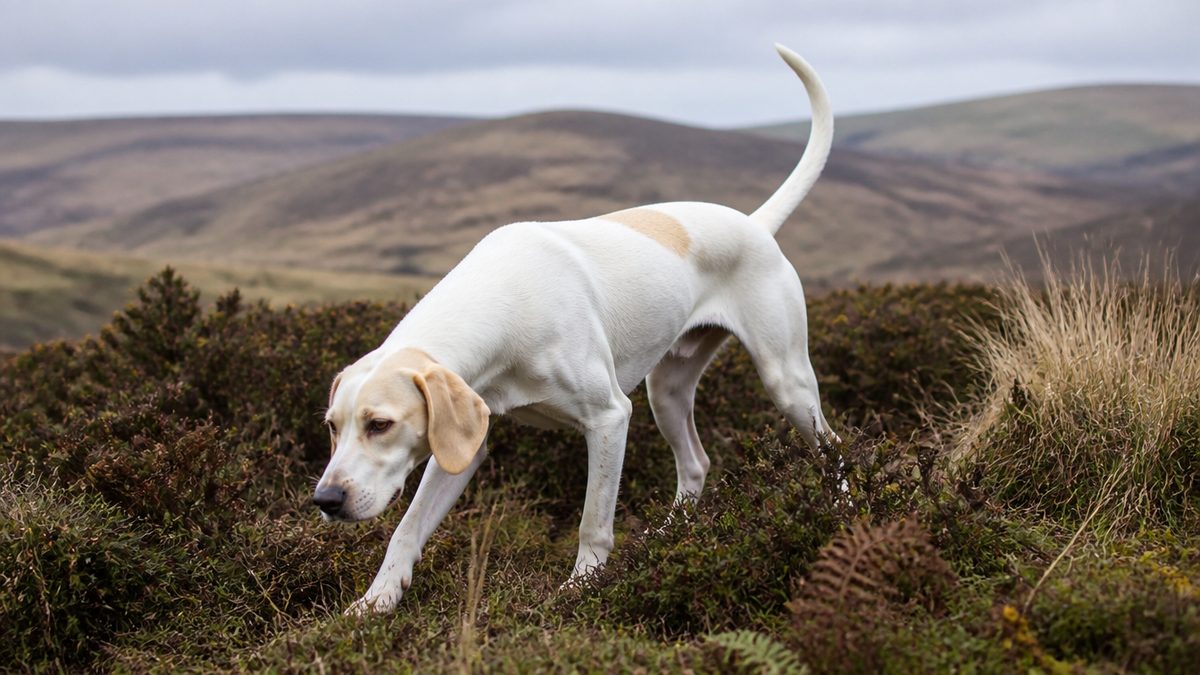
A West Country Harrier is bigger and lighter in colour than a Stud Book Harrier, predominantly white with cream, lemon or yellow markings usually concentrated on the head, and it is shown with no height restriction. The colour is the identifying feature and, as the health section shows, it is also the clinical one.
The Field describes the type directly: 'West Country hounds tend to be bigger and lighter in colouring, usually predominately white with cream and lemon markings on the head', in contrast with East Anglian packs that 'favour hounds that look more like scaled-down foxhounds'. Wikipedia's infobox gives the colour as 'Predominantly white with cream or yellow markings' and the coat as short.
| Attribute | West Country Harrier | Stud Book Harrier | Source |
|---|---|---|---|
| Height limit in classes | None at all | 22 inches dogs, 21 inches bitches | The Field, 2020 |
| Colour | Predominantly white, cream or lemon markings, usually on the head | Conventional hound markings, more foxhound-like | The Field and Wikipedia |
| Size | Bigger | Smaller | The Field |
| Speed and drive | Said to lack some of the Stud Book Harrier's | More | Wikipedia, reporting the claim |
| Scenting and voice | Claimed superior scenting and more appealing voices | Less claimed | Wikipedia, reporting the claim |
| Studbook | Yes, a separate one within the AMHB Stud Book | Yes, the AMHB Stud Book | AMHB and Wikipedia |
| Kennel club standard | None anywhere | The Kennel Club holds a harrier standard | RKC, AKC and FCI indexes |
The height point is the one that decides the breed test
A hound standard turns on height more than on anything else, because height is what separates a beagle from a harrier from a foxhound. The AMHB puts beagles at 14 to 16 inches and harriers at up to 21 inches. When The Field records that West Country classes have no height restriction, it is recording that this variety is judged outside the single measurable a standard would exist to fix. Bryden's Quarme hounds were eighteen and a half inches in 1903; nothing constrains their descendants today.
What Caius said a harrier looks like, in 1576
The anatomy has been stable for four and a half centuries. Caius defines the category by 'their long, large, and bagging lippes, by their hanging eares, reachyng downe both sydes of their chappes, and by the indifferent and measurable proportion of their making'. Long loose lips, long drop ears and moderate build. Youatt in 1845 adds 'the long body, deep chest, large bones, somewhat heavy head, sweeping ears, and mellow voice'.
Predominantly white means predominantly unpigmented, and the one veterinary paper that exists on harrier hounds describes photosensitivity confined to unpigmented skin. In a country with India's UV load that is the single most important sentence on this page, and it is covered properly in the health section.
Registry recognition: none for the variety, a standard for its parent
No kennel club anywhere recognises the West Country Harrier separately, and three of them recognise the parent Harrier. Each absence below was checked with controls inside the same document so a failed fetch could not be mistaken for a finding.
| Register | West Country Harrier | Harrier | In-document controls that returned |
|---|---|---|---|
| Royal Kennel Club, Breeds A to Z | Zero hits for 'west country' | Present, Hound group, with a breed standard | Labrador 1, Beagle 1, Foxhound 1, Bloodhound 3, Otterhound 1, Greyhound 2, Corgi 2, Terrier 62 |
| American Kennel Club, breeds index | Zero hits for 'west country' | Present, 2 hits | Labrador 2, Beagle 2, Foxhound 6, Bloodhound 2, Otterhound 2, Greyhound 7, Terrier 93 |
| FCI letter H index | Not present | Present, 1 hit | The index rendered with its rows intact |
| FCI provisional register | Not among the twenty entries | Not applicable | The list rendered with its twenty rows intact |
| AMHB Stud Book | PRESENT, in a separate studbook | Present | The AMHB's own statement of its two harrier breeds |
The parent breed is the control, and that is what makes this absence readable
This is an unusually clean absence to establish, because the parent Harrier is present in every register in the table American Kennel Club Federation Cynologique Internationale. A search string that finds 'harrier' and does not find 'west country' in the same document is not a broken search. That is a stronger form of control than this site normally gets, and it is worth naming.
A contradiction on the Royal Kennel Club's own page, and how to read it
The Royal Kennel Club's Harrier record prints 'Vulnerable native breed: No' while the same page states that 'The last century has seen a huge fall in the number of Harrier packs' and that the breed is 'still rare as family companions'. This site has recorded the same field being unreliable on other breeds, and the correct handling is not to treat the per-breed field as authoritative but to read the club's own vulnerable-breeds table instead, which is the document it actually maintains. The field is recorded here as observed, without being relied on either way.
The India position, answered properly
India's recognition position follows the FCI's. The FCI members register lists India as a full member represented by the Kennel Club of India in Chennai, so the KCI issues pedigrees against FCI nomenclature. The FCI holds the Harrier and does not hold this variety, so no KCI pedigree route exists for a West Country Harrier Federation Cynologique Internationale. Note that the KCI publishes no breed list of its own, so querying it directly returns zero for every breed and is a broken instrument rather than a finding.
Nothing was overlooked here. The people who keep these hounds have a studbook, a governing body and a show circuit of their own, and have not sought kennel club recognition. Treating that as a deficiency misreads what the AMHB system is for.
West Country Harrier price in India: there is none, and no harrier appears on any Indian list
No West Country Harrier has an Indian price, and neither does any other harrier. Two large Indian price lists covering more than fifty breeds between them carry no harrier of any kind, which is a cleaner absence than this site usually finds.
PawSpace's Dog Price in India list covers forty breeds including four Indian sighthounds and the Indian pariah dog, and no harrier. Wrapinfur's list covers more than fifty breeds and carries no harrier either. That is not a search failure: both lists were read from raw markup and both carry the Beagle, which is the breed a harrier is most often mistaken for.
| Result | What it is | What a buyer should conclude |
|---|---|---|
| Wikipedia, position 1 | The article, correctly stating no kennel club recognises it | Accurate. Read it |
| The Field | 'The not-so-rare harrier breed', British field-sports journalism | The best modern source, and it explains the height rule |
| Horse & Hound | Harrier breed facts and history | British, working-hound framing |
| National Purebred Dog Day | 'Stud Book Harrier and the West Country Harrier' | Correctly separates the two types |
| harrierclub.co.uk | The only club preserving both types, with litter enquiry forms | The one place actually placing puppies, and it is in England |
| Indian commercial results | None at all on page one | There is no Indian market for this dog |
The absence of an Indian scam is itself the finding
Most obscure breed names on this site attract Indian listing shells, generic price carousels and auto-generated local directory pages. This one attracts none. The entire Indian result set is British field-sports publishing, which tells you the term has no commercial traction in India at all, and that is a more useful answer for a buyer than any invented price band would be.
There is also no lawful route. Dogs enter India under ITC(HS) 01061900, classified Restricted, and DGFT Trade Notice 22/2022-23 states that applications for trading or breeding purposes shall be duly rejected, with entry limited to six ports. DAHD added a seventh port, Cochin International Airport at Kochi, for pets arriving under the baggage rules in October 2024. No import authorisation exists for bringing in a pack hound to breed from. The full route is set out in how to import a dog to India.
Bonbeno reports published price ranges as editorial content. For this variety there is nothing Indian to report. Where a figure appears below it belongs to a living breed an Indian buyer can actually reach, and is attributed to the Indian page it was read from.
What the reachable alternatives cost in India, and where the sources disagree
The Beagle is the dog an Indian buyer reaches when they want a scent hound, and two Indian price lists read on the same day disagree about its ceiling by Rs 50,000. Publishing that spread is more useful than averaging it.
| Breed | PawSpace | Wrapinfur | Note |
|---|---|---|---|
| West Country Harrier | Not listed | Not listed | No harrier of any kind appears on either list |
| Beagle | Rs 25,000 to Rs 90,000+ | Rs 15,000 to Rs 40,000 | A Rs 50,000 disagreement on the ceiling, same day |
| Labrador Retriever | Rs 20,000 to Rs 70,000 | Not compared here | The reference point most Indian buyers already hold |
| Rajapalayam | Rs 8,000 to Rs 30,000 | Not compared here | An Indian hound, heat-adapted, at a third of the Beagle ceiling |
| Mudhol Hound | Rs 8,000 to Rs 30,000 | Not compared here | Same band |
| Chippiparai | Rs 8,000 to Rs 30,000 | Not compared here | Same band |
| Kanni | Rs 8,000 to Rs 30,000 | Not compared here | Same band. Four Indian breeds sharing one band is a template signature, not four observations |
| Indian pariah dog | Rs 0 to Rs 5,000 | Not compared here | Free from a shelter this week, in every city named on this page |
These are rupee-native prices, and the negative result matters
Every distinct rupee figure between Rs 1,000 and Rs 5,00,000 in the raw markup of both lists was tested against 84.38, 80.00 and 74.00. Not one divides cleanly at 84.38 and not one at 74.00. The apparent matches are all at 80.00, which proves nothing, because 1,000 divided by 80 is 12.5 and any figure ending in three zeros therefore divides cleanly at that rate by construction, producing quotients like 15, 25 and 125 that no seller would print for a dog. This project has repeatedly caught Indian breed pages publishing a converted American price list. These two are not, and saying so is as much a duty as reporting the positive cases.
What the four identical Indian bands actually tell you
Four Indian sighthounds share an identical Rs 8,000 to Rs 30,000 band on one list. Identical bands across several breeds are a template signature rather than four independent observations, and this project has documented Indian sites assembling rows from a small set of presets. Treat that band as one data point about how the site prices Indian breeds, not as four, and check a local breeder or a rescue before acting on it.
A published range tells you what a category costs, not what a specific dog is worth. What decides value on a hound is whether the seller will show you the parents, the date of birth and a health record. All three are free to ask for and none of them appears in any table on this page.
Monthly cost of ownership in India for a medium scent hound
Budget roughly Rs 6,000 to Rs 12,000 a month for a medium scent hound in an Indian metro, built from named line items rather than lifted as a single total. For a predominantly white dog, add sun protection to the list, which no Indian breed page carries.
| Line | Figure | Source and caveat |
|---|---|---|
| Tick, flea and worm cover | About Rs 1,103 a month | NexGard Spectra for 15 to 30 kg, 3 tablets at Rs 3,308 against an MRP of Rs 3,375. Covers the tick and flea role and the roundworm and hookworm role in one tablet |
| Separate deworming, if used instead | Rs 125.67 a tablet, one per 10 kg | Drontal Plus, 6 tablets at Rs 754 against an MRP of Rs 838 |
| Vaccination, spread monthly | Rs 699 anti-rabies, Rs 899 for the 9-in-1 DHPPiL | Vetic's national page, one chain's promotional floors. The same chain quotes different course prices on different city pages on the same day |
| Grooming | Rs 934 bathing, Rs 99 add-ons | Vetic Delhi list. A short-coated hound needs the low end, and the Rs 1,359 haircut line does not apply at all |
| Sun protection | Not a standard line, and it should be | A predominantly white dog in India needs shade management and, on the nose and ear tips, a veterinary-approved sunscreen. Discuss the product with your vet rather than using a human one |
| Municipal registration | Rs 500 in Delhi, Rs 50 in Chennai | Delhi MCD charges Rs 500 new and Rs 500 renewal with a Rs 100 a month late fee. Greater Chennai Corporation licences a pet animal at Rs 50 |
| Food | Not quoted here | No current Indian retail figure was re-priced for this page, and a stale food price is worse than none |
The line Indian buyers underestimate, and the line nobody has
Parasite cover is the underestimated one. A drop-eared hound working nose-down in Indian undergrowth collects ticks, and the Indian tick-borne disease burden measured in clinic caseloads is large enough that monthly cover is a fixed line rather than a seasonal one Tick-borne pathogen survey of 584 dogs….
Sun protection is the line nobody has. It appears on no Indian breed page this project has read, and for a predominantly white hound it belongs in the monthly budget alongside the parasite cover. The reason is in the next section but one, and it is the best-evidenced India-specific finding on this page.
The municipal line is small and almost universally skipped. Delhi's Municipal Corporation's live counter read 18,958 pet dog certificates issued since 2021 on 9 September 2026, and 19,022 on 17 September, and Greater Chennai Corporation issued 9,115 licences in 2024 and runs six municipal pet clinics providing treatment and anti-rabies vaccination free of cost. That last item is the best-value line available to an Indian dog owner anywhere in this table.
This project has repeatedly found Indian breed sites publishing identical monthly totals across unrelated breeds, because the totals are the sum of a few preset lines rather than a costing of any actual animal. A figure assembled from named, separately sourced components can be checked line by line. A round total cannot.
Could a West Country Harrier handle the Indian climate? The heat tolerance answer
No, and the gap is about 12 to 20 degrees depending on the city. Exeter and Taunton, the two ends of this hound's country, average 10.92 C and 10.28 C across the year with warmest months of 16.20 C and 16.39 C. Chennai's coolest month averages 24.09 C.
The homeland figures come from NASA POWER points queried by explicit coordinates, with the grid-cell elevation echoed back and checked against the real town elevation. Exeter returns a cell at 94.05 m against a real elevation near 30 m, an error of about 64 m. Taunton returns 112.83 m against about 20 m, an error of about 93 m. Both errors are in the same direction and both are modest by the standards of this project, which has measured hill-station cells wrong by more than a kilometre.
One methodological point is worth making because it is a positive result. Exeter and Taunton return different cells, 94.05 m and 112.83 m. That matters because this project has repeatedly found pairs of nearby towns resolving to a single grid cell and returning byte-identical series, which cannot be used to corroborate each other. These two can be, and they agree closely, which is genuine cross-confirmation rather than the same reading twice.
| Place | Annual mean T2M | Hottest month | Coolest month | Annual RH |
|---|---|---|---|---|
| Exeter, Devon | 10.92 C | July, 16.20 C | February, 6.08 C | 87.13 percent |
| Taunton, Somerset | 10.28 C | July, 16.39 C | February, 4.88 C | 87.46 percent |
| Chennai | 27.95 C | May, 31.51 C | January, 24.09 C | 72.39 percent |
| Mumbai | 26.77 C | May, 31.19 C | January, 23.19 C | 67.39 percent |
| Kolkata | 25.81 C | May, 31.53 C | January, 17.31 C | 73.93 percent |
| Delhi | 25.60 C | June, 35.88 C | January, 13.61 C | 45.56 percent |
| Hyderabad | 26.10 C | May, 33.30 C | December, 20.76 C | 60.30 percent |
| Pune | 23.86 C | April, 28.93 C | December, 19.62 C | 66.80 percent |
| Bengaluru | 23.74 C | April, 28.37 C | December, 20.22 C | 67.94 percent |
Three of those hottest-month cells surprise people
Delhi peaks in June rather than May, at 35.88 C. Bengaluru and Pune both peak in April, and both are coolest in December rather than January. Chennai, Mumbai and Kolkata genuinely do peak in May. Those distinctions matter for scheduling a working hound's outings and they are wrong on a large number of Indian breed pages, which blanket-apply May to every city.
What the gap means for a working hound
Delhi's hottest month is 19.5 degrees above Taunton's. Even Bengaluru, the most forgiving city in the table, is 12 degrees above it. A hound bred for two to three hour hunts on Exmoor is a sustained-exertion animal, and sustained exertion is the specific thing that produces heat collapse. The Royal Kennel Club's own care guidance for the parent breed asks for 'More than 2 hours per day' of exercise, which is a British recommendation and is not directly transferable to an Indian summer afternoon.
Nobody has measured this variety's heat tolerance. The trait rating of 1 is derived from origin climate, from the working profile the sources describe, and from the unpigmented coat, and it is stated as an inference rather than as data. What is not an inference is the photosensitivity finding in the health section, which is measured and published.
Humidity, wet bulb, and why the damp-air argument is the wrong one
Devon and Somerset run about 87 percent annual relative humidity, higher than every Indian city in this comparison. So humidity by itself is not what would hurt this hound in India. What hurts it is heat, or heat combined with humidity, measured as wet-bulb load.
This correction matters because damp air is the argument most breed pages reach for when a British dog meets a tropical country. Exeter returns 87.13 percent annual relative humidity and Taunton 87.46 percent, against Chennai's 72.39, Kolkata's 73.93, Mumbai's 67.39 and Delhi's 45.56 NASA POWER climatology 2001-2020…. A hound bred on Exmoor is thoroughly adapted to wet air. It is not adapted to wet air at 31 degrees.
| Place | Peak wet-bulb month | Peak wet-bulb | Gap from the homeland |
|---|---|---|---|
| Exeter, Devon | August | 14.38 C | The baseline |
| Taunton, Somerset | July | 14.23 C | The second homeland point, agreeing closely |
| Bengaluru | May | 21.86 C | +7.5 C, and this is the best Indian case |
| Pune | June | 22.97 C | +8.6 C |
| Hyderabad | June | 23.35 C | +9.0 C |
| Mumbai | June | 25.77 C | +11.4 C |
| Chennai | May | 26.11 C | +11.7 C |
| Delhi | July | 26.50 C | +12.1 C |
| Kolkata | June | 27.09 C | +12.7 C, the highest in this comparison |
How to read a wet-bulb figure without overstating it
Wet bulb has a hard physical sanity check, which is why it is used here. Readings above about 35 C sit at the outer edge of anything ever observed on earth, so a table topping out at 27.09 C is inside the plausible range. Every figure was computed from the mean temperature and mean relative humidity, never from a period maximum, because a period maximum is an extreme rather than an average and feeding one into a wet-bulb calculation produces impossible numbers.
The practical translation is that a scent hound working in Kolkata in June has very little evaporative margin, and that a long low-intensity working session, which is exactly what this breed was built for, uses that margin up slowly and without obvious warning. That is a worse risk profile for a scent hound than for a sighthound, because a sighthound sprints and stops while a scent hound keeps going.
Bengaluru's 21.86 C peak wet bulb is the most forgiving in the table and it is still 7.5 degrees above the West Country baseline. A reader planning to keep any pack-bred scent hound in India should read that as the best case rather than as permission.
Temperament: bred for a pack, and that is the whole problem in a flat
A West Country Harrier is a pack animal in the literal sense: it has lived its whole life with twenty or more other hounds and has been selected for centuries on how well it works with them. That makes it sociable with dogs, easy with people, and genuinely poor at being alone.
The AMHB lists biddability as one of the six qualities of a working hound, and defines it precisely: 'their willingness to work and live as a member of a pack in and out of kennels'. That is not obedience to a person. It is tolerance of other dogs at close quarters, day and night, and it is the trait the whole system selects for.
What transfers to a home, and what does not
- Sociability with dogs transfers completely. A hound raised in a pack is about as dog-tolerant as a dog gets, which is genuinely useful in Indian apartment buildings and parks.
- Friendliness with people transfers. The Royal Kennel Club describes the parent breed as 'affectionate and smart', and pack hounds are handled by many different people from puppyhood.
- Tolerance of solitude does not transfer at all. A dog that has never been alone in its life does not learn to be alone at eighteen months in a flat in Gurgaon. This is the single largest welfare risk in the whole page.
- Recall does not transfer. A pack hound follows the pack and the line, not a person calling.
Voice, which was selected for and is a neighbour problem
Voice is on the AMHB's list of working qualities, and Wikipedia records the claim that West Country hounds have 'more appealing voices' than the Stud Book type. Appealing at half a mile across Exmoor and appealing through a shared wall in Mumbai are different propositions. Youatt's 'mellow voice' was a design feature, and it is not going to be trained out.
No temperament survey of this variety exists and no aggregate scores can honestly be given. Everything above is inference from the working system the AMHB describes and from the parent breed's published care guidance, and it is labelled as inference. A profile site printing a friendliness score out of five for this hound generated it.
Training a pack-bred hound: what actually works, and what will not
To train a pack-bred scent hound, give the nose a job you choose and manage the environment rather than escalating the commands. The AMHB's own list of working qualities includes steadiness, defined as 'their ability to stick to the line of the scent', which is precisely the trait that makes recall hard.
The system these hounds come from trains for one job to a very high standard. Steadiness on a line, biddability within a pack and response to a horn are what a huntsman installs. None of that is general household obedience, and expecting it produces frustration on both sides.
The five things that work on this kind of hound in India
- Start before the heat. Train at 6 to 8 in the morning and after dusk. Of the 879 UK heat-related illness events with a recorded trigger, 652 were exertional, which is 74.2 percent, and a training session is an exertion.
- Pay with food, every time. A scent hound works for its own reasons and food is the only currency that reliably competes with a smell.
- Use a long line rather than a better cue. Fifteen metres of line makes an uncontrollable dog controllable, and costs less than one grooming session.
- Teach being alone deliberately and early. This is the specific work a pack-bred hound needs and almost never gets. Start with seconds, not hours, and build it before it becomes a problem.
- Wait for eight weeks. Rule 8(1)(a) of the 2017 Rules requires that pups less than eight weeks in age are not sold, so a lawfully obtained puppy starts here.
What this breed resists
It resists being called off a line and it resists being left. The first was selected for over centuries and the second is an artefact of how these hounds are raised. An owner who understands both stops treating either as disobedience and starts building the environment around them, which is kinder and much more effective.
Ask how many hounds were in the kennel and how the puppy was raised. A genuinely pack-raised hound has never been alone, and a seller who does not know that is not close enough to the litter to be worth buying from.
Exercise: two to three hours of hunting, and what that becomes in an Indian city
The parent breed's published requirement is more than two hours a day, and the working profile behind it is a two to three hour hunt over moorland. In India that becomes two real outings at either end of the day plus deliberate indoor scent work, and the middle of the day indoors.
The Royal Kennel Club gives the parent breed's exercise need as 'More than 2 hours per day', its home size as 'Large house', its garden as 'Large garden' and its setting as 'Country'. That is a registry saying plainly that this is not a flat dog, in a British climate, before India is even considered.
Why timing matters more than distance in India
Heat-related illness in dogs is overwhelmingly exertional rather than environmental: 652 of the 879 UK events with a recorded trigger, against 113 environmental and 46 from vehicular confinement. That is a British cohort in a British climate, so read it as a floor rather than an estimate for India. The dog is not at risk because it is outside. It is at risk because it is working.
Bodyweight compounds it. Bodyweight at or above the breed and sex mean carried odds of 1.42, with a confidence interval of 1.12 to 1.80. A harrier is nowhere near the over-50 kg band, but the first finding applies directly: the exercise a household skips in April is paid for in May, through a heavier dog with a worse thermal margin.
| Slot | What it is | Why |
|---|---|---|
| 5:30 to 7:00 | Main walk, 40 to 60 minutes, sniffing allowed and encouraged | Coolest ground temperature of the day, and the shade is longest |
| Mid-morning | Ten minutes of find-it or scatter feeding indoors | Spends drive at no thermal cost and no sun exposure |
| Middle of the day | Indoors, out of direct sun, water always available | Both the heat window and the UV window, which matters more for a white dog |
| After dusk | Second walk, 25 to 35 minutes | Air has cooled, but check the pavement first |
| Weekly | One longer outing in a fenced space, on a long line | Replaces the hunting the breed was built for |
Put the back of your hand on the pavement and hold it there for five seconds. If you cannot, the dog cannot stand on it. Indian tarmac holds heat for hours after the air has cooled, and paw burns are the commonest avoidable summer injury in a city dog.
Grooming: the easiest coat on this site, and the ears that decide it
Groom a short-coated drop-eared hound by ignoring the coat and attending to the ears. The Royal Kennel Club puts the parent breed's grooming at once a week, and a rubber mitt does the whole job. Everything that matters is the ear canal and, for a white dog, the skin underneath.
The coat is genuinely trivial. The Royal Kennel Club gives coat length Short, Grooming 'Once a week', and Sheds Yes. Wikipedia gives the coat as short. There is no haircut, no stripping and no clipping, which is why the Rs 1,359 haircut line on an Indian grooming list simply does not apply to this dog.
The three things that actually matter, in order
- Check and dry the ears. Caius's 'hanging eares, reachyng downe both sydes of their chappes' is the exact anatomy that stops air reaching the canal, and in Indian humidity a canal that does not dry gets infected. Check every three days and dry after every wetting.
- Inspect the unpigmented skin weekly. Nose, ear tips, eyelids, belly and groin. On a predominantly white hound this is most of the dog, and it is where the one published health finding for this breed lives.
- Brush weekly and no more. A rubber mitt once a week removes the loose coat. Over-bathing a short-coated hound in India strips the skin's oils and makes the sun problem worse.
The Indian cost is small. Vetic's Delhi list gives bathing from Rs 934 and add-ons from Rs 99. A short-coated hound is one of the cheapest dogs in India to keep clean, and essentially all of that budget should go on ears rather than on coat.
This is also the point at which overseas breed-club care advice stops transferring. Guidance written for a British autumn routinely says to towel a hound and let it air dry, which is fine at 16 degrees in Taunton and wrong in Kochi in August. Dry actively, with a towel and then a cool-setting dryer or a fan, and pay particular attention to the ear folds.
Ear disease in a drop-eared hound can be bacterial, yeast, mite or foreign body, and the treatments differ. Over-the-counter drops used on the wrong cause make the next problem harder to treat. Consult a registered veterinarian near you rather than acting on anything on this page.
Health issues and life expectancy: one paper exists, and it is about white skin in the sun
The entire canine literature for harrier hounds is one paper, and it describes photosensitivity confined to unpigmented skin in twelve of thirty hounds in a single kennel. For a predominantly white breed in a country with India's UV load, that is the most directly useful health finding on this page.
The literature audit is controlled and it is worth setting out, because the way it fails is instructive. The exact-phrase query returns zero with PubMed's quotedphrasesnotfound warning, so unquoted forms were retried as this project's rules require. '"Harrier"[tiab]' returns 190 with a clean translation line, and reading the titles shows three separate homonyms rather than a dog literature: the bird, as in 'Detour migration to circumvent the Himalayas in the Montagu's Harrier Circus pygargus'; a clinical trial acronym, because HARRIER is one of the two pivotal brolucizumab trials in ophthalmology; and incidental uses. Narrowing to 'harrier[tiab] AND dog[tiab]' returns 9, of which exactly one is genuinely about this dog.
The one paper, and why it matters more in India than in Devon
Fairley and MacKenzie reported photosensitivity in a kennel of harrier hounds in Veterinary Dermatology in 1994. Twelve of thirty hounds developed skin disease. Both sexes were affected and the lesions were confined to unpigmented skin, principally the face, limbs and inguinal region. Affected skin was first erythematous, oedematous and moist; brown crusts then formed, and in the most severely affected dogs the skin sloughed to leave a dry brown crust matted in the hair with malodorous purulent exudate beneath.
| Finding | Figure or detail | Why it matters in India |
|---|---|---|
| Dogs affected | 12 of 30 in one kennel | 40 percent of a single kennel, in Britain |
| Sex distribution | Both males and females | Not a sex-linked problem |
| Lesion distribution | Confined to unpigmented skin: face, limbs, inguinal region | A predominantly white hound is mostly unpigmented skin |
| Progression | Erythema and oedema, then brown crusts, then sloughing in severe cases | Recognisable early if an owner is looking |
| Outcome | No dogs died. Most had normal skin within three months | Treatable, and not a reason for panic |
| Treatment | Mild cases recovered untreated; severe cases needed antibiotics and crust removal | Secondary infection is the part that needs a vet |
| Cause | Compatible with photosensitivity, but the causal agent could not be identified | The honest limit. Photosensitivity is not always simple sunburn |
How to read that paper without overstating it
This is one kennel, thirty dogs, in 1994, and the authors could not identify the causal agent. Photosensitivity in dogs can be primary, from a photodynamic substance the animal has eaten or contacted, or secondary to liver disease, and it is not the same thing as ordinary sunburn. So the correct statement is that harrier hounds have one published skin finding, that it was confined to unpigmented skin, and that a white dog in strong sunlight is the population in which it was seen. It is not a breed-wide prevalence figure and this page does not present it as one.
The screening data that DOES exist, and it was nearly missed
The Harrier has real hip screening data and it is good. The Orthopedic Foundation for Animals publishes 416 hip evaluations for the breed, at 84.4 percent normal and 14.7 percent dysplastic, ranking 88th. That is materially better than every other scent hound in the comparison, and it is the single most reassuring number on this page.
It was nearly missed, and the reason is worth recording. OFA's statistics load through JavaScript, so a plain fetch returns only a shell, and the page prints the string 'Searching Database, Please wait.' even when the tables are present. Reading that string as a failure is how a page ends up saying no screening data exists when 416 evaluations are sitting behind it. The figures here were read from the rendered dump, matched on the printed breed label and on the preceding disease marker row, with the hip table's own header read rather than assumed, and every row checked so that excellent plus good plus fair reproduces the printed normal figure.
| Breed | Rank | Evaluations | Normal | Dysplastic |
|---|---|---|---|---|
| Otterhound | 11 | 649 | 49.9 percent | 47.1 percent |
| Basset Hound | 14 | 286 | 57.7 percent | 39.5 percent |
| Bloodhound | 28 | 3,752 | 71.4 percent | 26.4 percent |
| Beagle | 61 | 1,783 | 79.2 percent | 18.6 percent |
| Harrier | 88 | 416 | 84.4 percent | 14.7 percent |
| Labrador Retriever, as a familiar reference | 121 | 324,934 | 87.5 percent | 11.3 percent |
| English Foxhound | No row | No row | n/a | n/a |
A working population that has never been bred for the show ring, screened at 416 dogs and coming back at 14.7 percent dysplastic against the Beagle's 18.6 and the Bloodhound's 26.4, is a result worth stating plainly. It does not prove that pack breeding is better than kennel-club breeding, because the dogs screened are self-selected by owners who chose to screen. But it is the opposite of what a reader would assume about an unrecognised breed with no written standard.
OFA's eye summary reports 97.7 percent normal of 86 evaluations, while its own detail rows report NORMAL as 73 of 86, which is 84.9 percent, a gap of 12.8 percentage points. The named findings underneath include keratoconjunctivitis sicca in 1 dog, corneal dystrophy in 2 and cataract of unknown significance in 3. This project has recorded the same contradiction on more than a dozen breeds, so it is a property of the tables rather than a finding about the Harrier, and neither figure should be quoted as 'the' rate.
Life expectancy, and why there is no median for this breed
McMillan and colleagues' 2024 study carries no Harrier row in its survival table, and Table S5 explains why: the Harrier is listed with 'Included in Survival Analysis' = N. So the correct statement is that the breed was in the study's breed list and was excluded from the survival analysis, not that it is absent from the study. The Royal Kennel Club gives the parent breed's lifespan as 'Over 12 years', which is a care-guidance figure rather than a study result. For comparison, the Beagle's measured median is 12.5 years on 1,552 deaths and the English Foxhound's is 13.0 years on 31.
There is a structural reason these hounds do not appear in companion-dog datasets, and it is worth naming. VetCompass samples dogs under primary veterinary care. Pack hounds are kennel-managed, attended by a hunt's own veterinary arrangements, and are typically not registered with a first-opinion practice. Their absence from a companion-animal dataset is a sampling fact rather than evidence about the dogs.
Every figure above comes from one 1994 case series and one British population study. Neither says anything about an individual dog and neither is a diagnosis. Consult a registered veterinarian near you before acting on anything here, and treat reddened or weeping skin on a white dog's face, ears or belly as a reason to call a clinic rather than to buy a cream.
The two Indian risks: ultraviolet light and tick-borne disease
A predominantly white scent hound in India faces two risks that no British source will price correctly. One is sunlight on unpigmented skin, which the breed's only published paper describes. The other is tick-borne disease, which Indian clinic surveys report at very high rates.
Sunlight, which is where this page earns its keep
India's ultraviolet load is far above Devon's, and the breed is mostly white. Put the one published harrier health finding next to the one published breed colour description and the conclusion is immediate: a dog whose lesions appear on unpigmented skin, in a country whose sun is much stronger than the one the breed developed in The Field, 'The not-so-rare harrier breed'. The practical measures are ordinary and cheap.
- Keep the dog out of direct sun between about 10am and 4pm. This is the same window as the heat advice, which makes it easy to follow.
- Watch the thin-haired unpigmented sites. Nose, ear tips, eyelids, belly and groin, which are the areas the 1994 series names.
- Ask your vet about a veterinary sunscreen for the nose and ear tips. Do not use a human product without asking, because dogs lick.
- Treat new redness or weeping as a reason to call a clinic, not to wait. In the published series the severe cases needed antibiotics and crust removal, and the mild ones did not.
Tick-borne disease, with the denominators stated correctly
A survey of 584 dogs in West Bengal found Babesia gibsoni in 76.54 percent of the 584 dogs screened (447 of 584) and Anaplasma in 55.75 percent (325 of the 583 tested for it), with 72.9 percent of the dogs carrying two or more pathogens. A Kerala survey of 120 dogs found Babesia in 80 of the 120 screened, which is 66.7 percent, and Ehrlichia canis in 5.0 percent, with a pre-monsoon March to May peak.
Both studies sampled dogs presenting at veterinary clinics rather than a random population, so they describe the burden among dogs tested at clinics and not a national prevalence. Writing '76.54 percent of Indian dogs' would be materially misleading. Writing '76.54 percent of 584 dogs screened at clinics in West Bengal' is what the papers support, and it is still a large number.
The routine costs about Rs 1,103 a month at the 15 to 30 kg size. NexGard Spectra covers the tick and flea role and the roundworm and hookworm role in one tablet at Supertails' listed price of Rs 3,308 for three, and Drontal Plus is the separate deworming route at Rs 125.67 a tablet, one per 10 kg. Add a physical check after every walk in grass, concentrating on the ear folds, between the toes and under the collar.
Pale gums, dark or coffee-coloured urine, a fever that comes and goes, or sudden lethargy after a tick season send a dog to a clinic the same day. Babesiosis and ehrlichiosis are treatable and both get worse quickly. Consult a registered veterinarian near you rather than acting on any figure on this page.
Feeding a working-bred scent hound in India
Feed a working-bred scent hound measured meals twice a day and keep it lean, because a hound bred to run for two hours and now walking for one will put on weight quickly. Body condition, not the number on the pack, is the instrument.
Pack hounds are fed as a group on a working ration and no published per-dog Indian figure exists for this variety. What is worth saying is that the working energy budget behind the breed is large, Bryden's packs hunting two days a week over Exmoor, and that none of it transfers to a dog in a Hyderabad flat.
The three rules
- Measure every meal. A scent hound's appetite is not a guide to its needs, and a hound that is allowed to free-feed will eat whatever it can reach.
- Split the ration across two meals. Morning and evening, matching the two walk slots, so the dog is not working on a full stomach.
- Check the ribs weekly. You want to feel them easily under a thin cover without seeing them. Ten seconds, and worth more than any feeding chart.
Weight control is the intervention with the clearest evidence behind it on this page. Bodyweight at or above the breed and sex mean carried odds of 1.42 for heat-related illness in the 905,543-dog cohort, with a confidence interval of 1.12 to 1.80. In an Indian climate that is not a cosmetic finding. A lean hound has a thermal margin and a heavy one does not.
What it costs, and why no monthly food figure appears here
This page quotes no monthly food figure, deliberately. Indian retail food prices move within weeks, this project has already caught one large-bag price going stale within days of being recorded, and a stale figure presented confidently is worse than an acknowledged gap. Build your own from the food you can actually buy in your city, at the grams per day the pack specifies for your dog's weight, and re-check it every few months.
A nose-led hound in an Indian street will eat what it finds, and what it finds includes bones, packaging and poisoned bait laid for rodents. There is a second reason to care here: photosensitivity can be triggered by ingested photodynamic substances, and the 1994 harrier series could not identify its causal agent. Controlling what the dog eats off the ground is not only a gut question.
The first year month by month, for a scent hound puppy in India
This timeline describes a Beagle or harrier-type puppy in an Indian city, because no West Country Harrier is obtainable in India and the reader arriving here needs the reachable version. The one breed-specific addition is sun management from the start.
The legal start point is eight weeks. Rule 8(1)(a) of the 2017 Rules requires that pups less than eight weeks in age are not sold, so month two is where a lawfully obtained puppy joins the household.
| Age | What happens | The Indian constraint |
|---|---|---|
| 8 to 10 weeks | Puppy legally leaves the breeder. Core vaccination course begins | Anti-rabies Rs 699 and the 9-in-1 DHPPiL Rs 899 at one national chain's listed floors. Chennai's six municipal clinics give treatment and anti-rabies free |
| 10 to 16 weeks | Socialisation window, and the first alone-time training | Do the outings at 7am and after dusk. A white puppy should not be in midday sun at all |
| 4 to 6 months | Lead manners, name response, the beginning of recall. Deworming continues | Drontal Plus at Rs 125.67 a tablet, one per 10 kg. Start monthly tick and flea cover before the first monsoon |
| 6 to 9 months | Adolescence. The nose switches on and recall appears to break | It has not broken, the drive has arrived. Long line, not louder commands |
| 9 to 12 months | Switch toward adult food. Full working nose and full voice | The first full Indian summer, and the first summer of adult sun exposure on unpigmented skin |
| 12 months | Municipal registration and the first annual booster | Delhi MCD registration Rs 500 with a Rs 100 a month late fee. Greater Chennai Corporation licences a pet at Rs 50 |
The training job nobody schedules
Teaching a scent hound to be alone belongs in months two to four and almost never gets done. A pack-bred hound has never been alone; a pet-bred one from a large litter has rarely been. Start with seconds, build to minutes, and do it while the puppy is still small enough that a mistake is not expensive. This is the single highest-value habit on the whole timeline for an Indian apartment household.
None of it is a West Country Harrier timeline. No growth data, no litter records and no published puppy account exist for the variety, because it is a pack hound maintained by a governing body rather than a pet breed studied by anyone. This page prints a reachable hound's timeline and labels it as one.
Indian law, and the British law that shapes this breed's present
Two bodies of law matter here. British hunting law changed what these packs do, and Indian import and breeding law closes the route for an Indian buyer entirely.
The British side, because it explains the breed's current position
The Hunting Act 2004 changed what harrier packs can lawfully do in England and Wales, and the AMHB records its own position that 'Despite the Hunting Act 2004, the Association and its members would like to maintain their commitment and amend the flawed legislation and to promote the management, welfare and conservation of the hare'. This page takes no view on that debate. What matters for a reader is the consequence: packs continue, hounds continue to be bred and entered in the stud book, and a club has begun placing hounds of both harrier types into private homes.
The Indian side: no import authorisation exists for this purpose
Dogs enter India under ITC(HS) 01061900, classified Restricted. DGFT Trade Notice 22/2022-23 states that applications for trading or breeding purposes shall be duly rejected, and limits entry to six ports at Delhi, Mumbai, Chennai, Hyderabad, Bangalore and Kolkata. DAHD added a seventh port, Cochin International Airport at Kochi, for pets arriving under the baggage rules in October 2024. The document was downloaded live at 226,361 bytes with a real text layer and read directly rather than summarised.
Breeding and housing, which are questions a buyer can ask
- Rule 8(1)(a) requires that pups less than eight weeks in age are not sold. Ask the date of birth.
- Second Schedule Part II paragraph 6(3) prohibits in breeding, defined as breeding between relatives of the second to fourth grade within the first four generations, and prohibits incest breeding. Ask how the parents are related.
- Second Schedule Part IV paragraph 21(1) bars outdoor housing, without the attending veterinary practitioner's written approval, for dogs not accustomed to local temperatures. For a kennel-raised British pack hound in an Indian summer that clause is directly on point.
The 2017 Rules run 1 to 13 and the string 'Rule 21' returns zero across the whole gazette. Everything numbered above 13 is a Second Schedule paragraph. A reader who looks up 'Rule 21' will find nothing and conclude the page invented it.
Head to head: what an Indian buyer is actually being offered instead
Nobody can sell you a West Country Harrier in India, so the useful comparison is between the scent hounds an Indian buyer can reach and the Indian breeds built for this climate.
| Dog | Available in India? | Registry standard? | Studbook? | The question that should decide it |
|---|---|---|---|---|
| West Country Harrier | No. Not on any Indian price list, no FCI number, no import route | None anywhere | Yes, a separate one in the AMHB Stud Book | Unobtainable. The interesting question is what its one health paper says about white dogs |
| Harrier (Stud Book) | No, effectively | Kennel Club, AKC and FCI standards | Yes, the AMHB Stud Book | Still a pack hound. The RKC itself calls it 'still rare as family companions' |
| Beagle | Yes, very widely, Rs 25,000 to Rs 90,000+ | FCI, RKC and AKC standards | Yes, kennel club studbooks | Whether your building tolerates the voice, and 12.5 years measured median |
| Basset Hound | Yes, less commonly | FCI, RKC and AKC standards | Yes | Ear and spine care in humidity, at 12.5 years |
| English Foxhound | Very rare, and a pack hound rather than a pet | FCI, RKC and AKC standards | Yes | Whether you can give a pack animal a pack. Usually you cannot |
| Rajapalayam or Chippiparai | Yes, Rs 8,000 to Rs 30,000 | ICAR-NBAGR registered Indian breeds | Yes, national | Heat-adapted, short-coated, and built for this climate rather than despite it |
| Indian pariah dog | Yes, free, this week, in every Indian city | ICAR-NBAGR registered breed | Not individually | Nothing in this page's climate or sun section applies to it in the same way |
How to read that table
The first two rows exist to be crossed out and the last two exist to be taken seriously. An Indian buyer drawn to a white, musical, hare-hunting pack hound has three honest options: a Beagle, which carries the voice and the nose and is genuinely available; an Indian sighthound at a third of the price, which is adapted to the heat and the sun; or a pariah dog, which is free.
The studbook column is worth a second look, because it is the column this page has spent most of its length on. Every row in it says yes except the last, which is a fact about Indian record-keeping rather than about Indian dogs. A country with recognised native breeds and no individual registry for its commonest dog is in roughly the position England was in when Bryden was writing.
Ask the puppy's date of birth and how the parents are related. Indian law regulates both, at Rule 8(1)(a) and Second Schedule Part II paragraph 6(3), and a seller who cannot answer either has told you what you needed to know.
What readers get wrong about the West Country Harrier, in order of cost
Eight mistakes recur on this breed, ordered here by what each one costs the person making it rather than by how often it appears.
- Assuming it is extinct. It is not. Packs are worked in Devon and Somerset, hounds are entered annually in the AMHB Stud Book, and a UK club places puppies. The extinct West Country hound is a different animal, the Southern Hound, and it died out in the same country.
- Buying a white dog in India without a sun plan. The breed's only published health paper describes photosensitivity confined to unpigmented skin in 12 of 30 hounds. This is the mistake with the highest welfare cost on the page.
- Treating 'no kennel club recognition' as 'no records'. The AMHB has published a stud book since 1891 and Bryden confirms West Country packs in it in 1903 Bryden HA. Hare-hunting and Harriers. A studbook without a standard is not the same as nothing.
- Confusing it with the Stud Book Harrier. They are different, and the clearest difference is that West Country classes have no height restriction at all.
- Quoting a Harrier lifespan from a study. McMillan 2024 has no Harrier row, and Table S5 shows the breed listed with the flag N, meaning present in the breed list and excluded from the survival analysis. 'Absent from the study' is wrong.
- Reading a PubMed count for 'harrier' as a dog literature. It returns 190 records and they are a bird, an ophthalmology trial acronym and incidental uses.
- Expecting a pack hound to be content alone. Biddability in the AMHB's sense means living as a member of a pack in and out of kennels, which is the opposite of coping with an empty flat.
- Following British exercise guidance in an Indian May. The parent breed's published requirement is more than two hours a day, and that has to be redistributed to either end of the day rather than reduced.
- Taking the People also ask box as being about this breed. All four questions Google attaches to the query are about the parent Harrier, the Beagle or the Beagle-Harrier, which is useful for showing what the name is confused with and useless as information about this variety.
A first pass at the PubMed audit would have reported that harrier hounds have no literature at all, because the exact phrase returns zero and the broad term returns a bird. Narrowing to 'harrier[tiab] AND dog[tiab]' and then reading all nine titles found exactly one genuine paper, and it turned out to be the most India-relevant finding in this whole batch. A count is not a reading.
Adoption and responsible sourcing: what to do instead
You cannot adopt a West Country Harrier in India and you cannot import one. Adopt an Indian pariah dog or a surrendered scent hound from a rescue, and buy from a breeder only after the two legal checks below.
Indian rescues carry surrendered Beagles constantly, and the reason is directly relevant to this page. A loud, food-driven, nose-led, company-loving hound bought into a small flat is one of the commonest surrenders in Indian metros, and every one of those adjectives describes a harrier too. An adult dog from a rescue also removes the socialisation gamble entirely, because what you can see is what the dog is.
If you are in Britain rather than India
There is a route, and it is worth naming because a share of this page's readers will be outside India. Harrier Club UK describes itself as the only club dedicated to preserving both Stud Book Harriers and West Country Harriers, and carries separate litter enquiry forms for each. Anyone considering that should read this page's temperament and exercise sections first, and should ask specifically how the puppies are raised and whether they have ever been alone.
The two checks to run on any Indian breeder
- Confirm the puppy is at least eight weeks old. Rule 8(1)(a) of the 2017 Rules requires that pups less than eight weeks in age are not sold, and a seller offering younger is breaking the rule in front of you.
- Ask how the parents are related. Second Schedule Part II paragraph 6(3) prohibits in breeding within the first four generations and prohibits incest breeding. A breeder who cannot answer does not have the pedigree to answer with.
Register the dog once it is home. Delhi's Municipal Corporation charges Rs 500 for a new pet dog registration, and Greater Chennai Corporation licences a pet at Rs 50 and runs six municipal clinics giving treatment and anti-rabies vaccination free of cost. In Chennai that is the cheapest legitimate route to rabies cover in the country, and almost no breed page mentions it.
What this breed is actually for, on a site written for India
The West Country Harrier is worth a page because it is the control case for the other three hounds in this batch. Three of them are gone and this one is not, and the difference is not luck: it is a governing body, an annual stud book kept since 1891, and a community that never stopped working the dogs. India has recognised native breeds and no comparable individual registry for most of them. That is the argument for taking Indian breed record-keeping seriously now, while the populations are still here to record.
If the West Country Harrier brought you here, the dogs to look at in India are an Indian pariah dog first, a rescue Beagle second, and a Beagle from a breeder who will show you the parents third. And whichever you choose, if it is largely white, read the health section again before the first summer.
West Country Harrier: the questions people actually ask
Are Harrier dogs good pets?
Harriers are affectionate and sociable and they are still poor pets for most households, and the Royal Kennel Club effectively says so. Its own breed record asks for more than two hours of exercise a day, a large house, a large garden and a country setting, and describes the breed as 'still rare as family companions'. These are pack hounds bred to live with twenty other dogs, so the hardest part of keeping one is not exercise but teaching it to be alone.
How big does a Harrier dog get?
The general limit for harriers is 22 inches at the shoulder for dogs and 21 inches for bitches, and the Association of Masters of Harriers and Beagles gives harriers as standing up to 21 inches against beagles at 14 to 16. West Country Harriers are the exception: their classes have no height restriction at all, which is one of the reasons no kennel club has written a standard for them. Bryden recorded the Quarme pack at 18.5 inches in 1903.
Is my dog a Beagle or a Harrier?
Height is the quickest test. A beagle stands 14 to 16 inches at the shoulder and a harrier up to 21, so a hound-marked dog over about 17 inches is not a beagle. A harrier also looks like a scaled-down foxhound rather than an enlarged beagle, with a longer, shallower head and less domed skull. In India the answer is almost always beagle or beagle cross, because no harrier of any kind appears on any Indian price list.
Is a beagle harrier a good family dog?
The Beagle-Harrier is a separate French breed, not a beagle crossed with a harrier at home, and it is essentially unobtainable in India. Like both its namesakes it is a pack-bred scent hound, so the same three constraints apply: a loud voice, a nose that overrides recall, and poor tolerance of being left alone. McMillan's 2024 breed list carries it flagged as excluded from the survival analysis, so no lifespan figure exists for it either.
Is the West Country Harrier a recognised breed?
No kennel club anywhere recognises it, and it nonetheless has a studbook. The Association of Masters of Harriers and Beagles has published an annual stud book since 1891 and maintains a separate studbook for this variety, while the Royal Kennel Club, the American Kennel Club and the FCI all hold the parent Harrier and none holds this one. That combination, a register without a written standard, is an unusual but real category.
Is the West Country Harrier extinct?
No. Packs are still worked in Devon and Somerset, hounds are still entered annually in the AMHB Stud Book, and a UK club places puppies of both harrier types into private homes. The confusion usually comes from the Southern Hound, which was a slow heavy West Country hound that really did die out and which Stonehenge recorded as extinct in 1878.
What is the difference between a West Country Harrier and a Stud Book Harrier?
Colour, size and the height rule. West Country hounds are bigger and much lighter in colouring, usually predominantly white with cream and lemon markings on the head, while Stud Book Harriers look more like scaled-down foxhounds. West Country classes have no height restriction while the general limit is 22 inches for dogs and 21 for bitches. West Country hounds are said to lack some speed and drive but to have superior scenting and better voices.
Can you buy a West Country Harrier in India?
No. No harrier of any kind appears on either of the two large Indian price lists checked for this page, which cover more than fifty breeds between them, and the entire Indian search result for the term is British field-sports publishing with no commercial results at all. There is also no lawful import route: DGFT Trade Notice 22/2022-23 makes dogs a Restricted import and states that applications for trading or breeding purposes shall be duly rejected.
What is the life expectancy of a West Country Harrier?
No measured figure exists. McMillan and colleagues' 2024 study has no Harrier row in its survival table, and Table S5 shows why: the breed is listed with 'Included in Survival Analysis' set to N, so it was in the breed list and excluded from the analysis rather than absent from the study. The Royal Kennel Club gives the parent breed as 'Over 12 years' as care guidance. For a measured comparison, the Beagle's median is 12.5 years on 1,552 deaths.
What health problems do harrier hounds have?
One health finding is published for harrier hounds and it concerns skin. Fairley and MacKenzie reported photosensitivity in 12 of 30 hounds in a single kennel, with lesions confined to unpigmented skin on the face, limbs and inguinal region, progressing from redness and swelling to brown crusts. No dogs died and most had normal skin within three months. The causal agent was not identified. For a predominantly white breed in India that finding matters more than it did in Britain.
Would a West Country Harrier cope with the Indian climate?
No, and there are two separate reasons rather than one. Taunton's warmest month averages 16.39 C against Chennai's coolest at 24.09 C, so the heat gap is about 8 degrees at India's mildest and about 19 degrees against Delhi in June. Separately, a predominantly white dog carries mostly unpigmented skin into a country with far more ultraviolet than Devon, and unpigmented skin is exactly where the breed's one published skin finding appeared.
How much does a Beagle cost in India?
Two Indian price lists read on the same day give Rs 25,000 to Rs 90,000 and above, and Rs 15,000 to Rs 40,000. That is a Rs 50,000 disagreement about the ceiling and it is published here rather than averaged, because the spread is the honest finding. Every figure on both lists was tested for a disguised dollar conversion at 84.38, 80 and 74, and none divides cleanly except at 80, which is arithmetic noise.
Did the West Country Harrier descend from the Southern Hound?
Bryden said so directly in 1903, and it is better evidenced than most extinct-ancestor claims. He wrote that the Southern hound crossed with the Cotswold beagle 'would produce a first-rate harrier' and that this strain 'is still plainly apparent, sometimes crossed with a dash of the foxhound, in most of the old-fashioned packs of pure harriers still hunting in the United Kingdom'. Youatt independently placed the last Southern Hounds in Devon in 1845, the same country.
Compare with similar breeds
West Country Harrier sits in 1 Bonbeno group. Each one compares it directly against the breeds it is genuinely an alternative to, on the same figures.