
Breed profile
Stephens Stock: The Complete India Guide
A little black Kentucky tree dog that three American registries call a breed, its own parent association ignores, and whose homeland summer is the closest match to India on this whole site.
Quick answer
The stephens stock dog is a black American treeing cur developed from Mountain Cur stock by the Stephens family in Kentucky, standing 16 to 23 inches and weighing no more than 55 pounds. Three American registries treat it as a separate breed and the Original Mountain Cur Breeders Association covers only the Mountain Cur. No Indian price exists, and its Kentucky homeland is the closest climate match to India on this site.
This page summarises published veterinary research, registry documents and breed-standard text for general information. It is not a diagnosis and it is not treatment advice. Consult your nearby vet about your own dog before acting on anything here, and treat a rectal temperature at or above 41.0 degrees Celsius after exertion in heat as an emergency.
Stephens Stock at a glance
What the Stephens Stock actually is
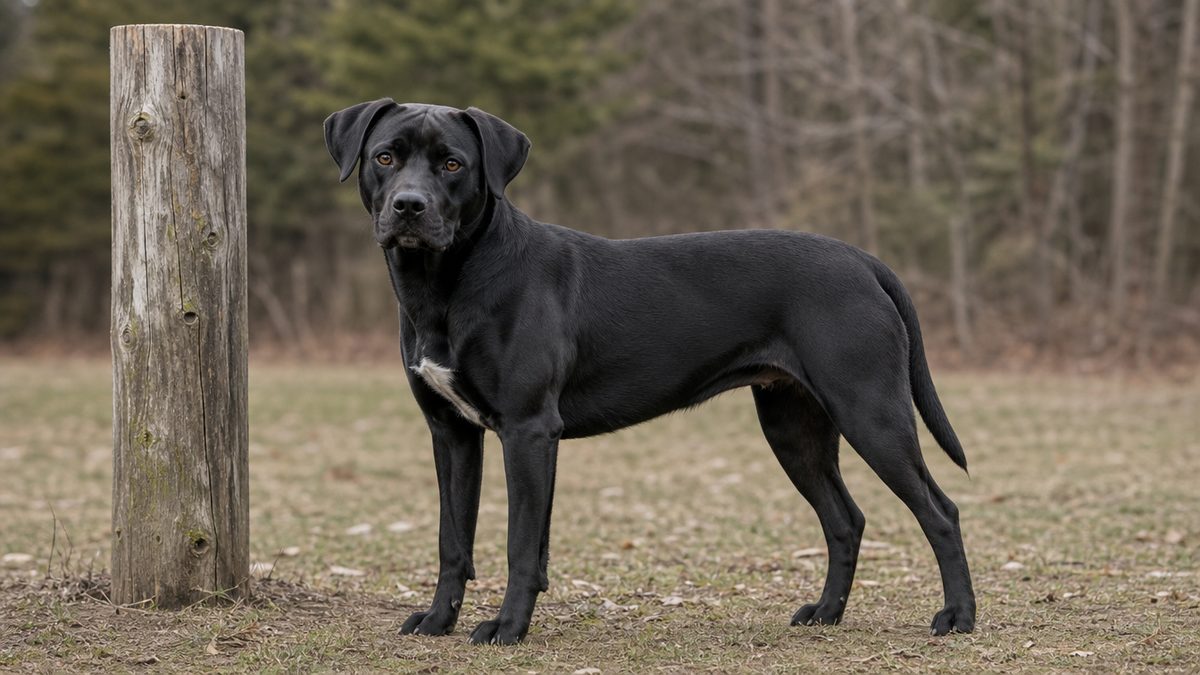
The Stephens Stock is a black American treeing cur developed from Mountain Cur stock by the family of Hugh Stephens in Kentucky, standing 16 to 23 inches and weighing no more than 55 pounds.
The United Kennel Club's standard is the clearest primary document on this breed and it states the origin in one sentence: 'Originally a strain of Mountain Cur, the little black dogs bred by the family of Hugh Stephens in Kentucky soon became sufficiently distinct that they were recognized as a separate breed'. The UKC recognised it on 1 November 1998 and files it in the Scenthound Group.
| Field | What the standard says |
|---|---|
| General appearance | A powerful, agile tree dog of small to medium size, the body just slightly longer than tall |
| Height | 16 to 23 inches |
| Weight | Proportionate to height and never over 55 pounds |
| Colour | Black. White markings permissible provided the dog is not more than one-third white |
| Coat | Outer coat short, smooth or rough in texture but not wooly, over a short dense soft undercoat |
| Ears | Drop, of short to medium length, wide at the base, and set high |
| Tail | Set low, and of medium length |
| Working style | Open or semi-open on track preferred, but silent trailing is acceptable |
| Disqualifications | Cryptorchidism, viciousness or extreme shyness, albinism, deafness, blindness, overshot bite, undershot bite |
Two framing points before the detail. This is a medium-sized dog rather than a large one, and readers arriving from photographs of American hunting dogs consistently overestimate it: at 16 to 23 inches it overlaps a Beagle at the bottom of its range and a Labrador at the top. And it is genuinely rare outside a narrow band of American hunting country, with no European register holding it and no Indian presence at all.
The clause that tells you this is a working standard
Two sentences in the UKC text mark it out from a companion breed's standard. The first is that the dog 'should be evaluated as a working dog, and exaggerations or faults should be penalized in proportion to how much they interfere with the dog's ability to work'. The second is sharper: 'Scars should neither be penalized nor regarded as proof of a dog's working abilities'.
Most standards are silent on scars. This one refuses them in both directions, declining to penalise a scarred dog and declining to treat scars as evidence that the dog can work. That is a standard written by people who had seen both mistakes made in a ring, and it is a more honest sentence than most breed standards contain.
Two disqualifications worth noticing
The UKC disqualifies deafness and blindness outright. Very few breed standards disqualify for a sensory defect rather than for a structural one, and it matters for an Indian reader because Indian law takes the opposite approach: the Dog Breeding and Marketing Rules 2017 name no hearing test anywhere, with the terms BAER and deaf appearing zero times across the whole gazette. So the American registry excludes a defect Indian law never asks anyone to test for.
Strain or breed, answered by four registries that disagree
Three American registries treat the Stephens Stock as a separate breed and the Original Mountain Cur Breeders Association, the body for the stock it came from, publishes nothing about it at all.
This is the question the page exists to settle, and the honest answer is that it depends on who is asking. Breed recognition is not a property of a dog. It is a decision each register makes, and here four registers have made four different decisions.
| Body | Position | Evidence |
|---|---|---|
| United Kennel Club | A separate breed since 1 November 1998 | A full published standard in the Scenthound Group, stating it was originally a strain of Mountain Cur |
| Continental Kennel Club | A separate breed | An independent standard in Breed Group 7, with the aliases Stephens' Cur and Stephens' Stock Cur |
| National Kennel Club | Listed as a breed | A breed page carrying photographs and no standard text at all |
| Original Mountain Cur Breeders Association | Not addressed | By-laws covering only the Mountain Cur; nothing published on any strain |
The fourth row is the interesting one. The OMCBA's by-laws define its object as 'preserving the true Mountain Cur Dog from extinction and to promote better breeding of the dog known as the All American Tree Dog'. Its registration pages mention no strains. So the association responsible for the parent stock neither registers the Stephens Stock nor argues against it. It simply does not cover it.
Say which body you mean. 'The Stephens Stock is a breed' is true of the UKC and the CKC. 'The Stephens Stock is a strain of Mountain Cur' is how the UKC itself describes its origin and is how the OMCBA's silence leaves it. Both sentences are defensible and neither is complete without naming its source, which is exactly the discipline this site applies to the Swiss and French variety questions elsewhere.
The 1970 date, and where it actually comes from
Almost every page repeats that the Stephens family maintained the line for over a century and that in 1970 it was declared a separate breed. That claim traces to two books rather than to any registry, being Morris 2001 at page 235 and De Prisco and Johnson 1990 at page 345Morris Desmond, DogsDe Prisco Andrew and Johnson James B. Neither the UKC nor the Continental Kennel Club states a century, and neither states 1970. The only registry date in evidence is the UKC's own recognition on 1 November 1998.
Many sources place the Stephens family in Wayne County, Kentucky. That attribution could not be sourced to any document we could reach, and searches pairing the family name with Wayne County returned unrelated Wayne Counties in four other states plus a Missouri printing firm coincidentally named Hugh Stephens. Every registry source we read says only 'Kentucky' or 'southeast Kentucky'. The county is left out rather than repeated.
The National Kennel Club's position is worth recording for completeness and for what it is not. It publishes a Stephens Cur breed page, which evidences that a third American body lists the breed, and that page carries no standard text at all, only photographs. A breed listing without a standard is a weaker form of recognition than the UKC's or the CKC's, and this page counts it as a listing rather than as a standard.
Two domains still cited as the breed's registry are now betting spam
The domains omcba.org and mountaincur.org both returned HTTP 200 serving sports-betting pages on 9 September 2026, and one of them had changed hands again eight days later, while the live Original Mountain Cur Breeders Association sits at omcba.net.
A dead domain fails loudly. A resold one answers, renders, and can be cited by anything that only checks whether a URL resolves. Both of these are cited across the cur-breed internet as the association's home, and both were checked on 9 September 2026 and again on 17 September 2026.
| Domain | HTTP status | What it actually serves |
|---|---|---|
| omcba.net | 200 | The real association, with by-laws, registration information and hunt results |
| omcba.org | 200 | A sports-betting page titled with an American football prediction on 9 September 2026; on 17 September, a redirect to wmrmcc.org, a West Michigan medical consortium |
| mountaincur.org | 200 | The identical sports-betting page on 9 September, and still a football-betting page on 17 September |
| omcba.com | timed out on HTTPS, 200 on HTTP | HTTPS timed out on 9 and 17 September 2026; plain HTTP returned a 1,294-byte page titled 'Website Disabled' on 17 September |
| originalmountaincur.com | does not resolve | DNS lookup failed on 9 and on 17 September 2026 |
Read the returned page's own title and language rather than its status code. On 9 September both expired domains returned an identical page titled with a football betting prediction, which no status check would have caught, and by 17 September one of them was redirecting somewhere else again. When a registry URL is load-bearing for a claim about recognition, confirm the page is still that registry's before citing it, and date the check.
The live association is worth reading on its own terms. Its home page gives a clubhouse address in Jamestown, Tennessee, names its registrar, and uses a contact address carrying the year 1957, which matches the 1957 founding the UKC's own Mountain Cur standard records. Its breed standards are published as a JPEG image on the back of its litter registration form rather than as text, so the standard's own wording could not be read; that limit is stated here rather than papered over.
Why this matters for a breed-recognition question
If you are trying to establish whether a body recognises a breed, the body's own site is the evidence. Two of the three obvious addresses for that body no longer belong to it, and anything citing them is citing a betting page. That is a live example of a failure mode this site documents generally, and it happens to sit directly on top of the question this page is answering.
Stephens Stock price in India
No Stephens Stock price in india exists, and no Indian listing offering the breed was found on a live search with a passing control.
The ten organic results for 'stephens stock dog' on Google India were the UKC standard, Wikipedia, an Indian pet blog, a breed-identification app, the Continental Kennel Club, an encyclopedia aggregator, two Facebook groups for American owners, Pinterest and the National Kennel Club. Not one is a listing, and the two Facebook groups are American hunting communities rather than sellers.
Why no price can form
Indian import law closes the supply chain. DGFT Trade Notice 22/2022-23 places dogs under ITC(HS) 01061900 as Restricted, allowing import only for a pet dog with a valid pet book in the importer's name, for an R&D organisation with a CPCSEA recommendation, or for Defence and Police use.
Policy Condition (8) reads: 'Import of commercial dogs for breeding or any other commercial activities other than the purposes mentioned above is not permitted.' Paragraph 6 adds that 'any applications for trading/breeding purposes, or applications made on behalf of some another person/entity shall be duly rejected'. An import authorisation for a personal pet covers one dog and creates no breeding stock.
The one thing worth knowing about American cur prices
In the United States working curs are among the cheapest hunting dogs precisely because they are bred for function rather than for show, and puppies are often placed within hunting networks rather than sold openly. That matters for an Indian reader for one reason only: it means there is no premium export market for this breed to draw from, so even the unlawful route that sometimes supplies expensive breeds does not exist here. This is not an expensive dog anywhere, and it is an unobtainable one here.
Bonbeno publishes no price. What is real and checkable is the cost of keeping a dog of this size in India, which follows.
What a 25 kg working dog costs to keep in India
The cost of ownership for a dog capped at 55 pounds in India runs roughly Rs 4,500 to Rs 9,000 a month once food, parasite control, vaccination and routine care are counted.
The weight ceiling in the UKC standard is unusually useful here, because most standards on this site give no weight at all. A dog never over 55 pounds is never over about 25 kg, which puts it squarely inside the commonest Indian parasite-product dose band and makes budgeting straightforward.
| Item | Published figure | Source and caveat |
|---|---|---|
| Anti-rabies vaccination | Rs 699 | Vetic clinic list price, national page |
| 9-in-1 DHPPiL | Rs 899 | Vetic clinic list price |
| Kennel cough | Rs 1,349 | Vetic clinic list price |
| Tick and flea plus worming, monthly | about Rs 1,103 | NexGard Spectra 15-30 kg, 3 tablets Rs 3,308 |
| Delhi pet dog registration | Rs 500 new, Rs 500 renewal | MCD, dogs only, late fee Rs 100 a month |
| Chennai pet licence | Rs 50 | Greater Chennai Corporation |
Treat the Vetic figures as one chain's list prices rather than as a market average, because that chain quotes different course prices on different city pages on the same day. The NexGard 15 to 30 kg band fits this breed at every point of its weight range, which is not true of the larger hounds elsewhere in this cluster.
Greater Chennai Corporation's six municipal veterinary clinics provide treatment and anti-rabies vaccination free of cost, and its pet licence is Rs 50. For a Chennai reader that is a materially more affordable baseline than any private rate card. Delhi's MCD charges Rs 500 to register a pet dog and the same again to renew.
Food is the largest line and the most predictable one here. A lean 20 to 25 kg working dog eats roughly 250 to 320 grams of a good dry food a day, which at Indian large-breed prices is a four-figure monthly number and still less than any of the 60 cm-plus hounds in this batch.
Suitability for the Indian climate
This is the one breed in its cluster whose homeland summer genuinely resembles an Indian one. Southeastern Kentucky's July wet-bulb peak of 21.71 C sits within 0.15 of a degree of Bengaluru's May peak of 21.86 C.
Every figure here comes from NASA POWER queried by explicit latitude and longitude over the 2001 to 2020 climatology window, with the elevation POWER reports for its own grid cell checked against an independent 90 metre digital elevation modelOpen-Meteo elevation API. That check matters because POWER returns a cell rather than a point, and in hill country the cell can miss the ground badly.
Monticello in southeastern Kentucky returns a cell elevation of 298.46 m against a real ground elevation of 282 m, an error of +16.46 m, which is about 0.11 C of lapse rate and therefore negligible. A second Kentucky point returns +102.80 m and is used only as a check rather than as a source. The Appalachian foothills are gentle enough here that the cell is the ground, unlike the Swiss Jura elsewhere in this cluster.
| Place | Annual mean C | Warmest month | Coolest month | Annual RH % |
|---|---|---|---|---|
| Southeastern Kentucky | 13.67 | JUL 24.85 | JAN 0.99 | 78.81 |
| Bengaluru | 23.74 | APR 28.37 | DEC 20.22 | 67.94 |
| Pune | 23.86 | APR 28.93 | DEC 19.62 | 66.80 |
| Delhi | 25.60 | JUN 35.88 | JAN 13.61 | 45.56 |
| Kolkata | 25.81 | MAY 31.53 | JAN 17.31 | 73.93 |
| Mumbai | 26.77 | MAY 31.19 | JAN 23.19 | 67.39 |
| Chennai | 27.95 | MAY 31.51 | JAN 24.09 | 72.39 |
The annual means still differ by ten degrees, because Kentucky has a real winter and India does not. The summers are the comparison that matters for a working dog, and there the gap closes sharply: Kentucky's July at 24.85 C against Bengaluru's April at 28.37 C is a difference of three and a half degrees, not the twelve-degree gulf the French and Swiss hounds on this site face.
The wet-bulb figure is the one to read
A dog sheds heat by evaporation, so the wet bulb temperature caps its cooling. Kentucky is humid in summer, at 78.81 percent annual relative humidity, and that humidity is what makes the comparison work.
| Place | Peak month | Peak wet bulb C | Gap from Kentucky |
|---|---|---|---|
| Southeastern Kentucky | JUL | 21.71 | - |
| Bengaluru | MAY | 21.86 | +0.15 |
| Pune | JUN | 22.97 | +1.26 |
| Hyderabad | JUN | 23.35 | +1.64 |
| Mumbai | JUN | 25.77 | +4.06 |
| Chennai | MAY | 26.11 | +4.40 |
| Delhi | JUL | 26.50 | +4.79 |
| Kolkata | JUN | 27.09 | +5.38 |
Bengaluru's peak evaporative load is 0.15 C above the load this breed evolved under. For the Deccan cities the honest verdict is therefore that the climate is workable rather than hostile, which is a verdict this site rarely gets to give an imported working breed. Pune and Hyderabad add one to two degrees, which is manageable with scheduling.
The coastal and northern cities are a different problem. Mumbai, Chennai, Delhi and Kolkata run four to five degrees of wet bulb above the Kentucky peak, which is outside anything the breed's homeland produces in any month. A black-coated working dog in Kolkata in June is not doing something its ancestors ever did, and the fact that Kentucky is hot in July does not transfer to that.
One caution against over-reading the good news. Hall 2020 found that of the 879 heat-related illness events with a recorded trigger in a 905,543-dog cohort, 652, being 74.2 percent, were exertional rather than environmental. A dog that copes with the ambient climate can still overheat doing the job it was bred for, and this breed's job is running game hard. The breed was not modelled in that study, so no breed-specific odds ratio exists and none is offered.
Temperament and household fit
The Stephens Stock is a fast, driven treeing dog that the UKC calls intelligent and easily trained, and its prey drive rather than its temper is what makes it a poor fit for most homes.
The UKC's Characteristics clause is unusually direct for a breed standard: 'The Stephens' Stock Cur is a fast, hard hunter that carries its head high on track. Open or semi-open on track is preferred, but silent trailing is acceptable. Good changeover at the tree is preferred. The Stephens' Stock Cur is intelligent and easily trained with strong treeing instincts on all game'.
Read that as a job description rather than as a personality. Carrying the head high on track means the dog works air scent as well as ground scent, so it covers ground fast. Strong treeing instincts on all game means it will tree a cat, a monkey or a squirrel with equal commitment, which in an Indian city is a serious problem rather than a charming quirk.
Not aggression, drive
The standard disqualifies viciousness or extreme shyness, so an aggressive dog is excluded from the breed by its own rules. These are not guard dogs and the American literature describes them as good family dogs within hunting households. The problem in an Indian setting is different and specific: a high-drive treeing dog in a country with free-roaming cats, monkeys and street dogs has a target every hundred metres.
- Choose another breed if you live in a flat, because a treeing dog's voice is the working instrument and it is loud.
- Choose another breed if your area has monkeys or many free-roaming cats, because those are exactly what this dog is built to tree.
- Choose another breed if you want off-lead freedom without training, because an independent working cur will self-employ.
- Consider one only with land, a fence, cool working hours and a real job for the nose.
The UKC calls the breed easily trained, and the Continental Kennel Club's profile calls it intelligent while recommending it for working and hunting homes. Easily trained is not a claim most working-hound standards make, and it is the one respect in which this dog is a better proposition for a first-time owner than the French pack hounds on this site. It does not cancel the drive or the voice.
Two adjectives sum the household problem. This dog is vocal, because a treeing dog holds quarry by voice until the hunter arrives, and it is trainable, which the UKC states outright. Those two together describe an animal that will learn what you teach it and will still announce every squirrel in the neighbourhood, and no amount of the second cancels the first.
Training approach and what this breed resists
Train a Stephens Stock for recall and for a reliable leave-it before anything else, because recall training against a treed animal is the difference between a manageable dog and an uncontainable one.
The breed's own standard says it is easily trained, and that is genuinely useful. What it does not say, because it has no reason to, is that a dog trained to tree will tree whatever is available. In Kentucky that is a raccoon. In an Indian city it is a cat on a wall or a monkey on a roof, and both of those end badly.
- Build recall on a long line through the first year, and never let the dog rehearse a successful chase or a successful tree.
- Teach a leave-it that works at distance, because the moment of choice happens twenty metres away rather than at your feet.
- Give the nose a legal daily outlet, because a treeing dog with no job will find one.
- Socialise early to Indian street conditions, cattle, monkeys, cats, crowds and other dogs, at a distance the dog can handle.
- Keep a long-line default in open ground, since honest management beats an obedience claim you cannot cash.
Treeing a monkey is not a training failure, it is the breed working correctly on the wrong target. Rhesus and bonnet macaques defend themselves, carry disease, and are protected wildlife. A dog that trees one can be injured, can injure the animal, and can put its owner in a legal position they did not anticipate. Plan for this before it happens rather than after.
Two approaches to avoid. Harsh handling on a sensitive working dog produces a shut-down animal rather than a compliant one. And a dominance framework does nothing for a dog whose motivation is prey rather than status. Exercise the drive properly and the training holds; suppress it and it surfaces somewhere worse.
Daily exercise requirement, and what happens without it
A Stephens Stock needs at least ninety minutes of real work daily across two sessions, because the UKC describes a fast hard hunter used on squirrel and raccoon and in packs on mountain lion and bear.
The quarry list in the standard sets the scale. A dog worked in packs on bear and mountain lion is an athletic, agile animal with genuine stamina, and the standard asks for it to be presented in hard muscular condition. An Indian city walk does not approximate that, and the gap shows up as behaviour.
| City | Usable hours, Apr to Jun | Practical plan |
|---|---|---|
| Bengaluru, Pune | 05:30 to 08:30 and after 18:30 | Two sessions of 45 minutes; the widest usable window of any Indian city for this breed |
| Hyderabad | 05:30 to 08:00 and after 19:00 | Two sessions, with the afternoon given up |
| Delhi, Ahmedabad | 05:00 to 07:00 and after 20:30 | Dawn session only in the worst weeks, indoors midday |
| Chennai, Mumbai, Kolkata | 05:00 to 07:00 and after 20:00 | Short sessions, water always, no midday movement |
The Bengaluru and Pune rows are wider than they would be for any other breed in this cluster, and that is a direct consequence of the wet-bulb match established above rather than a softening of the advice.
Give the nose and the problem-solving a job
- Scatter food across a garden or terrace and let the dog solve the pattern rather than showing it.
- Lay a short drag trail with a scented cloth and reward at the end of it.
- Use elevated hides so the dog has to work out where a scent went upward, which is closer to its real job than a flat trail.
- Rotate the search area, because a solved puzzle stops being exercise.
Baying, fence-climbing, escaping and destructive chewing, in that order. A treeing dog that cannot hunt does not become calm, it becomes inventive. This breed is a documented escape artist in American owner communities, and an Indian compound wall is a lower obstacle than an American yard fence.
Grooming and coat care in Indian humidity
Groom a Stephens Stock in five minutes a week, because the standard gives a short outer coat over a short dense undercoat and sets a high, short-to-medium drop ear that drains far better than a hound's.
The coat clause is short: an outer coat that is short and may be smooth or rough in texture but not wooly, over an undercoat that is short, dense and soft. A rubber mitt once a week covers it. The coat colour is black with white markings permitted up to one-third of the dog, and albinism is a disqualification.
A black coat absorbs radiant heat that a white one reflects, and this breed is black by definition. That works against the otherwise favourable wet-bulb match: in direct Indian sun a black dog gains heat faster than the air temperature alone predicts. Shade and timing matter more for this breed than for a light-coated one of the same size, and clipping is not the answer because the coat is already short and clipping exposes skin.
The ears are a genuine advantage here
The standard sets the ears as drop, of short to medium length, wide at the base, and set high. Compare that with the French and Swiss hounds in this cluster, whose ears reach the end of the muzzle or the tip of the nose and are set below eye level. A high-set, short drop ear admits more air and holds less water, so the ear infection risk in an Indian monsoon is materially lower than for a scent hound of the same size.
- Check both ears weekly by lifting the leather and looking.
- Dry the canal after every swim and every bath, since even a good ear design fails if water sits in it.
- Use a cleaner your vet recommends, and stop if the dog flinches.
- See your nearby vet at the first head shake or odour rather than the third.
Ticks and the working coat
A short black coat makes ticks harder to see rather than easier, which matters given the Indian burden. A West Bengal series of 584 dogs screened at veterinary clinics found Babesia gibsoni in 76.54 percent and two or more pathogens in 72.9 percent of the 584 dogs screened. A Kerala series of 120 dogs found Babesia in 66.7 percent, peaking pre-monsoon between March and May. Both sampled clinic caseloads rather than the street, and that caveat belongs beside the figure every time. Run hands over the whole dog weekly rather than relying on sight.
Health issues, screening and what is actually known
No breed-specific health data exists for the Stephens Stock, and the search that establishes it produces the cleanest homonym on this site: in PubMed, CUR means curcumin.
Every name form returns zero on-breed. 'Stephens Stock', 'Stephens Cur', 'Stephens Curs', 'Mountain Cur', 'Treeing Cur', 'Black Mouth Cur', 'cur dog' and 'Treeing Tennessee Brindle' each returned 0 in title or abstract, against controls of 126 and 141 in the same session.
A bare search for cur in title or abstract returned 5,446 PubMed records on 9 September 2026 and 5,456 on 17 September, because CUR is the standard abbreviation for curcumin. Not one of the dog-scoped hits is a cur dog: the 17 records returned with the dogs MeSH filter on 17 September are nearly all curcumin pharmacology in beagles or canine cells, and the rest are other cur- abbreviations such as curculigoside and curzerene. Scoping the same term to the title alone and to dogs returns zero. Any automated literature count for any cur breed is therefore meaningless unless it excludes this, and none of the pages ranking for these breeds does.
| Register | Result for the Stephens Stock | Control that passed |
|---|---|---|
| PubMed, eight name forms | Zero on-breed records | Labrador hip dysplasia 126, Jack Russell Terrier 141 |
| OFA breed-code list, 482 entries | No code, under any spelling | LABRADOR 109, BULLDOG 170, BEAGLE 61 |
| OFA published statistics tables | No row, under any disease | Same session, same dump |
| FCI definitive register, 1 to 400 | No record whose title contains STEPHEN | English Setter 2, Chesapeake Bay Retriever 263 |
| FCI provisional register | Absent | Buldogue Campeiro 374, Karaman 378 |
| McMillan 2024 longevity tables | Not among the 155 purebred breeds | The study's own breed list |
The relatives hold codes and still have no data
OFA does hold three of this breed's relatives. The Mountain Cur is MCR, the Black Mouth Cur is BMC and the Treeing Tennessee Brindle is TBC, all read from OFA's own markup. None of the three has a published statistics row. So even the parent stock, with an American population and a registry behind it, has never accumulated enough evaluations to publish.
'Breeds are not included in the OFA statistics tables until a minimum number of individuals have been evaluated. For hips, each breed must have at least 100 evaluations in the database. For all other databases, there must be at least 50.' That sentence is what to cite for any of these breeds, and it says something real: American working-cur owners largely do not submit evaluations, because the dogs are selected on performance rather than on scores.
What a buyer can still act on
The UKC standard disqualifies deafness and blindness, which is a stronger statement than most standards make and a reasonable thing to ask a breeder about directly. Beyond that, three risks transfer from shape and climate rather than from breed data: heat load on a black working coat, ear disease in a monsoon even with a well-designed ear, and the exertional heat risk Hall 2020 quantified across a very large cohort. Ask a seller to screen the parents under any scheme at all, and consult your nearby vet about what is worth testing.
The international registers were checked as well, since an American breed can still appear in a European one. It does not. The FCI's definitive register was enumerated by probing records 1 to 400 and reading back each page's own title, and no record's title contains STEPHEN, with the English Setter at record 2 and the Chesapeake Bay Retriever at record 263 confirming that the server resolves on the trailing integer rather than on the name slug. The FCI's provisional register holds no Stephens entry either, read with the Buldogue Campeiro at 374 and the Macedonian Shepherd Dog Karaman at 378 passing as in-document controls.
Life expectancy, and where the usual figure comes from
The Continental Kennel Club gives a life expectancy of 10 to 14 years, and that figure is a registry estimate rather than a measurement from any cohort.
The CKC's breed profile publishes 10 to 14 years alongside its height and weight figures. That is the only registry number in circulation, and it is worth quoting for exactly what it is. No cohort study models this breed. It is not among the 155 purebred breeds in the largest UK longevity study's supplementary tables, and no American equivalent covers working curs.
This site publishes no invented lifespan figures, and it does publish sourced ones with their provenance named. A registry's own published estimate is a real, attributable statement about what that registry tells buyers, and it is different from an aggregator's guess. Read 10 to 14 years as the Continental Kennel Club's position rather than as a measured median, because that is what the document supports.
What a working population's longevity actually depends on
For a breed selected on performance rather than on conformation, the largest determinants of lifespan are usually not genetic. They are hunting injury, road traffic, heat, and the tick-borne diseases that follow a dog worked in cover. In an Indian context the last two dominate, and both are managed rather than inherited.
That reframing matters more than the number. A page that gives you 10 to 14 years and stops has told you nothing you can act on. A page that tells you the main threats to this dog in India are heat, ticks and traffic has given you three things to do something about.
Feeding a working cur in India
Feed a Stephens Stock to a body condition score and to the standard's own instruction, which is that the dog should be presented in hard, muscular condition rather than in show weight.
This breed is unusual on this site in having a published weight ceiling. The UKC gives weight as proportionate to height and never over 55 pounds, which is about 25 kg, and adds that the dogs should be presented in hard, muscular condition. The Continental Kennel Club gives 30 to 55 pounds. Between them that is a real, sourced range, which most breeds here do not have.
- Feel the ribs with flat fingers and expect to find them under a thin cover, without pressing.
- Look down at the standing dog and expect a visible waist behind the ribs.
- Look from the side and expect an abdominal tuck rather than a level underline.
- Weigh monthly on the same scale and record it, because a trend beats a single reading.
The deep brisket still applies
The standard describes ribs that extend well back and curve down and inward to form a deep body, with the brisket extending to the elbow. Deep-chested conformation is the recognised risk factor for gastric dilatation-volvulus, which is a surgical emergency rather than an upset stomach.
Split the daily ration into two or three meals, avoid hard work for an hour either side of a meal, and slow a fast eater with a maze bowl. Unproductive retching, a distended abdomen and restlessness together are a same-hour emergency, and the number to call is your nearby vet.
A 20 to 25 kg working dog eats roughly 250 to 320 grams of a good dry food a day, more when actually worked and less when kept as a pet. Water matters more in India than in Kentucky despite the wet-bulb similarity, because the Indian hot season is far longer: Kentucky's uncomfortable window is roughly eight weeks and Bengaluru's runs from March to May every year.
Month by month through the first year
Plan a Stephens Stock's first year around containment and the socialisation window, because a treeing cur that learns to leave a compound is very hard to un-teach.
This timeline is generic working-breed guidance honestly labelled, because no breed-specific developmental data exists. Generic guidance named as generic beats breed-specific guidance invented.
| Age | Priority | What to do |
|---|---|---|
| 8 to 12 weeks | Vaccination and habituation | Complete the core course with your vet; begin surface, sound and handling exposure indoors |
| 12 to 16 weeks | Socialisation window | Short daily outings in cool hours; cattle, monkeys, cats, traffic and crowds at a workable distance |
| 4 to 6 months | Recall and leave-it | Long-line work only; never rehearse a chase or a tree; begin scent games |
| 6 to 9 months | Containment | Check and raise fencing before the dog tests it; register the dog with your municipality |
| 9 to 12 months | Endurance, slowly | Build distance gradually in cool hours; add elevated scent problems |
| 12 months onward | Adult workload | Ninety minutes daily; recall and leave-it proofing continue for life |
American owner communities describe this breed as a capable climber and escape artist. An Indian compound wall is usually lower than an American yard fence and often has a tree beside it. Fix that before the dog is nine months old rather than after the first escape, because the first successful escape is the one that teaches the behaviour.
The first Indian summer is the other pressure point. Indian law names young animals explicitly among the categories that must not be kept in outdoor facilities without a veterinarian's written approval, alongside dogs not accustomed to the temperatures prevalent in the area. Register the dog when your municipality requires it; Delhi charges Rs 500 and Greater Chennai Corporation Rs 50Greater Chennai Corporation.
Where the breed standard and Indian law collide
The UKC standard says dewclaws may be removed and Indian law prohibits de-clawing outright, which is the sharpest standard-versus-law collision in this cluster.
The UKC's Feet clause ends with four words: 'Dewclaws may be removed.' That is a permission rather than a requirement, and it is normal in American working-breed standards. In India it is not available.
Second Schedule Part II paragraph 6(8) of the Prevention of Cruelty to Animals (Dog Breeding and Marketing) Rules, 2017 reads: 'There shall be no tail docking, ear cropping, de-barking, de-clawing, branding, dyeing, injecting substances to enhance visual appeal, performing a surgery or procedure to camouflage or hide any defect or infirmity or any other kind of mutilation of any body part of the pup and any change of appearance by artificial means is strictly forbidden.'
So a practice the American standard permits is a practice Indian law forbids. This is the same shape as the Ariege Pointer case elsewhere on this site, where a parent club recommended breeding practice Indian law prohibits, and the correct handling is the same: state the provision, say plainly that enforcement is a separate question from what the text says, and do not repeat overseas guidance that does not transfer.
Two clauses that also apply
- Part III paragraph 8(10) requires breeding dogs to have been tested for genetic defects including overshot and undershot jaw. The UKC disqualifies both bites outright, so the standard and the law point the same way here.
- Part IV paragraph 21(1) bars keeping in outdoor facilities, without an attending veterinary practitioner's written approval, dogs not accustomed to the temperatures prevalent in the area, breeds that cannot tolerate them, and sick, infirm, aged or young animals.
- Part II paragraph 6(3) prohibits in-breeding, defined as breeding between relatives of the second to fourth grade within the first four generations, and incest breeding.
A citable absence that cuts the other way
The UKC disqualifies deafness, and the Indian Rules mention no hearing test at all. The terms BAER and deaf appear zero times across the whole gazette, verified by a pattern allowing whitespace and hyphens between every character, so the absence is genuine rather than an artefact of PDF extraction. An Indian breeder is therefore under no legal obligation to test hearing on a breed whose American registry excludes deaf dogs from the ring.
Head to head against the breeds it is confused with, and the ones you can get
The Stephens Stock is separated from its three closest American relatives by colour alone, and from the dogs an Indian buyer can actually get by availability alone.
| Breed | Colour clause | OFA code | Published OFA statistics |
|---|---|---|---|
| Stephens Stock | Black, up to one-third white | None | None |
| Mountain Cur | Black with or without tan or brindle points, blue, brindle, brown, red, yellow, or blonde or buttermilk buckskin | MCR | None |
| Treeing Tennessee Brindle | Brindle | TBC | None |
| Black Mouth Cur | Yellow to fawn with a dark muzzle | BMC | None |
Colour is the fastest discriminator and it is the only one that is reliable. These four breeds overlap heavily in size, build, ear set and working style, and a photograph without colour information cannot separate them. The fourth column is the other finding: three of the four hold OFA codes and not one of them has ever accumulated enough evaluations to publish a statistics row.
What an Indian buyer can actually get
| Breed | Indian availability | Heat tolerance | Size |
|---|---|---|---|
| Stephens Stock | None found | Moderate, best in the Deccan | 41 to 58 cm |
| Indian Pariah Dog | Free, everywhere | Excellent | 51 to 64 cm for males, 46 to 58 for females |
| Kombai | Regional, scarce | Excellent | About 58 cm, males 56 to 62 |
| Chippiparai | Regional, scarce | Excellent | About 61 cm, dogs 63 and bitches 56 |
| Beagle | Widely available | Moderate | 33 to 40 cm under FCI Standard 161 |
The honest recommendation here is unusually easy to make. An Indian Pariah Dog is close to this breed in size, build, drive and independence, is heat-adapted rather than merely heat-tolerant, is free, and is available in every Indian city. A Kombai gives you a comparable working temperament from a South Indian population selected in a climate this breed would find familiar.
This is the only breed in its cluster whose homeland evaporative load matches an Indian city, with southeastern Kentucky's July wet-bulb peak of 21.71 C against Bengaluru's May peak of 21.86 C. That makes it a more plausible import than the French or Swiss hounds on this site, and it remains unobtainable here for legal reasons rather than climatic ones. A plausible dog you cannot lawfully get is still a dog you cannot get.
For the parent breed itself the UKC publishes a separate standard, which is the document to read against this one if you want to see how far the two have diverged in writing rather than in argument. The colour clauses are where they part company most clearly, since the Mountain Cur standard admits black with or without tan or brindle points, blue, brindle, brown, red, yellow and blonde or buttermilk buckskin, while this one admits black alone. The same Mountain Cur standard's History section also names the Stephens strain in its list of the most common Mountain Cur strains, beside the McConnell, Ledbetter, Arline and York strains, so the UKC calls the dog a strain in one document and a breed in another.
What readers get wrong about the Stephens Stock
The commonest mistake is treating the strain-versus-breed question as having one answer, when four American registries have given four different ones.
- Assuming one registry speaks for all. Three recognise it as a breed and the parent association covers only the Mountain Cur.
- Repeating the 1970 date as a registry fact. It comes from two books, and no registry states it.
- Repeating the Wayne County attribution. It could not be sourced to any document we could reach, and this page leaves it out.
- Citing omcba.org or mountaincur.org. Both are expired domains that served sports-betting pages at HTTP 200 on 9 September 2026, and omcba.org had changed hands again by 17 September.
- Reading a PubMed cur count as literature. CUR abbreviates curcumin and returns 5,446 records.
- Identifying the breed by build. Its three closest relatives share the build; colour is the discriminator.
- Copying the dewclaw permission into an Indian context. De-clawing is prohibited outright by Indian law.
The mistake that costs a dog rather than money
For anyone who does end up with one in India, the specific risk is not heat in general. It is a black-coated high-drive dog treeing a monkey in direct sun in April. The wet-bulb match established above makes the ambient climate workable in the Deccan and says nothing about a dog running hard on a black coat with a macaque above it. Hall 2020 found 74.2 percent of triggered heat-related illness events were exertional rather than environmental, and that is exactly the mechanism.
Heavy unrelenting panting, a dog that lies down and will not rise, brick-red or very pale gums, vomiting, wobbliness or collapse. Move to shade, wet with cool rather than ice-cold water, offer small drinks, and reach your nearby vet at once. A rectal temperature at or above 41.0 C after exertion in heat is an emergency.
One research mistake worth naming, because this site nearly made it. A breed with three relatives that all hold OFA codes looks like a breed that should have health data. It does not, and neither do the relatives. Holding a registry code and having published statistics are different states, and conflating them is how a page ends up implying screening data exists when nobody has collected any.
Adoption and responsible sourcing
Adopt rather than pursue this breed in India, because no lawful route exists and the Indian dog that most closely resembles it is free in every city.
Nobody in India can sell you a Stephens Stock lawfully. DGFT Trade Notice 22/2022-23 permits importing a dog only as a pet with a valid pet book in the importer's name, for R&D with a CPCSEA recommendation, or for Defence and Police use, and states that applications for trading or breeding purposes shall be duly rejected.
What to do if this dog is what appeals to you
- Visit a municipal shelter and ask specifically for a young, high-drive black dog of about 20 kg, which is both the hardest type to place and the closest match available.
- Consider an Indian Pariah Dog, which matches this breed on size, drive and independence and beats it comfortably on heat.
- Look at a Kombai or a Chippiparai if you want a working South Indian dog with a living regional population.
- Ask any seller which registry issued the pedigree, then verify it against that registry's own index rather than trusting the certificate.
Three American registries hold this breed and each publishes its own materials, so a claimed pedigree is checkable. The UKC's standard is public, the Continental Kennel Club's breed page is public, and the OMCBA's by-laws state plainly that it covers only the Mountain CurContinental Kennel ClubOriginal Mountain Cur Breeders Association. A certificate claiming OMCBA registration for a Stephens Stock is claiming something that body does not offer.
If you are outside India
The breed lives in American hunting networks rather than in a show fancy, and puppies are usually placed within those networks. Expect to be asked whether you hunt, expect the dog to be assessed on performance rather than on conformation, and expect the standard's own instruction that scars are neither penalised nor treated as proof of ability to describe the culture accurately.
Bonbeno does not recommend breeders, link puppy listings or quote any price as an offer. This page reports what registries and governments publish, and for an Indian reader the conclusion is that this is a breed to read about and an Indian dog to bring home.
What the pages ranking in India actually tell you
The Indian search results carry one primary registry document, no second opinion on the strain-versus-breed question, and no acknowledgement that the parent association does not cover this dog.
| Source | What it says | What the primary documents say |
|---|---|---|
| United Kennel Club | A separate breed since 1 November 1998 | Correct, and it is the only registry document on the page |
| Wikipedia | A century-long line, declared separate in 1970 | Sourced to two books; no registry states either |
| Google knowledge panel | Names the breed 'Stephen cur' | Neither the UKC nor the CKC uses that spelling |
| Every ranking page | No mention of the OMCBA position | Its by-laws cover only the Mountain Cur |
| Every ranking page | No OFA status given | No code for this breed; MCR, BMC and TBC for its relatives, none with statistics |
| Every ranking page | No heat assessment | This is the only breed in its cluster whose homeland wet bulb matches an Indian city |
| Every ranking page | No mention of the dewclaw clause | The UKC permits removal; Indian law prohibits it |
What the People Also Ask box shows
Google India returned four questions and two are genuinely useful. Asking whether the Mountain Cur is aggressive goes straight to the strain question, and asking what a cur dog costs is the price question in the form Indian searchers actually type. The other two are the generic Indian cluster, asking about the tallest breed in India and the least wanted dog. All four are answered verbatim in the FAQ, untidied.
Google printed 'About 86 results' for this query and 'About 192 results' for the Labrador control in the same session, and the Labrador is the thickest commercial dog query in India. A printed result count measures nothing about demand and this page draws no conclusion from one. What evidences a thin Indian market is composition, being zero listings against a passing control.
The gap this page fills is not more description of a black tree dog. It is the four registry positions nobody set side by side, the two expired domains still being cited as one of them, the curcumin homonym that makes every automated literature count for this breed worthless, and the wet-bulb arithmetic that makes this the one imported working breed on this site whose homeland summer an Indian reader would recognise.
Stephens Stock questions people actually ask
What is the tallest dog breed in India?
The Great Dane is the tallest breed commonly kept in India, and FCI Standard 235 sets its males at a minimum of 80 cm at the withers and not more than 90. Google returned this question on a Stephens Stock search, which tells you the engine had little breed-specific material to work with. The Stephens Stock is nothing like a Great Dane, standing 16 to 23 inches, which is roughly 41 to 58 cm, and weighing no more than 55 pounds.
Is Mountain Cur aggressive?
No, and this question matters here because the Stephens Stock came from Mountain Cur stock. Both are working tree dogs with high prey drive toward game rather than aggression toward people. The UKC standard for the Stephens Stock disqualifies viciousness or extreme shyness outright, so an aggressive dog is excluded from the breed by its own standard. High drive and aggression are different things and get confused constantly.
How much does a cur dog cost?
No Indian price exists for any American cur breed, and Bonbeno publishes none. In the United States cur puppies from working lines are typically the cheapest hunting dogs available because they are bred for function rather than for show, but that is a market with no Indian equivalent. Indian import law bars importing a dog to breed or sell, so no supply chain can form here through which a price could be observed.
What is the least wanted dog?
No register measures wanting, so this question cannot be answered honestly with a name. What can be measured is placement difficulty, and Indian shelters consistently report that adult large black dogs are the hardest to rehome. That is directly relevant here, because a Stephens Stock is a black working dog of exactly that description, and it is a reason to look at a shelter rather than a seller.
Is the Stephens Stock a breed or a strain of Mountain Cur?
Both answers are correct depending on which register you read, and that is the honest finding. The United Kennel Club recognised it as a separate breed on 1 November 1998 and says it was originally a strain of Mountain Cur that became sufficiently distinct. The Continental Kennel Club treats it as a separate breed with its own standard. The Original Mountain Cur Breeders Association covers only the Mountain Cur and publishes nothing on the strain.
How big does a Stephens Stock get?
The UKC standard gives 16 to 23 inches at the withers, which is about 41 to 58 cm, with weight proportionate to height and never over 55 pounds, about 25 kg. The Continental Kennel Club splits the sexes, giving 16 to 23 inches for males and 15 to 22 inches for females, with 30 to 55 pounds for both. That is a genuinely wide range for one breed and reflects a working population rather than a show one.
What colour is a Stephens Stock?
Black. The UKC standard gives the colour as black, with white markings permissible provided the dog is not more than one-third white, and disqualifies albinism. That single clause is the fastest way to tell the breed from its relatives: a brindle dog is a Treeing Tennessee Brindle, a yellow dog with a dark muzzle is a Black Mouth Cur, and a merle is a Catahoula.
Can a Stephens Stock live in India?
Better than most imported working breeds, and no lawful route exists to bring one here. Southeastern Kentucky's July wet-bulb peak of 21.71 C is within 0.15 C of Bengaluru's May peak, so the evaporative load is genuinely comparable in the Deccan cities. Chennai, Mumbai and Kolkata run 26 to 27 C wet bulb, which is well outside anything the breed's homeland produces.
Why does searching for cur research return thousands of results?
Because CUR is the standard abbreviation for curcumin. A bare search for cur in title or abstract returned 5,446 PubMed records on 9 September 2026, and not one dog-scoped record among them is about a cur dog; nearly all are curcumin pharmacology. Scoping the same search to the title alone and to dogs returns zero. This is the cleanest homonym on this site and it means no automated literature count for any cur breed can be trusted.
When did the Stephens Stock become a separate breed?
The date usually given is 1970, and it comes from two books rather than from any registry. Morris 2001 and De Prisco and Johnson 1990 are the sources behind the claim that the Stephens family maintained the line for over a century before it was declared separate in 1970. Neither the UKC nor the Continental Kennel Club states a date, and the UKC's own recognition is dated 1 November 1998.
What health tests should a Stephens Stock have?
No breed-specific screening scheme exists, and the breed holds no OFA code at all. Its relatives do hold codes and no published statistics, with the Mountain Cur as MCR, the Black Mouth Cur as BMC and the Treeing Tennessee Brindle as TBC. OFA publishes a table only once a breed has 100 hip evaluations, or 50 for other databases. The UKC standard disqualifies deafness and blindness, which is worth knowing.
How long does a Stephens Stock live?
The Continental Kennel Club gives a life expectancy of 10 to 14 years, and that figure comes from a registry's breed profile rather than from any cohort study. The breed is not among the 155 purebred breeds in the largest UK longevity study's supplementary tables, and no cohort models it. Treat the 10 to 14 year figure as a registry estimate rather than as a measurement, because that is what it is.
Compare with similar breeds
Stephens Stock sits in 1 Bonbeno group. Each one compares it directly against the breeds it is genuinely an alternative to, on the same figures.