
Type, not a breed
Smithfield: The Tasmanian Type Its Own Breeder Says Is Not a Breed
Extinct in Britain, pushed off the Australian mainland partly because it could not stand the heat, and surviving in the coolest state in Australia. The 1914 verdict on this dog is the most useful thing an Indian reader could be told about it.
Quick answer
The Smithfield is a type rather than a breed: its own Tasmanian breeder says there has never been a pure breed of Smithfield and there never will be, no kennel club holds a standard for it and no studbook exists. There is no Smithfield price in India, no lawful import route, and a 1914 Australian assessment that it could not stand the heat.
This guide summarises news reporting, registry indexes, peer-reviewed veterinary genetics, Indian animal-welfare law and satellite climate data as general information for Indian dog owners. It is not a diagnosis and it is not treatment advice. Consult a registered veterinarian near you before acting on anything here, and treat collapse, laboured panting, vomiting or a sudden change in gum colour as an emergency. No breed-specific health data exists for this dog at all, so the health section describes what its reputed lineage carries rather than what it has been shown to carry, and that difference matters when you talk to your vet.
Smithfield at a glance
What the Smithfield is, and why its own breeder calls it a type
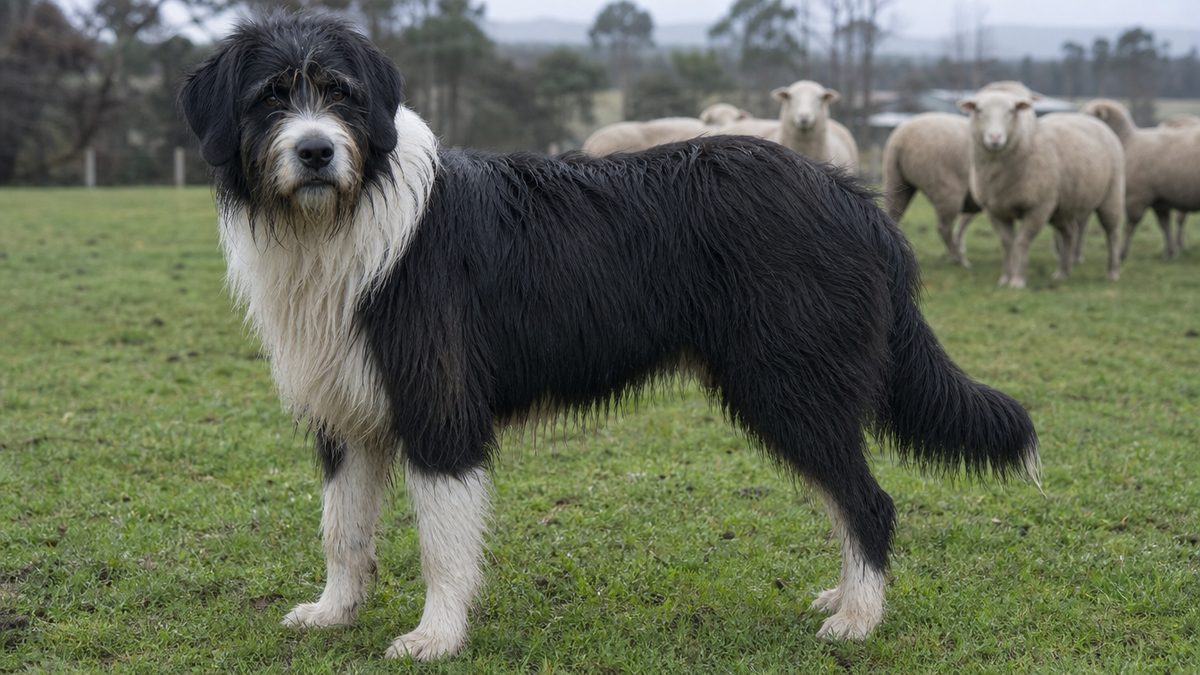
The Smithfield is a shaggy working stock-dog type from the London meat markets that survives in Tasmania, and the clearest statement that it is a type rather than a breed comes from a man who breeds them.
Speaking to ABC Radio Hobart in January 2024, Matthew Larner, who breeds Smithfields at his Glengarry farm in the West Tamar, said there had never been a pure breed of Smithfield and there never would be, and the report records that he said it was a type of dog rather than a breed. That is as direct an answer as this site has ever obtained on a breed-status question, and it comes from inside the population rather than from a registry looking in.
The same interview contains its own tension, and this page publishes it rather than smoothing it over. Two sentences after saying it is a type rather than a breed, Larner says of the same dogs that they have evolved into their own breed, adding that there has been some border collie added in over time, a bit of this and a bit of that, and that each farmer wants to improve and make their own type of dog that suits them. Both statements are in one article and neither is a slip. The second describes what the population feels like from inside; the first describes what it is by any external test.
The two-condition test, run on primary documents
This site applies one test to any name that might or might not be a breed: is there a written standard anywhere, and is there a studbook anywhere. The two conditions can be met by different bodies on different continents, so both are asked separately and both were asked here.
| Condition | Answer | Document that decided it |
|---|---|---|
| A written conformation standard anywhere | No | Absent from the Australian National Kennel Council's 227-entry breed standards index and from the FCI letter S index and provisional register |
| A studbook anywhere | No | No register of any kind was found in Australia, Britain or elsewhere; the Campbell Town Show class judges purity on appearance rather than on pedigree |
| National registry of its own country | No | Dogs Australia's index runs 227 breeds from Affenpinscher to Yugoslavian Shepherd Dog and does not include it |
| FCI recognition | No | Absent from the 41-entry letter S index and the 20-entry provisional register |
| Named by its own breeders as a breed | No | There has never been a pure breed of Smithfield and there never will be |
| Verdict | Type | The ABC News interview, corroborated by two registry absences with in-document controls |
The registry checks were run properly rather than by assumption. The Australian National Kennel Council, trading as Dogs Australia, publishes its breed standards index across three pages totalling 227 breeds, and all three were read on 9 September 2026. The Smithfield appears zero times. The alphabetical range where it would fall sits on page two, which carries Skye Terrier, Sloughi and Soft Coated Wheaten Terrier as in-document controls proving the index rendered. The FCI's letter S index returned 41 entries with Shetland Sheepdog 88, Shih Tzu 208 and Scottish Terrier 73 present, and no Smithfield.
A type, or landrace, is a shape of dog maintained by the job it does and the place it does it in rather than by a register. That is exactly what this population is, and it is what the farmers who keep it want it to be, because each of them is selecting for the dog that suits their own ground. Calling it a breed would imply a standard nobody has written and a studbook nobody keeps. Calling it a mongrel would miss two centuries of deliberate selection. Type is the accurate word.
Where the name comes from
The name is a London place name. The type worked livestock at the Smithfield meat markets, and dogs were brought to Australia in colonial days to herd sheep and cattle. Its reputed ancestors, the Bearded Collie and the Old English Sheepdog, were also working the same markets in the 1800s. The type is now extinct in the United Kingdom and the surviving population is Tasmanian.
The 1914 verdict on heat, and why it is the most useful thing ever written about this dog
The Smithfield disappeared from mainland Australia partly because it could not stand the heat, and that judgement was published in 1914 by the country's leading dog authority of the day.
Robert Kaleski, writing in *Australian Barkers and Biters* in 1914, gave the Smithfield what the ABC account calls an unfortunate review: it could not stand the heat, bit like an alligator, and barked like a consumptive. The same report gives that description as a likely reason the type disappeared in the United Kingdom and on the Australian mainland, and notes that as farming expanded the Smithfield was not cut out for the outback and its bark annoyed drovers and cattle.
This page has read that quotation in the ABC News report rather than in Kaleski's book, which could not be located in a digitised form, and it says so plainly rather than implying otherwise. What matters is not the wording but the shape of the claim: a period Australian authority, writing about a dog working in Australian conditions, singled out heat as one of three disqualifying problems.
The survival explanation is a climate explanation
The breeder interviewed in the same article gives the other half. Asked why the Smithfield lived on in Tasmania as a working dog and a pet, Larner said Tasmania's cool climate, combined with fewer species of burrs to get stuck in their long hairy coats, could be why the type had thrived there, and that while kelpies had largely taken over as working dogs on the mainland, there were still a handful of Smithfields being used on farms outside Tasmania.
Read those two together and the whole history of the type is a temperature gradient. It failed where it was hot, it survived where it was cool, and both the 1914 assessment and the 2024 explanation say so independently, 110 years apart. There is no other British-origin working dog on this site whose distribution is explained this cleanly by climate.
| Point | Cell elevation against real | Annual mean | Warmest month | Coolest month |
|---|---|---|---|---|
| Hobart, Tasmania | 100 m against 17 m, plus 83 m | 12.15 C | January, 16.56 C | July, 8.26 C |
| Launceston, Tasmania | 235 m against 25 m, plus 210 m | 11.37 C | January, 17.33 C | July, 6.44 C |
| London, near Smithfield | 73 m against 20 m, plus 53 m | 10.39 C | July, 17.63 C | January, 4.14 C |
| Chennai | 49 m against 6 m, plus 43 m | 27.95 C | May, 31.51 C | January, 24.09 C |
| Delhi | 206 m against 216 m, minus 10 m | 25.60 C | June, 35.88 C | January, 13.61 C |
| Bengaluru | 842 m against 920 m, minus 78 m | 23.74 C | April, 28.37 C | December, 20.22 C |
Two cautions on that table, both of which the numbers force rather than politeness. The Launceston cell sits 210 metres above the town, which at roughly 6.5 C per 1,000 metres makes it about 1.4 C too cold, so the West Tamar figure should be read as approximate and the Hobart row preferred. Hobart's cell is 83 metres high, about 0.5 C too cold, which is within the range this site treats as usable. The Indian plains cells are accurate to within about 80 metres.
Hobart's warmest month averages 16.56 C. Chennai's coolest month averages 24.09 C. The coldest four weeks an owner in Chennai will ever experience are seven and a half degrees hotter than the hottest four weeks in the place where this type survives. Delhi's June mean of 35.88 C is more than nineteen degrees above Hobart's January. A dog that a 1914 Australian authority said could not stand the heat, in a country whose hottest inhabited places are cooler than most of India, is not an Indian animal.
Price in India: no market, no registry, no import route
There is no Smithfield price in India because no Indian page sells the type, no registry anywhere would issue it a pedigree, and no lawful commercial import route into India exists.
A search for this dog's Indian price returns nothing Indian. The on-topic results reached on 9 September 2026 were Australian and British, led by the ABC News report and Wikipedia, with the commercial results being overseas breeder directories. That composition, rather than any result count, is what a genuinely absent market looks like.
Why no supply chain can form
Three facts close the question and each comes from a primary document. First, India's import policy for pets is Restricted: the Directorate General of Foreign Trade's own FAQ states that import of pets is permitted only with a DGFT authorisation, and only for research organisations with a CPCSEA recommendation, for internal security use, or as a genuine relocating owner's own pet, through the airports and seaports of Delhi, Mumbai, Chennai, Hyderabad, Bangalore and Kolkata under ITC(HS) code 01061900. DAHD added a seventh port, Cochin International Airport at Kochi, for pets arriving under the baggage rules in October 2024. The full route is set out in how to import a dog to India.
Second, no registry anywhere holds the type, so no pedigree can accompany a dog through that route or be issued after it. India is a full FCI member represented by the Kennel Club of India, and the FCI does not hold the Smithfield in its definitive or provisional registers. Third, the population itself is small, Tasmanian and farm-based rather than commercial, and its own breeders describe it as a working type rather than a marketable breed.
An Indian seller offering a Smithfield is offering something else, and the two most likely somethings are an Old English Sheepdog cross and a shaggy medium-large crossbreed. Neither is dishonest if described accurately, and both are dishonest at a rare-breed price. There is no document a seller can produce for this dog, because none exists anywhere in the world, so a claimed pedigree is by itself proof that something is wrong.
This page publishes no converted price
Overseas listings for shaggy Australian working dogs exist in Australian dollars and British pounds. Running one of them through an exchange rate would produce a rupee figure that has never described an Indian transaction, and that practice is one of the commonest routes by which fabricated Indian prices enter circulation. This site does not do it, and no rupee figure appears anywhere on this page as a purchase price for this dog.
What is genuinely knowable for an Indian reader is the cost of keeping a 25 kg shaggy working-type dog here, which the next section sets out line by line from Indian rate cards. For scale, the nearest priced herding breed with a published Indian ladder is the Shetland Sheepdog at Rs 30,000 to Rs 80,000 across three tiers, offered here only as a reference for what a herding dog costs in this country and not as any kind of Smithfield price.
The affordable and available alternative
If what attracted you was a hardy, shaggy, independent farm dog that will work stock and live outdoors, the Indian farm and village dog population is exactly that, is adapted to this climate rather than fighting it, and costs nothing to adopt. That is not a consolation suggestion. On the specific ground this page has established, a heat-intolerant British-origin type against a locally adapted one, it is the better animal for the job in this country.
Monthly cost of keeping a shaggy working-type dog in India
A 25 kg shaggy working-type dog costs roughly Rs 6,500 to Rs 11,000 a month in an Indian metro, and the coat is what pushes it above a short-coated dog of the same weight.
Each line below comes from a named Indian rate card read on 9 September 2026. Indian breed sites publish running costs as shared constants across unrelated breeds, so a table giving one total for a Pug and a wire-coated terrier is a preset row rather than an observation, and none of what follows is taken from one.
| Line | Rate read | Per month | Source |
|---|---|---|---|
| Annual booster vaccination | From Rs 3,199 (list Rs 3,806) | Rs 267 | Vetic national page |
| Anti-rabies, single | Rs 699 | Rs 58 | Vetic national page |
| Nine-in-one DHPPiL | Rs 899 | Within the course | Vetic national page |
| Kennel cough | Rs 1,349 | Annual, Rs 112 | Vetic national page |
| Monthly tick, flea and worm cover | Rs 3,308 for three NexGard Spectra 15 to 30 kg tablets | Rs 1,103 | Supertails listing |
| Deworming, tablet route | Rs 754 for six Drontal Plus, one per 10 kg | Rs 251 to Rs 377 per dose | Supertails listing |
| Grooming, bath and blow-out | From Rs 1,869 for complete bath and styling | Rs 935 at fortnightly | Vetic Delhi |
| Boarding, per 24 hours | Rs 899 | Varies | PawSpace Bengaluru |
| Municipal registration | Rs 500 Delhi, Rs 50 Chennai | Rs 42 or Rs 4 | MCD and GCC |
Two of those lines come from named operators rather than a template: the boarding tariff is PawSpace Bengaluru's own published overnight rate, and the deworming line is priced from a Supertails listing for Drontal Plus dosed at one tablet per 10 kg. The parasite line is the least discretionary of all for a dog that works outdoors.
The grooming line is the breed-specific one
Everything above except grooming applies to any 25 kg dog. The grooming line does not, and it is where a long shaggy coat in a coastal Indian monsoon becomes expensive. Vetic's Delhi page lists a complete bath and styling from Rs 1,869, bathing from Rs 934, a haircut from Rs 1,359 and add-ons from Rs 99. For a shaggy coat the service to buy is the bath and blow-out, fortnightly through a humid summer, which is roughly Rs 935 a month and a fifth of the total.
The municipal route
Greater Chennai Corporation licenses pet animals at Rs 50, issued 9,115 licences in 2024, and runs six pet clinics that provide treatment and anti-rabies vaccination free of cost. The Municipal Corporation of Delhi charges Rs 500 to register a pet dog, the same at renewal with a Rs 100 per month late fee, and has issued 18,958 pet dog certificates since 2021. That spread is the widest legitimate variation in Indian pet costs and almost no breed page mentions it.
Vetic quotes different package prices on different city pages on the same day while its individual per-vaccine prices stay identical across those pages. Record which city page a figure came from, and never read a difference between two of its city pages as a change over time. The per-vaccine prices are the durable layer worth quoting, and they were unchanged between two readings a week apart.
Food is arithmetic. A 25 kg working-type dog eats roughly 300 to 390 grams of dry food a day depending on activity and body condition score, so a monthly figure is a calculation from the pack you buy rather than a price anyone publishes. Premium large-breed kibble on Indian retail has moved by more than a fifth on the same product page within a fortnight.
Heat tolerance in Indian conditions
The Smithfield is rated lowest for heat tolerance on this site, and it is one of the few breeds where a period source says so directly rather than the rating being inferred from a homeland climate.
The evidence sits in two places, 110 years apart, and both point the same way. Kaleski's 1914 assessment that the type could not stand the heat is the only historical heat verdict this site has found on any breed page, and the modern breeder's explanation that Tasmania's cool climate is why the type survived there is the same finding restated as a distribution.
Add the coat, which is what makes a heat-sensitive origin into a heat-sensitive dog. This is a shaggy animal with long hair on body, face and legs, described by Kaleski as big and rough-coated with a white frill round the neck. Hall and colleagues, studying 905,543 United Kingdom dogs under primary veterinary care, named coat thickness in their discussion as the likely reason two thick-coated breeds carried raised heat-illness odds against the Labrador, and identified breed, higher bodyweight relative to the breed and sex mean, and age over two years as significant risk factors. The Smithfield was not in that study and no odds ratio exists for it.
| Point | Annual mean RH2M | Peak monthly wet bulb | Month |
|---|---|---|---|
| Hobart, Tasmania | 77.24 per cent | 12.83 C | January |
| Launceston, Tasmania | 78.98 per cent | 13.07 C | January |
| London | 84.59 per cent | 14.76 C | July |
| Bengaluru | 67.94 per cent | 21.86 C | May |
| Pune | 66.80 per cent | 22.97 C | June |
| Mumbai | 67.39 per cent | 25.77 C | June |
| Chennai | 72.39 per cent | 26.11 C | May |
| Delhi | 45.56 per cent | 26.50 C | July |
| Kolkata | 73.93 per cent | 27.09 C | June |
The peak wet bulb gap between Hobart and Kolkata is 14.26 degrees, and every Indian city on that list is more than eight degrees above the Tasmanian figure. Note also that humidity is not the differentiator: Hobart runs 77.24 per cent annual relative humidity and London 84.59, both above Mumbai, Pune and Bengaluru and far above Delhi. What this dog has never met is not damp air; it is warm air.
What Indian law says about a coat like this
Second Schedule Part IV paragraph 21(1) of the Prevention of Cruelty to Animals (Dog Breeding and Marketing) Rules 2017 bars keeping in outdoor facilities, without the attending veterinary practitioner's written approval, dogs not accustomed to the temperatures prevalent in the area or region in question, dog breeds that cannot tolerate the temperatures prevalent in the area or region in question, such as long-haired breeds in high temperature locations, and sick, infirm, aged or young animals. That clause was written for breeding establishments and the category it names is exactly this dog in exactly this country.
Walk before sunrise and after full dark from March to October in the plains. Treat panting that does not settle within about ten minutes of rest and shade as a veterinary emergency rather than as a hot day. Never leave the dog on a terrace, a balcony or in a parked car. Keep it lean, because bodyweight relative to the breed mean is one of the few heat-illness risk factors an owner controls. And do not clip the coat, because on a double coat that removes the still-air layer slowing heat gain and exposes thin skin to tropical sun.
The honest summary is that no Indian city is a good match and the least bad ones are Bengaluru and Pune, where the warmest month averages 28.37 C and 28.93 C and the peak wet bulb is 21.86 C and 22.97 C. Those are still five to ten degrees of wet bulb above the type's home range, and the difference between the least bad Indian option and a good one is not a difference this page can talk anyone into.
Temperament: happy-go-lucky, boisterous and loud
The Smithfield is described by its own breeder as a happy-go-lucky, boisterous, outgoing, very loyal and loving character, and as a dog that people either love or hate because of the barking.
That description is worth quoting in full because it is the only first-hand temperament account available. Asked whether the type would suit a television programme about working dogs, Larner said it would be pretty entertaining, that they are good characters, and that he would say they are happy-go-lucky dogs, boisterous and outgoing, very loyal and loving.
The same account gives the counterweight without being asked. He describes them as less controllable and more natural workers that begin training later than kelpies and border collies, says that training one as a working dog can be a bit frustrating, and notes that some of them can be pretty forceful dogs because they are used for their bark and their force to move big mobs of sheep, that they just really get in there and get going.
The barking is the defining trait, twice over
Barking is not incidental to this dog, it is the reason it exists and the reason it nearly disappeared. Kaleski's 1914 complaint that it barked like a consumptive is given as one of three reasons the type was pushed out of mainland droving, alongside the heat and the biting. And the breeder's modern account says the same thing from the other side: you either love them or hate them, a lot of people do not like barking sheepdogs these days, and some people swear by them, because if you have sheep at the bottom of a big gully you need that bark to force them out.
- The bark is a tool, not a fault. It is what the type is kept for, and selecting it out would produce a different dog.
- Suitability as a pet varies by strain. Larner says it could depend on where they came from, and that some strains of Smithfield are bred pretty full-on and hyperactive.
- Training starts later. A dog that matures slowly and works naturally rather than obediently is a longer project than a kelpie or a border collie, on the breeder's own account.
- Force is part of the working style. A dog selected to bore in at sheep and move them by pressure is not a dog that will be gentle about a running child.
Who this dog is for
It is for a Tasmanian or temperate-climate farmer with a large mob of sheep in difficult ground who wants a dog that will move them by voice and pressure. That is not a narrowing-down for effect; it is the population's actual purpose, and every characteristic in the breeder's description follows from it.
For an Indian reader the practical conclusion is that this page exists to explain what the name means rather than to help anyone acquire one. If the appeal was a shaggy, cheerful, hardy working dog, that description fits a great many Indian farm dogs who are adapted to this climate and available now.
A working type that survived a century after the national authority of its day wrote it off, kept alive by farmers who liked what it did rather than by a registry that liked how it looked, is a genuinely interesting thing. A Tasmanian Smithfield owners page on social media has more than a thousand members, which for a dog with no register, no standard and no show status is a real community.
Training a dog selected for force rather than finesse
Train a Smithfield by giving it work and structure rather than obedience drills, because its own breeder describes the type as less controllable, more natural workers that begin training later than kelpies and border collies.
The type is trainable for stock work and hard to train for anything else, and that is a statement about what it was selected for rather than about its intelligence. The training profile follows from the selection history. Two centuries of farmers choosing dogs that move big mobs by pressure and voice, with a minimum of direction, produces an animal that solves the problem in front of it rather than waiting for instruction. That is valuable on a hillside and difficult in a park.
- Give it a job. A dog bred to move livestock and given none will move something else, and the something else is usually children, cyclists or other dogs.
- Expect a longer runway. The breeder says training can be a bit frustrating and that these dogs start later than kelpies and border collies, so a handler who judges progress against a Border Collie's timetable will conclude the dog is stupid when it is simply slower to mature.
- Train an interrupter rather than silence. The bark is a selected trait. A reliable stop is achievable; a quiet dog is not, and trying for one sets the handler against the animal.
- Socialise early and widely. Carried exposure to traffic, lifts, marble floors, ceiling fans, generators and livestock before fourteen weeks is what makes a forceful adult manageable.
- Do not use force on a forceful dog. A dog selected to push back against a mob of sheep is not one that responds well to being pushed, and escalation here goes badly in both directions.
The socialisation window against the Indian vaccination schedule
The socialisation window closes at roughly twelve to fourteen weeks and in India it collides with the puppy vaccination course. Vetic prices a puppy course from Rs 6,499 against a struck-through Rs 8,111, built from individual vaccines including the puppy DP at Rs 849 and the nine-in-one at Rs 899. Waiting for full cover costs the window; ignoring the schedule risks parvovirus, which is not theoretical in an Indian city.
The answer is carried exposure. Socialise the puppy from your arms rather than from the pavement, arrange meetings with vaccinated adult dogs in private spaces rather than in parks, and introduce the household stimuli an Indian dog actually meets. On a type with no health screening, no register and no published temperament data, early experience is one of the very few things an owner fully controls.
Moving large numbers of sheep in rough country by presence and voice. The breeder's own contrast is instructive: if you have got a few quiet sheep, you might go for a quieter collie and probably do not want a Smithfield boring in at your sheep all the time. That is a precise description of a specialist, and specialists are excellent at the thing and poor at everything else.
Exercise: this type needs work, not walks
A Smithfield needs a job rather than a distance, and in an Indian city neither the job nor the hours are available for most of the year.
Two hours of lead walking will produce a fit, frustrated dog. The type is selected for sustained decision-making under pressure with livestock, and no Indian city offers a substitute for that at scale. The closest approximations are herding-style training with an instructor, competitive scent work and long-form problem solving, and all three are better than distance.
The Indian timing constraint sits on top of that. Delhi's mean June temperature is 35.88 C, Chennai's mean May temperature is 31.51 C with a peak monthly wet bulb of 26.11 C, and Kolkata's June wet bulb reaches 27.09 C. From roughly March to October in the plains, activity belongs before sunrise and after full dark, and for a shaggy heat-intolerant type that window is narrower than for most breeds.
- Test the pavement with the back of your hand. Five seconds is the threshold, and it will burn pads long after the air feels tolerable.
- Carry water on every outing and offer it before the dog looks like it needs it.
- Split rather than skip. Two shorter sessions in cool air beat one long one in warm air.
- Swap distance for problem solving through the hot months, which suits an independent working type better than it suits most breeds.
- Avoid the evening walk in May, which is the habitual Indian decision that produces exertional heat illness in working dogs.
Why exertional heat illness is the specific risk here
Hall and colleagues' companion paper on the same 905,543-dog cohort found that exertional heat-related illness, not hot cars, accounted for 652 of the 879 events with a recorded trigger, or 74.2 per cent. For a working type that figure is the whole warning, because exertion is the job description. A dog whose entire selection history is about pushing hard for long periods will not moderate its own effort when it is hot, and the handler has to do it instead.
The under-work picture is the same as in any working breed and arrives faster. Barking first, then chasing something, then pacing. Those behaviours are self-reinforcing and get harder to interrupt the longer they run, and in a type with this much drive the interval between boredom and habit is short.
Do not add distance or hard-surface running to a growing dog on the theory that a tired puppy is a good puppy, and be especially careful with a type its own breeder describes as maturing late. Hip dysplasia is one of the conditions Indian law names in its mandatory genetic-defect testing clause for breeding dogs, and no screening scheme exists for this type to tell you what its lineage carries. Free play on soft ground and flat work through the first year.
Grooming a shaggy coat in Indian humidity
Groom a Smithfield by brushing to the skin twice a week and drying it actively after every wetting, and never clip it, because the coat is also the dog's shade.
There is no standard describing this coat, so the description comes from the two accounts that exist. The dogs always possess floppy ears and shaggy hair on the body, face and legs, and Kaleski's 1914 description gives a big, rough-coated, square-bodied dog with a white frill round the neck Wikipedia, Smithfield (dog). In practice that is a working double coat carrying a lot of length and no shape.
- Brush to the skin twice a week, parting the coat rather than skimming the surface. Brushing only the top leaves a felted layer against the skin that you will not find until it smells.
- Rake the undercoat at the coat blow, which in India is less seasonal and more continuous than in a temperate climate, because the photoperiod and temperature cues the coat cycle relies on are different here.
- Check the mat sites weekly: behind the ears, under the elbows, in the armpits, behind the hocks and around the tail base.
- Dry to the skin after every bath and every wet walk. This is the monsoon rule and it matters more than bathing frequency.
- Check for burrs and grass seed after every outing. The breeder names burrs in the coat as one of the reasons the type struggled on the mainland, and Indian scrub supplies plenty of equivalents.
Working-dog guidance from temperate countries routinely says to towel a wet dog and let it dry off. That is sound in a Tasmanian January at 16.6 C and unsound in a Mumbai August at 26.1 C and around 90 per cent monthly humidity, where a shaggy undercoat may stay damp for hours. Dry actively with a stand dryer or high-velocity blaster and check the skin under the neck frill and behind the elbows afterwards.
Do not clip
A clipped double coat does not make a dog cooler. The outer coat holds a still-air layer that slows heat gain from radiation as well as heat loss from convection, and clipping exposes thin, often pale skin to direct tropical sun. It also changes the coat permanently, because undercoat regrows faster than guard hair, so the regrown coat is denser, softer and worse at shedding water. The two legitimate exceptions, a belly clip for a diagnosed heat problem and a targeted clip-out of a mat or hot spot, both need a vet's instruction rather than a groomer's.
Vetic's Delhi grooming page lists bathing from Rs 934, a haircut from Rs 1,359, complete bath and styling from Rs 1,869 and add-ons from Rs 99. For this coat the service to buy is the bath and blow-out. Ask any Indian salon what it would do with a shaggy double-coated dog in June, and if the answer is a clip, find another groomer.
Health issues: nothing measured, and a lineage that is known
No health data of any kind exists for the Smithfield, so this section reports what its reputed ancestry carries and says clearly where the evidence stops.
That distinction is the whole of this section. There is no published lifespan, no screening scheme, no prevalence survey and no clinical literature for this type. What exists is a documented ancestry and a body of genetics about the breeds in it.
What is genuinely unknown
- Lifespan. The largest United Kingdom companion dog longevity study lists 344 breeds in its reclassification table, 155 flagged as included in the survival analysis and 189 flagged as excluded. The Smithfield appears in neither list. It is not in the study at all rather than excluded from it, which is what you would expect of a type with no register to draw a sample from.
- Clinical literature. PubMed searches on 9 September 2026 for Smithfield dog, Smithfield combined with canine, and Tasmanian Smithfield each returned zero records with clean query translations, against an in-session control returning 126 and Shetland Sheepdog returning 129.
- Screening uptake. No scheme covers this type, so there is no equivalent of the hip or eye statistics published for recognised breeds.
What the reputed ancestry carries
The breeder's account names the Bearded Collie and the Old English Sheepdog as the founding stock, with Border Collie added over time. All three are British herding breeds inside the collie lineage, and two single-gene conditions run through that lineage.
The MDR1 deletion is a four base pair deletion in the canine ABCB1 gene that truncates P-glycoprotein at the blood-brain barrier and produces the ivermectin-sensitive phenotype in homozygotes. Neff and colleagues found it segregating in nine breeds and concluded that every dog carrying it descends from a single dog living in Great Britain before the genetic isolation of breeds by registry around 1873. That date matters here: the Smithfield's ancestors left Britain before or around the moment the registers closed, so the type is inside the relevant population rather than outside it.
| Breed | European survey, 4,729 dogs | United States laboratory table |
|---|---|---|
| Old English Sheepdog | not sampled | 5 per cent |
| Border Collie | 0 per cent | under 5 per cent |
| Bearded Collie | not sampled in that survey | not listed |
| Smooth Collie, for scale | 58.5 per cent | not separated |
| Shetland Sheepdog, for scale | 30.3 per cent | 15 per cent |
Read that table carefully and the honest conclusion is reassuring but weak. The two named ancestors that have been surveyed sit at the low end, with the Old English Sheepdog at approximately 5 per cent and the Border Collie at zero to under 5 per cent. That is not a Smithfield figure and it is not a prediction; it is the nearest available context, and the Bearded Collie has not been surveyed in either source.
If you ever have charge of a shaggy collie-type working dog of unknown register, ask for the MDR1 genotype before any sedation, anaesthesia, high-dose ivermectin or antiparasitic. The test costs a few thousand rupees and the alternative is a guess about a lineage that has never been surveyed. Tell the veterinarian the dog is a collie-type working dog of unknown ancestry, which is more useful than a name they cannot look up. Consult a registered veterinarian near you rather than acting on a website, including this one.
Collie eye anomaly follows the same logic. It is caused by a 7.8 kilobase deletion in intron 4 of the NHEJ1 gene, and Parker and colleagues showed it cosegregates with the condition across four breeds of one group and traced it to a single ancestral disease allele in a common ancestor of herding breeds. Nobody has tested a Smithfield, and the correct action is to test the individual rather than to reason from an ancestor list.
What Indian law would require of a breeder
Second Schedule Part III paragraph 8(10) of the Dog Breeding and Marketing Rules 2017 requires that dogs shall have been tested for genetic defects, including hip dysplasia, progressive retinal atrophy, night blindness, hypothyroidism, entropion, ectropion, overshot, undershot jaw, wry mouth, two or more missing teeth and cryptorchidism. The word is including, so the list is illustrative rather than closed, and a breeder in India cannot argue that collie eye anomaly falls outside it merely because it is unnamed.
The Indian health picture for a working dog
A working dog living in India faces three environmental risks its Tasmanian home does not present in the same degree, and a shaggy coat makes two of them harder to catch early.
Tick-borne haemoparasites come first and the Indian literature is unambiguous about scale, provided the denominators are read correctly. In West Bengal a screening study of 584 dogs found *Babesia gibsoni* in 76.54 per cent and *Anaplasma* in 55.75 per cent, with 72.9 per cent of the 584 dogs screened carrying two or more pathogens. In Kerala, of 120 dogs presented at veterinary clinics, *Babesia* was found in 66.7 per cent and *Ehrlichia canis* in 5.0 per cent, with a pre-monsoon peak from March to May.
Both studies sampled clinically suspected dogs or clinic caseloads rather than random household populations, so the honest phrasing is among dogs tested at veterinary clinics. A vaccinated dog on year-round prevention is not facing a 76 per cent risk. What they establish is that the pathogens are widespread across Indian states and that prevention is not optional here in the way it can be in a temperate country, and that matters most for a dog whose day is spent in long grass.
A shaggy coat compounds this in a way a short one does not. A hand run down a smooth-coated dog finds an attached tick; on a coat with this much length and undercoat it does not. Year-round systemic prevention at roughly Rs 1,103 a month for a 15 to 30 kg dog does the work a visual check cannot.
Ears, skin and the monsoon
Otitis externa in a dog with hair-lined canals and drop ears is a monsoon problem rather than a year-round one. Water gets in during a bath, a swim or a wet walk, the canal stays warm and damp, and the ear becomes a culture. Drop ears reduce airflow further, and this type is described as always possessing floppy ears.
Hot spots follow the same logic on the body, and on a working dog that crosses ditches and lies in wet grass the exposure is continuous through July and August. Treat any patch of damp, warm, smelly coat as something to open up and dry rather than to brush over, and treat sudden localised scratching in the monsoon as a moisture problem first and a parasite problem second.
Heat, and the emergency to recognise
Hall and colleagues found an event fatality rate of 14.18 per cent for heat-related illness in their United Kingdom cohort, roughly one in seven of the dogs that developed it. For a type a period authority described as unable to stand the heat, working in a country where every metro's peak wet bulb exceeds its home range by more than eight degrees, that figure is not an abstraction.
- Recognise it. Frantic panting that does not settle in shade, brick-red or very pale gums, unsteadiness, vomiting or diarrhoea, and a dog that stops responding to its name.
- Cool first, then travel. Wet the dog thoroughly with tap-temperature water including the belly and inner thighs, and move air over it. Not ice water, and not a wet towel left on the dog.
- Call ahead and say the words heat stroke rather than describing symptoms.
- Do not wait to see if it improves, because the fatality figure above is measured on dogs that reached veterinary care.
Feeding a working-type dog in India
Feed a shaggy working-type dog to a body condition score of 4 or 5 out of 9 and to its actual workload, because a heavy coat hides weight gain and weight is one of the few heat risks an owner controls.
The reason is measurable rather than aesthetic. Hall and colleagues identified higher bodyweight relative to the breed and sex mean as a significant risk factor for heat-related illness in a multivariable model of 905,543 dogs, alongside breed and age over two years. On a heat-intolerant type in a hot country that makes condition a cooling intervention.
Score by hand and not by eye, because a shaggy coat conceals a thickening neck and a lost waist completely. Ribs easily felt under a thin layer of tissue, a waist behind the ribs with your hands on the dog, and an abdominal tuck from the side once the coat is pushed aside. If you have to press to find ribs, the dog is overweight whatever the coat suggests.
| Stage | Age | Meals per day | What to prioritise |
|---|---|---|---|
| Settling in | 8 to 12 weeks | 4 | Continue the breeder's diet for two weeks. Indian law prohibits sale below eight weeks, so a younger pup is an illegal sale |
| Fast growth | 3 to 6 months | 3 | A large-breed puppy formulation with controlled calcium; do not supplement calcium separately |
| Slow growth | 6 to 12 months | 2 to 3 | Hold condition lean, and hold it longer than usual on a late-maturing type |
| Adult, low workload | 1 year onward | 2 | Roughly 300 to 390 g of dry food a day for a 25 kg dog, adjusted to condition |
| Adult, genuine stock work | 1 year onward | 2 to 3 | Materially more, fed after work rather than before, reassessed by condition every fortnight |
| Senior | 8 years onward | 2 | Lower calorie density, maintain protein, reassess condition monthly |
Move the main meal to the coolest part of the day and leave at least an hour between eating and exercise. Feed after work, never before it, because a deep-chested working dog that eats and then runs is the classic gastric dilatation and volvulus setup. Refresh the water bowl rather than topping it up, because a bowl standing all day in a Chennai May grows a biofilm.
On availability, large-breed dry food is easy to buy in Indian metros and the constraints are price volatility and storage rather than supply. Buy a bag you will finish within about six weeks and keep it sealed and cool, because a large bag in a humid coastal kitchen goes rancid faster than most owners expect. Ignore coat supplements: there is no evidence any of them improves a coat that is brushed and fed properly.
The first year, month by month
A working-type puppy's first year runs on three clocks that do not align, and on a late-maturing type the handler has to hold the training longer than instinct suggests.
| Age | What is happening | What you do |
|---|---|---|
| 8 to 10 weeks | Legal minimum age for sale in India | Register with a vet in week one. Start the vaccination course. Begin carried socialisation immediately |
| 10 to 14 weeks | Socialisation window closing | Lifts, horns, marble floors, ceiling fans, generators, livestock if you have it, calm vaccinated adult dogs |
| 3 to 4 months | Course completing, adult teeth arriving | Finish the course. Begin handling tolerance and a weekly tick-check routine on a coat that will only get longer |
| 4 to 6 months | Coat lengthening | Establish twice-weekly brushing to the skin now, before the adult coat makes it a chore |
| 6 to 9 months | Adolescence; independence asserting itself | Re-train recall from scratch. Reward checking in rather than punishing not checking in |
| 9 to 12 months | Still adolescent on a late-maturing type | Hold the training. The breeder's own account is that these dogs start later than kelpies and border collies |
| 12 months onward | Growth plates closing | Build duration gradually, introduce real work if you have stock, and keep every session inside the cool hours |
Two decisions before the puppy arrives
First, decide what job the dog will have. Not what exercise, what job. A type maintained for two centuries by farmers selecting working ability does not stop needing an occupation because it changed countries, and the households where these dogs go wrong are the ones that planned walks instead of work.
Second, arrange the MDR1 genotype early, before the first sedation, first surgery or first antiparasitic. On a type nobody has surveyed, testing the individual is the only way to know anything, and a dog neutered before anyone thought to ask has taken an avoidable risk.
Vaccination course from about Rs 6,499 at a private chain, or substantially less through a municipal clinic where one exists. Kennel cough at Rs 1,349 if you plan to board. Monthly parasite cover from about Rs 1,103. Municipal registration Rs 500 in Delhi or Rs 50 in Chennai. A slicker, a wide-tooth comb, an undercoat rake and a crate. Neutering and a first-year food budget on top. There is no purchase price line, because there is no Indian purchase.
Smithfield against the working dogs you can actually get
The Smithfield sits alongside the Welsh Sheepdog as an upright, vocal, force-using stock dog, and opposite the Border Collie, and for an Indian reader the comparison that matters is with what is available here.
| Smithfield | Welsh Sheepdog | Border Collie | Old English Sheepdog | |
|---|---|---|---|---|
| Conformation standard | None anywhere | None anywhere | Yes, FCI and Kennel Club | Yes, FCI and Kennel Club |
| Studbook | None | Welsh Sheepdog Society, two registers | ISDS Stud Book plus kennel clubs | Kennel clubs |
| Status verdict | Type | Register without a standard | Breed | Breed |
| Working style | Loose-eyed, upright, uses bark and force | Upright, vocal, fails if it sets | Crouching, eye, close handler control | Not working-tested |
| Registered per year | Not applicable | 1,000 birth registered in total | Over 6,000 pups a year, ISDS alone | 218 Kennel Club registrations in 2025 |
| Published median lifespan | None exists | None exists | 13.1 years, 7,969 deaths | 12.1 years, 604 deaths |
| Heat verdict on record | Could not stand the heat, 1914 | None published | None breed-specific | None breed-specific |
| Available in India | No | No | Yes | Yes |
The working-style row is the interesting one and it groups the table differently from how most people expect. The Smithfield and the Welsh Sheepdog are the same kind of dog doing the same job the same way, on opposite sides of the world, and the Border Collie is the outlier, despite being the breed whose register is by far the largest of the three at over 6,000 pups a year: one register explicitly fails a dog for the crouching approach the Border Collie is selected for, and the Smithfield's breeder says his dogs do not stalk or crouch down.
What to choose instead
- An Indian farm or village dog, if what attracted you was a hardy, shaggy, independent working animal. On climate alone that is a far better match than anything from a 16 C summer, and it costs nothing to adopt.
- A working-line Border Collie, if you want a genuine herding dog you can find in India and can meet a very high work requirement. It also carries the best health column here, at zero per cent MDR1 mutant allele frequency in a 4,729-dog European survey.
- An Old English Sheepdog, if the shaggy look was the appeal, understanding that it brings a heavier coat and the same heat problem. Kennel Club registrations fell from 424 in 2016 to 218 in 2025, so it is uncommon here too, and its 2025 quarters in the club's own quarterly file sum to that printed figure exactly.
- Nothing from this list, if the attraction was rarity. A dog with no standard, no register, no published health data and no Indian supply is not a rare acquisition; it is an unavailable one.
No head-to-head on trainability scores, temperament stability or health outcomes appears here between the Smithfield and the recognised breeds, because there is nothing to compare with. One side of every such comparison would be a measurement from tens of thousands of dogs and the other would be one breeder's impression, and putting them in adjacent columns would lend the impression an authority it has not earned.
What people get wrong about the Smithfield
Five errors recur in what is published about the Smithfield, and most of them come from applying a recognised breed's framework to a population that has never had one.
- Publishing a breed profile with a lifespan and a health list. Several sites do this. There is no lifespan study, no health survey and no clinical literature, and inventing a range in the shape of a breed profile is the commonest failure on obscure dogs.
- Calling it a rare breed. It is not a breed at all on its own breeders' account, and rarity is not a quality of a dog. A type maintained by farmers who each want something slightly different is not scarce; it is unstandardised.
- Treating the Campbell Town Show class as recognition. The type has been exhibited there for more than thirty years and purity is judged solely on the dog's appearance, which is a show class judged by eye rather than a register or a standard.
- Ignoring the heat verdict. The single most quotable line ever written about this dog, that it could not stand the heat, appears in a 1914 book by the leading Australian authority of the day and is quoted in the main modern news article, and no breed profile applies it.
- Reporting the ancestry as settled. The Bearded Collie and Old English Sheepdog account comes from one breeder in one interview, who says in the same breath that there has been a bit of this and a bit of that added over time. It is a plausible account rather than a documented pedigree.
The mistake this page could have made
It would have been easy to file this animal as a breed in formation, the fourth state this site uses where a written standard and a register both exist but no national body has admitted the breed. That would have been wrong. There is no draft standard, no private register and no application in progress: what exists is a population of farm dogs, a show class judged on looks, and a social media group with more than a thousand members.
It would also have been easy to file it as a breed because the modern breeder used the word. Reading only the sentence they have evolved into their own breed, and ignoring the two sentences before it, would have produced a page asserting exactly what the source denies. Read the whole quotation, not the convenient half.
Images published under this name vary enormously, and some of them are Old English Sheepdogs or Bearded Collies. That is not always deception: with no standard to check against, there is nothing to say a given shaggy farm dog is not one. It does mean that a photograph proves nothing about what a Smithfield is, and that any page describing the type's appearance precisely is describing individual dogs it has seen.
Adoption, and what an Indian reader should actually do
There is nothing to buy in India and something better to do instead, which is to adopt the shaggy working-type dog that is already here and adapted to this climate.
Start from the position established above. No Indian listing for this type exists, no registry anywhere would issue a pedigree, and India's import policy for dogs is Restricted, permitting entry only with a DGFT authorisation for research with a CPCSEA recommendation, for internal security use, or as a relocating owner's own pet, through seven named ports Department of Animal Husbandry…. Anything offered under this name in India is something else.
The adoption route, which is the real one
- Adopt the Indian working dog. If the appeal was a hardy, shaggy, independent, weatherproof animal, the Indian farm and village dog population is exactly that and is adapted to this climate rather than fighting it.
- Ask municipal shelters and clinics directly. Greater Chennai Corporation runs six pet clinics providing treatment and anti-rabies vaccination free of charge and is a sensible first call in that city.
- Take the adult. A dog whose temperament, noise level and coat you can observe is far safer than a puppy of unverifiable ancestry.
- Register the dog. Delhi charges Rs 500, Chennai Rs 50, and registration is what makes a lost dog findable.
- Budget for the MDR1 genotype. On any collie-type working dog of unknown ancestry the test is worth more, not less, because nothing about the lineage is documented.
How to test a claim, in four questions
If someone in India offers you a Smithfield, these four questions verify or demolish the claim without a laboratory, and you should verify before any money moves. Bonbeno does not recommend breeders and does not link listings.
- Which register are the parents in? There is no correct answer, because no register exists anywhere. A seller who names one is describing a document that cannot exist, and that ends the conversation.
- What does the breed standard say? Again there is no correct answer. No kennel club anywhere publishes one, and the Australian National Kennel Council's own 227-entry index does not carry the name.
- What is the import documentation? Any dog of this type in India arrived through a Restricted import route with a DGFT authorisation, and there should be paperwork. There will not be.
- How old is the puppy? Rule 8(1)(a) of the Dog Breeding and Marketing Rules 2017 prohibits the sale of pups less than eight weeks old, and a seller offering a six-week-old puppy is breaking the law in front of you.
This page exists so that an Indian reader who meets the name knows what it means, can tell a real claim from an invented one, and understands why a dog written off for heat intolerance in 1914 in Australia is not a candidate for Chennai or Delhi. It does not exist to help anyone buy one, because on the evidence assembled here nobody in India can. That is a finding rather than a gap, and it is worth more than a price would have been.
Smithfield questions, answered from the documents
Is the Smithfield a real breed?
It is a type rather than a breed, and the clearest statement of that comes from a man who breeds them. Speaking to ABC News in January 2024, Tasmanian breeder Matthew Larner said there has never been a pure breed of Smithfield and there never will be, and that it is a type of dog rather than a breed. No kennel club anywhere holds a standard for it and no studbook exists.
Is the Smithfield recognised by the Australian National Kennel Council?
No. The council, trading as Dogs Australia, publishes a breed standards index of 227 breeds across three pages, from Affenpinscher to Yugoslavian Shepherd Dog, read in full on 9 September 2026. The Smithfield appears zero times, with Skye Terrier, Sloughi and Soft Coated Wheaten Terrier present on the same page as controls to prove the index had rendered.
What is the price of a Smithfield in India?
There is no Indian price and no Indian market. No Indian page about this dog exists, no registry anywhere would issue it a pedigree, and India's import policy for dogs is Restricted, permitting entry only with a Directorate General of Foreign Trade authorisation for research with a CPCSEA recommendation, internal security use, or a relocating owner bringing their own pet.
Why did the Smithfield disappear from Britain?
It is extinct in the United Kingdom and the population that survives is Tasmanian. The type worked livestock at London's Smithfield meat markets and was taken to Australia in colonial days to herd sheep and cattle, and as farming expanded into the outback the type did not suit the conditions, while the same period saw it die out at home.
Can a Smithfield live in Indian heat?
The most direct answer to that question was published in 1914 and it was no. Robert Kaleski, writing in Australian Barkers and Biters, said the Smithfield could not stand the heat, bit like an alligator and barked like a consumptive, and the ABC account gives that verdict as part of why the type vanished from the Australian mainland. Hobart's warmest month averages 16.56 C against Chennai's coolest at 24.09 C.
What does a Smithfield look like?
There is no standard, so the honest answer is a range rather than a description. The dogs are shaggy with floppy ears and long hair on body, face and legs, and Kaleski described a big, rough-coated, square-bodied dog with a head like a wedge, a white frill round the neck and saddle flap ears. Some have long tails and some are naturally bob-tailed, on the breeder's own account.
How does a Smithfield work sheep?
Upright and loose-eyed, using voice and force rather than eye and crouch. The breeder describes dogs used for their bark and their force to move big mobs of sheep, that do not stalk or crouch down, and says the working type is known as loose-eyed and upright, unlike kelpies and border collies. That is the same working style the Welsh Sheepdog Society selects for and the opposite of what a Border Collie is bred to do.
How long do Smithfields live?
No published lifespan figure exists and this page gives none. The largest United Kingdom companion dog longevity study lists 344 breeds in its reclassification table, 155 flagged as included in the survival analysis and 189 flagged as excluded, and the Smithfield appears in neither list. It is not in the study at all rather than excluded from it.
Is there any veterinary research on the Smithfield?
None that PubMed indexes. Searches on 9 September 2026 for Smithfield dog, Smithfield combined with canine, and Tasmanian Smithfield each returned zero records with clean query translations, against an in-session control returning 126 and Shetland Sheepdog returning 129. The zero is a real absence for those name forms rather than a broken query.
What breeds is a Smithfield made from?
The reputed ancestors are the Bearded Collie and the Old English Sheepdog, which also worked the Smithfield markets in London in the 1800s, with Border Collie added over time. That account comes from the breeder interviewed by ABC News, who also says each farmer wants to improve and make their own type of dog that suits them, which is what a type is as opposed to a breed.
Would a Smithfield carry the MDR1 drug sensitivity?
Nobody has tested the type, so the answer is unknown and worth assuming. The MDR1 deletion is not breed-specific: Neff and colleagues traced every carrier to one dog living in Great Britain before breeds were isolated by registry around 1873. A dog descended from British collie-type stock and later crossed with Border Collies sits inside that lineage historically, and the individual test is the only way to know.
How much would a dog like this cost to keep in India?
About Rs 6,500 to Rs 11,000 a month for a 25 kg shaggy working-type dog, on Indian rate cards that apply to any dog of that size and coat. Vetic lists an annual booster from Rs 3,199 and anti-rabies at Rs 699, monthly parasite cover for a 15 to 30 kg dog runs near Rs 1,103, and grooming a long shaggy coat through a coastal monsoon is the line that varies most.
What is a Smithfield dog breed?
A shaggy working stock-dog type from London's Smithfield meat markets that is extinct in Britain and survives in Tasmania, and a type rather than a breed. Its own breeder, Matthew Larner, told ABC News in January 2024 that there has never been a pure breed of Smithfield and never will be. The reputed ancestors are the Bearded Collie and the Old English Sheepdog, which also worked the Smithfield markets in the 1800s, with Border Collie added over time. No kennel club anywhere holds a standard for it: the Australian National Kennel Council's 227-breed index and the FCI's registers both return it zero times, so no pedigree can exist for one.
Do Smithfield dogs bark a lot?
Yes, and the bark is the working tool. The breeder describes dogs used for their bark and their force to move big mobs of sheep, working upright and loose-eyed rather than stalking and crouching like a Border Collie, and says people either love or hate the type because of the barking. The verdict goes back a century: Robert Kaleski, writing in Australian Barkers and Biters in 1914, said the Smithfield barked like a consumptive, and the ABC account notes that its bark annoyed drovers and cattle as farming expanded into the outback. In a shared-wall Indian building that is not a training problem but the dog's purpose.
What is the temperament of a Tasmanian Smithfield dog?
Happy-go-lucky, boisterous, outgoing, very loyal and loving, in its own breeder's words, and loud. There is no standard to quote, so the only published description is the Tasmanian breeder interviewed by ABC News in January 2024, who adds that people either love or hate the type because of the barking. At work it is an upright, loose-eyed dog that moves stock with voice and force rather than eye and crouch. The other half of the temperament record is Kaleski's 1914 line that it bit like an alligator and could not stand the heat, which the ABC account gives as part of why the type vanished from mainland Australia.
Compare with similar breeds
Smithfield sits in 2 Bonbeno groups. Each one compares it directly against the breeds it is genuinely an alternative to, on the same figures.