
Breed profile
Segugio Italiano a Pelo Forte: the senior breed of the pair, and the one with a beard problem in India
A 50 to 60 cm Italian scent hound with a rough coat up to 5 cm long and a beard under the lips, holding FCI standard 198 since 1956, and declassified by the Royal Kennel Club in 2020 for want of registrations.
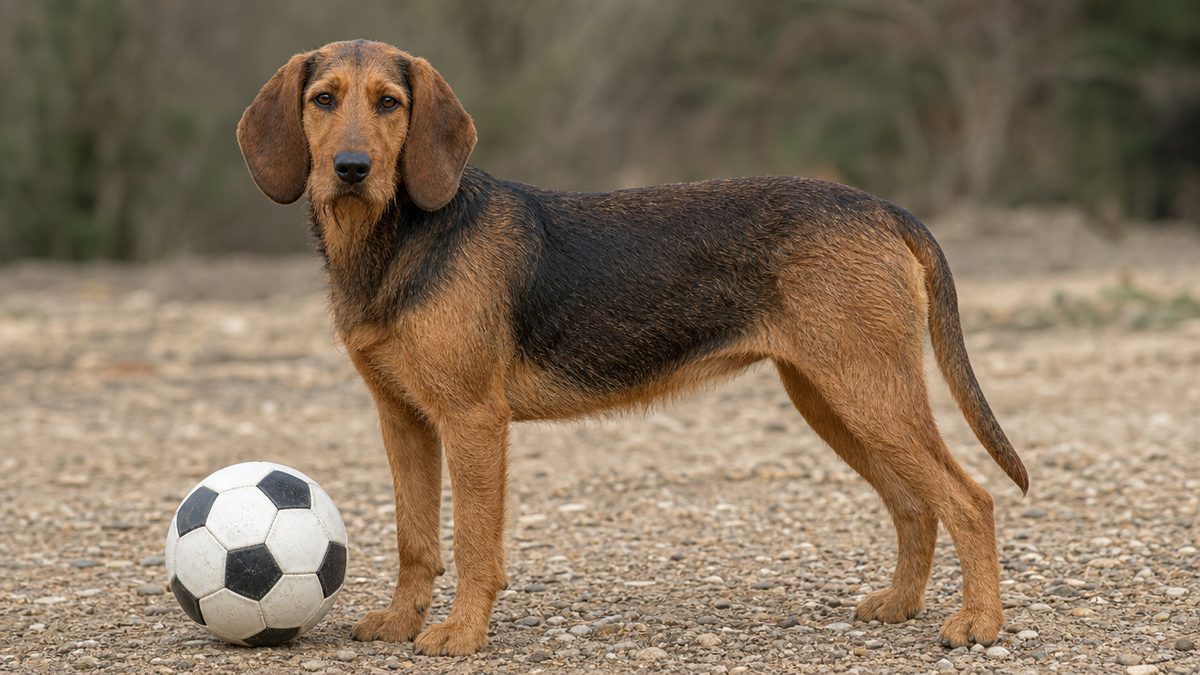
Quick answer
The Segugio Italiano a Pelo Forte is the rough-coated Italian scent hound registered as FCI breed 198, accepted definitively in 1956 and therefore 37 years older as a registered breed than the short-coated Segugio at 337. It stands 50 to 60 cm, carries a coat up to 5 cm long with a beard under the lips, and has no published Indian price at all.
This page reports published veterinary literature, registry documents and Indian government instruments. It is not veterinary advice and it cannot diagnose your dog. Heat, ear disease under a rough coat and canine leishmaniasis are the three risks that matter most here, and all three need a registered veterinarian rather than a web page. Consult your nearby vet before acting on anything you read, treat collapse or a temperature above 40 C as an emergency, and take weight loss with skin lesions over the muzzle or foot pads to a clinic the same week.
Segugio Italiano a Pelo Forte at a glance
What the Segugio Italiano a Pelo Forte is, and how its own standard describes it
The Segugio Italiano a Pelo Forte is a medium-sized rough-coated Italian scent hound built to fit inside a square, registered by the Federation Cynologique Internationale as breed standard 198 in Group 6, Section 1.2, subject to a working trial, and bred to hunt hare and wild boar.
Three characteristics identify it: a square outline on light bone, a long divergent head with a slightly convex muzzle, and a harsh coat no longer than 5 cm carrying a beard under the lips. The first two it shares with its short-coated sibling. The third is why it is a separate breed.
The standard opens with a description of construction rather than of appearance. It calls for a dog of medium proportions whose body fits into a square, harmonious as to size and harmonic in proportion to the profiles, well balanced, perfectly symmetrical, well built, with lean shapes, well muscled and without trace of fat, making him capable of following game from dawn to dusk. That last clause is the design brief. Height from ground to withers equals the length of the body from point of shoulder to point of buttock. Head length reaches four tenths of the height at the withers. Chest depth is slightly less than half the height at the withers.
The head carries the breed's signature. Seen from above the skull presents an elongated ellipse; in profile the upper longitudinal axis is moderately divergent in relation to the axis of the muzzle, and the muzzle's upper profile is slightly convex, which the AKC calls a Roman nose. The occipital protuberance is distinct but slightly recessed, perceptible only by touch. The muzzle width reaches 17 percent of the length of the head. The nose is always black, and the eyes are large and luminous, of dark ochre colour, with a look the standard describes as soft and proud with a veil of sadness.
The numbers, straight from the standard
| Clause | What the standard says |
|---|---|
| Height at withers, males | 52 to 60 cm |
| Height at withers, females | 50 to 58 cm |
| Height tolerance | Plus 2 cm only, for excellent dogs |
| Weight, males | 20 to 28 kg |
| Weight, females | 18 to 26 kg |
| Head length | Four tenths of the height at the withers |
| Ear length | 66 to 70 percent of the length of the head |
| Chest depth | Slightly less than half the height at the withers |
| Croup | Considered to be horizontal |
| Hock height from ground | Not exceeding 27 percent of the height at the withers |
| Hindleg length | About 90 percent of the height at the withers |
| Coat on the body | Not more than 5 cm, definitely rough, with a beard under the lips |
| Dewclaws | None |
| Gait | Preferred gait is the gallop, with walk and trot in the hunt |
Colour is a closed list and it matters when judging a photograph. The permissible colours are the whole range of solid fawn, shading from dark red fawn with black overlay to light fawn, and black and tan. Fawn dogs may carry white on the muzzle and skull, a white star on the chest, and white on the neck, pasterns, hocks, feet and tail tip, though the standard says white is not desirable and the less there is the better. A black and tan dog may carry only a white chest star, and is then called a tricolour Segugio. Slate or lead colour, brindle coat, coffee, brown or liver, and predominant white are all disqualifying.
Two disqualifications catch buyers looking at online photographs. Overshot mouth is disqualifying, and so is a tailless or short tail whether congenital or acquired. In India producing the acquired version is separately illegal: Second Schedule Part II paragraph 6(8) of the Prevention of Cruelty to Animals (Dog Breeding and Marketing) Rules, 2017 states that there shall be no tail docking, ear cropping, de-barking, de-clawing, branding, dyeing or any other kind of mutilation of any body part of the pup, and that any change of appearance by artificial means is strictly forbidden.
A square, lean, harsh-coated hound of 50 to 60 cm and 18 to 28 kg, with a bearded muzzle, a divergent Roman-nosed head, broad flat hanging ears without fringes, a black nose and a solid fawn or black and tan coat. If it has no beard, it is the other breed.
The coat: five centimetres, a beard, and what both do in an Indian monsoon
The rough coat is the entire reason this breed exists separately, and it is the single biggest practical difference between keeping this dog in India and keeping its short-coated sibling. The standard permits hair up to 5 cm on the body, requires it to be definitely rough, and requires a beard under the lips.
Read the coat clause in full, because every downstream care decision comes out of it. On the body the length of the hair should not be more than 5 cm. The hair is definitely rough, except on the head, the ears, the legs, the tail and the muzzle, where it is usually less rough than on the body and the lips. Under the lips, the hair, although of moderate length, forms the so-called beard. The hair on the superciliary arches is of limited length so as not to fall over the eyes or hide them.
Compare that with standard 337, which requires short hair all over the body, straight, of horse-hair texture, dense, close and uniformly smooth, with only a few scattered coarse hairs tolerated. One breed has furnishings and one does not. The skin underneath differs too: 198 calls it close fitting all over the body and somewhat thick, while 337 calls it fine and thin FCI-Standard N 337. That is two documents describing two genuinely different animals under one popular name.
Why the beard is the part that matters in India
A beard is a permanently damp structure on a dog that drinks from a bowl several times an hour in hot weather. In a temperate country that is a minor housekeeping matter. In Kochi at 78.83 percent annual relative humidity, Kolkata at 73.93 and Chennai at 72.39, a wet beard on a dog that also carries a broad sealed ear leather is a maintenance problem with a clinical tail. Nothing in the FCI standard addresses it, because the standard was written for the Apennine foothills.
- Wipe the beard dry after every drink and every meal during the hot and wet months, which is the single habit that separates a clean beard from a stained one
- Use a heavy, wide, shallow bowl rather than a deep one, so the beard sits above the waterline
- Check the skin under the beard weekly for redness, smell or crusting, because a bearded muzzle hides early skin disease
- Dry the coat properly after any bath or wet walk, since 5 cm of harsh hair over somewhat thick skin holds water where a smooth coat sheds it
- Watch the superciliary hair, which the standard limits precisely so it does not fall into the eyes, and trim nothing that the standard already restricts
The ears are furnished differently from the body and the standard is specific about it. The ear is covered with hair of moderate length, shorter than that of the body, less harsh, and without any fringes. So a Pelo Forte with fringed ears is incorrect, and fringing is also the last thing you want on a leather that already seals a canal in a humid climate. The tail is the same story: covered with hair along its entire length, thicker at the base than that of the shorthaired Segugio, but again without any fringes.
What the coat does NOT buy you
It does not make this a cold-weather dog and it does not make it a hardy all-weather one. There is no undercoat clause anywhere in standard 198, and no double-coat description. A 5 cm harsh single coat is protection against thorns and scrub, not against temperature. The published case of a nine-year-old outdoor-kept Italian hound referred in Parma for severe hypothermia after vomiting and diarrhoea, with a heart rate swinging between 20 and 115 beats per minute and a prolonged QT interval of 360 milliseconds, makes the point from the cold end.
Nor does it make the dog low-maintenance. Purina UK's attribute list gives requires grooming once a week and rates grooming needs 3 out of 5 for the Segugio, while also recording some drool. Weekly is the right frequency; the work inside that week is different from a smooth-coated dog's, and in India it is mostly about keeping things dry rather than about removing hair.
No beard means it is not this breed. The beard is written into standard 198 and absent from standard 337, so a photograph of a smooth muzzle under the name Pelo Forte is either the wrong dog or the wrong label.
The senior of the two: why 198 came 37 years before 337
This is the older registered breed of the pair. The FCI accepted the rough-coated Segugio Italiano on a definitive basis on 9 March 1956, and the short-coated one on 11 May 1993, a gap of 37 years inside one federation for two dogs most English sources describe as one breed with two coats.
The register is unambiguous. The FCI's breed record for 198 gives a date of acceptance on a definitive basis of 9 March 1956; the record for 337 gives 11 May 1993 Federation Cynologique Internationale. The date format is proven inside those same documents, where standard publication dates of 12/17/2015 and 11/13/2015 carry a second field above twelve while no first field does. In the FCI's Group 6 index the two sit side by side under Italy in Section 1.2, both marked for the CACIB and both subject to a working trial.
History explains the gap without dissolving it. Dogs of both smooth-haired and rough-haired type were shown at Milan in 1886, and at that time there was no clear distinction of breed. A breed club, the Societa Italiana Amatori del Segugio e del Cane da Tana, was formed at Lodi in 1920 and drew up a standard; it was dissolved in 1939 after restrictive legislation, and by the end of the Second World War the breed was at risk of disappearing. A new society, the Societa Italiana Pro Segugio, was formed in 1947. The rough coat was the one that carried the FCI number through that period, and the smooth coat was separated out much later.
The standard defines itself against its sibling three times
This is the strongest internal evidence that the FCI treats them as a pair rather than as a duplicate. Standard 198 makes three explicit comparisons to the short-coated dog inside its own text, and none of them is about coat.
| Clause | What standard 198 says about the short-coated Segugio |
|---|---|
| Muzzle | The sub-orbital region is chiselled, but a little less than in the shorthaired Segugio |
| Tail | Set high, thicker at the base than that of the shorthaired Segugio |
| Temperament | Compared with the shorthaired subjects, he is more reserved, less exuberant, wise, calm and poised for the job |
A standard that says a breed is calmer than another breed is asserting a temperament difference, not a grooming difference. Whether that difference is real in a given dog is another question, and neither standard offers evidence for it. What matters for a reader is that the FCI wrote it down, and that no popular page repeats it.
The two standards also disagree on how hard to punish the same faults
Standard 198 carries a SEVERE FAULTS section listing convergent cranio-facial axes and size over or under the margins indicated by the standard. Standard 337 carries no severe-faults section and lists both of those as DISQUALIFYING FCI-Standard N 337. The height tolerance splits the same way: 198 allows a tolerance of plus 2 cm only, while 337 allows 2 cm above or below FCI-Standard N 337. Bonbeno checked the French texts for a translation artefact and found none, since the French of 198 reads une tolerance de 2 cm en plus and the asymmetry is present in both languages.
The origin stories differ as well. Standard 198's history names two skeletons in perfect preservation from a Lombard necropolis in the province of Verona, identical in conformation to the modern Segugio. Standard 337's history instead traces the breed to primitive hounds of ancient Egypt introduced along the Mediterranean coast by Phoenician merchants FCI-Standard N 337. English Wikipedia dates the Verona find precisely, describing two skeletons of greyhound or scent hound type from a seventh-century necropolis at Povegliano, described in 1995, taller than the modern dog at an estimated 64 cm at the withers.
Ask for the LOI pedigree number and the FCI standard number the dog is registered against. 198 is this breed. 337 is the other one. No photograph and no seller description settles it as cleanly.
Declassified in Britain, thinning in Italy: what the registers actually record
The Royal Kennel Club declassified the Segugio Italiano with effect from 1 October 2020 after recording no new registrations since 2007. In Italy the rough coat registers in four figures but is falling, and it is outnumbered roughly three to one by the short coat.
The British fact is the cleanest registry event anywhere in this breed's paperwork, and it is published by the register itself. On 17 July 2020 the Royal Kennel Club's media centre carried a notice reading, verbatim: At its recent meeting, the Kennel Club Board noted that there had been no new registrations of the Segugio Italiano since 2007. It was therefore agreed that the breed will be declassified under Kennel Club regulation B(3)d with effect from 1 October 2020. Purina UK renders the same event slightly differently in its Fun Facts panel, saying there have not been any litters produced since 2007, and its own navigation label for the breed carries the parenthetical De-classified since 2020.
Note the difference between those two renderings. The register says no new registrations; the brand page says no litters produced. Those are not the same claim, and the register's is the one to quote.
It is the reason no lifespan figure for this breed exists. McMillan 2024 measured UK dogs under primary veterinary care. A breed with no UK registrations after 2007 cannot supply a survival curve, which is why Table S5 carries an N flag and no median for either coat.
The Italian studbook is where the real population lives
In Italy the breed is not rare in the way a British reader might assume, but it is the smaller half of a shrinking pair. New registrations in the national studbook for the rough coat were 1,740 in 2009 and 1,106 in 2015, against 4,500 and 3,647 in the same years for the short coat. So the rough coat runs at roughly a quarter of the short coat's numbers, and both fell by about a fifth over those six years.
| Body | Status | Date or figure |
|---|---|---|
| FCI | Recognised on a definitive basis, standard 198 | Accepted 9 March 1956 |
| ENCI, Italy | Libro genealogico, Codice FCI 198, Gruppo 6 Sezione 1 | One of eighteen breeds on the Razze Italiane page |
| Italian studbook registrations | Falling | 1,740 in 2009, 1,106 in 2015 |
| Royal Kennel Club, UK | Declassified under regulation B(3)d | Effective 1 October 2020 |
| Last recorded UK registration | None since | 2007 |
| American Kennel Club | Foundation Stock Service, merged with the short coat | Admitted at the July 2018 Board meeting |
| McMillan 2024 survival analysis | Considered and excluded, flag N | No median lifespan for either coat |
| Kennel Club of India | No breed list published for any breed | Not a finding about this breed |
The Indian row in that table needs its caveat stated rather than implied. The Kennel Club of India publishes no breed list at all, so a query there returns nothing for this breed and nothing for a common control either. That is a limit of the instrument and not evidence about the breed. What does answer the Indian recognition question is the FCI route: India is a full FCI member represented by the Kennel Club of India, so a breed the FCI holds definitively is a breed the KCI can issue pedigrees against under FCI nomenclature.
The ENCI filing, and one thing it shows about the whole cluster
In Italy the record sits in ENCI's Libro genealogico under Codice FCI 198, Gruppo 6, Segugi e cani per pista di sangue, Sezione 1, Cani da Seguita, with ENCI serving its own Italian translation of the standard credited to Pietro Paolo Condo. ENCI's Group 6 index lists this breed, the short coat, the Segugio Maremmano and the Segugio dell'Appennino as four separate breed records with four separate pages, and its Razze Italiane showcase names eighteen Italian breeds of which five belong to this cluster.
One field in the FCI's own record contradicts the standards, and it is worth flagging because it affects how a figure is adjudicated. The breed record for 198 states that the official authentic language is French. The English standard's header reads Official language (EN), the French standard's header reads Langue faisant foi (EN), and ENCI's Italian translation reads Lingua ufficiale Inglese FCI-Standard N 198, French text Ente Nazionale della Cinofilia Italiana. Three documents say English and the register says French. The same disagreement appears on the short coat's record and does not appear on the two newer Segugi, whose records say English.
Segugio Italiano a Pelo Forte price in India: none published, and the Italian classifieds show what it really costs
No published Segugio Italiano a Pelo Forte price in india exists. The rupee band at the top of the Indian commercial SERP is a euro figure multiplied by 92.5, and the only genuine asking prices for this coat sit on Italian classifieds at 400 and 1,100 euro.
Start with what Google India prints and how it was produced. The AI Mode answer for the commercial query states a range of 1,00,000 to 2,50,000 rupees or more, and in the same answer says that because the breed is exceptionally rare in India you will not find standard local commercial prices for it. Beneath that answer sits a Python block reading `eur_min, eur_max = 1200, 2500` and `rate = 92.5`. Multiply it out: 1,200 times 92.5 is 1,11,000, and 2,500 times 92.5 is 2,31,250. Nothing was observed in India.
Bonbeno publishes no rupee conversion of a euro price, because that is precisely the operation that manufactured the number above.
What the Italian market actually asks, in euros
The Italian classifieds are more useful than any breed blog because they are asking prices from sellers rather than editorial estimates. Subito.it, Italy's general classifieds index, surfaced on the Indian SERP with a result line reading Segugio pelo forte in vendita, and naming 1.100 euro for a Segugio italiano pelo forte and 400 euro for a Segugio italiano at Gubbio in Perugia. Read the Italian formatting carefully: a full stop is the thousands separator there, so 1.100 is one thousand one hundred euro and not eleven hundredths of one.
| Figure | Source | What it actually is |
|---|---|---|
| 1.100 euro | Subito.it classifieds, Italy | A real asking price for a Segugio italiano pelo forte |
| 400 euro | Subito.it classifieds, Gubbio (PG) | A real asking price for a Segugio italiano |
| Rs 1,00,000 to Rs 2,50,000 | Google India AI Mode | EUR 1,200 to 2,500 multiplied by 92.5 |
| Rs 799 | Flipkart | An 18 inch decorative wall sticker |
| Rs 589, from Rs 1,179 | Etsy India | A printable wall art poster |
| No figure | Amazon.in | A German-language breed manual |
| No figure | Any Indian listing for a live animal | None exists on the page |
One Indian-market page for this breed name does exist, and it is filed under the other coat. Purina India serves a breed page at a URL ending segugio-italiano-short-smooth-coat, which returned HTTP 200 on 8 September 2026 under the title Segugio Italiano (Short/Smooth Coat) Dog Breed Information. So the single brand page aimed at Indian readers describes the short-haired breed, and a reader looking for the rough-haired one lands on its sibling. Bonbeno makes no claim about whether a rough-coat Purina page exists, because the only rough-coat URLs tested were assembled rather than followed from the site's own index, and a 404 on a guessed URL proves nothing.
That table is the whole market picture. Three of the seven rows are merchandise, one is a conversion, two are Italian, and the row an Indian buyer actually wants is empty. The composition is the evidence here, not the printed result count, because an exact-phrase Indian query returns only a page or two of results even for a thick commercial breed term.
There is one genuine rescue route, and it is in Italy
The same search surfaced something better than a sale. A rescue post from Canile Rifugio Chieti describes CAMILLO, segugio italiano a pelo forte, castrato e testato, no caccia, no box, solo per vita familiare, which translates as a neutered and tested rough-coated Segugio Italiano, not for hunting, not for kennel life, family home only. That is what the breed's rescue population looks like, and it is a reminder that working hounds are surrendered when they stop working. It is also, unavoidably, in Italy.
Why no Indian supply chain can form
Import of dogs sits at ITC(HS) 01061900, Mammals: Other, marked Restricted. Policy Condition 7 permits import only for a pet dog with a valid pet book and records in the importer's own name, for research by an R&D organisation with a CPCSEA recommendation, or for internal security by the Defence and Police Force. Policy Condition 8 states that import of commercial dogs for breeding or any other commercial activity outside those purposes is not permitted, and paragraph 6 of the notice states that applications for trading or breeding purposes shall be duly rejected. The DGFT's own FAQ closes the last gap: new born puppies of less than 7 months are not to be allowed.
So a person relocating to India after two years abroad may bring their own adult Segugio through one of seven ports. Nobody may lawfully import one to breed from or to sell. The price you cannot find is a price that has never existed. The full route is set out in how to import a dog to India.
Monthly cost of ownership for a 25 kg rough-coated hound in India
Budget roughly Rs 4,000 to Rs 6,500 a month for a 25 kg dog before food quality choices, with a grooming line meaningfully higher than a smooth-coated hound's. Every figure below was read live from the seller's or the corporation's own page on 8 September 2026.
The cost of ownership here is a dog cost, not a breed cost, and saying so honestly matters. There is no Indian purchase price for this breed, so any total that includes one is built on a conversion. What is real and checkable is what a lean 18 to 28 kg dog costs to keep healthy in an Indian city, plus the extra the coat adds.
Parasite control, the largest fixed line
A 25 kg dog sits in the 15 to 30 kg band. NexGard Spectra for that band costs Rs 3,308 for three tablets against an MRP of Rs 3,375, and it is prescription-only. Dosed monthly, that is Rs 1,103 a month, covering the tick and flea role and the roundworm and hookworm role in one product. Drontal Plus for a broader deworming costs Rs 813 a strip of six against an MRP of Rs 838, which is Rs 135.50 a tablet, dosed one per 10 kg, so Rs 271 to Rs 407 per deworming for a dog of this size.
Bonbeno divided both figures by 84.38, 80 and 74 to test for a disguised dollar price. The NexGard pack gives 39.20, 41.35 and 44.70, none of which is a price a seller would print, so it is rupee-native. Both figures also move: an earlier Bonbeno reading of the same Drontal page recorded Rs 754 where it now reads Rs 813. Re-price before you budget.
Where the rough coat costs more than the smooth one
Two lines. First, professional grooming: Vetic's Delhi price list gives bathing from Rs 934, a haircut from Rs 1,359 and a complete bath and styling from Rs 1,869. A smooth-coated Segugio needs only the first of those. A bearded, harsh-coated dog in an Indian monsoon plausibly needs a proper wash and dry rather than a hose-down, which moves the line from the bottom of that list toward the middle. Second, ear and skin problems cost money when they become chronic, and both coats carry the same enormous sealed ear leather.
| Line | Price | Frequency | Monthly equivalent |
|---|---|---|---|
| NexGard Spectra 15-30 kg | Rs 3,308 for 3 | Monthly | Rs 1,103 |
| Drontal Plus deworming | Rs 813 for 6 | Quarterly, 2-3 tablets | Rs 90 to Rs 136 |
| Annual vaccination booster | From Rs 3,199 | Yearly | Rs 267 |
| Anti-rabies alone | Rs 699 | Yearly | Rs 58 |
| Bath, dry and beard care | From Rs 934 | Every 4 to 6 weeks in the wet season | Rs 650 to Rs 950 |
| Delhi pet dog registration | Rs 500 new, Rs 500 renewal | Yearly | Rs 42 |
| Chennai pet licence | Rs 50 | Yearly | Rs 4 |
| Food, mid-range dry | Varies by brand | Monthly | Rs 2,000 to Rs 4,000 |
Vaccination, and a spread worth knowing about
At Vetic, a chain with clinics across several metros, the puppy course starts at Rs 6,499 against a struck-through Rs 8,111, the annual booster starts at Rs 3,199 against Rs 3,806, anti-rabies alone is Rs 699, the 9-in-1 DHPPiL is Rs 899 and kennel cough is Rs 1,349. Those are promotional floors from one chain, and the same chain quotes different course prices on different city pages on the same day, so read them as one data point rather than a market rate.
The municipal route changes the arithmetic completely. Greater Chennai Corporation's pet clinics are listed as providing all treatment and anti-rabies vaccination free of cost for pet animals, and the corporation issued 9,115 pet licences during 2024 at Rs 50 each. Delhi's Municipal Corporation charges Rs 500 to register a pet dog and Rs 500 to renew, with a Rs 100 per month late fee and a one-month grace period after the anti-rabies certificate expires. Municipal fees are the durable numbers on this page; retail prices are the perishable ones.
Indian climate: the coat is the problem, and the humidity is not
This breed's heat tolerance is limited by temperature and by its own coat, not by damp air. Its Italian homeland is more humid than Mumbai, Bengaluru, Pune or Delhi, and between 8 and 12 degrees cooler, so the shock an imported Segugio meets is thermal rather than atmospheric.
Bonbeno queried NASA POWER by explicit latitude and longitude and echoed back the elevation the model reports for each cell, because a grid cell is not a town. Ravenna returns a cell at 12.00 m against a real 4 m and Ferrara 3.68 m against 9 m, so both are standing where the towns are. Chennai returns 48.95 m against 6 m, Delhi 206.37 m against 216 m and Bengaluru 841.72 m against 920 m, all usable. Shimla is not: its cell reads 897.65 m against a real 2,200 m, an error of 1,302 m, so no hill-station figure appears anywhere on this page.
| Place | Annual mean C | Annual RH percent | Hottest month | Peak wet bulb C |
|---|---|---|---|---|
| Ravenna, Emilia-Romagna | 16.12 | 73.66 | August, 25.73 | 20.82 |
| Ferrara, Emilia-Romagna | 14.94 | 73.17 | July, 26.46 | 20.25 |
| Delhi | 25.60 | 45.56 | June, 35.88 | 26.50 |
| Mumbai | 26.77 | 67.39 | May, 31.19 | 25.77 |
| Chennai | 27.95 | 72.39 | May, 31.51 | 26.11 |
| Bengaluru | 23.74 | 67.94 | April, 28.37 | 21.86 |
| Pune | 23.86 | 66.80 | April, 28.93 | 22.97 |
| Kolkata | 25.81 | 73.93 | May, 31.53 | 27.09 |
| Kochi | 27.31 | 78.83 | March, 29.42 | 25.79 |
Read the humidity column first, because the common claim about Mediterranean breeds in India is backwards. Ravenna runs 73.66 percent annual relative humidity and Ferrara 73.17. Mumbai runs 67.39, Bengaluru 67.94, Pune 66.80 and Delhi 45.56. Four of the nine Indian cities in that table are drier than the homeland, and only Kochi at 78.83 percent is meaningfully damper. Saying that Indian humidity will finish this breed is a reasoning error, not a data one.
The heat gap is the real one and it is large. Ravenna's hottest month averages 25.73 C. Chennai's coolest month averages 24.09 C. Delhi peaks in June, not May, at 35.88 C, which is more than ten degrees above anything the homeland sees, and Bengaluru and Pune both peak in April rather than May. The physiologically meaningful comparison is wet bulb, computed with the Stull approximation from mean temperature and mean humidity: Ravenna peaks at 20.82 C, against Kolkata 27.09, Delhi 26.50 and Chennai 26.11. That is a gap of 5.3 to 6.3 degrees of wet bulb.
Where the coat changes the answer
Both Segugio breeds are dolichocephalic in McMillan 2024's own classification, so both have a long nasal passage with a large evaporative surface, which is the opposite of the conformation that makes heat illness so dangerous in short-faced breeds. Where the two part company is insulation. Standard 198 permits up to 5 cm of harsh hair on the body plus a beard and superciliary furnishing; standard 337 requires short, close, uniformly smooth hair with none of it FCI-Standard N 337. More hair over a skin the standard calls somewhat thick is more thermal load, and a wet beard is a small permanent damp patch on the muzzle.
Bengaluru's peak wet bulb of 21.86 C sits about one degree above Ravenna's 20.82 C, and Pune's 22.97 C about two degrees above. If either Segugio has an Indian home, it is the Deccan plateau, not the coast and not the northern plain.
Do not shave the coat to solve this. Nothing in the standard contemplates it, a clipped harsh coat regrows differently, and the coat is protection against sun on a dog with somewhat thick but unpigmented skin under a pale fawn. Manage heat with timing, shade, water and body condition instead.
On body condition specifically, Hall 2020's Scientific Reports paper studied 905,543 UK dogs under primary veterinary care, recorded 395 confirmed heat-related illness events at an incidence of 0.04 percent and a case fatality of 14.18 percent, and found that dogs at or above the mean bodyweight for their breed and sex carried an odds ratio of 1.42, confidence interval 1.12 to 1.80. This breed was not in that study and no breed-specific figure exists for it, so the bodyweight finding is the only transferable one. A Segugio carrying three extra kilos through an Indian May is the case that finding describes.
Indian law reaches the outdoor question directly. Second Schedule Part IV paragraph 21(1) of the 2017 Rules bars keeping in outdoor facilities, without the attending veterinary practitioner's written approval, dogs not accustomed to the temperatures prevalent in the area, breeds that cannot tolerate them such as long-haired breeds in high temperature locations, and sick, infirm, aged or young animals. A 5 cm coat is not what most people mean by long-haired, but an imported Segugio is squarely the first of those three categories.
Temperament and household fit: the calmer of the two, by its own standard
The ideal owner is a hound person with a large secure garden and two hours a day. Standard 198 describes a dog that, compared with the shorthaired subjects, is more reserved, less exuberant, wise, calm and poised for the job, with a friendly, soft and proud expression veiled by a melancholic reflection.
That temperament clause is the most quotable passage in either standard and almost nobody quotes it. In full: the Segugio is perfectly adapted to the most difficult terrains and can be used as well in the mountains as on level ground; very resistant and fast, he works with ardour and passion, alone or in a pack; compared with the shorthaired subjects, he is more reserved, less exuberant, wise, calm and poised for the job; his expression is friendly, soft and proud, yet veiled by a melancholic reflection; his voice is resonant and very harmonious.
Purina UK's attribute list translates the same dog into household terms and is worth reading beside it: dogs suitable for experienced owners, extra training required, enjoys more than two hours of walking a day, medium dog, some drool, requires grooming once a week, chatty and vocal dog, welcomes everyone happily, generally friendly with other dogs, may need additional training to live with other pets, great family dog, needs a large garden. Its Vet Rating block gives family-friendly 5 out of 5, exercise needs 5, easy to train 3, tolerates being alone 3, likes other pets 5, energy level 4, grooming needs 3 and shedding 3.
The ideal owner, stated plainly
- Households with a large and very secure garden, which is Purina UK's own phrasing and not a euphemism
- Households that can supply two hours of walking, running and scent work a day, which Purina UK calls the bare minimum
- Households with older children, since Purina UK recommends outdoorsy homes with older children who can tolerate long walks and drooly hounds
- Households with neighbours who will forgive a voice the standard calls resonant and very harmonious
- Households willing to keep more than one, because Purina UK notes that one Segugio is likely to be lonely and several will be happier
- Apartments with no fenced outdoor space, because free running is the half of the exercise requirement that cannot be improvised
- Households wanting a first dog, since Purina UK files the breed under dogs suitable for experienced owners
- Households with cats, rabbits or poultry, because Purina UK notes the breed may need additional training to live with other pets
- Households out for ten hours, since the same source rates tolerance of being alone at 3 out of 5
- Households that want a quiet dog, which no scent hound bred to speak on a line will ever be
One correction to make about that famous soft expression. The AKC calls the Segugio Italiano loyal and personable, of great stamina and impeccable intelligence, with a gentle and docile demeanour, neither aggressive nor shy but courageous with a cautious nature, and says plainly that it is not a bold breed. None of that describes a guard dog, and buyers who read watchdog into the size will be disappointed. Vigilance and a loud voice are not the same as protection.
Reserve is not shyness, and India makes the difference bigger
The standard's word is reserved and the AKC's is cautious. A Segugio that has met few people looks aloof; one that has met almost nobody looks frightened. The AKC's remedy is early socialisation to prevent a shy or timid hound. In an Indian city that means deliberate, planned, pleasant exposure in the puppy months to lifts, horns, two-wheelers, delivery riders, umbrellas, crowds, temple noise and other dogs, because urban India is denser and louder than the terrain this dog was shaped in.
Calmer indoors than its short-coated sibling, if you believe its own standard, and gentle with family either way. Both of those depend entirely on the dog having already run. Two hours short of that, the temperament clause stops describing the animal in your flat.
Training: easy in the house, unwinnable against a live scent
To train this breed, build the recall before the nose matures and then stop relying on it outdoors. The AKC calls the Segugio Italiano eager to please and quick to learn but says it needs a consistent and firm handler, and that like many hounds it is best kept on lead outside a fenced area.
Indoor training is genuinely easy and the sources agree. The AKC describes a dog that is eager to please and learns quickly with a consistent and firm handler. Purina UK rates ease of training 3 out of 5 and adds extra training required, which is a fair summary: the obedience goes in, the specialism does not go away. Sit, down, stay, mat settling, crate work, loose-lead walking and handling for grooming all establish in the first six months.
The recall problem
A hound bred for hare and wild boar follows a line at speed, and standard 198 gives the preferred gait as the gallop, with walk and trot forced on it by the work. Once committed the dog is acting on information you cannot perceive. That is why the professional advice is a fence rather than a better recall. In India the stakes are higher than in Italy, because an unfenced park, maidan or colony road ends at traffic and a galloping hound does not check.
- Weeks 8 to 16: build a recall on a long line in a low-scent space, paying every time and never calling the dog off a scent you cannot win
- Weeks 12 to 20: socialise deliberately to Indian urban noise, lifts, autos, delivery riders, doorbells and other dogs, which the AKC names as the guard against a timid hound
- Months 4 to 8: teach an emergency stop or down as a second brake, because a stop sometimes catches a dog a recall cannot
- Months 6 to 12: start scent games and tracking as the legitimate outlet, which is the only work this breed finds genuinely rewarding
- Month 12 onward: keep a 10 to 15 metre long line permanently for unfenced spaces and stop treating that as a failure
Buy the long line before you buy anything else. It is the single piece of equipment that makes the rest of the plan possible in an Indian city.
Give the nose a job, especially indoors
Scent work, tracking, find-the-food games and a snuffle mat at mealtimes consume the drive that otherwise goes into barking at the corridor. Purina UK specifically suggests the breed would excel at scent-based dog games and sports such as scent detection and man-trailing, and notes it is likely to enjoy group walks with people and dogs. The great advantage of scent work in India is that it can be done on a cool floor indoors at two in the afternoon, which no amount of walking can.
Barking is a management problem and not a training failure. The standard treats the voice as a working virtue, resonant and very harmonious, because a hound out of sight has to be followed by ear. Training can teach a reliable settle, desensitise alarm barking at corridor noise, and stop the barking earning attention. It cannot make the dog quiet by nature, and Purina UK simply lists chatty and vocal dog as an attribute.
One legal note for anyone buying from an Indian breeder rather than importing. The 2017 Rules permit only out breeding and line breeding, and prohibit in breeding, defined as breeding between relatives of the second to fourth grade in straight or side line within the first four generations, and incest breeding, defined as mating between parents and children or between brother and sister. A breeder who volunteers that they doubled up on a champion three generations back has told you something about compliance as well as genetics.
Never call the dog off a live scent you are going to lose. Every failed recall teaches the dog that your voice is optional. Walk over and collect it on the long line instead, and keep the recall word for situations you can win.
Exercise needs: two hours is the floor, and Indian timing does the rest
Two hours of walking, running and following a scent is the bare minimum of daily exercise for this breed, which is Purina UK's own wording. In most Indian cities from March to October that has to be split across dawn and after dark, because the middle of the day is unusable.
The figure is not invented for a breed page. Purina UK states that the Segugio Italiano is a dog with incredible stamina and that two hours out walking, running, following a scent is the bare minimum of daily dog exercise, and rates exercise needs 5 out of 5. The AKC's version is a brisk 30 to 45 minute walk plus one to two hours of free roaming a day. The standard's own language is a dog capable of following game from dawn to dusk. Three sources, one requirement.
The Indian timing problem, in numbers
Chennai's coolest month averages 24.09 C, which is roughly the homeland in high summer, and its hottest averages 31.51 C with a peak wet bulb of 26.11 C. Delhi peaks in June at 35.88 C. Those are whole-day means, so afternoon readings run well above them. The workable schedule in a plains city for eight months of the year is a long walk before sunrise, a second after dark, and indoor scent work in between.
| City type | Morning | Evening | Midday substitute |
|---|---|---|---|
| Chennai, Mumbai, Kochi, Kolkata | 60 min before sunrise | 60 min after dark | Indoor scent games, 20 to 30 min |
| Delhi, Ahmedabad, Hyderabad | 60 min before sunrise | 60 min well after dark | Indoor work plus a cool floor |
| Bengaluru, Pune | 60 to 75 min, wider window | 60 min | Shaded garden roaming |
| Any city, monsoon weeks | Shortened, dry the coat and beard after | Shortened, dry the coat and beard after | Longer indoor work |
Free running is the hard half to supply in India, and Purina UK is explicit that this breed needs a large and very secure garden. A dog park, a fenced terrace, a society lawn whose gate actually closes, or a rented plot are the realistic options. A long line on an open maidan is a compromise and a good one, but it is not the same thing.
What under-exercise looks like, and the company problem
It does not look like a sad dog. It looks like barking at the corridor, chewing, digging at the door, pacing and an inability to settle in the evening. Purina UK adds a second failure mode that most breed pages miss: one Segugio is likely to be lonely, and several Segugios will be happier but will require more room. This is a pack breed, and a single Segugio left alone in an Indian flat for a working day is being asked to do something it was never selected for.
On heat and intensity, keep the dog lean. Hall 2020 found dogs at or above the mean bodyweight for their breed and sex carried an odds ratio of 1.42 for heat-related illness, with a case fatality of 14.18 percent across 395 events in 905,543 dogs. The breed was not in that study, so that bodyweight factor is the only transferable finding, and it is the one an Indian owner can actually act on.
Frantic panting that does not slow when the dog stops, bright red gums, unsteadiness, vomiting or collapse. Move to shade, wet the coat with cool water rather than iced water, and get to a vet. In the largest published study of canine heat-related illness the case fatality was 14.18 percent.
Grooming: once a week on the coat, every day on the beard, and the ears are the real work
Groom this breed weekly and dry it constantly. Purina UK's figure is grooming once a week with grooming needs rated 3 out of 5, but in Indian conditions the daily job is keeping the beard, the coat and the ear canals dry rather than removing hair.
Start with what the standard permits, because it bounds what you should do. Hair on the body is not more than 5 cm and definitely rough, less rough on the head, ears, legs, tail and muzzle; under the lips it forms the beard; and on the superciliary arches it is of limited length so as not to fall over the eyes. Nothing in that clause asks for clipping, scissoring or shaping, and there is no undercoat clause to strip out. Purina UK rates shedding 3 out of 5 and grooming needs 3 out of 5.
The weekly routine, and the daily one
- Brush the body coat once a week with a firm bristle or slicker, working with the lie of the harsh hair rather than against it
- Wipe the beard dry after every drink and every meal in the hot and wet months, which is the single most useful daily habit for this coat
- Check the skin under the beard and around the lips weekly for redness, smell or crusting, because furnishings hide early skin disease
- Lift and hold each ear leather open for thirty seconds weekly, looking for redness, wax, smell or head shaking
- Dry the ear canals after every bath, swim and wet walk with a vet-approved drying solution, never with cotton buds
- Trim nails as needed and check the teeth, since the 2017 Rules impose no dental requirement and nobody else will remind you
The ears deserve their own paragraph because the geometry is unforgiving. The standard requires an inset of moderate width at the level of the zygomatic arches, hanging, triangular, flat along almost their entire length, very broad, 66 to 70 percent of the length of the head, with a cartilage that although thin must be rather rigid and an insertion characterised by a torsion that draws the ear forward without allowing it to relax, fold over or curl. That is a broad rigid flap sealed against the head over a canal.
The AKC gives the correct instruction without saying why it matters more here: the ears should be cleaned regularly, kept dry and flipped over regularly to allow air into the canals to prevent ear infection. That is a monthly habit in a temperate country. In Kochi at 78.83 percent annual relative humidity, Kolkata at 73.93 or Chennai at 72.39, it is a weekly one, and the difference between catching otitis externa in days and treating it for months.
Bathing, and what not to do
Bathe when the dog is dirty rather than on a schedule, which in an Indian city means roughly every four to six weeks in the wet season and less often otherwise. Vetic's Delhi list gives bathing from Rs 934, a haircut from Rs 1,359 and a complete bath and styling from Rs 1,869. This breed needs a proper wash and a proper dry, not a styling. The dry is the part that matters: a 5 cm harsh coat over skin the standard calls somewhat thick holds water, and a damp dog in Indian warmth is a skin problem waiting to start.
Do not clip the coat back for summer. Nothing in the standard contemplates it, a clipped harsh coat regrows with a different texture, and the coat is also sun protection over pale skin. Manage heat with timing, shade, water and body condition, which are the levers that actually work.
Ten minutes brushing, thirty seconds per ear with the leather held open, a look at the skin under the beard, nails and teeth. Add a beard wipe after every drink and a drying solution after every wet walk from June to September. That is the whole job.
Health: two ranking pages say there are no known problems, and both predate the evidence
The Segugio Italiano has at least one breed-specific inherited disease, identified by the Canine Genetics Centre at Cambridge in August 2025 and found in no other breed. The AKC says the breed has no known health defects on a page last modified in 2019, and Purina UK calls it a robust breed with no widely recognised specific health concerns.
The finding first. An Italian veterinary ophthalmologist examined a family of Segugio Italiano dogs and found three dogs in one litter with glaucoma, together with short limbs, abnormal dentition and skull shape, and very patchy coats. The affected dogs were clear on the centre's in-house panel of known inherited eye disease variants, so two of them and their unaffected dam were whole genome sequenced.
The sequencing found a candidate variant in the gene behind human GAPO syndrome, which stands for growth retardation, alopecia, pseudoanodontia and ocular abnormalities. The clinical signs in the dogs and in GAPO-affected humans completely overlap; only 60 human cases have ever been reported; and the disease is deadly and drastically reduces life expectancy. The variant has been validated in a cohort of Segugio Italiano dogs and against the genomes of nearly 2,000 dogs, segregates perfectly and is present only in this breed. A manuscript is in preparation and a DNA test is being designed.
This is a research-group announcement, not yet a peer-reviewed paper. And the report says Segugio Italiano without naming a coat, so it does not say whether the affected litter was 198 or 337. That ambiguity is itself a consequence of the two breeds being written about as one. Ask any breeder whether the Cambridge test has been released and whether their stock has been screened.
Now set that against the ranking pages. The AKC states, in full, that at this time the Segugio Italiano has no known health defects, on a page whose own article:modified_time metadata reads 18 August 2019. Purina UK states that the Segugio Italiano dog is a robust breed with no widely recognised specific health concerns. Both statements predate the Cambridge work, and the AKC's also predates the 2016 report of a nonsense mutation in the myeloperoxidase gene causing hereditary myeloperoxidase deficiency in an Italian hound dog.
The whole literature, counted, and why it hides
The literature is small and split across two names. Searching PubMed for Segugio Italiano in title or abstract returns 2 records; the bare word Segugio returns 4; and the English name Italian Hound returns 6 more with no overlap between the sets. The FCI's own English name for this breed, Italian Rough-Haired Segugio, returns 0, with a quotedphrasesnotfound warning. Controls in the same session gave Labrador Retriever 1,109 and Bracco Italiano 5, while Spinone Italiano returned 0, which is a useful reminder that a zero is a fact about a name.
| Year | What it reports | Dog described |
|---|---|---|
| 2002 | Cerebellar granuloprival degeneration, granule cells lost, Purkinje cells normal | 7-month-old male Italian hound |
| 2006 | Focal tetanus diagnosed on electromyography, recovered over four months | 4-year-old male Italian hound |
| 2008 | Anaplastic subcutaneous sarcoma with giant cells, massive metastasis | 7-month-old female Italian hound |
| 2009 | Leishmania amastigotes found in peritoneal fluid, ELISA positive | 5-year-old female Italian hound |
| 2016 | Nonsense mutation in the myeloperoxidase gene | Italian hound dog |
| 2018 | Symptomatic leishmaniasis, antimonial plus allopurinol | 10-year-old Italian Segugio |
| 2020 | Haematological and biochemical reference intervals | 123 Segugio Italiano blood donors |
| 2025 | Hypothermia with atrial fibrillation and a J wave | 9-year-old outdoor Italian hound |
Not one of those eight records says which coat the dog carried. Every case report calls it an Italian hound or an Italian Segugio. So the entire published clinical literature for both FCI breeds is indistinguishable at the breed level, which means anything on this page describing 198 specifically comes from the standard and the registers, not from the medicine.
The blood-work paper, the most usable thing here
A 2020 study built reference intervals from 445 clinically healthy client-owned adult blood-donor dogs aged 2 to 8 across five hunting breeds, of which 123 were Segugio Italiano, the largest group, alongside 156 Ariegeois, 64 Bracco Italiano, 52 Bleu de Gascogne and 50 Briquet Griffon Vendeen. It found significant differences from established laboratory intervals in 12 haematological and serum biochemical analytes, publishing new reference intervals for haematocrit, MCH, MCHC, RDW, platelets, monocytes, eosinophils, albumin, urea, creatinine, AST and ALT for at least one breed.
That matters at an Indian clinic. A working hound's normal values are not a Labrador's, and a panel read against a general canine reference interval can send a healthy Segugio into an unnecessary work-up or mask a real problem. The paper is free to read in PubMed Central; print it for your vet at the first blood test.
Leishmaniasis, which is the India-relevant one
Two of the eight records are canine leishmaniasis, and both were diagnosed by serology. A 10-year-old Italian Segugio born in Torino and living in Romania presented with progressive weight loss and lesions over the muzzle, foot pads and tarsal joints, with polyarthritis and lymphadenopathies; the ELISA was positive while light microscopy of a popliteal lymph node smear failed to find the amastigotes, and it was treated with pentavalent antimonial for eight weeks and allopurinol for eight months. A 5-year-old female Italian hound was diagnosed from about 200 mL of peritoneal effusion containing amastigotes inside macrophages, and the effusion resolved within days of starting meglumine antimoniate and allopurinol.
India has the parasite and the sand fly vectors, so this belongs on an Indian page. The vector evidence from the breed's own part of the world is concrete: a three-year survey in eastern Sicily captured 9,095 sand flies and found Phlebotomus perniciosus at 14.4 percent of the catch in the Iblei mountains. Bonbeno publishes no Indian prevalence figure here, because the available Indian numbers come from clinic caseloads of already-suspected dogs and would describe a different population from the one your dog would join.
What nobody has measured
There is no median lifespan for either coat. McMillan 2024 lists the pair as a single merged row in supplementary Table S5 reading Segugio Italiano Pelo Raso and Pelo Forte, flagged N, meaning considered and excluded from the survival analysis, and the breed is absent from Table S3 entirely. That exclusion is normal for the type, since only 7 of the 65 scent-hound rows carry a Y flag, and it has a specific cause here: the Royal Kennel Club recorded no new UK registrations after 2007 and declassified the breed with effect from 1 October 2020.
So the circulating figures, 11 to 13 years from the AKC and 10 to 14 from Purina UK, rest on no dataset. There is likewise no hip or elbow screening scheme covering the breed anywhere. Bonbeno tried to read OFA's breed list on 8 September 2026 and could not: the attributes both pages depend on returned nothing and a Labrador control returned zero from the same pages in the same session, so the instrument was broken and no OFA claim is made here in either direction.
Feeding and nutrition: keep it lean, and feed the dog in front of you rather than the working dog on the label
Feed this breed to hold it lean, because its standard requires a dog well muscled and without trace of fat, and because carrying weight above the breed mean is the only heat-illness risk factor from the literature that transfers to it.
The standard is explicit about condition. It asks for a construction that is well balanced, perfectly symmetrical, well built, with lean shapes, well muscled and without trace of fat, and describes a lower profile rising gradually towards a lean abdomen that is never tucked up, with flanks that are slender and never fleshy. Ribs should be easy to feel under the harsh coat, which is harder to judge by eye on this coat than on the smooth one. Use your hands.
The AKC's nutrition advice needs qualifying rather than repeating. It says that for optimum performance the Segugio Italiano should be fed a high protein, low fat diet specifically made for performance dogs, and that for less active dogs the owner should consult a veterinarian. That first sentence is written for a hunting dog working full days. An Indian pet Segugio doing two hours of walking is the second case, and a performance formula fed to a dog that is not performing is simply surplus calories.
Why this is a heat decision
Hall 2020's Scientific Reports analysis of 905,543 UK dogs under primary veterinary care found that a bodyweight at or above the mean for the breed and sex carried an odds ratio of 1.42, confidence interval 1.12 to 1.80, for heat-related illness, against an incidence of 0.04 percent and a case fatality of 14.18 percent across 395 events. This breed was not modelled and no breed-specific odds ratio exists for it, so the bodyweight factor is the only transferable finding. In India it converts body condition from an aesthetic question into a risk control.
| Stage | Target condition | Meals a day | Priority |
|---|---|---|---|
| 8 to 16 weeks | Growing, ribs easily felt | 4 | Steady growth, never rapid |
| 4 to 8 months | Waist visible from above | 3 | Joint-safe growth rate |
| 8 to 14 months | Approaching 18 to 28 kg by sex | 2 | Muscle without fat cover |
| Adult male, active | 20 to 28 kg per the standard | 2 | Lean, ribs felt without pressing |
| Adult female, active | 18 to 26 kg per the standard | 2 | Lean, ribs felt without pressing |
| Adult, Indian summer | Same, fed away from the heat | 2, early and late | Water and timing over quantity |
| Senior, 8 years plus | Slightly lighter | 2 | Protein maintained, calories reduced |
Practical Indian notes, including one specific to the beard
Feed away from the heat of the day. A meal just before or after the coolest walk sits better than an afternoon one, and it keeps a deep-chested dog from exercising on a full stomach. Water should be constantly available and refreshed rather than topped up, because a bowl standing in Indian warmth all day is a culture medium.
The bowl itself matters more for this coat than for any other. A deep bowl soaks the beard at every drink, and a soaked beard in humid weather stays soaked. Use a heavy, wide, shallow bowl so the beard sits above the waterline, and wipe the muzzle dry after meals. That single habit prevents most of the beard staining and skin irritation owners of bearded breeds complain about.
Do not use food to solve a boredom problem. A hound barking at the corridor because it got forty minutes instead of two hours does not need a larger dinner. Scatter feeding and snuffle mats turn the same calories into nose work, which is the outlet the breed was actually selected for, and they can be done indoors at the hottest hour.
Bonbeno publishes no monthly kibble figure for this breed. Indian retail food prices move fast enough that a number written today is wrong within weeks, and a monthly total is arithmetic from a grams-per-day figure that depends entirely on the food you pick. Price the bag you intend to buy, divide by its own feeding guide, and treat the parasite and vaccination lines in the cost section as the stable part of the budget Vetic Pet Clinic, dog vaccination page.
The first year, month by month, with the Indian dates that bind
Plan the first year around three fixed points: the eight-week floor Indian law sets on any sale, the socialisation window that closes near four months, and the growth period during which a long-legged hound must not be over-exercised on hard ground.
Indian law sets the earliest date and it is worth knowing by rule number. Rule 8(1)(a) of the Prevention of Cruelty to Animals (Dog Breeding and Marketing) Rules, 2017 requires every breeder to ensure that pups less than eight weeks in age are not sold, and Second Schedule Part III paragraph 8(9) states that all pups shall be vaccinated starting at seven to eight weeks and usually completed at eighteen weeks. A six-week-old puppy offered in India is an offence you can name.
| Age | What is happening | What you do about it in India |
|---|---|---|
| Under 8 weeks | Legally unsaleable in India | Refuse the puppy and report the breeder |
| 8 to 10 weeks | Home, vaccination course begins | Book the puppy course, budget from Rs 6,499 |
| 10 to 14 weeks | Socialisation window open | Lifts, autos, doorbells, crowds, other dogs, on purpose |
| 14 to 16 weeks | Window closing, course completing | Anti-rabies, then municipal registration |
| 4 to 6 months | Nose switches on, recall degrades | Long line becomes permanent outdoors |
| 4 to 8 months | Adult coat texture coming through | Start the weekly brush and the daily beard wipe now |
| 6 to 9 months | Growth plates still open | No forced running, no stair work, no jumping |
| 9 to 12 months | Adult height nearly reached | Build stamina gradually in cool hours only |
| 12 to 18 months | Filling out to 18 to 28 kg by sex | Hold condition lean, ribs easily felt |
Register once the anti-rabies certificate exists, because the registration hangs on it. Delhi charges Rs 500 for a new pet dog registration and Rs 500 to renew, with a Rs 100 per month late fee and a one-month grace period after that certificate expires, and the certificate is valid for a maximum of one year tied to the vaccination date. Chennai charges Rs 50 for a pet licence and issued 9,115 in 2024.
Two published cases that are specifically about young dogs
Both of the youngest dogs in this breed's literature were seven months old, and neither survived, which is worth knowing not as a prediction but as a reason not to wait. A seven-month-old female Italian hound presented with anorexia, dyspnoea, weight loss and two subcutaneous masses; radiographs showed multiple opacities in the lungs, thorax, liver and spleen; the owner elected euthanasia and post-mortem confirmed massive metastatic spread of an anaplastic sarcoma with giant cells. A seven-month-old male had progressive ataxia and head tremor that began at three months and was found at necropsy to have a severely atrophied cerebellum with almost complete loss of granule cells.
The transferable lesson is about timing and not about this breed. A lump on a growing puppy, or a gait that gets worse rather than better between three and seven months, is a same-week veterinary appointment.
The wound risk on a scrub-working coat
One more hazard belongs here because it is common in India and it appears in this breed's own literature. A four-year-old male Italian hound was presented with severe spasticity of both thoracic limbs that worsened with external stimuli, and electromyography showing doublets and simultaneous agonist and antagonist activity supported a presumptive diagnosis of focal tetanus; the dog recovered gradually over four months on antitoxin and antibiotics. A harsh coat hides punctures well. Part the hair and look after any session in scrub, clean what you find, and treat a limb that goes rigid rather than lame as an emergency.
Weeks 10 to 14. Everything you expose the puppy to in that window is free and everything you skip costs years. In an Indian city that means lifts, horns, two-wheelers, delivery riders, umbrellas, crowds and other dogs, in short pleasant doses, before the window closes.
Head to head: the rough coat against its own family and against what India can supply
Against its short-coated sibling this is the bigger, calmer, higher-maintenance dog with the more forgiving standard. Against the other two Italian Segugi it is the tallest and the only one whose coat makes it a separate breed. Against a Beagle it loses on availability outright.
Take the family first, since English Wikipedia resolves the bare name Segugio Italiano to a disambiguation page listing four separate breeds, and ENCI's Group 6 index carries the same four as four separate records with four separate pages Ente Nazionale della Cinofilia Italiana.
| Breed | FCI no. | Males, cm | Weight, kg | Outline | Coats in the standard | Brindle allowed |
|---|---|---|---|---|---|---|
| Segugio Italiano a Pelo Forte | 198 | 52 to 60 | 20 to 28 males | Square | One, rough only | No, disqualifying |
| Segugio Italiano a Pelo Raso | 337 | 52 to 58 | 18 to 28 both sexes | Square | One, short only | No, disqualifying |
| Segugio Maremmano | 361 | 48 to 54 | 16 to 23 males | Rectangular, 11/10 | Two in one standard | Yes |
| Segugio dell'Appennino | 375 | 44 to 50 | 10 to 18 | Rectangular, 11/10 | Two in one standard | No |
That table holds the structural oddity of the whole group. This breed's coat makes it a separate FCI breed with its own number. The Segugio Maremmano's two coats and the Segugio dell'Appennino's two coats each sit inside one standard as varieties, and the Appennino's standard says outright that mating is possible between them. One federation, one section of one group, two opposite solutions to the same problem.
Bonbeno checked the FCI's own crossing register, because presence in it presupposes a single breed. The List of Breed Varieties That Can Be Crossed, issued after the FCI General Committee meeting in Helsinki in February 2019, contains Segugio zero times, against in-document controls of Podengo at 8 hits, Dachshund at 13 and Caniche at 28. For this pair that absence is consistent with the two-breed reading. It proves nothing about the Maremmano or the Appennino, both of which are provisional and one of which was recognised in 2026, after the register was issued.
Against the Pelo Raso, the choice that matters if both were available
| Clause | Pelo Forte, 198 | Pelo Raso, 337 |
|---|---|---|
| Definitive FCI acceptance | 9 March 1956 | 11 May 1993 |
| Height, males | 52 to 60 cm | 52 to 58 cm |
| Height, females | 50 to 58 cm | 48 to 56 cm |
| Height tolerance | Plus 2 cm only | 2 cm above or below |
| Weight | Split by sex, 20-28 and 18-26 kg | One range, 18 to 28 kg |
| Coat | Up to 5 cm, rough, with a beard | Short, smooth, horse-hair texture, no beard |
| Skin | Somewhat thick | Fine and thin |
| Croup | Considered horizontal | About 10 degrees below horizontal |
| Hindleg length | About 90 percent of height | About 93 percent of height |
| Convergent axes | Severe fault | Disqualifying |
| Oversize | Severe fault | Disqualifying |
| Stated temperament | More reserved, less exuberant, calm | Steady but not very outgoing |
| History given | Lombard necropolis near Verona | Egyptian hounds via Phoenician merchants |
For an Indian household the short coat is the easier dog, and the reason is grooming and moisture rather than heat physiology. Both are dolichocephalic and both start from the same good position on nose length. The rough coat adds a beard that stays wet, furnishings that hold humidity, and a body coat of up to 5 cm over skin the standard calls somewhat thick FCI-Standard N 337. Against that, this breed's own standard claims it is the calmer of the two, which if true is worth something in a flat.
Against what India can actually supply
| Dog | Available in India | What it gives you | What you give up |
|---|---|---|---|
| Segugio Italiano a Pelo Forte | No, import route only | A bearded square hound with a huge nose and a 1956 standard | Availability, any Indian price, any lifespan data |
| Segugio Italiano a Pelo Raso | No, import route only | The same dog with an easier coat for Indian humidity | The same availability problem |
| Beagle | Yes, widely | The same nose-first temperament and a measured median lifespan | Size, stamina, the long-legged outline |
| Indian Pariah Dog | Yes, free from any shelter | Heat adaptation nothing imported can match | The pedigree and the specific hunting style |
| Bracco Italiano | No, import route only | An Italian breed that does have a McMillan median | It is a pointer, and needs the same two hours |
| Italian Greyhound | Occasionally | Nothing this breed offers, despite what Google suggests | Everything: it is a 7 to 14 pound toy sighthound |
That last row is not a joke. Google India's People also ask panel for the query italian rough haired segugio, which is this breed's own FCI English name, opens with the question Is the Italian Greyhound a good pet?, and the AI Overview expanding it discusses Italian Greyhound bone fragility, difficult housebreaking and cold sensitivity throughout. A buyer following that panel is being shown a toy sighthound in place of a 28 kg working scent hound.
The honest recommendation is the Beagle. It is one of only seven of the 65 scent-hound rows in McMillan 2024's Table S5 carrying a Y flag and therefore a measured median lifespan, it is buyable in every Indian metro, and it has the same nose-first character, the same recall problem and the same need for a fence, in a smaller body. If what you want is this breed's character rather than its papers, the Beagle supplies most of it and is actually here.
Six mistakes Indian buyers make with the rough-coated Segugio
The commonest mistake is buying a rupee price that does not exist. The rest follow from reading one merged internet identity as though it described a single dog with a single set of numbers and a single coat.
1. Believing the rupee band at the top of the results
The band of 1,00,000 to 2,50,000 rupees is a euro figure of 1,200 to 2,500 multiplied by 92.5, and the answer prints that multiplication in a code block below itself while separately stating that no standard local commercial price exists. Anyone quoting a rupee price for a Segugio in India is quoting a conversion or quoting nothing. What is real is the Italian classifieds market at 400 to 1,100 euro for this coat.
2. Buying the wrong breed because the photograph looked right
The beard settles it and nothing else does reliably. Standard 198 requires hair up to 5 cm, definitely rough, with the hair under the lips forming the so-called beard; standard 337 requires short hair uniformly smooth with no beard at all FCI-Standard N 337. A smooth-muzzled dog sold as a Pelo Forte is the other breed. Ask for the LOI pedigree and the FCI standard number, 198 or 337.
3. Applying the AKC's or Purina's measurements to this breed
The AKC publishes one height range of 19.5 to 24.5 inches for males, which is 49.5 to 62.2 cm, for a breed it registers as one; that is wider than either standard at both ends. Purina UK gives 50 to 60 cm for males, and 50 is below both standards' floor of 52 FCI-Standard N 198 FCI-Standard N 337. Check a dog against the standard it is registered under, not against a merged range.
4. Trusting two pages that say there are no health problems
The AKC says the breed has no known health defects on a page last modified 18 August 2019, and Purina UK calls it a robust breed with no widely recognised specific health concerns. Since then the Canine Genetics Centre at Cambridge has identified a novel GAPO-like variant causing glaucoma with short limbs, abnormal dentition and patchy coats, validated it against nearly 2,000 dog genomes and found it in no other breed. A statement of absence carries the date it was written.
5. Assuming Indian humidity is the problem
It is not, and the numbers run the other way. Ravenna averages 73.66 percent annual relative humidity and Ferrara 73.17, against Mumbai 67.39, Bengaluru 67.94, Pune 66.80 and Delhi 45.56. The homeland is more humid than most of urban India. What India adds is heat: Ravenna's hottest month is 25.73 C while Chennai's coolest is 24.09 C, and the peak wet bulb gap runs to more than six degrees. Plan for heat and for a beard that stays wet, not for damp air in the abstract.
6. Leaving one Segugio alone all day
This is a pack breed and the sources say so. Purina UK notes that one Segugio is likely to be lonely and that several will be happier though they will need more room, and rates tolerance of being alone 3 out of 5. The standard describes a dog that works alone or in a pack with ardour and passion. A single hound in an Indian flat for a ten-hour working day, under-exercised and vocal by design, is the commonest route to a rehomed dog.
Trying to import a puppy. The DGFT FAQ states that new born puppies of less than 7 months are not to be allowed, and Policy Condition 8 bars import of commercial dogs for breeding or any other commercial activity, with applications for trading or breeding to be duly rejected.
Adoption and responsible sourcing: what is lawful here, and what to do instead
Adopt rather than import, because there is no lawful route into India for a Segugio puppy and no Indian breeder can lawfully produce one. The only lawful arrival is an adult pet dog travelling with its own owner, and the breed's actual rescue population is in Italy.
The law closes the question. Import of dogs sits at ITC(HS) 01061900, Mammals: Other, marked Restricted. Policy Condition 7 permits import only for a pet dog with a valid pet book and relevant records in the importer's own name, for research by an R&D organisation with a CPCSEA recommendation, and for internal security by the Defence and Police Force. Policy Condition 8 states that import of commercial dogs for breeding or any other commercial activity outside those purposes is not permitted, and paragraph 6 of Trade Notice 22/2022-23 says applications for trading or breeding purposes shall be duly rejected.
Entry is limited to the airports and seaports of Delhi, Mumbai, Chennai, Hyderabad, Bengaluru and Kolkata and, since October 2024, Kochi airport, with quarantine at the government quarantine station of those ports where required Department of Animal Husbandry…. The DGFT's FAQ closes the last gap: dogs for commercial purposes like breeding are not allowed, and new born puppies of less than 7 months are not to be allowed.
Who could lawfully have one in India
- Someone returning to India after two years or more abroad, bringing their own adult dog as passenger baggage with a pet book in their own name
- Someone holding a DGFT import authorisation obtained on documented justification through the Department of Animal Husbandry and Dairying
- An R&D organisation with a CPCSEA recommendation, which is not a pet-ownership route
- The Defence or Police forces, which is also not a pet-ownership route
Nobody else. If a seller in India offers you a Segugio Italiano a Pelo Forte puppy, either the dog is not this breed, or the sale is unlawful, or the listing does not exist. The third is the most likely, because the Indian commercial SERP for this breed returns a wall sticker, a poster and a German-language book and no live animal at all.
The rescue route, which is real and is in Italy
The breed does have a rescue population, and the same search that turned up the classifieds turned up a shelter post. Canile Rifugio Chieti advertises CAMILLO, segugio italiano a pelo forte, castrato e testato, no caccia, no box, solo per vita familiare, meaning a neutered and tested rough-coated Segugio, not for hunting, not for kennel life, family home only. That is what happens to working hounds that stop working, and it is the most honest place to acquire one. It is also, unavoidably, in Abruzzo rather than in India.
What to check if a dog is genuinely in front of you
- Ask for the LOI pedigree number and the FCI standard number, 198 for this breed and 337 for the short coat
- Look for the beard, since hair under the lips forming a beard is written into 198 and absent from 337
- Check the ears carry hair shorter and less harsh than the body and NO fringes, which the standard requires
- Check the tail is full length, since a tailless or short tail whether congenital or acquired is disqualifying and docking is illegal in India
- Check the nose is black and the muzzle profile slightly convex rather than concave, since a concave muzzle is disqualifying
- Ask whether the Cambridge DNA test for the GAPO-like variant has been released and whether the parents were screened
- Ask for the anti-rabies certificate before anything else, because the municipal registration hangs on it
On breeding practice, the 2017 Rules bind any Indian breeder. Only out breeding and line breeding are permitted; in breeding, defined as breeding between relatives of the second to fourth grade in straight or side line within the first four generations, and incest breeding, defined as mating between parents and children or between brother and sister, are both prohibited; and breeding to create new breeds of dogs or unusual looks is strictly prohibited.
The alternative, said plainly
If what you want is a lean, hardy, nose-driven dog that can handle an Indian summer, India already breeds one and gives it away. An Indian Pariah Dog is heat-adapted in a way nothing from Emilia-Romagna will ever be, costs nothing from a shelter, and needs the same fenced space and the same two hours a day. If you want a registered scent hound with paperwork and a measured lifespan behind it, a Beagle is available in every Indian metro.
This page exists to describe a breed accurately, not to help anyone acquire one. There is no lawful route to a Segugio Italiano a Pelo Forte puppy in India, no published Indian price, and no Indian rescue population. Adopt an Indie, or choose a breed that is genuinely here.
Segugio Italiano a Pelo Forte questions people actually ask, including the one Google gets wrong
What is the average size of a Segugio Italiano?
It depends which of the two registered breeds you mean, which is why this question has no single answer. FCI standard 198, the rough coat, gives males 52 to 60 cm and females 50 to 58 cm, with weights of 20 to 28 kg and 18 to 26 kg. FCI standard 337, the short coat, gives males 52 to 58 cm and females 48 to 56 cm, with a single weight range of 18 to 28 kg for both sexes.
How do you pronounce Segugio?
The American Kennel Club renders it Say-gu-joe Italiano and records that the breed is nicknamed the SEGIT, pronounced see get. Segugio is simply the Italian word for a hound, its plural is segugi, the breed's plural form is Segugi Italiani, and houndsmen in Italy are called Segugist.
Is the Italian Greyhound a good pet?
That question is about a different breed, and the fact that Google returns it first for this breed's own FCI English name is the point. Searching italian rough haired segugio on Google India returns a People also ask panel opening with the Italian Greyhound, and an AI Overview discussing bone fragility and housebreaking. The Italian Greyhound is a 7 to 14 pound toy sighthound. This dog is a 20 to 28 kg working scent hound with a rough coat.
Is the Segugio Italiano a Pelo Forte the same breed as the Pelo Raso?
No. The FCI holds them as two breeds with two numbers, 198 and 337, two standards and two acceptance dates 37 years apart. This one is the senior partner, accepted on a definitive basis on 9 March 1956 against the short coat's 11 May 1993. The AKC registers a single breed and then states on the same page that they are considered different breeds in some countries.
What is the Segugio Italiano a Pelo Forte price in India?
No published Indian price exists for either coat. The rupee band Google India prints for the query is a euro figure of 1,200 to 2,500 multiplied by 92.5, and the answer prints that multiplication in a code block below itself. What is real is the Italian classifieds market, where Subito.it currently surfaces asking prices of 400 euro and 1,100 euro for this coat.
Why did the Kennel Club declassify the Segugio Italiano?
Because nobody was registering any. The Royal Kennel Club published a notice on 17 July 2020 recording that its Board had noted there had been no new registrations of the Segugio Italiano since 2007, and that the breed would be declassified under Kennel Club regulation B(3)d with effect from 1 October 2020. Purina UK renders the same fact as no litters produced since 2007.
How long does a Segugio Italiano a Pelo Forte live?
Nobody has measured it. The AKC states 11 to 13 years and Purina UK states 10 to 14, neither with a dataset. McMillan 2024, the largest UK longevity study, merges the two coats into one supplementary-table row and flags it N, so it produced no median. That absence follows directly from a UK register that recorded no new registrations after 2007.
Does the rough coat cope with Indian heat better or worse than the short coat?
Worse, and the difference is the coat rather than the dog. Standard 198 allows hair up to 5 cm on the body, definitely rough, with a beard under the lips; standard 337 requires short hair uniformly smooth all over with no beard. More hair and more furnishings mean more insulation and more trapped moisture. Both breeds are dolichocephalic, so both start from a better position than any short-faced breed.
Does the Segugio Italiano a Pelo Forte have inherited diseases?
Yes, and the two pages that rank say otherwise. The AKC states the breed has no known health defects on a page last modified in August 2019, and Purina UK calls it a robust breed with no widely recognised specific health concerns. In August 2025 the Canine Genetics Centre at Cambridge reported a novel variant causing glaucoma with short limbs, abnormal dentition and patchy coats, validated against nearly 2,000 dog genomes and found in no other breed.
Is the Segugio Italiano a Pelo Forte legal to import into India?
An adult pet dog is importable, a puppy is not, and a breeding dog is not. Import falls under ITC(HS) 01061900, Restricted, and Policy Condition 7 permits only a pet dog with a valid pet book in the importer's own name, research imports with a CPCSEA recommendation, and Defence or Police use. Applications for trading or breeding are duly rejected, and puppies under seven months are refused.
How much does it cost to keep a 25 kg hound in India each month?
Budget roughly 4,000 to 6,500 rupees a month before food quality choices. Monthly tick, flea and worm cover with NexGard Spectra for a 15 to 30 kg dog costs 1,103 rupees, a deworming with Drontal Plus costs 271 to 407, an annual vaccination booster starts at 3,199, Delhi charges 500 rupees to register a pet dog and Chennai charges 50 for a licence.
What is the difference between the two Segugio standards, apart from the coat?
Severity, mostly. Standard 198 lists convergent cranio-facial axes and oversize as SEVERE faults; standard 337 lists both as disqualifying. Standard 198 allows a height tolerance of plus 2 cm only; standard 337 allows 2 cm either way. Standard 198 calls the skin somewhat thick where 337 calls it fine and thin, gives a horizontal croup where 337 slopes about 10 degrees, and traces the breed to a Lombard necropolis near Verona where 337 traces it to ancient Egypt.
Compare with similar breeds
Segugio Italiano a Pelo Forte sits in 1 Bonbeno group. Each one compares it directly against the breeds it is genuinely an alternative to, on the same figures.