
Breed profile
Greater Swiss Mountain Dog: The Largest Swiss Sennenhund
The largest of the four Swiss Sennenhund breeds, a bleeding disorder that ranks it first in the OFA database, and why the Rs 4 to 7 lakh figure on India's ranking pages is a house number rather than a price.
Quick answer
The Greater Swiss Mountain Dog is the largest of the four Swiss Sennenhund breeds, held under FCI Standard 58 at 65 to 72 cm for males and 60 to 68 cm for females. No verifiable Indian rupee price for the breed exists, its FCI standard orders hind dewclaws removed in a country where de-clawing is forbidden, and it is a cold-climate draught dog that suits almost nowhere in India below the Himalaya.
This page summarises published veterinary research and registry screening data for general information. It is not a diagnosis and it is not treatment advice. Consult a registered veterinarian about your own dog before acting on anything here, and treat a distended abdomen with unproductive retching, sudden collapse, or unexplained bleeding after surgery in this breed as an emergency.
Greater Swiss Mountain Dog at a glance
What the Greater Swiss Mountain Dog is, from its own breed standard
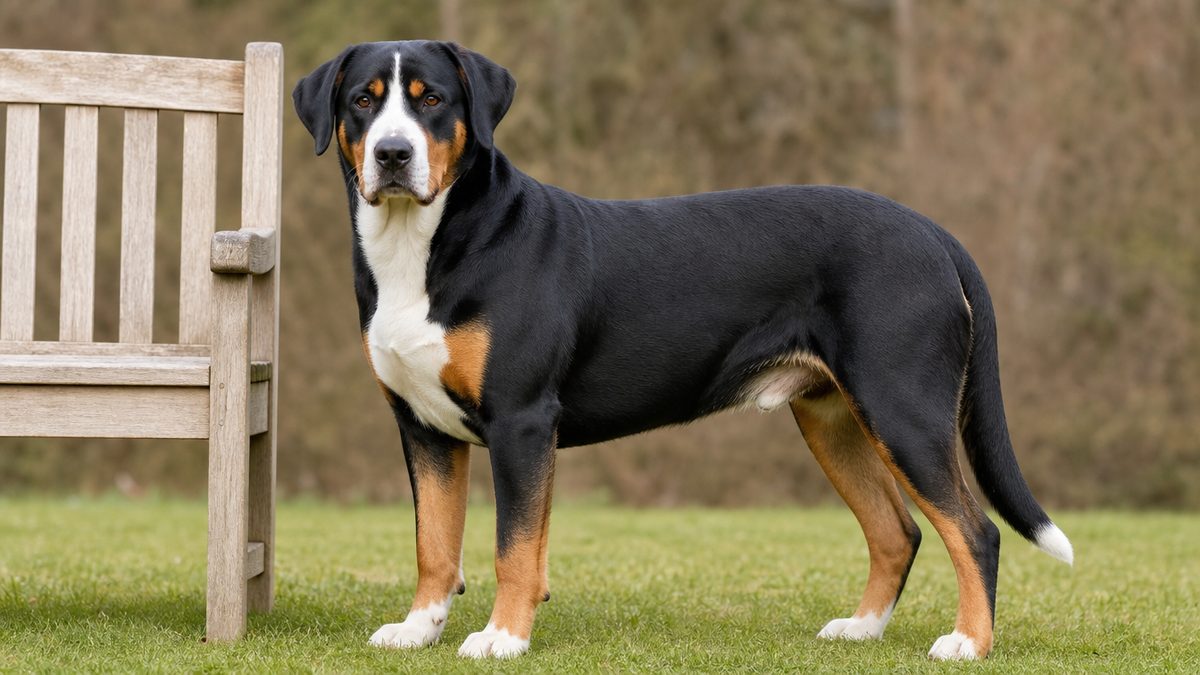
The Greater Swiss Mountain Dog is a large tricolour Swiss watch and draught dog held under FCI Standard 58, standing 65 to 72 cm at the withers for males and 60 to 68 cm for females. Its German name, Grosser Schweizer Sennenhund, is the authentic one, and the FCI's own English title for the breed is Great Swiss Mountain Dog rather than Greater.
Get the name right first, because it decides which document you are reading. The FCI nomenclature entry for breed number 58 prints the breed as GROSSER SCHWEIZER SENNENHUND, with the English title GREAT SWISS MOUNTAIN DOG, the French GRAND BOUVIER SUISSE and the Spanish GRAN BOYERO SUIZO. Sennenhund means the dog of the Senn, the Alpine herdsman and dairyman, so all four Swiss breeds share the second half of the name. The Orthopedic Foundation for Animals files the breed as GREATER SWISS MOUNTAIN DOG and records that the Kennel Club in Britain lists it as GREAT SWISS MOUNTAIN DOG, which is the same dog under two English spellings.
The breed's registry facts are short and checkable. It sits in FCI Group 2, Section 3, Swiss Mountain- and Cattledogs, country of origin Switzerland, official authentic language German. The FCI accepted it on a definitive basis on 13 August 1954, and the currently valid standard was published on 25 March 2003. It is not subject to a working trial. The American Kennel Club recognised it in 1995 as its 137th breed and places it in the Working Group.
What the standard actually specifies
The standard describes a tricolour, sturdy, heavy boned and muscular dog that presents endurance and agility in spite of its size and weight, with a distinctly obvious difference between the sexes. Four proportions are fixed rather than described. Body length measured from the point of the shoulder to the point of the buttock stands to height at withers as 10 to 9. Depth of chest to height at withers is 1 to 2. Length of skull to length of muzzle is 1 to 1, and width of skull to width of muzzle is 2 to 1.
| Point | What the standard says |
|---|---|
| Height at withers, males | 65 to 72 cm |
| Height at withers, females | 60 to 68 cm |
| Weight | Not specified anywhere in the standard |
| Body length to height | 10 : 9 |
| Coat | Double coat, thick outer coat of medium length, dense undercoat as dark grey or black as possible |
| Colour | Typically tricolour, main colour black with symmetrical reddish-brown and clean white markings |
| Tail | Reaching to the hocks, pendulous in repose, never curled or tilted over the back |
| Eyes | Hazel to chestnut brown, almond-shaped, medium size |
| Temperament | Self-confident, alert, watchful and fearless in everyday situations, medium temperament |
The standard prints no weight at all. That matters, because every Indian page selling the breed prints one. The American Kennel Club's breed page gives 115 to 140 pounds for males and 85 to 110 pounds for females, which is 52 to 64 kg and 39 to 50 kg. The Indian page ranked first for the price query prints 45 to 70 kg without saying for which sex. A third gives a single band of 130 to 135 pounds covering both sexes, which is a 2 kg spread for a breed whose males and females differ by more than 10 kg. Where a page cites the AKC and then prints 105 pounds as the male minimum against the AKC's own 115, as one ranking Indian page does, it has not read the source it names.
Where the breed came from, and where the usual story goes wrong
The standard's own historical summary is specific and short. In 1908, at Langenthal, at the jubilee show marking 25 years of the Schweizerische Kynologische Gesellschaft, two short-haired Bernese Mountain Dogs were presented to Professor Albert Heim. He recognised them as representatives of the old, vanishing, large mountain dog or butcher's dog. In 1909 the SKG recognised them as a separate breed and registered them in volume 12 of the Swiss stud book, and in 1912 the club for Grosse Schweizer Sennenhunde was founded. The first FCI standard was not published until 5 February 1939. The Swiss club still gives 1912 as its founding year and describes itself as a section of the SKG.
Set that against what the co-ranking pages say. One states the breed traces to approximately 2,000 years ago as a direct result of the Roman invasion of Europe, that Roman mastiffs crossed with local Swiss working dogs produced the four Sennenhund breeds, and that the Greater Swiss was the first of the four with the other three developed from it. None of that appears in the breed's own standard, which describes a rediscovery of two dogs at a show in 1908 and says nothing about Rome or about which Sennenhund came first. Bonbeno reports the club and standard version because it is documented, and reports the Roman version as a traditional account that its own registry does not carry.
One detail from the standard is worth keeping for later, because it collides with Indian law. Under Hindquarters it reads: 'Dewclaws must be removed except in countries where their removal is forbidden by law';. The German authentic text says the same thing in the same place. India is one of those countries, and the section on Indian law below sets out why.
How rare the breed actually is, in registry numbers
Germany registered 96 Grosser Schweizer Sennenhund puppies in 2025, against 55,053 puppies across all breeds, so the breed accounts for 0.17 percent of German pedigree registrations. That figure has fallen by 73.6 percent since 2014, and it is the closest thing to a supply number this breed has anywhere outside Switzerland.
The Verband fuer das Deutsche Hundewesen publishes a live fifteen-year table of puppy registrations by breed, and it is the most useful rarity instrument available for European breeds because it is a count rather than an estimate.
| Year | Grosser Schweizer | Berner | Entlebucher | Appenzeller |
|---|---|---|---|---|
| 2025 | 96 | 539 | 88 | 74 |
| 2024 | 134 | 602 | 93 | 92 |
| 2023 | 152 | 593 | 133 | 93 |
| 2022 | 228 | 761 | 139 | 114 |
| 2021 | 269 | 901 | 177 | 145 |
| 2020 | 263 | 818 | 166 | 66 |
| 2016 | 357 | 1,001 | 159 | 78 |
| 2014 | 364 | 1,199 | 184 | 80 |
| 2011 | 313 | 1,094 | 98 | 112 |
Three readings come out of that table. The Greater Swiss is falling faster than its siblings in absolute terms, from 364 in 2014 to 96 in 2025. The Bernese outnumbers it 5.6 to one, which is the ratio that explains why a buyer in any market meets Bernese first. And the Entlebucher, which Bonbeno's own page describes as the rarest of the four in Britain, has now drawn level with the Greater Swiss in Germany at 88 against 96, so 'rarest Sennenhund' depends entirely on which country you count in.
Put the German total beside it for scale. All breeds together produced 55,053 registered puppies in Germany in 2025. Ninety-six is 0.17 percent of that. For an Indian reader the number that matters is different and simpler: India registers none, imports none for breeding lawfully, and has no verified population at all.
The search result that could not be read
Bonbeno tried to harvest the People Also Ask box for the Indian query and could not, and the way it failed is worth publishing because the same failure will mislead anyone who does not run a control.
The Bing India results page for 'greater swiss mountain dog price in india' returned HTTP 200, the correct page title, and 'About 84 results'. Every one of its ten organic results was an Amazon corporate page: Amazon.com, the Spanish-language Amazon, Seller Central, Amazon Jobs, Amazon Music, the Amazon sign-in page, hiring.amazon.com, Amazon Web Services, Amazon Business Login and Amazon Kindle. Not one concerned a dog. The 'Searches you might like' strip offered 'india to switzerland flight ticket price', 'swiss pass price' and 'geyser price'.
A result count of 84 for an obscure breed looks exactly like a rarity finding, and it is not one. Bonbeno ran the control the playbook requires, 'labrador retriever price in india', through the identical path minutes later. It returned HTTP 200, the correct title, 'About 159,000 results', and ten Microsoft corporate pages. A control that fails identically proves the instrument was substituting result sets, not that the breed is absent. Nothing is concluded from either page in either direction, and no FAQ question on this page was invented to fill the gap.
An answer engine reading only the target query would have found 84 results, no dog pages, and could reasonably have reported that almost nothing exists about this breed in India. That would be a fabrication with a number attached. The control is what separates a real absence from a broken search, and it costs one extra query.
The rarity conclusion Bonbeno will stand behind comes from registries rather than from search engines. Ninety-six German puppies, no OFA statistics row for any Indian population because none exists, no entry in the largest UK longevity dataset, and a Restricted import classification that bars bringing the breed in to breed or sell. Those are four independent documents saying the same thing, and none of them is a search result.
Greater Swiss Mountain Dog price in India, and why no published figure survives a check
There is no verifiable Greater Swiss Mountain Dog price in india, because there is no verified Greater Swiss Mountain Dog for sale in India. Every rupee figure on the first page of Indian results for this query fails a check that takes under a minute, and this section shows each check so a reader can repeat it.
Say the finding first. Bonbeno pulled the Indian results page for 'greater swiss mountain dog price in india' on 31 August 2026 and opened the top five commercial results. Not one of them showed a Greater Swiss Mountain Dog offered for sale at a stated price. Two showed other breeds, one hid every price behind a sign-up wall, one published a band with no source, and one was a United States breeder's essay about American prices.
| Source | What it publishes | What it actually shows |
|---|---|---|
| Delhi seller, position 1 | Greater Swiss Mountain Dog Price, Buy Puppies in India | Eight puppies in the carousel: two Maltipoos, two Poodles, a Cane Corso, a Goldendoodle, a Rottweiler, a Doxiepoo. Zero Greater Swiss |
| Indian breed site, position 2 | Cost of buying Rs 4,00,000 to Rs 7,00,000 | No source, no listing, and the same Rs 7,00,000 ceiling on its Bernese page |
| National marketplace, position 3 | '3 Result Found' | A Weimaraner in Jaipur, a Border Collie in Pune, a Cavalier King Charles Spaniel in Kochi, all under 'Similar breeds at other locations' |
| Global breed directory, position 5 | Average USD 1,200 to 2,800 | A dollar figure, and a closing sentence comparing it to a Miniature Pinscher |
| US breeder essay, position 8 | USD 3,000 to 4,000 from reputable breeders | Honest, and about the American market rather than the Indian one |
The carousel on the first result deserves naming, because Bonbeno has now recorded the same pattern on eleven pages of that one site. The prices attached to those eight animals are Rs 98,999 three times, Rs 92,599 twice, Rs 94,999, Rs 1,20,000 and Rs 76,499. Rs 98,999 is a house price point, not a breed price. It follows whichever puppy is in stock, and it appears identically on pages for breeds the seller does not stock at all. Anyone quoting Rs 98,999 as the Indian price of a Greater Swiss Mountain Dog is quoting a Maltipoo named Fizey.
The Rs 4,00,000 to Rs 7,00,000 band, tested three ways
The second-ranked page publishes a purchase band of Rs 4,00,000 to Rs 7,00,000. Bonbeno divides any suspicious rupee figure by the rates Indian pages have been caught using, and asks whether the quotient is a price a human would print.
| Rupee figure | Divided by 84.38 | Divided by 74 | Divided by 66.67 | Divided by 80 |
|---|---|---|---|---|
| Rs 4,00,000 | USD 4,740.46 | USD 5,405.41 | USD 5,999.70 | USD 5,000.00 |
| Rs 7,00,000 | USD 8,295.80 | USD 9,459.46 | USD 10,499.48 | USD 8,750.00 |
Read the quotients rather than the ticks. At 84.38 and 74 the figures land on untidy numbers no seller would print. At 66.67 they land on 5,999.70 and 10,499.48, which look close to 6,000 and 10,500, and that test proves nothing at all, because 66.67 is 200 divided by 3, rounded, so 1,000 divided by 66.67 is 14.9993 and any multiple of a thousand lands within a hundredth of a whole number by construction. The same structural weakness applies to 80: 1,000 divided by 80 is 12.5, so every round-lakh figure divides cleanly. Both ends of this band are round lakh figures, so neither the 66.67 test nor the 80 test can discriminate here, and saying so is more useful than reporting a false match.
That leaves the plausibility question, and it is decisive. A reputable United States breeder of this breed publishes USD 3,000 to USD 4,000 as the typical price and warns that puppies advertised at USD 1,000 should raise doubts. At 84.38 that American range is Rs 2,53,140 to Rs 3,37,520. The Indian page's ceiling of Rs 7,00,000 is more than twice the top of the American breeder's own range, for a breed with no Indian supply chain. And the same site prints Rs 3,50,000 to Rs 7,00,000 for the Bernese Mountain Dog, where Bonbeno's own Bernese research found eight live Indian listings between Rs 76,499 and Rs 1,20,000. A ceiling that is identical across two different breeds, and roughly six times the observed price of the one that actually sells, is a template value.
What the honest answer is
No verified Indian sale price for this breed exists. Bonbeno found no listing, no seller-stated figure attached to an actual Greater Swiss Mountain Dog, and no published band with a source behind it. The lawful route to owning one is a personal pet import in the importer's own name, which carries an airfare, quarantine and paperwork cost rather than a shop price. Any Indian rupee figure you are quoted for this breed should be treated as unevidenced until the seller produces the import authorisation.
This is not a gap in the research. It is the answer. Germany, which has the largest European population of the breed outside Switzerland, registered 96 puppies in 2025. The DGFT notice bars importing a dog for breeding or sale outright. Between those two facts, no Indian supply chain for this breed can lawfully form, and a page that prints a confident rupee band is describing something that does not exist.
Cost of ownership for a Greater Swiss Mountain Dog in India
The recurring cost of ownership for this breed in India is driven by three things nobody prints: food for a 52 to 64 kg dog, year-round cooling in a house that would otherwise run fans, and the surgical contingency that a giant breed with a bleeding disorder and a bloat risk demands. The one published Indian monthly expenses figure omits all three.
The single Indian source that publishes monthly expenses for this breed gives Rs 4,900 on a basic lifestyle and Rs 7,650 on a premium one, split as food Rs 3,000 to Rs 4,500, veterinary Rs 1,200 to Rs 1,950 and grooming Rs 700 to Rs 1,200. Bonbeno reports that band because it is the only one that exists, and then says plainly what it leaves out.
| Line | Published Indian figure | What it does not include |
|---|---|---|
| Food | Rs 3,000 to Rs 4,500 | A US breeder of the same breed budgets about USD 60 a month for good food, which is Rs 5,063 at 84.38, before Indian import margins on giant-breed kibble |
| Veterinary | Rs 1,200 to Rs 1,950 | Nothing for a gastropexy, an emergency bloat surgery, a platelet panel before elective surgery, or orthopaedic imaging |
| Grooming | Rs 700 to Rs 1,200 | Correct for a short coat, and the one line that transfers cleanly |
| Cooling | Not listed | A dog rated 1 of 5 for heat tolerance in a metro needs air conditioning through the hot months, which is an electricity line, not a pet line |
| Insurance | Not listed | The breeder's own guidance urges health insurance for the first two years, when most orthopaedic injury occurs |
The food line is where the arithmetic misleads most cheaply. A United States breeder of this exact breed writes that owners should be prepared to spend about USD 60 a month on good quality food, and warns that the breed often does poorly on lower-cost foods laden with fillers and processed grains. Convert that at 84.38 and it is Rs 5,063 a month, above the top of the published Indian food line, before any allowance for the fact that giant-breed kibble in India is largely imported. The published Indian food figure is closer to what a 25 kg dog eats than a 60 kg one.
The costs that actually decide the budget
Three contingencies dominate, and none of them is monthly.
- Bloat surgery. The parent club describes gastric dilatation and volvulus as a life-threatening disorder requiring emergency medical and surgical care, and reports that of 1,161 respondents to an Orthopedic Foundation for Animals health survey covering dogs living from 2008 to 2012, 4.4 percent, or 54 dogs, reported an incidence of bloat or torsion, of which 11 were fatal. Eleven deaths in fifty-four events is a case fatality of one in five among reported events.
- Orthopaedic repair. One documented owner case in the breed ran past USD 10,000 across four limbs, including a total hip replacement and a pin, after a single early injury cascaded through a growing skeleton. At 84.38 that is over Rs 8,43,000, more than the top of the Indian purchase band anyone publishes.
- The platelet contingency. A dog carrying the P2Y12 mutation may need a platelet product or another prophylactic haemostatic before an invasive procedure. Indian veterinary blood banking is concentrated in a handful of metro referral hospitals, so this is a location decision as much as a money one.
Set against that, the grooming line is genuinely small. A short double coat needs brushing rather than clipping, and no trimming or stripping. Rs 700 to Rs 1,200 a month is a fair figure for a dog this size in an Indian metro, and it is the only line in the published band Bonbeno would repeat without qualification.
Take the published Rs 4,900 to Rs 7,650 as a floor, not an estimate. Add the difference between Indian medium-breed and giant-breed kibble at your own retailer, add your summer electricity increment for keeping one room at 24 degrees for six months, and hold a separate contingency equal to at least one emergency abdominal surgery at your nearest 24-hour hospital. If that total is uncomfortable, this is the wrong breed, and that is a useful thing to learn before rather than after.
Can a Greater Swiss Mountain Dog live in the Indian climate
A Greater Swiss Mountain Dog is adapted to a homeland that averages 8.56 degrees Celsius across the year, and Chennai averages 27.95, which is 19.39 degrees warmer. Heat tolerance is the single trait that decides this breed in India, and it is the one no global breed site rates. Bonbeno rates it 1 of 5.
Bonbeno builds the origin figure from satellite climatology rather than from a breed site, because climate pages routinely serve the wrong place. NASA POWER was queried by explicit latitude and longitude and asked to echo back what it served. The query for Bern used 46.948 north, 7.447 east; POWER returned coordinates 7.447, 46.948 at a grid elevation of 752 metres, which is the right valley. Every figure below was obtained the same way, and the returned grid elevation is printed beside each place so a reader can see what the satellite actually measured.
Wet-bulb temperature matters more than air temperature for a dog, because a panting dog cools by evaporation and evaporation stops working as humidity rises. Bonbeno computes it with the empirical expression published by Stull in 2011, applied to each month's mean air temperature and mean relative humidity. That is an approximation, and the honest caveat is that a monthly mean smooths the afternoon peak, so real afternoon wet-bulb readings run higher than the numbers in this table.
| Place | Grid elevation | Annual mean air temp | Annual mean humidity | Annual mean wet-bulb | Warmer than Bern by |
|---|---|---|---|---|---|
| Bern, Switzerland | 752 m | 8.56 C | 80.2 % | 6.56 C | the baseline |
| Zurich, Switzerland | 567 m | 9.07 C | 82.6 % | 7.29 C | 0.51 C |
| Chennai | 49 m | 27.95 C | 72.4 % | 24.04 C | 19.39 C |
| Mumbai | 97 m | 26.77 C | 67.4 % | 22.20 C | 18.21 C |
| Kolkata | 7 m | 25.81 C | 73.9 % | 22.25 C | 17.25 C |
| New Delhi | 206 m | 25.60 C | 45.6 % | 17.80 C | 17.04 C |
| Pune | 636 m | 23.86 C | 66.8 % | 19.43 C | 15.30 C |
| Bengaluru | 842 m | 23.74 C | 67.9 % | 19.48 C | 15.18 C |
| Darjeeling | 1,314 m | 18.42 C | 67.1 % | 14.45 C | 9.86 C |
| Gangtok | 3,240 m | 7.45 C | 73.8 % | 4.92 C | 1.11 C cooler |
| Tawang | 3,175 m | 7.49 C | 79.0 % | 5.43 C | 1.07 C cooler |
Two Indian places out of eleven are cooler than the breed's homeland, and both are Himalayan grid cells above three thousand metres. Everywhere else on that list is between 9.9 and 19.4 degrees warmer on the annual mean. Bengaluru, the Indian city with the best reputation for climate, is still 15.18 degrees warmer than Bern and its annual wet-bulb runs 12.92 degrees higher.
Read the elevation column before you trust a hill-station figure
NASA POWER works on a grid, and a grid cell in the Himalaya averages a valley floor with a ridge. That is why the elevations returned for Indian hill towns do not match the towns. The Gangtok cell came back at 3,240 metres against a town that sits near 1,650, and the Darjeeling cell at 1,314 metres against a town near 2,045. The Shimla cell came back at 898 metres, well below the town, which is why POWER's Shimla reads 21.15 degrees annual rather than the mild figure a visitor expects. Treat the Gangtok and Tawang rows as describing the high ridges above those towns, not the towns. Bonbeno prints the elevation rather than hiding it, because a reader who does not see it will read the wrong conclusion twice: once optimistically for Gangtok, once pessimistically for Shimla.
Why the short coat does not help
The Greater Swiss coat is a double coat with a thick outer coat of medium length over a dense undercoat, and the standard disqualifies a short coat without undercoat. So the insulating layer is required, not incidental. A breed page that reads the visible shortness as heat tolerance is describing the topcoat and ignoring the standard's own requirement underneath. The one Indian page that gives a comfort band puts it at 15 to 25 degrees Celsius, which no Indian metro meets as an annual mean.
The evidence on what heat does to a dog this size is specific. In the VetCompass cohort of 905,543 UK dogs, dogs at or above the mean bodyweight for their breed and sex had 1.42 times the odds of heat-related illness, and dogs over 50 kg had 3.42 times the odds of dogs under 10 kg. A male Greater Swiss weighs 52 to 64 kg, so the whole breed sits inside the top weight band. Neither Hall paper modelled this breed individually, and Bonbeno does not attach a breed-specific odds ratio to it for that reason. The bodyweight finding transfers; a breed effect would be fabricated.
The only plausible Indian places for this breed, month by month
Two Indian locations in Bonbeno's sample come out cooler than the breed's Swiss homeland, and both are high Sikkim and high Arunachal Pradesh. Everywhere else the question is not whether the dog can live there but how many months of the year it must be kept indoors and cooled.
Compare the hottest month rather than the annual mean, because the hottest month is what kills. Bern's warmest month is July at 18.09 degrees Celsius mean and a wet-bulb of 15.13. That is the upper edge of what this breed evolved to work in.
| Place | Warmest month | Mean air temp | Mean humidity | Wet-bulb | Above Bern's worst month |
|---|---|---|---|---|---|
| Bern, Switzerland | July | 18.09 C | 75.2 % | 15.13 C | the baseline |
| Kolkata | June | 29.90 C | 80.4 % | 27.09 C | 11.96 C |
| New Delhi | July | 32.27 C | 62.7 % | 26.50 C | 11.37 C |
| Chennai | May | 31.51 C | 64.5 % | 26.11 C | 10.98 C |
| Mumbai | June | 28.66 C | 79.5 % | 25.77 C | 10.64 C |
| Shimla grid cell | July | 27.66 C | 69.0 % | 23.27 C | 8.14 C |
| Pune | June | 25.63 C | 80.3 % | 22.97 C | 7.84 C |
| Bengaluru | May | 26.97 C | 63.8 % | 21.86 C | 6.73 C |
| Darjeeling grid cell | July | 22.46 C | 89.5 % | 21.12 C | 5.99 C |
| Gangtok grid cell | July | 13.60 C | 89.1 % | 12.36 C | 2.77 C cooler |
| Tawang grid cell | July | 13.67 C | 86.7 % | 12.18 C | 2.95 C cooler |
Kolkata in June sits 11.96 degrees of wet-bulb above the worst month this breed's homeland has ever asked it to work through. That is not a difference of degree. Delhi is close behind at 11.37, and Delhi gets there differently, with a much higher air temperature and much lower humidity, so a dog there loses more water and cools slightly better per breath. Chennai holds its heat across more months than either.
What each city actually means for the dog's day
- Chennai, Mumbai, Kolkata. The annual mean already exceeds the breed's warmest month. Assume a fully air-conditioned indoor life from March to November, walks before 6 am and after 9 pm, and no unsupervised balcony or terrace time in any month.
- Delhi, Pune, Bengaluru. Three to four months are workable at dawn and dusk without cooling. May, June and the monsoon months are not. Bengaluru's reputation buys about two extra tolerable months, not a suitable climate.
- Darjeeling, Shimla, Nainital, Ooty. These are the towns people mean by 'hill station', and the satellite grid smooths them badly. Judge them on the town's own weather station rather than on a grid cell that averages in a river valley, and treat Bonbeno's Darjeeling and Shimla rows as an upper bound on temperature rather than a description.
- High Sikkim and high Arunachal. Gangtok's and Tawang's grid cells, both above 3,100 metres, are the only sampled Indian points where the annual mean and the warmest-month wet-bulb both come out below Bern's. If a Greater Swiss Mountain Dog can be kept anywhere in India on climate alone, it is here, and the practical objection becomes veterinary access rather than temperature.
That last point is the honest resolution, and it is more useful than a flat statement that the breed cannot live in India. It can, in a narrow band of the eastern Himalaya, and almost nowhere else. Those are also the places furthest from a 24-hour hospital that can run an emergency laparotomy on a 60 kg dog with a platelet defect. The climate answer and the veterinary answer point in opposite directions, and a buyer has to pick which risk to carry.
Indian law names heat intolerance, and almost nobody quotes it
One Indian rule speaks to this directly. Second Schedule Part IV paragraph 21(1) of the Prevention of Cruelty to Animals (Dog Breeding and Marketing) Rules, 2017 provides that three categories of dog shall not be kept in outdoor facilities unless the attending veterinary practitioner approves it in writing: dogs that are not accustomed to the temperatures prevalent in the area, dog breeds that cannot tolerate the temperatures prevalent in the area or region in question, such as long-haired breeds in high temperature locations, and sick, infirm, aged or young animals. The same Schedule requires indoor housing temperature to be ambient and comfortable depending on the breeds housed, at paragraph 15, and permits air conditioning as a ventilation method at paragraph 16.
Read the scope carefully before repeating it. Those paragraphs bind breeding establishments registered under the Rules, not private pet owners, so a family keeping one Greater Swiss in a Chennai flat is not governed by paragraph 21. What it does establish is that Indian animal-welfare law already recognises the category this breed falls into, in its own words, and sets a veterinary sign-off as the threshold. A private owner has no such requirement and, by the same token, no such safety net.
The dewclaw clause: where this breed's standard collides with Indian law
FCI Standard 58 instructs that dewclaws must be removed, and Indian law lists de-clawing among procedures that are strictly forbidden. The standard resolves the conflict itself, in its own sentence, and no page ranking in India for this breed mentions either half of it.
Take the two texts in order. Under HINDQUARTERS, General appearance, FCI Standard 58 reads: 'Metatarsus and feet turning neither in nor out. Dewclaws must be removed except in countries where their removal is forbidden by law'. German is the authentic language for this standard, so the English is a translation and could in principle have drifted. It has not. The German text prints 'Afterkrallen muessen entfernt sein, ausser in den Laendern, in denen die Entfernung der Afterkrallen gesetzlich verboten ist', which says exactly the same thing.
Now the Indian text, quoted from the gazette rather than paraphrased. Second Schedule Part II paragraph 6(8) of the Prevention of Cruelty to Animals (Dog Breeding and Marketing) Rules, 2017 reads: 'There shall be no tail docking, ear cropping de-barking, de-clawing, branding, dyeing, injecting substances to enhance visual appeal, performing a surgery or procedure to camouflage or hide any defect or infirmity or any other kind of mutilation of any body part of the pup and any change of appearance by artificial means is strictly forbidden'.
India is a country where the removal is forbidden by law, so the standard's own exception applies and the dewclaws stay on. A Greater Swiss Mountain Dog bred or kept in India should have its hind dewclaws intact, and a breeder who removes them is not following the standard more strictly. They are breaking an Indian rule in order to satisfy a foreign one that expressly did not ask them to.
Cite it the way the gazette numbers it. This is Second Schedule Part II paragraph 6(8), not 'Rule 6(8)'. The Rules themselves run 1 to 13 and their own Rule 6 is a different provision headed 'Requirements to be met by breeders and establishments'; what it does is give the Second Schedule its force. Writing 'Rule 6(8)' sends a reader who looks it up to the wrong text.
Two more clauses that bite on this breed specifically
Second Schedule Part III paragraph 8(10) requires that breeding dogs 'shall have been tested for genetic defects, including hip dysplasia, progressive retinal atrophy, night blindness, hypothyroidism, entropion, ectropion, overshot, undershot jaw (when incisors do not touch or mesh), wry mouth, two or more missing teeth, unilateral cryptorchid or full cryptorchid males'. The word is 'including', so the list is illustrative rather than closed. Three items on it are conditions the Orthopedic Foundation for Animals records in this breed: hip dysplasia at 16.4 percent dysplastic across 4,743 evaluations, entropion in 17 of 1,835 eye examinations, and generalised retinal atrophy in 2 of the same 1,835 Orthopedic Foundation for Animals.
Rule 8(1)(a), a genuine Rule rather than a Schedule paragraph, provides that every breeder shall ensure that 'pups less than eight weeks in age are not sold';. That one is worth knowing because giant-breed puppies are sometimes offered early on the argument that they are already large. Size is not age.
What Indian law does not require, counted across all fourteen pages
| Term | Occurrences in the Rules |
|---|---|
| patella | 0 |
| BAER | 0 |
| deaf | 0 |
| dental or tooth | 0 |
| teeth | 1, inside paragraph 8(10) |
So there is no Indian legal requirement for a patella grade and none for a hearing test, on this breed or any other. Bonbeno states that because sellers cite 'legally required health testing' loosely, and because the Orthopedic Foundation for Animals does hold a patella row for this breed at 821 evaluations and 98.5 percent normal. A screen being available is not the same as a screen being mandated, and the two get merged in sales copy.
One last note on scope, because it is easy to overclaim here. These Rules govern breeders and breeding establishments. They do not create obligations for a private owner who already has a dog. Their value to a buyer is as a checklist for judging the person selling the puppy, and the dewclaw clause is the sharpest item on it, because it is visible on the animal in front of you before any paperwork changes hands.
Temperament, household fit and who should not buy this breed
The FCI standard describes the Greater Swiss Mountain Dog as self-confident, alert, watchful and fearless in everyday situations, good-natured and devoted towards people familiar to him, self-assured with strangers, and of medium temperament. That is a watch dog's description, not a retriever's, and the difference decides the household.
Read the standard's wording closely, because the useful information is in the qualifiers. 'Good-natured and devoted towards people familiar to him' is not the same as friendly with everyone. 'Self-assured with strangers' means neither fearful nor effusive. 'Medium temperament' is the standard's own way of saying the breed is not a high-drive working dog, and it is the phrase that most often gets dropped when a page copies the rest. The standard also lists unreliable behaviour as a fault and disqualifies aggressive or overly shy dogs outright.
The breed's original job explains the shape of that character. The standard gives the utilisation as 'originally watch- and draught dog, nowadays also companion, guard- and family dog', and describes a breed appreciated as a family dog for its calm, reliable temperament. A dog bred to pull a butcher's cart and mind a farmyard is territorial and vocal at the gate, and does not need to run twelve kilometres a day. That is a very different animal from the driving cattle dogs among its siblings.
Temperament with kids, and what the size actually means
Every source that rates this breed rates it well with children, and Bonbeno has no reason to disagree with that. A global breed directory scores it 4 of 5 for child friendliness and describes it as suitable for kids and friendly toward other pets. The loyal, calm, low-reactivity profile is genuine. The caution is arithmetic rather than temperamental: a male weighs 52 to 64 kg, which is more than most Indian nine-year-olds, and a dog that leans affectionately against a toddler on a polished floor knocks the toddler over. Enthusiasm at that mass is a physical hazard even when the intent is friendly.
Apartment living, honestly assessed
One directory rates the breed 3 of 5 for apartment friendliness and adds that they will do okay in an apartment if sufficiently exercised, that they prefer cool climates, and that a small yard is sufficient. The Indian page selling the breed answers the question 'Can they live in Indian apartments?' with 'Yes, if daily exercise and climate control are provided';. Both are technically true and both bury the operative clause. Apartment living for this breed in an Indian metro means a cooled room for most of the year, not a large one. The floor area matters far less than the thermostat, and any page that discusses square footage without discussing degrees has answered the wrong question.
Who this breed suits
- A household that wants a calm, watchful presence rather than a sporting companion. Medium temperament is a feature if you want a dog that settles indoors between two solid walks.
- A home with cool months and cooling in the hot ones. High Sikkim and high Arunachal on climate grounds; anywhere else on air conditioning grounds.
- People who are home. The breed is devoted to its own people and territorial about its own place, so long solitary days suit it badly.
- Someone within reach of a referral hospital. This is the least romantic entry on the list and the one that most often decides the outcome.
Who should not buy one
- Anyone in a hot metro without full-time cooling. A dog rated 1 of 5 for heat tolerance in a city 17 to 19 degrees warmer than its homeland is a welfare problem, not a challenge.
- First-time owners who want an easy dog. Easy to train is not the same as easy to own at 60 kg, and this is an expensive dog to feed, cool and insure.
- Anyone buying on the strength of a rupee price they found online. No such price has been verified, and the pages carrying one are showing other breeds.
- Households wanting a low-allergy dog. No breed is hypoallergenic and the evidence on that is settled. This one is rated a high shedder on the very page selling it.
One temperament note that belongs to the health section but shows up as behaviour first. The parent club describes a breed-specific behaviour called a 'lick fit', in which the dog frantically licks the air or objects and often ingests inappropriate items such as grass, carpet and flooring, and it advises crating the dog without bedding during an episode because of the blockage risk. The club records that the behaviour is thought to be associated with gastric upset. An Indian owner who has never heard of it will read it as anxiety and treat the wrong thing.
Training a Greater Swiss Mountain Dog, and what it resists
Train this breed on consistency rather than pressure, and start before it outweighs you. A global directory rates it 4 of 5 for trainability and describes an eager learner very responsive to its trainer's voice, with the caveat that training must be consistent but not severe. In India the harder problem is not obedience, it is timing the sessions around heat.
The published guidance on method is consistent across sources and matches the standard's temperament description. The breed is handled best with a loving, consistent approach on an even keel, and it needs a clear understanding of what is allowed and what is not. The Indian ranking page says the same thing in different words, that they are intelligent and eager to please, respond well to positive reinforcement, and need early socialisation and obedience work. Bonbeno has no source that contradicts either, and says so rather than manufacturing a disagreement.
The window that actually matters
Weight is the training clock for this breed. A Greater Swiss male reaches 52 to 64 kg, and every skill that depends on physically managing the dog has to be installed while the dog still weighs less than the handler. Loose-lead walking, recall, a settled down-stay and calm greeting behaviour all need to be reliable by about six months, because after that the dog can simply out-pull an adult on a wet Indian pavement. That is the same reason the parent club and Bonbeno both put a socialisation emphasis early: it is not that the breed becomes untrainable, it is that correction becomes a wrestling match.
Socialise deliberately rather than incidentally. A breed whose standard calls it watchful and self-assured with strangers will default to reserved if left to itself, and a reserved 60 kg dog at an Indian apartment gate is a liability. Take the puppy to lifts, stairwells, car parks, watchmen, delivery riders, the sound of a pressure horn and the sight of a cow on a road, all before sixteen weeks, and all in short sessions that end while the puppy is still comfortable.
What this breed resists
- Repetition without purpose. The standard describes medium temperament, and a dog bred to pull a cart and mind a yard is not a border collie that will work a cue forty times for the sake of it. Short sessions with an obvious point work better than drilling.
- Harsh handling. Published guidance is explicit that training must be consistent but not severe. Pressure produces a dog that shuts down rather than one that complies.
- Being asked to work in the heat. This is the Indian-specific one. A training session at 4 pm in a Chennai park is not a training problem, it is an exertional heat-illness risk, and exertional illness was the dominant recorded trigger in the largest study of the condition, at 652 of the 879 events with a trigger recorded.
- Formal drop-off training programmes. Boarding a giant, territorial, heat-sensitive breed with a trainer who has never seen one is a poor trade. Owner-led training with a coach is safer for this dog.
A realistic Indian timeline
| Age | Target | Why the deadline |
|---|---|---|
| 8 to 16 weeks | Name, crate, house training, first socialisation, handling for ears and feet | Handling tolerance now saves a fight at 60 kg later |
| 4 to 6 months | Loose lead, sit and down on cue, reliable recall in a fenced space | The last window where you outweigh the dog |
| 6 to 12 months | Settle on a mat, calm door and gate behaviour, muzzle conditioning for vet visits | Territorial behaviour firms up; muzzle work now makes emergency care possible later |
| 12 to 24 months | Controlled walking in traffic, tolerance of grooming and rectal temperature checks | A dog that accepts a thermometer is a dog whose heat stress you can measure |
That last row is not a training flourish. If you keep this breed anywhere below the Himalaya, the single most useful trained behaviour is standing still for a rectal temperature, because it converts 'the dog seems hot' into a number you can act on. Teach it with food, early, and repeat it monthly so it is boring by the time it matters.
Daily exercise routine, and what happens without one
Plan an exercise routine of 60 to 90 minutes a day for a Greater Swiss Mountain Dog, split into two sessions at the cool ends of the Indian day. Published guidance rates the requirement moderate rather than high, and the Indian constraint is not the quantity but the hour at which it can safely be taken.
The two Indian pages that publish a figure agree on it. One gives an exercise routine of 60 to 90 minutes with a high energy level, the other 90 minutes a day. A global directory scores exercise needs at 3 of 5 and describes moderate exercise with a daily long walk. Bonbeno reports the range as 60 to 90 minutes because three independent sources land inside it, which is a rare thing on this breed.
Understand what the exercise is for. This is a draught breed, built for endurance at a walk under load rather than for speed, and the standard describes balanced movement with good reach and free stride. It does not need sprinting, fetch until exhaustion, or a running partner. A long, steady, weight-bearing walk on a surface that is not scorching does the job.
The Indian timing rule, and why it is not negotiable
Exertional heat illness, meaning heat illness triggered by activity rather than by a hot car, was the dominant recorded trigger in the largest study of the condition: 652 of the 879 events that had a trigger recorded, which is 74.2 percent, against 113 environmental and 46 vehicular. In the companion paper on the same cohort of 905,543 dogs, the event fatality rate was 14.18 percent. Roughly one in seven heat-illness events in that dataset killed the dog.
Weight loads the dice further. Dogs at or above the mean bodyweight for their breed and sex carried 1.42 times the odds, and dogs over 50 kg carried 3.42 times the odds of dogs under 10 kg. A male Greater Swiss at 52 to 64 kg is inside the heaviest band the paper measured. Neither paper included this breed in its breed-level model, so the transferable number is the weight band and Bonbeno claims nothing more.
| City type | Months you can walk normally | Months requiring dawn and night only | Hard limit |
|---|---|---|---|
| Chennai, Mumbai, Kolkata | None on the annual mean | All twelve, in practice | No walking between 9 am and 7 pm from February to November |
| Delhi, Pune, Bengaluru | December to February | March to November | No walking between 10 am and 6 pm from March to October |
| Darjeeling, Shimla, Ooty | October to March | April to September | Judge by the town's own station, not a satellite grid cell |
| High Sikkim, high Arunachal | Most of the year | June to August afternoons | Wet-bulb above 15 C is the line, and these grid cells rarely reach it |
What happens without enough
Two things, and they compound. The first is behavioural: a directory that rates this breed 4 of 5 for playfulness also notes that if they are bored they will invent their own projects, and the parent club's description of a 'lick fit', in which the dog frantically licks and ingests carpet or flooring, is associated with gastric upset rather than with boredom alone. The second is orthopaedic. Osteochondrosis of the shoulder is a developmental disorder of rapidly growing large and giant breeds, attributed to genetics, rapid growth, nutrient excess, trauma and sex, and this breed sits at rank 9 of all breeds in the Orthopedic Foundation for Animals shoulder table with 2.8 percent abnormal across 2,444 evaluations.
Do not add forced running, stairs or jumping before twelve months, and do not let a puppy of this breed exercise to exhaustion on hard ground. The published orthopaedic case that ran past USD 10,000 in this breed began with a single early injury during a growth phase and ended with surgery on all four limbs. Free play on grass, unlimited; repetitive impact, none.
One practical Indian point. Concrete and paved surfaces in an Indian city hold heat long after sunset, and a 60 kg dog walks with four paw pads flat on that surface. Test with the back of your hand for five seconds before you leave. If you cannot hold it there, the walk is not happening, whatever the hour says.
Grooming a short-coated double coat in Indian humidity
Brush a Greater Swiss Mountain Dog once or twice a week and daily through a shed, and never clip or shave it. The coat is the easiest thing about the breed and the most commonly mishandled in India, because owners read a short topcoat as a coat that can be removed.
The standard specifies a double coat consisting of a thick outer coat of medium length over a dense undercoat, and it wants that undercoat as dark grey or black as possible. It permits a short outer coat only if the undercoat is present, and it disqualifies a short coat without undercoat outright. So the undercoat is required by the standard, not an accident of season. That single sentence is the whole argument against clipping.
The routine itself is genuinely light. A slicker or rubber curry once or twice a week lifts dead undercoat, and daily brushing through the two seasonal sheds keeps it off Indian floors. Published guidance rates grooming 1 of 5 for this breed and states that no trimming or stripping is needed. The Indian cost of it is small, at Rs 700 to Rs 1,200 a month for a dog this size, and that is one of the few published Indian figures on this page that Bonbeno would repeat as-is.
Do not shave, and here is the specific reason
The undercoat is the insulating layer and the topcoat is the sun barrier. Shaving removes the barrier and leaves the dog's skin exposed to direct Indian sun, while the dense undercoat regrows unevenly and can trap more heat than before. There is also a shedding point that sellers gloss: the same Indian page that markets the breed rates it High Shedding on its own spec card, and a global directory calls it moderate shedding with heavier sheds in spring and autumn. Those two ratings disagree, and Bonbeno prints both rather than picking. What both agree on is that hair comes off, which is the practical question for an Indian flat.
The monsoon problem the Swiss guidance does not cover
Care advice written for Switzerland assumes a dog dries. A Bern annual mean relative humidity of 80.2 percent sounds comparable to Chennai's 72.4, but Bern's air is 19.39 degrees colder, so it holds far less water and a coat dries. In an Indian monsoon a dense undercoat stays damp for hours after a bath or a walk in the rain. Dry the undercoat down to the skin with a stand dryer or a towel and a fan, do not let it air dry, and check the ear canals and the skin folds behind the elbows. Bonbeno makes the same correction on every double-coated breed it covers, because overseas breed clubs routinely tell owners to towel off and let the dog air dry, which is correct in Europe and wrong in an Indian July.
- Brush twice a week, daily during a shed, with a rubber curry followed by an undercoat rake.
- Bathe roughly monthly, more often in the monsoon only if the dog gets wet and muddy, and dry to the skin every time.
- Check ears weekly, and plug them before a bath. Wet canals in high humidity are how otitis starts.
- Trim nails every three to four weeks, and remember the hind dewclaws stay on in India, so they need trimming too and will curl if ignored.
- Inspect eyes at each grooming session, because distichiasis is recorded in 482 of 1,835 eye examinations of this breed and stiff extra lashes abrade the cornea.
The nail point is not a throwaway. Because Indian law forbids de-clawing and the FCI standard's removal instruction therefore does not apply here Prevention of Cruelty to Animals, an Indian-bred or Indian-kept Greater Swiss will have hind dewclaws that a European-bred one would not. They sit high on the leg, do not wear down on pavement, and grow into the pad if nobody trims them. A groomer who has only handled European-standard dogs of this breed may not think to look.
Coat colour, and one thing worth checking in a puppy
The standard's colour requirement is precise enough to use as a check. The main colour is black, with symmetrical reddish-brown markings between the black and the white on the cheeks, above the eyes, inside the ears, on both sides of the forechest, on all four legs and under the tail, and clean white markings on the head as a blaze and muzzle, running unbroken from the throat to the chest, and on the feet and tail tip. Between the blaze and the reddish-brown markings above the eyes, a band of black should remain. A puppy sold as a Greater Swiss with a long coat, a curled tail, or a base colour other than black is either not this breed or is disqualified from it by the standard's own list.
Health issues in the Greater Swiss Mountain Dog, with the registry numbers
The Greater Swiss Mountain Dog's health issues cluster in four places: a hereditary platelet defect that puts it first of every breed in the Orthopedic Foundation for Animals database on that condition, gastric dilatation with volvulus, splenic torsion the parent club calls rare in every breed except this one, and the joint and eye burden of a fast-growing giant.
Everything in this section is read from the Orthopedic Foundation for Animals published statistics tables, retrieved on 31 August 2026, plus the parent club's own health pages and the peer-reviewed literature. The OFA breed code was read out of OFA's own markup rather than guessed, because a guessed code returns another breed's table with no error at all. It is SMH, printed as data-name="GREATER SWISS MOUNTAIN DOG" against value="SMH", and the control breed in the same list, Labrador Retriever, reads LR as expected.
| Screen | Evaluations | Normal | Abnormal | Breed rank in that table |
|---|---|---|---|---|
| Hips | 4,743 | 81.8 % | 16.4 % dysplastic | 72 |
| Elbows | 4,187 | 87.2 % | 12.5 % | 41 |
| Shoulder (OCD) | 2,444 | 97.1 % | 2.8 % | 9 |
| Eyes (summary line) | 1,835 | 89.2 % | 10.8 % | 19 |
| Receptor platelet disorder | 114 | 63.2 % | 4.4 %, plus 32.5 % carriers | 1 |
| Patella | 821 | 98.5 % | 1.5 % | 100 |
| Thyroid | 207 | 91.8 % | 1.4 % compensative autoimmune thyroiditis | 96 |
| Congenital cardiac | 379 | 100.0 % | 0.0 % | 108 |
Publish the sample size beside every percentage, because these are live registers that move. Bonbeno holds an earlier pull of the same tables in which the patella row read 820 evaluations against today's 821, the shoulder row 2,442 against today's 2,444, and the elbow breed rank 42 against today's 41. A bare decimal quoted from a live register, without its denominator or its date, is not a fact you can check.
The hips row reconciles against its own components. Excellent 17.3 plus Good 51.5 plus Fair 12.9 comes to 81.7 against a printed 81.8 normal, and Mild 12.1 plus Moderate 3.9 plus Severe 0.3 comes to 16.3 against a printed 16.4 dysplastic. Both gaps are one tenth of a point, which is rounding rather than error. The elbow row behaves the same way: Grade 1 10.9 plus Grade 2 1.6 plus Grade 3 0.1 is 12.6 against a printed 12.5.
Bloat, and a figure worth recomputing
The parent club reports that in an Orthopedic Foundation for Animals health survey of Greater Swiss Mountain Dogs living between 2008 and 2012, of 1,161 respondents, 4.4 percent, or 54 dogs, reported an incidence of bloat or torsion, and 11 of those were fatal. Divide it out and the two figures do not agree. 54 divided by 1,161 is 4.65 percent, not 4.4, and 4.4 percent of 1,161 is 51.1 dogs, not 54. One of the two numbers is wrong and the source does not say which. Bonbeno quotes both, flags the discrepancy, and does not silently pick one. What is not in doubt is the 11 deaths, which against 54 reported events is a case fatality of 20.4 percent.
The club also lists the predisposing factors it recognises: a first-degree relative with a history of gastric dilatation and volvulus, aggressive or fearful behaviour, once-daily feeding, rapid consumption of food, and previous splenic disease. That last one is the link to splenic torsion, and it is why the two conditions are treated together on this breed rather than separately.
The conditions the parent club names
- Bleeding issues. The club reports a small number of incidents of excessive bleeding during surgery, after illness or injury, and spontaneous nasal bleeding without trauma, and says a cause has not been determined and the heritability is not known. The published P2Y12 work is narrower and better characterised, and the two are not the same claim.
- Epilepsy. The club states that idiopathic epilepsy can be inherited, 'with Greater Swiss Mountain Dogs commonly afflicted', and that affected dogs can need lifelong medication with periodic blood testing.
- Splenic torsion. Described by the club as occurring by itself 'rare, except in GSMDs', which is an unusually direct statement for a parent club to make about its own breed.
- Urinary incontinence. Described as a common affliction in young growing female Greater Swiss Mountain Dogs and a frequent problem in spayed females of all ages, known but uncommon in males.
- Eye conditions. Cataracts, distichiasis and entropion, all three named by the club and all three present in the OFA detail rows.
The urinary incontinence entry is worth an Indian owner's attention because it is the one that gets misread as a house-training failure. A young female of this breed leaking urine in her sleep is showing a documented breed problem, not disobedience, and the club describes it as usually treatable with medication Aegis Greater Swiss Mountain Dogs.
The P2Y12 platelet mutation, and why it matters most in India
The Greater Swiss Mountain Dog carries a hereditary platelet defect caused by a three base-pair deletion in the gene encoding the P2Y12 ADP receptor, and it ranks first of every breed in the Orthopedic Foundation for Animals receptor platelet disorder table. The dog looks completely normal until it is cut, which is exactly why it is dangerous in a country where no vet has seen the breed.
The original description is a case report from 2011 by Boudreaux and Martin in Veterinary Clinical Pathology, and it is worth reading in the order it happened. A Greater Swiss Mountain Dog bled excessively after a routine ovariohysterectomy and needed multiple transfusions. Her coagulation screening assays, platelet counts and von Willebrand factor antigen activity were all within reference intervals, so every ordinary bleeding test came back normal. Flow cytometry then showed her platelets expressed normal glycoproteins IIb and IIIa and responded to convulxin and platelet-activating factor, but not to ADP. DNA work identified a three base-pair deletion predicted to eliminate a serine from the extracellular domain of the gene encoding P2Y12.
The authors then traced it through the pedigree, and this is the part that makes it a breed problem rather than a case. The mutation was found in the sire, the maternal grand-dam, a maternal great grandparent, a paternal great grandparent and a great-great grandparent, across five generations. The sire was homozygous and had never been identified as having a haemostatic disorder. Two unrelated Greater Swiss tested at the same time were unremarkable.
Tell the surgeon, in these words, that the breed carries a P2Y12 receptor gene mutation affecting ADP-induced platelet aggregation, that routine coagulation panels and platelet counts do not detect it, and ask whether a platelet product or another prophylactic haemostatic should be on hand. This applies to neutering, dental extractions, biopsies and any orthopaedic work, not only to emergencies.
How common it is, from the registry rather than from a case report
The Orthopedic Foundation for Animals runs a receptor platelet disorder database, and the Greater Swiss Mountain Dog sits at rank 1 in it. Across 114 evaluations, 63.2 percent were normal, 32.5 percent were carriers and 4.4 percent were abnormal. Read that carefully: roughly one dog in three of those tested carries a copy. The sample is small by OFA standards, and a screening database is self-selected because people test dogs they intend to breed, so the true population frequency is unknown in both directions. What the number does establish is that this is not a single unlucky family.
The 2011 paper is explicit about the clinical shape of the disorder, and it is the shape that catches people out. P2Y12 is the same receptor that ticlopidine and clopidogrel target in human medicine, so spontaneous bleeding is not expected unless something else contributes. The authors write that the disorder is 'particularly troublesome because spontaneous hemorrhage is absent to mild in affected dogs; however, following routine surgical procedures or trauma, excessive bleeding could occur and have possible fatal consequences';.
Why this is an India-specific risk rather than a general one
Three things compound in India that do not compound in Zurich or Ohio.
- Nobody has seen the breed. With no verified Indian population and 96 registered puppies in the whole of Germany in 2025, an Indian veterinary surgeon has no reason to know a breed-specific platelet defect exists. The information has to come from the owner.
- Routine panels miss it. The index case had normal coagulation screens, normal platelet count and normal von Willebrand factor. A pre-anaesthetic profile in an Indian clinic will look reassuring.
- Canine platelet products are concentrated in a few referral centres. Fresh whole blood and platelet products are available in the large metro veterinary hospitals and thinly elsewhere, so the contingency has to be arranged before the surgery, not during it.
The parent club's own bleeding-issues page describes a slightly different and broader picture, and Bonbeno reports the difference rather than merging the two. The club records a small number of incidents of excessive bleeding during surgery, after illness or injury, and spontaneous nasal bleeding without trauma, and says that despite significant research a cause has not been determined and the heritability is not known. That is a statement about a wider set of bleeding events than the P2Y12 mutation explains. Both can be true: a characterised mutation accounts for some cases, and the club is describing others it cannot yet attribute.
The practical consequence is the same either way. Ask for the platelet result on both parents, and tell your surgeon before the scalpel, not after.
The eye numbers contradict themselves, and both halves are worth knowing
The Orthopedic Foundation for Animals summary line reports 89.2 percent of 1,835 Greater Swiss Mountain Dog eye examinations as normal, while its own detail rows on the same denominator record only 1,049 dogs as normal, which is 57.2 percent. A 32-point gap is too large to be rounding, so Bonbeno publishes both with the arithmetic and quotes neither as the rate.
Here are the two figures side by side, both read from the same page on the same day Orthopedic Foundation for Animals.
| Source line | Denominator | Count | Percentage | Arithmetic check |
|---|---|---|---|---|
| Summary: normal | 1,835 | not printed | 89.2 % | implies about 1,637 normal dogs |
| Detail row: NORMAL (OTHER .000) | 1,835 | 1,049 | 57.2 % | 1,049 / 1,835 = 57.2 %, exact |
| Summary: abnormal | 1,835 | not printed | 10.8 % | implies about 198 abnormal dogs |
| Detail row: DISTICHIASIS 25.110 | 1,835 | 482 | 26.3 % | 482 / 1,835 = 26.3 %, exact |
A part cannot exceed its whole. Distichiasis alone is recorded in 482 dogs, 26.3 percent, on a table whose summary line says only 10.8 percent of the same 1,835 examinations were abnormal at all. The two lines cannot be measuring the same thing. The most likely explanation is that the summary counts a dog as normal unless it has a finding the registry treats as disqualifying, while the detail rows count every recorded observation including minor ones, but the tables do not say so, and Bonbeno will not invent an explanation the source does not print.
This is not unique to the Greater Swiss. Bonbeno has now recorded the same shape on the Field Spaniel, English Shepherd, Entlebucher, Dandie Dinmont, Clumber Spaniel and Dogo Argentino, always with the summary line reporting a much higher normal percentage than the per-diagnosis rows on a near-identical denominator. Treat any 'X percent of this breed has normal eyes' claim built on an OFA summary line as unreliable, on any breed.
What the detail rows actually say about this breed
| Finding | Dogs | Percentage |
|---|---|---|
| Normal (other .000) | 1,049 | 57.2 % |
| Distichiasis (eyelids 25.110) | 482 | 26.3 % |
| Cataract, significance unknown (lens 100.210) | 101 | 5.5 % |
| Persistent pupillary membranes, iris to iris (uvea 93.710) | 49 | 2.7 % |
| Incipient cataract, posterior cortex (lens 100.312) | 55 | 3.0 % |
| Punctate cataract, anterior cortex (lens 100.301) | 60 | 3.3 % |
| Entropion (eyelids 21.000) | 17 | 0.9 % |
| Retinal atrophy, generalised (fundus 120.310) | 2 | 0.1 % |
Distichiasis dominates, and the parent club's description matches the registry. It calls it an inherited condition in which extra eyelashes grow so close to the eye that they contact the surface, notes that many Greater Swiss Mountain Dogs have only a few soft distichia that cause no issue and need no treatment, and that some individuals have stiff abnormal lashes causing significant irritation and corneal damage, treated by cryosurgery, cryoepilation or electroepilation. That is the reconciliation an owner needs: a quarter of examined dogs have the finding recorded, and most of them will never need anything done.
Cataracts are the second cluster. The club reports that most inherited cataracts found in this breed progress fairly slowly, so the dog may keep reasonable sight well into old age, with surgery reserved for the few that progress towards blindness. The registry's own figures are consistent with a slow, mild picture: 101 dogs at 5.5 percent recorded as cataract of unknown significance, against 2 dogs at 0.1 percent with generalised retinal atrophy.
What this means for an Indian owner
Two practical items. First, entropion and progressive retinal atrophy are both named in Second Schedule Part III paragraph 8(10) of the 2017 Rules as genetic defects a breeding dog must have been tested for, so the Indian legal screening list and this breed's actual eye burden overlap directly. Second, distichiasis in a dusty, high-glare Indian environment is not a cosmetic finding. A stiff lash abrading a cornea, plus dust, plus a dog that rubs its face, is how a corneal ulcer starts. Look at the eyes at every grooming session, and treat squinting, discharge or excessive blinking as a same-week veterinary appointment rather than a wait-and-see.
One limitation Bonbeno will state rather than hide. The eye detail rows on OFA's published tables are not always retrievable, and the figures above were captured in a single successful pull on 31 August 2026. If a later reader cannot reproduce them, that is a property of the source rather than evidence the contradiction has been fixed.
Joints, the abdomen, and lifespan: what the data does and does not support
The Greater Swiss Mountain Dog's joint burden is real but not extreme for a giant breed, its abdominal risk is the one that kills, and its lifespan is the figure Bonbeno cannot verify from any study, because the largest longevity dataset excluded the breed for want of data.
Hips, elbows and shoulders
Take the three orthopaedic screens together. Hip dysplasia runs at 16.4 percent dysplastic across 4,743 evaluations, which places the breed 72nd in the OFA hip table. Elbow dysplasia runs higher relative to other breeds, at 12.5 percent abnormal across 4,187 evaluations for a breed rank of 41. And the shoulder is where this breed stands out: 2.8 percent abnormal across 2,444 evaluations, a low absolute number that still puts it 9th of all breeds in that table.
That shoulder rank is the one to act on, because osteochondrosis dissecans is a growth-phase disease and the window to influence it closes early. The parent club describes it as a developmental disorder of rapidly growing large and giant breed dogs, beginning with the failure of immature cartilage to form into bone in the humeral head, attributed to genetics, rapid growth, nutrient excess, trauma and sex. Two of those five, rapid growth and nutrient excess, are decisions an owner makes at every meal for the first year.
Splenic torsion, the condition this breed owns
The parent club's phrasing on splenic torsion is unusually blunt: a twisting, or folding and unfolding, of the spleen, which 'may occur by itself (rare, except in GSMDs) or in association with gastric dilatation-volvulus syndrome'. Most breeds see splenic torsion only as a complication of bloat. In this one it is described as a standalone event. The club also lists previous splenic disease among the predisposing factors for gastric dilatation and volvulus, so the two conditions feed each other.
Both are abdominal emergencies with a similar presentation, and both are survivable only with fast surgery. The club's early-warning list for bloat is worth memorising because it is the same list that should send you to a hospital for a torsion: sudden abdominal distension, non-productive retching, increased salivation, restlessness, respiratory distress, depression, weakness, staggering, and pale or brick-red gums.
Know, before you own the dog, which hospital within thirty minutes of your home has a surgeon and an anaesthetist on site overnight, not merely a duty vet. Write the number on the fridge. The parent club advises against attempting decompression with a bloat kit unless you genuinely know how, because improper use causes permanent injury, and says it is far better to put the dog in the car. In Indian traffic that decision has to be made in seconds, which is why the hospital is chosen in advance.
Prophylactic gastropexy, in which the stomach wall is sutured to the abdominal wall, is recommended by many veterinarians for at-risk breeds and for dogs with affected relatives, and laparoscopic-assisted techniques are gaining favour because they are less invasive with faster recovery. A gastropexy does not prevent bloating; in most cases it prevents the twist. For this breed there is a second reason to plan it deliberately rather than urgently, which is the platelet mutation: an elective gastropexy can be scheduled with a haemostatic contingency in place, an emergency one cannot.
Lifespan, and the study that could not include this breed
The honest answer on life expectancy is that no large longevity study Bonbeno could find contains this breed. McMillan and colleagues published the largest UK dataset in 2024, covering 584,734 dogs with a median survival of 12.5 years. Its Supplementary Table S5 lists every breed and flags whether it was included in the survival analysis, and the Greater Swiss Mountain Dog row reads N, with the table's own note explaining that the flag reflects presence in the data. The Labrador Retriever control row reads Y. So there is no median, no confidence interval and no hazard ratio for this breed in the best available dataset.
What exists instead are breed-page estimates that disagree. The American Kennel Club gives 8 to 11 years. The Indian page ranked second gives the same 8 to 11. A global directory gives 10 to 12. The Delhi seller ranked first gives 8 to 10. That is a four-year spread across four sources with no study behind any of them, and Bonbeno prints the spread rather than averaging it into a false precision. If you need one number for planning, use the AKC's 8 to 11 because it is the parent registry's own figure, and treat it as an estimate rather than a measurement.
Feeding a giant breed in India, and the two rules that matter most
Feed a Greater Swiss Mountain Dog to keep it lean and growing slowly, and split every day's ration into at least two meals. Those two rules address the breed's two worst outcomes directly, because nutrient excess is a named factor in shoulder osteochondrosis and once-daily feeding is a named factor in bloat.
Start with the two evidence-backed rules, because everything else is detail. The parent club lists once daily feeding and rapid consumption of food among the recognised predisposing factors for gastric dilatation and volvulus. And it attributes shoulder osteochondrosis in part to rapid growth and nutrient excesses. So the two feeding decisions that matter are how many meals and how much, not which brand.
- Split the ration into two or three meals, never one. This is the cheapest bloat-risk reduction available and it costs nothing.
- Slow the eating down with a slow-feeder bowl or a snuffle mat. Rapid consumption is on the club's own list.
- Keep the puppy lean through the first year. A visible waist and easily felt ribs, on a large-breed puppy formula rather than an adult or all-life-stages food, because the calcium and energy density are what drive the growth rate.
- Do not free-feed. A giant breed grazing all day is both a growth-rate problem and an unmeasurable intake.
What it costs in India, and where the published figure falls short
The only Indian source publishing a food figure for this breed gives Rs 3,000 to Rs 4,500 a month. A United States breeder of the same breed writes that owners should budget about USD 60 a month for good quality food and warns that this breed often does poorly on lower-cost foods laden with fillers and processed grains. Converted at 84.38, USD 60 is Rs 5,063, which is above the top of the Indian band before any allowance for import margins on giant-breed kibble. Bonbeno's reading is that the published Indian food line is set for a medium dog and applied to a giant one.
The same Indian source publishes a daily calorie figure of 2,500 kcal for puppies and 2,000 kcal for adults. Treat those as illustrative rather than prescriptive: the correct intake for a 52 kg working-line adult and a 39 kg spayed female differ substantially, and neither figure comes with a source. Body condition beats any published calorie number, and it is free to assess.
Indian availability, honestly
Giant-breed formulations sold in India are largely imported lines, and the Indian page for this breed names Royal Canin Giant Breed, Farmina N&D, Acana Large Breed, Orijen Large Breed and Hill's Science Diet Large Breed as premium options. Bonbeno does not endorse a brand on this page and has not tested any of them on this breed. What is worth knowing is structural: a 52 to 64 kg dog eats roughly twice what a Labrador does, so a food that is affordable per kilogram at 30 kg becomes a different monthly decision at 60 kg, and the switch people make under that pressure is exactly the switch to cheaper filler-heavy food the breeder's guidance warns against.
Feeding around the Indian heat
Three adjustments belong to the climate rather than the breed.
- Feed at the cool ends of the day, aligning meals with the hours the dog can also be walked, and leave a clear gap between a meal and any activity.
- Water is a bigger line than food. A heavy double-coated dog in an Indian summer drinks a great deal, and a bowl that runs dry at 2 pm in May is a heat-illness contributor as much as a hydration one.
- Watch appetite as a heat signal. The Indian page's own stress list names changes in appetite alongside excessive panting, reluctance to move and pacing, and in a breed rated 1 of 5 for heat tolerance a dog going off its food in May is worth a temperature check before it is worth a diet change.
Two or three meals a day, a slow bowl, and a lean puppy. Those three habits address the breed's two most expensive outcomes, bloat and shoulder osteochondrosis, and none of them depends on buying a particular brand or on a figure anyone has published for India.
Month by month through the first year in India
Plan the first year around three deadlines: socialisation before sixteen weeks, physical control before the puppy outweighs you at around six months, and no forced impact exercise before twelve months. Indian heat moves every outdoor item on that list to dawn and after dark for most of the year.
Two legal points bound the start. Rule 8(1)(a) of the 2017 Rules provides that pups less than eight weeks in age are not sold, and the same gazette records at Second Schedule Part III paragraph 8(9) that all pups shall be vaccinated, which can start at the age of seven to eight weeks and is usually completed at the age of eighteen weeks. So an eight-week-old puppy arriving mid-course is normal, and a six-week-old puppy is a red flag about the seller rather than a bargain.
| Age | Physical | Training and socialisation | Health and heat |
|---|---|---|---|
| 8 to 12 weeks | Large-breed puppy food, three meals, slow bowl | Name, crate, house training, handling of ears, feet and hind dewclaws | Complete the vaccination course; indoors during daylight from March to October |
| 12 to 16 weeks | Free play on grass only, no stairs | The socialisation window closes; lifts, watchmen, traffic noise, cows, delivery riders, all in short sessions | First full grooming session; teach standing for a rectal temperature |
| 4 to 6 months | Two meals or three, keep visibly lean | Loose lead, recall and settle must be reliable now, while you still outweigh the dog | Ask the vet to record a baseline weight curve; discuss the P2Y12 platelet issue before any neuter |
| 6 to 9 months | Growth plates still open, no forced running or jumping | Gate and door manners; muzzle conditioning for future vet visits | Watch shoulders for intermittent front-limb lameness, the classic OCD sign |
| 9 to 12 months | Walk distance builds slowly; still no repetitive impact | Public calmness in Indian traffic and crowds | Discuss timing of an elective gastropexy alongside any other planned surgery |
| 12 to 24 months | Adult food; adult exercise routine of 60 to 90 minutes | Maintenance, not new installation | First hip and elbow screening films at two years, per registry convention |
The three things that go wrong most often
Over-exercising a growing giant. The published orthopaedic disaster case in this breed began with a single event at about five months and ended with surgery on all four limbs, including a total hip replacement, at a cost past USD 10,000. Growth plates in a giant breed close late, and the temptation to take a big, willing, athletic-looking puppy running is exactly the wrong instinct. Free play on soft ground is unlimited; stairs, jumps and lead-running are not.
Missing the socialisation window because of the weather. In Chennai or Mumbai a puppy arriving in April has its entire socialisation window inside the hottest months, when outdoor exposure has to happen before six in the morning. That is a real planning constraint, not an excuse. If you cannot commit to dawn socialisation outings for eight consecutive weeks, take delivery of a puppy in November instead.
Treating urinary leakage as disobedience. The parent club describes urinary incontinence as a common affliction in young growing female Greater Swiss Mountain Dogs. A female puppy leaking in her sleep at seven months is showing a documented breed problem that is usually treatable with medication, and punishing her for it is both cruel and useless.
Teach the puppy to stand quietly for a rectal thermometer before sixteen weeks, and take a reading once a month so it stays boring. In a breed rated 1 of 5 for heat tolerance in a country where the annual mean runs 15 to 19 degrees above its homeland, a number beats an impression, and the day it matters is not the day to teach it.
One last note on the first year, specific to India. Tick exposure begins the day the puppy goes outdoors, and a thick undercoat hides ticks well. Part the coat behind the ears, under the collar line, between the toes and around the hind dewclaws at every grooming session. Because Indian law means those dewclaws are still present on a dog bred here, there is an extra skin fold to check that a European-bred dog of this breed would not have.
Greater Swiss Mountain Dog against the three breeds it is cross-shopped with
The Greater Swiss Mountain Dog is the largest of the four Swiss Sennenhund breeds and the only one of the four that Indian buyers almost never actually see. Every ranking page mentions that four Swiss breeds exist. None of them puts the four side by side from their own FCI standards, which is the comparison a buyer is really making when a tricolour dog appears in a photograph.
The FCI holds exactly four breeds in Group 2, Section 3, Swiss Mountain- and Cattledogs, all under one country heading. The German breed club for all four states its purpose as promoting the pure breeding of the Appenzeller, Berner, Entlebucher and Grosser Schweizer Sennenhund, which is the cynological grouping rather than a blog's family tree. Each row below is taken from that breed's own standard.
| Breed | FCI standard | Male height at withers | Coat per the standard | Tail per the standard |
|---|---|---|---|---|
| Grosser Schweizer Sennenhund | 58 | 65 to 72 cm | Double coat, thick outer coat of medium length | Pendulous in repose, never curled over the back |
| Berner Sennenhund | 45 | 64 to 70 cm, ideal 66 to 68 | Long, shining, straight or slightly wavy | Bushy, hanging straight down at rest |
| Appenzeller Sennenhund | 46 | 52 to 56 cm, tolerance 2 cm either way | Double coat, topcoat thick and shiny | Carried tightly curled over the croup in movement |
| Entlebucher Sennenhund | 47 | 44 to 50 cm, tolerance to 52 cm | Double coat, topcoat short, close fitting, harsh and shiny | Natural long tail and congenital bobtail equally acceptable |
Read down that table and three things separate the Greater Swiss from its siblings Federation Cynologique Internationale Federation Cynologique Internationale Federation Cynologique Internationale. It is the tallest, by 2 cm at the top of the male range over the Bernese and by 22 cm over the Entlebucher. It is the only one of the four whose original job the standard describes as watch and draught work rather than driving cattle. And it is the short-coated answer to the Bernese: same tricolour pattern, same size class, a coat the standard calls medium length against the Bernese's long. The single fastest way to tell a photograph apart is coat length for the Bernese and tail carriage for the Appenzeller, because only the Appenzeller standard demands a tightly curled tail.
Bonbeno's own Entlebucher page reached the same four heights from the same four documents, and the two pages agree exactly. Where this page adds something is the proportion. The Greater Swiss, the Bernese and the Appenzeller are all built on a 9:10 height-to-length ratio, so all three read as slightly longer than tall. Only the Entlebucher Mountain Dog is 8:10, which is why it looks low-slung beside the others and why a size cue matters in any photograph of it.
What an Indian buyer is actually being offered
If you search for a Swiss tricolour dog in India, what you will be shown is a Bernese Mountain Dog, because it is the only one of the four with a real Indian market. Bonbeno's Bernese page found eight live rupee prices on one Delhi seller's page, from Rs 76,499 to Rs 1,20,000, and a published Indian cost guide covering ten cities. Nothing comparable exists for the Greater Swiss. The two breeds are close enough in size that a short-coated Bernese, or a cross, is easy to present as a Swissy to a buyer who has only seen photographs.
That confusion is not hypothetical. Germany registered 539 Berner Sennenhund puppies in 2025 against 96 Grosser Schweizer, a ratio of 5.6 to 1 in the country with the largest population of both outside Switzerland. In a market where neither breed is bred at all, the ratio of what is genuinely available is not 5.6 to 1. It is one to zero.
Against the breeds an Indian buyer can actually get
| Breed | Male size | Coat | Heat tolerance, Bonbeno rating | Real Indian supply |
|---|---|---|---|---|
| Greater Swiss Mountain Dog | 65 to 72 cm, 52 to 64 kg | Short double coat, dense undercoat | 1 of 5 | None verified |
| Bernese Mountain Dog | 64 to 70 cm | Long double coat | 1 of 5 | Yes, with published rupee prices |
| St Bernard | 70 cm and over | Short or long double coat | 1 of 5 | Yes, widely sold |
| Indian Pariah Dog | 51 to 64 cm | Short single coat | 5 of 5 | Free to adopt, everywhere |
The honest comparison for a giant tricolour dog in India ends in the same place every time. If what attracts you is the look, the Bernese Mountain Dog and the St Bernard are the versions you can actually buy, and both carry the same heat problem. If what attracts you is the calm, biddable, heavy working temperament, an Indian Pariah Dog will not give you the size but will give you a dog that can be walked at three in the afternoon in May without a veterinary emergency.
Mistakes Indian owners make with a Greater Swiss Mountain Dog
The five mistakes that matter with this breed in India are believing a published rupee price, letting a surgeon operate without knowing the platelet result, treating the short coat as a heat advantage, allowing a breeder to remove the hind dewclaws because the standard says so, and exercising a heavy dog at the wrong hour. Each one is avoidable in a single decision.
1. Treating a published Indian price as a price
Every rupee figure on the Indian first page for this breed fails a basic check. The top result carries no Greater Swiss at all, only a carousel of two Maltipoos, two Poodles, a Cane Corso, a Goldendoodle, a Rottweiler and a Doxiepoo. The second prints Rs 4,00,000 to Rs 7,00,000 and prints the same Rs 7,00,000 ceiling on its Bernese page, which is a house number rather than an observation. The third announces three results and shows a Weimaraner, a Border Collie and a Cavalier King Charles Spaniel. Ask any seller quoting a price to name the litter's registration and the importing human, and the conversation usually ends there.
2. Booking surgery without asking about the platelet mutation
The Greater Swiss carries a hereditary platelet defect that is silent until the day it is not. Of 114 dogs in the Orthopedic Foundation for Animals receptor platelet disorder database, 32.5 percent were carriers and 4.4 percent abnormal, and the breed sits at rank 1 in that table. The original description found the mutation across five generations of one family, and the first affected dog was identified only because she bled excessively after a routine spay and needed multiple transfusions. Tell your veterinary surgeon the breed carries a P2Y12 receptor mutation before any elective procedure, including neutering and dental work. An Indian vet who has never seen the breed has no reason to know this, and the paper itself warns that bleeding may be absent or mild until surgery or trauma.
3. Reading the short coat as heat tolerance
The Greater Swiss coat is short on top and the standard requires a dense undercoat underneath, and it disqualifies a short coat without undercoat outright. So the visible shortness is misleading: the insulating layer is still there, and shaving it removes the sun barrier without removing the insulation. Bonbeno rates this breed 1 of 5 for heat tolerance for the same reason it rates the Bernese and the St Bernard at 1. A ranking Indian page gives the breed an 'Ideal Weather' band of 15 to 25 degrees Celsius and then tells the reader they tolerate hill stations well but need careful climate management in hot metros, which is true and unquantified. Bonbeno's climate section gives the numbers instead.
4. Letting a breeder remove the hind dewclaws
The FCI standard for this breed says dewclaws must be removed except in countries where their removal is forbidden by law, and the German authentic text says the same thing Federation Cynologique Internationale. India is such a country. Second Schedule Part II paragraph 6(8) of the Prevention of Cruelty to Animals (Dog Breeding and Marketing) Rules, 2017 names de-clawing in a list of procedures that are strictly forbidden. A breeder who removes hind dewclaws in India to satisfy a Swiss standard is breaking an Indian rule to comply with a foreign one. The standard itself anticipates exactly this and defers.
5. Walking a 60 kg dog in the afternoon
Exertional heat illness is the dominant trigger in the largest study of the condition, not hot cars. In a cohort of 905,543 UK dogs, of the 879 heat-related illness events that had a trigger recorded, 652 were exertional, which is 74.2 percent. Weight compounds it: dogs at or above their breed and sex mean bodyweight had 1.42 times the odds of heat-related illness, and dogs over 50 kg had 3.42 times the odds of dogs under 10 kg. A male Greater Swiss at 52 to 64 kg sits inside that top band by definition. Neither paper modelled this breed individually, so the transferable finding is the weight band, not a breed-specific risk.
Do not accept a rupee price without a named import authorisation, do not allow elective surgery without telling the surgeon about the platelet mutation, do not shave the coat, do not permit dewclaw removal, and do not walk the dog between 10 am and 5 pm from March to October anywhere below the Himalaya.
6. Assuming a short coat means a low-allergy dog
No breed is hypoallergenic, and the short coat does not make this one an exception. Vredegoor and colleagues measured Can f 1 across 196 dogs of so-called hypoallergenic breeds against 160 control dogs and found the hypoallergenic group higher, at 2.26 against 0.77 micrograms per gram of hair and 27.04 against 12.98 in coat samples. The FCI standard for the Greater Swiss says nothing about shedding at all, and the ranking Indian page rates the breed 'High Shedding' on the same page that sells it. A dense undercoat sheds twice a year whatever the topcoat is doing.
Adoption, sourcing and how to verify a Greater Swiss claim in India
Adopting a Greater Swiss Mountain Dog in India is not realistically possible, and buying one lawfully means importing a pet in the name of a human being who is moving to India. That is the whole legal picture, and it is checkable in three documents that any buyer can read for free.
Start with the import route, because it decides everything else. Dogs enter India under ITC (HS) 01061900 as a Restricted item. Policy Condition (7) allows import only for a pet dog with a valid pet book and records in the name of the importer, for research organisations with a recommendation from the Committee for the Purpose of Control and Supervision of Experiments on Animals, and for internal security by the Defence and Police Force. Policy Condition (8) states that import of commercial dogs for breeding or any other commercial activity is not permitted, and the notice adds that applications for trading or breeding purposes, or applications made on behalf of another person or entity, 'shall be duly rejected';.
Two practical limits follow from the same notice. Import of pet animals is allowed only through the airports and seaports of Delhi, Mumbai, Chennai, Hyderabad, Bengaluru and Kolkata and, since October 2024, Kochi airport. And up to two pets may come as passenger baggage without a DGFT authorisation only for a person transferring residence to India after two years of continuous stay abroad. So a lawfully imported Greater Swiss arrives beside a named human who is moving home, not with a kennel building breeding stock. The full route is set out in how to import a dog to India.
Ask for the DGFT import authorisation number or the transfer-of-residence baggage entry, ask which of the seven permitted ports the dog entered through, and ask for the export pedigree in the importer's own name. A seller with a genuine imported Greater Swiss can produce all three in an afternoon. A seller without them is not selling what the listing says.
The adoption route, stated honestly
No Indian rescue is going to have a Greater Swiss Mountain Dog. The breed is not bred in India, is barely bred in Europe, and produced 96 registered puppies in the whole of Germany in 2025 against 55,053 across all breeds. Breed rescue for this dog exists only where the breed exists: the American parent club runs a rescue page alongside its breeder listings, and an overseas rescue placement would still have to clear the same DGFT route as any other import, which the notice does not permit for a third party acting on someone else's behalf.
What is available to adopt in India is a large, calm, short-coated dog of no particular breed, and that is not a consolation prize. The Indian Pariah Dog is the only dog on this page rated 5 of 5 for heat tolerance, costs nothing beyond a vaccination and sterilisation fee, and carries none of the orthopaedic and bleeding risk this page has spent several thousand words documenting. A shelter in any Indian metro will have several today.
If you are buying anyway, what a responsible transaction looks like
Bonbeno does not recommend breeders and does not link listings. It can tell you what the Indian rules require of one. Rule 8(1)(a) of the 2017 Rules prohibits selling pups less than eight weeks in age. Second Schedule Part III paragraph 8(10) requires that breeding dogs have been tested for genetic defects, and the clause names hip dysplasia, progressive retinal atrophy, night blindness, hypothyroidism, entropion, ectropion, overshot and undershot jaw, wry mouth, two or more missing teeth and cryptorchidism. Three of those, hip dysplasia, entropion and progressive retinal atrophy, are conditions the Greater Swiss carries and the Orthopedic Foundation for Animals records for it, so the clause bites directly on this breed rather than generically Orthopedic Foundation for Animals.
Note what the clause does not cover. Across all fourteen pages of the gazette, the word 'BAER' appears zero times and 'deaf' appears zero times, and 'patella' appears zero times. There is no Indian legal requirement for a patella grade or a hearing test on any breed. Anyone telling you a puppy is 'legally health tested' in India is describing paragraph 8(10) and nothing wider.
Screening results a genuine breeder can hand you
| Screen | Breed database size | What the breed shows |
|---|---|---|
| Hips | 4,743 evaluations | 81.8 percent normal, 16.4 percent dysplastic |
| Elbows | 4,187 evaluations | 87.2 percent normal, 12.5 percent abnormal |
| Shoulder (OCD) | 2,444 evaluations | 97.1 percent normal, breed rank 9 |
| Eyes | 1,835 evaluations | Summary 89.2 percent normal, detail rows disagree |
| Receptor platelet disorder | 114 evaluations | 63.2 percent normal, 32.5 percent carrier, breed rank 1 |
| Patella | 821 evaluations | 98.5 percent normal |
| Thyroid | 207 evaluations | 91.8 percent normal |
A breeder anywhere in the world who cannot produce hip, elbow and platelet results for both parents is not screening to the standard their own national club describes. The platelet test is the one to insist on, because it is the only screen on that list where this breed ranks first of every breed in the database and the only one whose consequence is a dog bleeding out on an operating table in a city where nobody has seen the breed before.
Greater Swiss Mountain Dog questions Indian buyers actually ask
How much is a Swiss mountain dog?
No verified Indian sale price exists. Bonbeno opened the top five commercial results for that query on 31 August 2026 and found no Greater Swiss Mountain Dog offered at a stated price: the top result's carousel held two Maltipoos, two Poodles, a Cane Corso, a Goldendoodle, a Rottweiler and a Doxiepoo, and the national marketplace announced three results and showed a Weimaraner, a Border Collie and a Cavalier King Charles Spaniel.
Is the Rs 4,00,000 to Rs 7,00,000 figure on Indian sites real?
Treat it as unevidenced. It carries no source, no listing and no seller behind it, and the same site prints the identical Rs 7,00,000 ceiling on its Bernese Mountain Dog page, where Bonbeno's own research found real Indian listings between Rs 76,499 and Rs 1,20,000. A ceiling that repeats across two breeds and sits roughly six times above the observed price of the one that actually sells is a template value rather than an observation.
How big do Greater Swiss Mountain Dogs get?
FCI Standard 58 gives 65 to 72 cm at the withers for males and 60 to 68 cm for females, and prints no weight at all. The American Kennel Club's breed page gives 115 to 140 pounds for males, which is 52 to 64 kg, and 85 to 110 pounds for females. Any Indian page quoting a single weight band for both sexes is not reading either document.
Can they handle India's heat?
Poorly, and Bonbeno rates the breed 1 of 5 for heat tolerance. Its homeland at Bern averages 8.56 degrees Celsius across the year against Chennai's 27.95, a difference of 19.39 degrees, and the wet-bulb gap is 17.48 degrees. Only two of eleven Indian points Bonbeno sampled came out cooler than Bern, and both were Himalayan grid cells above three thousand metres.
Can they live in Indian apartments?
Yes on temperament and no on climate without cooling. This is a calm dog of medium temperament that settles indoors between two walks, so floor area is not the binding constraint. The binding constraint is that a metro flat needs air conditioning for most of the year for a dog rated 1 of 5 on heat, which is an electricity decision rather than a square-footage one.
What is the difference between a Greater Swiss and a Bernese Mountain Dog?
Coat length and size, read from their own standards. The Greater Swiss stands 65 to 72 cm for males with a double coat whose outer coat the standard calls medium length. The Bernese stands 64 to 70 cm with a coat the standard calls long, shining, straight or slightly wavy. Both are tricolour, both are FCI Group 2 Section 3, and only the Bernese has a real Indian market.
What are the main health issues in a Greater Swiss Mountain Dog?
Four clusters. A hereditary P2Y12 platelet mutation that ranks the breed first of all breeds in the Orthopedic Foundation for Animals database for that condition, gastric dilatation with volvulus, splenic torsion that the parent club describes as rare in every breed except this one, and the joint and eye burden of a fast-growing giant including 16.4 percent hip dysplasia across 4,743 evaluations.
Why should I tell my vet about a platelet mutation before surgery?
Because ordinary tests miss it. In the case that first described the mutation, the dog bled excessively after a routine spay and needed multiple transfusions, yet her coagulation screens, platelet count and von Willebrand factor were all within reference intervals. The authors warn that spontaneous bleeding is absent to mild but that surgery or trauma can cause excessive bleeding with possible fatal consequences.
How long do Greater Swiss Mountain Dogs live?
Nobody has measured it in a large dataset. The American Kennel Club gives 8 to 11 years, two Indian pages give 8 to 11 and 8 to 10, and a global directory gives 10 to 12, which is a four-year spread with no study behind any figure. The largest UK longevity study flags this breed N for inclusion in its survival analysis, so it has no median and no confidence interval there.
Should a Greater Swiss Mountain Dog have its dewclaws removed in India?
No. FCI Standard 58 says dewclaws must be removed except in countries where their removal is forbidden by law, and India is such a country. Second Schedule Part II paragraph 6(8) of the Prevention of Cruelty to Animals (Dog Breeding and Marketing) Rules, 2017 lists de-clawing among procedures that are strictly forbidden, so the standard's own exception applies and the dewclaws stay on.
Can I import a Greater Swiss Mountain Dog into India to breed from?
No. Dogs are a Restricted item under ITC (HS) 01061900, and DGFT Policy Condition 8 states that import of commercial dogs for breeding or any other commercial activity is not permitted. The trade notice adds that applications for trading or breeding purposes, or made on behalf of another person, shall be duly rejected. Only a personal pet import in the importer's own name is available.
Are Greater Swiss Mountain Dogs hypoallergenic?
No breed is, and the evidence is settled. Vredegoor and colleagues measured the allergen Can f 1 across 196 dogs of so-called hypoallergenic breeds against 160 control dogs and found the hypoallergenic group higher, at 2.26 against 0.77 micrograms per gram of hair. FCI Standard 58 says nothing about shedding, and the Indian page selling the breed rates it a high shedder on its own spec card.
Why are Greater Swiss Mountain Dogs so rare?
Germany registered 96 puppies in 2025, against 55,053 across all breeds, which is 0.17 percent of German pedigree registrations. That is down from 364 in 2014, a fall of 73.6 percent in eleven years. In the same year the Bernese Mountain Dog recorded 539 German puppies, so the Bernese outnumbers it by 5.6 to one in the largest European market outside Switzerland.
Is a Greater Swiss Mountain Dog a good family dog?
Yes on temperament, with a size caution. A global directory scores it 4 of 5 for child friendliness, and the FCI standard describes a good-natured dog devoted to people familiar to it and self-assured with strangers. The caution is physical rather than behavioural, because a male weighs 52 to 64 kg and an affectionate lean at that mass knocks a small child over on a polished floor.
What does a Greater Swiss Mountain Dog cost per month in India?
The only published Indian figure gives Rs 4,900 to Rs 7,650 a month, split as food Rs 3,000 to Rs 4,500, veterinary Rs 1,200 to Rs 1,950 and grooming Rs 700 to Rs 1,200. Treat that as a floor: it omits cooling, insurance and any surgical contingency, and its food line is below the Rs 5,063 that a United States breeder of the same breed budgets at current exchange.
Is the Greater Swiss Mountain Dog a good guard dog?
A watchdog by standard, and the wording matters. FCI Standard 58 gives the utilisation as originally watch- and draught dog, nowadays also companion, guard- and family dog, and describes a self-confident, alert, watchful and fearless dog, good-natured and devoted towards people familiar to him and self-assured with strangers, which means neither fearful nor effusive. A dog bred to pull a butcher's cart and mind a farmyard is territorial and vocal at the gate. The same standard lists unreliable behaviour as a fault and disqualifies aggressive or overly shy dogs outright, so it guards by presence and voice, not by attack.
Compare with similar breeds
Greater Swiss Mountain Dog sits in 1 Bonbeno group. Each one compares it directly against the breeds it is genuinely an alternative to, on the same figures.