
Breed profile
Wirehaired Vizsla (Drotszoru Magyar Vizsla): India Guide
A separate Hungarian breed in four registries and the same breed as the smooth Vizsla in the largest lifespan study ever run, sold in India through a URL that says vizsla and a carousel that contains neither.
Quick answer
No Indian page publishes a Wirehaired Vizsla price in India at all. The three that appear to are pricing the smooth Vizsla, at Rs 50,000 to Rs 4,00,000, and the top marketplace result serves this breed's page from a URL ending in vizsla with a carousel containing neither breed. The dog itself is a wire-coated Hungarian gundog with an undercoat the smooth Vizsla does not have.
This guide summarises breed-standard documents, kennel-club register data, peer-reviewed veterinary research, Indian breeding law and satellite climate data as general information for Indian pet owners. It is not a diagnosis and it is not a treatment plan. Screening schedules, diet, urinary management and heat-emergency care must be decided for your individual dog by a qualified veterinarian, so consult your nearby vet before acting on anything here, and treat any suspected heat-related illness as an emergency.
Wirehaired Vizsla at a glance
What the Wirehaired Vizsla actually is
The Wirehaired Vizsla is a medium-sized Hungarian pointing dog held by the Federation Cynologique Internationale as standard number 239, in Group 7, Section 1, Continental Pointing Dogs, subsection Braque type, with a compulsory field and water working trial.
Every breed number quoted on this page was read out of the FCI's own Group 7 index rather than assembled from a name, because an fci.be URL resolves on its trailing number and will serve another breed's document at HTTP 200 without erroring.
The breed is a deliberate twentieth-century creation and its own standard says so. Verbatim, the Hungarian Wire-Haired Vizsla was created by cross-breeding the Hungarian Short-Haired Vizsla with the German Wire-Haired Pointer during the 1930s. The FCI accepted it definitively on 27 March 1963, nine years and seven months after the smooth Vizsla, and names English as the official authentic language.
The coat is the whole difference, and it is more than a texture
FCI 239 specifies a wiry, close-lying, strong, dense and not glossy outer coat with a length of 2 to 3 cm over a dense water-repellent undercoat. FCI 57 describes the smooth Vizsla's coat and mentions no undercoat at all. For an Indian owner that single difference matters more than any other line on this page, because an undercoat is insulation and India does not need it.
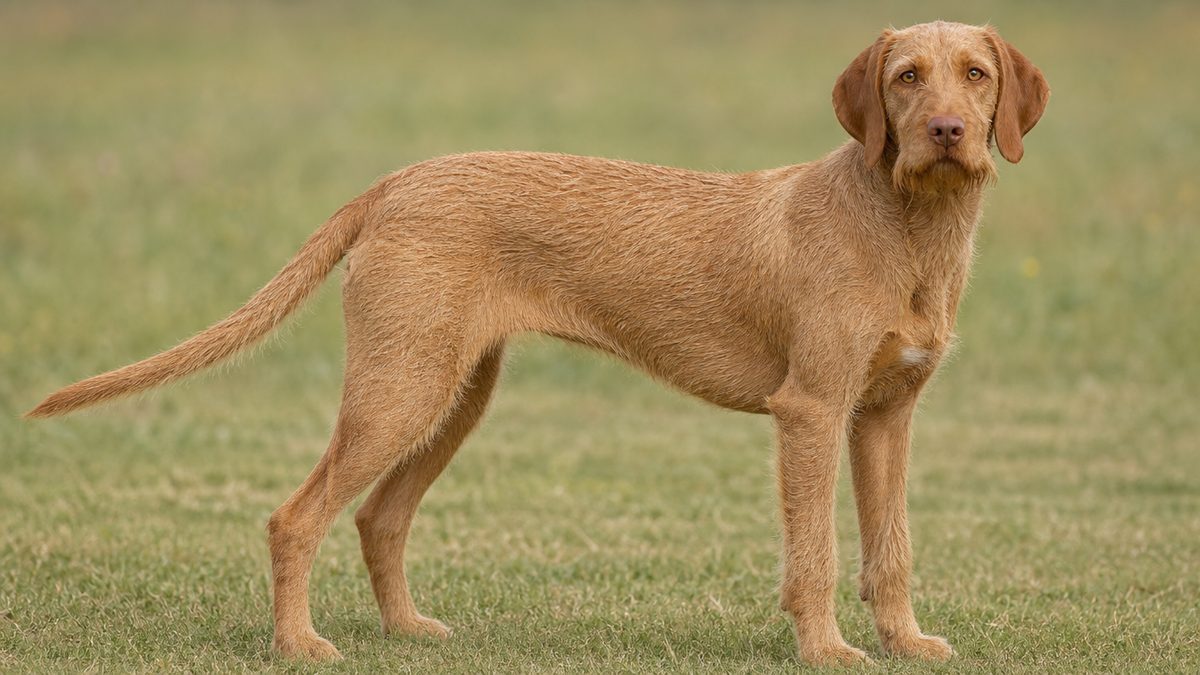
The Kennel Club describes the same coat differently and with more detail: harsh and close fitting on the neck and body, up to 4 cm long, with an undercoat which is normally heavier in winter, short coarse hair on the muzzle forming a small beard on the chin, short dry hair over the skull giving the head a somewhat square striking appearance, and short hair on the ears.
Two registries that disagree about how big the dog is
| Registry | Wirehaired dogs | Wirehaired bitches | Smooth dogs | Smooth bitches |
|---|---|---|---|---|
| FCI | 58 to 64 cm | 54 to 60 cm | 58 to 64 cm | 54 to 60 cm |
| The Kennel Club | 58 to 62 cm | 54 to 58 cm | 57 to 64 cm | 53 to 60 cm |
| American Kennel Club | 23 to 25 in, 58.4 to 63.5 cm | 21.5 to 23 in, 54.6 to 58.4 cm | 22 to 24 in, 55.9 to 61.0 cm | 21 to 23 in, 53.3 to 58.4 cm |
The FCI gives the two breeds identical ranges, word for word, including the identical instruction that it is ineffective to increase the height at the withers. The Kennel Club gives them different ranges, making the wirehaired dog two centimetres shorter at the top and one centimetre taller at the bottom than its smooth Vizsla standard. So one registry says the two breeds are the same size and another says they are not, and both are current.
The Kennel Club's standard then adds a tolerance that must be read separately from the range rather than folded into it. A variance of less than 3 cm is permitted as long as the dog remains in proportion. That is a tolerance clause, not a wider range, and a secondary source that quietly reports this breed as 55 to 65 cm has flattened the two together.
Neither the FCI nor the Kennel Club gives this breed a weight. The AKC does, at 55 to 65 pounds for males and 45 to 55 for females. An Indian page quoting a Wirehaired Vizsla weight and attributing it to the breed standard is quoting the AKC or quoting nobody.
The Indian pages ranking for this breed are pricing a different dog. This one opens both FCI standards, both Kennel Club standards, the AKC's own board-meeting record, the Orthopedic Foundation for Animals statistics tables, McMillan's supplementary tables and the Indian breeding gazette, and it reports where they disagree rather than picking one.
One breed or two, and why the answer changes the numbers you read
The Wirehaired Vizsla is a separate breed in four registries and the same breed as the smooth Vizsla in the largest study of canine longevity ever published, so almost every lifespan figure circulating for this dog is a merged figure.
| Body | Smooth | Wirehaired | Same breed? |
|---|---|---|---|
| FCI | Standard 57, accepted 12 August 1954 | Standard 239, accepted 27 March 1963 | No, two numbers |
| American Kennel Club | Vizsla, rank 35 of 210 | Wirehaired Vizsla, stud book 1 June 2014, rank 159 of 210 | No, two breeds |
| The Kennel Club | Hungarian Vizsla, 57 to 64 cm | Hungarian Wirehaired Vizsla, 58 to 62 cm | No, and different sizes |
| FCI crossing register | Absent | Absent | Not treated as varieties of one breed |
| Orthopedic Foundation for Animals | VIZSLA, 19,841 hips | WIREHAIRED VIZSLA, 387 hips | No, two labels throughout |
| McMillan 2024, Table S5 | Merged into one Vizsla row | Merged into the same row | Yes, for that analysis |
The FCI's crossing register is the decisive registry document, because its whole purpose is to name the cases where two coats are one breed. Neither 57 nor 239 appears anywhere in it, while the Weimaraner appears twice, as 99 WEIMARANER short and 99 WEIMARANER long. The same body that will let a long-coated Weimaraner be bred to a short-coated one under a single number will not do the same for the two Vizslas.
The American record, dated
The AKC's own Foundation Stock Service archive carries the decision. Its 15 April 2013 entry records that the Wirehaired Vizsla Club of America is the official parent club for the breed and that the board voted to accept the Wirehaired Vizsla into the AKC Stud Book on 1 June 2014, with the breed eligible to compete in the Sporting Group beginning 2 July 2014. An earlier entry lists the breed among those meeting the criterion of a minimum of 150 to 200 dogs with complete three-generation pedigrees.
That is a small founding population, and it is the reason the screening dataset for this dog is thin. The AKC's own breed page describes the dense wiry coat as what distinguishes him from his close cousin, the Vizsla, which is an accurate description of a breed that shares a parent with the dog it is distinguished from.
What the genetics found at the boundary
A Hungarian team genotyped 70 registered purebred Hungarian Short-haired Vizslas on about 145,000 single nucleotide polymorphisms and asked where the edge of that breed sits. The outer point of the breed demarcation was a single Hungarian Wire-haired Vizsla, the closest animal genetically to the short-haired population. The authors then had to simulate admixed dogs from short-haired and wire-haired data, because no real animals of known mixed proportion existed to calibrate against.
Read that carefully, because it cuts both ways. The wirehaired dog is not inside the short-haired breed, and nothing else in the dataset is nearer to it. A registry boundary and a genetic boundary can sit in the same place and still be doing different jobs.
McMillan 2024's Table S5 carries a single Vizsla row flagged Y for inclusion whose Phylogeny Reclassification column reads Hungarian Vizsla (Hungarian Shorthaired Pointer) followed by Hungarian Wirehaired Vizsla (Hungarian Wirehaired Pointer). Both breeds were folded into one row before any survival curve was drawn, so the 13.5-year median with a 13.2 to 13.9 interval, computed on 503 deaths, describes the two breeds together. There is no wirehaired-specific median anywhere in that study, and this page publishes none. Anyone quoting one for this breed alone is quoting a figure that does not exist.
Wirehaired Vizsla price in India, and what the ranking pages are selling
No Indian page publishes a Wirehaired Vizsla price in India. Three appear to, and all three are describing the smooth Vizsla, at figures running from Rs 50,000 to Rs 4,00,000.
| Source | What it says it is | What it actually contains |
|---|---|---|
| Puppiezo | Wirehaired Vizsla Puppies For Sale in India | A URL ending in vizsla-puppies-for-sale and eight animals, none of them a Vizsla of either coat |
| Premium Pet House | Vizsla Dog Price In India | Rs 50,000 to Rs 4,00,000 across ten cities, with the word wirehaired appearing zero times |
| Asia Pets | Vizsla Puppies for Sale in India, Best Price | Zero rupee figures, beside a claim that every dog shown is available now at its actual asking price |
| Happy Pet | No page at all | A genuine 404 titled 404 - Page Not Found at its wirehaired-vizsla path |
| Dog Breeds List | Wirehaired Vizsla, Price, Temperament, Life span | 1,000 to 1,500 US dollars and no rupee figure at all |
The same eight animals under two different breed headings
The top Indian result for this breed is a page headed Wirehaired Vizsla Puppies For Sale, served from a URL ending in vizsla-puppies-for-sale. Under a sub-heading reading Available Wirehaired Vizsla Puppies For Sale it lists eight animals: Fizey at Rs 98,999, Kuzo and Dugu at Rs 92,599, Kazuka at Rs 94,999, Doir at Rs 1,20,000, Samy at Rs 98,999, Tugi at Rs 76,499 and Yoki at Rs 98,999.
The same eight animals, with the same names and the same prices, appear on the same seller's Weimaraner page under a heading reading Available Weimaraner, where the page itself names their breeds as Maltipoo, Poodle, Poodle, Cane Corso, Goldendoodle, Maltipoo, Rottweiler and Doxiepoo. So the carousel is site furniture rather than stock, and not one of the eight is a Vizsla of either coat. Rs 98,999 appears three times on each page.
The ten-city table that never says wirehaired
Premium Pet House publishes a Vizsla price of INR 50,000 to INR 4,00,000 and a ten-city table. Every row has the identical floor of Rs 50,000, and the ceilings take exactly three values: Rs 3,50,000 in Delhi, Ahmedabad and Kolhapur, Rs 4,20,000 in Kolkata, and Rs 4,00,000 in the other six. The string wirehaired appears zero times on the page. Its ceiling is four times the ceiling Happy Pet gives the smooth Vizsla, which is a genuine and unexplained spread rather than a rounding difference.
That page's own specification card also puts the dog at 56 to 64 cm for males, which is two centimetres below the FCI floor for either Vizsla, and gives Apartment Friendly as No. Federation Cynologique Internationale The second of those is the most useful sentence on any Indian page about this breed.
Running the division tests
Every figure above was tested against 84.38, 80, 74, 75, 91 and 92.5. None resolves to a plausible foreign price. Rs 4,00,000 gives 4,740.46 at 84.38 and 5,405.41 at 74; Rs 98,999 gives 1,173.25 and 1,337.82. The one clean match is arithmetic noise, because Rs 4,00,000 divides by 80 to give exactly 5,000 and any figure ending in several zeros does the same.
One more Indian page belongs in this list for what it does not contain. Asia Pets returns HTTP 200 for a Vizsla Puppies for Sale in India page, states in its own prose that every single dog you see, Vizslas included, is available right now from a real breeder at their actual asking price, and carries zero rupee figures in its raw markup. A rare imported gundog is genuinely expensive to buy and to keep, and none of these pages tells you what either costs. For scale, the smooth Vizsla ranks 35 of 210 on AKC popularity against this breed's 159, which is the underlying reason one has an Indian price layer and the other does not.
The American reference makes the point from the other end. A US breed profile puts the Wirehaired Vizsla at 1,000 to 1,500 dollars, which at 84.38 would be Rs 84,380 to Rs 1,26,570. The Indian ceiling of Rs 4,00,000 is more than three times that, so it is not a converted American price. It is a rupee-native number nobody has measured.
The figures above are reported from published pages as editorial content. They are not offers, we do not sell animals, and we do not recommend breeders. Where a page's own content contradicts its heading, this guide says so and names the page rather than repeating its number.
Monthly cost of ownership, built from Indian rate cards
No Indian breed page publishes a cost of ownership figure for this dog, so this one is built from clinics and retailers that publish their own prices, and it lands between about Rs 4,000 and Rs 8,000 a month for an adult.
The absence is itself worth stating. The site that supplies most Indian breed cost tables returns a genuine 404 at its Wirehaired Vizsla path, so the templated Rs 3,550 monthly row that it prints for the smooth Vizsla has never been extended to this breed. That is better than the alternative, because that row is a preset shared with unrelated breeds rather than an observation of any dog.
| Item | Price | Source |
|---|---|---|
| Anti-rabies, single dose | Rs 699 | Vetic clinic list |
| 9-in-1 DHPPiL | Rs 899 | Vetic clinic list |
| Kennel cough | Rs 1,349 | Vetic clinic list |
| Plain bath | from Rs 934 | Vetic Delhi |
| Complete bath and styling | from Rs 1,869 | Vetic Delhi |
| NexGard Spectra 15 to 30 kg, per month | Rs 1,103 | Supertails listing |
| Delhi pet dog registration | Rs 500 | Municipal Corporation of Delhi |
| Chennai pet licence | Rs 50 | Greater Chennai Corporation |
The grooming line is where this breed differs from its smooth relative, and it differs in a way Indian salons are not set up for. A harsh wire jacket is traditionally maintained by hand-stripping rather than clipping, and clipping a wire coat softens it permanently. Almost no Indian groomer offers hand-stripping, so budget either for a Rs 1,869 salon visit that will do the wrong thing or for a stripping knife, a rake and twenty minutes a week of your own time.
The most useful Indian cost fact remains the spread rather than any single figure. The same 9-in-1 vaccine is Rs 899 at a private clinic chain and Rs 600 inclusive of certificate at a Goa government veterinary hospital, and anti-rabies runs from Rs 100 there to Rs 699 at the clinic. In Chennai the Greater Chennai Corporation licenses a pet animal for Rs 50, issued 9,115 licences in 2024, and runs six pet clinics giving treatment and anti-rabies vaccination free of cost. Delhi charges Rs 500 to register a pet dog with a Rs 100 monthly late fee.
- Food. Roughly 300 to 400 g a day of a complete maintenance dry food for a 27 kg dog, adjusted to the dog rather than to the bag.
- Parasite control. Rs 1,103 a month at the 15 to 30 kg pack size, and not optional in a tick-heavy Indian city.
- Coat. A rake, a comb and a stripping knife once, then your own time. This is the cheapest coat plan in the wire-coated gundog group.
- Air conditioning. The line nobody prints, and the largest genuine cost of keeping an undercoated dog in most of India.
Clinic and retail prices move within weeks and one large-bag food price this site tracked went stale in days. Municipal fees are the durable half. Treat the table above as a dated reading rather than a current quote, and confirm at the source before budgeting.
Suitability for the Indian climate, homeland numbers first
The Wirehaired Vizsla comes from the Hungarian plain, about 15 degrees cooler on an annual mean than Chennai, and it carries an undercoat the smooth Vizsla does not, which makes it the harder of the two to keep in India.
Every figure below was pulled from NASA POWER by explicit latitude and longitude over the 2001 to 2020 climatology window, and every grid cell's reported elevation was compared against an SRTM90 ground elevation for the same point before the figure was used. That check matters because POWER returns a grid cell rather than a point.
| Point | Cell elevation minus real | Annual mean C | Annual mean RH percent | Hottest month | Peak wet bulb C |
|---|---|---|---|---|---|
| Debrecen, Hungary | minus 2.67 m | 11.38 | 73.35 | July, 23.43 | 18.13 in July |
| Szeged, Hungary | plus 7.49 m | 11.94 | 71.94 | July, 24.24 | 18.03 in July |
| Budapest, Hungary | plus 63.05 m | 10.75 | 74.69 | July, 22.81 | 17.32 in July |
| Delhi | minus 6.63 m | 25.57 | 45.51 | June, 35.88 | 26.50 in July |
| Chennai | plus 39.95 m | 27.94 | 72.39 | May, 31.51 | 26.11 in May |
| Kolkata | minus 6.65 m | 25.80 | 73.84 | May, 31.53 | 27.09 in June |
| Mumbai | plus 92.15 m | 26.77 | 67.28 | May, 31.19 | 25.77 in June |
| Bengaluru | minus 70.28 m | 23.74 | 67.84 | April, 28.37 | 21.86 in May |
| Pune | plus 75.99 m | 23.86 | 66.68 | April, 28.93 | 22.97 in June |
Debrecen is the cleanest Hungarian point available, its grid cell sitting 2.67 metres below the real ground, so the homeland baseline is not an artefact of the model. On that baseline the breed's home July averages 23.43 C with a peak wet-bulb load of 18.13 C, against Kolkata's 27.09 C in June.
The undercoat is the reason this dog rates below the smooth Vizsla
Hungary is a humid country. Debrecen runs 73.35 percent annual relative humidity against Chennai's 72.39 and Kolkata's 73.84, so a Wirehaired Vizsla arriving in Chennai meets air it is already adapted to and about sixteen degrees more heat. The thing that hurts this breed in India is heat, or heat combined with humidity, never damp air on its own.
What separates the two Vizslas is what sits under the jacket. FCI 239 specifies a dense water-repellent undercoat and the Kennel Club adds that it is normally heavier in winter, while FCI 57 specifies no undercoat for the smooth dog at all. The Kennel Club, Hungarian Wirehaired… Federation Cynologique Internationale An insulating layer evolved for a Hungarian January is a liability in a Chennai May, and it is why this page gives the wirehaired dog the lower heat tolerance rating of the pair.
Bengaluru at a 21.86 C peak wet bulb and Pune at 22.97 C are the two mainstream Indian cities where the gap narrows to about four degrees, and they are the two where this breed is a defensible choice. Both peak in April rather than May and both are coolest in December, so a summer plan built for Chennai will be a month out of step.
It quotes no Indian hill-station figure, because NASA POWER's cells for Indian hill towns are wrong by hundreds to nearly two thousand metres in both directions and would make a hill station look habitable for a heat-sensitive dog when it is not. And it uses no T2M_MAX value anywhere, because on the climatology endpoint that is the highest temperature recorded in the whole twenty-year period rather than a mean daily maximum, and reading it as an average overstates routine heat by eight to ten degrees.
Managing heat, and the 41 degree line
To keep a Wirehaired Vizsla safe in an Indian summer, move all work to the ends of the day, hold the dog lean, keep the undercoat raked out rather than shaved, and treat a rectal temperature of 41.0 C or above as an emergency.
The best evidence on canine heat-related illness comes from a UK primary-care cohort of 905,543 dogs. Heat-related illness had an incidence of 0.04 percent with an event fatality rate of 14.18 percent, and bodyweight at or above the breed and sex mean was an independent risk factor at an odds ratio of 1.42. Dogs over two years of age were also at greater risk.
The companion paper on the same cohort settles what triggers these events. Of 1,259 events from 1,222 dogs, 879 had a recorded trigger, and 652 of those 879, being 74.2 percent, were exertional. For a breed with a working trial in its own classification, that means the risk is the walk rather than the parked car.
The number to write on the fridge
A 2026 revision of the VetCompass heat-related illness grading tool added critical temperature criteria of 41.0 C or above to both the Moderate and Severe grades, moved dyspnoea up from Mild to Moderate and moved episodic collapse down from Moderate to Mild. It was evaluated on 364 emergency cases from 2022, validated on 422 from 2023, and discriminated fatal outcomes at an area under the curve of 0.79 against the original tool's 0.72. Laboured breathing after exercise is now a moderate event, not a mild one.
Never shave the wire coat
The single most damaging piece of well-meant Indian summer advice for this breed is to clip it down. A harsh double-layered wire coat does two jobs, insulating against cold and shading skin against sun, and clipping it removes the second while permanently softening the first. Rake the dead undercoat out instead, which genuinely reduces the insulating layer, and leave the harsh outer jacket in place. The grooming section below sets out how.
- Chennai and Kochi. Work before 6:30 am and after 8:00 pm from March to October. There is no cool season to plan around and Kochi is coolest in August rather than January.
- Delhi and Ahmedabad. A real winter exists and is the season to build fitness in. June is the month to avoid outright, and Delhi's July wet-bulb peak of 26.50 C is the highest on this page.
- Kolkata. The hardest mainstream Indian city on the wet-bulb measure at 27.09 C in June. Swimming is the safer form of work here and the standard describes a dog that manifestly enjoys water.
- Bengaluru and Pune. The two workable cities. Plan around an April peak, and remember that Bengaluru load shedding between March and May can take out a boarding kennel's air conditioning.
- Mumbai and Hyderabad. Manageable with air conditioning and discipline, and Mumbai's wet-bulb peak of 25.77 C is below Chennai's.
One risk that gets over-claimed should be corrected here as it is on the smooth Vizsla page. Across 54,542 canine anaesthetics, overall mortality was 0.69 percent, and after adjustment for the dog's ASA physical status only the Chihuahua and the Spanish Water Dog retained an excess, with the German Shepherd Dog and the Bulldog specifically not retaining one. Between-breed differences in that study largely reflected case severity rather than breed, so nobody should tell you a Wirehaired Vizsla carries a special anaesthetic risk.
Temperament, and who should not buy this dog
The Wirehaired Vizsla is an affectionate, self-confident, stubborn gundog that the Kennel Club describes with one word its smooth Vizsla standard does not use, patience, and it does badly alone.
The two registries describe the same dog with a different emphasis, and both are worth having. The FCI calls it an affectionate and intelligent dog, self-confident, easily trained, which cannot bear rough treatment, keeping contact with his handler, passionate in his quest, stubborn, with a good nose and staunch on the point. The Kennel Club calls it loyal, intelligent, obedient, sensitive, very affectionate and with patience, easily trained.
Put those side by side with the smooth Vizsla's clause, which reads lively, friendly, evenly tempered, easily trained, and the difference is real if small. The wirehaired dog is described as more self-confident, more stubborn, and more patient. The Kennel Club also gives it a more robust build and a stronger bone structure than the shorthaired Vizsla, so it is physically the heavier dog even where the height ranges overlap.
Who this breed suits
- Households with someone home most of the day, because the contact trait the standard names produces separation anxiety across a nine-hour Indian working day.
- Owners who run, cycle or swim, since two hours of work is met most easily by folding the dog into an existing habit.
- People who will do their own grooming, because Indian salons are not equipped for a wire coat.
- Owners in Bengaluru, Pune or a hill posting with real measured data, rather than a coastal metro.
Who should buy something else
- Anyone who wants a rare breed for its rarity, because rarity here means 387 hip evaluations worldwide and one indexed paper that is about a different dog.
- Anyone out nine hours a day in a small flat, which describes most Indian metro buyers this breed attracts.
- Anyone planning to correct with a slip chain, because the FCI standard says outright that this dog cannot bear rough treatment.
- Anyone in Chennai, Kochi or Kolkata without air conditioning, where an undercoated working dog is a welfare problem rather than a planning one.
One point applies to this breed more than to almost any other on this site. You are buying into a market that cannot reliably tell your dog from its smooth relative, on a page whose URL says vizsla, from a carousel with no Vizslas in it. Verify the coat, the parents and the paperwork in person, because nothing in the Indian information layer will do it for you.
Training a stubborn dog that learns fast
To train a Wirehaired Vizsla, use reward-based methods exclusively, start structured socialisation before sixteen weeks, and expect a slightly more self-directed dog than the smooth Vizsla.
The breed is highly trainable and highly sensitive, and the FCI adds the qualifier that decides the method: it cannot bear rough treatment. It also calls the dog self-confident and stubborn in the same sentence as easily trained, which is not a contradiction. A confident dog complies because the plan makes sense to it, and stops complying when it does not.
What works
- Mark and reward. Short sessions of five to ten minutes several times a day, food, and a marker word or clicker.
- Socialise before sixteen weeks. Traffic, lifts, tiled floors, autorickshaws, monsoon rain, other dogs and unfamiliar people, all at the puppy's pace.
- Build a recall before the nose matures. A pointing breed with an adult nose and no recall is an escaped dog on an Indian road.
- Handle the coat from week nine. A dog that will stand for a rake and a stripping knife at two years old is a dog that was taught to at nine weeks.
What this breed resists
It resists being nagged. Repeating a cue that has not worked teaches this dog that the cue is optional, and repeating it more loudly teaches it that you are unreliable. Change the picture instead, make the exercise easier, and pay well. Train for confidence and the compliance follows.
Timelines are realistic rather than optimistic. Expect reliable house-training by four months, a solid sit and recall in low distraction by five months, an adolescent regression from about eight to fourteen months, and a settled adult at two and a half to three years. The coat matures on its own schedule, and a puppy jacket that looks soft at four months usually comes in harsh by twelve.
Slip chains, prong collars and choke chains are still sold as standard equipment in Indian pet shops, and this is a breed whose own standard says it cannot bear rough treatment. A well-fitted Y-front harness and a two-metre lead cost less and do not carry that warning. Ask a qualified reward-based trainer, or your nearby vet, before using any aversive tool on this dog.
The daily exercise requirement, and what happens without it
An adult Wirehaired Vizsla needs about two hours of real work a day, and in most Indian cities that has to be split across the two cool ends of the day.
The requirement is written into the breed's classification. FCI Group 7 Section 1 carries a compulsory field and water trial for this breed, and the standard's utilisation clause describes a versatile gun dog that must work in field, forest and water, with determination to remain on the scent even when swimming, and which copes with difficult terrain as well as extreme weather conditions. That is a stamina specification, and it is identical to the smooth Vizsla's.
| Season | Morning | Evening | Indoor substitute |
|---|---|---|---|
| Cool season, December to February | 45 to 60 min off-lead or running | 45 to 60 min | Not usually needed |
| Pre-monsoon, March to May | 45 min before 6:30 am | 40 min after 8:00 pm | 20 to 30 min scent work at midday |
| Monsoon, June to September | 40 min between showers | 40 min | 30 min indoor retrieves and puzzle feeding |
| Post-monsoon, October to November | 45 to 60 min | 45 min | Optional |
Swimming is the best Indian exercise for this breed where clean water exists, and there is a coat caveat. A water-repellent undercoat holds moisture close to the skin longer than a smooth coat does, so a wirehaired dog that swims needs the coat worked through with fingers and towelled at the skin rather than just at the surface, and the ears dried every time.
What under-exercise looks like
It looks like destruction rather than aggression. The under-worked dog chews skirting boards, digs at doors, paces, barks and becomes reactive on the lead. In India the pattern peaks in May and June, when owners quietly cut walks because of the heat and replace the workload with nothing.
Do not solve it by walking a hot dog. Exertional heat-related illness accounted for 652 of 879 triggered events in the largest study of the problem, and a dog whose owner is making up a missed week in a Delhi June is exactly the dog that study describes.
None of the adult figures above applies to a growing dog. Forced exercise on hard surfaces, long runs and stairs load the growth plates of a fast-growing gundog, and the puppy timeline below gives age-appropriate figures instead. Ask your nearby vet what is safe for your individual puppy before starting any running programme.
Grooming a wire coat in Indian humidity
To groom a Wirehaired Vizsla in India, rake the undercoat out rather than clipping the jacket, comb the beard daily, and dry the ears after every swim and bath.
The coat is a two-layer system and it needs to be treated as one. The wire coat on the neck and body is harsh and close fitting, up to 4 cm long under the Kennel Club standard and 2 to 3 cm under the FCI's, over an undercoat that the Kennel Club describes as normally heavier in winter. The furnishings are short and coarse on the muzzle, forming a small beard on the chin, with short dry hair over the skull.
- Rake the undercoat weekly with an undercoat rake, which is what actually reduces the insulating layer before an Indian summer.
- Hand-strip the jacket twice a year if you can, or find someone who can. Clipping softens a wiry coat permanently and it does not grow back harsh.
- Comb the beard daily. It holds water, food and, in a humid climate, yeast. This is the single job that separates this breed from the smooth Vizsla day to day.
- Bathe roughly once every eight weeks, with a mild dog shampoo, and dry down to the skin rather than at the surface.
- Dry the ear leathers every time. The ears are medium set, proportionately long, thin-skinned and hang close to the cheeks.
- Trim nails fortnightly, because a dog exercised on grass rather than pavement does not wear them down.
The ear and beard problem is the Indian problem
Overseas gundog-club guidance routinely says to towel a dog off and let it air dry, and that instruction was written for a temperate climate. In an Indian monsoon a wire coat over an undercoat holds moisture for hours, and a wet beard sits against warm skin all day. Indian veterinary work on canine otitis seasonality is poorly indexed internationally so this page puts no prevalence figure on it, but the practical rule stands: dry inside the ear leather, do not flush the canal at home, and take a smelly or itchy ear to a vet.
Shedding and colour, honestly
The breed sheds moderately, with a genuine seasonal component the smooth Vizsla does not have, because there is an undercoat to lose. In India that seasonality is muted and the shed becomes a steady year-round trickle, which most owners find easier and some find worse.
On colour, the Kennel Club permits golden sand to russet, with small white marks on chest and feet tolerated, and names dark brown and pale yellow as undesirable and any other colour or combination as unacceptable. The nose colour must harmonise with the coat, which means brown rather than black. A wire-coated dog offered in India in liver and white is a German Wirehaired Pointer, and one offered in steel grey with brown is a Wirehaired Pointing Griffon.
Health issues, and a screening dataset of 387 dogs
The Wirehaired Vizsla has no breed-specific lifespan figure, no clinical literature of its own, and one genuinely important screening finding, and an honest page has to say all three.
Start with what does not exist, because that is the finding. There is no median life expectancy for this breed, and no separate lifespan figure of any kind. McMillan 2024 folded it into the Vizsla row before drawing any survival curve, so the 13.5-year median with a 13.2 to 13.9 interval on 503 deaths covers both breeds together. A separate VetCompass life-table analysis is available for anyone who wants a population-level comparison, and it too has no wirehaired row. McMillan KM, Bielby J, Williams CL
There is also almost no literature. A PubMed audit run with the query translation line read for every query returned exactly one record across three name forms, and that record is a study of the short-haired Vizsla in which a single wirehaired dog appears as the outermost point of the short-haired breed's boundary. The control query returned 126 records in the same session with a sane translation, so the instrument was working and the absence is real.
Hips and elbows, on a small denominator
| Breed | Hip evaluations | Hips normal percent | Hips dysplastic percent | Elbow evaluations | Elbows abnormal percent |
|---|---|---|---|---|---|
| Wirehaired Vizsla | 387 | 88.9 | 10.6 | 242 | 3.3 |
| Vizsla | 19,841 | 92.6 | 6.7 | 5,235 | 2.3 |
| Weimaraner | 14,546 | 90.4 | 8.5 | 3,068 | 2.1 |
| Labrador Retriever | 319,018 | 87.5 | 11.4 | 143,182 | 9.9 |
The Orthopedic Foundation for Animals keeps WIREHAIRED VIZSLA and VIZSLA as separate labels throughout its statistics, which is the practical reason the registry question earlier on this page is not academic. On 387 hips the wirehaired dog reports 88.9 percent normal against the smooth breed's 92.6 percent on 19,841, and a hip dysplasia rate of 10.6 percent against 6.7.
Read that gap carefully rather than as a verdict. The components reconcile exactly, at 13.7 excellent plus 63.3 good plus 11.9 fair for 88.9 normal, and 7.2 mild plus 3.4 moderate plus 0.0 severe for 10.6 dysplastic. But 387 evaluations is a fiftieth of the smooth breed's denominator, and a small screening population drawn from a small founding population is exactly where a percentage moves most. The honest statement is that the wirehaired dog currently screens worse and that the sample is small.
Every OFA figure here describes dogs whose owners chose to submit a result, overwhelmingly in North America. There is no Indian hip register for this breed, no Indian prevalence figure and, as far as this page can establish, no Indian breeding population at all. These numbers describe a small screening population rather than an Indian litter. Ask for the parents' actual certificates and take them to your nearby vet to read with you.
Hyperuricosuria, the one finding that changes what you feed
The Orthopedic Foundation for Animals ranks the Wirehaired Vizsla second of all breeds for hyperuricosuria, behind only the Dalmatian, with 45.1 percent carriers and 2.8 percent affected among 71 dogs tested.
This is the most actionable health fact about the breed and no Indian page mentions it.
| Rank | Breed | Evaluations | Normal percent | Carrier percent | Abnormal percent |
|---|---|---|---|---|---|
| 1 | Dalmatian | 1,391 | 12.7 | 54.1 | 33.1 |
| 2 | Wirehaired Vizsla | 71 | 52.1 | 45.1 | 2.8 |
| 3 | Weimaraner | 367 | 76.8 | 22.3 | 0.8 |
| 4 | Bulldog | 1,011 | 79.5 | 19.7 | 0.8 |
| 5 | Giant Schnauzer | 123 | 81.3 | 17.9 | 0.8 |
| 9 | Labrador Retriever | 741 | 99.7 | 0.3 | 0.0 |
Hyperuricosuria is a recessive condition in which the dog excretes abnormally high uric acid in the urine, and the consequence for an owner is urate stone formation. The Dalmatian is the breed everyone associates with it, and the register places the Wirehaired Vizsla immediately behind it on carrier frequency. The Labrador control on the same table sits at 0.3 percent carriers, which is what an unaffected breed looks like.
Two cautions before anyone acts on that. The denominator is 71 dogs, which is small, and OFA's percentages describe owners who chose to submit a DNA result rather than a random sample of the breed. The direction of that bias is not obvious, because breeders test when they suspect a problem and also test to clear a line. What the figure does justify is asking, and asking is free.
What an Indian owner actually does about it
- Ask for the parents' hyperuricosuria DNA results before buying, not after. This is a single cheek-swab test and a clear-by-parentage result is meaningful in a recessive condition.
- Recognise the signs. Straining to urinate, blood in the urine, frequent small urinations and, in a male, sudden inability to pass urine, which is an emergency.
- Do not self-prescribe a purine-restricted diet. A homozygous dog may need one and a clear dog does not, and the wrong diet in a growing gundog causes its own problems.
- Keep water available and abundant, which matters more in an Indian summer than in a Hungarian one because a dehydrated dog concentrates its urine.
- Take any urinary sign to a veterinarian the same day. Ask your nearby vet whether a urate stone risk applies to your individual dog before changing anything about how you feed it.
The eye numbers, and a register that contradicts itself
| Breed | Summary normal percent | Summary denominator | Detail normal count | Detail denominator | Detail normal percent | Gap in points |
|---|---|---|---|---|---|---|
| Wirehaired Vizsla | 98.5 | 333 | 251 | 333 | 75.4 | 23.1 |
| Vizsla | 97.1 | 3,525 | 2,759 | 3,523 | 78.3 | 18.8 |
| Labrador Retriever | 95.7 | 95,312 | 76,357 | 95,200 | 80.2 | 15.5 |
Both figures are printed by the same register on the same day, and this page prints both with the arithmetic shown rather than quoting either as the breed's eye rate. The gap appears on the Labrador control too, so it is a property of the tables rather than a finding about this breed.
What the detail rows do give is the actual diagnoses. For this breed the three largest are cataract of unknown significance in 30 of 333 dogs at 9.0 percent, persistent pupillary membranes iris to sheets in 26 at 7.8 percent, and iris to iris in 19 at 5.7 percent. A puppy's parents should carry a current eye certificate, and the smooth Vizsla's known gonioscopy risk gives a second reason to ask for one, even though that study covered the short-haired breed only.
Indian law, the docked tail and the genetic-defect clause
Three provisions of the Prevention of Cruelty to Animals (Dog Breeding and Marketing) Rules, 2017 reach this breed directly, and one contradicts a description still printed in the Kennel Club's own standard.
The gazette was extracted directly for this page rather than summarised from a secondary source. It runs to 14 pages and 51,953 extractable characters with a real text layer on every page, and every clause below was located with a whitespace-tolerant search and read in context.
| Provision | Correct citation | What it says |
|---|---|---|
| Minimum age at sale | Rule 8(1)(a) | Pups less than eight weeks in age are not sold |
| Docking and cropping | Second Schedule Part II paragraph 6(8) | No tail docking, ear cropping, de-barking, de-clawing, branding or dyeing, and any change of appearance by artificial means is strictly forbidden |
| Close breeding | Second Schedule Part II paragraph 6(3) | In breeding and incest breeding prohibited; in breeding covers relatives of the second to fourth grade within the first four generations |
| Creating new breeds | Second Schedule Part II paragraph 6(9) | Breeding to create new breeds of dogs or unusual looks shall be strictly prohibited |
| Genetic-defect testing | Second Schedule Part III paragraph 8(10) | Dogs shall have been tested for genetic defects including hip dysplasia, progressive retinal atrophy, night blindness, hypothyroidism, entropion and ectropion |
| Outdoor housing | Second Schedule Part IV paragraph 21(1) | Dogs not accustomed to local temperatures, and breeds that cannot tolerate them, are not to be kept outdoors without the attending veterinary practitioner's written approval |
The docked tail is illegal here and still described in the standard
The Kennel Club's Hungarian Wirehaired Vizsla standard carries a tail section with two descriptions, one docked by one third of the length and one undocked and reaching to the hocks. Paragraph 6(8) of the Indian Second Schedule forbids tail docking outright, in the same sentence as ear cropping and de-clawing, and closes with the words that any change of appearance by artificial means is strictly forbidden. So an Indian reader looking at a docked Wirehaired Vizsla is looking at a dog that could not lawfully have been docked in India.
Cite the number carefully too. This is a Second Schedule paragraph, not a Rule, and the Rules themselves stop at 13, so a citation reading Rule 14 or higher is wrong by construction.
The paragraph that has an unusual bite on this breed
Paragraph 6(9) prohibits breeding to create new breeds of dogs or unusual looks. This breed's own FCI standard says it was created in the 1930s by crossing two existing breeds. That is not retrospective, and nothing about owning or importing an established FCI breed is affected by it. What it does mean is that an Indian breeder proposing to recreate the cross, or to breed a wirehaired Vizsla to a smooth one in pursuit of a new coat type, is proposing something the gazette prohibits on its face. Say that plainly rather than implying the breed itself is unlawful, because it is not.
Paragraph 8(10) requires testing for genetic defects including hip dysplasia, progressive retinal atrophy, night blindness, hypothyroidism, entropion and ectropion, and the word including makes the list illustrative rather than closed, so hyperuricosuria is not outside it merely because it is unlisted. What the Rules do not contain is also citable: patella, luxation, BAER and deaf each return zero occurrences across the whole gazette, so there is no Indian patellar-grading or hearing-test requirement for any breed.
Second Schedule Part IV paragraph 21(1) bars keeping in outdoor facilities, without the attending veterinary practitioner's written approval, dogs not accustomed to the temperatures prevalent in the area and breeds that cannot tolerate them, naming long-haired breeds in high temperature locations as its example. A wire-coated dog with a dense undercoat, bred in a country whose hottest month averages 23.43 C, plainly falls under the first limb. Enforcement is a separate question from what the text says.
Feeding, and one breed-specific reason to ask about the water bowl
To feed a Wirehaired Vizsla in India, split the ration into two or three meals, keep the dog visibly lean, and make sure it drinks, because the breed's highest-ranking DNA finding is a urinary one.
Bodyweight is the most consequential feeding decision an Indian owner makes here, and the reason is thermal rather than orthopaedic. In a cohort of 905,543 dogs, bodyweight at or above the breed and sex mean carried an odds ratio of 1.42 for heat-related illness. A dog carrying three extra kilograms in Chennai has moved itself into a higher-risk group before it takes a step.
- Feed an adult roughly 300 to 400 g a day of a complete maintenance dry food for a 27 kg dog, adjusted to the dog rather than to the bag.
- Split the ration into two meals for an adult and three for a puppy under six months, which lowers stomach volume at any one time.
- Rest around meals. Leave an hour before and after with no hard exercise, because a deep-chested athletic breed carries gastric dilatation-volvulus risk.
- Check body condition weekly by feeling the ribs rather than reading a scale, aiming for ribs easy to feel and a waist visible from above.
- Add water to dry food in summer and put out more bowls than you think you need, which matters more in this breed than in most.
Why the water bowl gets its own paragraph
A dog that concentrates its urine is a dog whose urate crystals have more chance to form, and this breed sits second of all breeds on OFA's hyperuricosuria table at 45.1 percent carriers among 71 tested. Carriers of a recessive condition are not affected dogs, and this is not a reason for a special diet in a clear or carrier animal. It is a reason to keep water abundant in an Indian summer and to take straining, blood in the urine or frequent small urinations to a vet rather than watching them.
Do not put a dog on a purine-restricted diet on the strength of a breed page. Ask your nearby vet whether your individual dog's genotype and urine findings justify one, because a restricted diet in a growing gundog that does not need it causes problems of its own.
The Indian supply constraint applies as it does to every imported breed. Large-breed and performance formulations are stocked reliably in the metros and inconsistently elsewhere, and a 15 kg bag price this site tracked moved materially inside a single week. Build the budget on the bag you can actually buy in your city and re-price it quarterly.
The first year, month by month
A Wirehaired Vizsla puppy's first year has three fixed deadlines, and the coat handling you teach in month three is what makes month twenty-four possible.
| Age | What is happening | What you do |
|---|---|---|
| Before 8 weeks | Legally still with the litter. Rule 8(1)(a) bars sale under eight weeks | Visit, meet the dam, confirm the coat on both parents, read the certificates |
| 8 to 12 weeks | Core vaccination begins; the gazette records it can start at seven to eight weeks | Structured socialisation indoors and in carried outings, plus daily handling of the beard and feet |
| 12 to 16 weeks | Socialisation window closes; vaccination usually completes by about eighteen weeks | Traffic, lifts, tiled floors, monsoon rain, autorickshaws and unfamiliar people, at the puppy's pace |
| 4 to 6 months | Teething, rapid growth, first adolescent testing. The puppy coat is still soft | Short lead walks only, no forced running or stairs, introduce the rake and the comb |
| 6 to 9 months | Growth plates still open; the recall erodes as the nose matures | Rebuild recall on a long line, add scent games, keep the dog lean |
| 9 to 12 months | Adolescent regression peaks; the adult jacket starts coming through harsh | Hold reward-based handling, first proper strip, expect setbacks |
| 12 months and beyond | Physically adult, mentally not. Settled behaviour at two and a half to three years | Build to the full two-hour adult workload, and only then consider running |
Two Indian details reshape that table. First, a puppy arriving between March and June has its socialisation window inside the hottest part of the year, so the outings that build a confident adult have to happen at six in the morning or after dark. Plan for it rather than skipping the window.
Second, tick exposure begins the day the puppy goes outdoors, and a wire coat with an undercoat hides ticks better than a smooth one does. Indian clinic-based surveys report heavy burdens among dogs presented for testing, including Babesia in 80 of 120 dogs in a Kerala series with a pre-monsoon peak from March to May, and two or more pathogens in 72.9 percent of 584 dogs screened in West Bengal. Tick-borne haemoparasite survey of 584 dogs… Those are clinic caseloads rather than random populations, so they describe the dogs vets see, and they are still the reason monthly parasite control starts early here and the reason you part the coat rather than stroking it.
Ask the breeder to show you both parents' coats in person and to confirm the hyperuricosuria status of the line. A wire coat can look deceptively soft in a young puppy, and a seller who cannot answer a straight question about a single cheek-swab test on a breed that ranks second of all breeds for that condition has told you what kind of breeder they are.
Head to head against the breeds Indian buyers cross-shop
Anyone considering this breed in India is really choosing between it, the smooth Vizsla and one of the German wire-coated pointers, and the deciding factors are coat, data and availability.
| Breed | FCI number | Coat | OFA hip evaluations | Median lifespan available? |
|---|---|---|---|---|
| Wirehaired Vizsla | 239 | Wiry 2 to 4 cm over a dense undercoat | 387 | No, merged into the Vizsla row |
| Vizsla | 57 | Short single, no undercoat | 19,841 | Yes, 13.5 years on 503 deaths |
| Weimaraner | 99 | Short, plus a long-haired variety | 14,546 | Yes, 12.8 years on 1,229 deaths |
| German Wirehaired Pointer | 98 | Harsh wire, liver and white | Not quoted here | Yes, 13.0 years on 138 deaths |
| Wirehaired Pointing Griffon | 107 | Harsh, coarse, steel grey with brown | 3,750 | No, excluded from the study |
Wirehaired Vizsla against the smooth Vizsla
Choose on coat and on how much information you want. The smooth dog has fifty times the OFA hip denominator, its own lifespan median, a published gonioscopy prevalence, three mapped disease genes and a genome-wide breed profile study. McMillan 2024 Supplementary Table S3 Oliver JA, Ekiri AB Varga L, Edvine EM, Hudak P, Anton I The wirehaired dog has 387 hips, one paper that is about the other breed, and a striking hyperuricosuria finding.
On the dog itself, the wirehaired is the more robust build with stronger bone, slightly more self-confident and stubborn in the FCI's words, and carrying an undercoat the smooth dog lacks. In Indian terms that means marginally more grooming, marginally worse heat tolerance and a marginally tougher dog in cover.
Wirehaired Vizsla against the German wire-coated pointers
The German Wirehaired Pointer is the closest functional equivalent and it is liver and white rather than golden sand, which is the fastest way to tell an Indian listing apart. It is also one of this breed's two founding parents according to FCI 239's own history. The Wirehaired Pointing Griffon, FCI 107, is the shaggier, softer-coated option and carries a much larger OFA hip denominator at 3,750.
For an Indian buyer with no strong preference between them, availability decides it, and availability for all three is close to zero. That is a real answer rather than a hedge: if you cannot find a litter with documented parents in India, the correct move is not to buy the nearest wire-coated dog somebody will sell you.
What Indian owners actually get wrong with this breed
Six mistakes account for most of the trouble Indian owners have with this dog, and the first three happen before the puppy arrives.
- Buying from a page that is selling something else. The top Indian result is headed Wirehaired Vizsla Puppies For Sale, sits on a URL ending in vizsla, and lists eight animals of which none is a Vizsla of either coat.
- Assuming the smooth Vizsla's numbers apply. They do not. The lifespan median is merged, the gonioscopy study covers the short-haired breed only, and the OFA hip denominator differs by a factor of fifty.
- Skipping the hyperuricosuria question. This breed sits second of all breeds on that table at 45.1 percent carriers, and a single cheek swab on the parents answers it.
- Clipping the wire coat for summer. Clipping softens a harsh jacket permanently and removes the layer that shades the skin. Rake the undercoat out instead.
- Air drying after a swim or a bath. Overseas gundog-club advice says to towel off and let the dog air dry, and that was written for a temperate climate rather than an Indian monsoon.
- Cutting walks in May and replacing them with nothing. Exertional heat-related illness accounted for 74.2 percent of the 879 triggered events in the largest study of the problem.
A seventh mistake belongs to the sellers. The one Indian page that publishes a breed standard figure for this dog puts the male at 56 to 64 cm, two centimetres below the FCI floor of 58, on a page where the word wirehaired never appears at all. A page that never names the breed is not describing the breed's measurements.
The last one is about cost of ownership and it is the reason this page builds its figures from clinics rather than from a breed table. No Indian breed page for this dog exists, so any monthly figure you are shown for it has been borrowed from the smooth Vizsla's templated row, and that row is a preset shared with unrelated breeds.
Adoption and responsible sourcing in India
To adopt a Wirehaired Vizsla in India, accept that you will almost certainly not find one, and treat that as useful information rather than a dead end.
Realism first. A breed ranking 159 of 210 on AKC popularity, with a founding population that met a criterion of 150 to 200 dogs with complete three-generation pedigrees, and no Indian breed page of its own, does not have an Indian rescue population. What Indian shelters do have is smooth Vizslas and wire-coated crossbreds, and both are worth meeting.
The route that works
- Contact general shelters in your metro and describe the dog you want by behaviour rather than by breed name, since a shelter will not have this breed on a list.
- Consider a wire-coated crossbred, which will give you the coat, the energy and none of the price, and ask the shelter what it knows about the dog's history.
- Budget for a full veterinary workup on intake, including an eye examination and a urinalysis, because an adult with no history has no screening record.
- Plan the first fortnight around a cool room, not around outings, if you adopt between March and June.
If you import or buy instead
Verify four things at the source rather than accepting a claim. Ask which of the two Vizsla breeds you are buying and get the answer in writing, because the Indian market demonstrably cannot tell them apart. Ask to see the sire and dam's hip, elbow, eye and hyperuricosuria results and read the numbers rather than a summary line, since this page has shown a register whose summary and detail rows differ by 23.1 points. Ask which registry the pedigree runs on, since India is an FCI member through the Kennel Club of India and FCI nomenclature holds this dog at number 239. And ask to see the litter with the dam, in person, after eight weeks, which Rule 8(1)(a) requires in any case.
Refuse a docked puppy. Docking is prohibited under Second Schedule Part II paragraph 6(8), and a breeder who has docked a litter has told you what else they are willing to do.
This page names no breeder, links no listing and treats no published price as an offer. What it gives you instead is the list of documents to ask for and the arithmetic to check them with. If a seller cannot produce a hip number, an eye certificate, a hyperuricosuria result and a straight answer about which Vizsla you are being sold, that is the answer.
Wirehaired Vizsla questions Indian buyers actually ask
What is the Wirehaired Vizsla price in India?
No Indian page publishes one. The pages that appear in search for this term are pricing the smooth Vizsla, at figures running from Rs 50,000 to Rs 4,00,000, and the highest-ranking marketplace result serves a Wirehaired Vizsla page from a URL ending in vizsla with a carousel that contains neither breed.
Is the Wirehaired Vizsla just a Vizsla with a different coat?
No, in every registry that holds it. The FCI gives the two dogs two numbers accepted nine years apart, the AKC admitted this breed to its stud book on 1 June 2014 as a separate breed, and the Kennel Club maintains two separate standards with two different height ranges.
How tall is a Wirehaired Vizsla?
It depends which registry you ask, and this is the clearest disagreement about the breed. The FCI gives 58 to 64 cm for dogs, word for word the same as its smooth Vizsla standard, while the Kennel Club gives 58 to 62 cm for this breed and 57 to 64 cm for the smooth one, making the wirehaired dog the narrower range.
How long does a Wirehaired Vizsla live?
No breed-specific median exists. The largest study of dog longevity folded the Hungarian Wirehaired Vizsla into its Vizsla row before any survival curve was drawn, so the widely quoted 13.5 years covers both breeds together and cannot be attributed to this one alone.
Does the Wirehaired Vizsla have an undercoat?
Yes, and that is the single most important practical difference from the smooth Vizsla in an Indian climate. FCI 239 specifies a wiry, close-lying outer coat of 2 to 3 cm over a dense water-repellent undercoat, while FCI 57 describes a short single coat with no undercoat mentioned at all.
Why is this breed so rare in India?
Because it is rare everywhere. It ranks 159 of 210 on AKC popularity against the smooth Vizsla's 35, the Orthopedic Foundation for Animals holds 387 hip evaluations for it against 19,841 for the smooth breed, and the entire indexed veterinary literature naming it consists of one paper that is actually about the smooth Vizsla.
What health tests should a Wirehaired Vizsla breeder have done?
Hips, elbows, eyes and a hyperuricosuria DNA test. That last one is not optional in this breed: OFA ranks it second of all breeds for hyperuricosuria, with 45.1 percent carriers and 2.8 percent affected among 71 dogs tested, behind only the Dalmatian.
Is it legal to dock a Wirehaired Vizsla's tail in India?
No. Second Schedule Part II paragraph 6(8) of the Prevention of Cruelty to Animals (Dog Breeding and Marketing) Rules 2017 states that there shall be no tail docking, ear cropping, de-barking or de-clawing, and that any change of appearance by artificial means is strictly forbidden. The Kennel Club standard still describes a docked tail and that description does not transfer to India.
Can a Wirehaired Vizsla cope with Indian heat?
Less well than the smooth Vizsla, because it carries an undercoat the smooth dog does not. It is workable in Bengaluru or Pune with air conditioning and disciplined timing, and it is a poor choice for Chennai, Kochi or Kolkata, where the peak wet-bulb load runs eight to nine degrees above anything in the breed's Hungarian homeland.
How do I tell a Wirehaired Vizsla from a German Wirehaired Pointer?
By colour, first. The Wirehaired Vizsla is golden sand to russet, self-coloured, with a nose harmonising with the coat, while the German Wirehaired Pointer is liver and white. The two breeds are related, because FCI 239's own history says this breed was created by crossing the Hungarian Short-haired Vizsla with the German Wire-haired Pointer in the 1930s.
How much grooming does the wire coat need?
About twenty minutes a week plus a seasonal strip. The Kennel Club describes a harsh close-fitting coat up to 4 cm long with an undercoat that is normally heavier in winter, plus a small beard on the chin. In India the beard is the part that needs daily attention, because it holds water and food in a humid climate.
What does a Wirehaired Vizsla cost to keep in India each month?
Between about Rs 4,000 and Rs 8,000 for an adult, built from named Indian rate cards rather than from a breed page, because no Indian breed page for this dog exists. Vaccination, monthly parasite control at Rs 1,103 and food dominate the bill, and air conditioning is the line nobody prints.
Are wirehaired Vizslas good pets?
For a household with someone home most of the day, yes. The FCI standard calls the breed affectionate, intelligent, self-confident, easily trained, stubborn, and a dog that cannot bear rough treatment and keeps contact with its handler, and the Kennel Club adds loyal, sensitive, very affectionate and patient. That contact trait produces separation anxiety across a nine-hour Indian working day, two hours of exercise are needed, and the wire coat must be groomed at home because Indian salons are not equipped for it.
Is a Vizsla a good family dog?
Yes, in a family that is home, and the wirehaired dog differs from the smooth Vizsla in emphasis rather than kind. The smooth Vizsla's standard reads lively, friendly, evenly tempered and easily trained; the Wirehaired Vizsla's describes a more self-confident, more stubborn and more patient dog with a more robust build and stronger bone. Both keep contact with their handler and cannot bear rough treatment, so a slip chain, an empty flat or a household out nine hours a day fails either breed.
Are wirehaired Vizslas rare?
Yes, everywhere, and in India there is no market at all. The breed ranks 159 of 210 on AKC popularity against the smooth Vizsla's 35, the Orthopedic Foundation for Animals holds 387 hip evaluations for it against 19,841 for the smooth breed, and the entire indexed veterinary literature naming it consists of one paper that is actually about the smooth Vizsla. Rarity here means an absence of data rather than a special dog, and it is a poor reason to buy one.
How much does a Wirehaired Vizsla puppy cost?
No Indian page publishes a price for one. The pages that appear in search for this term are pricing the smooth Vizsla, at figures running from Rs 50,000 to Rs 4,00,000, and the highest-ranking marketplace result serves a Wirehaired Vizsla page from a URL ending in vizsla with a carousel that contains neither breed. Upkeep is the figure this page can stand behind: between about Rs 4,000 and Rs 8,000 a month for an adult, built from named Indian rate cards.
Compare with similar breeds
Wirehaired Vizsla sits in 2 Bonbeno groups. Each one compares it directly against the breeds it is genuinely an alternative to, on the same figures.