
Breed profile
Slovak Cuvac Price in India: a Standard Still Counting a Country That Ended
A 62 to 70 cm white Tatra mountain guardian of 36 to 44 kg, bred white so shepherds could tell it from a wolf at night. Its governing FCI standard was written in 1965, is still the current one, and describes a country that stopped existing in 1992.
Quick answer
No Indian seller lists this breed, so there is no verifiable Slovak Cuvac price in India. The figure that should decide an Indian buyer is not a price but a coat: a 36 to 44 kg mountain guardian in a thick white double coat, from a homeland whose warmest month averages under 20 C, with pink skin under white hair in a country of hard sun.
This page reports registry documents, breed-standard text and Indian veterinary literature. It is not veterinary advice and it cannot diagnose your dog. No peer-reviewed paper anywhere names this breed and it has no row in any published screening database, so nothing here should be read as a health guarantee in either direction. Heat collapse, sunburn on unpigmented skin and skin disease under a dense coat are the presentations to watch in India. Consult your nearby vet before acting on anything here, and take an unwell dog to a registered veterinarian rather than to a web page.
Slovak Cuvac at a glance
What the Slovak Cuvac is, and the numbers its breed standard actually publishes
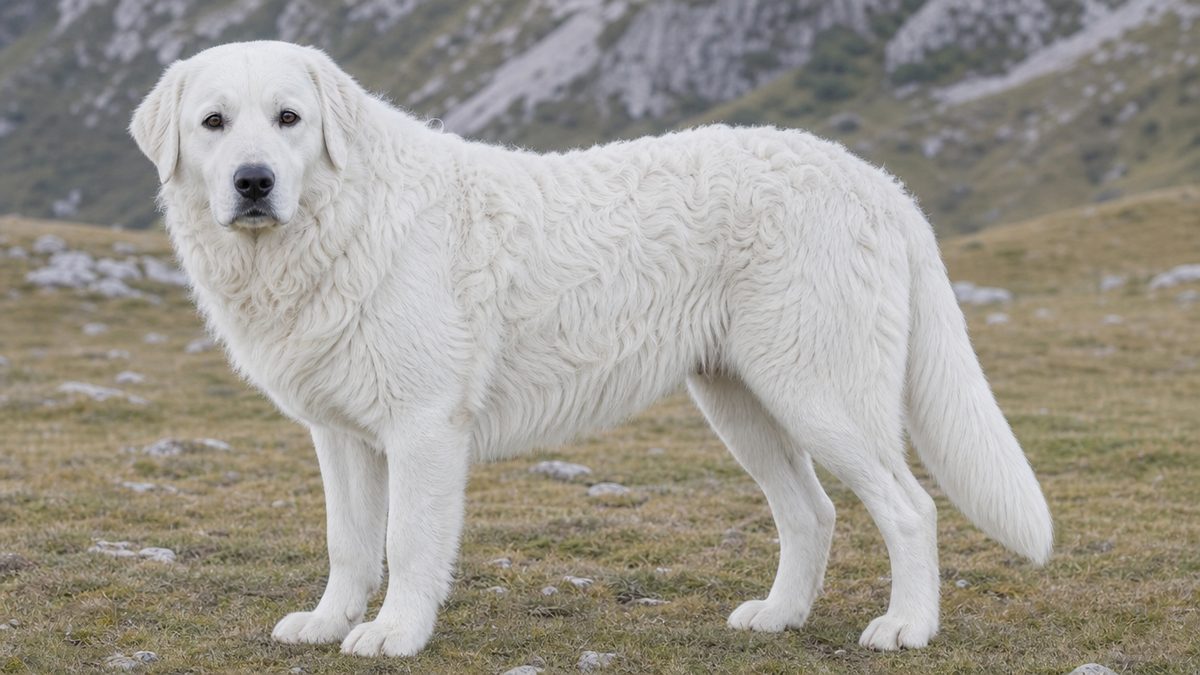
The Slovak Cuvac is a large white Slovak livestock guardian from the Tatra mountains, held by the FCI as breed standard 142 in Group 1, Section 1. Bonbeno read that number off the FCI's own letter index rather than assembling a URL, because an FCI address built from a guessed number returns a complete and correct page for whichever breed owns that number; the index files this one under S as SLOVENSKY CUVAC and links it as breed 142 Federation Cynologique Internationale. Wikipedia describes the frame as massive, which is fair for a dog the standard gives a chest girth of 70 to 83 cm. Males stand 62 to 70 cm and weigh 36 to 44 kg; females stand 59 to 65 cm and weigh 31 to 37 kg.
Unusually among FCI standards, this one publishes a full measurement table rather than two height bands, and it is worth reproducing because almost no page carries it. The precision is a hint about the document's age: this is how breed standards were written in the 1960s, when a judge was expected to carry a tape.
| Measurement | Dogs | Bitches |
|---|---|---|
| Length of head (average) | 25 to 28 cm | 23 to 26 cm |
| Length of cranial region | 13 to 15 cm | 12 to 14 cm |
| Length of facial region | 12 to 14 cm | 11 to 13 cm |
| Height at sternum level | 33 to 37 cm | 30 to 35 cm |
| Depth of chest | 30 to 34 cm | 25 to 30 cm |
| Length of body | 69 to 76 cm | 60 to 72 cm |
| Length of ribcage | 40 to 47 cm | 37 to 44 cm |
| Girth of chest behind shoulder | 70 to 83 cm | 68 to 72 cm |
| Girth of chest at last floating rib | 60 to 70 cm | 56 to 65 cm |
It also fixes four joint angles as numbers: shoulder joint 107 degrees, elbow joint 145 degrees, hip joint 90 degrees, stifle joint 110 degrees. Google India's knowledge panel for this breed reproduces the height and weight bands exactly, at 36 to 44 kg and 62 to 70 cm for males and 31 to 37 kg and 59 to 65 cm for females, which is a rare case of a knowledge panel matching a governing document and is worth saying because it so often does not.
The coat, and the one clause that helps an Indian owner
The coat clause specifies a dense coat with no parting on the back and no feathering on tail or buttocks, hair short and close on head and legs, a striking mane in males, and a topcoat of 5 to 15 cm that is most wavy on the mane and moderately wavy elsewhere, forming numerous waves across the back that merge into each other. Single unjoined waves are undesired. The undercoat is fine and dense, up to half or two thirds the length of the topcoat.
Most double-coated breed standards say nothing about seasonal shedding. This one does: 'The undercoat is shed during the summer, so the coat loses its density, but remains light throughout the year on account of the wavy topcoat which forms no parting on the back.' That is a genuine mitigation for a hot country and it deserves stating plainly, because the rest of this page is about why the breed is still a poor fit for India.
White is functional, not decorative
Colour is white, with yellowish shading at the ear set-on permitted but not desired, and distinct yellow patches not permitted at all. Yellow patches are also listed as a disqualifying fault, alongside pink spots on nose leather, lips or eyelids, and light eyes. The standard gives the reason for the colour in one sentence: in order to distinguish him from wild beasts in the night, he is, according to ancient tradition, only bred in white.
That functional explanation has a consequence nobody follows through for a tropical country. The standard also specifies that the skin is pink, with black pigmentation only round the eyes, the neck and the muzzle where it merges with the black mucous membranes, and black pads. A pink-skinned dog under white hair is a sun exposure problem in India in a way it is not in the Tatras, and the thinly haired belly, flanks and inner thighs are where it shows.
- Nose black, especially in summer, which is the standard's own phrasing and describes the seasonal nose depigmentation common in northern white breeds.
- Ears set on high, hanging, lying close to the head, with finer hair halfway down, reaching mouth level at rest.
- Tail set on low, hanging to the hock joints, straight like a cigar at rest, carried curled over the loin when moving.
- Dewclaws undesired, and listed as a fault. This matters in India and the adoption section explains why.
- Jaws always with a complete scissor bite. A pincer bite and missing teeth are both faults.
The governing document is sixty-one years old and counts a country that no longer exists
FCI Standard 142 is dated 18 August 1965 and is still the currently valid standard for this breed. Reading it is like opening a sealed room. It contains a population census written in the present tense about a state that dissolved in 1992.
The FCI's own breed record gives the date of publication of the official valid standard as 18 August 1965, while the English translation carried on the FCI's site was published on 4 June 1996 and the French translation on 14 June 2018. So the text is from 1965, the English rendering of it is from 1996, and one language of it was still being issued in 2018. Nothing in the substance has been revised in sixty-one years.
Verbatim from the standard's historical summary: 'The number of club members with breeding stock and kennels has recently been counted as towards 200. Living registered dogs, at present in the republic, number nearly 800.' The words are 'recently' and 'at present'. The republic is Czechoslovakia, which ceased to exist on 31 December 1992. Anyone quoting 'nearly 800 living registered dogs' as a current population figure for this breed is quoting a snapshot taken around 1965.
Two further sentences date the document from the inside. The standard says the stud book of the Tatra Chuvach in Czechoslovakia was founded more than thirty years ago by Professor Anton Hruza of the Brno Veterinary College, which places the writing three decades after that founding. And it says the quality of 'our breeding' is confirmed by favourable assessment at international shows in Prague, Brno, Liberec, Bratislava and Leipzig. Leipzig was in East Germany. The first-person 'our' is Czechoslovak.
Three defects in the FCI's own English text
Bonbeno extracted both the English and the authentic German PDFs with pypdf rather than reading either through a fetch tool's rendering, and the English text carries three visible errors the German does not.
| Where | What the English prints | What it plainly means |
|---|---|---|
| ORIGIN line | Slovakian Republik | Slovakian Republic, with a German k |
| FAULTS list | Results of tickets or distemper | Rickets, a bone disease, not tickets |
| COAT clause, twice | Males have a striking name | Mane. The German has Mahne |
None of those changes a measurement and none of them matters clinically. They matter because they tell you what kind of document you are reading: a 1965 German text, translated once in 1996, transcribed with errors, and never revisited. A page that treats this standard as a live, maintained specification is treating it as something it is not, and that is the frame an Indian buyer needs before reading anything else about the breed.
The history the standard tells, and what has aged badly in it
The historical summary opens by deriving the whole group of white mountain dogs from Arctic wolves whose pre-ice-age remains were preserved at the edge of the glaciers, in the Caucasus, the Rhodopes, the Carpathians and especially the Tatra, the northern Abruzzi, the Alps and the Pyrenees. That is a mid-twentieth-century account of dog origins and it is not how the question is framed now. Bonbeno reports it as what the standard says rather than as what is currently understood, and publishes no origin claim of its own, because no genetic study naming this breed exists to draw on.
The rest of the history is social and it is genuinely good. It records that the Slovak mountain people were largely free, not subject to medieval forced labour, protecting the frontiers and paying their dues in sheep's cheese, organised in a herding and military body the standard calls the Wallachischer Bund, whose centre until the repeal of forced labour was at Kaschau. Members served on the mountain meadows always accompanied by their dogs, and were always depicted with them.
Slovak Cuvac price in India: no listing, no rupee figure, and no lawful way to make one
There is no Slovak Cuvac price in India. India's largest puppy listing site carries a breed selector of roughly three hundred entries and no Slovak breed of any kind appears in it. Google India returns about 121 results for the bare breed query.
| Position | Site | Country and what it offers |
|---|---|---|
| 1 | akc.org | United States. Breed information, no price |
| 2 | sk.wikipedia.org | Slovak-language Wikipedia, no price |
| 3 | en.wikipedia.org | Encyclopaedia, no price |
| 4 | dimensions.com | Dimensioned drawings, no price |
| 5 | cuvacusa.com | The United States breed club, no listings |
| 6 | dogbreedslist.info | Prices in United States dollars |
| 7 | shutterstock.com | Stock photography, not dogs |
| 8 | wagwalking.com | United States, costs in dollars |
| 9 | wamiz.co.uk | United Kingdom, prices in pounds |
| 10 | a-z-animals.com | United States, no Indian price |
Not one Indian result appears, and the only breed club on the page is American. That is a cleaner absence than the Polish Greyhound's, where the whole first page was full of Indian sellers offering a different breed. Here the results are honest and simply foreign.
Why Bonbeno publishes no converted figure
One ranking page quotes a puppy price average in United States dollars and another gives daily, monthly and annual cost figures in dollars. Converting either into rupees would produce a number that looks like a price and describes nothing: no Indian seller, no Indian transaction, no Indian dog. Bonbeno caught Google's own AI Mode doing exactly that on two other breeds in the same research session, once at a flat 75.00 rupees to the dollar and once as a rounded sterling conversion at two different implied rates.
Dogs are a Restricted import in India. Entry is permitted for a pet accompanying its owner with a valid pet book in the importer's name, for research with a CPCSEA recommendation, and for defence or police use, while applications for trading or breeding purposes are rejected and entry is limited to a named list of ports. So no Indian breeder can lawfully import foundation stock and produce this breed here. The empty listings follow from the law, not from taste.
What an Indian buyer would actually be buying
If somebody offers you a Slovak Cuvac in India, the realistic possibilities are a Great Pyrenees, a white Kuvasz-type dog, a white Central Asian Shepherd, or a large white crossbreed. All four are more likely to be available here than this breed is, and none of them is this breed. The distinguishing marks from the standard are the ones to check: tail set low and hanging to the hock rather than plumed and carried high, no double dewclaws on the hind legs, a coat with no parting along the back, and pigmentation that is black on nose, eyelids, lips and palate.
The Great Pyrenees comparison is the one that matters most, because Wag!'s own breed page describes the Slovensky Cuvac as closely resembling it. The clearest single separator is the dewclaw: the Great Pyrenees standard requires double dewclaws on the hind legs, while this standard lists dewclaws as a fault and says they are undesired. A big white mountain dog with double hind dewclaws is not a Cuvac.
Cost of ownership in India for a 36 to 44 kg double-coated guardian
The cost of ownership for this breed in India is calculable even though the purchase price is not. Use the standard's own weight range, 36 to 44 kg for males, as the planning basis, because it puts the dog above the common parasite-control weight band and into the next one.
| Item | Published figure | Source |
|---|---|---|
| Puppy core vaccination course | from Rs 6,499 | Vetic, national page |
| Annual booster | from Rs 3,199 | Vetic, national page |
| Anti-rabies, single dose | Rs 699 | Vetic |
| Nine-in-one DHPPiL | Rs 899 | Vetic |
| Consultation | Rs 500 to Rs 1,000 | VOSD, treated as one data point |
| NexGard Spectra, 15 to 30 kg band, per month | Rs 1,103 | Supertails. This dog is heavier |
| Professional bath | from Rs 934 | Vetic Delhi grooming |
| Complete bath and styling | from Rs 1,869 | Vetic Delhi grooming |
| Boarding, overnight to 24 hours | Rs 899 | PawSpace Bengaluru |
| Delhi MCD pet dog registration | Rs 500 | MCD Delhi, dogs only |
| Chennai GCC pet licence | Rs 50 | Greater Chennai Corporation |
Read the parasite line carefully for this breed
Supertails lists NexGard Spectra for dogs of 15 to 30 kg at Rs 3,308 for three tablets, which is Rs 1,103 a month. A male Slovak Cuvac at 36 to 44 kg sits above that band entirely and needs the next weight presentation, so the Rs 1,103 figure is a floor rather than an estimate for this dog. Bonbeno does not publish a figure for the heavier band because it did not price that product, and inventing one by scaling would be arithmetic rather than a price.
Tick control is not optional for a dog that lives outdoors in India, which is where a guardian will want to be. A West Bengal series of 584 dogs screened at veterinary clinics found *Babesia gibsoni* in 76.54 percent and 72.9 percent of the 584 dogs screened carrying two or more pathogens. An eastern Indian series of 178 dogs found *Ehrlichia canis* in 56 of 178, that is 31.46 percent, and reported that 75 percent of infected dogs weighed over 20 kg with 79 percent having a tick history. Both sampled clinic caseloads rather than random populations, so read them as what an Indian vet sees. That over-20 kg finding puts this breed squarely in the exposed group.
Air conditioning, or at minimum a cooled indoor space with real air movement, is a running cost for this breed rather than a comfort. Budget it as electricity, and ask any boarding facility about generator backup before leaving a 40 kg double-coated white dog anywhere in an Indian summer.
Municipal costs are small and durable. Delhi's Municipal Corporation charges Rs 500 to register a pet dog and publishes its own counters, 18,958 certificates issued since 2021 and 71 of 1,006 applications rejected in FY 2026-27. Greater Chennai Corporation charges Rs 50, issued 9,115 licences in 2024, and runs six municipal clinics providing treatment and anti-rabies vaccination free of cost. For a large guardian breed, a registered identity matters more than the fee suggests.
Boarding needs a breed-specific caution. PawSpace Bengaluru publishes overnight care to 24 hours at Rs 899 and VOSD gives a wider Indian range of Rs 500 to Rs 2,000 a day. Before booking, ask whether the facility has experience with livestock guardian breeds, because a territorial 40 kg dog in a communal boarding run is a different proposition from a Labrador.
Bonbeno quotes no single monthly total. A headline figure would have to assume a city, a food brand, a clinic and a body weight, and Indian breed sites that print one are usually reprinting a preset row shared across unrelated breeds. What can be said is the direction: this is an expensive dog to keep in India relative to its size, because the cooling, the coat work and the heavier parasite-control band all scale against you at once.
Heat tolerance in India, and why the homeland cannot be measured properly
This breed's heat tolerance in India is the worst Bonbeno rates on any Polish or Slovak breed. Its own standard says the dog has for centuries been accustomed to the harsh climate of the Slovakian mountains, especially the Tatra. Measuring that homeland turns out to be harder than it looks, and the difficulty is itself worth reporting.
What NASA POWER can and cannot tell you about Slovakia
Bonbeno queried NASA POWER by explicit latitude and longitude for five Slovak points and echoed the model cell elevation on every one, because a satellite grid cell in mountains is frequently not the town underneath it. The results split cleanly into one usable point and four unusable ones.
| Point | Cell elevation | Real elevation | Error | Usable |
|---|---|---|---|---|
| Bratislava | 162.22 m | about 134 m | +28 m | Yes |
| Banska Bystrica | 553.06 m | about 362 m | +191 m | No |
| Zvolen | 553.06 m | about 295 m | +258 m | No |
| Zilina | 640.20 m | about 342 m | +298 m | No |
| Poprad, the Tatra gateway | 1,033.53 m | about 672 m | +362 m | No |
Zvolen and Banska Bystrica are separate towns 67 m apart in elevation, and NASA POWER returned a byte-identical series for both: the same 553.06 m cell elevation, the same 7.84 C annual mean, the same 80.46 percent humidity, the same July 19.17 C and the same January minus 4.37 C. That is one grid cell queried twice, not two measurements, and neither figure can be used to describe either town. Bonbeno reports the limitation rather than publishing the cell as if it were a place.
So the only Slovak point on this page that describes an actual town is Bratislava, which sits on the Danube plain at the opposite end of the country from the breed's mountains. Its cell returns an annual mean of 10.86 C, a July mean of 22.73 C, a January mean of minus 1.20 C and annual relative humidity of 74.72 percent. That is the warmest point in Slovakia, and it is where the breed does not come from. The Tatra highlands are colder, and Bonbeno cannot say by how much with an instrument this coarse.
| Place | Annual mean | Hottest month | Coolest month |
|---|---|---|---|
| Bratislava, Slovakia | 10.86 C | July, 22.73 C | January, minus 1.20 C |
| Delhi | June, 35.88 C | January, 13.61 C | |
| Chennai | May, 31.51 C | January, 24.09 C | |
| Mumbai | May, 31.19 C | January, 23.19 C | |
| Kolkata | May, 31.53 C | January, 17.31 C | |
| Bengaluru | April, 28.37 C | December, 20.22 C | |
| Pune | April, 28.93 C | December, 19.62 C | |
| Kochi | March, 29.42 C | August, 25.91 C |
Every one of those Indian figures describes a climate this breed has no evolutionary experience of, and a 40 kg double-coated dog is heat-sensitive in a way its own standard never had to say out loud because it was written for the Tatras. Set the two lines together. Slovakia's warmest city in its warmest month averages 22.73 C. Chennai's coolest month averages 24.09 C and Kochi's coolest averages 25.91 C. Both Indian coastal cities are warmer in their coldest month than Slovakia's warmest city is in July, and the breed comes from mountains that are colder still.
The exertion evidence, and what transfers
Hall and colleagues, working 905,543 UK dogs under primary veterinary care in 2016, recorded 1,259 heat-related illness events from 1,222 dogs, of which the 879 events with a recorded trigger split into 652 exertional, which is 74.2 percent, 113 environmental and 46 from vehicular confinement. The companion paper on the same cohort, with a stricter definition and 395 confirmed events, gives an incidence of 0.04 percent and a fatality rate of 14.18 percent, and reports odds of 3.42 (1.54 to 7.57) for dogs over 50 kg and 1.42 (1.12 to 1.80) for dogs at or above their breed and sex mean bodyweight. Name which paper you are reading; the two share authors, a year and a cohort.
A large male Cuvac at 44 kg sits just under that 50 kg threshold, so the over-50 odds ratio does not apply to the breed as standard. The transferable factor is bodyweight relative to breed mean, and a working-condition guardian sits at or above it. The breed itself was not modelled, because no UK cohort holds enough of them.
Sun, not just heat
The sun exposure risk is specific to this breed and almost nobody writes about it. The standard specifies pink skin with black pigmentation only around the eyes, neck and muzzle. Unpigmented skin under white hair burns, and the sites that burn are the ones with the least hair: the belly, the inner thighs, the groin and the bridge of the nose in a dog whose nose depigments in summer. In a country with high UV for most of the year, that is a real dermatological consideration, and a white dog lying on a sunny Indian terrace is exposed in a way a black dog is not.
Indian law reaches the housing question directly. Second Schedule Part IV paragraph 21(1) of the Dog Breeding and Marketing Rules, 2017 bars keeping dogs in outdoor facilities without the attending veterinary practitioner's written approval where they are not accustomed to local temperatures, or are of breeds that cannot tolerate them, such as long-haired breeds in high temperature locations. A guardian breed wants to be outdoors and this clause is written about exactly that combination.
- Bengaluru and Pune are the only Indian metros where this breed is even arguable, peaking in April rather than May and coolest in December.
- Delhi is workable December to February and hostile the rest of the year, peaking in June at 35.88 C.
- Chennai, Mumbai, Kolkata and Kochi have no cool season at all for a dog like this. Kochi is coolest in August, in the monsoon.
- Shade and airflow beat air conditioning alone, because a dog that is cooled indoors and then taken onto a hot terrace loses the benefit in minutes.
Temperament: a guardian that decides for itself, and what that means in an Indian compound
The Slovak Cuvac's temperament is written into its standard in one sentence: he is boundlessly faithful and courageous, always ready to fight off any intruder, be it even bears and wolves. That is not colour. It is the job description, and it is why this breed is a difficult proposition in Indian urban life.
The utilization clause is equally direct: the breed's use derives from its age-old work as a shepherd and mountain dog in bare high mountain regions and as a guard dog for farms and borders. The general appearance clause adds vigilant, fearless and alert, and notes that this vigilance gave the breed its name, since the Slovak word cuvat means to hear. The American Kennel Club's breed page reproduces the standard's temperament sentence closely.
Anyone in an apartment, anyone in a housing society with shared corridors, anyone whose home has daily domestic staff, deliveries and visitors, anyone without secure high fencing, and any first-time owner. A livestock guardian is bred to make life-or-death decisions alone at night without consulting a handler, and that is the opposite of what a busy Indian household needs.
Guardian behaviour in an Indian setting
The specific problem in India is not aggression, it is traffic. An Indian home has far more legitimate strangers crossing its boundary in a week than a Tatra sheepfold sees in a year: cooks, cleaners, drivers, couriers, gas cylinder deliveries, building maintenance, the milk man, the newspaper boy. A guardian breed evaluates each of them, and a dog that is correct by its standard will challenge many of them.
- Introduce regular visitors formally and repeatedly, on lead, with the dog rewarded for calm, rather than expecting habituation to happen on its own.
- Manage the boundary rather than the dog. A guardian behind a gate it can see through is working all day; a solid boundary lowers the workload more than any training does.
- Never leave a guardian breed loose in a compound with unrestricted delivery access. In India that is the single commonest route to a bite incident with a large breed.
- Expect night vigilance. This is a nocturnal working pattern in the original job, and street noise in an Indian city runs all night.
The secondary sources converge on the same picture in their own words. One breed directory calls it a powerful, calm, loyal flock guardian, Royal Canin describes solidly built mountain dogs with a thick white coat and robust bone structure, and the United States breed club presents itself as an education and resources body for owners, breeders and admirers of what it calls a rare breed. There is no equivalent Indian club, which is worth knowing before you take on a breed whose problems are best explained by people who own them. With its own family the standard's word is loyal, or more precisely boundlessly faithful, and owners consistently describe a calm, affectionate, deeply attached dog indoors. Wamiz's characteristic list gives more or less affectionate, moderately playful, very calm and low prey drive, and the low prey drive is genuinely useful: unlike Poland's sighthound and scent hound, this breed was not selected to chase, which makes it safer around livestock and, in an Indian context, around street animals.
With children the standard says nothing and no behavioural study exists. What can be said structurally is that a 40 kg dog with a guarding temperament may read a visiting child's rough play with a resident child as a threat to the resident child, which is a guardian failure mode rather than a temperament fault. Supervise on that specific basis rather than on a general one.
Training a livestock guardian: manage first, obedience second
To train a Slovak Cuvac, spend your effort on management and socialisation rather than on obedience polish, because a livestock guardian's independence is the trait it was selected for. This is the least biddable breed Bonbeno covers among the Polish and Slovak set.
The standard describes a lively temperament that is vigilant, fearless and alert, and nothing about eagerness to please. That absence is meaningful. A herding dog checks in with a handler; a guardian is bred to be correct when no handler is present. Training methods built on constant handler feedback work poorly here, and pressure works worse.
The order to teach things in
- Socialisation first, and far more of it than you think. The window closes near sixteen weeks and a guardian that is under-socialised becomes an adult that cannot distinguish a courier from an intruder.
- Handling and restraint second, taught as a pleasant routine, because a 40 kg dog that objects to being examined cannot be treated by an Indian vet in a busy clinic.
- Lead manners third. A guardian that pulls is genuinely unmanageable at this weight, and the lead is the only reliable control system in public.
- A reliable recall inside a fence fourth, understanding that off-lead reliability in open Indian ground is not a realistic target for this breed.
- Place and settle fifth, which is what lets a vigilant dog stand down when you tell it the visitor is fine.
- Crate or safe-room conditioning sixth, so that the dog has somewhere to be during the daily traffic rather than having to make a decision about every arrival.
Socialise to what the dog will meet in India, which is not the European list. Autorickshaws, temple bells, firecrackers, cattle, monkeys, street dogs at a controlled distance, building watchmen, lift doors and the sound of a metal gate. A guardian that has never met any of that before six months will spend its life deciding about all of it.
Do not train hard in the middle of an Indian day. A double-coated 40 kg dog that is thermally stressed learns nothing, and short bursts of effort are exactly the exertional pattern behind 652 of the 879 triggered UK heat-illness events. First light and after dark, as with every breed on this site, and more strictly here than for most.
A well-raised Slovak Cuvac will be calm indoors, tolerant of familiar visitors, safe with its own family and reliably under control on a lead. It will not be an off-lead dog in an open Indian park, and it will not stop assessing strangers. Owners who accept that keep their dogs; owners who expect a friendly giant do not.
Exercise needs: less than you would expect, and at the wrong time of day
A Slovak Cuvac's exercise needs are moderate rather than extreme, at roughly ninety minutes a day of walking plus territory to patrol. Livestock guardians conserve energy by design, and the FCI standard describes a dog that is surprisingly light footed in spite of his powerful build, agile and quick, in every terrain and in all weathers, with a preference for trot.
That last phrase, in all weathers, was written about Tatra weather. In India the constraint is not the dog's stamina but the clock: a 40 kg double-coated white dog has two usable windows a day and both are dark or nearly dark.
| When | What | Why |
|---|---|---|
| Daily, first light | 45 to 60 minutes on lead at the dog's own pace | The only genuinely safe window in most Indian cities |
| Daily, after dark | 30 to 45 minutes on lead | Second session without daytime heat or UV load |
| Daily, throughout | Access to a shaded, secure area to patrol | A guardian settles when it can check its boundary; confinement without that is the stressor |
| Two or three times a week | Slow structured work, long-line or scent games | Mental load matters more than distance for a breed that conserves energy |
| Never | Exercise between 11am and 4pm, in any Indian month | Exertional heat illness accounted for 652 of 879 triggered UK events |
Patrol is the requirement, not distance
This is the practical difference between a guardian and a working gundog. A Slovak Cuvac does not need to be run; it needs somewhere to be responsible for. A dog with a secure shaded yard it can walk the perimeter of several times a day is a settled dog on far less formal exercise than an equivalent-sized sporting breed. A dog with no territory and two lead walks is under-served no matter how long the walks are.
- Under-exercise shows as pacing and night barking, not as destructiveness, because a frustrated guardian patrols harder rather than chewing.
- Weight gain is easy to miss under 5 to 15 cm of coat, which is why the feeding section asks for a monthly weigh-in rather than a visual check.
- Joint loading matters in a large slow-maturing breed with no published hip screening data anywhere, so keep the dog lean and keep stairs and jumping down to a minimum in the first eighteen months.
- Growth plates close late in a 40 kg breed. Free movement on soft ground until about eighteen months, and no forced roadwork before then.
One correction to a common instruction. Overseas guardian-breed guidance often recommends turning the dog out to live with stock. That advice assumes a temperate climate and it does not transfer: in India, an outdoor-living double-coated white dog is exactly the case Second Schedule Part IV paragraph 21(1) of the Dog Breeding and Marketing Rules, 2017 was written about, and keeping such a dog in outdoor facilities without the attending veterinary practitioner's written approval is not permitted.
Grooming a white double coat in Indian humidity
Groom a Slovak Cuvac by line brushing twice a week, rising to daily during the seasonal undercoat shed. The coat is a 5 to 15 cm moderately wavy topcoat over a fine dense undercoat, with no parting along the back and a striking mane in males.
The routine, and the Indian additions to it
- Line brush to the skin twice a week, parting the coat in horizontal sections. Surface brushing on a wavy double coat moves the top layer and leaves felt underneath.
- Work the mane and the trousers hardest, because those are the densest areas and the first to mat in humidity.
- Brush daily through the summer shed, when the undercoat lifts and has nowhere to go. The standard says this shed happens; plan for it.
- Dry to the skin after every bath. A double coat that is dried only on the surface in a humid Indian city stays damp underneath for hours, which is how a hot spot starts.
- Check pink skin on the belly, groin and inner thighs weekly for sunburn and irritation, which is a breed-specific check almost no guide mentions.
- Check for ticks by hand, not by eye. A 15 cm coat hides them completely, and the Indian tick load makes this a weekly job.
The instinct in an Indian summer is to clip the coat off, and on this breed it is actively harmful rather than merely unhelpful. The coat shields pink, largely unpigmented skin from sun, and clipping exposes a dog that burns. Manage heat with timing, shade, airflow and water instead. If a coat has genuinely felted to the skin, clipping is the right answer to that welfare problem, and it is a decision to take with a vet rather than a seasonal habit.
Why white is harder here
A white coat in India shows everything: red dust in the north, laterite in the south, road grime everywhere, and tear and saliva staining around the face. Bathing more often is the obvious answer and it is the wrong one, because frequent bathing on a dense double coat in humidity creates more skin problems than it solves. The better approach is mechanical: brush out dry dirt, spot-clean the face daily, and reserve full baths for every three or four weeks.
Vetic's Delhi grooming page lists bathing from Rs 934, a complete bath and styling from Rs 1,869 and a haircut from Rs 1,359. For this breed the haircut option is the one to avoid, and the question to ask a groomer is whether they force-dry to the skin. A half-dried 40 kg double coat is worse than an unwashed one.
Shedding is heavy and seasonal, with the standard's own acknowledgement that the undercoat goes in summer. In an air-conditioned Indian home the seasons blur and many owners report moderate shedding all year instead of two concentrated moults. Nobody markets this breed as hypoallergenic, and if they did, Vredegoor and colleagues measured Can f 1 across 196 dogs of so-called hypoallergenic breeds against 160 controls and found the hypoallergenic group came back higher, concluding there is a lack of evidence to describe any dog breed as hypoallergenic.
Health problems and life expectancy: three instruments, three zeros, and two OFA codes
Every health instrument Bonbeno can reach returns nothing for this breed. Zero papers in PubMed across five name forms with controls passing, no statistics row in any OFA database despite the breed holding two OFA codes, and McMillan 2024 lists it in Supplementary Table S5 with flag N. This section is about what that does and does not mean.
Life expectancy: no study, and one circulating number
McMillan and colleagues published the largest UK companion-dog longevity analysis in Scientific Reports in 2024, covering 155 purebred breeds. Bonbeno downloaded the supplementary tables from the publisher rather than reading the article body, because a breed's absence from an article's prose proves nothing. Supplementary Table S5, which is where inclusion is adjudicated, lists 'Slovakian Chuvach' with flag N and no reclassification. Flag N means considered and excluded, not merged and not filed under another name.
So there is no median and no confidence interval for this breed. The life expectancy figure of 11 to 13 years that circulates on breed-directory pages traces to no study naming the breed. For scale, McMillan's Table S3 gives the Great Pyrenees a median of 10.9 years (10.5 to 11.3) from 260 dogs and 128 deaths, with a hazard ratio of 1.5. That is what a real large-guardian row looks like, and it is a sobering comparator for anyone assuming a giant white mountain dog is long-lived.
OFA: two codes for one breed, and no data under either
Bonbeno read the Orthopedic Foundation for Animals breed codes out of OFA's own checkbox markup rather than guessing them, recovering 475 codes. This breed appears twice: once as SLOVENSKY CUVAC, code SLO, and once as SLOVAK TCHOUVATCH, code SLT. Those are the same dog under a Slovak spelling and a French one.
An owner filing a hip radiograph under SLO and another filing under SLT are contributing to two separate pools, neither of which will reach OFA's publication threshold of 100 hip evaluations. For a breed this rare, splitting the record in half is the difference between eventually having breed statistics and never having them. If you ever screen a dog of this breed in the United States, it is worth asking which code the submission goes under.
A case-insensitive search of OFA's full statistics dump returns zero rows for CUVAC and zero for CHUVACH, against in-session controls returning 109 hits for LABRADOR, 93 for GREYHOUND, 62 for BORZOI and 32 for SALUKI. The correct statement is therefore 'no row in OFA's published statistics tables', not 'absent from the OFA database'. OFA requires 100 hip evaluations, or 50 for its other databases, before a breed is published at all, and this breed has not reached that under either of its two codes.
| Instrument | Result for the Slovak Cuvac | Control in the same session |
|---|---|---|
| PubMed, 'Slovensky Cuvac'[tiab] | 0 records | Labrador Retriever tiab, 1,109 |
| PubMed, 'Slovak Cuvac'[tiab] | 0 records | Labrador hip dysplasia, 126 |
| PubMed, 'Slovakian Chuvach'[tiab] | 0 records | as above |
| PubMed, 'Tatra Chuvach'[tiab] | 0 records | as above |
| PubMed, 'Slovakian Shepherd'[tiab] | 0 records | as above |
| OFA breed code list | Two codes, SLO and SLT | Labrador LR, Greyhound GH present |
| OFA statistics dump | 0 rows under either code | LABRADOR 109, GREYHOUND 93, BORZOI 62 |
| McMillan 2024 Table S5 | Listed, flag N | Labrador and Whippet both flag Y |
What can honestly be said about risk
Where no breed data exists, the defensible move is to reason from conformation and from the law rather than to borrow another breed's percentages. Three things follow.
- Hip dysplasia is the screening priority for any 36 to 44 kg slow-maturing breed, and Indian law agrees: Second Schedule Part III paragraph 8(10) of the Dog Breeding and Marketing Rules, 2017 requires breeding dogs to have been tested for genetic defects including hip dysplasia. Ask for hip results on both parents and accept no substitute.
- Gastric dilatation-volvulus is a risk in any deep-chested large breed. The standard describes a broad chest with the sternum reaching lower than the elbows and a ribcage exceeding half the body length. A distended, tight abdomen with unproductive retching is an emergency measured in hours.
- Sun and skin. The standard's pink skin under a white coat is a real dermatological consideration in India, and it is the one risk on this list that is breed-specific rather than size-generic.
Bonbeno publishes no prevalence percentage for any inherited condition in this breed, because none has ever been measured anywhere. Any page that gives you one has borrowed it from the Great Pyrenees or the Kuvasz. Consult your nearby vet about a screening plan before breeding from any dog of this breed, and treat 'no reported problems' as a statement about the literature rather than about the dog.
Feeding a 40 kg guardian in India, by hand rather than by eye
Feed a Slovak Cuvac to body condition assessed by hand, using the standard's 36 to 44 kg for males and 31 to 37 kg for females as the sanity check. A 5 to 15 cm coat hides three kilograms without any change in outline.
Guardians are metabolically economical, which surprises owners who expect a 40 kg dog to eat like a 40 kg sporting breed. A Cuvac that patrols a yard and walks twice a day eats considerably less than a working gundog of similar mass, and the commonest error is feeding to the breed's size rather than to its actual output.
| Stage | Meals per day | What matters most |
|---|---|---|
| 8 to 16 weeks | 4 | A large-breed puppy formulation with controlled calcium. Never free-feed a giant breed |
| 4 to 8 months | 3 | Fastest growth, and where overfeeding buys hip and joint problems in a breed with no screening data |
| 8 to 18 months | 2 | Keep visibly lean through a long growth-plate window, judged by hand under the coat |
| 18 months to 7 years | 2 | Feed to condition. Split meals and rest either side of any hard work |
| 7 years and older | 2 | Watch weight closely. A slowing guardian under a heavy coat gains invisibly |
Never feed immediately before or after exercise. Split the daily ration into two meals, leave an hour after eating before any work, and half an hour after work before feeding. The standard describes a broad chest whose sternum reaches lower than the elbows, which is the classic body shape for gastric dilatation-volvulus. Consult your nearby vet about what the early signs look like, because in this breed you will be looking for them through a lot of hair.
Indian storage and water
Dry food in a humid Indian city degrades faster than the same bag in Slovakia. Buy smaller bags more often, decant into an airtight container, keep it off the floor and out of sun, and discard anything that smells sharp. In the monsoon treat an opened bag as a two-to-three-week item. That habit does more for a dog's gut than the brand does.
Water is a specific concern for a double-coated dog in India because the dog will drink heavily after any exertion, and gulping a large volume at once after exercise is itself a bloat risk factor. Offer measured amounts over twenty minutes rather than leaving a full bucket down immediately, and check that the mane dries afterwards, because a permanently damp neck ruff in Indian humidity becomes a skin problem.
Weigh the dog monthly on the same scale and record the number. For a breed with no published screening data, no lifespan study and a coat that conceals its own outline, your own trend line is the most reliable health instrument you will ever have.
The first year, month by month, in Indian conditions
A Slovak Cuvac puppy's first year in India runs on four clocks: the vaccination schedule, the socialisation window closing near sixteen weeks, growth plates that stay open to about eighteen months in a 40 kg breed, and the guardian instinct, which switches on somewhere between six and fourteen months and changes the dog you thought you had.
| Age | What happens | The Indian complication |
|---|---|---|
| 8 weeks | Legal minimum age of sale in India under Rule 8(1)(a). Vaccination begins | A puppy offered below eight weeks is being sold unlawfully. Walk away |
| 8 to 12 weeks | Socialisation at maximum intensity. This is the whole ballgame for a guardian breed | Carry the puppy in public until the course completes. Street-dog contact is a real disease risk |
| 12 to 16 weeks | Course completes. Formal introductions to every regular household visitor begin | All outdoor work before 8am. A double-coated white puppy has almost no heat regulation |
| 4 to 8 months | Adult teeth. Rapid growth. Still socially open | First monsoon. Weekly skin and coat checks under a thickening coat |
| 6 to 14 months | The guardian instinct emerges. Barking at arrivals begins and is normal | This is when Indian households discover what they bought. Manage the boundary, do not punish the alert |
| 12 to 18 months | Adult coat, adult size, adult judgement about strangers | Hip screening conversation with your vet starts at twelve months |
| 18 months | Growth plates close. Structured exercise can begin | Not before. A 40 kg breed matures slowly and forced work costs joints |
The socialisation window is the whole decision
For most breeds under-socialisation produces a shy or reactive dog. For a livestock guardian it produces a dog that cannot tell a courier from an intruder, at forty kilograms, in a country where couriers come daily. There is no adult training that fully compensates. If you cannot commit to intensive, structured, positive exposure between eight and sixteen weeks, this is not the breed to take on in an Indian city.
What are the hip results for both parents, and can I see the certificates, given no published screening statistics exist for this breed anywhere? How were the puppies raised, indoors with household traffic or in a kennel run, since a guardian's socialisation starts before you collect it? And is there any yellow patching, light eye or pink nose pigment in the line, all three of which are disqualifying faults under the standard?
Rule 8(1)(a) of the Prevention of Cruelty to Animals (Dog Breeding and Marketing) Rules, 2017 requires every breeder to ensure that pups less than eight weeks in age are not sold, and Rule 8(1)(b) requires that dogs over six months are not sold without prior sterilisation unless sold to a registered breeder. Both bind the seller.
Plan the first festival season deliberately. Diwali and wedding season produce sustained close-range noise in Indian residential areas, and a guardian breed that is already primed to evaluate every disturbance is exactly the wrong animal to leave unprepared. Start low-volume desensitisation in the first month and have a quiet interior room ready before the week itself.
Cuvac against the white guardians Indian buyers actually cross-shop
An Indian buyer looking at this breed is realistically choosing between it, the Great Pyrenees, the Kuvasz and an Indian guardian type. On sourced figures the Cuvac is the least documented of the European options and the least available in India.
| Slovak Cuvac | Great Pyrenees | Polish Tatra Sheepdog | Indian guardian type | |
|---|---|---|---|---|
| FCI standard number | 142 | 137 | 252 | None |
| Height, males | 62 to 70 cm | 70 to 80 cm | 65 to 70 cm | Varies |
| Weight in its FCI standard | 36 to 44 kg, stated | Not stated | Not stated | No standard |
| Date of the current standard | 18 August 1965 | More recent | More recent | Not applicable |
| Papers naming the breed in PubMed | 0 | Several | Very few | Very few |
| Rows in OFA published statistics | None, holds two codes | Present | Present, 127 hip evaluations | None |
| McMillan 2024 median lifespan | No row, flag N | 10.9 years (10.5 to 11.3) | No row | No row |
| Hind dewclaws | A fault | Double dewclaws required | Varies | Varies |
| Available in India | No evidence of any | Occasionally listed | No evidence | Widely |
Two rows carry the decision. The McMillan row is the one that should give any buyer of a giant white guardian pause: the Great Pyrenees, the best-documented breed of this type, has a median survival of 10.9 years with a hazard ratio of 1.5, built on 128 deaths. That is a short-lived group of dogs, and there is no reason to assume the Cuvac is different simply because nobody has measured it.
The dewclaw row is the practical identification test. The Great Pyrenees standard requires double dewclaws on the hind legs; FCI Standard 142 lists dewclaws as a fault and says they are undesired. If somebody in India shows you a large white mountain dog with double hind dewclaws and calls it a Cuvac, it is not one.
The Polish Tatra Sheepdog, from the other side of the same mountains
The comparison the standard itself draws is with the Polish side. It records that on the Polish side of the Tatra a similar breed, the Goral or mountain dogs, is kept, and that particularly powerful animals there are called Liptauer by the people, which the standard reads as pointing to Slovak origin, so that the breeding region has a topographic boundary. That Polish breed is the Polski Owczarek Podhalanski, FCI 252, and it is the better-documented of the pair: OFA publishes 127 hip evaluations for it, showing 64.6 percent normal and 33.1 percent dysplastic.
The Polish Tatra Sheepdog is the nearest relative of this breed with any published hip data at all, and a third of its evaluated dogs are dysplastic. That is not a figure for the Slovak Cuvac and must not be quoted as one. It is a reason to insist on parental hip certificates for a breed where no population figure exists, rather than assuming an unmeasured breed is a sound one.
For most Indian readers the honest recommendation is neither. A large, heat-adapted, short-coated Indian guardian type is free or inexpensive, immediately available, already suited to the climate, and carries none of the white-coat sun problem. If you specifically need a livestock guardian for stock in a cool Indian hill region, the conversation is different, and it should start with what is legally importable rather than with what is desirable.
Mistakes Indian buyers make with this breed
The commonest mistake with this breed in India is buying a guardian and expecting a companion. The second is quoting the standard's 'nearly 800 registered dogs' as a current population figure when it describes Czechoslovakia around 1965.
- Treating the FCI standard as a current document. It is dated 18 August 1965 and its population census, its country and its show circuit all describe a state that ended in 1992.
- Buying a Great Pyrenees by accident. The two look alike and the separator is simple: double hind dewclaws are required in the Pyrenees and are a fault here.
- Expecting biddability. A livestock guardian is bred to decide alone. Training methods built on constant handler feedback work poorly, and pressure works worse.
- Shaving the coat in an Indian summer, which removes the layer shielding largely unpigmented pink skin from hard sun.
- Skipping socialisation between eight and sixteen weeks, which for a guardian breed is not a missed opportunity but a permanent one.
- Housing the dog outdoors in an Indian city, which the Dog Breeding and Marketing Rules 2017 restrict for breeds that cannot tolerate local temperatures.
- Reading 'no reported health problems' as good news. Zero papers, no OFA rows under either code and a McMillan flag of N mean nobody has looked.
- Quoting an 11 to 13 year lifespan as research. The best-documented comparable breed, the Great Pyrenees, has a McMillan median of 10.9 years.
How to check a claim about this breed in five minutes
| Claim you are told | How to check it | What you will find |
|---|---|---|
| A current population figure of about 800 dogs | Read the standard's own historical summary | It is a present-tense census of Czechoslovakia, in a 1965 document |
| Hip scores quoted from OFA | Search OFA's statistics for CUVAC and CHUVACH | Zero rows under either of the breed's two codes |
| A lifespan sourced to research | Search McMillan 2024 Table S5 | Listed as Slovakian Chuvach with flag N. No median exists |
| This dog is a Cuvac, shown with double hind dewclaws | Read the standard's HINDQUARTERS clause | Dewclaws undesired, and listed among the faults |
| The breed is hypoallergenic | Read Vredegoor 2012 | Hypoallergenic breeds measured HIGHER for Can f 1 than controls |
Because no verified Slovak Cuvac supply exists in India, any large white dog offered under the name is more likely to be something else. Check four things from the standard: tail set LOW and hanging to the hock, no double hind dewclaws, no parting down the back of the coat, and black pigment on nose, eyelids, lips and palate. Pink spots on nose leather, lips or eyelids are a disqualifying fault, so a dog showing them is not a show-quality example of the breed whatever its paperwork says.
One mistake belongs to the search engines rather than to buyers. Google India returned no People also ask panel at all for the bare breed query on two separate fetches, and the question form then returned a panel in which three of four questions were not about this breed, two of them about the Czechoslovakian Wolfdog and the Slovakian pointer. The engine is not confused about the words; it is answering from the corpus that exists, and for this breed that corpus is thin enough that neighbouring Slovak breeds fill the gap.
Adoption, sourcing, and the dewclaw clause Indian law settles
The realistic route to a livestock guardian in India is to adopt one that is already here, because Indian import policy does not permit bringing a dog in to buy, sell or breed from. If you do source a Cuvac, one clause of its standard cannot lawfully be satisfied by an Indian breeder.
The dewclaw problem
FCI Standard 142 lists dewclaws as a fault and states under HINDQUARTERS that dewclaws are undesired. The ordinary way a breeder produces a dog without them is to remove them in the first days of life. Second Schedule Part II paragraph 6(8) of the Prevention of Cruelty to Animals (Dog Breeding and Marketing) Rules, 2017 states that there shall be no tail docking, ear cropping, de-barking, de-clawing, branding, dyeing, injecting substances to enhance visual appeal, performing a surgery or procedure to camouflage or hide any defect or infirmity or any other kind of mutilation of any body part of the pup, and that any change of appearance by artificial means is strictly forbidden.
The standard does not instruct removal; it penalises the presence of dewclaws. So this is a softer collision than the Slovak Rough-haired Pointer's, whose standard says outright that dewclaws must be removed and the tail docked at half length. But the practical effect is the same: an Indian breeder cannot lawfully remove a dewclaw to improve a dog's conformation, and a Cuvac bred in India will therefore carry a fault the standard penalises. That is a real constraint and no page mentions it.
The import position
Dogs are a Restricted import in India. The lawful routes are a pet accompanying its owner with a valid pet book in the importer's name, research use with a CPCSEA recommendation, and defence or police use, with applications for trading or breeding purposes rejected and entry limited to a named list of ports. So no Indian breeder can lawfully import foundation stock and produce this breed commercially here. A returning resident relocating with their own registered dog is the case the pet route exists for, and it should be worked from that route's own instrument with the Animal Quarantine and Certification Station.
What Indian breeding law would require
- Second Schedule Part II paragraph 6(3) prohibits in breeding, defined as breeding between relatives of the 2nd to 4th grade in straight or side line within the first four generations, and incest breeding, defined as mating between parents and children or between brother and sister. Only out breeding and line breeding are permitted, which is a real constraint on a breed whose entire recorded population was under a thousand dogs when its standard was written.
- Second Schedule Part III paragraph 8(10) requires breeding dogs to have been tested for genetic defects including hip dysplasia, progressive retinal atrophy, night blindness and hypothyroidism.
- Second Schedule Part II paragraph 6(8) forbids docking, cropping, de-barking, de-clawing and any change of appearance by artificial means.
- Rule 8(1)(a) prohibits selling pups under eight weeks, and Rule 8(1)(b) prohibits selling dogs over six months without prior sterilisation unless the buyer is a registered breeder.
The route that is actually open
India has no Slovak Cuvac rescue because India has no Slovak Cuvacs. It does have large guardian-type dogs in need of homes, and a reader who wants this kind of dog can have one.
- Indian guardian types in rescue, including Bakharwal, Gaddi and Himalayan sheepdog types in the northern states, which are adapted to the climate they live in.
- Rehomed Great Pyrenees and large white crossbreeds, which are surrendered in Indian cities specifically because owners underestimated coat and temperament, and which come with an honest account of what that took.
- Indian pariah dogs of large build, which are common, free, robust and by a wide margin the best-adapted large dog available in India.
- Municipal shelters and NGO drives, several of which cost nothing beyond vaccination. Greater Chennai Corporation's six pet clinics provide treatment and anti-rabies vaccination free of cost.
Register whichever dog you take home. Delhi charges Rs 500 and has issued 18,958 pet dog certificates since 2021; Greater Chennai Corporation charges Rs 50 and issued 9,115 licences in 2024. For a large guardian breed a registered identity is not paperwork, it is the difference between a manageable incident and an unmanageable one.
Bonbeno does not recommend breeders, link puppy listings or quote live prices as offers. If you decide this is your breed and can source one properly in its country of origin, ask for hip certificates on both parents, ask how the litter was socialised, and ask the breeder directly how they expect a Tatra guardian to cope with the climate you are taking it to. A breeder who has no answer to that last question is the answer to whether you should buy from them.
Slovak Cuvac questions Indian buyers actually ask
What is the temperament of a Slovak Cuvac?
Fearless, vigilant and independent. The FCI standard says the breed is boundlessly faithful and courageous, always ready to fight off any intruder, be it even bears and wolves, and describes a lively temperament that is vigilant, fearless and alert. The standard also states that this vigilance gave the breed its name, from the Slovak word cuvat. It is a guardian, not a companion breed with guarding tendencies.
What is the #1 best family dog?
No register or study ranks breeds that way, so the honest answer is that the question has no data behind it. What can be said about this breed specifically is that it is a poor fit for most Indian family homes: a 36 to 44 kg territorial livestock guardian with low biddability, a heavy double coat and an FCI standard that describes it fighting off bears is not a starter dog.
Are Czechoslovakian wolfdogs good pets?
Google returns this question on Slovak Cuvac searches because both breeds come from the former Czechoslovakia and the engine groups them. They are unrelated: the Cuvac is an ancient white livestock guardian in FCI Group 1 Section 1, while the Czechoslovakian Wolfdog is a twentieth-century German Shepherd and Carpathian wolf cross. Bonbeno covers that breed on its own page.
Are Slovakian pointers good family dogs?
That is a different Slovak breed, the Slovak Rough-haired Pointer, FCI 320, and it is a much better family prospect than this one. It is a gundog bred to work with a handler rather than a guardian bred to work alone, so it is biddable in a way the Cuvac is not. Its own complication in India is that its FCI standard requires docking and dewclaw removal, both of which Indian law prohibits.
How much does a Slovak Cuvac cost in India?
There is no Indian price, because no Indian seller lists the breed. India's largest puppy listing site carries a selector of roughly three hundred breeds and no Slovak breed of any kind appears in it. Overseas guides price the breed in United States dollars, and converting those into rupees would produce a number that describes no Indian transaction.
How big does a Slovak Cuvac get?
Males stand 62 to 70 cm at the withers and weigh 36 to 44 kg; females stand 59 to 65 cm and weigh 31 to 37 kg. Unusually, this standard also publishes a full measurement table, giving head length, cranial and facial length, sternum height, chest depth, body length, ribcage length and two chest girths for each sex, which almost no other FCI standard does.
Why are Slovak Cuvacs always white?
Because shepherds needed to tell the dog from the predator in the dark. The FCI standard states it directly: in order to distinguish him from wild beasts in the night, he is, according to ancient tradition, only bred in white. White is the only permitted colour, yellowish shading at the ear set-on is tolerated but not desired, and distinct yellow patches are a disqualifying fault.
Can a Slovak Cuvac live in Indian heat?
Not on the plains, and not comfortably anywhere in India. The breed standard says the dog has for centuries been accustomed to the harsh climate of the Slovakian mountains. Bratislava's warmest month averages 22.73 C while Chennai's coolest averages 24.09 C, and the Tatra highlands the breed actually comes from are colder still. India's own outdoor-housing rule bars keeping such a dog outdoors without written veterinary approval.
How long do Slovak Cuvacs live?
No breed-specific study exists. McMillan 2024, the largest UK longevity dataset, lists 'Slovakian Chuvach' in Supplementary Table S5 with flag N, meaning the authors considered the breed and excluded it, so there is no median and no confidence interval. Secondary sites print 11 to 13 years, and that figure traces to no study naming this breed.
Does the Slovak Cuvac shed its undercoat in summer?
Yes, and the breed standard says so explicitly, which is unusual and useful. The undercoat is shed during the summer, so the coat loses its density but remains light throughout the year on account of the wavy topcoat, which forms no parting on the back. That is the one clause in the document that works in an Indian owner's favour, and it does not make the breed heat-tolerant.
Is the Slovak Cuvac the same as the Polish Tatra Sheepdog?
No, they are separate FCI breeds from opposite sides of the same mountains. The Slovak Cuvac is FCI 142 and the Polish Tatra Shepherd, Polski Owczarek Podhalanski, is FCI 252. The Cuvac's own standard notices the relationship, recording that on the Polish side of the Tatra a similar breed is kept and that particularly powerful animals there are called Liptauer, which the standard reads as pointing to Slovak origin.
Are Slovak Cuvacs hypoallergenic?
No. No dog breed is, and a heavy seasonally shedding double coat is the opposite of the claim. Vredegoor and colleagues measured Can f 1 in hair and homes across 196 dogs of so-called hypoallergenic breeds against 160 control dogs and found the hypoallergenic group came back higher on both hair and coat, concluding there is a lack of evidence to describe any dog breed as hypoallergenic.
Compare with similar breeds
Slovak Cuvac sits in 1 Bonbeno group. Each one compares it directly against the breeds it is genuinely an alternative to, on the same figures.