
Breed profile
Harrier Dog Price in India, and Why It Is Not a Small Foxhound
What a Harrier actually costs in India, why three kennel clubs describe the same dog three different ways, and the two-measurement test that separates it from a Beagle and an English Foxhound.
Quick answer
No verified Harrier dog price in India exists, because no Indian market exists to set one. India's top-ranking page prints Rs 15,000 to Rs 40,000, which is the same floor it gives the Beagle, and US sources price the same breed at 1,500 to 2,500 dollars. The Harrier is a medium-sized British pack scent hound, FCI standard 295, and the four registries that describe it disagree on whether it is a small Foxhound. Bonbeno rates it 2 of 5 for heat tolerance.
This guide is general information for Indian pet owners and is not a diagnosis. Always consult a registered veterinarian near you before acting on anything you read here, and treat heatstroke, sudden collapse or a swollen abdomen as an emergency that needs a clinic the same hour.
Harrier traits, rated for Indian conditions
What a Harrier is, and what four registries cannot agree on
A Harrier is a medium-sized British pack scent hound bred to hunt hare, registered by the FCI as standard 295 in Group 6, Section 1.2, Medium sized scent hounds, accepted on a definitive basis on 27 November 1974 and subject to a working trial.
The interesting part is what happens when you read four registries' documents side by side. They do not describe the same dog.
The American Kennel Club standard, approved 13 December 1988 and effective 1 February 1989, contains the sentence "The Harrier should, in fact, be a smaller version of the English Foxhound."; The United Kennel Club standard, revised 1 January 2010, opens its General Appearance clause with "The Harrier is a smaller version of the English Foxhound."; Merriam-Webster's dictionary agrees, defining the word as "any of a breed of hunting dogs resembling a small English foxhound", though it then names the quarry as rabbits where every registry says hare.
FCI-Standard No. 295 says the opposite of a scaled copy. Its General Appearance clause reads, in full, "Strong and light dog, less powerful and more distinguished than the Foxhound." That is a comparison drawn to mark a difference in build, not a statement that one dog is the other shrunk. And the Royal Kennel Club's breed standard, last updated 1 August 2025, does not mention the Foxhound at all. It says only "Medium sized, smooth coated hound. Well balanced, compact without exaggeration. Strongly built without coarseness.";
The Kennel Club has managed to hold both positions in its own publications. Its October 2019 recognition announcement called the breed "like a small Foxhound but larger than a Beagle", while its Breeds A to Z page describes it as standing "between the taller Foxhound and the smaller Beagle as the intermediate sized scent hound";. The Royal Kennel Club
The one place a fifth authority is blunt about it
In hunt country the question is settled differently again. The Field's 2020 survey of the breed states that "Most harriers look more like diminutive foxhounds rather than large beagles";, and that type varies by pack: West Country hounds run bigger and lighter in colour, usually predominantly white with cream and lemon head markings, while East Anglian packs such as the Dunston and the Waveney favour hounds that look like scaled-down foxhounds.
The Harrier Club of America goes further and undermines the idea of a fixed pedigree altogether. Many of the foundation Harriers admitted to the Association of Masters of Harriers and Beagles stud book in 1891 were small Foxhounds with parents from recognised Foxhound kennels, some of them appear in top winning Beagle pedigrees, and in AMHB packs "Harrier often defines type of hunting and size of hound rather than pedigree". Breeding to Foxhounds still occurs in England.
Every Indian page on this breed copies one of these sentences without noticing the other three exist. If you are told a Harrier is a small Foxhound, that is the AKC and UKC position. If you are told it is a distinct medium hound, that is the FCI and the Kennel Club. Both are quoting a real document, and neither is quoting all of them.
Appearance, from the standards rather than from a blog
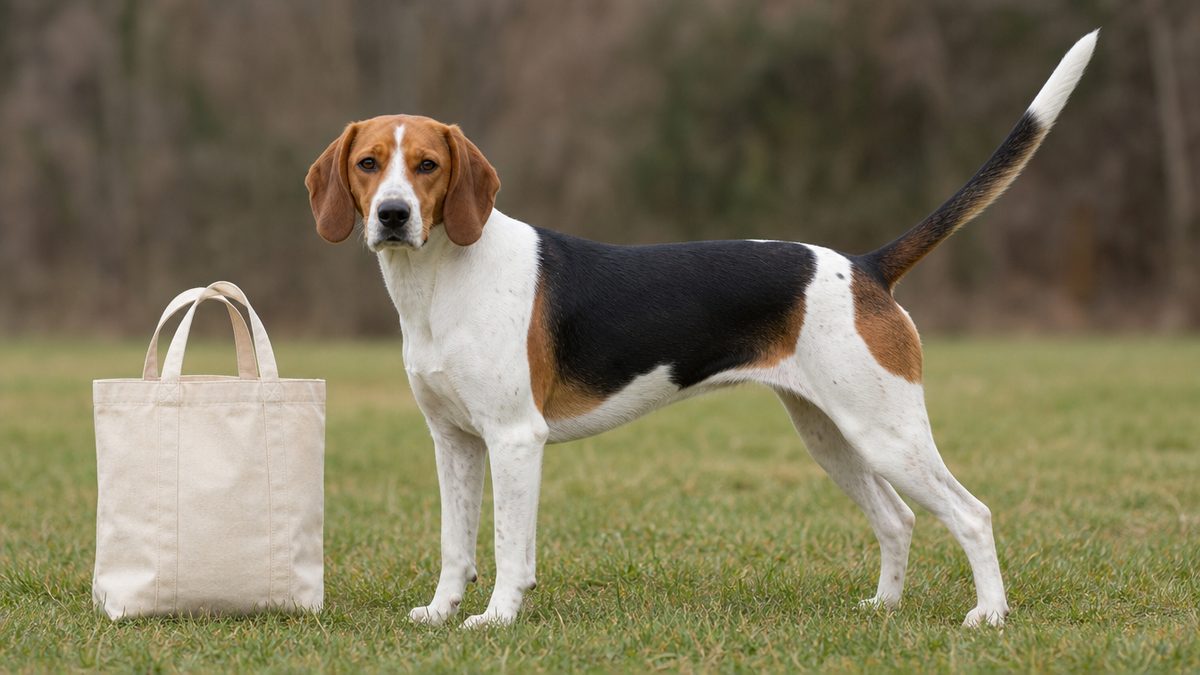
A Harrier is a smooth-coated hound with a level topline, a long high-set tail carried up and never curled over the back, and round cat-like feet. The AKC standard asks for a sturdy dog, very sturdily built with large bone for their size, and both English Wikipedia and the Kennel Club's own announcement place it between the Beagle and the English Foxhound in size. Even here the documents diverge. The AKC sets the ears low, lying close to the cheeks and rounded at the tips; the Kennel Club sets them high, pendant, with a rounded tip; the FCI and UKC both call them V-shaped, almost flat, quite short and rather set on high. Federation Cynologique Internationale United Kennel Club Ear set is exactly what separates a Beagle head from a Foxhound head, so the disagreement is not cosmetic.
Coat and colour split the same way. The AKC and UKC both ask for a coat "short, dense, hard and glossy", the Kennel Club asks for "short, dense and weatherproof", and the FCI asks for hair "Smooth, of English style, i.e. flat and not too short";. The Royal Kennel Club Federation Cynologique Internationale On colour the AKC says "Any color, not regarded as very important", while the Kennel Club allows only recognised hound colours and rules that "Any other colour or combination of colours unacceptable";. The Royal Kennel Club
The FCI standard carries one line that explains a lot about where the breed actually survives. Describing colour, it says the base is usually white with all shades of black to orange, and then adds "in France generally tricolour with black mantle covering the upper part of the back";. A standard for a Great Britain breed, written in English as its authentic language, reaches for France to describe what the dog normally looks like.
The four standards, printed side by side
Reading all four breed standard documents against each other takes about ten minutes and settles arguments no ranking page even acknowledges. Bonbeno downloaded each one and, for the FCI, extracted the PDF with pypdf rather than trusting a scraper's rendering.
| Clause | AKC, 1989 | UKC, rev. 2010 | FCI 295, valid 1974 | Kennel Club, 2025 |
|---|---|---|---|---|
| Is it a small Foxhound? | Yes, "should, in fact, be a smaller version of the English Foxhound" | Yes, "is a smaller version of the English Foxhound" | No, "less powerful and more distinguished than the Foxhound" | Silent, the Foxhound is not mentioned |
| Height at withers | 19 to 21 in, plus or minus 1 in | 19 to 21 in | 48 to 55 cm max, 48 to 50 cm preferred | Ideal dogs 53 cm, bitches 48 cm, tolerance 2.5 cm smaller |
| Ear set | Set on low, close to cheeks, rounded tips | V-shaped, quite short, almost flat, set on rather high | V-shaped, almost flat, quite short, rather set on high | High set, pendant, rounded tip |
| Coat | Short, dense, hard and glossy | Short, dense, hard and glossy | Smooth, of English style, flat and not too short | Short, dense and weatherproof |
| Colour | Any colour, not regarded as very important | Any good hound colour | Usually white base, black to orange, tricolour in France | Recognised hound colours only, anything else unacceptable |
| Weight | Not stated | Not stated | Not stated | Not stated |
| Working trial | Not required | Not required | Subject to a working trial | Not required |
Read the height row twice, because it produces a result that sounds impossible. An AKC-legal Harrier can be too tall for the FCI, and a Kennel Club-legal bitch can be too short. The AKC allows 21 inches plus a one-inch variation, which is 55.9 cm, above the FCI's stated maximum of 55 cm. The Kennel Club's ideal bitch is 48 cm with a tolerance of 2.5 cm smaller, which reaches 45.5 cm, below the FCI's floor of 48 cm. The Royal Kennel Club Federation Cynologique Internationale
Not one of the four gives a weight. The AKC's own breed page prints 45 to 60 pounds, but that is editorial copy on the website rather than a clause in the standard, and Dog Breeds List prints 40 to 60 pounds without saying where it came from. Dog Breeds List, 'Harrier - Price So a seller quoting you a weight range is quoting a website, not a breed standard.
And a fifth set of rules, with no ceiling at all
The working registers use different numbers again. The Field gives the general height limit in hunt classes as 22 inches for dogs and 21 for bitches, and records that classes for West Country harriers carry no height restriction whatsoever. Twenty-two inches is 55.9 cm, which is over the FCI ceiling, and "no restriction" is not a number any kennel club would print.
Ask which standard a seller is measuring against before you accept any height claim. A dog described as a Harrier at 45 cm satisfies the Kennel Club and fails the FCI. A dog at 56 cm satisfies a West Country hunt class and fails both. There is no single answer, and a seller who has not noticed that has not read any of the documents.
How to tell a Harrier from a Beagle and a Foxhound, on the dog in front of you
To identify a Harrier, check the rear feet for dewclaws first, then measure the height at withers, then look at the shape of the skull and muzzle. Those three checks take two minutes and settle most cases.
1. The rear dewclaw test, which is a straight elimination
A rear dewclaw, or a scar where one was removed, means the dog is not a Harrier. The Harrier Club of America's own identification guide states this plainly, adding that rear dewclaws are fairly common in Beagles and unheard of in Harriers. The test only runs one way: their absence proves nothing, because most Beagles do not have them either.
2. Measure the dog, and know which gap you are in
The FCI standards for the three breeds give a clean ladder, and reading it settles the "big Beagle" question by arithmetic rather than by opinion.
| Breed | FCI standard | Height at withers |
|---|---|---|
| Beagle | 161, valid 13.10.2010 | Desirable minimum 33 cm, desirable maximum 40 cm |
| Beagle-Harrier | 290, valid 01.08.2023 | 45 to 50 cm |
| Harrier | 295, valid 27.11.1974 | 48 to 55 cm, 48 to 50 cm preferred |
| English Foxhound | 159, valid 26.03.2009 | Approx. 58 to 64 cm |
The gap below the Harrier is 8 cm and the gap above it is 3 cm. By its own registry's numbers the breed sits nearly three times closer to the English Foxhound than to the Beagle, which is the single best answer to anyone calling it a large Beagle. Federation Cynologique Internationale
Two cautions come with that. The Beagle-Harrier overlaps the Harrier outright between 48 and 50 cm, and it is a separate French breed rather than a cross of the two dogs in its name. And an oversized Beagle is genuinely common: the Harrier Club of America notes that seventeen-inch Beagles, about 43 cm, "are not uncommon", and warns that height alone does not make a dog a Harrier.
3. The head, which is the test the hunting world uses
A Harrier's head should be longer and shallower, in both stop and muzzle, than a Foxhound's, and quite different from the higher-domed, squarer-muzzled Beagle. The Kennel Club standard matches that: head long with an appearance of quality, skull fairly broad and tapering towards the muzzle, occiput not prominent, slight stop, rectangular muzzle of moderate depth.
4. Paperwork beats appearance, and the parent club says so
The Harrier Club of America's rule is worth quoting because it cuts through every argument a seller can make. "If you bought your puppy and the breeder said it was a Beagle, then it IS a Beagle, even if it's now grown to 17 inches and 45 lbs."; They add that a puppy from a pound is not a Harrier, because Harrier breeders keep year-long waiting lists, and that most veterinarians, veterinary technicians, groomers and shelter workers have never seen the breed in person.
In 1999 the AKC registered 6 Harrier litters and 24 puppies in the entire United States, against more than 19,000 Beagle litters and more than 49,000 Beagle puppies. That is roughly 2,000 Beagle puppies for every Harrier puppy, before counting unregistered Beagles and Beagle crosses. Any houndy dog you meet is overwhelmingly likely to be one of those.
Harrier dog price in India, and why no honest figure exists
There is no verified Harrier dog price in India, because there is no Indian market for the breed to price. Every rupee figure Bonbeno could find traces to a page that gives the Beagle the same number, and the only sourced prices for the breed anywhere are in US dollars.
Start with what India's top-ranking page actually prints. Happy Pet, which held position one on an India-located search for the target query on 31 August 2026, gives a cost of buying of Rs 15,000 to Rs 40,000. On the same site, the Beagle page gives Rs 15,000 to Rs 50,000. The floor is identical for a breed that is one of India's most commonly kept pets and for a breed of which the AKC registered 24 puppies in a whole year across the whole United States.
The division tests, and what they show here
Bonbeno runs the standard conversion checks on any suspicious Indian figure, because Indian pages routinely publish a dollar number run through one exchange rate. Rs 15,000 divided by 84.38 is 177.8, by 74 is 202.7 and by 80 is 187.5. Rs 40,000 divided by 84.38 is 474.0, by 74 is 540.5 and by 80 is exactly 500. Only one endpoint lands on a number a seller would print, and 80 is the weak test, because any figure ending in three zeros divides cleanly by it. So this is not a converted US price list. It is a rupee-native band, and rupee-native does not mean researched.
The check that matters more is plausibility. The two US sources on the same results page give 1,500 to 2,500 dollars and 1,500 to 2,000 dollars for a Harrier puppy from a breeder. At roughly 84 rupees to the dollar that is about Rs 1,26,000 to Rs 2,11,000. The Indian page's ceiling of Rs 40,000 is under a third of the US floor, for a breed with no Indian breeders at all.
Two absences, both checked rather than assumed
Supertails' 40-breed 2026 India price list does not mention the Harrier once. Bonbeno retrieved the whole page, 125,428 characters, and searched it: Harrier returns zero, Foxhound returns zero, and Beagle returns twelve occurrences at Rs 15,000 to Rs 60,000. That is the most-cited price reference in the Indian pet internet, and this breed is not in it.
The second absence is one Bonbeno will not claim. An attempt to test Indian for-sale listings on Bing India failed the control: the query returned ten Stack Overflow threads about the Facebook API and the Labrador Retriever control returned ten Chinese-language WhatsApp pages, both under an identical result count. A search that was never really run is not evidence of anything, so no conclusion about Indian listings is drawn from it.
What a Harrier in India would actually cost you to obtain
The lawful route is import, and only as your own pet. DGFT Trade Notice 22/2022-23 of 19 December 2022 places dogs under ITC(HS) 01061900 as Restricted. Policy Condition 7 permits a dog only as a pet with a valid pet book in the importer's name, for research by an organisation with CPCSEA recommendation, or for internal security by Defence and Police. Policy Condition 8 bars commercial import for breeding. Paragraph 6 states that any applications for trading or breeding purposes shall be duly rejected, and paragraph 7 restricts entry to the airports and seaports of Delhi, Mumbai, Chennai, Hyderabad, Bangalore and Kolkata. DAHD added a seventh port, Cochin International Airport at Kochi, for pets arriving under the baggage rules in October 2024.
Bringing two or fewer pets as passenger baggage without an import authorisation is allowed only to a person transferring residence to India after two years of continuous stay abroad. Anything else needs an import authorisation from DGFT, applied for at least two months before travel. To then register the dog with the Kennel Club of India you need the original export pedigree, the original airway bill, the original air ticket, the boarding pass, the DGFT licence, customs clearance, quarantine clearance, a pet passport and a notarised affidavit.
Nobody in India is selling you a Harrier. If a seller offers one, the most likely animals are an oversized Beagle, a Beagle cross or a hound-type indie, and the Harrier Club of America's own guide exists because that confusion is universal even in countries where the breed is registered. Ask for the pedigree before you ask for the price.
India is a full FCI member, so an Indian pedigree for this breed would be written against FCI-Standard 295 rather than the AKC one. That matters, because the two documents disagree about what the dog is supposed to be.
Monthly expenses for a Harrier-sized hound in India
Running a 20 to 27 kg scent hound in an Indian metro costs roughly Rs 6,000 to Rs 15,000 a month on published Indian figures, and the first year lands between Rs 1,00,000 and Rs 2,50,000 before the dog itself. Those are real Indian numbers for a medium hound, and they apply whatever the breed on the paperwork says.
There is no Harrier-specific Indian cost data, so this section uses Indian published costs for a medium scent hound of the same size and coat. That is honest, and it is more useful than a fabricated breed line.
| Item | PawSpace, June 2026 | Happy Pet, Harrier page |
|---|---|---|
| Food | Rs 3,000 to Rs 7,000 | Rs 2,250 to Rs 3,000 |
| Grooming | Rs 1,000 to Rs 3,000 per session | Rs 700 to Rs 1,200 |
| Vet and preventive care | Rs 500 to Rs 2,000 | Rs 600 to Rs 1,200 |
| Tick and flea prevention | Rs 500 to Rs 1,500 | Not itemised |
| Treats and chews | Rs 500 to Rs 1,500 | Not itemised |
| Toys and enrichment | Rs 500 to Rs 2,000 | Not itemised |
| Monthly total | Rs 6,000 to Rs 15,000 and above | Rs 3,550 to Rs 5,400 |
The two published Indian totals differ by roughly a factor of three at the top, and neither states a sample size or a method. Happy Pet, 'Harrier Dog | Breed… Bonbeno publishes both rather than averaging them, because the gap tells you something the average hides: the low figure omits training, treats, toys and parasite prevention entirely, and the high figure includes them. Budget against the higher one and treat the lower one as a bare minimum for food, a groom and a vet visit.
First-year costs, itemised
The first year is the expensive one because everything is bought once. Indian published figures put vaccinations at Rs 3,000 to Rs 8,000, deworming and vet visits at Rs 2,000 to Rs 6,000, a year of food at Rs 36,000 to Rs 84,000, grooming at Rs 12,000 to Rs 30,000, training at Rs 8,000 to Rs 30,000, bed, bowl, leash and collar at Rs 3,000 to Rs 10,000, toys and chews at Rs 5,000 to Rs 15,000, and tick and flea prevention at Rs 6,000 to Rs 15,000, for a first-year total of Rs 1,00,000 to Rs 2,50,000 and above.
Three costs this breed adds that a Beagle does not
- Exercise time, converted into money. The Kennel Club prints more than 2 hours per day for the Harrier, its highest band, against up to 1 hour for a Beagle. In an Indian metro that gap is usually filled by a paid dog walker, and PawSpace-style walking services are a recurring line rather than a one-off.
- Space you have to rent. The Kennel Club lists a large house, a large garden and country rather than town for this breed. If you are matching that in Bengaluru or Pune, the housing premium dwarfs every other line in the table.
- Sun protection and skin care. The only dermatology paper on the breed describes an outbreak confined to unpigmented skin, and a mainly white hound in Indian sun needs shade structures and a vet who will look at photosensitivity rather than treat every crust as a bacterial pyoderma.
Import costs sit on top of all of that and are not published anywhere reliably. Air cargo, an import authorisation, quarantine clearance and KCI registration are each separate charges, and Bonbeno does not quote a figure it cannot source. The Kennel Club of India
Heat tolerance in India, measured against the breed's own homeland
Bonbeno rates the Harrier 2 of 5 for heat tolerance. The breed was built for English hare-hunting country with an annual mean of 10.28 degrees Celsius, and Chennai's coolest month averages 24.09, so the coolest month India can offer is 7.7 degrees hotter than the hottest month the breed evolved in.
The baseline here is measured, not assumed. Bonbeno queried NASA POWER's 2001-2020 climatology by explicit latitude and longitude for Taunton in Somerset, in the middle of West Country harrier country, and echoed back the grid-cell elevation: 112.83 m against a town near 25 m, an 88 m difference, which is within tolerance for a lowland point. The Indian cells checked the same way came back accurate too, at Delhi 206.37 m against about 216 m and Chennai 48.95 m against about 6 m.
| Place | Cell elevation | Coldest month | Hottest month | Annual mean |
|---|---|---|---|---|
| Taunton, Somerset | 112.83 m | 4.88 (Feb) | 16.39 (Jul) | 10.28 |
| Bengaluru | 841.72 m | 20.22 (Dec) | 28.37 (Apr) | 23.74 |
| Chennai | 48.95 m | 24.09 (Jan) | 31.51 (May) | 27.95 |
| Mumbai | 97.15 m | 23.19 (Jan) | 31.19 (May) | 26.77 |
| Delhi | 206.37 m | 13.61 (Jan) | 35.88 (Jun) | 25.60 |
Read the Chennai row against the Taunton row. Chennai's coldest month, at 24.09 degrees, is 7.7 degrees warmer than Taunton's warmest. Delhi's June, at 35.88, is 19.5 degrees above it. There is no month anywhere in the Indian plains that reproduces an English summer for this dog.
Humidity is not the problem, and that is worth saying
Taunton's annual mean relative humidity is 87.46 percent, against Chennai's 72.39 and Delhi's 45.56. The homeland is wetter than the Indian coast, so a Harrier is not naive about damp air. What it has never met is 30-degree damp air. Heat and humidity together are the load, and the coat that keeps a hound comfortable at 16 degrees in 87 percent humidity does nothing for it at 31 degrees in 72 percent.
What the heat evidence actually supports for this breed
The largest study of heat-related illness in dogs covered 905,543 UK dogs under primary veterinary care in 2016 and recorded 395 confirmed events, with a case fatality of 14.18 percent. Dogs at or above their breed and sex mean bodyweight carried an odds ratio of 1.42 with a confidence interval of 1.12 to 1.80. The Harrier is not one of the breeds that study modelled, so no breed-specific odds ratio exists for it and Bonbeno does not borrow one. What transfers is the bodyweight finding, which applies to any dog above its own breed mean.
The companion paper, on the same 905,543-dog cohort, is the one that matters for an exercise-heavy hound. Of 1,259 heat-related illness events from 1,222 dogs, 380 had no trigger recorded, leaving 879 with a recorded trigger, of which 652 were exertional, 113 environmental and 46 vehicular confinement. That is 74.2 percent of the 879 events with a recorded trigger. For a breed the Kennel Club says needs more than two hours a day, exertional heat illness is the specific risk, not a dog left in a car.
Indian thresholds, and the legal line
The India Meteorological Department declares a heat wave when a plains station reaches at least 40 degrees Celsius, or 30 degrees in hilly regions, with a departure from normal of 4.5 to 6.4 degrees, and a severe heat wave above 6.4 degrees. Delhi's monthly mean 2-metre temperature exceeds 30 degrees from April through July on POWER's climatology, so the exposure is a season, not an event.
Indian law reaches this directly. Second Schedule Part IV paragraph 21(1) of the Prevention of Cruelty to Animals (Dog Breeding and Marketing) Rules, 2017 bars keeping in outdoor facilities, without the attending veterinary practitioner's written approval, dogs "that are not accustomed to the temperatures prevalent in the area or region in question" and breeds "that cannot tolerate the temperatures prevalent in the area or region in question, such as long-haired breeds in high temperature locations". Paragraph 21(2) additionally requires one or more separate outside areas of shade, large enough to hold all the animals at once and to protect them from the direct rays of the sun.
The string "Rule 21" appears zero times in the gazette. This is Second Schedule Part IV paragraph 21, and the Rules themselves stop at Rule 13. Bonbeno extracted the 14-page AWBI gazette with pypdf and checked.
The practical schedule that follows is narrow. Walk before sunrise and after dusk, treat any month whose mean exceeds 28 degrees as a restricted-exercise month, carry water on every outing, and never let an Indian summer afternoon and a scent line meet, because a scenting hound on a trail will not stop itself.
Temperament, and who should not buy this breed
A Harrier is an affectionate, outgoing pack hound that is friendly with people and other dogs by selection, vocal by design, and unsuited to living alone in a flat. The AKC standard makes sociability a requirement rather than a hope.
The AKC standard's temperament clause is short and states the reason: "Outgoing and friendly, as a working pack breed, Harriers must be able to work in close contact with other hounds. Therefore, aggressiveness towards other dogs cannot be tolerated."; The Kennel Club's is shorter still and just as firm: "Friendly, lively. Showing aggression or nervousness unacceptable."; The UKC repeats the pack logic almost word for word.
That produces a dog which is genuinely easy with strangers, children and other dogs, and which is correspondingly useless as a guard. It also produces a dog that has never been selected to be alone. Packs of thirty or fifty hounds live together, and the two clinical outbreaks in the literature involve packs of 30 and 51 animals. Gore R, Osborne AD, Darke PG
The Field's verdict, which no Indian page repeats
"Like foxhounds, harriers have been bred as pack animals for many generations so are not suited to life as a pet."; That is written by a field-sports author about the breed's own home country, in the article welcoming its Kennel Club recognition. The same piece notes that recognition was bound to create demand, and questions whether prospective owners will have any idea what they are taking on.
The breed's American parent club, writing for pet owners, warns in the same direction on voice and on prey drive: harriers tend to be vocal, some love to howl, and an untrained, poorly socialised harrier may treat cats and other small furry animals as prey.
Household fit, stated plainly
| Situation | Verdict |
|---|---|
| A 2BHK flat with both adults working full time | No. Two hours of daily exercise and a hound's voice do not fit, and the dog will be alone all day |
| A house with a large secured garden and someone home | Workable, if the heat schedule is respected and the garden is genuinely escape-proof |
| A family with young children and other dogs | Good on temperament. The standards make sociability compulsory |
| A household with cats or small pets | Poor. Prey drive is the working trait the breed was selected for |
| A first dog for an Indian city owner | No. Choose a breed with a supply chain, local vets who know it, and a lower exercise load |
| Anyone who wants a guard dog | No. Aggression is a disqualifying temperament under two standards |
One structural point deserves stating. The Kennel Club's own breed characteristics for the Harrier read: size large, exercise more than 2 hours per day, size of home large house, town or country country, size of garden large garden. Every one of those is a poor match for the Indian metro apartment where most people reading this live, and the mismatch is not something training fixes.
Training a Harrier, and the one thing it will never do
To train a Harrier, work everything on a long line and accept that off-lead recall against a live scent is not achievable. The breed was selected for exactly the opposite behaviour, and the FCI marks it as subject to a working trial, which tells you what it was bred to prove.
Start with the honest limit, because every other training decision follows from it. A scent hound bred to hunt hare in packs was selected, for centuries, to commit to a line and ignore the human behind it. The FCI classes the Harrier as "With working trial", a condition very few show breeds carry, and the Harrier Club of America is explicit that there are no personality quirks unique to Harriers, because the traits described belong to scent hounds generally.
The Field's guide, written for people who might now buy one, warns that harriers are hunting dogs that will take any opportunity to pursue game or follow a scent, and that a poorly socialised one may treat cats and small animals as prey. In Indian conditions that translates directly: cattle, street cats, monkeys, poultry and free-roaming dogs are all live triggers on an ordinary morning walk.
What works, in order
- Long line from week one. A five to ten metre biothane line on a harness, never a collar, for every outdoor session for the first two years. Off-lead freedom is earned in enclosed spaces only.
- Food, not correction. A pack hound is biddable with its handler and indifferent to pressure. Reward-based marker training holds attention; harsh handling produces a dog that leaves faster.
- Scent work as the outlet, not the enemy. Give the nose a job. Ten minutes of tracking or scatter feeding tires a hound more than half an hour of walking, which matters enormously in an Indian summer when outdoor time is rationed.
- Socialise deliberately and early. Take the puppy to see traffic, lifts, watchmen, other dogs and household staff before sixteen weeks, because a hound that has met India will cope with India.
- Train a settle, not just a sit. The behaviour you need in a flat is lying quietly for two hours, and that is taught on a mat with duration, not with obedience commands.
- Manage the voice rather than punishing it. Bay and howl are working traits. Reduce triggers, keep the dog tired and accept that a silent Harrier is not a realistic goal.
Realistic timelines for an Indian household
| Age | What is realistic |
|---|---|
| 8 to 16 weeks | House training, name response, crate and mat settle, socialisation to Indian street noise. Exercise stays short and indoors in hot months |
| 4 to 8 months | Loose-lead walking on a long line, recall inside enclosed spaces only, first scent games. Adolescence begins and recall gets worse before it gets better |
| 8 to 18 months | Peak difficulty. Expect the dog to ignore a recall it knew perfectly at six months. Do not test it near a road |
| 18 months to 3 years | A reliable settle indoors, dependable long-line manners, and a workable but never absolute recall away from live scent |
| Lifelong | Off-lead in unfenced Indian public space is a risk decision, not a training milestone |
Published Indian training costs run Rs 8,000 to Rs 30,000 and above for a programme, and an eight to twelve session plan is more realistic than a short course for a scent hound. Budget for it as a fixed cost, not a rescue measure.
Exercise needs, and how to deliver them in an Indian climate
A Harrier needs more than two hours of exercise a day, which is the highest band the Kennel Club publishes for any breed. In an Indian metro that has to be split across a pre-dawn and a post-dusk session for most of the year, because the hours when the dog can safely run are the hours most people are asleep.
The Kennel Club prints "More than 2 hours per day" against the Harrier, alongside large house, large garden and country. For comparison it prints up to one hour for the Beagle. That is a doubling of daily commitment for a dog that looks superficially similar to Indian buyers.
The Field describes what the breed was doing with those hours. Harriers bred to pursue hares "hunt very differently to foxhounds, casting in circles and hunting in the open", and they were followed on foot precisely because their pace let humans keep up. A hound casting in circles across open country for a morning is doing several hours of continuous aerobic work.
The Indian window problem
Delhi's monthly mean 2-metre temperature runs above 30 degrees Celsius from April to July, and Chennai's never drops below 24 in any month. The India Meteorological Department's plains heat-wave threshold is 40 degrees. Combine those with the exertional finding from the UK heat-illness work, where 652 of 879 triggered events were exertional rather than environmental, and the schedule writes itself.
| Season | Morning | Evening | Indoor substitute |
|---|---|---|---|
| Nov to Feb, plains | 60 to 75 min from first light | 45 to 60 min after dusk | Optional |
| Mar and Oct | 45 to 60 min, finish before 7 am | 45 min, start after 7 pm | 15 min scent work |
| Apr to Jun | 30 to 40 min, pre-dawn only | 30 min, well after dark | 30 to 45 min scent and puzzle work, split into blocks |
| Jul to Sep, monsoon | 40 min between showers | 40 min | Dry the dog and the ears fully every time |
| Coastal cities year round | Treat every month as a hot month | Same | Scent work carries more of the load than in Delhi |
Sniffing counts, and in India it has to
A scenting hound working a trail burns mental energy at a rate walking does not touch. In the months when you cannot safely walk a dog for two hours, replace volume with nose work: scatter feeds across a room, hide a scented article and let the dog find it, run a short tracking line on a balcony or terrace before sunrise. That is not a compromise invented for this page; it is the behaviour the breed exists to perform.
Never let a Harrier run loose in unfenced Indian space. A hound on a line does not hear you, does not look up, and does not check for traffic. The breed's own parent club and The Field both say the same thing in different words, and Indian roads are less forgiving than English fields.
If you cannot honestly deliver two hours a day, every day, in the windows the climate allows, this is the point to stop reading and look at a breed with a lower load. That is not a soft recommendation. It is the difference between a settled dog and a destructive, vocal one that the household eventually rehomes.
Grooming a smooth-coated hound in Indian humidity
Grooming a Harrier takes about ten minutes a week with a rubber curry and a damp cloth, because all four breed standards describe a short smooth coat. The real work is the pendant ears and the unpigmented skin, and neither is what an Indian groomer will bill you for.
The coat clauses agree on the outcome even where they disagree on wording. The AKC and UKC both call for hair "short, dense, hard and glossy", the Kennel Club for "short, dense and weatherproof", and the FCI for hair "Smooth, of English style, i.e. flat and not too short";. United Kennel Club The Royal Kennel Club Federation Cynologique Internationale The Kennel Club's own breed page lists grooming as once a week and coat length as short.
So the weekly routine is short. Rubber curry against the lie of the coat to lift dead hair, a wipe with a damp cloth, nails every three to four weeks, and a bath only when the dog is genuinely dirty. Do not clip or shave a smooth hound. The coat is the only barrier between Indian sun and skin that, on this breed, is frequently unpigmented.
The ears are the actual job, and the monsoon is the reason
Every standard gives this breed pendant or close-lying ears, which seal the canal and hold moisture. American Kennel Club In an Indian monsoon that is an otitis externa risk, and the routine that prevents it is dull and daily rather than clever.
- Check both ears every evening in July, August and September, and twice a week the rest of the year.
- Dry the canal after every bath, swim, wet walk and monsoon soaking, and never let a wet ear stay folded shut.
- Plug the ears before a bath rather than letting water run in, because bathing without doing so is a commonly named cause of Indian canine ear disease.
- Escalate on head-shaking, an ear held low, odour or brown discharge, rather than reaching for a bottle from a pet shop.
Overseas breed-club grooming advice routinely tells owners to towel a hound and let it air dry. That is correct in England and wrong in an Indian monsoon, where a folded ear over a damp canal is an incubator. Dry it properly.
The finding no other page carries: unpigmented skin under Indian sun
The only dermatology paper on this breed in the literature describes a sudden skin condition in 12 of 30 harrier hounds in a New Zealand kennel, in which "lesions were confined to areas of unpigmented skin, mainly on the face, legs and groin". Affected skin was erythematous, oedematous and moist, then crusted, and in the worst cases sloughed to leave a dry brown eschar with purulent exudate underneath. Mildly affected dogs recovered untreated; the worst needed antibiotics and debridement; none died and most had normal skin within three months. No photodynamic agent was ever identified.
Set that against the FCI standard, which gives the breed's skin as "White with black markings" and its base coat colour as usually white. A mainly white hound with large unpigmented areas, in Indian sun, is the exact animal that paper describes. No Indian page on this breed mentions it, and the practical consequences are cheap.
- Provide hard shade in any outdoor run, which Second Schedule Part IV paragraph 21(2) of the 2017 Rules already requires for outdoor housing in India.
- Avoid midday exposure on white-faced and white-legged dogs, not only for heat but for the skin itself.
- Photograph any crusting on unpigmented areas and take the photographs to the vet, because photosensitivity presents differently from ordinary pyoderma and is easy to treat as the wrong thing.
- Ask your vet to consider photosensitivity when lesions stop exactly where the pigment starts.
Published Indian grooming costs run Rs 1,000 to Rs 3,000 per session, or Rs 700 to Rs 1,200 a month on the lower published estimate. For this coat, most of that is optional. Spend the money on ear care and a good tick and flea programme instead.
Health, screening and life expectancy, with the gaps named
Hips are the only part of Harrier health with a real dataset: the Orthopedic Foundation for Animals holds 416 evaluations, of which 14.7 percent are dysplastic, ranking the breed 88th. Every other list of Harrier health issues you will read online is copied from a generic hound template, and the eye tables contradict themselves.
Bonbeno retrieved OFA's disease-statistics page in full on 31 August 2026, saved the 2,226,110-character dump and searched it case-insensitively, because the breed names are printed in capitals and a case-sensitive search manufactures false absences. HARRIER returns 14 rows. The controls run in the same session returned LABRADOR 109, BEAGLE 61 and OTTERHOUND 3, while FOXHOUND returns zero, so the search string was working.
| Measure | Value |
|---|---|
| Rank among all breeds | 88 |
| Evaluations | 416 |
| Normal | 84.4 percent |
| Excellent / Good / Fair | 8.2 / 53.6 / 22.6 percent |
| Dysplastic | 14.7 percent |
| Mild / Moderate / Severe | 11.3 / 3.1 / 0.2 percent |
The arithmetic checks: 8.2 plus 53.6 plus 22.6 is 84.4, and 11.3 plus 3.1 plus 0.2 is 14.6 against a printed 14.7, which is rounding. Four hundred and sixteen evaluations is a genuinely usable number for a breed this rare, and it puts the Harrier in a different position from its relatives: neither foxhound breed has a single row in OFA's published tables at all.
The eye tables disagree with themselves, on the same 86 dogs
OFA's eye summary line gives the Harrier 97.7 percent normal of 86 evaluations, ranked 201, with 2.3 percent abnormal. Its own per-diagnosis detail rows, on the same denominator of 86, give the normal count as 73 of 86, which is 84.9 percent. That is a gap of 12.8 percentage points.
The detail rows are worth listing, because they name actual diagnoses and the summary does not. On 86 dogs OFA records 1 keratoconjunctivitis sicca, 2 epithelial or stromal corneal dystrophy, 3 cataract of unknown significance, 1 each of punctate anterior cortex, punctate posterior cortex, punctate nucleus, incipient capsular and incomplete posterior cortex lens opacities, 1 persistent hyaloid artery, 1 retinal dysplasia with folds, and 6 findings classed as suspected not inherited. Those individual findings sum to 19 across 86 dogs, which cannot be reconciled with a summary claiming roughly two abnormal animals.
Publish both with the arithmetic, as this page does. OFA's eye registry has been found contradicting itself the same way on at least six other breeds, so this is a property of the source rather than a Harrier oddity. Sample sizes also move as evaluations are added, so quote the denominator alongside the percentage every time.
The entire veterinary literature on this breed is three papers
A PubMed search for the breed returns 20 records, of which three are genuinely about Harriers, and the controls passed in the same session. Searching the bare word returns 293 records dominated by the hawk genus Circus, the Harrier jump jet and a brolucizumab clinical trial named HARRIER, which is why the query has to name the animal.
| Year | Paper | Finding |
|---|---|---|
| 1977 | Gore et al., Veterinary Record 101(5):93-5 | Aujeszky's disease killed 11 of a pack of 51 harrier hounds in south-west England after the pack was fed pig carcase material |
| 1991 | Sheahan et al., Veterinary Pathology 28(2):117-24 | Spinal myelinopathy in 12 English Foxhounds and 2 Harriers aged 3 to 6 years, associated with a diet composed mainly of ruminant stomachs and low serum methionine |
| 1994 | Fairley and Mackenzie, Veterinary Dermatology 5(1):1-7 | Photosensitivity in 12 of 30 harrier hounds, lesions confined to unpigmented skin, no photodynamic agent found |
Two of the three describe a disease caused by what the pack was fed. Sheahan BJ, Caffrey JF, Gunn HM That is the most useful health finding on this page and it is covered in the feeding section rather than here.
One near miss is worth naming so nobody repeats it. A PubMed title search surfaces "Renal dysplasia in boxers and Finnish harriers" from the Journal of Small Animal Practice in 2000. The Finnish Harrier is an older English name for the Finnish Hound, a different breed, so that paper is not evidence about this dog, and Bonbeno read the abstract before deciding.
Life expectancy and screening, with the disagreement left visible
Published life expectancy for the Harrier runs from 10 years to 15 years across four sources, none of which cites a study. Bonbeno prints the spread rather than picking a number, because picking one would invent a precision nobody has earned.
| Source | Figure | What it is |
|---|---|---|
| American Kennel Club breed page | 12 to 15 years | Editorial copy, no study cited |
| The Royal Kennel Club breed page | Over 12 years | A band, not a median |
| Happy Pet, India's top result | 12 to 14 years | No source given |
| Dog Breeds List | 10 to 12 years | No source given |
The spread is five years at the bottom end and three at the top, and not one of the four names a dataset. The Royal Kennel Club Happy Pet, 'Harrier Dog | Breed… Dog Breeds List, 'Harrier - Price Bonbeno could not retrieve a breed-specific median for the Harrier from either of the two large UK life-table studies within this build, and says so rather than borrowing a relative's figure. A number taken from a Beagle or a Foxhound and printed under this breed's name would be fabrication with a citation attached.
What a breeder should actually be able to show you
The Kennel Club recommends no breed-specific screening test for the Harrier at all, listing only "prioritising genetic diversity" under good practice, and offers no breed-specific DNA package. The OFA hip dataset is therefore the only screen with numbers behind it, so a hip score is the one document worth insisting on.
For anyone breeding in India, Second Schedule Part III paragraph 8(10) of the 2017 Rules requires that breeding dogs have been tested for genetic defects "including hip dysplasia, progressive retinal atrophy, night blindness, hypothyroidism, entropion, ectropion, overshot, undershot jaw (when incisors do not touch or mesh), wry mouth, two or more missing teeth, unilateral cryptorchid or full cryptorchid males". Hip dysplasia is named first, and it is the one defect this breed has published data on.
Note what the Rules do not contain, because it stops a common overclaim. Across the whole gazette the words "patella", "luxation", "BAER", "deaf" and "dental" each appear zero times. There is no Indian patella-grading requirement and no Indian hearing-test requirement, so anyone citing one is inventing it.
The FCI standard lists prognathism, an undershot jaw, among its disqualifying faults, and paragraph 8(10) names undershot jaw as a defect a breeding dog must have been tested for. The two documents point the same way for once, which makes the bite worth checking on any dog offered to you as breeding stock. Prevention of Cruelty to Animals
Feeding, and the one health lesson this breed genuinely teaches
Feed a Harrier a complete, balanced diet appropriate to its life stage, and do not build the diet around cheap offal. Two of the three papers in the entire veterinary literature about this breed describe diseases caused by what a pack was fed, which makes feeding the single most evidenced health topic on the page.
The evidence, which no other page connects
In 1991 a Dublin team described degenerative spinal cord lesions in 12 English Foxhounds and 2 Harriers aged between 3 and 6 years. The lesions ran the length of the cord, were worse in the ventral and lateral columns, and were associated with a diet composed mainly of ruminant stomachs. Affected dogs restored to a balanced diet had significantly lower mean serum methionine and significantly higher liver methionine synthetase than age-matched controls, and the authors drew a parallel with subacute combined degeneration of the human spinal cord.
In 1977 an English pack lost 11 of 51 hounds to Aujeszky's disease after being fed pig carcase material from a very large fattening unit. No clinical disease was seen in the pigs themselves, but serology showed earlier infection.
Both outbreaks were caused by feeding raw abattoir material to a pack. That is a directly transferable warning in India, where butcher offal and unfit meat are cheap and are routinely recommended as a budget diet for large dogs. Neither disease is a breed defect. Both are a feeding practice with a body count.
What to feed, by life stage
| Stage | Approach | Indian monthly food cost |
|---|---|---|
| 8 weeks to 4 months | Complete puppy food for medium breeds, four meals a day, weighed rather than scooped | Rs 2,250 to Rs 4,000 |
| 4 to 12 months | Three meals, then two from around six months. Slow, steady growth beats fast growth on a breed with a 14.7 percent hip dysplasia rate | Rs 3,000 to Rs 6,000 |
| 1 to 7 years | Two meals, adult maintenance, portion set by body condition score and not by the bag | Rs 3,000 to Rs 7,000 |
| 7 years and older | Two meals, lower calorie density, joint support discussed with your vet | Rs 3,000 to Rs 7,000 |
Published Indian food costs for a medium scent hound run Rs 3,000 to Rs 7,000 a month on one source and Rs 2,250 to Rs 3,000 on another, a gap that mostly reflects premium versus budget kibble.
Body condition, and why it matters more here than elsewhere
Weigh the risk before you free-feed. In the largest study of canine heat-related illness, dogs at or above their breed and sex mean bodyweight carried an odds ratio of 1.42, with a confidence interval of 1.12 to 1.80, on a cohort of 905,543 dogs. For a hound doing two hours a day in an Indian climate, an overweight dog is not just less fit; it is measurably more likely to have a heat event.
Run your hands over the ribs weekly. You should feel them under a thin cover without pressing, see a waist from above, and see an abdominal tuck from the side. That takes ten seconds and it is more reliable than any feeding chart, because Indian kibble bags are calibrated for a sedentary dog and a working-bred hound is not one.
Do not feed raw abattoir offal as the basis of the diet. Do not feed uncooked pig products at all. Split the daily ration around exercise rather than feeding a full meal before a long walk. And keep fresh water available all day, because the hazard on this page is exertional, not environmental.
The first year, month by month
Plan a Harrier puppy's first year around three fixed points: the socialisation window closes near sixteen weeks, growth plates close somewhere between ten and fourteen months, and adolescence wrecks recall between eight and eighteen months. In India, add a fourth: the summer months when outdoor time has to shrink.
| Age | Development | What you do |
|---|---|---|
| Under 8 weeks | Still with the litter. Indian law bars the sale of pups under eight weeks under Rule 8(1)(a) of the 2017 Rules | Refuse any seller offering a younger puppy, and say why |
| 8 to 10 weeks | Home, crate, name, first vaccines. Vaccination can start at seven to eight weeks under paragraph 8(9) | Four meals a day, no forced exercise, indoor socialisation only |
| 10 to 16 weeks | The socialisation window. Vaccination is usually completed by eighteen weeks | Meet lifts, watchmen, traffic noise, other dogs, household staff. Short pre-dawn outings in hot months |
| 4 to 6 months | Teething, rapid growth, first real prey responses to street cats and birds | Long line becomes permanent. Three meals. Start scent games indoors |
| 6 to 8 months | Adult teeth in, height climbing towards the 48 cm floor. Sterilisation is compulsory before sale above six months under Rule 8(1)(b) | Two meals. Build the settle. Do not add distance work yet |
| 8 to 12 months | Adolescence. Recall degrades sharply. Voice deepens and baying starts | Manage rather than correct. Keep sessions short and successful. Never off-lead near roads |
| 10 to 14 months | Growth plates closing. Adult height reached | Introduce sustained trotting distance only after this point |
| 12 months | Adult food, adult exercise load of two hours a day, full heat protocol | Book the first adult health check and discuss hip radiography with your vet |
Two of those rows are law rather than advice. Rule 8(1)(a) of the 2017 Rules requires that "pups less than eight weeks in age are not sold", and Rule 8(1)(b) requires that dogs over six months are not sold without first being sterilised, unless the buyer is another licensed breeder. Paragraph 8(9) of the Second Schedule states that all pups shall be vaccinated starting at seven to eight weeks and usually completed by eighteen weeks.
The Indian calendar overlay
Match the puppy's arrival to the climate if you can. A puppy landing in November in the plains gets four months of usable outdoor time before April closes the window, which covers most of the socialisation period. A puppy landing in March gets the worst of both, a socialisation window that falls inside a heat season and an owner who cannot take it outside. India Meteorological Department
Training. Published Indian programmes run Rs 8,000 to Rs 30,000 and above, and an eight to twelve session plan suits a scent hound better than a short course. A settle and a long-line habit built before eight months are worth more than any equipment you can buy afterwards.
Harrier against the breeds Indian buyers actually cross-shop
Against the Beagle, the Harrier costs you twice the daily exercise, twice the space and an unobtainable supply chain. Against the English Foxhound, it is 10 cm shorter and the only one of the two with published health data. Here are the four hounds side by side, from their own registries.
| Harrier | Beagle | English Foxhound | Beagle-Harrier | |
|---|---|---|---|---|
| FCI standard | 295 | 161 | 159 | 290 |
| Height at withers | 48 to 55 cm | 33 to 40 cm | approx. 58 to 64 cm | 45 to 50 cm |
| Verified India price | None | Rs 15,000 to Rs 90,000 plus | None | None |
| On Supertails' 40-breed India list | No | Yes, Rs 15,000 to Rs 60,000 | No | No |
| Kennel Club exercise band | More than 2 hours a day | Up to 1 hour a day | More than 2 hours a day | Not on the register |
| OFA hip rows | 416 evaluations, 14.7 percent dysplastic | Published, large dataset | No row of any kind | No row |
| UK registrations, decade to 2025 | 67, from 2020 only | 18,374 | 15 | Not registered |
| Heat tolerance, Bonbeno rating | 2 of 5 | 3 of 5 | 1 of 5 | 2 of 5 |
Read the registration row before anything else. In the ten years to 2025 the Royal Kennel Club registered 18,374 Beagles and 67 Harriers, and the Harrier figure covers only six of those years because the breed was not recognised until 1 January 2020. That is roughly 274 Beagles for every Harrier in the breed's own home country. The Royal Kennel Club media centre Bonbeno re-summed all forty rows of that PDF against the printed column totals and they reconcile exactly in all ten columns, so the numbers are sound.
Bonbeno's Foxhound and English Foxhound guides both give the Royal Kennel Club's Foxhound decade total as 20. The ten annual figures those pages list are 2, 0, 0, 0, 0, 0, 1, 1, 6 and 5, which is the same series this build read from the Kennel Club's own PDF and from its vulnerable-native-breeds web table, and those ten numbers sum to 15, not 20. The series is right and the total is wrong. This page uses 15 and flags the disagreement rather than quietly averaging it. The Royal Kennel Club
Against the Beagle, which is the real decision
Almost everyone who searches for this breed in India ends up buying a Beagle, and on most practical measures that is the correct outcome. The Beagle is smaller, is genuinely available, has a supply chain, has vets who recognise it, and needs half the daily exercise. What you give up is real but narrow: a Beagle is a hare hound scaled for following on foot, and a Harrier is a bigger, faster, more athletic dog with more stamina and a heavier voice.
What you should not do is buy an oversized Beagle believing it is a Harrier. The Harrier Club of America is blunt: if the breeder sold it as a Beagle, it is a Beagle, whatever it grows to, and seventeen-inch Beagles are common.
Against the English Foxhound, on the one row that matters
The English Foxhound is 10 cm taller at the floor and was bred as a "Packhound for mounted hunt" rather than a hound followed on foot. The decisive difference for a buyer is data: neither foxhound breed has a single row in OFA's published statistics, while the Harrier has 416 hip evaluations and 86 eye evaluations. Anyone quoting you a foxhound health profile has borrowed it from somewhere else.
And the breed nobody expects
The Beagle-Harrier is a separate French breed, FCI 290, at 45 to 50 cm, and it is not a Beagle crossed with a Harrier. Its band overlaps the Harrier's preferred 48 to 50 cm outright, so height alone cannot separate the two. If a seller offers either one in India, ask which FCI standard the pedigree is written against.
For an Indian household, the Indian Pariah Dog is heat-adapted, free to adopt and available in every city, and the Beagle is the obtainable version of what most people want when they search for a Harrier. Buying a Harrier in India means importing one as your own pet under a DGFT authorisation, and that is a different project from buying a puppy.
Mistakes Indian owners make with this breed
The commonest mistake is not owning a Harrier badly. It is believing you own one at all, because the dog most Indian buyers are shown is an oversized Beagle or a hound-type indie sold under a rarer name.
1. Paying a premium for a name nobody verified
India's top-ranking page for this query prints a Harrier price band of Rs 15,000 to Rs 40,000, gives the Beagle the same Rs 15,000 floor, and illustrates the Harrier article with an image whose own alt text reads "A tri color Beagle puppy";, alongside a third image captioned "possibly a Harrier". When the page that ranks first cannot tell the two apart in its own image library, a seller's word is worth nothing. Ask for the pedigree, the export documents and the DGFT licence before you ask the price.
2. Reading one registry and assuming it is the answer
If your source says the Harrier is a small English Foxhound, it read the AKC or UKC standard. If it says the breed is a distinct medium hound, it read the FCI or the Kennel Club. Four registries, four positions, and each one is a real document. United Kennel Club Federation Cynologique Internationale The Royal Kennel Club Treat any page that states this confidently in one sentence as a page that has read one source.
3. Treating the exercise number as negotiable
The Kennel Club's more-than-two-hours band is not a suggestion for a fit young dog. It is the load the breed was built around, and it has to be delivered in the pre-dawn and post-dusk windows that Indian heat leaves open. Owners who compress it into one evening walk get the destruction and the baying, then conclude the dog is badly behaved.
4. Exercising into the heat instead of around it
Of 879 UK heat-illness events with a recorded trigger, 652 were exertional against 46 from vehicular confinement. The Indian mental model of heatstroke is a dog left in a car, and the evidence says the risk is a dog being walked. Move the walk, do not shorten the water.
5. Ignoring unpigmented skin because the coat looks easy
A smooth-coated hound reads as low maintenance, so owners stop looking. The only dermatology paper on this breed found lesions confined to unpigmented skin on the face, legs and groin in 12 of 30 dogs. On a mainly white hound in Indian sun, the white areas are the ones to check weekly.
6. Letting the ears stay wet
Pendant ears plus monsoon plus a bath with no ear protection is the standard route into chronic otitis externa. Overseas breed-club advice that says to towel the dog and let it air dry was written for a cool climate and does not transfer. Dry the canal every time.
7. Feeding cheap offal because the dog is big
Two of the three papers about this breed describe pack diseases caused by feeding raw abattoir material, one of them fatal in 11 of 51 hounds. Sheahan BJ, Caffrey JF, Gunn HM In India that advice is given routinely and cheaply, and it is the one health mistake with a body count attached to this specific breed.
8. Trusting an off-lead recall
A working scent hound on a live line does not hear you. The Field warns that harriers will take any opportunity to pursue game or follow a scent, and Indian roads and street animals make that a life-threatening habit rather than an inconvenience.
Do not repeat the claim that the Kennel Club does not recognise the Harrier. The breed's own American parent club still says the UK Kennel Club is "notably absent" from the registries recognising it. That was true until 31 December 2019 and has been wrong since 1 January 2020.
How rare the Harrier really is, and the contradiction on the Kennel Club's own site
The Harrier is rare on kennel-club registers and not rare in hunt kennels, and confusing the two produces most of the nonsense written about it. Bonbeno checked the Kennel Club's web table against its own PDF and found the Harrier's row agreeing in all six recorded cells.
The register numbers are small and real. The Royal Kennel Club's ten-yearly Hound group table records the Harrier as 12, 38, 9, 0, 1 and 7 for 2020 to 2025, with nothing before 2020 because the breed was only recognised on 1 January that year. The decade total is 67. The Royal Kennel Club media centre The AKC ranks the breed 199 of 210 for popularity.
Bonbeno downloaded that PDF and extracted it with pypdf rather than reading a scraper's rendering, then re-summed all forty breed rows against the printed column totals. They reconcile exactly in all ten columns, which independently confirms that the Hound group is one of the clean groups in the Kennel Club's statistics. It also confirms the right-alignment of the Harrier's six figures, because the web table prints NA for 2016 to 2019 and the same six numbers afterwards.
The Kennel Club contradicts itself about this breed
The Harrier appears on the Royal Kennel Club's vulnerable native breeds table, and the Harrier's own page on the same site prints the characteristic row "Vulnerable native breed: No";. The Royal Kennel Club Both were read on 31 August 2026. Bonbeno publishes the contradiction rather than picking the more convenient half, and notes that the identical contradiction exists on the same site for the Foxhound.
There is a second, subtler asymmetry on the vulnerable-breeds page. An asterisk footnote marks breeds that take part in Vulnerable Breed competitions "because its registered numbers are low, but the breed is known to be numerous outside of The Royal Kennel Club due to either later recognition with The Royal Kennel Club, or registration on an alternate specialist register". The Foxhound and the Greyhound carry that asterisk. The Harrier does not. Yet the Harrier is precisely a breed with later recognition and an alternate specialist register, since AMHB and Masters of Foxhounds stud books have carried it continuously.
In hunt kennels the picture is completely different
The Field counts 18 harrier packs registered in England with the AMHB and the Masters of Foxhounds Association, some with both, none in Wales or Scotland, and more than 50 in Ireland, with the Lancashire-based Holcombe Hunt tracing its lineage to the 11th century. The AMHB was formed in March 1891 and its 1891 to 1900 volumes list 107 registered packs of Harriers, so the decline over a century is real but the breed never approached extinction.
Two legal moments explain the shape of that decline. The Kennel Club stopped registering the breed after 1915 and did not recognise it again until 2020. The Royal Kennel Club media centre And since 19 February 2005, packs of Harriers and Beagles have been restricted by the Hunting Act 2004, which is why the AMHB now advises members on hunting within that law.
Sixty-seven Kennel Club registrations in six years, 199th of 210 on the AKC's popularity list, and 24 AKC puppies in the whole United States in a representative year add up to one thing. There is no volume of dogs from which an Indian supply chain could form, and DGFT Trade Notice 22/2022-23 forecloses the commercial route anyway.
Adoption, and what you are actually being offered
Adopt the dog in front of you rather than the breed on the label, because a dog described as a Harrier in an Indian shelter is very unlikely to be one. The breed's own parent club says most veterinary and shelter professionals have never seen a Harrier in person.
The Harrier Club of America runs an identification page for exactly this reason, and its guidance is direct. A hound from a pound or shelter is very unlikely to be a purebred Harrier. A very young puppy from a pound is not one, because Harrier breeders keep year-long waiting lists. Personality is not diagnostic, because the traits described belong to scent hounds generally. And "Most veterinarians, veterinary technicians, dog groomers, shelter workers, and other pet professionals have never seen a Harrier in person.";
The club also names what people usually have instead: an oversized Beagle, a Beagle cross, a Walker Hound or a coonhound. When a Beagle crosses with another breed, the offspring tend to be houndy dogs bigger than a Beagle, and those are the dogs most often labelled Harriers.
The Indian version of the same problem
In India the substitution runs one step further, because there is no domestic population of the breed at all to be confused with. Supertails' 40-breed 2026 price list does not mention the Harrier once. So a shelter dog offered as a Harrier in Bengaluru or Delhi is realistically a hound-type indie, a Beagle cross or a large Beagle, and calling it something rarer does not change the dog you are taking home.
That is not a reason to walk away. It is a reason to adopt honestly. A 20 kg hound-type indie with a good temperament is a better bet in an Indian climate than an imported Harrier on almost every measure that matters, because it is heat-adapted, locally understood by vets, and free.
How to adopt well, in order
- Meet the dog twice, once quietly indoors and once outdoors on a lead, before deciding anything.
- Test the nose. A hound-type dog that puts its head down and stops hearing you is telling you what its exercise requirement will be.
- Check the ears at the first meeting, because pendant-eared shelter dogs in India frequently arrive with untreated otitis externa.
- Ask for the intake record, the vaccination card and the sterilisation certificate, and be suspicious of a shelter that assigns a rare breed name without documentation.
- Budget the same Rs 6,000 to Rs 15,000 a month you would for any medium dog, because adoption changes the purchase price and nothing else.
- Commit to the exercise load you actually observed in the dog, not the one the breed label implies.
If you genuinely want this breed
The only lawful route into India is to import a dog as your own pet. That means a valid pet book and records in your own name, an import authorisation from DGFT unless you are transferring residence after two years abroad with no more than two animals, entry through one of the seven named ports, and an Advance No Objection Certificate from the Animal Quarantine and Certification Service. Applications made for trading or breeding purposes are duly rejected. To then register the dog with the Kennel Club of India you must produce the original export pedigree, the airway bill, the air ticket, the boarding pass, the DGFT licence, customs and quarantine clearances, a pet passport and a notarised affidavit.
There is also a question worth sitting with before starting. The breed's working role no longer exists in most of the world it came from, and it never existed here. Section 9 of the Wild Life (Protection) Act, 1972 prohibits hunting any wild animal specified in the Schedules, except as provided under sections 11 and 12. Britain restricted harrier packs under the Hunting Act 2004 from 19 February 2005. A dog selected over 700 years for a job that is unlawful in both countries is a companion animal now, and it needs to be judged as one.
We do not broker puppy sales and we do not recommend breeders. If you want a hound in India, adopt one. If you want this specific breed, import it as your own pet under the rules above, and expect to be the only person your vet has met who owns one.
Harrier questions Indian buyers actually ask
What is the harrier dog price in india?
No verified Harrier price in India exists. The top-ranking Indian page prints Rs 15,000 to Rs 40,000, but it gives the Beagle the same Rs 15,000 floor on the same site, and Supertails' 40-breed 2026 India price list does not mention the Harrier once. Published US figures for the breed run 1,500 to 2,500 dollars, which is a different order of magnitude.
Is a Harrier just a small Foxhound?
Two registries say yes and two do not, in their own published standards. The AKC standard states the Harrier should, in fact, be a smaller version of the English Foxhound, and the UKC standard opens with the same sentence. FCI-Standard 295 instead calls it less powerful and more distinguished than the Foxhound, and the Kennel Club's 2025 breed standard never mentions the Foxhound at all.
Is a Harrier a Beagle?
No, and the size gap is measurable. Under the FCI the Beagle's ceiling is 40 cm and the Harrier's floor is 48 cm, an 8 cm gap, while only 3 cm separate the Harrier's 55 cm ceiling from the English Foxhound's 58 cm floor. By its own registry's numbers the breed sits nearly three times closer to the Foxhound than to the Beagle.
How can I tell a Harrier from an oversized Beagle?
Look at the rear feet first. The Harrier Club of America's identification guide says a rear dewclaw, or a scar where one was removed, means the dog is not a Harrier, because rear dewclaws are fairly common in Beagles and unheard of in the breed. Then look at the head, which should be longer and shallower in stop and muzzle than a Foxhound's and quite unlike the higher-domed, squarer-muzzled Beagle.
Is the Harrier a vulnerable native breed?
The Kennel Club says both. Its vulnerable native breeds table lists the Harrier with registrations of 12, 38, 9, 0, 1 and 7 for 2020 to 2025, while the breed's own A to Z page on the same site prints the characteristic row Vulnerable native breed: No. Bonbeno checked both pages on 31 August 2026 and reports the contradiction rather than picking one.
Can I import a Harrier into India?
Only as your own pet, and not to breed or sell. DGFT Trade Notice 22/2022-23 makes dogs a Restricted import under ITC(HS) 01061900, allows entry only for a pet dog with a valid pet book in the importer's name, for CPCSEA-recommended research or for Defence and Police use, and states that applications for trading or breeding purposes shall be duly rejected. Entry is limited to seven named ports. The full route is set out in how to import a dog to India.
Can a Harrier live in an Indian apartment?
Almost certainly not. The Kennel Club prints a large house, a large garden, country rather than town, and more than two hours of exercise per day, which is the highest exercise band it uses. The Field states plainly that harriers have been bred as pack animals for many generations and are not suited to life as a pet.
How long do Harriers live?
Published figures disagree and none of them comes from a study of this breed. The AKC gives 12 to 15 years, the Kennel Club gives over 12 years, the top Indian page gives 12 to 14 and Dog Breeds List gives 10 to 12. Bonbeno could not retrieve a breed-specific median from either large UK life-table study, so no single figure is quoted here as fact.
What health problems does a Harrier have?
Hips are the one area with real numbers. The Orthopedic Foundation for Animals holds 416 Harrier hip evaluations with 14.7 percent dysplastic, ranking the breed 88th. Its eye tables contradict themselves on the same 86 dogs, reporting 97.7 percent normal on the summary line and 73 of 86, which is 84.9 percent, in the detail rows. Only three papers in the veterinary literature are about Harriers at all.
Do Harrier dogs bark a lot?
Yes, by design. A pack hound bred to give tongue on a line is vocal, and The Field's guide warns that harriers tend to be vocal and that some love to howl. In an Indian apartment block that produces neighbour complaints rather than a training problem you can fix, so treat voice as a fixed cost of the breed.
Is the Harrier good in Indian heat?
No. Bonbeno rates the breed 2 of 5 for heat tolerance. NASA POWER's 2001-2020 climatology puts Taunton in Somerset, in the middle of English hare-hunting country, at an annual mean of 10.28 degrees Celsius, while Chennai's coolest month averages 24.09 and Delhi's hottest averages 35.88. The coolest month India can offer is 7.7 degrees hotter than the hottest month the breed evolved in.
Where can I adopt a Harrier in India?
Nowhere reliably, and a dog offered to you as a Harrier in an Indian shelter is very unlikely to be one. The Harrier Club of America notes that most veterinarians, veterinary technicians, groomers and shelter workers have never seen the breed in person, and that a hound from a pound is almost certainly not a Harrier. Adopt the dog in front of you on its own merits instead.
Do Harrier dogs make good pets?
On temperament, yes: the AKC standard calls the breed outgoing and friendly and states that aggressiveness towards other dogs cannot be tolerated, and the Kennel Club's standard reads friendly, lively, with aggression or nervousness unacceptable. On living conditions, mostly no. The Kennel Club prints a large house, a large garden, country rather than town and more than two hours of exercise a day, and The Field states plainly that harriers have been bred as pack animals for generations and are not suited to life as a pet. A family with space, other dogs and time suits it; an Indian apartment does not.
Are Harrier dogs rare?
Rare on kennel-club registers and not rare in hunt kennels, and confusing the two produces most of the nonsense written about it. The Kennel Club's vulnerable native breeds table records 12, 38, 9, 0, 1 and 7 registrations for 2020 to 2025, which is 67 dogs in six years, while the breed's own page on the same site prints Vulnerable native breed: No. In the United States it sits 199th of 210 on the AKC's popularity list, with 24 AKC puppies in a representative year. Hunt stud books under the AMHB have carried it continuously, which is where the numbers actually are.
Compare with similar breeds
Harrier sits in 2 Bonbeno groups. Each one compares it directly against the breeds it is genuinely an alternative to, on the same figures.